
Citizen Media and Online Engagement: Webinar Part 2 –  Issues Forums Steven Clift,  E-Democracy.Org Listen to this webinar from: http://e-democracy.org/webinars
E-Democracy.Org  Issues Forums Steven Clift,  Founder and Board Chair E-Democracy.Org
The Problem Lack of Participation in Local Democracy Time Trust and accountability Loss of civility Sense your voice won’t be heard
The Problem Need to Make Participation More Effective Timely access to information and opinions when it matters Openness and inclusion Building social capital Need more deliberative opportunities People need to experience lasting power and influence
We Are Building Any time, anywhere democracy Two-way online town hall meeting  NOT typical male-dominated political blogs (Hyde Park) or reactionary anonymous reader comments on news sites Demand for local information and news in a democracy Low-cost, volunteer-based, network of service club like local democracy committees – 15+ communities
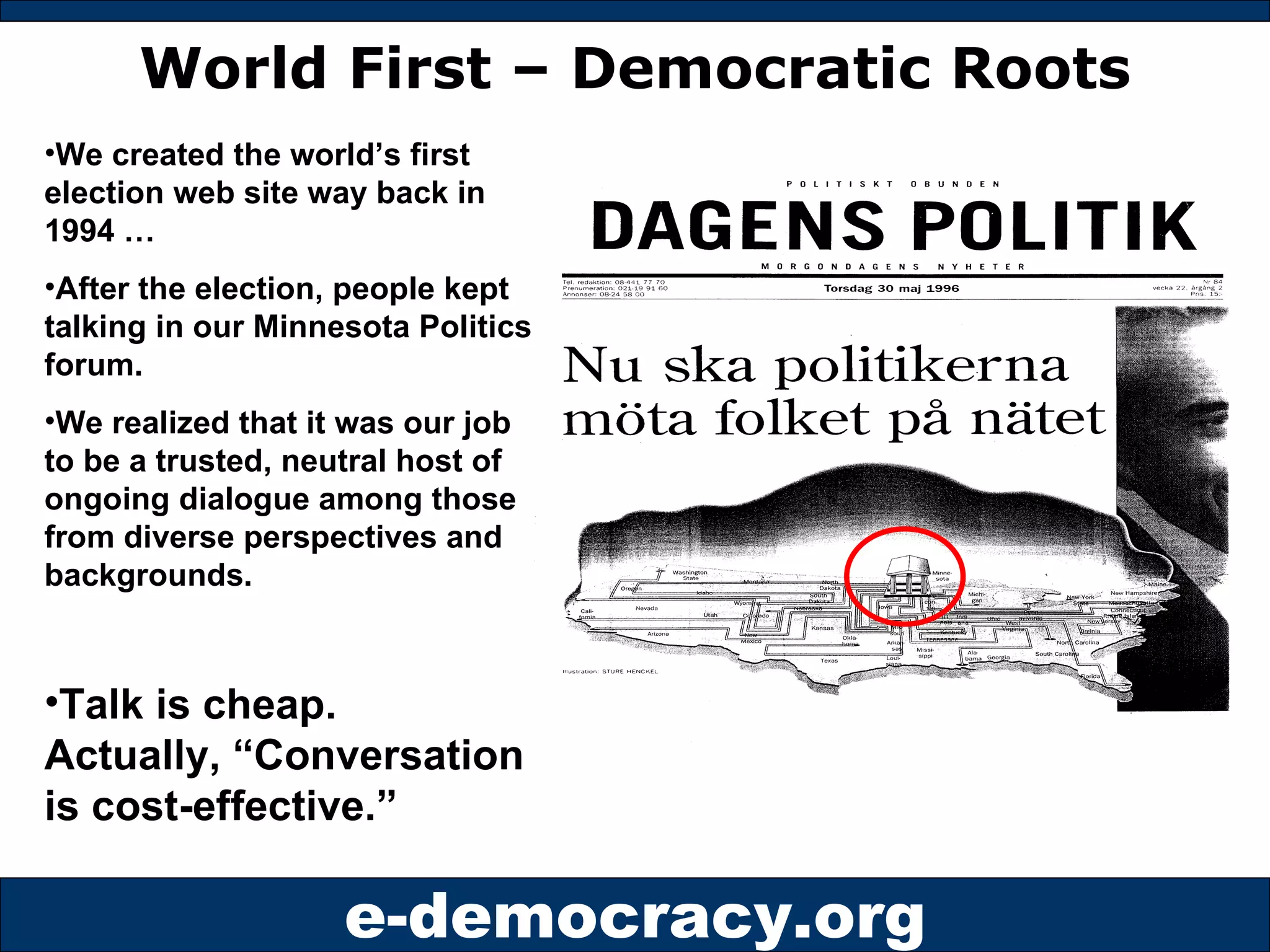
World First – Democratic Roots We created the world’s first election web site way back in 1994 … After the election, people kept talking in our Minnesota Politics forum. We realized that it was our job to be a trusted, neutral host of ongoing dialogue among those from diverse perspectives and backgrounds. Talk is cheap. Actually, “Conversation is cost-effective.”
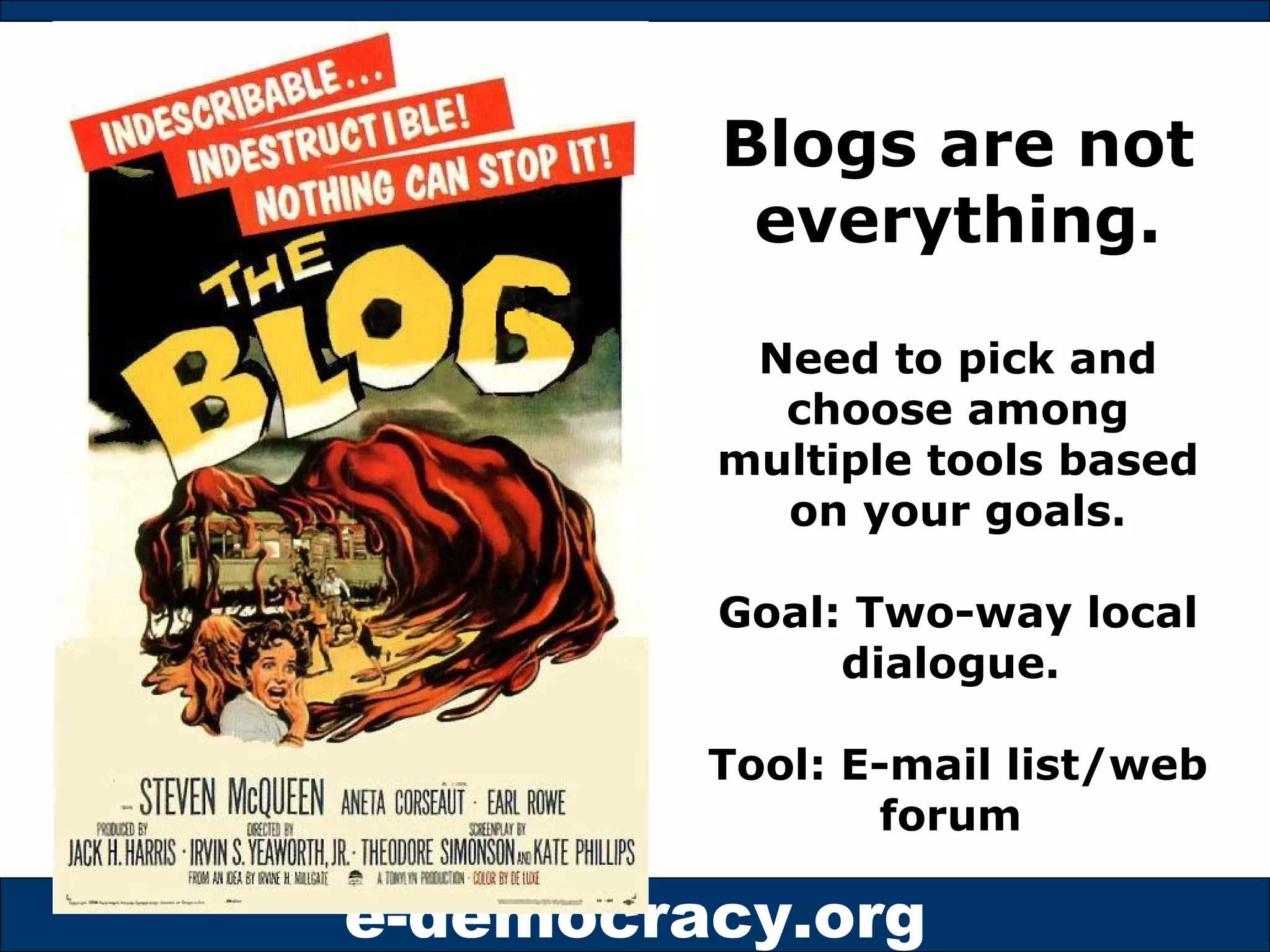
Blogs are not everything. Need to pick and choose among multiple tools based on your goals. Goal: Two-way local dialogue.  Tool: E-mail list/web forum
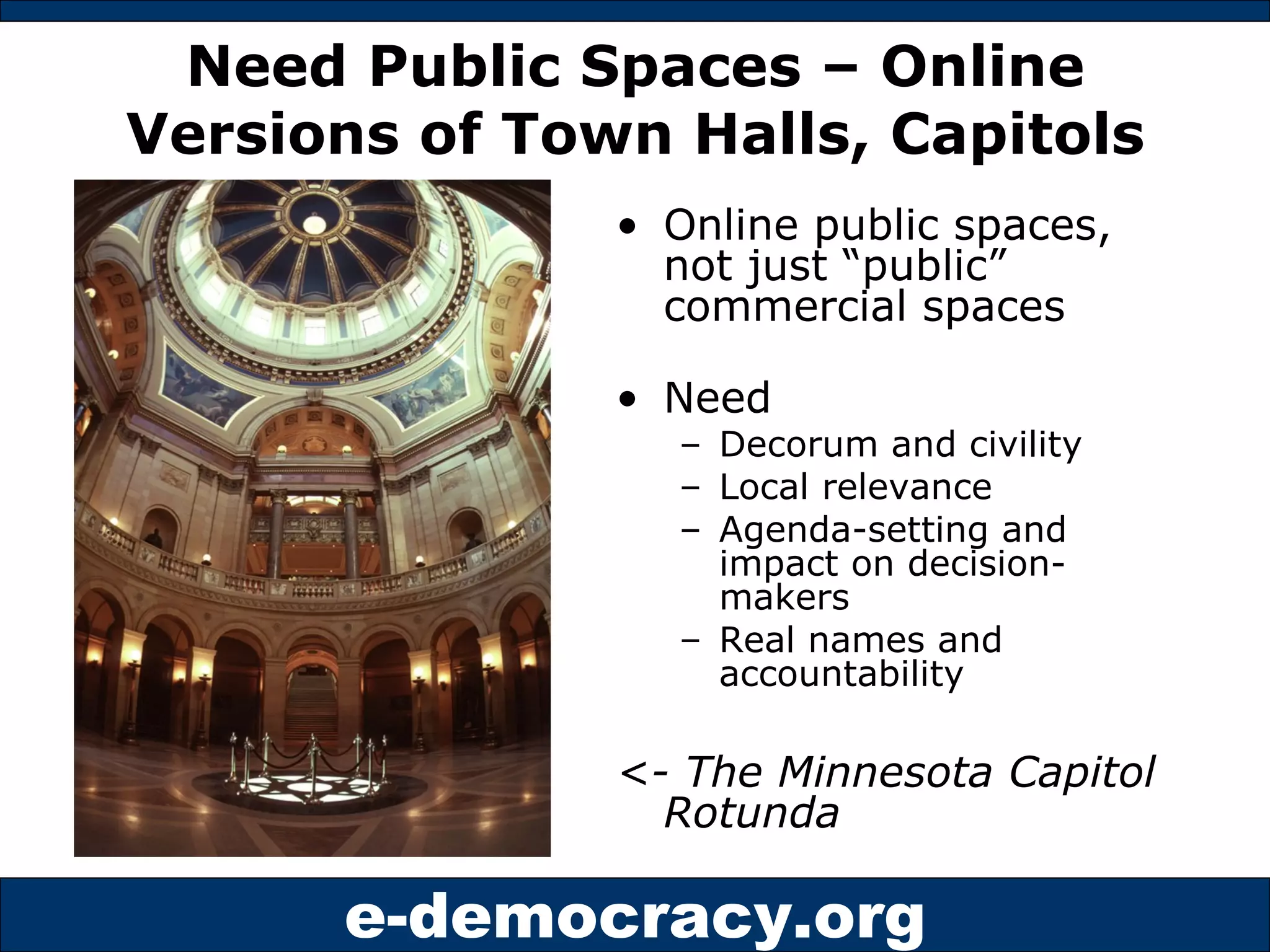
Need Public Spaces – Online Versions of Town Halls, Capitols Online public spaces, not just “public” commercial spaces Need Decorum and civility Local relevance Agenda-setting and impact on decision-makers Real names and accountability <- The Minnesota Capitol Rotunda
Local Issues Forums The online town hall City-wide, neighborhoods as well Where is local power? – We place an online public space in the center “ Government websites don’t have sidewalks.” (Or public hearings online.) Need for independent online spaces for media accountability Locally “owned” by civic-inspired citizen committee as part of E-Democracy.Org
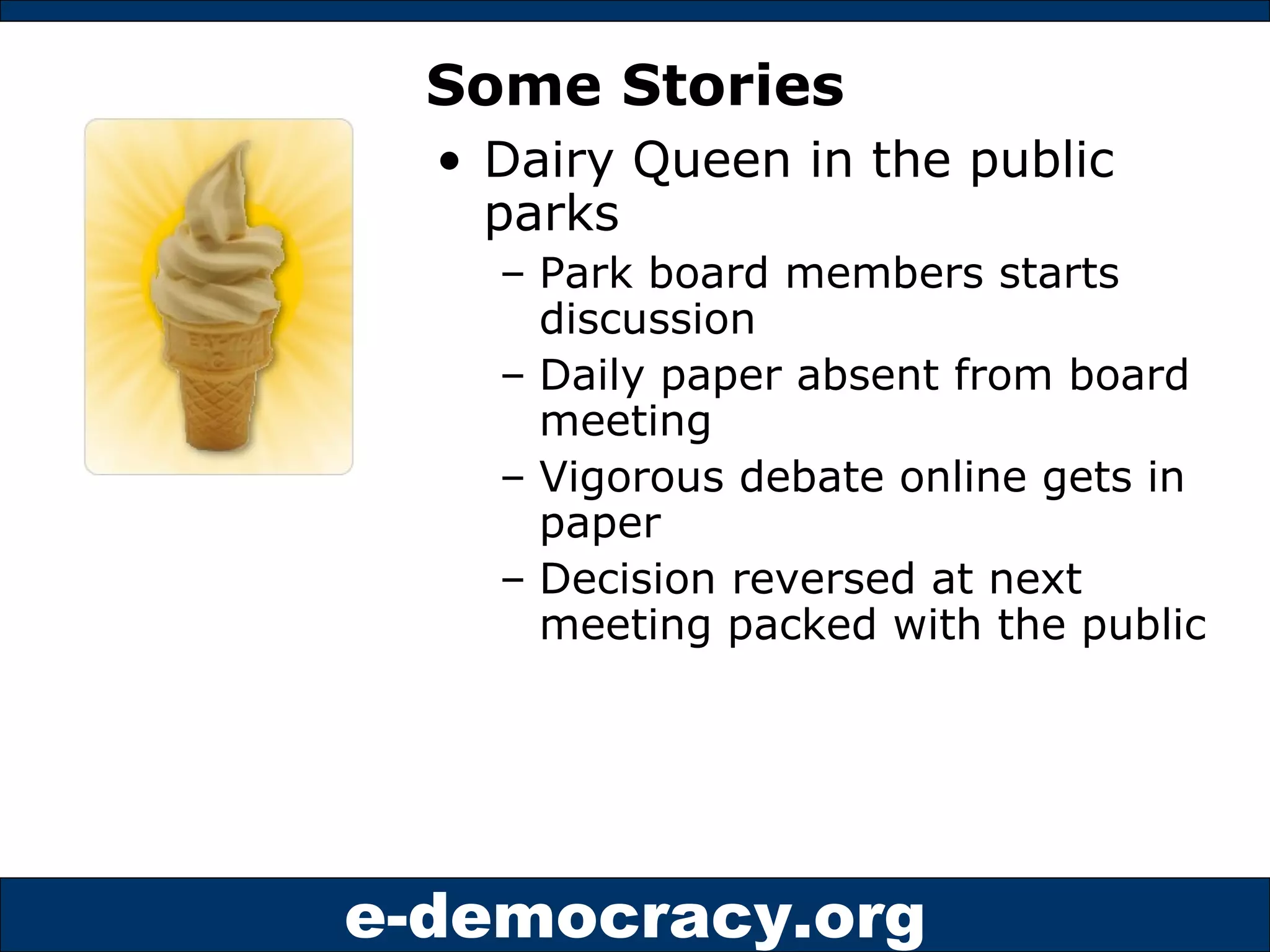
Some Stories Dairy Queen in the public parks Park board members starts discussion Daily paper absent from board meeting Vigorous debate online gets in paper Decision reversed at next meeting packed with the public
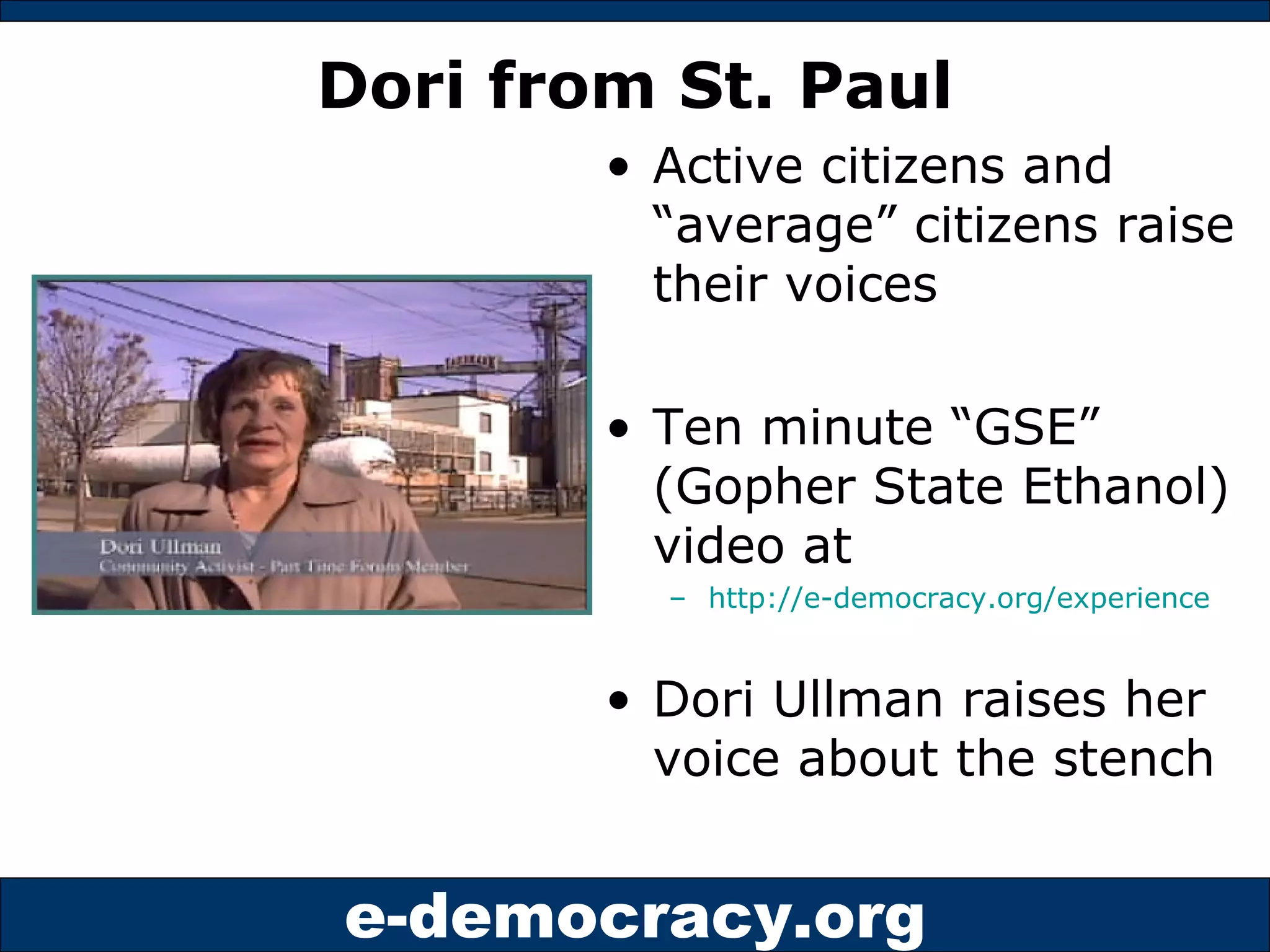
Dori from St. Paul Active citizens and “average” citizens raise their voices Ten minute “GSE” (Gopher State Ethanol) video at  http://e-democracy.org/experience Dori Ullman raises her voice about the stench
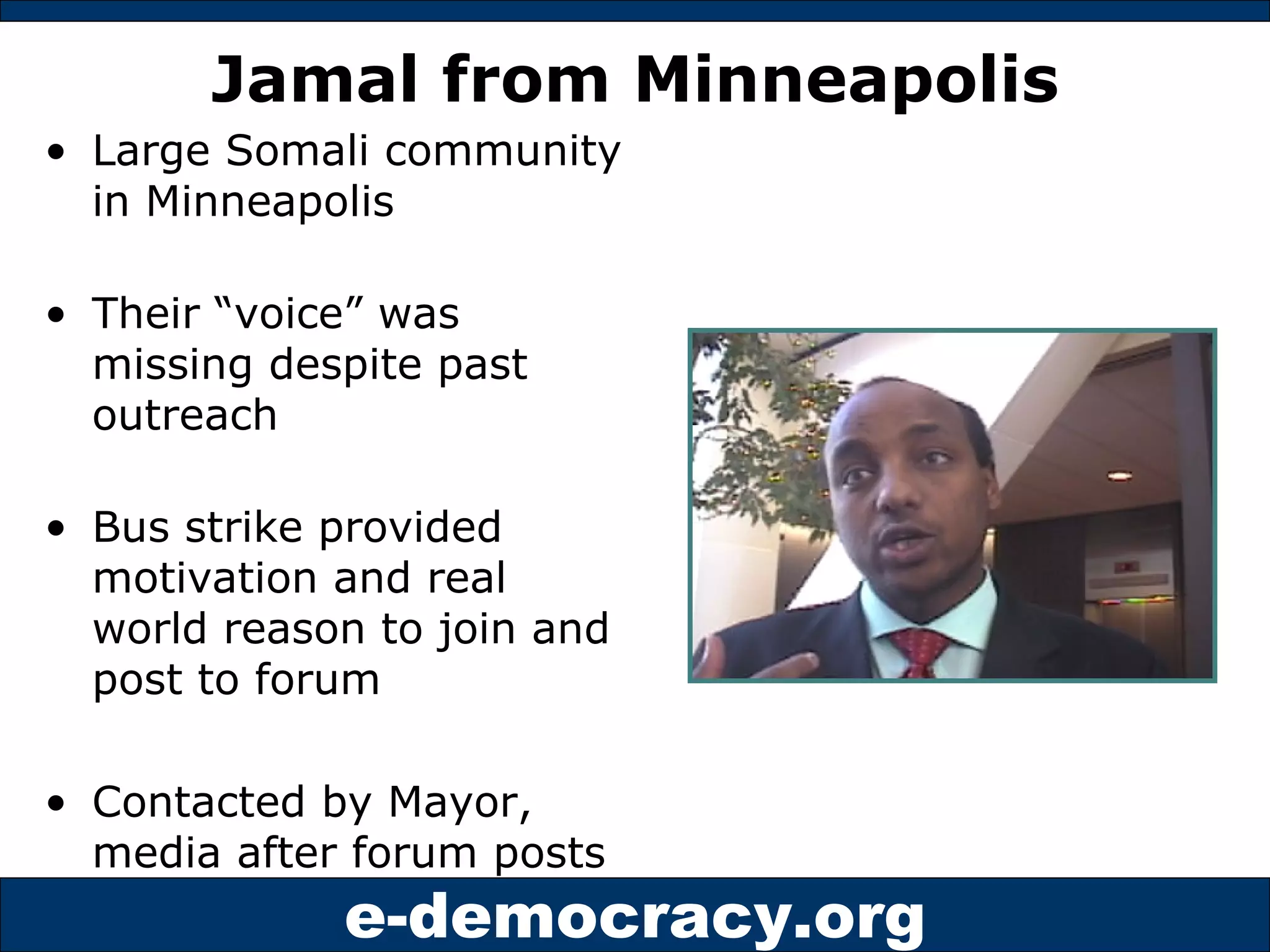
Jamal from Minneapolis Large Somali community in Minneapolis Their “voice” was missing despite past outreach Bus strike provided motivation and real world reason to join and post to forum Contacted by Mayor, media after forum posts
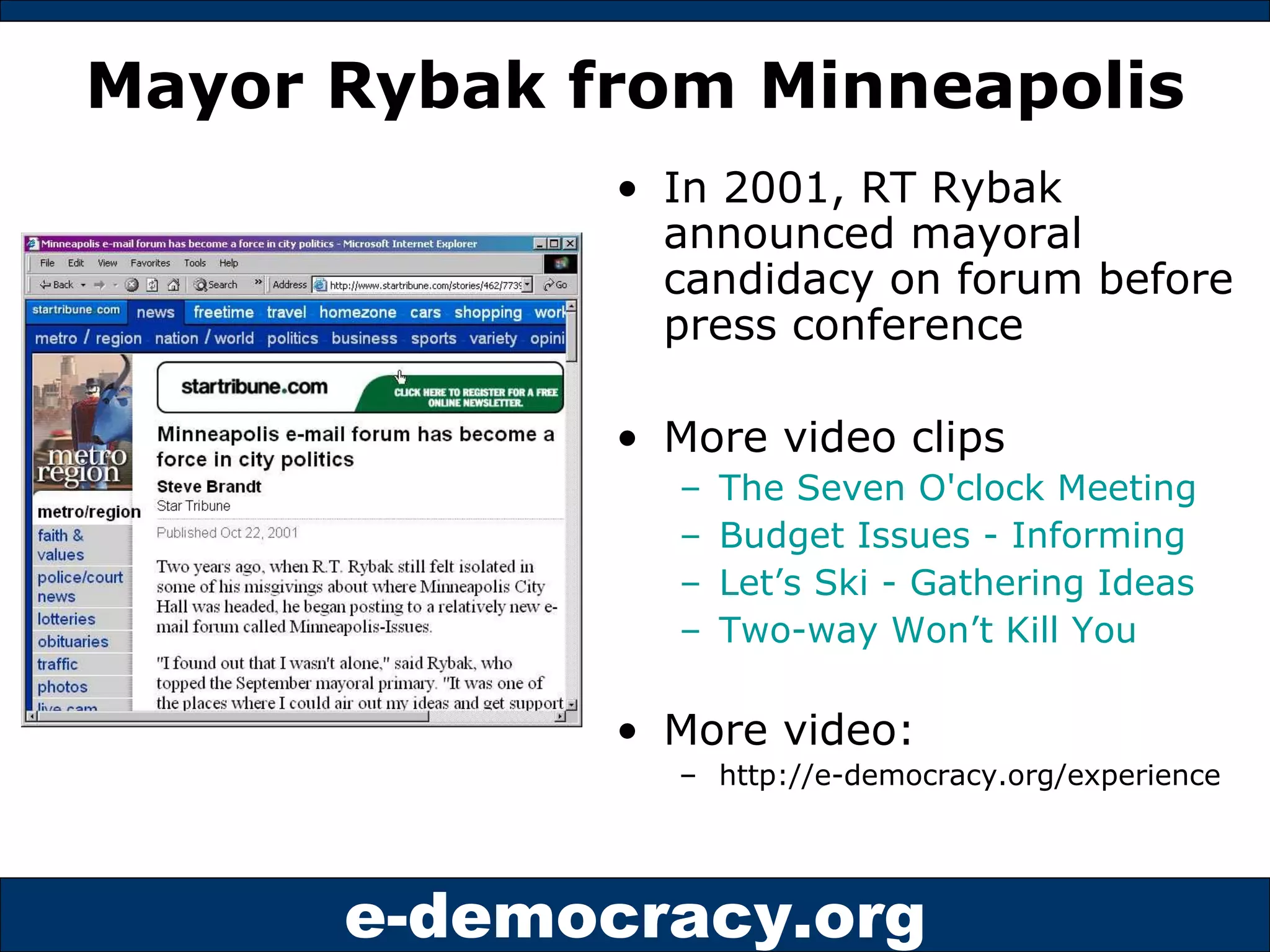
Mayor Rybak from Minneapolis In 2001, RT Rybak announced mayoral candidacy on forum before press conference More video clips The Seven O'clock Meeting Budget Issues - Informing Let’s Ski - Gathering Ideas Two-way Won’t Kill You More video: http://e-democracy.org/experience
Issues Forums – E-Democracy.Org Recent Topics Local schools Support for area war veterans Neighborhood park changes Water quality and shortage Crime and policing Candidates and elections Feral cat problem Racetrack noise pollution
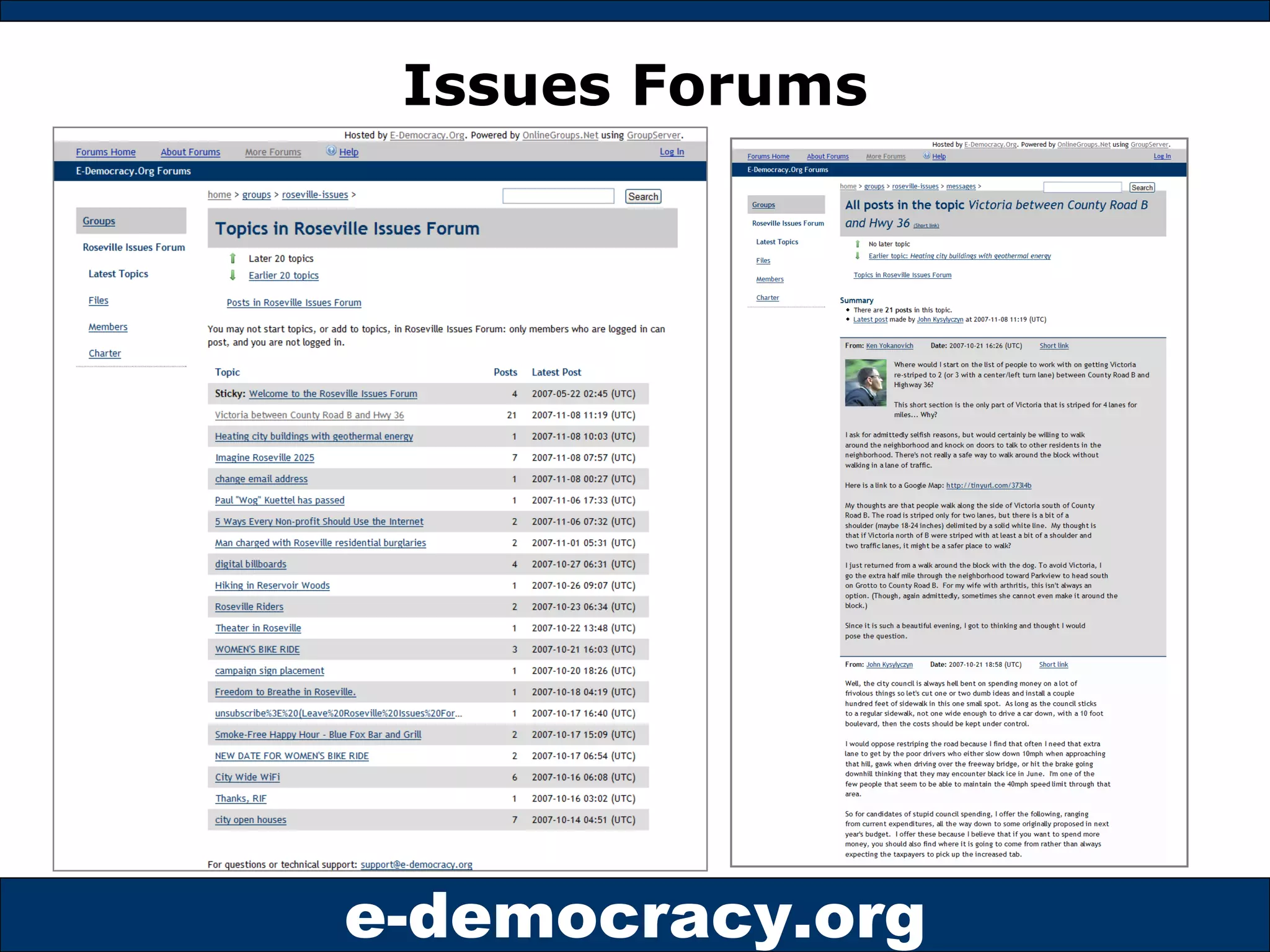
Issues Forums
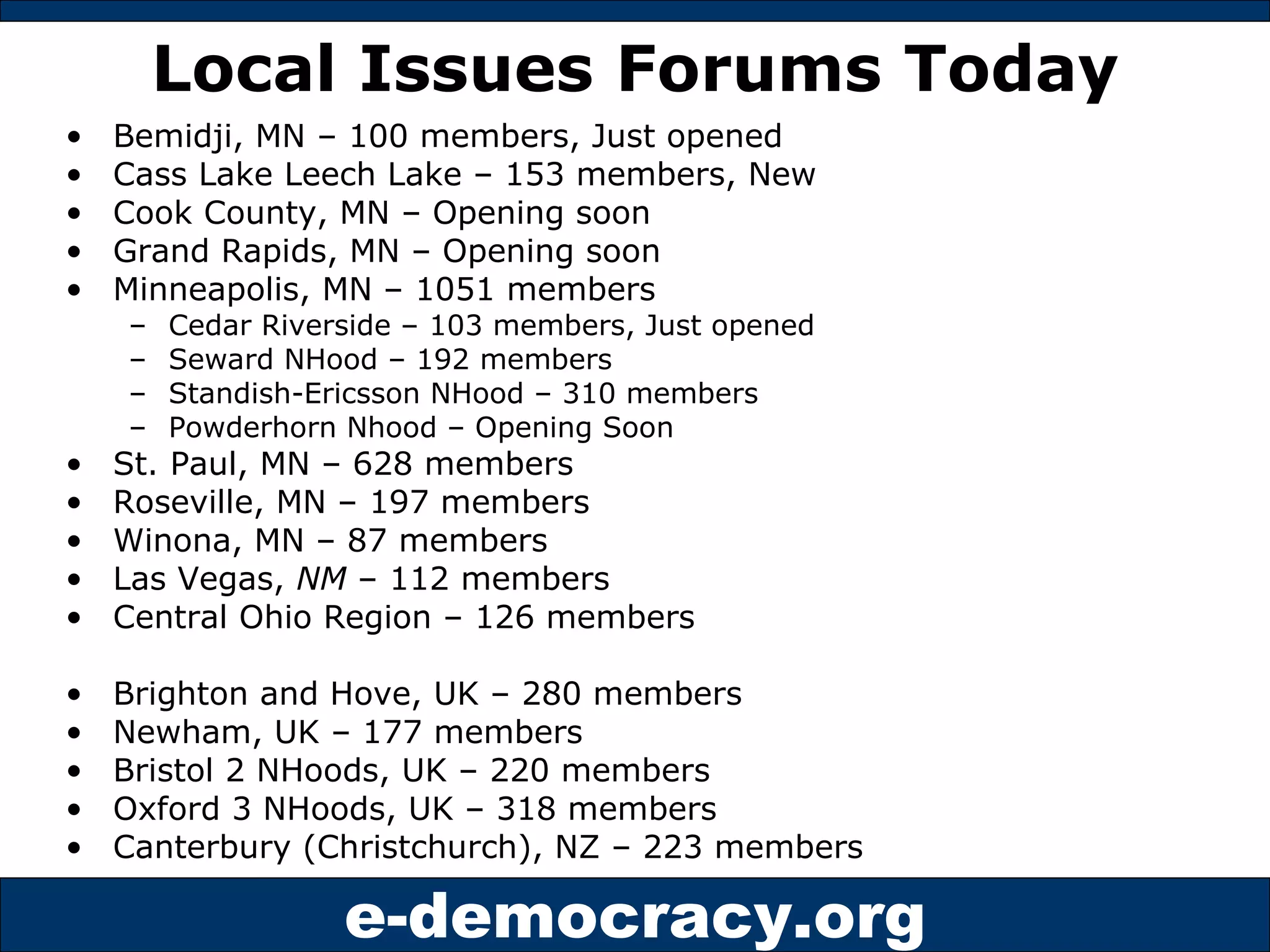
Local Issues Forums Today Bemidji, MN – 100 members, Just opened Cass Lake Leech Lake – 153 members, New Cook County, MN – Opening soon Grand Rapids, MN – Opening soon Minneapolis, MN – 1051 members Cedar Riverside – 103 members, Just opened Seward NHood – 192 members Standish-Ericsson NHood – 310 members  Powderhorn Nhood – Opening Soon St. Paul, MN – 628 members Roseville, MN – 197 members Winona, MN – 87 members  Las Vegas,  NM  – 112 members Central Ohio Region – 126 members Brighton and Hove, UK – 280 members Newham, UK – 177 members Bristol 2 NHoods, UK – 220 members Oxford 3 NHoods, UK – 318 members  Canterbury (Christchurch), NZ – 223 members
How Issues Forum Work, Starting One Steve Kranz
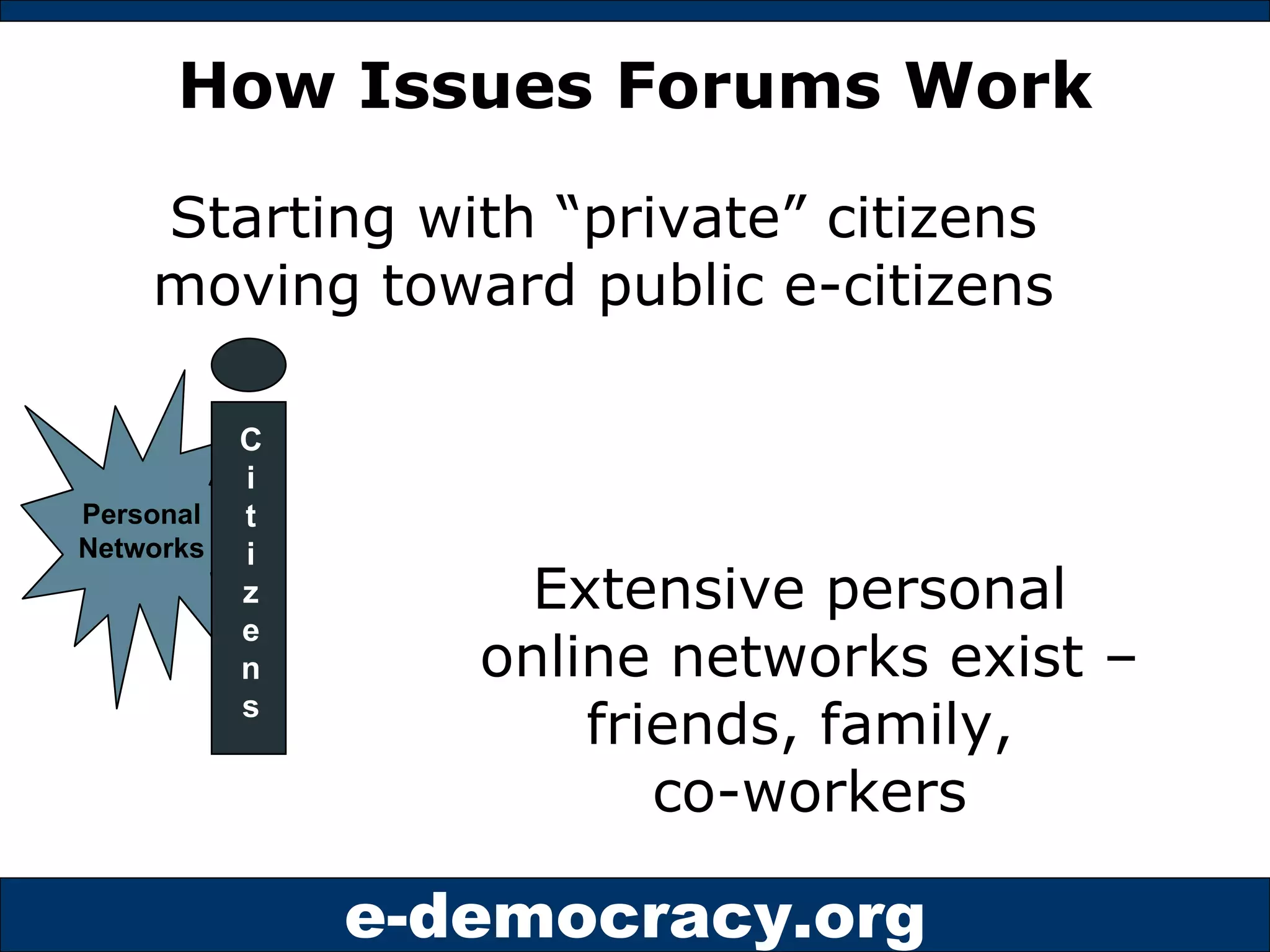
How Issues Forums Work C i t i z e n s Starting with “private” citizens moving toward public e-citizens Extensive personal  online networks exist – friends, family,  co-workers Personal Networks
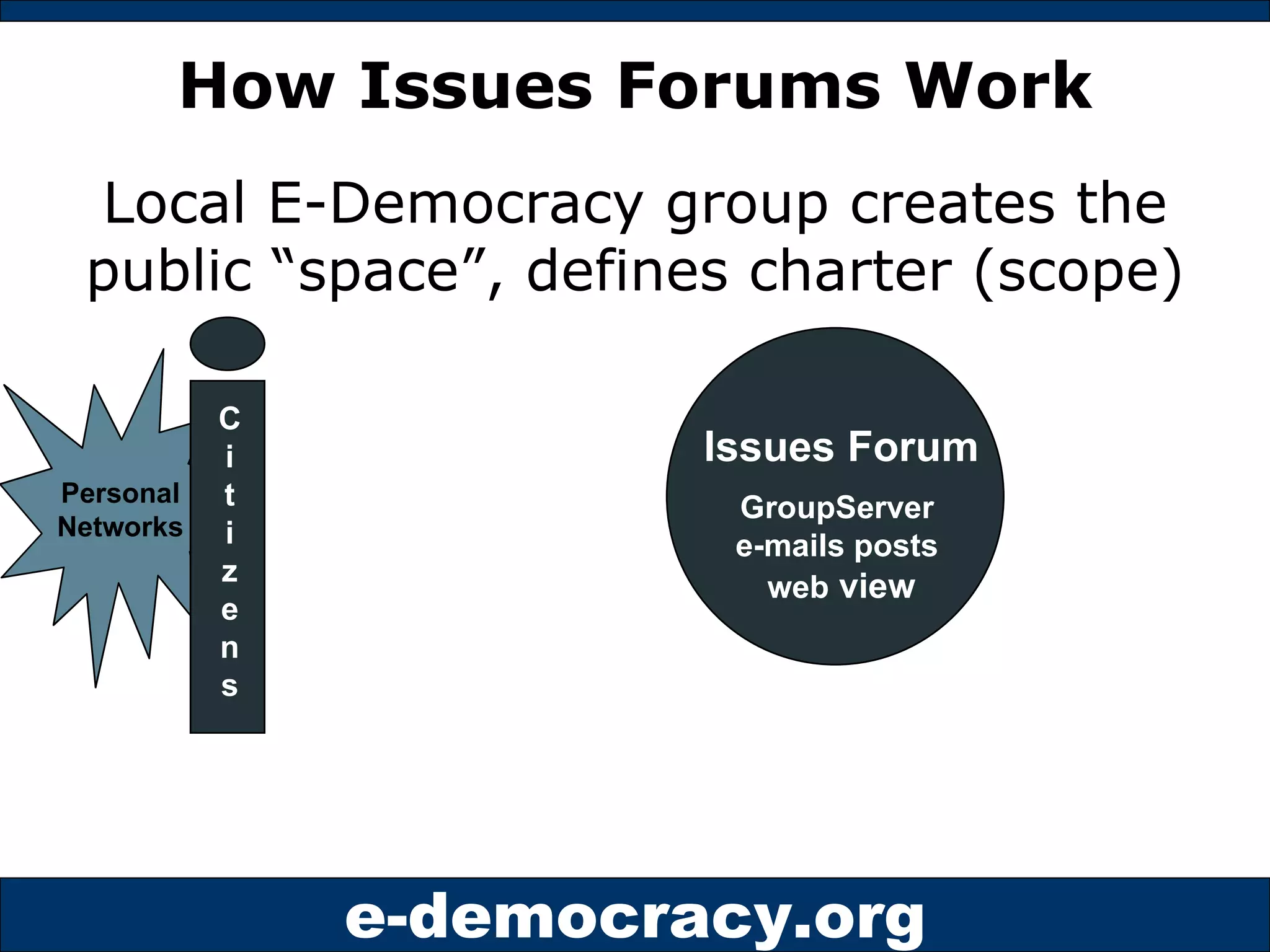
How Issues Forums Work Local E-Democracy group creates the public “space”, defines charter (scope) C i t i z e n s Issues Forum GroupServer  e-mails posts  web  view Personal Networks
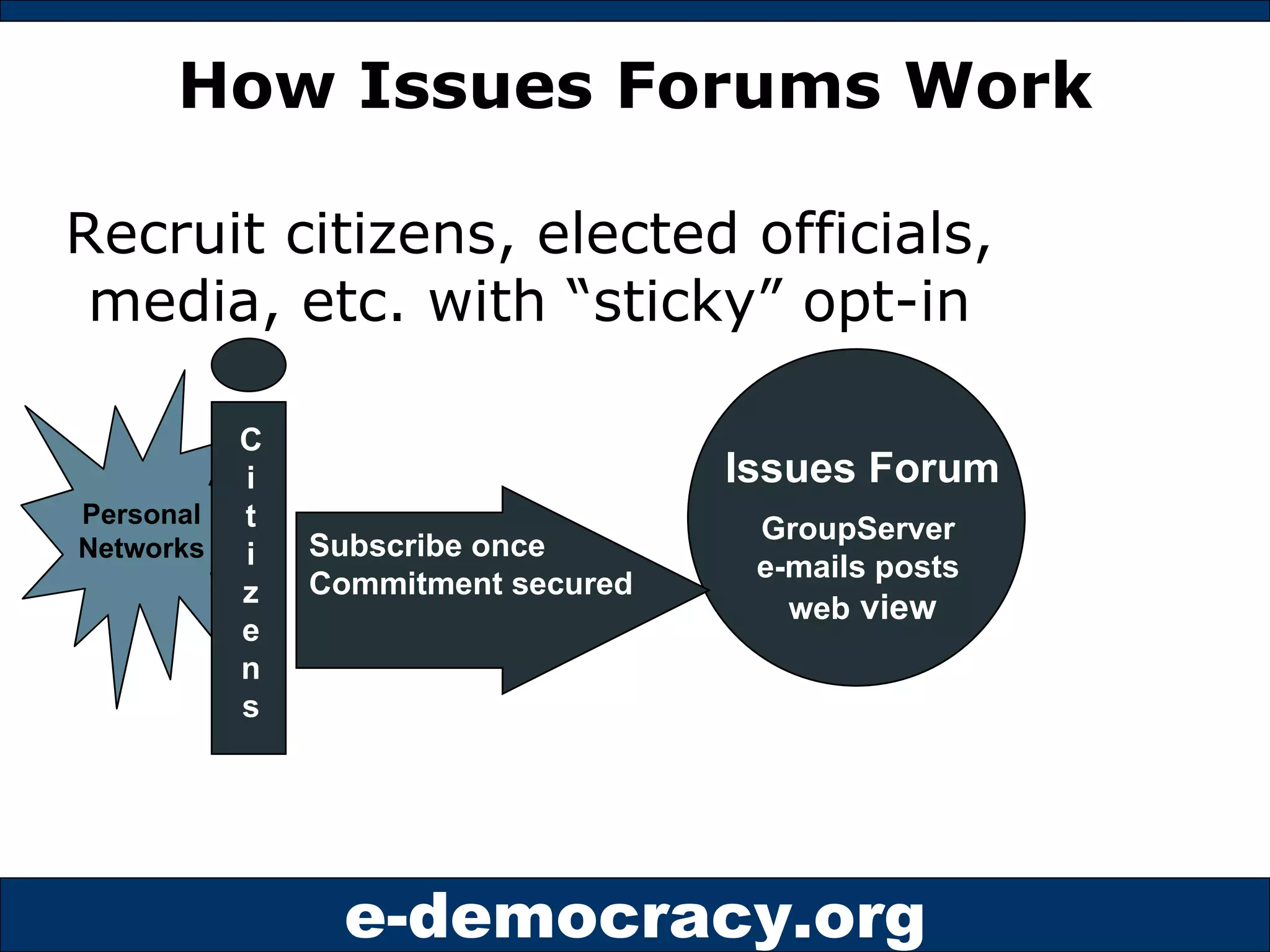
How Issues Forums Work C i t i z e n s Issues Forum GroupServer  e-mails posts  web  view Subscribe once Commitment secured Recruit citizens, elected officials, media, etc. with “sticky” opt-in Personal Networks
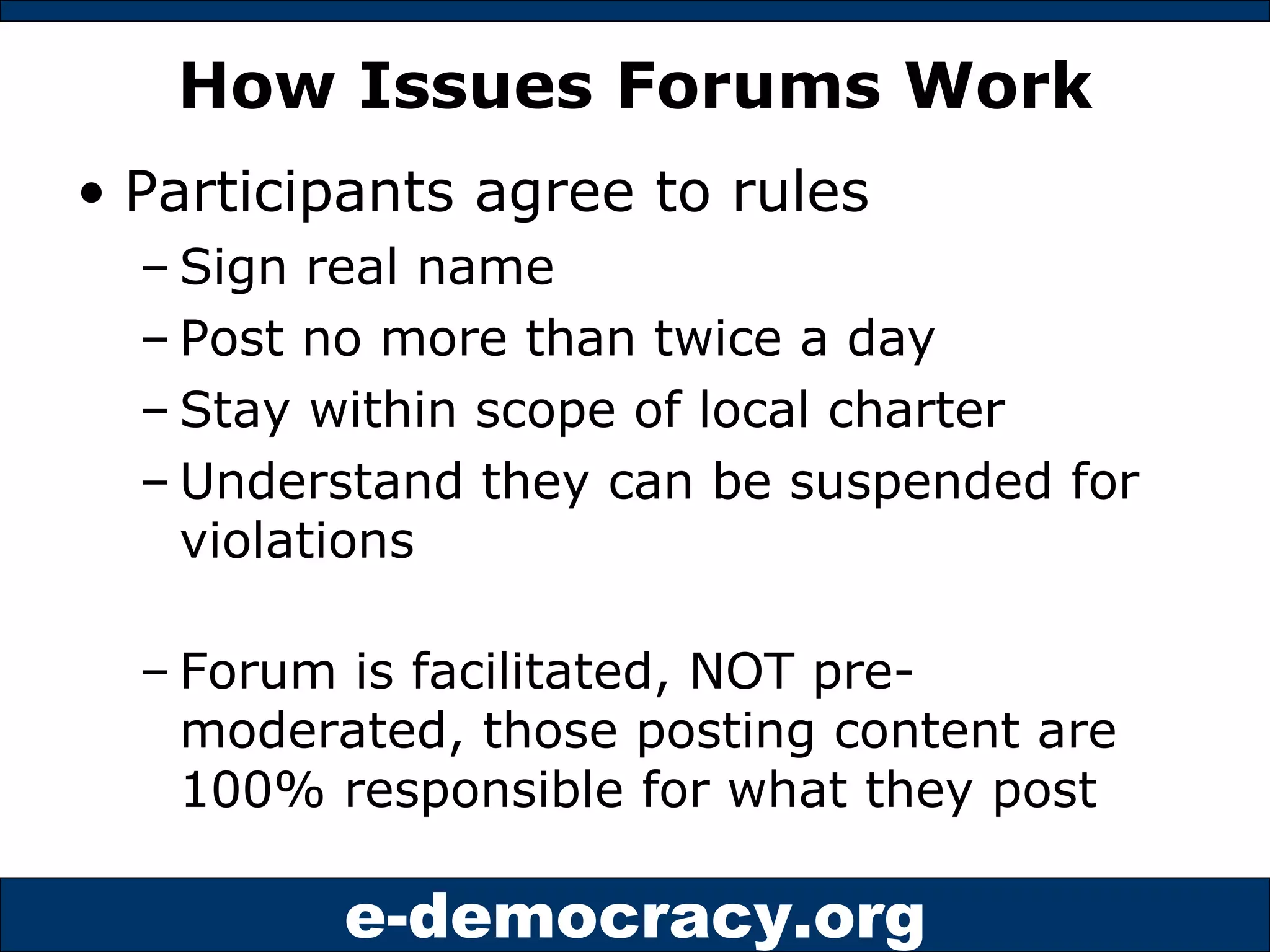
How Issues Forums Work Participants agree to rules Sign real name Post no more than twice a day Stay within scope of local charter Understand they can be suspended for violations Forum is facilitated, NOT pre-moderated, those posting content are 100% responsible for what they post
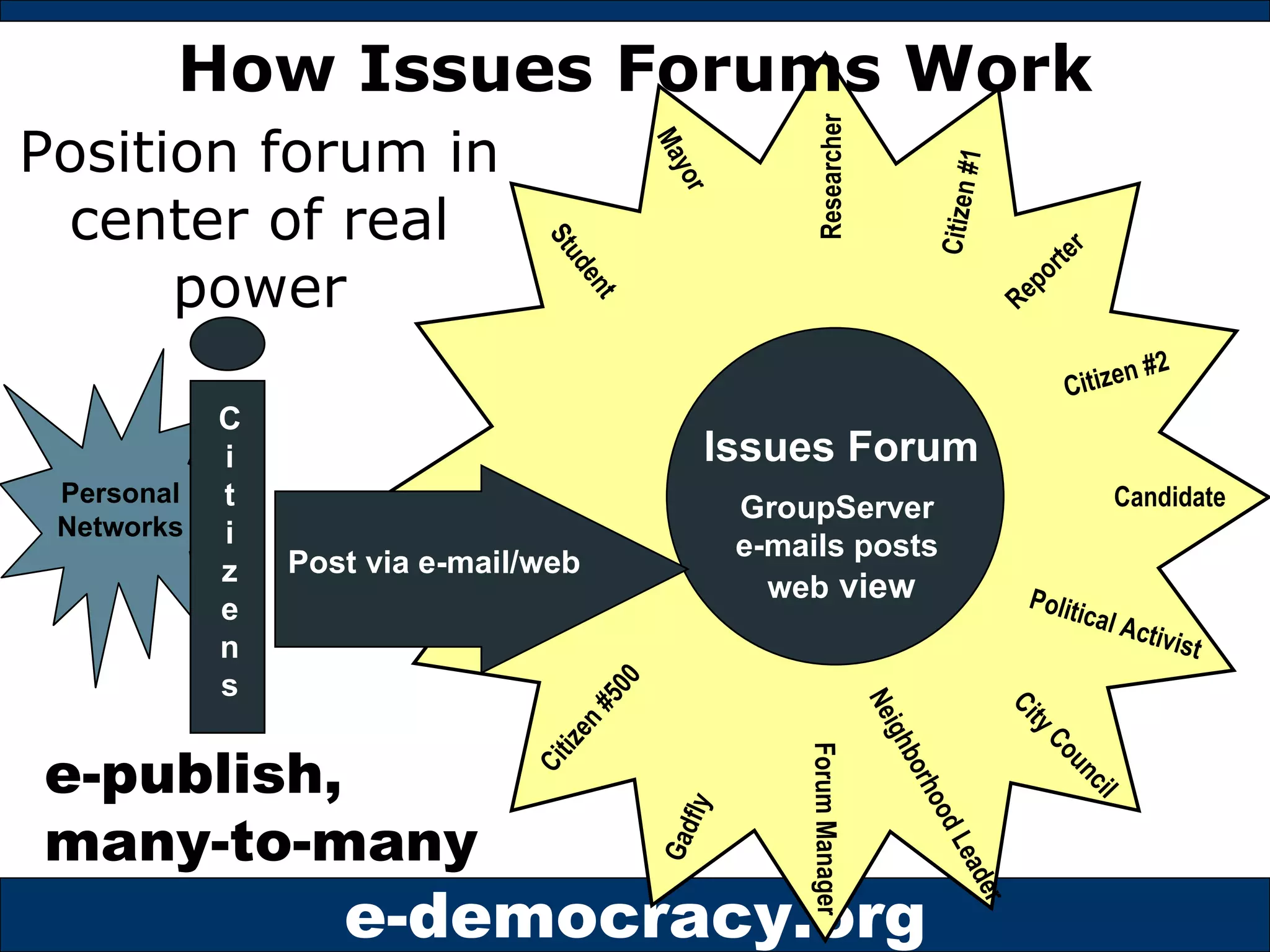
How Issues Forums Work Position forum in center of real power Political Activist Reporter Citizen #1 Mayor Citizen #2 Candidate Researcher City Council Neighborhood Leader Student Forum Manager Citizen #500 Gadfly C i t i z e n s Issues Forum GroupServer  e-mails posts  web  view Post via e-mail/web e-publish,  many-to-many Personal Networks
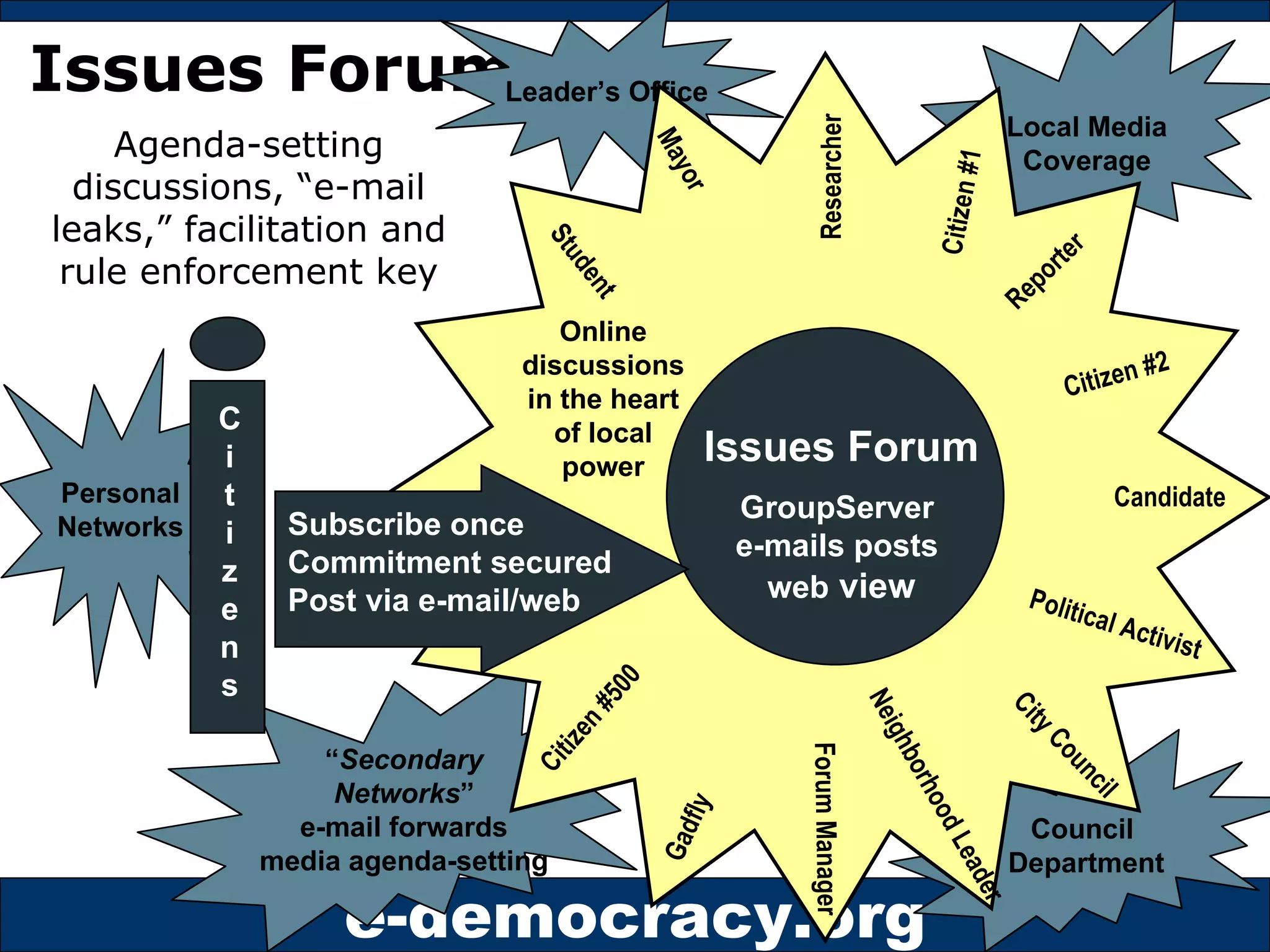
Issues Forums Agenda-setting discussions, “e-mail leaks,” facilitation and rule enforcement key Political Activist Reporter Citizen #1 Mayor Citizen #2 Candidate Researcher City Council Neighborhood Leader Student Forum Manager Citizen #500 Gadfly C i t i z e n s Issues Forum GroupServer  e-mails posts  web  view Online discussions in the heart of local power Subscribe once Commitment secured Post via e-mail/web Leader’s Office “ Secondary Networks ” e-mail forwards media agenda-setting Council  Department Personal Networks Local Media Coverage
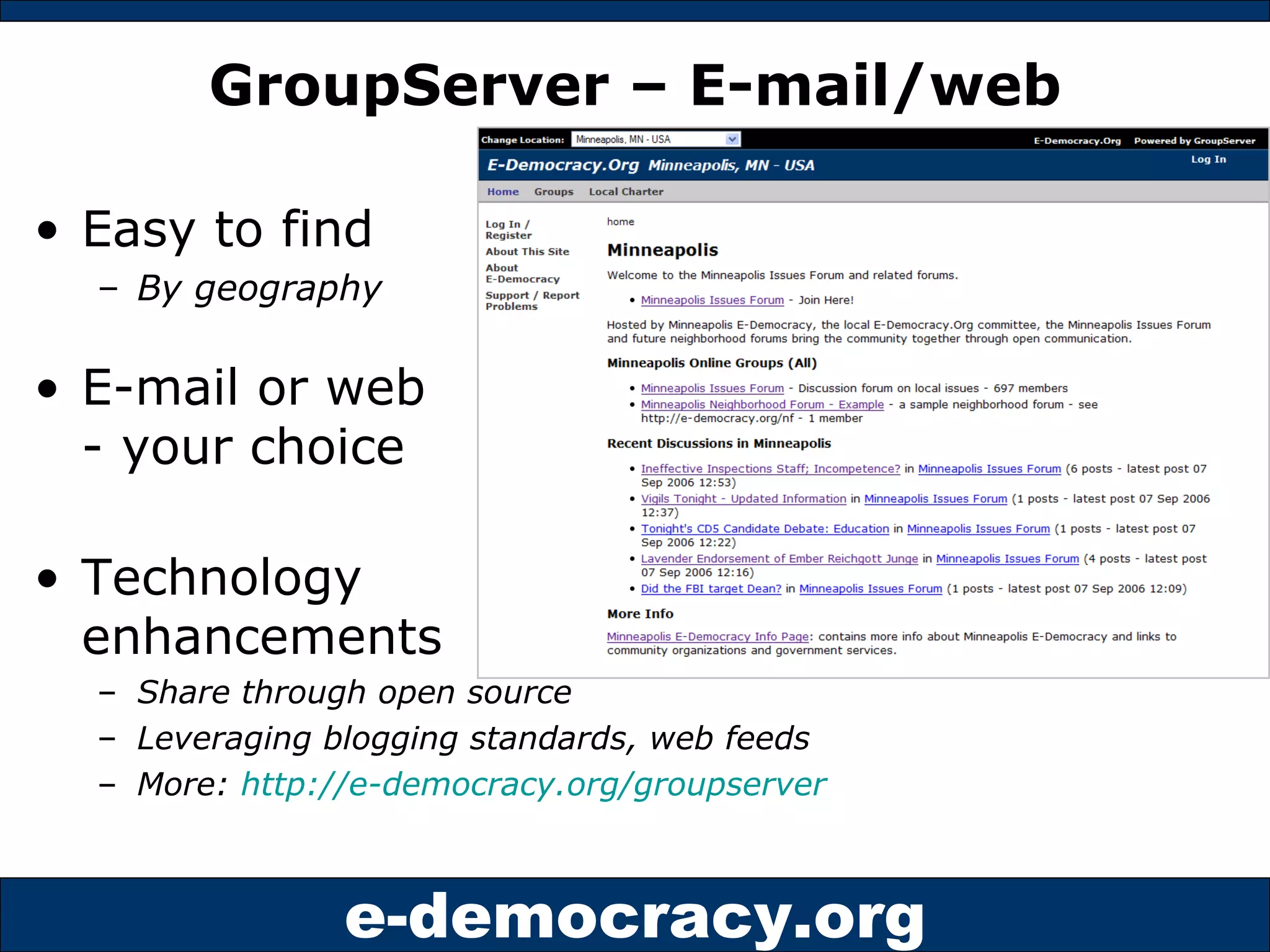
GroupServer – E-mail/web Easy to find  By geography E-mail or web - your choice Technology  enhancements  Share through open source  Leveraging blogging standards, web feeds More:  http://e-democracy.org/groupserver
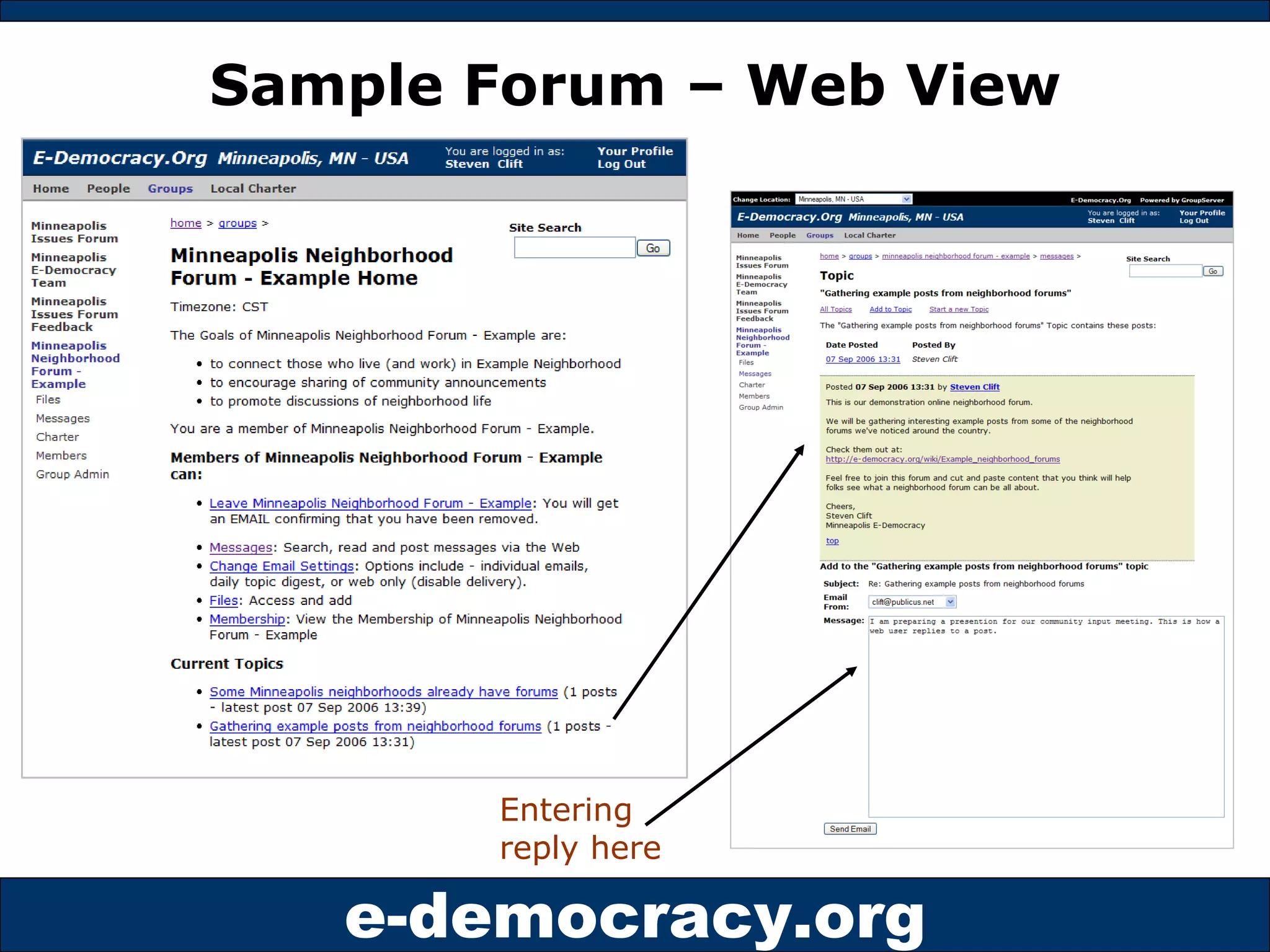
Sample Forum – Web View Entering reply here
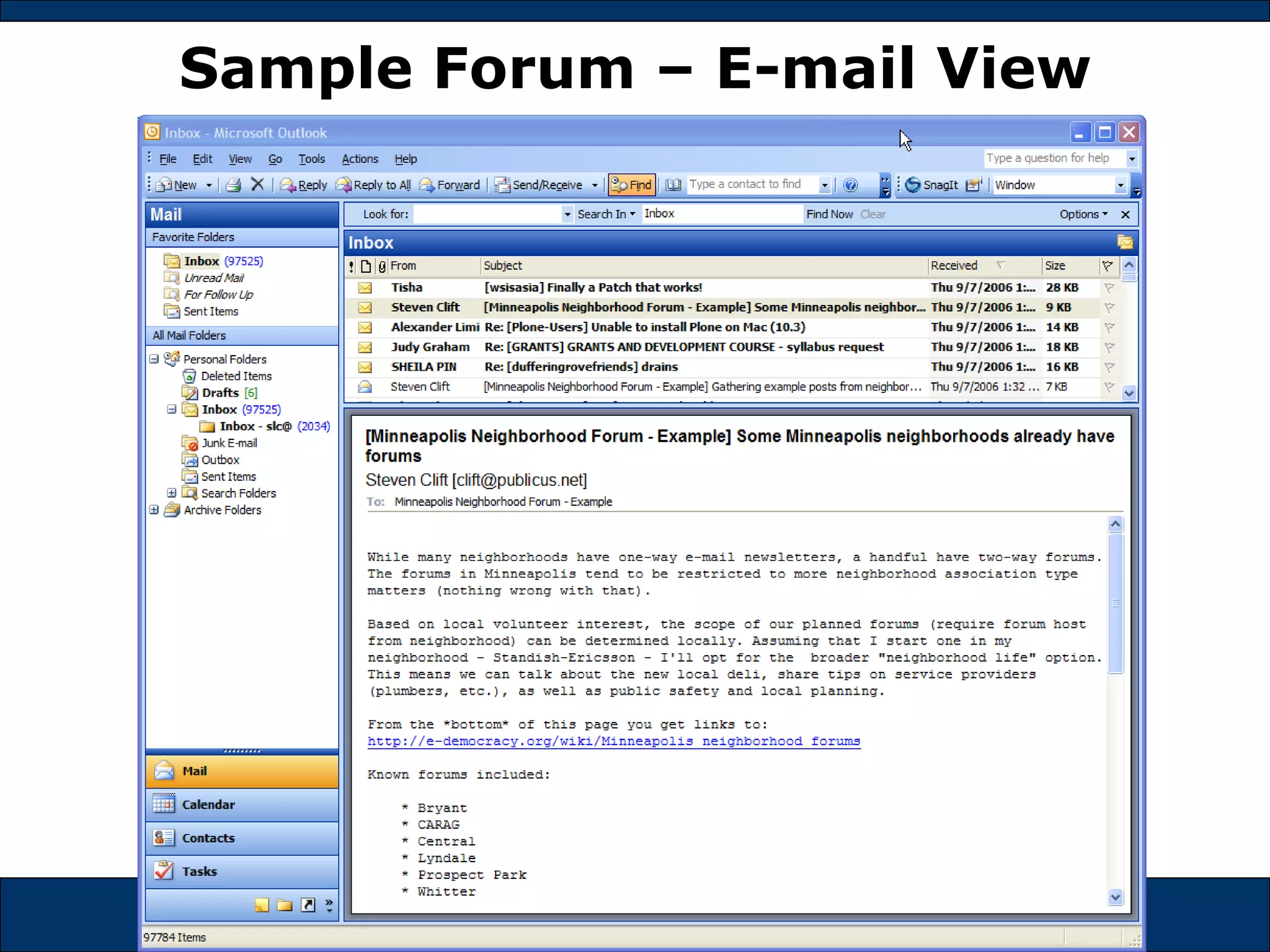
Sample Forum – E-mail View
Our Approach Leverage democratic information from government, media, political sectors Open sharing of lessons, how-to Open source software Local up – do not colonize Low cost – volunteer driven, shared infrastructure and org. identity
Start Up Overview 5-10 Person Steering Committee Volunteer Forum Manager Other participant roles Recruit 100 initial participants Open forum and facilitate Enforce civility/scope rules
Form Steering Committee A local “democracy committee”  based on the service club model – Lions, Rotary Can form in association with related efforts  e.g. KAXE’s online community media initiative Needs convening spirit  Key to community trust is a mix of public members not all part of one political faction
Drafting Your Charter Two-three sentence description will determine scope, set tone for years Longer charter is your local detailed description that guides the forum Supported by universal E-Democracy.Org rules (terms of participation) Use charter drafting to involve the community in a “what do we really want” conversation to ensure broad sense of ownership
Mapping Local Power Recruitment to make the forum “matter” politically is essential, best upfront Elected officials, community leaders, local journalists, active citizens “ Average” citizens will not waste time in a forum that does not matter Work from the “center” and avoid marginalization Gives the deliberations reach and local agenda-setting power
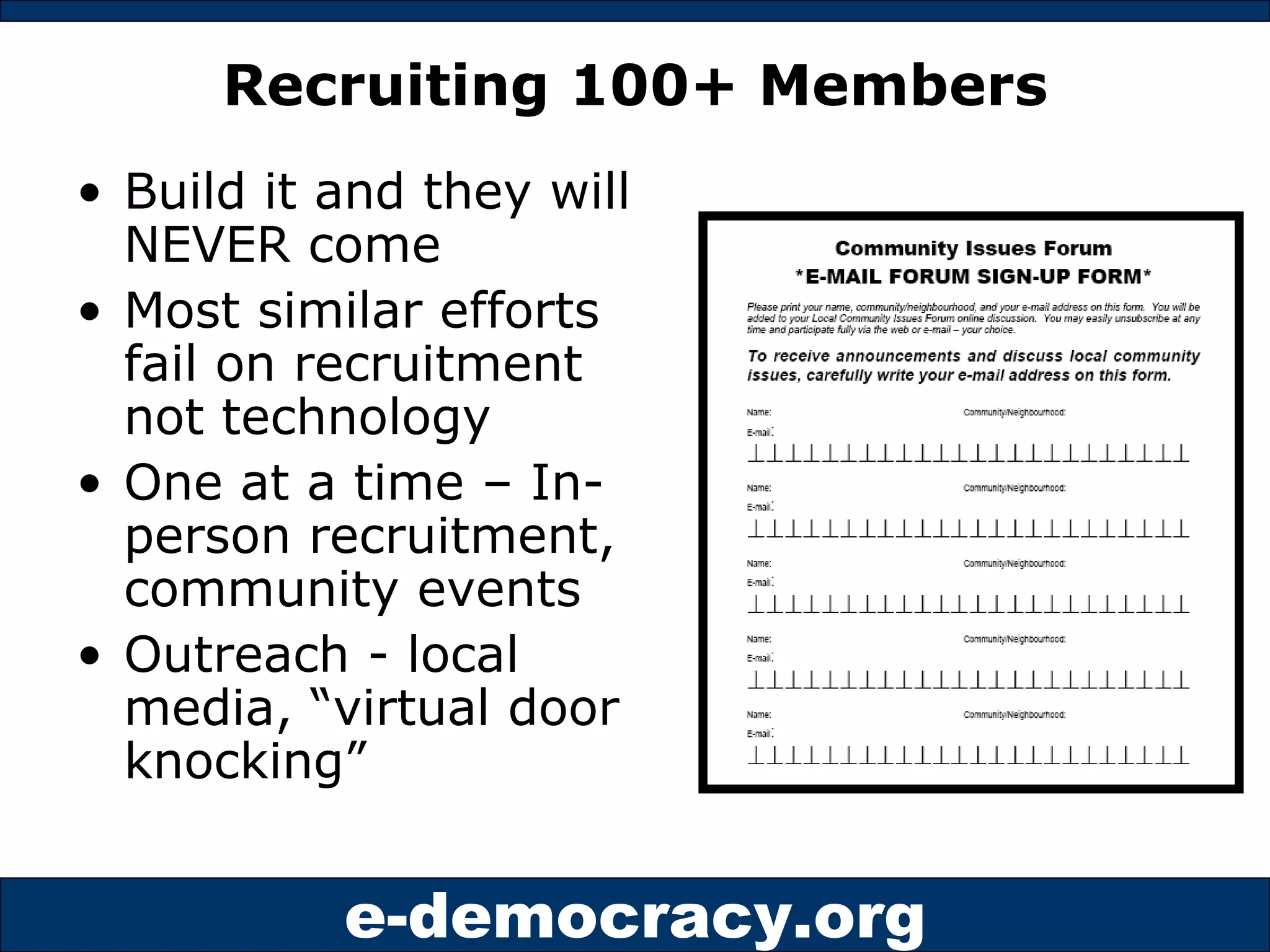
Recruiting 100+ Members Build it and they will NEVER come Most similar efforts fail on recruitment not technology One at a time – In-person recruitment, community events Outreach - local media, “virtual door knocking”
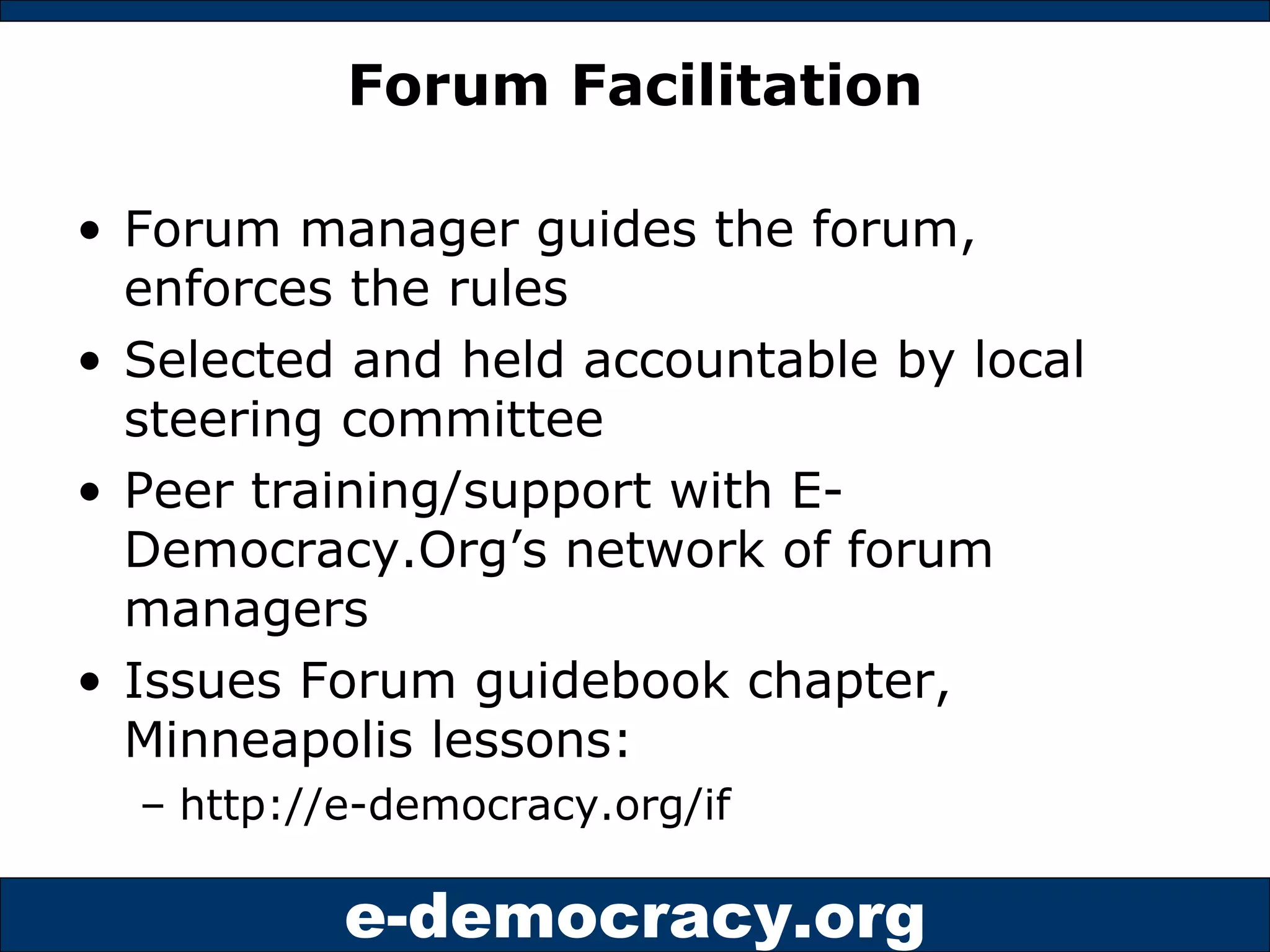
Forum Facilitation Forum manager guides the forum, enforces the rules Selected and held accountable by local steering committee Peer training/support with E-Democracy.Org’s network of forum managers Issues Forum guidebook chapter, Minneapolis lessons:  http://e-democracy.org/if
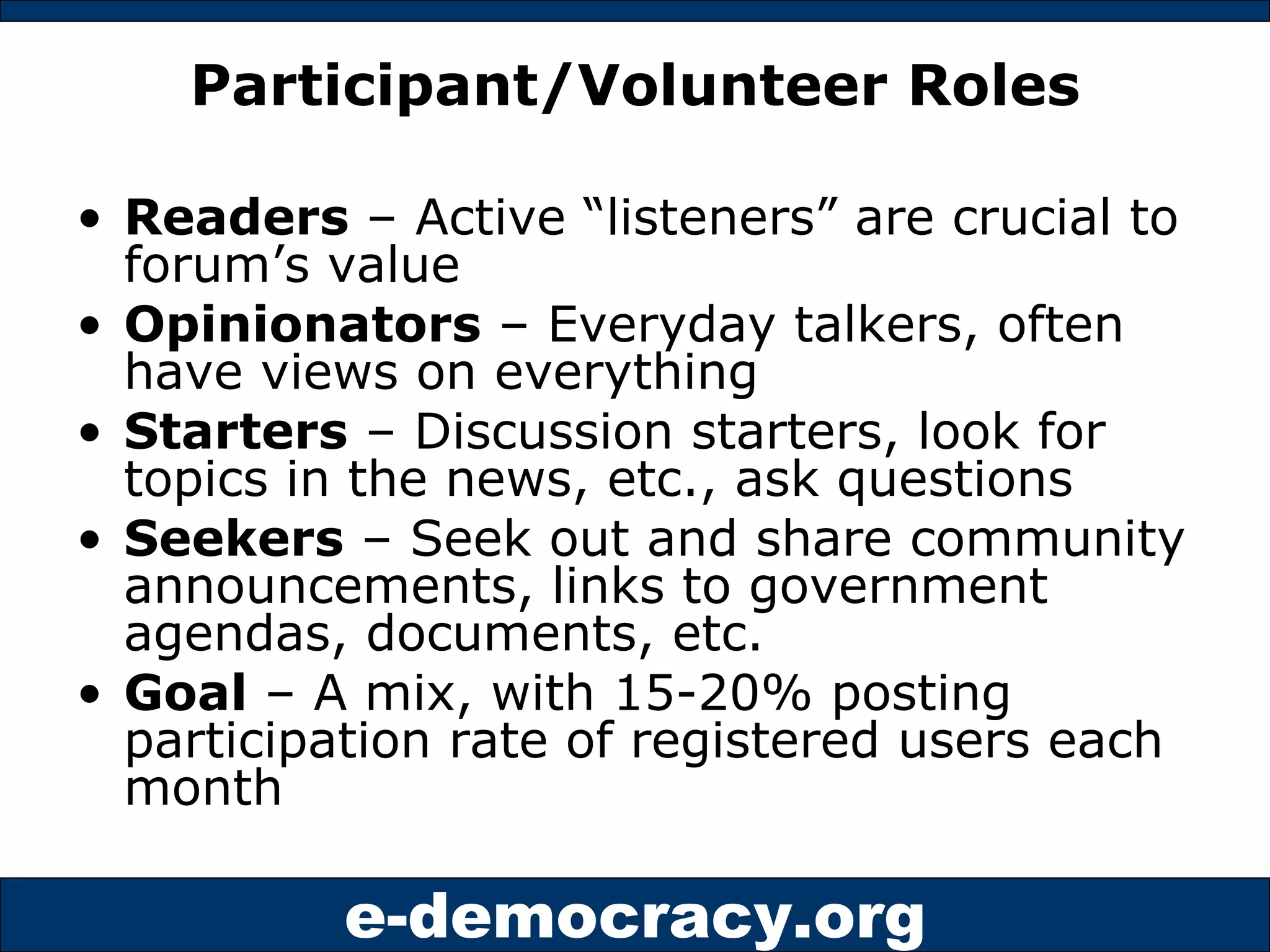
Participant/Volunteer Roles Readers  – Active “listeners” are crucial to forum’s value Opinionators  – Everyday talkers, often have views on everything Starters  – Discussion starters, look for topics in the news, etc., ask questions Seekers  – Seek out and share community announcements, links to government agendas, documents, etc. Goal  – A mix, with 15-20% posting participation rate of registered users each month
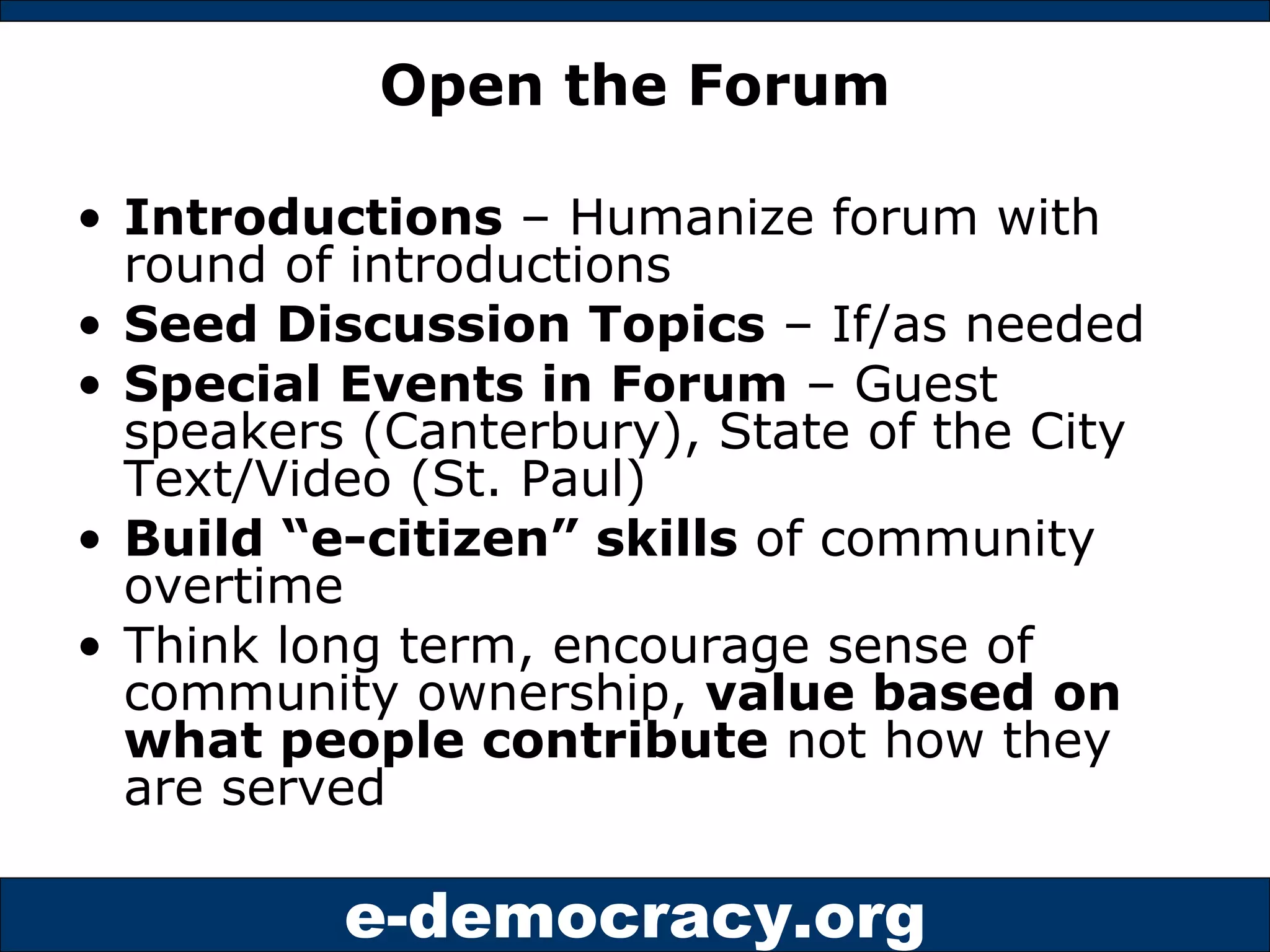
Open the Forum Introductions  – Humanize forum with round of introductions Seed Discussion Topics  – If/as needed Special Events in Forum  – Guest speakers (Canterbury), State of the City Text/Video (St. Paul) Build “e-citizen” skills  of community overtime Think long term, encourage sense of community ownership,  value based on what people contribute  not how they are served
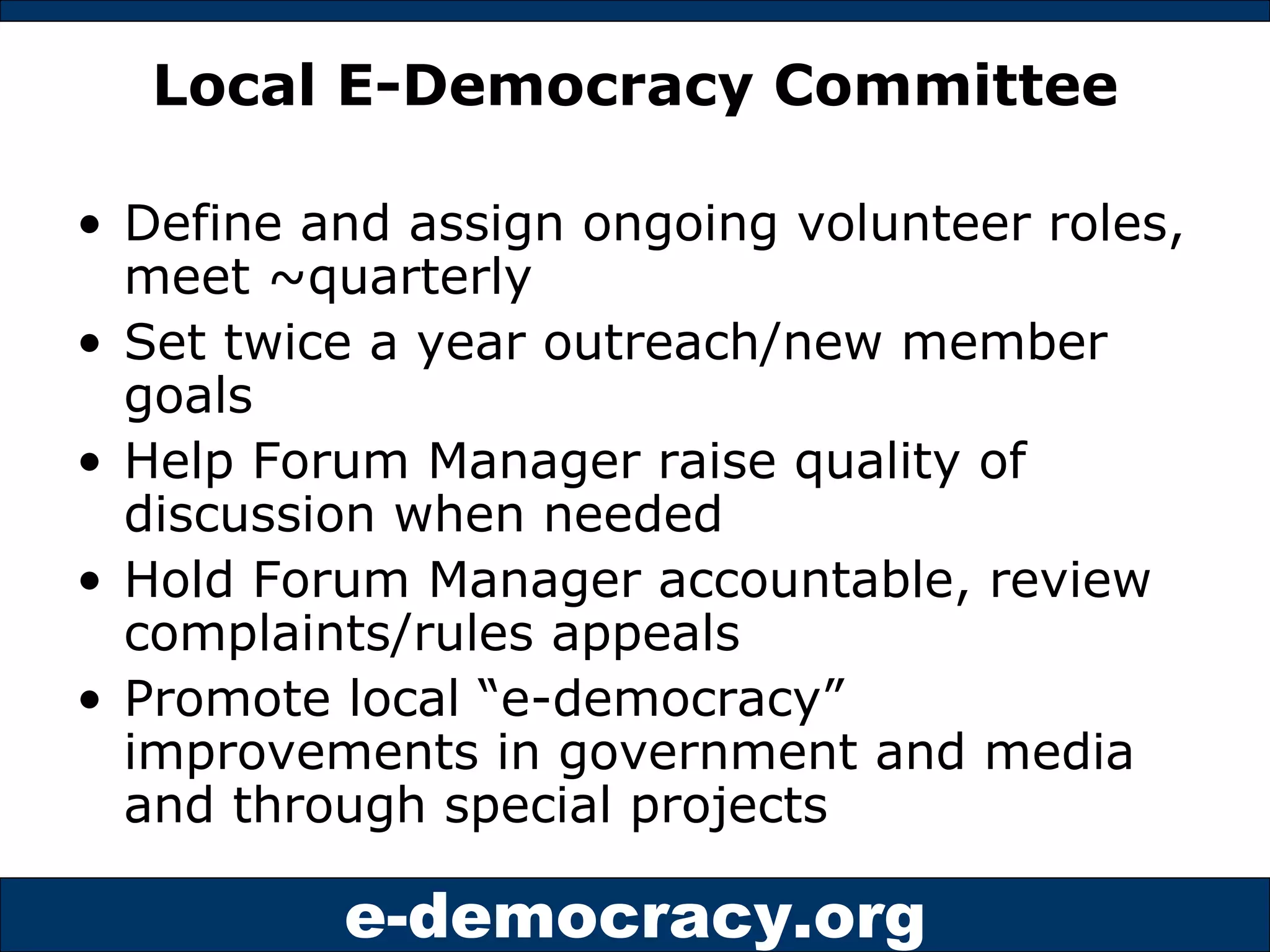
Local E-Democracy Committee Define and assign ongoing volunteer roles, meet ~quarterly Set twice a year outreach/new member goals Help Forum Manager raise quality of discussion when needed Hold Forum Manager accountable, review complaints/rules appeals Promote local “e-democracy” improvements in government and media and through special projects
Conclusion
What Makes Us Different Many to many with  real names  and civility Strength in  people-based model  and processes that allow us to adapt technologically Agenda-setting  – Real world pragmatic approach versus empowering citizens isolated from influence Recruitment  process leads to far deeper geographic participation that pure blogs or social networks Technology choice  – e-mail, web, blog feeds, future social network application
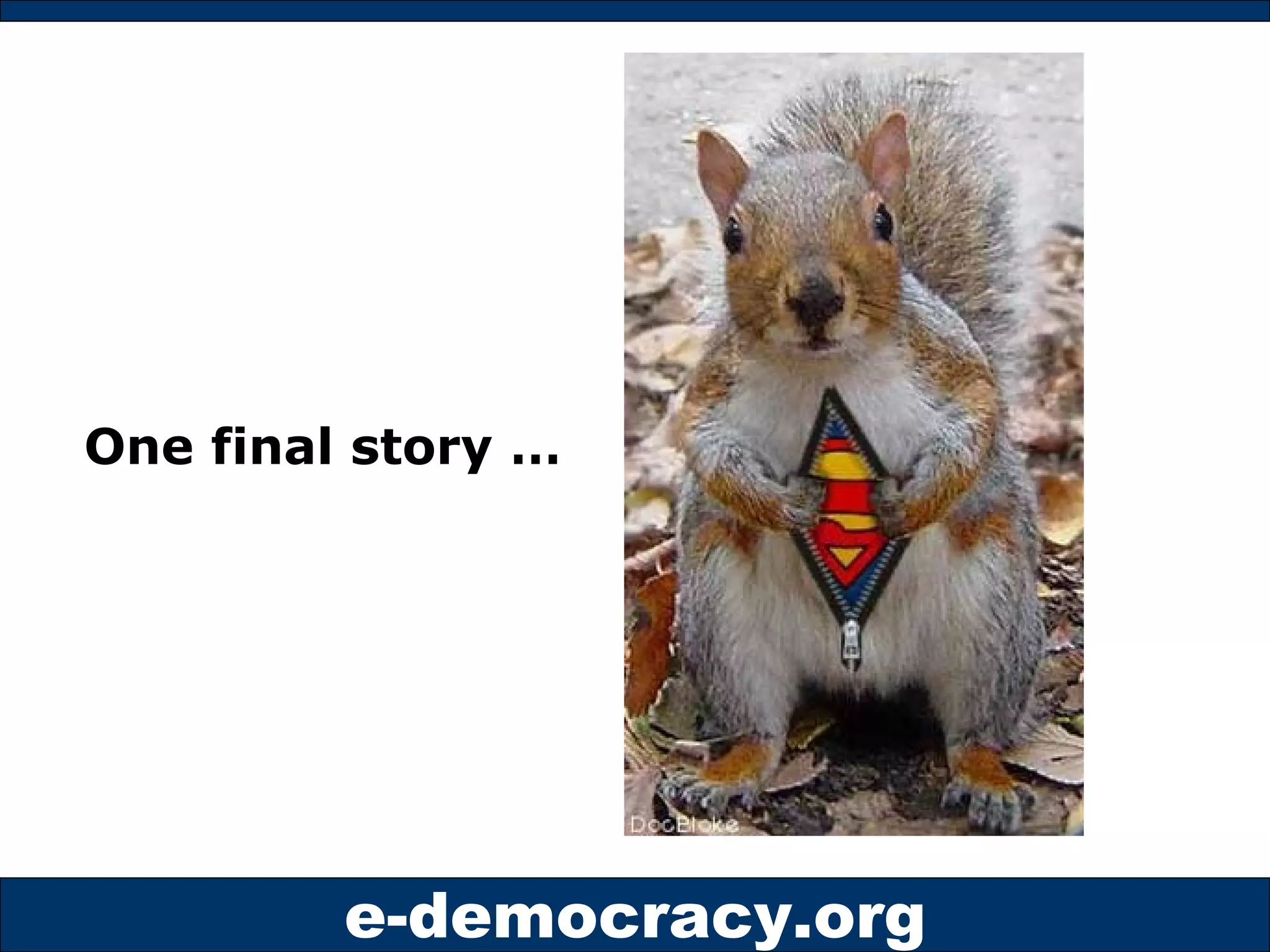
One final story …
Steven Clift posted humorously about the “public health risks of a large squirrel population” in the Minneapolis forum’s early days.   From  Southwest Journal  newspaper by Martiga Lohn  Most days, mpls-issues is a substantive discussion of important public policy issues… However … here are a few excerpts from this burning issue … > Go to hardware store…buy trap…set track…kill squirrel. End of public policy question.  > Grab a trap and KILL the squirrel????????? Why must we destroy a living thing as a solution? > Rocky and his friends are out of control. … If you want evidence, try to eat a sandwich on a bench in Loring Park.  > Quit telling people to move their nasty attack squirrels to wooded areas (i.e., Minneapolis parks) — we already have our fair share.  > I ran on an anti-squirrel platform for Student Legislature at Syracuse University in my freshman year in college. I promised to eradicate the nuisance squirrel population. It was my first election loss.  Squirrel Story
Conclusion If this inspires you … Let’s form a steering committee Find a local forum manager Draft a charter Recruit 100 people Open to dynamic and useful local public issue discussions online – any where, anytime participation Change local democracy forever
Act Now Visit  http://e-democracy.org/if   Read, watch, then fill out worksheets: http://pages.e-democracy.org/Start_A_Forum
Additional Training Slides
What Makes Us Different Some comparisons Blogs  – Hyper-individualistic and more male, democratize national punditry more than empower locally – Our model equitable two-way conversation with greater female participation Citizen media/online news  – Vastly more expensive starting point per community – Our model create demand for better local news, brings stories to the surface Social networks  – Publicize private life – Our model make real geographic public life accessible anywhere, any time Independent efforts  – Often fail due to lack of knowledge or use of inappropriate technology – Our model is tried and tested over a decade with a shared network for support and proven technology that reduces volunteer burn-out and help local democracy online efforts launch successfully – That said we hope that for every community that joins our network, 10 other projects will learn from or be inspired by us including citizen media projects
Small Groups Come up with a rule and a technology feature that would: 1. Increase the diversity of opinions 2. Increase participation by women/youth/older citizens – diversity of participants 3. Make posting by elected officials more likely 4. Increase respect for those with differing opinions, increase trust or civility among members 5. Help readers/posters find value more quickly 6. Move participants toward consensus or allow group to agree on what they disagree about 7. Avoid alienating political minorities while allowing majority positions to become known 8. Hold forum managers/hosts more accountable to their responsibilities 9. Troll group – List strategies for destroying an online community, technologies you prefer
Your Questions/Challenges What do you need to know? What are you concerned about? Have you had a different experience you’d like to share? There are 5 right ways and 95 wrong paths. How do you choose which is better?
Report Back Small groups – Write down: One rule Best tech idea Questions: Top question Best advice/example
Who makes a good Forum Manager? Sincere belief in value of dialogue Respect for diverse ideologies Patience Thick skin, can handle public criticism People skills – easier to teach tech skills Not intimidated by technology Common sense approach to facilitation, ability to ask questions, guide diplomatically, act quickly when required Time available, committed
Forum Management Tasks - 1 Keeping the space “safe” or civil for all participants Encouraging/enforcing compliance with forum rules Keeping discussions on topic (within scope or purpose of forum)
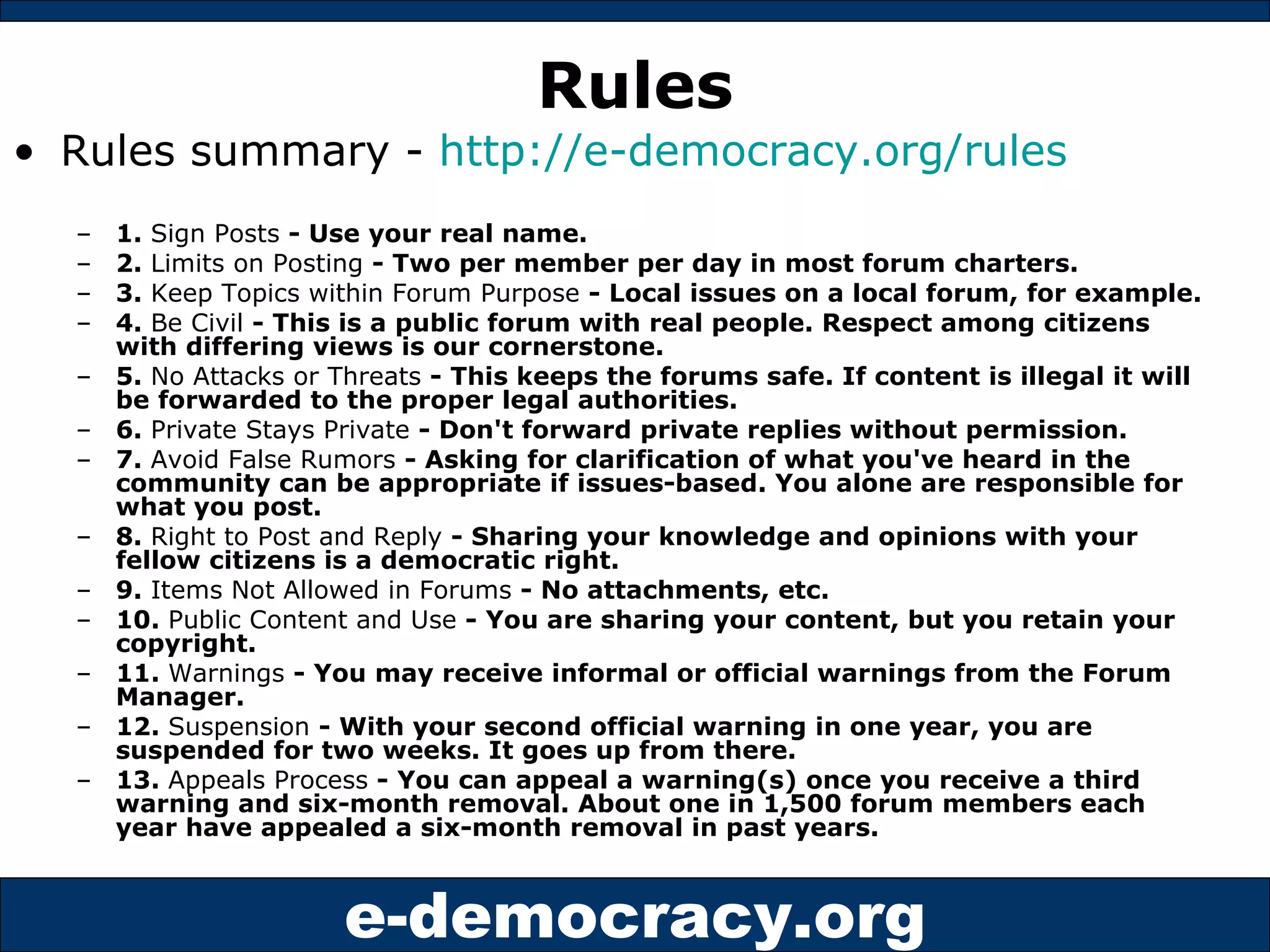
Rules Rules summary -  http://e-democracy.org/rules 1.  Sign Posts  - Use your real name. 2.  Limits on Posting  - Two per member per day in most forum charters. 3.  Keep Topics within Forum Purpose  - Local issues on a local forum, for example. 4.  Be Civil  - This is a public forum with real people. Respect among citizens with differing views is our cornerstone. 5.  No Attacks or Threats  - This keeps the forums safe. If content is illegal it will be forwarded to the proper legal authorities. 6.  Private Stays Private  - Don't forward private replies without permission. 7.  Avoid False Rumors  - Asking for clarification of what you've heard in the community can be appropriate if issues-based. You alone are responsible for what you post. 8.  Right to Post and Reply  - Sharing your knowledge and opinions with your fellow citizens is a democratic right. 9.  Items Not Allowed in Forums  - No attachments, etc. 10.  Public Content and Use  - You are sharing your content, but you retain your copyright. 11.  Warnings  - You may receive informal or official warnings from the Forum Manager. 12.  Suspension  - With your second official warning in one year, you are suspended for two weeks. It goes up from there. 13.  Appeals Process  - You can appeal a warning(s) once you receive a third warning and six-month removal. About one in 1,500 forum members each year have appealed a six-month removal in past years.
Forum Management Tasks - 2 Welcoming new members Managing message volume  in both unmoderated and moderated forums Introducing new topics Sharing media/website links Asking a question Encouraging alternative viewpoints Moving discussion along
Forum Management Tasks - 3 Supporting and encouraging good behavior Responding to participant questions or complaints Waiting for complaints versus public/private action Ongoing recruitment Tasks can be distributed/shared
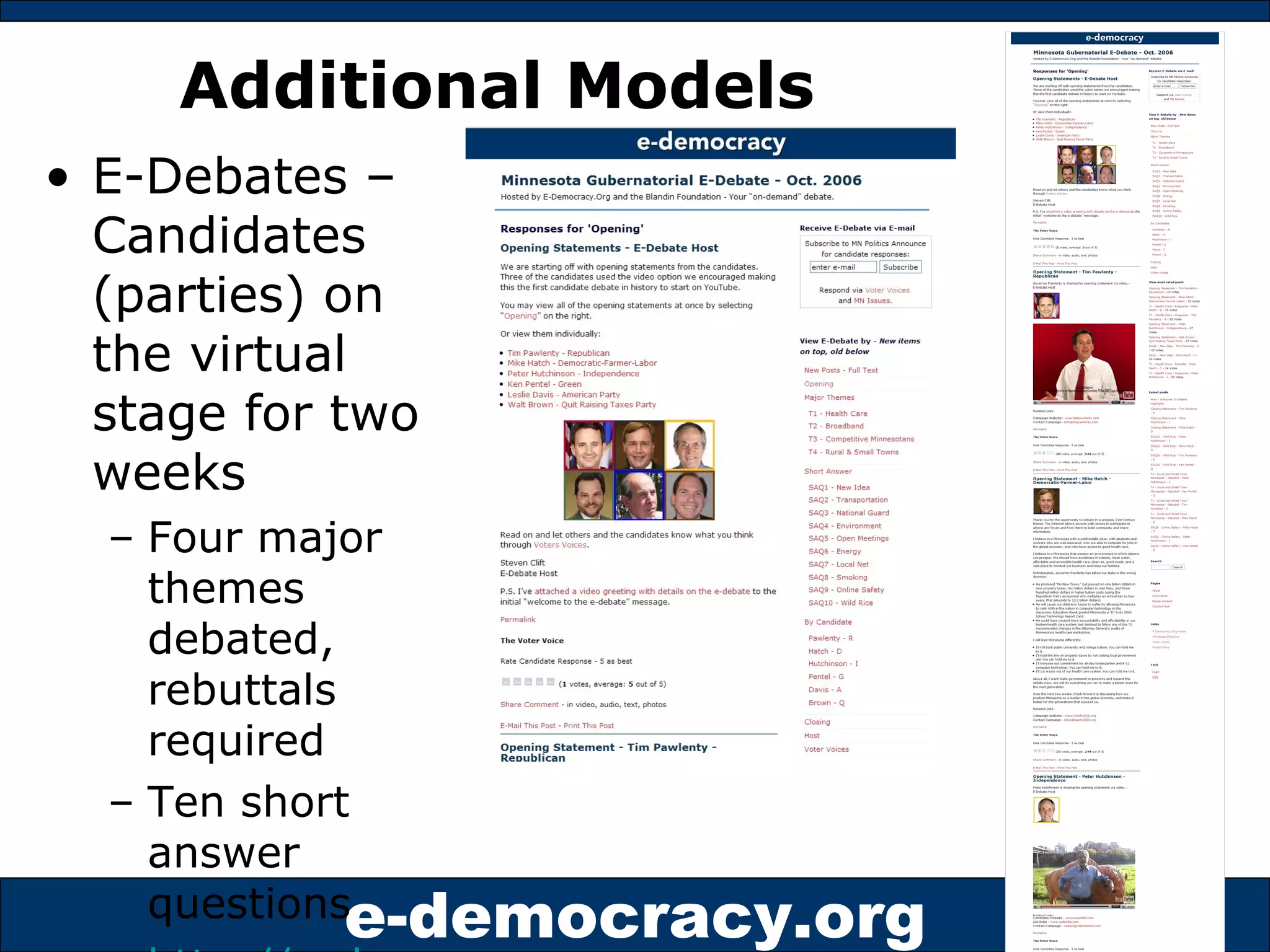
Additional Models E-Debates – Candidates (parties) on the virtual stage for two weeks Four major themes debated, rebuttals required Ten short answer questions http://e-democracy.org/e-debates
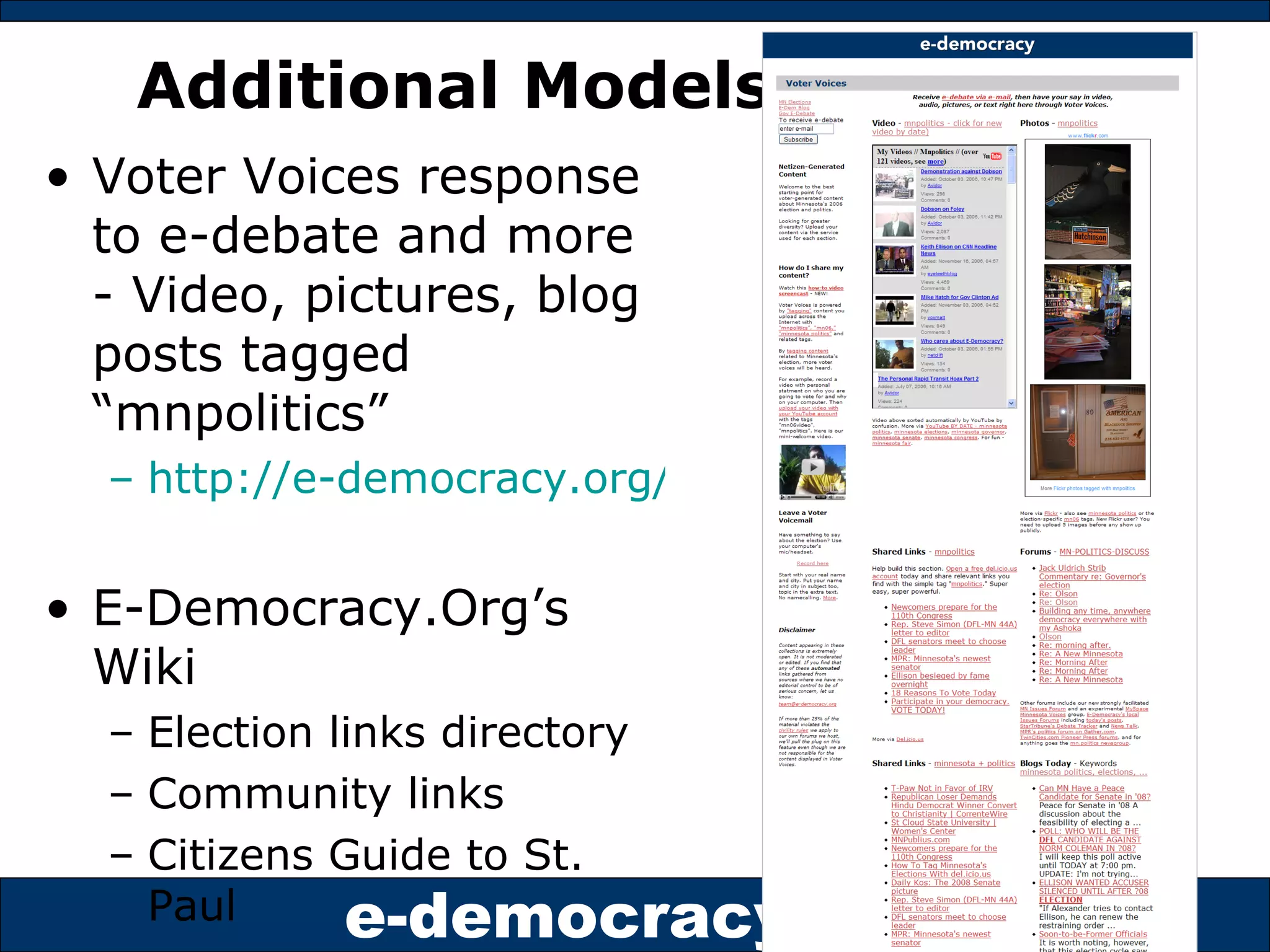
Additional Models Voter Voices response to e-debate and more - Video, pictures, blog posts tagged “mnpolitics”  http://e-democracy.org/voices E-Democracy.Org’s Wiki Election links directory Community links Citizens Guide to St. Paul
Bonus Slides Winona Case Study
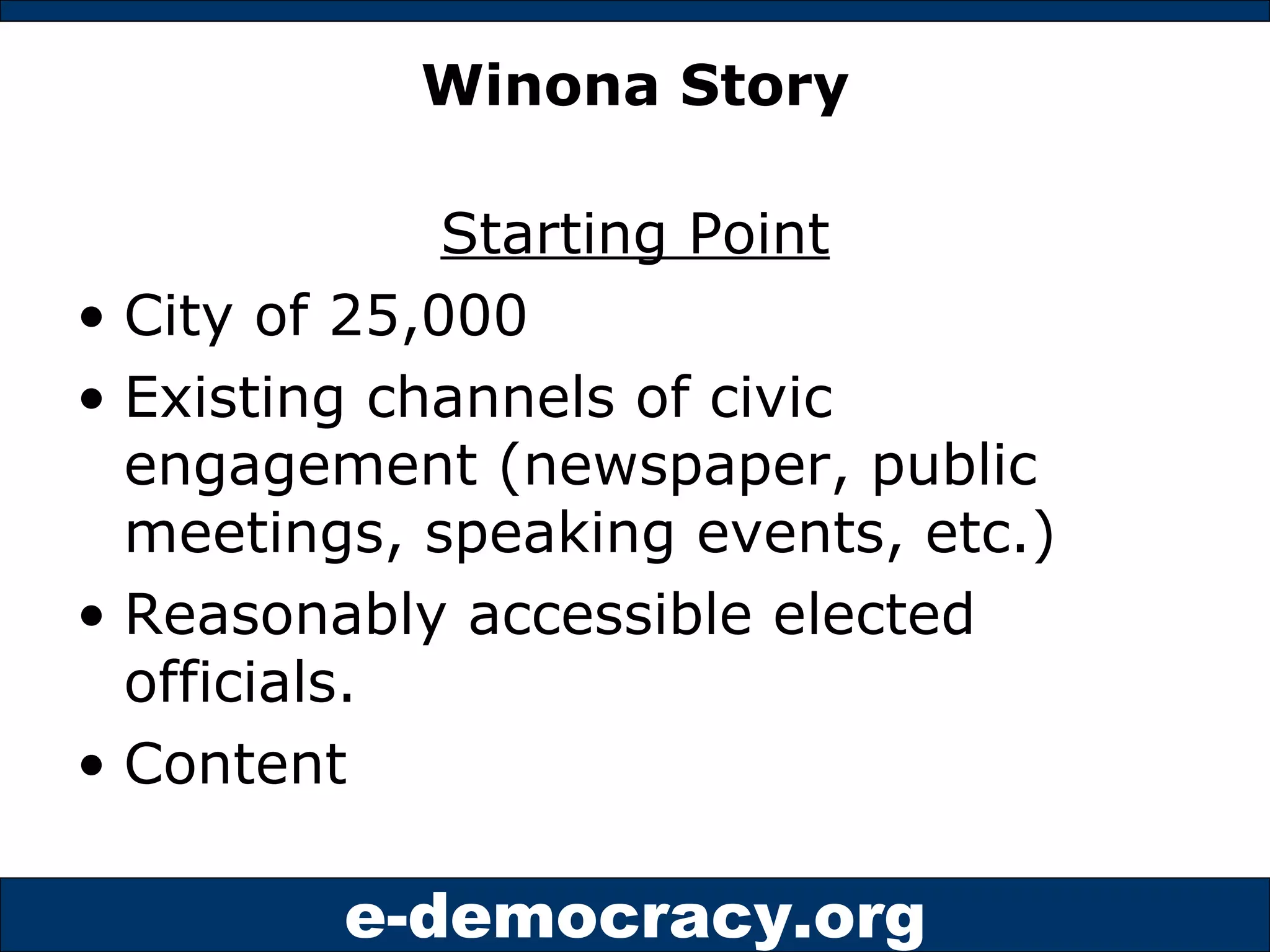
Winona Story Starting Point City of 25,000 Existing channels of civic engagement (newspaper, public meetings, speaking events, etc.) Reasonably accessible elected officials. Content
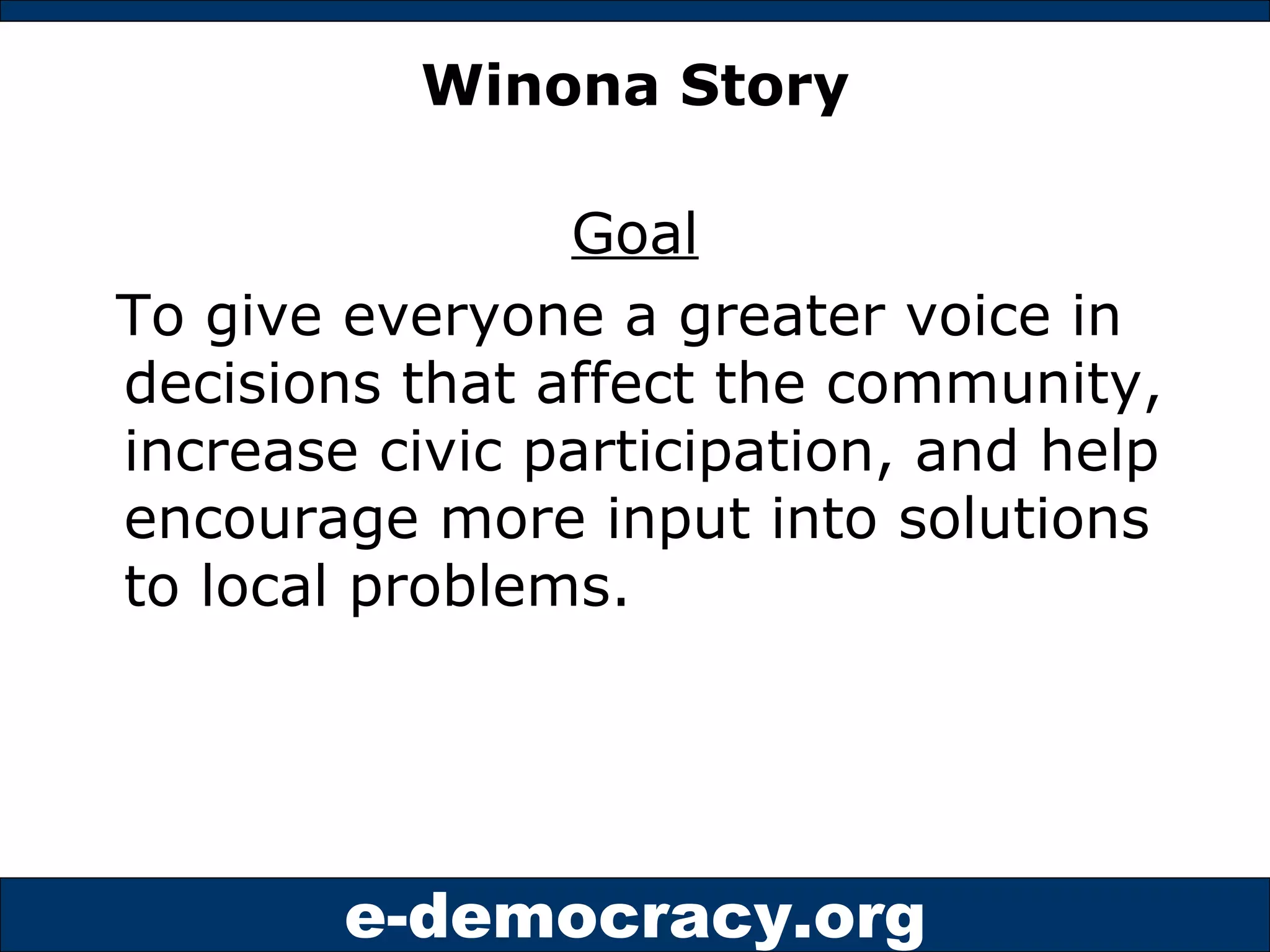
Winona Story Goal To give everyone a greater voice in decisions that affect the community, increase civic participation, and help encourage more input into solutions to local problems.
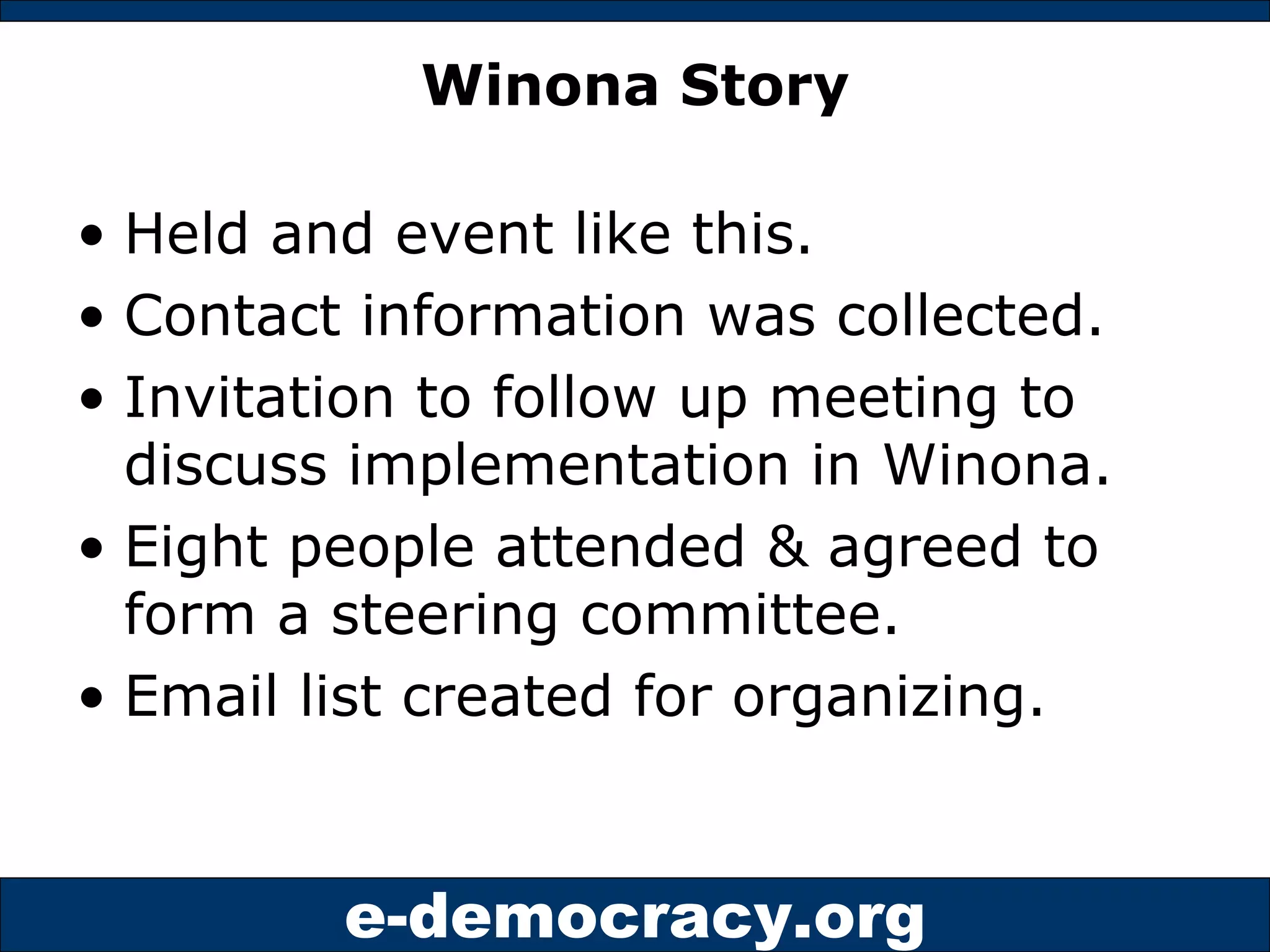
Winona Story Held and event like this. Contact information was collected. Invitation to follow up meeting to discuss implementation in Winona. Eight people attended & agreed to form a steering committee. Email list created for organizing.
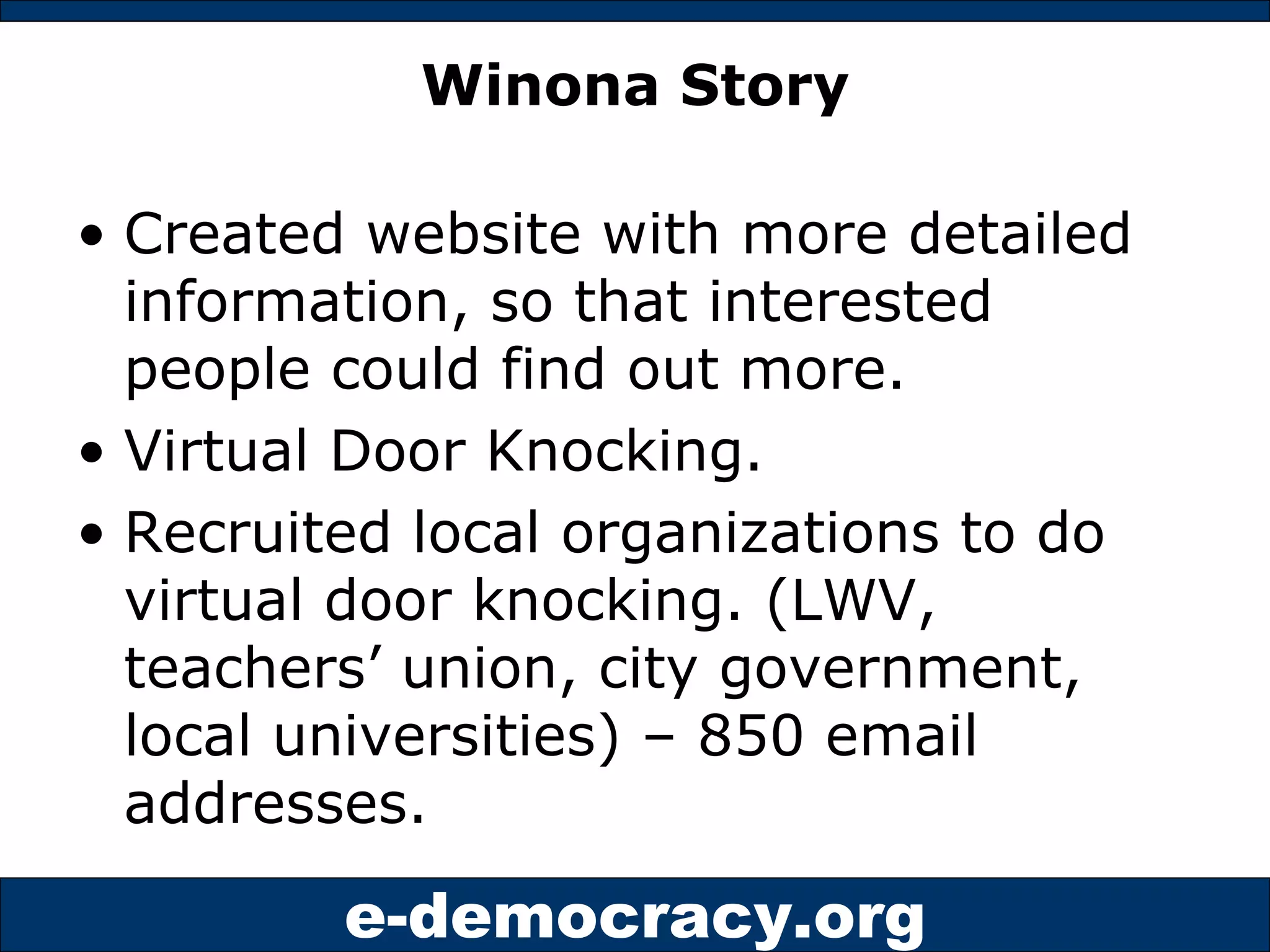
Winona Story Created website with more detailed information, so that interested people could find out more. Virtual Door Knocking. Recruited local organizations to do virtual door knocking. (LWV, teachers’ union, city government, local universities) – 850 email addresses.
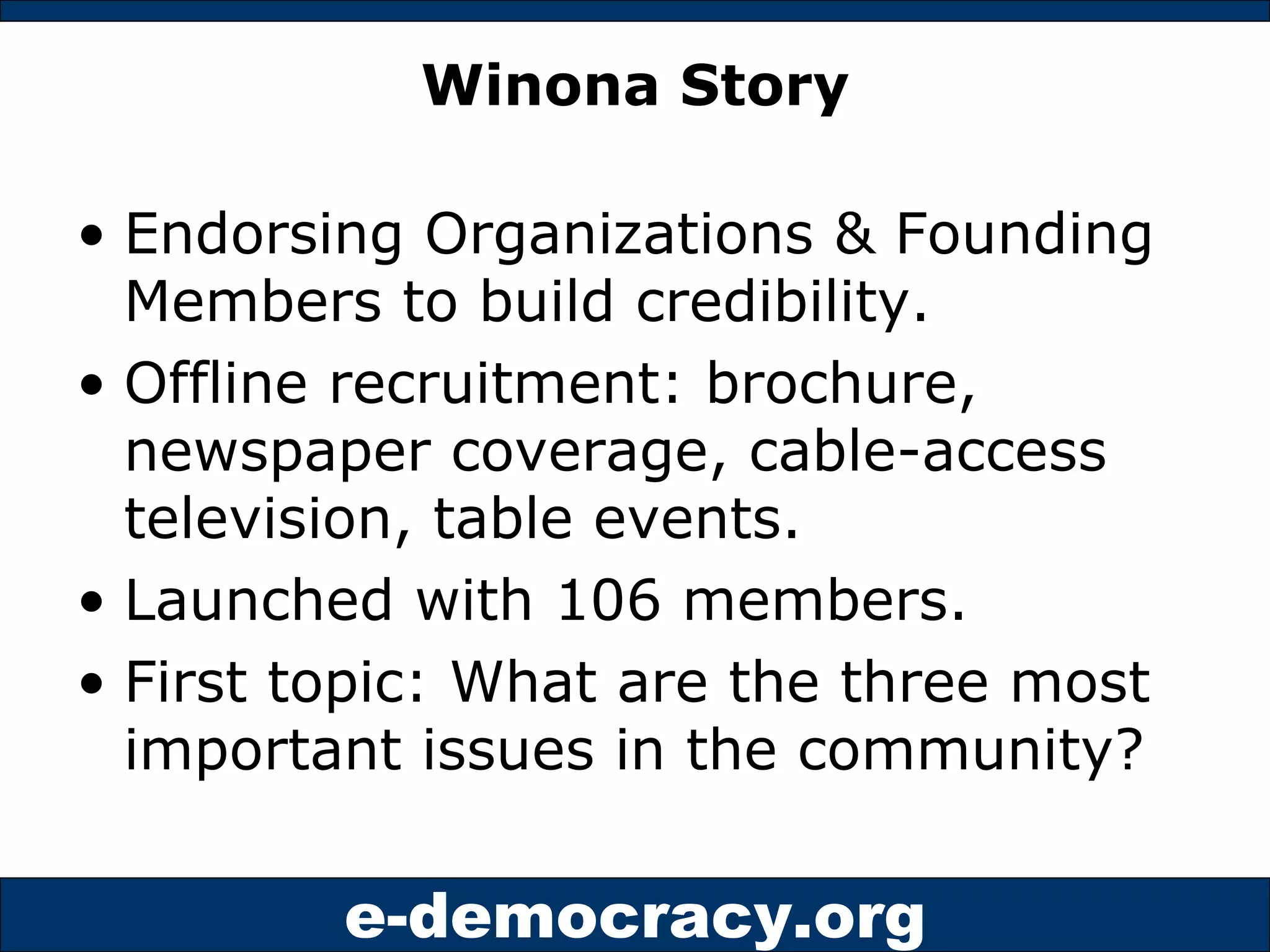
Winona Story Endorsing Organizations & Founding Members to build credibility. Offline recruitment: brochure, newspaper coverage, cable-access television, table events. Launched with 106 members. First topic: What are the three most important issues in the community?
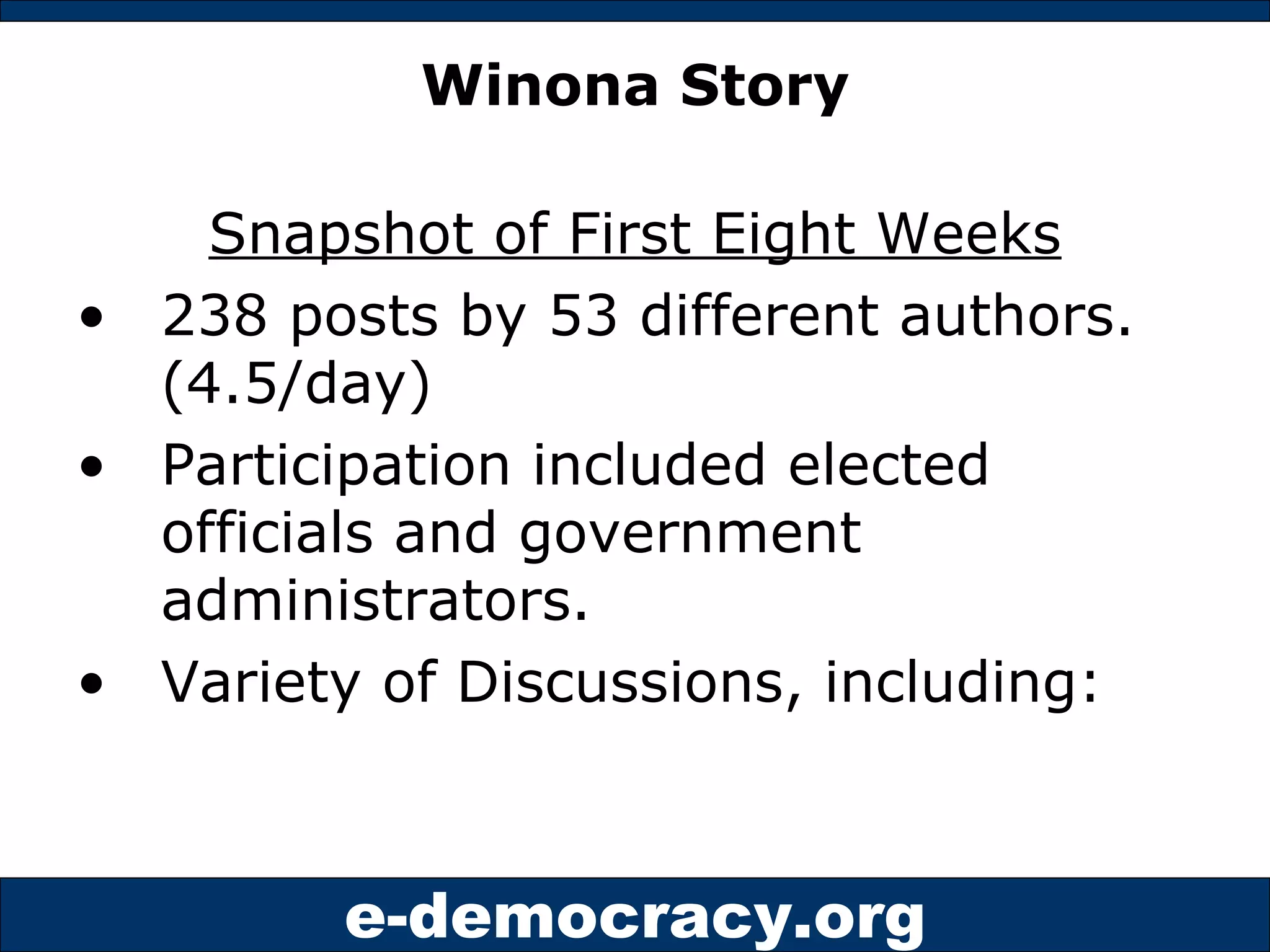
Winona Story Snapshot of First Eight Weeks 238 posts by 53 different authors. (4.5/day) Participation included elected officials and government administrators. Variety of Discussions, including:
Winona Story Example Discussion Topics Identifying dangerous intersections. (mayor) Improving digital divide. (county human services) Shortfalls in education funding, rebuilding historic courthouse, plans to increase railroad traffic.
Winona Story Expanded to 230 people Hosted mixed live/online events National/International attention.

Issues Forums Webinar

  • 1.
    Citizen Media andOnline Engagement: Webinar Part 2 – Issues Forums Steven Clift, E-Democracy.Org Listen to this webinar from: http://e-democracy.org/webinars
  • 2.
    E-Democracy.Org IssuesForums Steven Clift, Founder and Board Chair E-Democracy.Org
  • 3.
    The Problem Lackof Participation in Local Democracy Time Trust and accountability Loss of civility Sense your voice won’t be heard
  • 4.
    The Problem Needto Make Participation More Effective Timely access to information and opinions when it matters Openness and inclusion Building social capital Need more deliberative opportunities People need to experience lasting power and influence
  • 5.
    We Are BuildingAny time, anywhere democracy Two-way online town hall meeting NOT typical male-dominated political blogs (Hyde Park) or reactionary anonymous reader comments on news sites Demand for local information and news in a democracy Low-cost, volunteer-based, network of service club like local democracy committees – 15+ communities
  • 6.
    World First –Democratic Roots We created the world’s first election web site way back in 1994 … After the election, people kept talking in our Minnesota Politics forum. We realized that it was our job to be a trusted, neutral host of ongoing dialogue among those from diverse perspectives and backgrounds. Talk is cheap. Actually, “Conversation is cost-effective.”
  • 7.
    Blogs are noteverything. Need to pick and choose among multiple tools based on your goals. Goal: Two-way local dialogue. Tool: E-mail list/web forum
  • 8.
    Need Public Spaces– Online Versions of Town Halls, Capitols Online public spaces, not just “public” commercial spaces Need Decorum and civility Local relevance Agenda-setting and impact on decision-makers Real names and accountability <- The Minnesota Capitol Rotunda
  • 9.
    Local Issues ForumsThe online town hall City-wide, neighborhoods as well Where is local power? – We place an online public space in the center “ Government websites don’t have sidewalks.” (Or public hearings online.) Need for independent online spaces for media accountability Locally “owned” by civic-inspired citizen committee as part of E-Democracy.Org
  • 10.
    Some Stories DairyQueen in the public parks Park board members starts discussion Daily paper absent from board meeting Vigorous debate online gets in paper Decision reversed at next meeting packed with the public
  • 11.
    Dori from St.Paul Active citizens and “average” citizens raise their voices Ten minute “GSE” (Gopher State Ethanol) video at http://e-democracy.org/experience Dori Ullman raises her voice about the stench
  • 12.
    Jamal from MinneapolisLarge Somali community in Minneapolis Their “voice” was missing despite past outreach Bus strike provided motivation and real world reason to join and post to forum Contacted by Mayor, media after forum posts
  • 13.
    Mayor Rybak fromMinneapolis In 2001, RT Rybak announced mayoral candidacy on forum before press conference More video clips The Seven O'clock Meeting Budget Issues - Informing Let’s Ski - Gathering Ideas Two-way Won’t Kill You More video: http://e-democracy.org/experience
  • 14.
    Issues Forums –E-Democracy.Org Recent Topics Local schools Support for area war veterans Neighborhood park changes Water quality and shortage Crime and policing Candidates and elections Feral cat problem Racetrack noise pollution
  • 15.
  • 16.
    Local Issues ForumsToday Bemidji, MN – 100 members, Just opened Cass Lake Leech Lake – 153 members, New Cook County, MN – Opening soon Grand Rapids, MN – Opening soon Minneapolis, MN – 1051 members Cedar Riverside – 103 members, Just opened Seward NHood – 192 members Standish-Ericsson NHood – 310 members Powderhorn Nhood – Opening Soon St. Paul, MN – 628 members Roseville, MN – 197 members Winona, MN – 87 members Las Vegas, NM – 112 members Central Ohio Region – 126 members Brighton and Hove, UK – 280 members Newham, UK – 177 members Bristol 2 NHoods, UK – 220 members Oxford 3 NHoods, UK – 318 members Canterbury (Christchurch), NZ – 223 members
  • 17.
    How Issues ForumWork, Starting One Steve Kranz
  • 18.
    How Issues ForumsWork C i t i z e n s Starting with “private” citizens moving toward public e-citizens Extensive personal online networks exist – friends, family, co-workers Personal Networks
  • 19.
    How Issues ForumsWork Local E-Democracy group creates the public “space”, defines charter (scope) C i t i z e n s Issues Forum GroupServer e-mails posts web view Personal Networks
  • 20.
    How Issues ForumsWork C i t i z e n s Issues Forum GroupServer e-mails posts web view Subscribe once Commitment secured Recruit citizens, elected officials, media, etc. with “sticky” opt-in Personal Networks
  • 21.
    How Issues ForumsWork Participants agree to rules Sign real name Post no more than twice a day Stay within scope of local charter Understand they can be suspended for violations Forum is facilitated, NOT pre-moderated, those posting content are 100% responsible for what they post
  • 22.
    How Issues ForumsWork Position forum in center of real power Political Activist Reporter Citizen #1 Mayor Citizen #2 Candidate Researcher City Council Neighborhood Leader Student Forum Manager Citizen #500 Gadfly C i t i z e n s Issues Forum GroupServer e-mails posts web view Post via e-mail/web e-publish, many-to-many Personal Networks
  • 23.
    Issues Forums Agenda-settingdiscussions, “e-mail leaks,” facilitation and rule enforcement key Political Activist Reporter Citizen #1 Mayor Citizen #2 Candidate Researcher City Council Neighborhood Leader Student Forum Manager Citizen #500 Gadfly C i t i z e n s Issues Forum GroupServer e-mails posts web view Online discussions in the heart of local power Subscribe once Commitment secured Post via e-mail/web Leader’s Office “ Secondary Networks ” e-mail forwards media agenda-setting Council Department Personal Networks Local Media Coverage
  • 24.
    GroupServer – E-mail/webEasy to find By geography E-mail or web - your choice Technology enhancements Share through open source Leveraging blogging standards, web feeds More: http://e-democracy.org/groupserver
  • 25.
    Sample Forum –Web View Entering reply here
  • 26.
    Sample Forum –E-mail View
  • 27.
    Our Approach Leveragedemocratic information from government, media, political sectors Open sharing of lessons, how-to Open source software Local up – do not colonize Low cost – volunteer driven, shared infrastructure and org. identity
  • 28.
    Start Up Overview5-10 Person Steering Committee Volunteer Forum Manager Other participant roles Recruit 100 initial participants Open forum and facilitate Enforce civility/scope rules
  • 29.
    Form Steering CommitteeA local “democracy committee” based on the service club model – Lions, Rotary Can form in association with related efforts e.g. KAXE’s online community media initiative Needs convening spirit Key to community trust is a mix of public members not all part of one political faction
  • 30.
    Drafting Your CharterTwo-three sentence description will determine scope, set tone for years Longer charter is your local detailed description that guides the forum Supported by universal E-Democracy.Org rules (terms of participation) Use charter drafting to involve the community in a “what do we really want” conversation to ensure broad sense of ownership
  • 31.
    Mapping Local PowerRecruitment to make the forum “matter” politically is essential, best upfront Elected officials, community leaders, local journalists, active citizens “ Average” citizens will not waste time in a forum that does not matter Work from the “center” and avoid marginalization Gives the deliberations reach and local agenda-setting power
  • 32.
    Recruiting 100+ MembersBuild it and they will NEVER come Most similar efforts fail on recruitment not technology One at a time – In-person recruitment, community events Outreach - local media, “virtual door knocking”
  • 33.
    Forum Facilitation Forummanager guides the forum, enforces the rules Selected and held accountable by local steering committee Peer training/support with E-Democracy.Org’s network of forum managers Issues Forum guidebook chapter, Minneapolis lessons: http://e-democracy.org/if
  • 34.
    Participant/Volunteer Roles Readers – Active “listeners” are crucial to forum’s value Opinionators – Everyday talkers, often have views on everything Starters – Discussion starters, look for topics in the news, etc., ask questions Seekers – Seek out and share community announcements, links to government agendas, documents, etc. Goal – A mix, with 15-20% posting participation rate of registered users each month
  • 35.
    Open the ForumIntroductions – Humanize forum with round of introductions Seed Discussion Topics – If/as needed Special Events in Forum – Guest speakers (Canterbury), State of the City Text/Video (St. Paul) Build “e-citizen” skills of community overtime Think long term, encourage sense of community ownership, value based on what people contribute not how they are served
  • 36.
    Local E-Democracy CommitteeDefine and assign ongoing volunteer roles, meet ~quarterly Set twice a year outreach/new member goals Help Forum Manager raise quality of discussion when needed Hold Forum Manager accountable, review complaints/rules appeals Promote local “e-democracy” improvements in government and media and through special projects
  • 37.
  • 38.
    What Makes UsDifferent Many to many with real names and civility Strength in people-based model and processes that allow us to adapt technologically Agenda-setting – Real world pragmatic approach versus empowering citizens isolated from influence Recruitment process leads to far deeper geographic participation that pure blogs or social networks Technology choice – e-mail, web, blog feeds, future social network application
  • 39.
  • 40.
    Steven Clift postedhumorously about the “public health risks of a large squirrel population” in the Minneapolis forum’s early days. From Southwest Journal newspaper by Martiga Lohn Most days, mpls-issues is a substantive discussion of important public policy issues… However … here are a few excerpts from this burning issue … > Go to hardware store…buy trap…set track…kill squirrel. End of public policy question. > Grab a trap and KILL the squirrel????????? Why must we destroy a living thing as a solution? > Rocky and his friends are out of control. … If you want evidence, try to eat a sandwich on a bench in Loring Park. > Quit telling people to move their nasty attack squirrels to wooded areas (i.e., Minneapolis parks) — we already have our fair share. > I ran on an anti-squirrel platform for Student Legislature at Syracuse University in my freshman year in college. I promised to eradicate the nuisance squirrel population. It was my first election loss. Squirrel Story
  • 41.
    Conclusion If thisinspires you … Let’s form a steering committee Find a local forum manager Draft a charter Recruit 100 people Open to dynamic and useful local public issue discussions online – any where, anytime participation Change local democracy forever
  • 42.
    Act Now Visit http://e-democracy.org/if Read, watch, then fill out worksheets: http://pages.e-democracy.org/Start_A_Forum
  • 43.
  • 44.
    What Makes UsDifferent Some comparisons Blogs – Hyper-individualistic and more male, democratize national punditry more than empower locally – Our model equitable two-way conversation with greater female participation Citizen media/online news – Vastly more expensive starting point per community – Our model create demand for better local news, brings stories to the surface Social networks – Publicize private life – Our model make real geographic public life accessible anywhere, any time Independent efforts – Often fail due to lack of knowledge or use of inappropriate technology – Our model is tried and tested over a decade with a shared network for support and proven technology that reduces volunteer burn-out and help local democracy online efforts launch successfully – That said we hope that for every community that joins our network, 10 other projects will learn from or be inspired by us including citizen media projects
  • 45.
    Small Groups Comeup with a rule and a technology feature that would: 1. Increase the diversity of opinions 2. Increase participation by women/youth/older citizens – diversity of participants 3. Make posting by elected officials more likely 4. Increase respect for those with differing opinions, increase trust or civility among members 5. Help readers/posters find value more quickly 6. Move participants toward consensus or allow group to agree on what they disagree about 7. Avoid alienating political minorities while allowing majority positions to become known 8. Hold forum managers/hosts more accountable to their responsibilities 9. Troll group – List strategies for destroying an online community, technologies you prefer
  • 46.
    Your Questions/Challenges Whatdo you need to know? What are you concerned about? Have you had a different experience you’d like to share? There are 5 right ways and 95 wrong paths. How do you choose which is better?
  • 47.
    Report Back Smallgroups – Write down: One rule Best tech idea Questions: Top question Best advice/example
  • 48.
    Who makes agood Forum Manager? Sincere belief in value of dialogue Respect for diverse ideologies Patience Thick skin, can handle public criticism People skills – easier to teach tech skills Not intimidated by technology Common sense approach to facilitation, ability to ask questions, guide diplomatically, act quickly when required Time available, committed
  • 49.
    Forum Management Tasks- 1 Keeping the space “safe” or civil for all participants Encouraging/enforcing compliance with forum rules Keeping discussions on topic (within scope or purpose of forum)
  • 50.
    Rules Rules summary- http://e-democracy.org/rules 1. Sign Posts - Use your real name. 2. Limits on Posting - Two per member per day in most forum charters. 3. Keep Topics within Forum Purpose - Local issues on a local forum, for example. 4. Be Civil - This is a public forum with real people. Respect among citizens with differing views is our cornerstone. 5. No Attacks or Threats - This keeps the forums safe. If content is illegal it will be forwarded to the proper legal authorities. 6. Private Stays Private - Don't forward private replies without permission. 7. Avoid False Rumors - Asking for clarification of what you've heard in the community can be appropriate if issues-based. You alone are responsible for what you post. 8. Right to Post and Reply - Sharing your knowledge and opinions with your fellow citizens is a democratic right. 9. Items Not Allowed in Forums - No attachments, etc. 10. Public Content and Use - You are sharing your content, but you retain your copyright. 11. Warnings - You may receive informal or official warnings from the Forum Manager. 12. Suspension - With your second official warning in one year, you are suspended for two weeks. It goes up from there. 13. Appeals Process - You can appeal a warning(s) once you receive a third warning and six-month removal. About one in 1,500 forum members each year have appealed a six-month removal in past years.
  • 51.
    Forum Management Tasks- 2 Welcoming new members Managing message volume in both unmoderated and moderated forums Introducing new topics Sharing media/website links Asking a question Encouraging alternative viewpoints Moving discussion along
  • 52.
    Forum Management Tasks- 3 Supporting and encouraging good behavior Responding to participant questions or complaints Waiting for complaints versus public/private action Ongoing recruitment Tasks can be distributed/shared
  • 53.
    Additional Models E-Debates– Candidates (parties) on the virtual stage for two weeks Four major themes debated, rebuttals required Ten short answer questions http://e-democracy.org/e-debates
  • 54.
    Additional Models VoterVoices response to e-debate and more - Video, pictures, blog posts tagged “mnpolitics” http://e-democracy.org/voices E-Democracy.Org’s Wiki Election links directory Community links Citizens Guide to St. Paul
  • 55.
  • 56.
    Winona Story StartingPoint City of 25,000 Existing channels of civic engagement (newspaper, public meetings, speaking events, etc.) Reasonably accessible elected officials. Content
  • 57.
    Winona Story GoalTo give everyone a greater voice in decisions that affect the community, increase civic participation, and help encourage more input into solutions to local problems.
  • 58.
    Winona Story Heldand event like this. Contact information was collected. Invitation to follow up meeting to discuss implementation in Winona. Eight people attended & agreed to form a steering committee. Email list created for organizing.
  • 59.
    Winona Story Createdwebsite with more detailed information, so that interested people could find out more. Virtual Door Knocking. Recruited local organizations to do virtual door knocking. (LWV, teachers’ union, city government, local universities) – 850 email addresses.
  • 60.
    Winona Story EndorsingOrganizations & Founding Members to build credibility. Offline recruitment: brochure, newspaper coverage, cable-access television, table events. Launched with 106 members. First topic: What are the three most important issues in the community?
  • 61.
    Winona Story Snapshotof First Eight Weeks 238 posts by 53 different authors. (4.5/day) Participation included elected officials and government administrators. Variety of Discussions, including:
  • 62.
    Winona Story ExampleDiscussion Topics Identifying dangerous intersections. (mayor) Improving digital divide. (county human services) Shortfalls in education funding, rebuilding historic courthouse, plans to increase railroad traffic.
  • 63.
    Winona Story Expandedto 230 people Hosted mixed live/online events National/International attention.