Enhancing Exploratory Search with Hedonic BrowsingUsing Social Tagging ToolsHesham Allam, James Blustein,Louise Spiteri, & Michael Bliemel2nd International Workshop on Modeling Social Media (MSM 2011)
AgendaIntroductionDefinitionsExploratory SearchSocial TaggingProposed Hedonic ModelMethodResults and ImplicationsStudy Limitations and Future Research2011-10-09Modeling Social Media (MSM 2011)
Exploratory Search is…A complex set of search activitieswithin an Information Retrieval systemUsed to broadly explore a topic of interest (Wilson, 2007)Used whenSearch goal is not clearSearching for something complexSearchers are not satisfied with results from traditional search systems2011-10-09Modeling Social Media (MSM 2011)
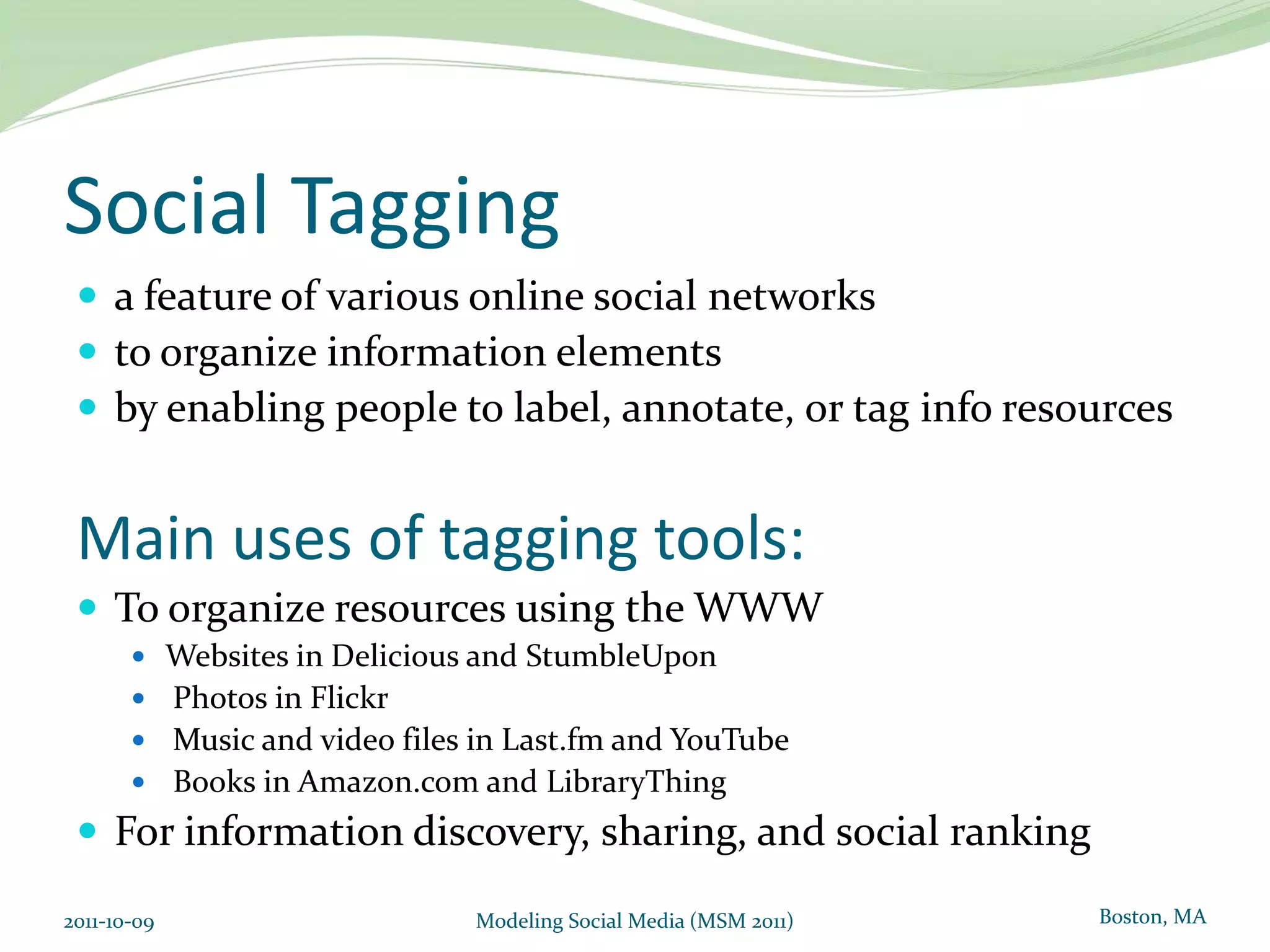
Social Tagginga feature of various online social networksto organize information elementsby enabling people to label, annotate, or tag info resourcesMain uses of tagging tools:To organize resources using the WWWWebsites in Delicious and StumbleUpon Photos in Flickr Music and video files in Last.fm and YouTube Books in Amazon.com and LibraryThingFor information discovery, sharing, and social ranking2011-10-09Modeling Social Media (MSM 2011)
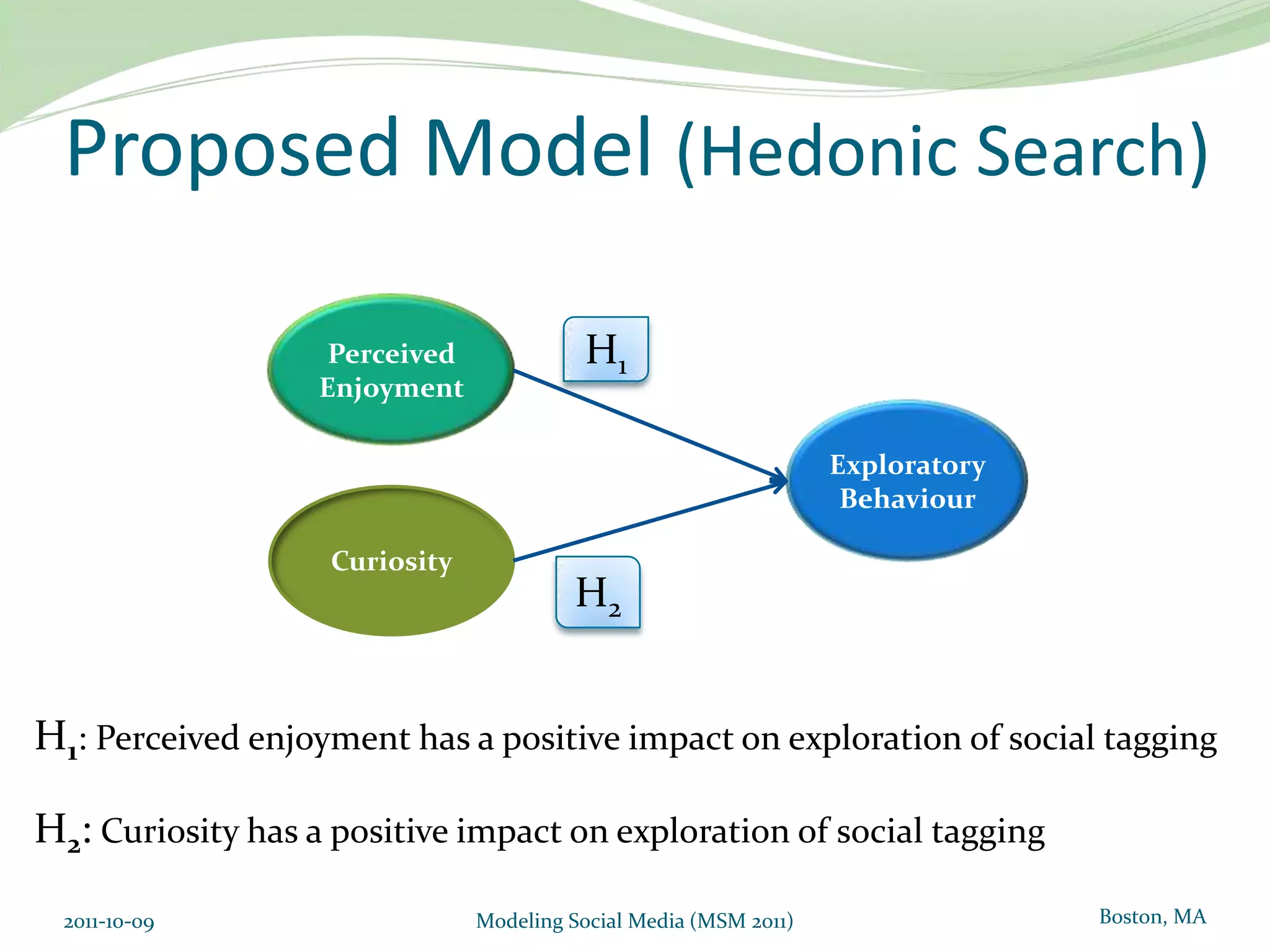
Proposed Model (Hedonic Search)2011-10-09Modeling Social Media (MSM 2011)Perceived EnjoymentH1ExploratoryBehaviourCuriosityH2H1: Perceived enjoyment has a positive impact on exploration of social tagging  H2: Curiosity has a positive impact on exploration of social tagging
MethodSince our study is exploratory in essence, we used Structural Equation Modeling (SEM)SEM is an approach used for identifying and estimating models of linear relationships among measured (Explorability) and latent variables (Enjoyment and Curiosity)We also used the bootstrapping approach to assess the t-value significance (in our case t-value = 3.57 for p≤0.01).2011-10-09Modeling Social Media (MSM 2011)
MethodExploratory study  Structural Equation Modeling (SEM)For identifying and estimating models of linear relationships among measured (Explorability) and latent variables (Enjoyment and Curiosity)We also used the bootstrappingTo assess the t-value significance(in our case t-value = 3.57 for p≤0.01).2011-10-09Modeling Social Media (MSM 2011)
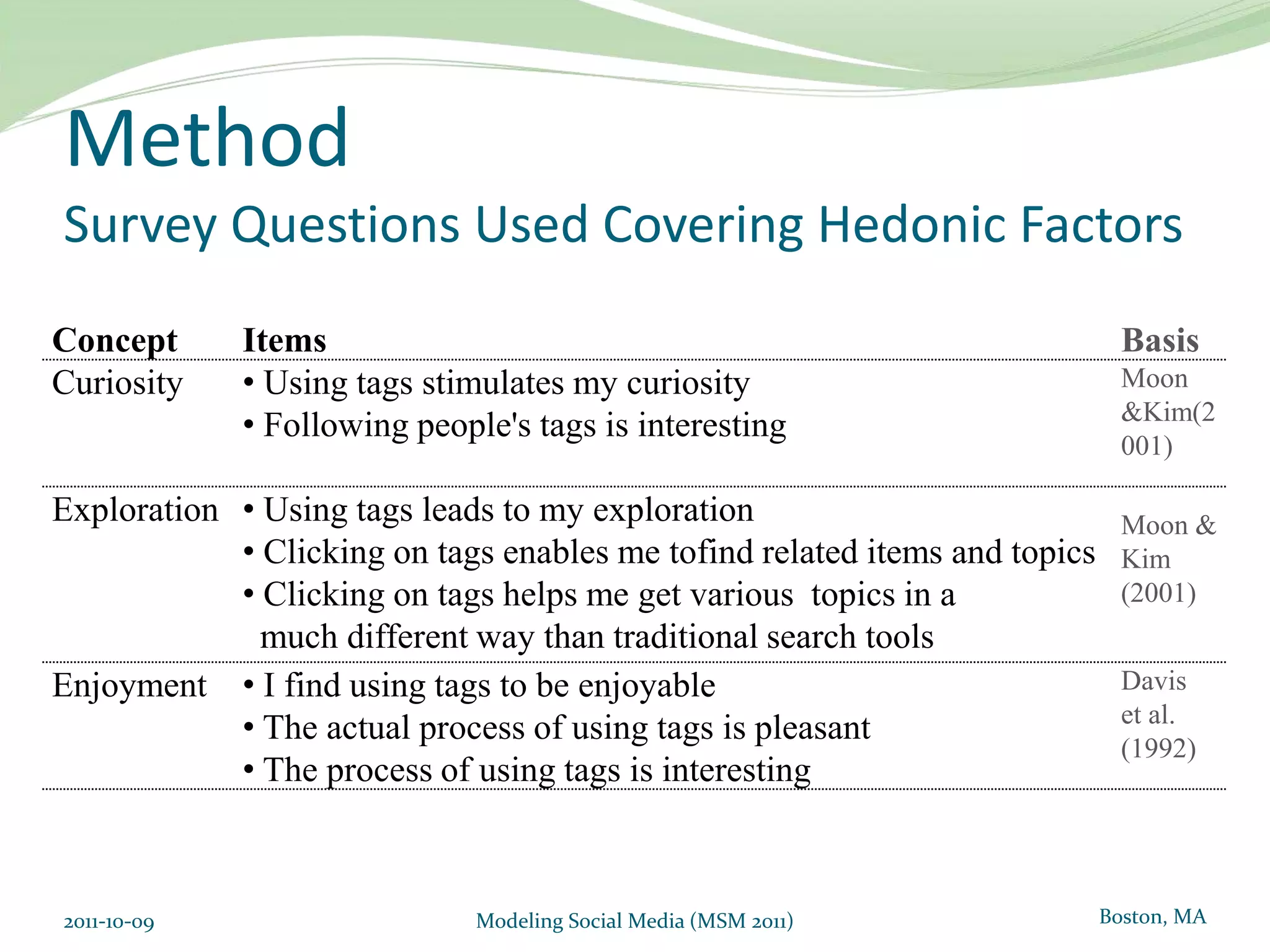
MethodSurvey Questions Used Covering Hedonic Factors2011-10-09Modeling Social Media (MSM 2011)
Respondents’ Profiles(N = 38)2011-10-09Modeling Social Media (MSM 2011)
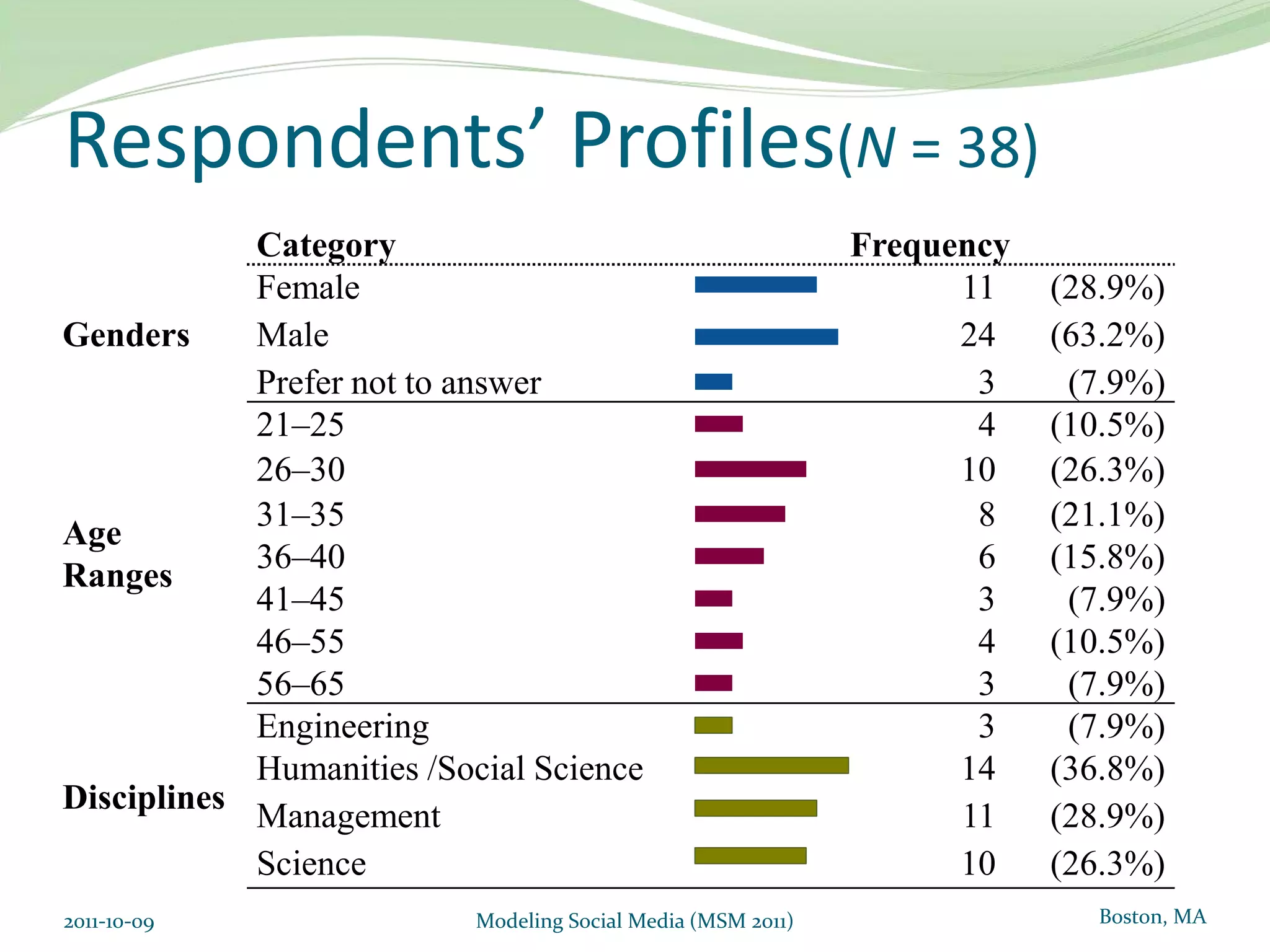
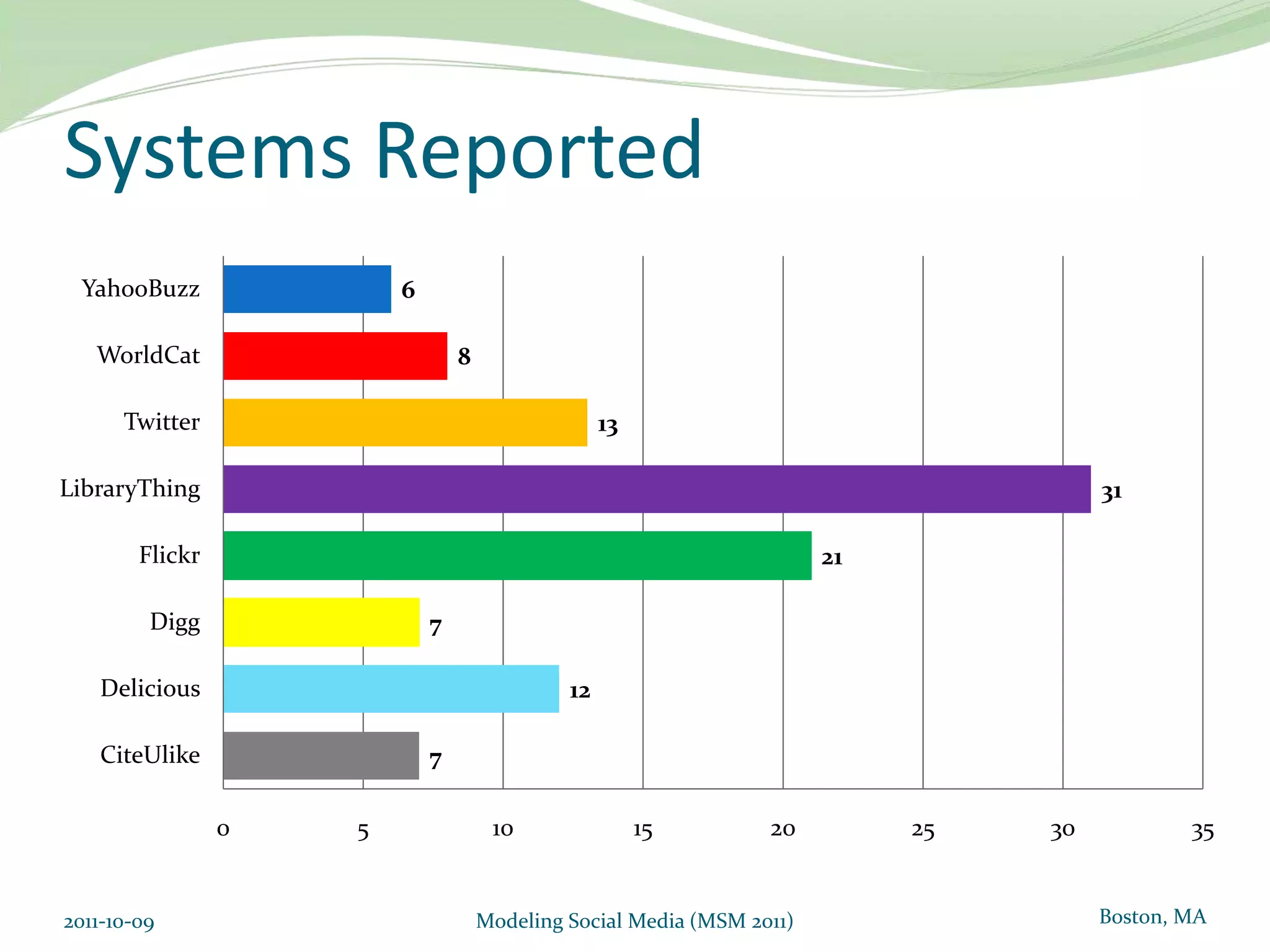
Systems Reported2011-10-09Modeling Social Media (MSM 2011)
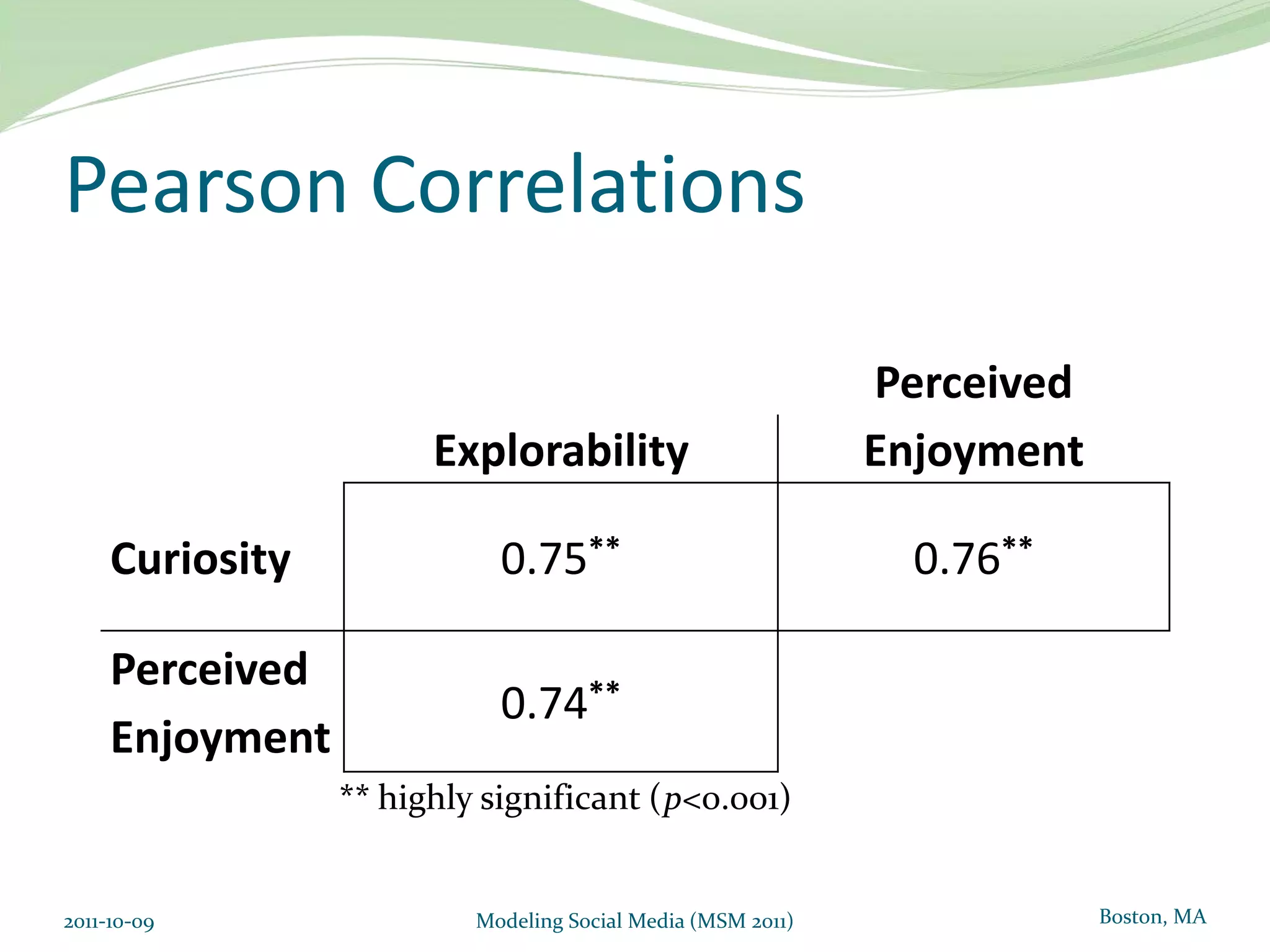
Pearson Correlations2011-10-09Modeling Social Media (MSM 2011)** highly significant ( p<0.001)
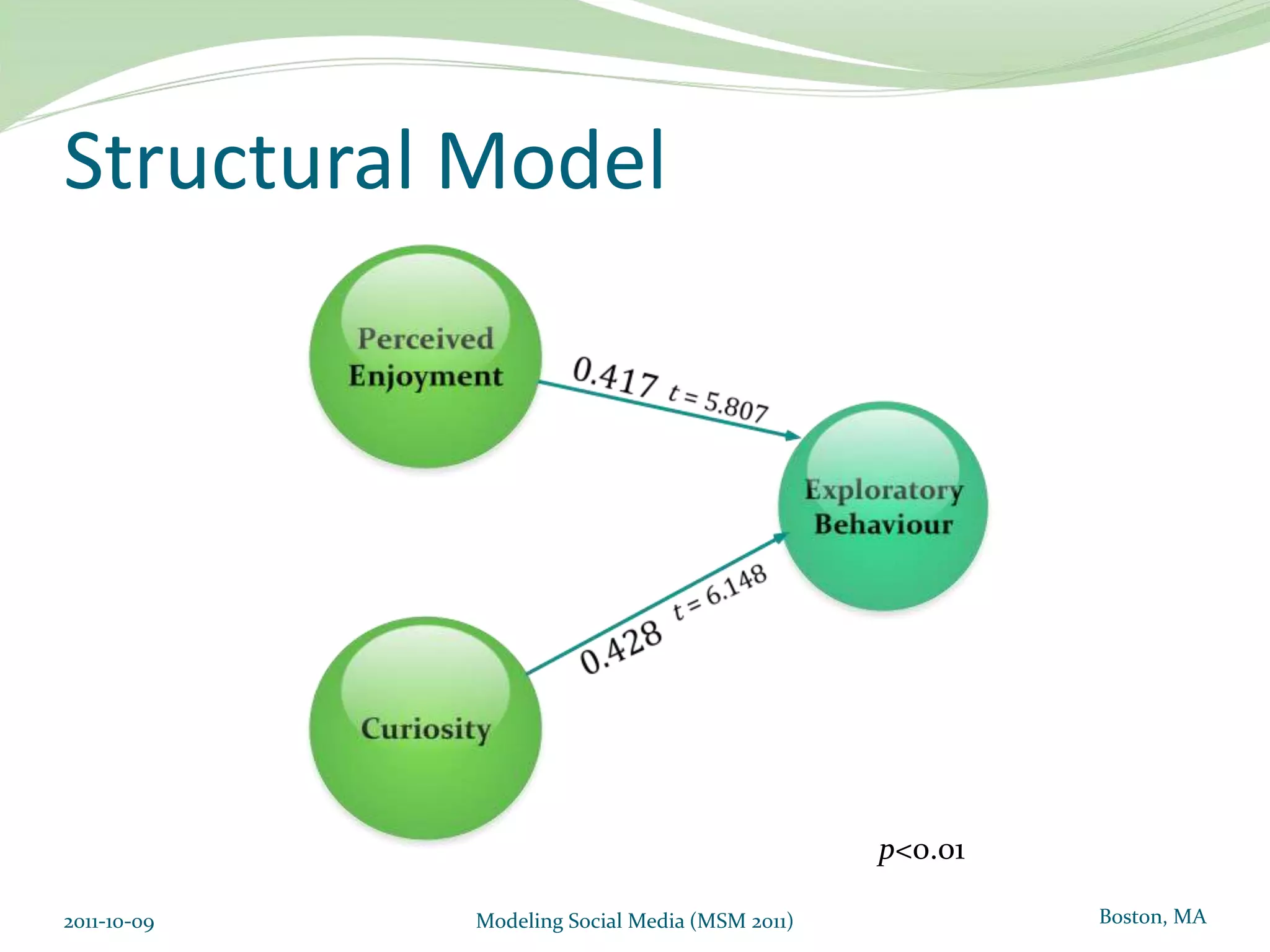
Structural Model2011-10-09Modeling Social Media (MSM 2011)p<0.01
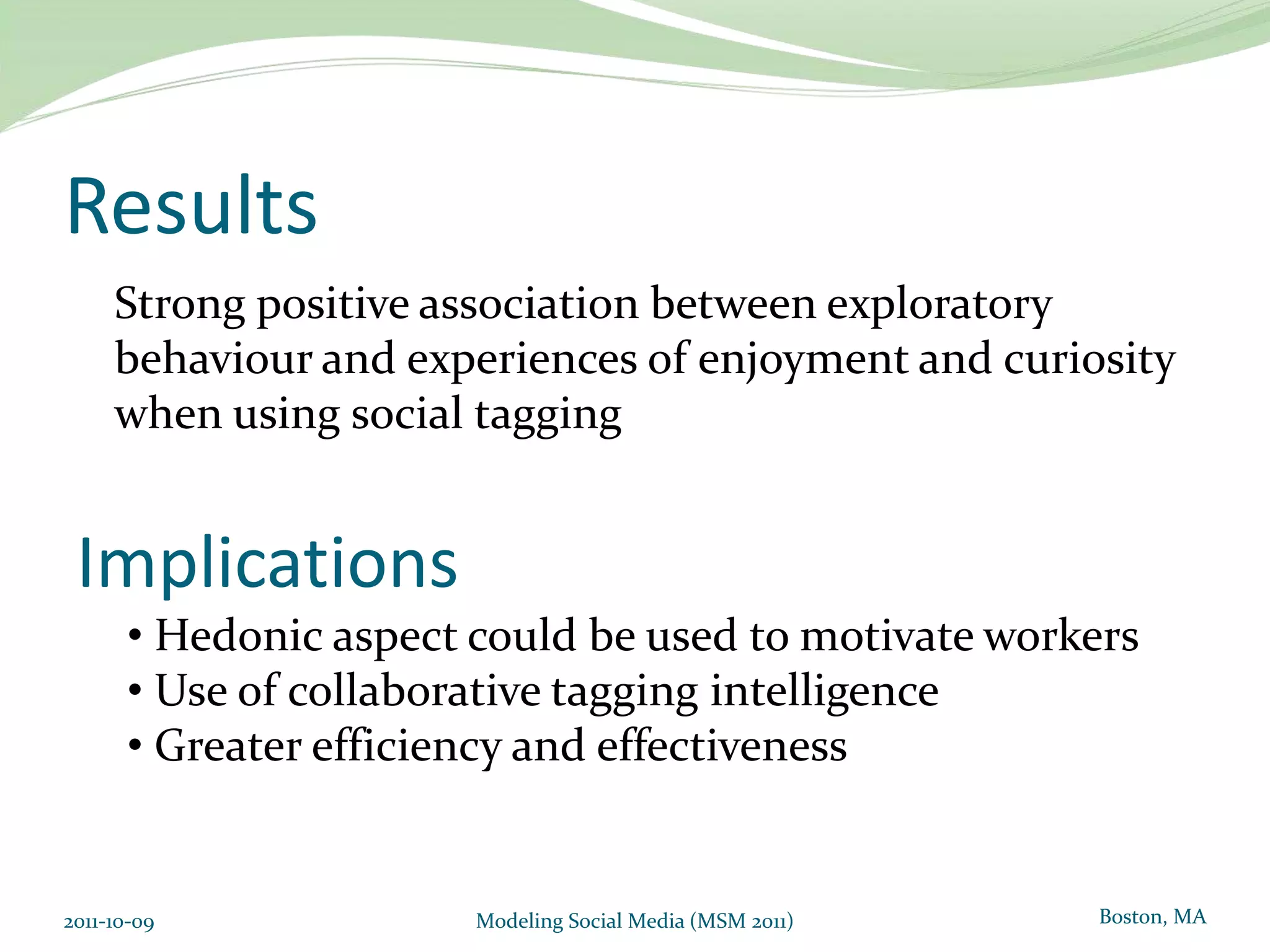
ResultsStrong positive association between exploratory behaviour and experiences of enjoyment and curiosity when using social tagging 2011-10-09Modeling Social Media (MSM 2011)Implications Hedonic aspect could be used to motivate workers
 Use of collaborative tagging intelligence
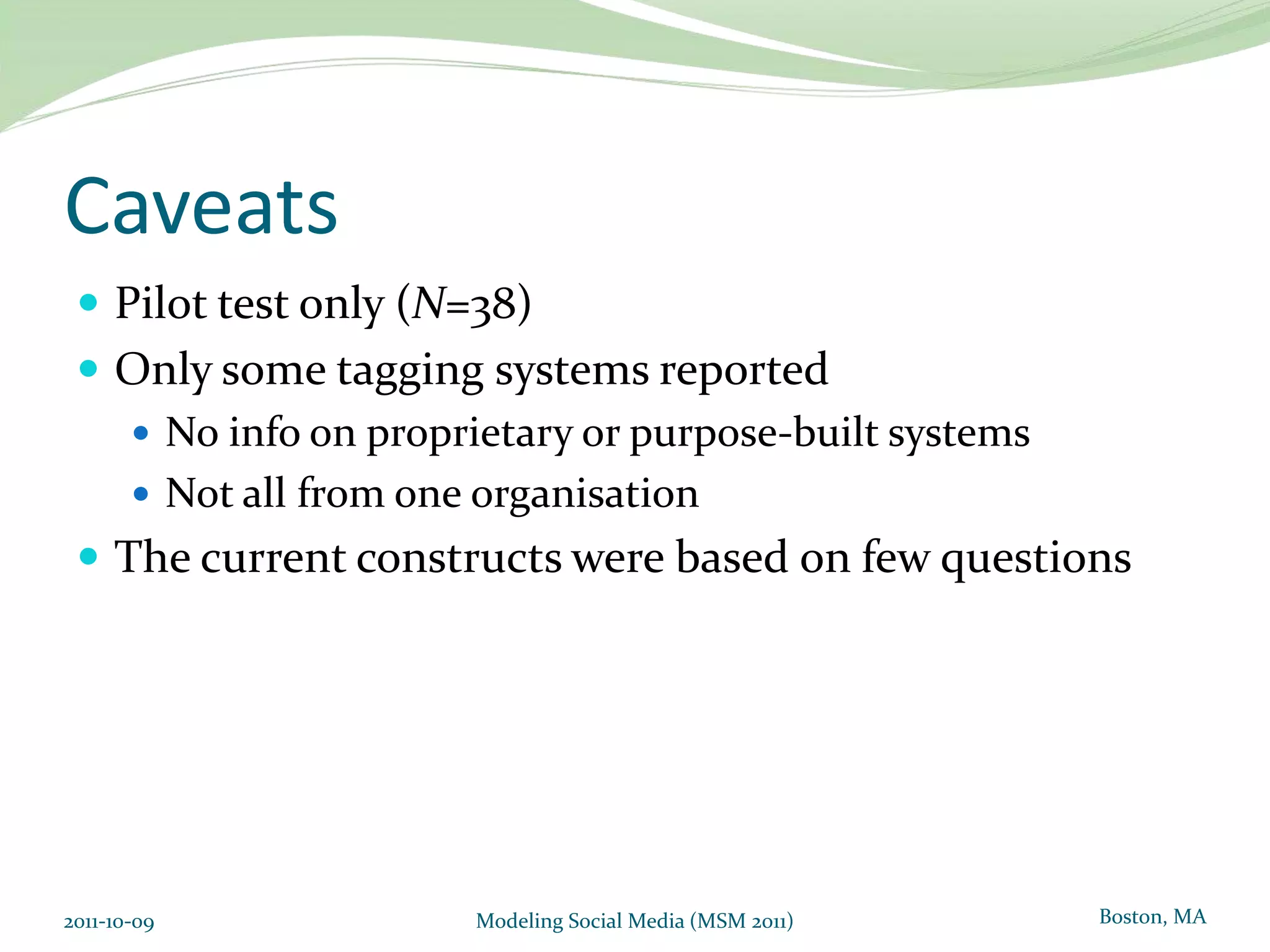
 Greater efficiency and effectivenessCaveatsPilot test only (N=38)Only some tagging systems reportedNo info on proprietary or purpose-built systemsNot all from one organisationThe current constructs were based on few questions2011-10-09Modeling Social Media (MSM 2011)

Enhancing Exploratory Search with Hedonic Browsing Using Social Tagging Tools

  • 1.
    Enhancing Exploratory Searchwith Hedonic BrowsingUsing Social Tagging ToolsHesham Allam, James Blustein,Louise Spiteri, & Michael Bliemel2nd International Workshop on Modeling Social Media (MSM 2011)
  • 2.
    AgendaIntroductionDefinitionsExploratory SearchSocial TaggingProposedHedonic ModelMethodResults and ImplicationsStudy Limitations and Future Research2011-10-09Modeling Social Media (MSM 2011)
  • 3.
    Exploratory Search is…Acomplex set of search activitieswithin an Information Retrieval systemUsed to broadly explore a topic of interest (Wilson, 2007)Used whenSearch goal is not clearSearching for something complexSearchers are not satisfied with results from traditional search systems2011-10-09Modeling Social Media (MSM 2011)
  • 4.
    Social Tagginga featureof various online social networksto organize information elementsby enabling people to label, annotate, or tag info resourcesMain uses of tagging tools:To organize resources using the WWWWebsites in Delicious and StumbleUpon Photos in Flickr Music and video files in Last.fm and YouTube Books in Amazon.com and LibraryThingFor information discovery, sharing, and social ranking2011-10-09Modeling Social Media (MSM 2011)
  • 5.
    Proposed Model (HedonicSearch)2011-10-09Modeling Social Media (MSM 2011)Perceived EnjoymentH1ExploratoryBehaviourCuriosityH2H1: Perceived enjoyment has a positive impact on exploration of social tagging  H2: Curiosity has a positive impact on exploration of social tagging
  • 6.
    MethodSince our studyis exploratory in essence, we used Structural Equation Modeling (SEM)SEM is an approach used for identifying and estimating models of linear relationships among measured (Explorability) and latent variables (Enjoyment and Curiosity)We also used the bootstrapping approach to assess the t-value significance (in our case t-value = 3.57 for p≤0.01).2011-10-09Modeling Social Media (MSM 2011)
  • 7.
    MethodExploratory study Structural Equation Modeling (SEM)For identifying and estimating models of linear relationships among measured (Explorability) and latent variables (Enjoyment and Curiosity)We also used the bootstrappingTo assess the t-value significance(in our case t-value = 3.57 for p≤0.01).2011-10-09Modeling Social Media (MSM 2011)
  • 8.
    MethodSurvey Questions UsedCovering Hedonic Factors2011-10-09Modeling Social Media (MSM 2011)
  • 9.
    Respondents’ Profiles(N =38)2011-10-09Modeling Social Media (MSM 2011)
  • 10.
  • 11.
    Pearson Correlations2011-10-09Modeling SocialMedia (MSM 2011)** highly significant ( p<0.001)
  • 12.
  • 13.
    ResultsStrong positive associationbetween exploratory behaviour and experiences of enjoyment and curiosity when using social tagging 2011-10-09Modeling Social Media (MSM 2011)Implications Hedonic aspect could be used to motivate workers
  • 14.
    Use ofcollaborative tagging intelligence
  • 15.
    Greater efficiencyand effectivenessCaveatsPilot test only (N=38)Only some tagging systems reportedNo info on proprietary or purpose-built systemsNot all from one organisationThe current constructs were based on few questions2011-10-09Modeling Social Media (MSM 2011)
  • 16.
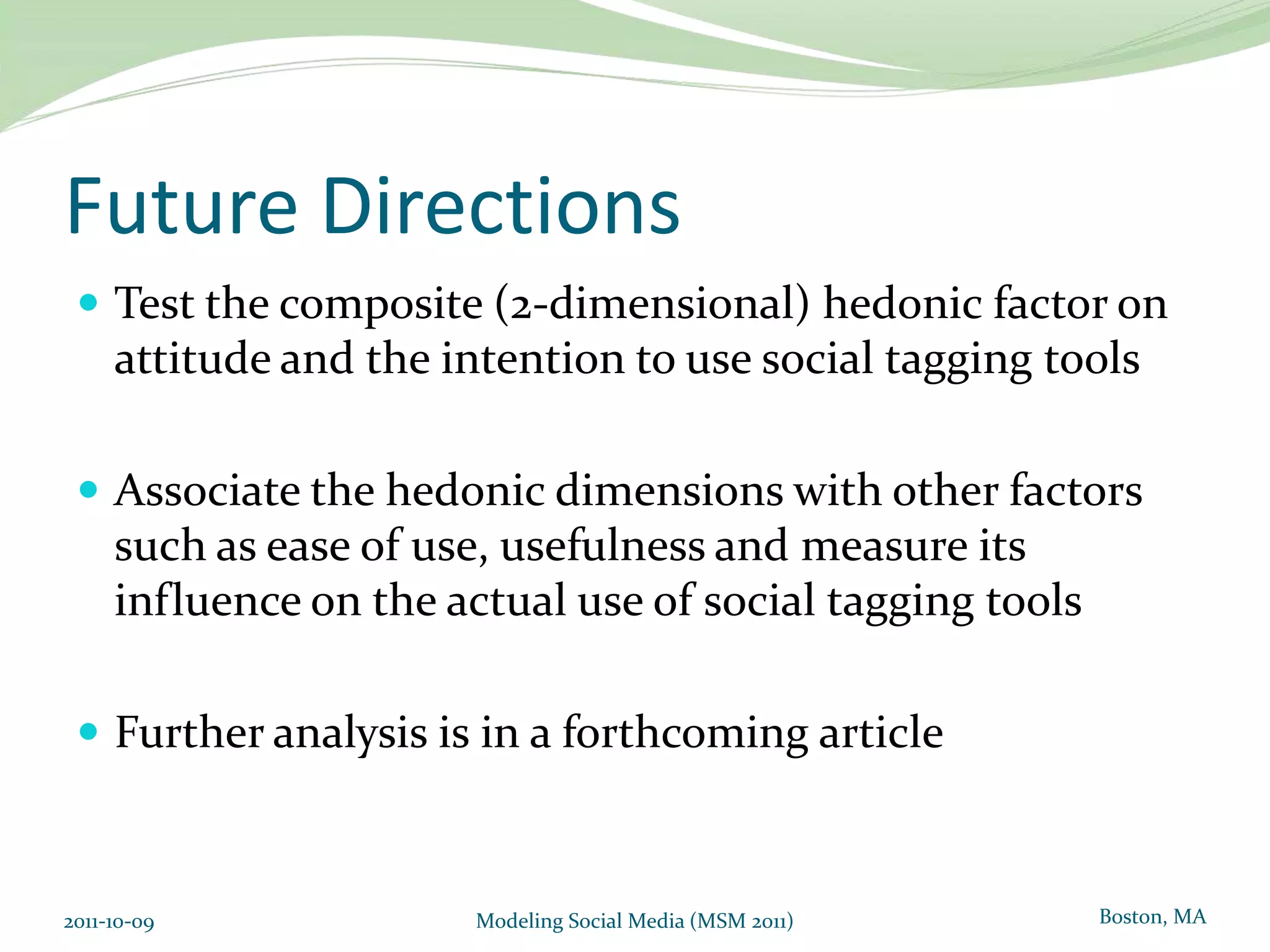
    Future DirectionsTest thecomposite (2-dimensional) hedonic factor on attitude and the intention to use social tagging toolsAssociate the hedonic dimensions with other factors such as ease of use, usefulness and measure its influence on the actual use of social tagging toolsFurther analysis is in a forthcoming article2011-10-09Modeling Social Media (MSM 2011)
  • 17.
  • 18.
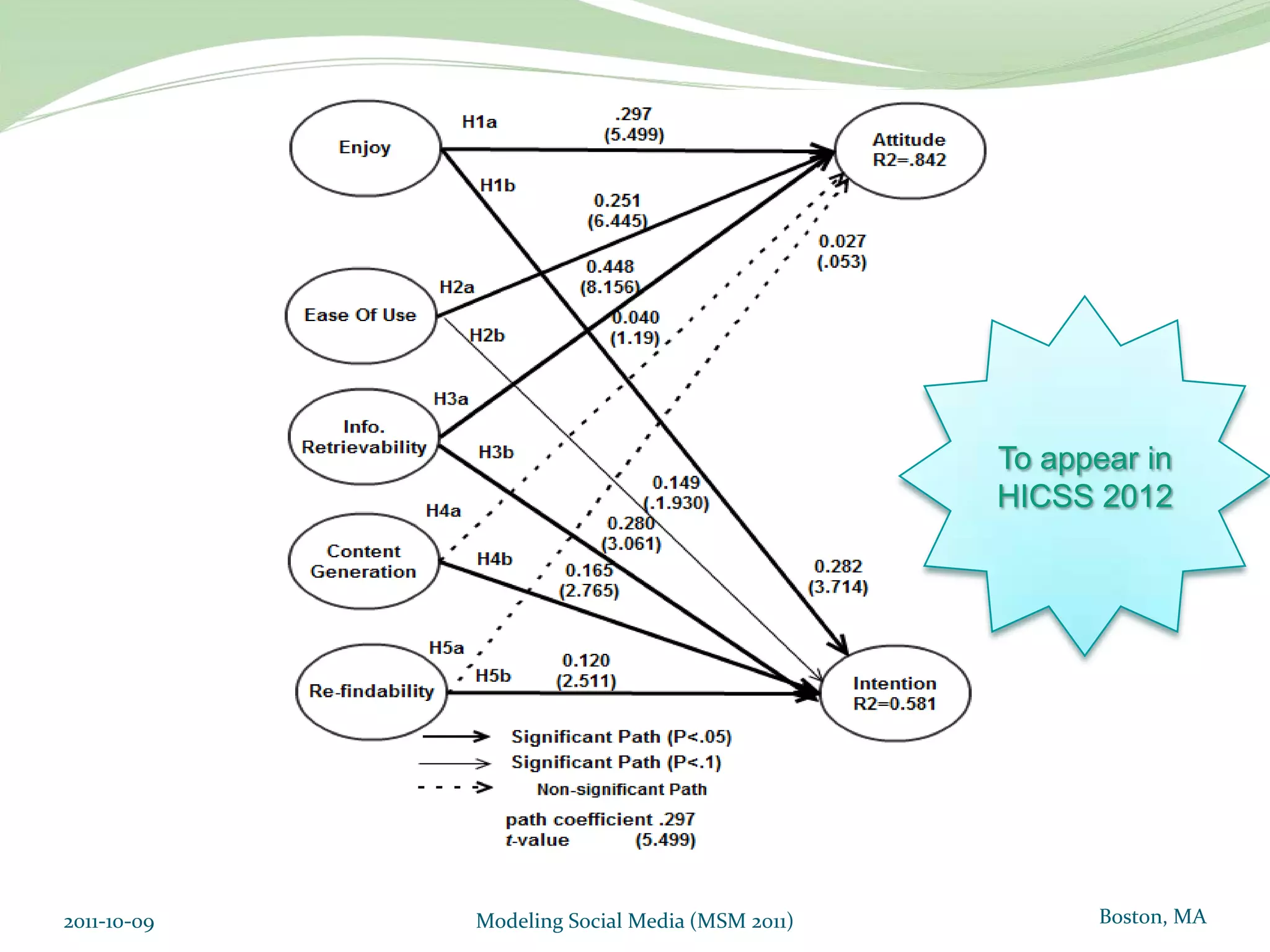
    2011-10-09Modeling Social Media(MSM 2011)To appear in HICSS 2012

Editor's Notes

  • #2 IntroductionDefinitionsExploratory SearchSocial TaggingProposed Hedonic ModelMethodResults and ImplicationsStudy Limitations and Future Research
  • #4 In recent years, there has been a shift in search system designs toward larger search tasks rather than the more traditional approach of matching users’ queriesUsers’ role is changing from mere receivers of information to explorers seeking to learn and discover new and unanticipated relevant informationTags have the potential to improve exploratory search and discovery of information resourcesWe introduce hedonicbrowsing through social tagging as an enhancer for exploratory search
  • #6 The term hedonic derives from the word hedonism, a term used to denote the doctrine that pleasure or happiness is the chief good in life (Merriam-Webster, 2011)Curiosity as the strength of one’s belief that interactions with social tagging tools and tags will fulfill the users’ intrinsic motives of curiosityPerceived enjoyment (PE) is defined as the degree to which the activities of using computer systems are perceived to be enjoyable regardless of the anticipated performance of the system ‘Davis [11] definedperceived usefulness as “the degree of which a person believes that using a particular system would enhance his or her job performance”andperceived ease of use as “the degree of which a person believes that using a particular system would be free of effort.”’ [Moon &amp; Kim [11] F.D. Davis Jr., Perceived usefulness, perceived ease of use, and user acceptance of information technology, MIS Quarterly 13 (3), 1989, pp. 319-340.]
  • #9 Online survey stayed for 3 days. Eight questions asked about users’ perception and experience when interacting with social tagging systems with a focus on three concepts: Curiosity, Enjoyment, and Explorability.J.-W. Moon &amp; Y.-G. Kim (2001) Information &amp; Management38:217-230F. D. Davis et al.(1992) Journal of Applied Social Psychology 22(14):1111-1132
  • #13 Notes from HeshamBasically we do the t-test to make sure that results from the structural model are correct and that the R2 that was produced is not misleading. It is another way to test the influence of our independent factors on our dependent factors and make sure that there are no other influences that could have interfered to skew the results. The t-statistics test and t-value were based on the bootstrap approach of randomly re-sampling the data into 5000 iterations to see if we can get the same results in numerous occasions.  We extract the t-value from the bootstrap analysis and compare it to our calculated critical t-value to see how confident we are that our factors are statistically significant.I calculated the critical t-value based on my sample size of 38 responses and it came out 3.57 which corresponded to .01 significance level with the possibility of errors very low. Any t-value reported by the bootstrap technique higher than 3.57 it means that our confidence level is even higher than the required critical t-value 3.57For example, our two independent variables Enjoyment and Curiosity scored 6.148 and 5.807 (respectively) which are both higher than 3.57. These scores are in line with the path coefficient results that were produced from the structural model (.428 and .417). This means that our two variables can predict the occurrence of our dependent variable (Explorability) with .01 confidence level.
  • #14 Organizations could use hedonic aspect to motivate employees to complete work-related tasks more effectively and efficiently by using collaborative tagging intelligence features
  • #17 The image on this slide is licensed from iStockphoto.com. It may not be distributed with the rest of the slides.
  • #18 N = 174