What’s New in MongoDB 3.2
Mat Keep
Director, Product Marketing, MongoDB
Andrew Morgan
Principal Product Marketing Manager, MongoDB
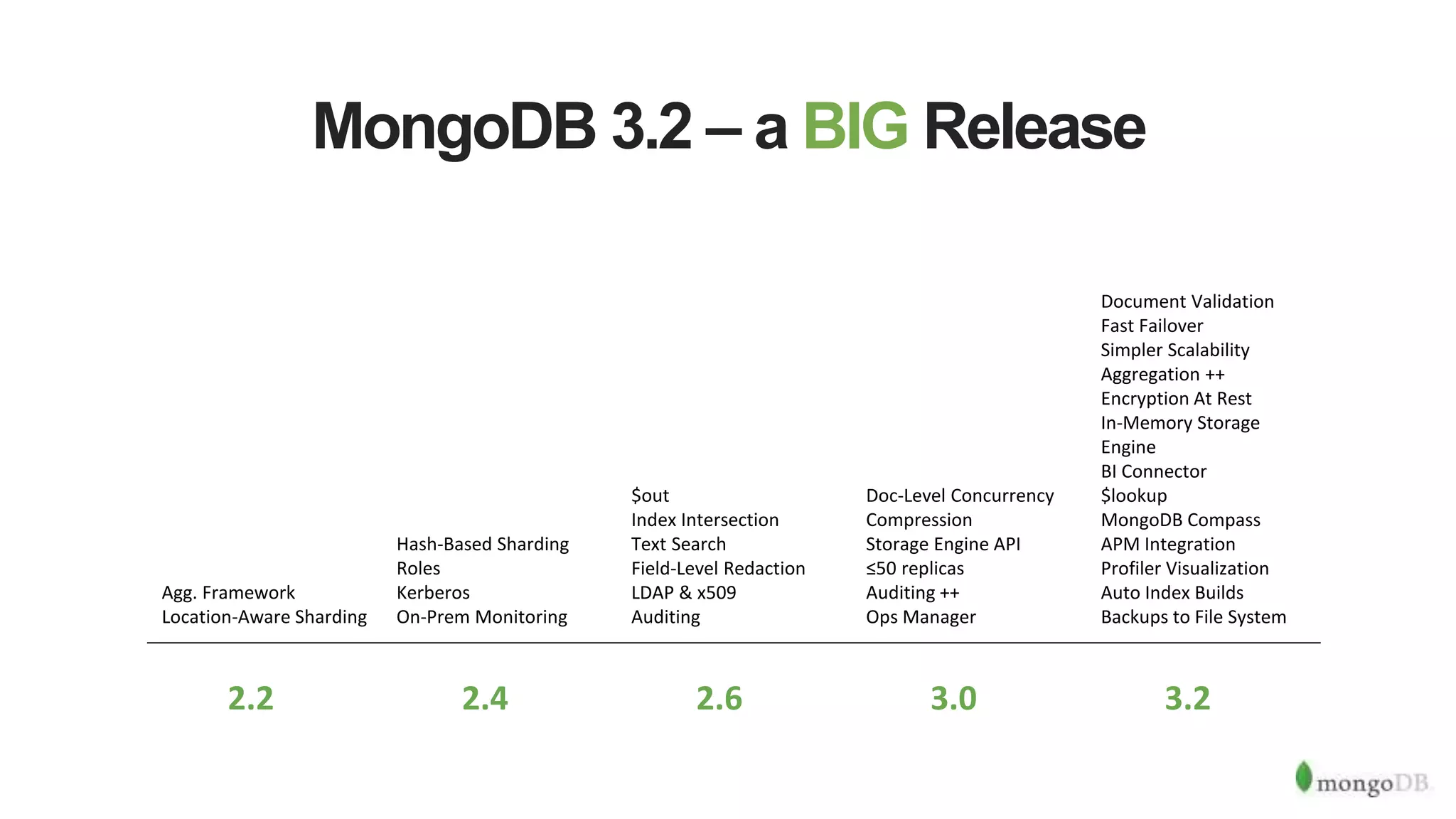
MongoDB 3.2 – a BIG Release
Hash-Based Sharding
Roles
Kerberos
On-Prem Monitoring
2.2 2.4 2.6 3.0 3.2
Agg. Framework
Location-Aware Sharding
$out
Index Intersection
Text Search
Field-Level Redaction
LDAP & x509
Auditing
Document Validation
Fast Failover
Simpler Scalability
Aggregation ++
Encryption At Rest
In-Memory Storage
Engine
BI Connector
$lookup
MongoDB Compass
APM Integration
Profiler Visualization
Auto Index Builds
Backups to File System
Doc-Level Concurrency
Compression
Storage Engine API
≤50 replicas
Auditing ++
Ops Manager
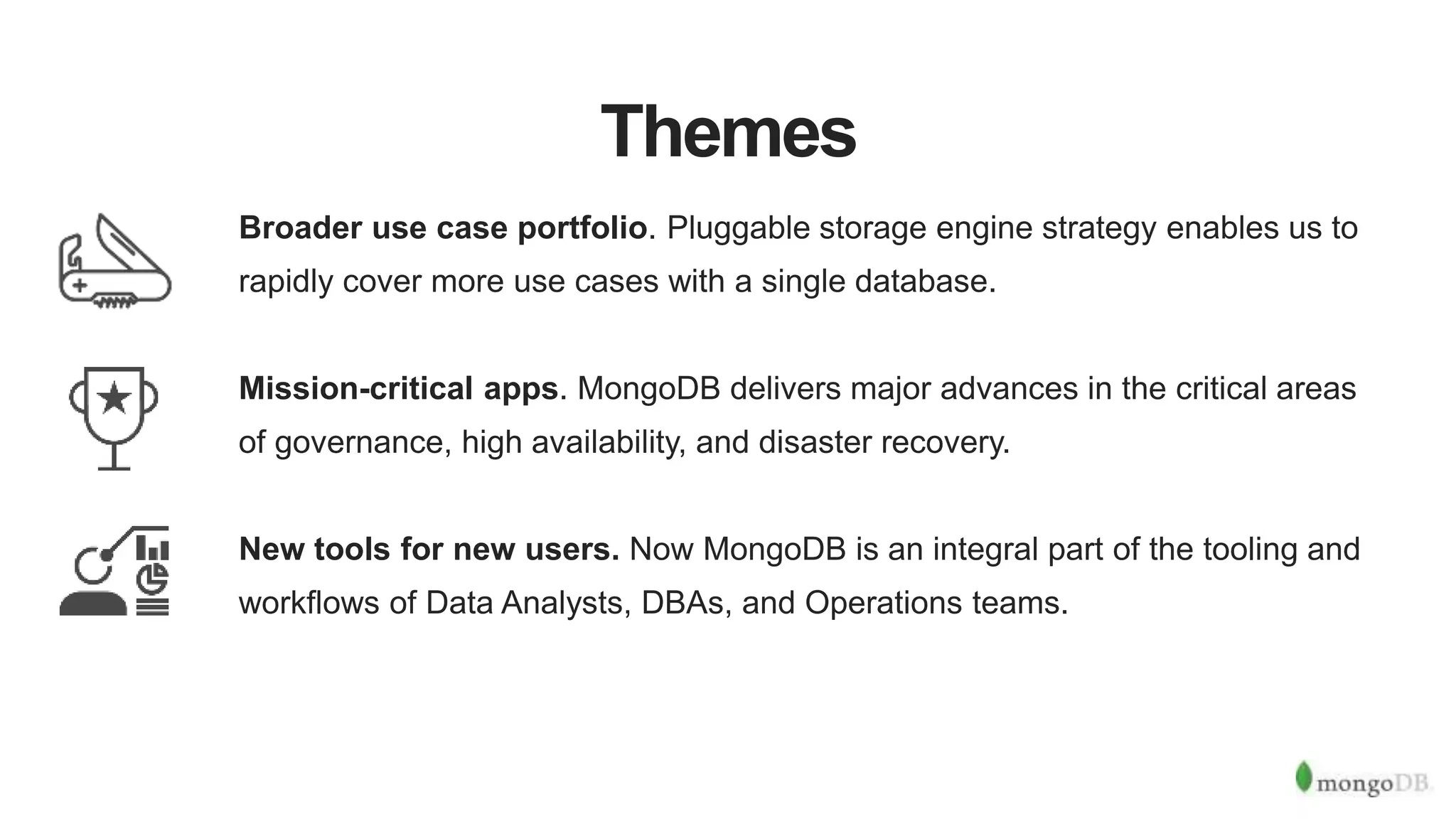
Themes
Broader use case portfolio. Pluggable storage engine strategy enables us to
rapidly cover more use cases with a single database.
Mission-critical apps. MongoDB delivers major advances in the critical areas
of governance, high availability, and disaster recovery.
New tools for new users. Now MongoDB is an integral part of the tooling and
workflows of Data Analysts, DBAs, and Operations teams.
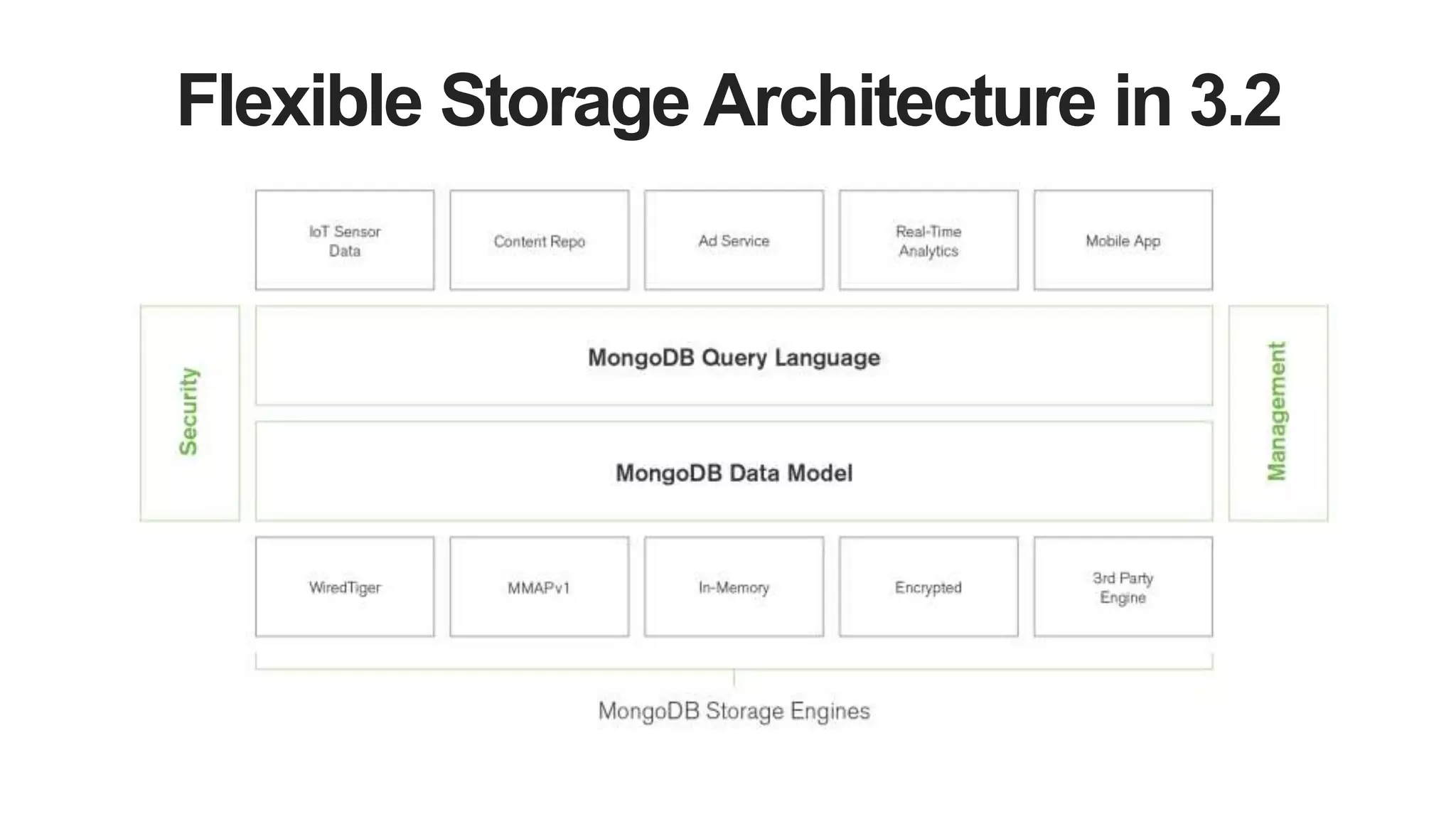
Storage Engines Broaden Use Cases
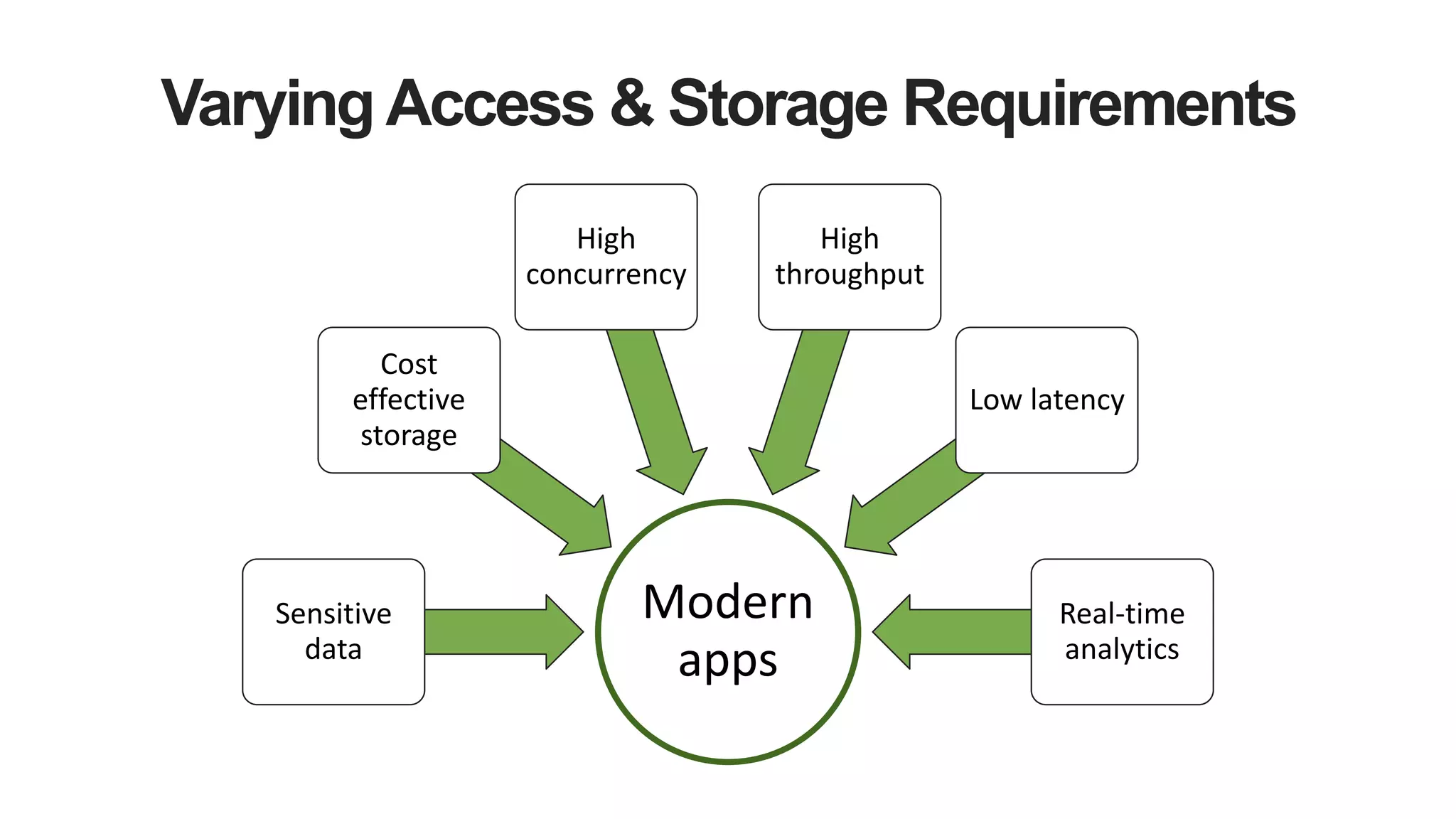
Varying Access & Storage Requirements
Modern
apps
Sensitive
data
Cost
effective
storage
High
concurrency
High
throughput
Low latency
Real-time
analytics
Flexible Storage Architecture in 3.2
WiredTiger is the New Default
WiredTiger – widely deployed with 3.0 – is
now the default storage engine for
MongoDB.
• Best general purpose storage engine
• 7-10x better write throughput
• Up to 80% compression
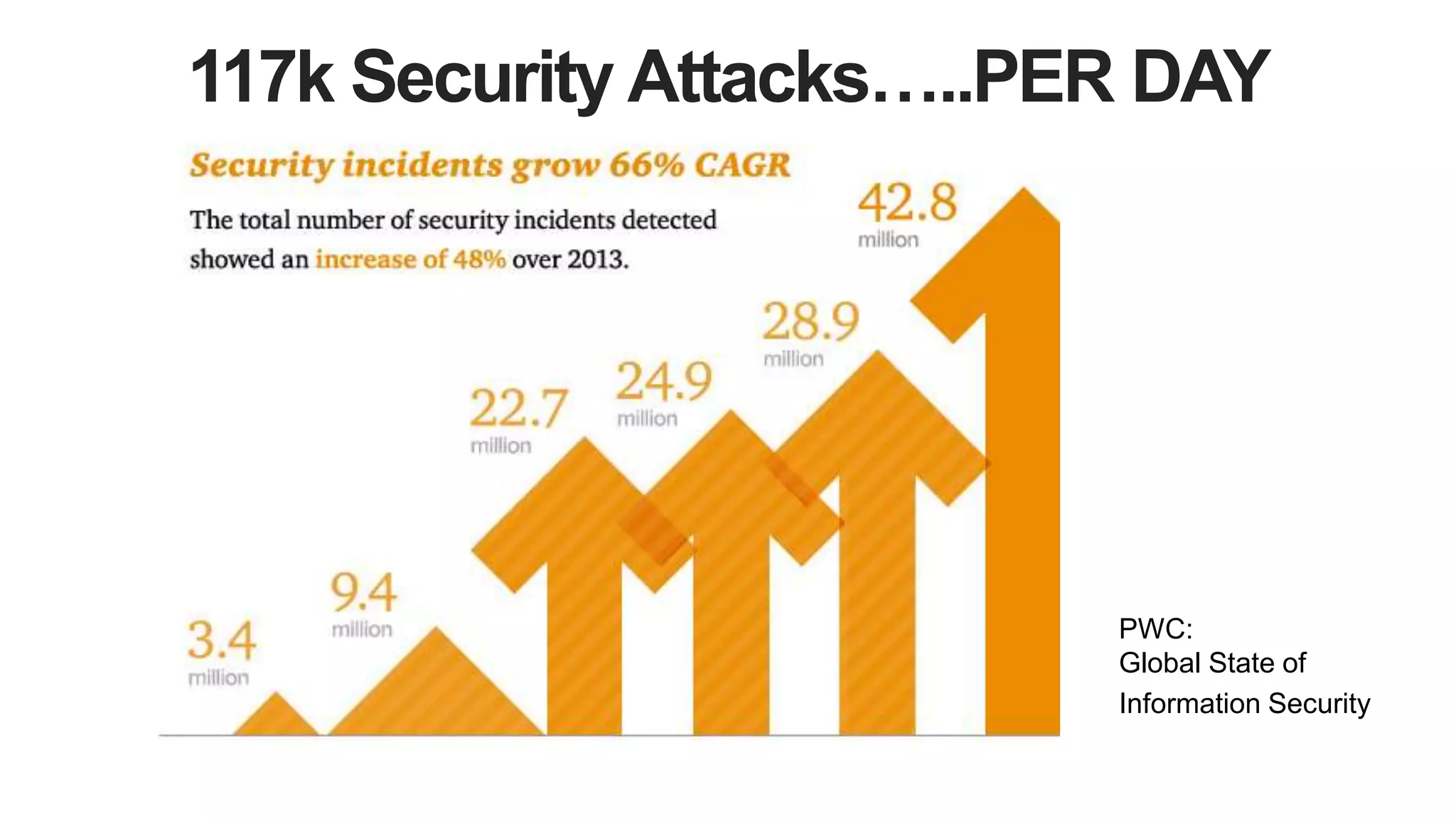
117k Security Attacks…..PER DAY
PWC:
Global State of
Information Security
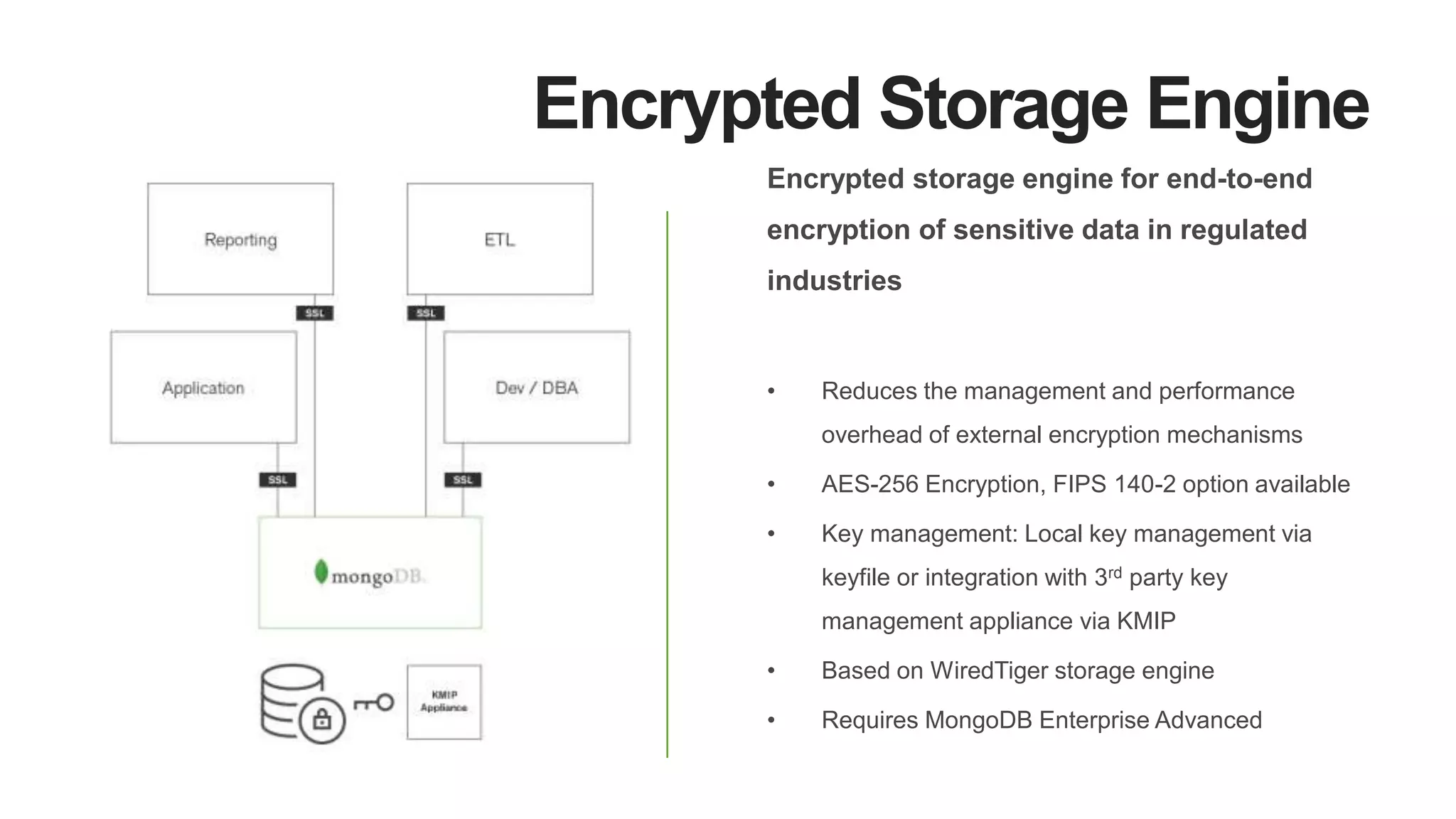
Encrypted Storage Engine
Encrypted storage engine for end-to-end
encryption of sensitive data in regulated
industries
• Reduces the management and performance
overhead of external encryption mechanisms
• AES-256 Encryption, FIPS 140-2 option available
• Key management: Local key management via
keyfile or integration with 3rd party key
management appliance via KMIP
• Based on WiredTiger storage engine
• Requires MongoDB Enterprise Advanced
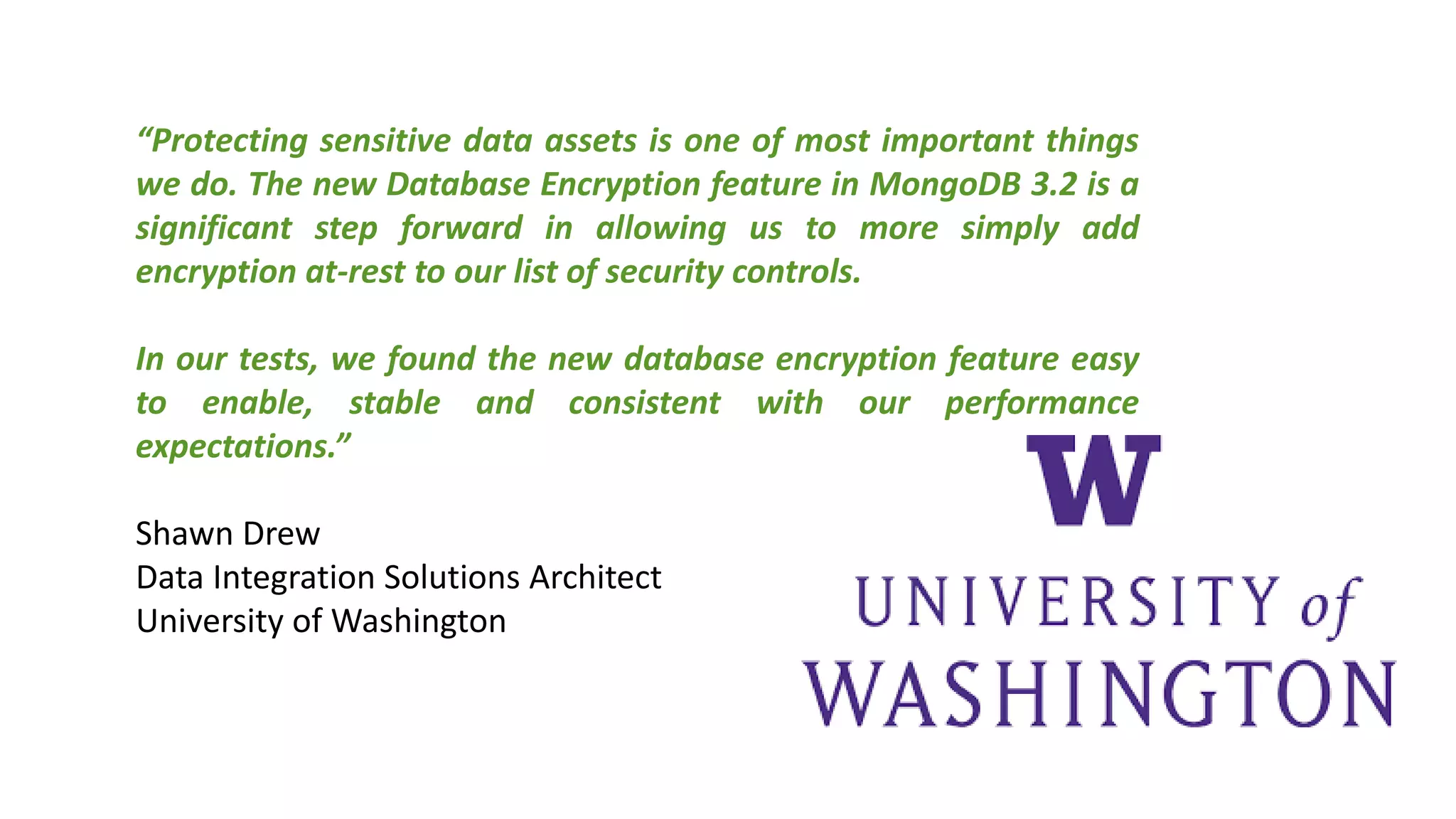
“Protecting sensitive data assets is one of most important things
we do. The new Database Encryption feature in MongoDB 3.2 is a
significant step forward in allowing us to more simply add
encryption at-rest to our list of security controls.
In our tests, we found the new database encryption feature easy
to enable, stable and consistent with our performance
expectations.”
Shawn Drew
Data Integration Solutions Architect
University of Washington
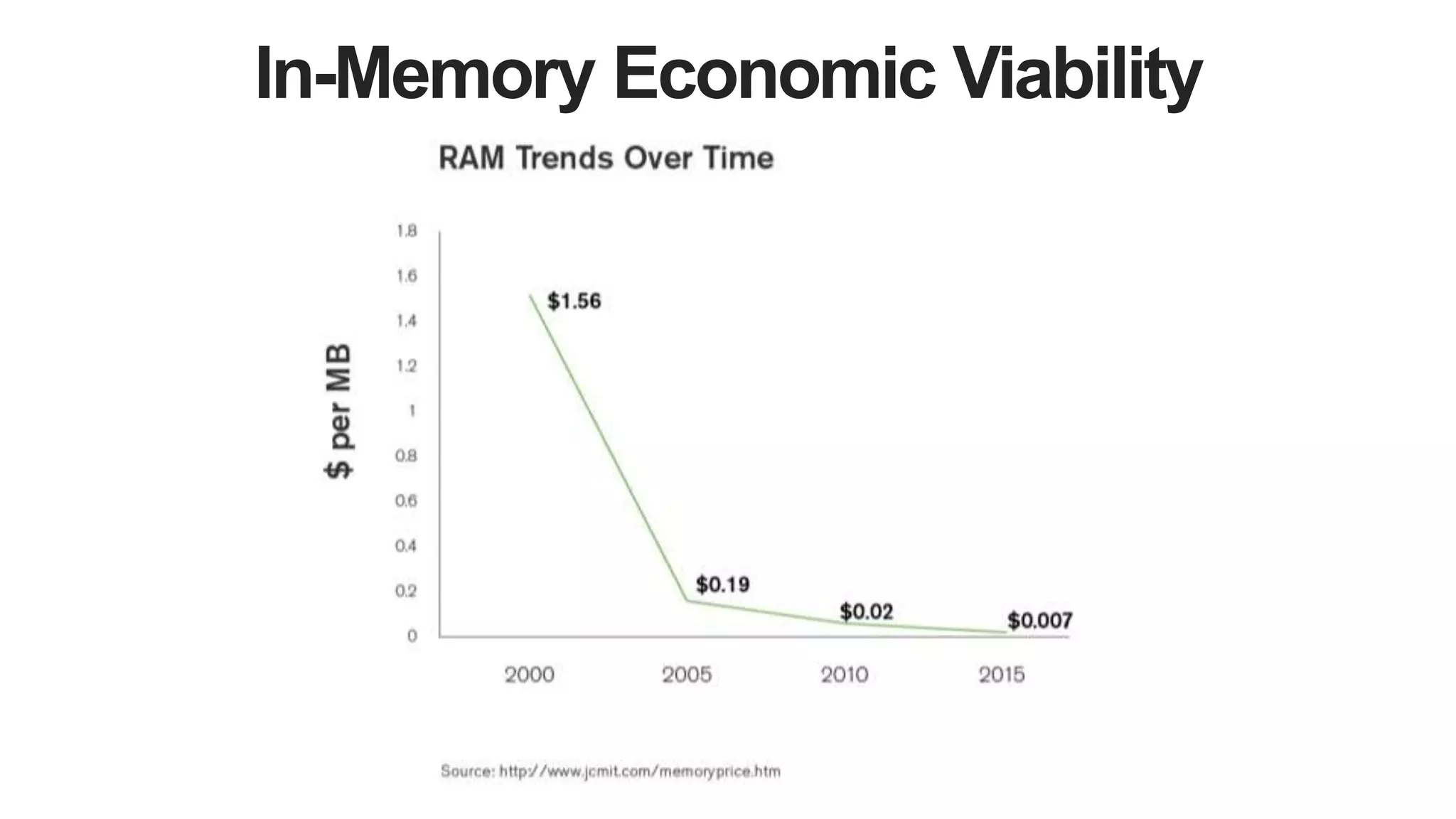
In-Memory Economic Viability
In-Memory Storage Engine (Beta)
Handle ultra-high throughput with low
latency and high availability
• Delivers the extreme throughput and predictable
latency required by the most demanding apps in
Adtech, finance, and more.
• Achieve data durability with replica set members
running disk-backed storage engine
• Available for beta testing and is expected for GA in
early 2016
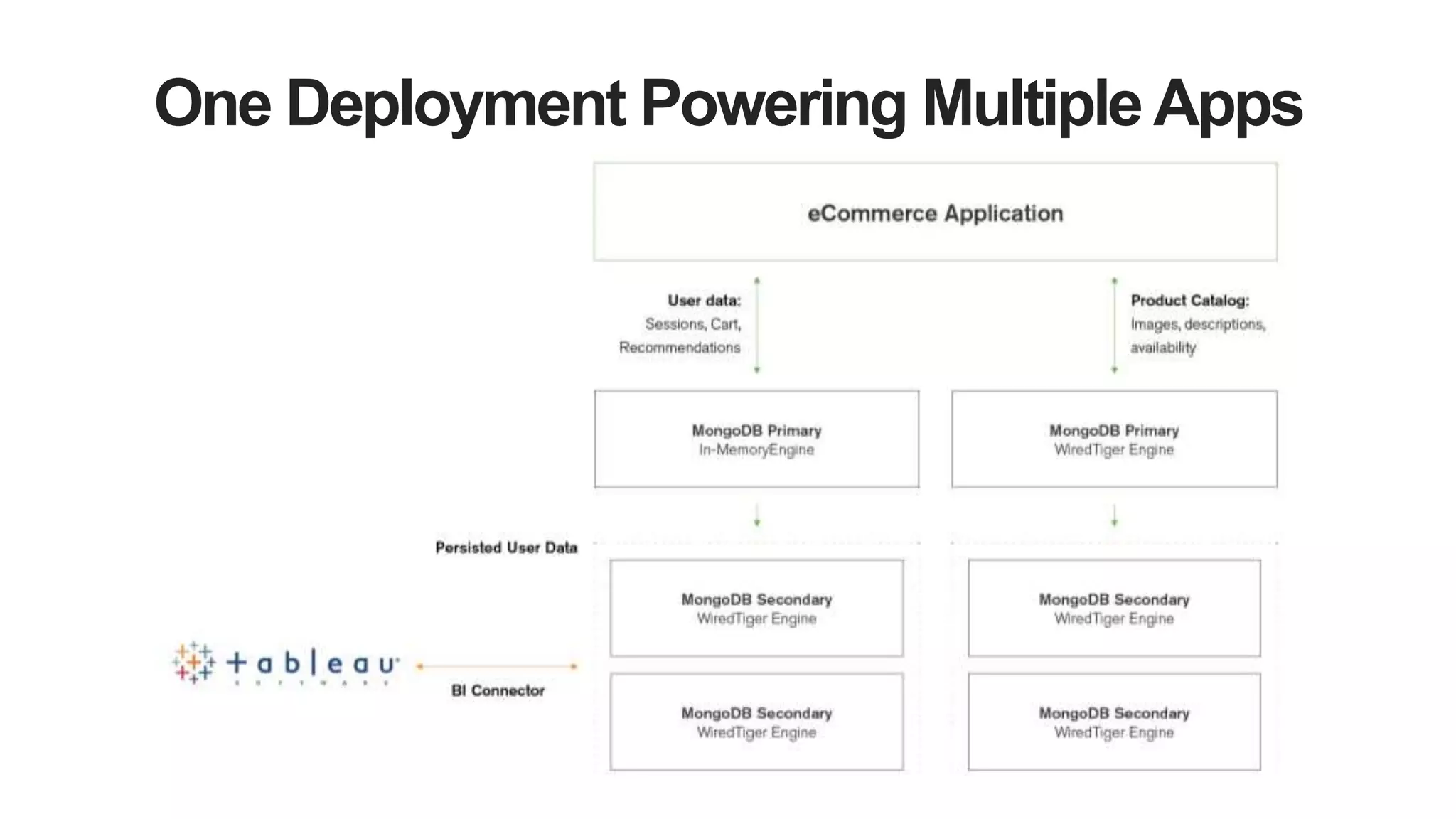
One Deployment Powering MultipleApps
Built for Mission Critical Deployments
A 10% improvement in data usability
at a Fortune 1000 company could
increase revenues by $2 BN per year
Source: University of Texas, Austin
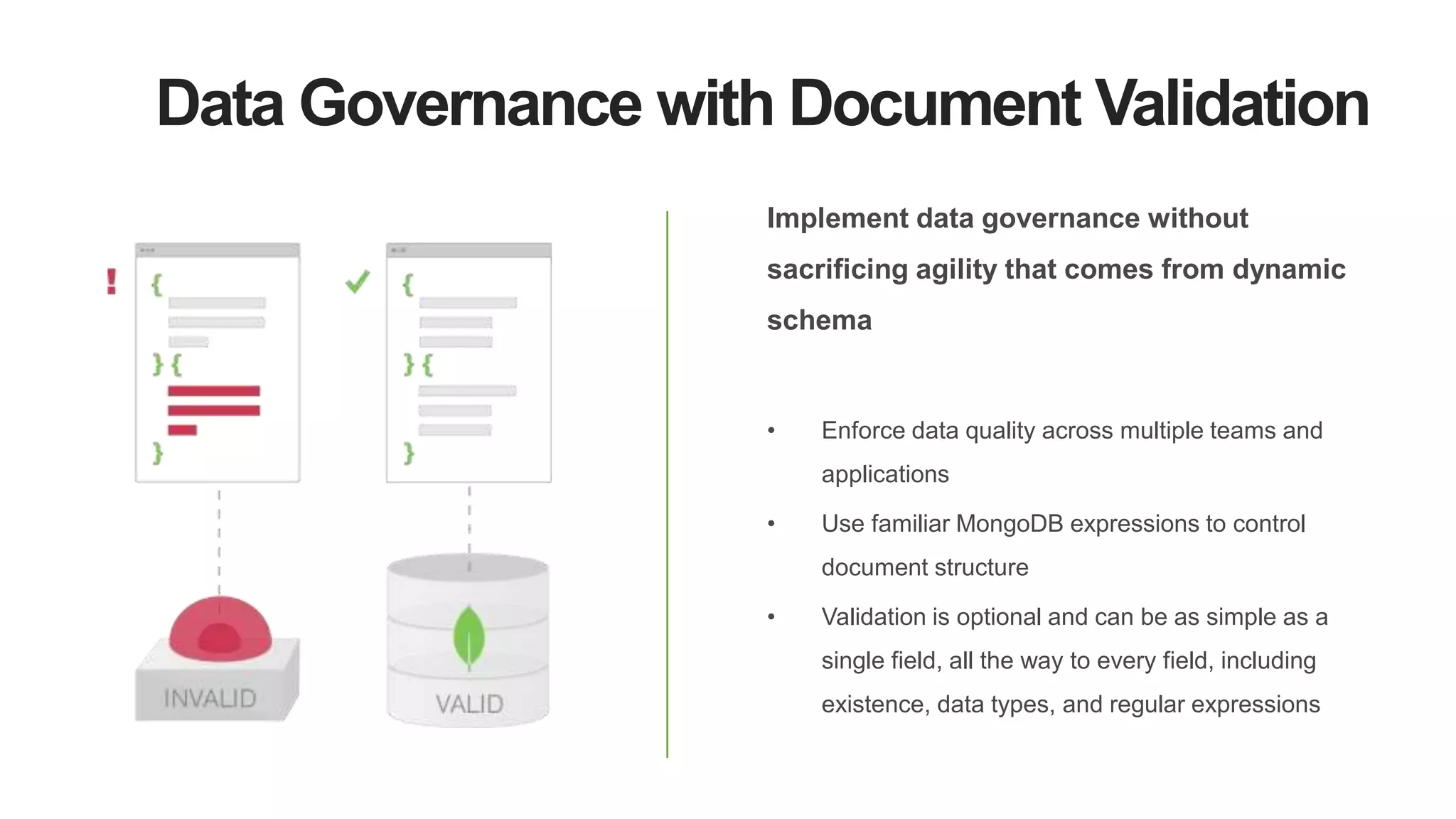
Data Governance with Document Validation
Implement data governance without
sacrificing agility that comes from dynamic
schema
• Enforce data quality across multiple teams and
applications
• Use familiar MongoDB expressions to control
document structure
• Validation is optional and can be as simple as a
single field, all the way to every field, including
existence, data types, and regular expressions
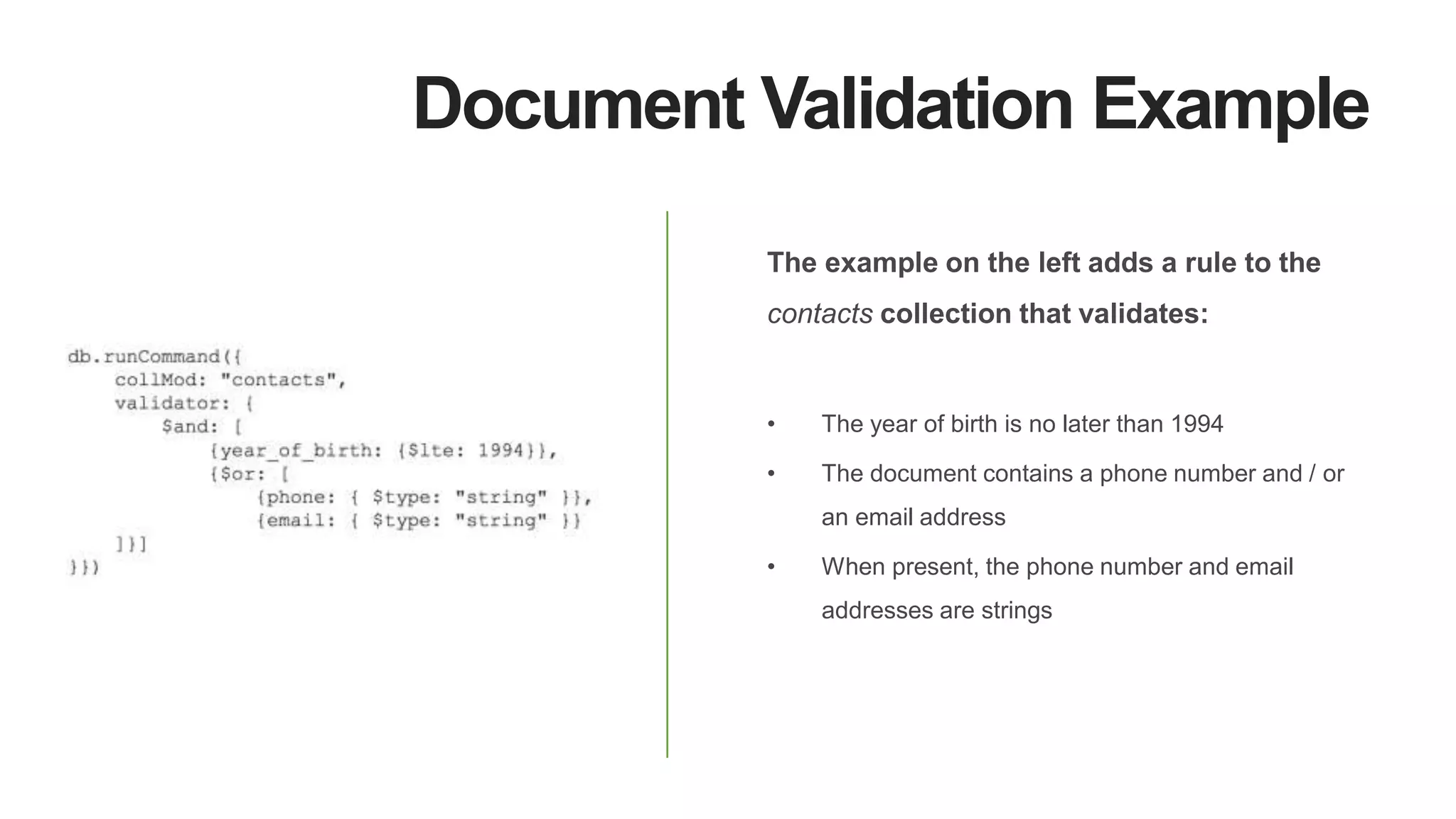
Document Validation Example
The example on the left adds a rule to the
contacts collection that validates:
• The year of birth is no later than 1994
• The document contains a phone number and / or
an email address
• When present, the phone number and email
addresses are strings
“Rocket.Chat and our other applications need to be able to quickly
access various types of data to provide a seamless solution for our
users.
With MongoDB 3.2, we will now be able to implement the data
governance we’re seeking, without sacrificing agility that comes from
dynamic schema. The newfound ability to use familiar MongoDB
expression syntax to control document structure, rather than learning a
whole new language or process, is key for us.”
Gabriel Engel
Founder and CEO
Rocket.Chat
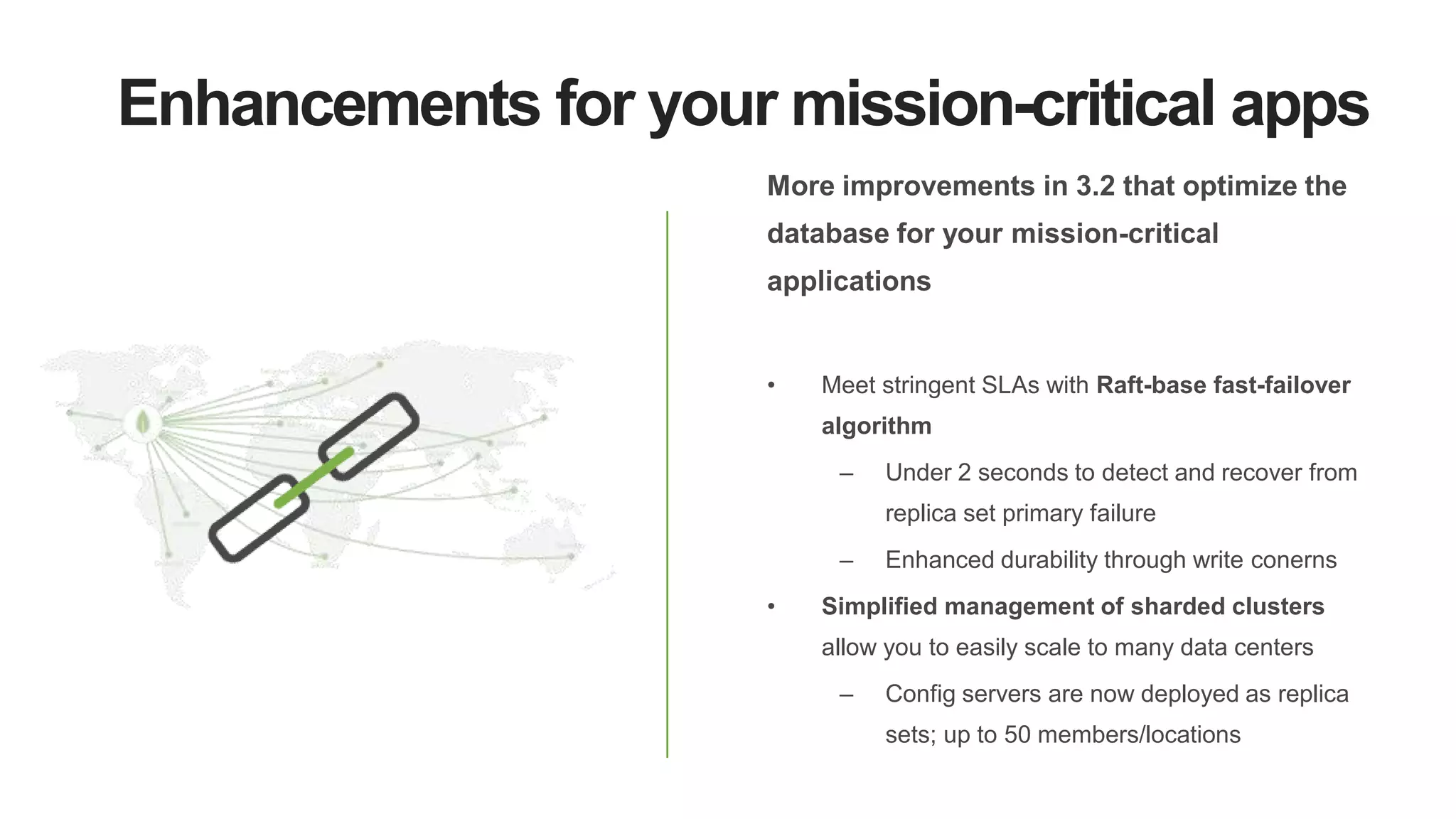
Enhancements for your mission-critical apps
More improvements in 3.2 that optimize the
database for your mission-critical
applications
• Meet stringent SLAs with Raft-base fast-failover
algorithm
– Under 2 seconds to detect and recover from
replica set primary failure
– Enhanced durability through write conerns
• Simplified management of sharded clusters
allow you to easily scale to many data centers
– Config servers are now deployed as replica
sets; up to 50 members/locations
Tools for UsersAcross Your Organization
For Business Analysts & Data Scientists
MongoDB 3.2 allows business analysts and
data scientists to support the business with
new insights from untapped data sources
• MongoDB Connector for BI
• Dynamic Lookup
• New Aggregation Operators & Improved Text
Search
Only 0.5% of data is analyzed
Source: IDC
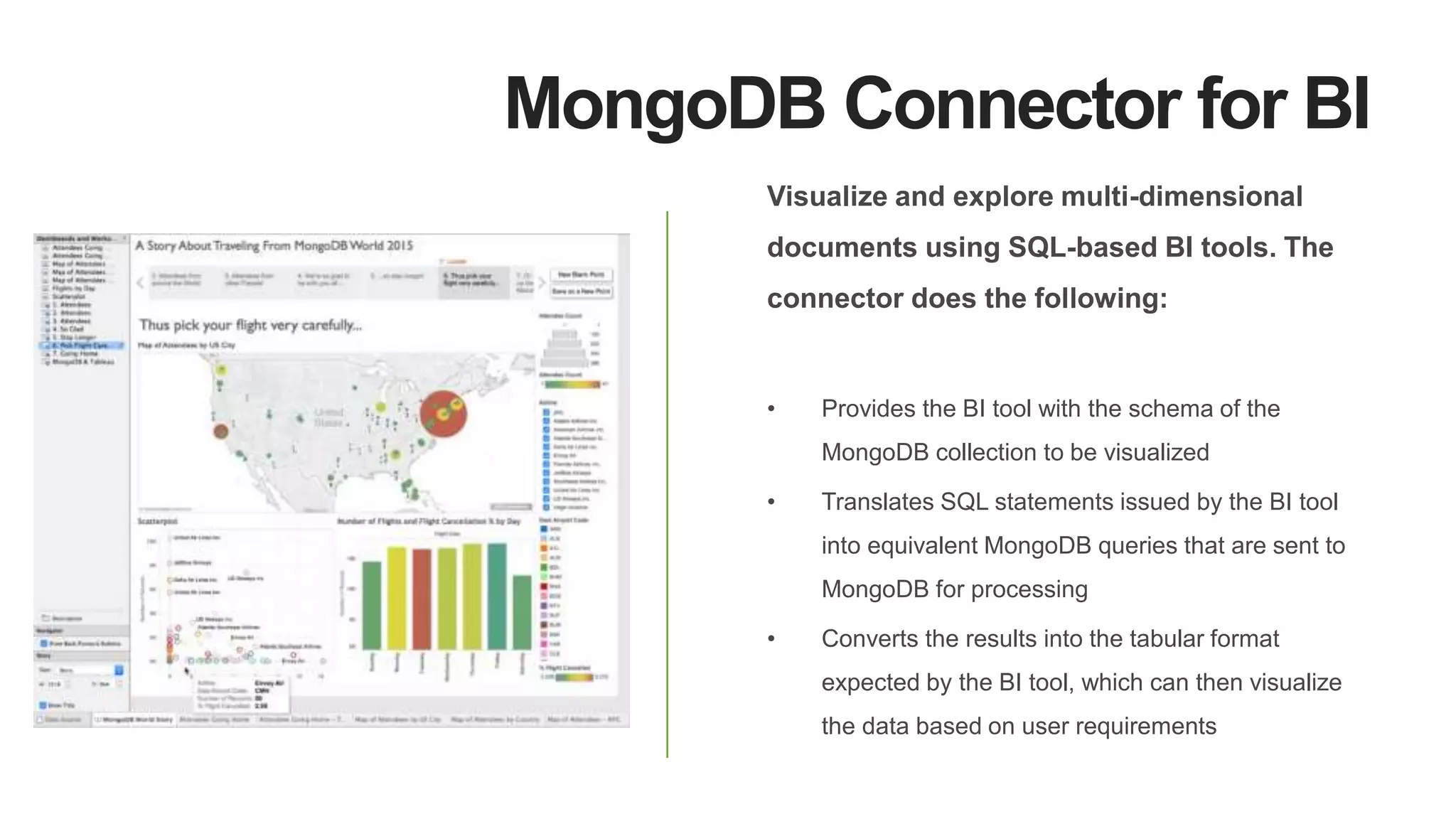
MongoDB Connector for BI
Visualize and explore multi-dimensional
documents using SQL-based BI tools. The
connector does the following:
• Provides the BI tool with the schema of the
MongoDB collection to be visualized
• Translates SQL statements issued by the BI tool
into equivalent MongoDB queries that are sent to
MongoDB for processing
• Converts the results into the tabular format
expected by the BI tool, which can then visualize
the data based on user requirements
“We are thrilled to enable Tableau users, who traditionally work with their
relational data, to fully integrate the multi-structured data stored in the
database powering modern applications via the new MongoDB BI Connector”
Jeffrey Feng
Product Manager
Tableau Software
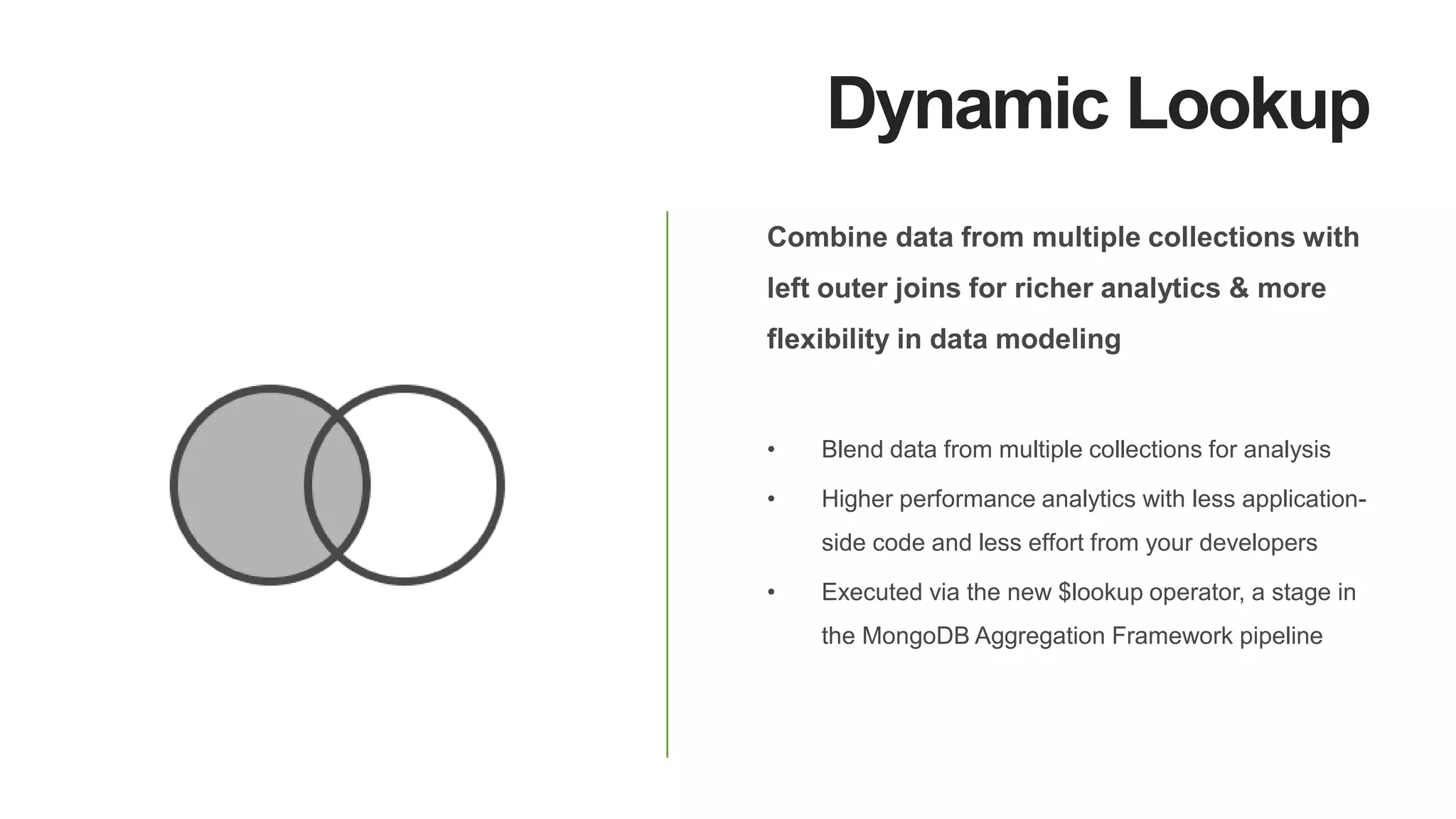
Dynamic Lookup
Combine data from multiple collections with
left outer joins for richer analytics & more
flexibility in data modeling
• Blend data from multiple collections for analysis
• Higher performance analytics with less application-
side code and less effort from your developers
• Executed via the new $lookup operator, a stage in
the MongoDB Aggregation Framework pipeline
“I am most excited by the dynamic lookups coming in MongoDB 3.2. The ability
to more easily join customer data with 3rd-party data feeds gives us more
flexibility in data modeling, and simplifies the real-time analytics we rely on to
constantly improve our value to our customers.”
David Strickland
CTO
MyDealerLot
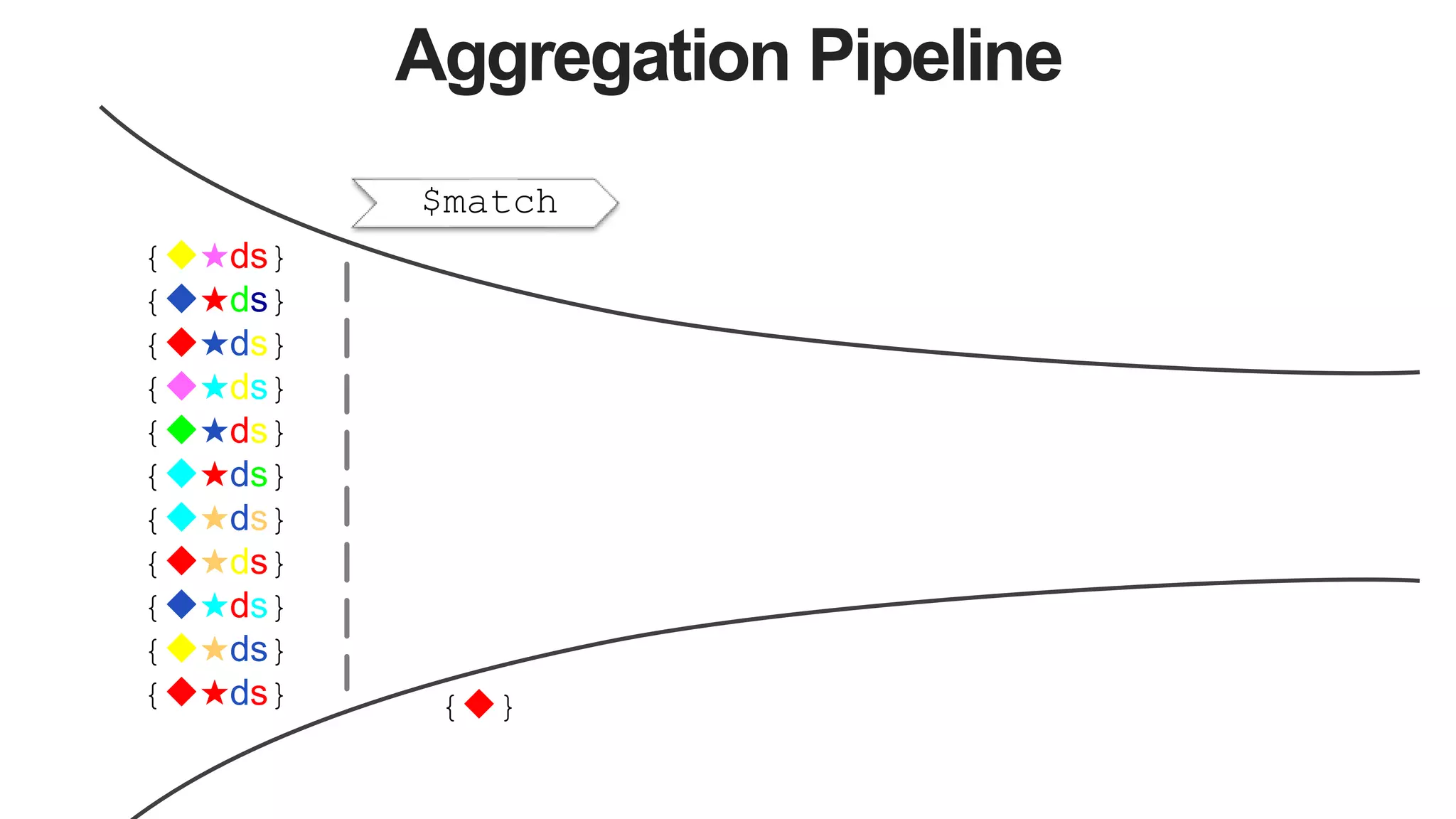
Aggregation Pipeline
{★ds}
{★ds}
{★ds}
{★ds}
{★ds}
{★ds}
{★ds}
{★ds}
{★ds}
{★ds}
{★ds}
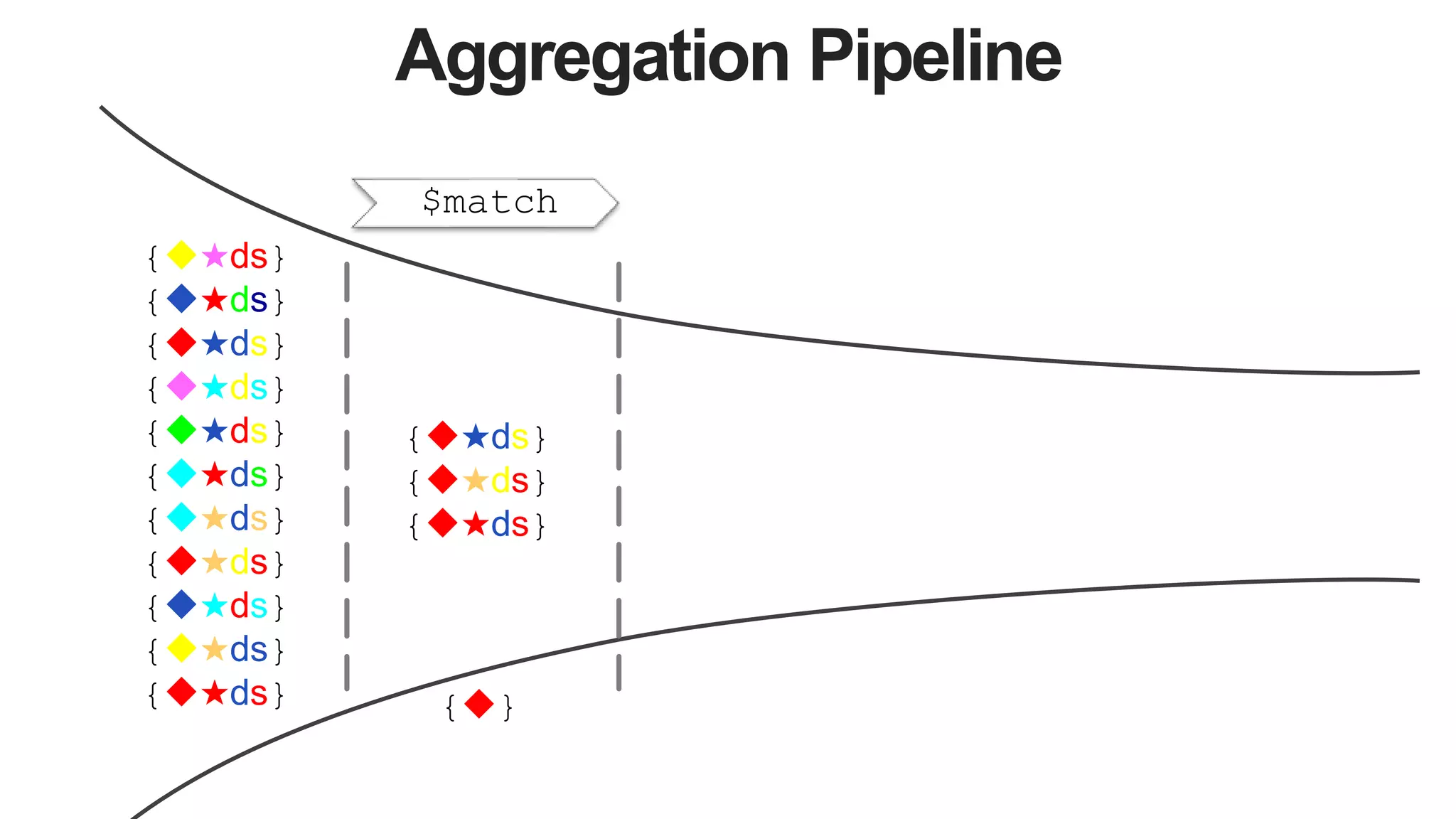
Aggregation Pipeline
$match
{★ds}
{★ds}
{★ds}
{★ds}
{★ds}
{★ds}
{★ds}
{★ds}
{★ds}
{★ds}
{★ds} {}
Aggregation Pipeline
$match
{★ds}
{★ds}
{★ds}
{★ds}
{★ds}
{★ds}
{★ds}
{★ds}
{★ds}
{★ds}
{★ds} {}
{★ds}
{★ds}
{★ds}
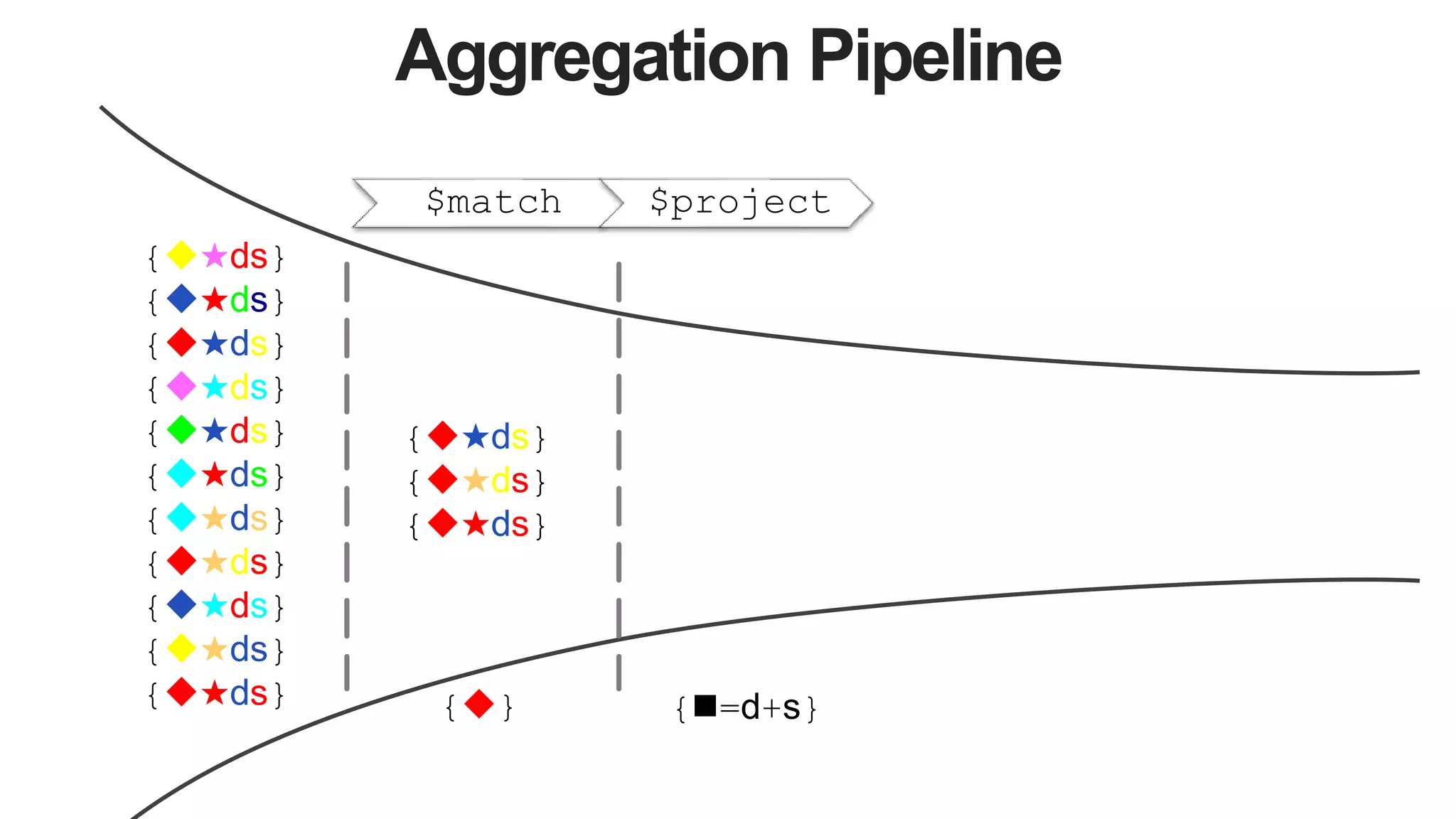
Aggregation Pipeline
$match $project
{★ds}
{★ds}
{★ds}
{★ds}
{★ds}
{★ds}
{★ds}
{★ds}
{★ds}
{★ds}
{★ds} {}
{★ds}
{★ds}
{★ds}
{=d+s}
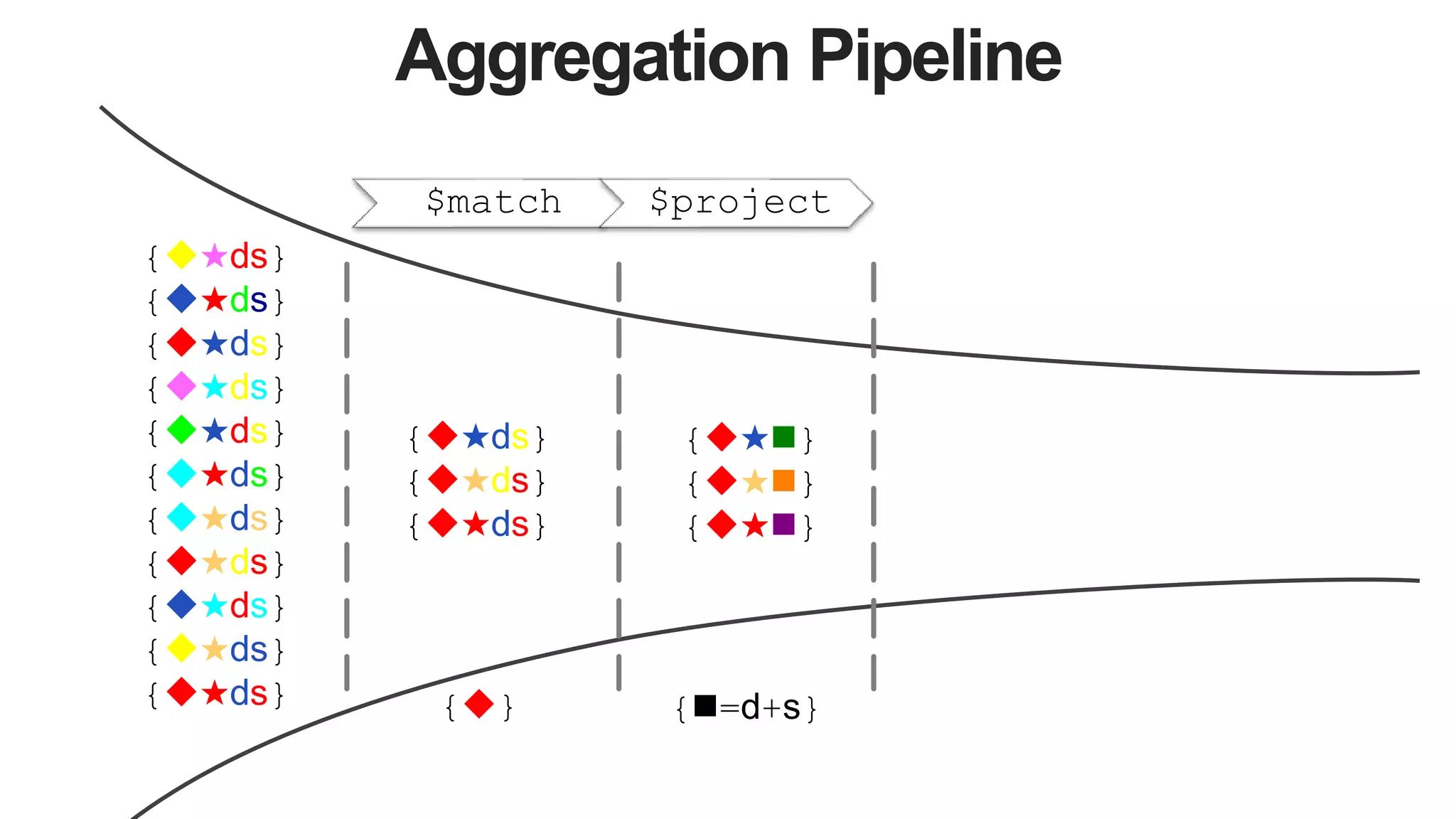
Aggregation Pipeline
$match $project
{★ds}
{★ds}
{★ds}
{★ds}
{★ds}
{★ds}
{★ds}
{★ds}
{★ds}
{★ds}
{★ds} {}
{★ds}
{★ds}
{★ds}
{★}
{★}
{★}
{=d+s}
Aggregation Pipeline
$match $project $lookup
{★ds}
{★ds}
{★ds}
{★ds}
{★ds}
{★ds}
{★ds}
{★ds}
{★ds}
{★ds}
{★ds} {}
{★ds}
{★ds}
{★ds}
{★}
{★}
{★}
{★}
{★}
{★}
{★}
{=d+s}
Aggregation Pipeline
$match $project $lookup
{★ds}
{★ds}
{★ds}
{★ds}
{★ds}
{★ds}
{★ds}
{★ds}
{★ds}
{★ds}
{★ds} {}
{★ds}
{★ds}
{★ds}
{★}
{★}
{★}
{★}
{★}
{★}
{★}
{=d+s}
{★[]}
{★[]}
{★}
Aggregation Pipeline
$match $project $lookup $group
{★ds}
{★ds}
{★ds}
{★ds}
{★ds}
{★ds}
{★ds}
{★ds}
{★ds}
{★ds}
{★ds} {}
{★ds}
{★ds}
{★ds}
{★}
{★}
{★}
{★}
{★}
{★}
{★}
{=d+s}
{
Σ λ σ}
{
Σ λ σ}
{
Σ λ σ}
{★[]}
{★[]}
{★}
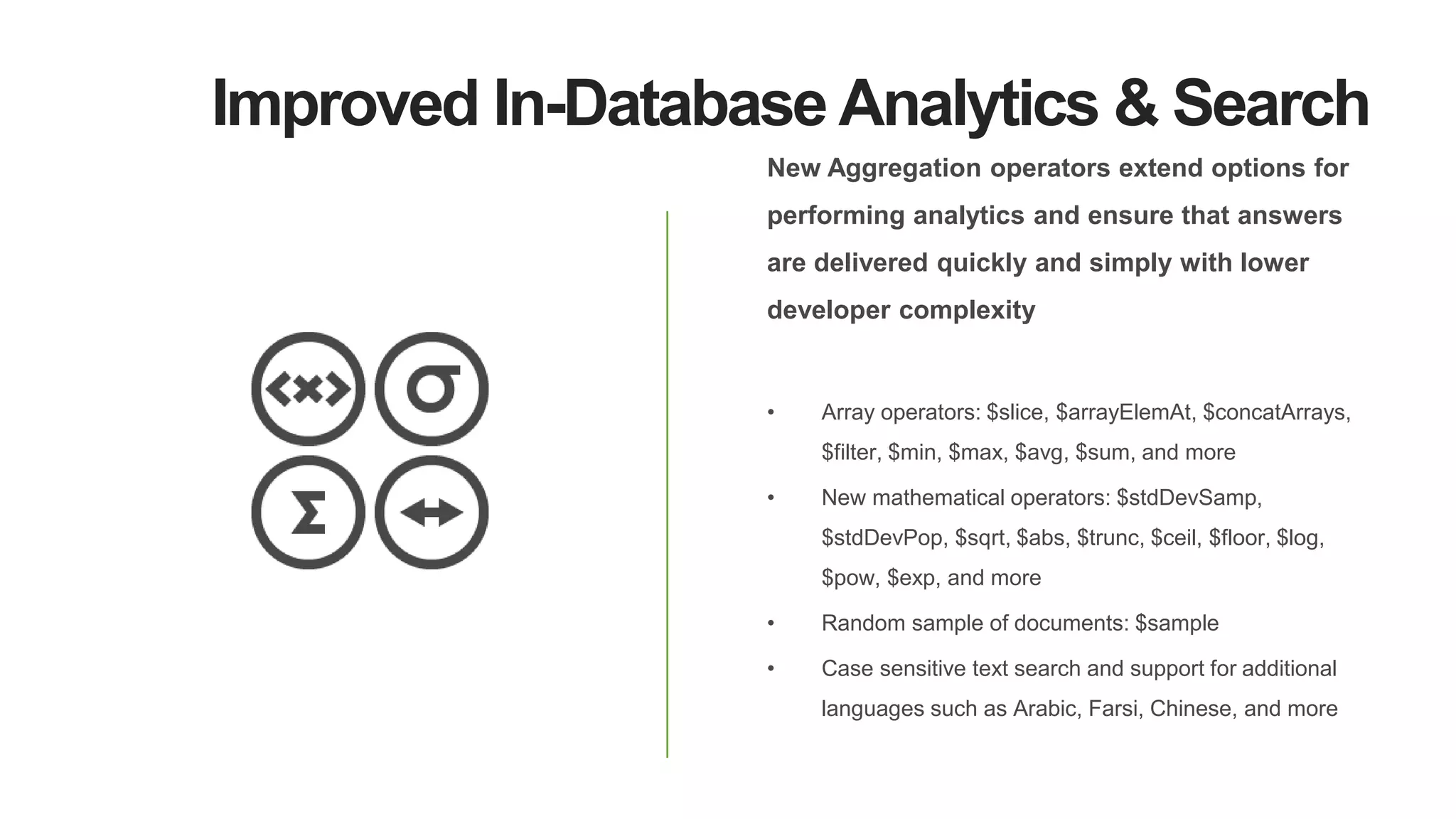
Improved In-Database Analytics & Search
New Aggregation operators extend options for
performing analytics and ensure that answers
are delivered quickly and simply with lower
developer complexity
• Array operators: $slice, $arrayElemAt, $concatArrays,
$filter, $min, $max, $avg, $sum, and more
• New mathematical operators: $stdDevSamp,
$stdDevPop, $sqrt, $abs, $trunc, $ceil, $floor, $log,
$pow, $exp, and more
• Random sample of documents: $sample
• Case sensitive text search and support for additional
languages such as Arabic, Farsi, Chinese, and more
For Database Administrators
MongoDB 3.2 helps users in your
organization understand the data in your
database
• MongoDB Compass
– For DBAs responsible for maintaining the
database in production
– No knowledge of the MongoDB query
language required
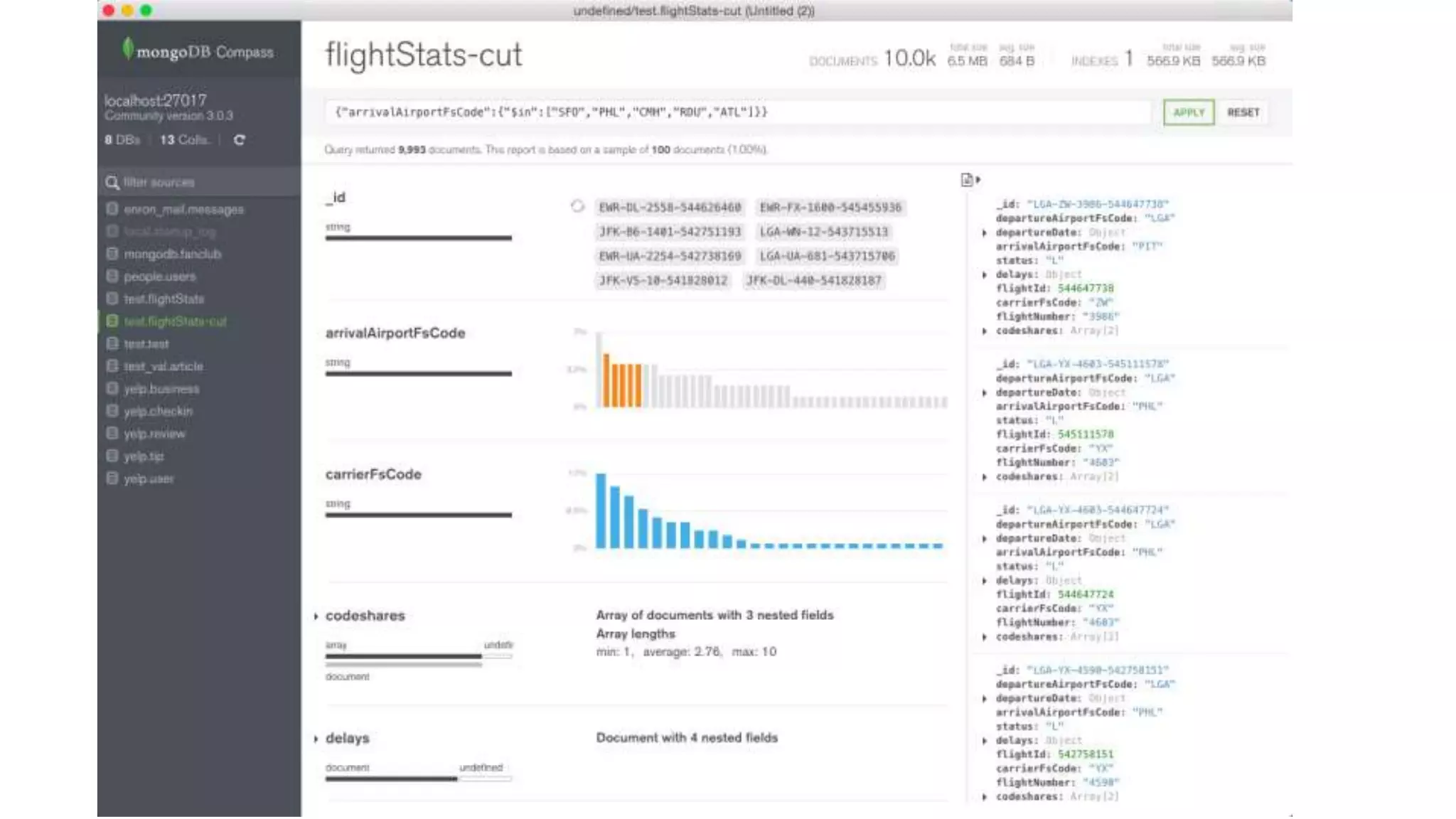
MongoDB Compass
For fast schema discovery and visual
construction of ad-hoc queries
• Visualize schema
– Frequency of fields
– Frequency of types
– Determine validator rules
• View Documents
• Graphically build queries
• Authenticated access
MongoDB Compass
Up to 80% of TCO is driven by
on-going operations and
maintenance costs
Source: Gartner
For Operations Teams
MongoDB 3.2 simplifies and enhances
MongoDB’s management platforms. Ops
teams can be 10-20x more productive using
Ops and Cloud Manager to run MongoDB.
• Start from a global view of infrastructure:
Integrations with Application Performance
Monitoring platforms
• Drill down: Visual query performance diagnostics,
index recommendations
• Then, deploy: Automated index builds
• Refine: Partial indexes improve resource
utilization
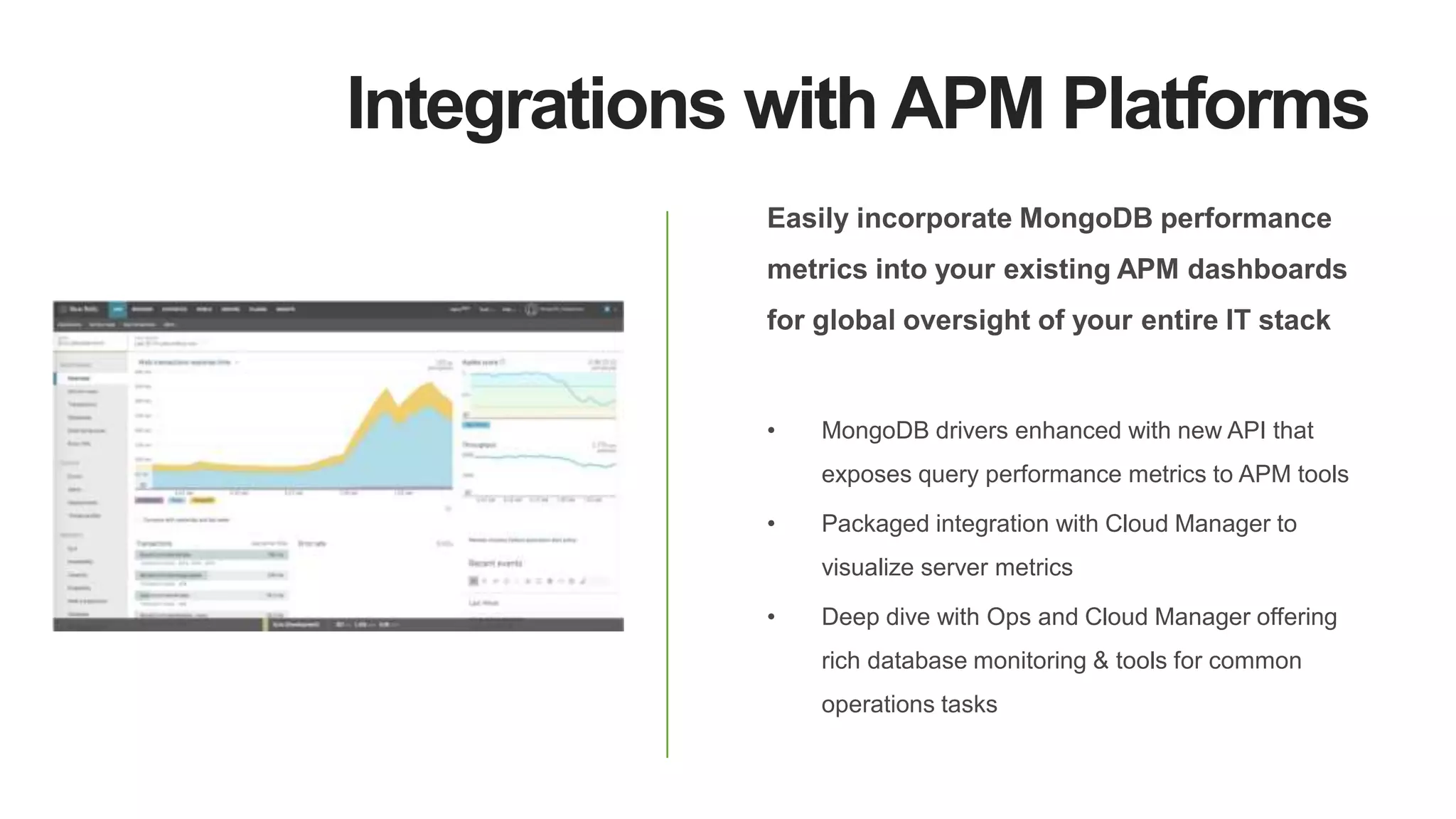
Integrations with APM Platforms
Easily incorporate MongoDB performance
metrics into your existing APM dashboards
for global oversight of your entire IT stack
• MongoDB drivers enhanced with new API that
exposes query performance metrics to APM tools
• Packaged integration with Cloud Manager to
visualize server metrics
• Deep dive with Ops and Cloud Manager offering
rich database monitoring & tools for common
operations tasks
“We've been really excited to work with MongoDB on enhancing their APM
integration with the New Relic platform. MongoDB has become an integral
part of the tooling and workflows of DBAs and Operations teams and we
expect the trend to increase.
To support MongoDB 3.2, we jointly-developed an integration between
MongoDB Ops Manager and New Relic APM, Insights, and Plugins. These
integrations mean MongoDB health can now be monitored alongside the rest
of the application estate.".”
Cooper Marcus
Senior Product Manager
New Relic.
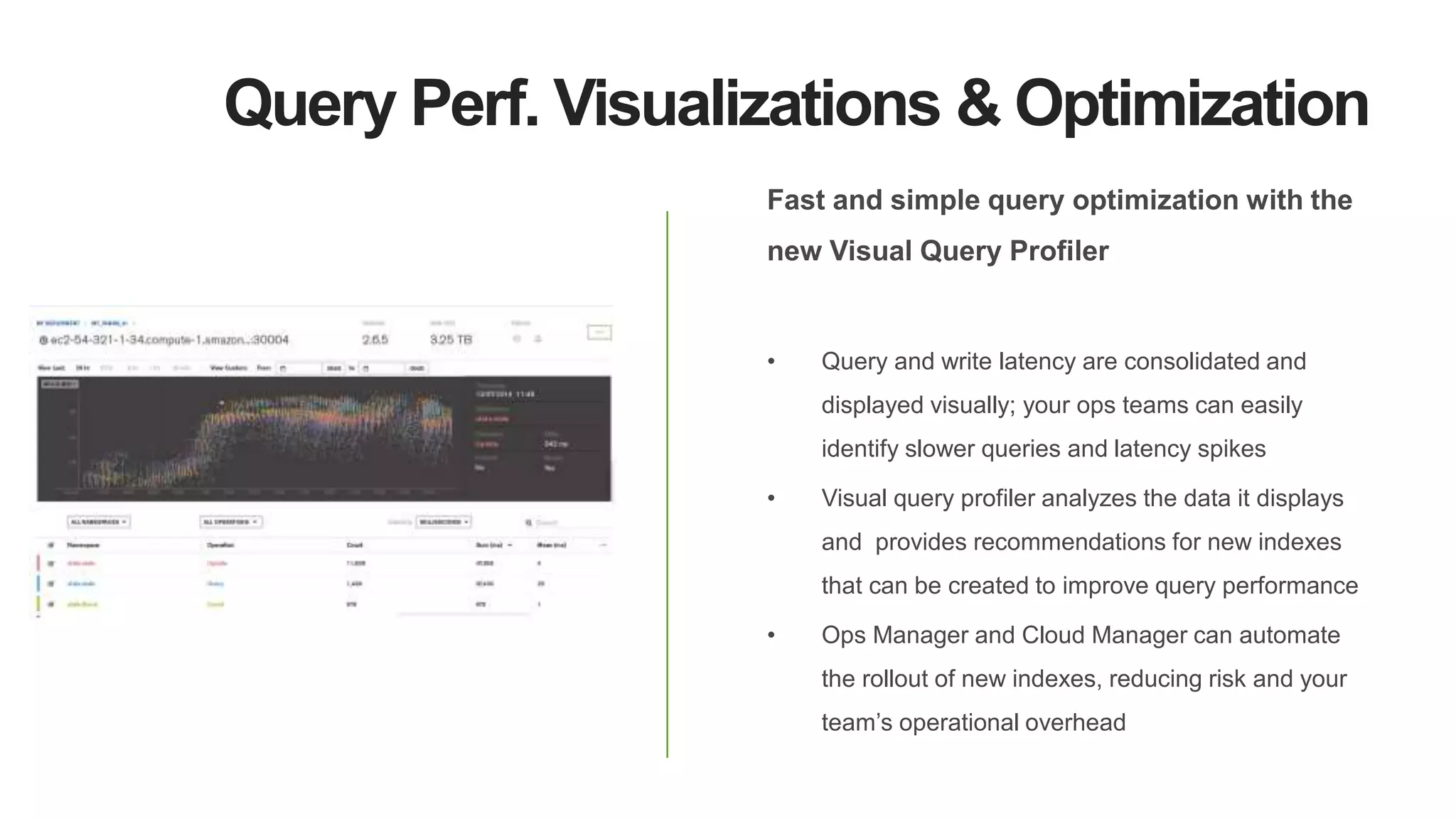
Query Perf. Visualizations & Optimization
Fast and simple query optimization with the
new Visual Query Profiler
• Query and write latency are consolidated and
displayed visually; your ops teams can easily
identify slower queries and latency spikes
• Visual query profiler analyzes the data it displays
and provides recommendations for new indexes
that can be created to improve query performance
• Ops Manager and Cloud Manager can automate
the rollout of new indexes, reducing risk and your
team’s operational overhead
“I’m excited by the availability of Visual Query Profiler in Ops Manager &
Cloud Manager. It helps us tremendously improve the performance of our
database by identifying queries that are slowing us down and provides
recommendations for new indexes -- which it can then build through a rolling
index build.”
Daniel Rubio
Director
Mondo Sports Ltd
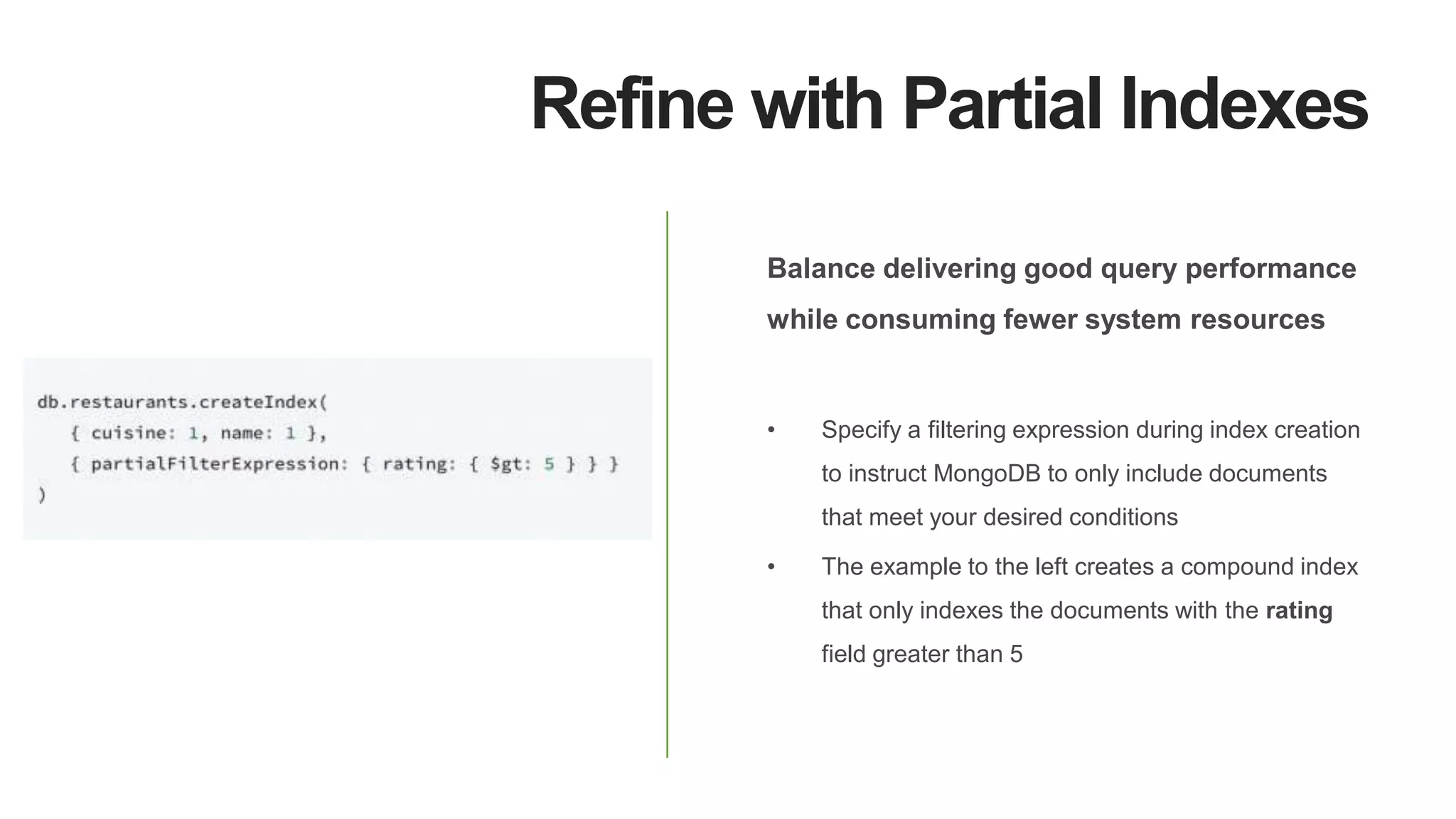
Refine with Partial Indexes
Balance delivering good query performance
while consuming fewer system resources
• Specify a filtering expression during index creation
to instruct MongoDB to only include documents
that meet your desired conditions
• The example to the left creates a compound index
that only indexes the documents with the rating
field greater than 5
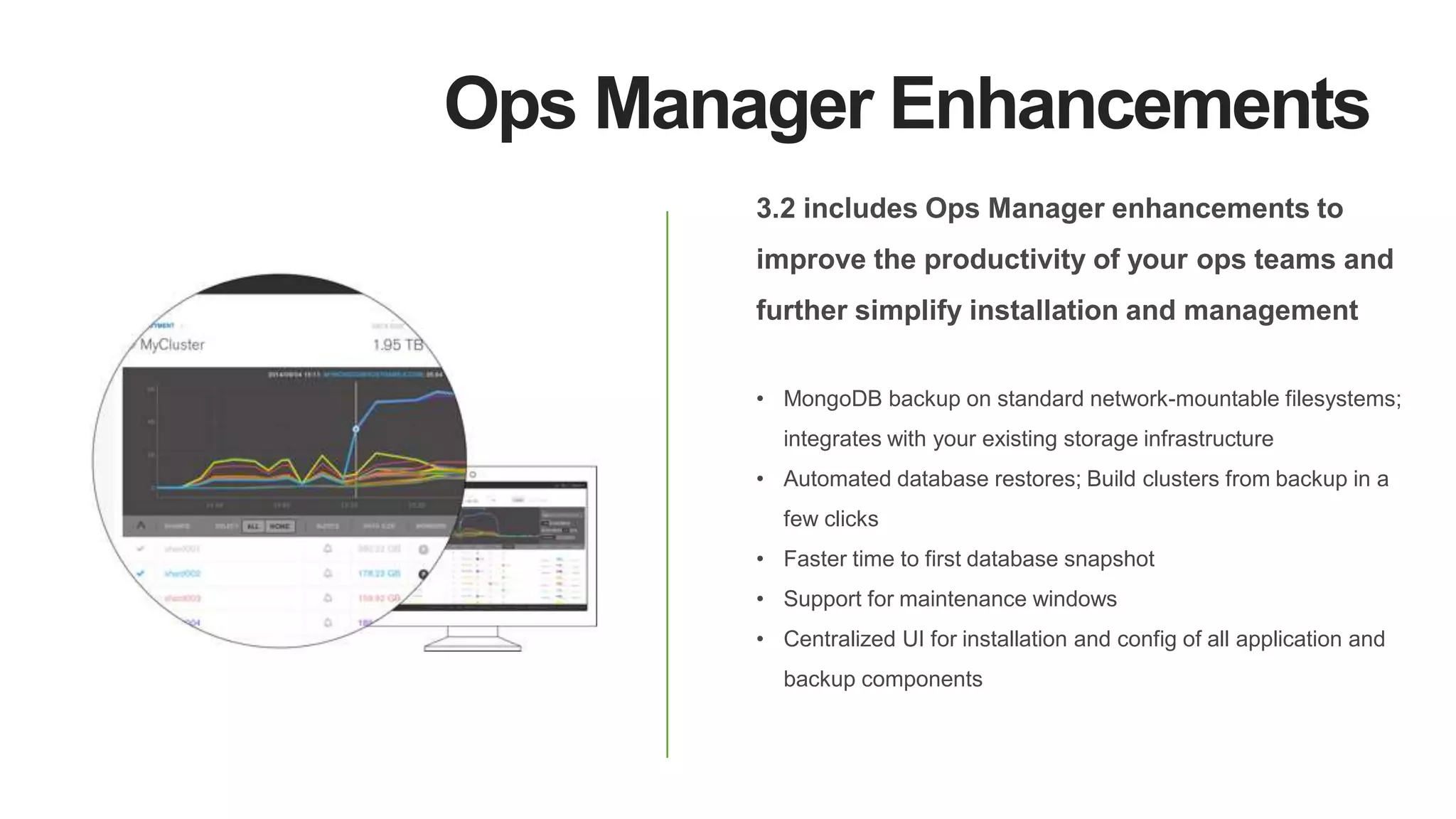
Ops Manager Enhancements
3.2 includes Ops Manager enhancements to
improve the productivity of your ops teams and
further simplify installation and management
• MongoDB backup on standard network-mountable filesystems;
integrates with your existing storage infrastructure
• Automated database restores; Build clusters from backup in a
few clicks
• Faster time to first database snapshot
• Support for maintenance windows
• Centralized UI for installation and config of all application and
backup components
Next Steps
• Download the Whitepaper
– https://www.mongodb.com/collateral/mongodb-3-2-whats-new
• Read the Release Notes
– https://docs.mongodb.org/manual/release-notes/3.2/
• Not yet ready for production but download and try!
– https://www.mongodb.org/downloads#development
• Detailed blogs
– https://www.mongodb.com/blog/
• Feedback
– MongoDB 3.2 Bug Hunt
• https://www.mongodb.com/blog/post/announcing-the-mongodb-3-2-bug-hunt
– https://jira.mongodb.org/
DISCLAIMER: MongoDB's product plans are for informational purposes only. MongoDB's plans may
change and you should not rely on them for delivery of a specific feature at a specific time.
Questions
Mat Keep (mat.keep@mongodb.com) @matkeep
Andrew Morgan (andrew.morgan@mongodb.com) @andrewmorgan
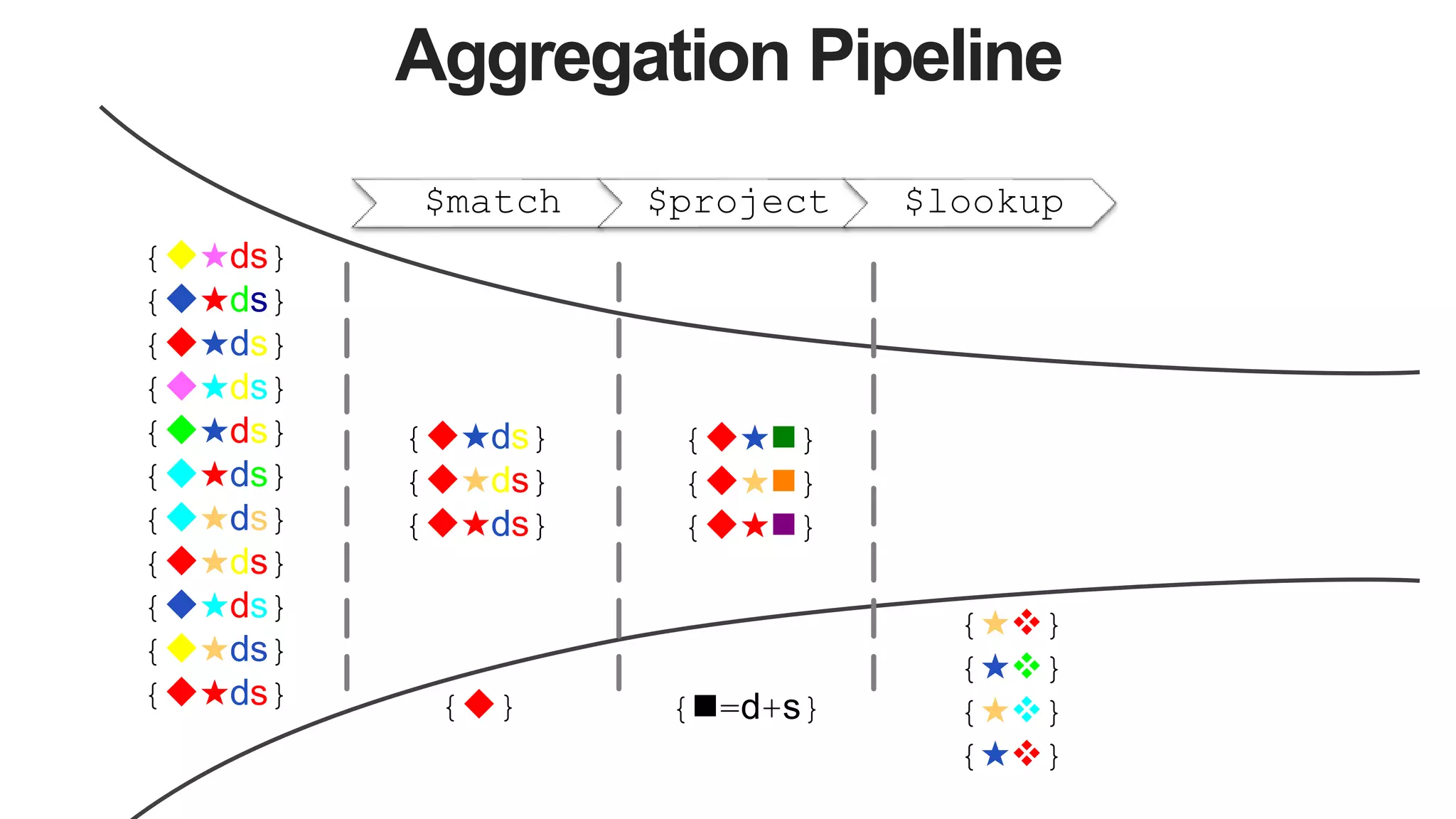
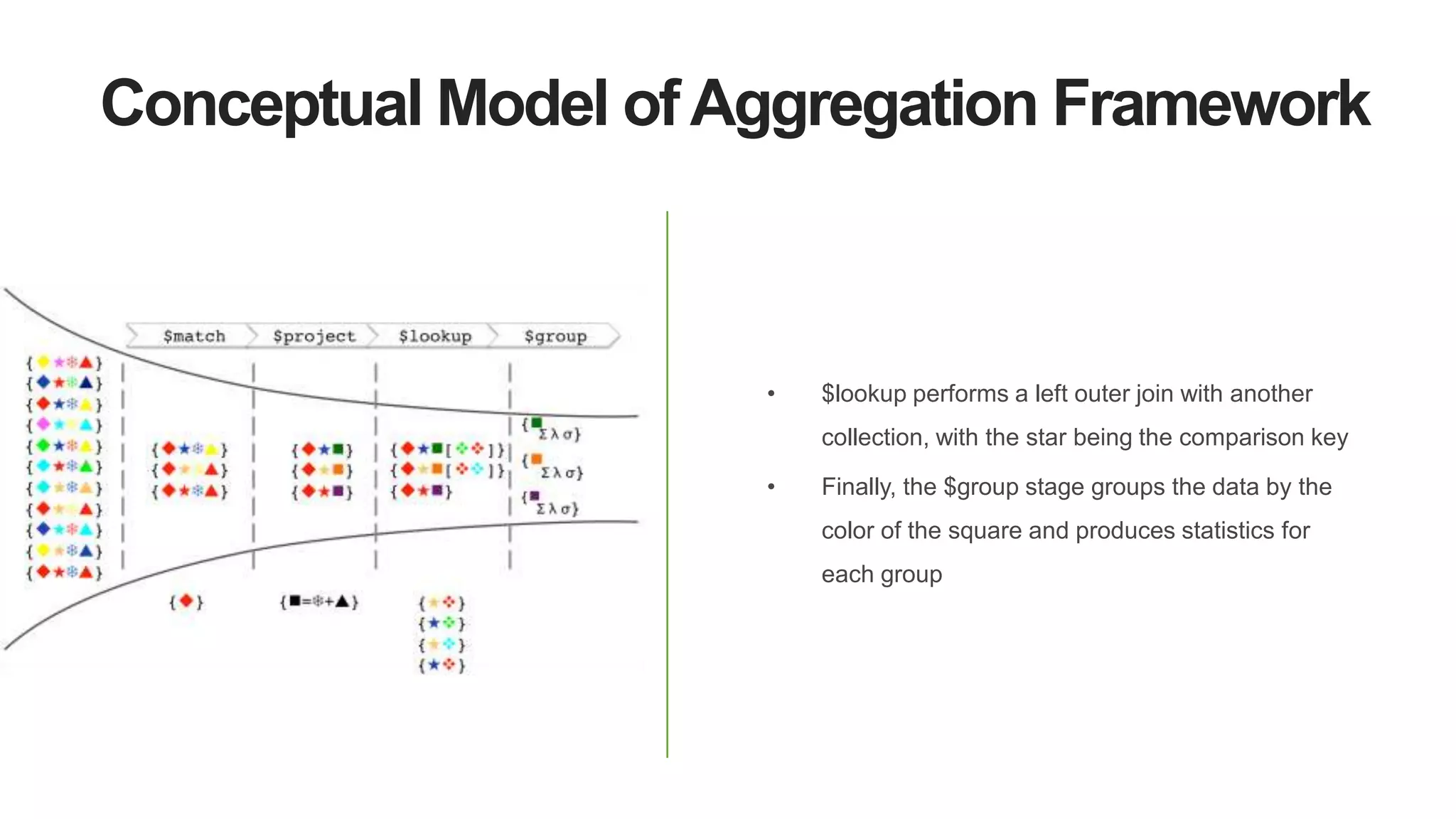
Conceptual Model ofAggregation Framework
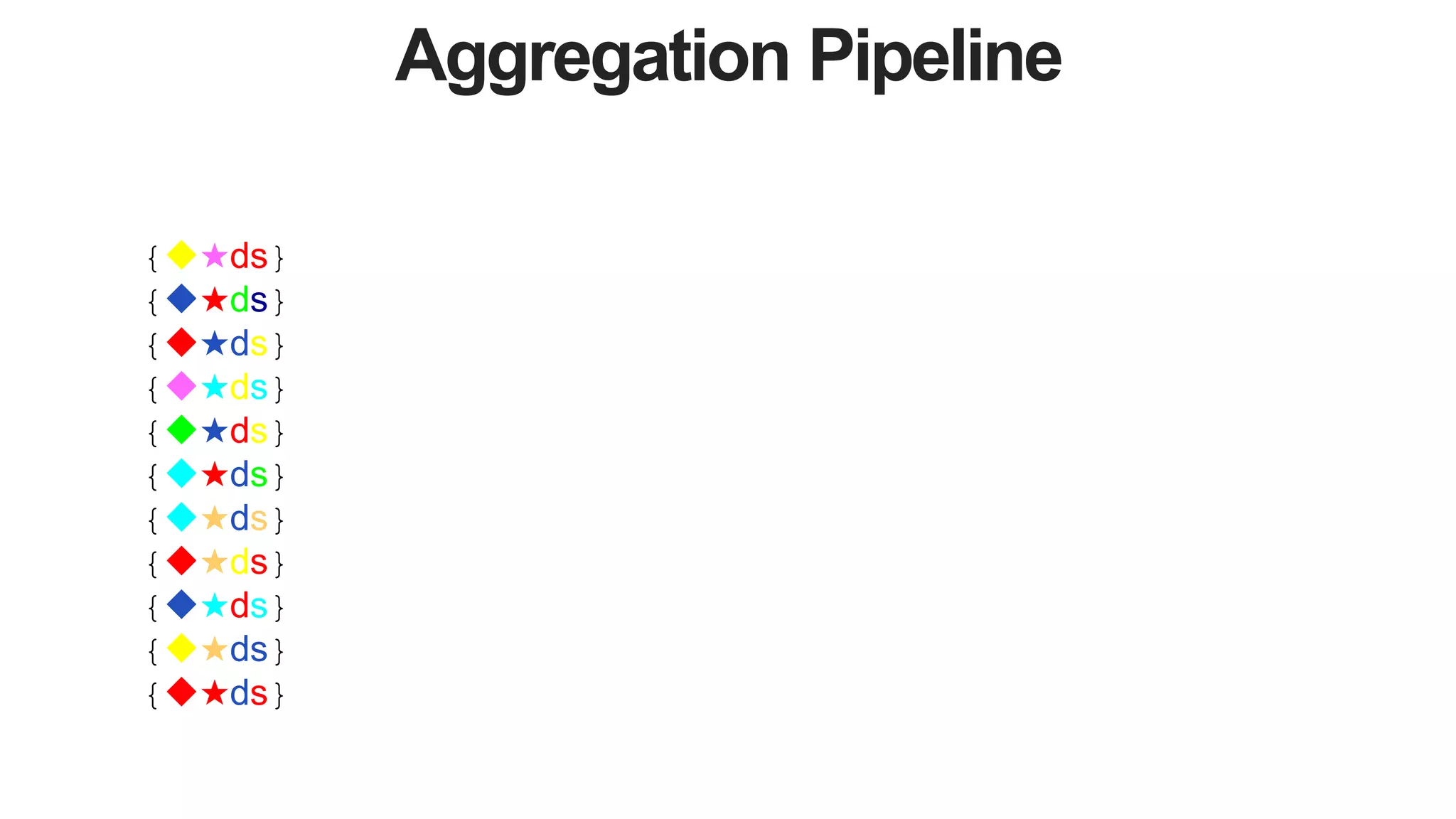
Start with the original collection; each record
(document) contains a number of shapes (keys),
each with a particular color (value)
• $match filters out documents that don’t contain a
red diamond
• $project adds a new “square” attribute with a value
computed from the value (color) of the snowflake
and triangle attributes
Conceptual Model ofAggregation Framework
• $lookup performs a left outer join with another
collection, with the star being the comparison key
• Finally, the $group stage groups the data by the
color of the square and produces statistics for
each group

Webinar: What's New in MongoDB 3.2

  • 1.
    What’s New inMongoDB 3.2 Mat Keep Director, Product Marketing, MongoDB Andrew Morgan Principal Product Marketing Manager, MongoDB
  • 2.
    MongoDB 3.2 –a BIG Release Hash-Based Sharding Roles Kerberos On-Prem Monitoring 2.2 2.4 2.6 3.0 3.2 Agg. Framework Location-Aware Sharding $out Index Intersection Text Search Field-Level Redaction LDAP & x509 Auditing Document Validation Fast Failover Simpler Scalability Aggregation ++ Encryption At Rest In-Memory Storage Engine BI Connector $lookup MongoDB Compass APM Integration Profiler Visualization Auto Index Builds Backups to File System Doc-Level Concurrency Compression Storage Engine API ≤50 replicas Auditing ++ Ops Manager
  • 3.
    Themes Broader use caseportfolio. Pluggable storage engine strategy enables us to rapidly cover more use cases with a single database. Mission-critical apps. MongoDB delivers major advances in the critical areas of governance, high availability, and disaster recovery. New tools for new users. Now MongoDB is an integral part of the tooling and workflows of Data Analysts, DBAs, and Operations teams.
  • 4.
  • 5.
    Varying Access &Storage Requirements Modern apps Sensitive data Cost effective storage High concurrency High throughput Low latency Real-time analytics
  • 6.
  • 7.
    WiredTiger is theNew Default WiredTiger – widely deployed with 3.0 – is now the default storage engine for MongoDB. • Best general purpose storage engine • 7-10x better write throughput • Up to 80% compression
  • 8.
    117k Security Attacks…..PERDAY PWC: Global State of Information Security
  • 9.
    Encrypted Storage Engine Encryptedstorage engine for end-to-end encryption of sensitive data in regulated industries • Reduces the management and performance overhead of external encryption mechanisms • AES-256 Encryption, FIPS 140-2 option available • Key management: Local key management via keyfile or integration with 3rd party key management appliance via KMIP • Based on WiredTiger storage engine • Requires MongoDB Enterprise Advanced
  • 10.
    “Protecting sensitive dataassets is one of most important things we do. The new Database Encryption feature in MongoDB 3.2 is a significant step forward in allowing us to more simply add encryption at-rest to our list of security controls. In our tests, we found the new database encryption feature easy to enable, stable and consistent with our performance expectations.” Shawn Drew Data Integration Solutions Architect University of Washington
  • 11.
  • 12.
    In-Memory Storage Engine(Beta) Handle ultra-high throughput with low latency and high availability • Delivers the extreme throughput and predictable latency required by the most demanding apps in Adtech, finance, and more. • Achieve data durability with replica set members running disk-backed storage engine • Available for beta testing and is expected for GA in early 2016
  • 13.
  • 14.
    Built for MissionCritical Deployments
  • 15.
    A 10% improvementin data usability at a Fortune 1000 company could increase revenues by $2 BN per year Source: University of Texas, Austin
  • 16.
    Data Governance withDocument Validation Implement data governance without sacrificing agility that comes from dynamic schema • Enforce data quality across multiple teams and applications • Use familiar MongoDB expressions to control document structure • Validation is optional and can be as simple as a single field, all the way to every field, including existence, data types, and regular expressions
  • 17.
    Document Validation Example Theexample on the left adds a rule to the contacts collection that validates: • The year of birth is no later than 1994 • The document contains a phone number and / or an email address • When present, the phone number and email addresses are strings
  • 18.
    “Rocket.Chat and ourother applications need to be able to quickly access various types of data to provide a seamless solution for our users. With MongoDB 3.2, we will now be able to implement the data governance we’re seeking, without sacrificing agility that comes from dynamic schema. The newfound ability to use familiar MongoDB expression syntax to control document structure, rather than learning a whole new language or process, is key for us.” Gabriel Engel Founder and CEO Rocket.Chat
  • 19.
    Enhancements for yourmission-critical apps More improvements in 3.2 that optimize the database for your mission-critical applications • Meet stringent SLAs with Raft-base fast-failover algorithm – Under 2 seconds to detect and recover from replica set primary failure – Enhanced durability through write conerns • Simplified management of sharded clusters allow you to easily scale to many data centers – Config servers are now deployed as replica sets; up to 50 members/locations
  • 20.
    Tools for UsersAcrossYour Organization
  • 21.
    For Business Analysts& Data Scientists MongoDB 3.2 allows business analysts and data scientists to support the business with new insights from untapped data sources • MongoDB Connector for BI • Dynamic Lookup • New Aggregation Operators & Improved Text Search
  • 22.
    Only 0.5% ofdata is analyzed Source: IDC
  • 23.
    MongoDB Connector forBI Visualize and explore multi-dimensional documents using SQL-based BI tools. The connector does the following: • Provides the BI tool with the schema of the MongoDB collection to be visualized • Translates SQL statements issued by the BI tool into equivalent MongoDB queries that are sent to MongoDB for processing • Converts the results into the tabular format expected by the BI tool, which can then visualize the data based on user requirements
  • 24.
    “We are thrilledto enable Tableau users, who traditionally work with their relational data, to fully integrate the multi-structured data stored in the database powering modern applications via the new MongoDB BI Connector” Jeffrey Feng Product Manager Tableau Software
  • 25.
    Dynamic Lookup Combine datafrom multiple collections with left outer joins for richer analytics & more flexibility in data modeling • Blend data from multiple collections for analysis • Higher performance analytics with less application- side code and less effort from your developers • Executed via the new $lookup operator, a stage in the MongoDB Aggregation Framework pipeline
  • 26.
    “I am mostexcited by the dynamic lookups coming in MongoDB 3.2. The ability to more easily join customer data with 3rd-party data feeds gives us more flexibility in data modeling, and simplifies the real-time analytics we rely on to constantly improve our value to our customers.” David Strickland CTO MyDealerLot
  • 27.
  • 28.
  • 29.
  • 30.
  • 31.
  • 32.
    Aggregation Pipeline $match $project$lookup {★ds} {★ds} {★ds} {★ds} {★ds} {★ds} {★ds} {★ds} {★ds} {★ds} {★ds} {} {★ds} {★ds} {★ds} {★} {★} {★} {★} {★} {★} {★} {=d+s}
  • 33.
    Aggregation Pipeline $match $project$lookup {★ds} {★ds} {★ds} {★ds} {★ds} {★ds} {★ds} {★ds} {★ds} {★ds} {★ds} {} {★ds} {★ds} {★ds} {★} {★} {★} {★} {★} {★} {★} {=d+s} {★[]} {★[]} {★}
  • 34.
    Aggregation Pipeline $match $project$lookup $group {★ds} {★ds} {★ds} {★ds} {★ds} {★ds} {★ds} {★ds} {★ds} {★ds} {★ds} {} {★ds} {★ds} {★ds} {★} {★} {★} {★} {★} {★} {★} {=d+s} { Σ λ σ} { Σ λ σ} { Σ λ σ} {★[]} {★[]} {★}
  • 35.
    Improved In-Database Analytics& Search New Aggregation operators extend options for performing analytics and ensure that answers are delivered quickly and simply with lower developer complexity • Array operators: $slice, $arrayElemAt, $concatArrays, $filter, $min, $max, $avg, $sum, and more • New mathematical operators: $stdDevSamp, $stdDevPop, $sqrt, $abs, $trunc, $ceil, $floor, $log, $pow, $exp, and more • Random sample of documents: $sample • Case sensitive text search and support for additional languages such as Arabic, Farsi, Chinese, and more
  • 36.
    For Database Administrators MongoDB3.2 helps users in your organization understand the data in your database • MongoDB Compass – For DBAs responsible for maintaining the database in production – No knowledge of the MongoDB query language required
  • 37.
    MongoDB Compass For fastschema discovery and visual construction of ad-hoc queries • Visualize schema – Frequency of fields – Frequency of types – Determine validator rules • View Documents • Graphically build queries • Authenticated access
  • 38.
  • 39.
    Up to 80%of TCO is driven by on-going operations and maintenance costs Source: Gartner
  • 40.
    For Operations Teams MongoDB3.2 simplifies and enhances MongoDB’s management platforms. Ops teams can be 10-20x more productive using Ops and Cloud Manager to run MongoDB. • Start from a global view of infrastructure: Integrations with Application Performance Monitoring platforms • Drill down: Visual query performance diagnostics, index recommendations • Then, deploy: Automated index builds • Refine: Partial indexes improve resource utilization
  • 41.
    Integrations with APMPlatforms Easily incorporate MongoDB performance metrics into your existing APM dashboards for global oversight of your entire IT stack • MongoDB drivers enhanced with new API that exposes query performance metrics to APM tools • Packaged integration with Cloud Manager to visualize server metrics • Deep dive with Ops and Cloud Manager offering rich database monitoring & tools for common operations tasks
  • 42.
    “We've been reallyexcited to work with MongoDB on enhancing their APM integration with the New Relic platform. MongoDB has become an integral part of the tooling and workflows of DBAs and Operations teams and we expect the trend to increase. To support MongoDB 3.2, we jointly-developed an integration between MongoDB Ops Manager and New Relic APM, Insights, and Plugins. These integrations mean MongoDB health can now be monitored alongside the rest of the application estate.".” Cooper Marcus Senior Product Manager New Relic.
  • 43.
    Query Perf. Visualizations& Optimization Fast and simple query optimization with the new Visual Query Profiler • Query and write latency are consolidated and displayed visually; your ops teams can easily identify slower queries and latency spikes • Visual query profiler analyzes the data it displays and provides recommendations for new indexes that can be created to improve query performance • Ops Manager and Cloud Manager can automate the rollout of new indexes, reducing risk and your team’s operational overhead
  • 44.
    “I’m excited bythe availability of Visual Query Profiler in Ops Manager & Cloud Manager. It helps us tremendously improve the performance of our database by identifying queries that are slowing us down and provides recommendations for new indexes -- which it can then build through a rolling index build.” Daniel Rubio Director Mondo Sports Ltd
  • 45.
    Refine with PartialIndexes Balance delivering good query performance while consuming fewer system resources • Specify a filtering expression during index creation to instruct MongoDB to only include documents that meet your desired conditions • The example to the left creates a compound index that only indexes the documents with the rating field greater than 5
  • 46.
    Ops Manager Enhancements 3.2includes Ops Manager enhancements to improve the productivity of your ops teams and further simplify installation and management • MongoDB backup on standard network-mountable filesystems; integrates with your existing storage infrastructure • Automated database restores; Build clusters from backup in a few clicks • Faster time to first database snapshot • Support for maintenance windows • Centralized UI for installation and config of all application and backup components
  • 47.
    Next Steps • Downloadthe Whitepaper – https://www.mongodb.com/collateral/mongodb-3-2-whats-new • Read the Release Notes – https://docs.mongodb.org/manual/release-notes/3.2/ • Not yet ready for production but download and try! – https://www.mongodb.org/downloads#development • Detailed blogs – https://www.mongodb.com/blog/ • Feedback – MongoDB 3.2 Bug Hunt • https://www.mongodb.com/blog/post/announcing-the-mongodb-3-2-bug-hunt – https://jira.mongodb.org/ DISCLAIMER: MongoDB's product plans are for informational purposes only. MongoDB's plans may change and you should not rely on them for delivery of a specific feature at a specific time.
  • 48.
    Questions Mat Keep (mat.keep@mongodb.com)@matkeep Andrew Morgan (andrew.morgan@mongodb.com) @andrewmorgan
  • 49.
    Conceptual Model ofAggregationFramework Start with the original collection; each record (document) contains a number of shapes (keys), each with a particular color (value) • $match filters out documents that don’t contain a red diamond • $project adds a new “square” attribute with a value computed from the value (color) of the snowflake and triangle attributes
  • 50.
    Conceptual Model ofAggregationFramework • $lookup performs a left outer join with another collection, with the star being the comparison key • Finally, the $group stage groups the data by the color of the square and produces statistics for each group

Editor's Notes

  • #9 And its getting worse! Research from PWC – 66% CAGR since 2009 48% increase in 2014 over 2013 It’s also worth noting that the number of respondents reporting losses of $20 million or more almost doubled over 2013. Other research, 96% came from theft of database records
  • #14 As illustrated by the ecommerce example above, user data is managed by the In-Memory engine to provide the throughput and bounded latency essential for great customer experience. However, the product catalog’s data storage requirements exceed server memory capacity, so is provisioned to another MongoDB replica set configured with the disk-based WiredTiger storage engine. In this example, MongoDB’s flexible storage architecture means developers are freed from the complexity of having to use different in-memory and disk-based databases to support the e-commerce application. Administrators are freed from the complexity of having to configure and manage separate data layers. Instead, the application uses the same MongoDB database with each service powered by the storage engine best optimized for the use case.
  • #28 Projection should create a new key rather than removing some
  • #29 Projection should create a new key rather than removing some
  • #30 Projection should create a new key rather than removing some
  • #31 Projection should create a new key rather than removing some
  • #32 Projection should create a new key rather than removing some
  • #33 Projection should create a new key rather than removing some
  • #34 Projection should create a new key rather than removing some
  • #35 Projection should create a new key rather than removing some
  • #38 Determine validator rules: You can use the tool to figure out what you want to set as validation rules
  • #39 Determine validator rules: You can use the tool to figure out what you want to set as validation rules
  • #51 $lookup – this creates new documents which contain everything from the previous stage but augmented with data from any document from the second collection containing a matching colored star (i.e., the blue and yellow stars had matching lookup values, whereas the red star had none)