Module 1 Lesson 19.notebook 
1 
October 20, 2014 
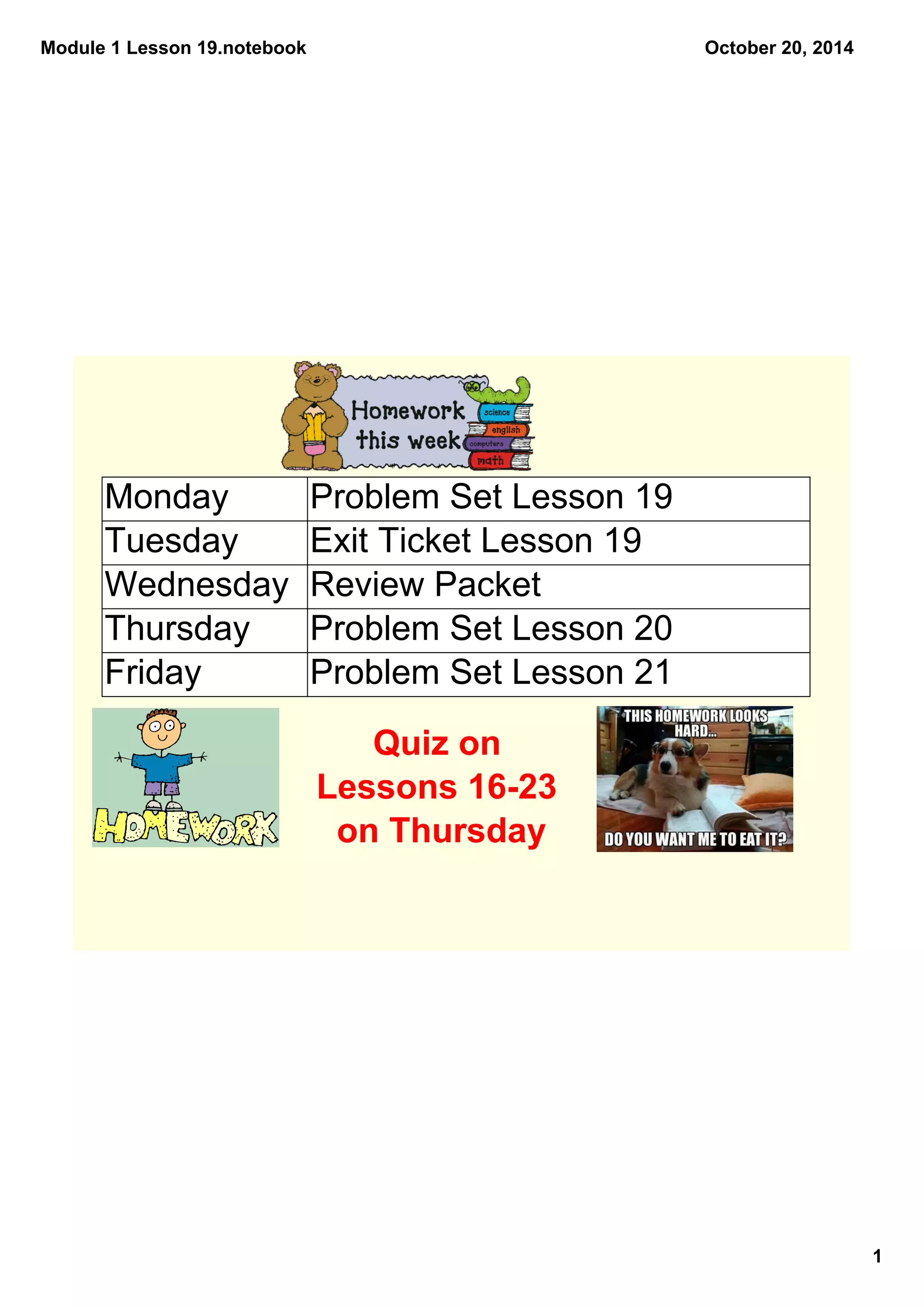
Monday Problem Set Lesson 19 
Tuesday Exit Ticket Lesson 19 
Wednesday Review Packet 
Thursday Problem Set Lesson 20 
Friday Problem Set Lesson 21 
Quiz on 
Lessons 16­23 
on Thursday
Module 1 Lesson 19.notebook 
2 
October 20, 2014 
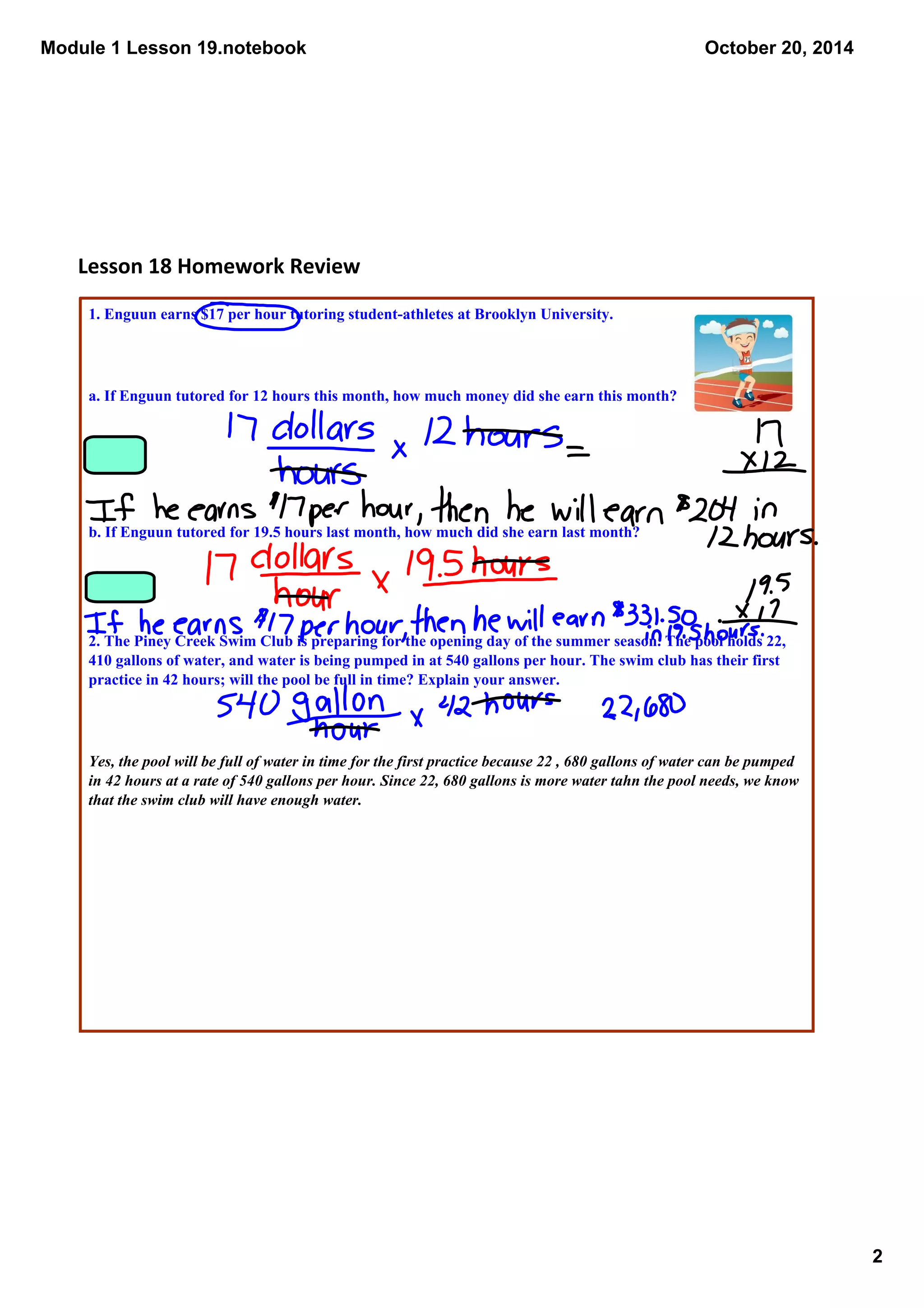
Lesson 18 Homework Review 
1. Enguun earns $17 per hour tutoring student­athletes 
at Brooklyn University. 
a. If Enguun tutored for 12 hours this month, how much money did she earn this month? 
$204 
b. If Enguun tutored for 19.5 hours last month, how much did she earn last month? 
$331.50 
2. The Piney Creek Swim Club is preparing for the opening day of the summer season. The pool holds 22, 
410 gallons of water, and water is being pumped in at 540 gallons per hour. The swim club has their first 
practice in 42 hours; will the pool be full in time? Explain your answer. 
Yes, the pool will be full of water in time for the first practice because 22 , 680 gallons of water can be pumped 
in 42 hours at a rate of 540 gallons per hour. Since 22, 680 gallons is more water tahn the pool needs, we know 
that the swim club will have enough water.
Module 1 Lesson 19.notebook 
3 
October 20, 2014 
Module 1 
Ratios and Unit Rates 
Topic A: Representing and Reasoning About Ratios 
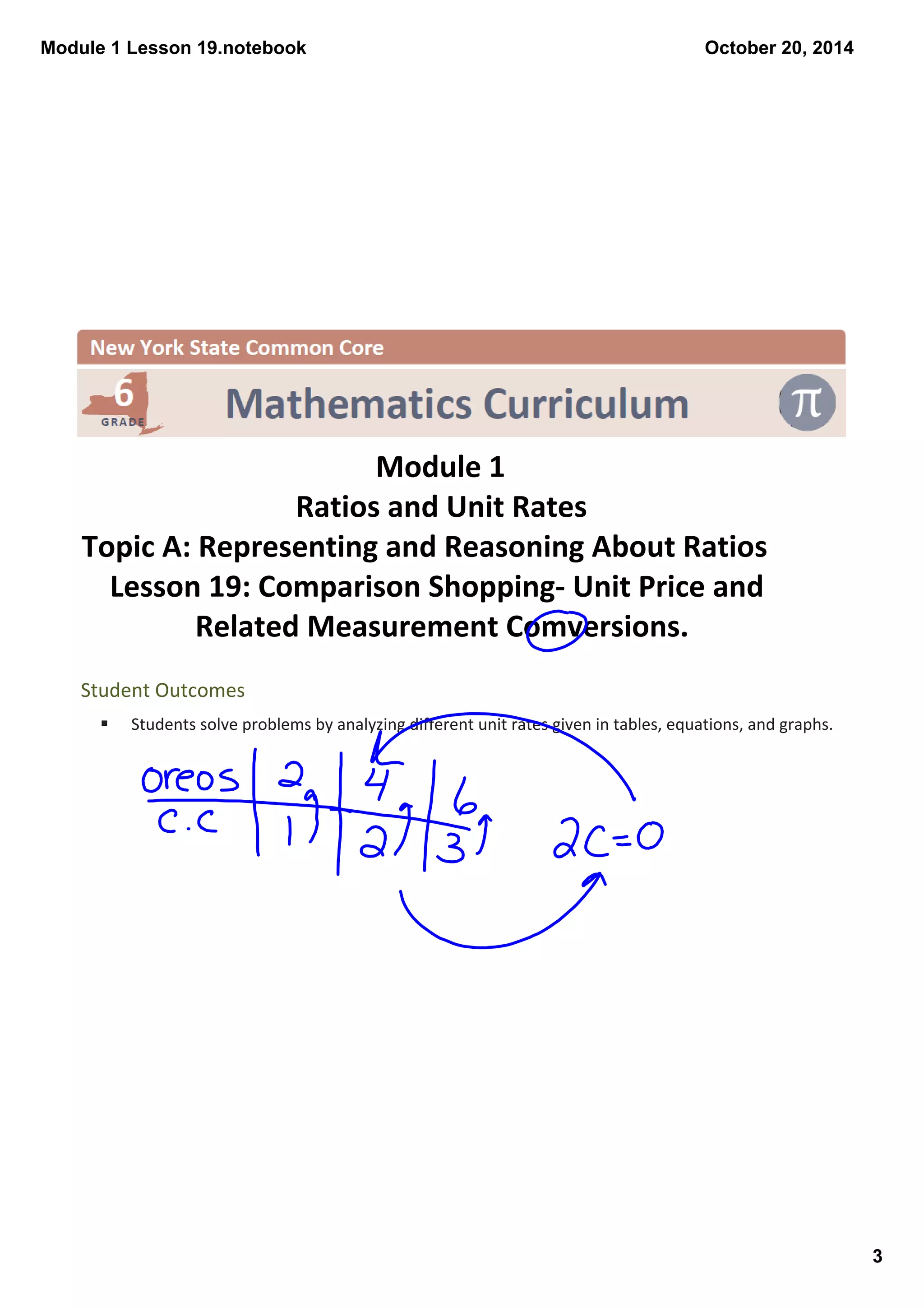
Lesson 19: Comparison Shopping‐ Unit Price and 
Related Measurement Comversions. 
Student Outcomes 
§ Students solve problems by analyzing different unit rates given in tables, equations, and graphs.
Module 1 Lesson 19.notebook 
4 
October 20, 2014 
Classwork 
Example 1 
Creating Tables from Equations: 
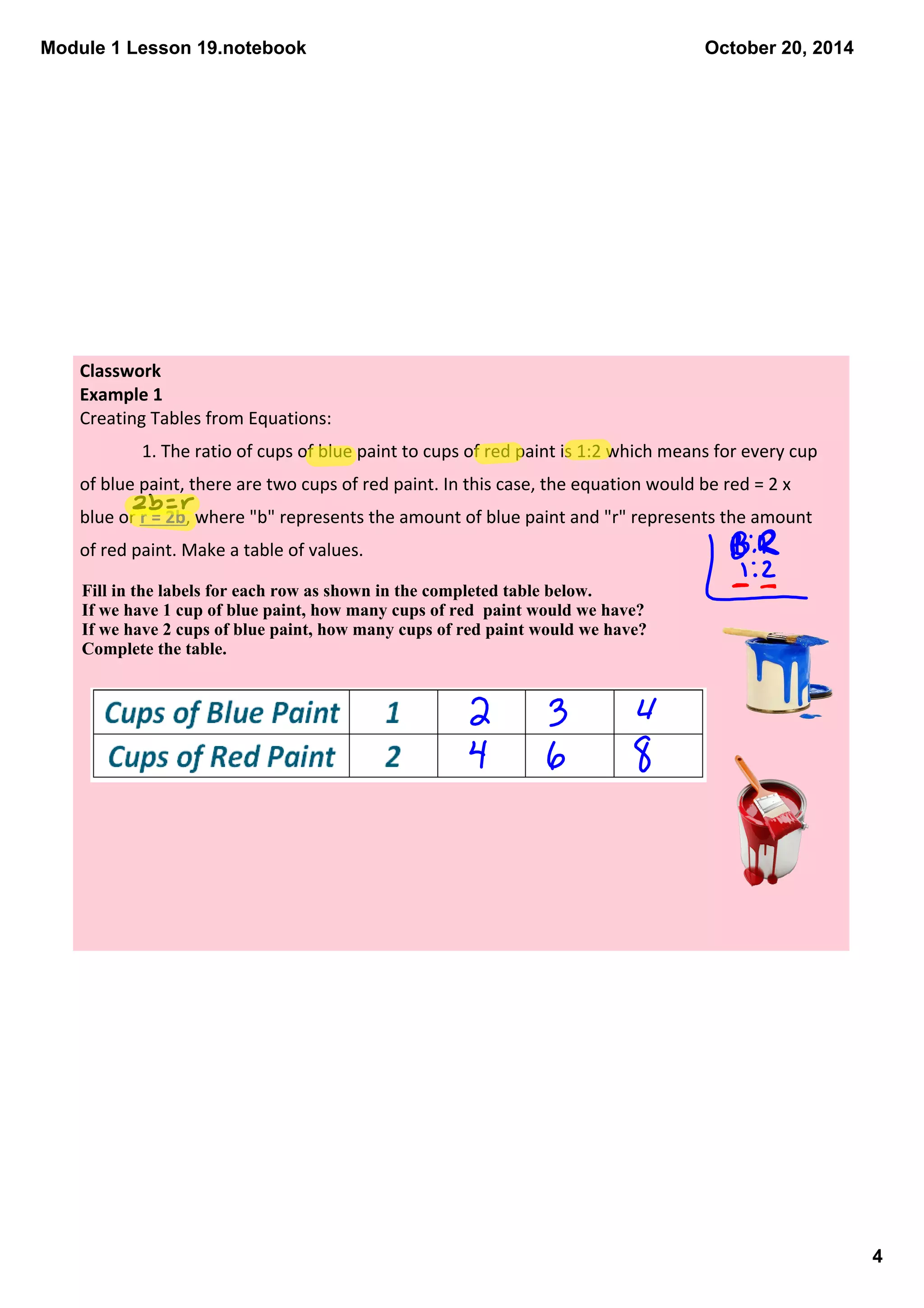
1. The ratio of cups of blue paint to cups of red paint is 1:2 which means for every cup 
of blue paint, there are two cups of red paint. In this case, the equation would be red = 2 x 
blue or r = 2b, where "b" represents the amount of blue paint and "r" represents the amount 
of red paint. Make a table of values. 
Fill in the labels for each row as shown in the completed table below. 
If we have 1 cup of blue paint, how many cups of red paint would we have? 
If we have 2 cups of blue paint, how many cups of red paint would we have? 
Complete the table.
Module 1 Lesson 19.notebook 
5 
October 20, 2014 
34 
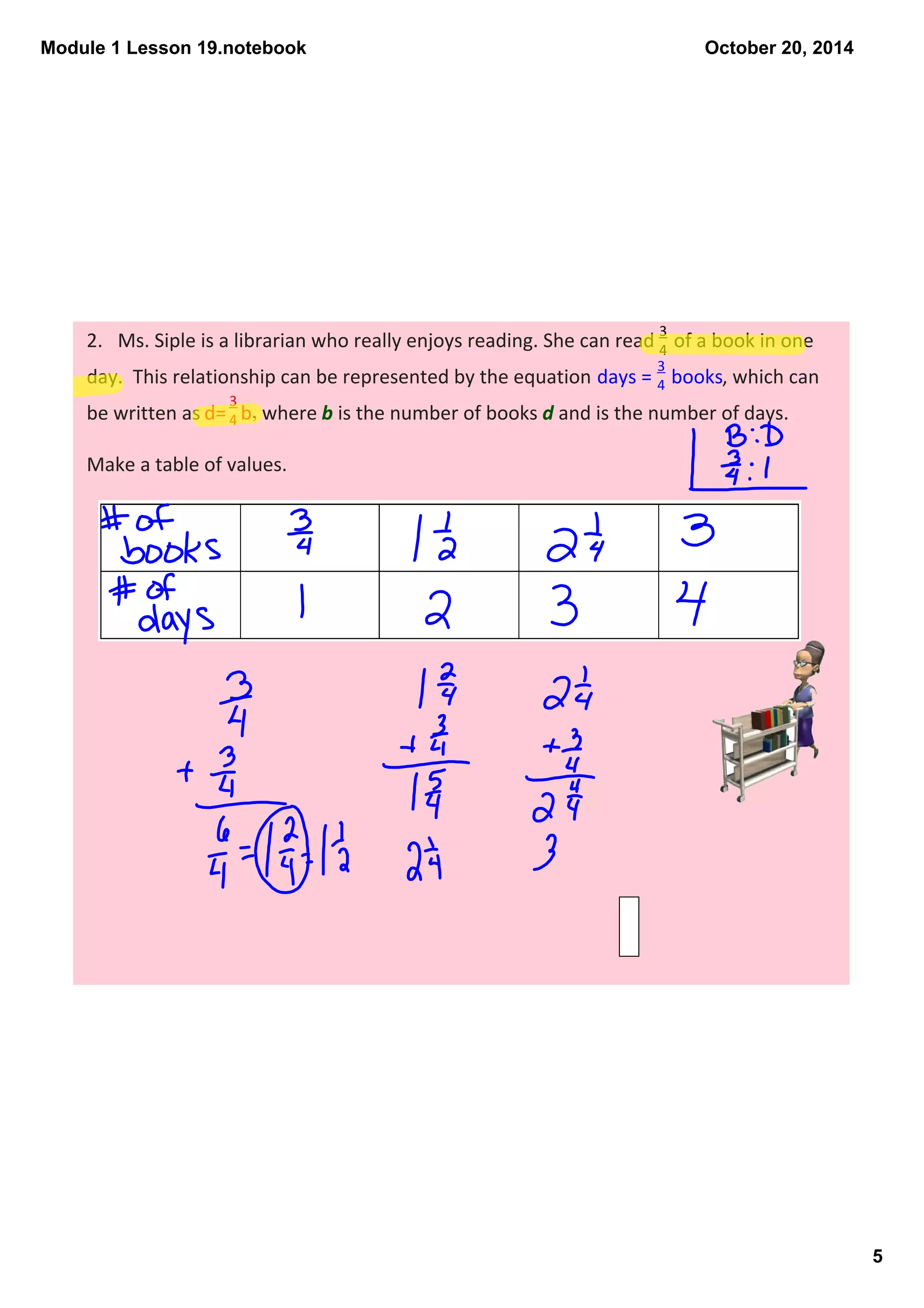
2. Ms. Siple is a librarian who really enjoys reading. She can read of a book in one 
day. This relationship can be represented by the equation days = books, which can 
be written as d= b, where b is the number of books d and is the number of days. 
Make a table of values. 
34 
34
Module 1 Lesson 19.notebook 
6 
October 20, 2014 
Exercise 1 
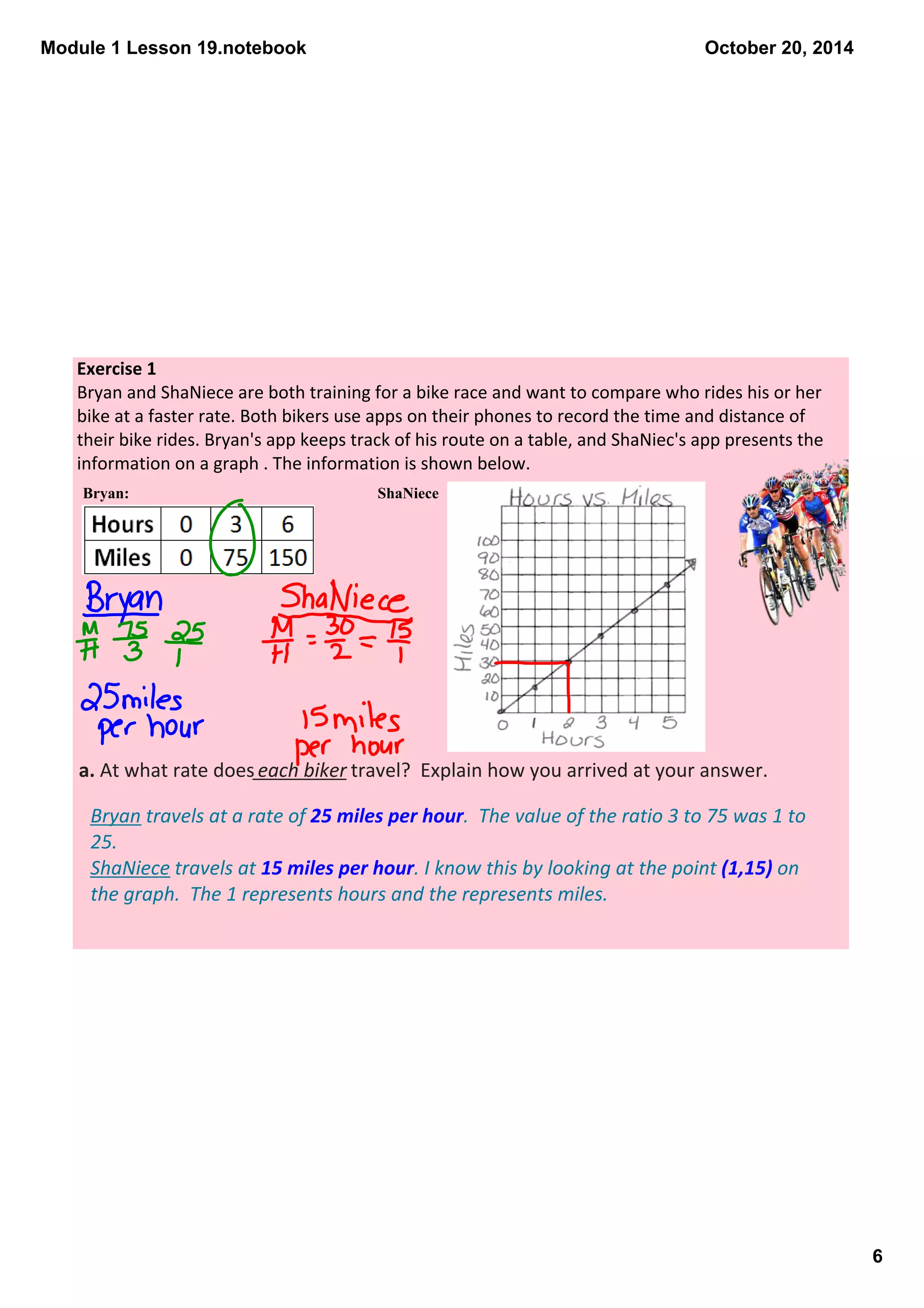
Bryan and ShaNiece are both training for a bike race and want to compare who rides his or her 
bike at a faster rate. Both bikers use apps on their phones to record the time and distance of 
their bike rides. Bryan's app keeps track of his route on a table, and ShaNiec's app presents the 
information on a graph . The information is shown below. 
Bryan: ShaNiece 
a. At what rate does each biker travel? Explain how you arrived at your answer. 
Bryan travels at a rate of 25 miles per hour. The value of the ratio 3 to 75 was 1 to 
25. 
ShaNiece travels at 15 miles per hour. I know this by looking at the point (1,15) on 
the graph. The 1 represents hours and the represents miles.
Module 1 Lesson 19.notebook 
7 
October 20, 2014 
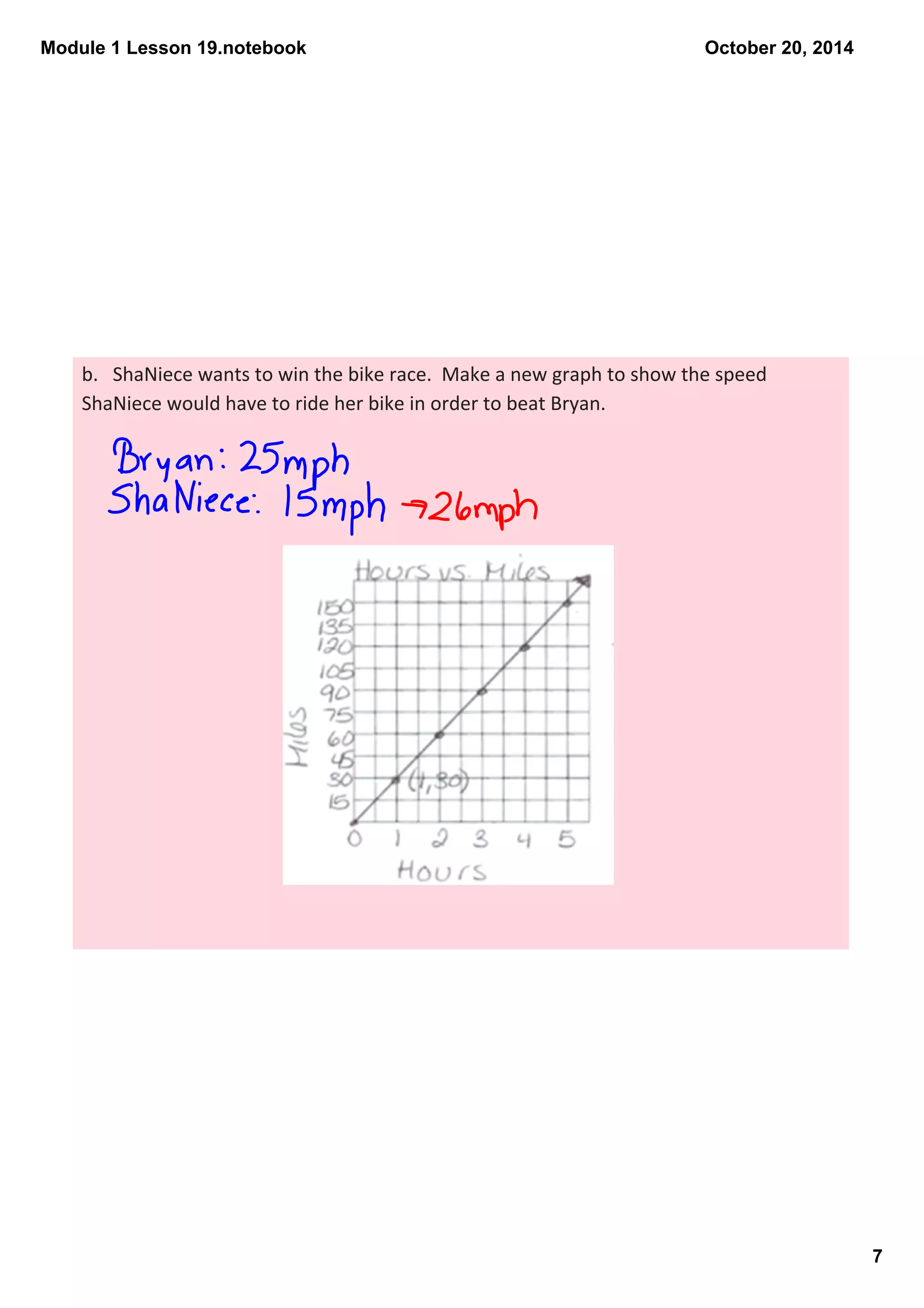
b. ShaNiece wants to win the bike race. Make a new graph to show the speed 
ShaNiece would have to ride her bike in order to beat Bryan.
Module 1 Lesson 19.notebook 
8 
October 20, 2014 
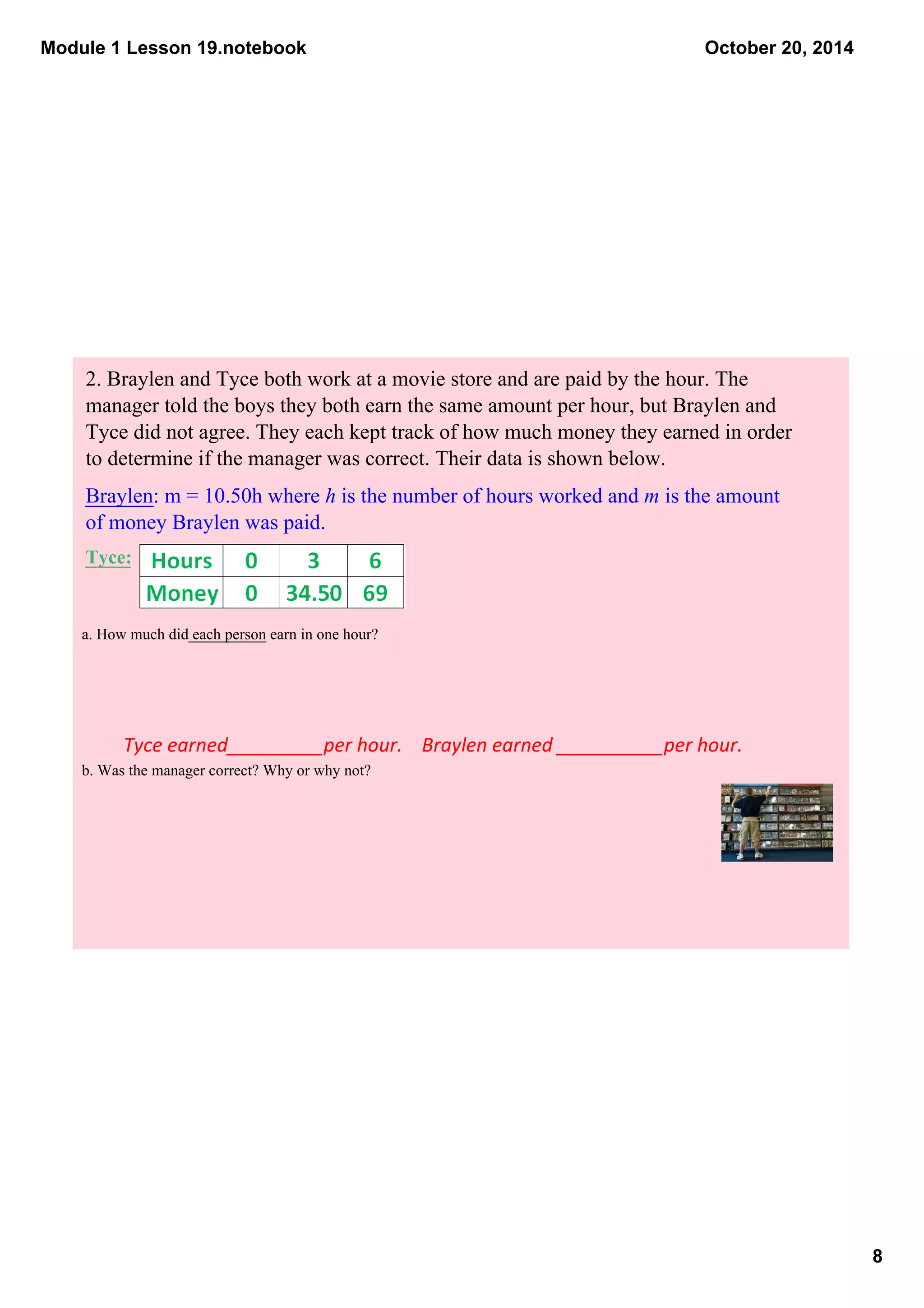
2. Braylen and Tyce both work at a movie store and are paid by the hour. The 
manager told the boys they both earn the same amount per hour, but Braylen and 
Tyce did not agree. They each kept track of how much money they earned in order 
to determine if the manager was correct. Their data is shown below. 
Braylen: m = 10.50h where h is the number of hours worked and m is the amount 
of money Braylen was paid. 
Tyce: 
a. How much did each person earn in one hour? 
Tyce earned_________per hour. Braylen earned __________per hour. 
b. Was the manager correct? Why or why not?
Module 1 Lesson 19.notebook 
9 
October 20, 2014 
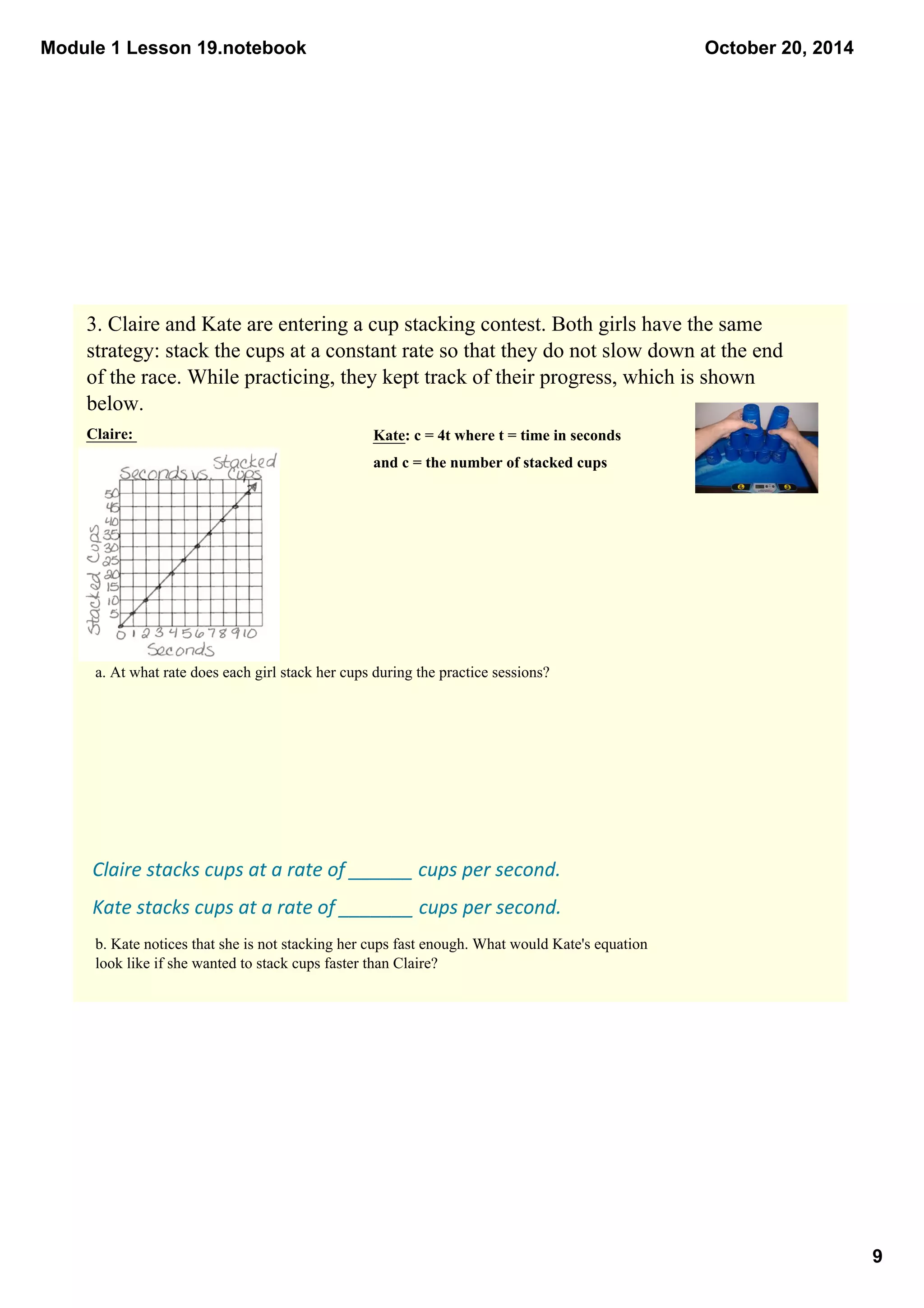
3. Claire and Kate are entering a cup stacking contest. Both girls have the same 
strategy: stack the cups at a constant rate so that they do not slow down at the end 
of the race. While practicing, they kept track of their progress, which is shown 
below. 
Claire: Kate: c = 4t where t = time in seconds 
and c = the number of stacked cups 
a. At what rate does each girl stack her cups during the practice sessions? 
Claire stacks cups at a rate of ______ cups per second. 
Kate stacks cups at a rate of _______ cups per second. 
b. Kate notices that she is not stacking her cups fast enough. What would Kate's equation 
look like if she wanted to stack cups faster than Claire?
Module 1 Lesson 19.notebook 
10 
October 20, 2014 
Closing 
How do you identify the unit rate in a table, graph, and equation? 
Why was the unit rate instrumental when comparing rates? 
Please take out your exit ticket for Lesson 19, close your 
binder, and complete the exit ticket. This will be collected.
Module 1 Lesson 19.notebook 
11 
October 20, 2014

Module 1 lesson 19

  • 1.
    Module 1 Lesson19.notebook 1 October 20, 2014 Monday Problem Set Lesson 19 Tuesday Exit Ticket Lesson 19 Wednesday Review Packet Thursday Problem Set Lesson 20 Friday Problem Set Lesson 21 Quiz on Lessons 16­23 on Thursday
  • 2.
    Module 1 Lesson19.notebook 2 October 20, 2014 Lesson 18 Homework Review 1. Enguun earns $17 per hour tutoring student­athletes at Brooklyn University. a. If Enguun tutored for 12 hours this month, how much money did she earn this month? $204 b. If Enguun tutored for 19.5 hours last month, how much did she earn last month? $331.50 2. The Piney Creek Swim Club is preparing for the opening day of the summer season. The pool holds 22, 410 gallons of water, and water is being pumped in at 540 gallons per hour. The swim club has their first practice in 42 hours; will the pool be full in time? Explain your answer. Yes, the pool will be full of water in time for the first practice because 22 , 680 gallons of water can be pumped in 42 hours at a rate of 540 gallons per hour. Since 22, 680 gallons is more water tahn the pool needs, we know that the swim club will have enough water.
  • 3.
    Module 1 Lesson19.notebook 3 October 20, 2014 Module 1 Ratios and Unit Rates Topic A: Representing and Reasoning About Ratios Lesson 19: Comparison Shopping‐ Unit Price and Related Measurement Comversions. Student Outcomes § Students solve problems by analyzing different unit rates given in tables, equations, and graphs.
  • 4.
    Module 1 Lesson19.notebook 4 October 20, 2014 Classwork Example 1 Creating Tables from Equations: 1. The ratio of cups of blue paint to cups of red paint is 1:2 which means for every cup of blue paint, there are two cups of red paint. In this case, the equation would be red = 2 x blue or r = 2b, where "b" represents the amount of blue paint and "r" represents the amount of red paint. Make a table of values. Fill in the labels for each row as shown in the completed table below. If we have 1 cup of blue paint, how many cups of red paint would we have? If we have 2 cups of blue paint, how many cups of red paint would we have? Complete the table.
  • 5.
    Module 1 Lesson19.notebook 5 October 20, 2014 34 2. Ms. Siple is a librarian who really enjoys reading. She can read of a book in one day. This relationship can be represented by the equation days = books, which can be written as d= b, where b is the number of books d and is the number of days. Make a table of values. 34 34
  • 6.
    Module 1 Lesson19.notebook 6 October 20, 2014 Exercise 1 Bryan and ShaNiece are both training for a bike race and want to compare who rides his or her bike at a faster rate. Both bikers use apps on their phones to record the time and distance of their bike rides. Bryan's app keeps track of his route on a table, and ShaNiec's app presents the information on a graph . The information is shown below. Bryan: ShaNiece a. At what rate does each biker travel? Explain how you arrived at your answer. Bryan travels at a rate of 25 miles per hour. The value of the ratio 3 to 75 was 1 to 25. ShaNiece travels at 15 miles per hour. I know this by looking at the point (1,15) on the graph. The 1 represents hours and the represents miles.
  • 7.
    Module 1 Lesson19.notebook 7 October 20, 2014 b. ShaNiece wants to win the bike race. Make a new graph to show the speed ShaNiece would have to ride her bike in order to beat Bryan.
  • 8.
    Module 1 Lesson19.notebook 8 October 20, 2014 2. Braylen and Tyce both work at a movie store and are paid by the hour. The manager told the boys they both earn the same amount per hour, but Braylen and Tyce did not agree. They each kept track of how much money they earned in order to determine if the manager was correct. Their data is shown below. Braylen: m = 10.50h where h is the number of hours worked and m is the amount of money Braylen was paid. Tyce: a. How much did each person earn in one hour? Tyce earned_________per hour. Braylen earned __________per hour. b. Was the manager correct? Why or why not?
  • 9.
    Module 1 Lesson19.notebook 9 October 20, 2014 3. Claire and Kate are entering a cup stacking contest. Both girls have the same strategy: stack the cups at a constant rate so that they do not slow down at the end of the race. While practicing, they kept track of their progress, which is shown below. Claire: Kate: c = 4t where t = time in seconds and c = the number of stacked cups a. At what rate does each girl stack her cups during the practice sessions? Claire stacks cups at a rate of ______ cups per second. Kate stacks cups at a rate of _______ cups per second. b. Kate notices that she is not stacking her cups fast enough. What would Kate's equation look like if she wanted to stack cups faster than Claire?
  • 10.
    Module 1 Lesson19.notebook 10 October 20, 2014 Closing How do you identify the unit rate in a table, graph, and equation? Why was the unit rate instrumental when comparing rates? Please take out your exit ticket for Lesson 19, close your binder, and complete the exit ticket. This will be collected.
  • 11.
    Module 1 Lesson19.notebook 11 October 20, 2014