© 2013 Maveric Systems Limited
Knowledge Encapsulation
in Model Based Testing
© 2013 Maveric Systems Limited 2
▸ Background
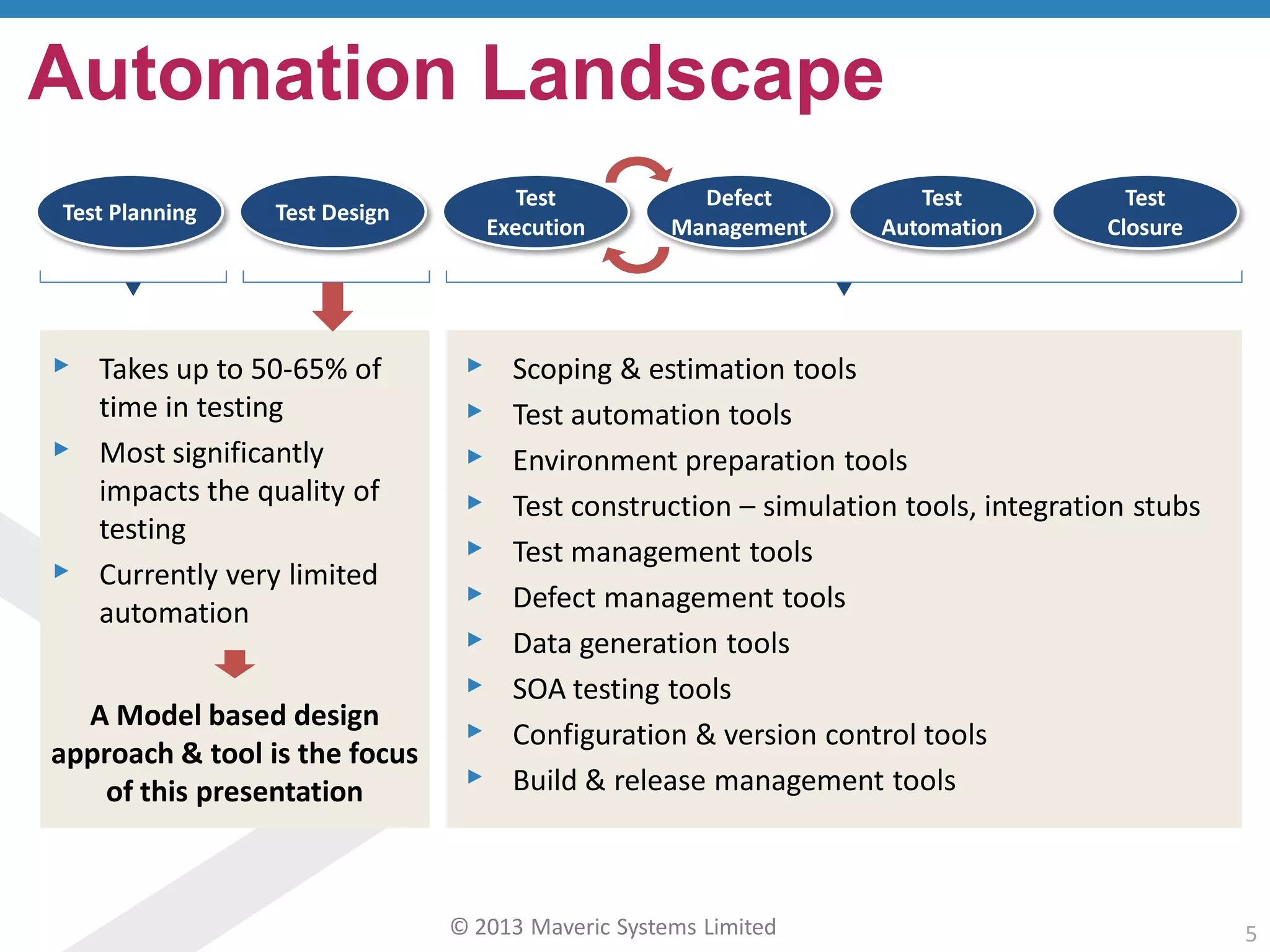
▸ Automation LANDSCAPE
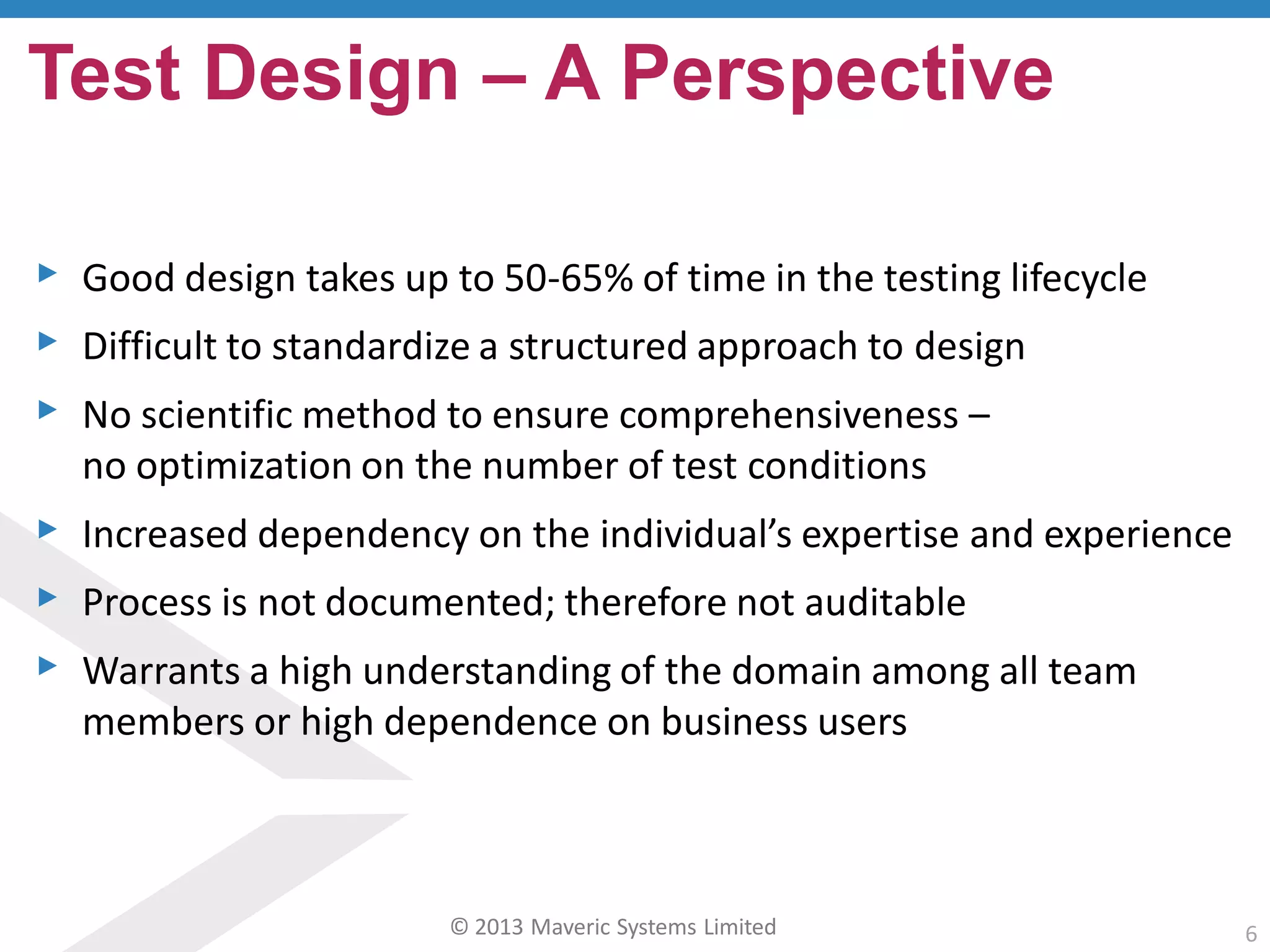
▸ Test design – A Perspective
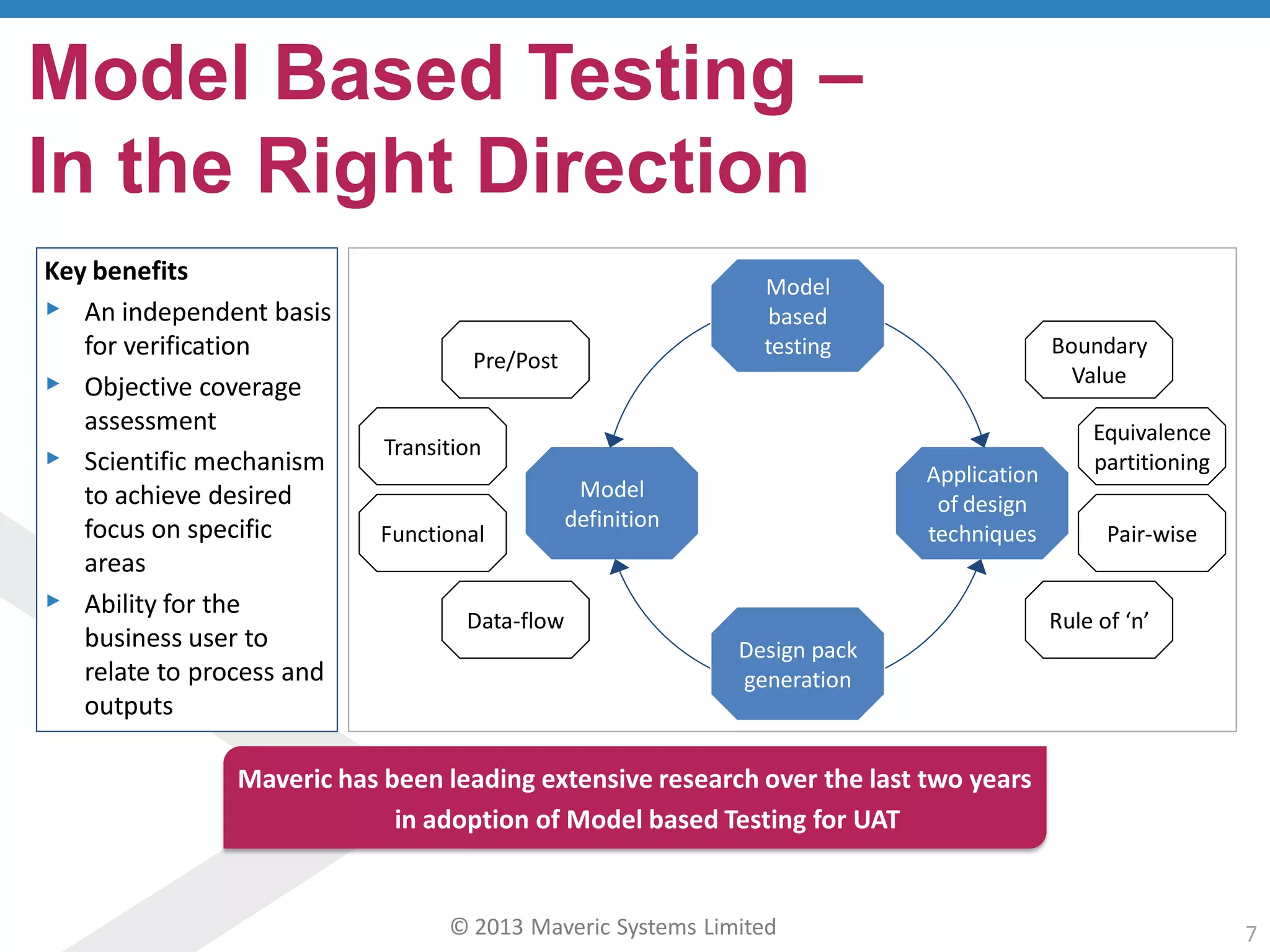
▸ Model Based Testing – A positive influence
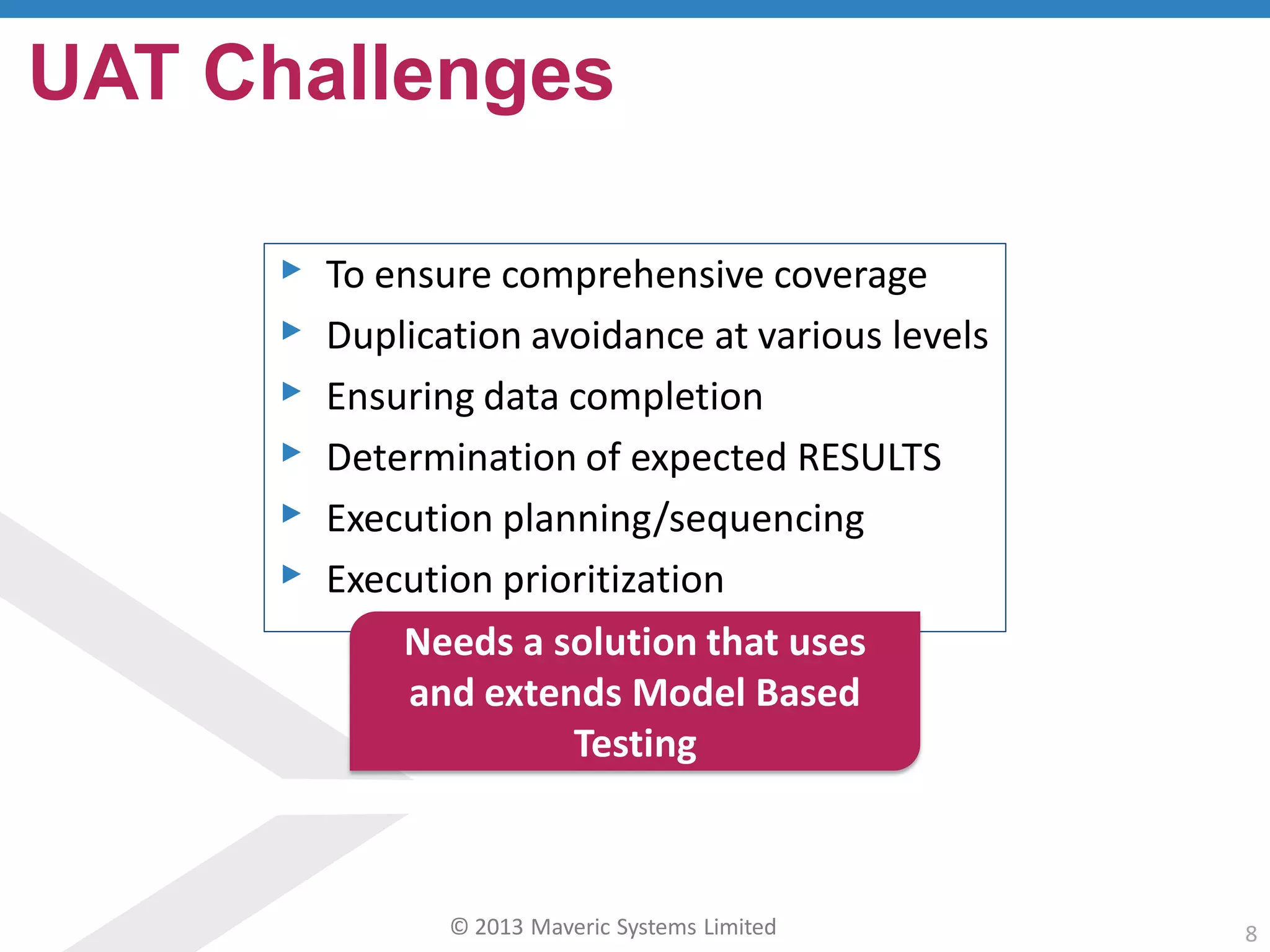
▸ UAT Challenges
▸ Testac – Challenges addressed
▸ Testac driven design process
Coverage
© 2013 Maveric Systems Limited 3
Software Testing – Relatively nascent as an independent industry
▸ Key drivers – over past 10 years
» Early years – need for objectivity/independence
» Mid years – domain/vertical competencies, regression &
repeatability
» What now?
Background
© 2013 Maveric Systems Limited 4
▸ Productivity improvement across the testing lifecycle, achieved
through
» Process improvement initiatives (alignment to TMM, TPI etc.)
» Automation initiatives
What now?
© 2013 Maveric Systems Limited 5
Test DesignTest Planning
Test
Closure
Automation Landscape
Defect
Management
Test
Execution
Test
Automation
▸ Takes up to 50-65% of
time in testing
▸ Most significantly
impacts the quality of
testing
▸ Currently very limited
automation
▸ Scoping & estimation tools
▸ Test automation tools
▸ Environment preparation tools
▸ Test construction – simulation tools, integration stubs
▸ Test management tools
▸ Defect management tools
▸ Data generation tools
▸ SOA testing tools
▸ Configuration & version control tools
▸ Build & release management tools
A Model based design
approach & tool is the focus
of this presentation
© 2013 Maveric Systems Limited 6
▸ Good design takes up to 50-65% of time in the testing lifecycle
▸ Difficult to standardize a structured approach to design
▸ No scientific method to ensure comprehensiveness –
no optimization on the number of test conditions
▸ Increased dependency on the individual’s expertise and experience
▸ Process is not documented; therefore not auditable
▸ Warrants a high understanding of the domain among all team
members or high dependence on business users
Test Design – A Perspective
© 2013 Maveric Systems Limited 7
Model Based Testing –
In the Right Direction
Maveric has been leading extensive research over the last two years
in adoption of Model based Testing for UAT
Key benefits
▸ An independent basis
for verification
▸ Objective coverage
assessment
▸ Scientific mechanism
to achieve desired
focus on specific
areas
▸ Ability for the
business user to
relate to process and
outputs
Model
based
testing
Design pack
generation
Model
definition
Application
of design
techniques
Equivalence
partitioning
Pair-wise
Rule of ‘n’
Boundary
Value
Transition
Functional
Data-flow
Pre/Post
© 2013 Maveric Systems Limited 8
▸ To ensure comprehensive coverage
▸ Duplication avoidance at various levels
▸ Ensuring data completion
▸ Determination of expected RESULTS
▸ Execution planning/sequencing
▸ Execution prioritization
UAT Challenges
Needs a solution that uses
and extends Model Based
Testing
© 2013 Maveric Systems Limited 9
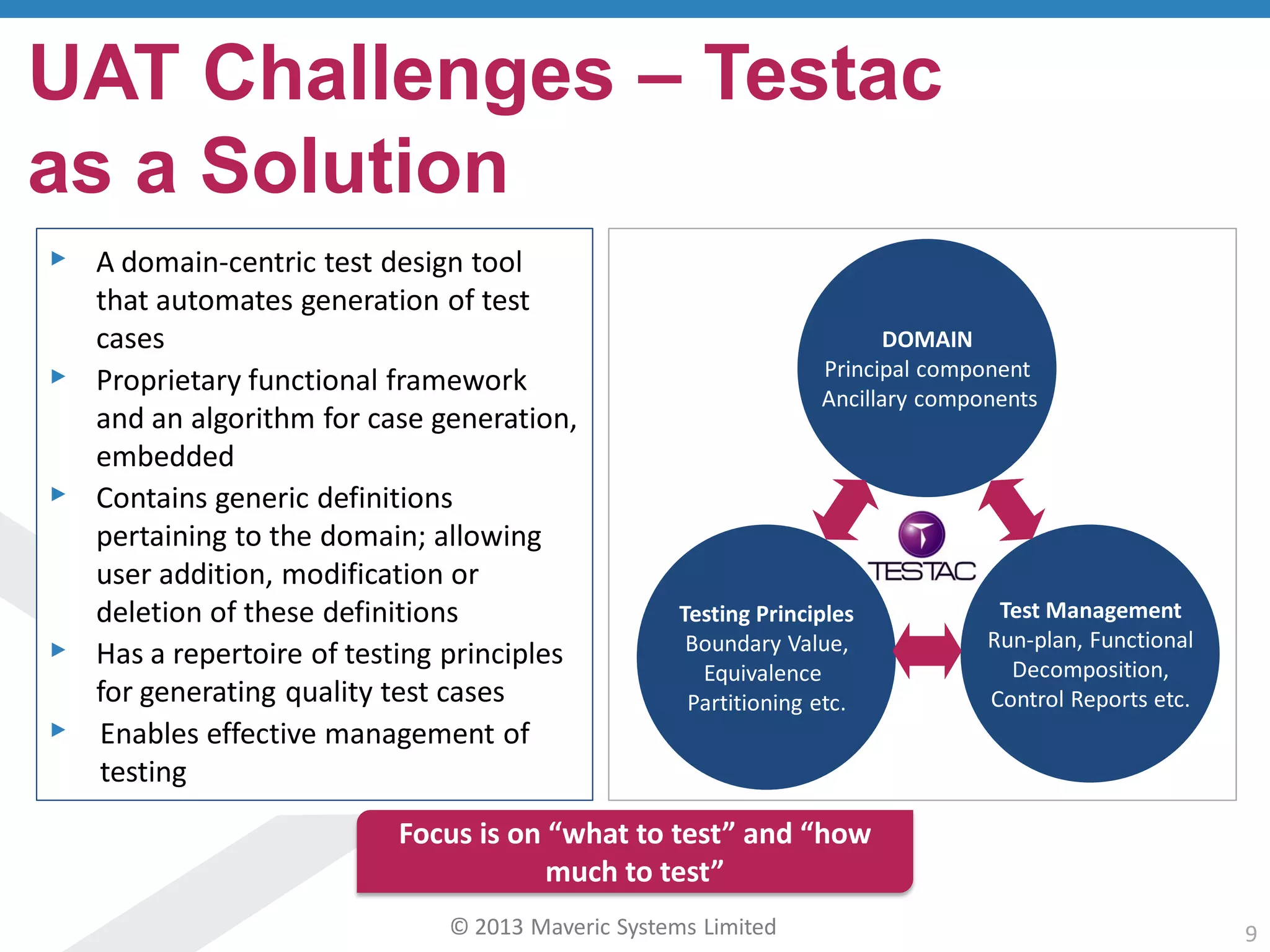
UAT Challenges – Testac
as a Solution
DOMAIN
Principal component
Ancillary components
Testing Principles
Boundary Value,
Equivalence
Partitioning etc.
Test Management
Run-plan, Functional
Decomposition,
Control Reports etc.
▸ A domain-centric test design tool
that automates generation of test
cases
▸ Proprietary functional framework
and an algorithm for case generation,
embedded
▸ Contains generic definitions
pertaining to the domain; allowing
user addition, modification or
deletion of these definitions
▸ Has a repertoire of testing principles
for generating quality test cases
▸ Enables effective management of
testing
Focus is on “what to test” and “how
much to test”
© 2013 Maveric Systems Limited 10
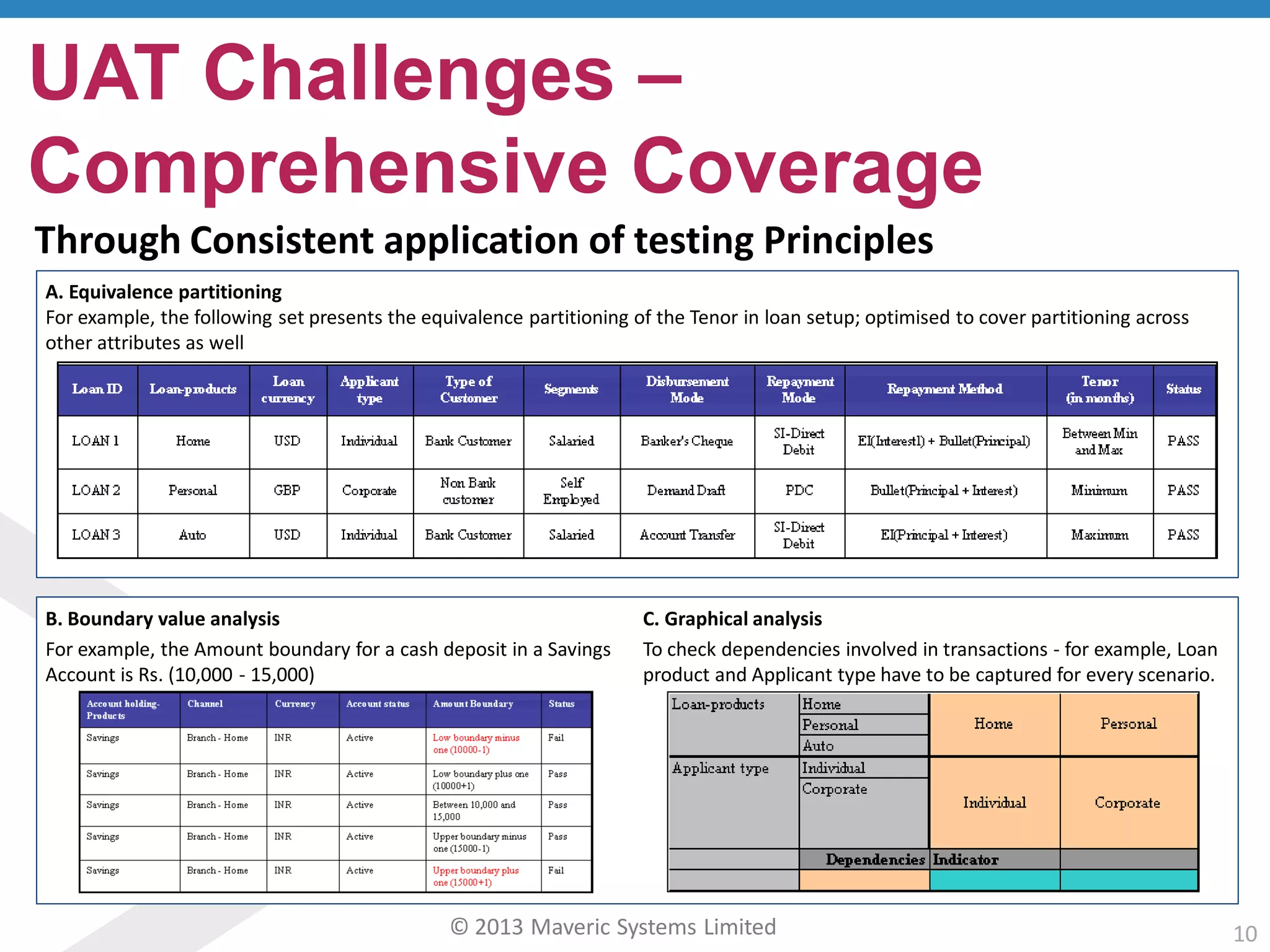
UAT Challenges –
Comprehensive Coverage
A. Equivalence partitioning
For example, the following set presents the equivalence partitioning of the Tenor in loan setup; optimised to cover partitioning across
other attributes as well
Through Consistent application of testing Principles
B. Boundary value analysis
For example, the Amount boundary for a cash deposit in a Savings
Account is Rs. (10,000 - 15,000)
C. Graphical analysis
To check dependencies involved in transactions - for example, Loan
product and Applicant type have to be captured for every scenario.
© 2013 Maveric Systems Limited 11
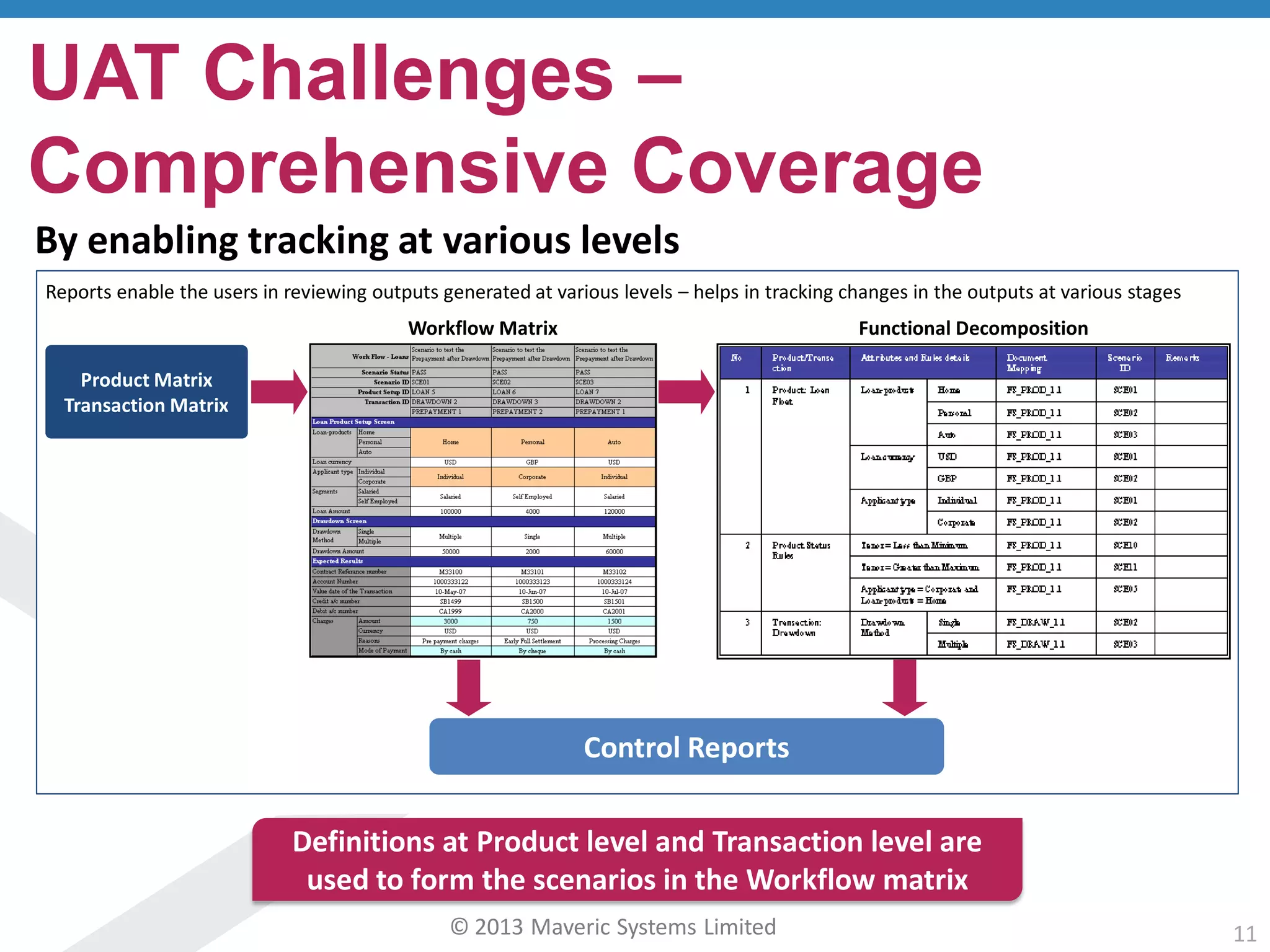
UAT Challenges –
Comprehensive Coverage
By enabling tracking at various levels
Reports enable the users in reviewing outputs generated at various levels – helps in tracking changes in the outputs at various stages
Product Matrix
Transaction Matrix
Workflow Matrix Functional Decomposition
Definitions at Product level and Transaction level are
used to form the scenarios in the Workflow matrix
Control Reports
© 2013 Maveric Systems Limited 12
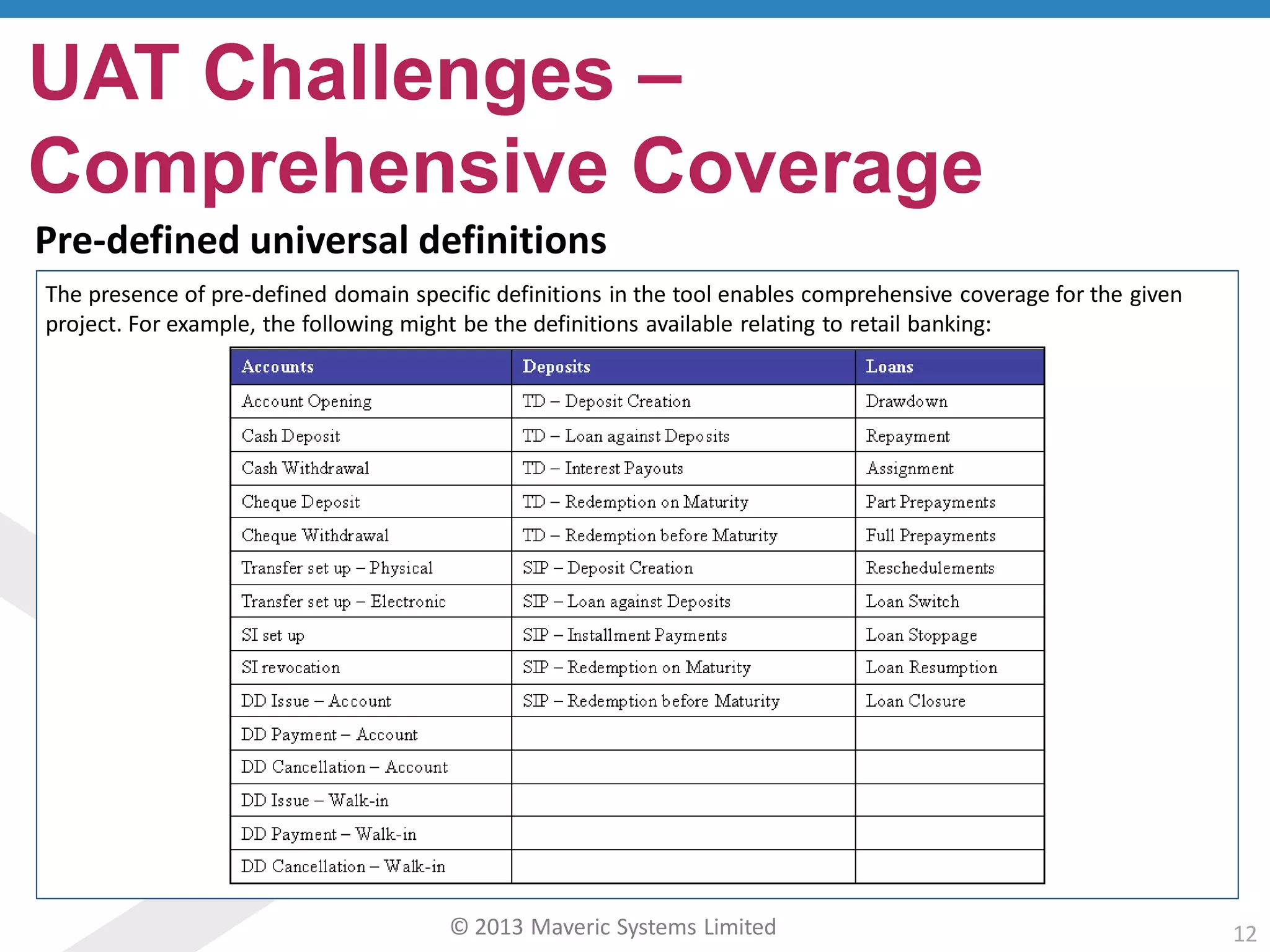
UAT Challenges –
Comprehensive Coverage
Pre-defined universal definitions
The presence of pre-defined domain specific definitions in the tool enables comprehensive coverage for the given
project. For example, the following might be the definitions available relating to retail banking:
© 2013 Maveric Systems Limited 13
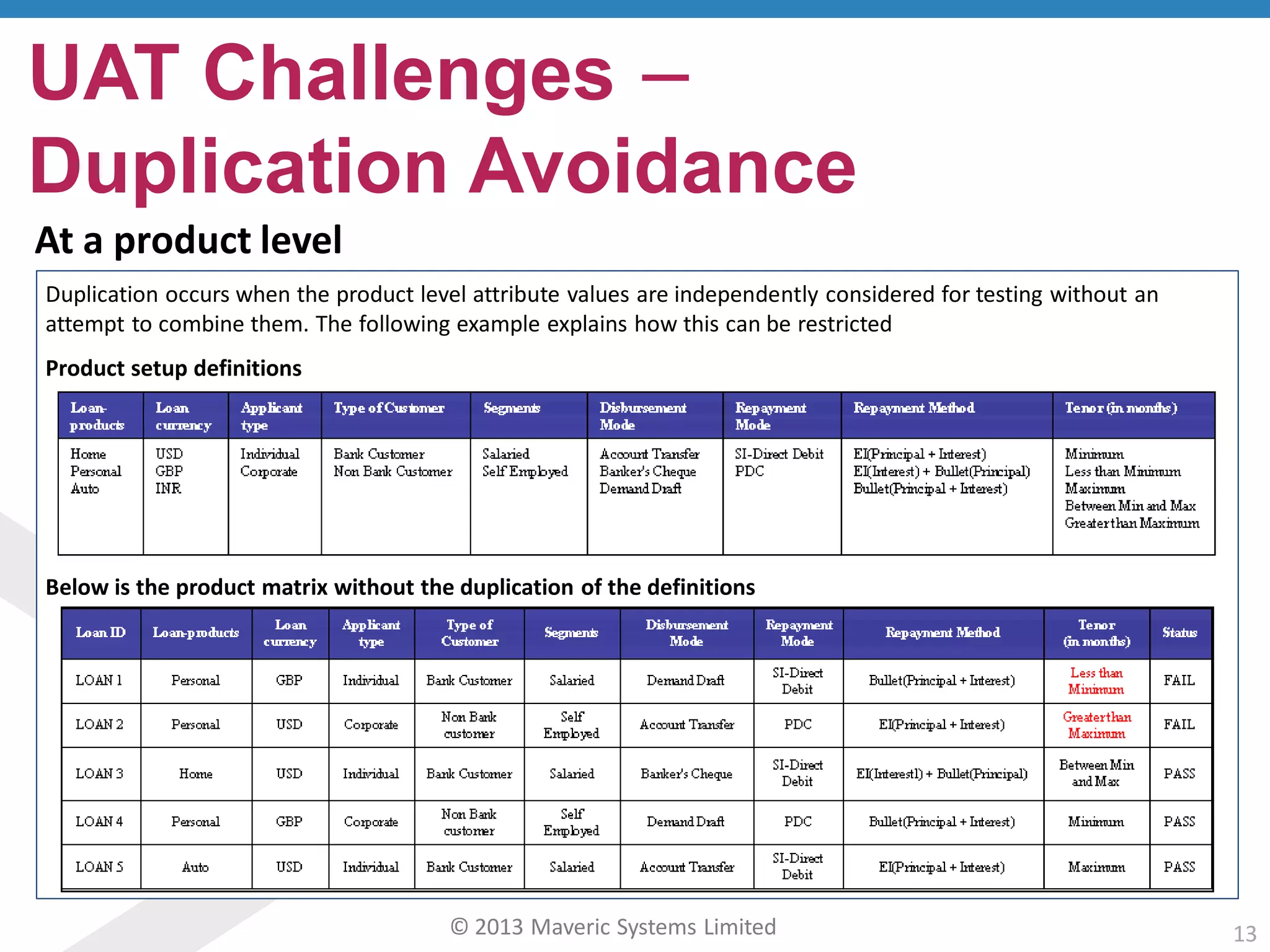
At a product level
Duplication occurs when the product level attribute values are independently considered for testing without an
attempt to combine them. The following example explains how this can be restricted
UAT Challenges –
Duplication Avoidance
Product setup definitions
Below is the product matrix without the duplication of the definitions
© 2013 Maveric Systems Limited 14
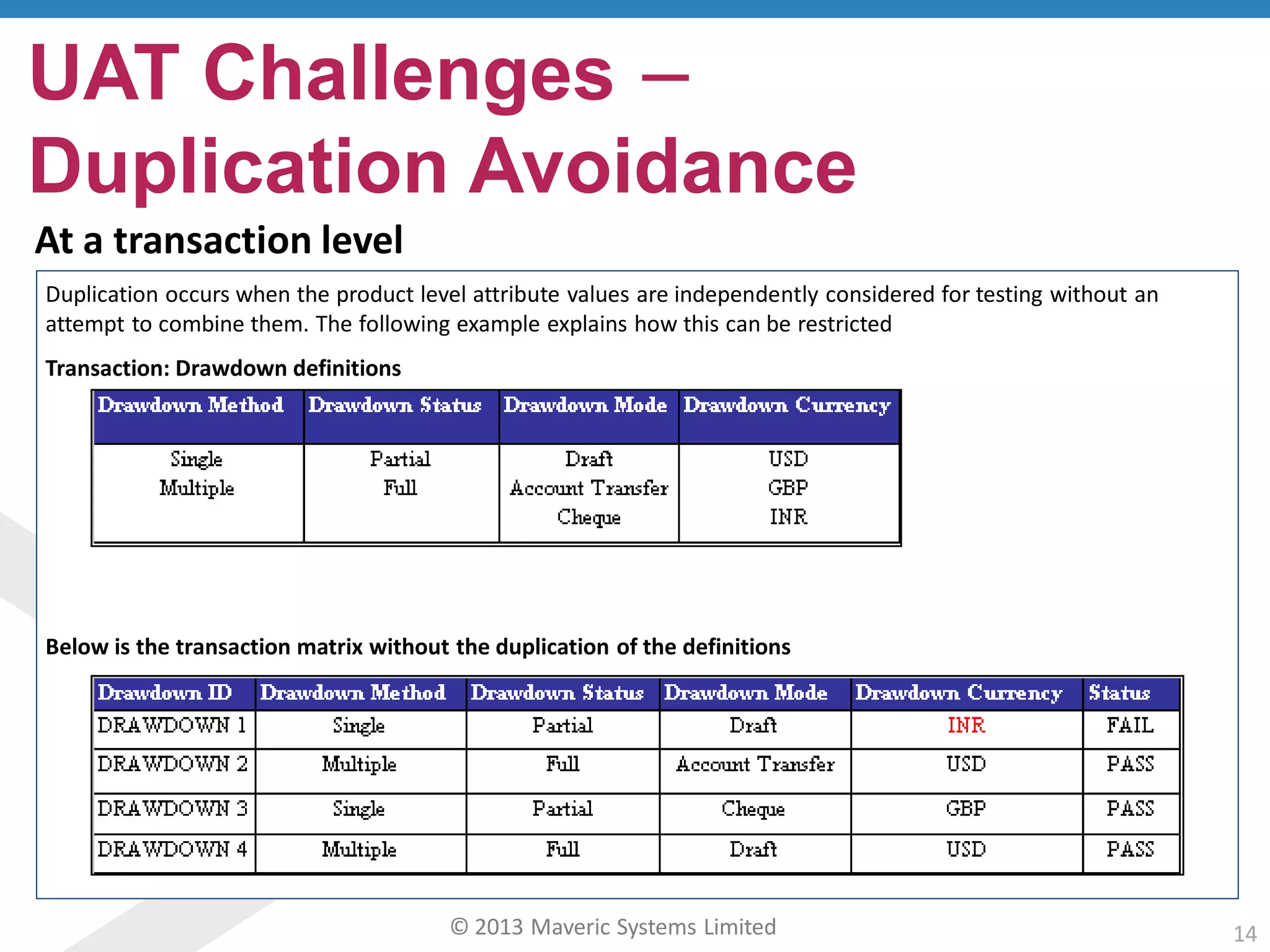
At a transaction level
Duplication occurs when the product level attribute values are independently considered for testing without an
attempt to combine them. The following example explains how this can be restricted
Transaction: Drawdown definitions
UAT Challenges –
Duplication Avoidance
Below is the transaction matrix without the duplication of the definitions
© 2013 Maveric Systems Limited 15
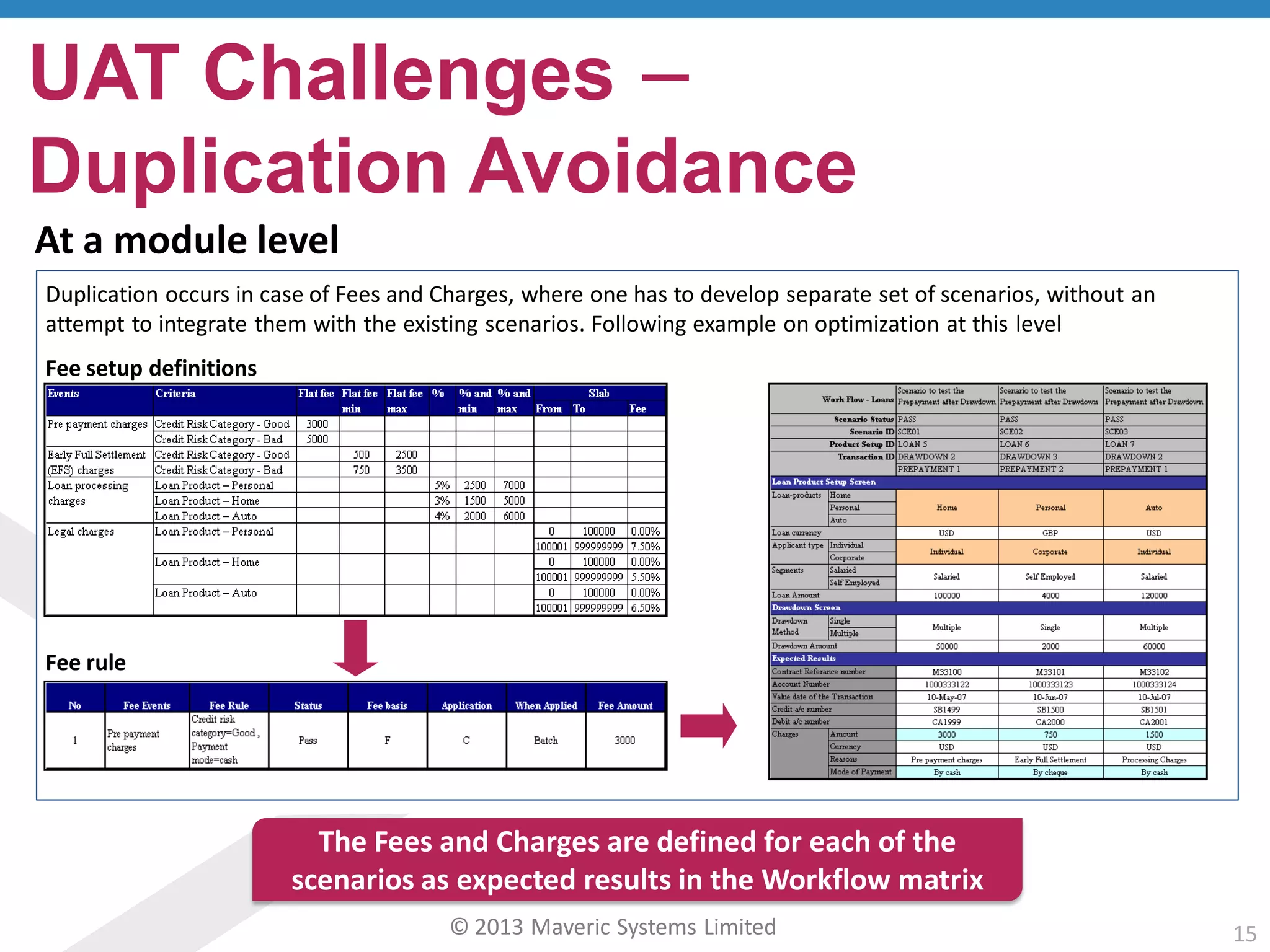
At a module level
Duplication occurs in case of Fees and Charges, where one has to develop separate set of scenarios, without an
attempt to integrate them with the existing scenarios. Following example on optimization at this level
UAT Challenges –
Duplication Avoidance
Fee setup definitions
Fee rule
The Fees and Charges are defined for each of the
scenarios as expected results in the Workflow matrix
© 2013 Maveric Systems Limited 16
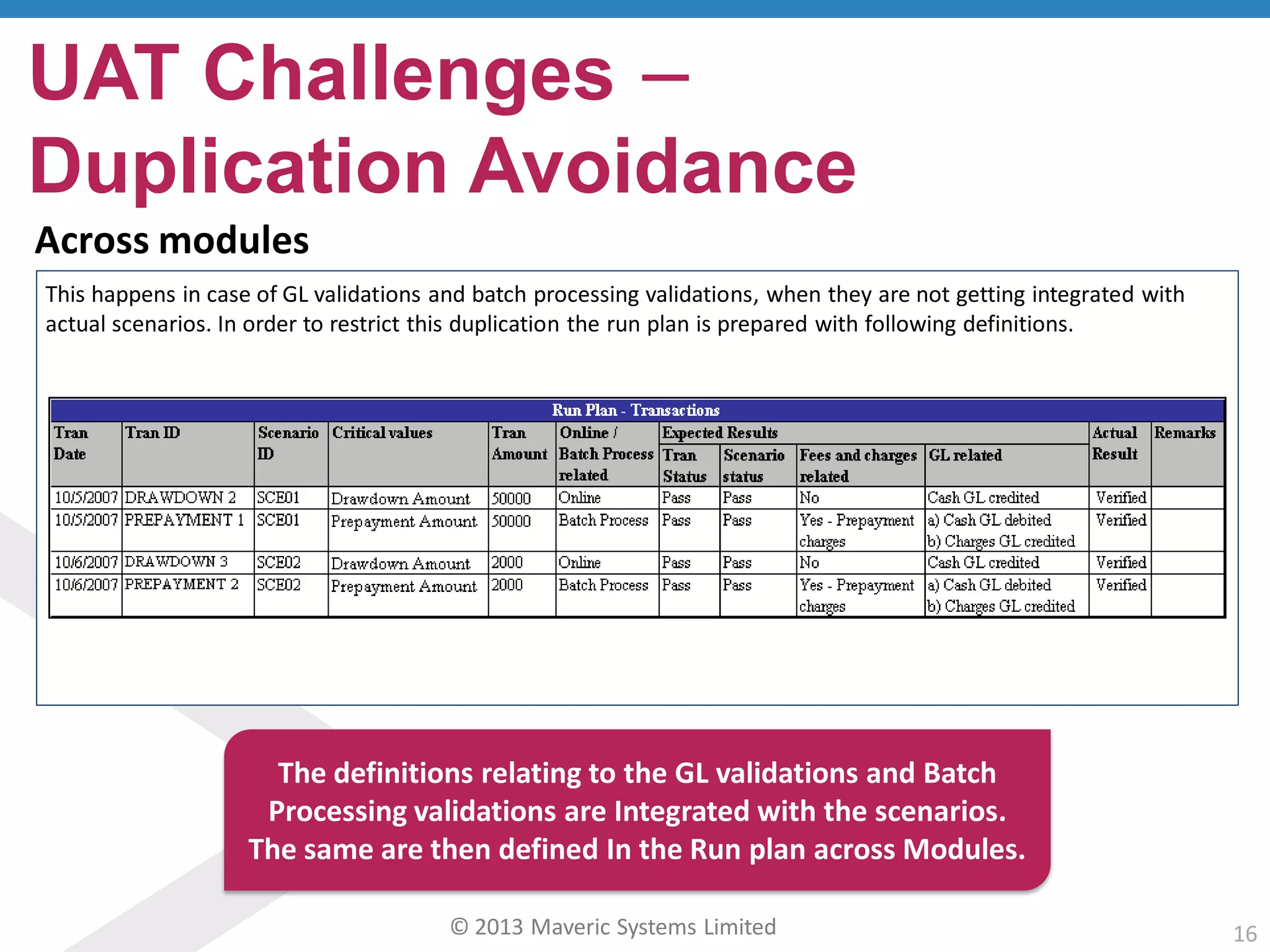
Across modules
This happens in case of GL validations and batch processing validations, when they are not getting integrated with
actual scenarios. In order to restrict this duplication the run plan is prepared with following definitions.
UAT Challenges –
Duplication Avoidance
The definitions relating to the GL validations and Batch
Processing validations are Integrated with the scenarios.
The same are then defined In the Run plan across Modules.
© 2013 Maveric Systems Limited 17
UAT Challenges –
Ensuring Data Completion
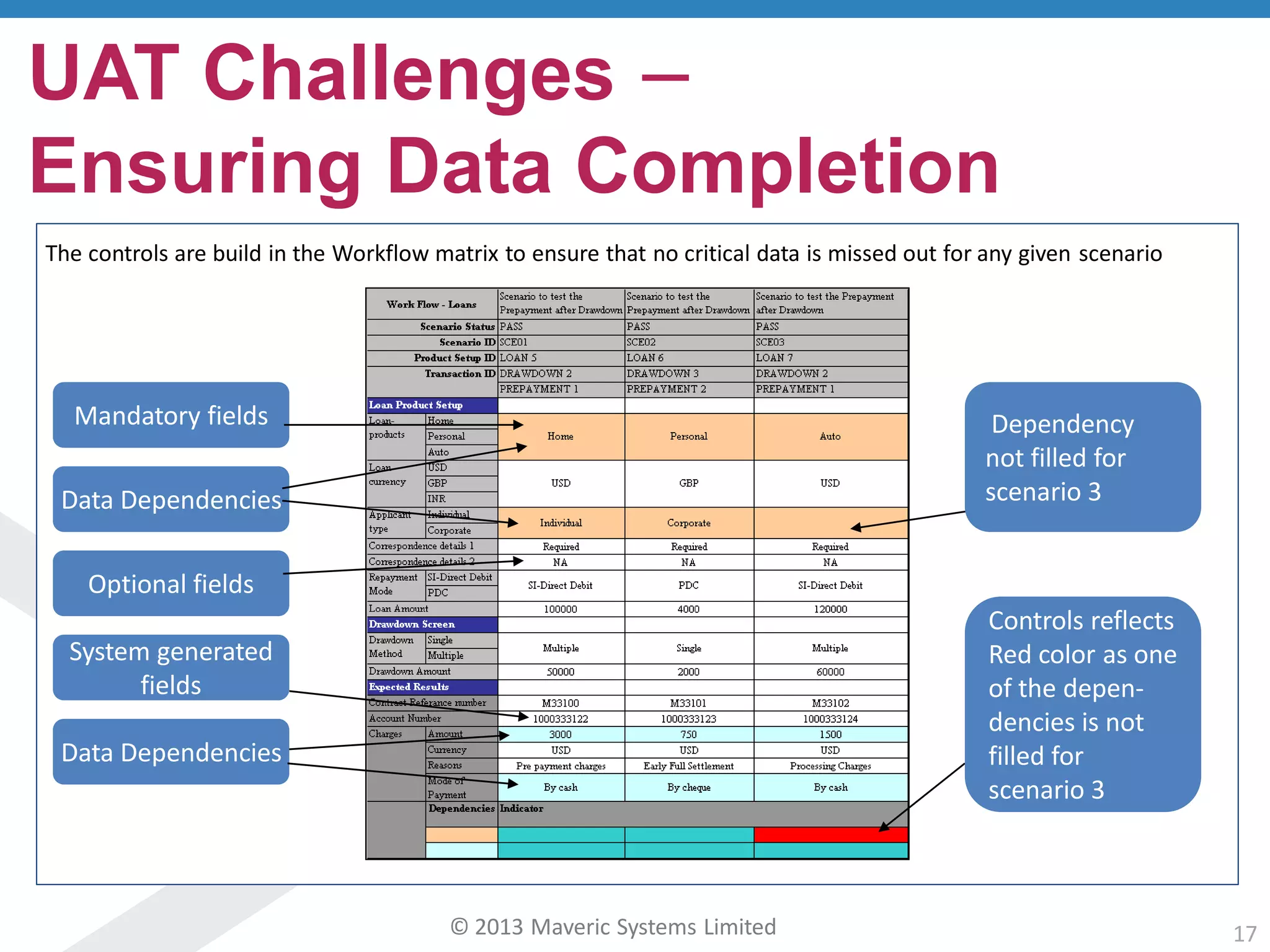
The controls are build in the Workflow matrix to ensure that no critical data is missed out for any given scenario
Data Dependencies
Data Dependencies
System generated
fields
Optional fields
Mandatory fields Dependency
not filled for
scenario 3
Controls reflects
Red color as one
of the depen-
dencies is not
filled for
scenario 3
© 2013 Maveric Systems Limited 18
UAT Challenges –
Expected Results
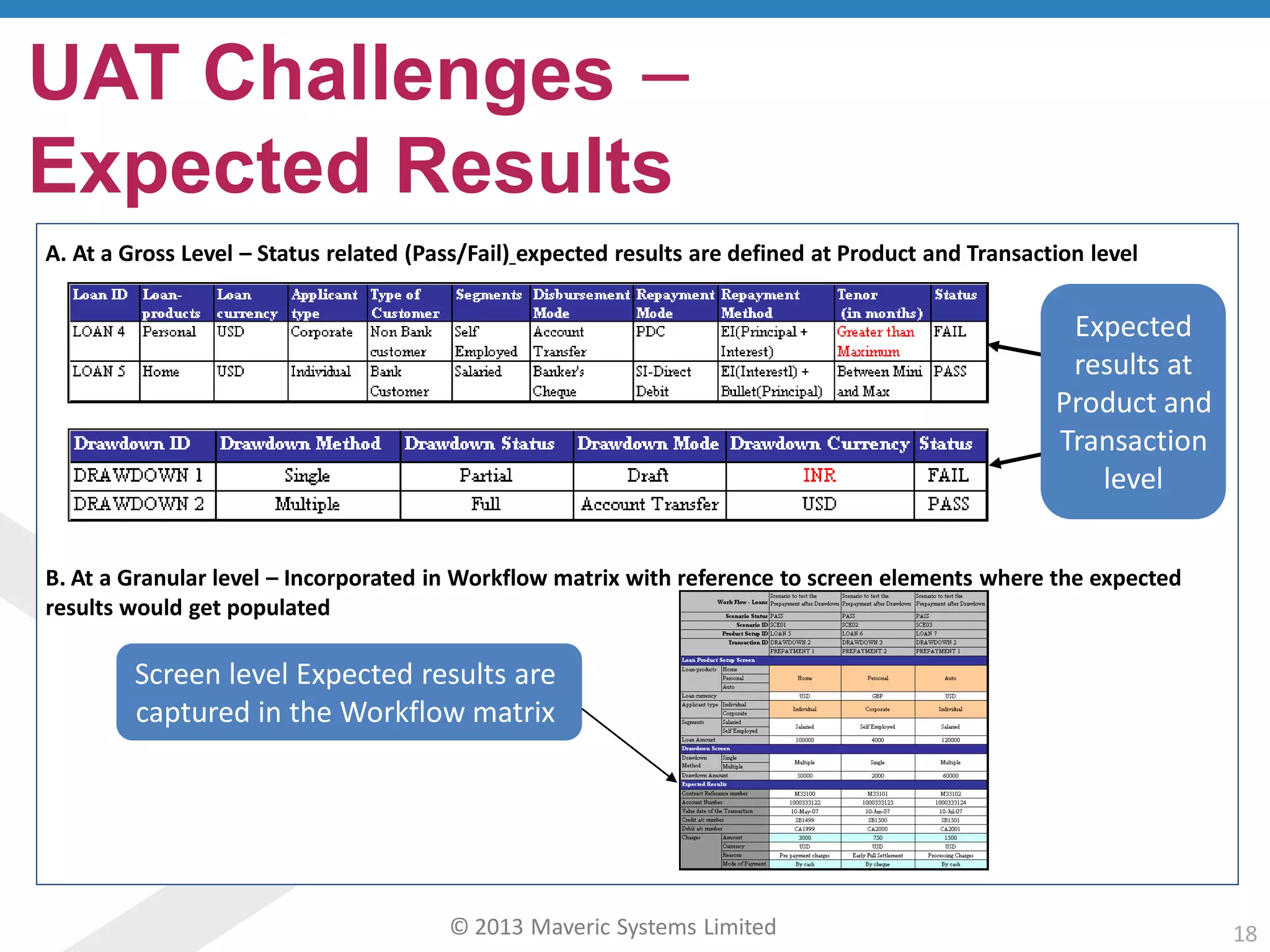
A. At a Gross Level – Status related (Pass/Fail) expected results are defined at Product and Transaction level
Expected
results at
Product and
Transaction
level
B. At a Granular level – Incorporated in Workflow matrix with reference to screen elements where the expected
results would get populated
Screen level Expected results are
captured in the Workflow matrix
© 2013 Maveric Systems Limited 19
UAT Challenges –
Execution Planning
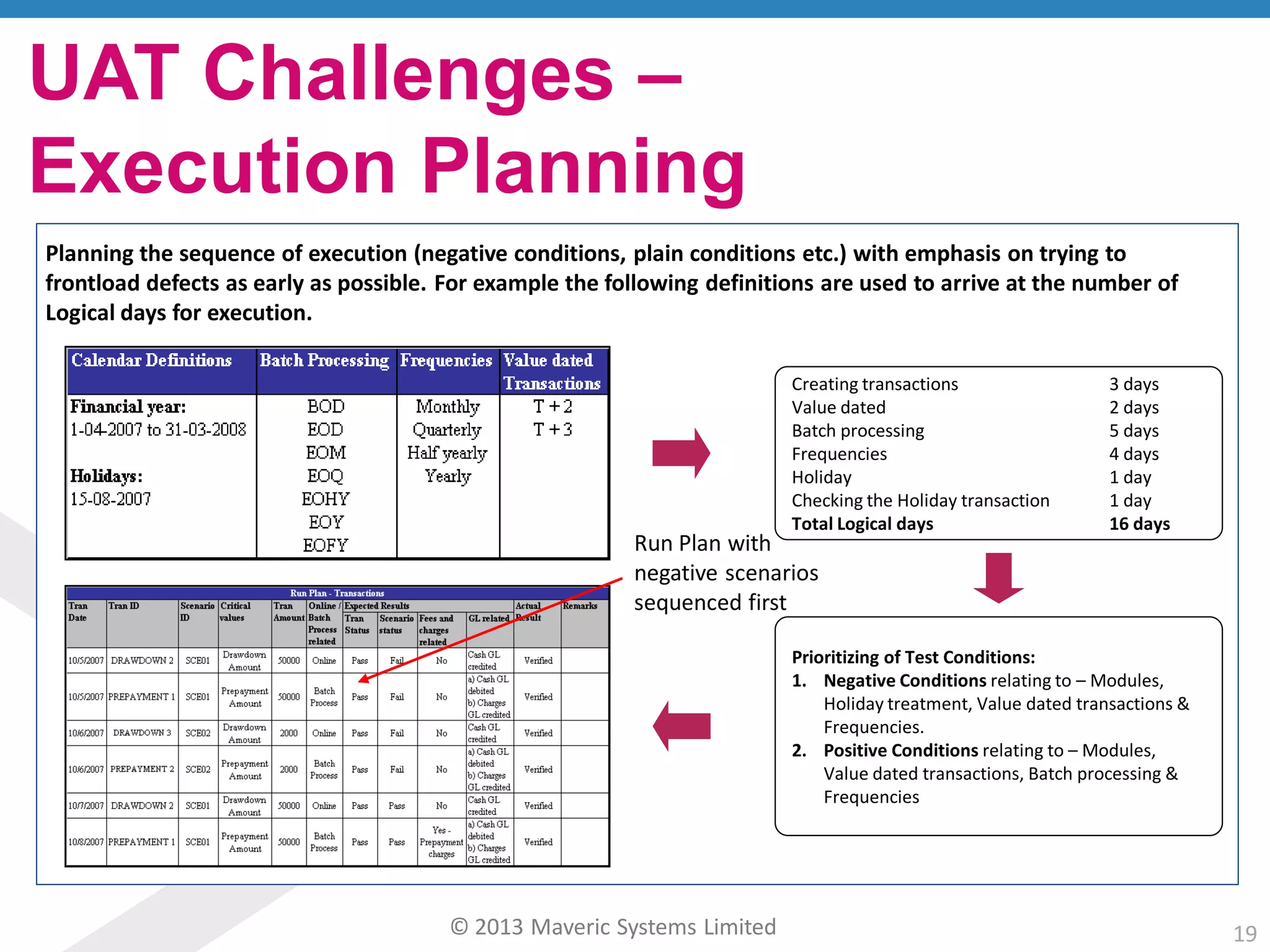
Creating transactions 3 days
Value dated 2 days
Batch processing 5 days
Frequencies 4 days
Holiday 1 day
Checking the Holiday transaction 1 day
Total Logical days 16 days
Prioritizing of Test Conditions:
1. Negative Conditions relating to – Modules,
Holiday treatment, Value dated transactions &
Frequencies.
2. Positive Conditions relating to – Modules,
Value dated transactions, Batch processing &
Frequencies
Run Plan with
negative scenarios
sequenced first
Planning the sequence of execution (negative conditions, plain conditions etc.) with emphasis on trying to
frontload defects as early as possible. For example the following definitions are used to arrive at the number of
Logical days for execution.
© 2013 Maveric Systems Limited 20
UAT Challenges – Execution
Prioritization
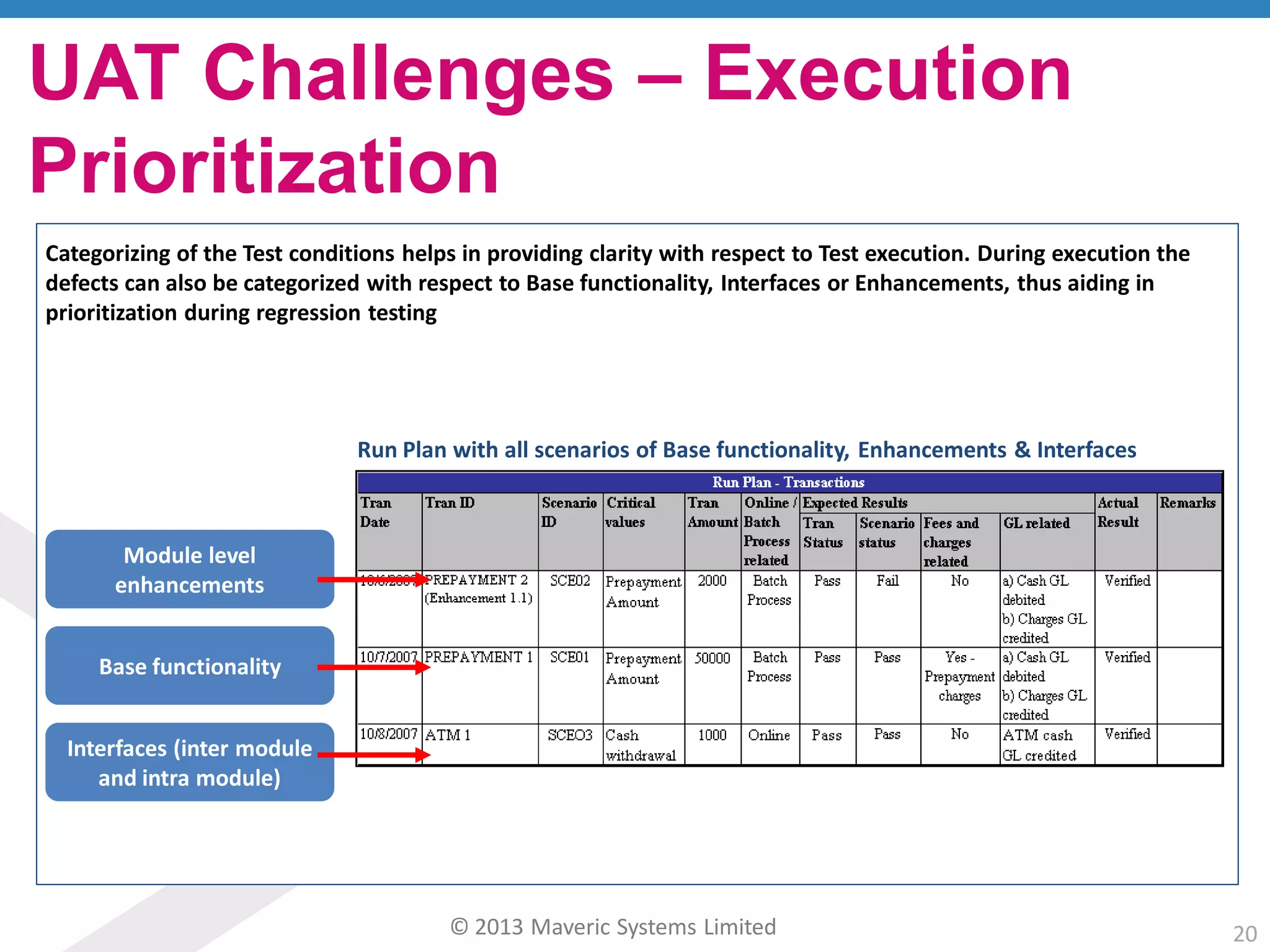
Categorizing of the Test conditions helps in providing clarity with respect to Test execution. During execution the
defects can also be categorized with respect to Base functionality, Interfaces or Enhancements, thus aiding in
prioritization during regression testing
Run Plan with all scenarios of Base functionality, Enhancements & Interfaces
Module level
enhancements
Interfaces (inter module
and intra module)
Base functionality
© 2013 Maveric Systems Limited 21
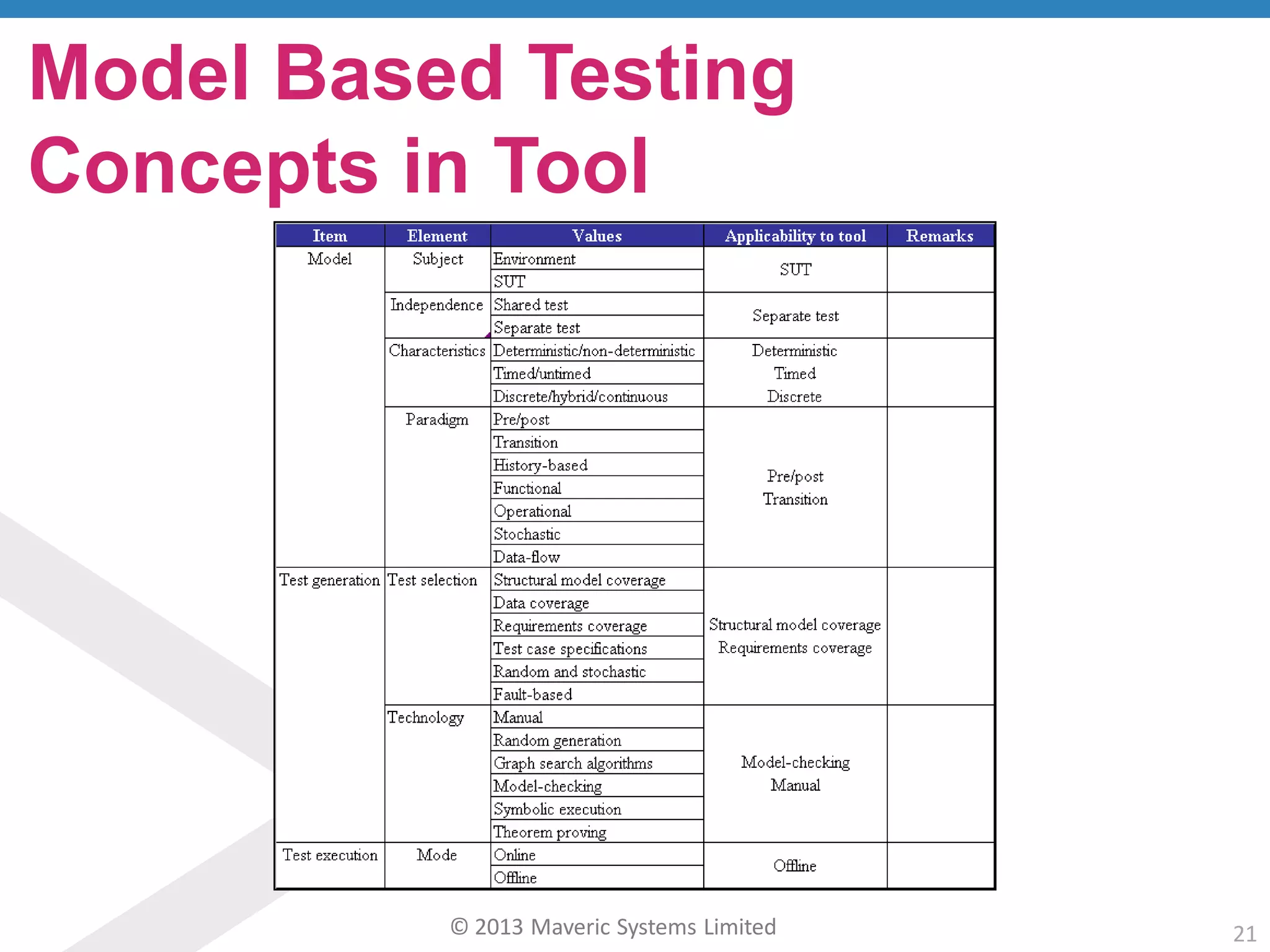
Model Based Testing
Concepts in Tool
© 2013 Maveric Systems Limited 22
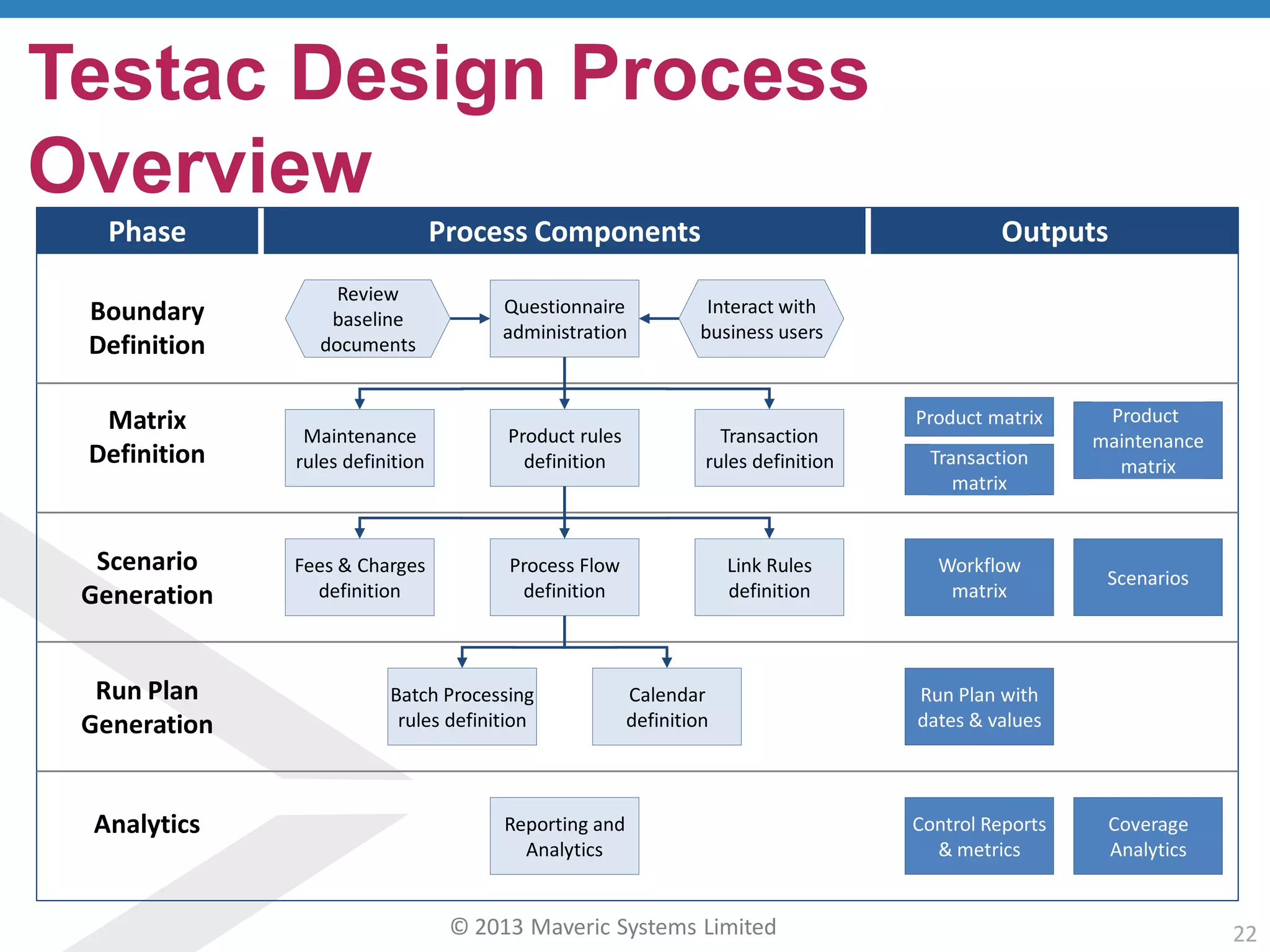
Testac Design Process
Overview
OutputsProcess Components
Questionnaire
administration
Review
baseline
documents
Interact with
business users
Product rules
definition
Transaction
rules definition
Maintenance
rules definition
Process Flow
definition
Fees & Charges
definition
Link Rules
definition
Calendar
definition
Batch Processing
rules definition
Reporting and
Analytics
Phase
Boundary
Definition
Matrix
Definition
Scenario
Generation
Run Plan
Generation
Analytics
Product matrix Product
maintenance
matrix
Control Reports
& metrics
Coverage
Analytics
Run Plan with
dates & values
Workflow
matrix
Scenarios
Transaction
matrix
© 2013 Maveric Systems Limited
Thank You

Model based testing

  • 1.
    © 2013 MavericSystems Limited Knowledge Encapsulation in Model Based Testing
  • 2.
    © 2013 MavericSystems Limited 2 ▸ Background ▸ Automation LANDSCAPE ▸ Test design – A Perspective ▸ Model Based Testing – A positive influence ▸ UAT Challenges ▸ Testac – Challenges addressed ▸ Testac driven design process Coverage
  • 3.
    © 2013 MavericSystems Limited 3 Software Testing – Relatively nascent as an independent industry ▸ Key drivers – over past 10 years » Early years – need for objectivity/independence » Mid years – domain/vertical competencies, regression & repeatability » What now? Background
  • 4.
    © 2013 MavericSystems Limited 4 ▸ Productivity improvement across the testing lifecycle, achieved through » Process improvement initiatives (alignment to TMM, TPI etc.) » Automation initiatives What now?
  • 5.
    © 2013 MavericSystems Limited 5 Test DesignTest Planning Test Closure Automation Landscape Defect Management Test Execution Test Automation ▸ Takes up to 50-65% of time in testing ▸ Most significantly impacts the quality of testing ▸ Currently very limited automation ▸ Scoping & estimation tools ▸ Test automation tools ▸ Environment preparation tools ▸ Test construction – simulation tools, integration stubs ▸ Test management tools ▸ Defect management tools ▸ Data generation tools ▸ SOA testing tools ▸ Configuration & version control tools ▸ Build & release management tools A Model based design approach & tool is the focus of this presentation
  • 6.
    © 2013 MavericSystems Limited 6 ▸ Good design takes up to 50-65% of time in the testing lifecycle ▸ Difficult to standardize a structured approach to design ▸ No scientific method to ensure comprehensiveness – no optimization on the number of test conditions ▸ Increased dependency on the individual’s expertise and experience ▸ Process is not documented; therefore not auditable ▸ Warrants a high understanding of the domain among all team members or high dependence on business users Test Design – A Perspective
  • 7.
    © 2013 MavericSystems Limited 7 Model Based Testing – In the Right Direction Maveric has been leading extensive research over the last two years in adoption of Model based Testing for UAT Key benefits ▸ An independent basis for verification ▸ Objective coverage assessment ▸ Scientific mechanism to achieve desired focus on specific areas ▸ Ability for the business user to relate to process and outputs Model based testing Design pack generation Model definition Application of design techniques Equivalence partitioning Pair-wise Rule of ‘n’ Boundary Value Transition Functional Data-flow Pre/Post
  • 8.
    © 2013 MavericSystems Limited 8 ▸ To ensure comprehensive coverage ▸ Duplication avoidance at various levels ▸ Ensuring data completion ▸ Determination of expected RESULTS ▸ Execution planning/sequencing ▸ Execution prioritization UAT Challenges Needs a solution that uses and extends Model Based Testing
  • 9.
    © 2013 MavericSystems Limited 9 UAT Challenges – Testac as a Solution DOMAIN Principal component Ancillary components Testing Principles Boundary Value, Equivalence Partitioning etc. Test Management Run-plan, Functional Decomposition, Control Reports etc. ▸ A domain-centric test design tool that automates generation of test cases ▸ Proprietary functional framework and an algorithm for case generation, embedded ▸ Contains generic definitions pertaining to the domain; allowing user addition, modification or deletion of these definitions ▸ Has a repertoire of testing principles for generating quality test cases ▸ Enables effective management of testing Focus is on “what to test” and “how much to test”
  • 10.
    © 2013 MavericSystems Limited 10 UAT Challenges – Comprehensive Coverage A. Equivalence partitioning For example, the following set presents the equivalence partitioning of the Tenor in loan setup; optimised to cover partitioning across other attributes as well Through Consistent application of testing Principles B. Boundary value analysis For example, the Amount boundary for a cash deposit in a Savings Account is Rs. (10,000 - 15,000) C. Graphical analysis To check dependencies involved in transactions - for example, Loan product and Applicant type have to be captured for every scenario.
  • 11.
    © 2013 MavericSystems Limited 11 UAT Challenges – Comprehensive Coverage By enabling tracking at various levels Reports enable the users in reviewing outputs generated at various levels – helps in tracking changes in the outputs at various stages Product Matrix Transaction Matrix Workflow Matrix Functional Decomposition Definitions at Product level and Transaction level are used to form the scenarios in the Workflow matrix Control Reports
  • 12.
    © 2013 MavericSystems Limited 12 UAT Challenges – Comprehensive Coverage Pre-defined universal definitions The presence of pre-defined domain specific definitions in the tool enables comprehensive coverage for the given project. For example, the following might be the definitions available relating to retail banking:
  • 13.
    © 2013 MavericSystems Limited 13 At a product level Duplication occurs when the product level attribute values are independently considered for testing without an attempt to combine them. The following example explains how this can be restricted UAT Challenges – Duplication Avoidance Product setup definitions Below is the product matrix without the duplication of the definitions
  • 14.
    © 2013 MavericSystems Limited 14 At a transaction level Duplication occurs when the product level attribute values are independently considered for testing without an attempt to combine them. The following example explains how this can be restricted Transaction: Drawdown definitions UAT Challenges – Duplication Avoidance Below is the transaction matrix without the duplication of the definitions
  • 15.
    © 2013 MavericSystems Limited 15 At a module level Duplication occurs in case of Fees and Charges, where one has to develop separate set of scenarios, without an attempt to integrate them with the existing scenarios. Following example on optimization at this level UAT Challenges – Duplication Avoidance Fee setup definitions Fee rule The Fees and Charges are defined for each of the scenarios as expected results in the Workflow matrix
  • 16.
    © 2013 MavericSystems Limited 16 Across modules This happens in case of GL validations and batch processing validations, when they are not getting integrated with actual scenarios. In order to restrict this duplication the run plan is prepared with following definitions. UAT Challenges – Duplication Avoidance The definitions relating to the GL validations and Batch Processing validations are Integrated with the scenarios. The same are then defined In the Run plan across Modules.
  • 17.
    © 2013 MavericSystems Limited 17 UAT Challenges – Ensuring Data Completion The controls are build in the Workflow matrix to ensure that no critical data is missed out for any given scenario Data Dependencies Data Dependencies System generated fields Optional fields Mandatory fields Dependency not filled for scenario 3 Controls reflects Red color as one of the depen- dencies is not filled for scenario 3
  • 18.
    © 2013 MavericSystems Limited 18 UAT Challenges – Expected Results A. At a Gross Level – Status related (Pass/Fail) expected results are defined at Product and Transaction level Expected results at Product and Transaction level B. At a Granular level – Incorporated in Workflow matrix with reference to screen elements where the expected results would get populated Screen level Expected results are captured in the Workflow matrix
  • 19.
    © 2013 MavericSystems Limited 19 UAT Challenges – Execution Planning Creating transactions 3 days Value dated 2 days Batch processing 5 days Frequencies 4 days Holiday 1 day Checking the Holiday transaction 1 day Total Logical days 16 days Prioritizing of Test Conditions: 1. Negative Conditions relating to – Modules, Holiday treatment, Value dated transactions & Frequencies. 2. Positive Conditions relating to – Modules, Value dated transactions, Batch processing & Frequencies Run Plan with negative scenarios sequenced first Planning the sequence of execution (negative conditions, plain conditions etc.) with emphasis on trying to frontload defects as early as possible. For example the following definitions are used to arrive at the number of Logical days for execution.
  • 20.
    © 2013 MavericSystems Limited 20 UAT Challenges – Execution Prioritization Categorizing of the Test conditions helps in providing clarity with respect to Test execution. During execution the defects can also be categorized with respect to Base functionality, Interfaces or Enhancements, thus aiding in prioritization during regression testing Run Plan with all scenarios of Base functionality, Enhancements & Interfaces Module level enhancements Interfaces (inter module and intra module) Base functionality
  • 21.
    © 2013 MavericSystems Limited 21 Model Based Testing Concepts in Tool
  • 22.
    © 2013 MavericSystems Limited 22 Testac Design Process Overview OutputsProcess Components Questionnaire administration Review baseline documents Interact with business users Product rules definition Transaction rules definition Maintenance rules definition Process Flow definition Fees & Charges definition Link Rules definition Calendar definition Batch Processing rules definition Reporting and Analytics Phase Boundary Definition Matrix Definition Scenario Generation Run Plan Generation Analytics Product matrix Product maintenance matrix Control Reports & metrics Coverage Analytics Run Plan with dates & values Workflow matrix Scenarios Transaction matrix
  • 23.
    © 2013 MavericSystems Limited Thank You