Global
Design
Principles
Matthias Noback
Dutch PHP Conference, Amsterdam, June 26th, 2015
The Quest for
Stability
Change
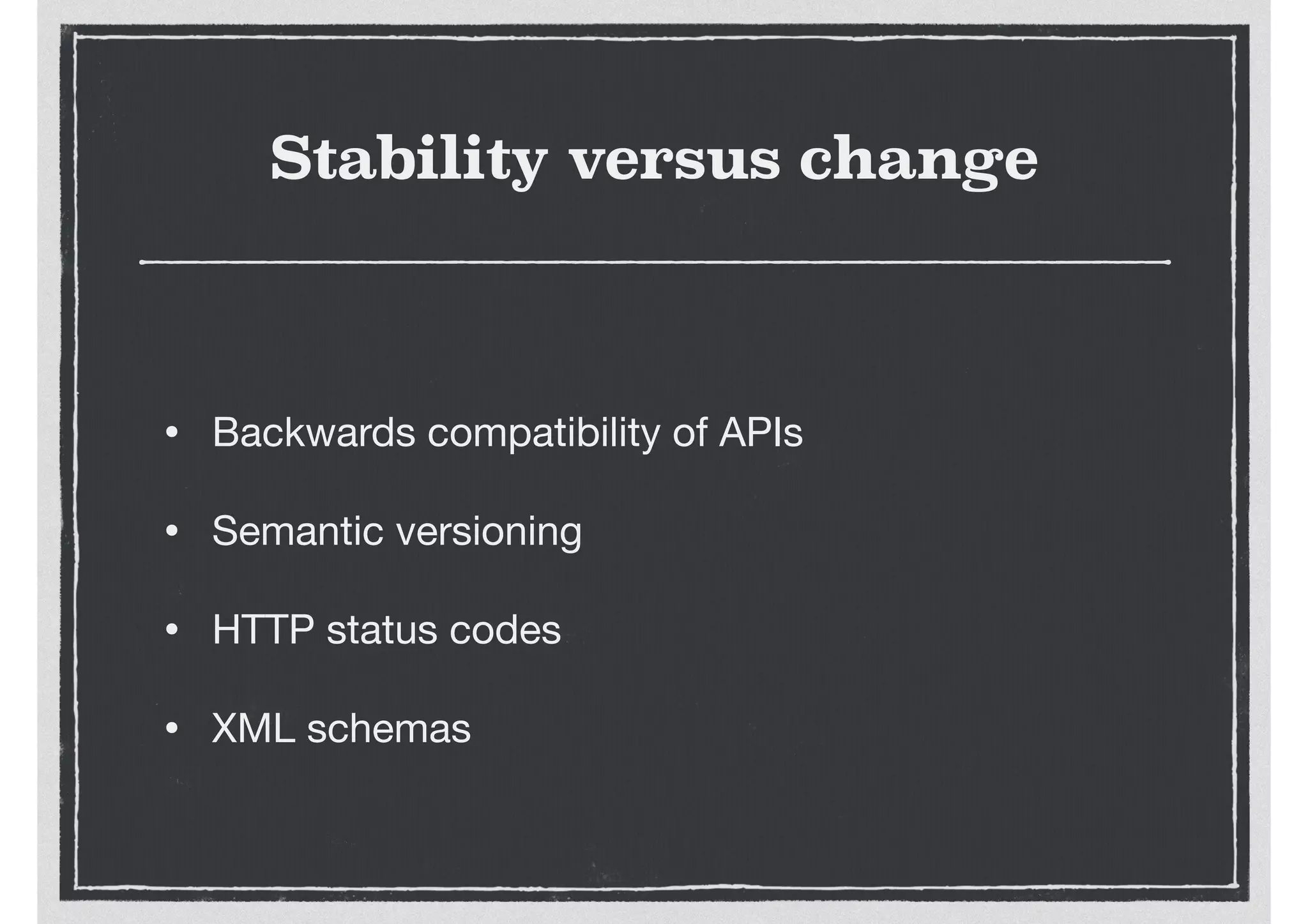
Stability versus change
• Backwards compatibility of APIs

• Semantic versioning

• HTTP status codes

• XML schemas
For internal APIs
only!
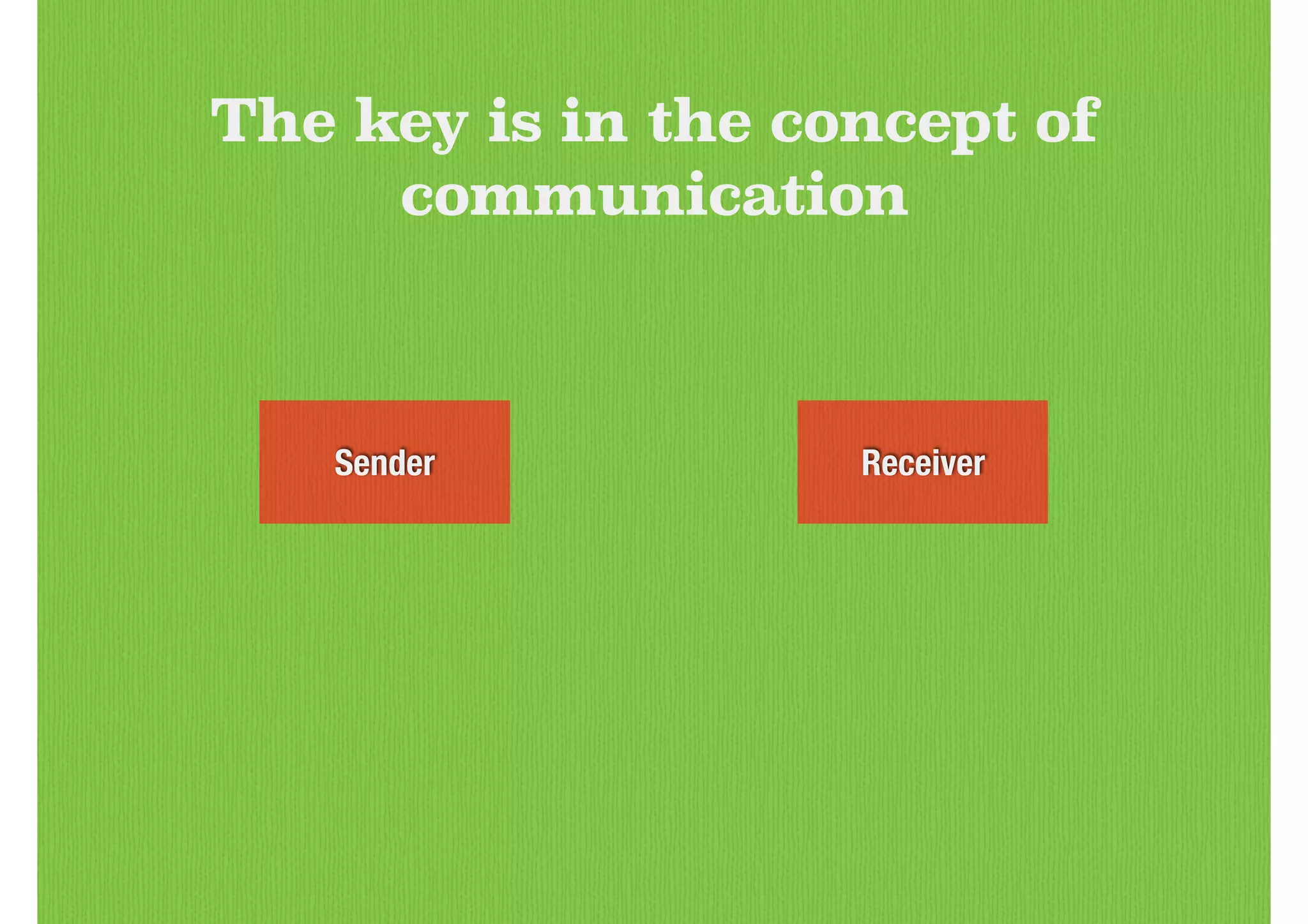
The key is in the concept of
communication
ReceiverSender
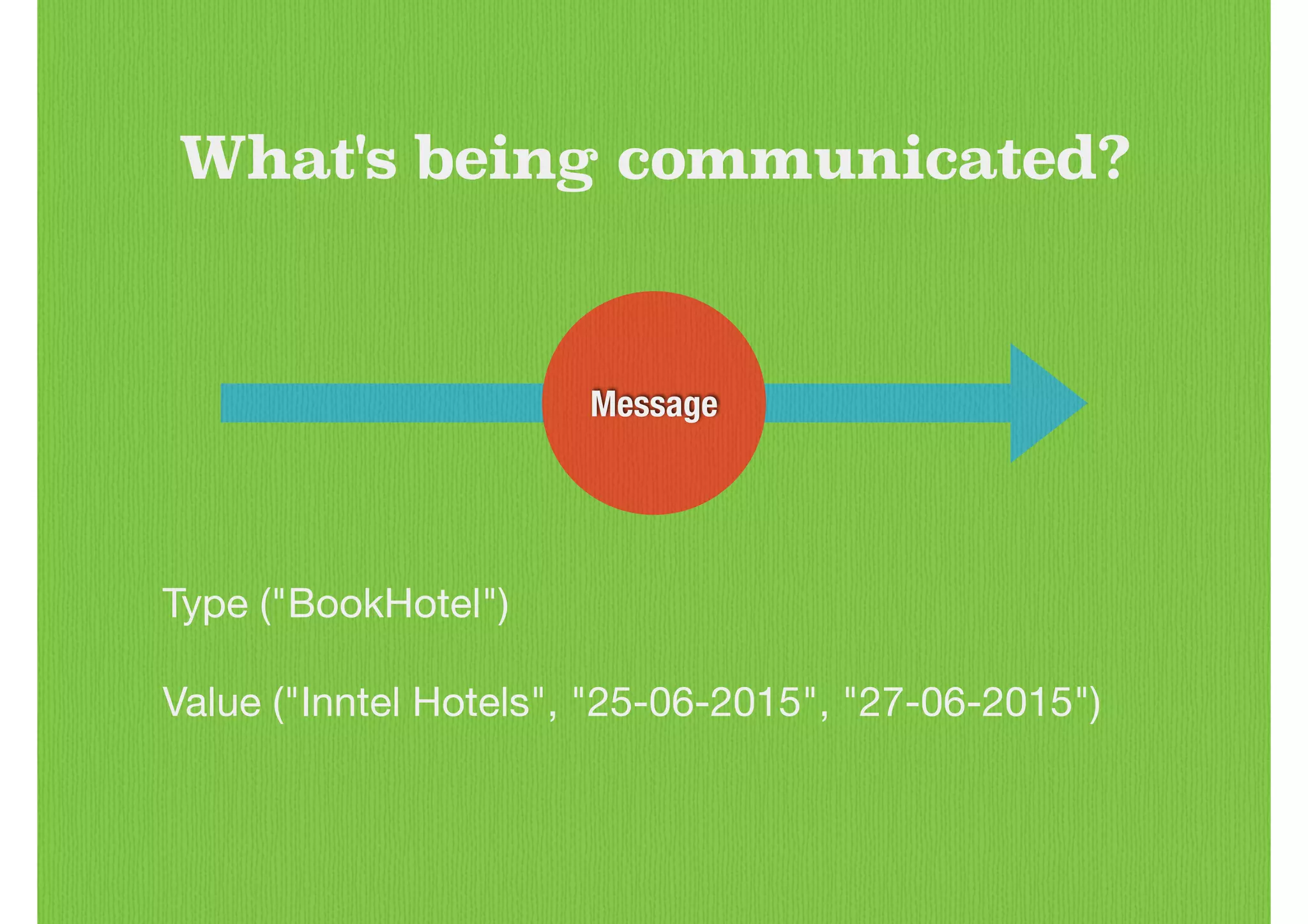
What's being communicated?
Message
Type ("BookHotel")

Value ("Inntel Hotels", "25-06-2015", "27-06-2015")
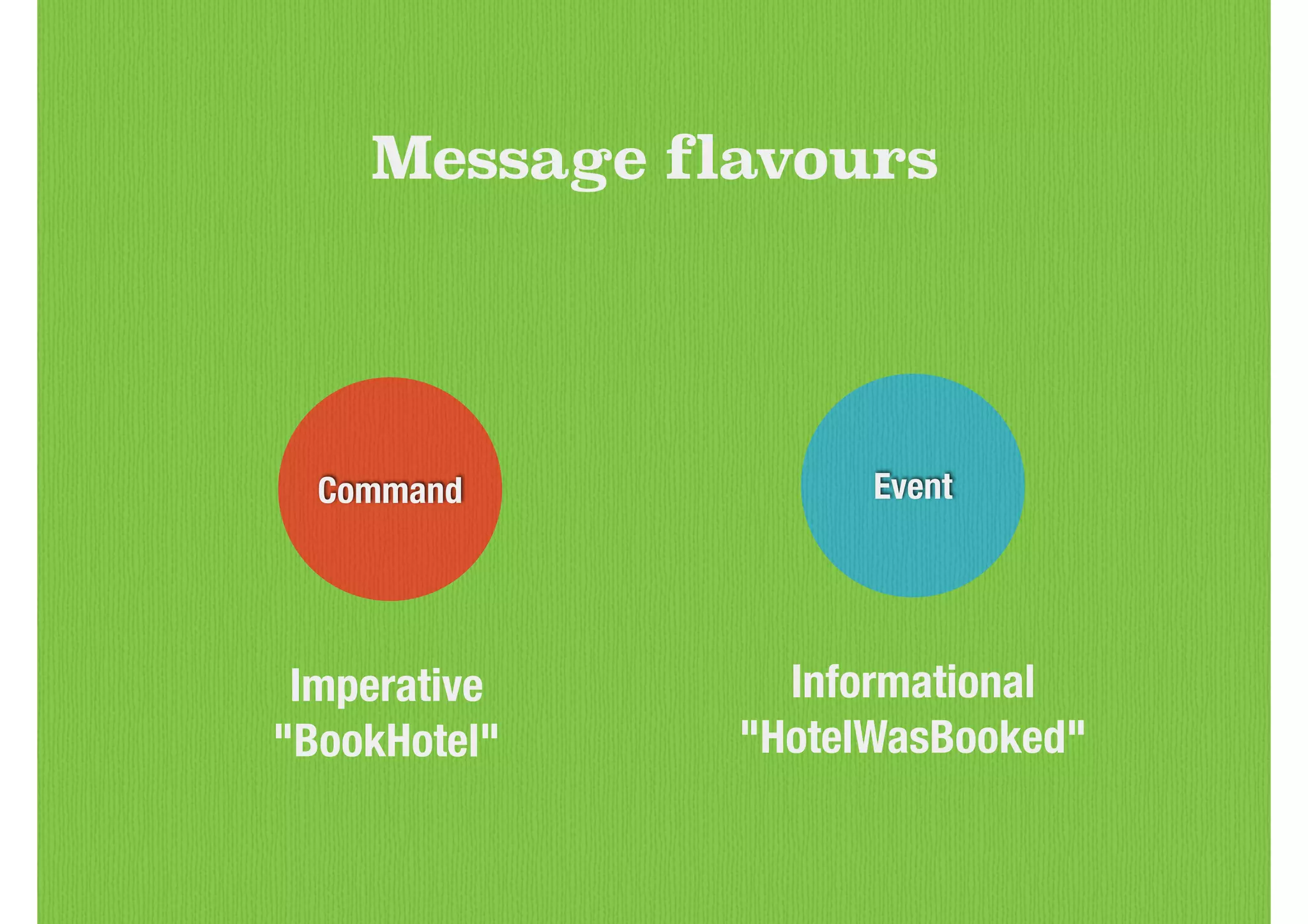
Message flavours
Command Event
Imperative
"BookHotel"
Informational
"HotelWasBooked"
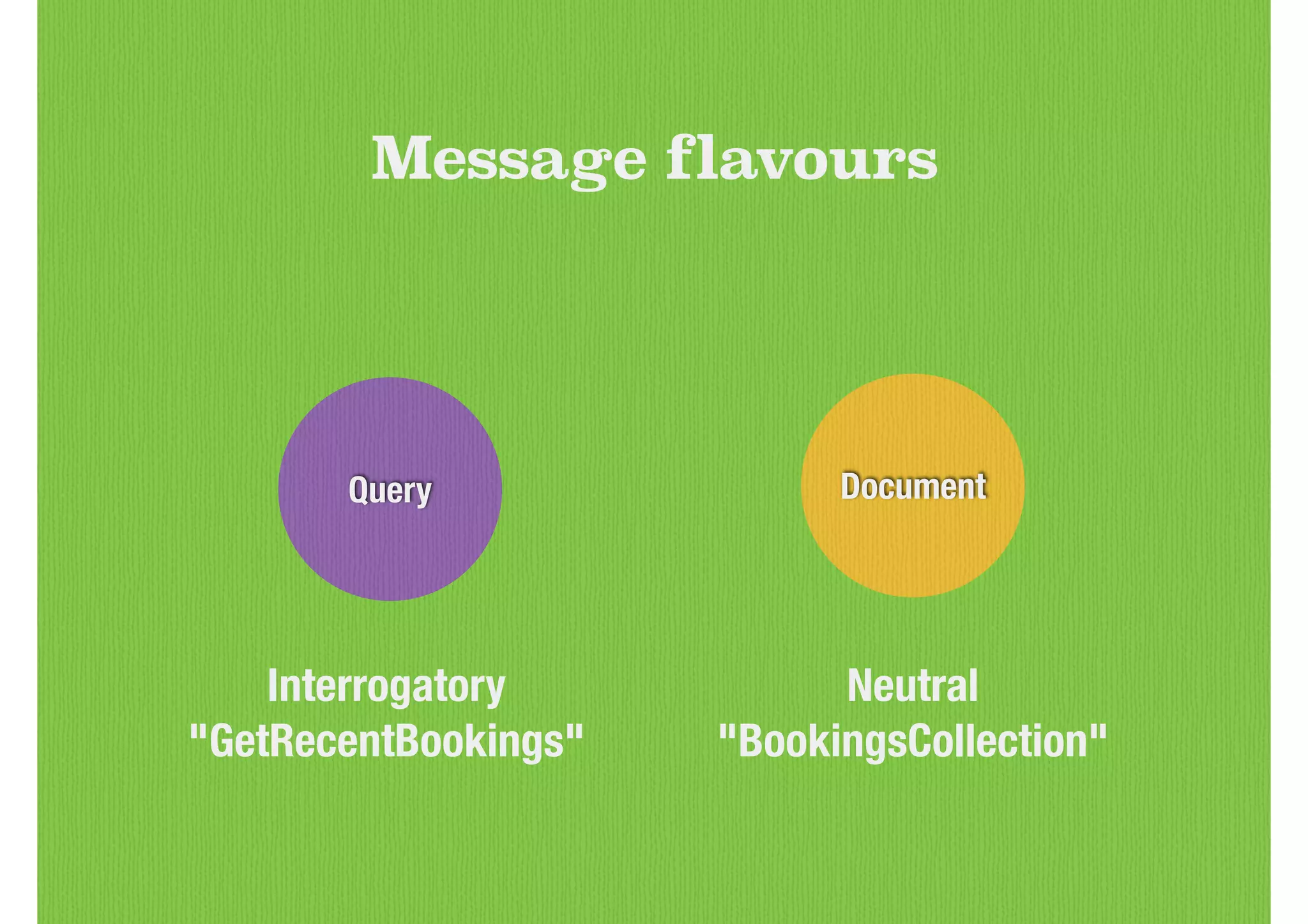
Message flavours
Query Document
Interrogatory
"GetRecentBookings"
Neutral
"BookingsCollection"
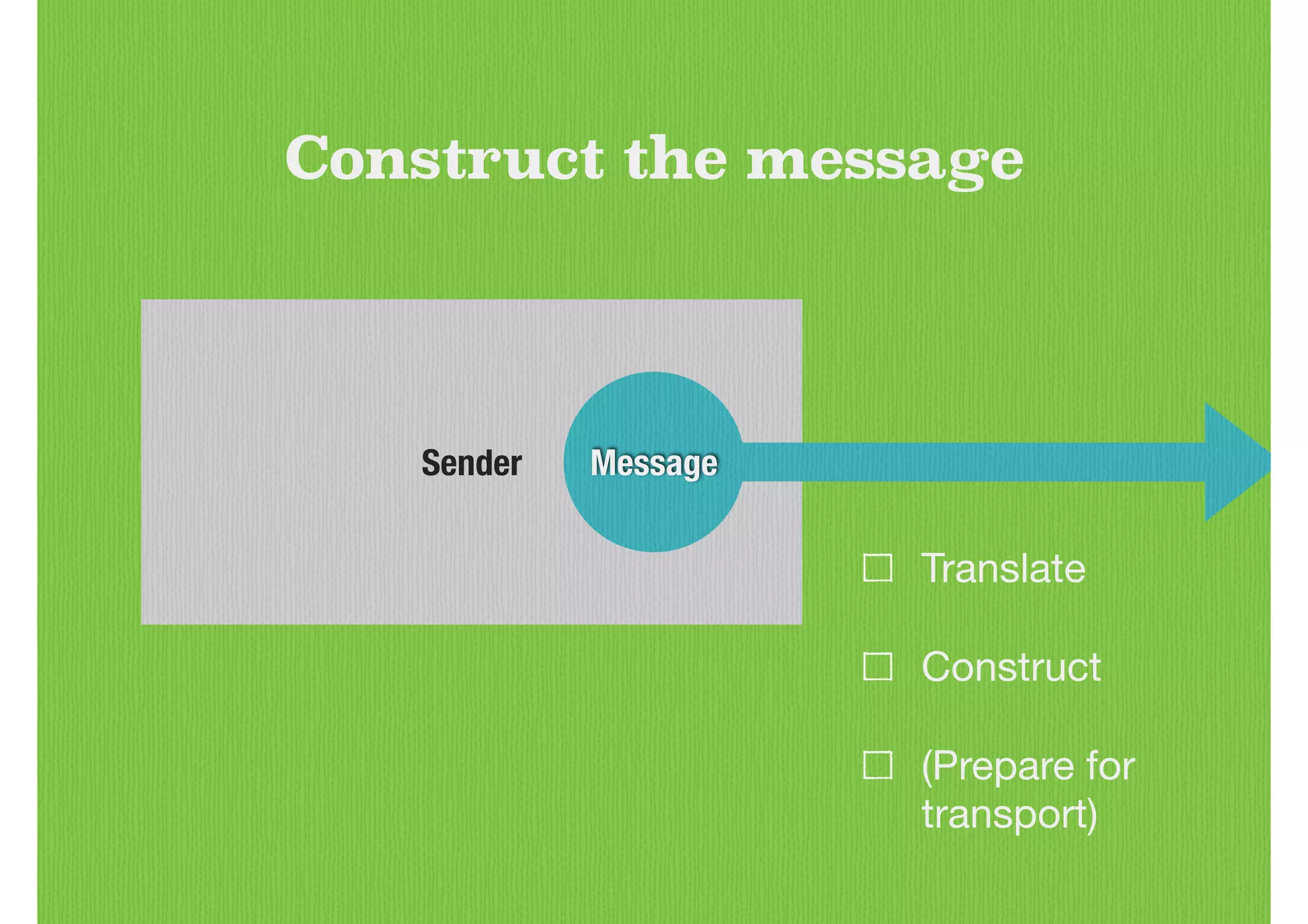
Sender
Construct the message
Message
Translate 

Construct

(Prepare for

transport)
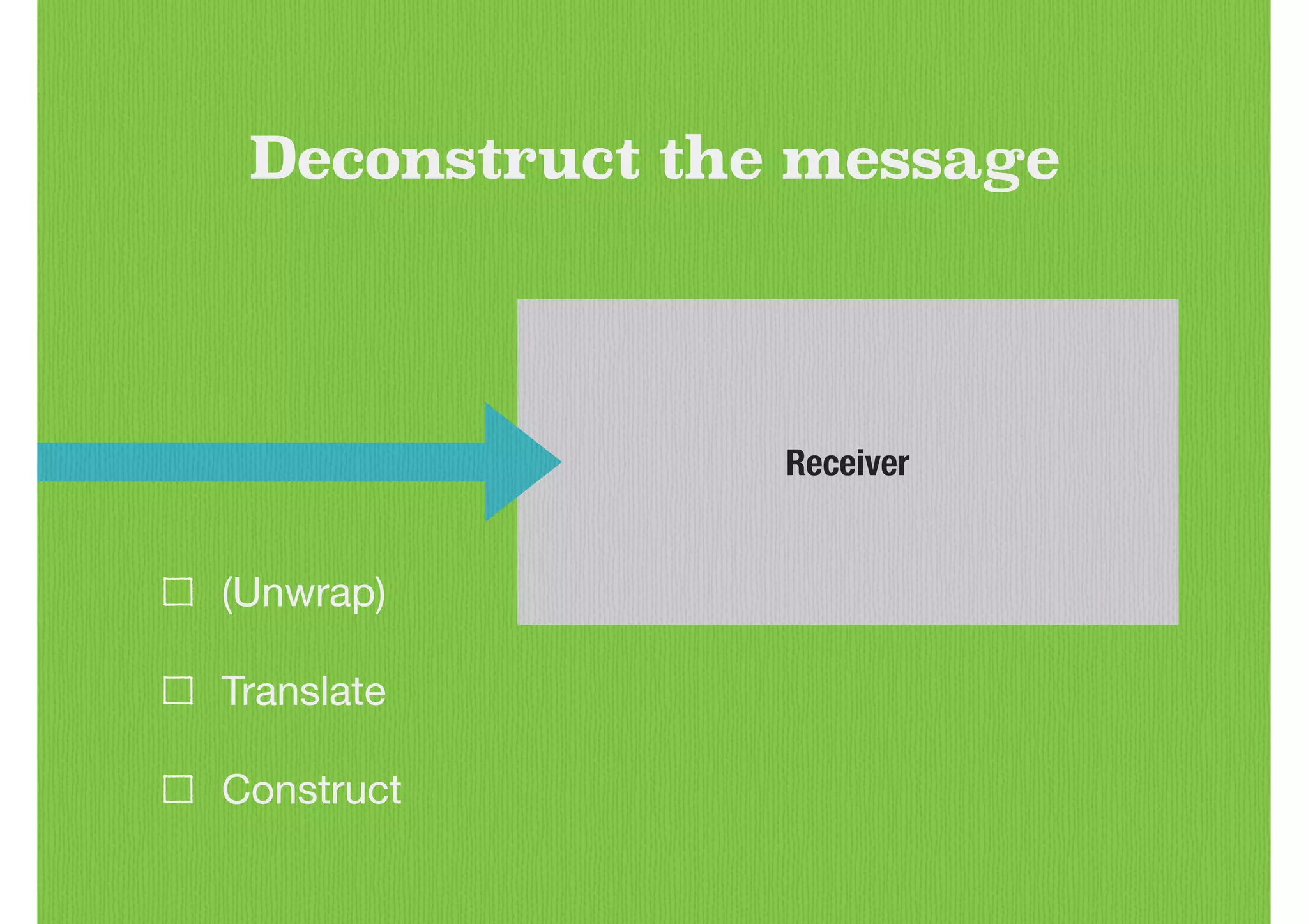
Receiver
Deconstruct the message
(Unwrap)

Translate

Construct
Global design
principles can be
discovered
if we recognise the fact that
communication between objects and
applications are (more or less) equal
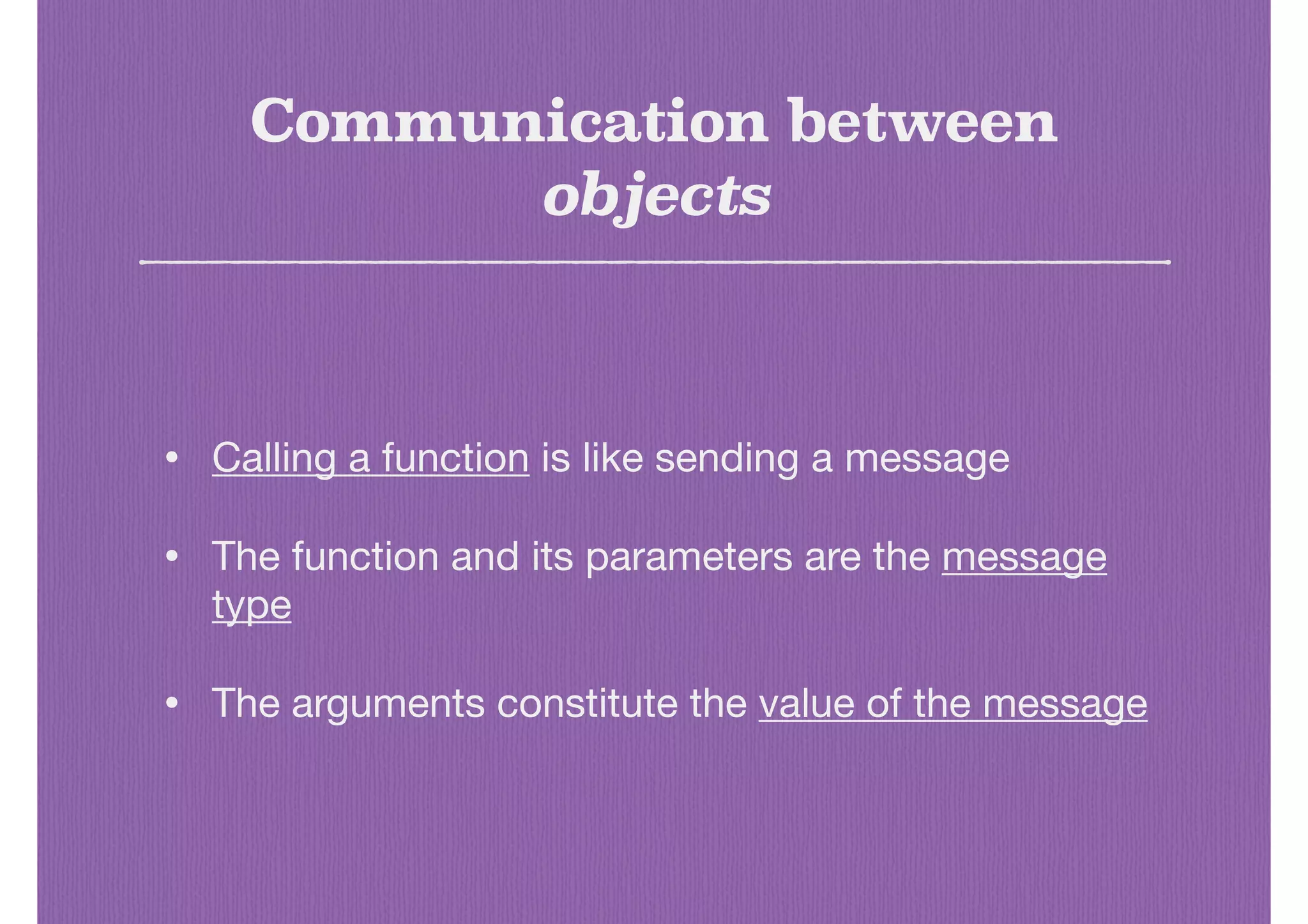
Communication between
objects
• Calling a function is like sending a message

• The function and its parameters are the message
type

• The arguments constitute the value of the message
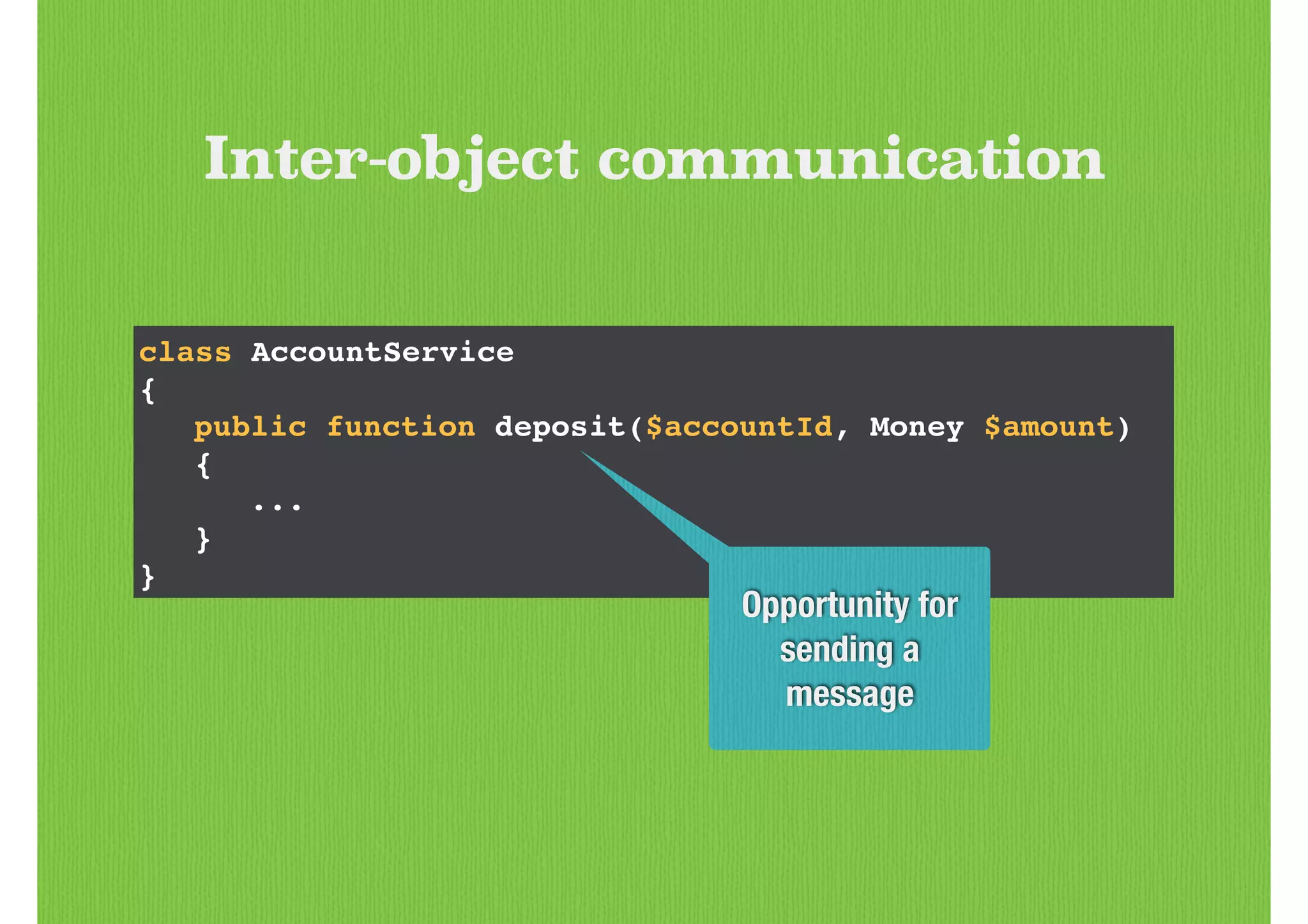
class AccountService!
{!
! public function deposit($accountId, Money $amount)
! {!
! ! ...!
! }!
}
Opportunity for
sending a
message
Inter-object communication
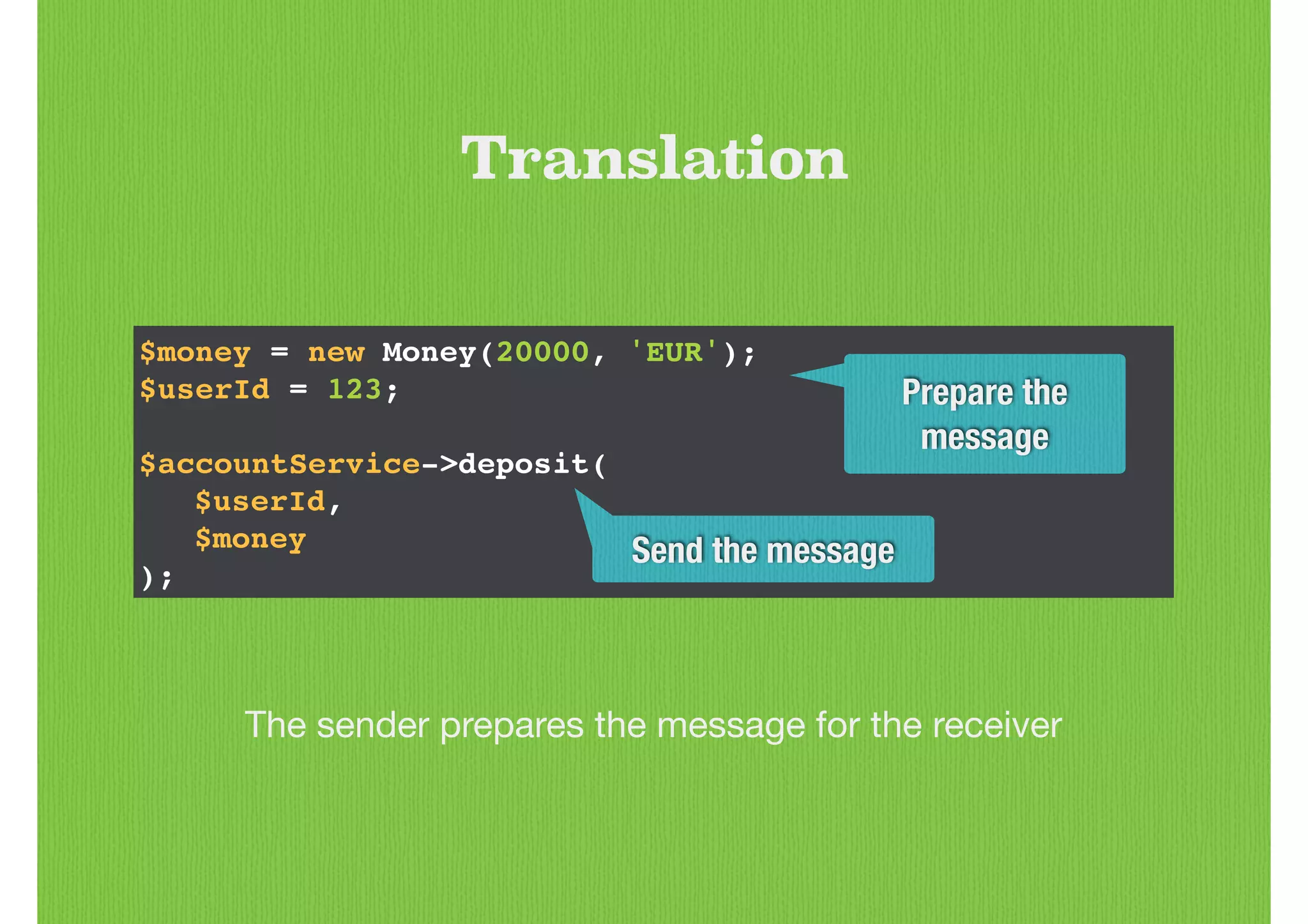
$money = new Money(20000, 'EUR');!
$userId = 123;!
!
$accountService->deposit(!
! $userId, !
! $money!
);
Translation
The sender prepares the message for the receiver
Prepare the
message
Send the message
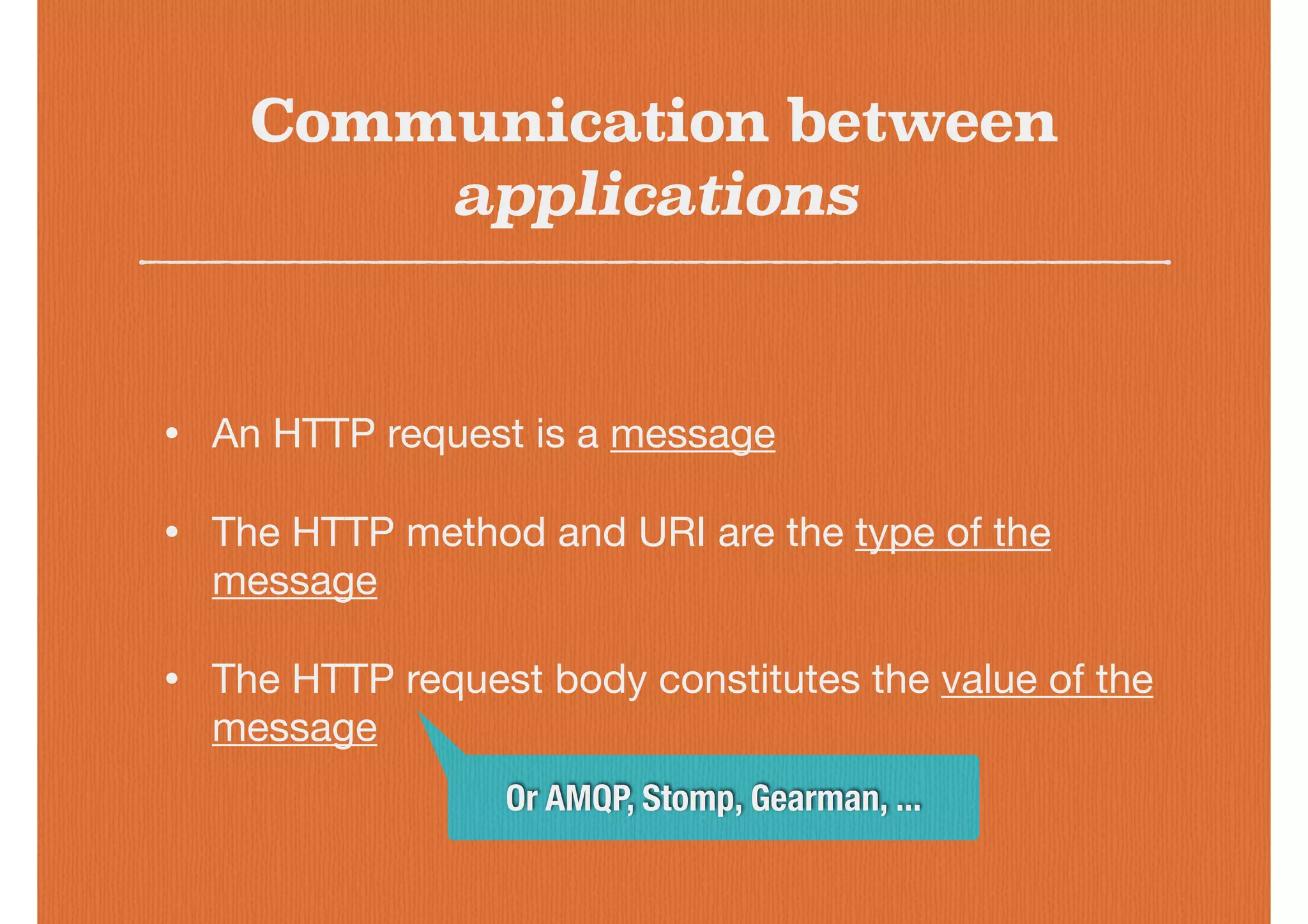
Communication between
applications
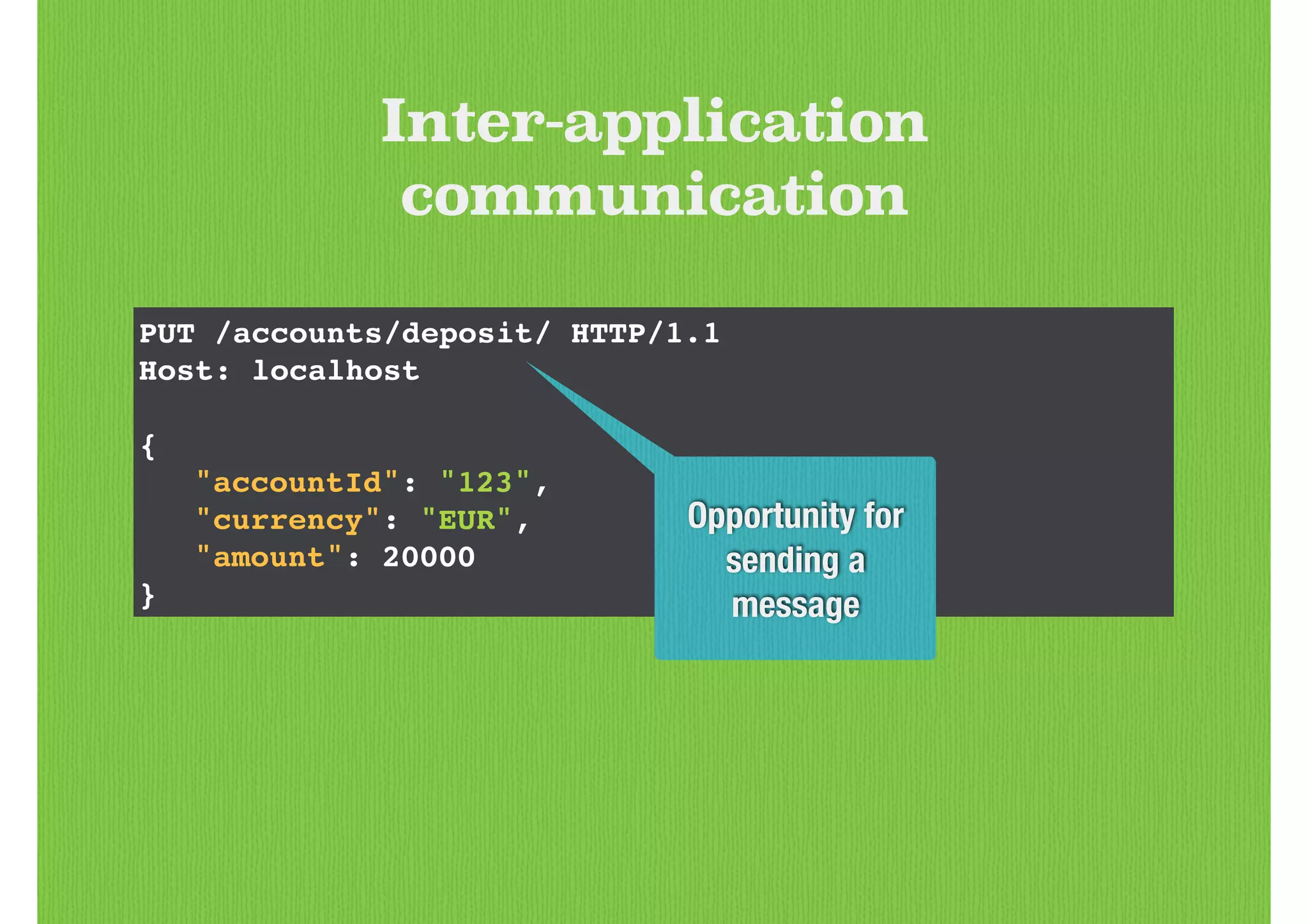
• An HTTP request is a message

• The HTTP method and URI are the type of the
message

• The HTTP request body constitutes the value of the
message
Or AMQP, Stomp, Gearman, ...
PUT /accounts/deposit/ HTTP/1.1!
Host: localhost!
!
{!
! "accountId": "123",!
! "currency": "EUR",!
! "amount": 20000!
}
Inter-application
communication
Opportunity for
sending a
message
$uri ='/accounts/deposit/';!
!
$data = json_encode([!
! 'accountId' => 123!
! 'currency' => 'EUR',!
! 'amount' => 20000!
]);!
!
$httpClient!
! ->createRequest('PUT', $uri, $data)!
! ->send();
Translation
Prepare the
message
Send the message
/** @Route("/accounts/deposit") */!
function depositAction(Request $request)!
{!
! $request = json_decode($request->getContent());!
! $money = new Money(!
! ! $request['amount'],!
! ! $request['currency']!
! );!
!
! $this->get('account_service')->deposit(!
! ! ! $request['accountId'],!
! ! ! $money!
! ! );!
!
! return new Response(null, 200);!
}!
Translation
Prepare the
message
Send the message
Global design
principles
Should be applicable to both inter-object and inter-application communication
Part I
Stability
III Implementation
II Information
Sender Receiver
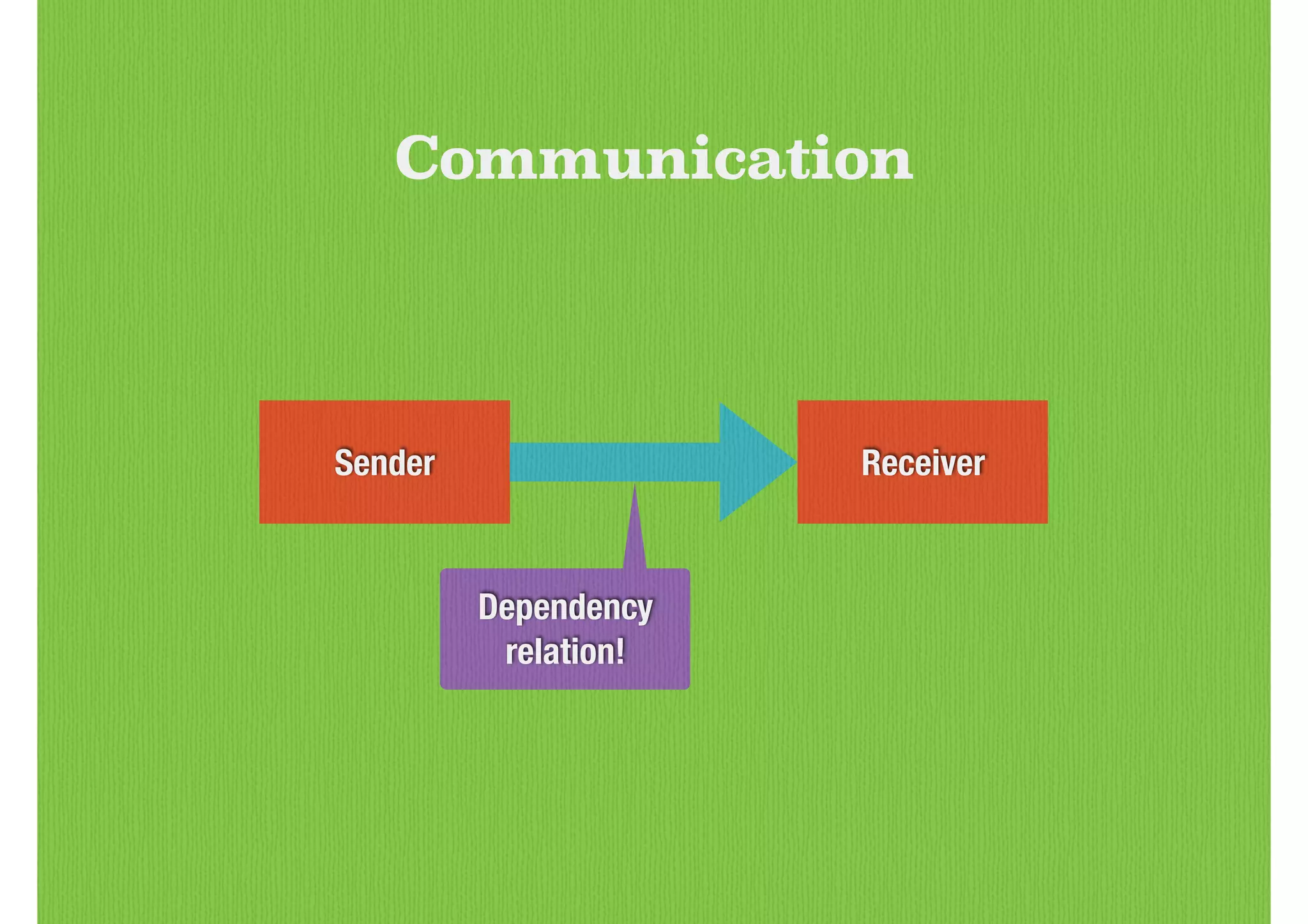
Communication
Dependency
relation!
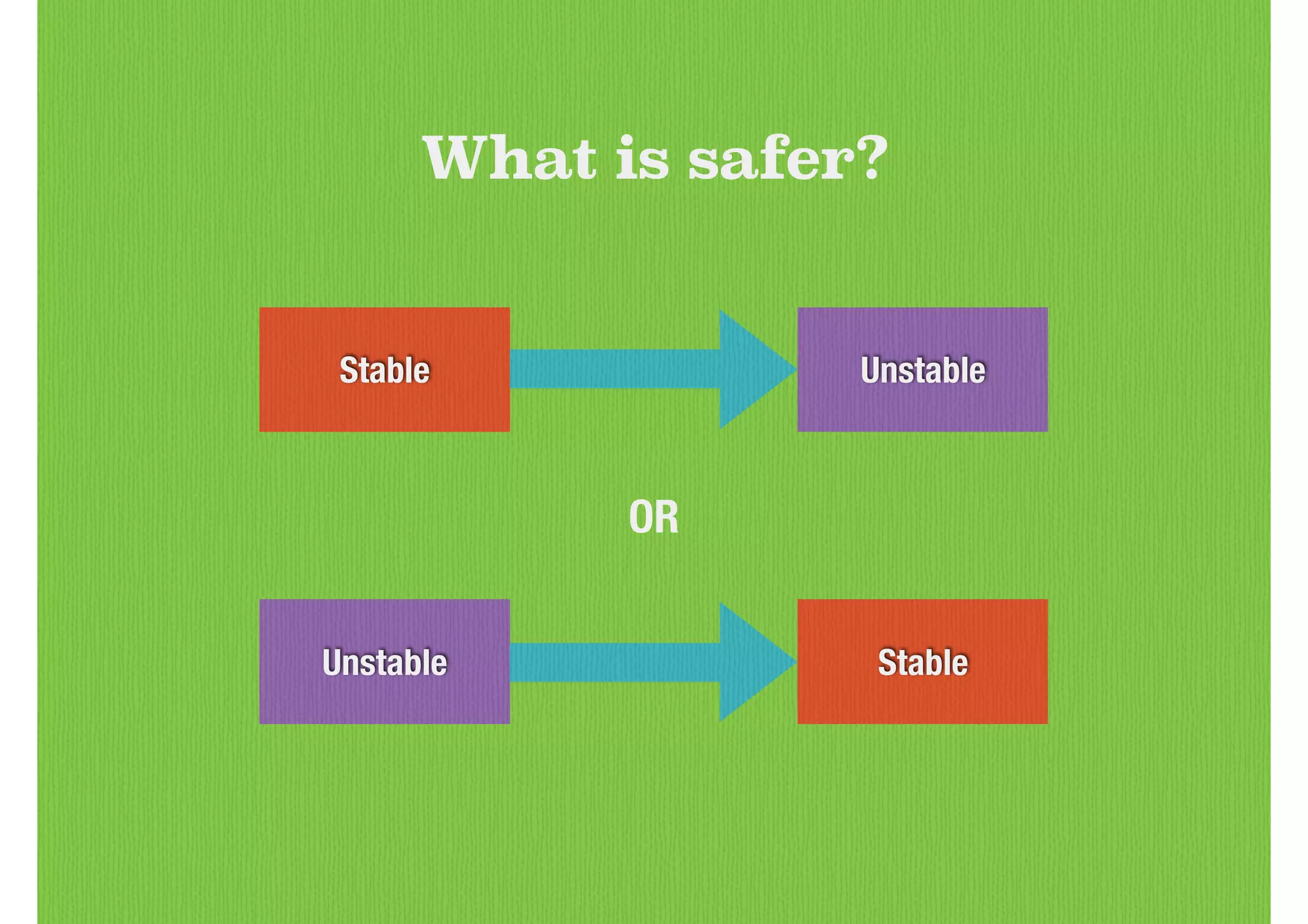
Stable Unstable
What is safer?
Unstable Stable
OR
To be stable
"Steady in position or balance;
firm"
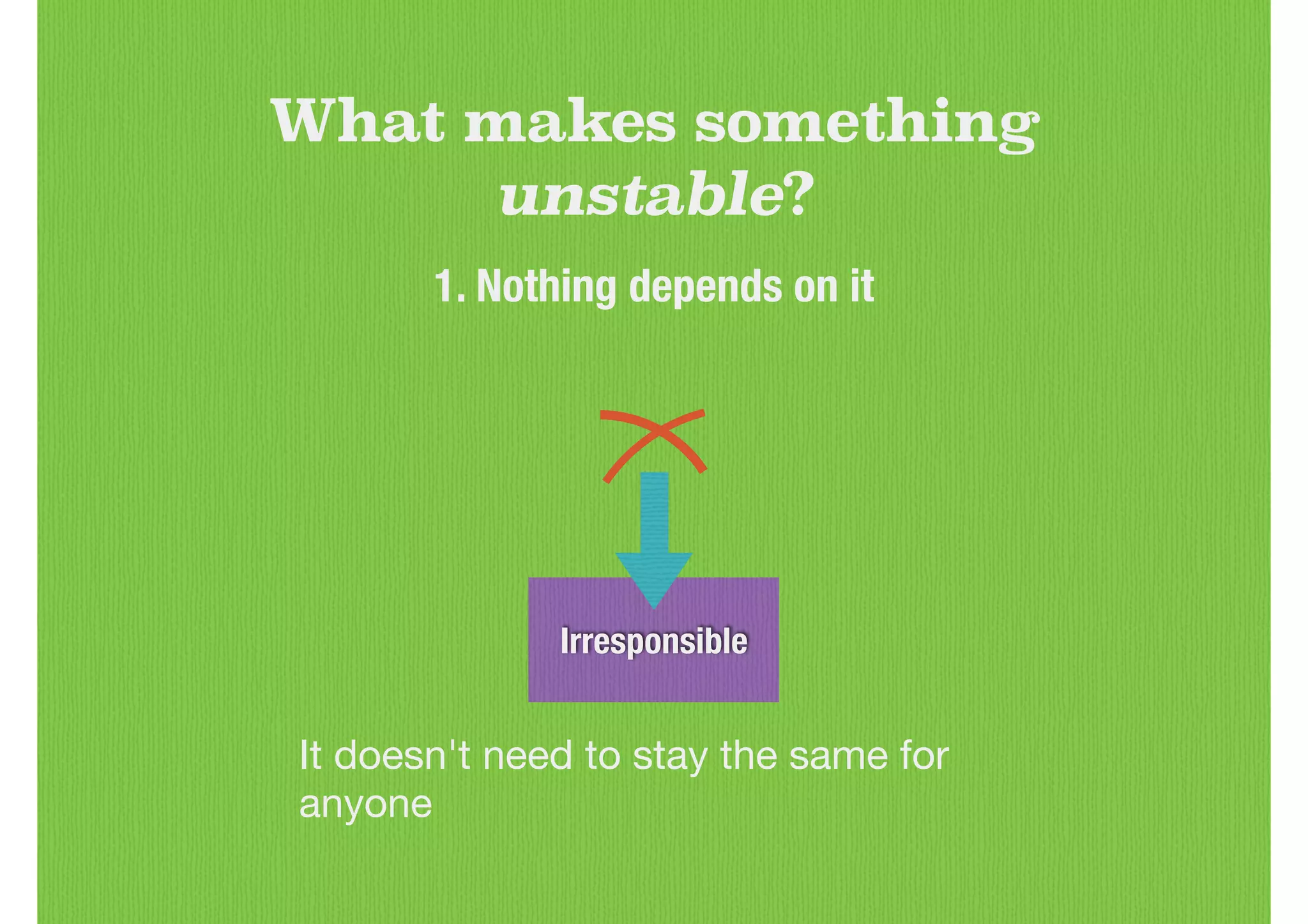
Irresponsible
What makes something
unstable?
1. Nothing depends on it
It doesn't need to stay the same for
anyone
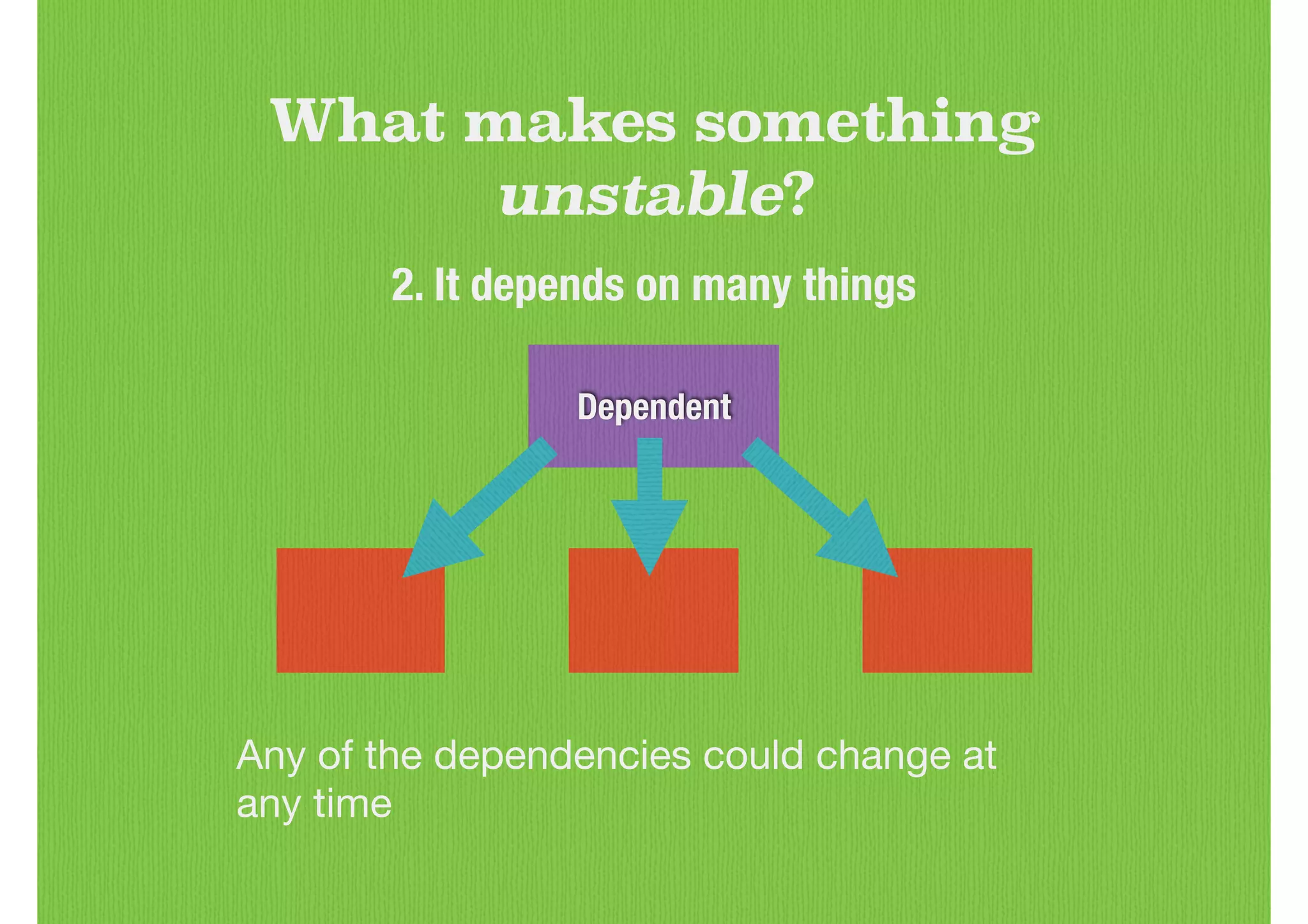
Dependent
What makes something
unstable?
2. It depends on many things
Any of the dependencies could change at
any time
Stability is not a
quality of one thing
It emerges from the environment
of that thing
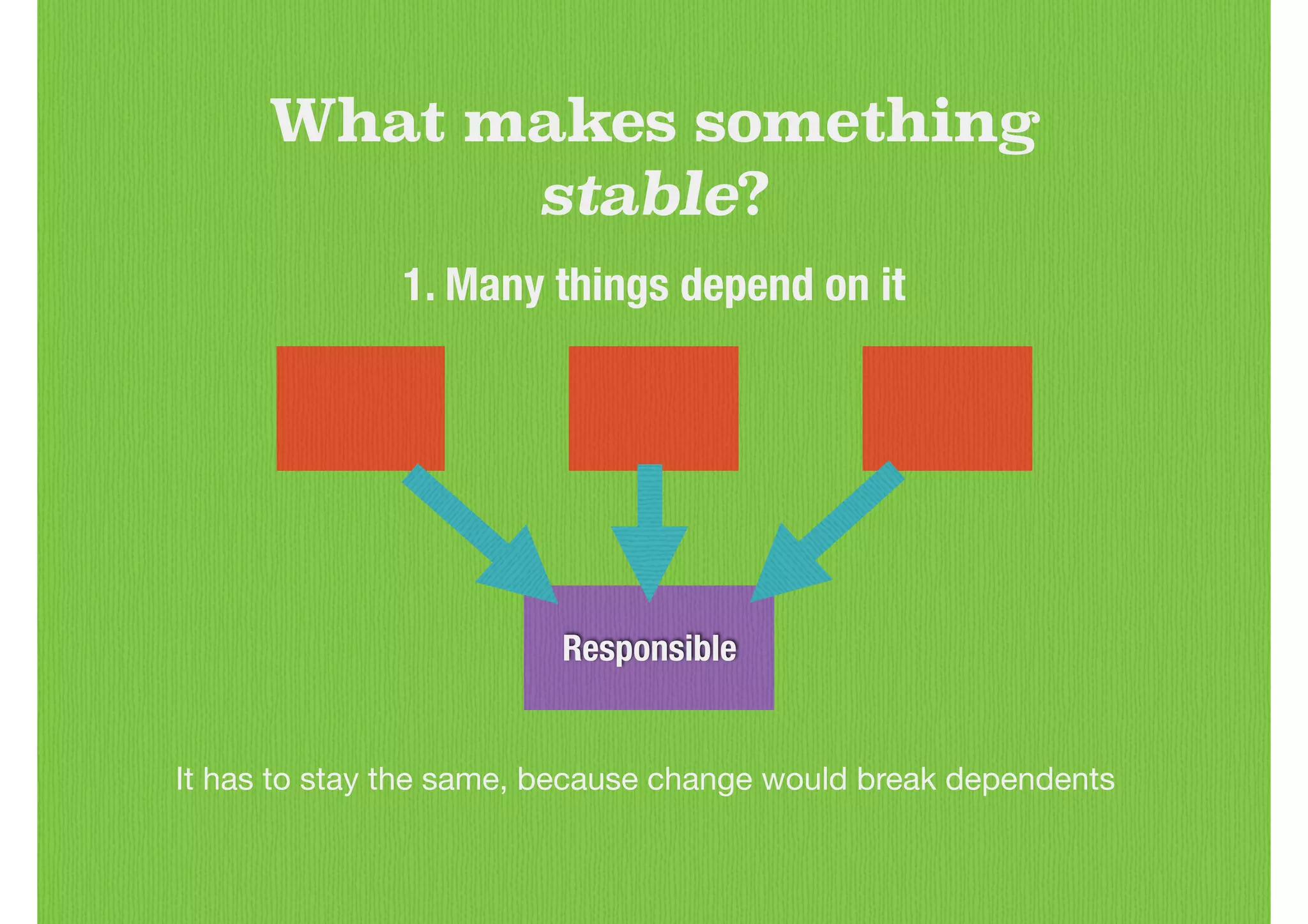
Responsible
What makes something
stable?
1. Many things depend on it
It has to stay the same, because change would break dependents
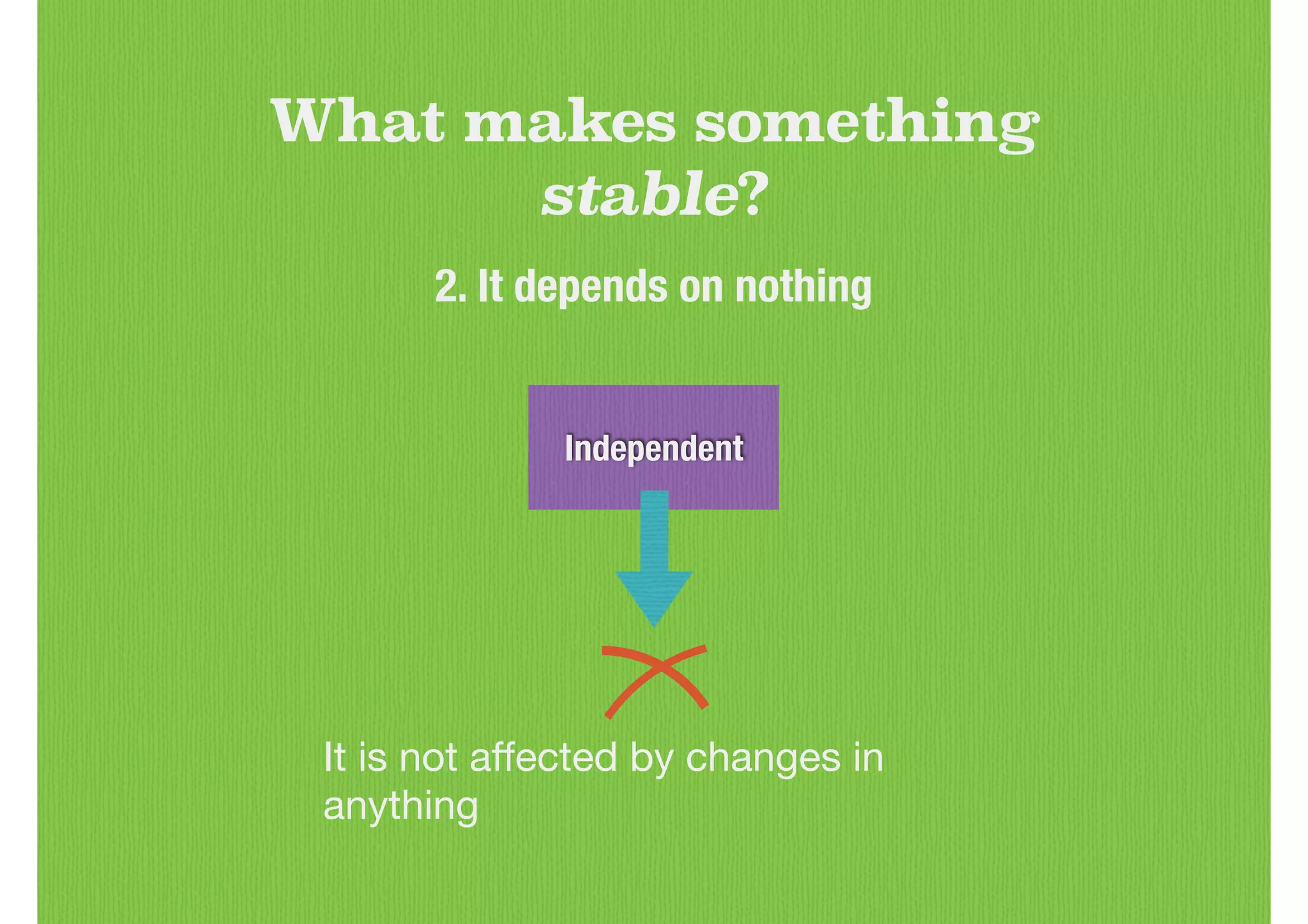
Independent
What makes something
stable?
2. It depends on nothing
It is not affected by changes in
anything
–The Stable dependencies principle
Depend in the
direction of stability
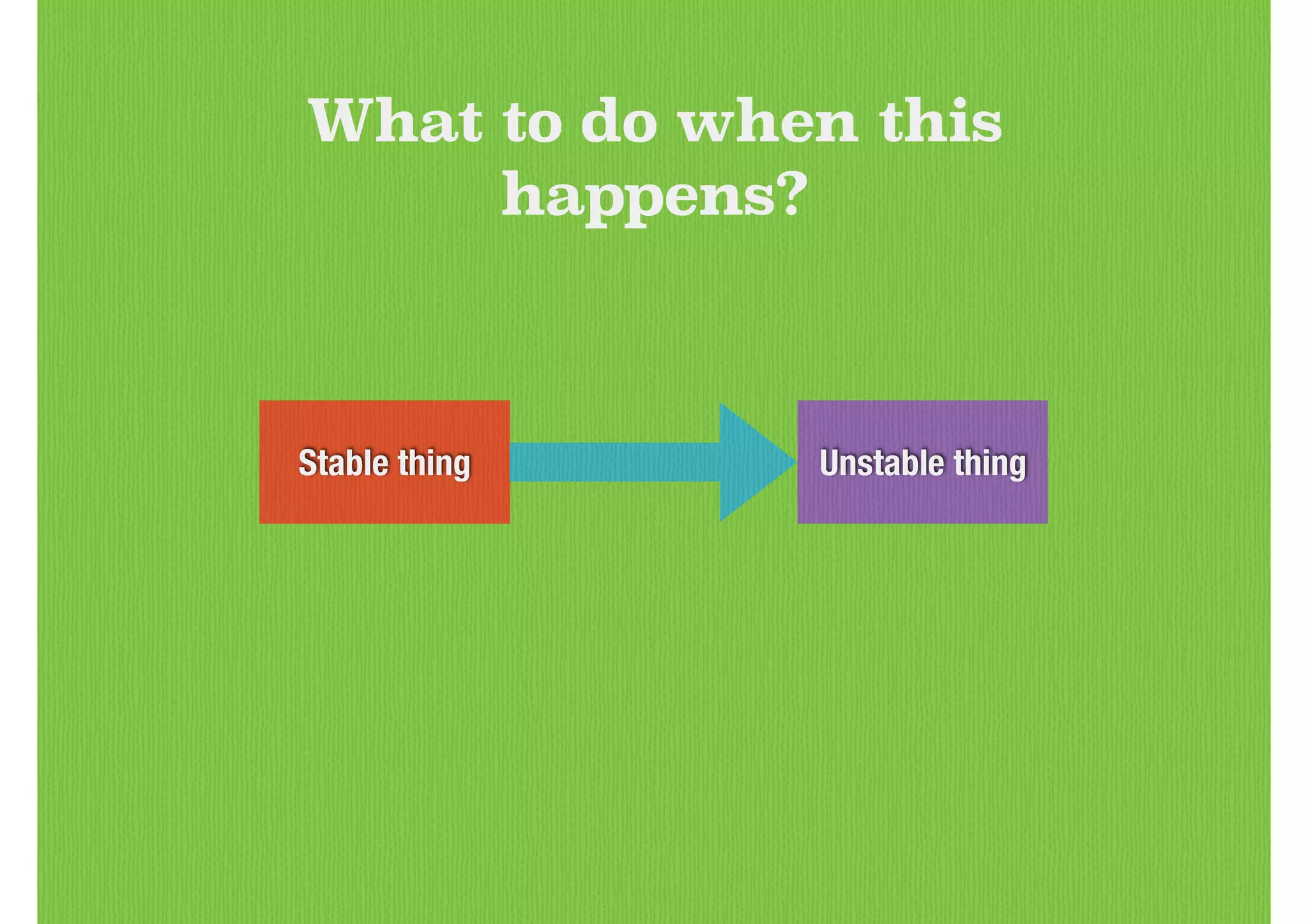
Stable thing Unstable thing
What to do when this
happens?
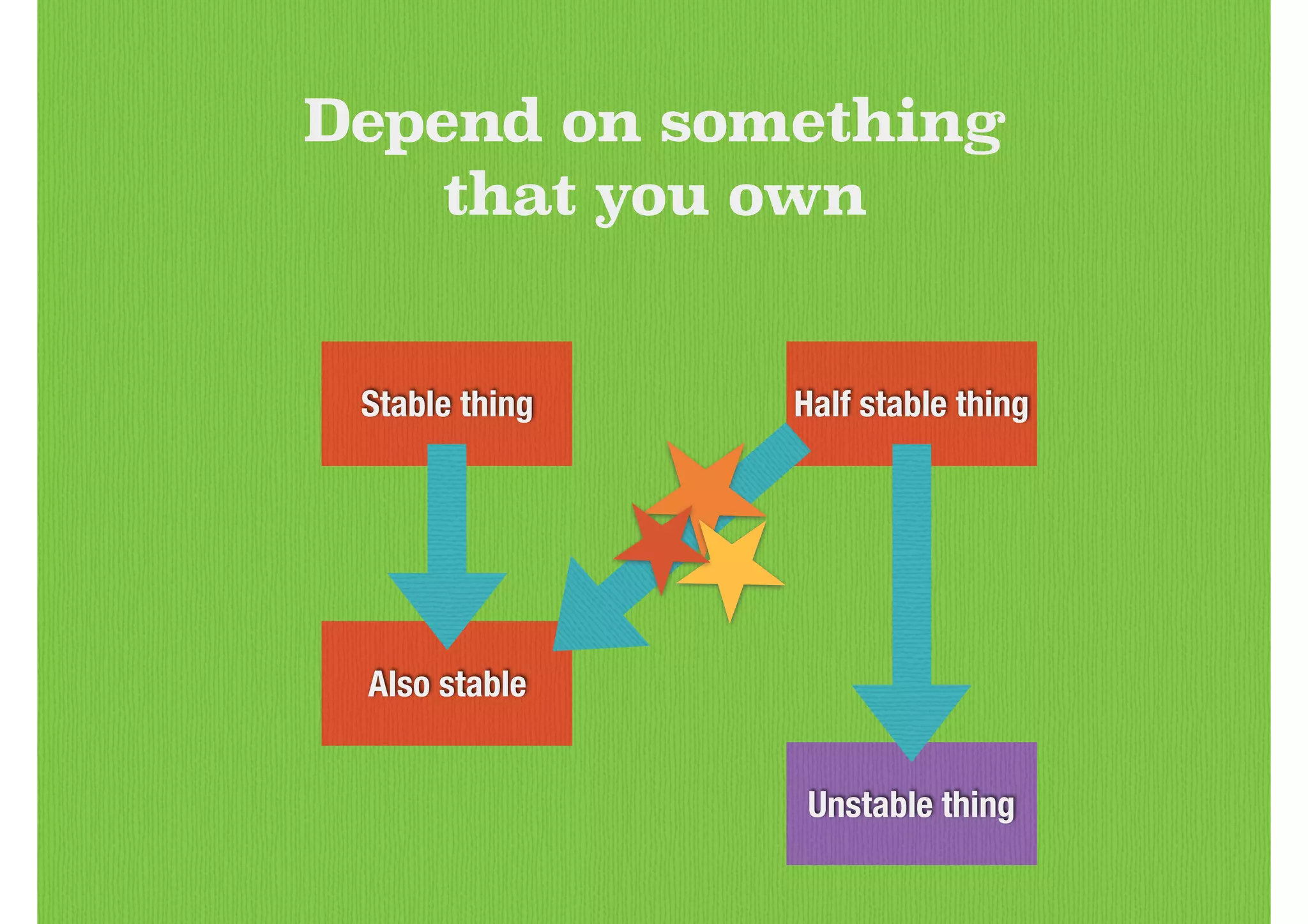
Also stable
Half stable thingStable thing
Unstable thing
Depend on something
that you own
–The Dependency inversion principle
Always depend on abstractions,
not on concretions
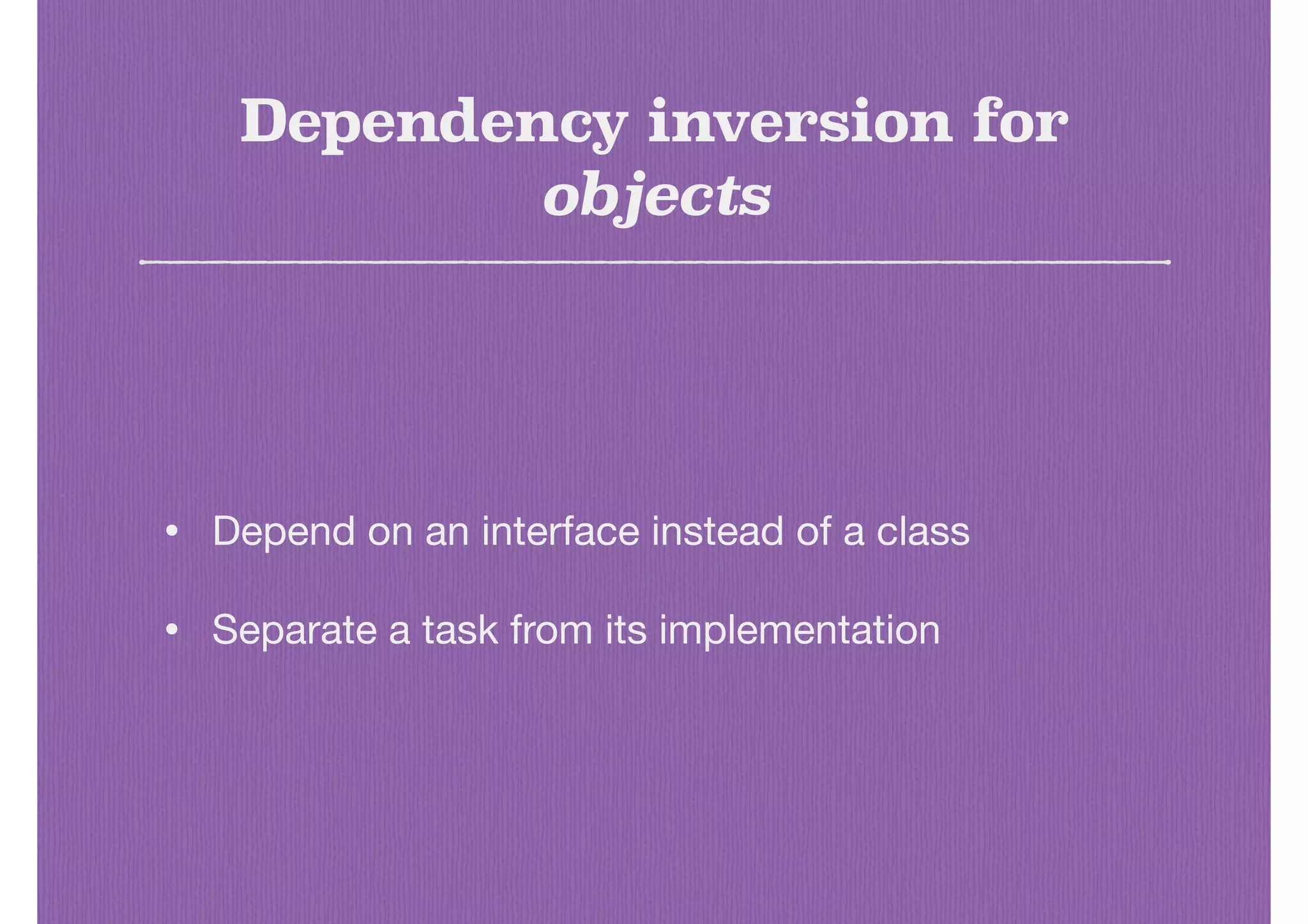
Dependency inversion for
objects
• Depend on an interface instead of a class

• Separate a task from its implementation
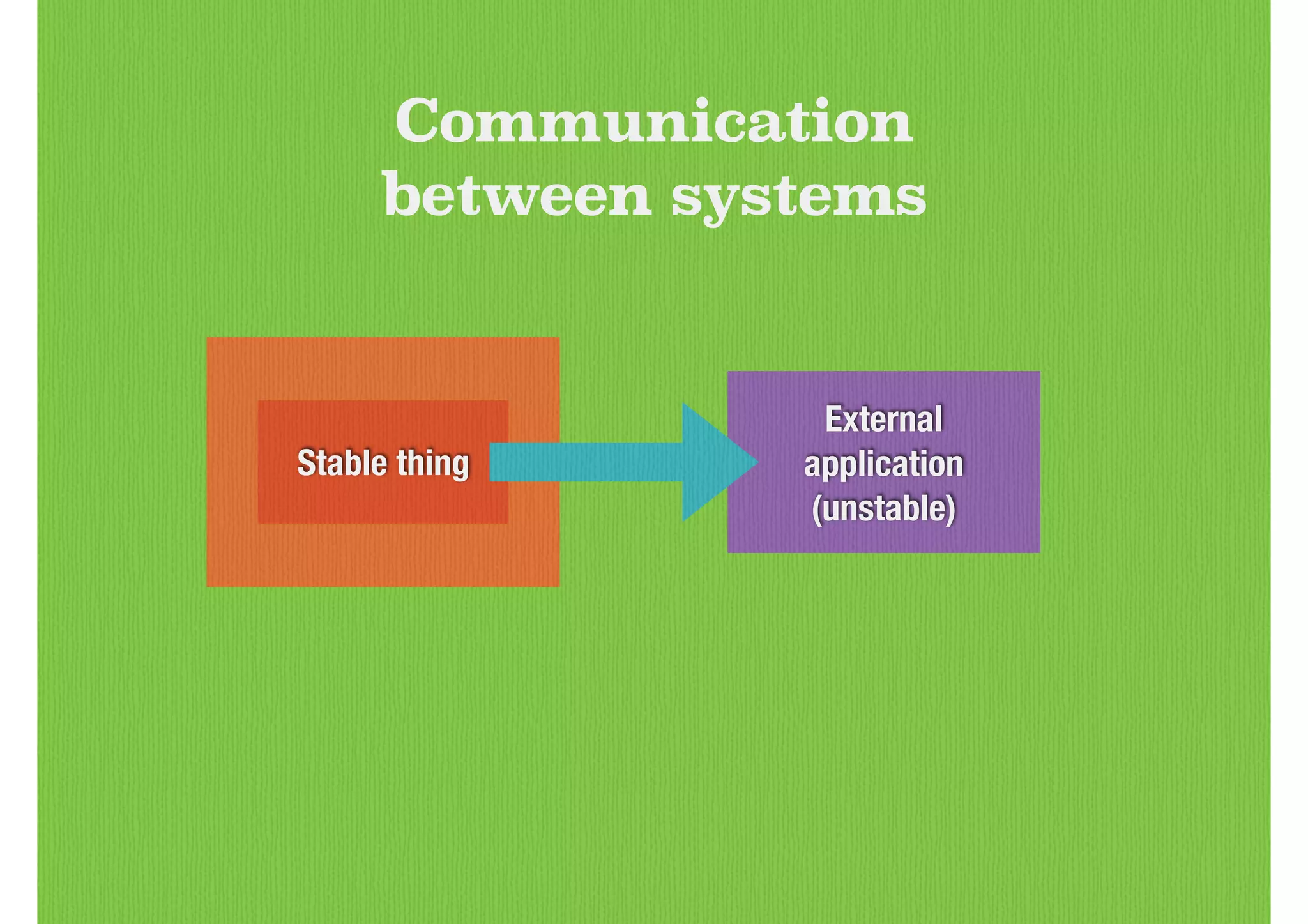
Stable thing
Communication
between systems
External
application
(unstable)
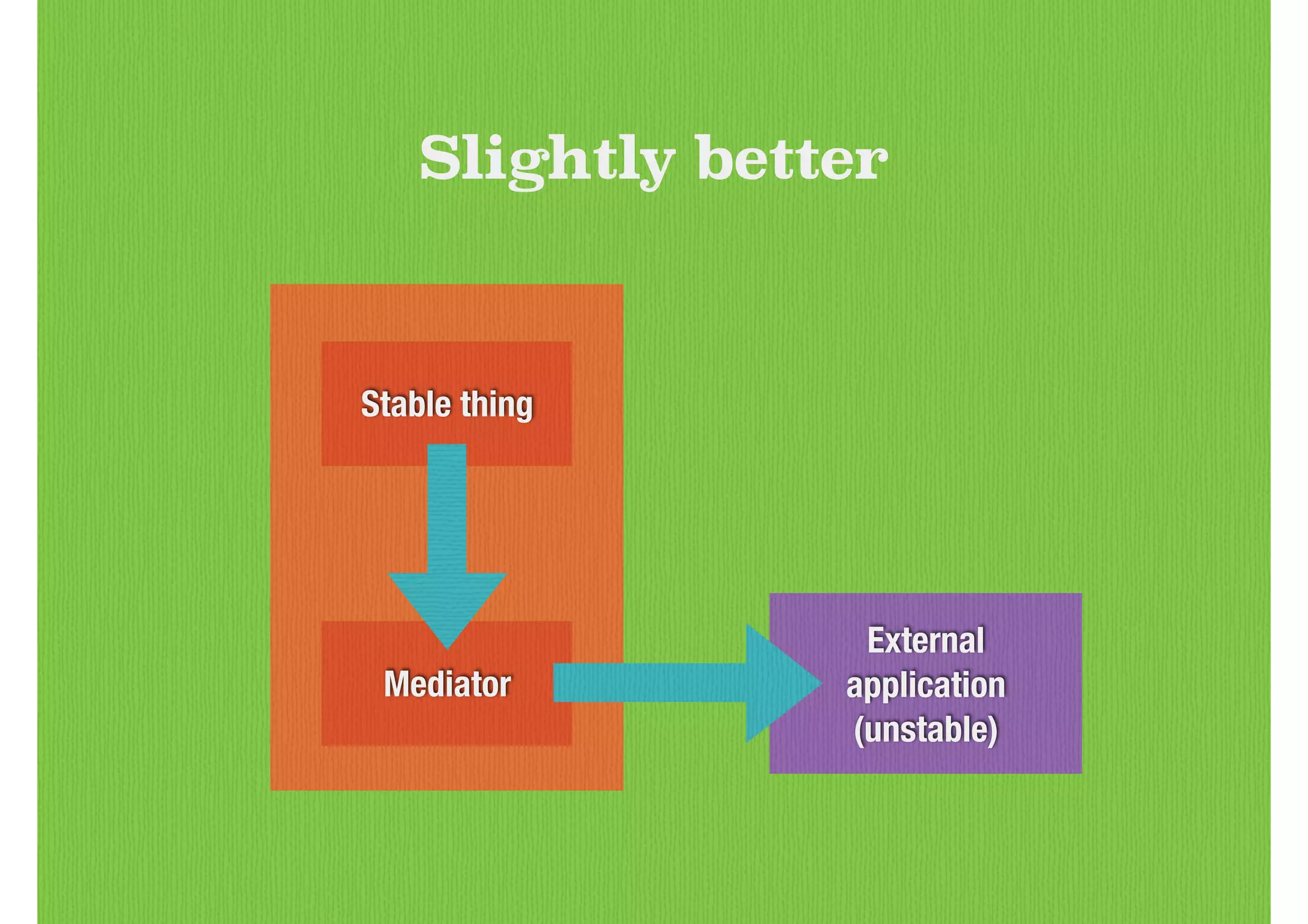
Mediator
Stable thing
Slightly better
External
application
(unstable)
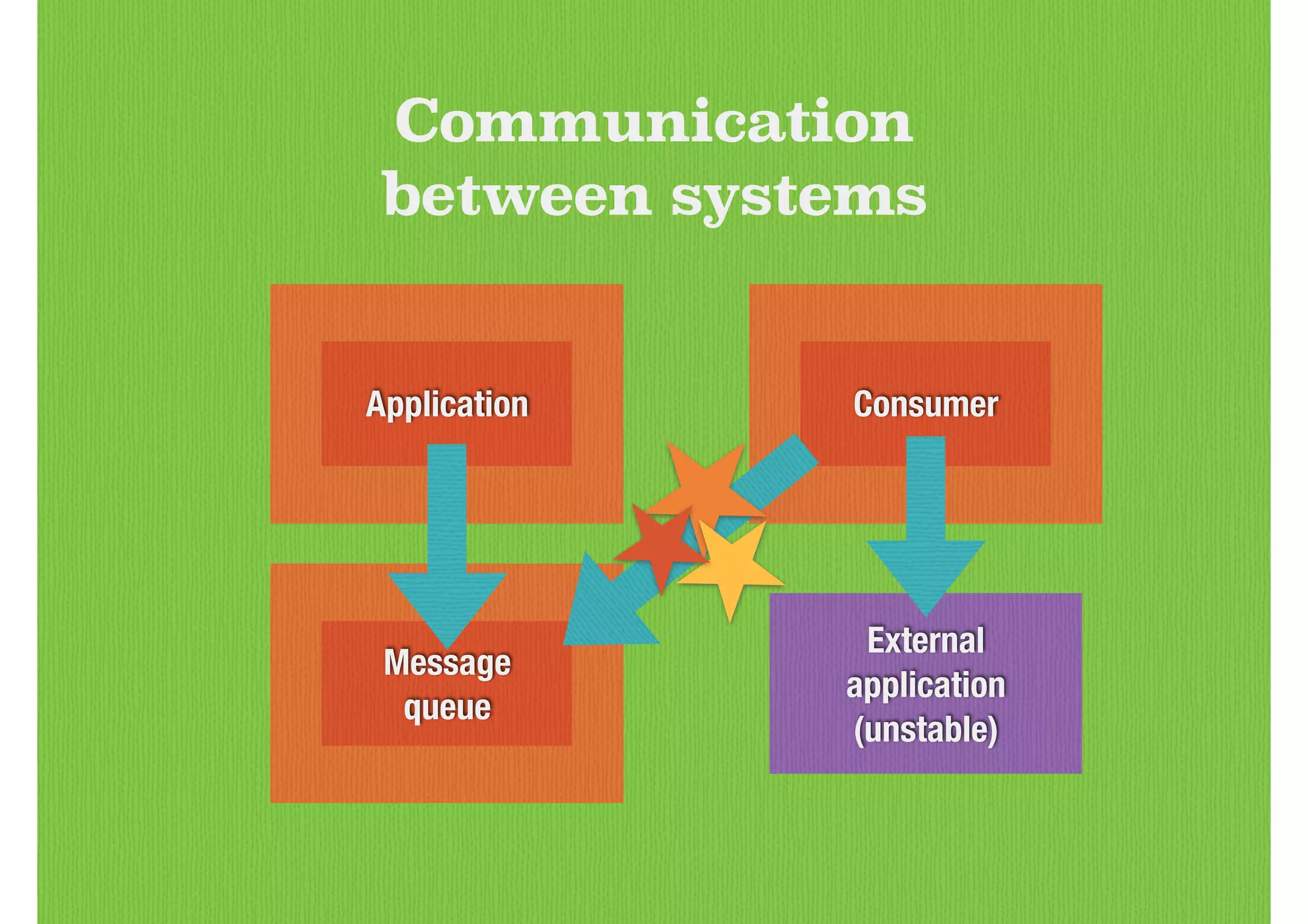
ConsumerApplication
Communication
between systems
Message
queue
External
application
(unstable)
Dependency inversion for
systems
• Depend on your own (messaging) system

• Communicate with other applications via a
message queue
Part II
Information
I Stability
III Implementation
Knowledge, data, duplication
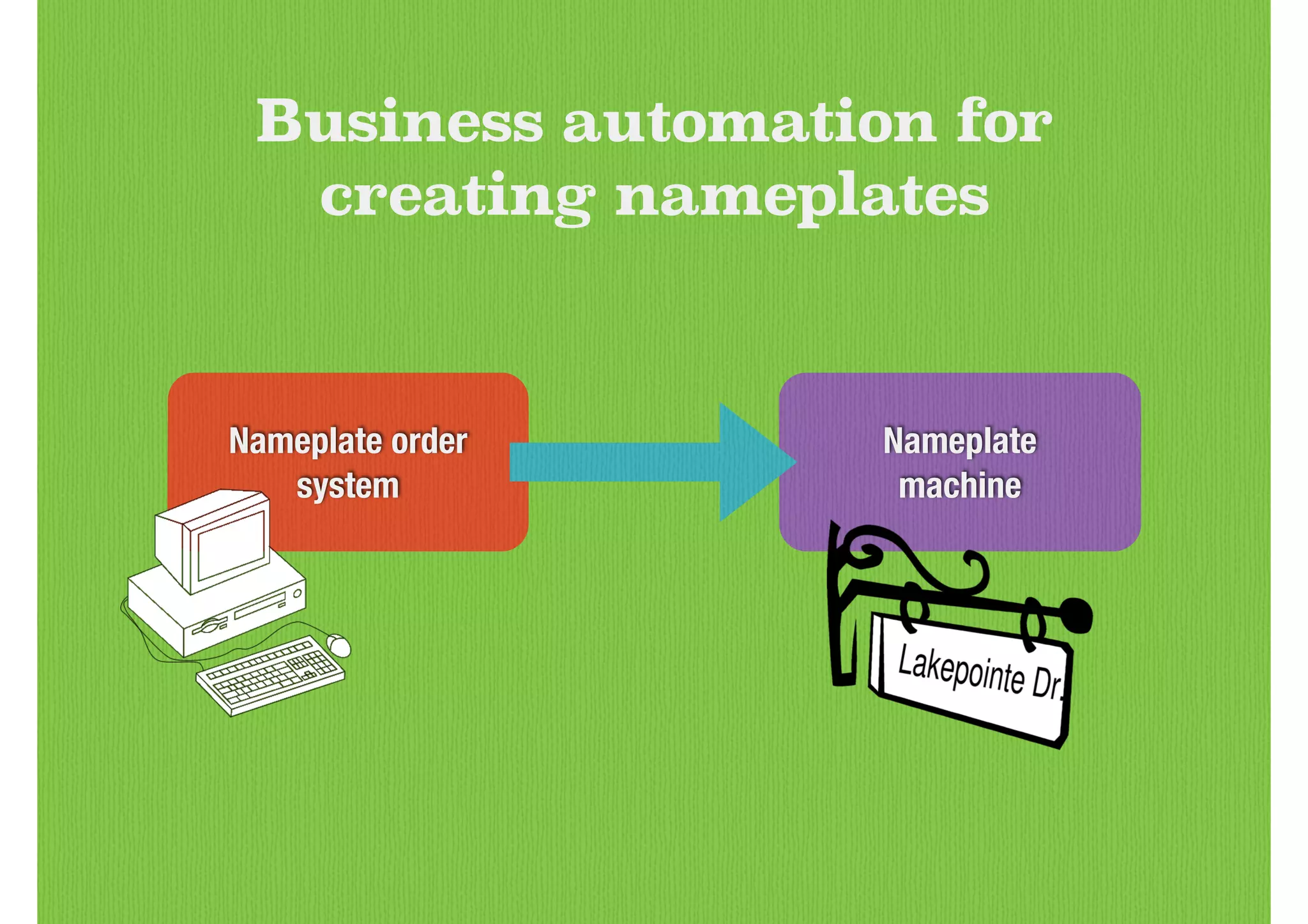
Nameplate order
system
Nameplate
machine
Business automation for
creating nameplates
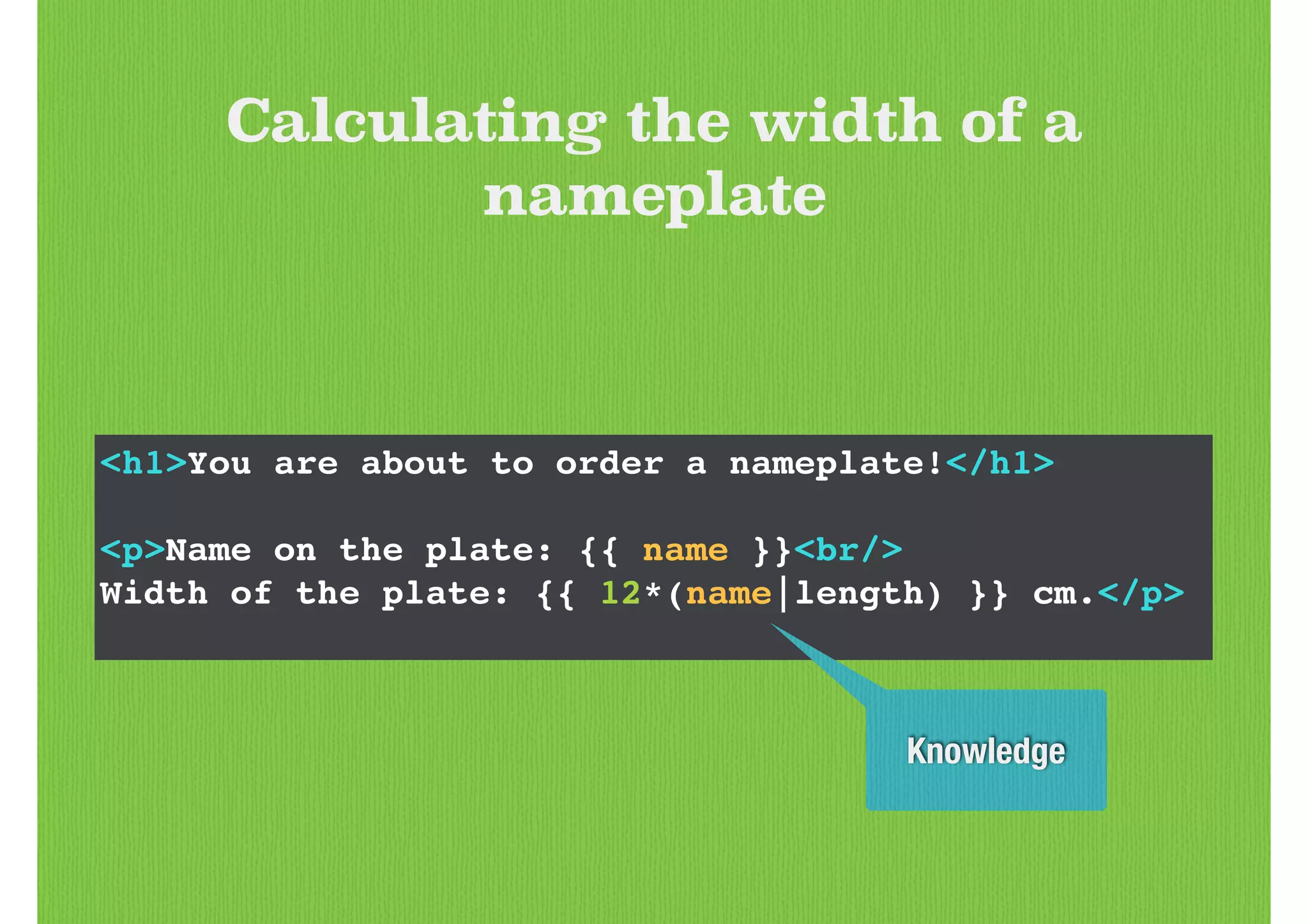
<h1>You are about to order a nameplate!</h1>!
!
<p>Name on the plate: {{ name }}<br/>!
Width of the plate: {{ 12*(name|length) }} cm.</p>!
Calculating the width of a
nameplate
Knowledge
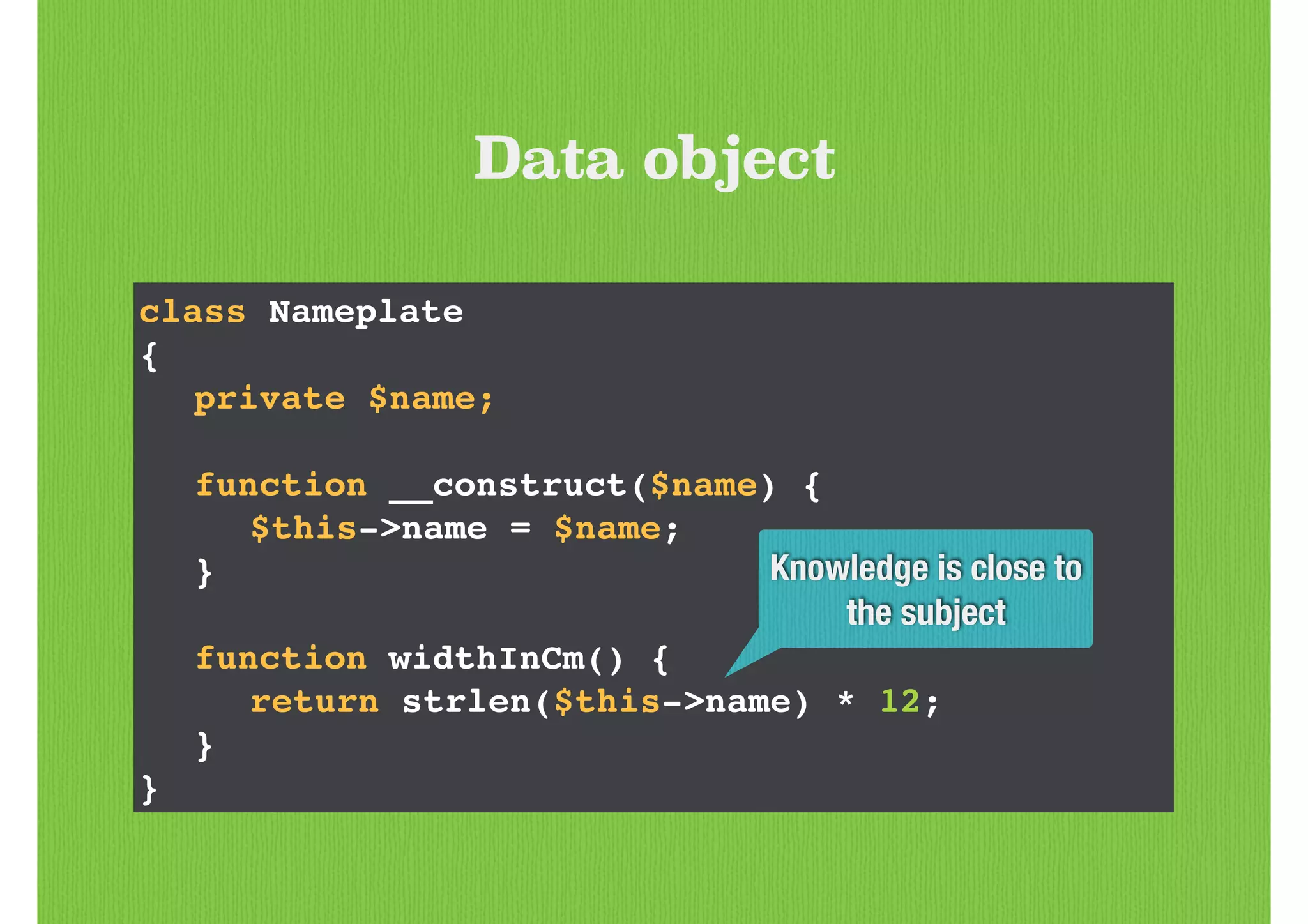
class Nameplate!
{!
! private $name;!
!
! function __construct($name) {!
! ! $this->name = $name;!
! }!
!
! function widthInCm() {!
! ! return strlen($this->name) * 12;!
! }!
}
Data object
Knowledge is close to
the subject
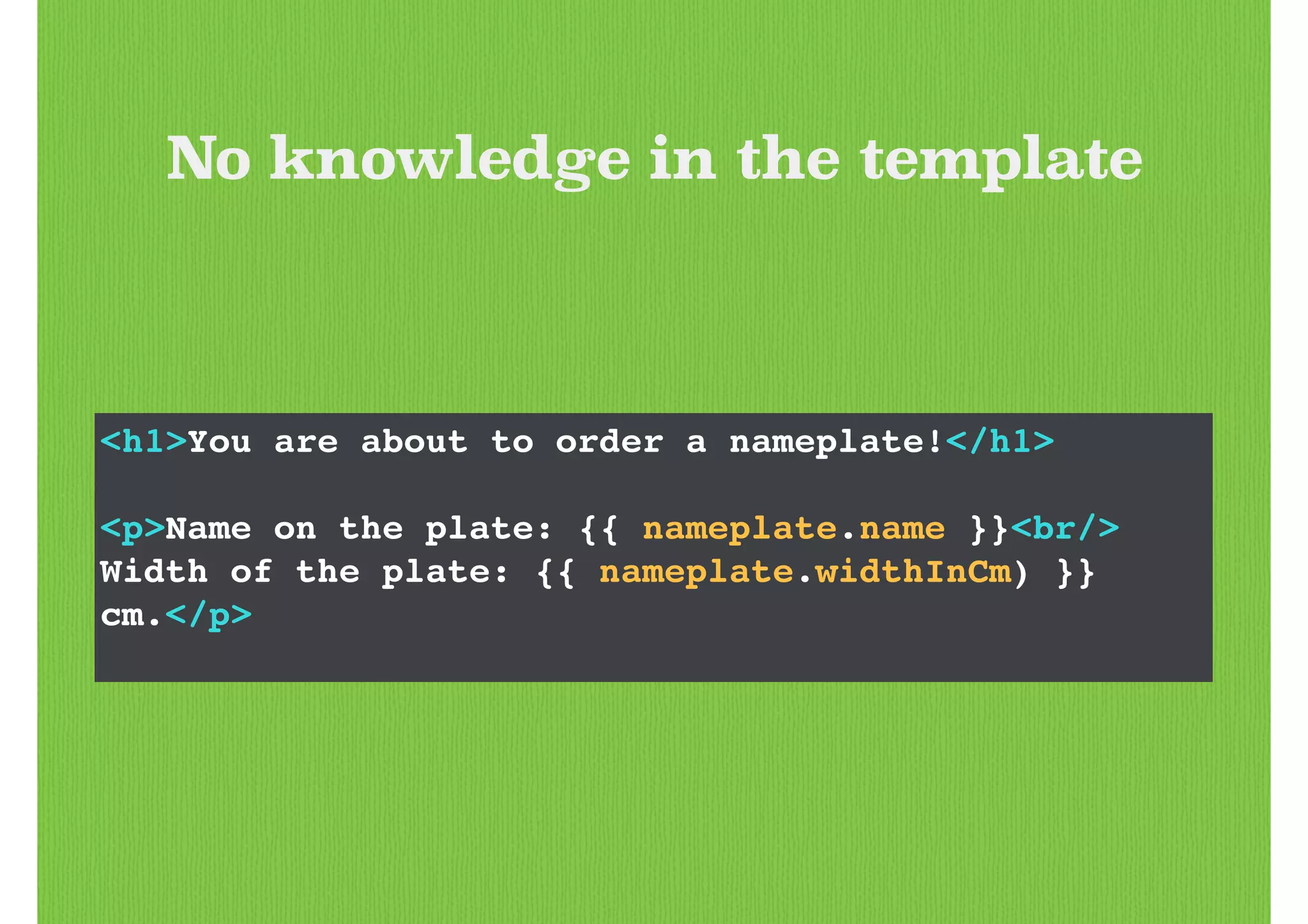
<h1>You are about to order a nameplate!</h1>!
!
<p>Name on the plate: {{ nameplate.name }}<br/>!
Width of the plate: {{ nameplate.widthInCm) }}
cm.</p>!
No knowledge in the template
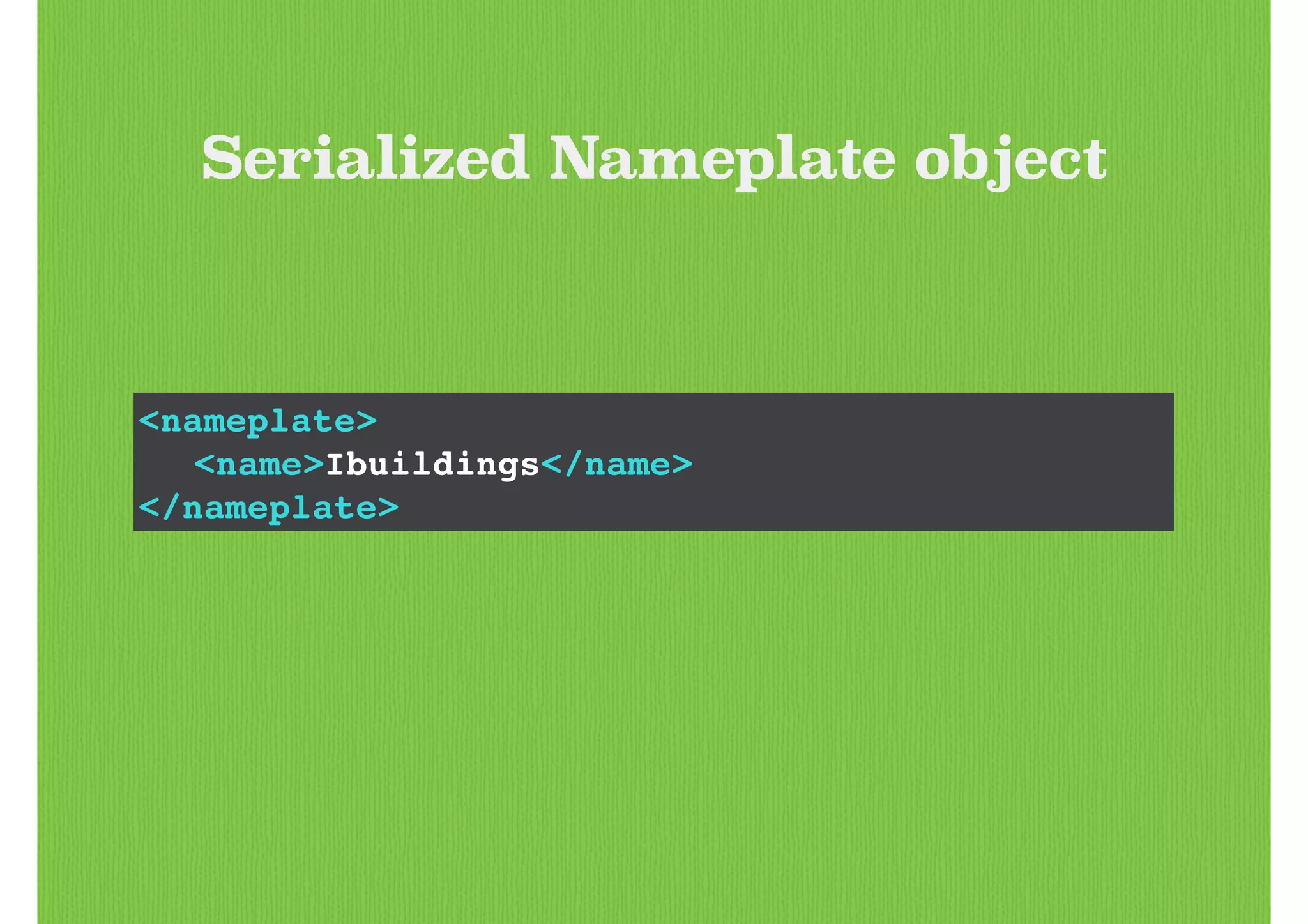
<nameplate>!
! <name>Ibuildings</name>!
</nameplate>
Serialized Nameplate object
// calculate the width of the nameplate!
!
$nameplate = deserialize($xml);!
$name = $nameplate['name'];!
!
$width = strlen($name);!
!
$widthPerCharacterInCm = 12;!
!
$widthInCm = $width * $widthPerCharacterInCm;!
!
// configure the nameplate machine ;)
Accepting messages
Duplication of knowledge
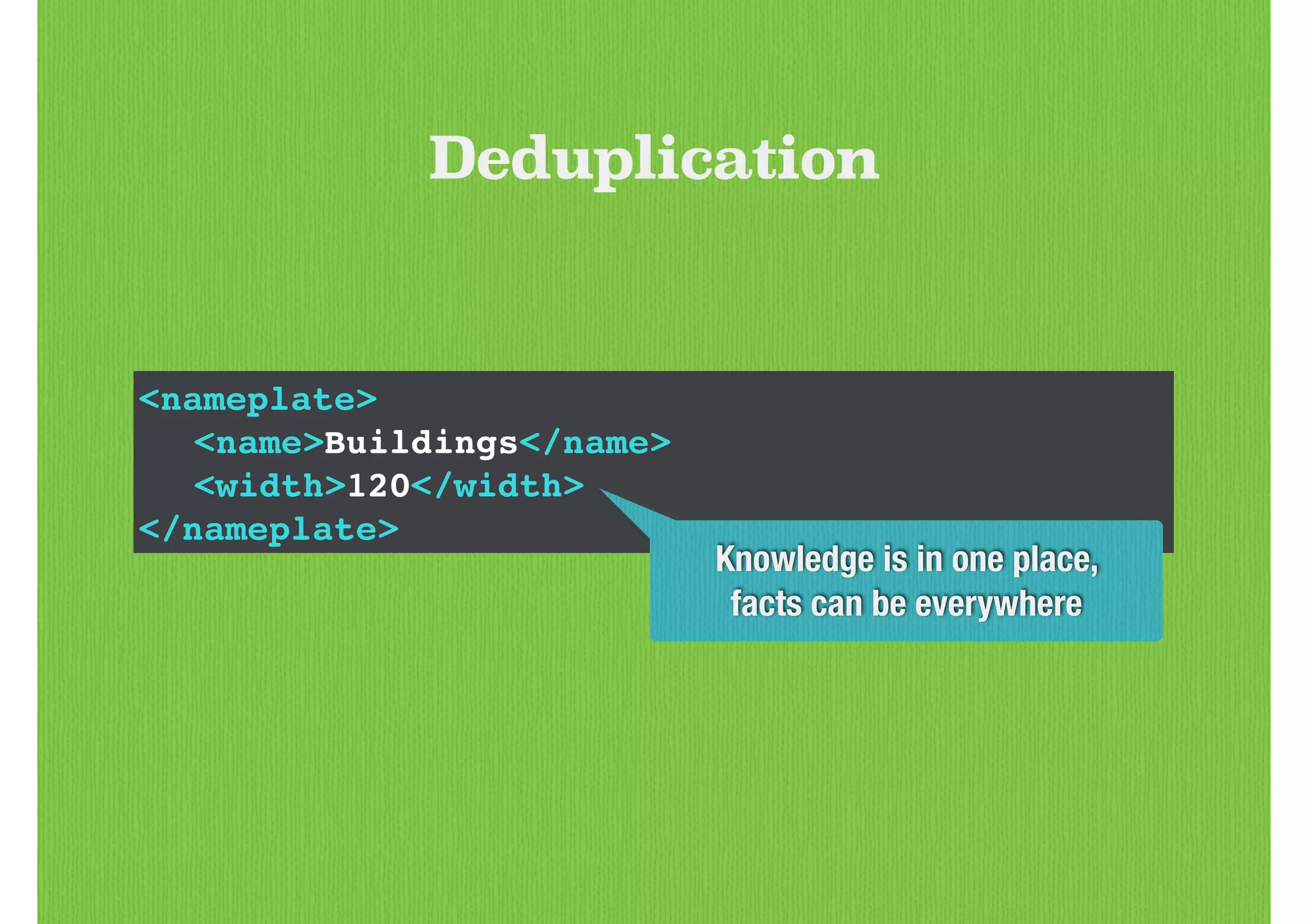
<nameplate>!
! <name>Buildings</name>!
! <width>120</width>!
</nameplate>
Deduplication
Knowledge is in one place,
facts can be everywhere
$nameplate = deserialize($xml);!
!
$width = $nameplate['width'];
Accepting messages
No duplicate knowledge
anymore
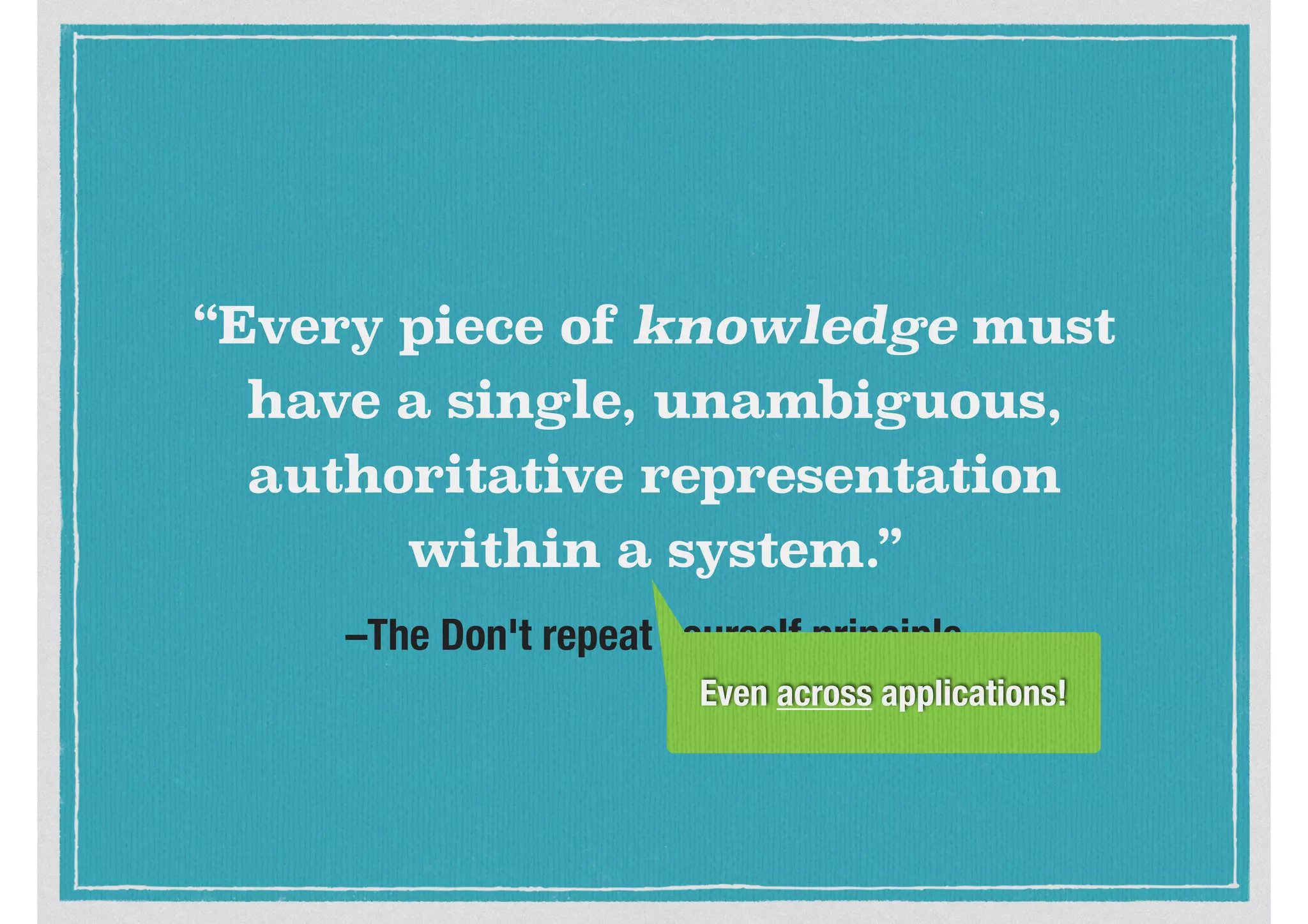
–The Don't repeat yourself principle
“Every piece of knowledge must
have a single, unambiguous,
authoritative representation
within a system.”
Even across applications!
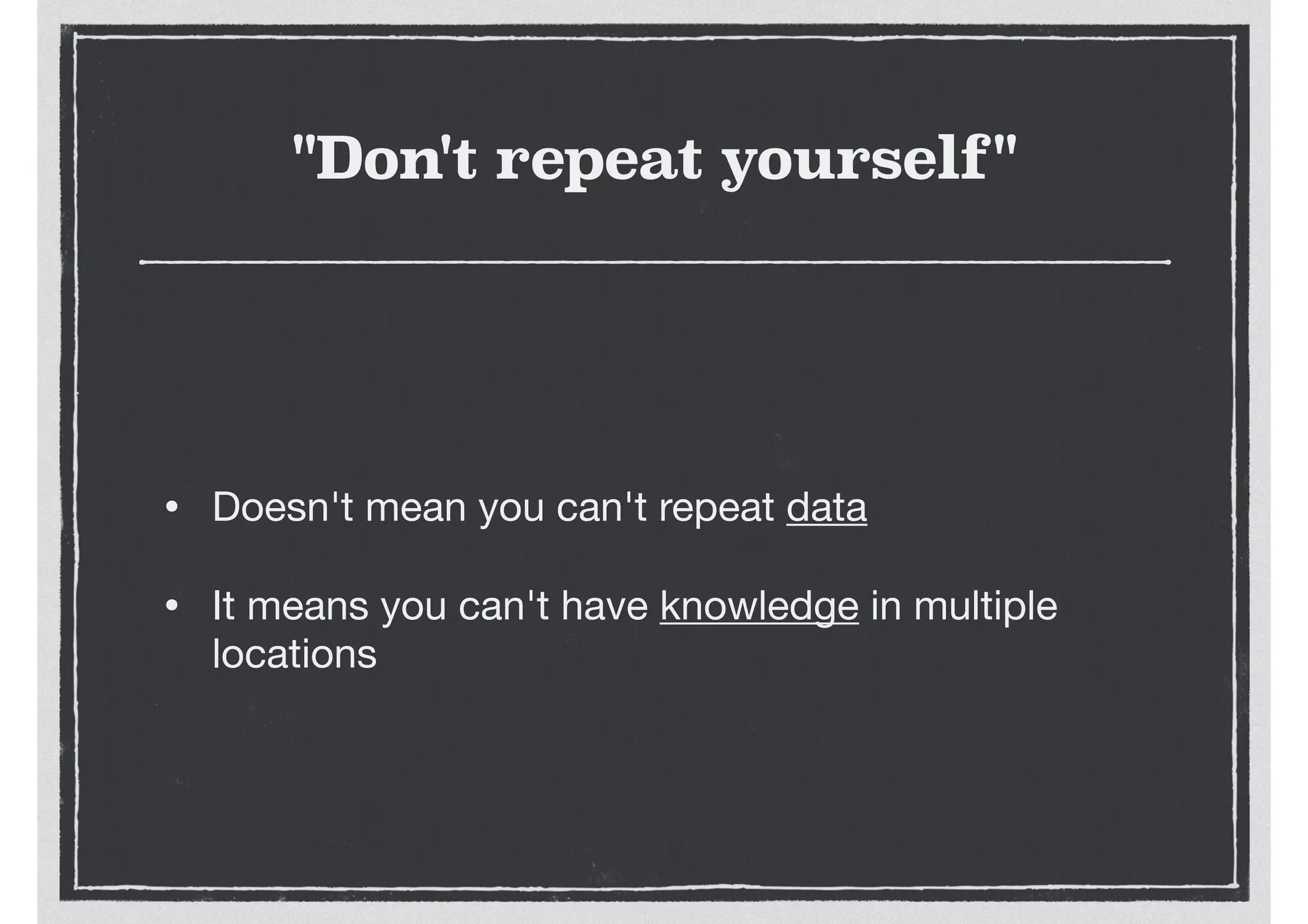
"Don't repeat yourself"
• Doesn't mean you can't repeat data

• It means you can't have knowledge in multiple
locations
Mutability
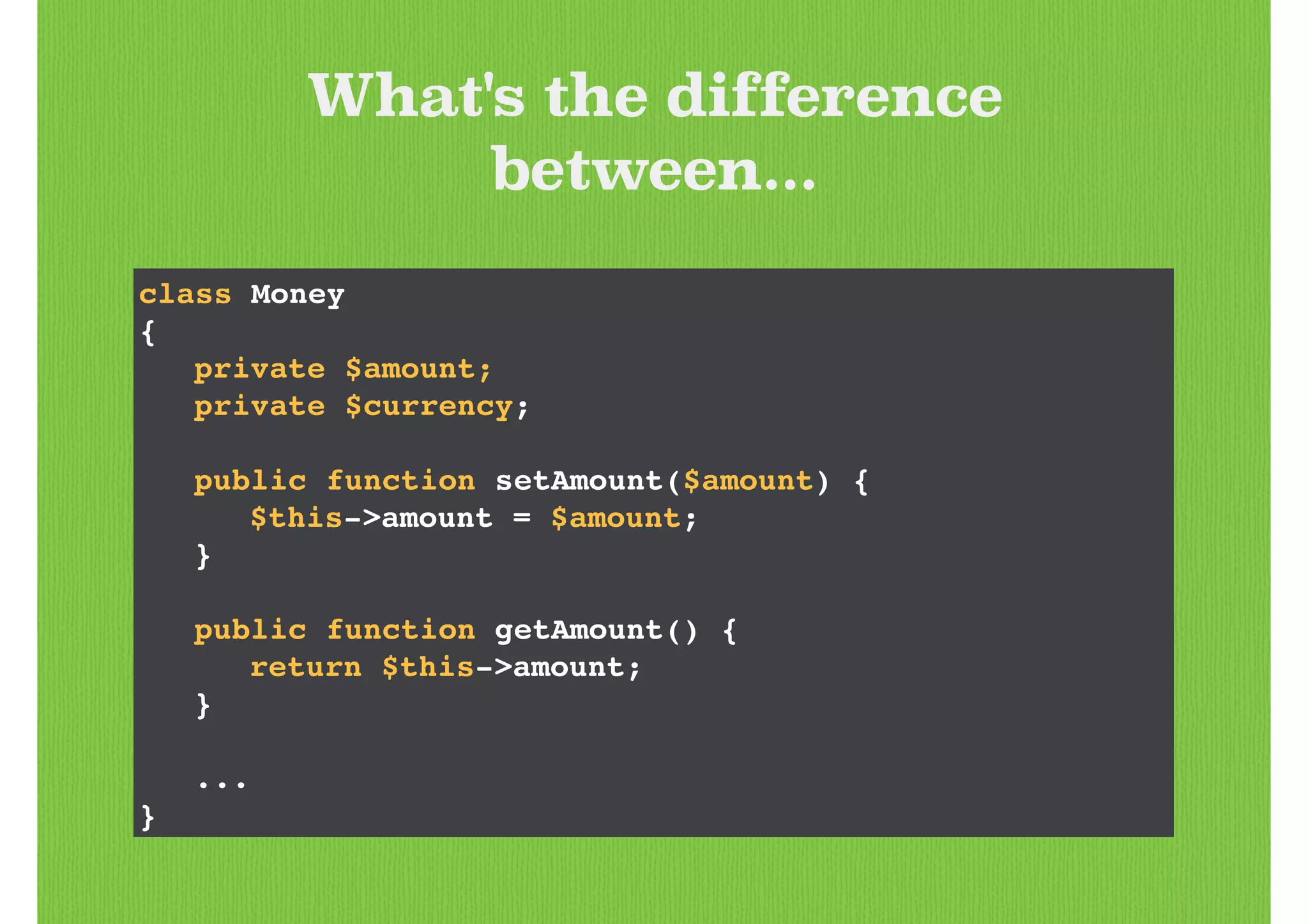
What's the difference
between...
class Money!
{!
! private $amount;!
! private $currency;!
!
! public function setAmount($amount) {!
! ! $this->amount = $amount;!
! }!
!
! public function getAmount() {!
! ! return $this->amount;!
! }!
!
! ...!
}
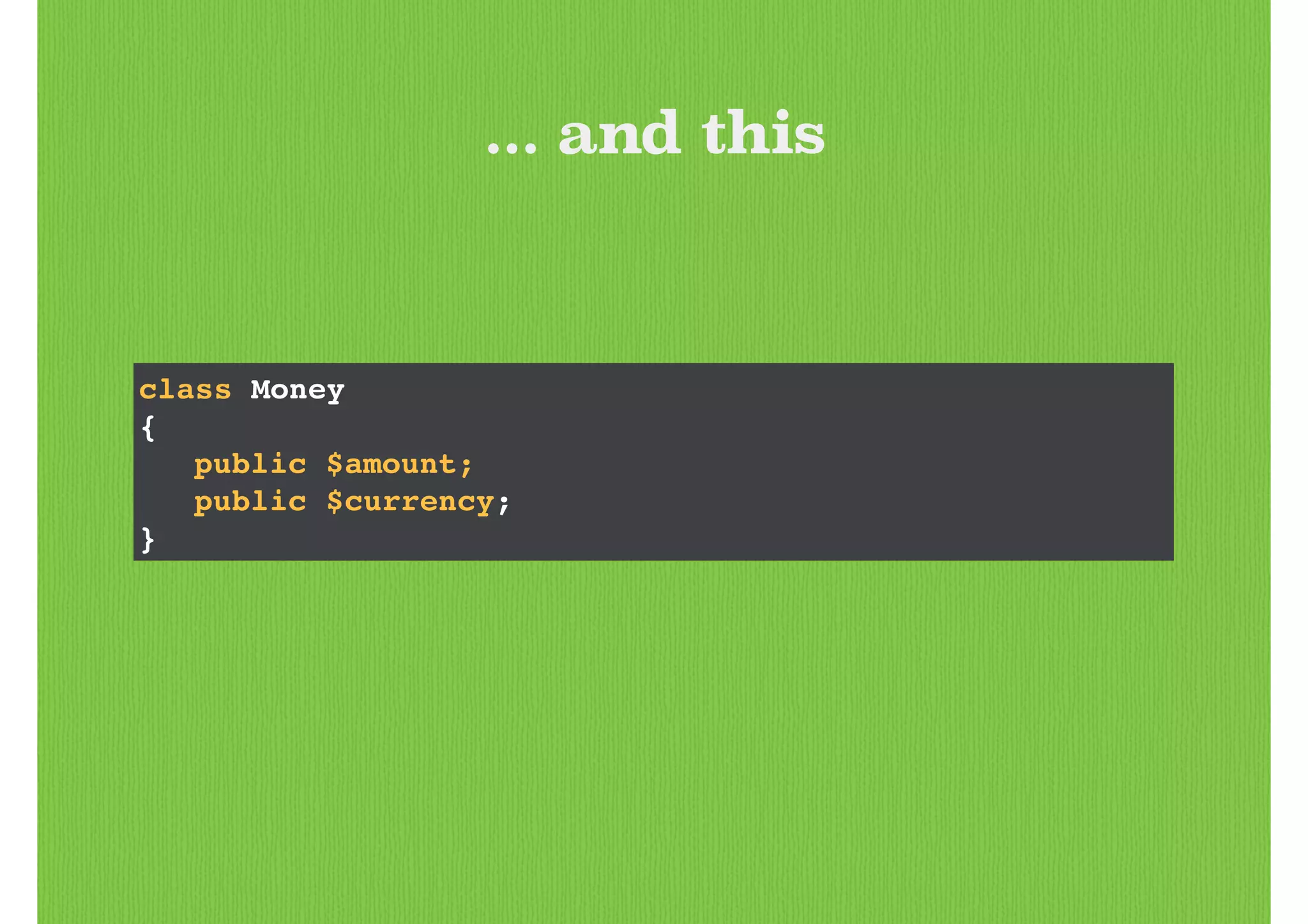
... and this
class Money!
{!
! public $amount;!
! public $currency;!
}
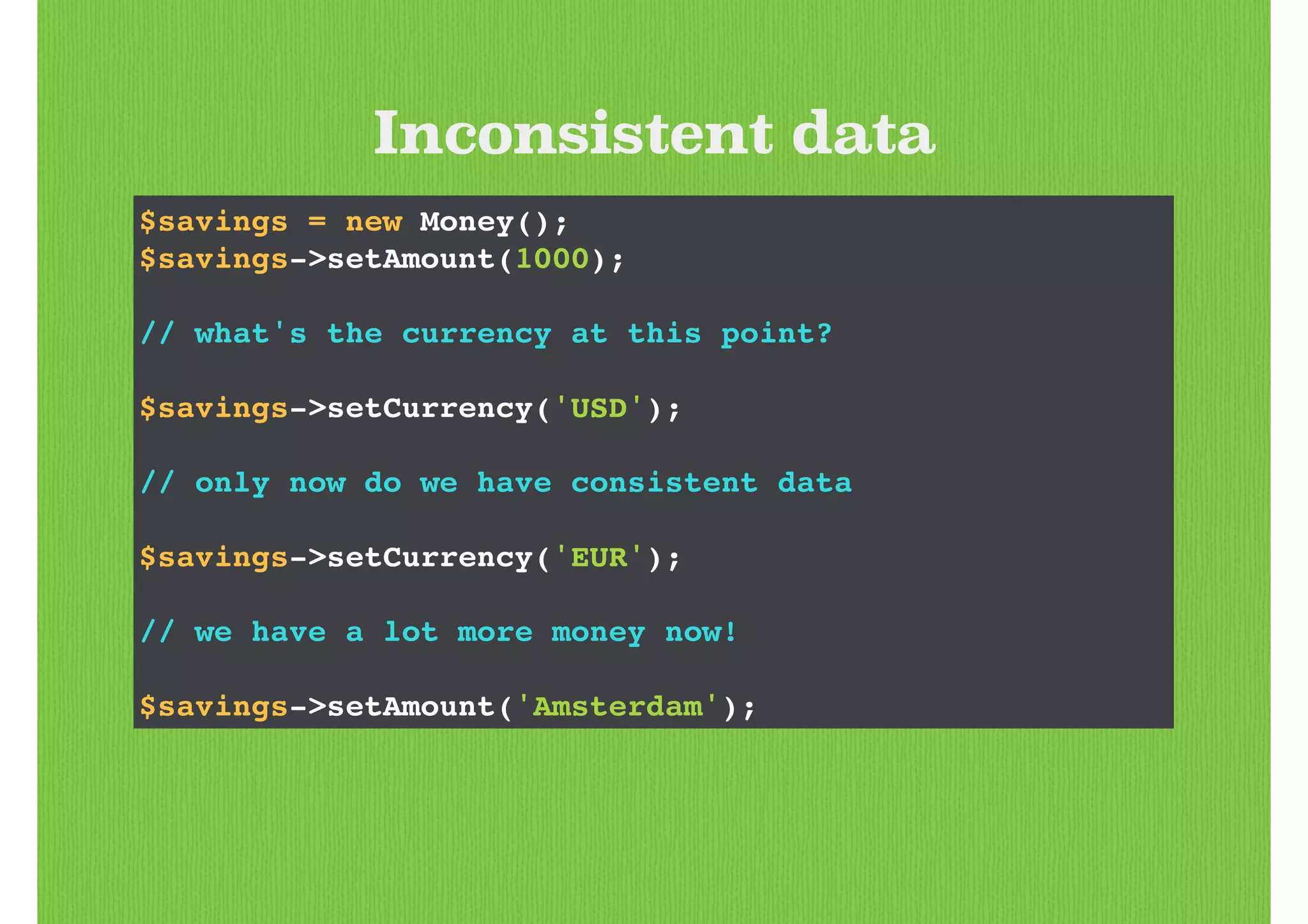
Inconsistent data
$savings = new Money();!
$savings->setAmount(1000);!
!
// what's the currency at this point?!
!
$savings->setCurrency('USD');!
!
// only now do we have consistent data!
!
$savings->setCurrency('EUR');!
!
// we have a lot more money now!!
!
$savings->setAmount('Amsterdam');
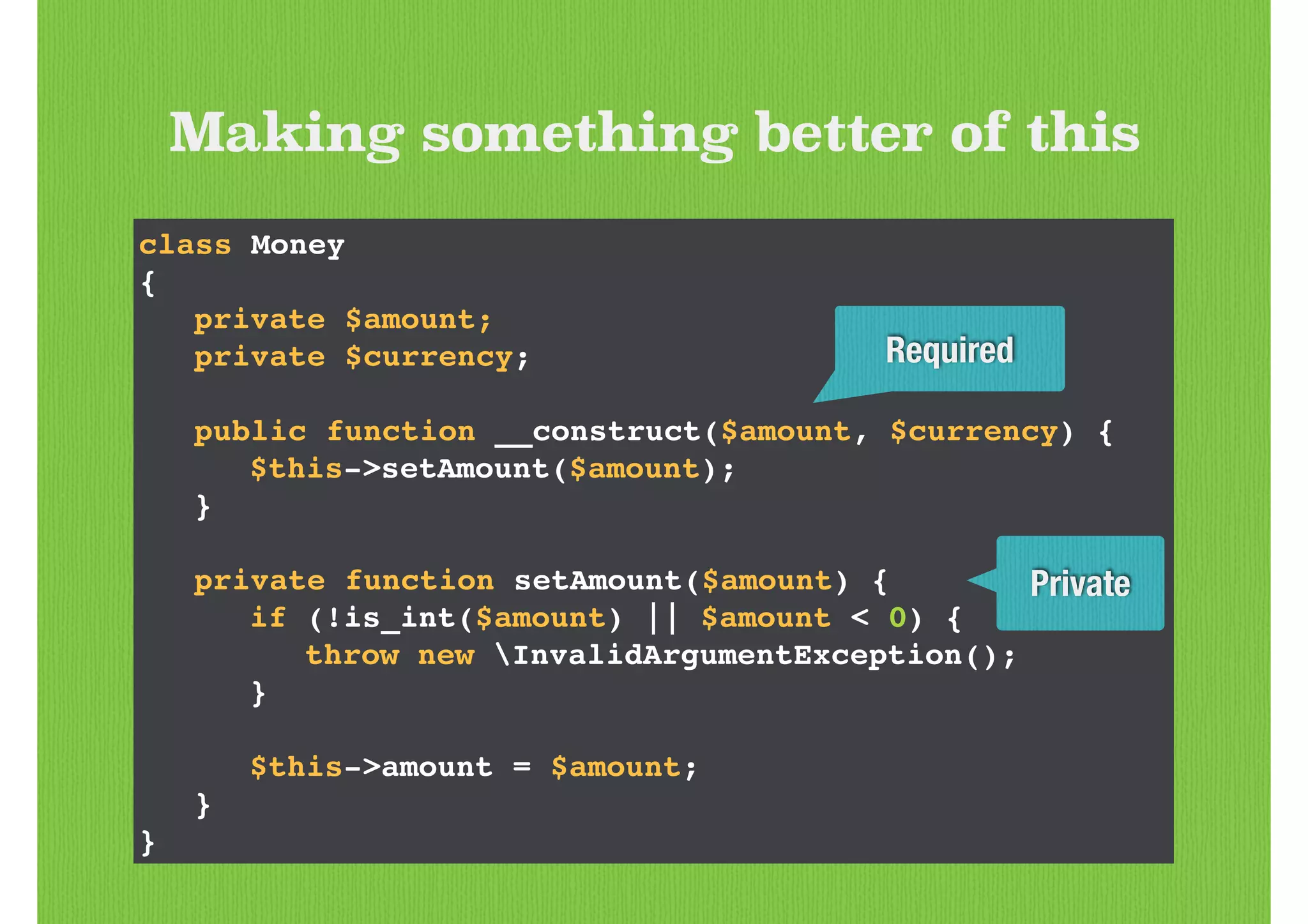
Making something better of this
class Money!
{!
! private $amount;!
! private $currency;!
!
! public function __construct($amount, $currency) {!
! ! $this->setAmount($amount);!
! }!
!
! private function setAmount($amount) {!
! ! if (!is_int($amount) || $amount < 0) {!
! ! ! throw new InvalidArgumentException();!
! ! }!
!
! ! $this->amount = $amount;!
! }!
}
Private
Required
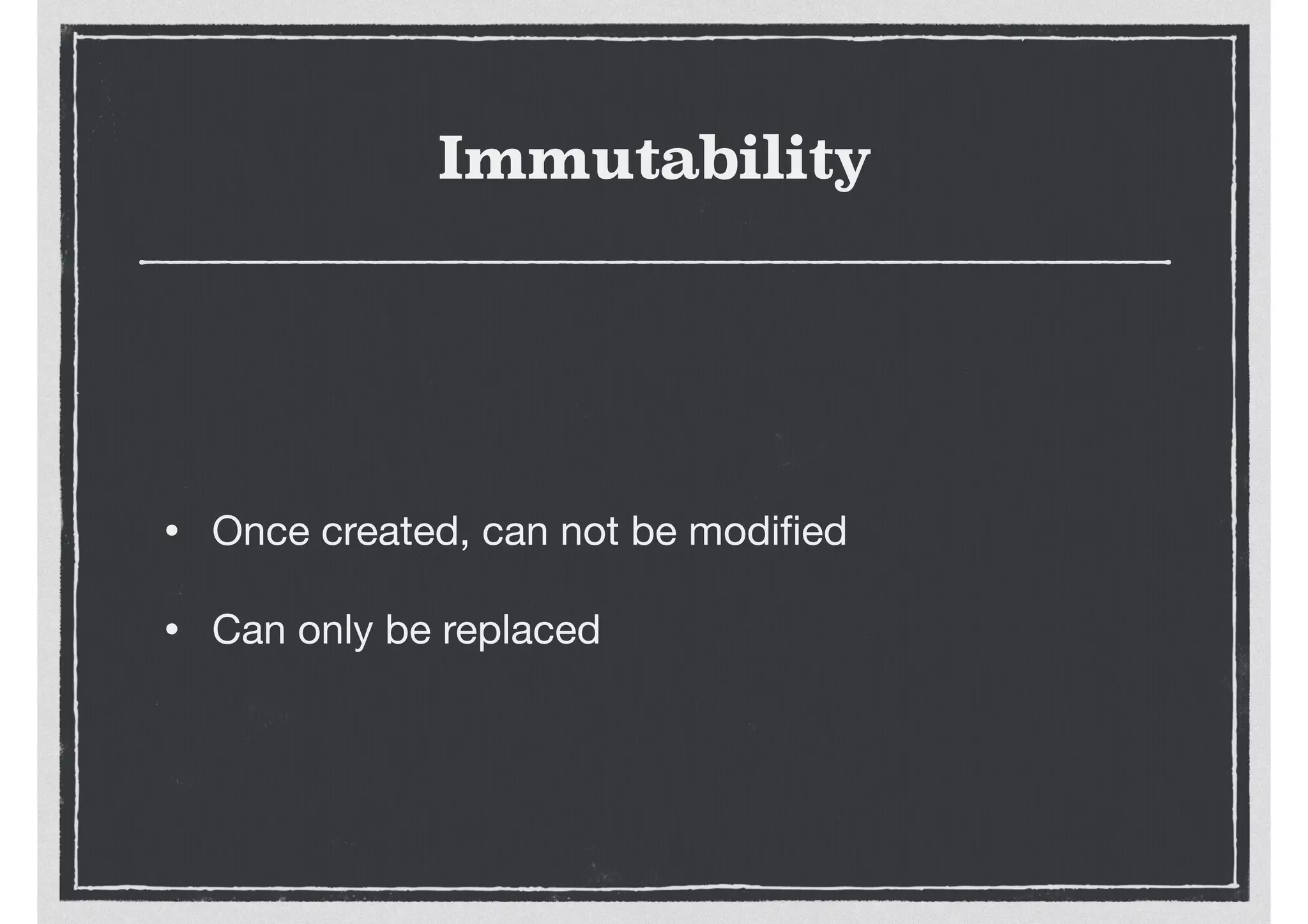
Immutability
• Once created, can not be modified

• Can only be replaced
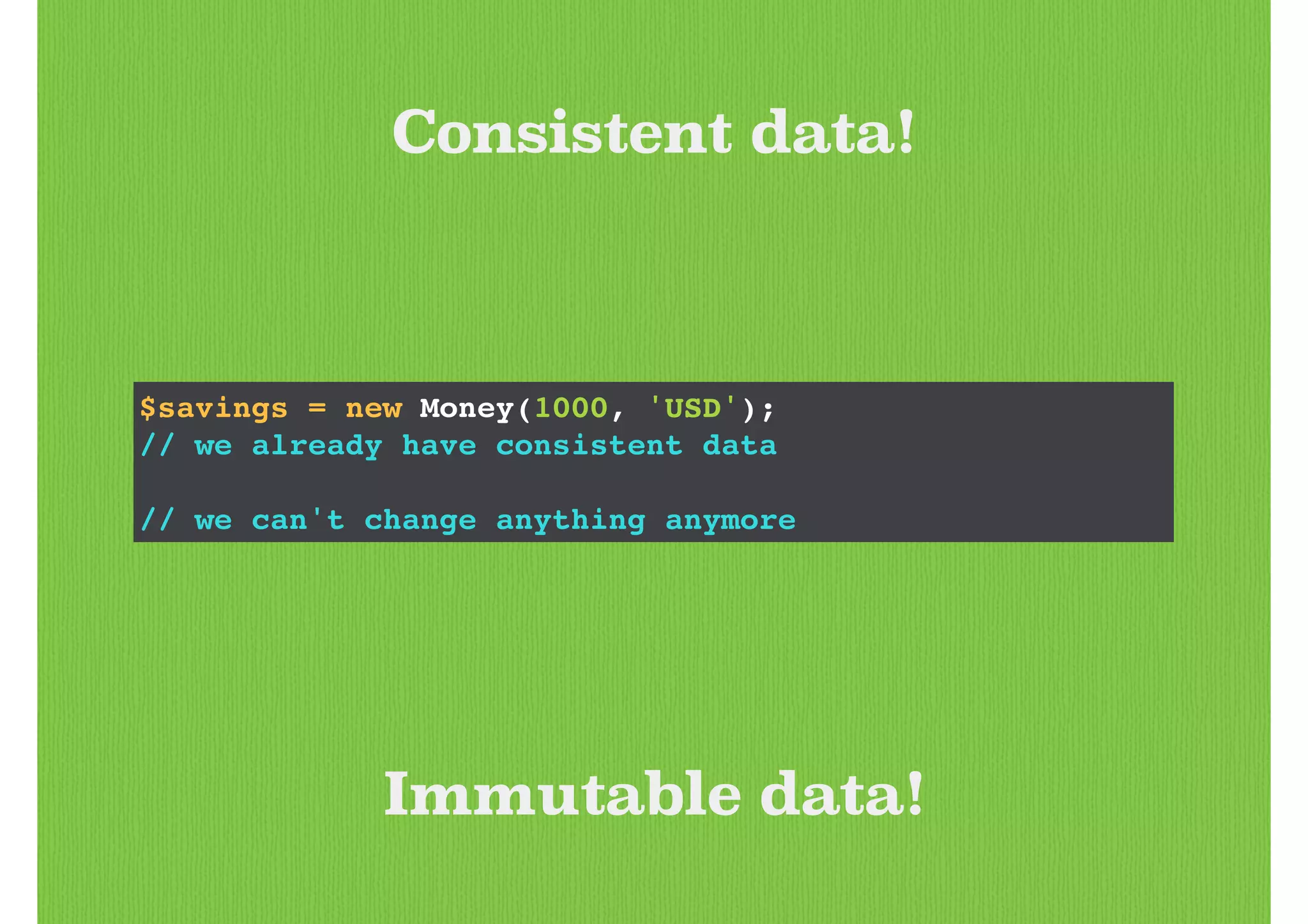
Consistent data!
$savings = new Money(1000, 'USD');!
// we already have consistent data!
!
// we can't change anything anymore
Immutable data!
Using immutable values
• Prevents bugs

• Prevents invalid state
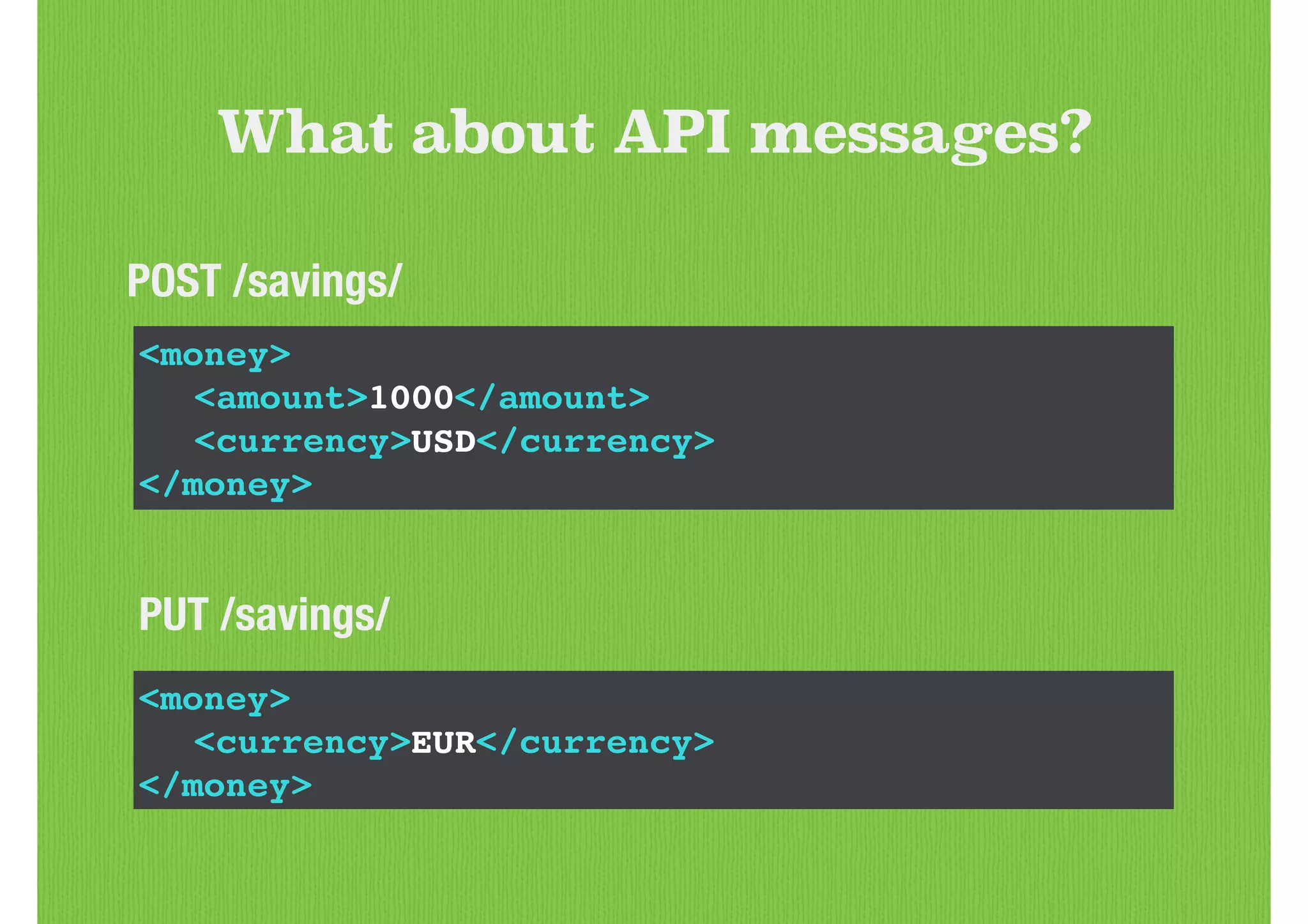
What about API messages?
<money>!
! <amount>1000</amount>!
! <currency>USD</currency>!
</money>
PUT /savings/
<money>!
! <currency>EUR</currency>!
</money>
POST /savings/
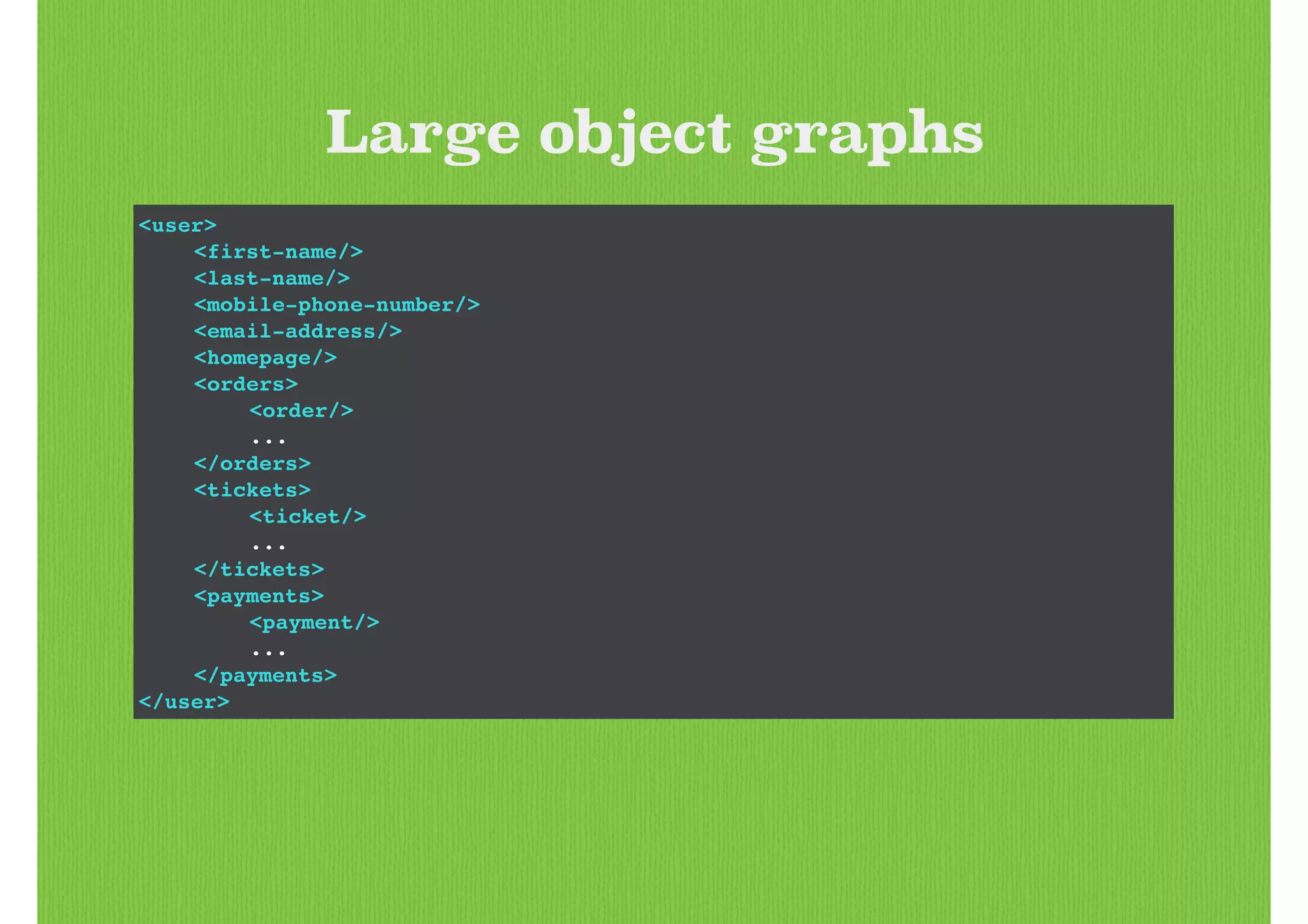
Large object graphs
<user>!
! <first-name/>!
! <last-name/> !
! <mobile-phone-number/> !
! <email-address/> !
! <homepage/> !
! <orders>!
! ! <order/>!
! ! ...!
! </orders>!
! <tickets>!
! ! <ticket/>!
! ! ...!
! </tickets>!
! <payments>!
! ! <payment/>!
! ! ...!
! </payments>!
</user>
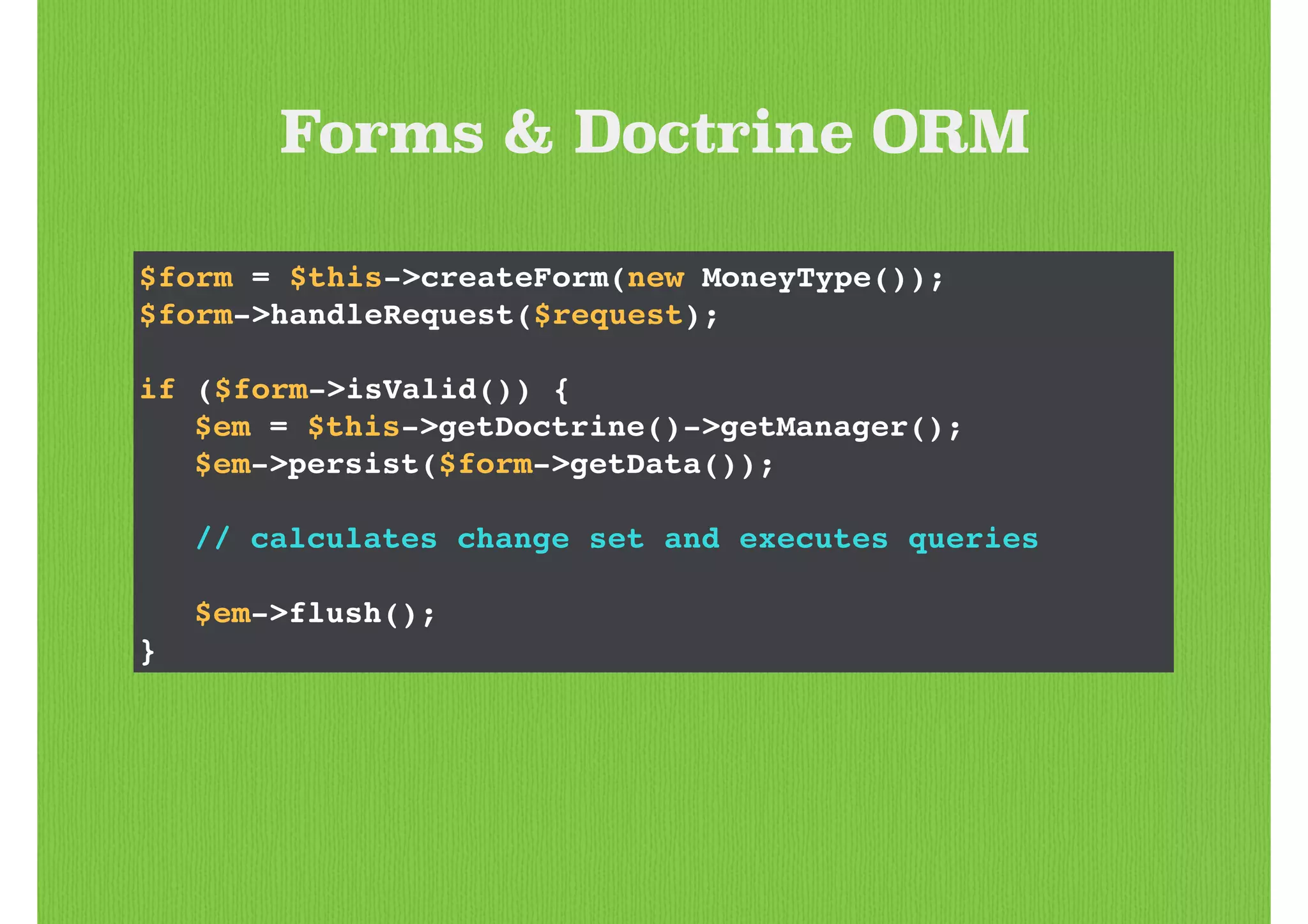
Forms & Doctrine ORM
$form = $this->createForm(new MoneyType());!
$form->handleRequest($request);!
!
if ($form->isValid()) {!
! $em = $this->getDoctrine()->getManager();!
! $em->persist($form->getData());!
!
! // calculates change set and executes queries!
!
! $em->flush();!
}
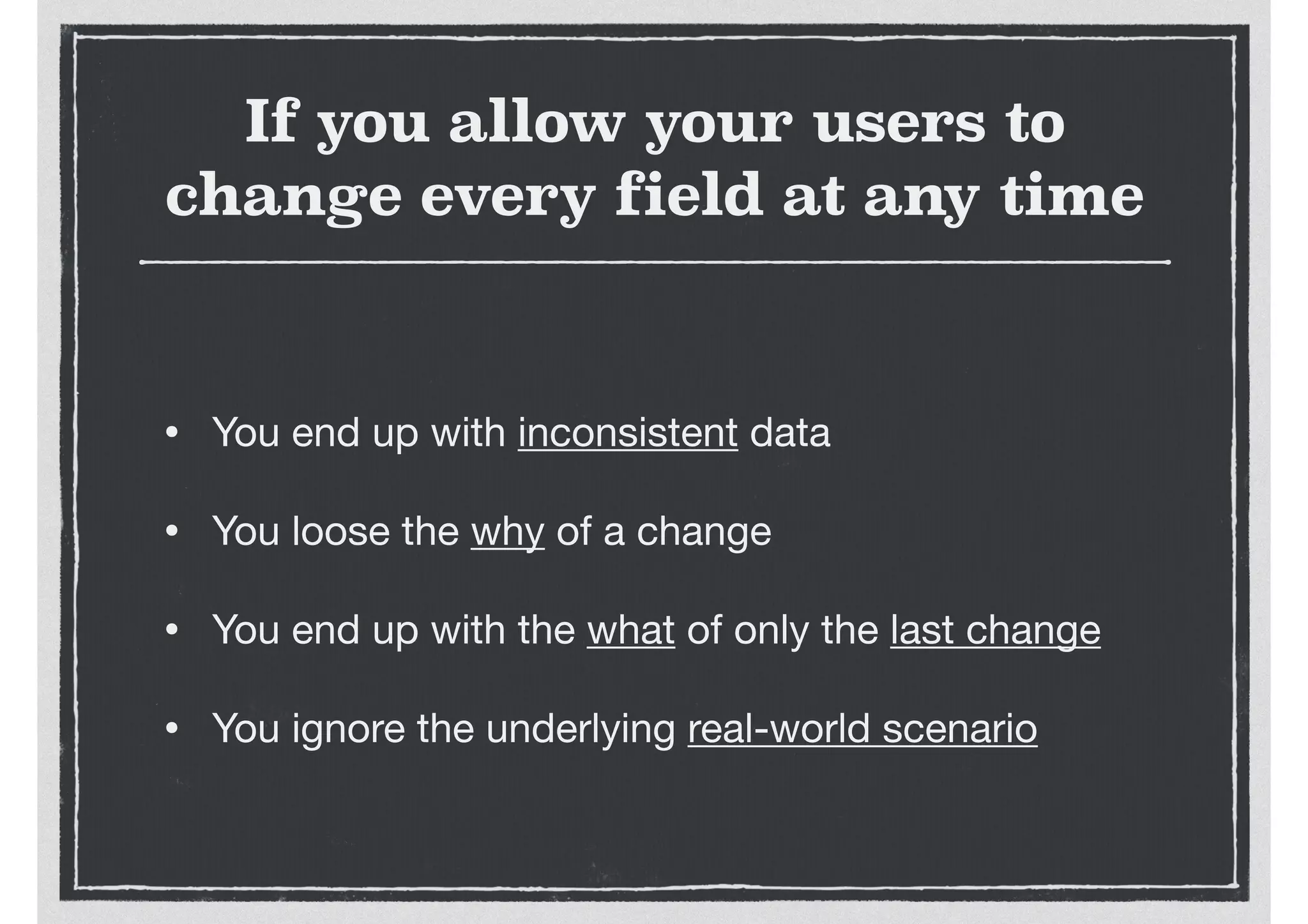
If you allow your users to
change every field at any time
• You end up with inconsistent data

• You loose the why of a change

• You end up with the what of only the last change

• You ignore the underlying real-world scenario
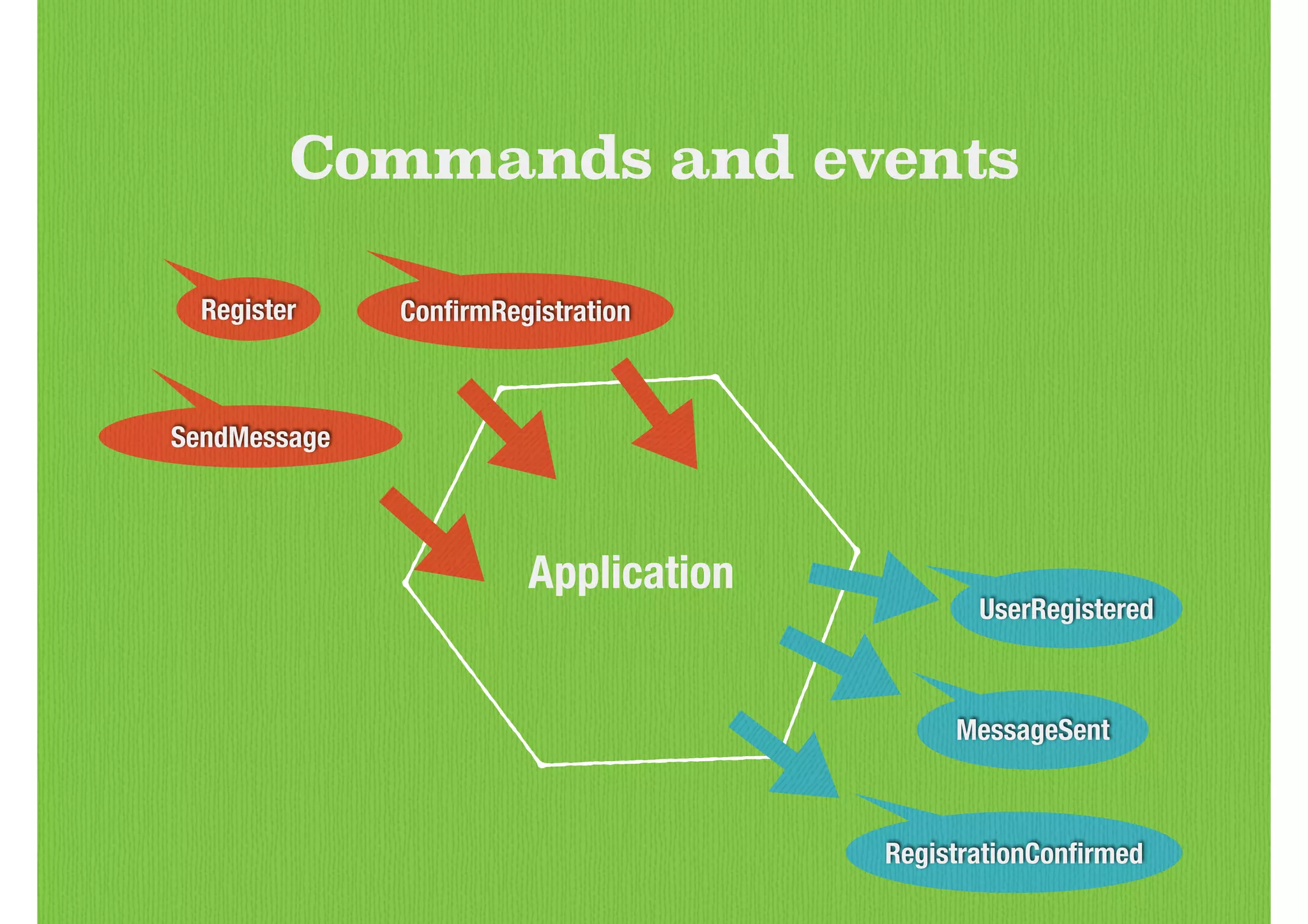
Commands and events
Register ConfirmRegistration
SendMessage
RegistrationConfirmed
MessageSent
UserRegistered
Application
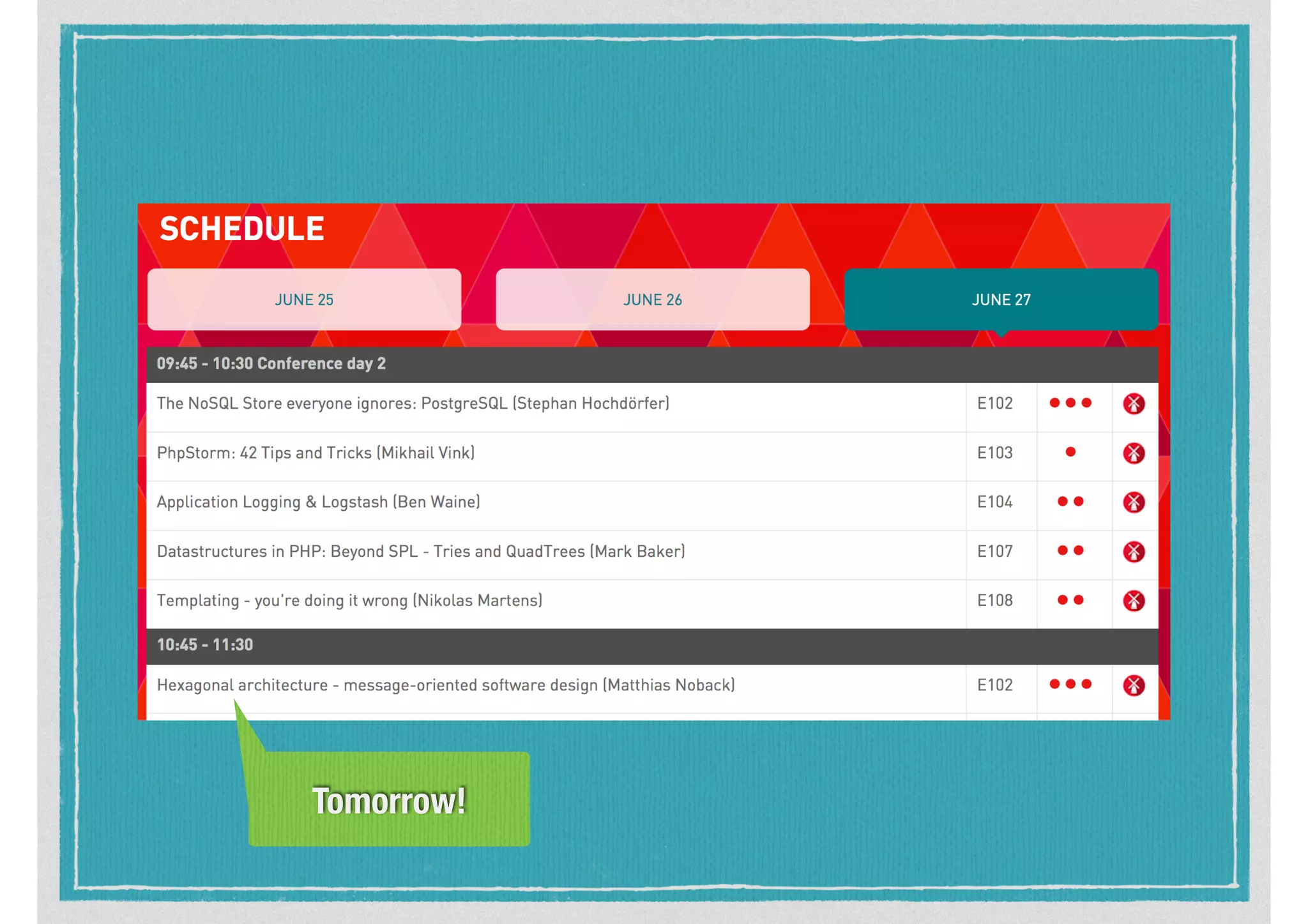
Tomorrow!
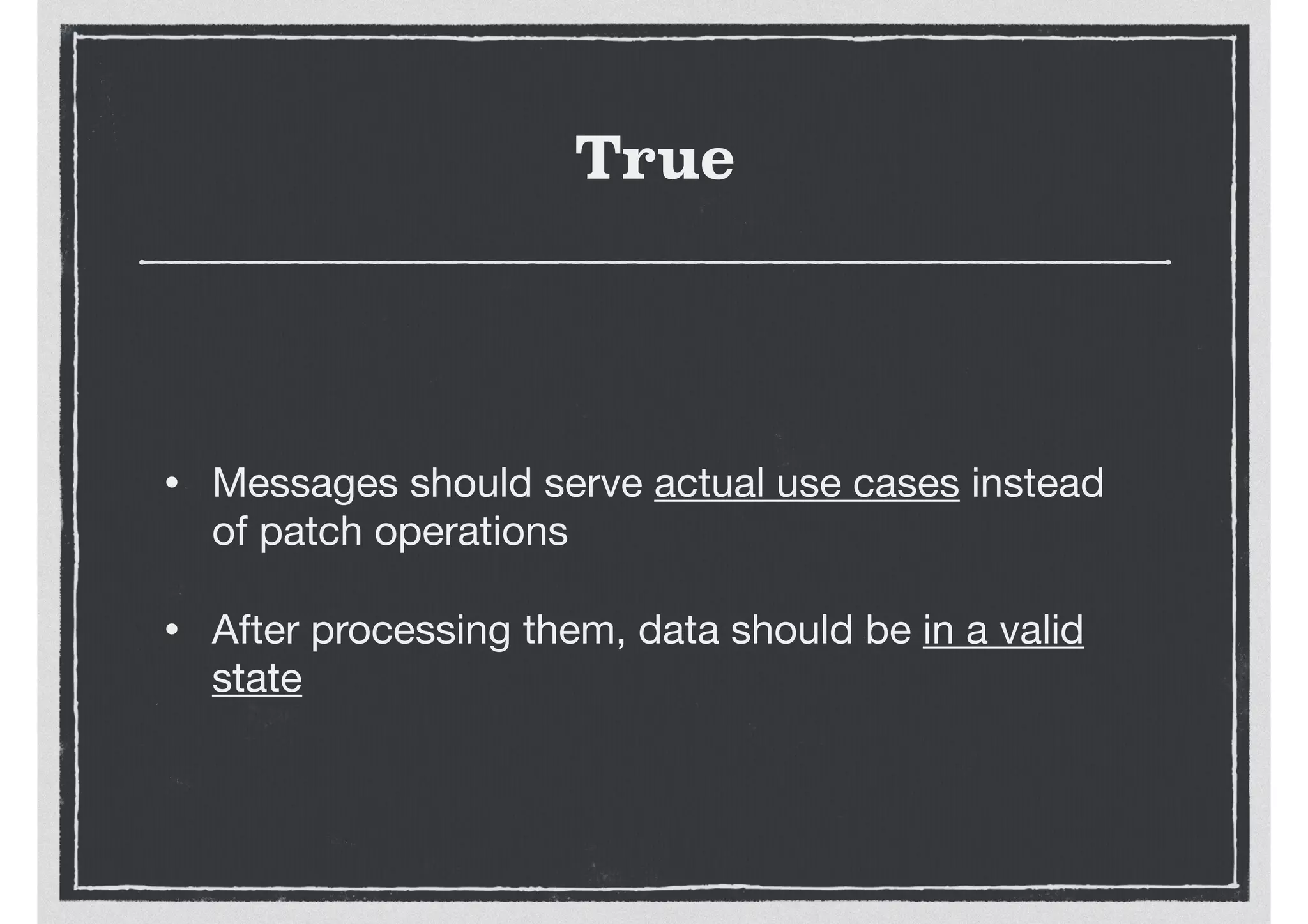
True
• Messages should serve actual use cases instead
of patch operations

• After processing them, data should be in a valid
state
Part III
Implementation
I Stability
II Information
IV Conclusion
Implementation
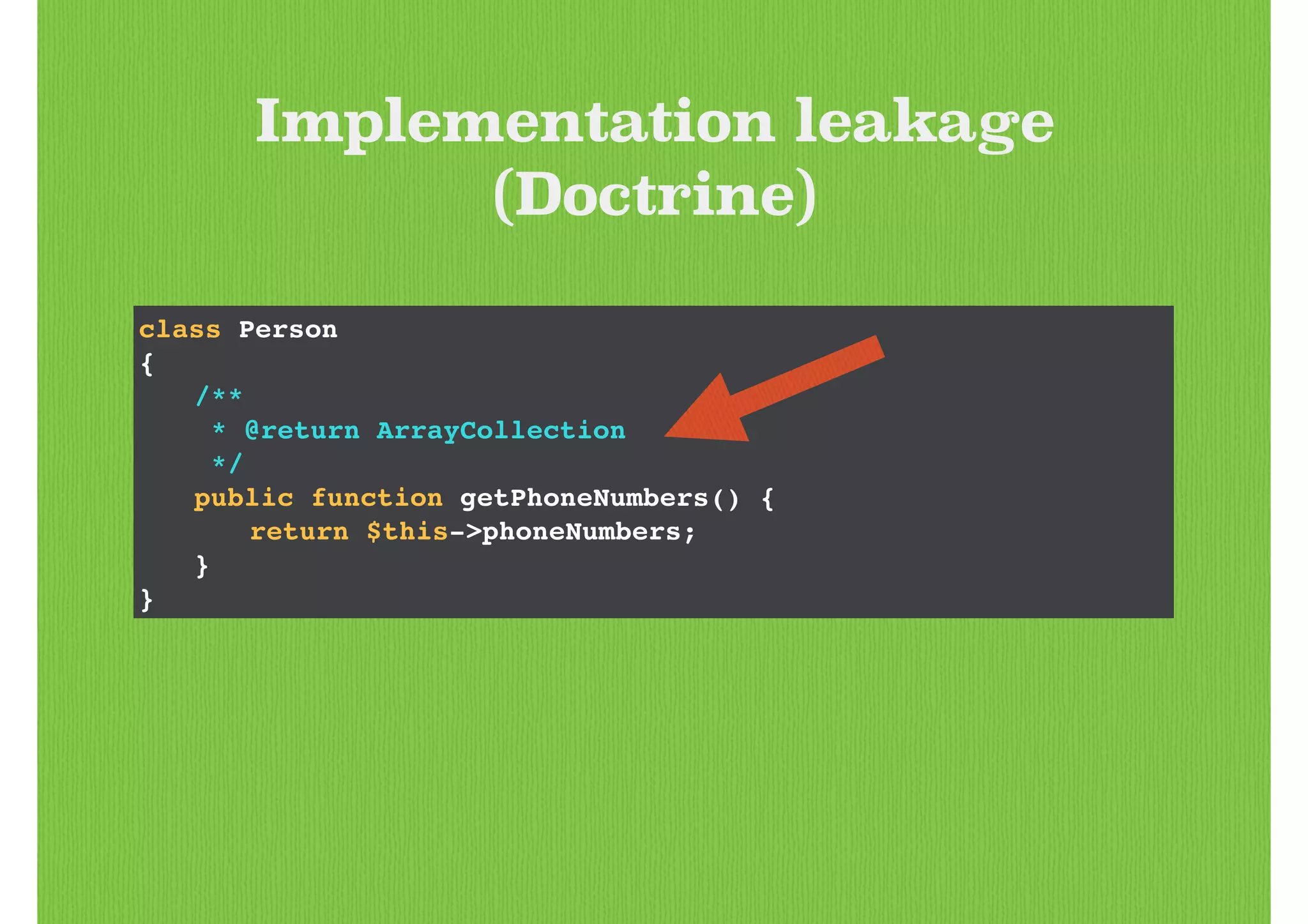
Leaking implementation
details
class Person!
{!
! /**!
! * @return PhoneNumber[]!
! */!
! public function getPhoneNumbers() {!
! ! return $this->phoneNumbers;!
! }!
}
Initial implementation
class Person!
{!
! /**!
! * @return ArrayCollection!
! */!
! public function getPhoneNumbers() {!
! ! return $this->phoneNumbers;!
! }!
}
Implementation leakage
(Doctrine)
class Person!
{!
! /**!
! * @return PhoneNumber[]!
! */!
! public function getPhoneNumbers() {!
! ! return $this->phoneNumbers->toArray();!
! }!
}
Hiding implementation
class NameplateController!
{!
! function getAction($id) {!
! ! $nameplate = $this!
! ! ! ->getDoctrine()!
! ! ! ->getManager()!
! ! ! ->getRepository(Nameplate::class)!
! ! ! ->findOneBy(['id' => $id]);!
!
! ! if ($nameplate === null) {!
! ! ! throw new NotFoundHttpException();!
! ! }!
! ! ...!
! }!
}
More implementation hiding
Actual field names!
null or false?
"find"?
class NameplateRepository!
{!
! function fromId($id) {!
! ! $nameplate = $this!
! ! ! ->findOneBy(['id' => $id]);!
!
! ! if ($nameplate === null) {!
! ! ! throw new NameplateNotFound($id);!
! ! }!
!
! ! return $nameplate;!
! }!
}
Push it out of sight
Domain-specific exception
Hide specific return value
No "find"
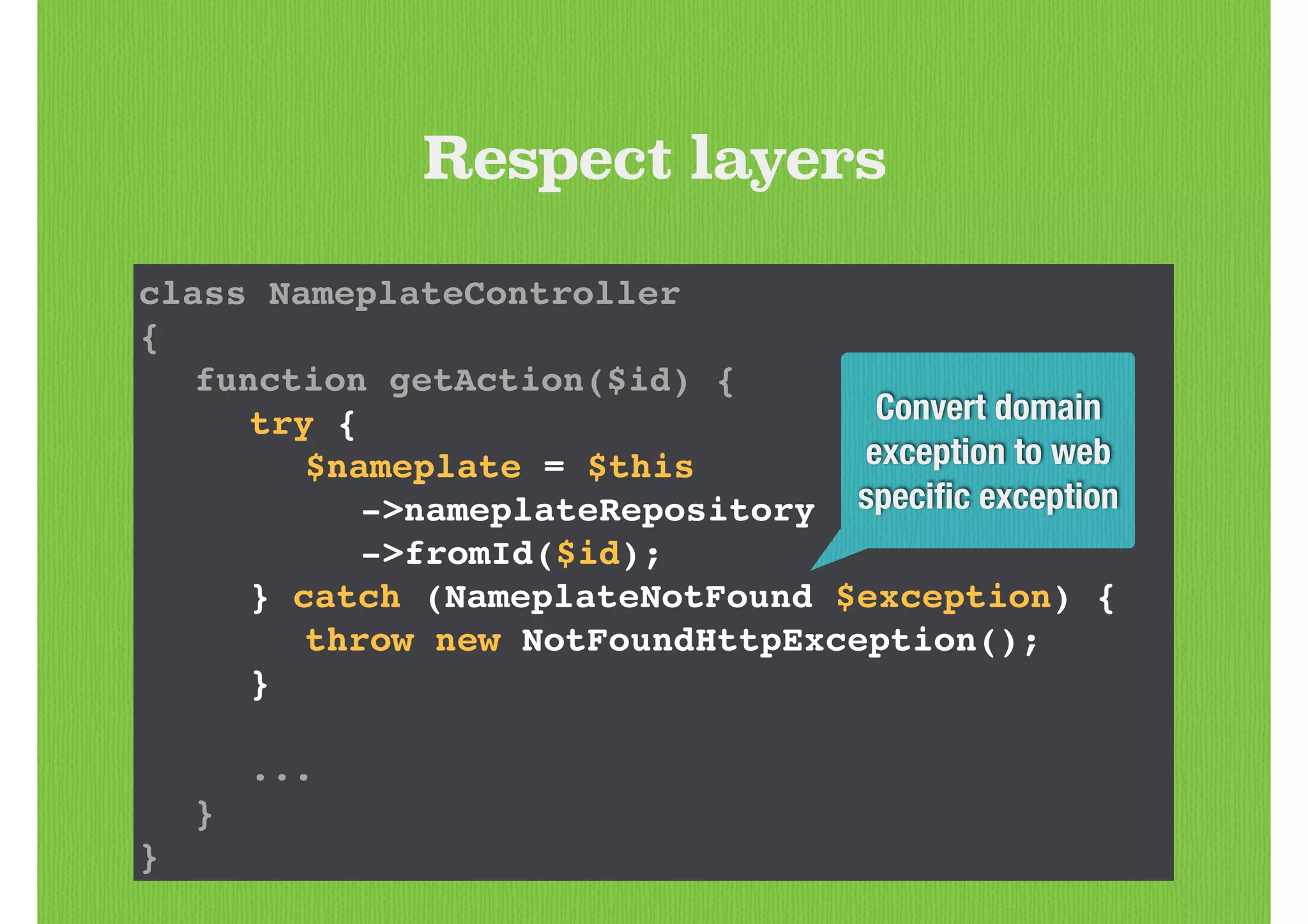
class NameplateController!
{!
! function getAction($id) {!
! ! try {!
! ! ! $nameplate = $this!
! ! ! ! ->nameplateRepository!
! ! ! ! ->fromId($id);!
! ! } catch (NameplateNotFound $exception) {!
! ! ! throw new NotFoundHttpException();!
! ! }!
!
! ! ...!
! }!
}
Respect layers
Convert domain
exception to web
specific exception
Plain old OOP
• Encapsulation

• Abstraction
Limited by implementation
details
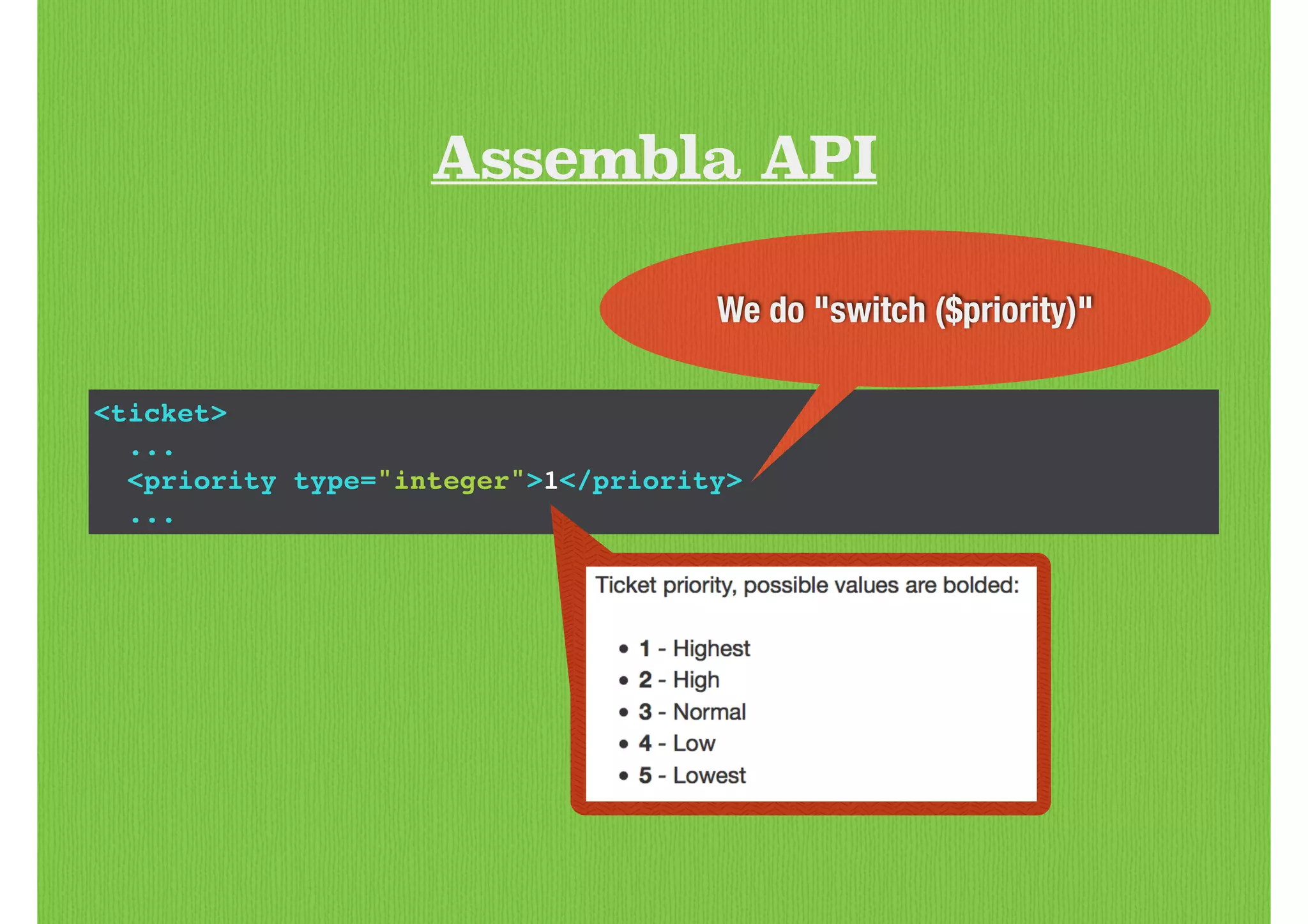
<ticket>!
...!
<priority type="integer">1</priority>!
...
Assembla API
We do "switch ($priority)"
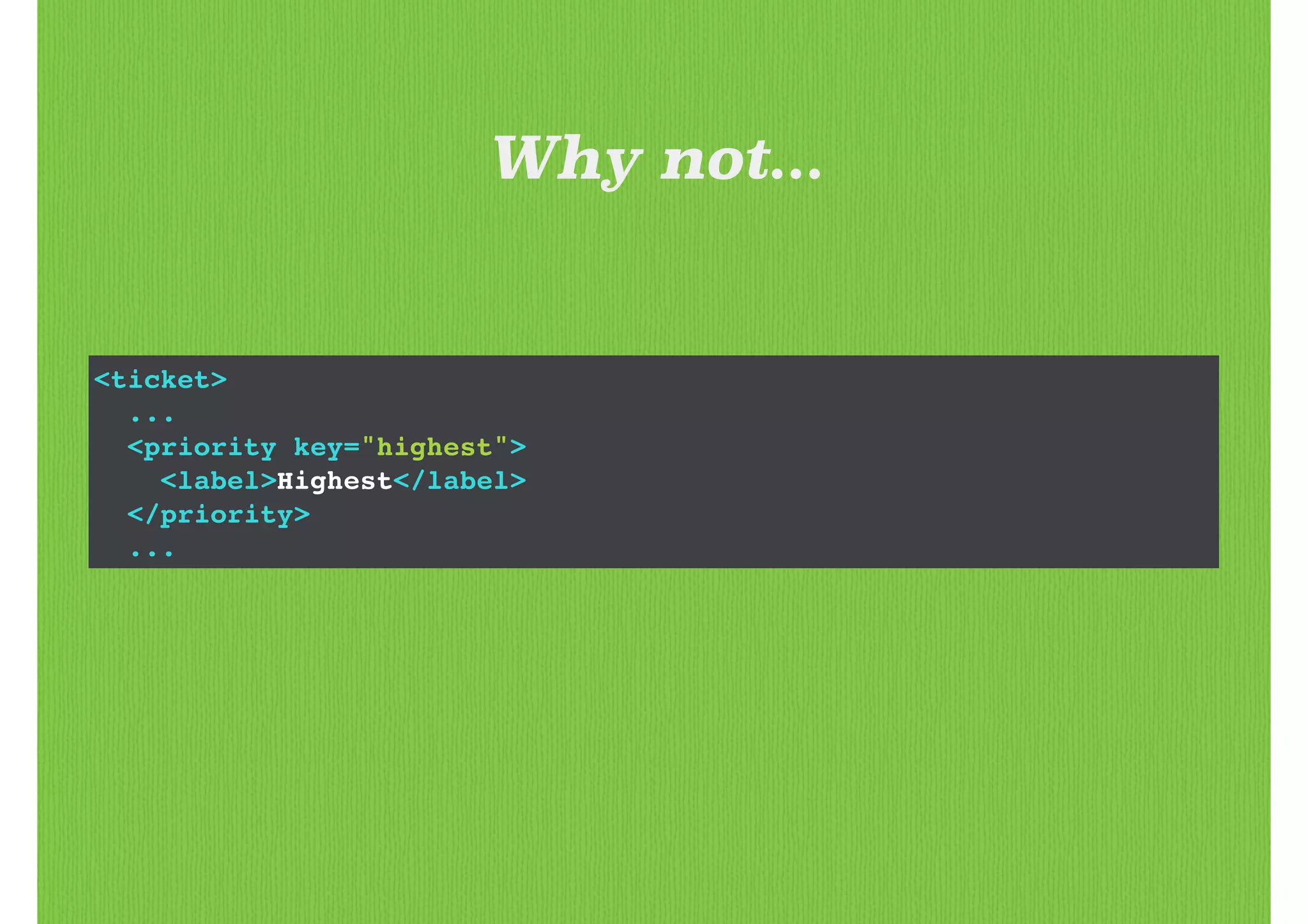
<ticket>!
...!
<priority key="highest">!
<label>Highest</label>!
</priority>!
...
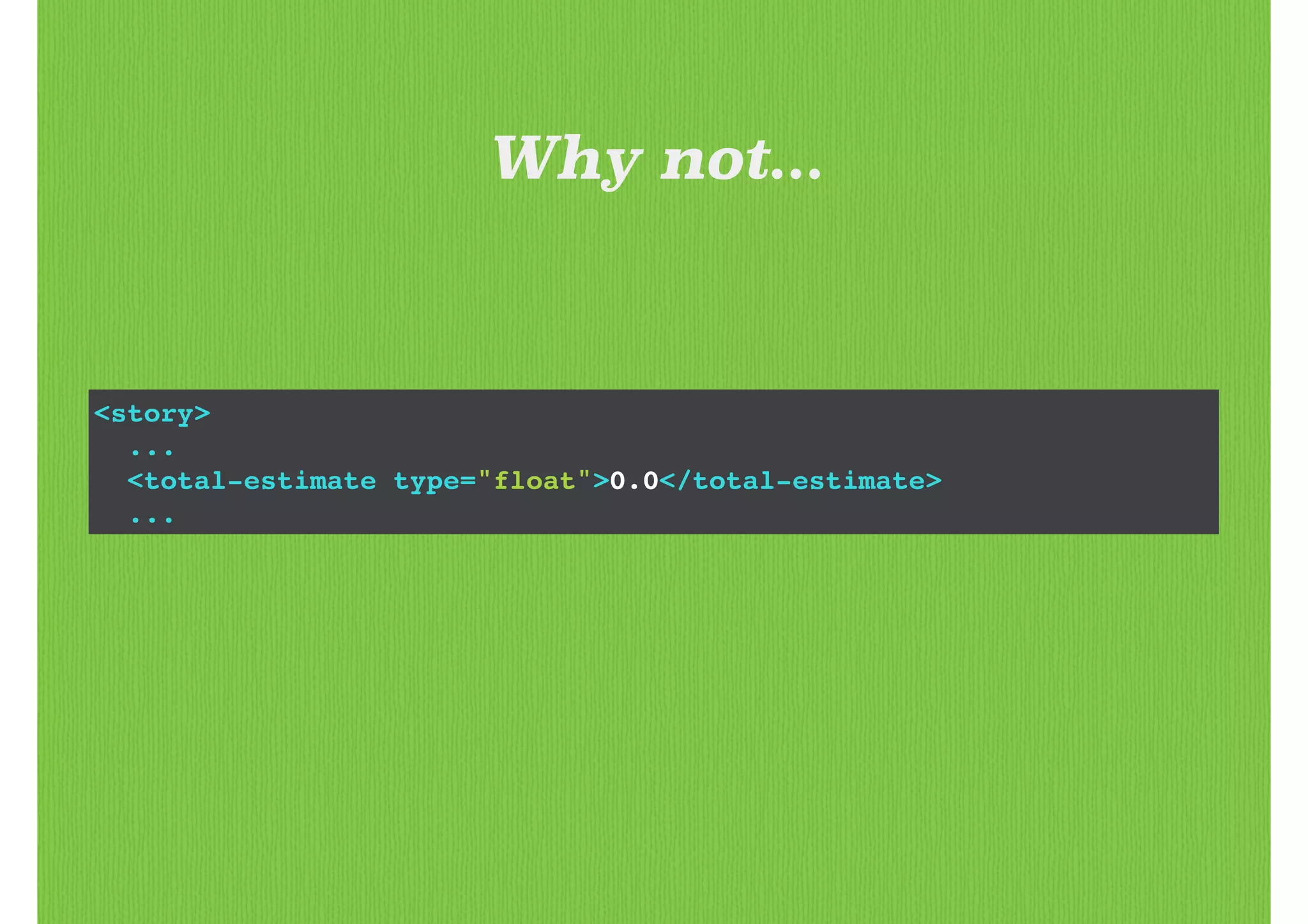
Why not...
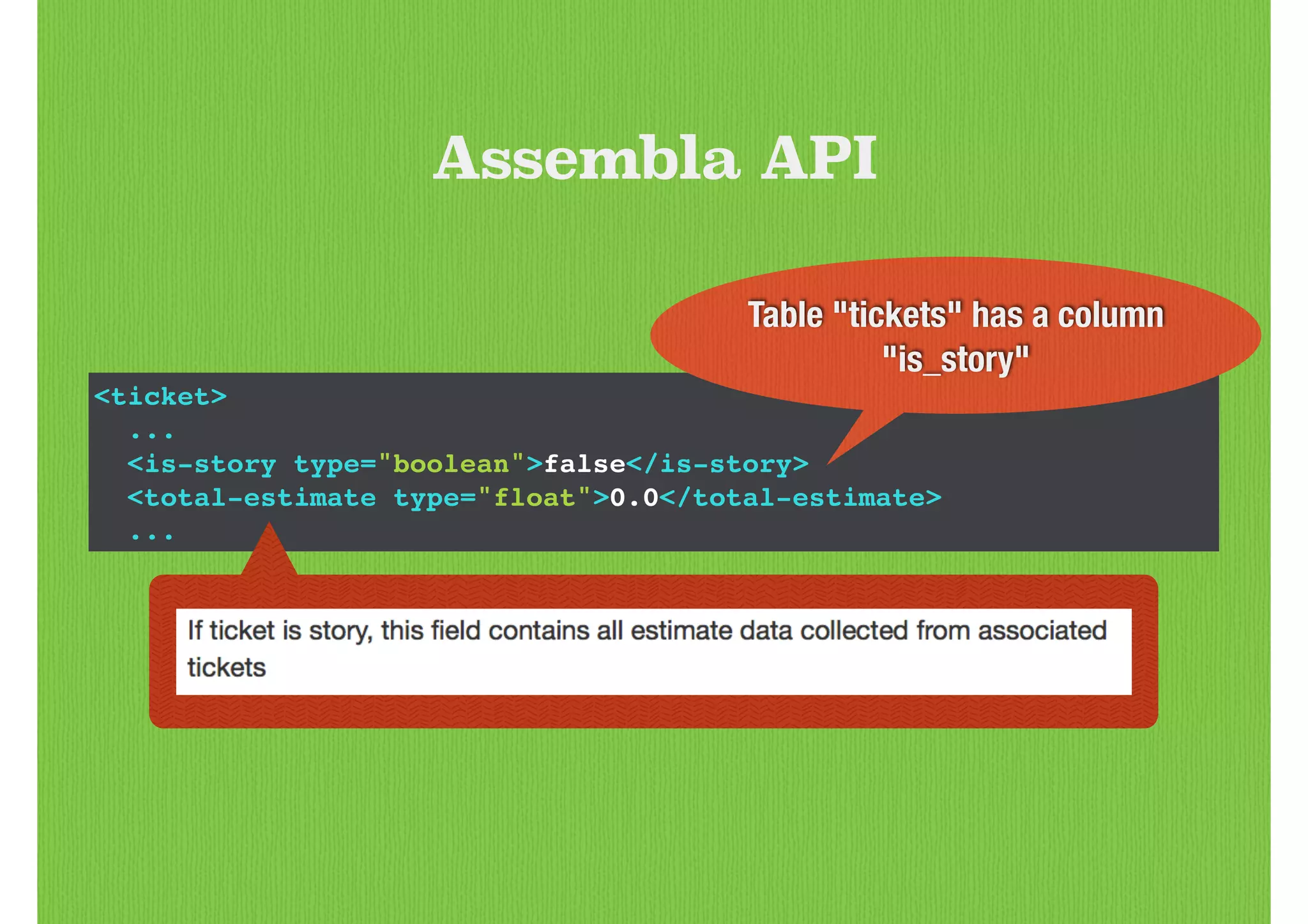
<ticket>!
...!
<is-story type="boolean">false</is-story>!
<total-estimate type="float">0.0</total-estimate>!
...
Assembla API
Table "tickets" has a column
"is_story"
<story>!
...!
<total-estimate type="float">0.0</total-estimate>!
...
Why not...
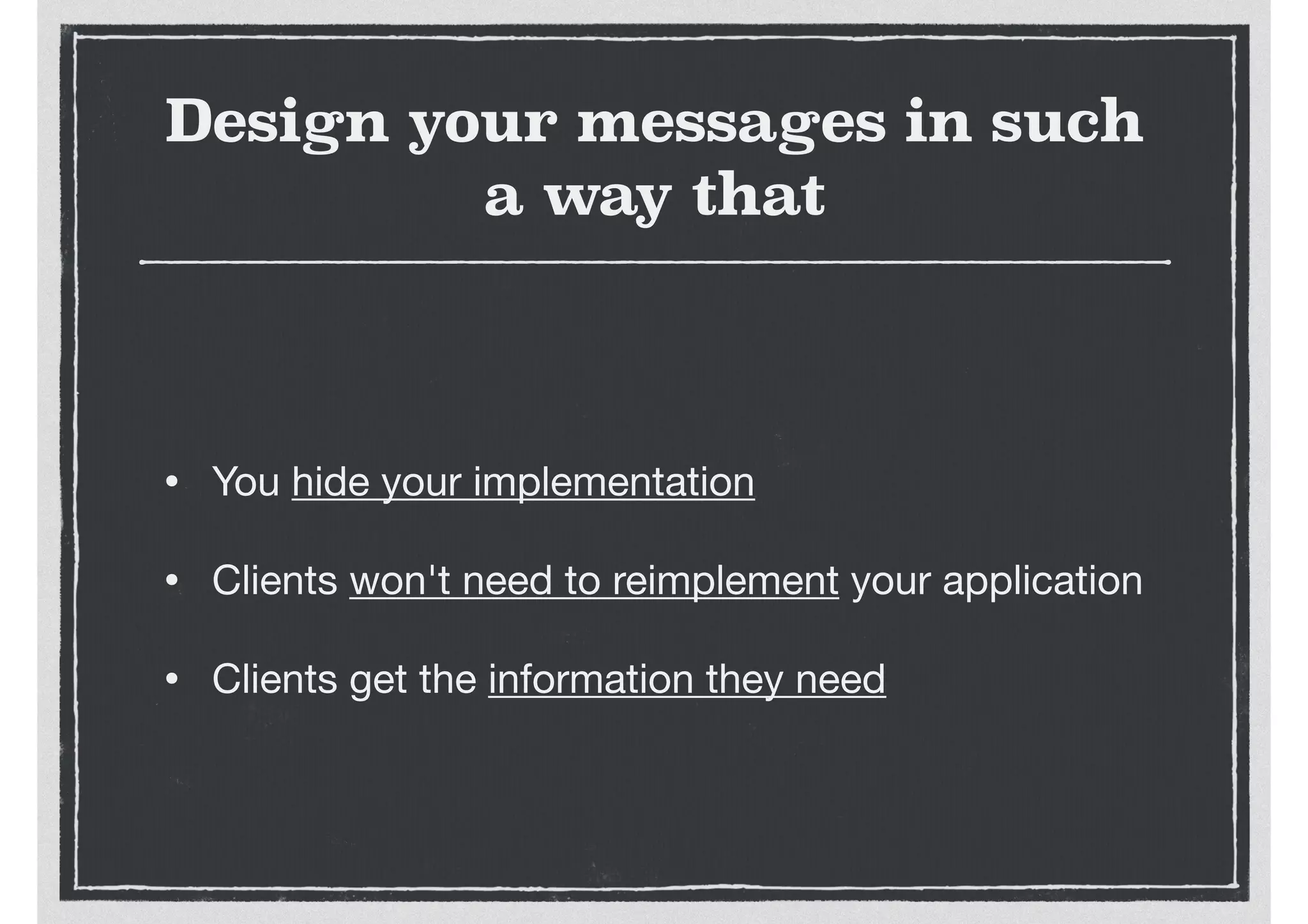
Design your messages in such
a way that
• You hide your implementation

• Clients won't need to reimplement your application

• Clients get the information they need
API discovery
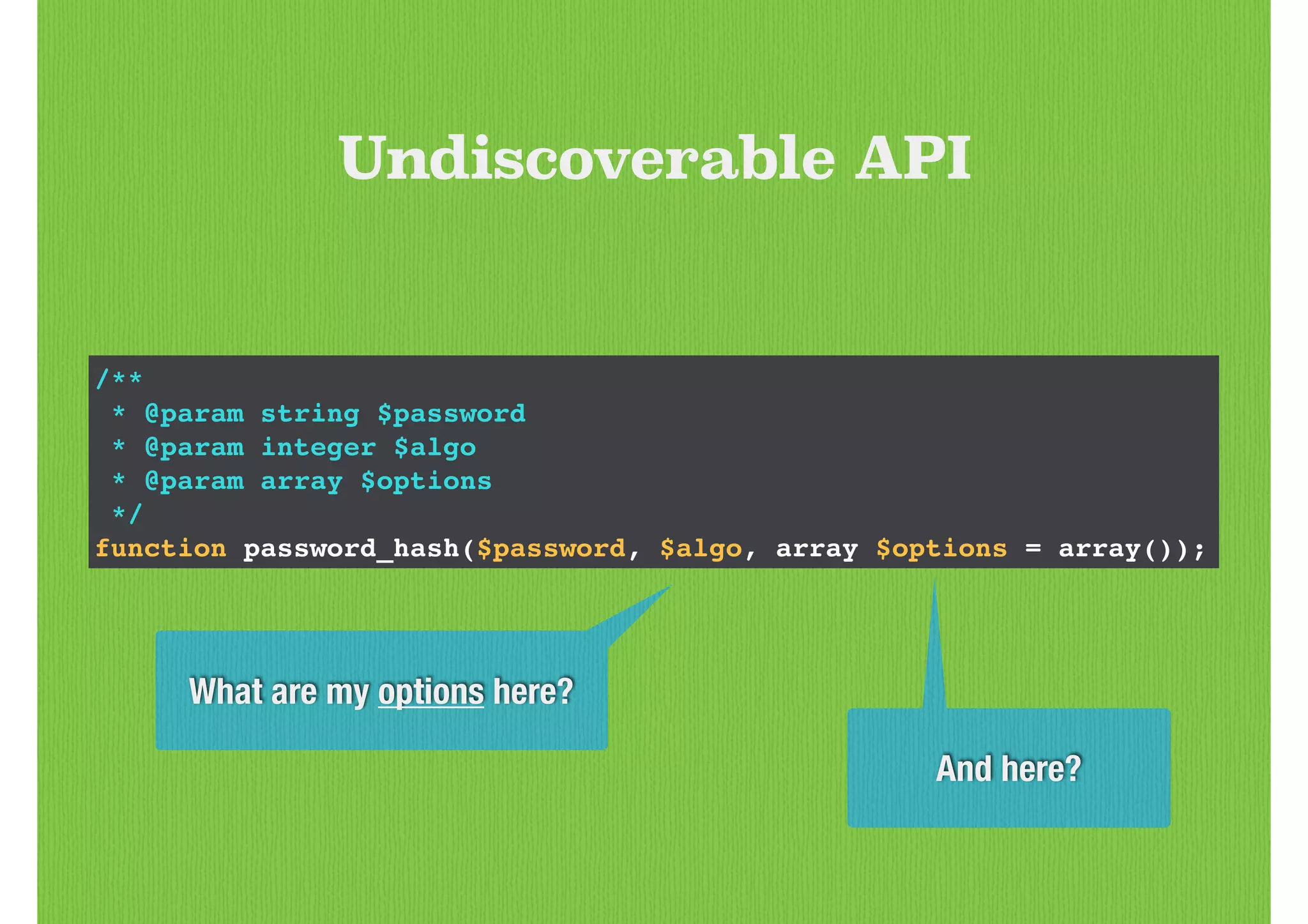
/**!
* @param string $password!
* @param integer $algo!
* @param array $options!
*/!
function password_hash($password, $algo, array $options = array());
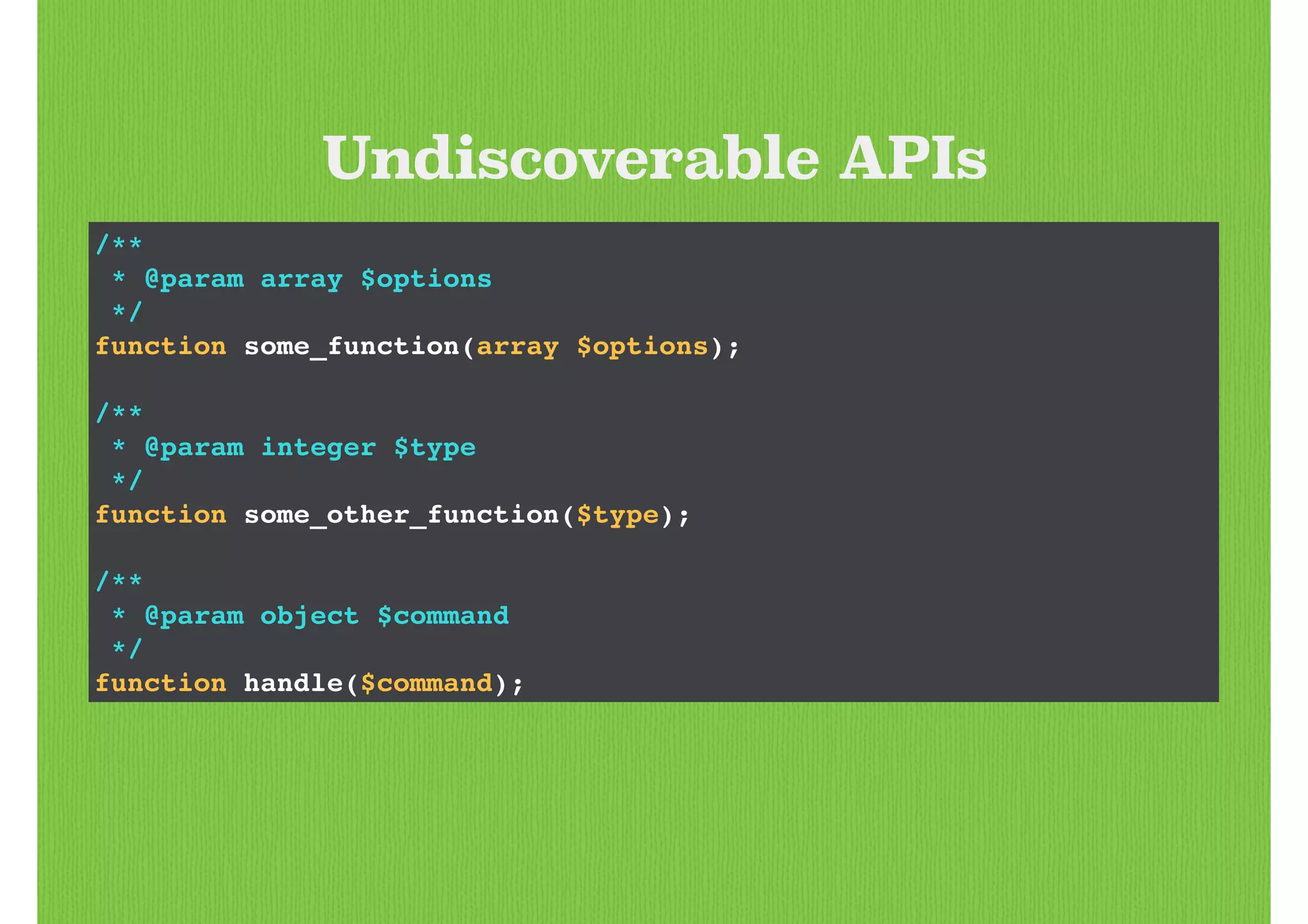
Undiscoverable API
What are my options here?
And here?
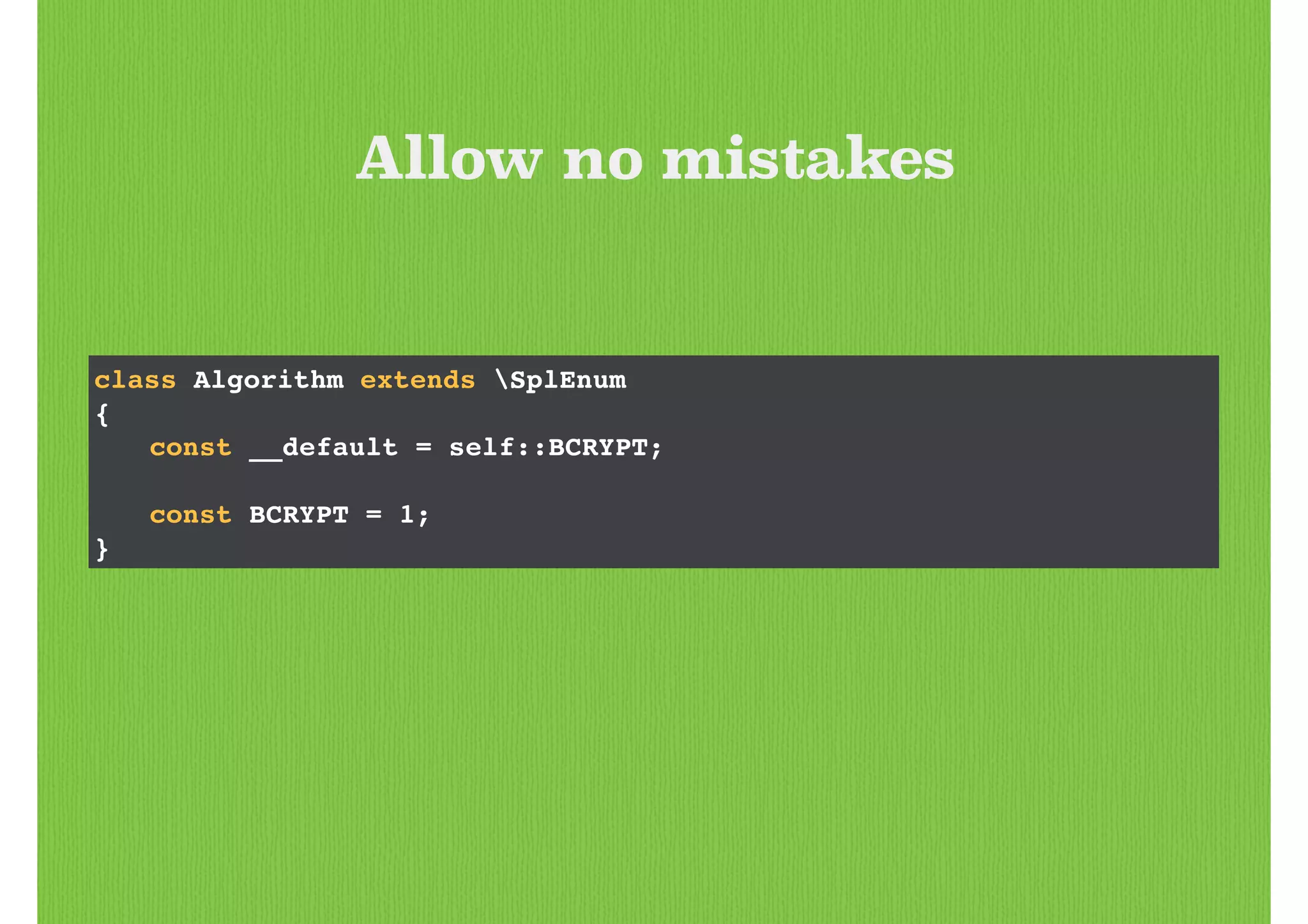
class Algorithm extends SplEnum!
{!
! const __default = self::BCRYPT;!
!
! const BCRYPT = 1;!
}
Allow no mistakes
[!
! 'salt' => '...'!
! 'cost' => 10!
]
Options for bcrypt hashing
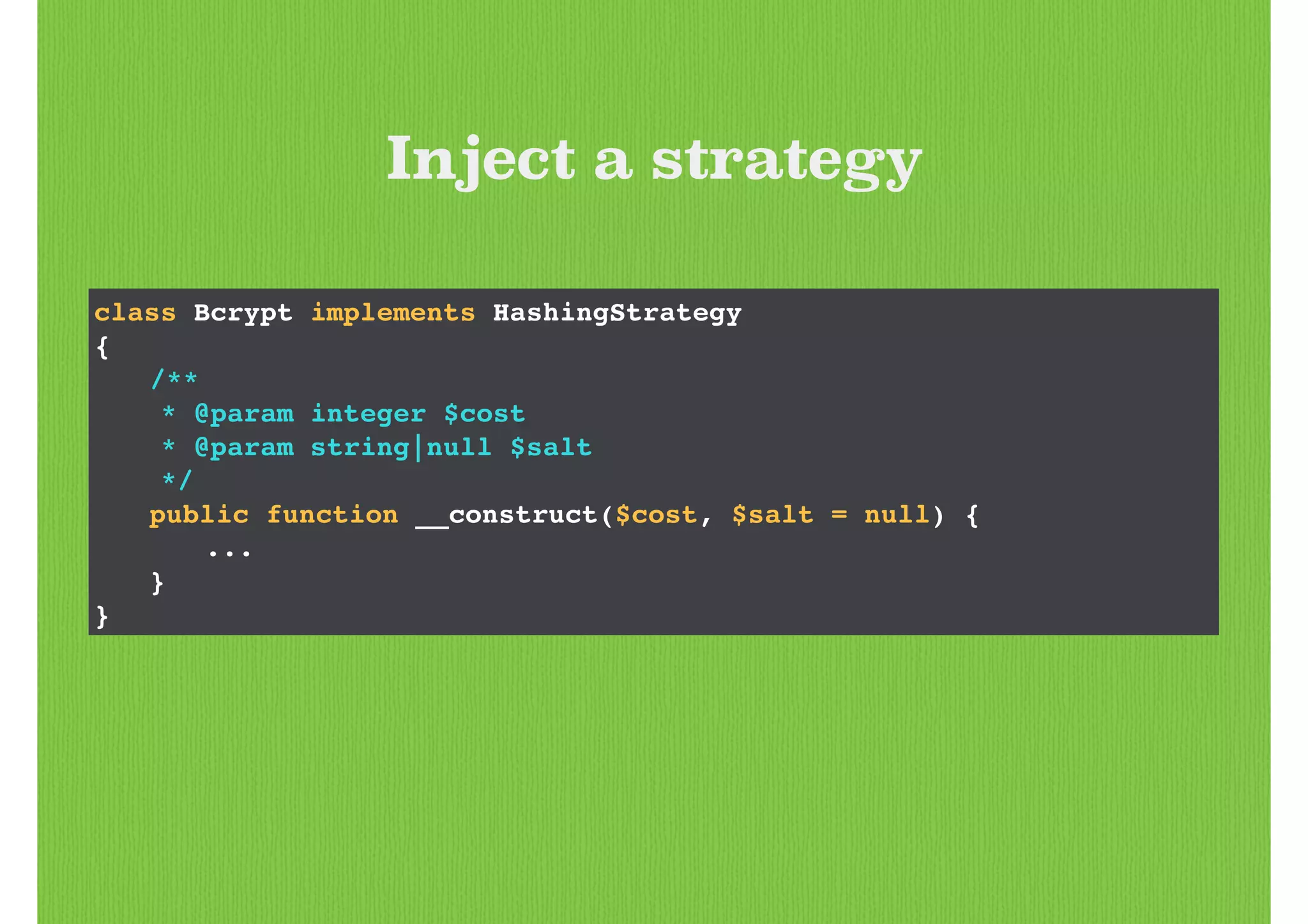
class Bcrypt implements HashingStrategy!
{!
! /**!
* @param integer $cost!
* @param string|null $salt!
*/!
! public function __construct($cost, $salt = null) {!
! ! ...!
! }!
}
Inject a strategy
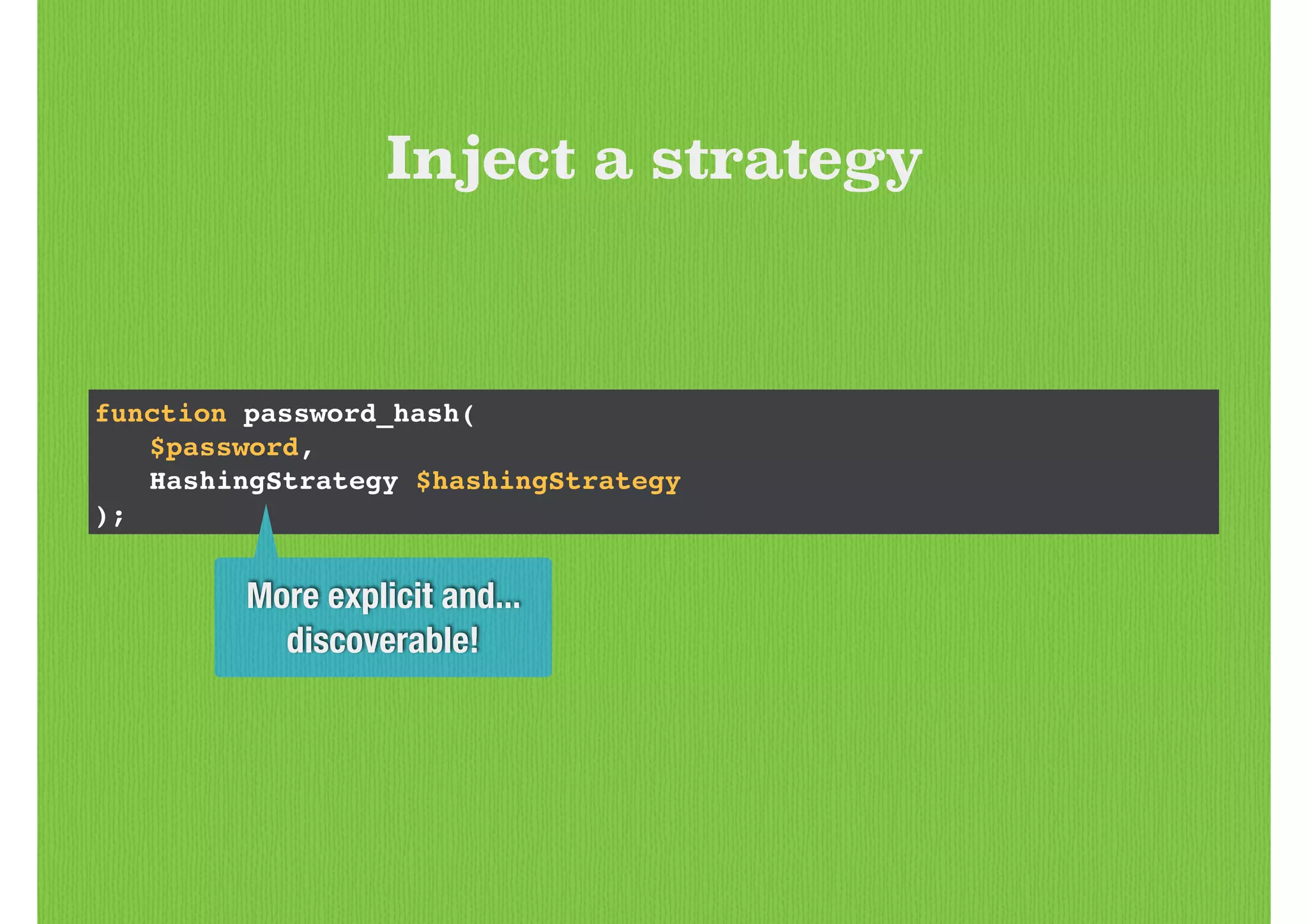
function password_hash(!
! $password, !
! HashingStrategy $hashingStrategy!
);
Inject a strategy
More explicit and...
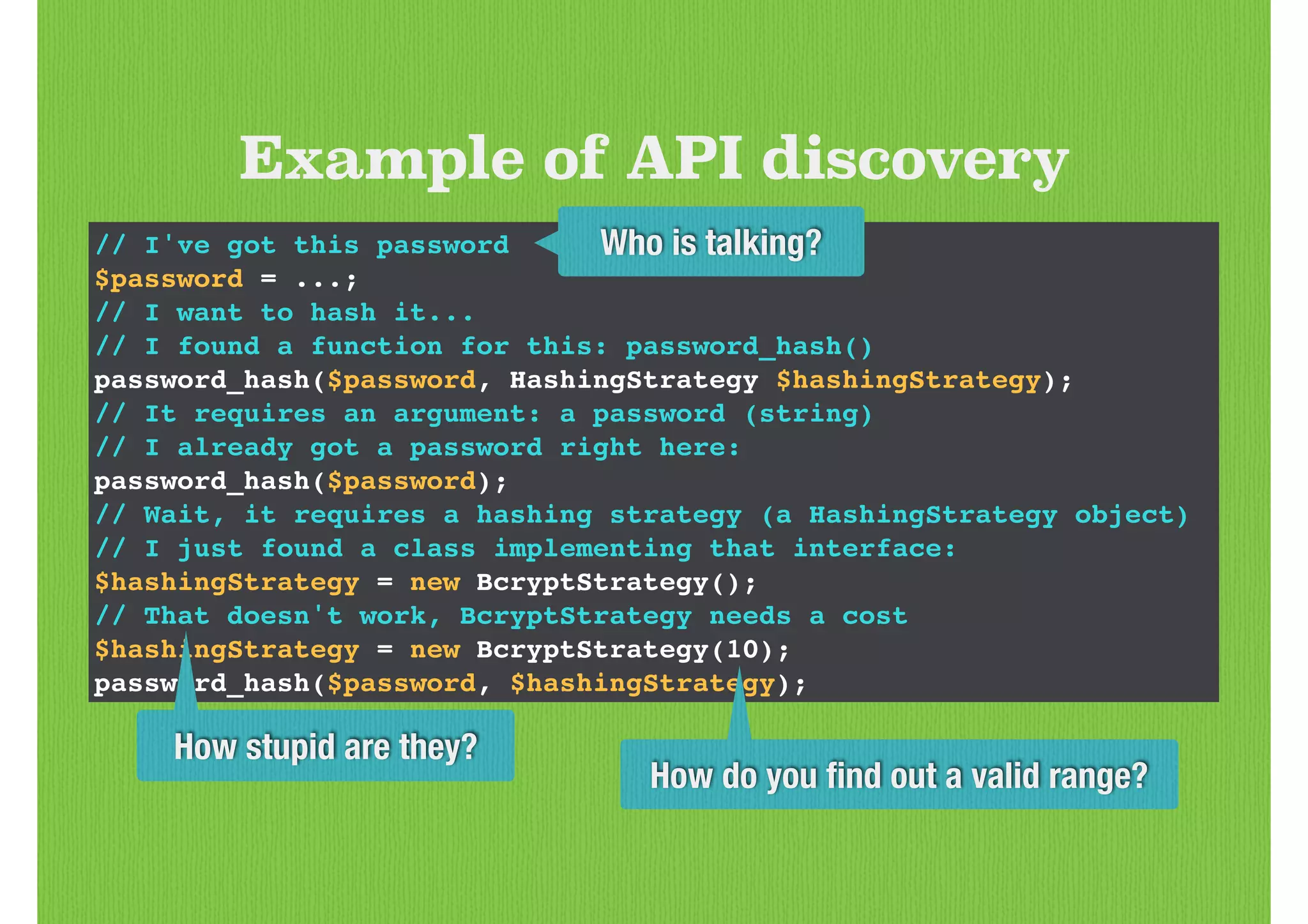
discoverable!
Discoverability of an API
• Full Reflection capabilities :)

• Basic knowledge of English
// I've got this password!
$password = ...;!
// I want to hash it...!
// I found a function for this: password_hash()!
password_hash($password, HashingStrategy $hashingStrategy);!
// It requires an argument: a password (string)!
// I already got a password right here:!
password_hash($password);!
// Wait, it requires a hashing strategy (a HashingStrategy object)!
// I just found a class implementing that interface:!
$hashingStrategy = new BcryptStrategy();!
// That doesn't work, BcryptStrategy needs a cost!
$hashingStrategy = new BcryptStrategy(10);!
password_hash($password, $hashingStrategy);
Example of API discovery
Who is talking?
How stupid are they?
How do you find out a valid range?
/**!
* @param array $options!
*/!
function some_function(array $options);!
!
/**!
* @param integer $type!
*/!
function some_other_function($type);!
!
/**!
* @param object $command!
*/!
function handle($command);
Undiscoverable APIs
Any kind of API should be
maximally discoverable
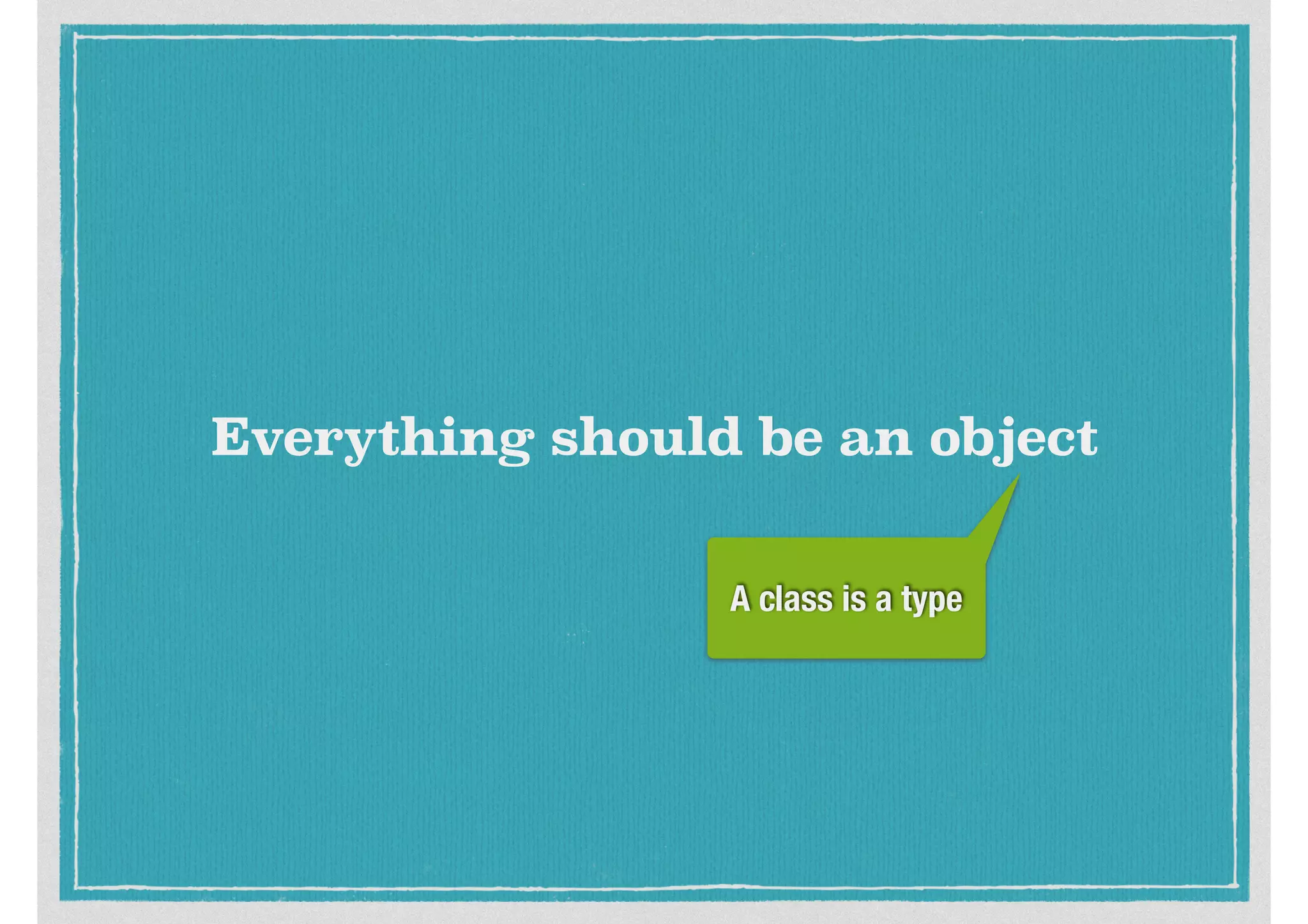
Everything should be an object
A class is a type
Define lots of interfaces
An interface defines the
public API of functions
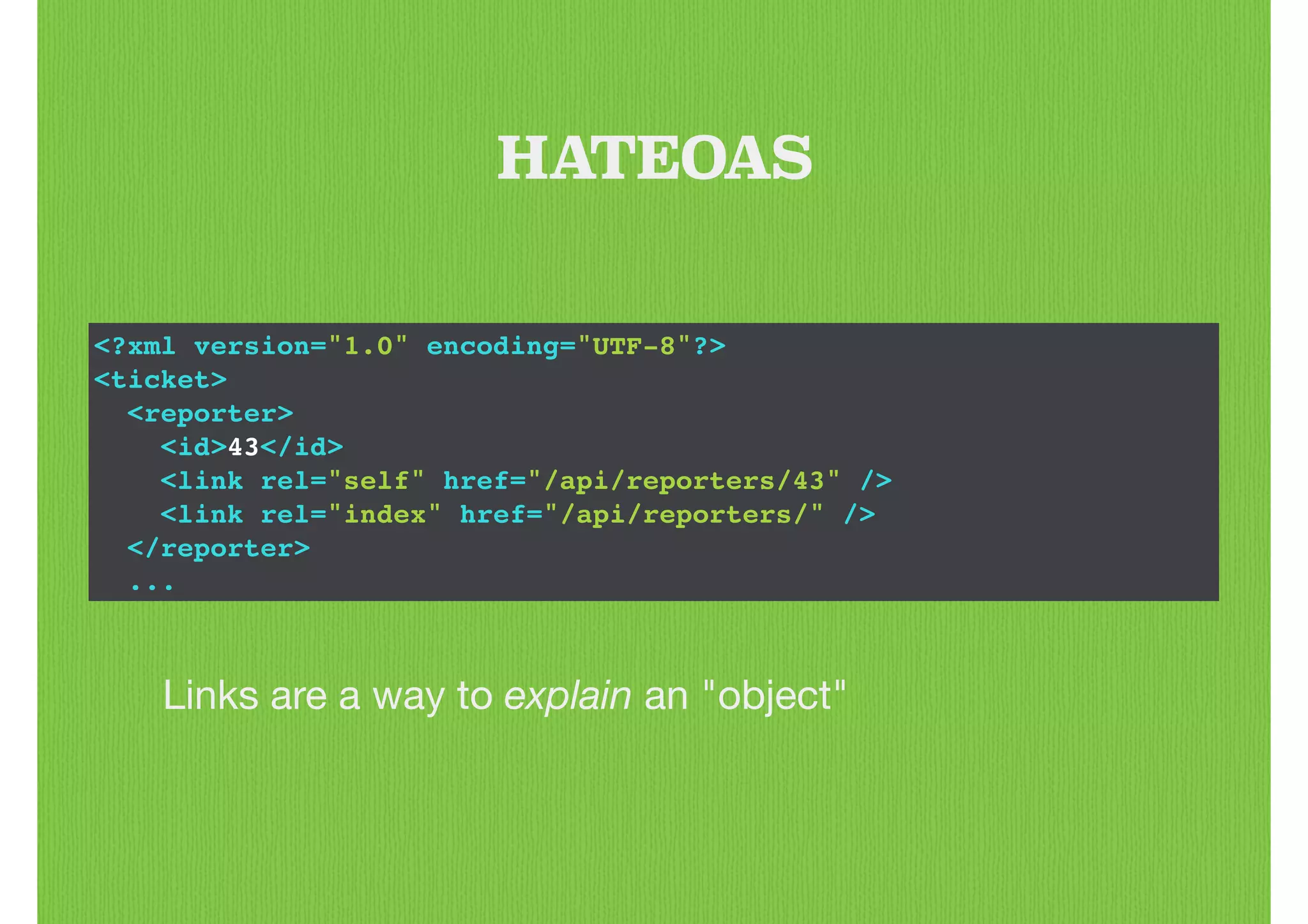
<?xml version="1.0" encoding="UTF-8"?>!
<ticket>!
<reporter>!
<id>43</id>!
<link rel="self" href="/api/reporters/43" />!
<link rel="index" href="/api/reporters/" />!
</reporter>!
...
HATEOAS
Links are a way to explain an "object"
In summary
• Objects are just like applications

• Try to apply the same rules to them
Think about
• Stable dependencies

• Duplication of facts, not knowledge

• Immutability over mutability

• No leakage of implementation details

• Everything should be maximally discoverable
Questions? Feedback?
joind.in/14217 Thanks!

Dutch PHP Conference 2015 - The quest for global design principles