
<Insert Picture Here>
Nashorn War Stories
(from a battle scarred veteran of invokedynamic)
Marcus Lagergren
Oracle
<Insert Picture Here>
Nashorn Rants
(from a battle scarred veteran of invokedynamic)
Marcus Lagergren
Oracle
The Legal Slide
"THE FOLLOWING IS INTENDED TO OUTLINE OUR
GENERAL PRODUCT DIRECTION. IT IS INTENDED
FOR INFORMATION PURPOSES ONLY, AND MAY NOT
BE INCORPORATED INTO ANY CONTRACT. IT IS NOT
A COMMITMENT TO DELIVER ANY MATERIAL, CODE,
OR FUNCTIONALITY, AND SHOULD NOT BE RELIED
UPON IN MAKING PURCHASING DECISION. THE
DEVELOPMENT, RELEASE, AND TIMING OF ANY
FEATURES OR FUNCTIONALITY DESCRIBED FOR
ORACLE'S PRODUCTS REMAINS AT THE SOLE
DISCRETION OF ORACLE."
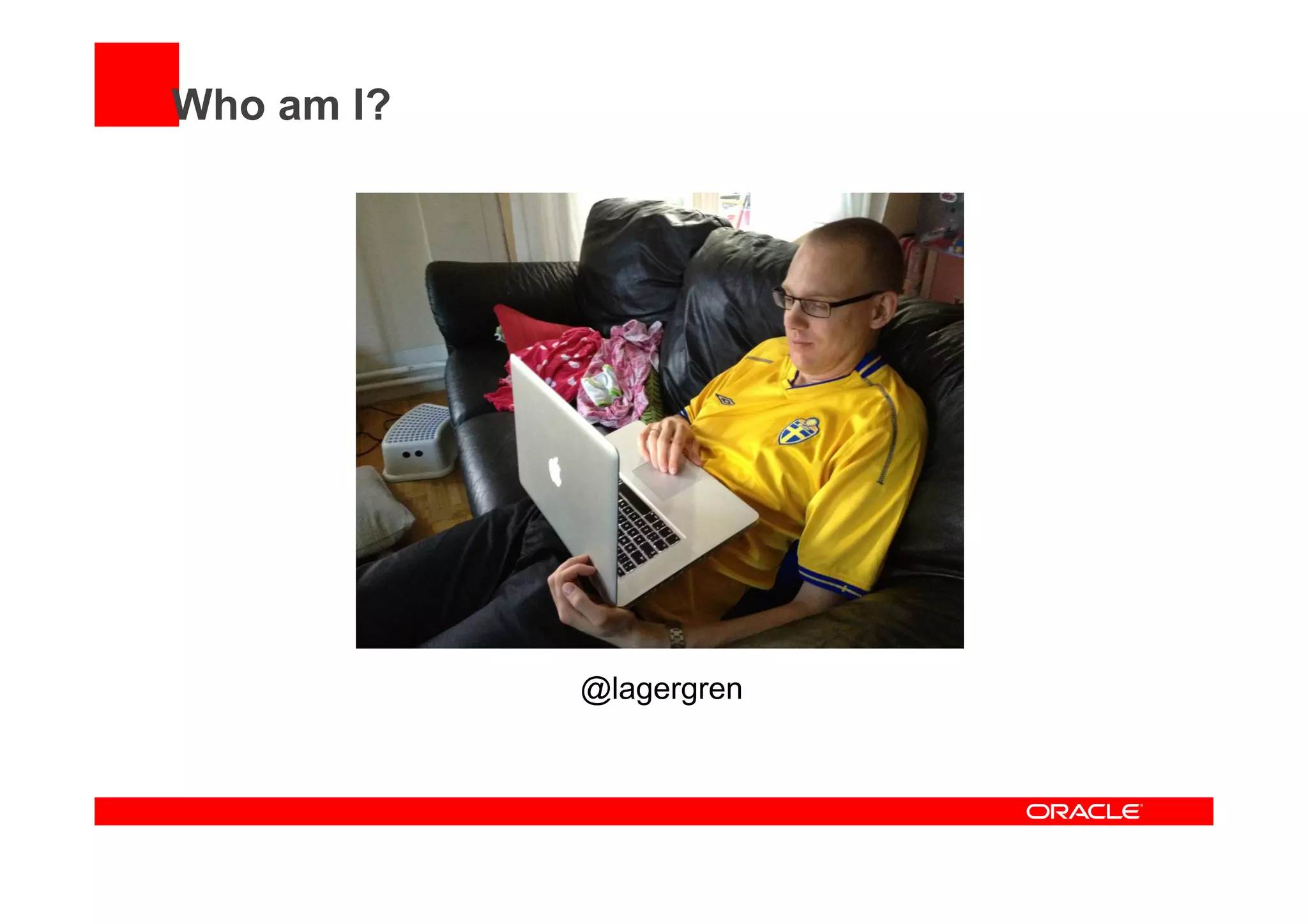
Who am I?
@lagergren
I am here to talk about…
What we’ve suffered through so far to
implement a dynamic language on the JVM
I am here to talk about…
What we’ve suffered through so far to
implement a dynamic language on the JVM
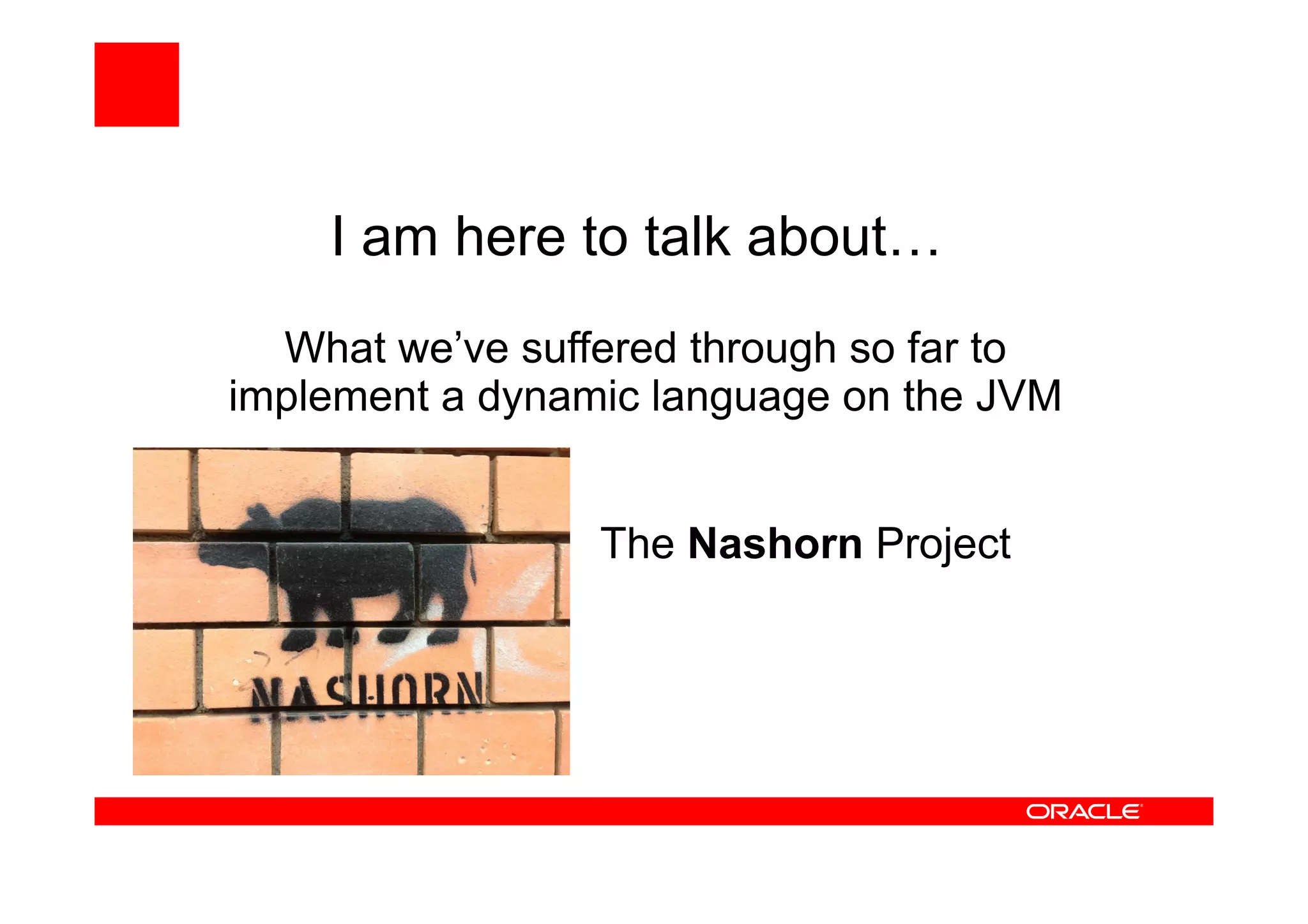
The Nashorn Project
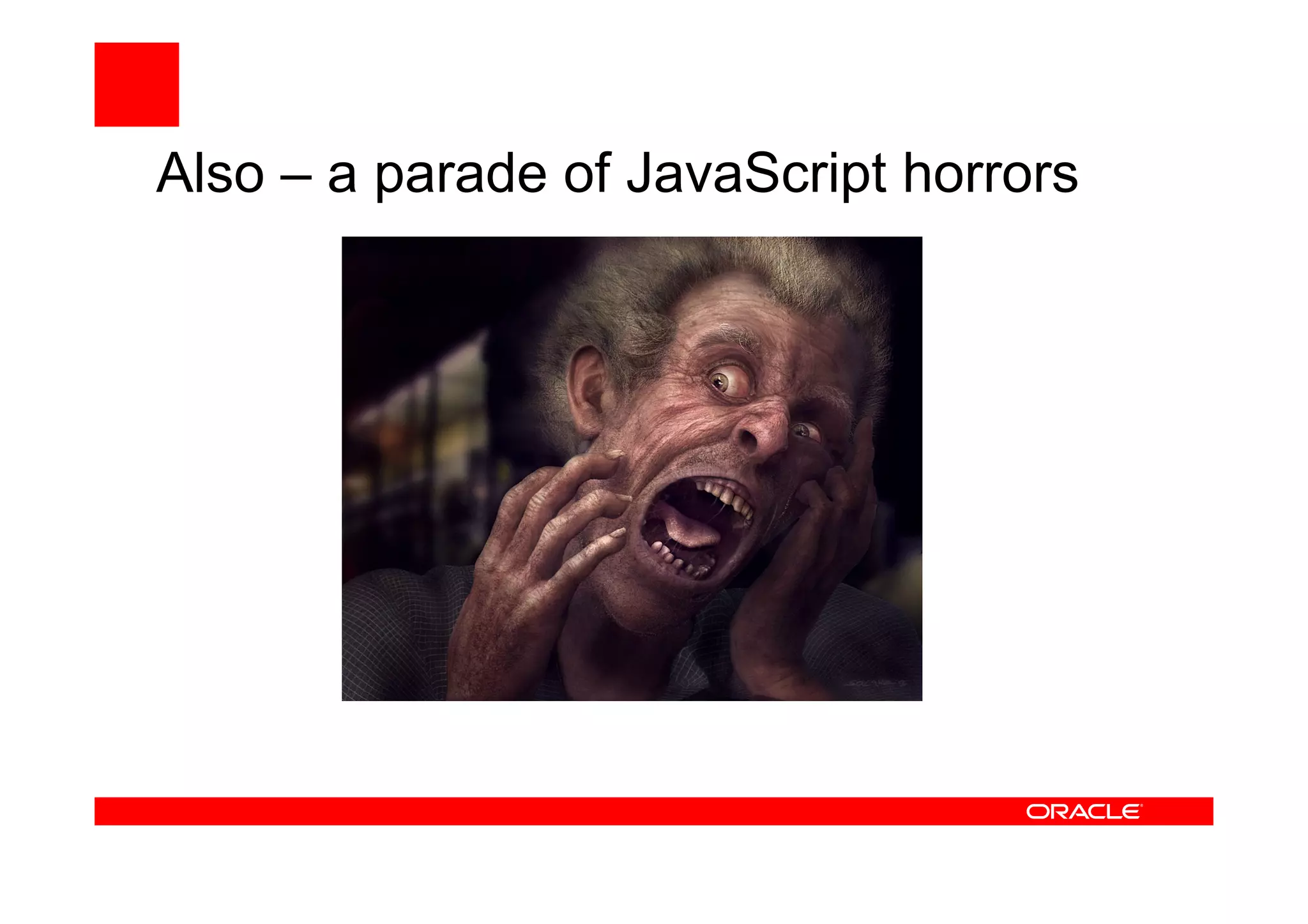
Also – a parade of JavaScript horrors
Agenda
•  What is Nashorn and why?
•  The problem of compiling an alien language to
Java [sic] bytecode
•  Types
•  Optimistic assumptions
•  The JVM and its issues
What is Nashorn
and why?
What is Nashorn?
•  Nashorn is a 100% pure Java runtime for JavaScript
•  Nashorn generates bytecode
•  Invokedynamics are everywhere
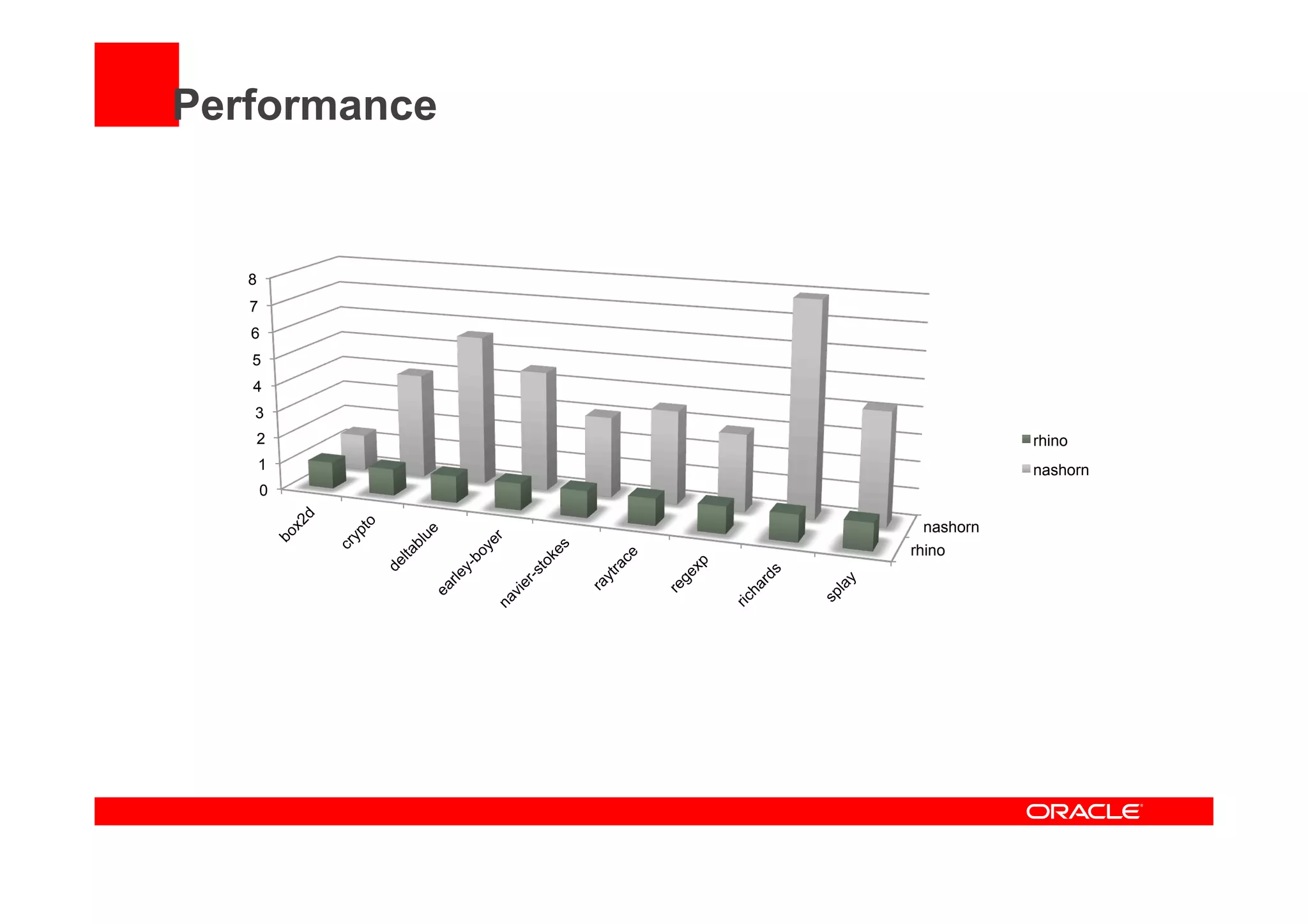
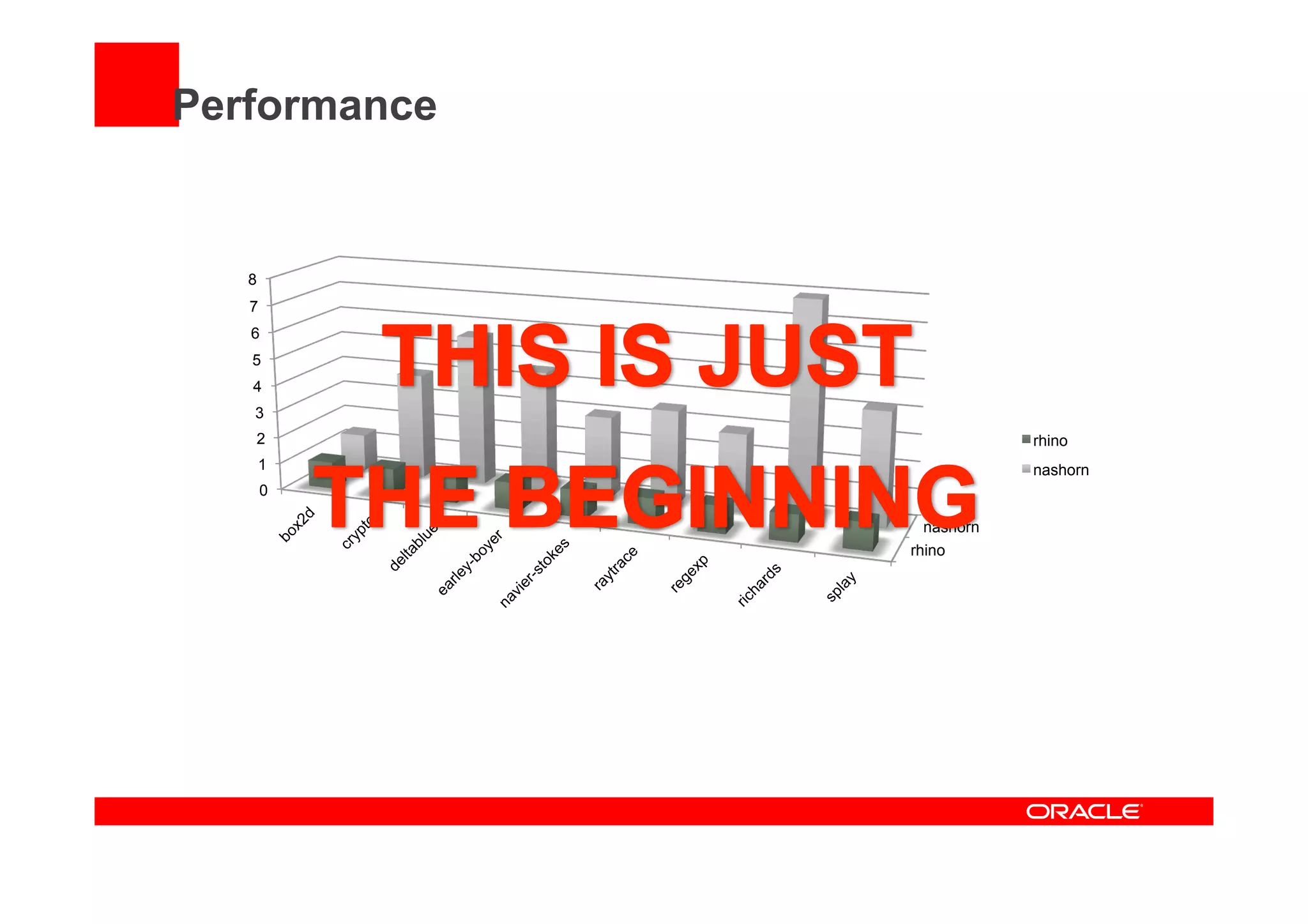
•  Nashorn currently performs somewhere on the order of
~2-10x better than Rhino
•  Nashorn is in JDK 8
•  Nashorn is 100% ECMAScript compliant
•  Nashorn has a well thought through security model
Why Nashorn?
•  Started as an invokedynamic POC.
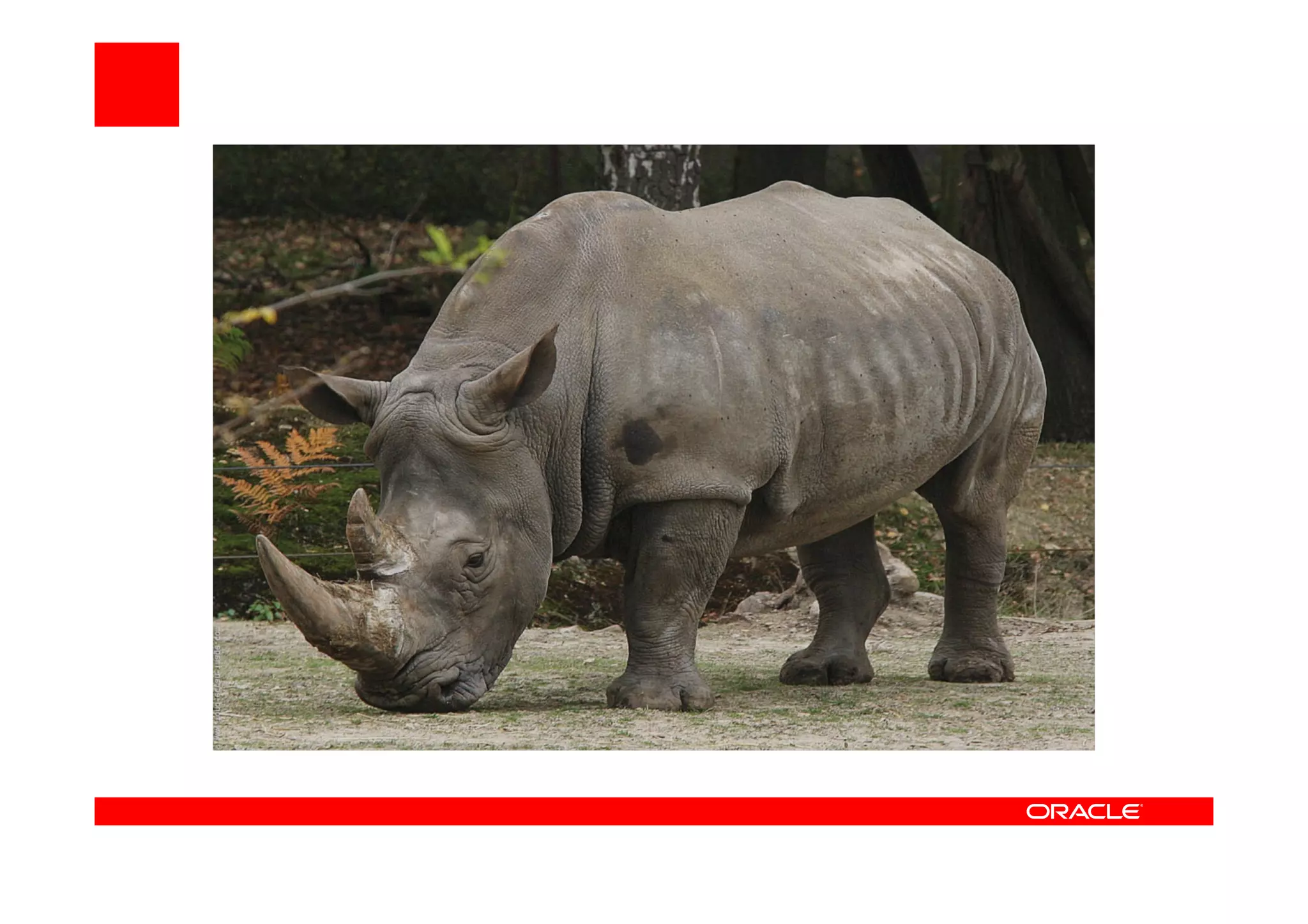
•  Rhino is still alive today after ~18 years. Why?
•  JSR-223
•  Nashorn is now mature and replaces Rhino for Java 8
Performance
rhino
nashorn
0
1
2
3
4
5
6
7
8
rhino
nashorn
Performance
rhino
nashorn
0
1
2
3
4
5
6
7
8
rhino
nashorn
When is Nashorn available?
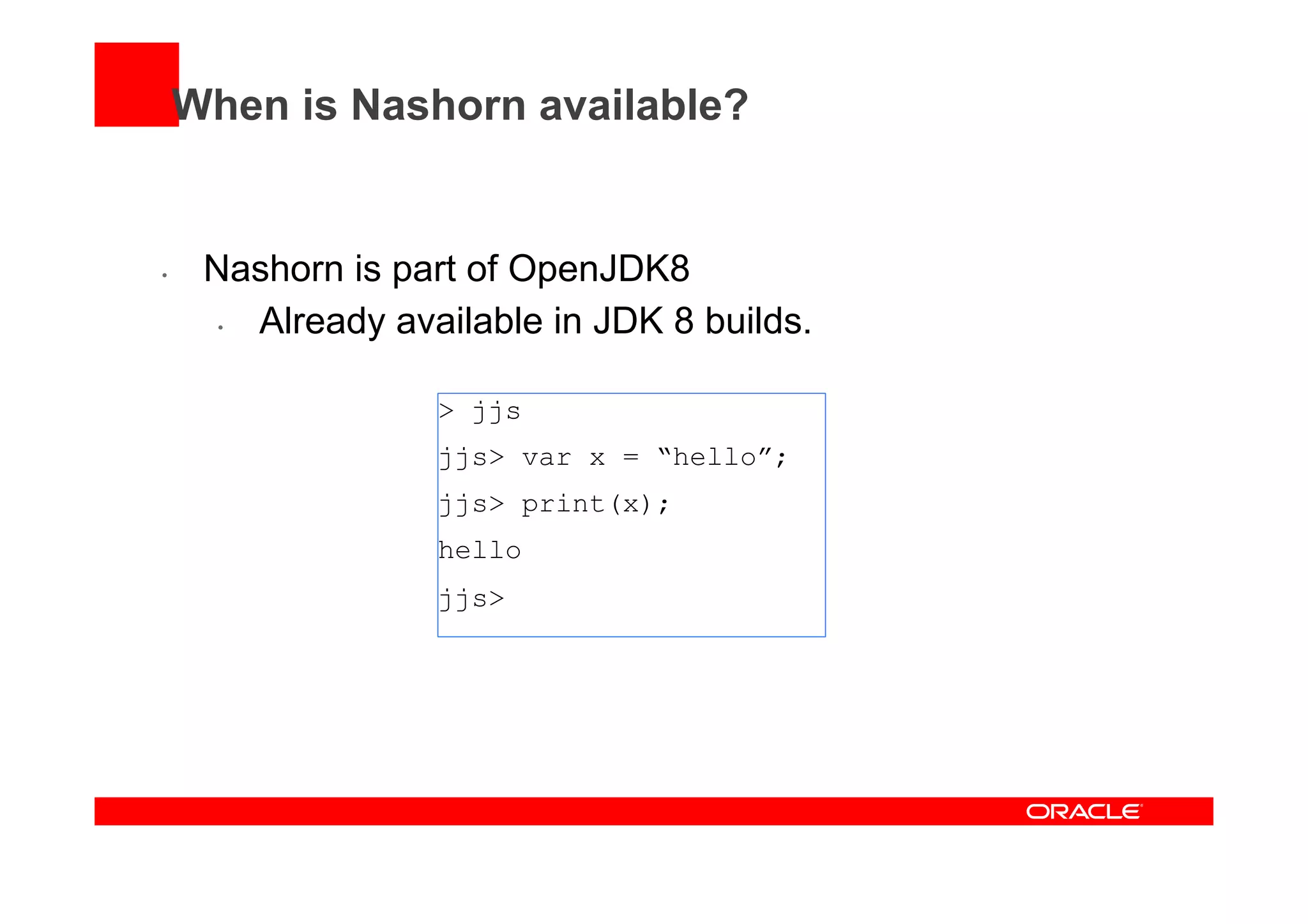
•  Nashorn is part of OpenJDK8
•  Already available in JDK 8 builds.
> jjs
jjs> var x = “hello”;
jjs> print(x);
hello
jjs>
Compiling an alien
language to Java
[sic] bytecode
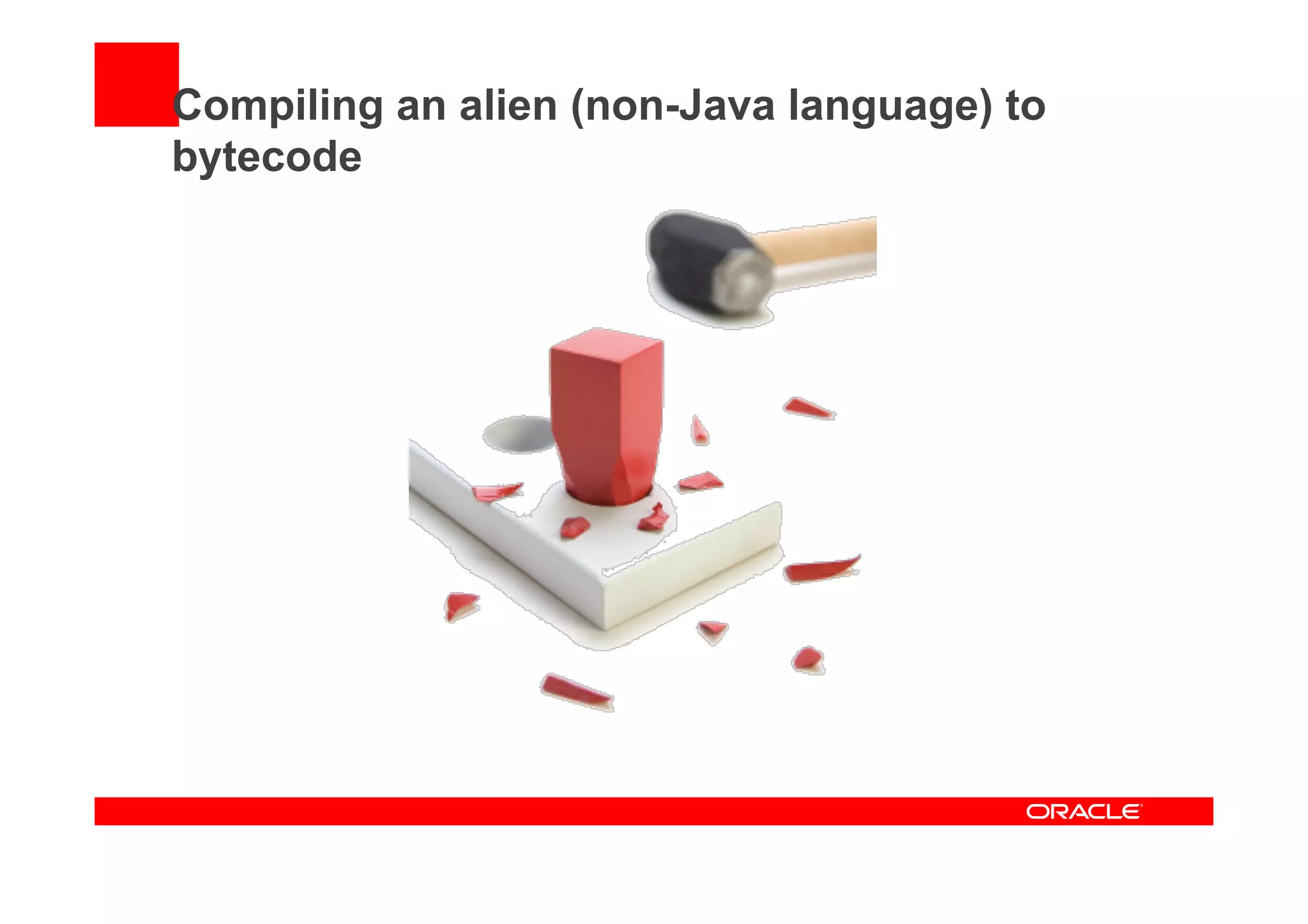
Compiling an alien (non-Java language) to
bytecode
Compiling an alien (non-Java language) to
bytecode
•  Scala is fairly good fit
Compiling an alien (non-Java language) to
bytecode
•  Scala is fairly good fit
•  Yes I know: hard tail call optimization, interface
injection etc.
Compiling an alien (non-Java language) to
bytecode
•  Scala is fairly good fit
•  Yes I know: hard tail call optimization, interface
injection etc.
•  Ruby and JavaScript are pretty bad fits
Compiling an alien (non-Java language) to
bytecode
•  Scala is fairly good fit
•  Yes I know: hard tail call optimization, interface
injection etc.
•  Ruby and JavaScript are pretty bad fits
•  No types
•  Things change at runtime. A lot.
•  Invokedynamic certainly alleviates a lot of the pain,
but plenty of stuff remains to be solved
JavaScript!
Was it deliberately
designed to make every
efficient representation
useless?
Let’s talk about JavaScript
jjs> Array.prototype[1] = 17;
Let’s talk about JavaScript
jjs> Array.prototype[1] = 17;
17
jjs>
Let’s talk about JavaScript
jjs> Array.prototype[1] = 17;
17
jjs> print([,,,]);
Let’s talk about JavaScript
jjs> Array.prototype[1] = 17;
17
jjs> print([,,,]);
,17,
jjs>
Let’s talk about JavaScript - Numbers
•  Numbers in JavaScript have no fixed ranges
•  “Intish”. “Doublish”.
•  Not very nice for strongly typed bytecode
•  Overflows must be handled
•  Conservative: At least they tend to fit in Java doubles.
Let’s talk about JavaScript - Numbers
•  Double arithmetic is slower than integer arithmetic on
modern HW
•  Double arithmetic is sometimes even faster than int
arithmetic with the necessary overflow checks.
•  WAT!
•  (getting back to that)
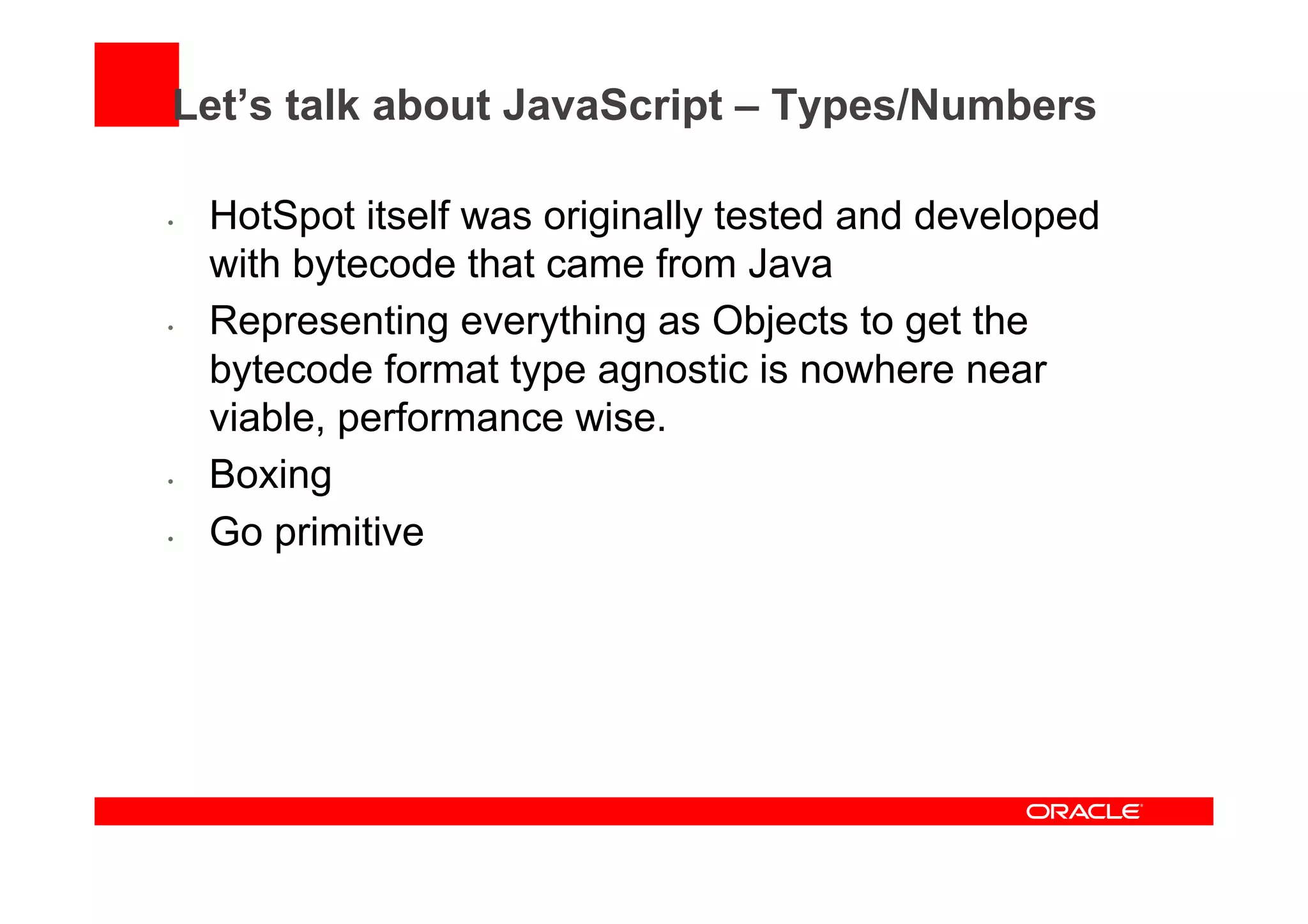
Let’s talk about JavaScript – Types/Numbers
•  HotSpot itself was originally tested and developed
with bytecode that came from Java
•  Representing everything as Objects to get the
bytecode format type agnostic is nowhere near
viable, performance wise.
•  Boxing
•  Go primitive
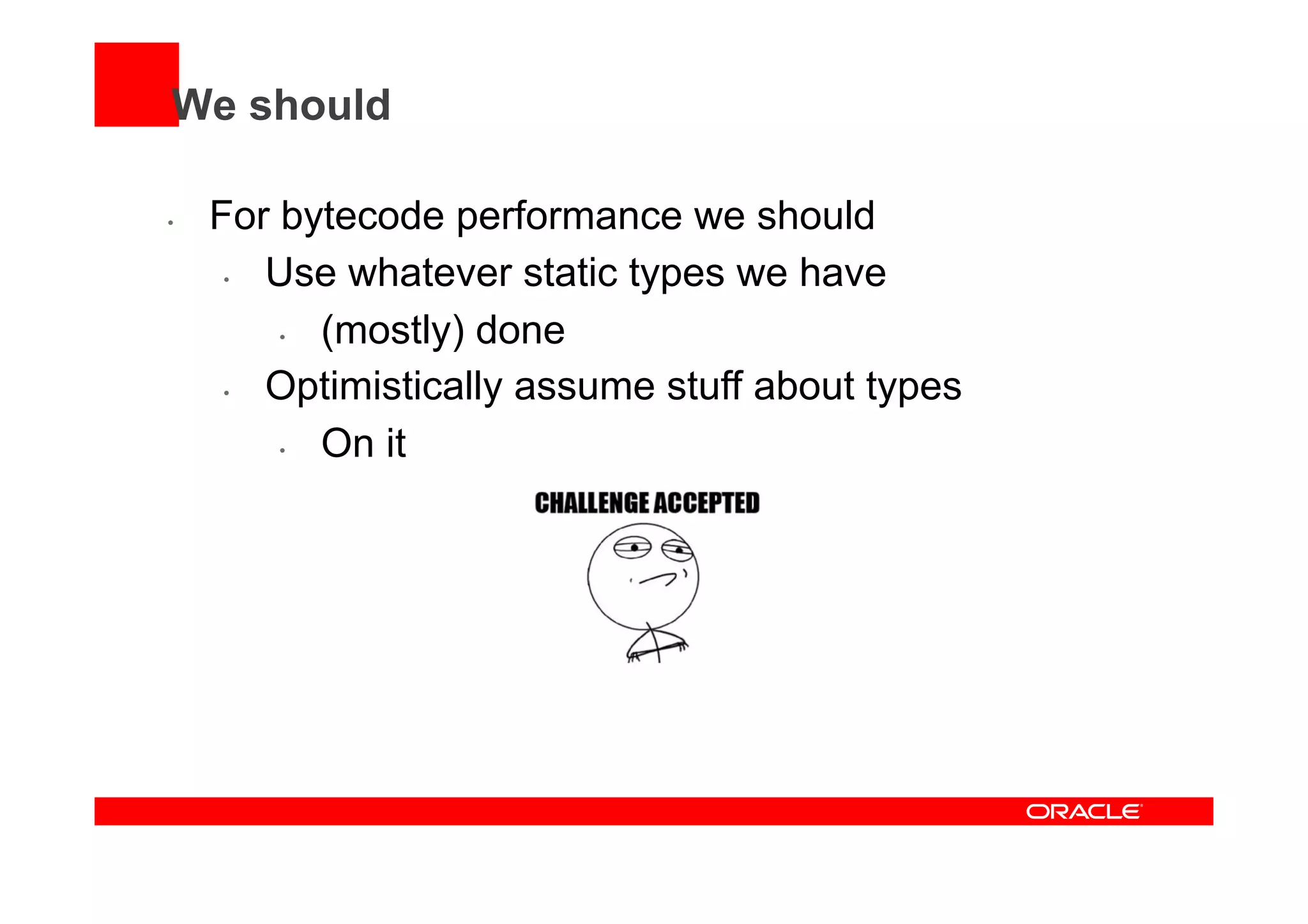
We should
•  For bytecode performance we should
•  Use whatever static types we have
•  (mostly) done
•  Optimistically assume stuff about types
•  On it
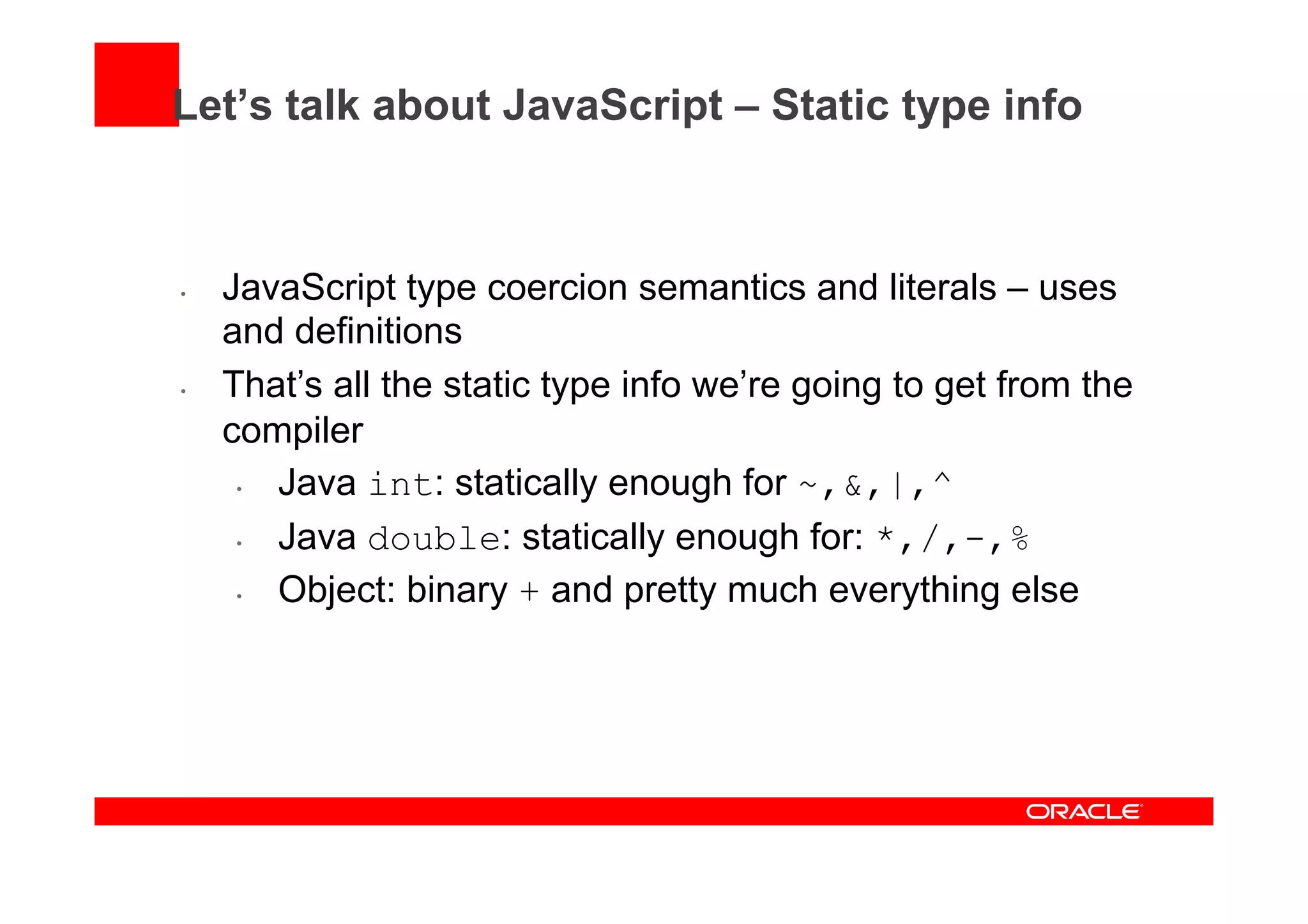
Let’s talk about JavaScript – Static type info
•  JavaScript type coercion semantics and literals – uses
and definitions
•  That’s all the static type info we’re going to get from the
compiler
•  Java int: statically enough for ~,&,|,^
•  Java double: statically enough for: *,/,-,%
•  Object: binary + and pretty much everything else
Let’s talk about JavaScript – Static type info
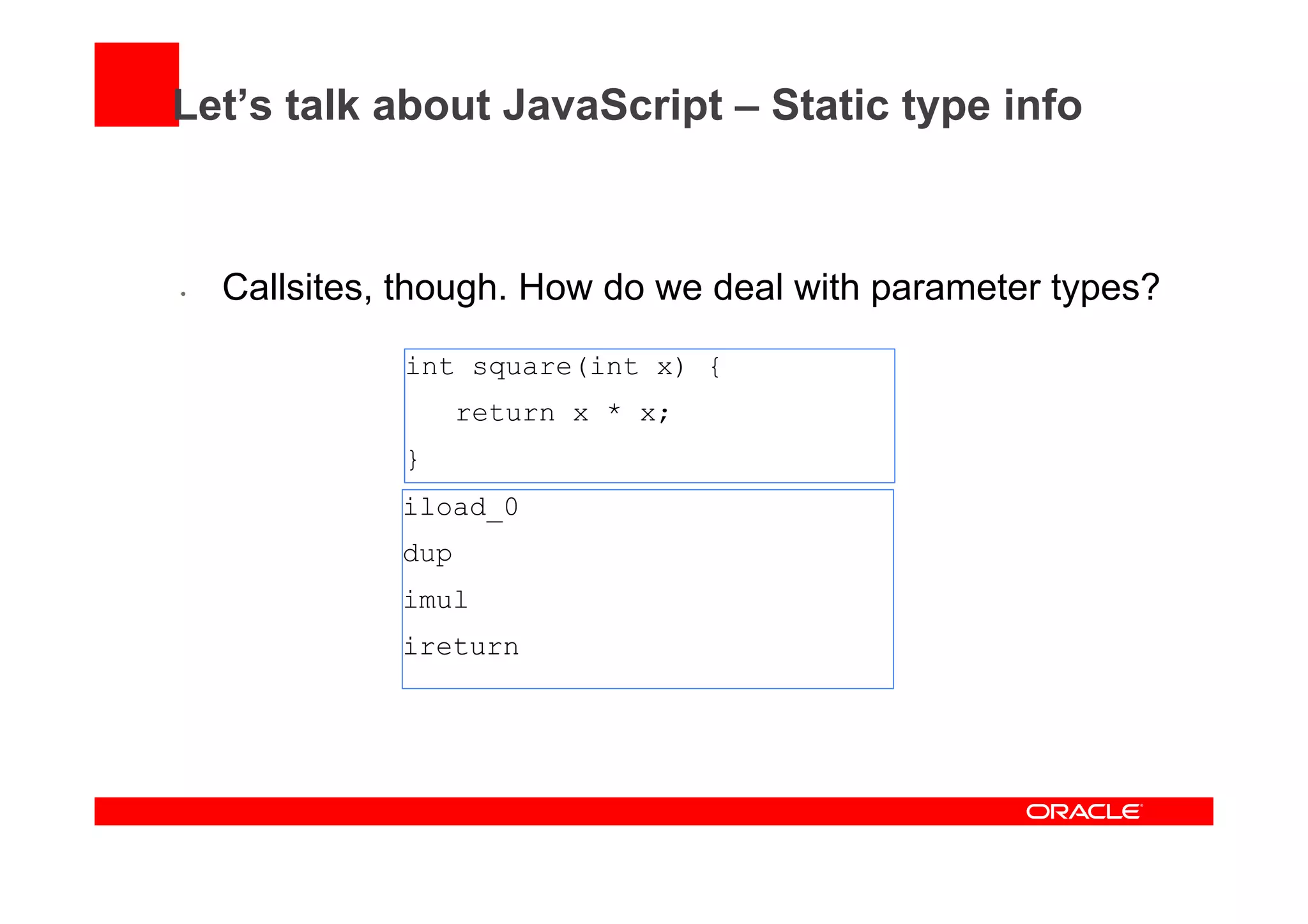
•  Callsites, though. How do we deal with parameter types?
int square(int x) {
return x * x;
}
iload_0
dup
imul
ireturn
Let’s talk about JavaScript – Static type info
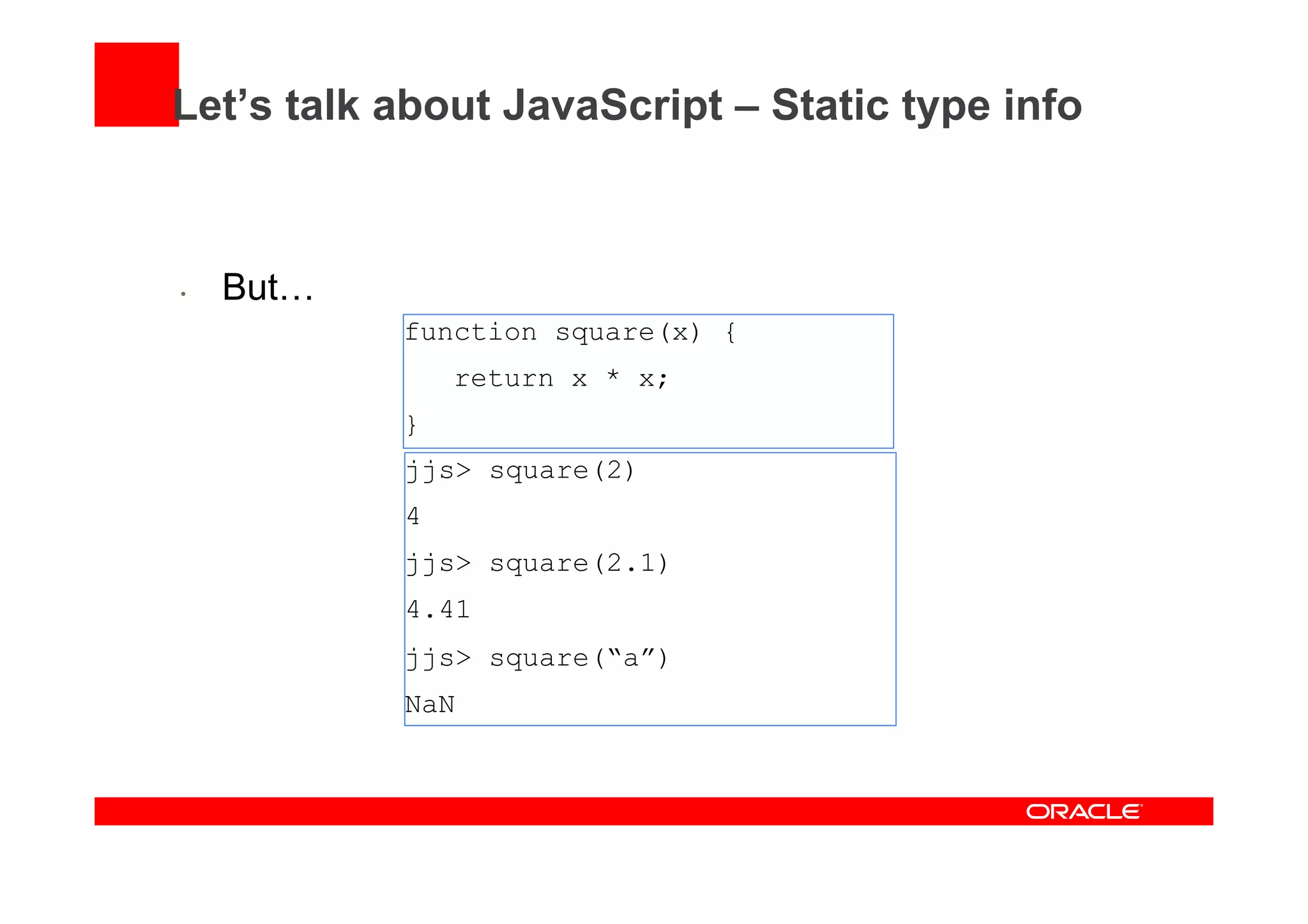
•  But…
function square(x) {
return x * x;
}
jjs> square(2)
4
jjs> square(2.1)
4.41
jjs> square(“a”)
NaN
Let’s talk about JavaScript – Static type info
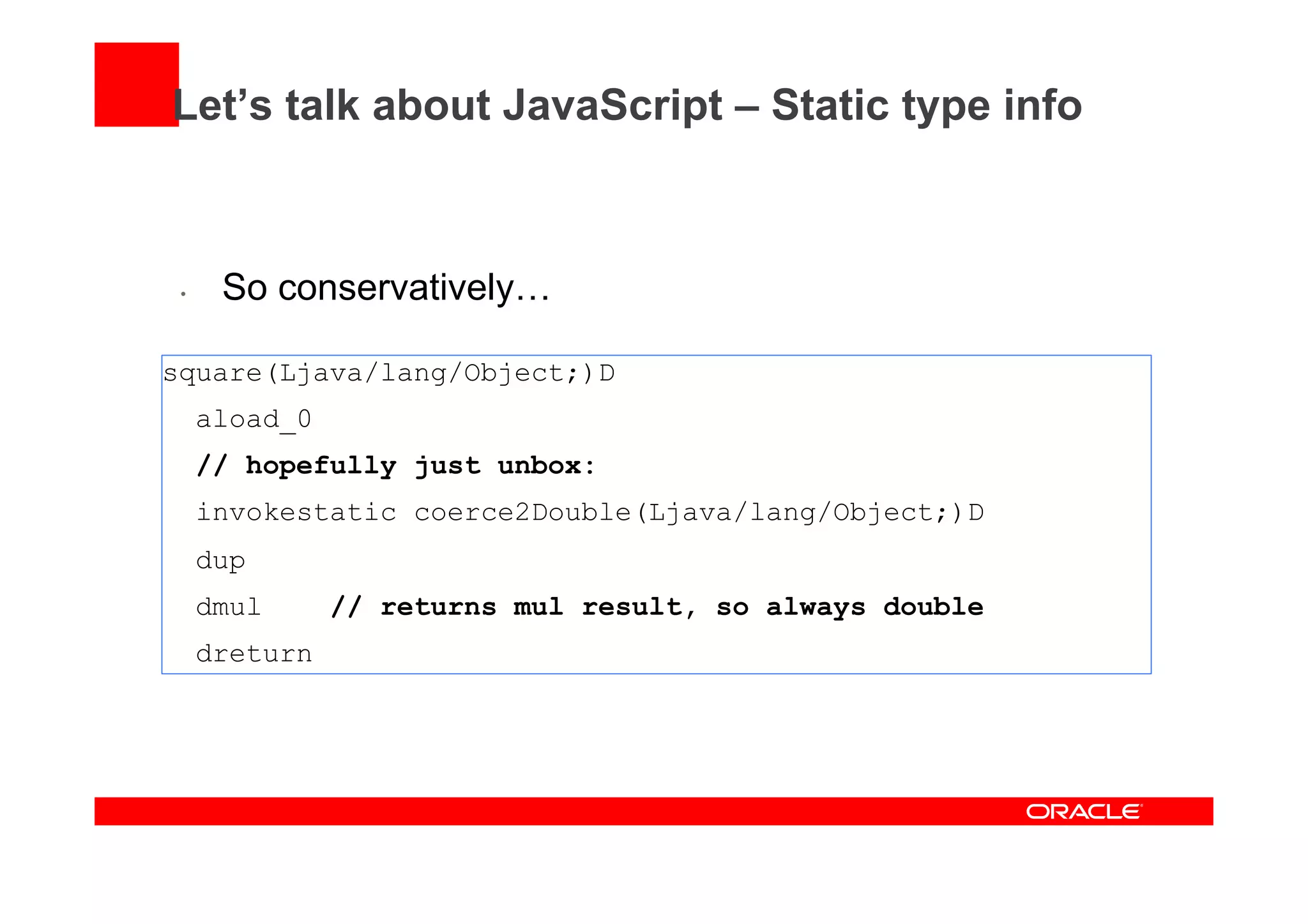
•  So conservatively…
square(Ljava/lang/Object;)D
aload_0
// hopefully just unbox:
invokestatic coerce2Double(Ljava/lang/Object;)D
dup
dmul // returns mul result, so always double
dreturn
Let’s talk about JavaScript – Static type info
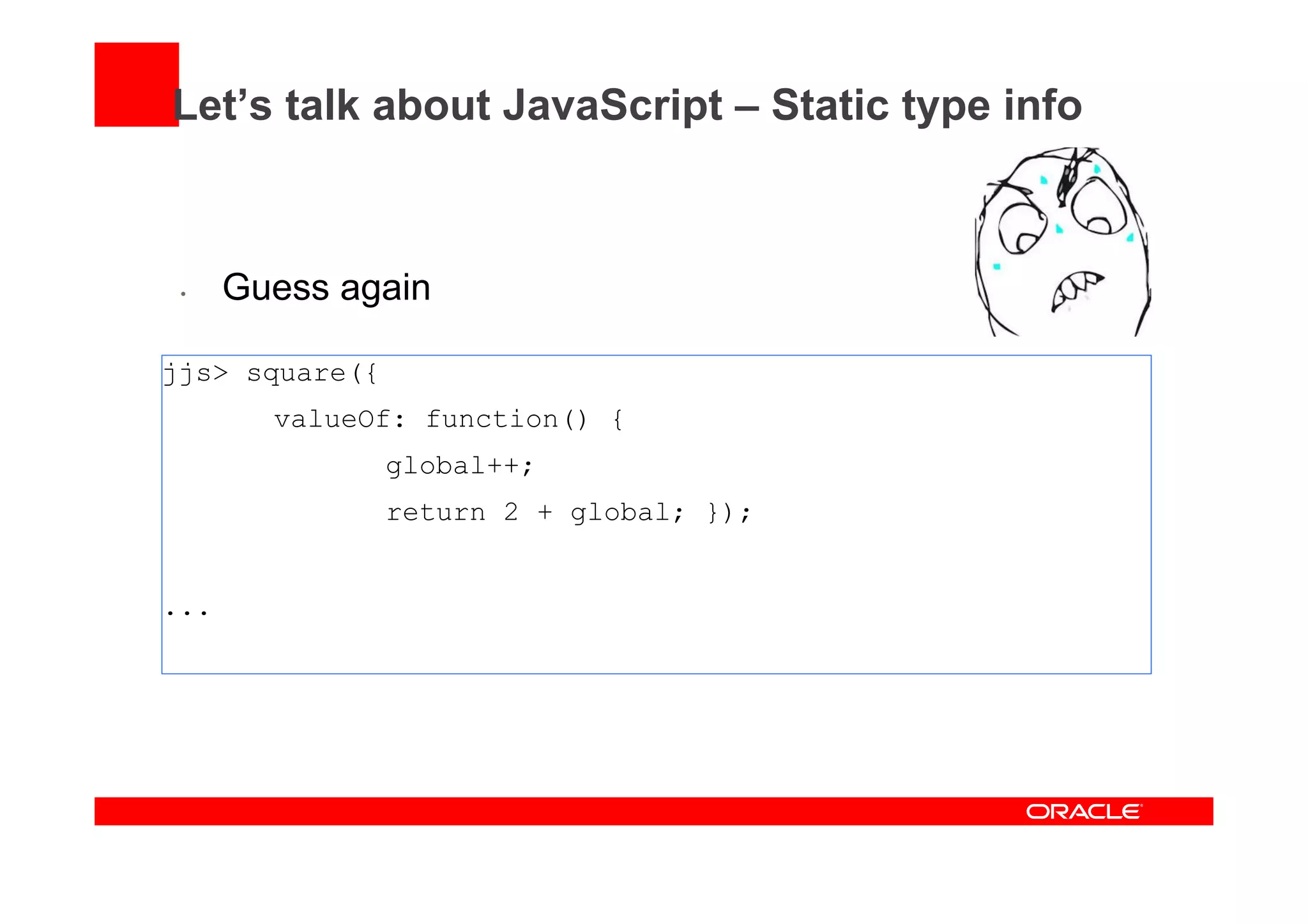
•  Guess again
jjs> square({
valueOf: function() {
global++;
return 2 + global; });
...
Let’s talk about JavaScript – Static type info
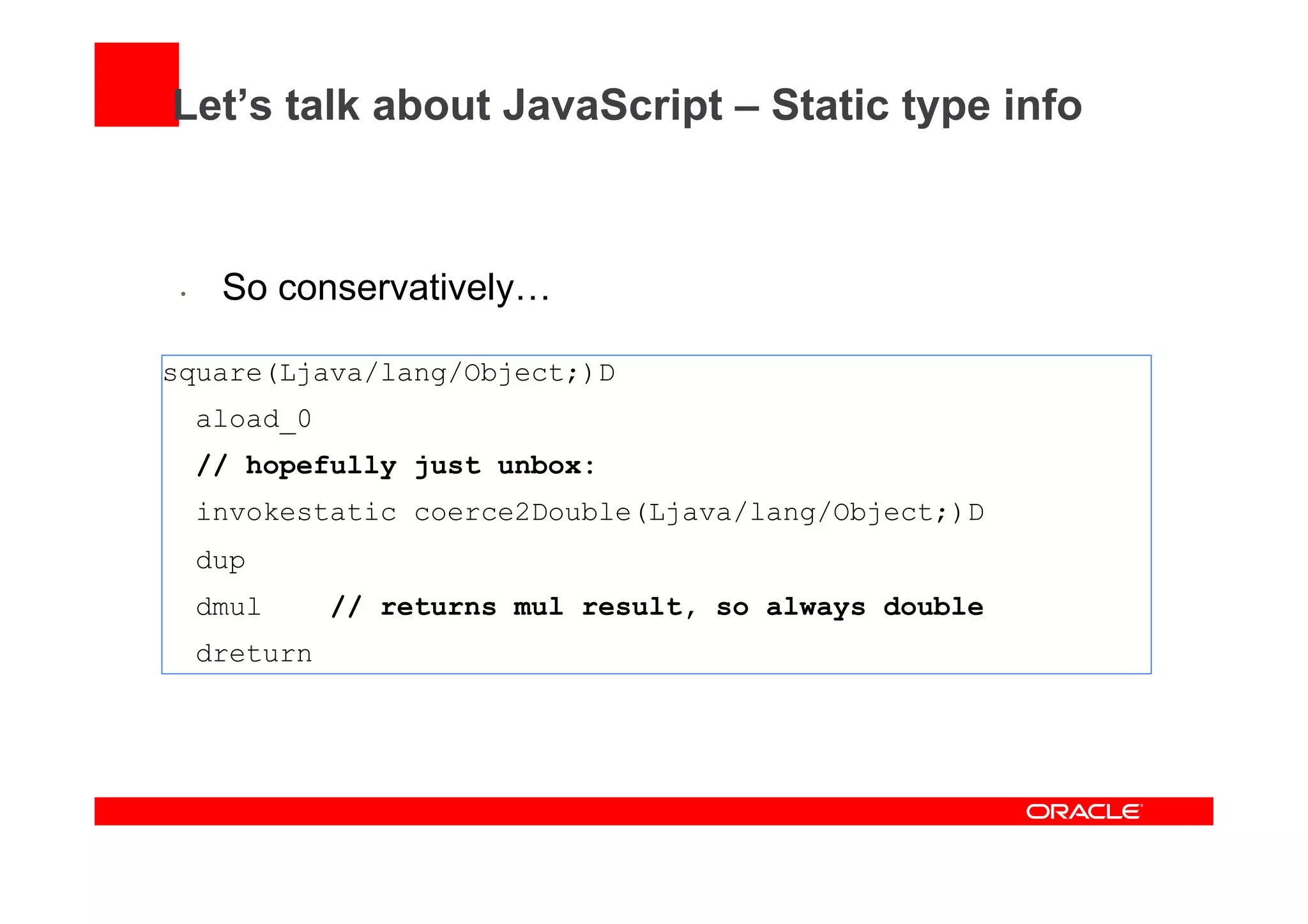
•  So conservatively…
square(Ljava/lang/Object;)D
aload_0
// hopefully just unbox:
invokestatic coerce2Double(Ljava/lang/Object;)D
dup
dmul // returns mul result, so always double
dreturn
Let’s talk about JavaScript – Static type info
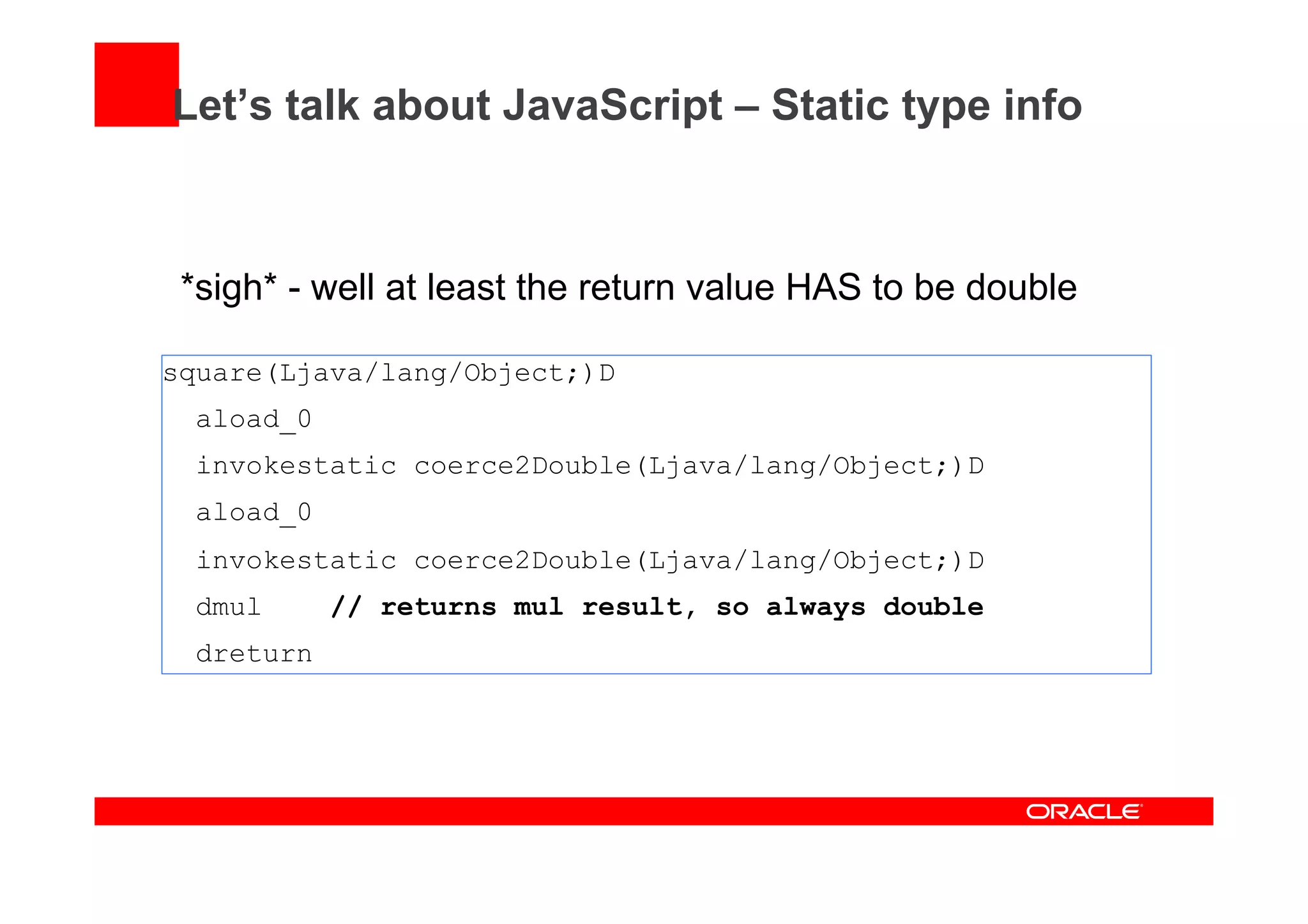
*sigh* - well at least the return value HAS to be double
square(Ljava/lang/Object;)D
aload_0
invokestatic coerce2Double(Ljava/lang/Object;)D
aload_0
invokestatic coerce2Double(Ljava/lang/Object;)D
dmul // returns mul result, so always double
dreturn
JavaScript has a lot of magic in its number
coercion
var dict = Object.create(null);
var key = ‘valueOf’;
//later
dict[key] = formatHarddriveFunction;
//much later
dict++;
… and this turns into “10”, of course
++[[]][+[]]+[+[]]
===
“10”
Brendan
Fibbonacci calculator
function fib(_) {
for(_=[+[],++[[]][+[]],+[],_],_[++[++[++[[]][+[]]]
[+[]]][+[]]]=(((_[++[++[++[[]][+[]]][+[]]][+[]]]-
(++[[]][+[]]))&(((--[[]][+[]])>>>(++[[]][+[]]))))
===(_[++[++[++[[]][+[]]][+[]]][+[]]]-
(++[[]][+[]])))?(_[++[++[[]][+[]]][+[]]]=
++[[]][+[]],_[++[++[++[[]][+[]]][+[]]][+[]]]-
(++[[]][+[]])):+[];_[++[++[++[[]][+[]]][+[]]]
[+[]]]--;_[+[]]=(_[++[[]][+[]]]=
_[++[++[[]][+[]]][+[]]]=_[+[]]+_[++[[]][+[]]])-
_[+[]]);
return _[++[++[[]][+[]]][+[]]];
}
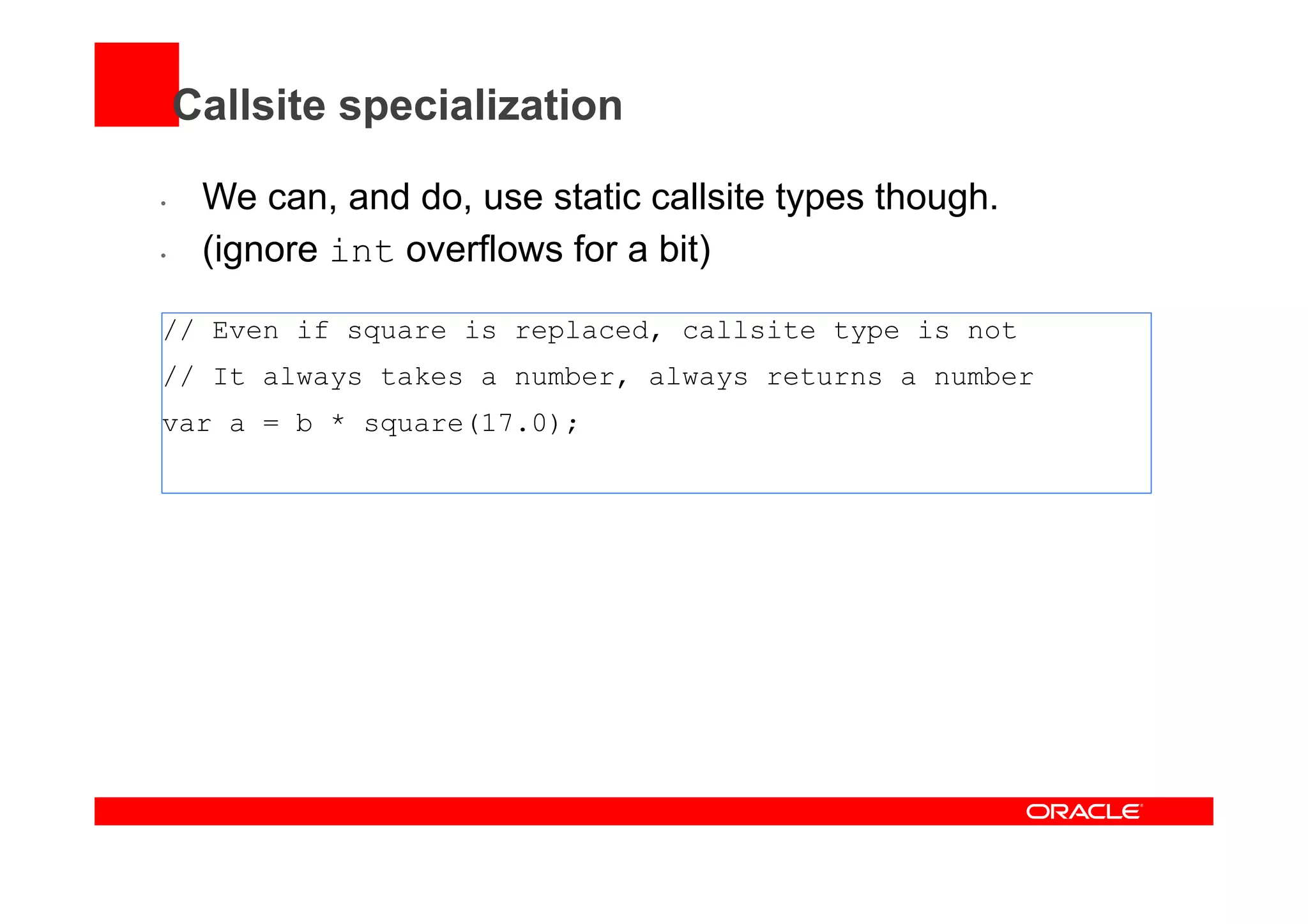
Callsite specialization
•  We can, and do, use static callsite types though.
•  (ignore int overflows for a bit)
// Even if square is replaced, callsite type is not
// It always takes a number, always returns a number
var a = b * square(17.0);
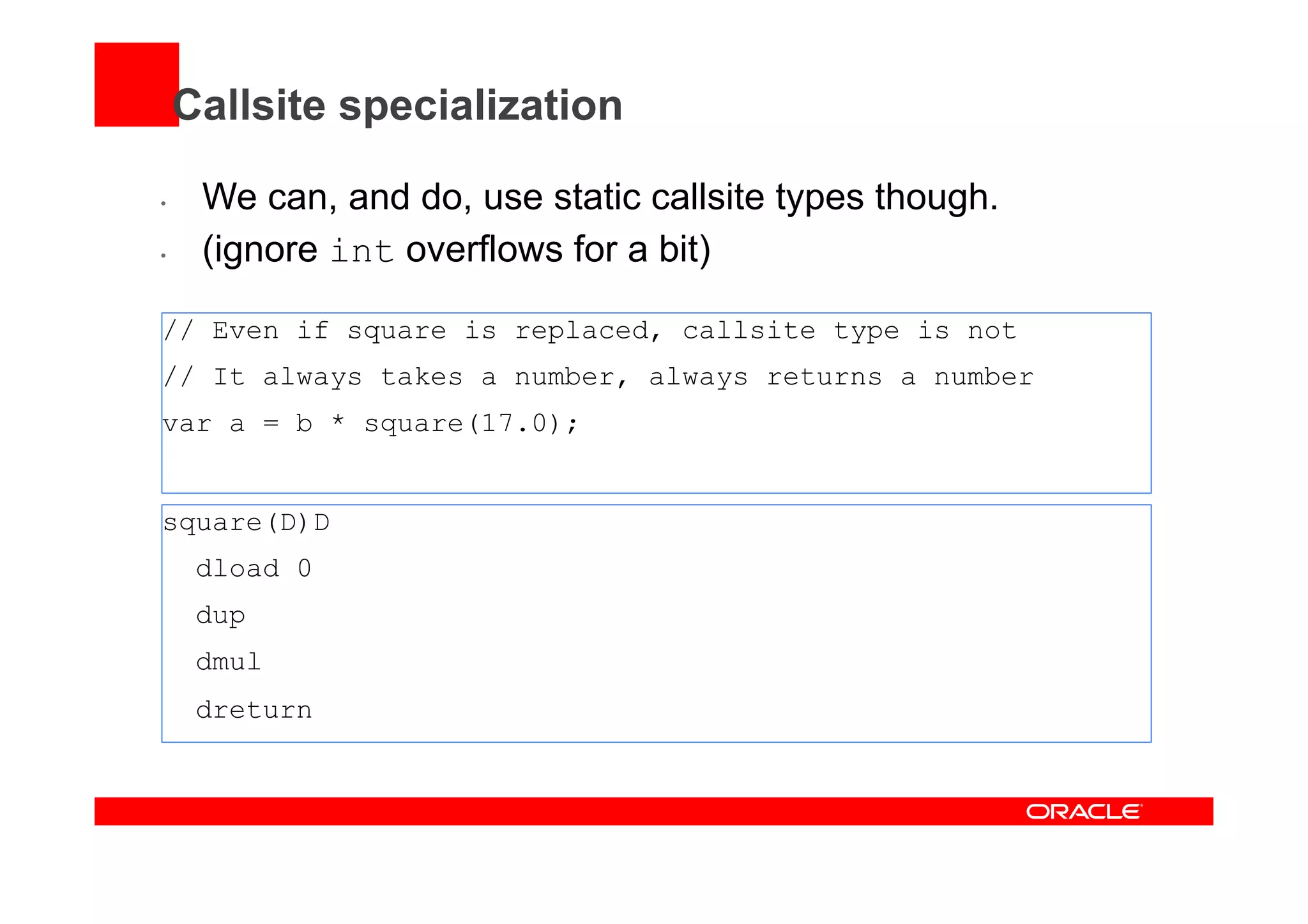
Callsite specialization
•  We can, and do, use static callsite types though.
•  (ignore int overflows for a bit)
// Even if square is replaced, callsite type is not
// It always takes a number, always returns a number
var a = b * square(17.0);
square(D)D
dload 0
dup
dmul
dreturn
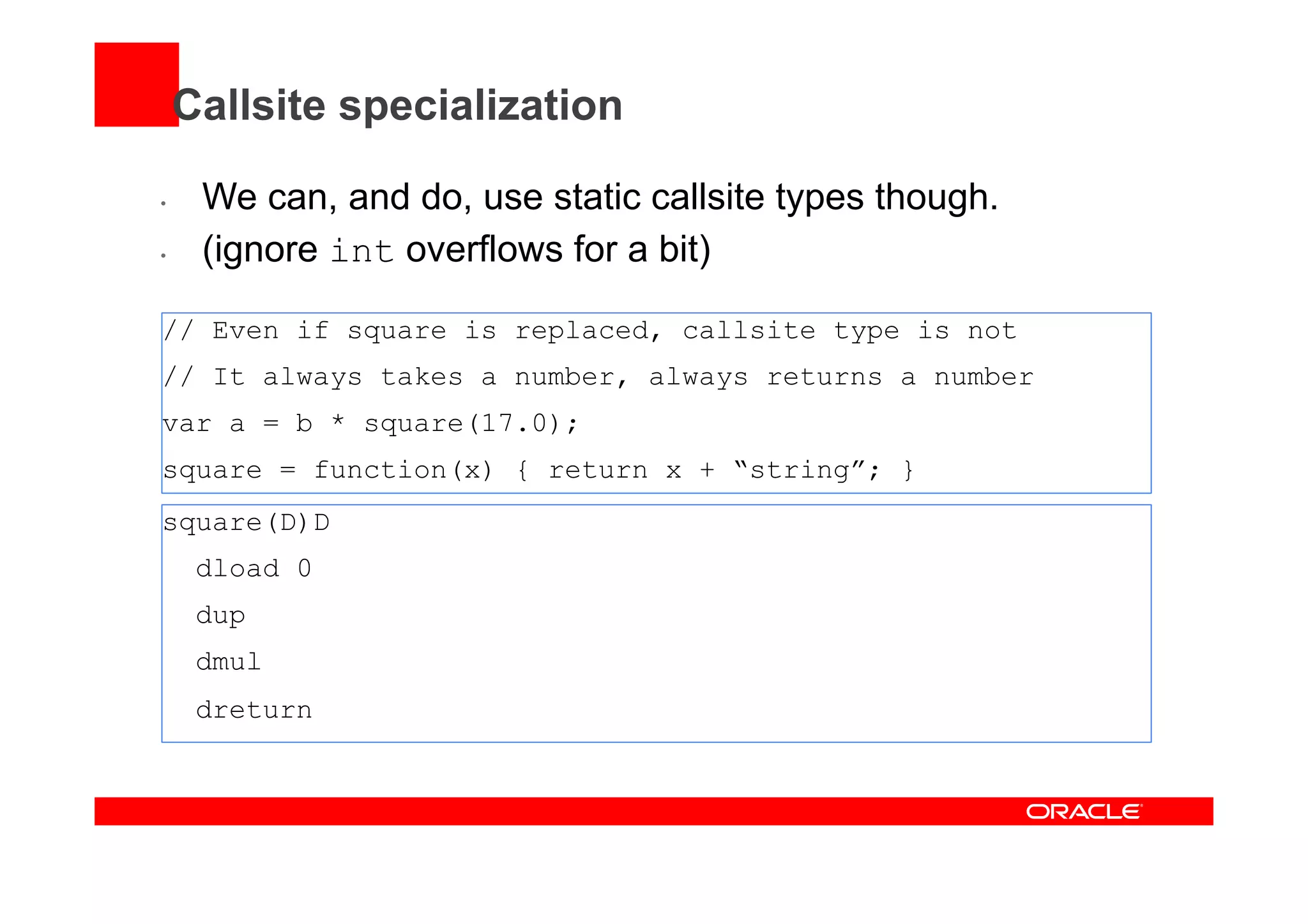
Callsite specialization
•  We can, and do, use static callsite types though.
•  (ignore int overflows for a bit)
// Even if square is replaced, callsite type is not
// It always takes a number, always returns a number
var a = b * square(17.0);
square = function(x) { return x + “string”; }
square(D)D
dload 0
dup
dmul
dreturn
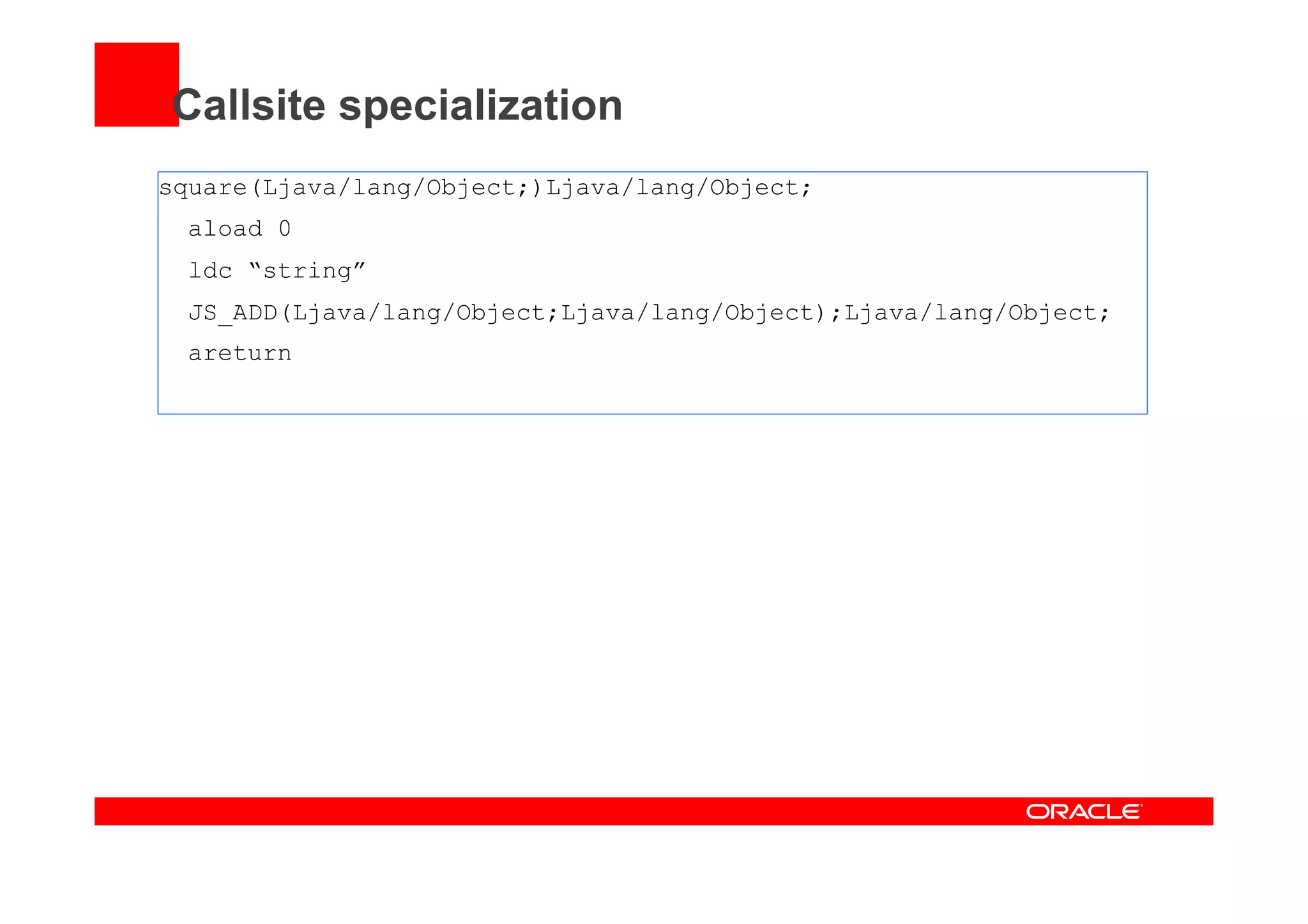
Callsite specialization
square(Ljava/lang/Object;)Ljava/lang/Object;
aload 0
ldc “string”
JS_ADD(Ljava/lang/Object;Ljava/lang/Object);Ljava/lang/Object;
areturn
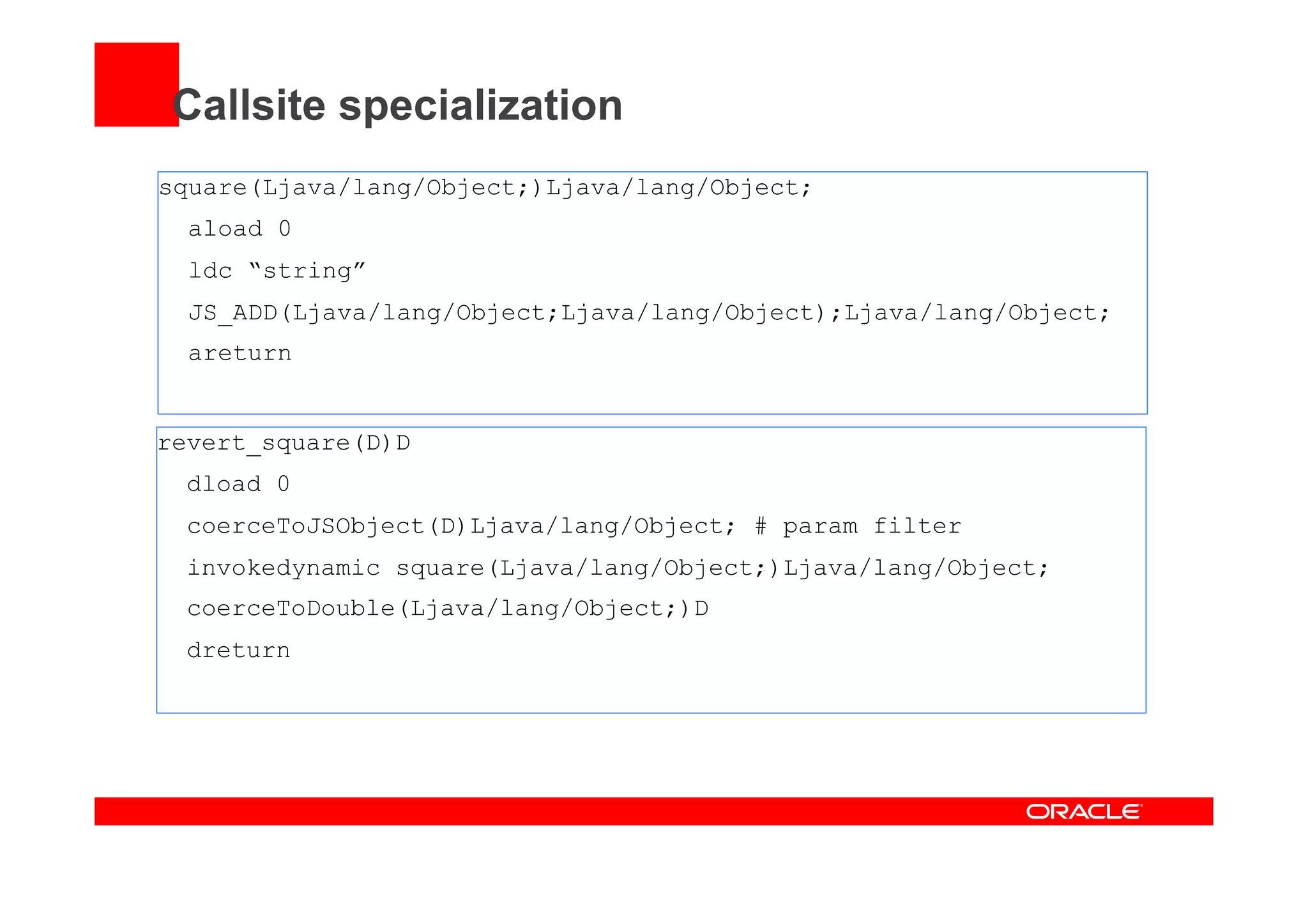
Callsite specialization
square(Ljava/lang/Object;)Ljava/lang/Object;
aload 0
ldc “string”
JS_ADD(Ljava/lang/Object;Ljava/lang/Object);Ljava/lang/Object;
areturn
revert_square(D)D
dload 0
coerceToJSObject(D)Ljava/lang/Object; # param filter
invokedynamic square(Ljava/lang/Object;)Ljava/lang/Object;
coerceToDouble(Ljava/lang/Object;)D
dreturn
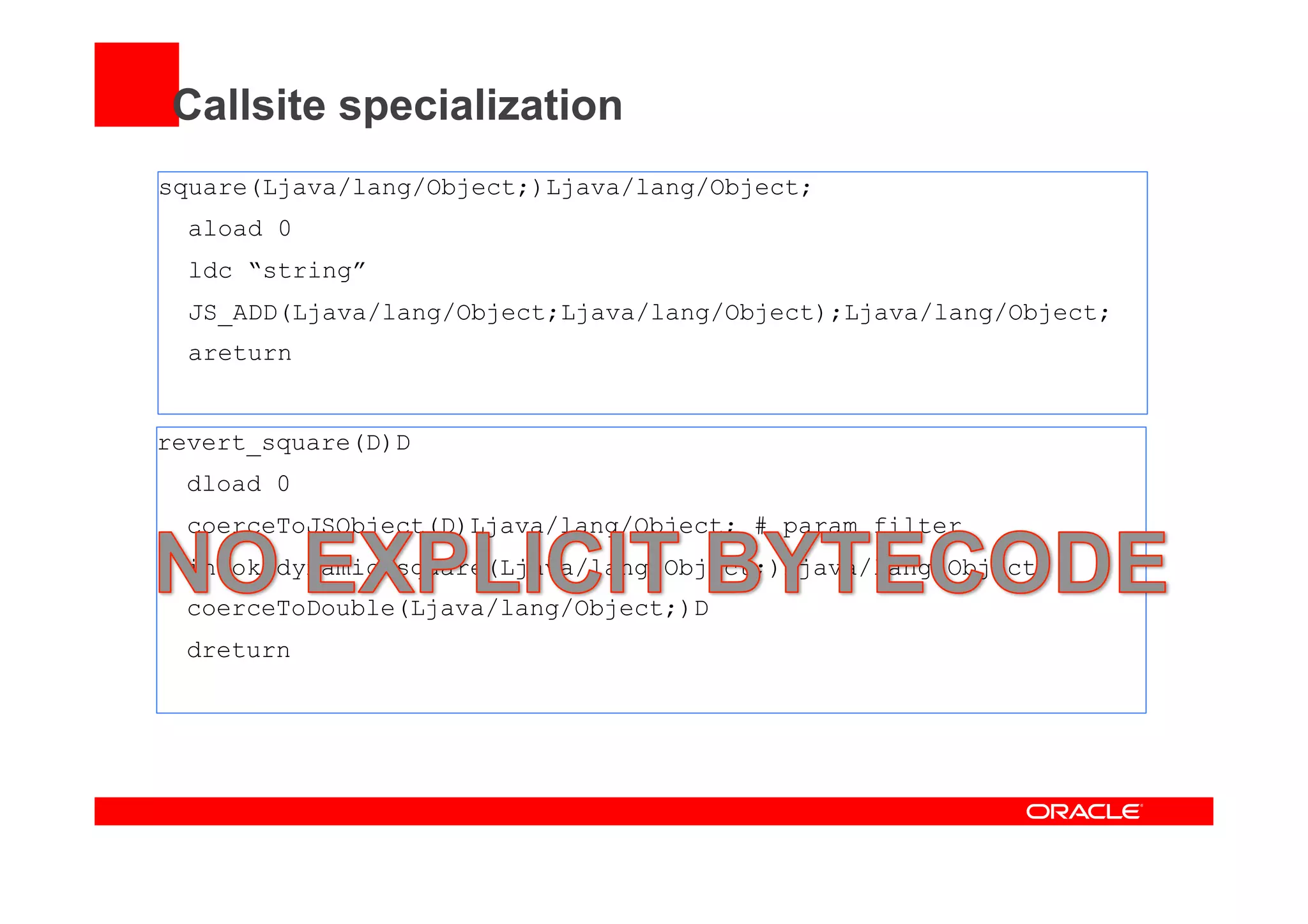
Callsite specialization
square(Ljava/lang/Object;)Ljava/lang/Object;
aload 0
ldc “string”
JS_ADD(Ljava/lang/Object;Ljava/lang/Object);Ljava/lang/Object;
areturn
revert_square(D)D
dload 0
coerceToJSObject(D)Ljava/lang/Object; # param filter
invokedynamic square(Ljava/lang/Object;)Ljava/lang/Object;
coerceToDouble(Ljava/lang/Object;)D
dreturn
Static compile time types bring us
performance,
[But they are too rare to take us all
the way]
Type Specialization
function am3(i,x,w,j,c,n) {
var this_array = this.array;
var w_array = w.array;
var xl = x&0x3fff, xh = x>>14;
while(--n >= 0) {
var l = this_array[i]&0x3fff;
var h = this_array[i++]>>14;
var m = xh*l+h*xl;
l = xl*l+((m&0x3fff)<<14)+w_array[j]+c;
c = (l>>28)+(m>>14)+xh*h;
w_array[j++] = l&0xfffffff;
}
return c;
}
Type Specialization – Prove ints
function am3(i,x,w,j,c,n) {
var this_array = this.array;
var w_array = w.array;
var xl = x&0x3fff, xh = x>>14;
while(--n >= 0) {
var l = this_array[i]&0x3fff;
var h = this_array[i++]>>14;
var m = xh*l+h*xl;
l = xl*l+((m&0x3fff)<<14)+w_array[j]+c;
c = (l>>28)+(m>>14)+xh*h;
w_array[j++] = l&0xfffffff;
}
return c;
}
Type Specialization – prove doubles
function am3(i,x,w,j,c,n) {
var this_array = this.array;
var w_array = w.array;
var xl = x&0x3fff, xh = x>>14;
while(--n >= 0) {
var l = this_array[i]&0x3fff;
var h = this_array[i++]>>14;
var m = xh*l+h*xl;
l = xl*l+((m&0x3fff)<<14)+w_array[j]+c;
c = (l>>28)+(m>>14)+xh*h;
w_array[j++] = l&0xfffffff;
}
return c;
}
Static range analysis – fold doubles to ints
function am3(i,x,w,j,c,n) {
var this_array = this.array;
var w_array = w.array;
var xl = x&0x3fff, xh = x>>14; // xl = max 32 bits, xh: 18 bits
while(--n >= 0) {
var l = this_array[i]&0x3fff; // l max 12 bits
var h = this_array[i++]>>14; // h max (32-14) = 18 bits
var m = xh*l+h*xl; // will never overflow
l = xl*l+((m&0x3fff)<<14)+w_array[j]+c;
c = (l>>28)+(m>>14)+xh*h;
w_array[j++] = l&0xfffffff;
}
return c;
}
Static range analysis – fold away doubles
function am3(i,x,w,j,c,n) {
var this_array = this.array;
var w_array = w.array;
var xl = x&0x3fff, xh = x>>14; // xl = max 32 bits, xh: 18 bits
while(--n >= 0) {
var l = this_array[i]&0x3fff; // l max 12 bits
var h = this_array[i++]>>14; // h max (32-14) = 18 bits
var m = xh*l+h*xl; // will never overflow
l = xl*l+((m&0x3fff)<<14)+w_array[j]+c;
c = (l>>28)+(m>>14)+xh*h;
w_array[j++] = l&0xfffffff;
}
return c;
}
Do we need our own inlining as well?
We can statically prove a few primitive numbers from
callsites to am3.
Not from all of them.
Runtime callsite is really:
(Ljava/lang/Object;IILjava/lang/Object;III)I
Statically unprovable, though
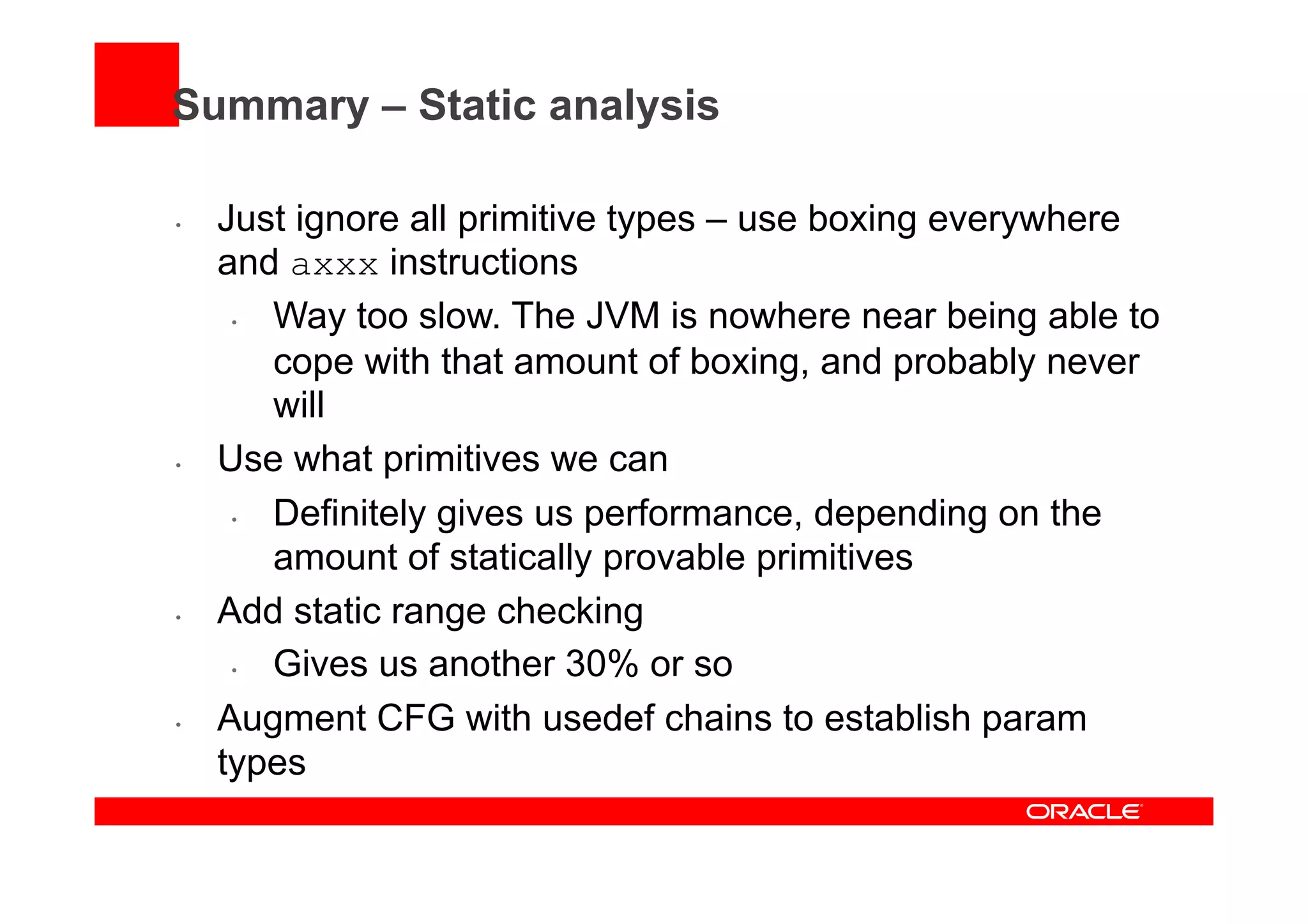
Summary – Static analysis
•  Just ignore all primitive types – use boxing everywhere
and axxx instructions
•  Way too slow. The JVM is nowhere near being able to
cope with that amount of boxing, and probably never
will
Summary – Static analysis
•  Just ignore all primitive types – use boxing everywhere
and axxx instructions
•  Way too slow. The JVM is nowhere near being able to
cope with that amount of boxing, and probably never
will
•  Use what primitives we can
•  Definitely gives us performance, depending on the
amount of statically provable primitives
Summary – Static analysis
•  Just ignore all primitive types – use boxing everywhere
and axxx instructions
•  Way too slow. The JVM is nowhere near being able to
cope with that amount of boxing, and probably never
will
•  Use what primitives we can
•  Definitely gives us performance, depending on the
amount of statically provable primitives
•  Add static range checking
•  Gives us another 30% or so
Summary – Static analysis
•  Just ignore all primitive types – use boxing everywhere
and axxx instructions
•  Way too slow. The JVM is nowhere near being able to
cope with that amount of boxing, and probably never
will
•  Use what primitives we can
•  Definitely gives us performance, depending on the
amount of statically provable primitives
•  Add static range checking
•  Gives us another 30% or so
•  Augment CFG with usedef chains to establish param
types
But soon… static analysis won’t get
us further unless we build our own
native JavaScript runtime
But soon… static analysis won’t get
us further unless we build our own
native JavaScript runtime
Become adaptive/dynamic/optimistic
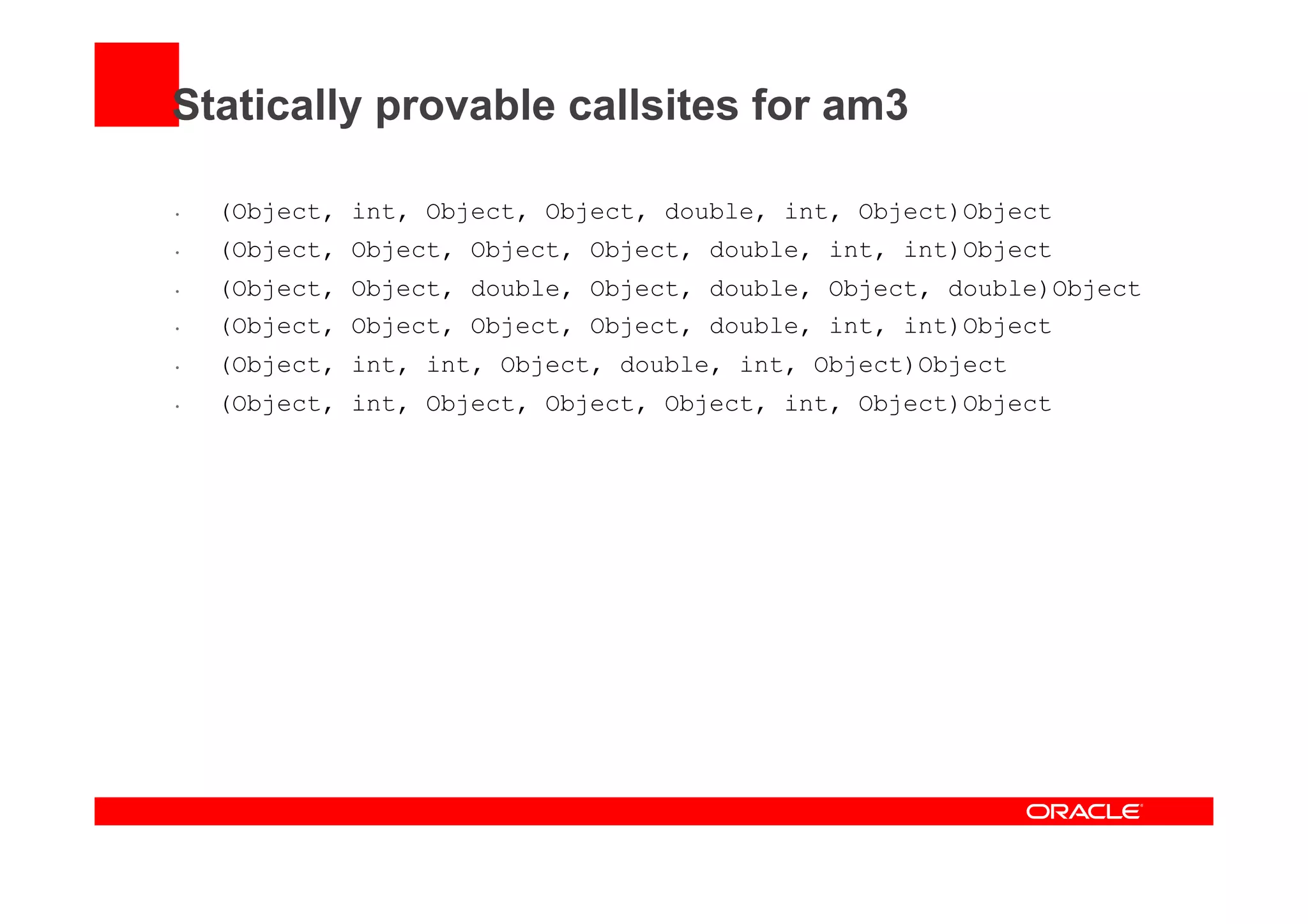
Statically provable callsites for am3
•  (Object, int, Object, Object, double, int, Object)Object
•  (Object, Object, Object, Object, double, int, int)Object
•  (Object, Object, double, Object, double, Object, double)Object
•  (Object, Object, Object, Object, double, int, int)Object
•  (Object, int, int, Object, double, int, Object)Object
•  (Object, int, Object, Object, Object, int, Object)Object
In fact they are…
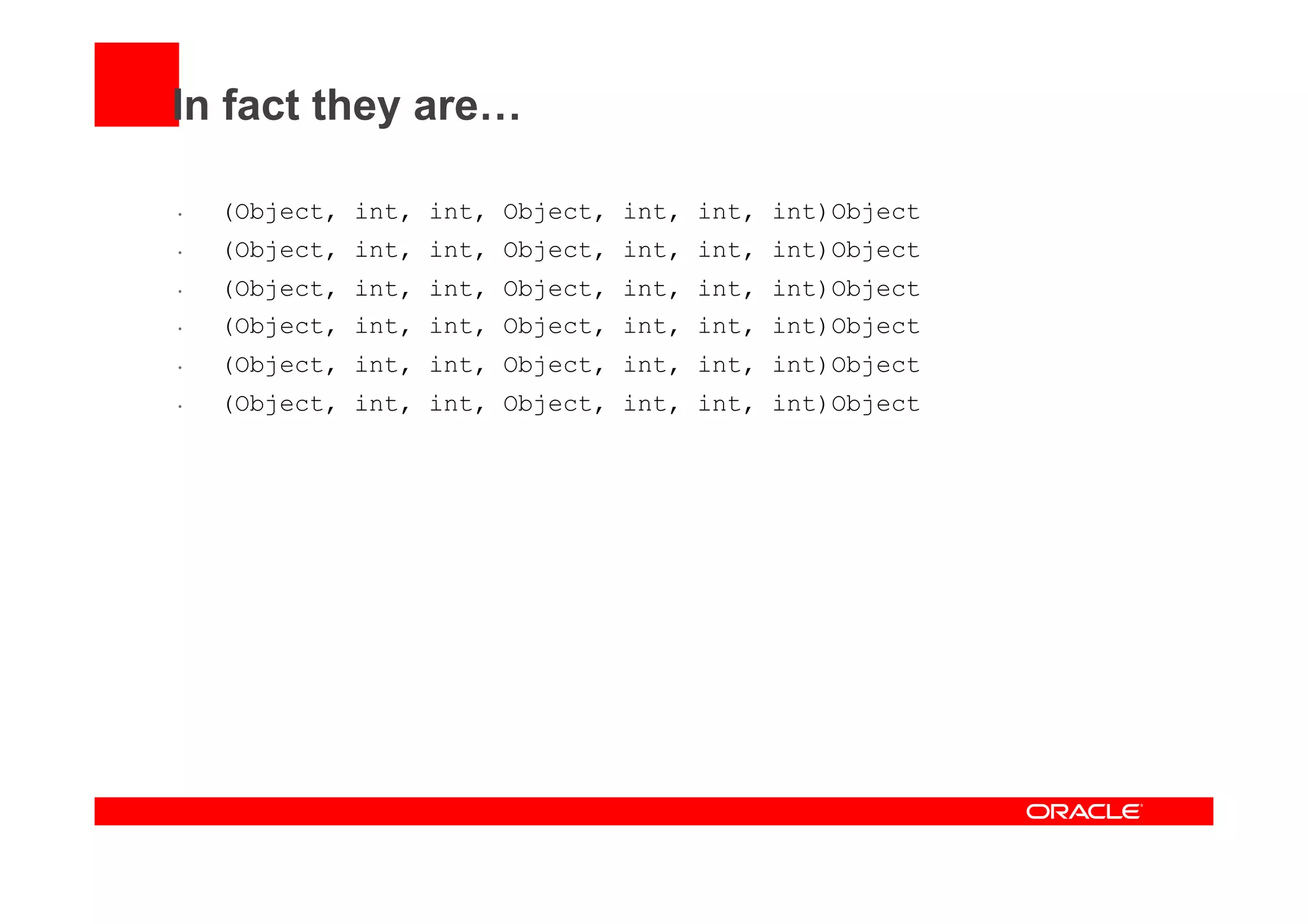
•  (Object, int, int, Object, int, int, int)Object
In fact they are…
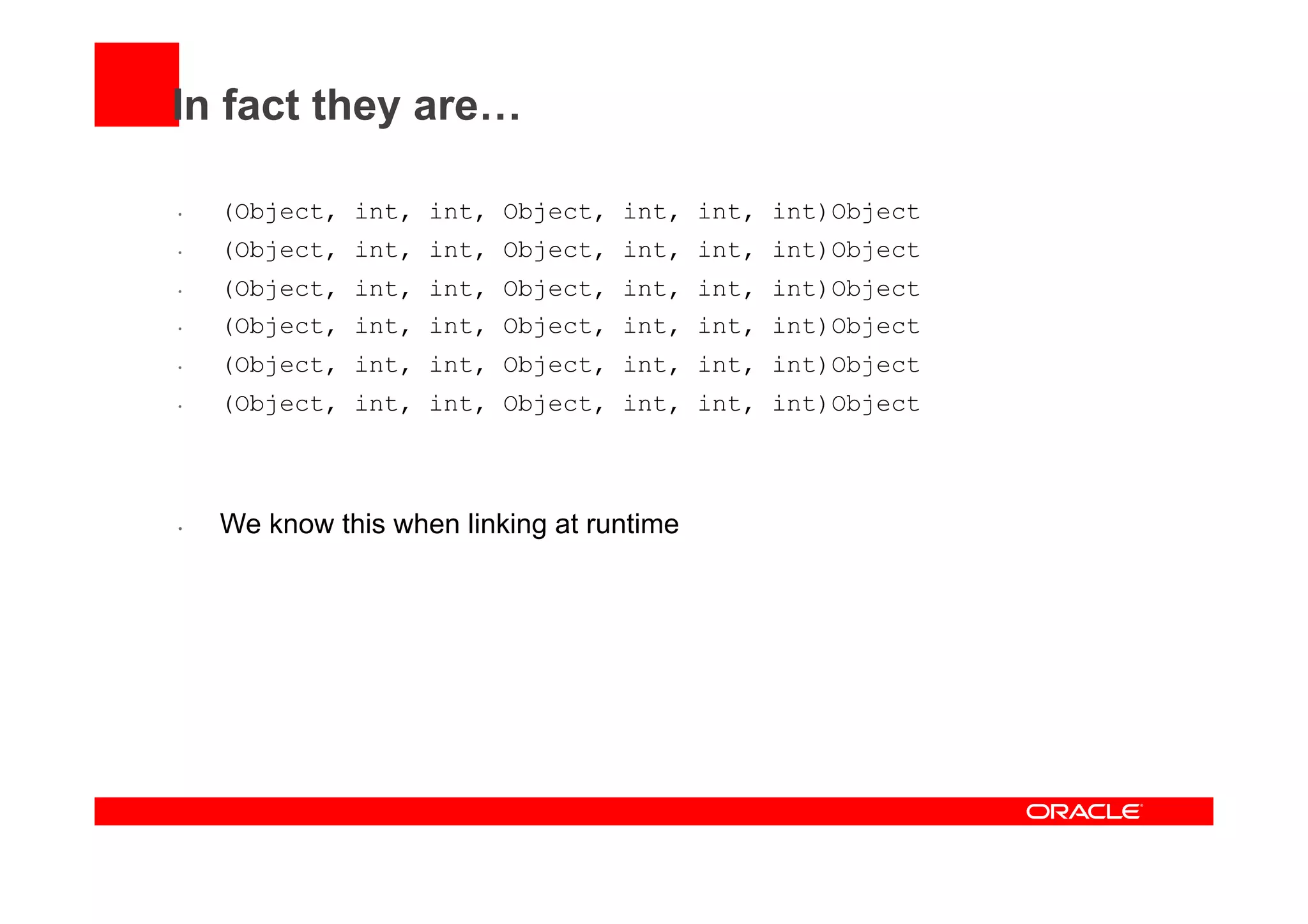
•  (Object, int, int, Object, int, int, int)Object
•  We know this when linking at runtime
In fact they are…
•  (Object, int, int, Object, int, int, int)Object
•  We know this when linking at runtime
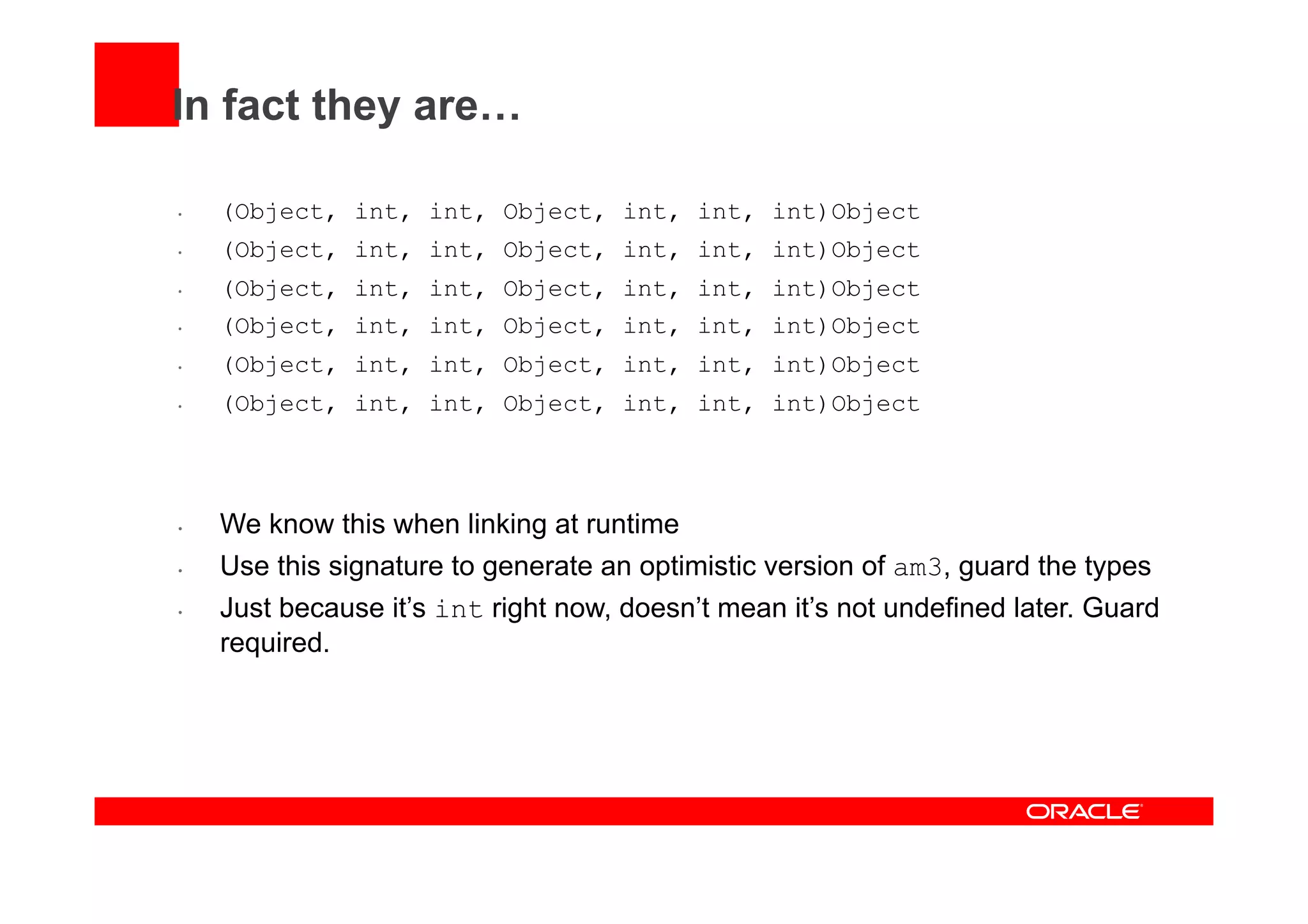
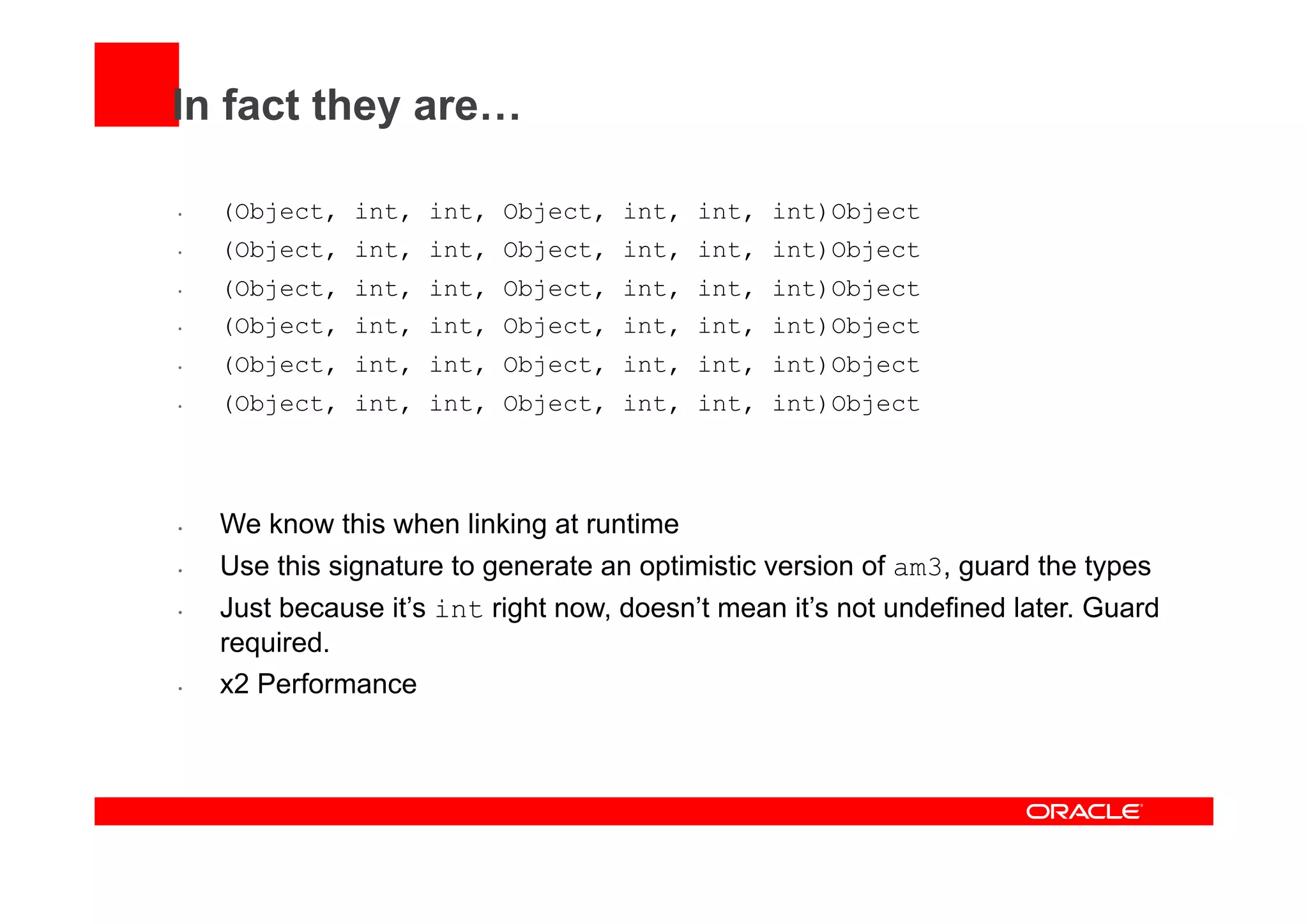
•  Use this signature to generate an optimistic version of am3, guard the types
•  Just because it’s int right now, doesn’t mean it’s not undefined later. Guard
required.
In fact they are…
•  (Object, int, int, Object, int, int, int)Object
•  We know this when linking at runtime
•  Use this signature to generate an optimistic version of am3, guard the types
•  Just because it’s int right now, doesn’t mean it’s not undefined later. Guard
required.
•  x2 Performance
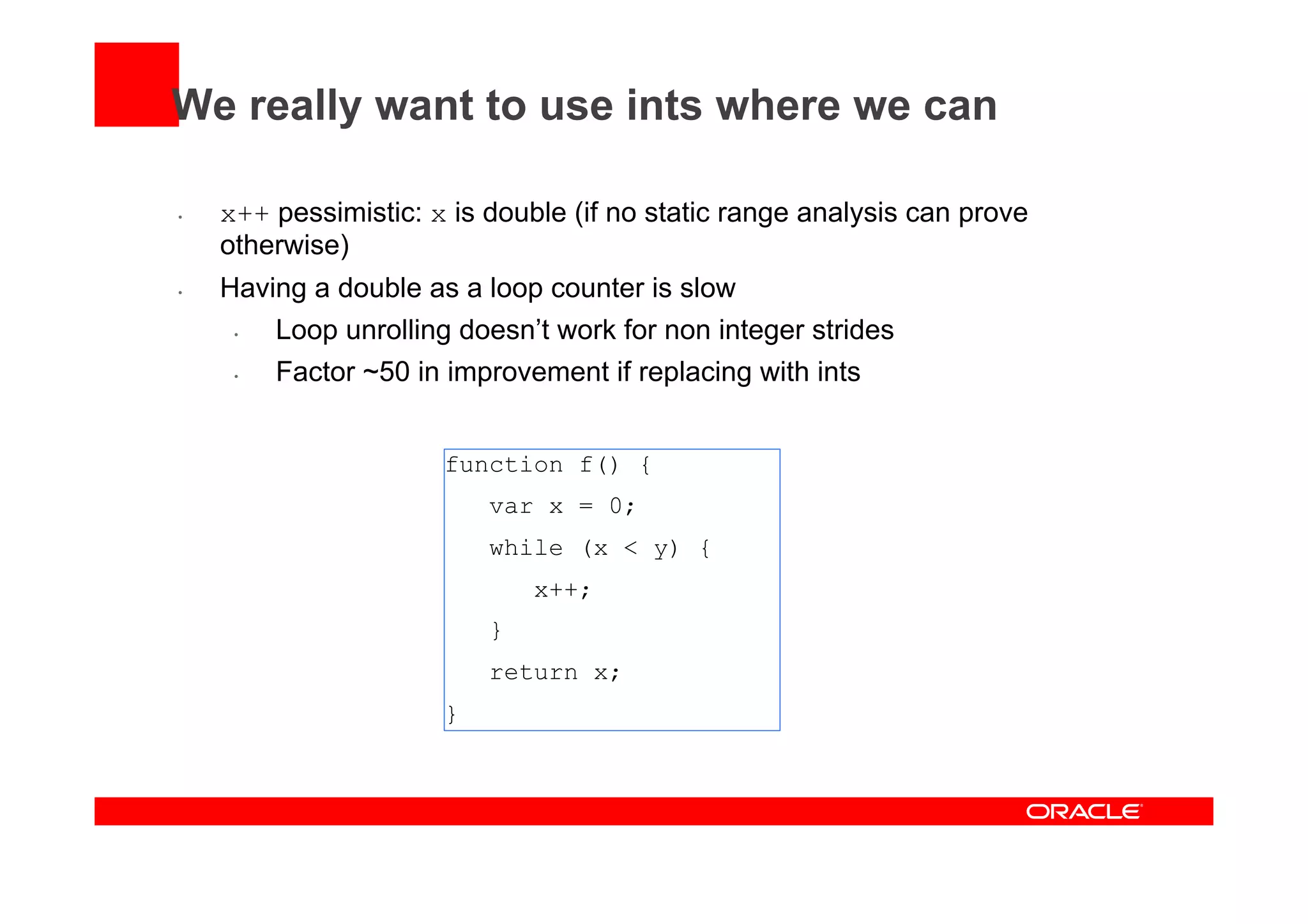
We really want to use ints where we can
•  x++ pessimistic: x is double (if no static range analysis can prove
otherwise)
•  Having a double as a loop counter is slow
•  Loop unrolling doesn’t work for non integer strides
•  Factor ~50 in improvement if replacing with ints
function f() {
var x = 0;
while (x < y) {
x++;
}
return x;
}
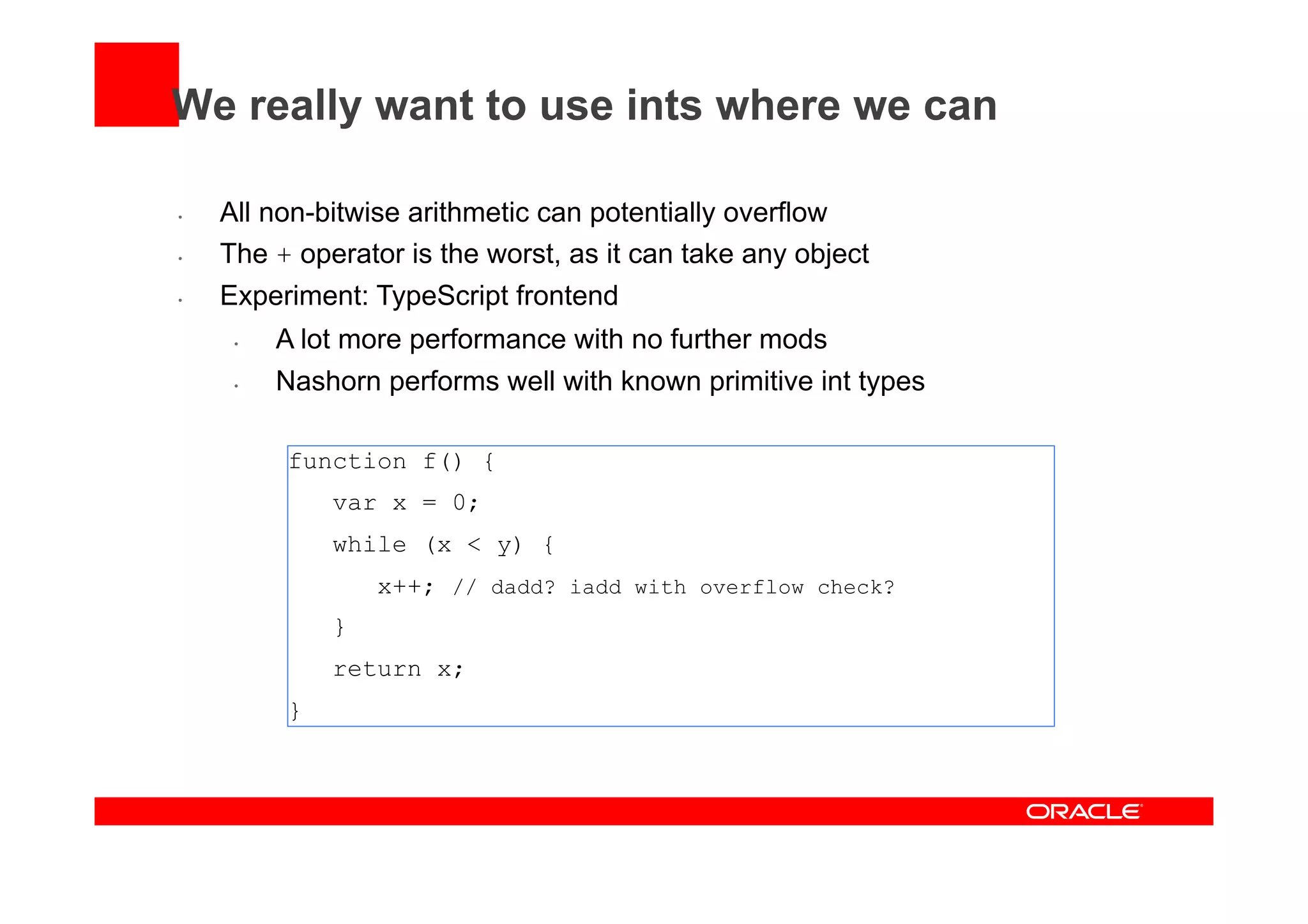
We really want to use ints where we can
•  All non-bitwise arithmetic can potentially overflow
•  The + operator is the worst, as it can take any object
•  Experiment: TypeScript frontend
•  A lot more performance with no further mods
•  Nashorn performs well with known primitive int types
function f() {
var x = 0;
while (x < y) {
x++; // dadd? iadd with overflow check?
}
return x;
}
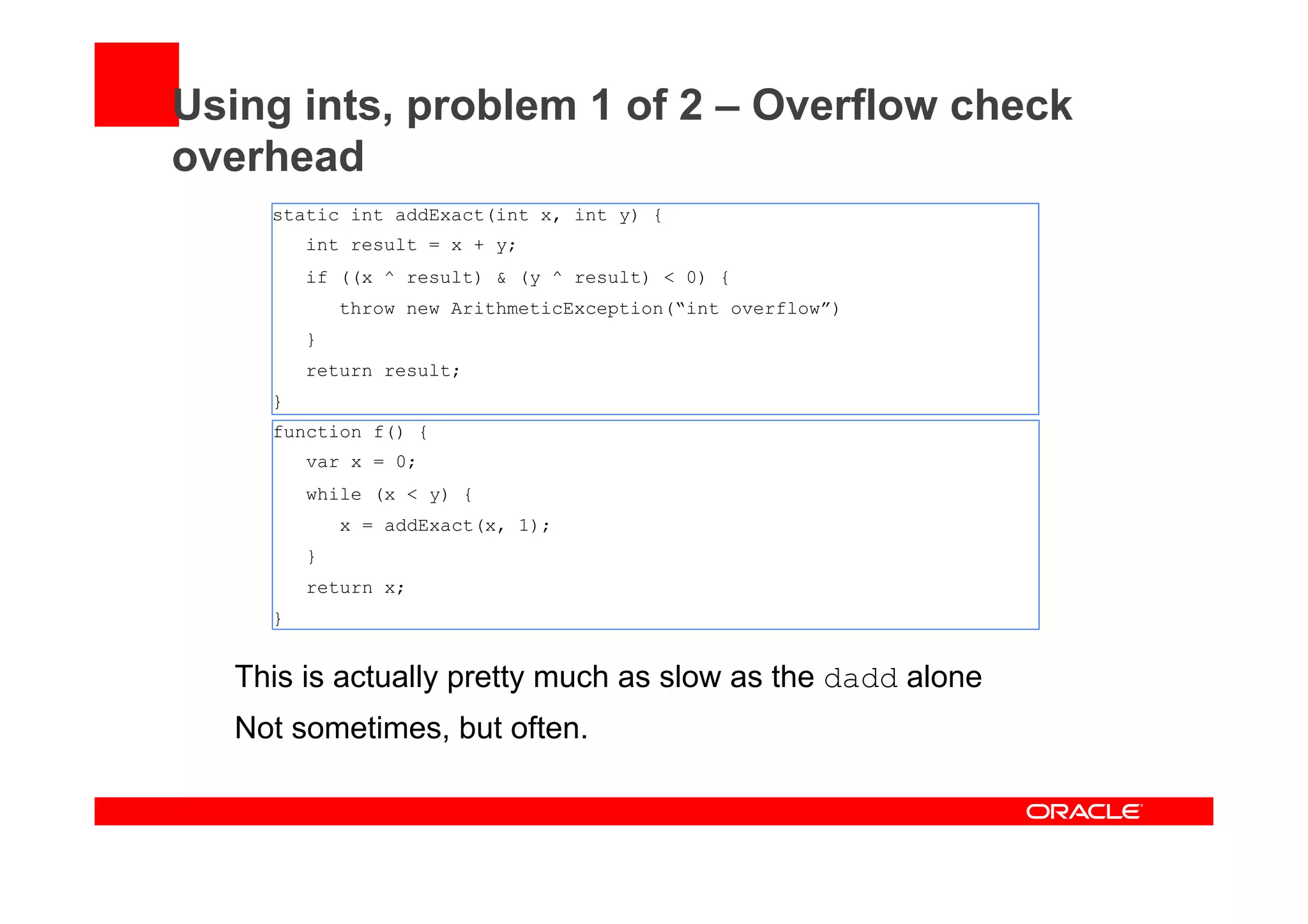
Using ints, problem 1 of 2 – Overflow check
overhead
static int addExact(int x, int y) {
int result = x + y;
if ((x ^ result) & (y ^ result) < 0) {
throw new ArithmeticException(“int overflow”)
}
return result;
}
function f() {
var x = 0;
while (x < y) {
x = addExact(x, 1);
}
return x;
}
This is actually pretty much as slow as the dadd alone
Not sometimes, but often.
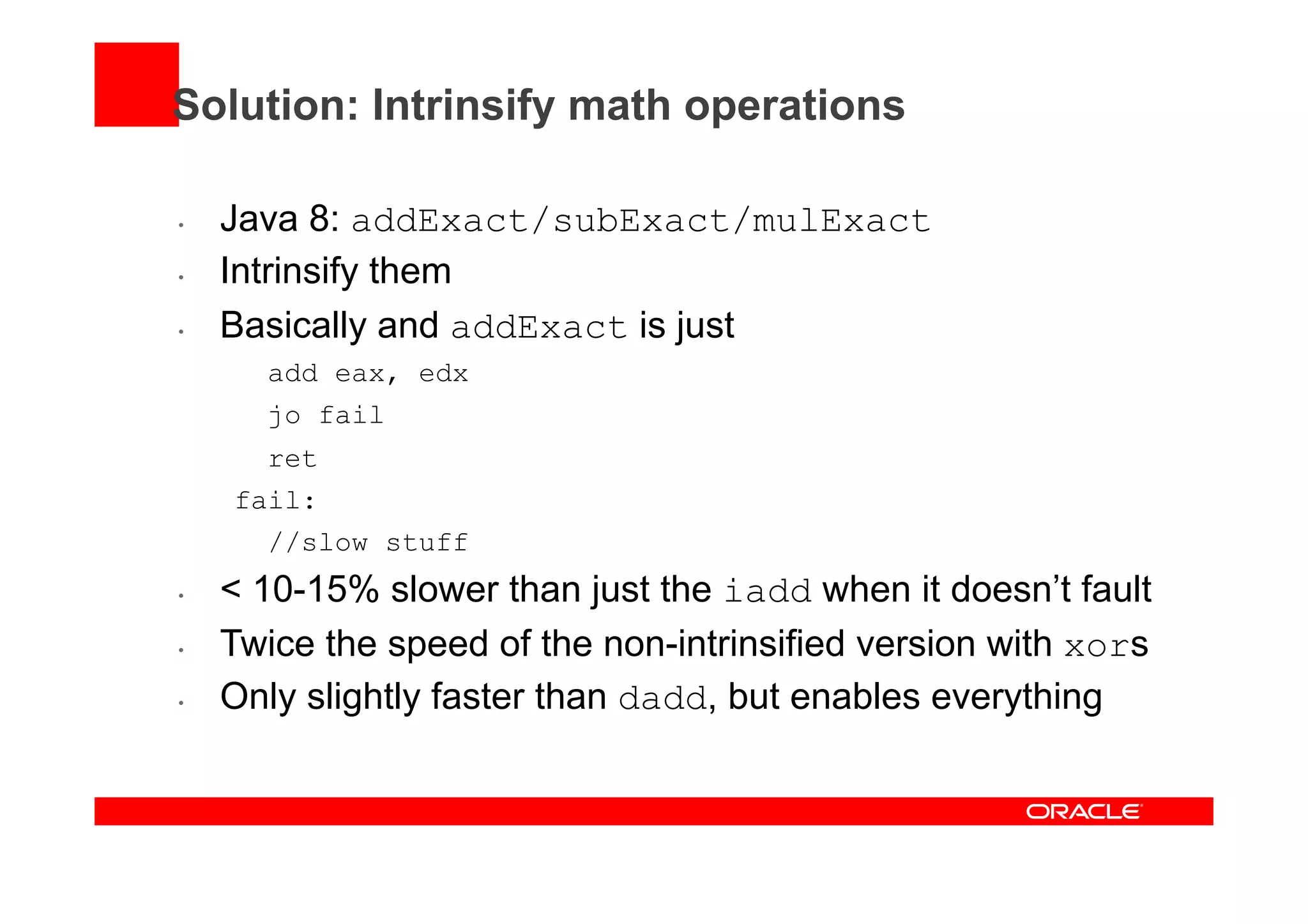
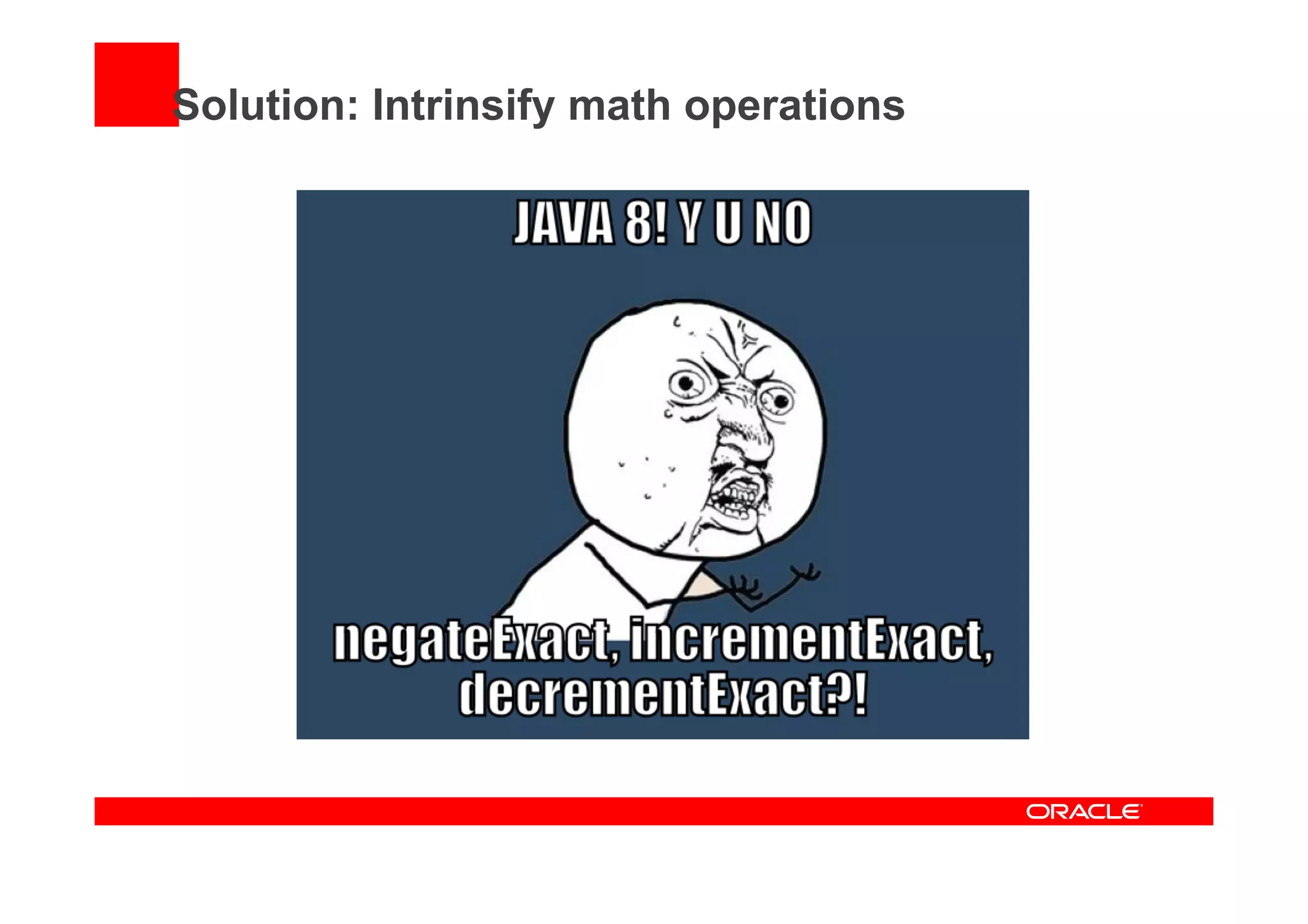
Solution: Intrinsify math operations
•  Java 8: addExact/subExact/mulExact
•  Intrinsify them
•  Basically and addExact is just
add eax, edx
jo fail
ret
fail:
//slow stuff
•  < 10-15% slower than just the iadd when it doesn’t fault
•  Twice the speed of the non-intrinsified version with xors
•  Only slightly faster than dadd, but enables everything
Solution: Intrinsify math operations
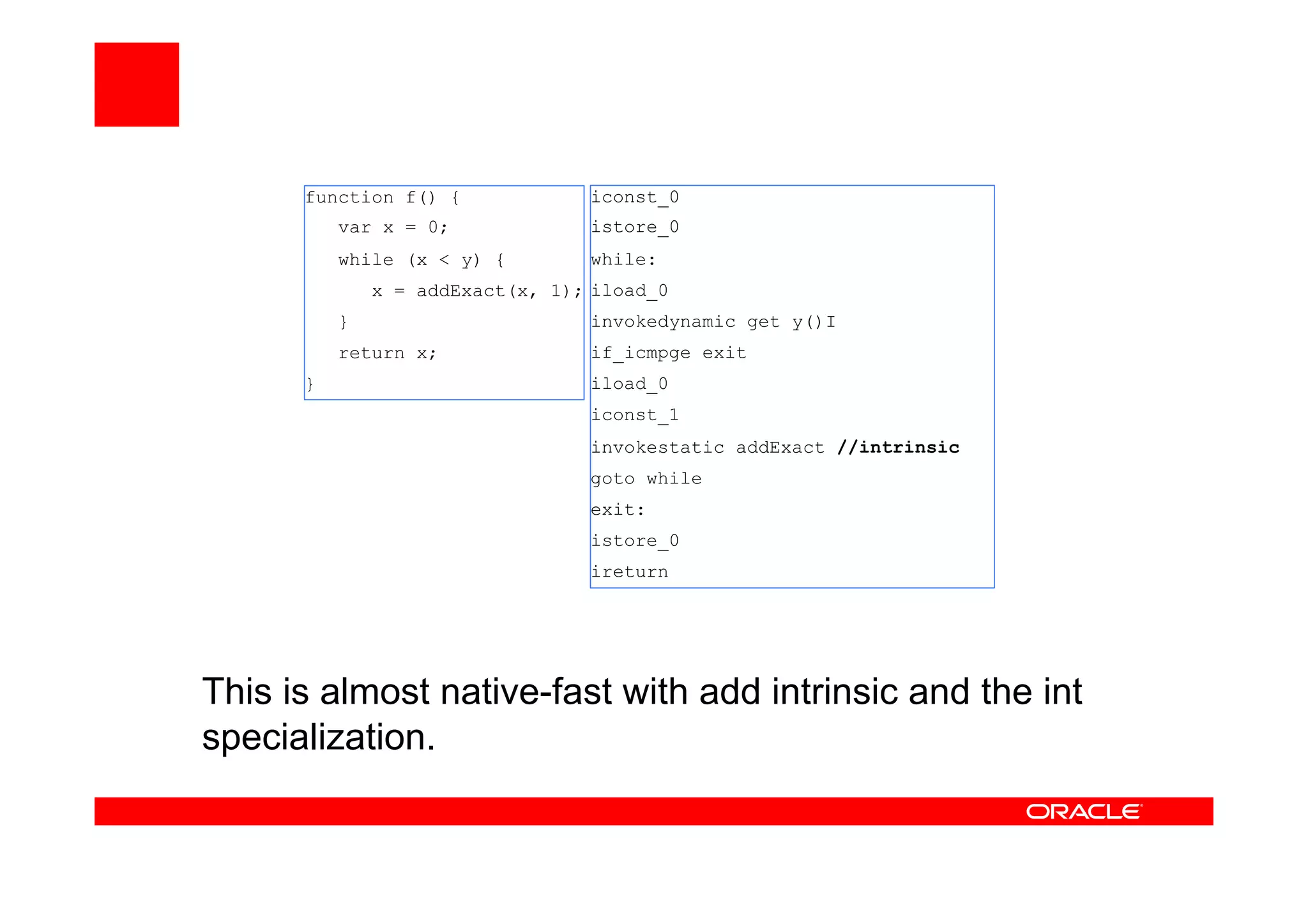
This is almost native-fast with add intrinsic and the int
specialization.
function f() {
var x = 0;
while (x < y) {
x = addExact(x, 1);
}
return x;
}
iconst_0
istore_0
while:
iload_0
invokedynamic get y()I
if_icmpge exit
iload_0
iconst_1
invokestatic addExact //intrinsic
goto while
exit:
istore_0
ireturn
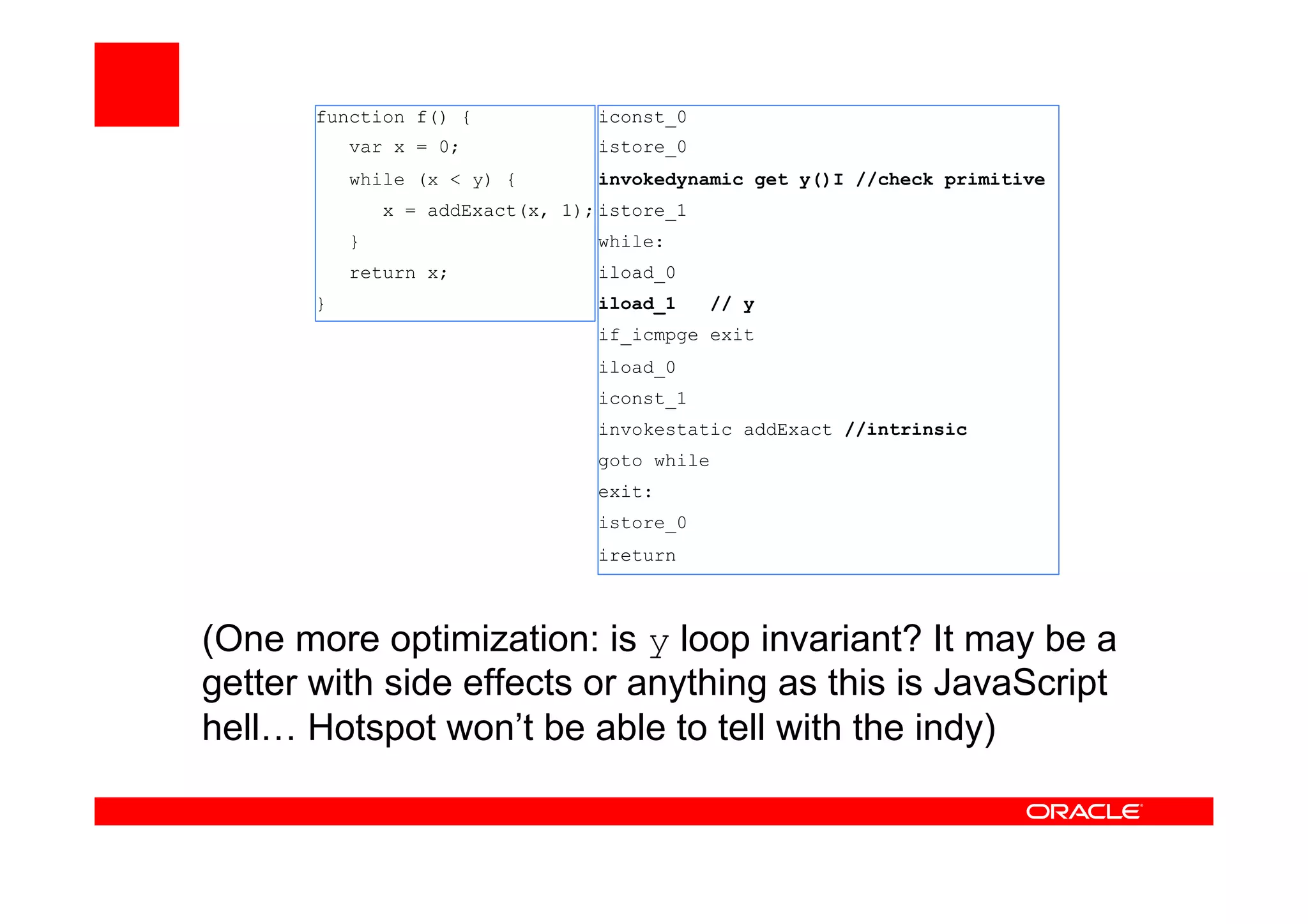
(One more optimization: is y loop invariant? It may be a
getter with side effects or anything as this is JavaScript
hell… Hotspot won’t be able to tell with the indy)
function f() {
var x = 0;
while (x < y) {
x = addExact(x, 1);
}
return x;
}
iconst_0
istore_0
invokedynamic get y()I //check primitive
istore_1
while:
iload_0
iload_1 // y
if_icmpge exit
iload_0
iconst_1
invokestatic addExact //intrinsic
goto while
exit:
istore_0
ireturn
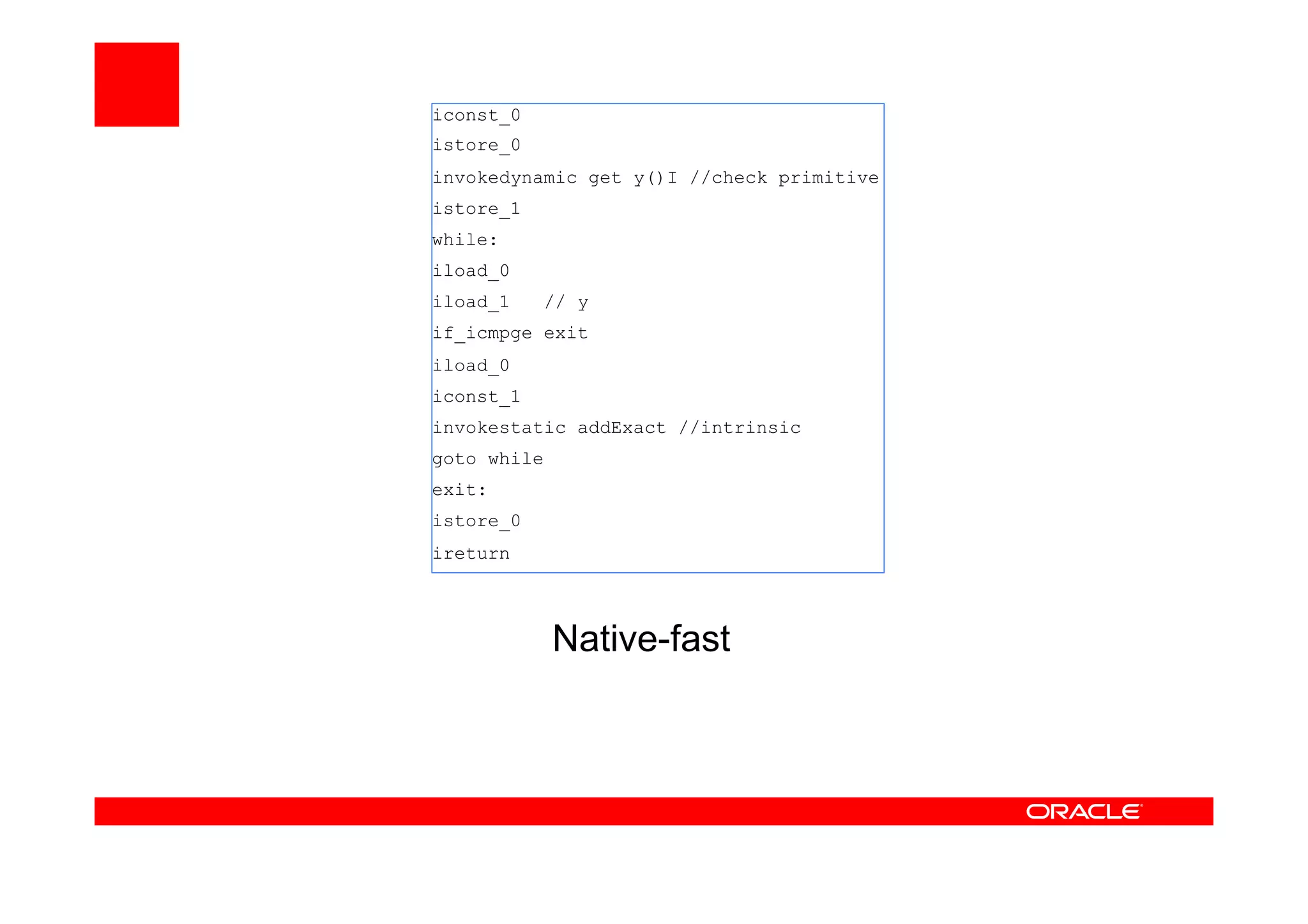
Native-fast
iconst_0
istore_0
invokedynamic get y()I //check primitive
istore_1
while:
iload_0
iload_1 // y
if_icmpge exit
iload_0
iconst_1
invokestatic addExact //intrinsic
goto while
exit:
istore_0
ireturn
We really want to use ints where we can
Very common instance of same problem.
function f() {
return 17 + array[3];
}
...
bipush 17
aload 2 //scope
invokedynamic get:array(Ljava/lang/Object;)Ljava/lang/Object;
aload 2
iconst_3
invokedynamic getElem(Ljava/lang/Object;I)Ljava/lang/Object;
invokedynamic ADD:OIO_I(ILjava/lang/Object;)Ljava/lang/Object;
areturn
We really want to use ints where we can
Very common instance of same problem.
function f() {
return 17 + array[3];
}
...
bipush 17
aload 2 //scope
invokedynamic get:array(Ljava/lang/Object;)Ljava/lang/Object;
aload 2
iconst_3
invokedynamic getElem(Ljava/lang/Object;I)I
invokestatic Math.addExact
ireturn
Using ints problem 2 of 2 – erroneous
assumptions
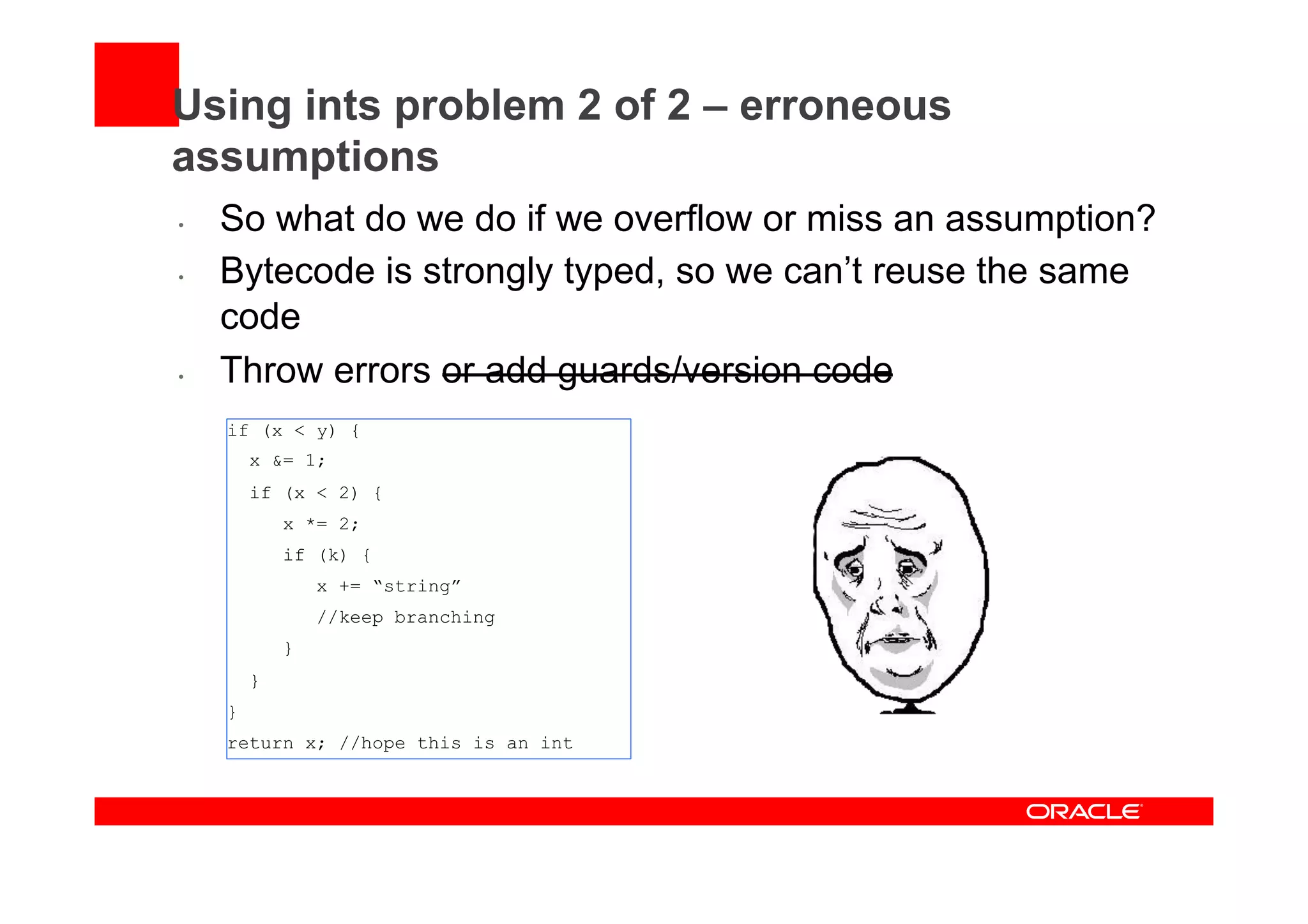
•  So what do we do if we overflow or miss an assumption?
•  Bytecode is strongly typed, so we can’t reuse the same
code
•  Throw errors or add guards/version code
•  So what do we do if we overflow or miss an assumption?
•  Bytecode is strongly typed, so we can’t reuse the same
code
•  Throw errors or add guards/version code
if (x < y) {
x &= 1;
if (x < 2) {
x *= 2;
if (k) {
x += “string”
//keep branching
}
}
}
return x; //hope this is an int
Using ints problem 2 of 2 – erroneous
assumptions
So add a catch block, take a
continuation and jump to a less
specialized version of the code
So add a catch block, take a
continuation and jump to a less
specialized version of the code
Uh-oh…
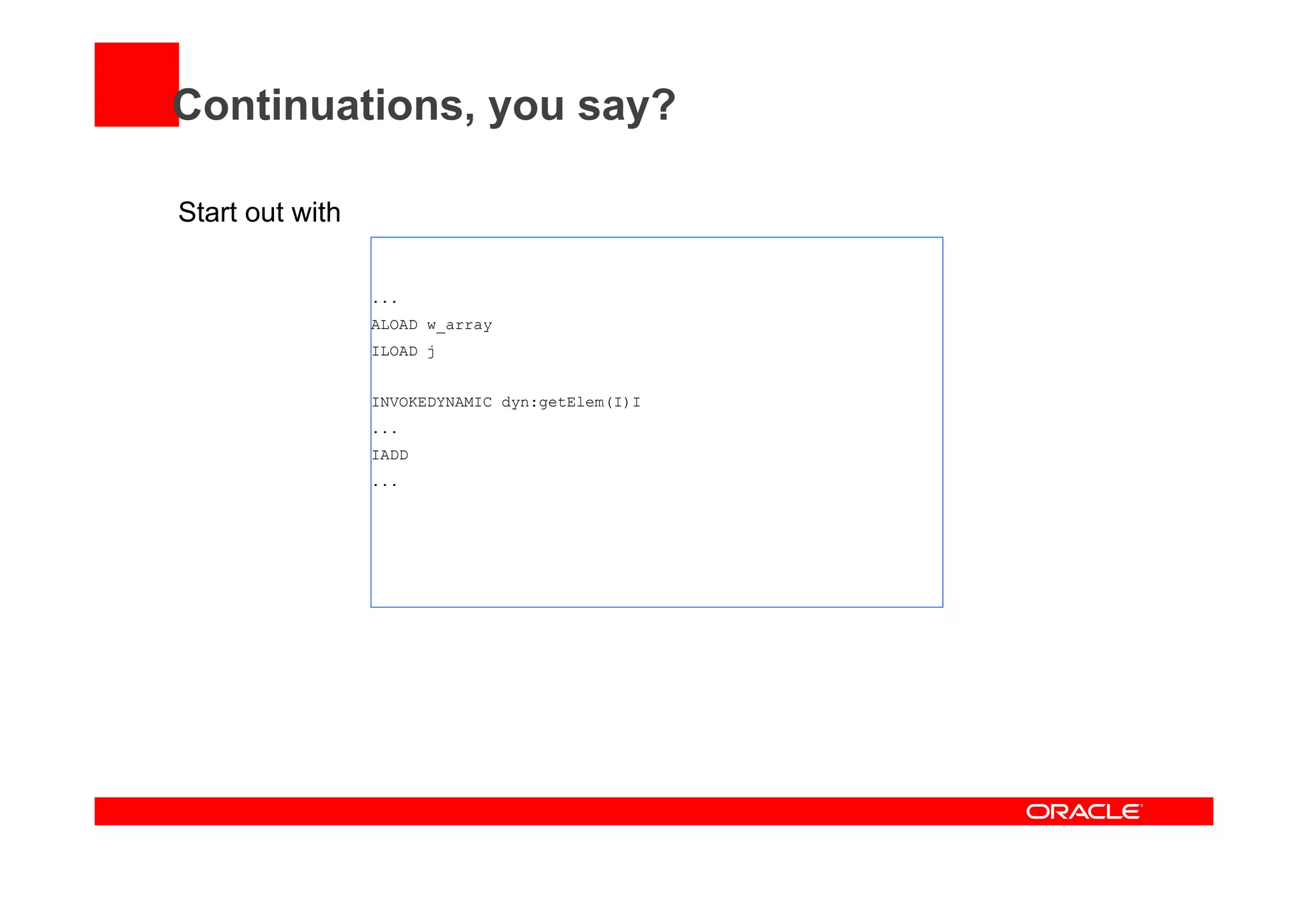
Continuations, you say?
Start out with
...
ALOAD w_array
ILOAD j
INVOKEDYNAMIC dyn:getElem(I)I
...
IADD
...
Continuations, you say?
Mark callsite optimistic, tag it with a program point
...
ALOAD w_array
ILOAD j
INVOKEDYNAMIC dyn:getElem(I)I [optimistic | pp 17]
...
IADD
...
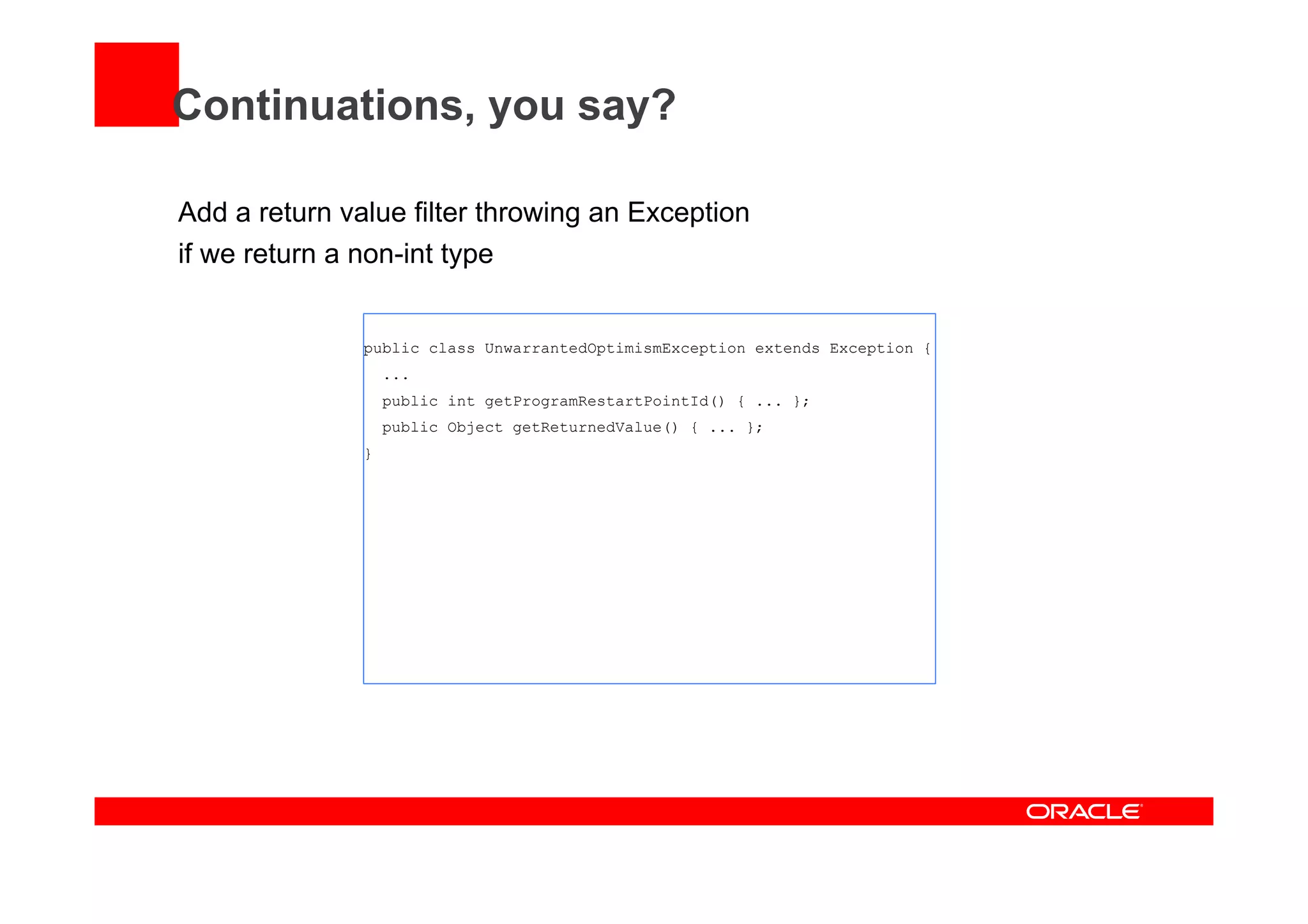
Continuations, you say?
Add a return value filter throwing an Exception
if we return a non-int type
public class UnwarrantedOptimismException extends Exception {
...
public int getProgramRestartPointId() { ... };
public Object getReturnedValue() { ... };
}
Continuations, you say?
Send a message to the caller to regenerate the method
try {
...
ALOAD w_array
ILOAD j
// make sure bc stack is written to locals
INVOKEDYNAMIC dyn:getElem(I)I [optimistic | pp 17]
...
IADD
...
} catch (UnwarrantedOptimismException e) {
// ask linker to regenerate method
throw new RewriteException(e.getId(), e.getReturnValue(), locals);
}
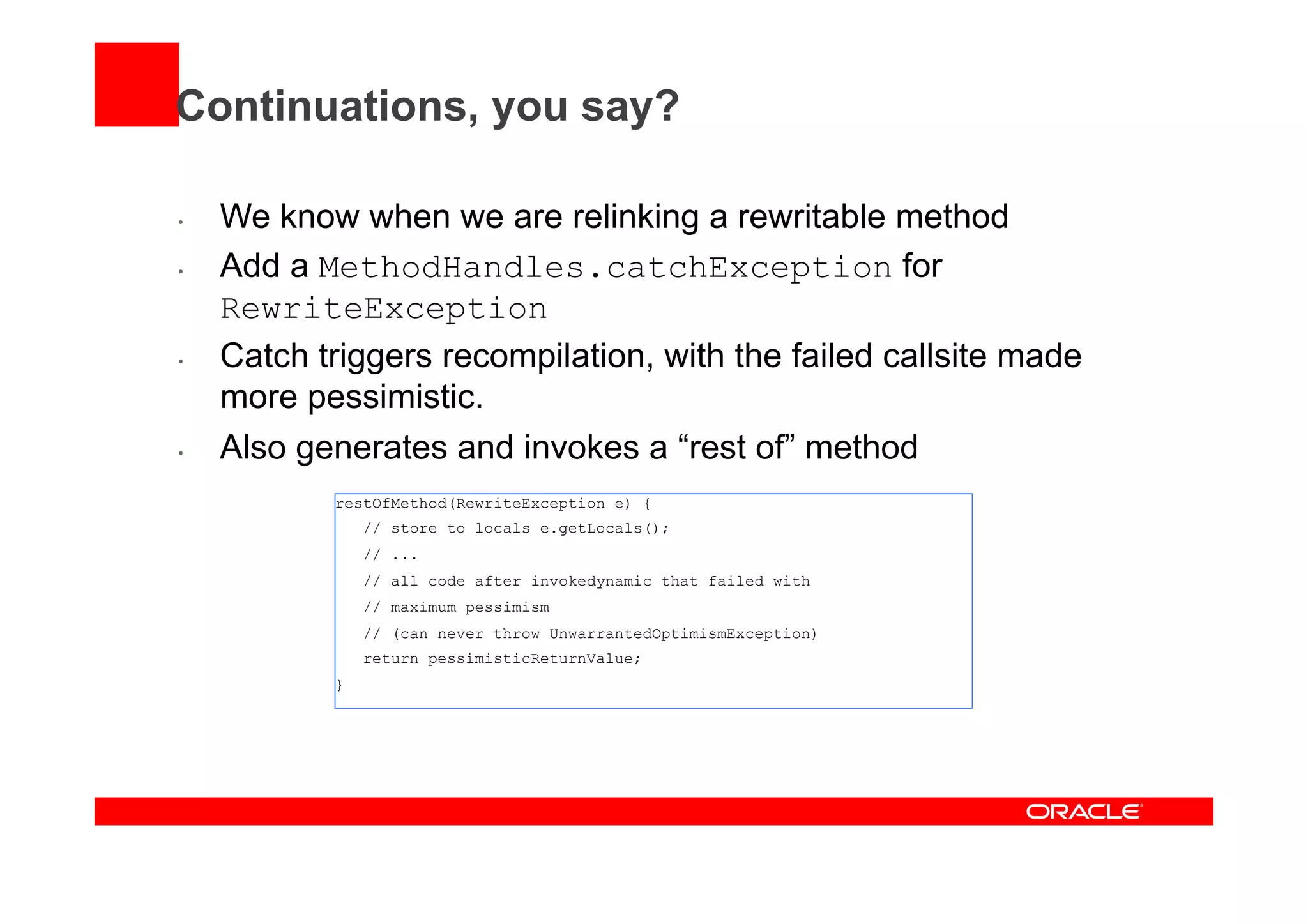
Continuations, you say?
•  We know when we are relinking a rewritable method
•  Add a MethodHandles.catchException for
RewriteException
•  Catch triggers recompilation, with the failed callsite made
more pessimistic.
•  Also generates and invokes a “rest of” method
restOfMethod(RewriteException e) {
// store to locals e.getLocals();
// ...
// all code after invokedynamic that failed with
// maximum pessimism
// (can never throw UnwarrantedOptimismException)
return pessimisticReturnValue;
}
The JVM situation
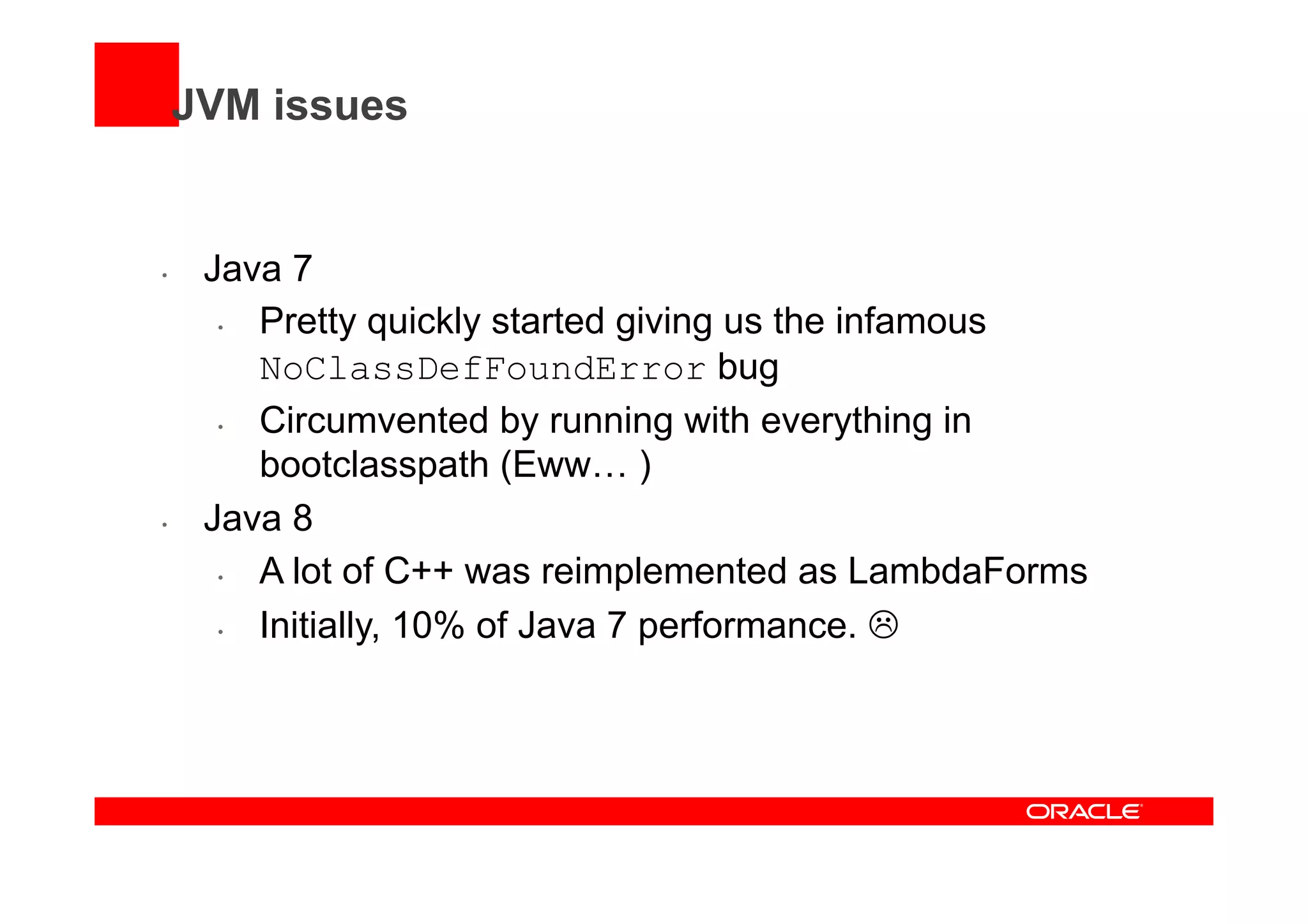
JVM issues
•  Java 7
•  Pretty quickly started giving us the infamous
NoClassDefFoundError bug
•  Circumvented by running with everything in
bootclasspath (Eww… )
•  Java 8
•  A lot of C++ was reimplemented as LambdaForms
•  Initially, 10% of Java 7 performance. L
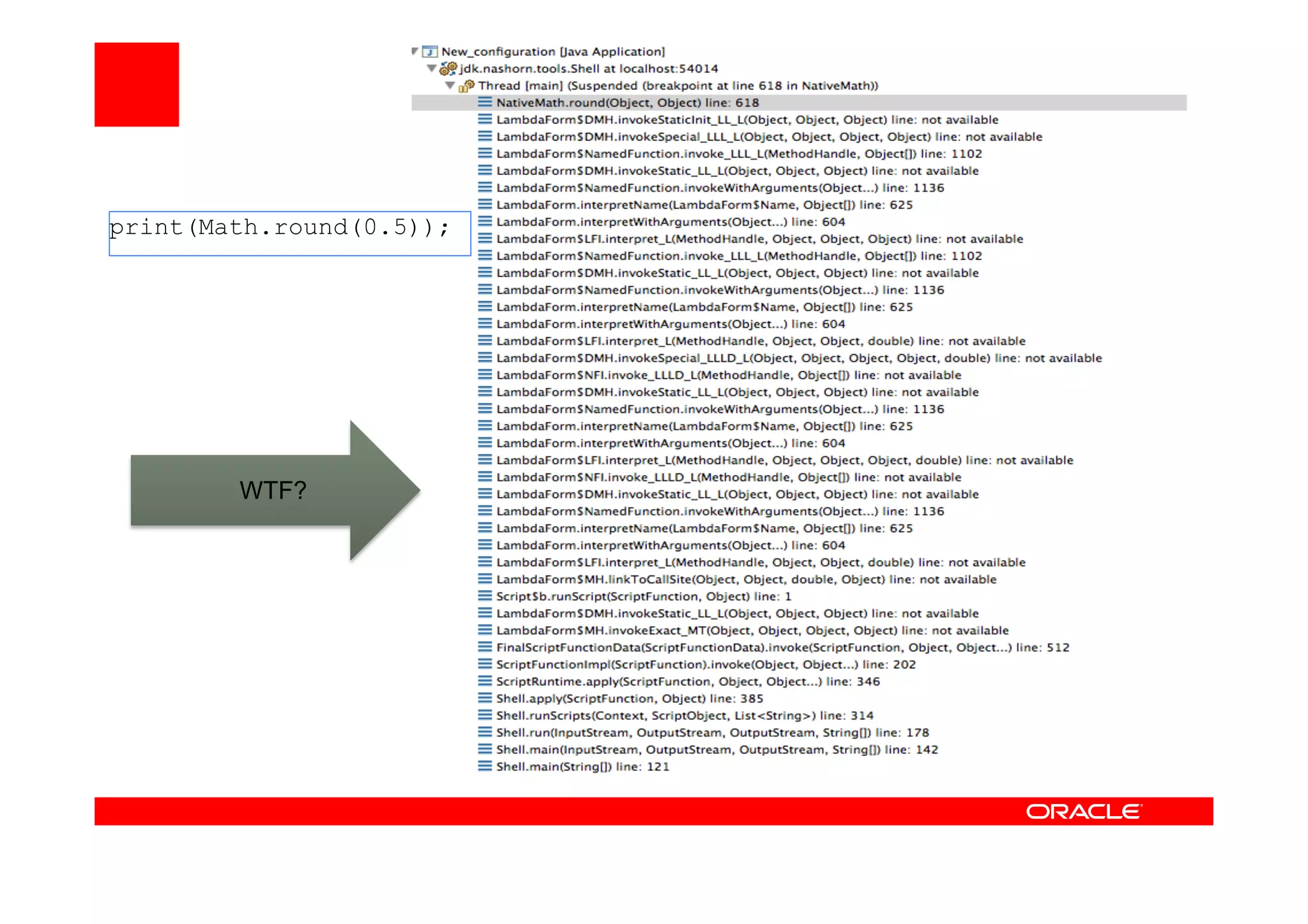
print(Math.round(0.5));
WTF?
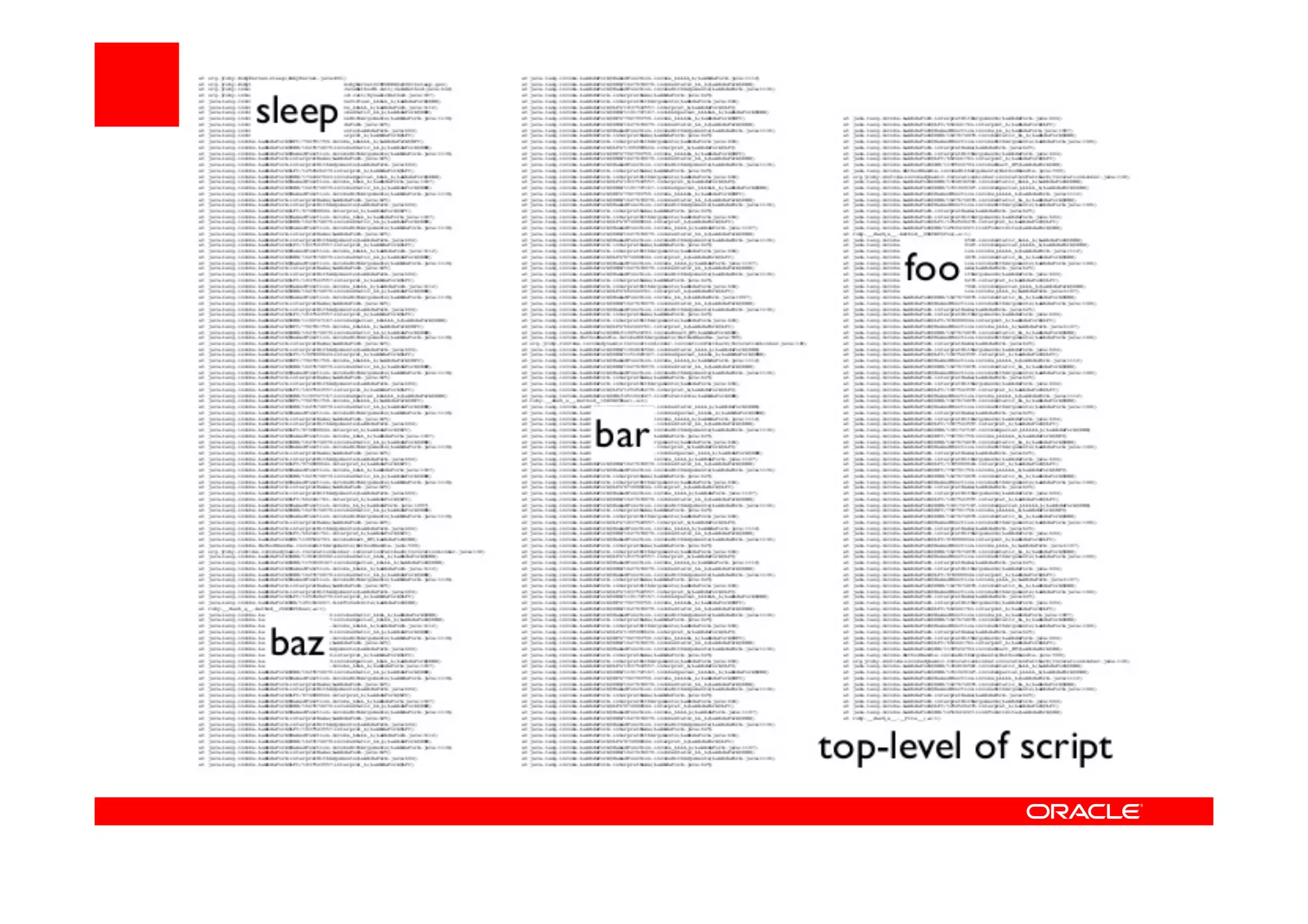
JVM issues
JVM issues
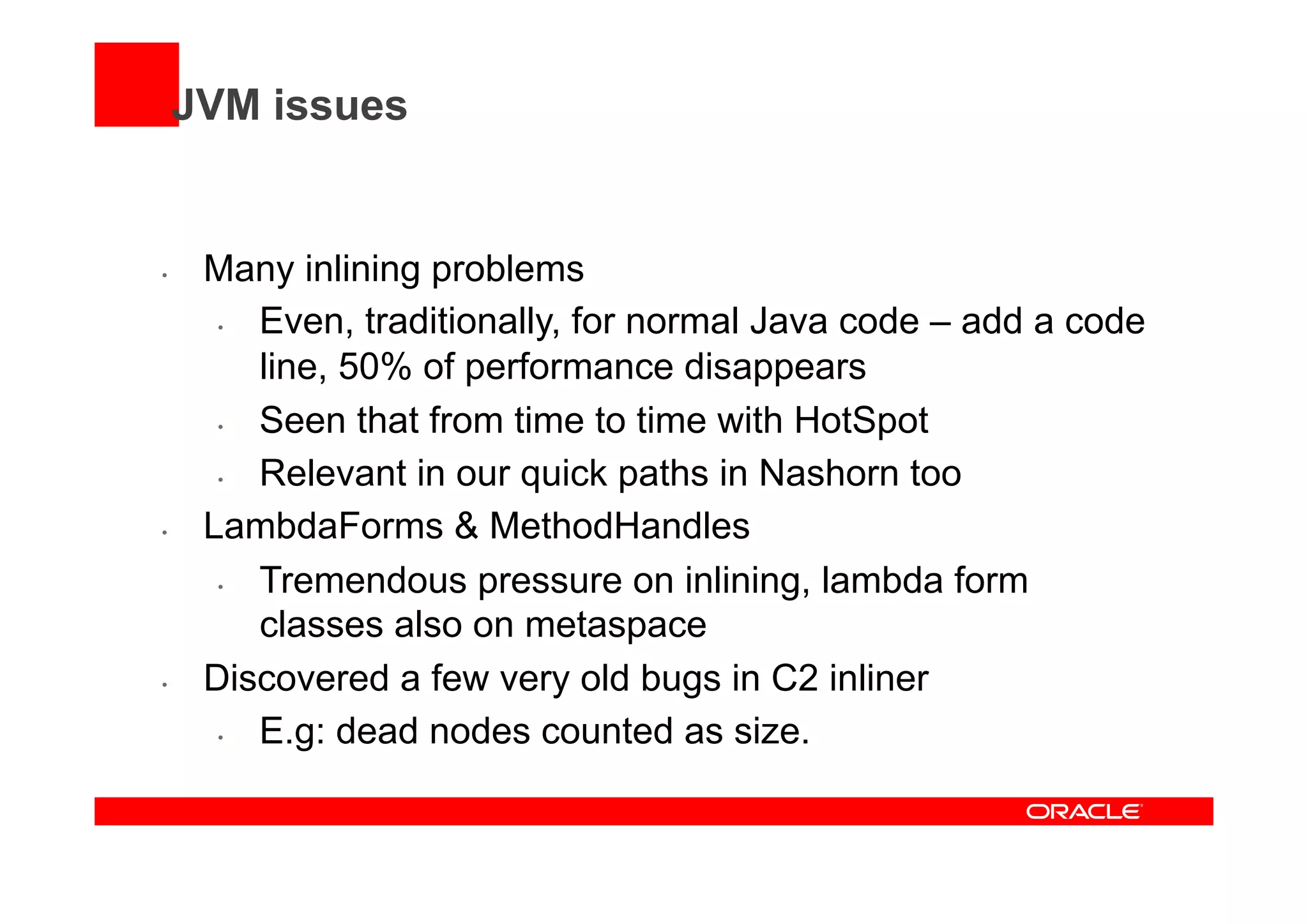
•  Many inlining problems
•  Even, traditionally, for normal Java code – add a code
line, 50% of performance disappears
•  Seen that from time to time with HotSpot
•  Relevant in our quick paths in Nashorn too
•  LambdaForms & MethodHandles
•  Tremendous pressure on inlining, lambda form
classes also on metaspace
•  Discovered a few very old bugs in C2 inliner
•  E.g: dead nodes counted as size.
JVM issues
JVM issues
JVM issues
•  LambdaForms compile a lot of code, generate a lot of
metaspace stress
•  If we have to have LambdaForms, they might not be able
to remain in bytecode land?
•  Inlining, despite tweaking has a lot of problems that
remain to be solved
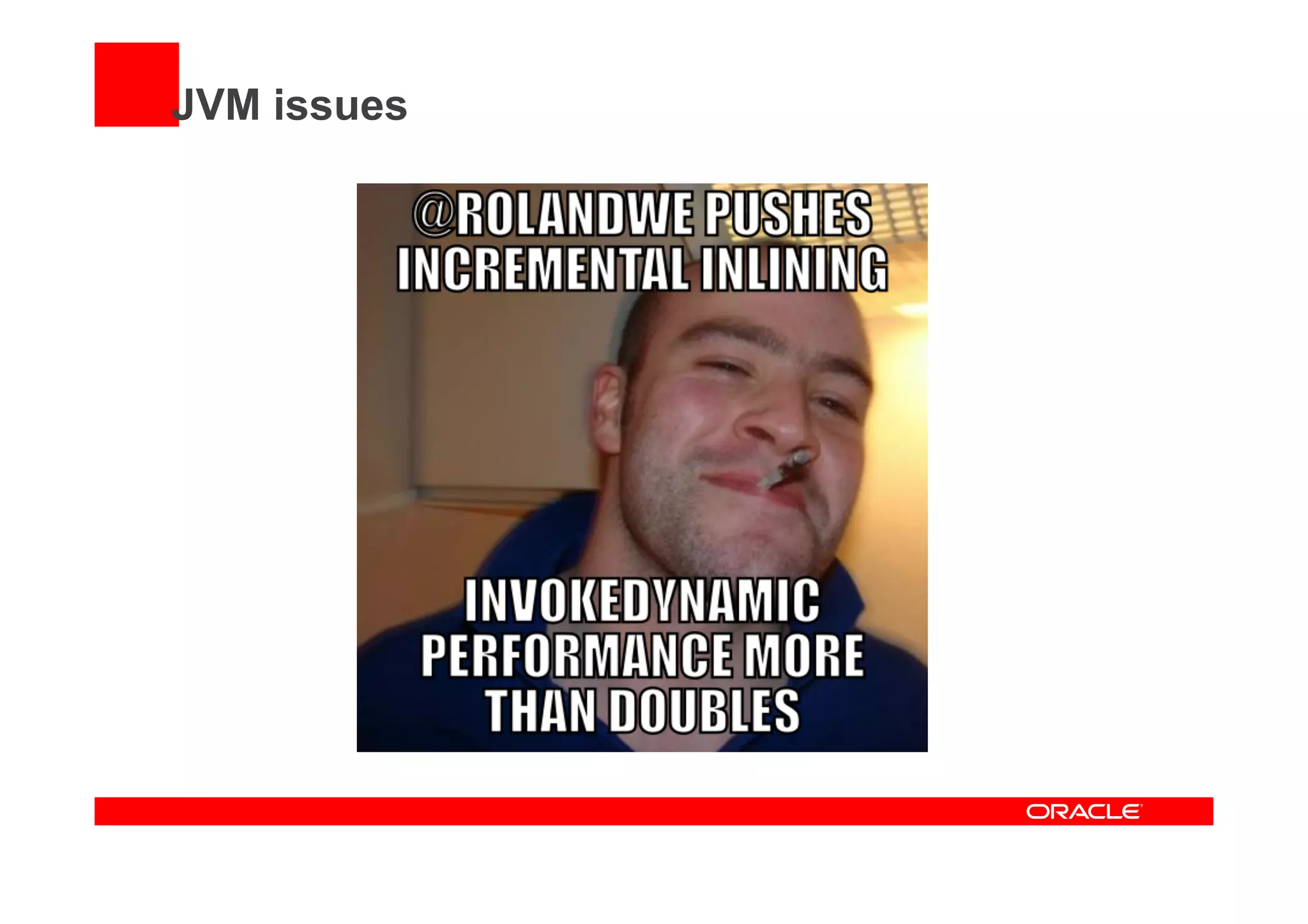
•  Boxing removal boxing removal boxing removal
•  (probably enabled by local escape analysis)
JVM issues
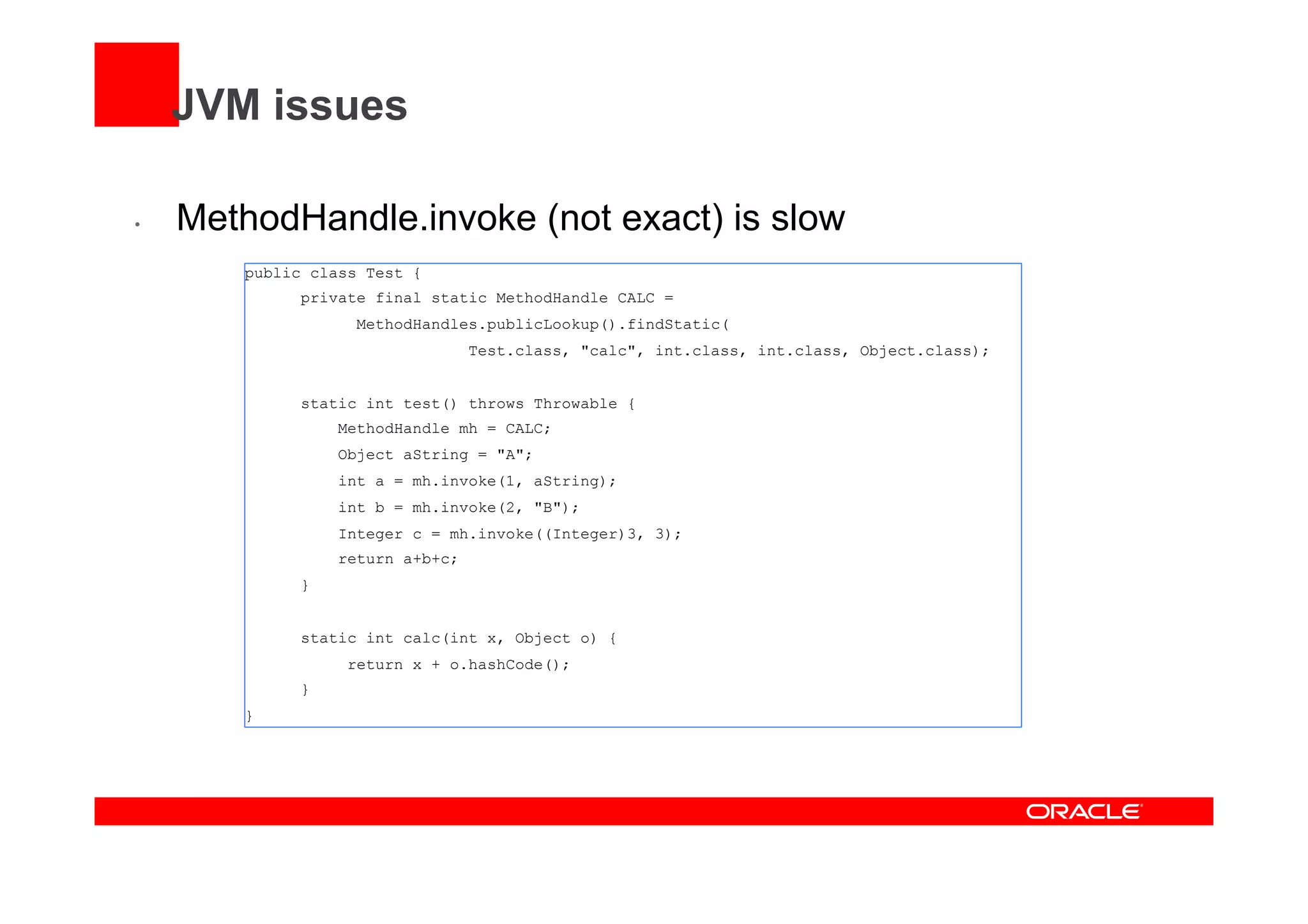
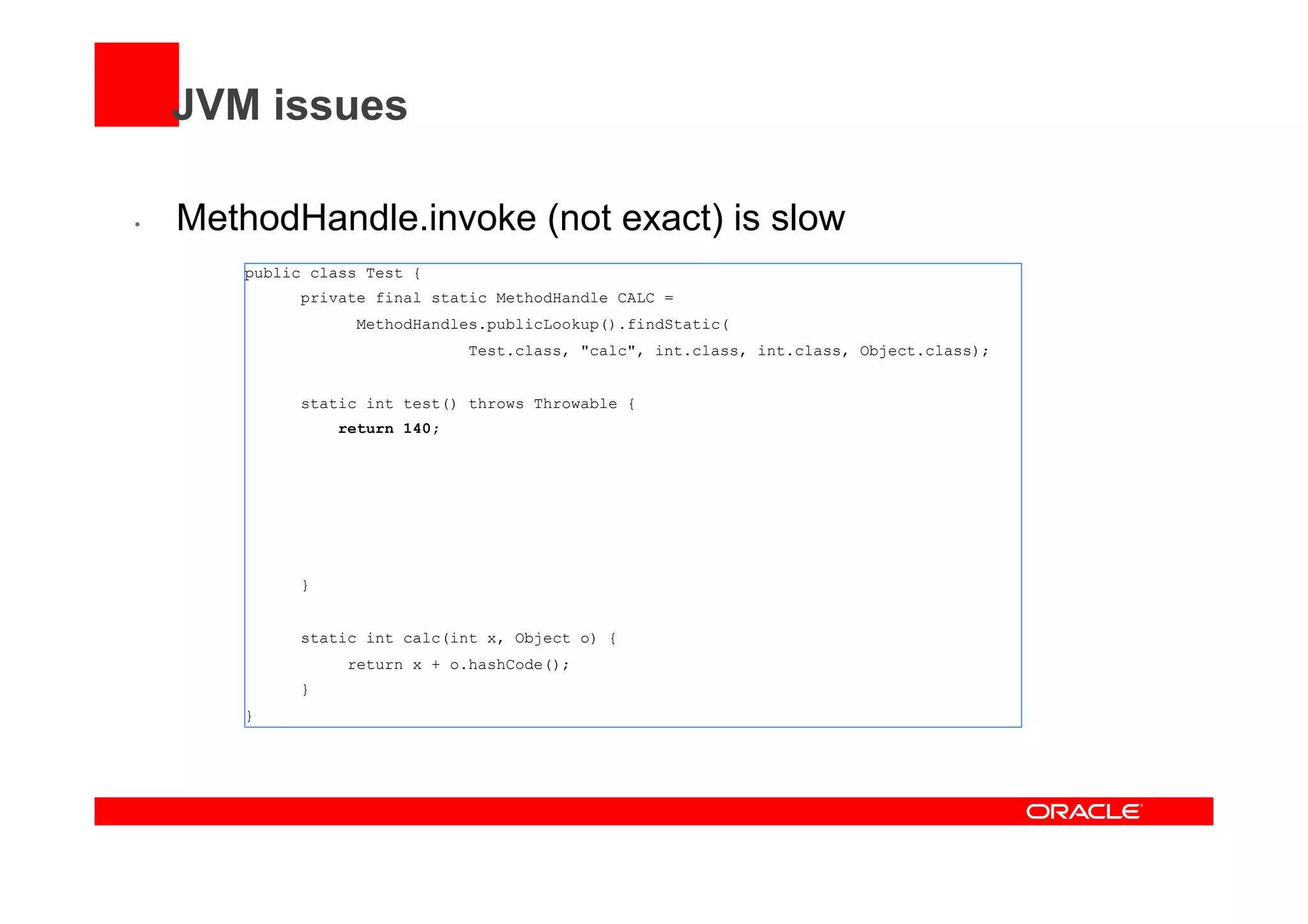
•  MethodHandle.invoke (not exact) is slow
public class Test {
private final static MethodHandle CALC =
MethodHandles.publicLookup().findStatic(
Test.class, "calc", int.class, int.class, Object.class);
static int test() throws Throwable {
MethodHandle mh = CALC;
Object aString = "A";
int a = mh.invoke(1, aString);
int b = mh.invoke(2, "B");
Integer c = mh.invoke((Integer)3, 3);
return a+b+c;
}
static int calc(int x, Object o) {
return x + o.hashCode();
}
}
JVM issues
•  MethodHandle.invoke (not exact) is slow
public class Test {
private final static MethodHandle CALC =
MethodHandles.publicLookup().findStatic(
Test.class, "calc", int.class, int.class, Object.class);
static int test() throws Throwable {
return 140;
}
static int calc(int x, Object o) {
return x + o.hashCode();
}
}
JVM issues
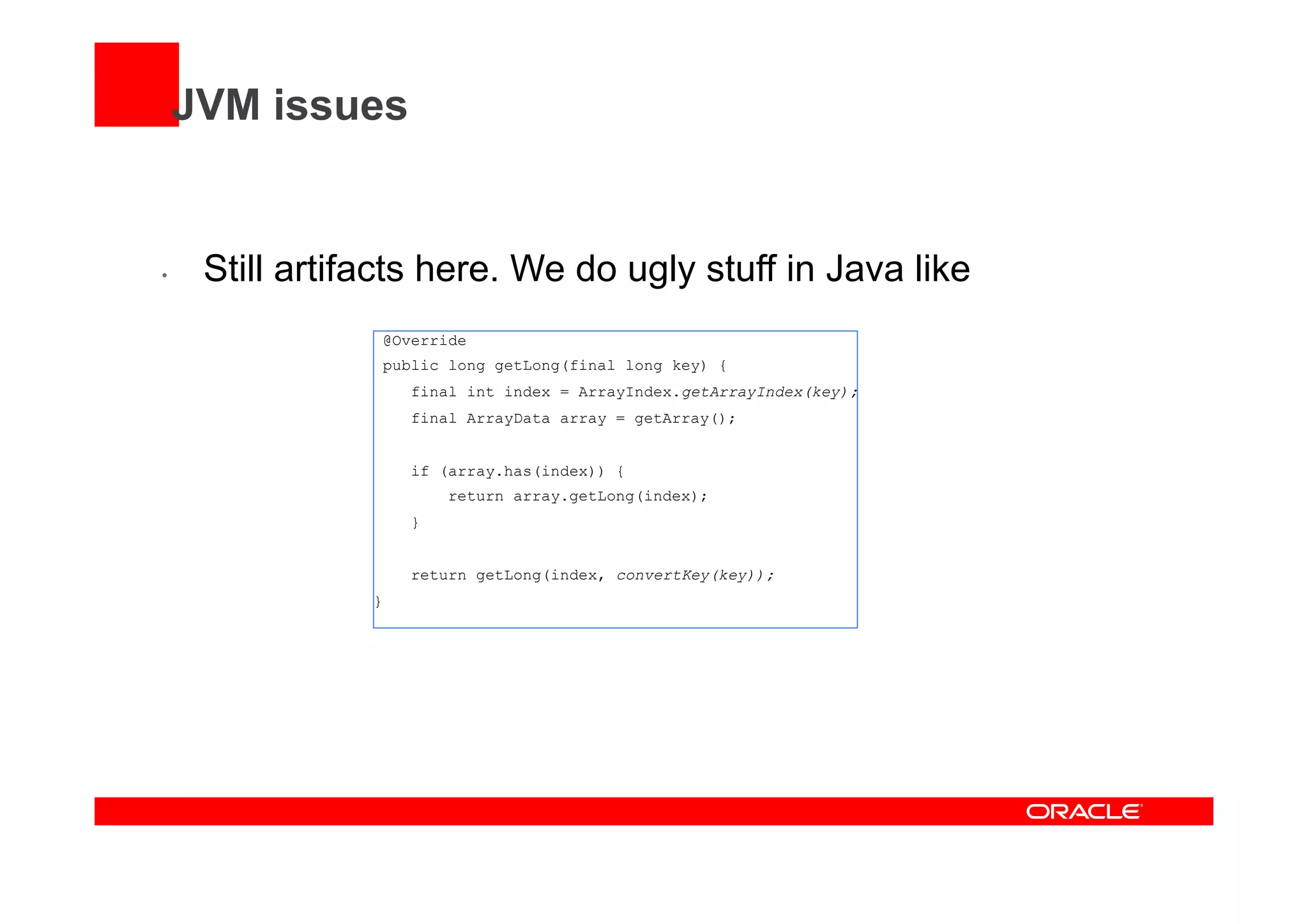
•  Still artifacts here. We do ugly stuff in Java like
@Override
public long getLong(final long key) {
final int index = ArrayIndex.getArrayIndex(key);
final ArrayData array = getArray();
if (array.has(index)) {
return array.getLong(index);
}
return getLong(index, convertKey(key));
}
JVM issues
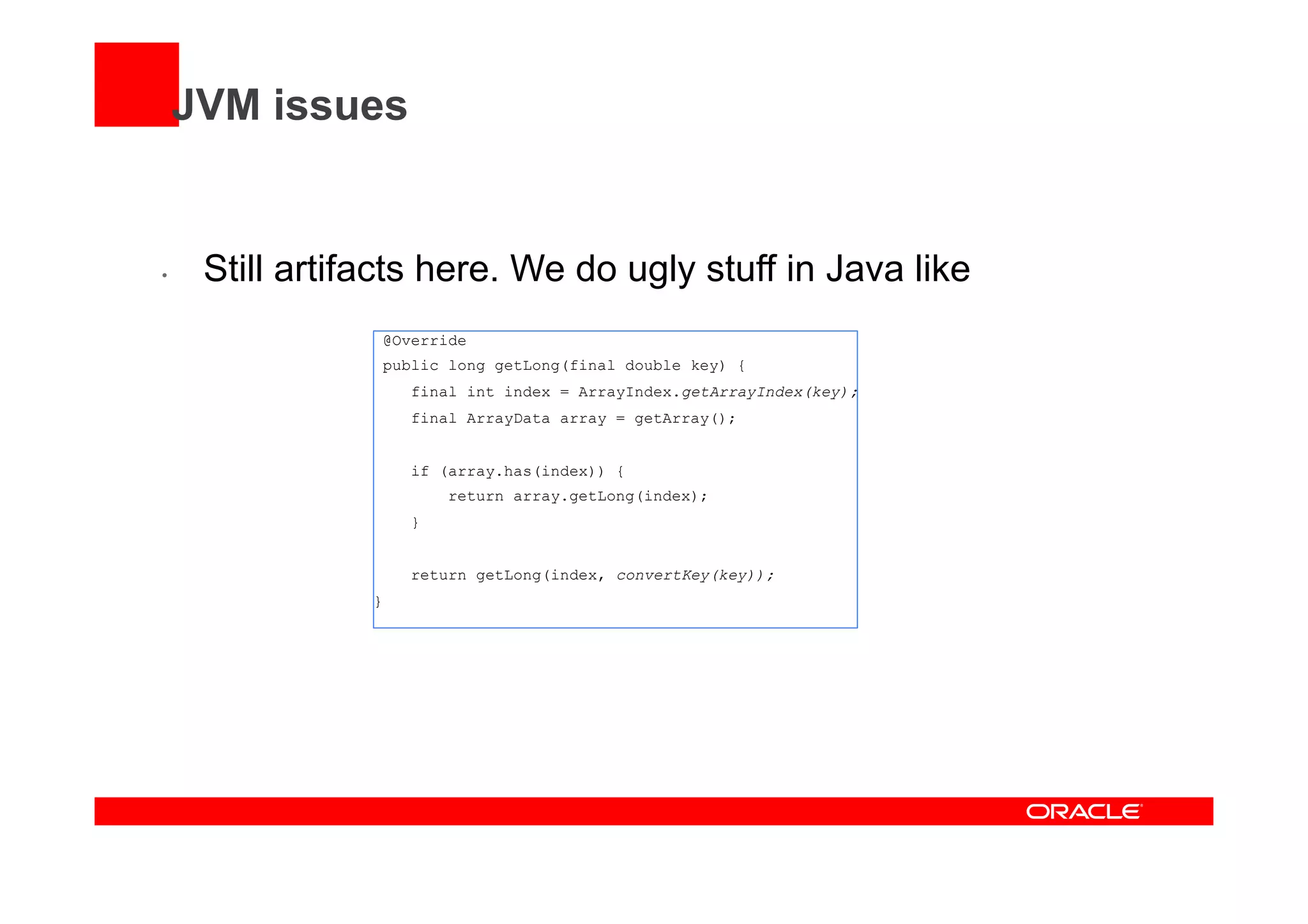
•  Still artifacts here. We do ugly stuff in Java like
@Override
public long getLong(final double key) {
final int index = ArrayIndex.getArrayIndex(key);
final ArrayData array = getArray();
if (array.has(index)) {
return array.getLong(index);
}
return getLong(index, convertKey(key));
}
JVM issues
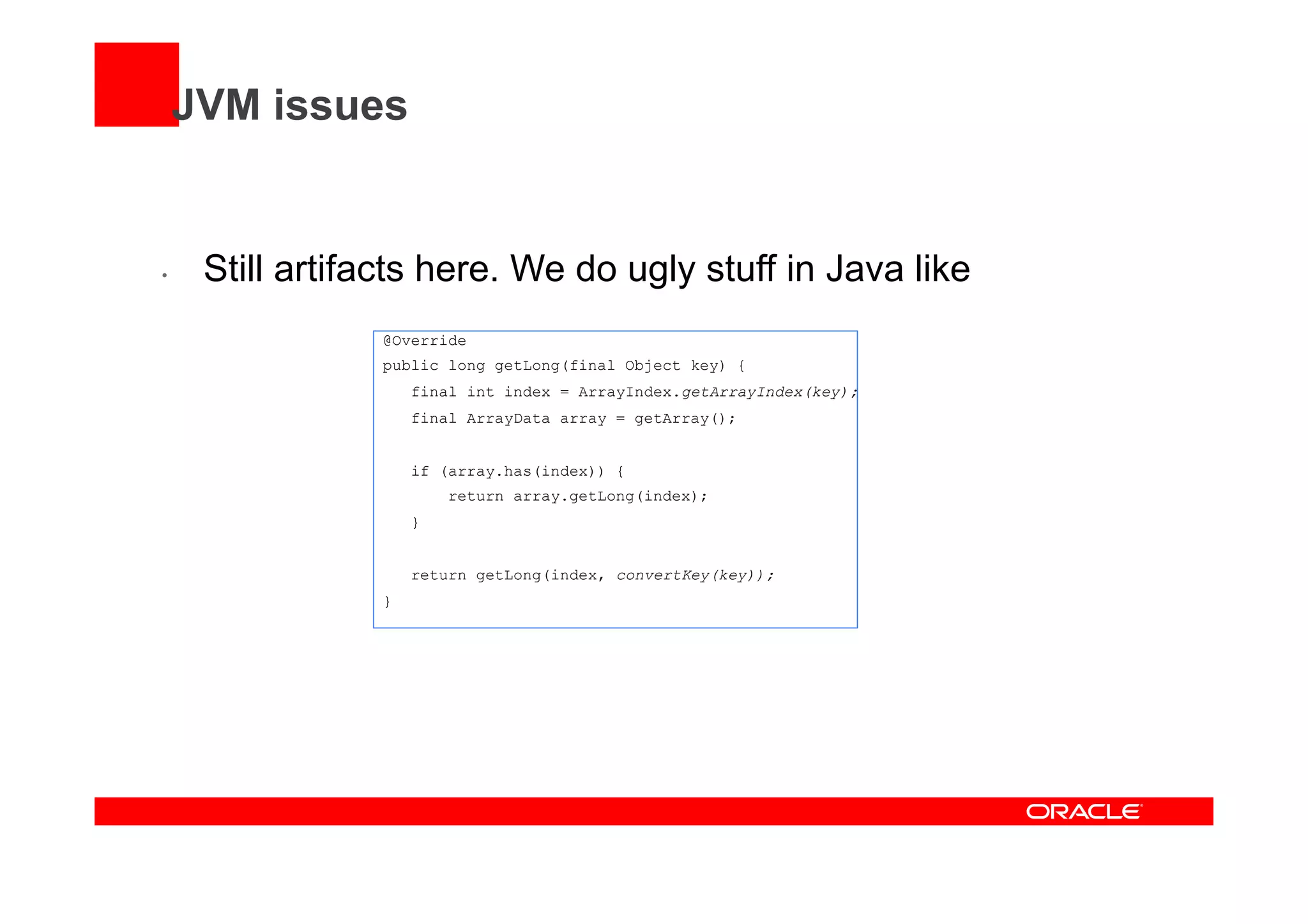
•  Still artifacts here. We do ugly stuff in Java like
@Override
public long getLong(final Object key) {
final int index = ArrayIndex.getArrayIndex(key);
final ArrayData array = getArray();
if (array.has(index)) {
return array.getLong(index);
}
return getLong(index, convertKey(key));
}
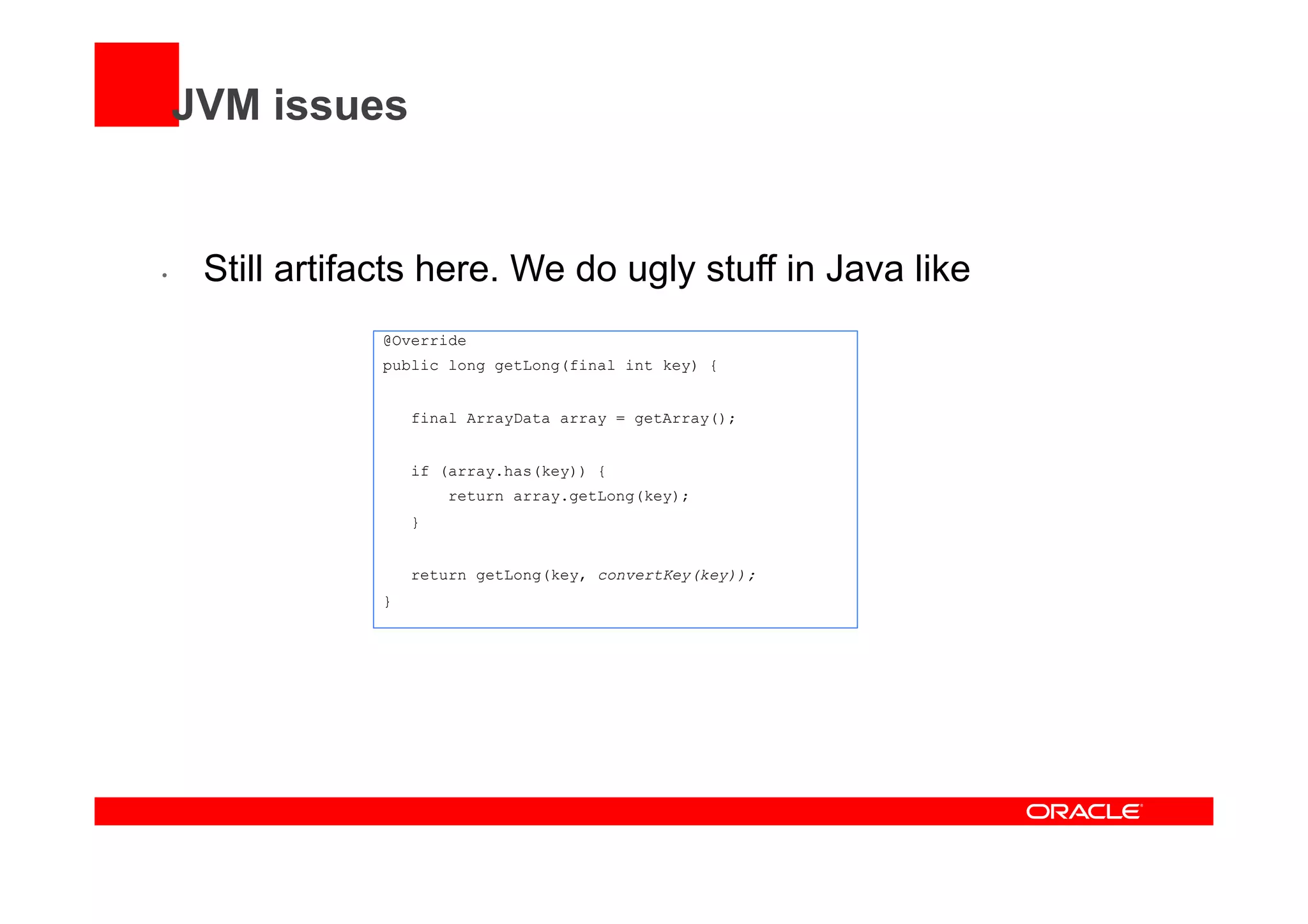
JVM issues
•  Still artifacts here. We do ugly stuff in Java like
@Override
public long getLong(final int key) {
final ArrayData array = getArray();
if (array.has(key)) {
return array.getLong(key);
}
return getLong(key, convertKey(key));
}
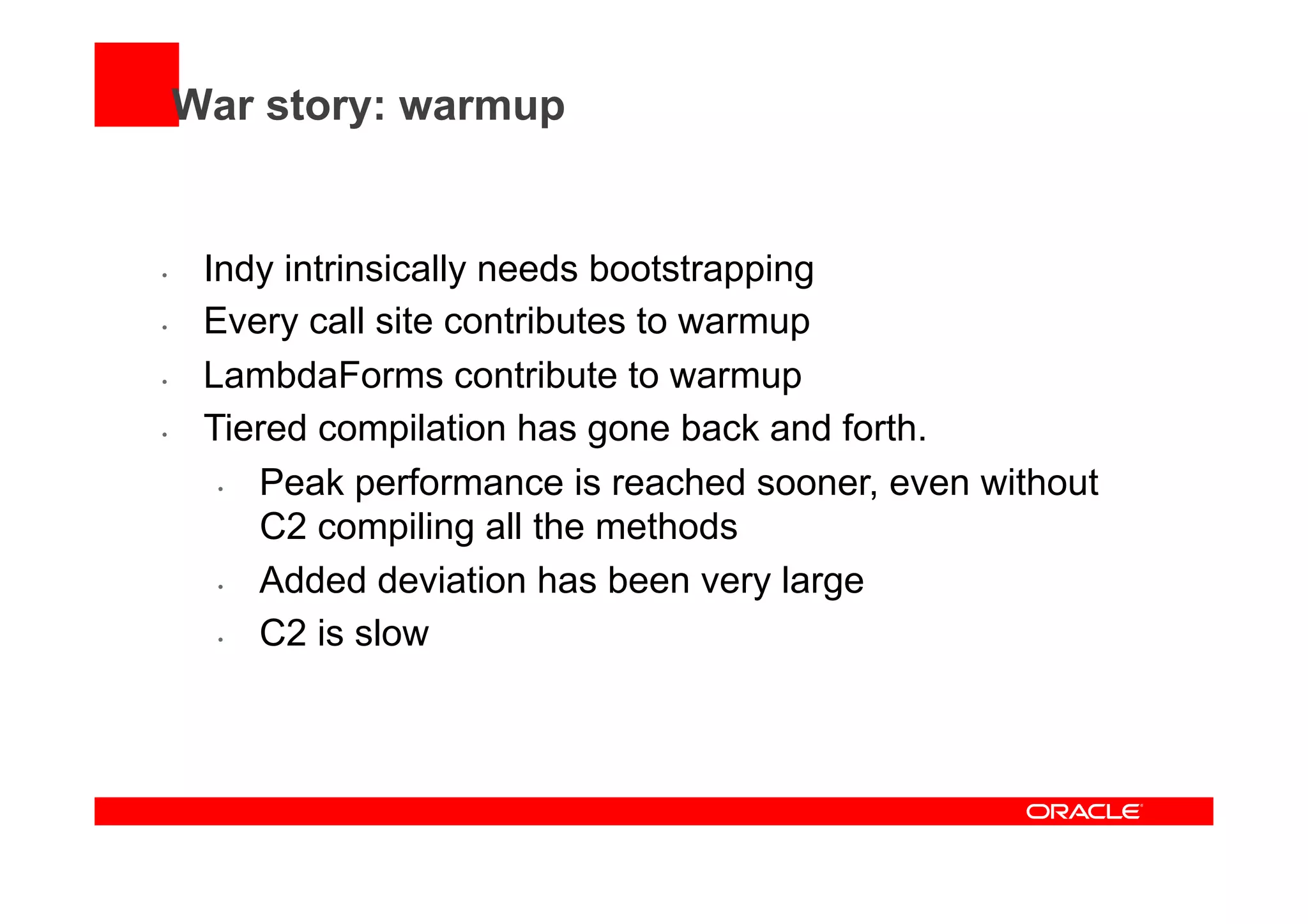
War story: warmup
•  Indy intrinsically needs bootstrapping
•  Every call site contributes to warmup
•  LambdaForms contribute to warmup
•  Tiered compilation has gone back and forth.
•  Peak performance is reached sooner, even without
C2 compiling all the methods
•  Added deviation has been very large
•  C2 is slow
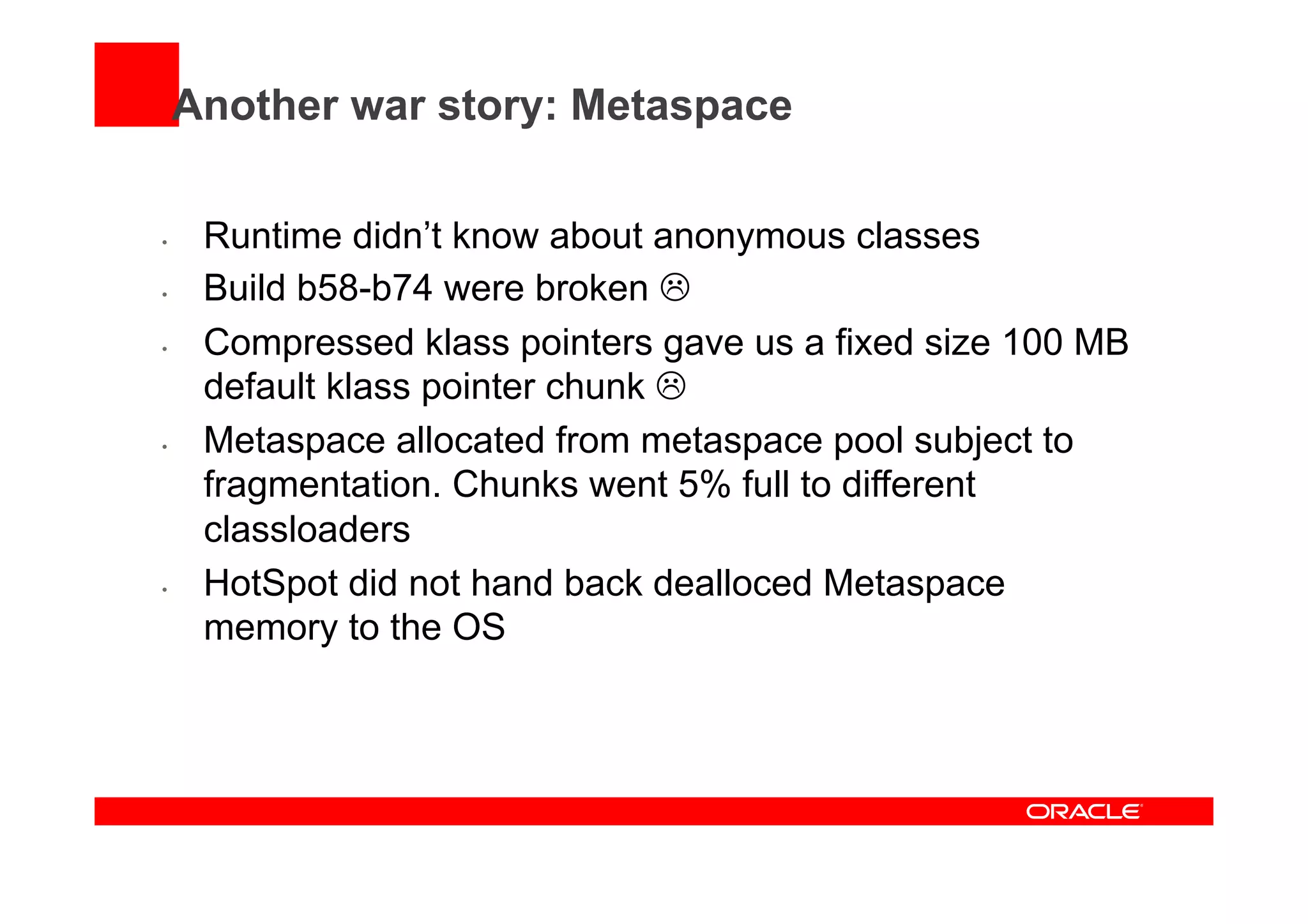
Another war story: Metaspace
•  Runtime didn’t know about anonymous classes
•  Build b58-b74 were broken L
•  Compressed klass pointers gave us a fixed size 100 MB
default klass pointer chunk L
•  Metaspace allocated from metaspace pool subject to
fragmentation. Chunks went 5% full to different
classloaders
•  HotSpot did not hand back dealloced Metaspace
memory to the OS
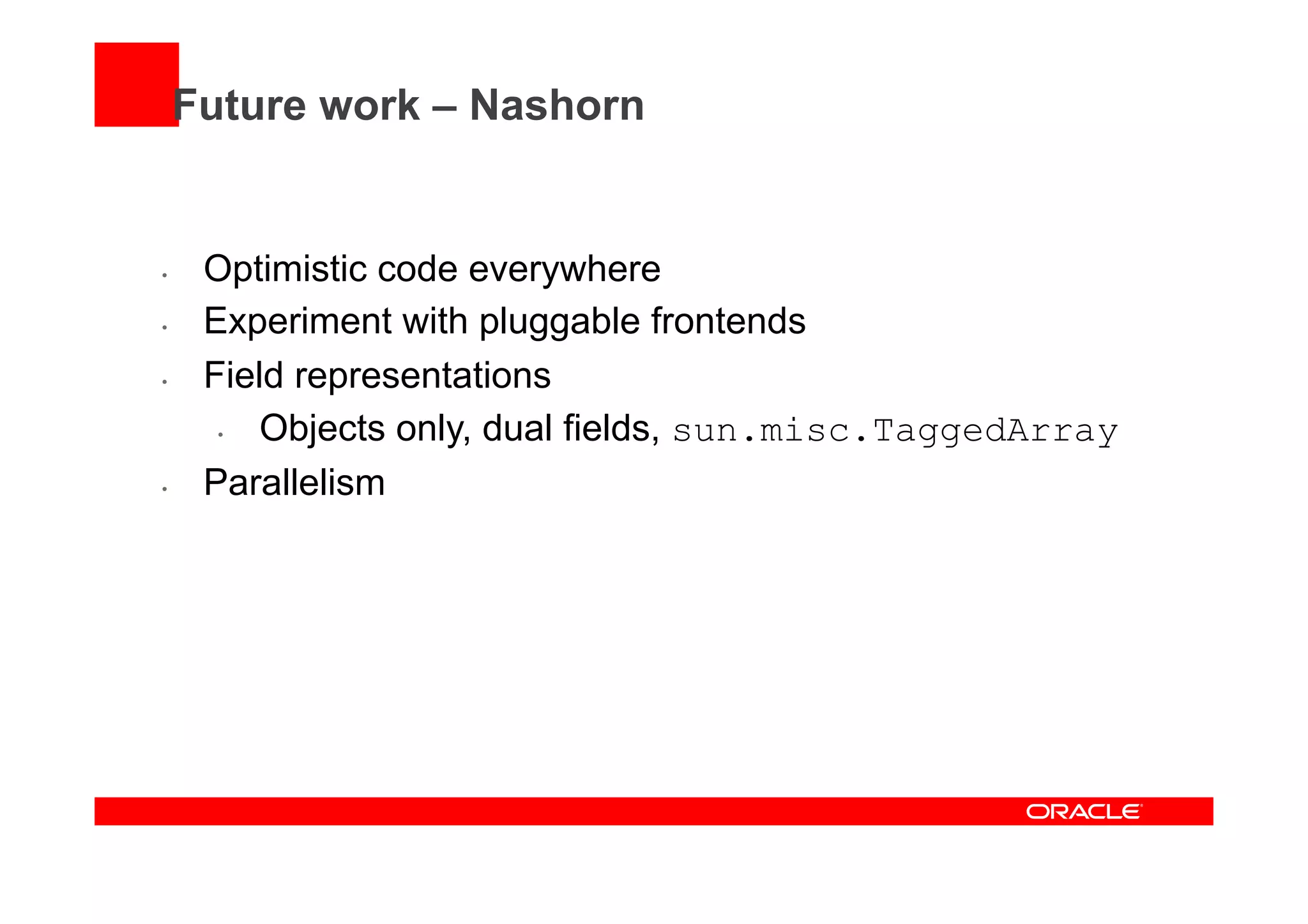
Future work – Nashorn
•  Optimistic code everywhere
•  Experiment with pluggable frontends
•  Field representations
•  Objects only, dual fields, sun.misc.TaggedArray
•  Parallelism
Future work - JVM
•  Boxing removal (probably requires Local EA)
•  Value types, sun.misc.TaggedArray?
•  Intrinsify Math.addExact and friends
(onFailLambda?)
•  MethodHandle.invoke must be fast
•  LambdaForms
•  Caching for footprint?
•  Replacing LambdaForms with something else?
•  Get them out of class/bytecode land
Future work - JVM
•  Is bytecode even the correct format to do this entire in
•  Pluggable frontends?
•  More magic: I probably really need to talk to my
compiler
•  Or have my compiler talk to me
Thank you!
Q&A?
@lagergren
Lagergren jvmls-2013-final

Lagergren jvmls-2013-final

  • 1.
    <Insert Picture Here> NashornWar Stories (from a battle scarred veteran of invokedynamic) Marcus Lagergren Oracle
  • 2.
    <Insert Picture Here> NashornRants (from a battle scarred veteran of invokedynamic) Marcus Lagergren Oracle
  • 3.
    The Legal Slide "THEFOLLOWING IS INTENDED TO OUTLINE OUR GENERAL PRODUCT DIRECTION. IT IS INTENDED FOR INFORMATION PURPOSES ONLY, AND MAY NOT BE INCORPORATED INTO ANY CONTRACT. IT IS NOT A COMMITMENT TO DELIVER ANY MATERIAL, CODE, OR FUNCTIONALITY, AND SHOULD NOT BE RELIED UPON IN MAKING PURCHASING DECISION. THE DEVELOPMENT, RELEASE, AND TIMING OF ANY FEATURES OR FUNCTIONALITY DESCRIBED FOR ORACLE'S PRODUCTS REMAINS AT THE SOLE DISCRETION OF ORACLE."
  • 4.
  • 5.
    I am hereto talk about…
  • 6.
    I am hereto talk about… What we’ve suffered through so far to implement a dynamic language on the JVM
  • 7.
    I am hereto talk about… What we’ve suffered through so far to implement a dynamic language on the JVM The Nashorn Project
  • 8.
    Also – aparade of JavaScript horrors
  • 9.
    Agenda •  What isNashorn and why? •  The problem of compiling an alien language to Java [sic] bytecode •  Types •  Optimistic assumptions •  The JVM and its issues
  • 10.
  • 11.
    What is Nashorn? • Nashorn is a 100% pure Java runtime for JavaScript •  Nashorn generates bytecode •  Invokedynamics are everywhere •  Nashorn currently performs somewhere on the order of ~2-10x better than Rhino •  Nashorn is in JDK 8 •  Nashorn is 100% ECMAScript compliant •  Nashorn has a well thought through security model
  • 12.
    Why Nashorn? •  Startedas an invokedynamic POC. •  Rhino is still alive today after ~18 years. Why? •  JSR-223 •  Nashorn is now mature and replaces Rhino for Java 8
  • 15.
  • 16.
  • 17.
    When is Nashornavailable? •  Nashorn is part of OpenJDK8 •  Already available in JDK 8 builds. > jjs jjs> var x = “hello”; jjs> print(x); hello jjs>
  • 18.
    Compiling an alien languageto Java [sic] bytecode
  • 19.
    Compiling an alien(non-Java language) to bytecode
  • 20.
    Compiling an alien(non-Java language) to bytecode •  Scala is fairly good fit
  • 21.
    Compiling an alien(non-Java language) to bytecode •  Scala is fairly good fit •  Yes I know: hard tail call optimization, interface injection etc.
  • 22.
    Compiling an alien(non-Java language) to bytecode •  Scala is fairly good fit •  Yes I know: hard tail call optimization, interface injection etc. •  Ruby and JavaScript are pretty bad fits
  • 23.
    Compiling an alien(non-Java language) to bytecode •  Scala is fairly good fit •  Yes I know: hard tail call optimization, interface injection etc. •  Ruby and JavaScript are pretty bad fits •  No types •  Things change at runtime. A lot. •  Invokedynamic certainly alleviates a lot of the pain, but plenty of stuff remains to be solved
  • 24.
    JavaScript! Was it deliberately designedto make every efficient representation useless?
  • 25.
    Let’s talk aboutJavaScript jjs> Array.prototype[1] = 17;
  • 26.
    Let’s talk aboutJavaScript jjs> Array.prototype[1] = 17; 17 jjs>
  • 27.
    Let’s talk aboutJavaScript jjs> Array.prototype[1] = 17; 17 jjs> print([,,,]);
  • 28.
    Let’s talk aboutJavaScript jjs> Array.prototype[1] = 17; 17 jjs> print([,,,]); ,17, jjs>
  • 29.
    Let’s talk aboutJavaScript - Numbers •  Numbers in JavaScript have no fixed ranges •  “Intish”. “Doublish”. •  Not very nice for strongly typed bytecode •  Overflows must be handled •  Conservative: At least they tend to fit in Java doubles.
  • 30.
    Let’s talk aboutJavaScript - Numbers •  Double arithmetic is slower than integer arithmetic on modern HW •  Double arithmetic is sometimes even faster than int arithmetic with the necessary overflow checks. •  WAT! •  (getting back to that)
  • 31.
    Let’s talk aboutJavaScript – Types/Numbers •  HotSpot itself was originally tested and developed with bytecode that came from Java •  Representing everything as Objects to get the bytecode format type agnostic is nowhere near viable, performance wise. •  Boxing •  Go primitive
  • 32.
    We should •  Forbytecode performance we should •  Use whatever static types we have •  (mostly) done •  Optimistically assume stuff about types •  On it
  • 33.
    Let’s talk aboutJavaScript – Static type info •  JavaScript type coercion semantics and literals – uses and definitions •  That’s all the static type info we’re going to get from the compiler •  Java int: statically enough for ~,&,|,^ •  Java double: statically enough for: *,/,-,% •  Object: binary + and pretty much everything else
  • 34.
    Let’s talk aboutJavaScript – Static type info •  Callsites, though. How do we deal with parameter types? int square(int x) { return x * x; } iload_0 dup imul ireturn
  • 35.
    Let’s talk aboutJavaScript – Static type info •  But… function square(x) { return x * x; } jjs> square(2) 4 jjs> square(2.1) 4.41 jjs> square(“a”) NaN
  • 36.
    Let’s talk aboutJavaScript – Static type info •  So conservatively… square(Ljava/lang/Object;)D aload_0 // hopefully just unbox: invokestatic coerce2Double(Ljava/lang/Object;)D dup dmul // returns mul result, so always double dreturn
  • 37.
    Let’s talk aboutJavaScript – Static type info •  Guess again jjs> square({ valueOf: function() { global++; return 2 + global; }); ...
  • 38.
    Let’s talk aboutJavaScript – Static type info •  So conservatively… square(Ljava/lang/Object;)D aload_0 // hopefully just unbox: invokestatic coerce2Double(Ljava/lang/Object;)D dup dmul // returns mul result, so always double dreturn
  • 39.
    Let’s talk aboutJavaScript – Static type info *sigh* - well at least the return value HAS to be double square(Ljava/lang/Object;)D aload_0 invokestatic coerce2Double(Ljava/lang/Object;)D aload_0 invokestatic coerce2Double(Ljava/lang/Object;)D dmul // returns mul result, so always double dreturn
  • 40.
    JavaScript has alot of magic in its number coercion var dict = Object.create(null); var key = ‘valueOf’; //later dict[key] = formatHarddriveFunction; //much later dict++;
  • 41.
    … and thisturns into “10”, of course ++[[]][+[]]+[+[]] === “10” Brendan
  • 42.
    Fibbonacci calculator function fib(_){ for(_=[+[],++[[]][+[]],+[],_],_[++[++[++[[]][+[]]] [+[]]][+[]]]=(((_[++[++[++[[]][+[]]][+[]]][+[]]]- (++[[]][+[]]))&(((--[[]][+[]])>>>(++[[]][+[]])))) ===(_[++[++[++[[]][+[]]][+[]]][+[]]]- (++[[]][+[]])))?(_[++[++[[]][+[]]][+[]]]= ++[[]][+[]],_[++[++[++[[]][+[]]][+[]]][+[]]]- (++[[]][+[]])):+[];_[++[++[++[[]][+[]]][+[]]] [+[]]]--;_[+[]]=(_[++[[]][+[]]]= _[++[++[[]][+[]]][+[]]]=_[+[]]+_[++[[]][+[]]])- _[+[]]); return _[++[++[[]][+[]]][+[]]]; }
  • 43.
    Callsite specialization •  Wecan, and do, use static callsite types though. •  (ignore int overflows for a bit) // Even if square is replaced, callsite type is not // It always takes a number, always returns a number var a = b * square(17.0);
  • 44.
    Callsite specialization •  Wecan, and do, use static callsite types though. •  (ignore int overflows for a bit) // Even if square is replaced, callsite type is not // It always takes a number, always returns a number var a = b * square(17.0); square(D)D dload 0 dup dmul dreturn
  • 45.
    Callsite specialization •  Wecan, and do, use static callsite types though. •  (ignore int overflows for a bit) // Even if square is replaced, callsite type is not // It always takes a number, always returns a number var a = b * square(17.0); square = function(x) { return x + “string”; } square(D)D dload 0 dup dmul dreturn
  • 46.
    Callsite specialization square(Ljava/lang/Object;)Ljava/lang/Object; aload 0 ldc“string” JS_ADD(Ljava/lang/Object;Ljava/lang/Object);Ljava/lang/Object; areturn
  • 47.
    Callsite specialization square(Ljava/lang/Object;)Ljava/lang/Object; aload 0 ldc“string” JS_ADD(Ljava/lang/Object;Ljava/lang/Object);Ljava/lang/Object; areturn revert_square(D)D dload 0 coerceToJSObject(D)Ljava/lang/Object; # param filter invokedynamic square(Ljava/lang/Object;)Ljava/lang/Object; coerceToDouble(Ljava/lang/Object;)D dreturn
  • 48.
    Callsite specialization square(Ljava/lang/Object;)Ljava/lang/Object; aload 0 ldc“string” JS_ADD(Ljava/lang/Object;Ljava/lang/Object);Ljava/lang/Object; areturn revert_square(D)D dload 0 coerceToJSObject(D)Ljava/lang/Object; # param filter invokedynamic square(Ljava/lang/Object;)Ljava/lang/Object; coerceToDouble(Ljava/lang/Object;)D dreturn
  • 49.
    Static compile timetypes bring us performance, [But they are too rare to take us all the way]
  • 50.
    Type Specialization function am3(i,x,w,j,c,n){ var this_array = this.array; var w_array = w.array; var xl = x&0x3fff, xh = x>>14; while(--n >= 0) { var l = this_array[i]&0x3fff; var h = this_array[i++]>>14; var m = xh*l+h*xl; l = xl*l+((m&0x3fff)<<14)+w_array[j]+c; c = (l>>28)+(m>>14)+xh*h; w_array[j++] = l&0xfffffff; } return c; }
  • 51.
    Type Specialization –Prove ints function am3(i,x,w,j,c,n) { var this_array = this.array; var w_array = w.array; var xl = x&0x3fff, xh = x>>14; while(--n >= 0) { var l = this_array[i]&0x3fff; var h = this_array[i++]>>14; var m = xh*l+h*xl; l = xl*l+((m&0x3fff)<<14)+w_array[j]+c; c = (l>>28)+(m>>14)+xh*h; w_array[j++] = l&0xfffffff; } return c; }
  • 52.
    Type Specialization –prove doubles function am3(i,x,w,j,c,n) { var this_array = this.array; var w_array = w.array; var xl = x&0x3fff, xh = x>>14; while(--n >= 0) { var l = this_array[i]&0x3fff; var h = this_array[i++]>>14; var m = xh*l+h*xl; l = xl*l+((m&0x3fff)<<14)+w_array[j]+c; c = (l>>28)+(m>>14)+xh*h; w_array[j++] = l&0xfffffff; } return c; }
  • 53.
    Static range analysis– fold doubles to ints function am3(i,x,w,j,c,n) { var this_array = this.array; var w_array = w.array; var xl = x&0x3fff, xh = x>>14; // xl = max 32 bits, xh: 18 bits while(--n >= 0) { var l = this_array[i]&0x3fff; // l max 12 bits var h = this_array[i++]>>14; // h max (32-14) = 18 bits var m = xh*l+h*xl; // will never overflow l = xl*l+((m&0x3fff)<<14)+w_array[j]+c; c = (l>>28)+(m>>14)+xh*h; w_array[j++] = l&0xfffffff; } return c; }
  • 54.
    Static range analysis– fold away doubles function am3(i,x,w,j,c,n) { var this_array = this.array; var w_array = w.array; var xl = x&0x3fff, xh = x>>14; // xl = max 32 bits, xh: 18 bits while(--n >= 0) { var l = this_array[i]&0x3fff; // l max 12 bits var h = this_array[i++]>>14; // h max (32-14) = 18 bits var m = xh*l+h*xl; // will never overflow l = xl*l+((m&0x3fff)<<14)+w_array[j]+c; c = (l>>28)+(m>>14)+xh*h; w_array[j++] = l&0xfffffff; } return c; }
  • 55.
    Do we needour own inlining as well?
  • 56.
    Do we needour own inlining as well? We can statically prove a few primitive numbers from callsites to am3. Not from all of them. Runtime callsite is really: (Ljava/lang/Object;IILjava/lang/Object;III)I Statically unprovable, though
  • 57.
    Summary – Staticanalysis •  Just ignore all primitive types – use boxing everywhere and axxx instructions •  Way too slow. The JVM is nowhere near being able to cope with that amount of boxing, and probably never will
  • 58.
    Summary – Staticanalysis •  Just ignore all primitive types – use boxing everywhere and axxx instructions •  Way too slow. The JVM is nowhere near being able to cope with that amount of boxing, and probably never will •  Use what primitives we can •  Definitely gives us performance, depending on the amount of statically provable primitives
  • 59.
    Summary – Staticanalysis •  Just ignore all primitive types – use boxing everywhere and axxx instructions •  Way too slow. The JVM is nowhere near being able to cope with that amount of boxing, and probably never will •  Use what primitives we can •  Definitely gives us performance, depending on the amount of statically provable primitives •  Add static range checking •  Gives us another 30% or so
  • 60.
    Summary – Staticanalysis •  Just ignore all primitive types – use boxing everywhere and axxx instructions •  Way too slow. The JVM is nowhere near being able to cope with that amount of boxing, and probably never will •  Use what primitives we can •  Definitely gives us performance, depending on the amount of statically provable primitives •  Add static range checking •  Gives us another 30% or so •  Augment CFG with usedef chains to establish param types
  • 61.
    But soon… staticanalysis won’t get us further unless we build our own native JavaScript runtime
  • 62.
    But soon… staticanalysis won’t get us further unless we build our own native JavaScript runtime Become adaptive/dynamic/optimistic
  • 63.
    Statically provable callsitesfor am3 •  (Object, int, Object, Object, double, int, Object)Object •  (Object, Object, Object, Object, double, int, int)Object •  (Object, Object, double, Object, double, Object, double)Object •  (Object, Object, Object, Object, double, int, int)Object •  (Object, int, int, Object, double, int, Object)Object •  (Object, int, Object, Object, Object, int, Object)Object
  • 64.
    In fact theyare… •  (Object, int, int, Object, int, int, int)Object •  (Object, int, int, Object, int, int, int)Object •  (Object, int, int, Object, int, int, int)Object •  (Object, int, int, Object, int, int, int)Object •  (Object, int, int, Object, int, int, int)Object •  (Object, int, int, Object, int, int, int)Object
  • 65.
    In fact theyare… •  (Object, int, int, Object, int, int, int)Object •  (Object, int, int, Object, int, int, int)Object •  (Object, int, int, Object, int, int, int)Object •  (Object, int, int, Object, int, int, int)Object •  (Object, int, int, Object, int, int, int)Object •  (Object, int, int, Object, int, int, int)Object •  We know this when linking at runtime
  • 66.
    In fact theyare… •  (Object, int, int, Object, int, int, int)Object •  (Object, int, int, Object, int, int, int)Object •  (Object, int, int, Object, int, int, int)Object •  (Object, int, int, Object, int, int, int)Object •  (Object, int, int, Object, int, int, int)Object •  (Object, int, int, Object, int, int, int)Object •  We know this when linking at runtime •  Use this signature to generate an optimistic version of am3, guard the types •  Just because it’s int right now, doesn’t mean it’s not undefined later. Guard required.
  • 67.
    In fact theyare… •  (Object, int, int, Object, int, int, int)Object •  (Object, int, int, Object, int, int, int)Object •  (Object, int, int, Object, int, int, int)Object •  (Object, int, int, Object, int, int, int)Object •  (Object, int, int, Object, int, int, int)Object •  (Object, int, int, Object, int, int, int)Object •  We know this when linking at runtime •  Use this signature to generate an optimistic version of am3, guard the types •  Just because it’s int right now, doesn’t mean it’s not undefined later. Guard required. •  x2 Performance
  • 68.
    We really wantto use ints where we can •  x++ pessimistic: x is double (if no static range analysis can prove otherwise) •  Having a double as a loop counter is slow •  Loop unrolling doesn’t work for non integer strides •  Factor ~50 in improvement if replacing with ints function f() { var x = 0; while (x < y) { x++; } return x; }
  • 69.
    We really wantto use ints where we can •  All non-bitwise arithmetic can potentially overflow •  The + operator is the worst, as it can take any object •  Experiment: TypeScript frontend •  A lot more performance with no further mods •  Nashorn performs well with known primitive int types function f() { var x = 0; while (x < y) { x++; // dadd? iadd with overflow check? } return x; }
  • 70.
    Using ints, problem1 of 2 – Overflow check overhead static int addExact(int x, int y) { int result = x + y; if ((x ^ result) & (y ^ result) < 0) { throw new ArithmeticException(“int overflow”) } return result; } function f() { var x = 0; while (x < y) { x = addExact(x, 1); } return x; } This is actually pretty much as slow as the dadd alone Not sometimes, but often.
  • 71.
    Solution: Intrinsify mathoperations •  Java 8: addExact/subExact/mulExact •  Intrinsify them •  Basically and addExact is just add eax, edx jo fail ret fail: //slow stuff •  < 10-15% slower than just the iadd when it doesn’t fault •  Twice the speed of the non-intrinsified version with xors •  Only slightly faster than dadd, but enables everything
  • 72.
  • 73.
    This is almostnative-fast with add intrinsic and the int specialization. function f() { var x = 0; while (x < y) { x = addExact(x, 1); } return x; } iconst_0 istore_0 while: iload_0 invokedynamic get y()I if_icmpge exit iload_0 iconst_1 invokestatic addExact //intrinsic goto while exit: istore_0 ireturn
  • 74.
    (One more optimization:is y loop invariant? It may be a getter with side effects or anything as this is JavaScript hell… Hotspot won’t be able to tell with the indy) function f() { var x = 0; while (x < y) { x = addExact(x, 1); } return x; } iconst_0 istore_0 invokedynamic get y()I //check primitive istore_1 while: iload_0 iload_1 // y if_icmpge exit iload_0 iconst_1 invokestatic addExact //intrinsic goto while exit: istore_0 ireturn
  • 75.
    Native-fast iconst_0 istore_0 invokedynamic get y()I//check primitive istore_1 while: iload_0 iload_1 // y if_icmpge exit iload_0 iconst_1 invokestatic addExact //intrinsic goto while exit: istore_0 ireturn
  • 76.
    We really wantto use ints where we can Very common instance of same problem. function f() { return 17 + array[3]; } ... bipush 17 aload 2 //scope invokedynamic get:array(Ljava/lang/Object;)Ljava/lang/Object; aload 2 iconst_3 invokedynamic getElem(Ljava/lang/Object;I)Ljava/lang/Object; invokedynamic ADD:OIO_I(ILjava/lang/Object;)Ljava/lang/Object; areturn
  • 77.
    We really wantto use ints where we can Very common instance of same problem. function f() { return 17 + array[3]; } ... bipush 17 aload 2 //scope invokedynamic get:array(Ljava/lang/Object;)Ljava/lang/Object; aload 2 iconst_3 invokedynamic getElem(Ljava/lang/Object;I)I invokestatic Math.addExact ireturn
  • 78.
    Using ints problem2 of 2 – erroneous assumptions •  So what do we do if we overflow or miss an assumption? •  Bytecode is strongly typed, so we can’t reuse the same code •  Throw errors or add guards/version code
  • 79.
    •  So whatdo we do if we overflow or miss an assumption? •  Bytecode is strongly typed, so we can’t reuse the same code •  Throw errors or add guards/version code if (x < y) { x &= 1; if (x < 2) { x *= 2; if (k) { x += “string” //keep branching } } } return x; //hope this is an int Using ints problem 2 of 2 – erroneous assumptions
  • 80.
    So add acatch block, take a continuation and jump to a less specialized version of the code
  • 81.
    So add acatch block, take a continuation and jump to a less specialized version of the code Uh-oh…
  • 82.
    Continuations, you say? Startout with ... ALOAD w_array ILOAD j INVOKEDYNAMIC dyn:getElem(I)I ... IADD ...
  • 83.
    Continuations, you say? Markcallsite optimistic, tag it with a program point ... ALOAD w_array ILOAD j INVOKEDYNAMIC dyn:getElem(I)I [optimistic | pp 17] ... IADD ...
  • 84.
    Continuations, you say? Adda return value filter throwing an Exception if we return a non-int type public class UnwarrantedOptimismException extends Exception { ... public int getProgramRestartPointId() { ... }; public Object getReturnedValue() { ... }; }
  • 85.
    Continuations, you say? Senda message to the caller to regenerate the method try { ... ALOAD w_array ILOAD j // make sure bc stack is written to locals INVOKEDYNAMIC dyn:getElem(I)I [optimistic | pp 17] ... IADD ... } catch (UnwarrantedOptimismException e) { // ask linker to regenerate method throw new RewriteException(e.getId(), e.getReturnValue(), locals); }
  • 86.
    Continuations, you say? • We know when we are relinking a rewritable method •  Add a MethodHandles.catchException for RewriteException •  Catch triggers recompilation, with the failed callsite made more pessimistic. •  Also generates and invokes a “rest of” method restOfMethod(RewriteException e) { // store to locals e.getLocals(); // ... // all code after invokedynamic that failed with // maximum pessimism // (can never throw UnwarrantedOptimismException) return pessimisticReturnValue; }
  • 87.
  • 88.
    JVM issues •  Java7 •  Pretty quickly started giving us the infamous NoClassDefFoundError bug •  Circumvented by running with everything in bootclasspath (Eww… ) •  Java 8 •  A lot of C++ was reimplemented as LambdaForms •  Initially, 10% of Java 7 performance. L
  • 89.
  • 91.
  • 92.
    JVM issues •  Manyinlining problems •  Even, traditionally, for normal Java code – add a code line, 50% of performance disappears •  Seen that from time to time with HotSpot •  Relevant in our quick paths in Nashorn too •  LambdaForms & MethodHandles •  Tremendous pressure on inlining, lambda form classes also on metaspace •  Discovered a few very old bugs in C2 inliner •  E.g: dead nodes counted as size.
  • 93.
  • 94.
  • 95.
    JVM issues •  LambdaFormscompile a lot of code, generate a lot of metaspace stress •  If we have to have LambdaForms, they might not be able to remain in bytecode land? •  Inlining, despite tweaking has a lot of problems that remain to be solved •  Boxing removal boxing removal boxing removal •  (probably enabled by local escape analysis)
  • 96.
    JVM issues •  MethodHandle.invoke(not exact) is slow public class Test { private final static MethodHandle CALC = MethodHandles.publicLookup().findStatic( Test.class, "calc", int.class, int.class, Object.class); static int test() throws Throwable { MethodHandle mh = CALC; Object aString = "A"; int a = mh.invoke(1, aString); int b = mh.invoke(2, "B"); Integer c = mh.invoke((Integer)3, 3); return a+b+c; } static int calc(int x, Object o) { return x + o.hashCode(); } }
  • 97.
    JVM issues •  MethodHandle.invoke(not exact) is slow public class Test { private final static MethodHandle CALC = MethodHandles.publicLookup().findStatic( Test.class, "calc", int.class, int.class, Object.class); static int test() throws Throwable { return 140; } static int calc(int x, Object o) { return x + o.hashCode(); } }
  • 98.
    JVM issues •  Stillartifacts here. We do ugly stuff in Java like @Override public long getLong(final long key) { final int index = ArrayIndex.getArrayIndex(key); final ArrayData array = getArray(); if (array.has(index)) { return array.getLong(index); } return getLong(index, convertKey(key)); }
  • 99.
    JVM issues •  Stillartifacts here. We do ugly stuff in Java like @Override public long getLong(final double key) { final int index = ArrayIndex.getArrayIndex(key); final ArrayData array = getArray(); if (array.has(index)) { return array.getLong(index); } return getLong(index, convertKey(key)); }
  • 100.
    JVM issues •  Stillartifacts here. We do ugly stuff in Java like @Override public long getLong(final Object key) { final int index = ArrayIndex.getArrayIndex(key); final ArrayData array = getArray(); if (array.has(index)) { return array.getLong(index); } return getLong(index, convertKey(key)); }
  • 101.
    JVM issues •  Stillartifacts here. We do ugly stuff in Java like @Override public long getLong(final int key) { final ArrayData array = getArray(); if (array.has(key)) { return array.getLong(key); } return getLong(key, convertKey(key)); }
  • 102.
    War story: warmup • Indy intrinsically needs bootstrapping •  Every call site contributes to warmup •  LambdaForms contribute to warmup •  Tiered compilation has gone back and forth. •  Peak performance is reached sooner, even without C2 compiling all the methods •  Added deviation has been very large •  C2 is slow
  • 103.
    Another war story:Metaspace •  Runtime didn’t know about anonymous classes •  Build b58-b74 were broken L •  Compressed klass pointers gave us a fixed size 100 MB default klass pointer chunk L •  Metaspace allocated from metaspace pool subject to fragmentation. Chunks went 5% full to different classloaders •  HotSpot did not hand back dealloced Metaspace memory to the OS
  • 104.
    Future work –Nashorn •  Optimistic code everywhere •  Experiment with pluggable frontends •  Field representations •  Objects only, dual fields, sun.misc.TaggedArray •  Parallelism
  • 105.
    Future work -JVM •  Boxing removal (probably requires Local EA) •  Value types, sun.misc.TaggedArray? •  Intrinsify Math.addExact and friends (onFailLambda?) •  MethodHandle.invoke must be fast •  LambdaForms •  Caching for footprint? •  Replacing LambdaForms with something else? •  Get them out of class/bytecode land
  • 106.
    Future work -JVM •  Is bytecode even the correct format to do this entire in •  Pluggable frontends? •  More magic: I probably really need to talk to my compiler •  Or have my compiler talk to me
  • 107.