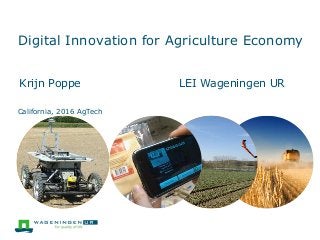
My presentation to introduce our work in LEI Wageningen UR on IT in agriculture to the 2016 AgTech seminar in Mountain View, Cal. (a.k.a. Sillicon Valley)
Digital Innovation forAgriculture Economy
Krijn Poppe LEI Wageningen UR
California, 2016 AgTech
2.
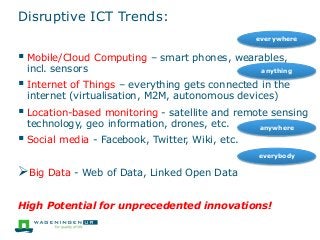
Disruptive ICT Trends:
Mobile/Cloud Computing – smart phones, wearables,
incl. sensors
Internet of Things – everything gets connected in the
internet (virtualisation, M2M, autonomous devices)
Location-based monitoring - satellite and remote sensing
technology, geo information, drones, etc.
Social media - Facebook, Twitter, Wiki, etc.
Big Data - Web of Data, Linked Open Data
High Potential for unprecedented innovations!
everywhere
anything
anywhere
everybody
3.
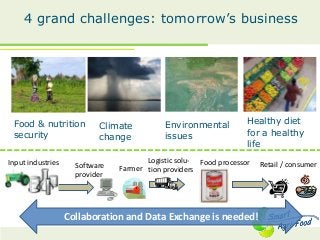
4 grand challenges:tomorrow’s business
Transport
Input industries
Farmer
Food processor Retail / consumerSoftware
provider
Logistic solu-
tion providers
Collaboration and Data Exchange is needed!
Food & nutrition
security
Climate
change
Healthy diet
for a healthy
life
Environmental
issues
4.
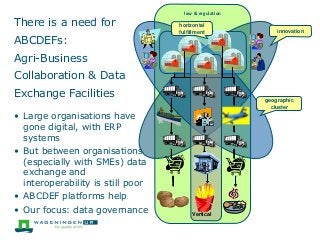
There is aneed for
ABCDEFs:
Agri-Business
Collaboration & Data
Exchange Facilities
• Large organisations have
gone digital, with ERP
systems
• But between organisations
(especially with SMEs) data
exchange and
interoperability is still poor
• ABCDEF platforms help
• Our focus: data governance
law & regulation
innovation
geographic
cluster
horizontal
fulfillment
Vertical
5.
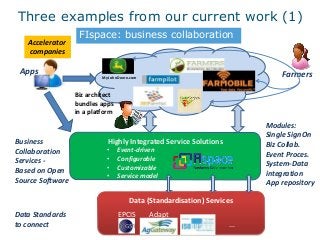
Highly Integrated ServiceSolutions
• Event-driven
• Configurable
• Customizable
• Service model
Data (Standardisation) Services
AdaptEPCIS
MyJohnDeere.com
Data Standards
to connect
Business
Collaboration
Services -
Based on Open
Source Software
Farmers
Biz architect
bundles apps
in a platform
...
Accelerator
companies
Apps
Modules:
Single SignOn
Biz Collab.
Event Proces.
System-Data
integration
App repository
Three examples from our current work (1)
FIspace: business collaboration
6.
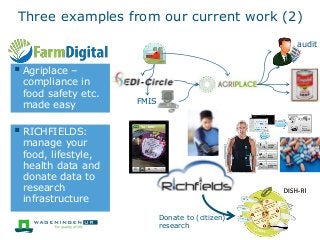
Agriplace –
compliancein
food safety etc.
made easy
Three examples from our current work (2)
Donate to (citizen)
research
RICHFIELDS:
manage your
food, lifestyle,
health data and
donate data to
research
infrastructure
audit
FMIS
7.
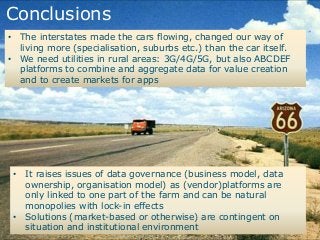
Conclusions
• The interstatesmade the cars flowing, changed our way of
living more (specialisation, suburbs etc.) than the car itself.
• We need utilities in rural areas: 3G/4G/5G, but also ABCDEF
platforms to combine and aggregate data for value creation
and to create markets for apps
• It raises issues of data governance (business model, data
ownership, organisation model) as (vendor)platforms are
only linked to one part of the farm and can be natural
monopolies with lock-in effects
• Solutions (market-based or otherwise) are contingent on
situation and institutional environment