Tropical Storms 1

Loading...

Flash Player 9 (or above) is needed to view presentations.
We have detected that you do not have it on your computer. To install it, go here.

0 comments

Post a comment

    Post a comment
    Embed Video
    Edit your comment Cancel

    1 Favorite

    Tropical Storms 1 - Presentation Transcript

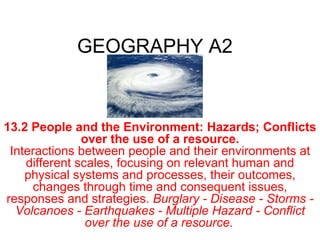
    1. GEOGRAPHY A2 13.2 People and the Environment: Hazards; Conflicts over the use of a resource. Interactions between people and their environments at different scales, focusing on relevant human and physical systems and processes, their outcomes, changes through time and consequent issues, responses and strategies. Burglary - Disease - Storms - Volcanoes - Earthquakes - Multiple Hazard - Conflict over the use of a resource.
      • DEFINE THE TERM HAZARD
      Hazards A Hazard is a situation which poses a level of threat to life, health, property or environment. Most hazards are dormant or potential, with only a theoretical risk of harm, however, once a hazard becomes 'active', it can create an emergency situation.
    2. Hazards
      • Burglary - Disease - Storms - Volcanoes - Earthquakes - Multiple Hazard
      • TROPICAL STORMS
      • A tropical cyclone is a meteorological term for a storm system characterised by a low pressure system centre and thunderstorms that produces strong wind and flooding rain. A tropical cyclone feeds on the heat released when moist air rises and the water vapour it contains condenses. They are fuelled by a different heat mechanism than other cyclonic windstorms such as nor'easters, European windstorms, and polar lows, leading to their classification as "warm core" storm systems.
    3. Hazards – Tropical Storms What are the most frequently used local names for tropical storms? "Hurricane" and "Typhoon"
    4. Syllabus - part 1
      • Concept of 'hazard'. Definition — rotating tropical storm with wind speeds over 118 kph. Transition tropical depression to storm to hurricane. 'Hurricane season'. Global distribution linked to regional names. Factors influencing distribution.
    5. Hazards – Tropical Storms Tracks of hurricanes and typhoons
      • The origin , geographical distribution , frequency of occurrence and scale of the hazard.
      Hazards – Tropical Storms
      • All tropical cyclones are areas of low atmospheric pressure near the Earth's surface. The pressures recorded at the centres of tropical cyclones are among the lowest that occur on Earth's surface at sea level.
      Hazards – Tropical Storms
      • Tropical cyclones are characterised and driven by the release of large amounts of latent heat of condensation, which occurs when moist air is carried upwards and its water vapour condenses. This heat is distributed vertically around the centre of the storm. Thus, at any given altitude (except close to the surface, where water temperature dictates air temperature) the environment inside the cyclone is warmer than its outer surroundings
      Hazards – Tropical Storms
      • A tropical cyclone's primary energy source is the release of the heat of condensation from water vapor condensing at high altitudes, with solar heating being the initial source for evaporation. Therefore, a tropical cyclone can be visualized as a giant vertical heat engine supported by mechanics driven by physical forces such as the rotation and gravity of the Earth.
      Hazards – Tropical Storms
      • In another way, tropical cyclones could be viewed as a special type of mesoscale convective complex, which continues to develop over a vast source of relative warmth and moisture. Condensation leads to higher wind speeds, as a tiny fraction of the released energy is converted into mechanical energy; the faster winds and lower pressure associated with them in turn cause increased surface evaporation and thus even more condensation.
      Hazards – Tropical Storms
    6.  
      • Scientists at the National Centre for Atmospheric Research estimate that a tropical cyclone releases heat energy at the rate of 50 to 200 trillion joules per day. For comparison, this rate of energy release is equivalent to 200 times the world-wide electrical generating capacity, or to exploding a 10-megaton nuclear bomb every 20 minutes!!!
      Hazards – Tropical Storms
      • Worldwide, tropical cyclone activity peaks in late summer, when the difference between temperatures aloft and sea surface temperatures is the greatest. However, each particular basin has its own seasonal patterns. On a worldwide scale, May is the least active month, while September is the most active
      Hazards – Tropical Storms
    7. Hazards – Tropical Storms In the Northern Atlantic Ocean, a distinct hurricane season occurs from June 1 to November 30, sharply peaking from late August through September. The statistical peak of the Atlantic hurricane season is September 10.
    8. Hazards – Tropical Storms The Northeast Pacific Ocean has a broader period of activity, but in a similar time frame to the Atlantic. The Northwest Pacific sees tropical cyclones year-round, with a minimum in February and a peak in early September. In the North Indian basin, storms are most common from April to December, with peaks in May and November.
    9. Hazards – Tropical Storms In the Southern Hemisphere, tropical cyclone activity begins in late October and ends in May. Southern Hemisphere activity peaks in mid-February to early March
      • Causal Factors
      • In most situations, water temperatures of at least 26.5 °C (80 °F) are needed down to a depth of at least 50 m (150 feet)
      • Low amounts of wind shear are needed, as high shear is disruptive to the storm's circulation.
      • Tropical cyclones generally need to form more than 500 km (310 miles) or 5 degrees of latitude away from the equator, allowing the Coriolis effect to deflect winds blowing towards the low pressure centre and creating a circulation
      Hazards – Tropical Storms
      • Tropical cyclones originate on the eastern side of oceans, but move west, intensifying as they move. Most of these systems form between 10 and 30 degrees away of the equator, and 87% form no farther away than 20 degrees of latitude, north or south. Because the Coriolis effect initiates and maintains tropical cyclone rotation, tropical cyclones rarely form or move within about 5 degrees of the equator, where the Coriolis effect is weakest.
      Hazards – Tropical Storms
      • Most strong storms lose their strength very rapidly after landfall and become disorganized areas of low pressure within a day or two, or evolve into extratropical cyclones
      • A tropical cyclone can dissipate when it moves over waters significantly below 26.5 °C
      Hazards – Tropical Storms
      • In the 1960s and 1970s, the United States government attempted to weaken hurricanes through Project Stormfury by seeding selected storms with silver iodide. It was thought that the seeding would cause super cooled water in the outer rain bands to freeze, causing the inner eye wall to collapse and thus reducing the winds.
      Hazards – Tropical Storms

    + Keith PhippsKeith Phipps, 11 months ago

    custom

    433 views, 1 favs, 1 embeds more stats

    More info about this document

    © All Rights Reserved

    Go to text version

    • Total Views 433
      • 431 on SlideShare
      • 2 from embeds
    • Comments 0
    • Favorites 1
    • Downloads 0
    Most viewed embeds
    • 2 views on http://keithphipps.wordpress.com

    more

    All embeds
    • 2 views on http://keithphipps.wordpress.com

    less

    Flagged as inappropriate Flag as inappropriate
    Flag as inappropriate

    Select your reason for flagging this presentation as inappropriate. If needed, use the feedback form to let us know more details.

    Cancel
    File a copyright complaint
    Having problems? Go to our helpdesk?

    Categories

    Tags