Xvisor: embedded and
lightweight hypervisor
Jim Huang ( 黃敬群 ) <jserv@0xlab.org>
Aug 3, 2013 / COSCUP
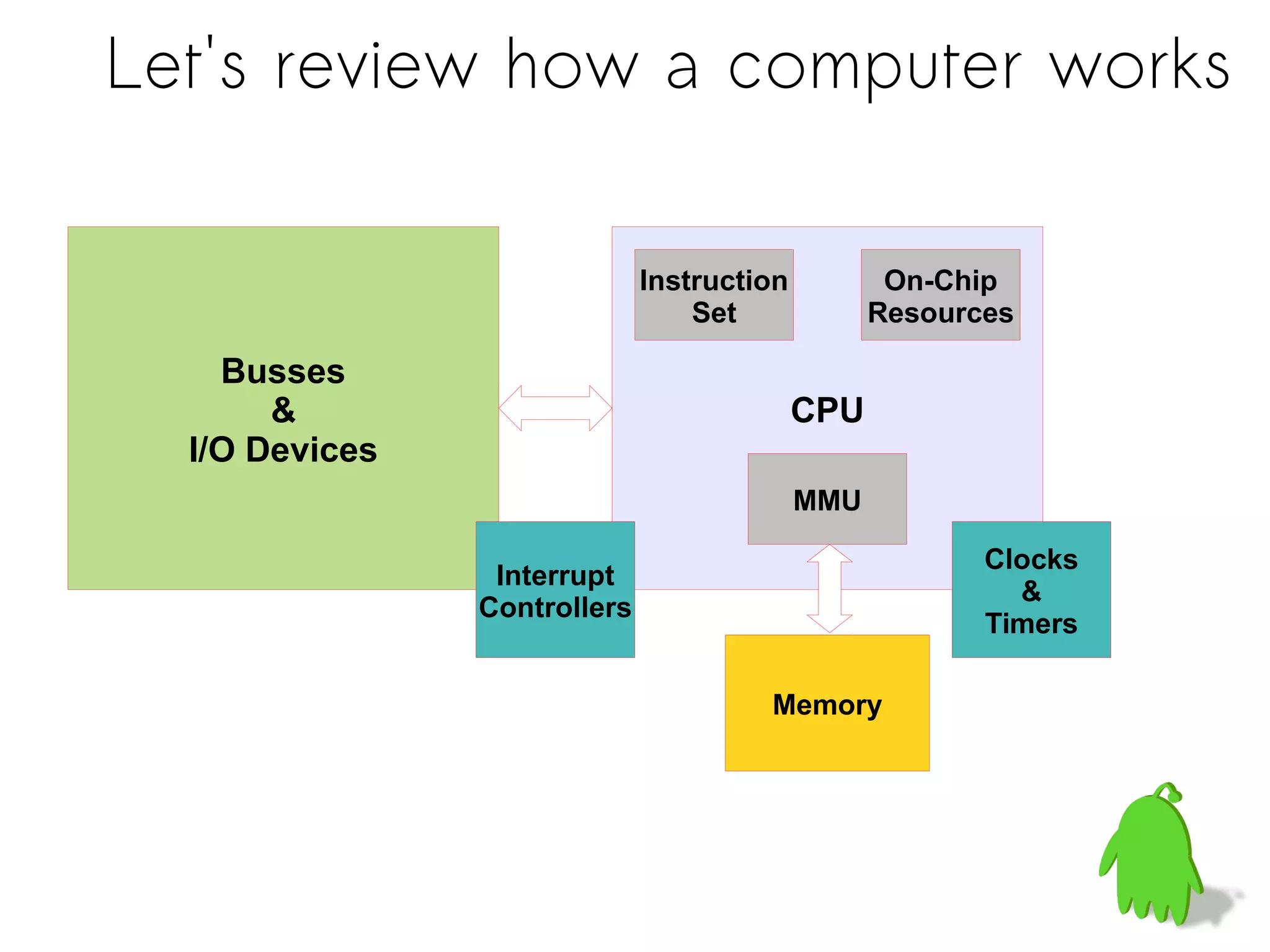
CPU
MMU
Instruction
Set
Clocks
&
Timers
Busses
&
I/O Devices
Interrupt
Controllers
Memory
On-Chip
Resources
Let's review how a computer works
Agenda (1) Virtualization Concepts
(2) Xvisor for ARM
(3) Device Virtualization
Virtualization Concepts
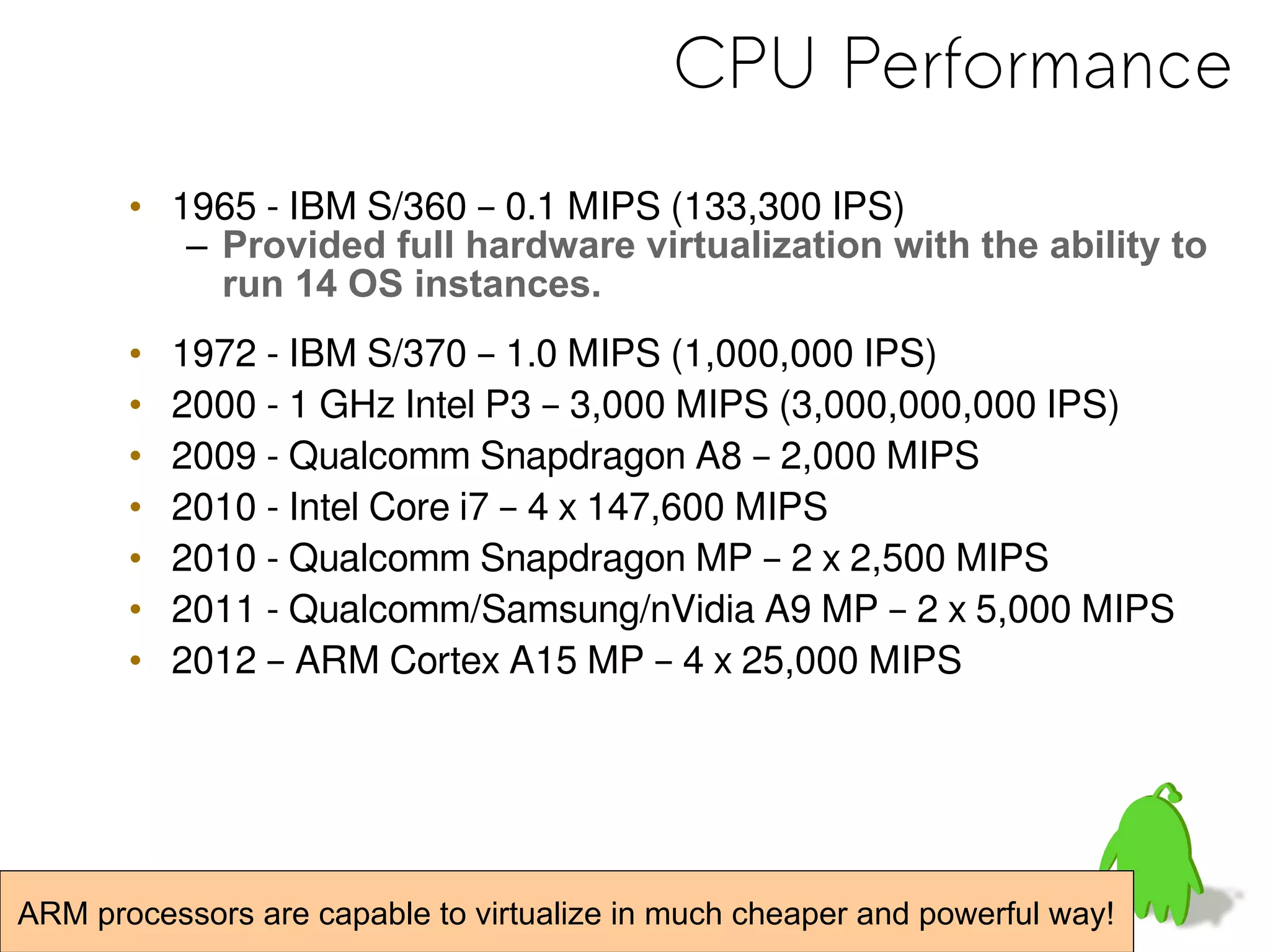
CPU Performance
• 1965 - IBM S/360 – 0.1 MIPS (133,300 IPS)
– Provided full hardware virtualization with the ability to
run 14 OS instances.
• 1972 - IBM S/370 – 1.0 MIPS (1,000,000 IPS)
• 2000 - 1 GHz Intel P3 – 3,000 MIPS (3,000,000,000 IPS)
• 2009 - Qualcomm Snapdragon A8 – 2,000 MIPS
• 2010 - Intel Core i7 – 4 x 147,600 MIPS
• 2010 - Qualcomm Snapdragon MP – 2 x 2,500 MIPS
• 2011 - Qualcomm/Samsung/nVidia A9 MP – 2 x 5,000 MIPS
• 2012 – ARM Cortex A15 MP – 4 x 25,000 MIPS
ARM processors are capable to virtualize in much cheaper and powerful way!
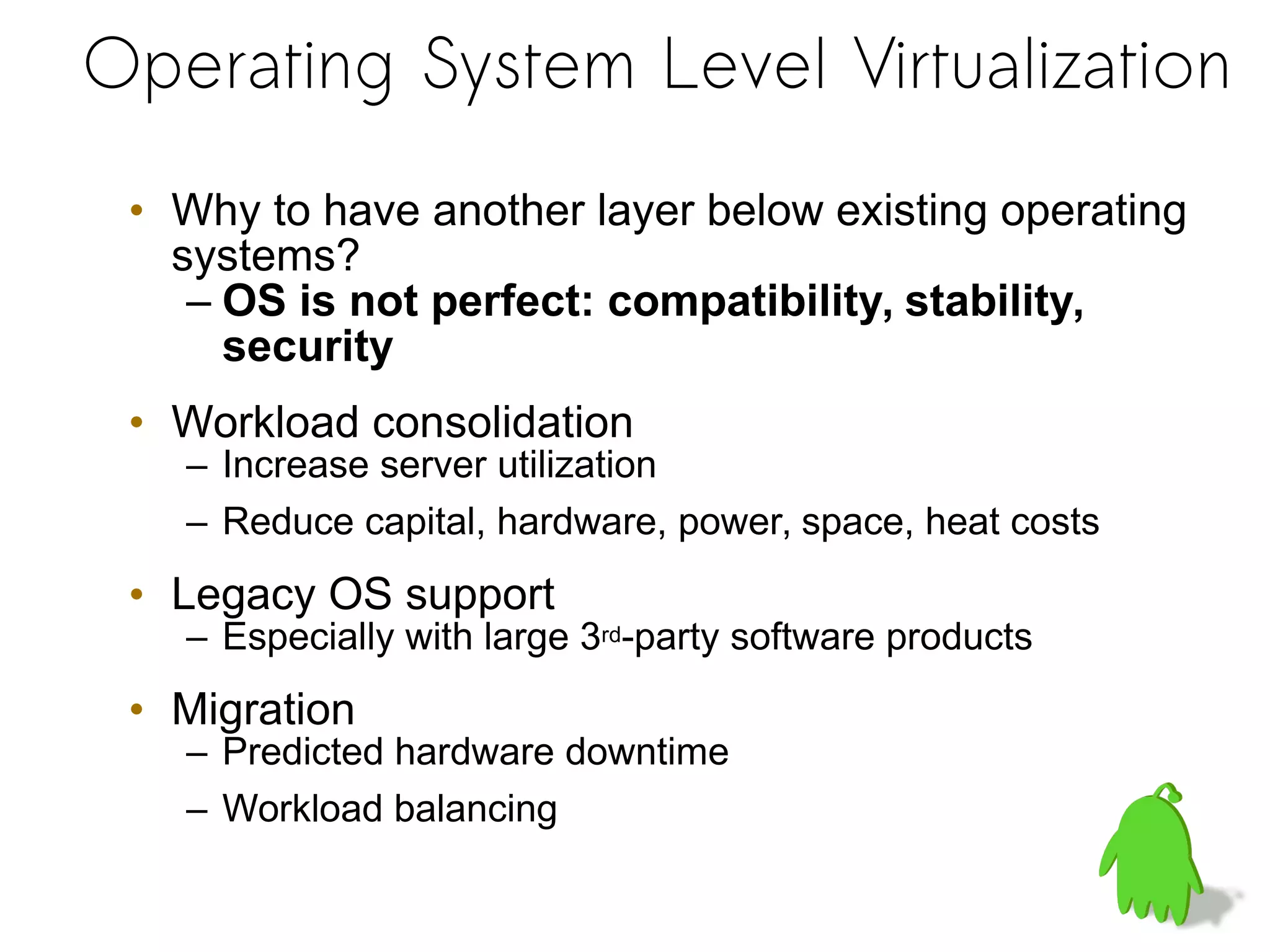
Operating System Level Virtualization
• Why to have another layer below existing operating
systems?
– OS is not perfect: compatibility, stability,
security
• Workload consolidation
– Increase server utilization
– Reduce capital, hardware, power, space, heat costs
• Legacy OS support
– Especially with large 3rd-party software products
• Migration
– Predicted hardware downtime
– Workload balancing
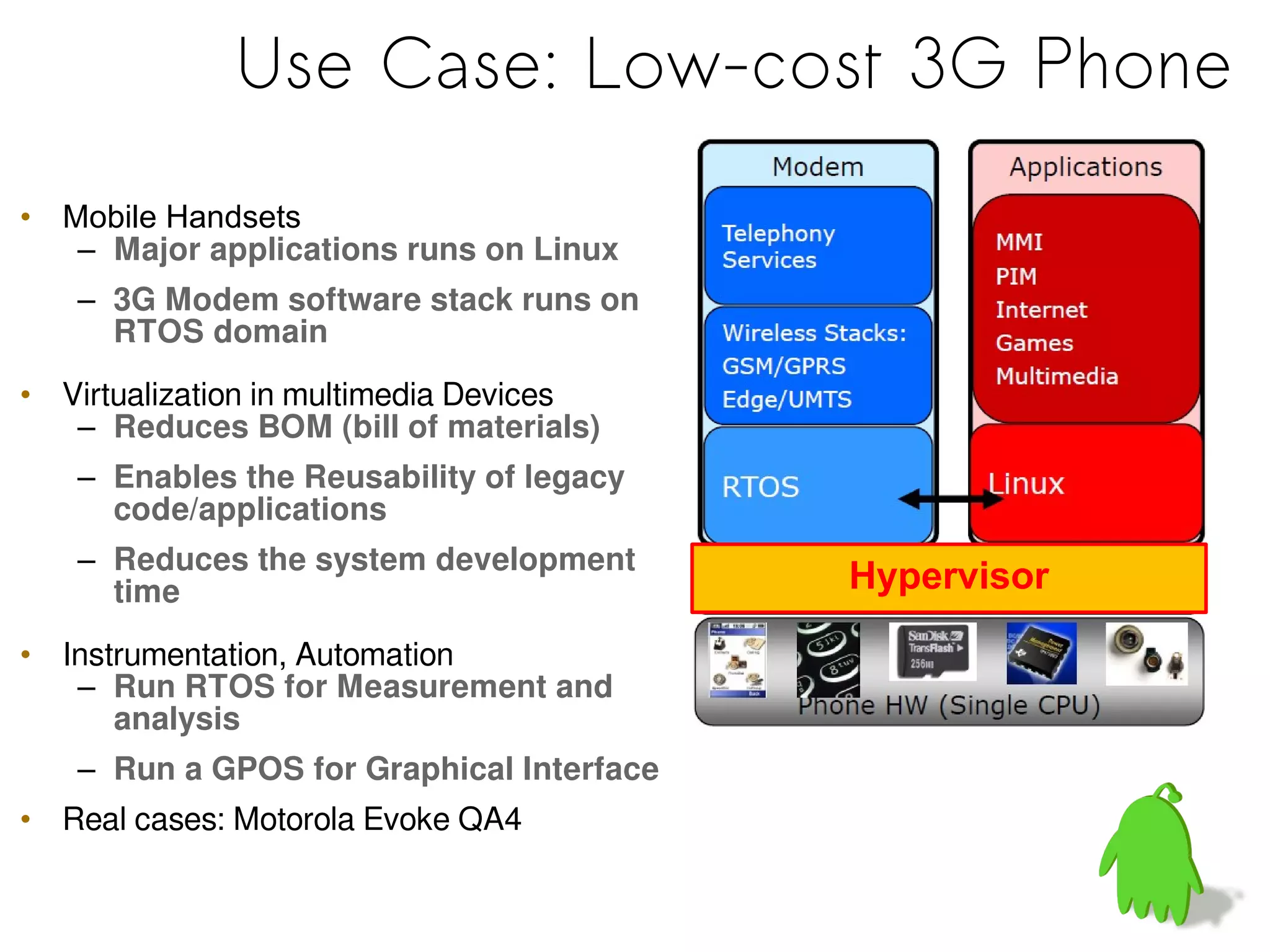
Use Case: Low-cost 3G Phone
• Mobile Handsets
– Major applications runs on Linux
– 3G Modem software stack runs on
RTOS domain
• Virtualization in multimedia Devices
– Reduces BOM (bill of materials)
– Enables the Reusability of legacy
code/applications
– Reduces the system development
time
• Instrumentation, Automation
– Run RTOS for Measurement and
analysis
– Run a GPOS for Graphical Interface
• Real cases: Motorola Evoke QA4
Hypervisor
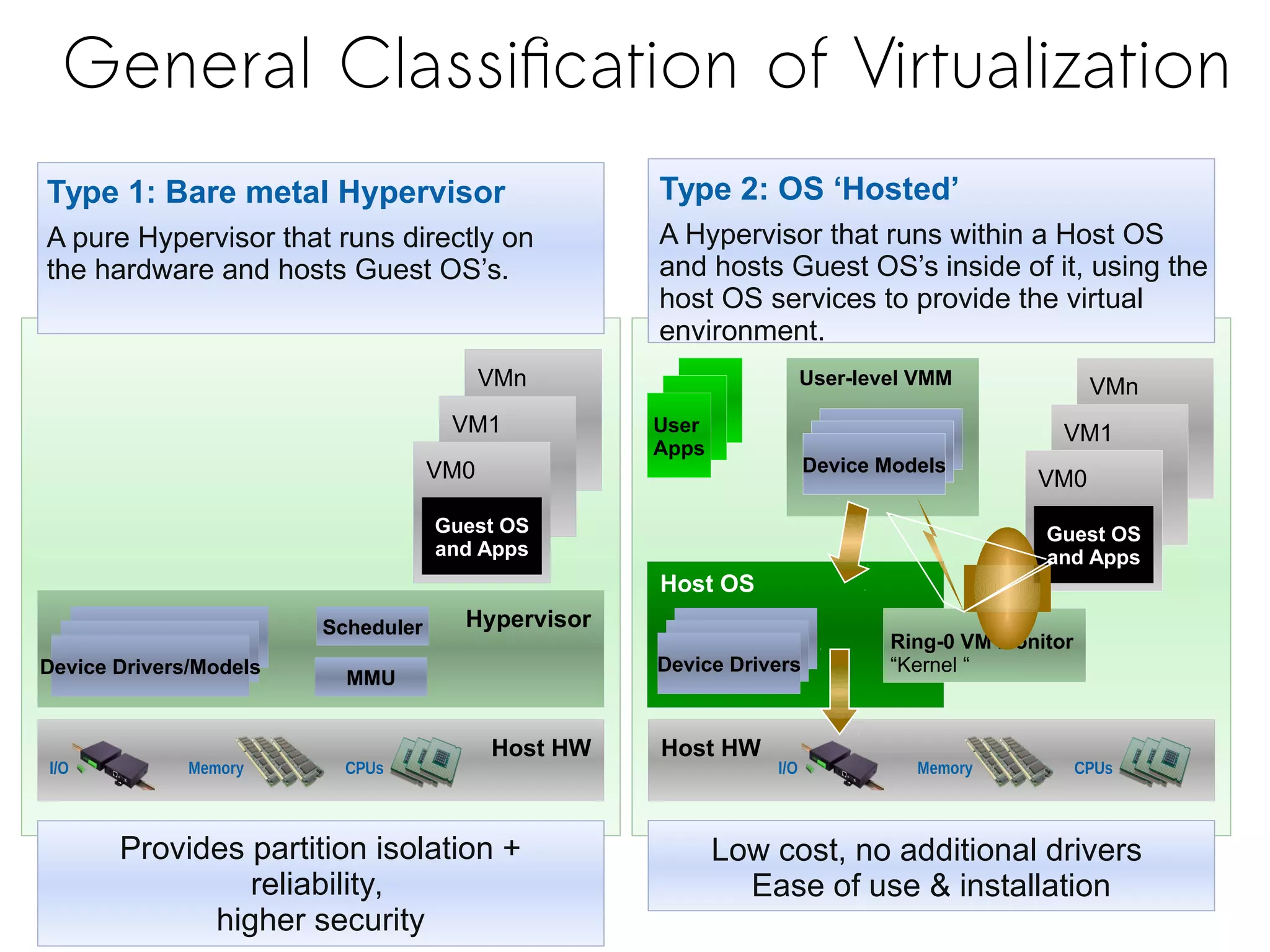
Type 1: Bare metal Hypervisor
A pure Hypervisor that runs directly on
the hardware and hosts Guest OS’s.
Type 2: OS ‘Hosted’
A Hypervisor that runs within a Host OS
and hosts Guest OS’s inside of it, using the
host OS services to provide the virtual
environment.
Provides partition isolation +
reliability,
higher security
Low cost, no additional drivers
Ease of use & installation
Host HW
Memory CPUsI/O
Host HW
Memory CPUsI/O
HypervisorScheduler
MMU
Device Drivers/Models
VMn
VM1
VM0
Guest OS
and Apps
Host OS
Device Drivers
Ring-0 VM Monitor
“Kernel “
VMn
VM1
VM0
Guest OS
and Apps
User
Apps
User-level VMM
Device Models
General Classification of Virtualization
Virtualizable
is a property of the Instruction Set Architecture (ISA)
• A sensitive instruction
– changes the
configuration or mode
of the processor,
or
– depends in its behavior
on the processor’s
state
• A privileged instruction
– must be executed with
sufficient privilege
– causes a trap in user
mode
If all sensitive instructions are privileged,
virtual machine monitor can be written.
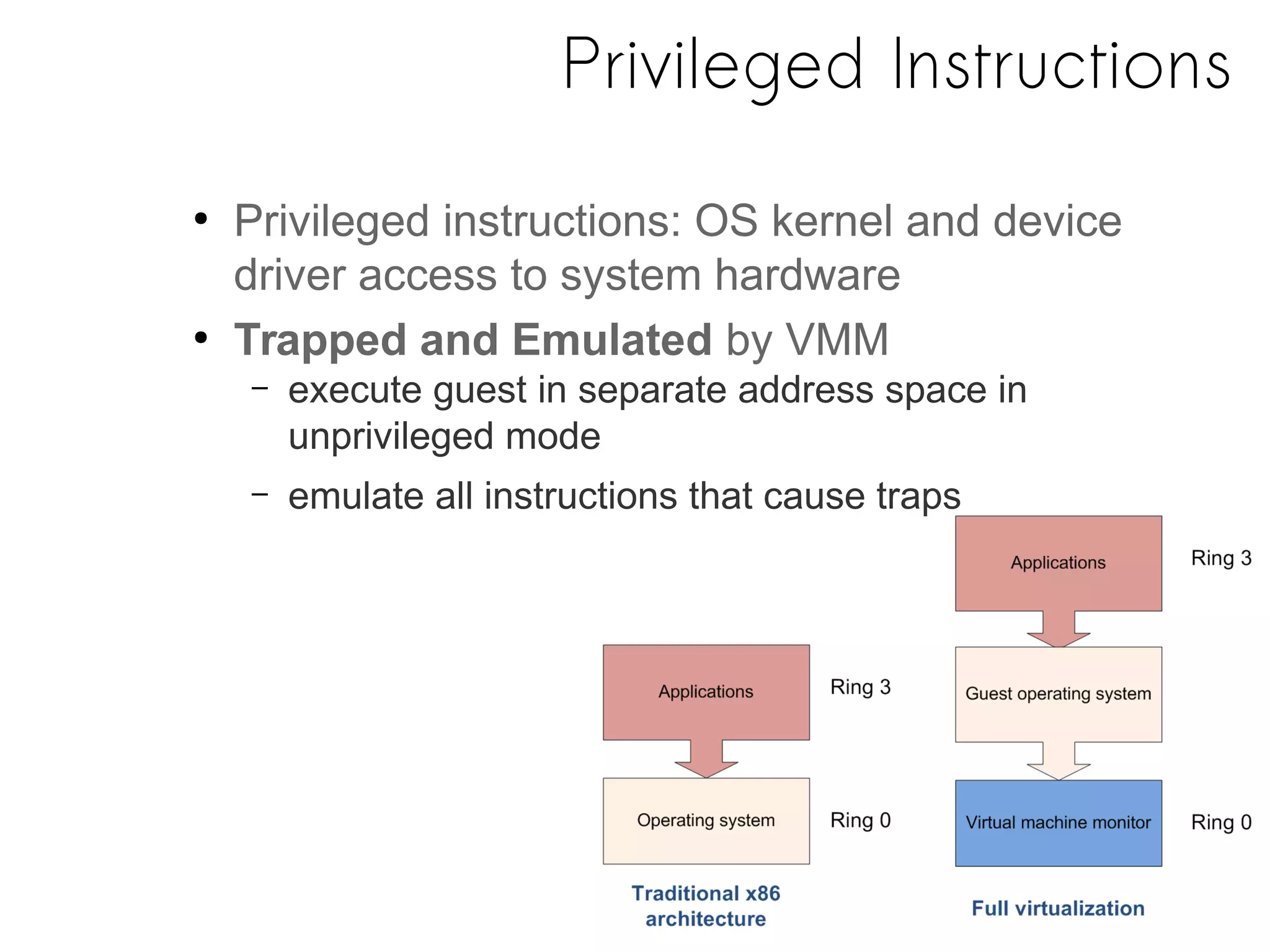
●
Privileged instructions: OS kernel and device
driver access to system hardware
●
Trapped and Emulated by VMM
– execute guest in separate address space in
unprivileged mode
– emulate all instructions that cause traps
Privileged Instructions
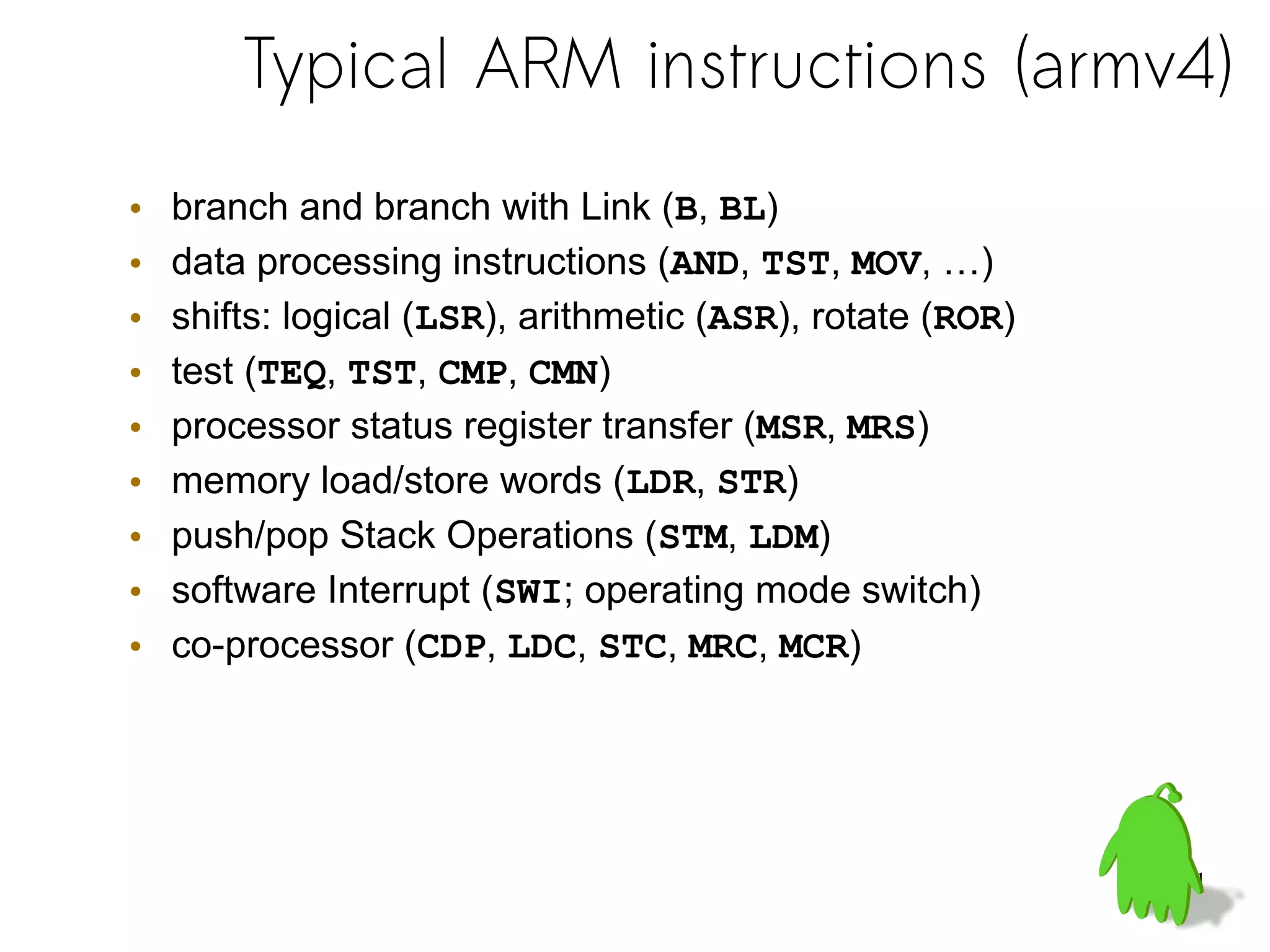
11
• branch and branch with Link (B, BL)
• data processing instructions (AND, TST, MOV, …)
• shifts: logical (LSR), arithmetic (ASR), rotate (ROR)
• test (TEQ, TST, CMP, CMN)
• processor status register transfer (MSR, MRS)
• memory load/store words (LDR, STR)
• push/pop Stack Operations (STM, LDM)
• software Interrupt (SWI; operating mode switch)
• co-processor (CDP, LDC, STC, MRC, MCR)
Typical ARM instructions (armv4)
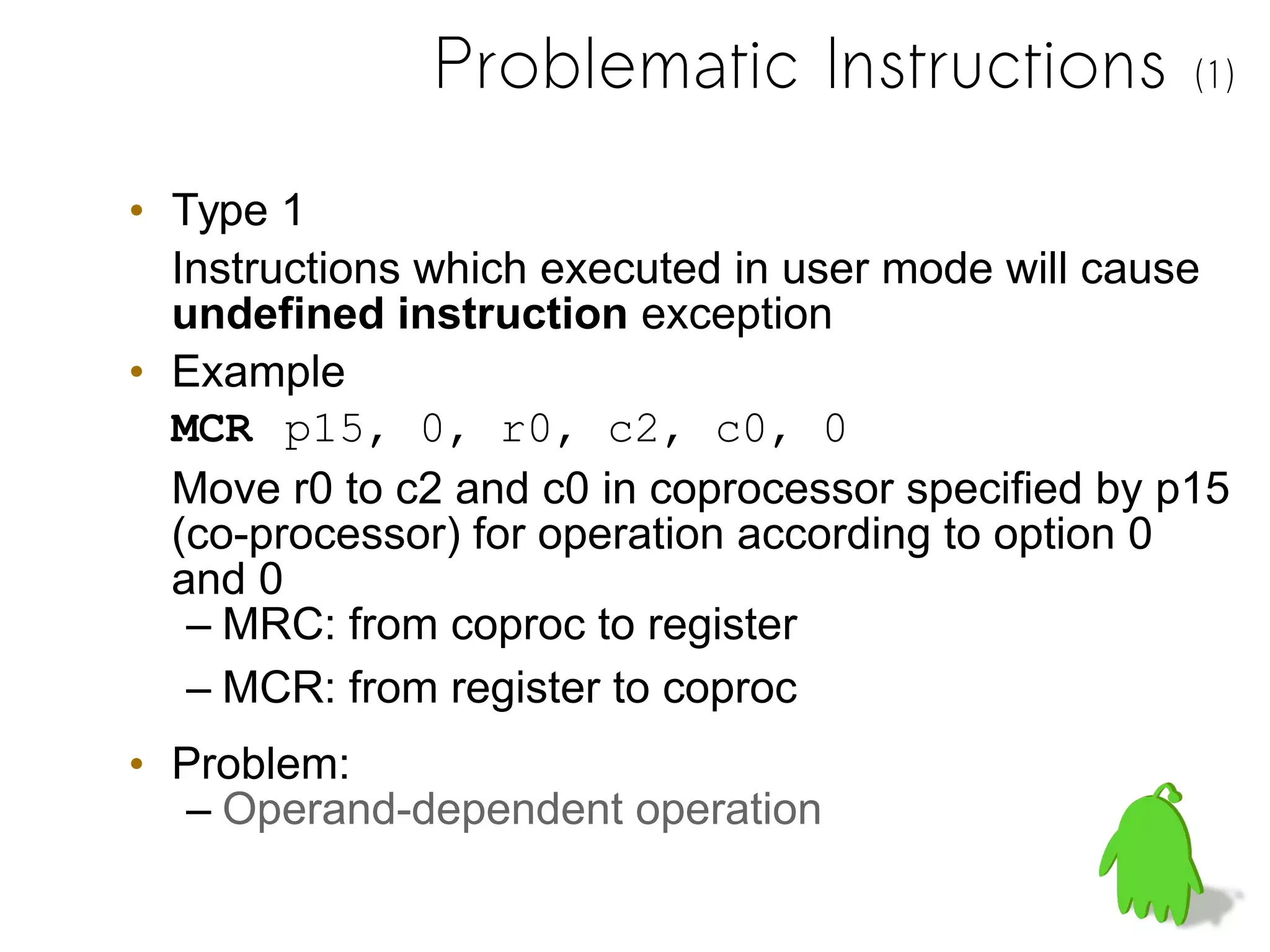
Problematic Instructions (1)
• Type 1
Instructions which executed in user mode will cause
undefined instruction exception
• Example
MCR p15, 0, r0, c2, c0, 0
Move r0 to c2 and c0 in coprocessor specified by p15
(co-processor) for operation according to option 0
and 0
– MRC: from coproc to register
– MCR: from register to coproc
• Problem:
– Operand-dependent operation
Problematic Instructions (2)
• Type 2
Instructions which executed in user mode will have
no effect
• Example
MSR cpsr_c, #0xD3
Switch to privileged mode and disable interrupt
N Z C V Q -- J -- GE[3:0] -- E A I F T M[4:0]
31 0
Execution
Flags
Exception
Mask
Execution
Mode
Program Status Register (PSR)
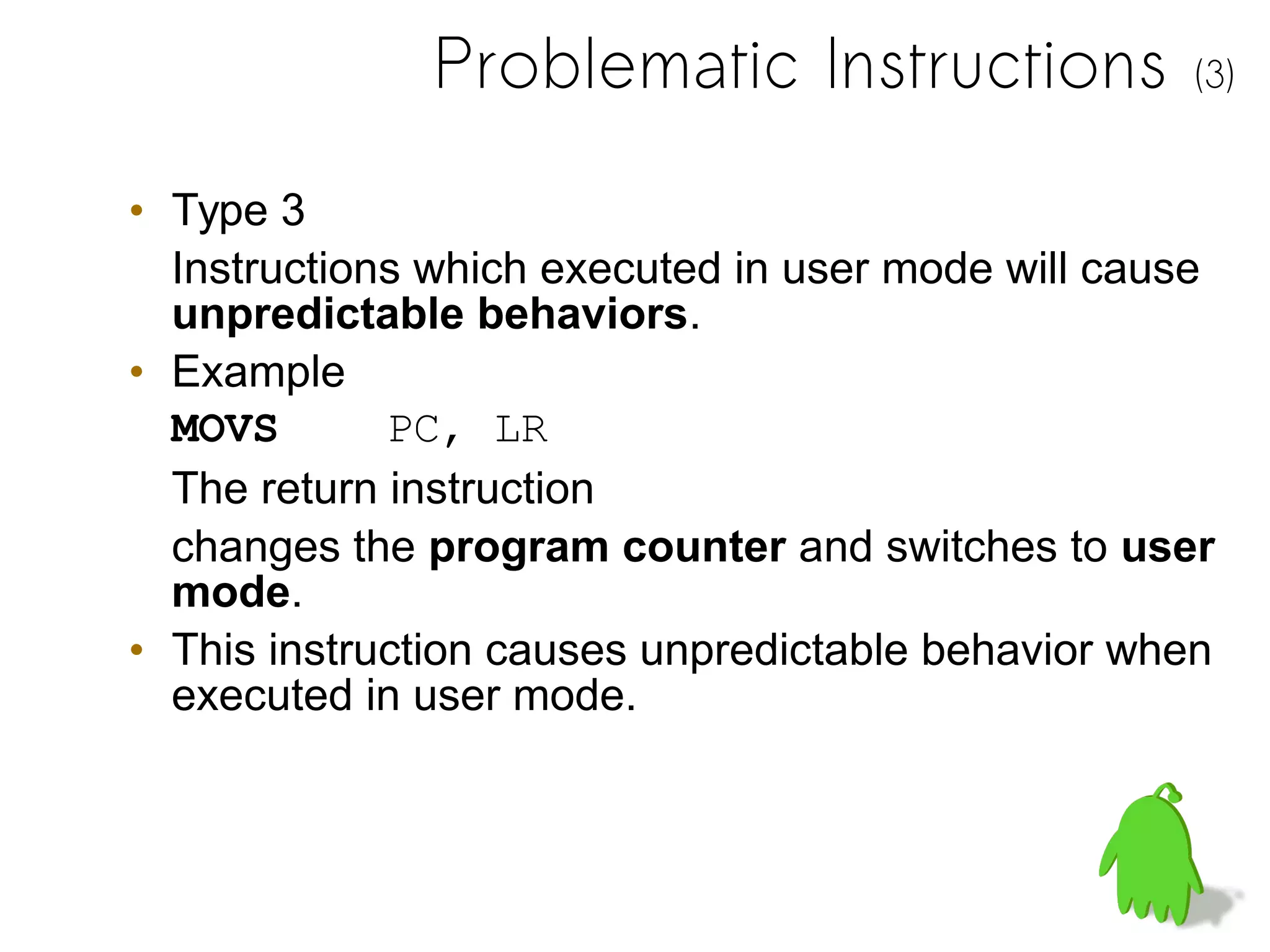
Problematic Instructions (3)
• Type 3
Instructions which executed in user mode will cause
unpredictable behaviors.
• Example
MOVS PC, LR
The return instruction
changes the program counter and switches to user
mode.
• This instruction causes unpredictable behavior when
executed in user mode.
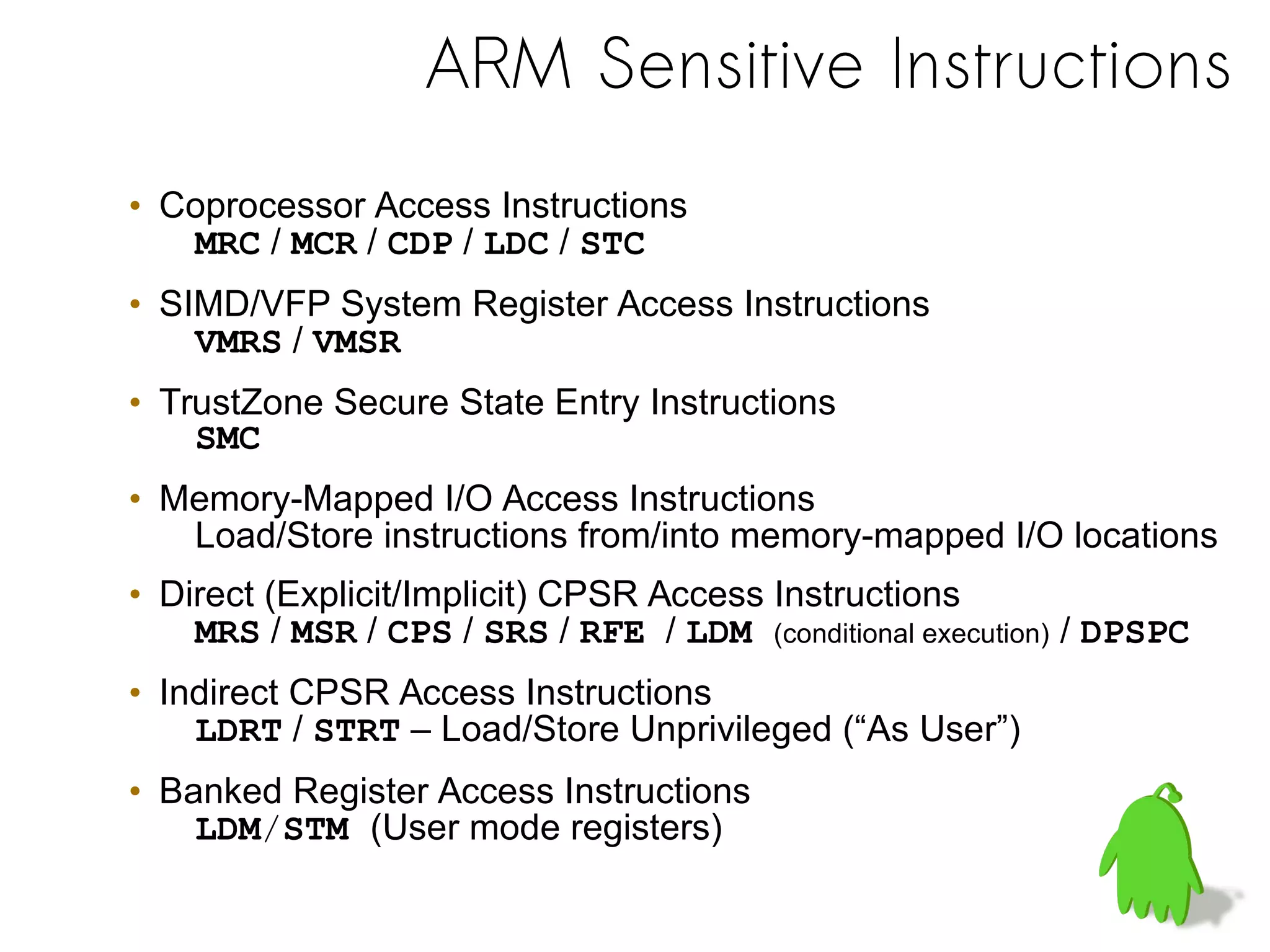
ARM Sensitive Instructions
• Coprocessor Access Instructions
MRC / MCR / CDP / LDC / STC
• SIMD/VFP System Register Access Instructions
VMRS / VMSR
• TrustZone Secure State Entry Instructions
SMC
• Memory-Mapped I/O Access Instructions
Load/Store instructions from/into memory-mapped I/O locations
• Direct (Explicit/Implicit) CPSR Access Instructions
MRS / MSR / CPS / SRS / RFE / LDM (conditional execution) / DPSPC
• Indirect CPSR Access Instructions
LDRT / STRT – Load/Store Unprivileged (“As User”)
• Banked Register Access Instructions
LDM/STM (User mode registers)
Solutions to Problematic Instructions
[ Hardware Techniques ]
• Privileged Instruction Semantics dictated/translated
by instruction set architecture
• MMU-enforced traps
– Example: page fault
• Tracing/debug support
– Example: bkpt (breakpoint)
• Hardware-assisted Virtualization
– Example: extra privileged mode, HYP, in ARM
Cortex-A15
Complexity
Binary
translation
Hypercall
Design High Low
Implementation Medium High
Runtime High Medium
Method: trap and emulate
Solutions to Problematic Instructions
[ Software Techniques ]
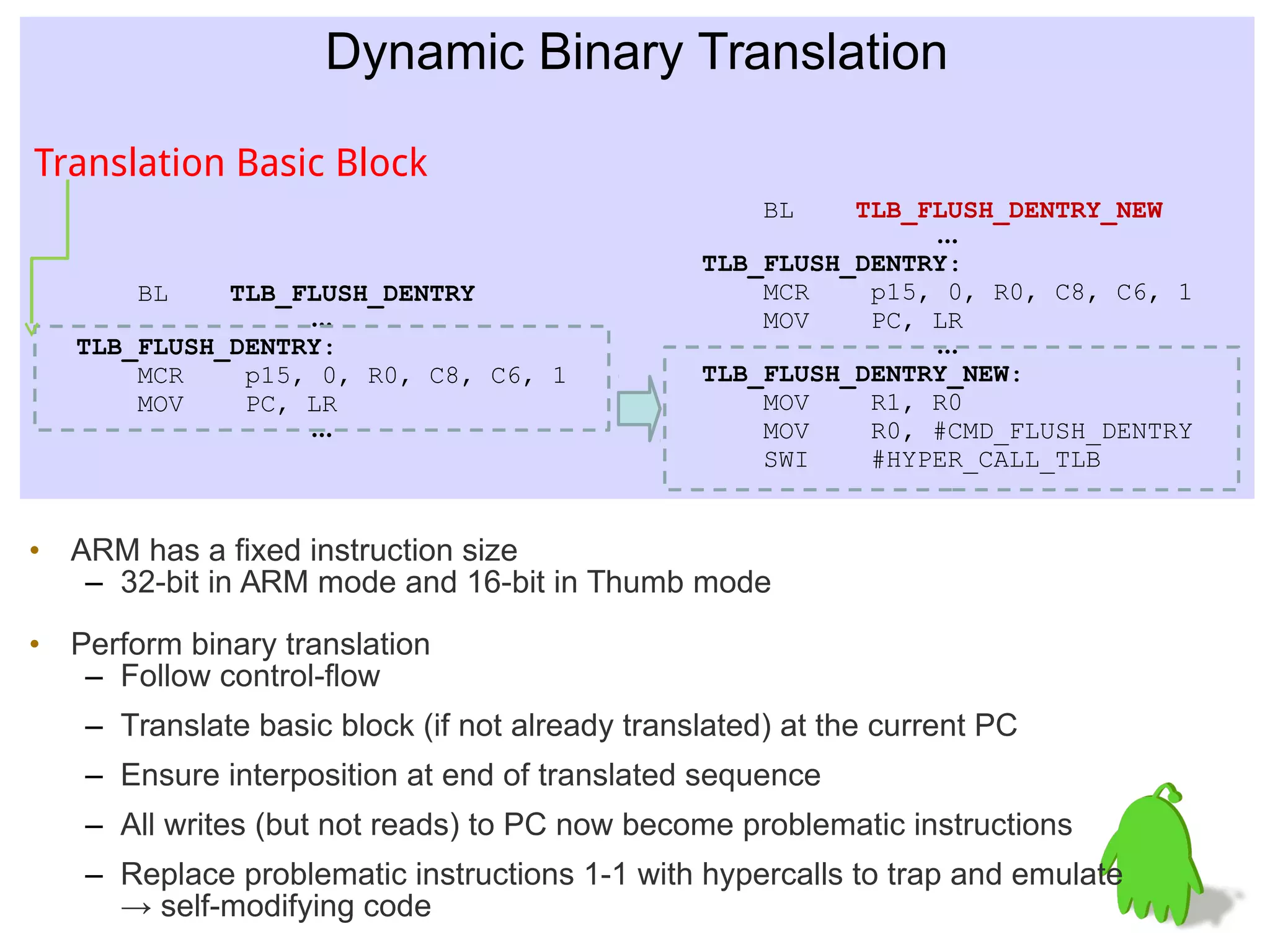
Dynamic Binary Translation
BL TLB_FLUSH_DENTRY
…
TLB_FLUSH_DENTRY:
MCR p15, 0, R0, C8, C6, 1
MOV PC, LR
…
BL TLB_FLUSH_DENTRY_NEW
…
TLB_FLUSH_DENTRY:
MCR p15, 0, R0, C8, C6, 1
MOV PC, LR
…
TLB_FLUSH_DENTRY_NEW:
MOV R1, R0
MOV R0, #CMD_FLUSH_DENTRY
SWI #HYPER_CALL_TLB
Translation Basic Block
• ARM has a fixed instruction size
– 32-bit in ARM mode and 16-bit in Thumb mode
• Perform binary translation
– Follow control-flow
– Translate basic block (if not already translated) at the current PC
– Ensure interposition at end of translated sequence
– All writes (but not reads) to PC now become problematic instructions
– Replace problematic instructions 1-1 with hypercalls to trap and emulate
→ self-modifying code
Virtualization APIs – hypercalls
BL TLB_FLUSH_DENTRY
…
TLB_FLUSH_DENTRY:
MOV R1, R0
MOV R0, #CMD_FLUSH_DENTRY
SWI #HYPER_CALL_TLB
…
Restore User Context & PC
SWI Handler
Hypercall Handler
……
LDR R1, [SP, #4]
MCR p15, 0, R1, C8, C6, 1
/* In Hypervisor */
/* In Guest OS */
• Use trap instruction to issue hypercall
• Encode hypercall type and original instruction bits in hypercall hint
• Upon trapping into the VMM, decode the hypercall type and the original
instruction bits, and emulate instruction semantics
mrs r8, cpsr swi 0x088000
mrs Rd, R <cpsr/spsr>
Xvisor:
Type 1 Hypervisor; GPL; ARM
Xvisor
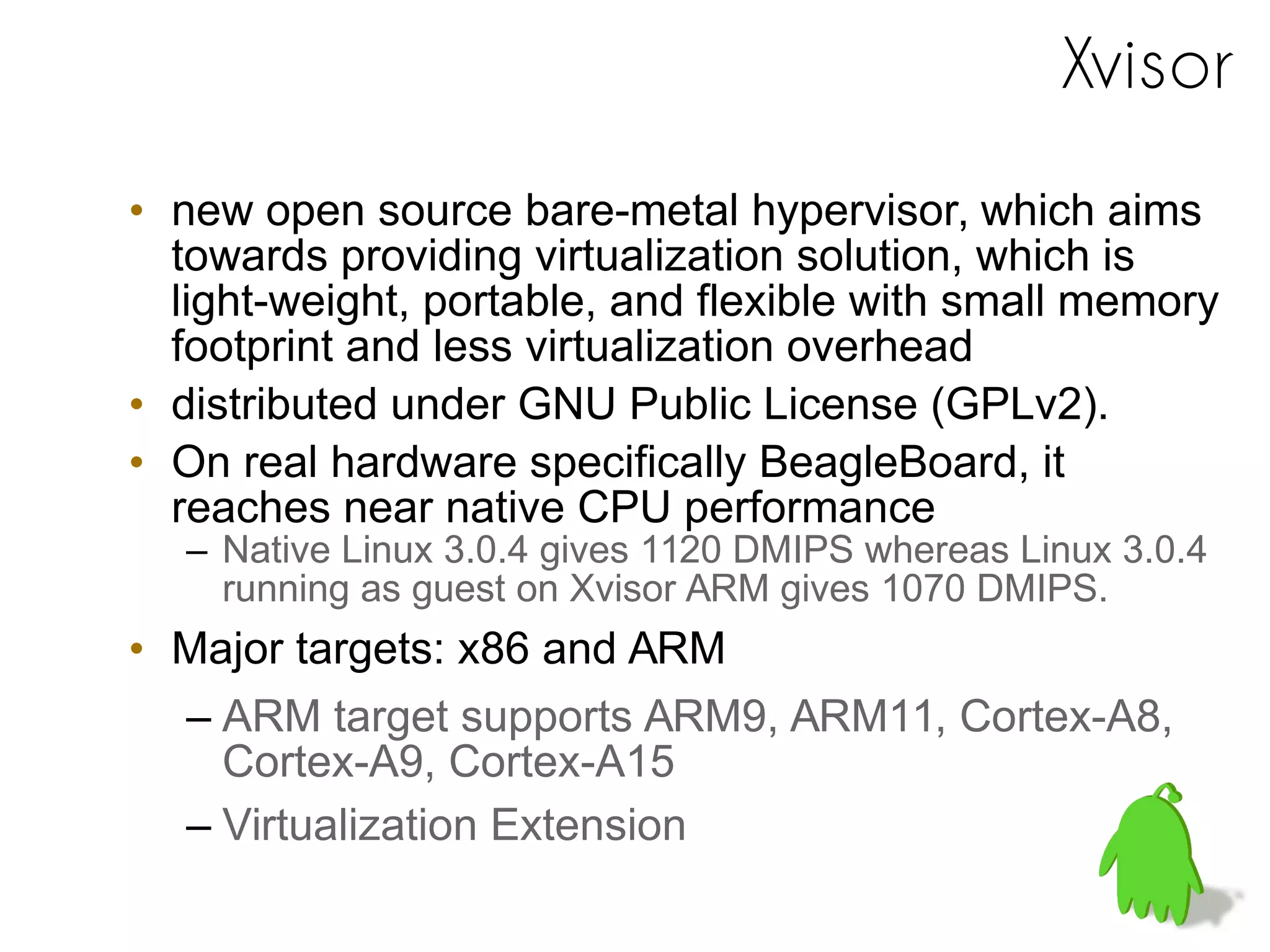
• new open source bare-metal hypervisor, which aims
towards providing virtualization solution, which is
light-weight, portable, and flexible with small memory
footprint and less virtualization overhead
• distributed under GNU Public License (GPLv2).
• On real hardware specifically BeagleBoard, it
reaches near native CPU performance
– Native Linux 3.0.4 gives 1120 DMIPS whereas Linux 3.0.4
running as guest on Xvisor ARM gives 1070 DMIPS.
• Major targets: x86 and ARM
– ARM target supports ARM9, ARM11, Cortex-A8,
Cortex-A9, Cortex-A15
– Virtualization Extension
Xvisor-ARM
https://github.com/xvisor
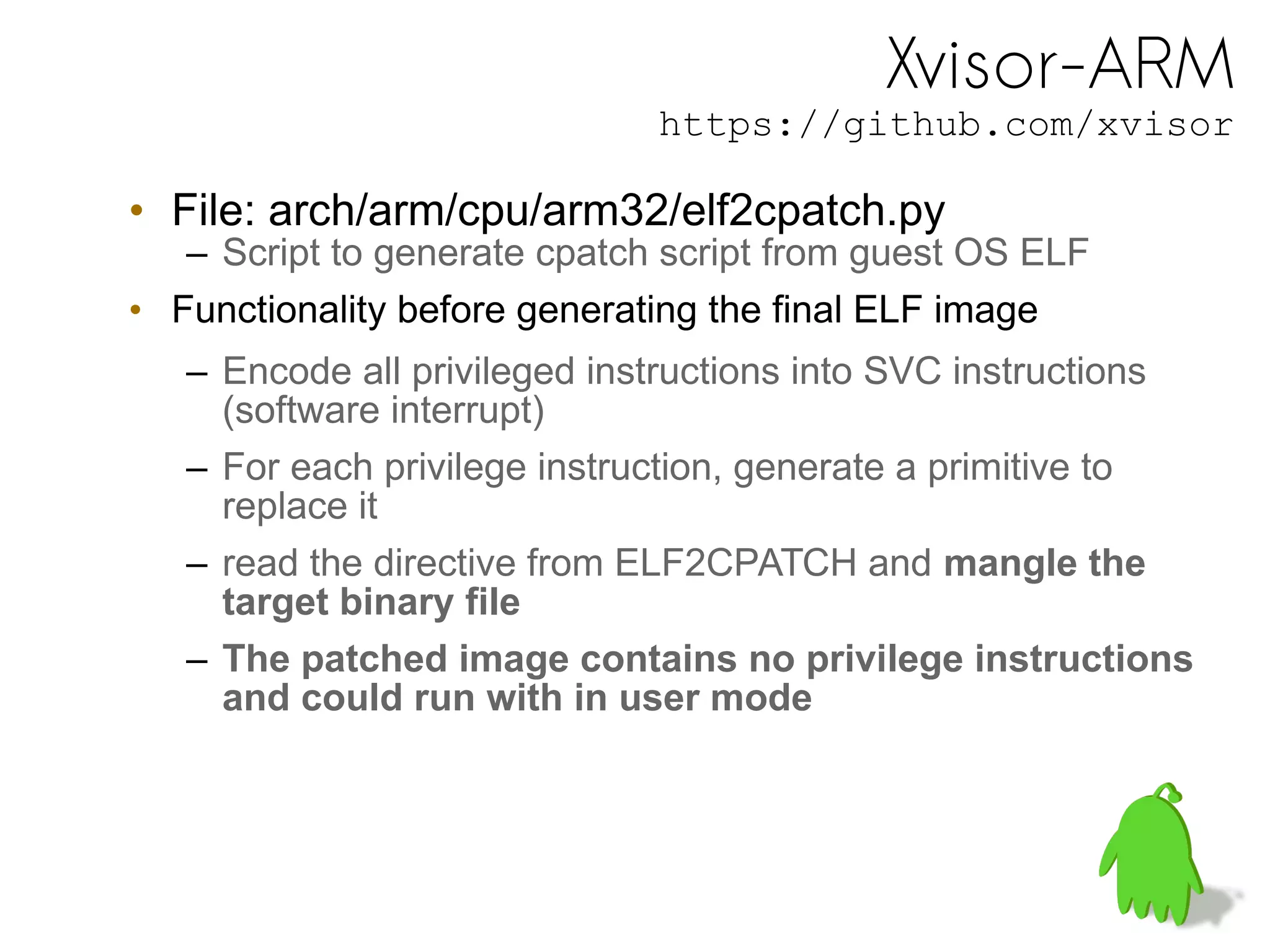
• File: arch/arm/cpu/arm32/elf2cpatch.py
– Script to generate cpatch script from guest OS ELF
• Functionality before generating the final ELF image
– Encode all privileged instructions into SVC instructions
(software interrupt)
– For each privilege instruction, generate a primitive to
replace it
– read the directive from ELF2CPATCH and mangle the
target binary file
– The patched image contains no privilege instructions
and could run with in user mode
elf2cpatch.py : 
...
if (len(w)==3):
    if (w[2]=="wfi"):
        print "t#", w[2] 
        print "twrite32,0x%x,0x%08x" % (addr, convert_wfi_inst(w[1]))
    elif (len(w)==4):
        if (w[2]=="cps" or w[2]=="cpsie" or w[2]=="cpsid"):
            print "t#", w[2], w[3]
           print "twrite32,0x%x,0x%08x" % (addr, convert_cps_inst(w[1]))
How does Xvisor handle problematic
instructions like MSR?
• Type 2
Instructions which executed in user mode will have
no effect
• Example
MSR cpsr_c, #0xD3
Switch to privileged mode and disable interrupt
N Z C V Q -- J -- GE[3:0] -- E A I F T M[4:0]
31 0
Execution
Flags
Exception
Mask
Execution
Mode
Program Status Register (PSR)
MSR cpsr_c, #0xD3
Switch to privileged mode and disable interrupt
# MSR (immediate)
# Syntax:
# msr<c> <spec_reg>, #<const>
# Fields:
# cond = bits[31:28]
# R = bits[22:22]
# mask = bits[19:16]
# imm12 = bits[11:0]
# Hypercall Fields:
# inst_cond[31:28] = cond
# inst_op[27:24] = 0xf
# inst_id[23:20] = 0
# inst_subid[19:17] = 2
# inst_fields[16:13] = mask
# inst_fields[12:1] = imm12
# inst_fields[0:0] = R
First, cpatch (ELF patching tool) looks
up the instructions...
def convert_msr_i_inst(hxstr):
hx = int(hxstr, 16)
inst_id = 0
inst_subid = 2
cond = (hx >> 28) & 0xF
R = (hx >> 22) & 0x1
mask = (hx >> 16) & 0xF
imm12 = (hx >> 0) & 0xFFF
rethx = 0x0F000000
rethx = rethx | (cond << 28)
rethx = rethx | (inst_id << 20)
rethx = rethx | (inst_subid << 17)
rethx = rethx | (mask << 13)
rethx = rethx | (imm12 << 1)
rethx = rethx | (R << 0)
return rethx
# MSR (immediate)
# Syntax:
# msr<c> <spec_reg>, #<const>
# Fields:
# cond = bits[31:28]
# R = bits[22:22]
# mask = bits[19:16]
# imm12 = bits[11:0]
# Hypercall Fields:
# inst_cond[31:28] = cond
# inst_op[27:24] = 0xf
# inst_id[23:20] = 0
# inst_subid[19:17] = 2
# inst_fields[16:13] = mask
# inst_fields[12:1] = imm12
# inst_fields[0:0] = R
Xvisor utilizes cpatch to convert
all problematic instructions for OS
image files (ELF format).
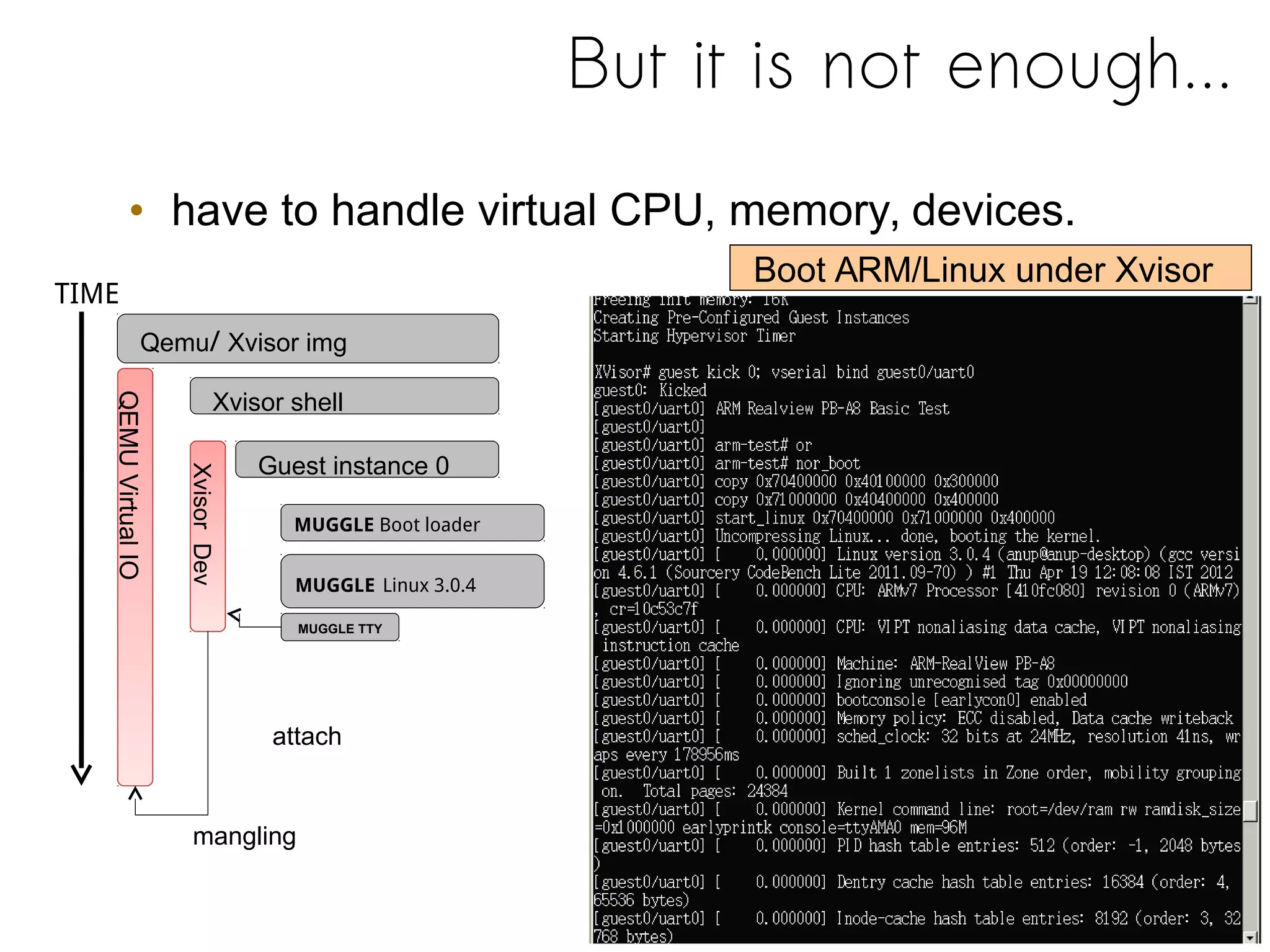
But it is not enough...
• have to handle virtual CPU, memory, devices.
Boot ARM/Linux under Xvisor
Qemu/ Xvisor img
Xvisor shell
Guest instance 0
MUGGLE Boot loader
MUGGLE Linux 3.0.4
QEMUVirtualIO
TIME
XvisorDev
MUGGLE TTY
attach
mangling
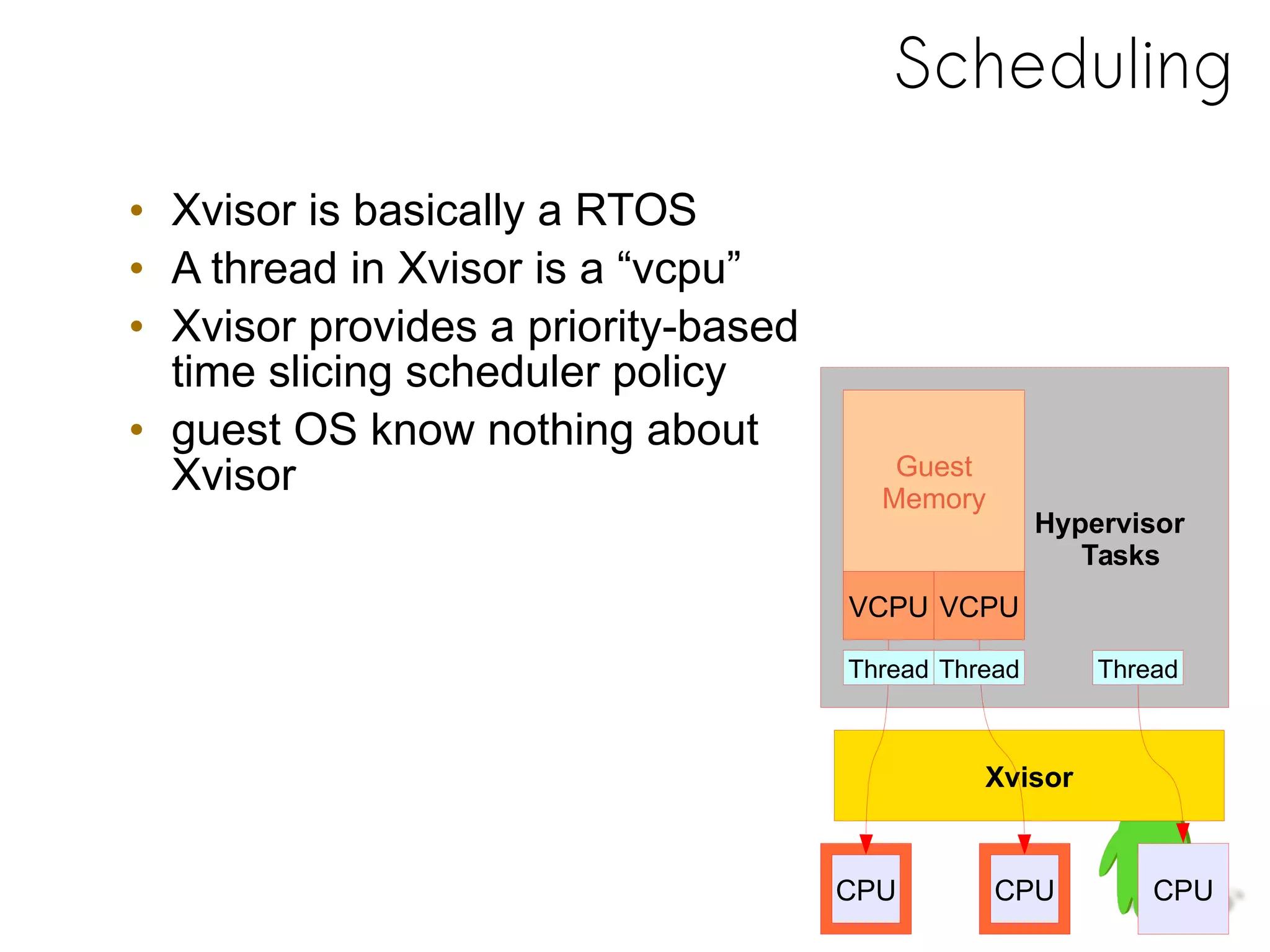
Scheduling
• Xvisor is basically a RTOS
• A thread in Xvisor is a “vcpu”
• Xvisor provides a priority-based
time slicing scheduler policy
• guest OS know nothing about
Xvisor
Hypervisor
Tasks
Guest
Memory
CPU CPU
VCPU VCPU
Thread
CPU
Xvisor
Thread Thread
VCPU Execution
• Guest OS is not expected to release the CPU during
its initial state
• While executing WFI instruction...
– with VE (Virtualization Extension) configuration
WFI is configured to trap into HYP mode
– with Non-VE configuration
WFI is converted into single SVC call during build
time
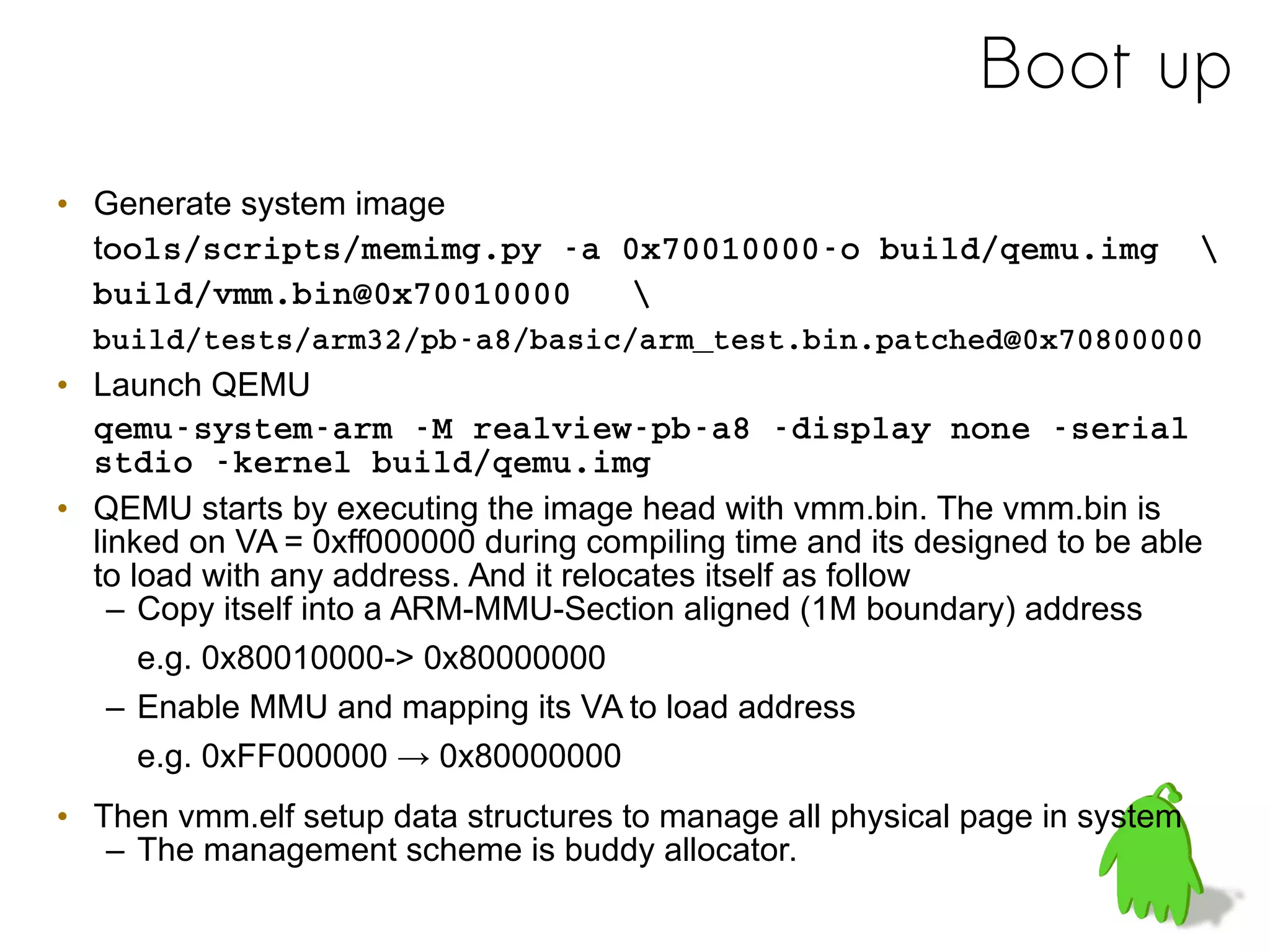
Boot up
• Generate system image
tools/scripts/memimg.py ­a 0x70010000­o build/qemu.img  
build/vmm.bin@0x70010000   
build/tests/arm32/pb­a8/basic/arm_test.bin.patched@0x70800000 
• Launch QEMU
qemu­system­arm ­M realview­pb­a8 ­display none ­serial 
stdio ­kernel build/qemu.img
• QEMU starts by executing the image head with vmm.bin. The vmm.bin is
linked on VA = 0xff000000 during compiling time and its designed to be able
to load with any address. And it relocates itself as follow
– Copy itself into a ARM-MMU-Section aligned (1M boundary) address
e.g. 0x80010000-> 0x80000000
– Enable MMU and mapping its VA to load address
e.g. 0xFF000000 → 0x80000000
• Then vmm.elf setup data structures to manage all physical page in system
– The management scheme is buddy allocator.
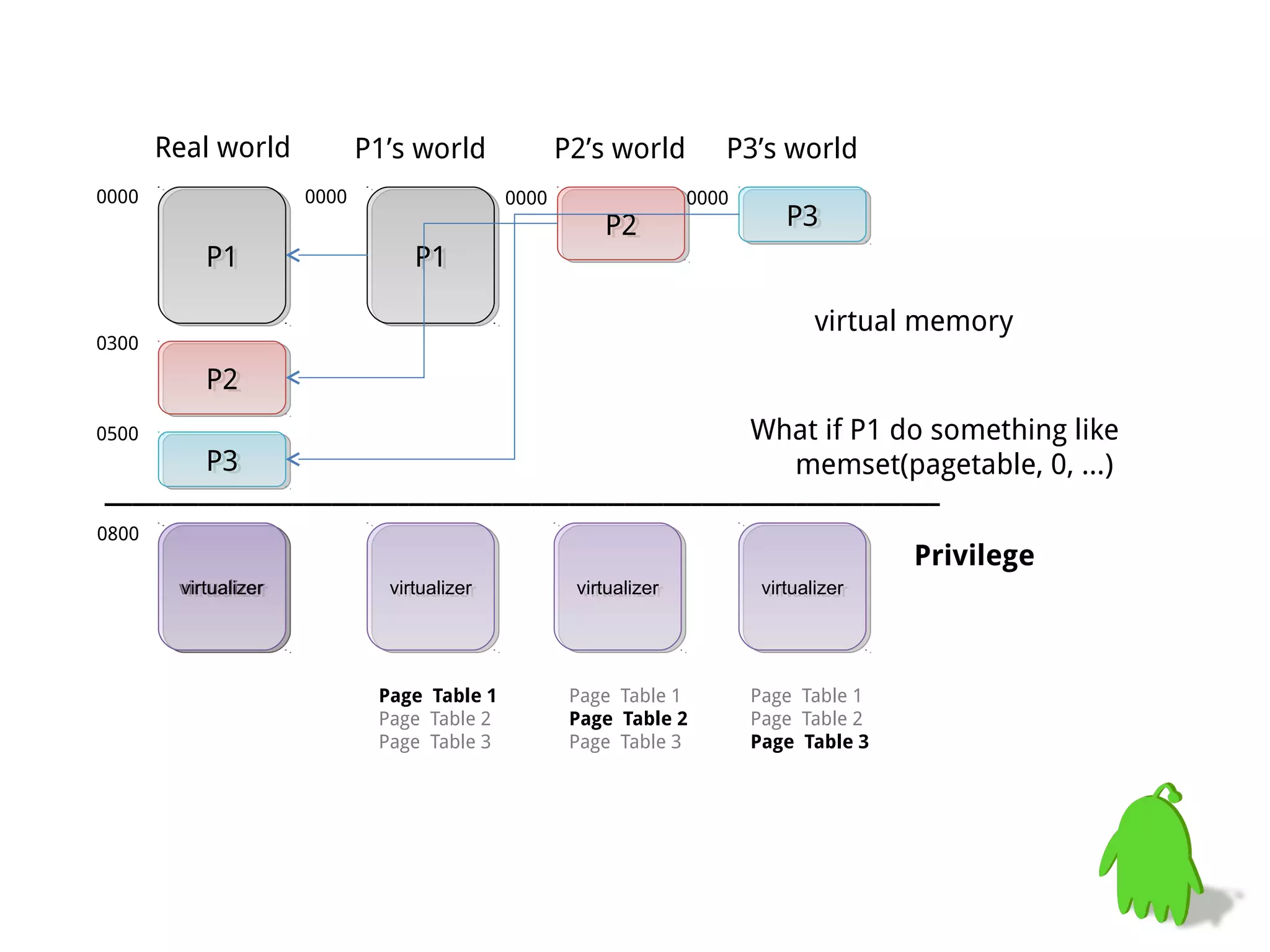
virtualizervirtualizer
P1P1
P2P2
P3P3
virtualizervirtualizer
0000
0300
0500
0800
P1’s world
P1P1
virtualizervirtualizer
0000
P2’s world
virtualizervirtualizer
P2P2
P3’s world
virtualizervirtualizer
P3P3
Real world
0000 0000
Page Table 1
Page Table 2
Page Table 3
Page Table 1
Page Table 2
Page Table 3
Page Table 1
Page Table 2
Page Table 3
Privilege
What if P1 do something like
memset(pagetable, 0, …)
virtual memory
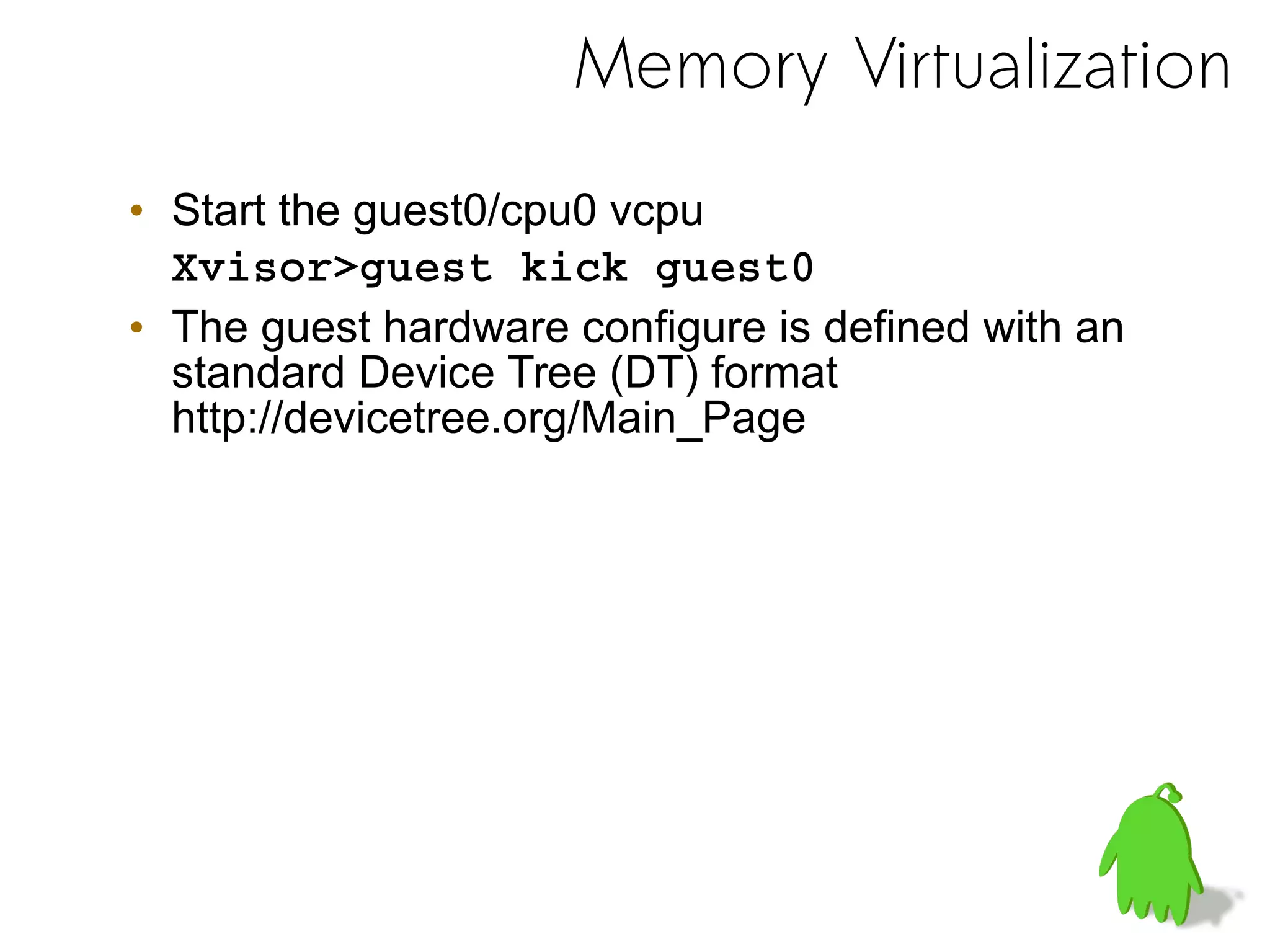
Memory Virtualization
• Start the guest0/cpu0 vcpu
Xvisor>guest kick guest0
• The guest hardware configure is defined with an
standard Device Tree (DT) format
http://devicetree.org/Main_Page
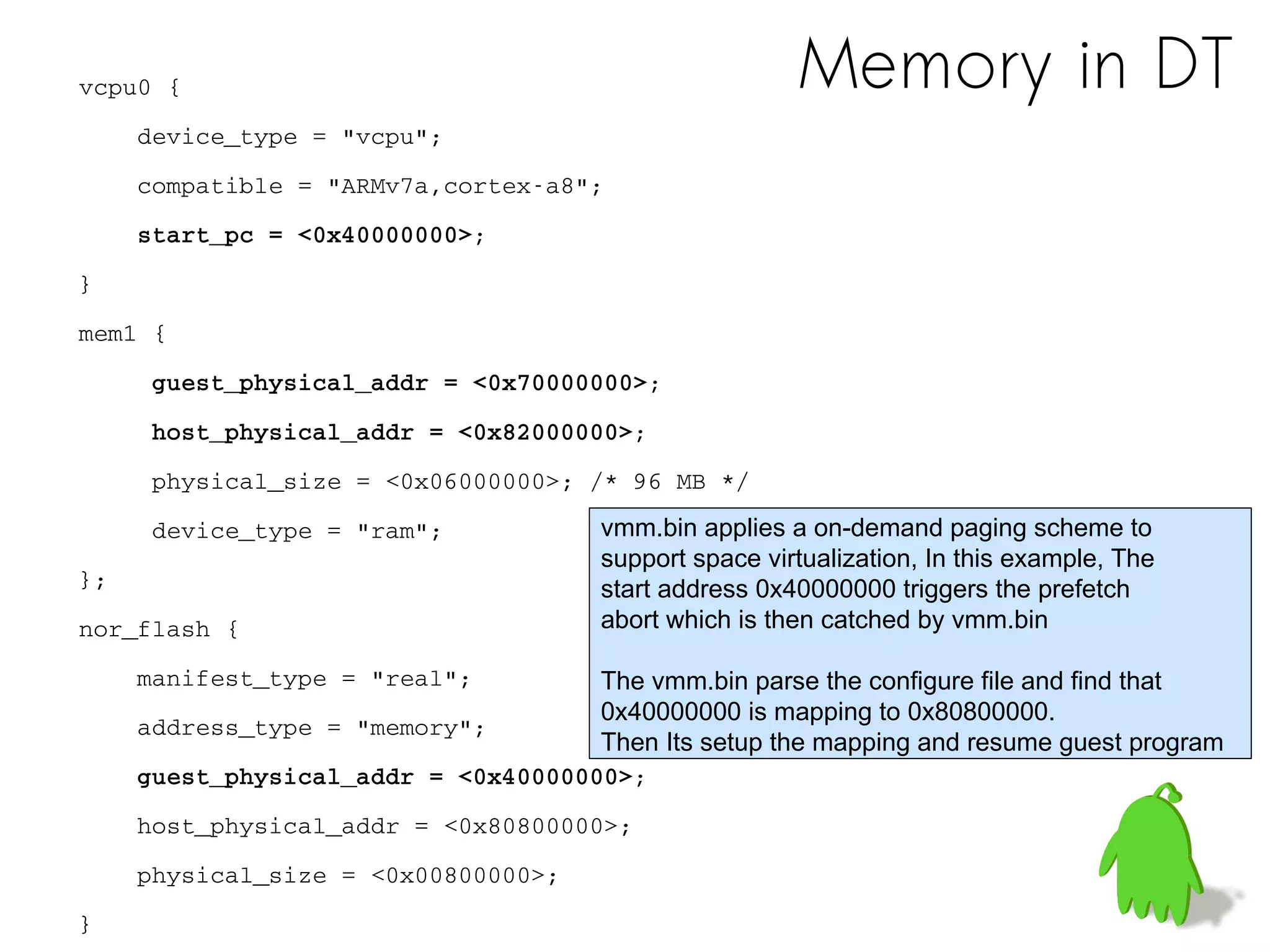
Memory in DTvcpu0 {
    device_type = "vcpu";
    compatible = "ARMv7a,cortex­a8";
    start_pc = <0x40000000>;
}
mem1 {
     guest_physical_addr = <0x70000000>;
     host_physical_addr = <0x82000000>;
     physical_size = <0x06000000>; /* 96 MB */
     device_type = "ram";
};
nor_flash {
    manifest_type = "real";
    address_type = "memory";
    guest_physical_addr = <0x40000000>;
    host_physical_addr = <0x80800000>;
    physical_size = <0x00800000>; 
}
vmm.bin applies a on-demand paging scheme to
support space virtualization, In this example, The
start address 0x40000000 triggers the prefetch
abort which is then catched by vmm.bin
The vmm.bin parse the configure file and find that
0x40000000 is mapping to 0x80800000.
Then Its setup the mapping and resume guest program
Device Virtualization
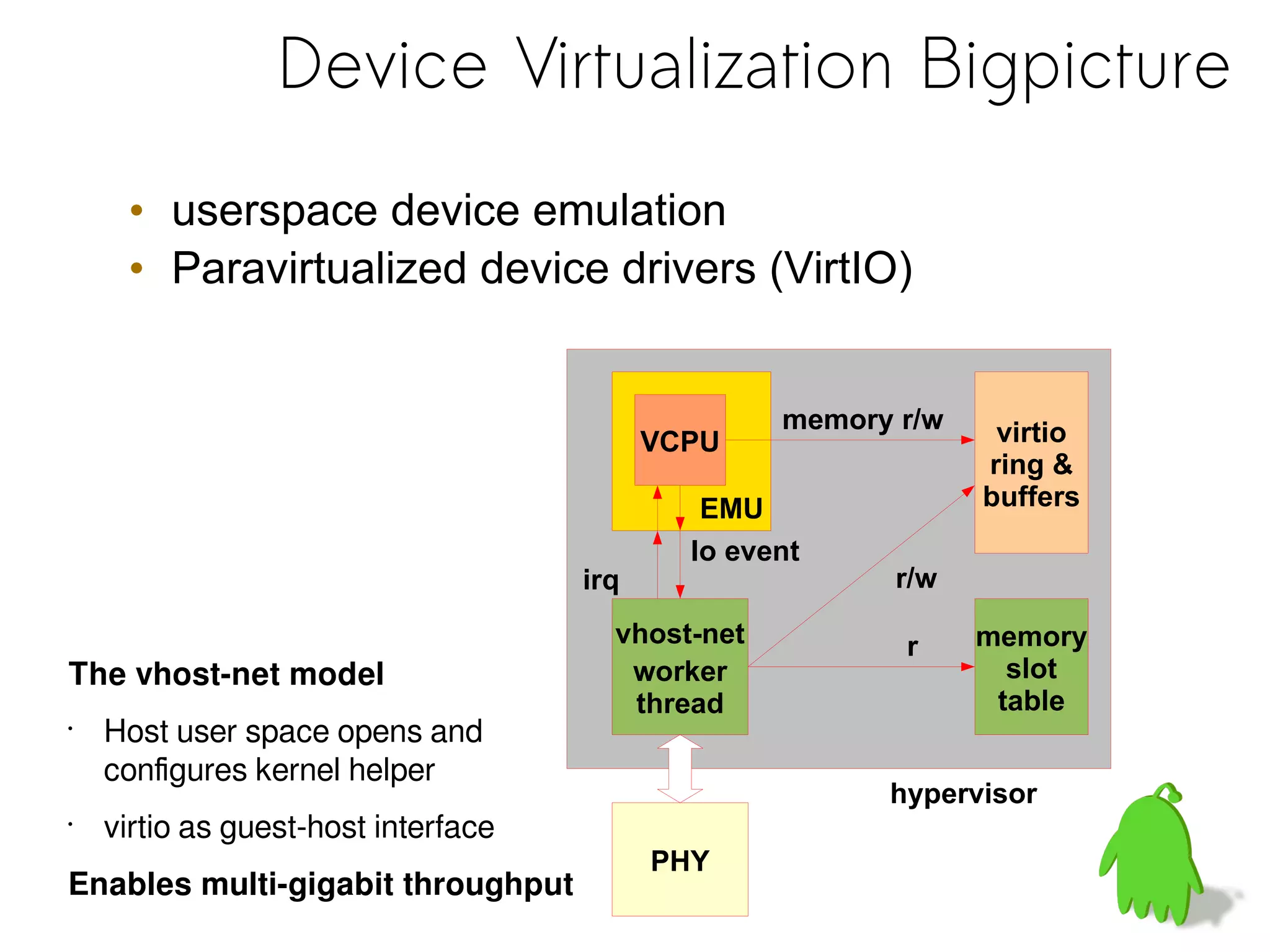
Device Virtualization Bigpicture
• userspace device emulation
• Paravirtualized device drivers (VirtIO)
vhost-net
worker
thread
EMU
VCPU
PHY
virtio
ring &
buffers
memory
slot
table
Io event
memory r/w
r/w
r
irq
hypervisor
The vhost-net model
•
Host user space opens and
configures kernel helper
•
virtio as guest-host interface
Enables multi-gigabit throughput
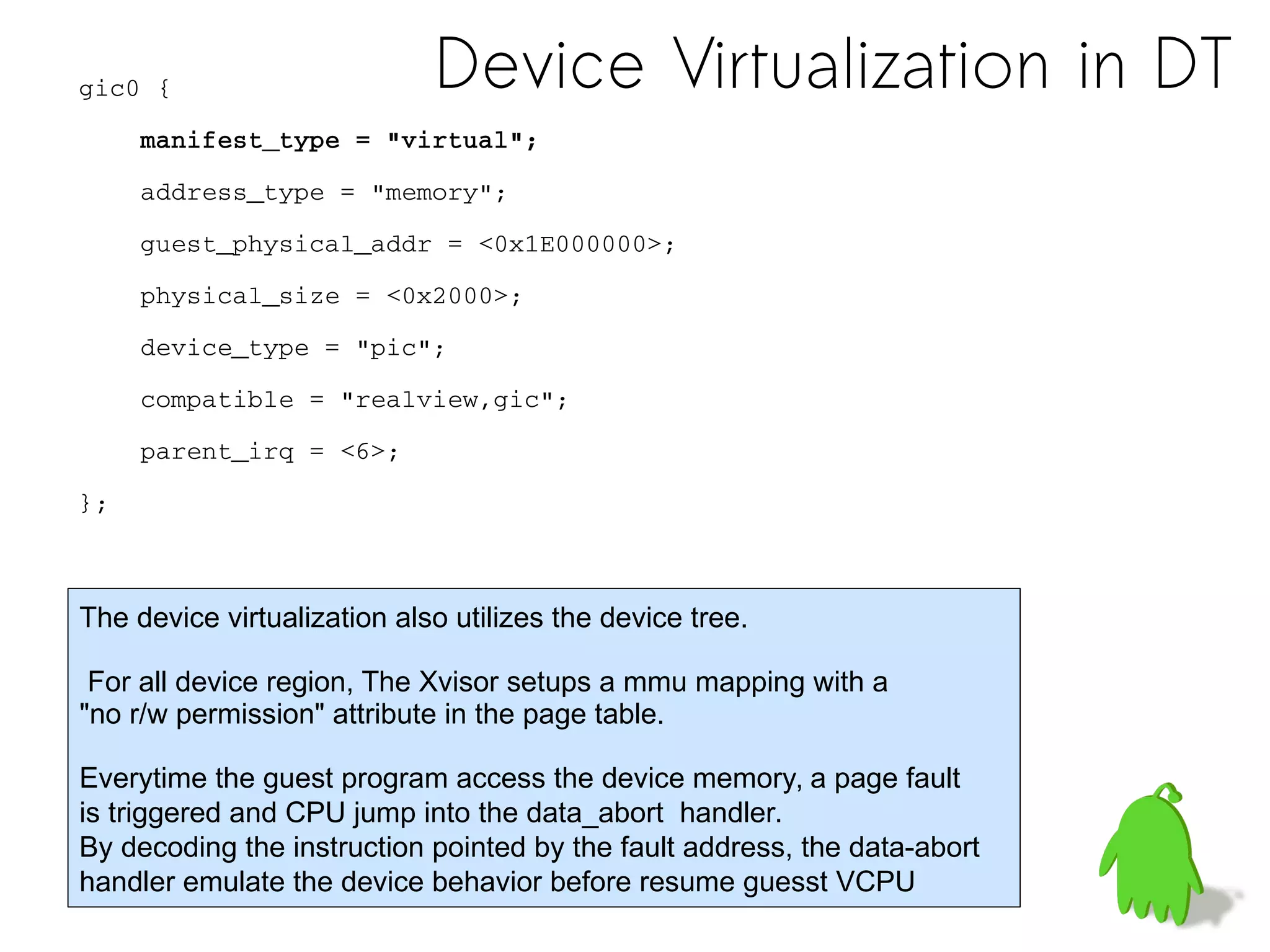
Device Virtualization in DTgic0 {
    manifest_type = "virtual";
    address_type = "memory";
    guest_physical_addr = <0x1E000000>;
    physical_size = <0x2000>;
    device_type = "pic";
    compatible = "realview,gic";
    parent_irq = <6>;
};
The device virtualization also utilizes the device tree.
For all device region, The Xvisor setups a mmu mapping with a
"no r/w permission" attribute in the page table.
Everytime the guest program access the device memory, a page fault
is triggered and CPU jump into the data_abort handler.
By decoding the instruction pointed by the fault address, the data-abort
handler emulate the device behavior before resume guesst VCPU
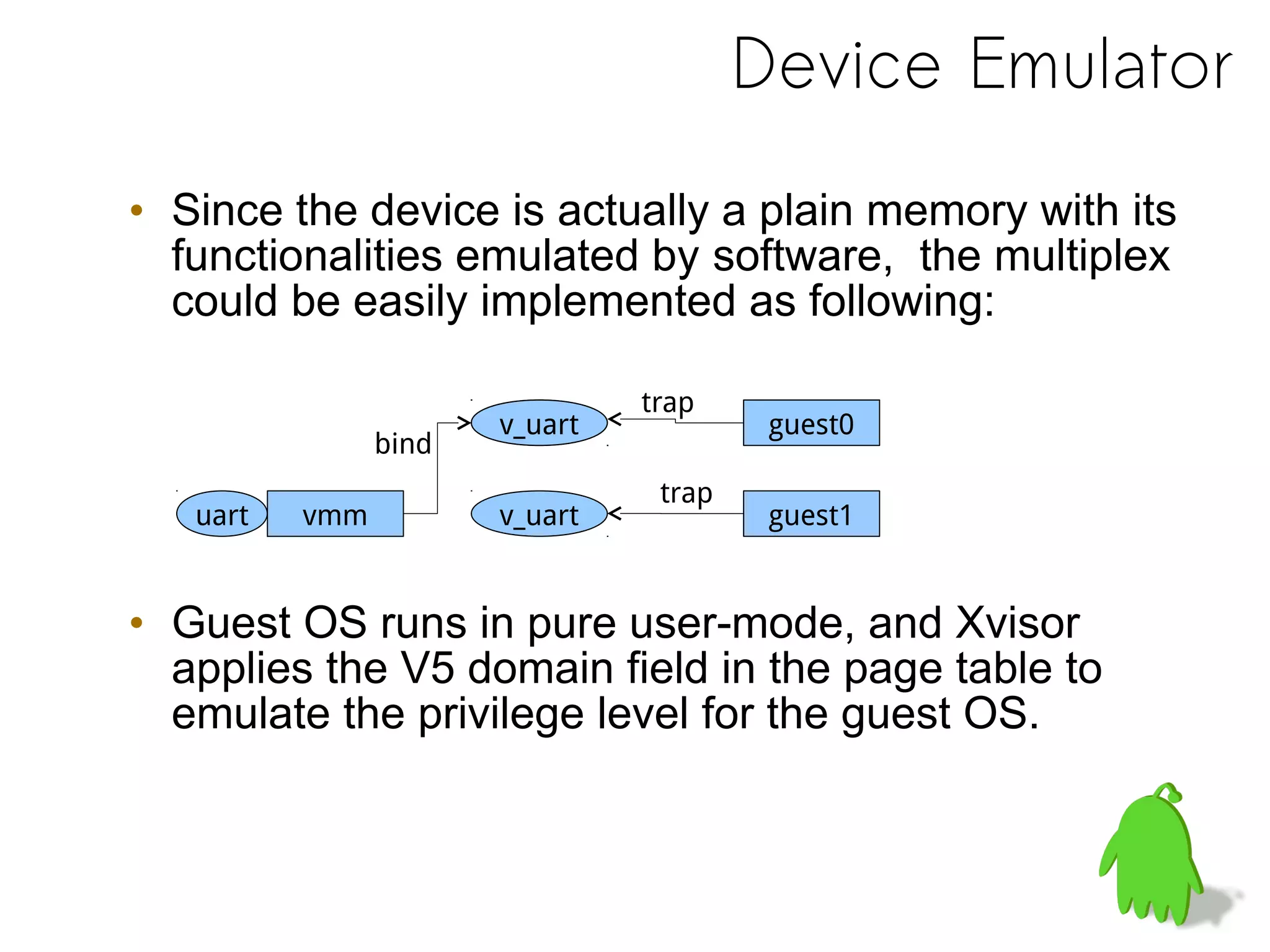
Device Emulator
• Since the device is actually a plain memory with its
functionalities emulated by software, the multiplex
could be easily implemented as following:
• Guest OS runs in pure user-mode, and Xvisor
applies the V5 domain field in the page table to
emulate the privilege level for the guest OS.
vmm guest1
guest0v_uart
uart
v_uart
v_uart
trap
trap
bind
Reference
• ARM Virtualization: CPU & MMU Issues, Prashanth Bungale,
vmware
• Hardware accelerated Virtualization in the
ARM Cortex™ Processors, John Goodacre, ARM
Ltd. (2011)

Xvisor: embedded and lightweight hypervisor

  • 1.
    Xvisor: embedded and lightweighthypervisor Jim Huang ( 黃敬群 ) <jserv@0xlab.org> Aug 3, 2013 / COSCUP
  • 2.
  • 3.
    Agenda (1) VirtualizationConcepts (2) Xvisor for ARM (3) Device Virtualization
  • 4.
  • 5.
    CPU Performance • 1965- IBM S/360 – 0.1 MIPS (133,300 IPS) – Provided full hardware virtualization with the ability to run 14 OS instances. • 1972 - IBM S/370 – 1.0 MIPS (1,000,000 IPS) • 2000 - 1 GHz Intel P3 – 3,000 MIPS (3,000,000,000 IPS) • 2009 - Qualcomm Snapdragon A8 – 2,000 MIPS • 2010 - Intel Core i7 – 4 x 147,600 MIPS • 2010 - Qualcomm Snapdragon MP – 2 x 2,500 MIPS • 2011 - Qualcomm/Samsung/nVidia A9 MP – 2 x 5,000 MIPS • 2012 – ARM Cortex A15 MP – 4 x 25,000 MIPS ARM processors are capable to virtualize in much cheaper and powerful way!
  • 6.
    Operating System LevelVirtualization • Why to have another layer below existing operating systems? – OS is not perfect: compatibility, stability, security • Workload consolidation – Increase server utilization – Reduce capital, hardware, power, space, heat costs • Legacy OS support – Especially with large 3rd-party software products • Migration – Predicted hardware downtime – Workload balancing
  • 7.
    Use Case: Low-cost3G Phone • Mobile Handsets – Major applications runs on Linux – 3G Modem software stack runs on RTOS domain • Virtualization in multimedia Devices – Reduces BOM (bill of materials) – Enables the Reusability of legacy code/applications – Reduces the system development time • Instrumentation, Automation – Run RTOS for Measurement and analysis – Run a GPOS for Graphical Interface • Real cases: Motorola Evoke QA4 Hypervisor
  • 8.
    Type 1: Baremetal Hypervisor A pure Hypervisor that runs directly on the hardware and hosts Guest OS’s. Type 2: OS ‘Hosted’ A Hypervisor that runs within a Host OS and hosts Guest OS’s inside of it, using the host OS services to provide the virtual environment. Provides partition isolation + reliability, higher security Low cost, no additional drivers Ease of use & installation Host HW Memory CPUsI/O Host HW Memory CPUsI/O HypervisorScheduler MMU Device Drivers/Models VMn VM1 VM0 Guest OS and Apps Host OS Device Drivers Ring-0 VM Monitor “Kernel “ VMn VM1 VM0 Guest OS and Apps User Apps User-level VMM Device Models General Classification of Virtualization
  • 9.
    Virtualizable is a propertyof the Instruction Set Architecture (ISA) • A sensitive instruction – changes the configuration or mode of the processor, or – depends in its behavior on the processor’s state • A privileged instruction – must be executed with sufficient privilege – causes a trap in user mode If all sensitive instructions are privileged, virtual machine monitor can be written.
  • 10.
    ● Privileged instructions: OSkernel and device driver access to system hardware ● Trapped and Emulated by VMM – execute guest in separate address space in unprivileged mode – emulate all instructions that cause traps Privileged Instructions
  • 11.
    11 • branch andbranch with Link (B, BL) • data processing instructions (AND, TST, MOV, …) • shifts: logical (LSR), arithmetic (ASR), rotate (ROR) • test (TEQ, TST, CMP, CMN) • processor status register transfer (MSR, MRS) • memory load/store words (LDR, STR) • push/pop Stack Operations (STM, LDM) • software Interrupt (SWI; operating mode switch) • co-processor (CDP, LDC, STC, MRC, MCR) Typical ARM instructions (armv4)
  • 12.
    Problematic Instructions (1) •Type 1 Instructions which executed in user mode will cause undefined instruction exception • Example MCR p15, 0, r0, c2, c0, 0 Move r0 to c2 and c0 in coprocessor specified by p15 (co-processor) for operation according to option 0 and 0 – MRC: from coproc to register – MCR: from register to coproc • Problem: – Operand-dependent operation
  • 13.
    Problematic Instructions (2) •Type 2 Instructions which executed in user mode will have no effect • Example MSR cpsr_c, #0xD3 Switch to privileged mode and disable interrupt N Z C V Q -- J -- GE[3:0] -- E A I F T M[4:0] 31 0 Execution Flags Exception Mask Execution Mode Program Status Register (PSR)
  • 14.
    Problematic Instructions (3) •Type 3 Instructions which executed in user mode will cause unpredictable behaviors. • Example MOVS PC, LR The return instruction changes the program counter and switches to user mode. • This instruction causes unpredictable behavior when executed in user mode.
  • 15.
    ARM Sensitive Instructions •Coprocessor Access Instructions MRC / MCR / CDP / LDC / STC • SIMD/VFP System Register Access Instructions VMRS / VMSR • TrustZone Secure State Entry Instructions SMC • Memory-Mapped I/O Access Instructions Load/Store instructions from/into memory-mapped I/O locations • Direct (Explicit/Implicit) CPSR Access Instructions MRS / MSR / CPS / SRS / RFE / LDM (conditional execution) / DPSPC • Indirect CPSR Access Instructions LDRT / STRT – Load/Store Unprivileged (“As User”) • Banked Register Access Instructions LDM/STM (User mode registers)
  • 16.
    Solutions to ProblematicInstructions [ Hardware Techniques ] • Privileged Instruction Semantics dictated/translated by instruction set architecture • MMU-enforced traps – Example: page fault • Tracing/debug support – Example: bkpt (breakpoint) • Hardware-assisted Virtualization – Example: extra privileged mode, HYP, in ARM Cortex-A15
  • 17.
    Complexity Binary translation Hypercall Design High Low ImplementationMedium High Runtime High Medium Method: trap and emulate Solutions to Problematic Instructions [ Software Techniques ]
  • 18.
    Dynamic Binary Translation BLTLB_FLUSH_DENTRY … TLB_FLUSH_DENTRY: MCR p15, 0, R0, C8, C6, 1 MOV PC, LR … BL TLB_FLUSH_DENTRY_NEW … TLB_FLUSH_DENTRY: MCR p15, 0, R0, C8, C6, 1 MOV PC, LR … TLB_FLUSH_DENTRY_NEW: MOV R1, R0 MOV R0, #CMD_FLUSH_DENTRY SWI #HYPER_CALL_TLB Translation Basic Block • ARM has a fixed instruction size – 32-bit in ARM mode and 16-bit in Thumb mode • Perform binary translation – Follow control-flow – Translate basic block (if not already translated) at the current PC – Ensure interposition at end of translated sequence – All writes (but not reads) to PC now become problematic instructions – Replace problematic instructions 1-1 with hypercalls to trap and emulate → self-modifying code
  • 19.
    Virtualization APIs –hypercalls BL TLB_FLUSH_DENTRY … TLB_FLUSH_DENTRY: MOV R1, R0 MOV R0, #CMD_FLUSH_DENTRY SWI #HYPER_CALL_TLB … Restore User Context & PC SWI Handler Hypercall Handler …… LDR R1, [SP, #4] MCR p15, 0, R1, C8, C6, 1 /* In Hypervisor */ /* In Guest OS */ • Use trap instruction to issue hypercall • Encode hypercall type and original instruction bits in hypercall hint • Upon trapping into the VMM, decode the hypercall type and the original instruction bits, and emulate instruction semantics mrs r8, cpsr swi 0x088000 mrs Rd, R <cpsr/spsr>
  • 20.
  • 21.
    Xvisor • new opensource bare-metal hypervisor, which aims towards providing virtualization solution, which is light-weight, portable, and flexible with small memory footprint and less virtualization overhead • distributed under GNU Public License (GPLv2). • On real hardware specifically BeagleBoard, it reaches near native CPU performance – Native Linux 3.0.4 gives 1120 DMIPS whereas Linux 3.0.4 running as guest on Xvisor ARM gives 1070 DMIPS. • Major targets: x86 and ARM – ARM target supports ARM9, ARM11, Cortex-A8, Cortex-A9, Cortex-A15 – Virtualization Extension
  • 22.
    Xvisor-ARM https://github.com/xvisor • File: arch/arm/cpu/arm32/elf2cpatch.py –Script to generate cpatch script from guest OS ELF • Functionality before generating the final ELF image – Encode all privileged instructions into SVC instructions (software interrupt) – For each privilege instruction, generate a primitive to replace it – read the directive from ELF2CPATCH and mangle the target binary file – The patched image contains no privilege instructions and could run with in user mode
  • 23.
  • 24.
    How does Xvisorhandle problematic instructions like MSR? • Type 2 Instructions which executed in user mode will have no effect • Example MSR cpsr_c, #0xD3 Switch to privileged mode and disable interrupt N Z C V Q -- J -- GE[3:0] -- E A I F T M[4:0] 31 0 Execution Flags Exception Mask Execution Mode Program Status Register (PSR)
  • 25.
    MSR cpsr_c, #0xD3 Switchto privileged mode and disable interrupt # MSR (immediate) # Syntax: # msr<c> <spec_reg>, #<const> # Fields: # cond = bits[31:28] # R = bits[22:22] # mask = bits[19:16] # imm12 = bits[11:0] # Hypercall Fields: # inst_cond[31:28] = cond # inst_op[27:24] = 0xf # inst_id[23:20] = 0 # inst_subid[19:17] = 2 # inst_fields[16:13] = mask # inst_fields[12:1] = imm12 # inst_fields[0:0] = R First, cpatch (ELF patching tool) looks up the instructions...
  • 26.
    def convert_msr_i_inst(hxstr): hx =int(hxstr, 16) inst_id = 0 inst_subid = 2 cond = (hx >> 28) & 0xF R = (hx >> 22) & 0x1 mask = (hx >> 16) & 0xF imm12 = (hx >> 0) & 0xFFF rethx = 0x0F000000 rethx = rethx | (cond << 28) rethx = rethx | (inst_id << 20) rethx = rethx | (inst_subid << 17) rethx = rethx | (mask << 13) rethx = rethx | (imm12 << 1) rethx = rethx | (R << 0) return rethx # MSR (immediate) # Syntax: # msr<c> <spec_reg>, #<const> # Fields: # cond = bits[31:28] # R = bits[22:22] # mask = bits[19:16] # imm12 = bits[11:0] # Hypercall Fields: # inst_cond[31:28] = cond # inst_op[27:24] = 0xf # inst_id[23:20] = 0 # inst_subid[19:17] = 2 # inst_fields[16:13] = mask # inst_fields[12:1] = imm12 # inst_fields[0:0] = R Xvisor utilizes cpatch to convert all problematic instructions for OS image files (ELF format).
  • 27.
    But it isnot enough... • have to handle virtual CPU, memory, devices. Boot ARM/Linux under Xvisor Qemu/ Xvisor img Xvisor shell Guest instance 0 MUGGLE Boot loader MUGGLE Linux 3.0.4 QEMUVirtualIO TIME XvisorDev MUGGLE TTY attach mangling
  • 28.
    Scheduling • Xvisor isbasically a RTOS • A thread in Xvisor is a “vcpu” • Xvisor provides a priority-based time slicing scheduler policy • guest OS know nothing about Xvisor Hypervisor Tasks Guest Memory CPU CPU VCPU VCPU Thread CPU Xvisor Thread Thread
  • 29.
    VCPU Execution • GuestOS is not expected to release the CPU during its initial state • While executing WFI instruction... – with VE (Virtualization Extension) configuration WFI is configured to trap into HYP mode – with Non-VE configuration WFI is converted into single SVC call during build time
  • 30.
    Boot up • Generatesystem image tools/scripts/memimg.py ­a 0x70010000­o build/qemu.img   build/vmm.bin@0x70010000    build/tests/arm32/pb­a8/basic/arm_test.bin.patched@0x70800000  • Launch QEMU qemu­system­arm ­M realview­pb­a8 ­display none ­serial  stdio ­kernel build/qemu.img • QEMU starts by executing the image head with vmm.bin. The vmm.bin is linked on VA = 0xff000000 during compiling time and its designed to be able to load with any address. And it relocates itself as follow – Copy itself into a ARM-MMU-Section aligned (1M boundary) address e.g. 0x80010000-> 0x80000000 – Enable MMU and mapping its VA to load address e.g. 0xFF000000 → 0x80000000 • Then vmm.elf setup data structures to manage all physical page in system – The management scheme is buddy allocator.
  • 31.
    virtualizervirtualizer P1P1 P2P2 P3P3 virtualizervirtualizer 0000 0300 0500 0800 P1’s world P1P1 virtualizervirtualizer 0000 P2’s world virtualizervirtualizer P2P2 P3’sworld virtualizervirtualizer P3P3 Real world 0000 0000 Page Table 1 Page Table 2 Page Table 3 Page Table 1 Page Table 2 Page Table 3 Page Table 1 Page Table 2 Page Table 3 Privilege What if P1 do something like memset(pagetable, 0, …) virtual memory
  • 32.
    Memory Virtualization • Startthe guest0/cpu0 vcpu Xvisor>guest kick guest0 • The guest hardware configure is defined with an standard Device Tree (DT) format http://devicetree.org/Main_Page
  • 33.
    Memory in DTvcpu0 {     device_type = "vcpu";     compatible = "ARMv7a,cortex­a8";     start_pc = <0x40000000>; } mem1 {      guest_physical_addr = <0x70000000>;      host_physical_addr = <0x82000000>;      physical_size = <0x06000000>; /* 96 MB */      device_type = "ram"; }; nor_flash {     manifest_type = "real";     address_type = "memory";     guest_physical_addr = <0x40000000>;     host_physical_addr = <0x80800000>;     physical_size = <0x00800000>;  } vmm.binapplies a on-demand paging scheme to support space virtualization, In this example, The start address 0x40000000 triggers the prefetch abort which is then catched by vmm.bin The vmm.bin parse the configure file and find that 0x40000000 is mapping to 0x80800000. Then Its setup the mapping and resume guest program
  • 34.
  • 35.
    Device Virtualization Bigpicture •userspace device emulation • Paravirtualized device drivers (VirtIO) vhost-net worker thread EMU VCPU PHY virtio ring & buffers memory slot table Io event memory r/w r/w r irq hypervisor The vhost-net model • Host user space opens and configures kernel helper • virtio as guest-host interface Enables multi-gigabit throughput
  • 36.
    Device Virtualization inDTgic0 {     manifest_type = "virtual";     address_type = "memory";     guest_physical_addr = <0x1E000000>;     physical_size = <0x2000>;     device_type = "pic";     compatible = "realview,gic";     parent_irq = <6>; }; The device virtualization also utilizes the device tree. For all device region, The Xvisor setups a mmu mapping with a "no r/w permission" attribute in the page table. Everytime the guest program access the device memory, a page fault is triggered and CPU jump into the data_abort handler. By decoding the instruction pointed by the fault address, the data-abort handler emulate the device behavior before resume guesst VCPU
  • 37.
    Device Emulator • Sincethe device is actually a plain memory with its functionalities emulated by software, the multiplex could be easily implemented as following: • Guest OS runs in pure user-mode, and Xvisor applies the V5 domain field in the page table to emulate the privilege level for the guest OS. vmm guest1 guest0v_uart uart v_uart v_uart trap trap bind
  • 38.
    Reference • ARM Virtualization:CPU & MMU Issues, Prashanth Bungale, vmware • Hardware accelerated Virtualization in the ARM Cortex™ Processors, John Goodacre, ARM Ltd. (2011)