Adam Gibson
Email:
0@blix.io
Twitter:
@agibsonccc
Github:
https://github.com/a
gibsonccc
Slideshare:
http://slideshare.net/agibsonc
cc/
Instructor at
http://zipfianacademy.com/
Wired Coverage:
http://www.wired.com/2014/0
6/skymind-deep-learning/
Josh Patterson
Email:
josh@pattersonconsultingtn.com
Twitter:
@jpatanooga
Github:
https://github.com/jpata
nooga
Past
Published in IAAI-09:
“TinyTermite: A Secure Routing Algorithm”
Grad work in Meta-heuristics, Ant-algorithms
Tennessee Valley Authority (TVA)
Hadoop and the Smartgrid
Cloudera
Principal Solution Architect
Today: Patterson Consulting
Overview
• What is Deep Learning?
• Deep Belief Networks
• Implementation on Hadoop/YARN
• Results
What is Deep Learning?
Algorithm that tries to learn simple features in lower
layers
And more complex features in higher layers
Interesting Properties of Deep Learning
Reduces a problem with overfitting in neural
networks.
Introduces new techniques for "unsupervised feature
learning”
introduces new more automatic ways to figure out the
parts of your data you should feed into your learning
algorithm.
Chasing Nature
Learning sparse representations of auditory signals
leads to filters that closely correspond to neurons in
early audio processing in mammals
When applied to speech
Learned representations showed a striking
resemblance to the cochlear filters in the auditory
cortext
Yann LeCunn on Deep Learning
Has become the dominant method for acoustic
modeling in speech recognition
Quickly becoming the dominant method for several
vision tasks such as
object recognition
object detection
semantic segmentation.
What is a Deep Belief Network?
Generative probabilistic model
Composed of one visible layer
Many hidden layers
Each hidden layer learns relationship between units
in lower layer
Higher layer representations tend to become more
complext
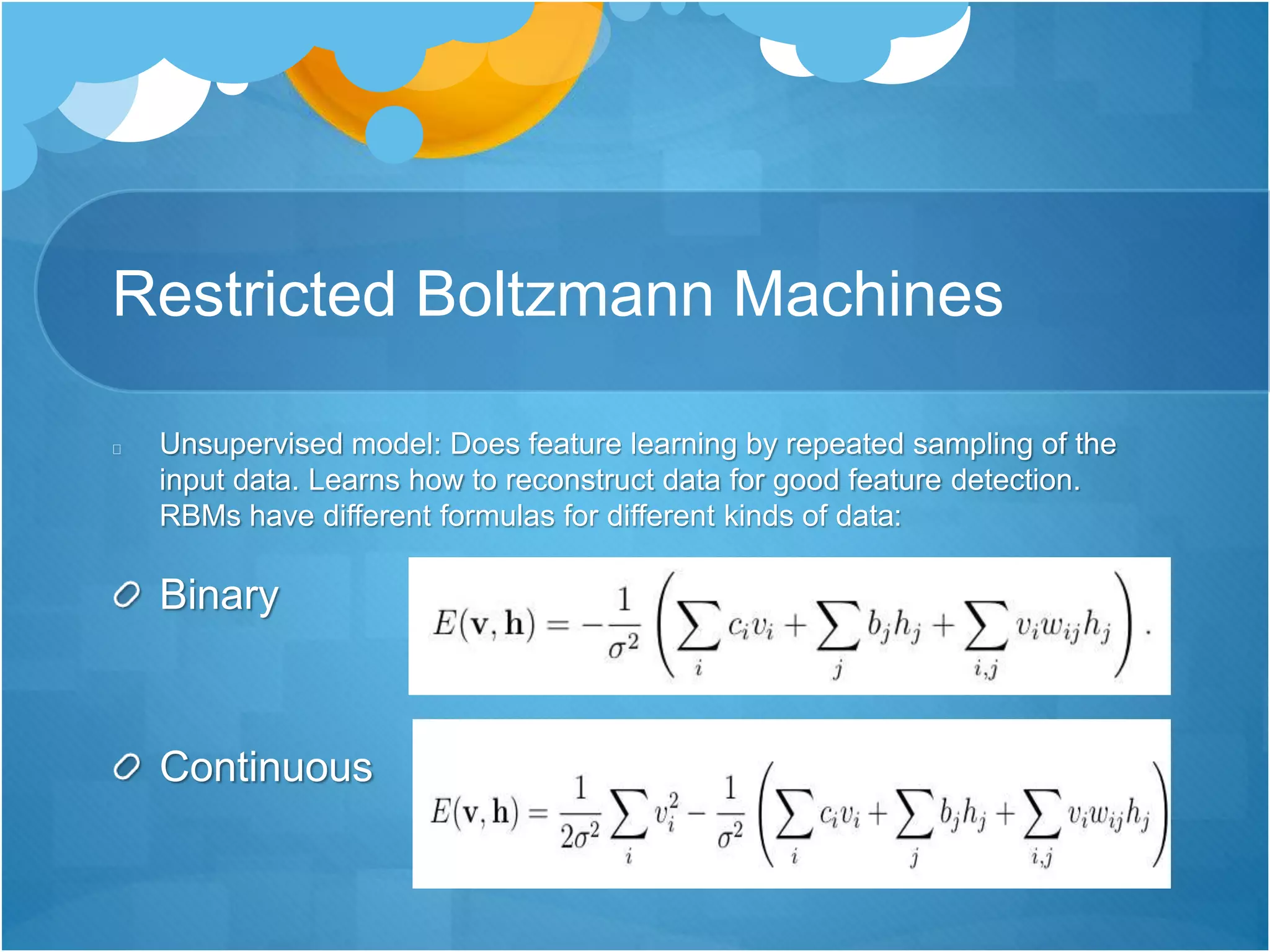
Restricted Boltzmann Machines
Unsupervised model: Does feature learning by repeated sampling of the
input data. Learns how to reconstruct data for good feature detection.
RBMs have different formulas for different kinds of data:
Binary
Continuous
DeepLearning4J
Implementation in Java
Self-contained & built on Akka, Hazelcast, Jblas
Distributed to run faster and with more features than
current Theano-based implementations.
Talks to any data source, expects one format.
Vectorized Implementation
Handles lots of data concurrently.
Any number of examples at once, but the code does
not change.
Faster: Allows for native/GPU execution.
One format: Everything is a matrix.
DL4J vs Theano Perf
GPUs are inherently faster than normal native.
Theano is not distributed, and GPUs have very low
RAM.
DL4J allows for situations where you have to “throw
CPUs at it.”
What are Good Applications for Deep Learning?
Image Processing
High MNIST Scores
Audio Processing
Current Champ on TIMIT dataset
Text / NLP Processing
Word2vec, etc
Past Work: Parallel Iterative Algorithms on YARN
Started with
Parallel linear, logistic regression
Parallel Neural Networks
Packaged in Metronome
100% Java, ASF 2.0 Licensed, on github
Parameter Averaging
McDonald, 2010
Distributed Training Strategies for the Structured Perceptron
Langford, 2007
Vowpal Wabbit
Jeff Dean’s Work on Parallel SGD
DownPour SGD
19
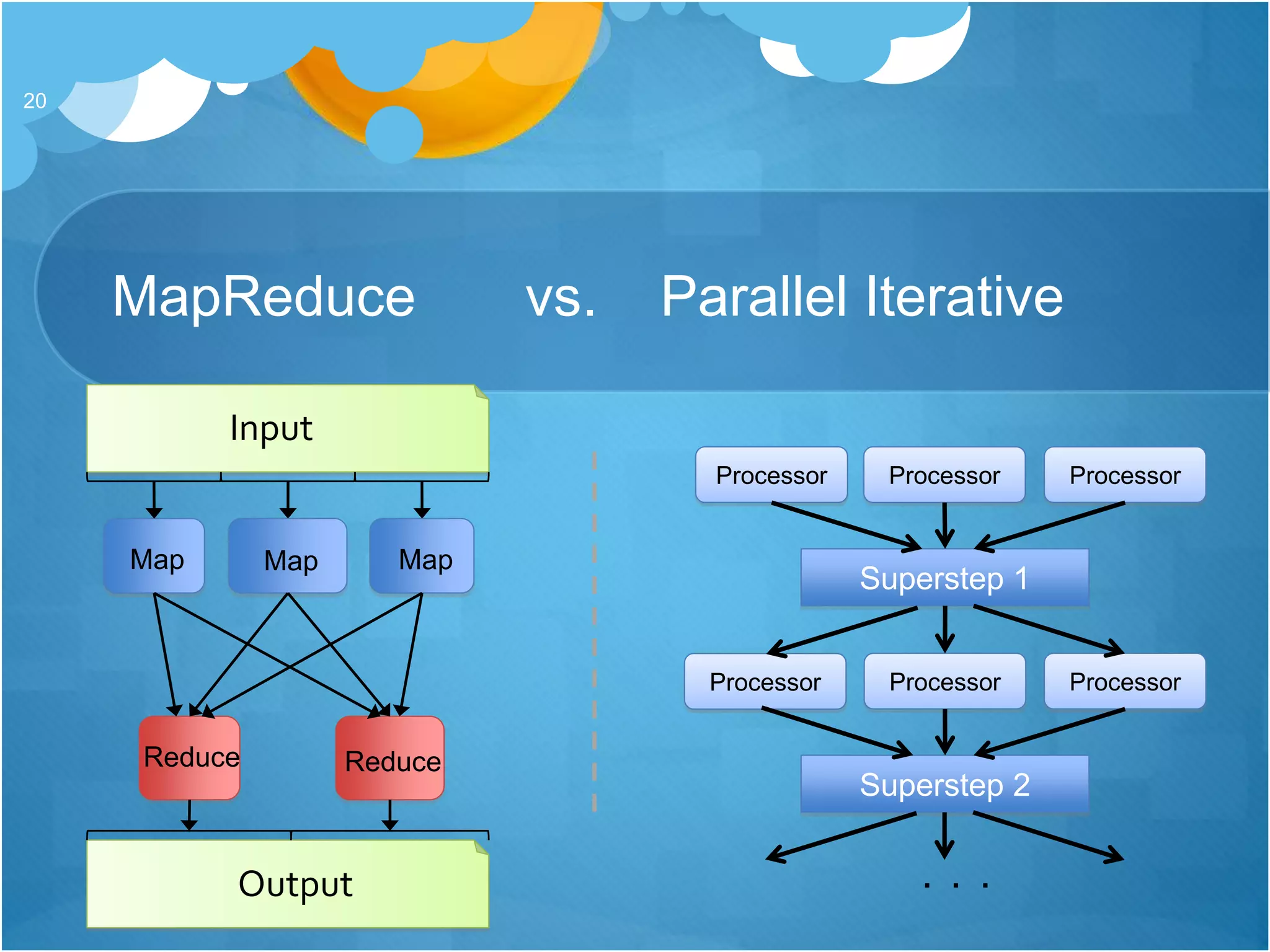
MapReduce vs. Parallel Iterative
20
Input
Output
Map Map Map
Reduce Reduce
Processor Processor Processor
Superstep 1
Processor Processor
Superstep 2
. . .
Processor
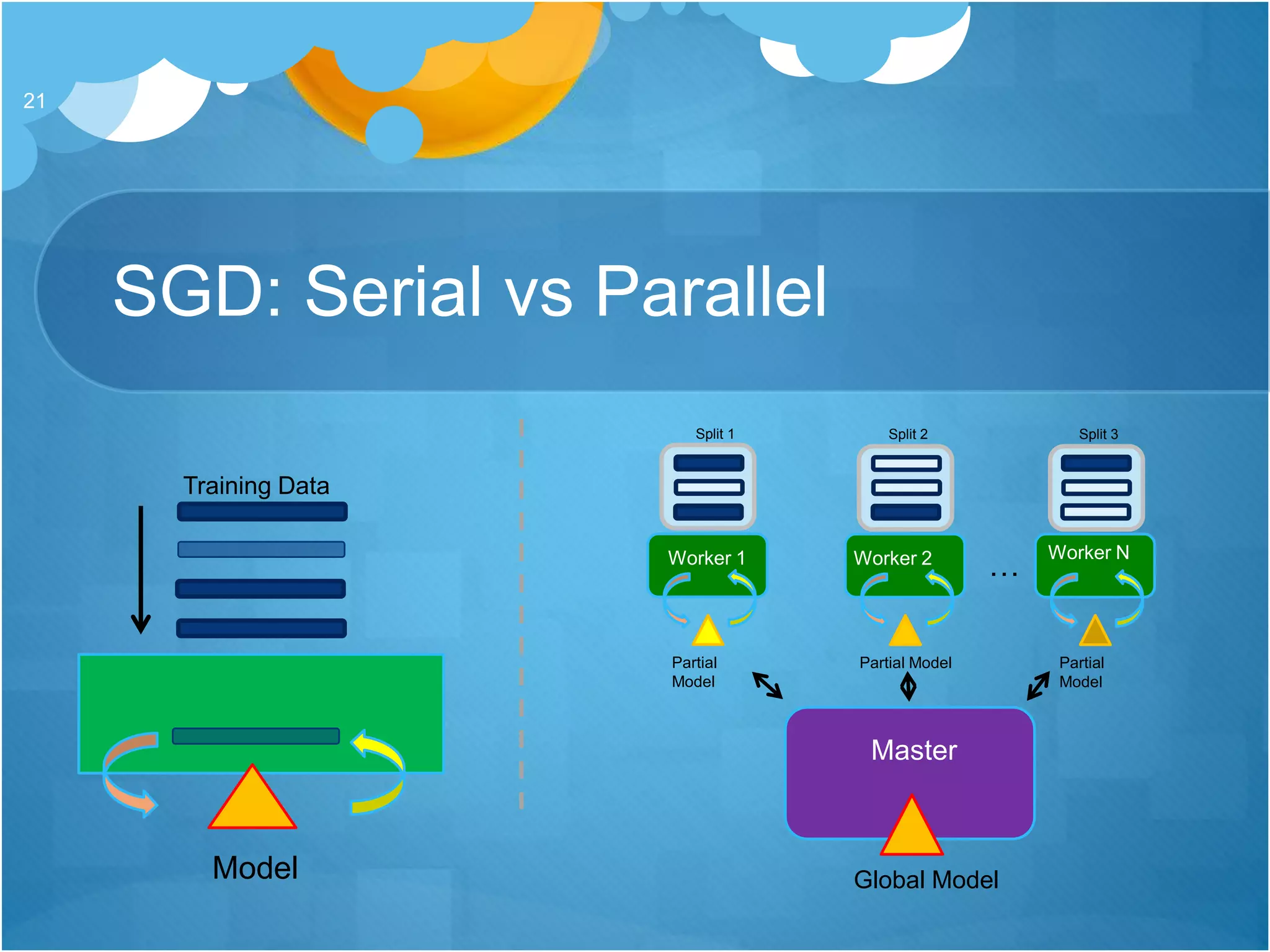
SGD: Serial vs Parallel
21
Model
Training Data
Worker 1
Master
Partial
Model
Global Model
Worker 2
Partial Model
Worker N
Partial
Model
Split 1 Split 2 Split 3
…
Managing Resources
Running through YARN on hadoop is important
Allows for workflow scheduling
Allows for scheduler oversight
Allows the jobs to be first class citizens on Hadoop
And share resources nicely
Parallelizing Deep Belief Networks
Two phase training
Pre Train
Fine tune
Each phase can do multiple passes over dataset
Entire network is averaged at master
PreTrain and Lots of Data
We’re exploring how to better leverage the
unsupervised aspects of the PreTrain phase of
Deep Belief Networks
Allows for the use of far less unlabeled data
Allows us to more easily modeled the massive amounts
of structured data in HDFS
DBNs on IR Performance
Faster to Train.
Parameter averaging is an automatic form of
regularization.
Adagrad with IR allows for better generalization of
different features and even pacing.
Scale Out Metrics
Batches of records can be processed by as many
workers as there are data splits
Message passing overhead is minimal
Exhibits linear scaling
Example: 3x workers, 3x faster learning
Usage From Command Line
Run Deep Learning on Hadoop
yarn jar iterativereduce-0.1-SNAPSHOT.jar [props file]
Evaluate model
./score_model.sh [props file]
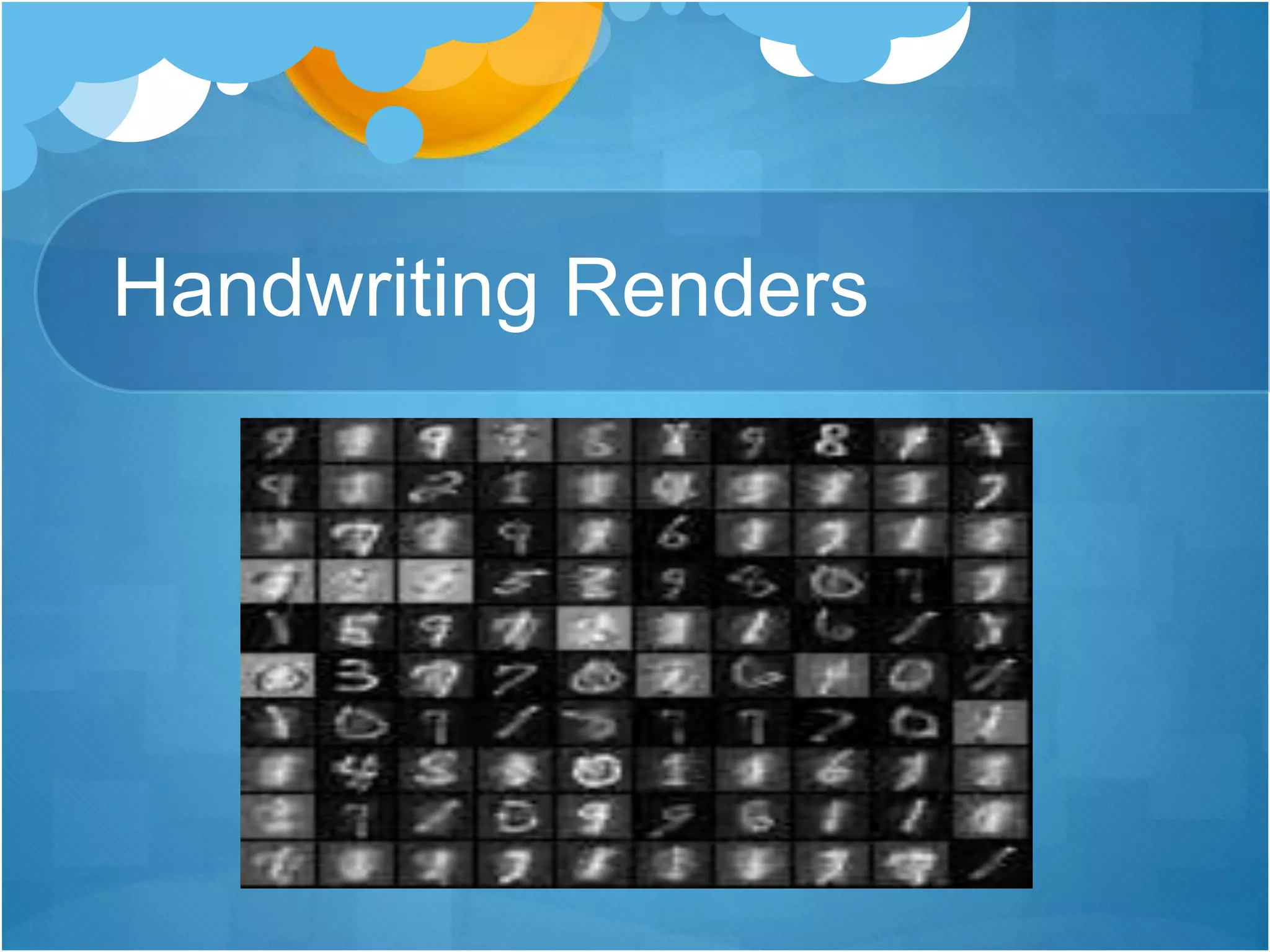
Handwriting Renders
Faces Renders
…In Which We Gather Lots of Cat Photos
Future Direction
GPUs
Better Vectorization tooling
Move YARN version back over to JBLAS for matrices
References
“A Fast Learning Algorithm for Deep Belief Nets”
Hinton, G. E., Osindero, S. and Teh, Y. - Neural Computation
(2006)
“Large Scale Distributed Deep Networks”
Dean, Corrado, Monga - NIPS (2012)
“Visually Debugging Restricted Boltzmann Machine Training
with a 3D Example”
Yosinski, Lipson - Representation Learning Workshop (2012)

Hadoop Summit 2014 - San Jose - Introduction to Deep Learning on Hadoop

  • 2.
  • 3.
    Josh Patterson Email: josh@pattersonconsultingtn.com Twitter: @jpatanooga Github: https://github.com/jpata nooga Past Published inIAAI-09: “TinyTermite: A Secure Routing Algorithm” Grad work in Meta-heuristics, Ant-algorithms Tennessee Valley Authority (TVA) Hadoop and the Smartgrid Cloudera Principal Solution Architect Today: Patterson Consulting
  • 4.
    Overview • What isDeep Learning? • Deep Belief Networks • Implementation on Hadoop/YARN • Results
  • 6.
    What is DeepLearning? Algorithm that tries to learn simple features in lower layers And more complex features in higher layers
  • 7.
    Interesting Properties ofDeep Learning Reduces a problem with overfitting in neural networks. Introduces new techniques for "unsupervised feature learning” introduces new more automatic ways to figure out the parts of your data you should feed into your learning algorithm.
  • 8.
    Chasing Nature Learning sparserepresentations of auditory signals leads to filters that closely correspond to neurons in early audio processing in mammals When applied to speech Learned representations showed a striking resemblance to the cochlear filters in the auditory cortext
  • 9.
    Yann LeCunn onDeep Learning Has become the dominant method for acoustic modeling in speech recognition Quickly becoming the dominant method for several vision tasks such as object recognition object detection semantic segmentation.
  • 11.
    What is aDeep Belief Network? Generative probabilistic model Composed of one visible layer Many hidden layers Each hidden layer learns relationship between units in lower layer Higher layer representations tend to become more complext
  • 12.
    Restricted Boltzmann Machines Unsupervisedmodel: Does feature learning by repeated sampling of the input data. Learns how to reconstruct data for good feature detection. RBMs have different formulas for different kinds of data: Binary Continuous
  • 13.
    DeepLearning4J Implementation in Java Self-contained& built on Akka, Hazelcast, Jblas Distributed to run faster and with more features than current Theano-based implementations. Talks to any data source, expects one format.
  • 14.
    Vectorized Implementation Handles lotsof data concurrently. Any number of examples at once, but the code does not change. Faster: Allows for native/GPU execution. One format: Everything is a matrix.
  • 15.
    DL4J vs TheanoPerf GPUs are inherently faster than normal native. Theano is not distributed, and GPUs have very low RAM. DL4J allows for situations where you have to “throw CPUs at it.”
  • 16.
    What are GoodApplications for Deep Learning? Image Processing High MNIST Scores Audio Processing Current Champ on TIMIT dataset Text / NLP Processing Word2vec, etc
  • 18.
    Past Work: ParallelIterative Algorithms on YARN Started with Parallel linear, logistic regression Parallel Neural Networks Packaged in Metronome 100% Java, ASF 2.0 Licensed, on github
  • 19.
    Parameter Averaging McDonald, 2010 DistributedTraining Strategies for the Structured Perceptron Langford, 2007 Vowpal Wabbit Jeff Dean’s Work on Parallel SGD DownPour SGD 19
  • 20.
    MapReduce vs. ParallelIterative 20 Input Output Map Map Map Reduce Reduce Processor Processor Processor Superstep 1 Processor Processor Superstep 2 . . . Processor
  • 21.
    SGD: Serial vsParallel 21 Model Training Data Worker 1 Master Partial Model Global Model Worker 2 Partial Model Worker N Partial Model Split 1 Split 2 Split 3 …
  • 22.
    Managing Resources Running throughYARN on hadoop is important Allows for workflow scheduling Allows for scheduler oversight Allows the jobs to be first class citizens on Hadoop And share resources nicely
  • 23.
    Parallelizing Deep BeliefNetworks Two phase training Pre Train Fine tune Each phase can do multiple passes over dataset Entire network is averaged at master
  • 24.
    PreTrain and Lotsof Data We’re exploring how to better leverage the unsupervised aspects of the PreTrain phase of Deep Belief Networks Allows for the use of far less unlabeled data Allows us to more easily modeled the massive amounts of structured data in HDFS
  • 26.
    DBNs on IRPerformance Faster to Train. Parameter averaging is an automatic form of regularization. Adagrad with IR allows for better generalization of different features and even pacing.
  • 27.
    Scale Out Metrics Batchesof records can be processed by as many workers as there are data splits Message passing overhead is minimal Exhibits linear scaling Example: 3x workers, 3x faster learning
  • 28.
    Usage From CommandLine Run Deep Learning on Hadoop yarn jar iterativereduce-0.1-SNAPSHOT.jar [props file] Evaluate model ./score_model.sh [props file]
  • 29.
  • 30.
  • 31.
    …In Which WeGather Lots of Cat Photos
  • 32.
    Future Direction GPUs Better Vectorizationtooling Move YARN version back over to JBLAS for matrices
  • 33.
    References “A Fast LearningAlgorithm for Deep Belief Nets” Hinton, G. E., Osindero, S. and Teh, Y. - Neural Computation (2006) “Large Scale Distributed Deep Networks” Dean, Corrado, Monga - NIPS (2012) “Visually Debugging Restricted Boltzmann Machine Training with a 3D Example” Yosinski, Lipson - Representation Learning Workshop (2012)

Editor's Notes

  • #20 Bottou similar to Xu2010 in the 2010 paper
  • #21 Benefits of data flow: runtime can decide where to run tasks and can automatically recover from failures Acyclic data flow is a powerful abstraction, but is not efficient for applications that repeatedly reuse a working set of data: Iterative algorithms (many in machine learning) • No single programming model or framework can excel at every problem; there are always tradeoffs between simplicity, expressivity, fault tolerance, performance, etc.
  • #22 POLR: Parallel Online Logistic Regression Talking points: wanted to start with a known tool to the hadoop community, with expected characteristics Mahout’s SGD is well known, and so we used that as a base point