RECORDS MANAGER COMPONENT Hisham Galal
What is Record? A record is any content item whose disposition and location should be tracked and maintained according to an organization’s requirements.
Records Manager Overview Records Manager enables you to manage content items—regardless of their source or format—in a single, consistent, manageable infrastructure. Content items managed by Records Manager are assigned  retention schedules  and  disposition rules . This enables you to schedule lifecycles for content to eliminate outdated or superseded information, manage storage resources, or comply with legal audit holds.
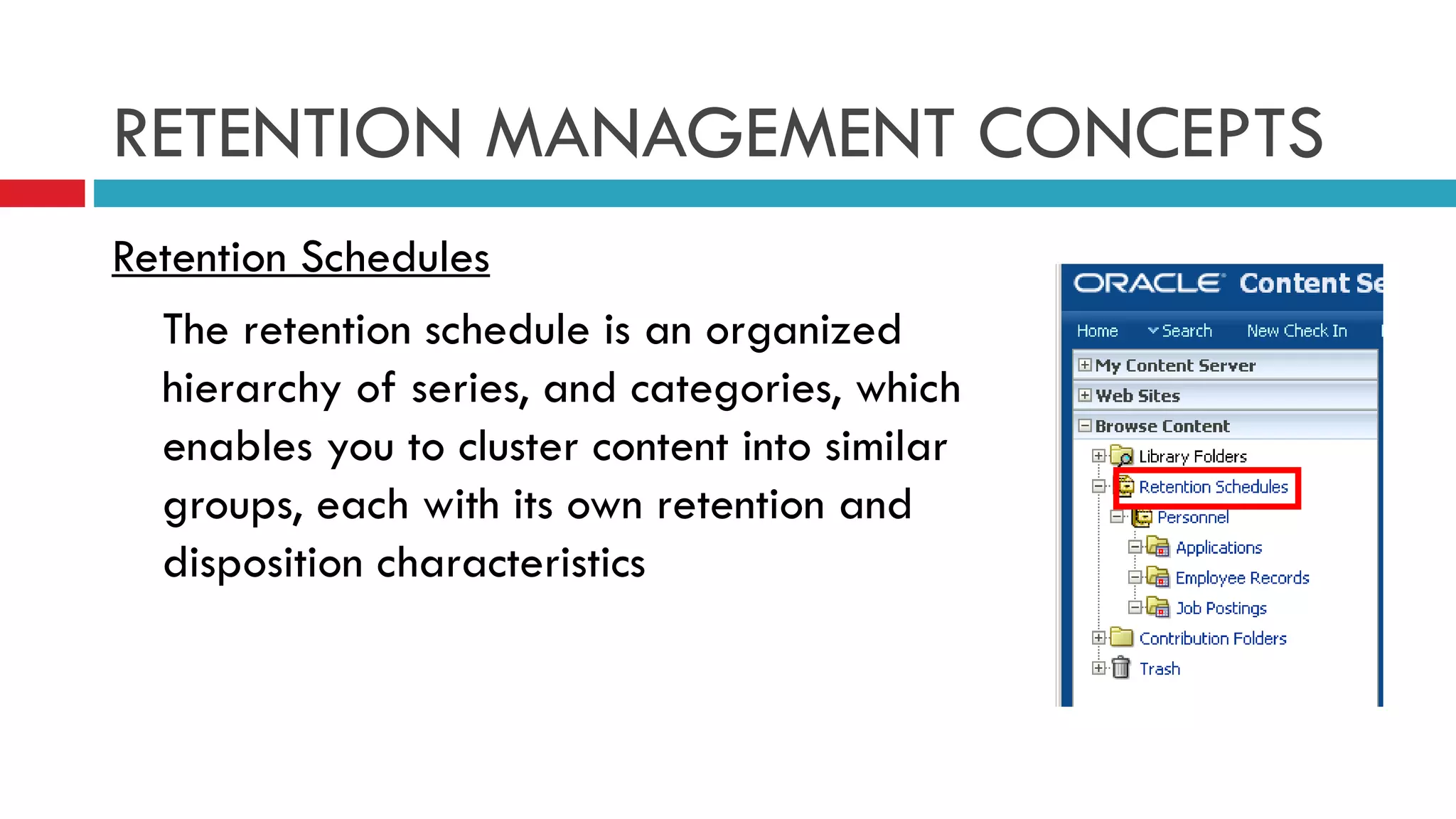
RETENTION MANAGEMENT CONCEPTS Retention Schedules The retention schedule is an organized hierarchy of series, and categories, which enables you to cluster content into similar groups, each with its own retention and disposition characteristics
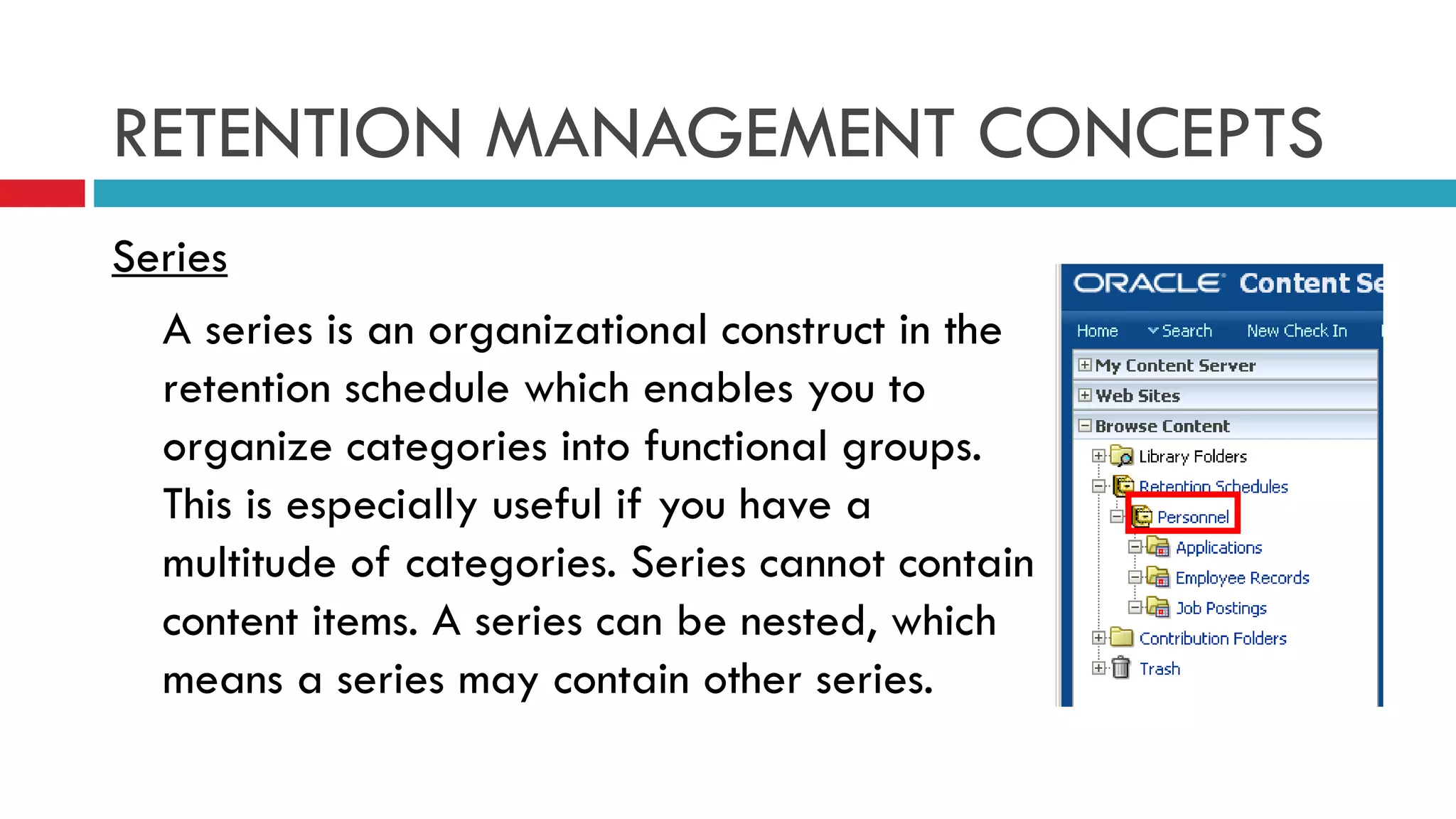
RETENTION MANAGEMENT CONCEPTS Series A series is an organizational construct in the retention schedule which enables you to organize categories into functional groups. This is especially useful if you have a multitude of categories. Series cannot contain content items. A series can be nested, which means a series may contain other series.
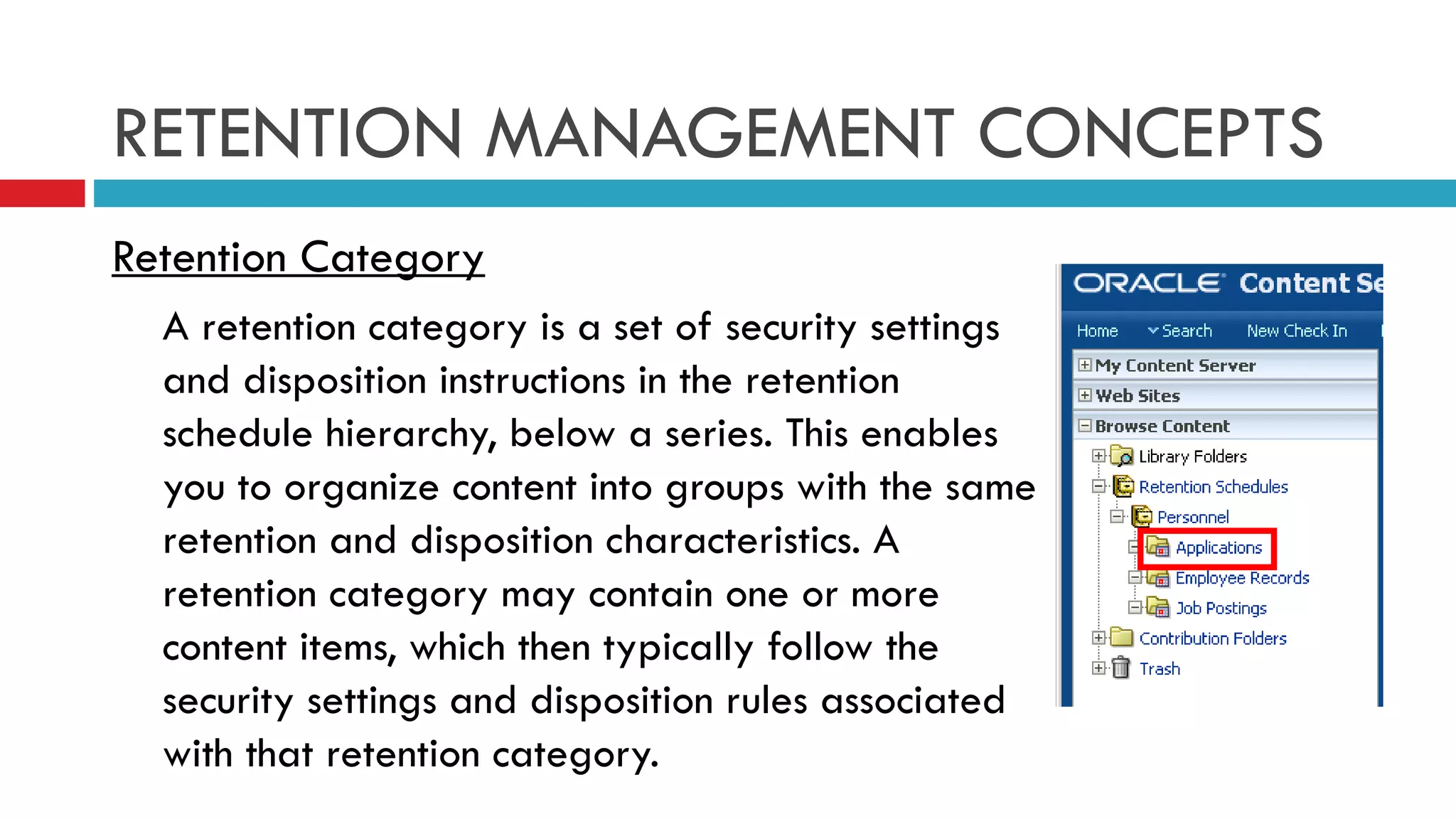
RETENTION MANAGEMENT CONCEPTS Retention Category A retention category is a set of security settings and disposition instructions in the retention schedule hierarchy, below a series. This enables you to organize content into groups with the same retention and disposition characteristics. A retention category may contain one or more content items, which then typically follow the security settings and disposition rules associated with that retention category.
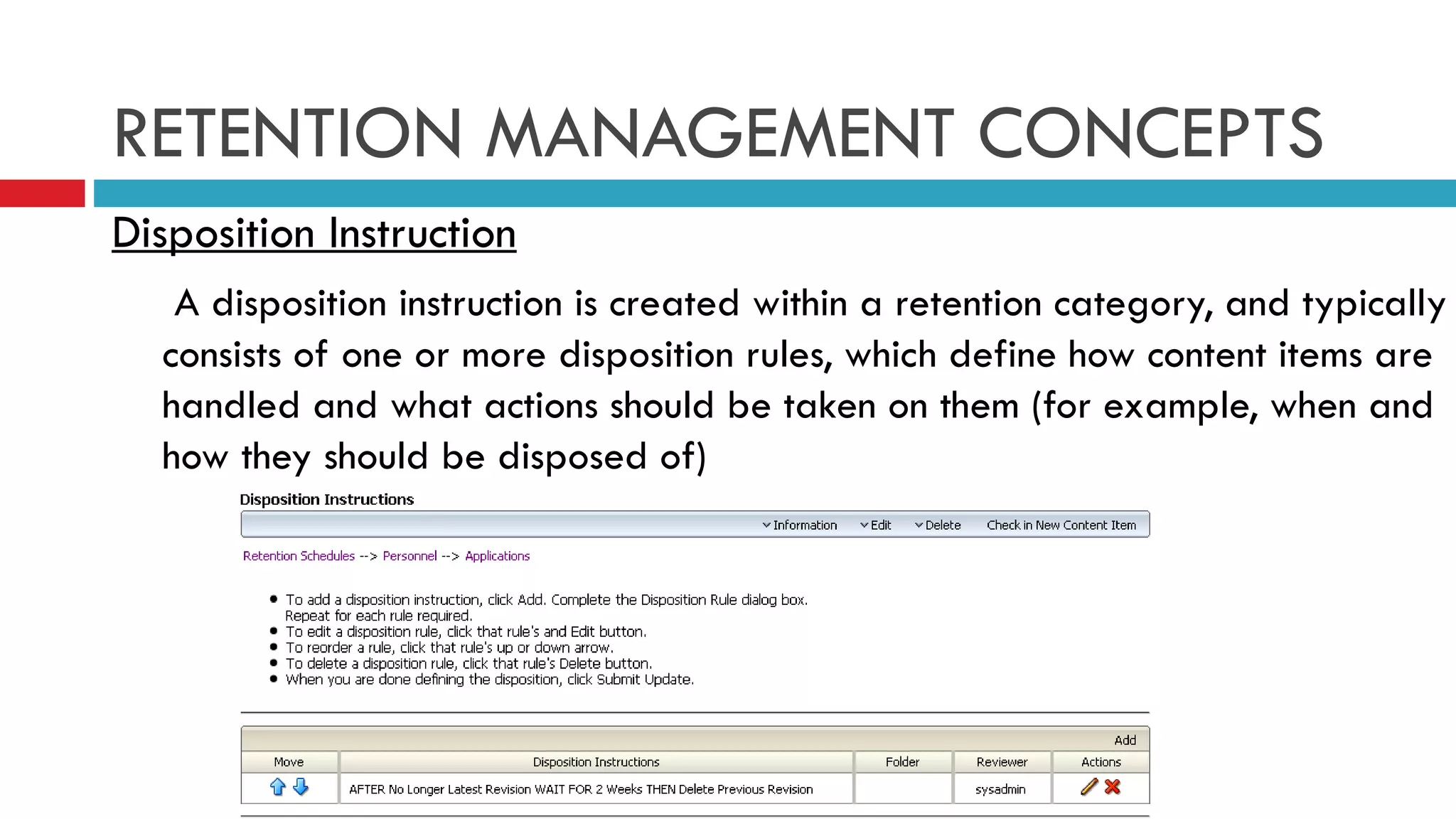
RETENTION MANAGEMENT CONCEPTS Disposition Instruction   A disposition instruction is created within a retention category, and typically consists of one or more disposition rules, which define how content items are handled and what actions should be taken on them (for example, when and how they should be disposed of)
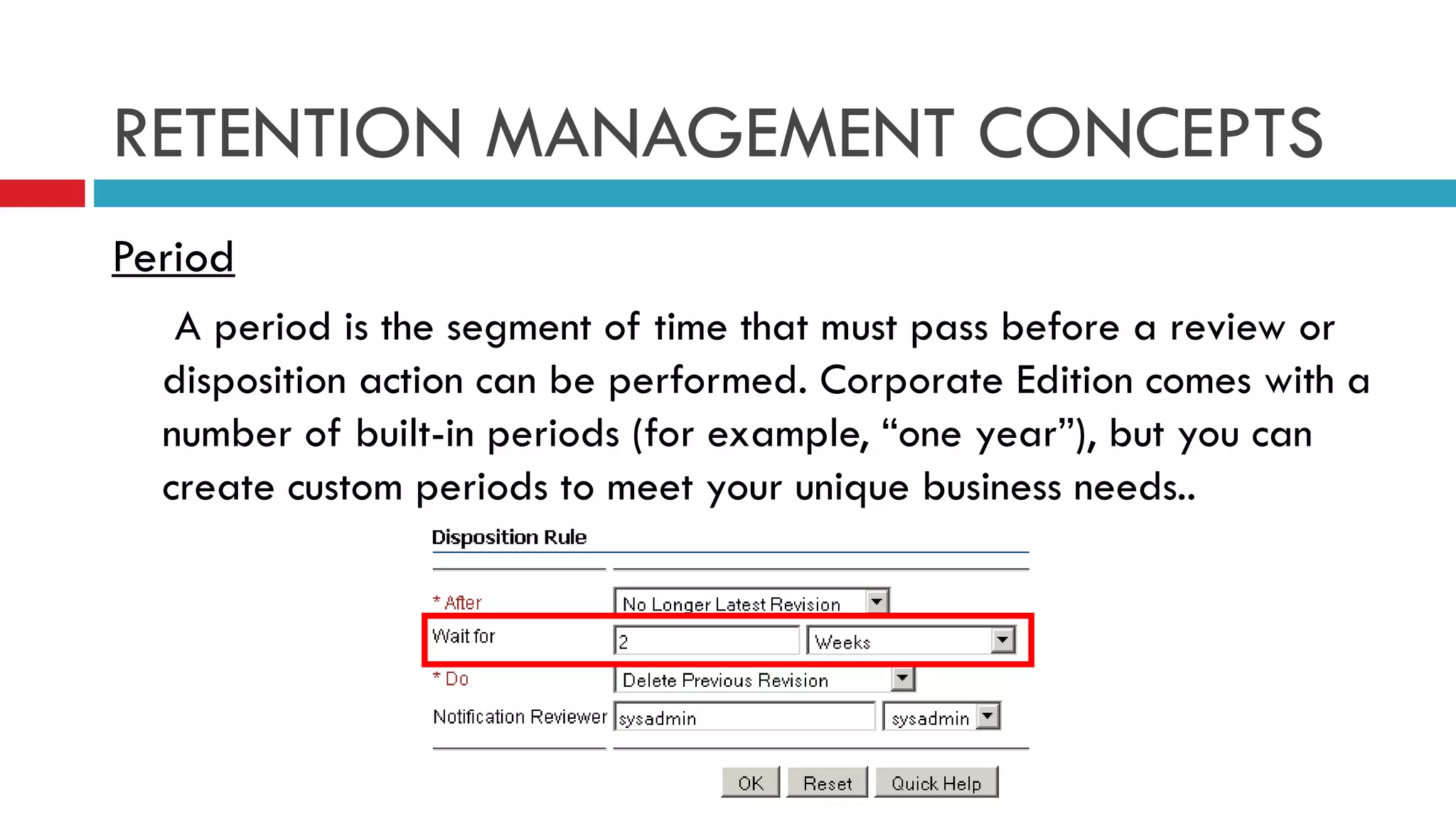
RETENTION MANAGEMENT CONCEPTS Period   A period is the segment of time that must pass before a review or disposition action can be performed. Corporate Edition comes with a number of built-in periods (for example, “one year”), but you can create custom periods to meet your unique business needs..
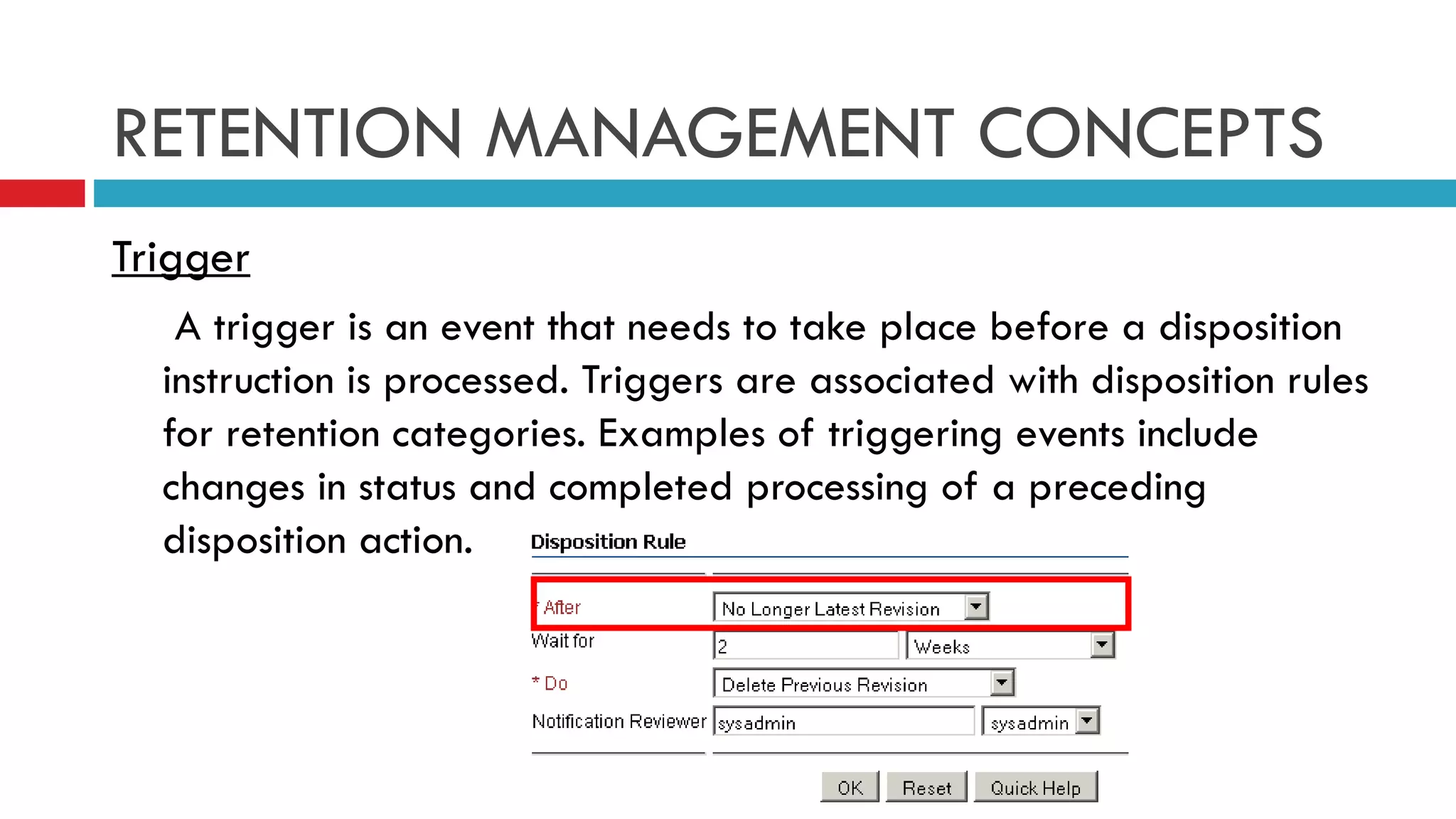
RETENTION MANAGEMENT CONCEPTS Trigger   A trigger is an event that needs to take place before a disposition instruction is processed. Triggers are associated with disposition rules for retention categories. Examples of triggering events include changes in status and completed processing of a preceding disposition action.
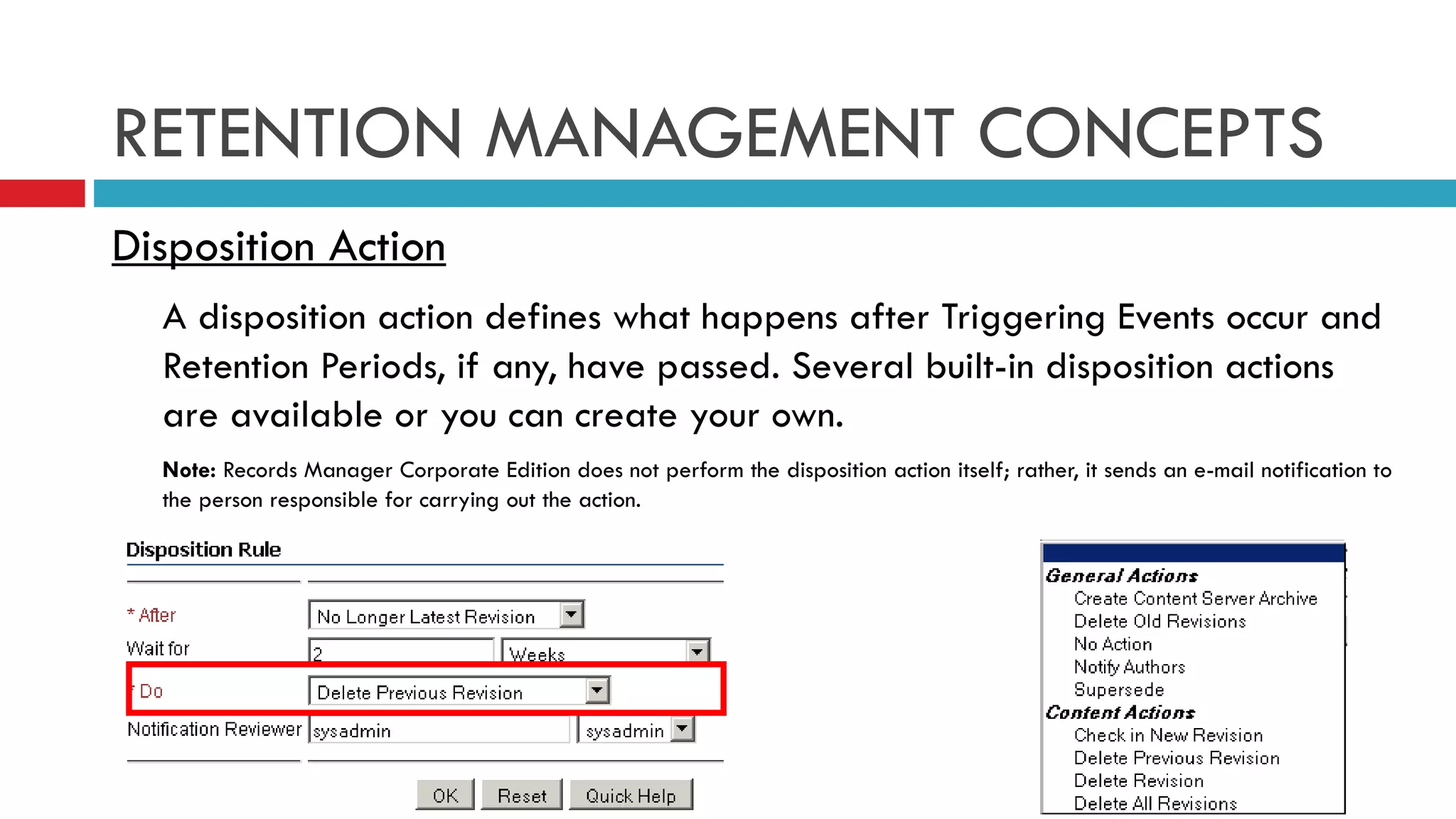
RETENTION MANAGEMENT CONCEPTS Disposition Action A disposition action defines what happens after Triggering Events occur and Retention Periods, if any, have passed. Several built-in disposition actions are available or you can create your own. Note:  Records Manager Corporate Edition does not perform the disposition action itself; rather, it sends an e-mail notification to the person responsible for carrying out the action.
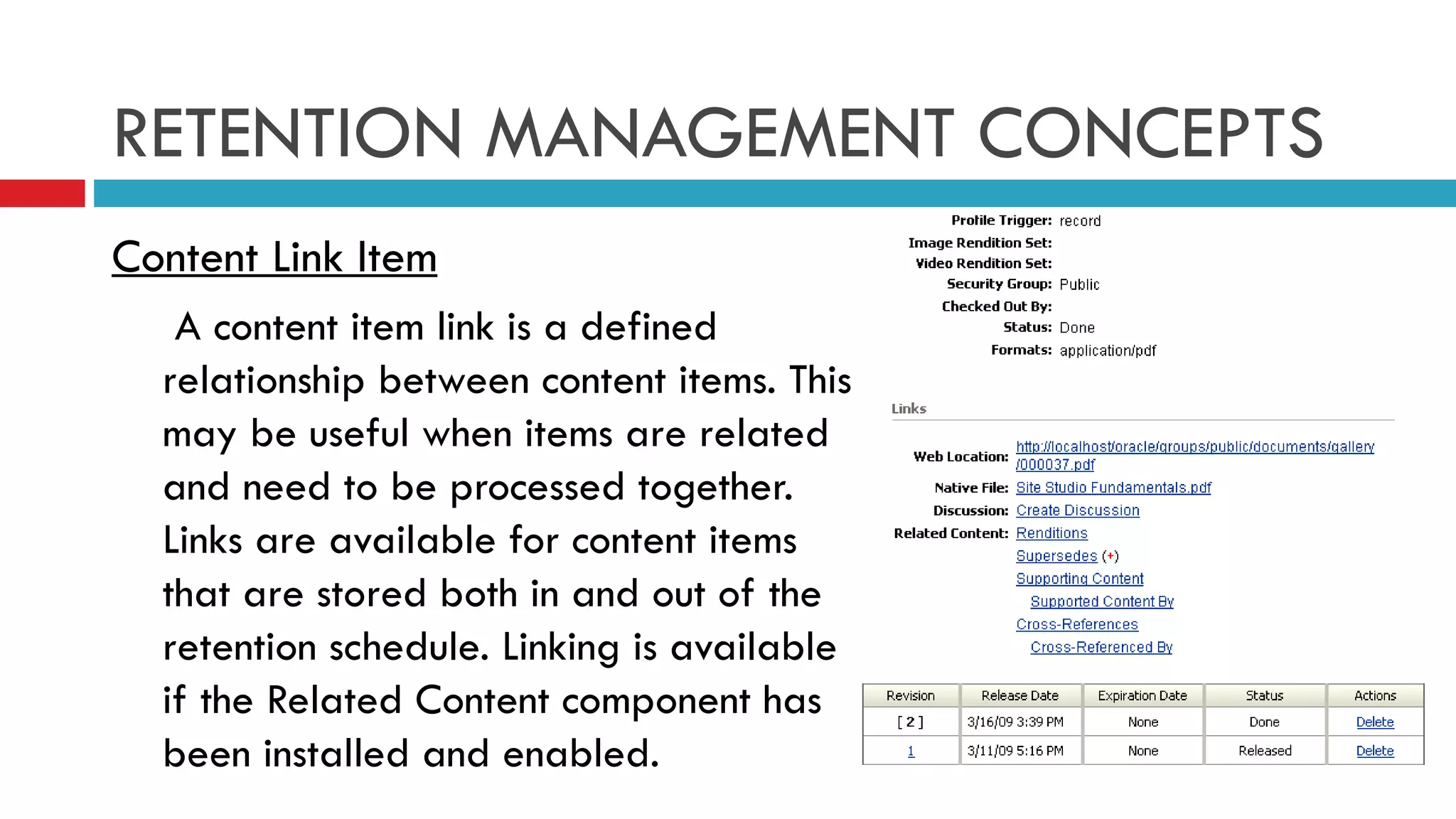
RETENTION MANAGEMENT CONCEPTS Content Link Item   A content item link is a defined relationship between content items. This may be useful when items are related and need to be processed together. Links are available for content items that are stored both in and out of the retention schedule. Linking is available if the Related Content component has been installed and enabled.
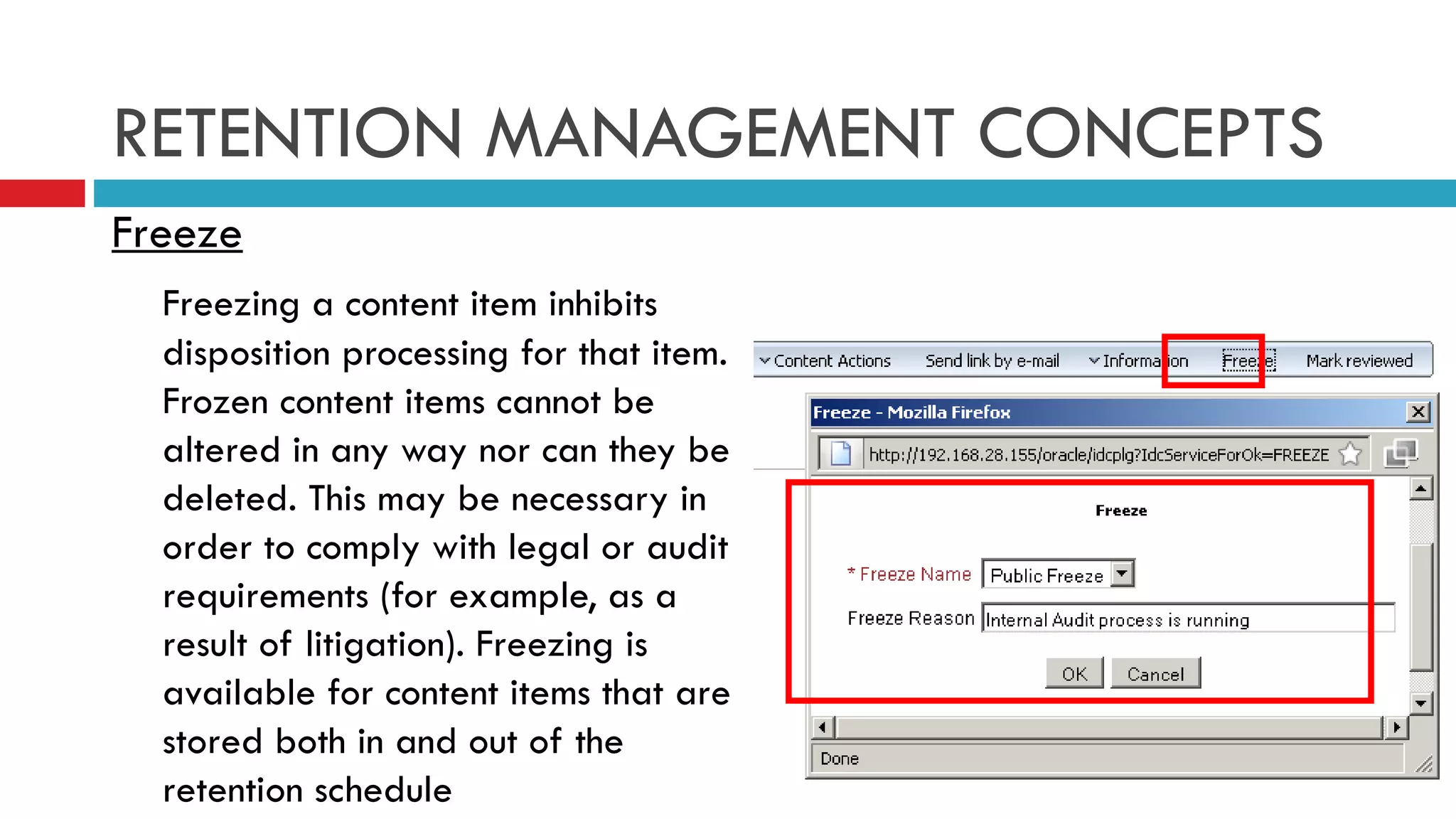
RETENTION MANAGEMENT CONCEPTS Freeze Freezing a content item inhibits disposition processing for that item. Frozen content items cannot be altered in any way nor can they be deleted. This may be necessary in order to comply with legal or audit requirements (for example, as a result of litigation). Freezing is available for content items that are stored both in and out of the retention schedule
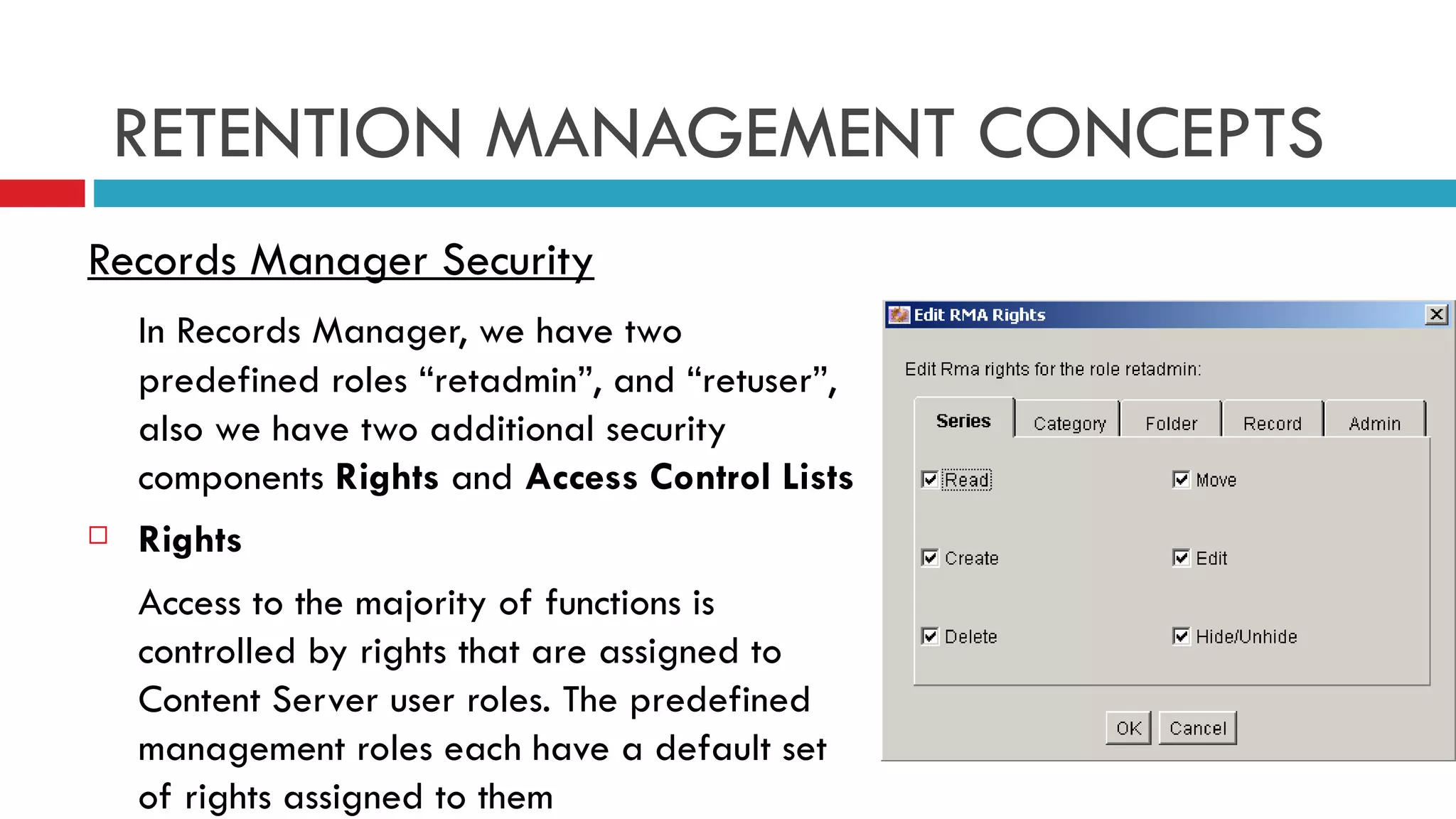
RETENTION MANAGEMENT CONCEPTS Records Manager Security In Records Manager, we have two predefined roles “retadmin”, and “retuser”, also we have two additional security components  Rights  and  Access Control Lists Rights Access to the majority of functions is controlled by rights that are assigned to Content Server user roles. The predefined management roles each have a default set of rights assigned to them
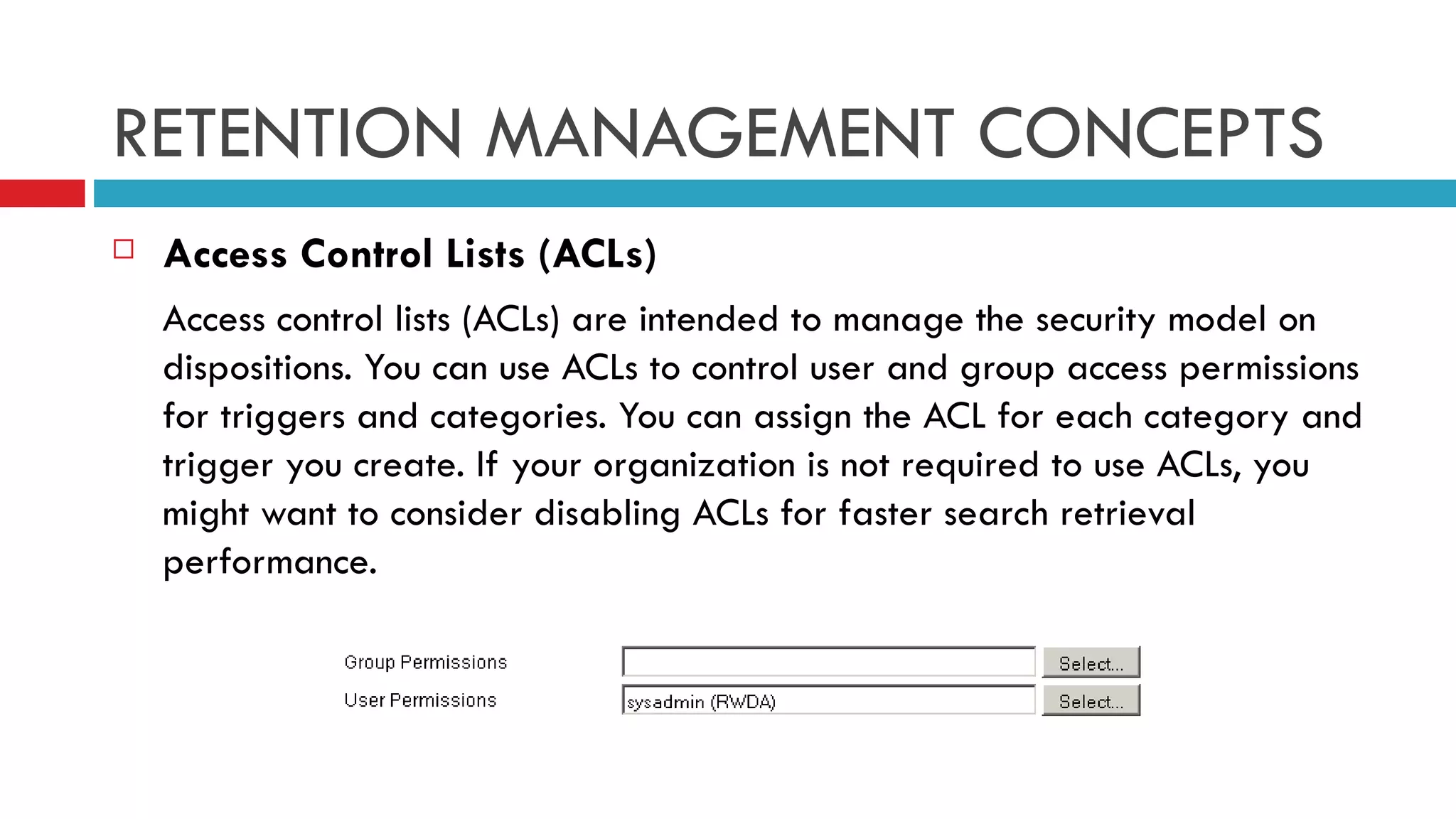
RETENTION MANAGEMENT CONCEPTS Access Control Lists (ACLs) Access control lists (ACLs) are intended to manage the security model on dispositions. You can use ACLs to control user and group access permissions for triggers and categories. You can assign the ACL for each category and trigger you create. If your organization is not required to use ACLs, you might want to consider disabling ACLs for faster search retrieval performance.
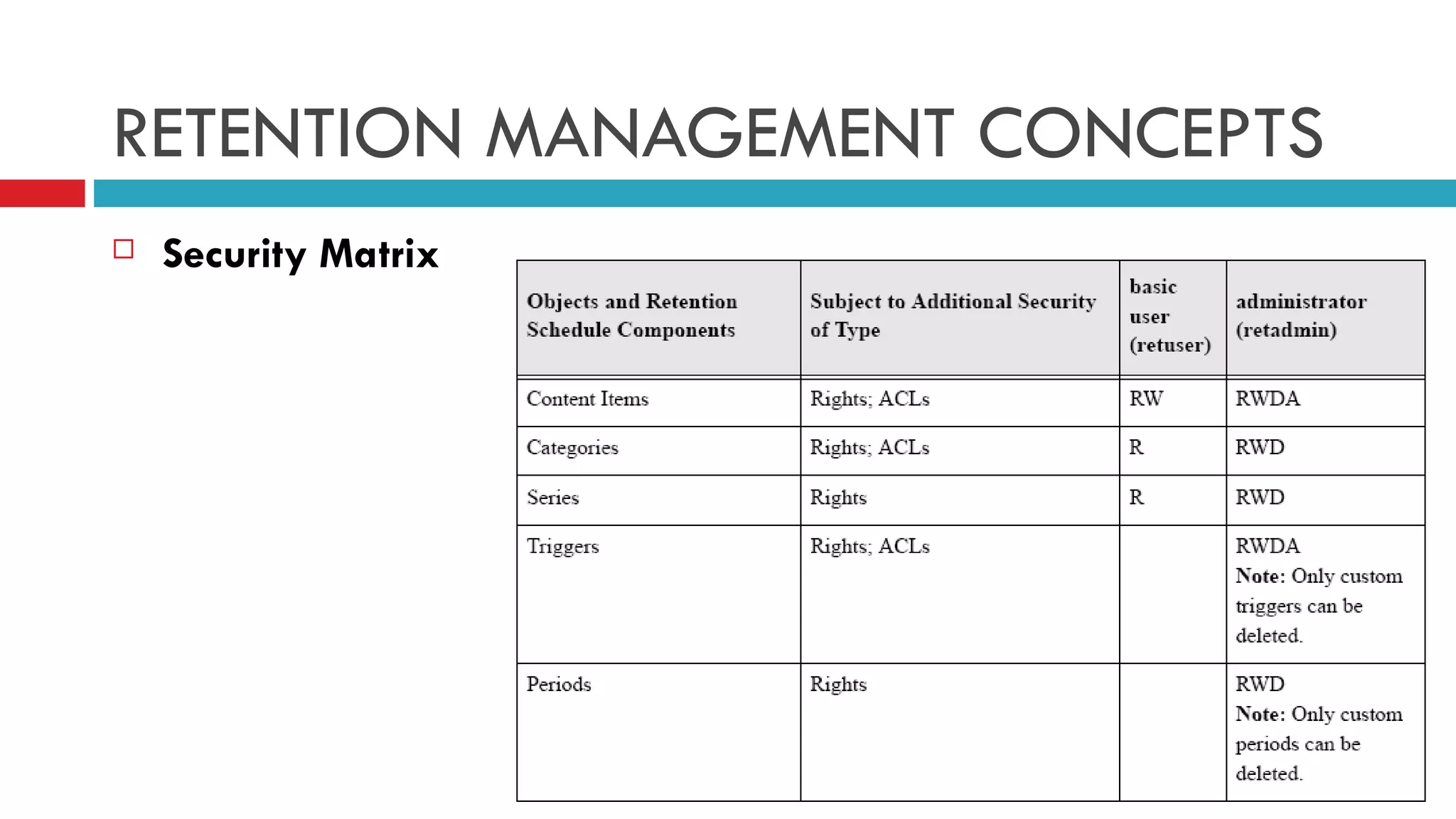
RETENTION MANAGEMENT CONCEPTS Security Matrix

Records Manager Component

  • 1.
  • 2.
    What is Record?A record is any content item whose disposition and location should be tracked and maintained according to an organization’s requirements.
  • 3.
    Records Manager OverviewRecords Manager enables you to manage content items—regardless of their source or format—in a single, consistent, manageable infrastructure. Content items managed by Records Manager are assigned retention schedules and disposition rules . This enables you to schedule lifecycles for content to eliminate outdated or superseded information, manage storage resources, or comply with legal audit holds.
  • 4.
    RETENTION MANAGEMENT CONCEPTSRetention Schedules The retention schedule is an organized hierarchy of series, and categories, which enables you to cluster content into similar groups, each with its own retention and disposition characteristics
  • 5.
    RETENTION MANAGEMENT CONCEPTSSeries A series is an organizational construct in the retention schedule which enables you to organize categories into functional groups. This is especially useful if you have a multitude of categories. Series cannot contain content items. A series can be nested, which means a series may contain other series.
  • 6.
    RETENTION MANAGEMENT CONCEPTSRetention Category A retention category is a set of security settings and disposition instructions in the retention schedule hierarchy, below a series. This enables you to organize content into groups with the same retention and disposition characteristics. A retention category may contain one or more content items, which then typically follow the security settings and disposition rules associated with that retention category.
  • 7.
    RETENTION MANAGEMENT CONCEPTSDisposition Instruction A disposition instruction is created within a retention category, and typically consists of one or more disposition rules, which define how content items are handled and what actions should be taken on them (for example, when and how they should be disposed of)
  • 8.
    RETENTION MANAGEMENT CONCEPTSPeriod A period is the segment of time that must pass before a review or disposition action can be performed. Corporate Edition comes with a number of built-in periods (for example, “one year”), but you can create custom periods to meet your unique business needs..
  • 9.
    RETENTION MANAGEMENT CONCEPTSTrigger A trigger is an event that needs to take place before a disposition instruction is processed. Triggers are associated with disposition rules for retention categories. Examples of triggering events include changes in status and completed processing of a preceding disposition action.
  • 10.
    RETENTION MANAGEMENT CONCEPTSDisposition Action A disposition action defines what happens after Triggering Events occur and Retention Periods, if any, have passed. Several built-in disposition actions are available or you can create your own. Note: Records Manager Corporate Edition does not perform the disposition action itself; rather, it sends an e-mail notification to the person responsible for carrying out the action.
  • 11.
    RETENTION MANAGEMENT CONCEPTSContent Link Item A content item link is a defined relationship between content items. This may be useful when items are related and need to be processed together. Links are available for content items that are stored both in and out of the retention schedule. Linking is available if the Related Content component has been installed and enabled.
  • 12.
    RETENTION MANAGEMENT CONCEPTSFreeze Freezing a content item inhibits disposition processing for that item. Frozen content items cannot be altered in any way nor can they be deleted. This may be necessary in order to comply with legal or audit requirements (for example, as a result of litigation). Freezing is available for content items that are stored both in and out of the retention schedule
  • 13.
    RETENTION MANAGEMENT CONCEPTSRecords Manager Security In Records Manager, we have two predefined roles “retadmin”, and “retuser”, also we have two additional security components Rights and Access Control Lists Rights Access to the majority of functions is controlled by rights that are assigned to Content Server user roles. The predefined management roles each have a default set of rights assigned to them
  • 14.
    RETENTION MANAGEMENT CONCEPTSAccess Control Lists (ACLs) Access control lists (ACLs) are intended to manage the security model on dispositions. You can use ACLs to control user and group access permissions for triggers and categories. You can assign the ACL for each category and trigger you create. If your organization is not required to use ACLs, you might want to consider disabling ACLs for faster search retrieval performance.
  • 15.