Humanitarian Informatics Approach to
Cooperation between Citizens &
Organizational Decision Makers
Hemant Purohit
Humanitarian Informatics Lab, Information Sciences and Technology
1
@hemant_pt
CADMICS-2016
‘Collaboration and Decision Making in Crisis Situations’
Workshop at ACM CSCW 2016
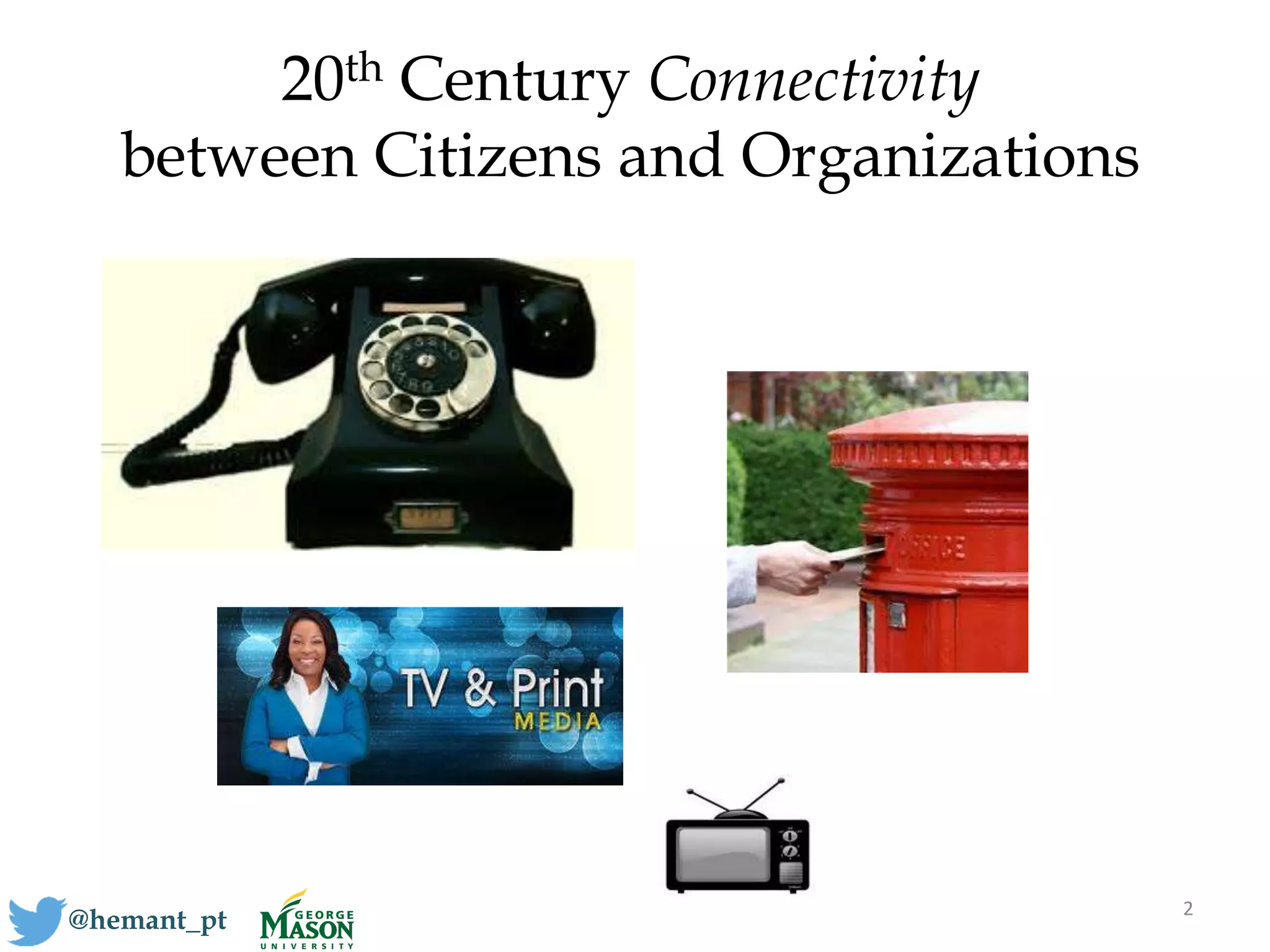
20th Century Connectivity
between Citizens and Organizations
2
@hemant_pt
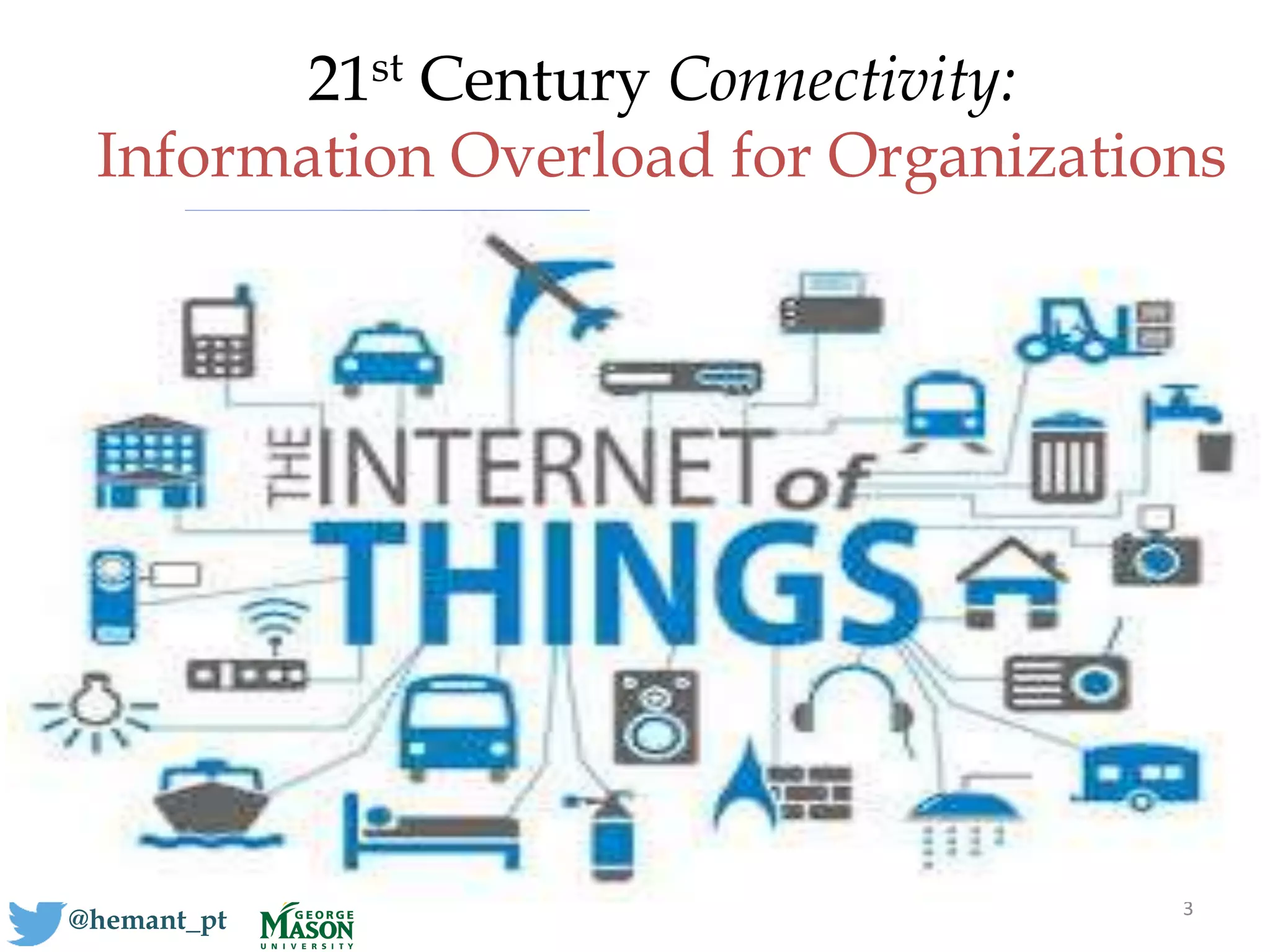
21st Century Connectivity:
Information Overload for Organizations
3
@hemant_pt
Scenario: Can Disaster Response
Organizations leverage Social Data at Scale?
4
@hemant_pt
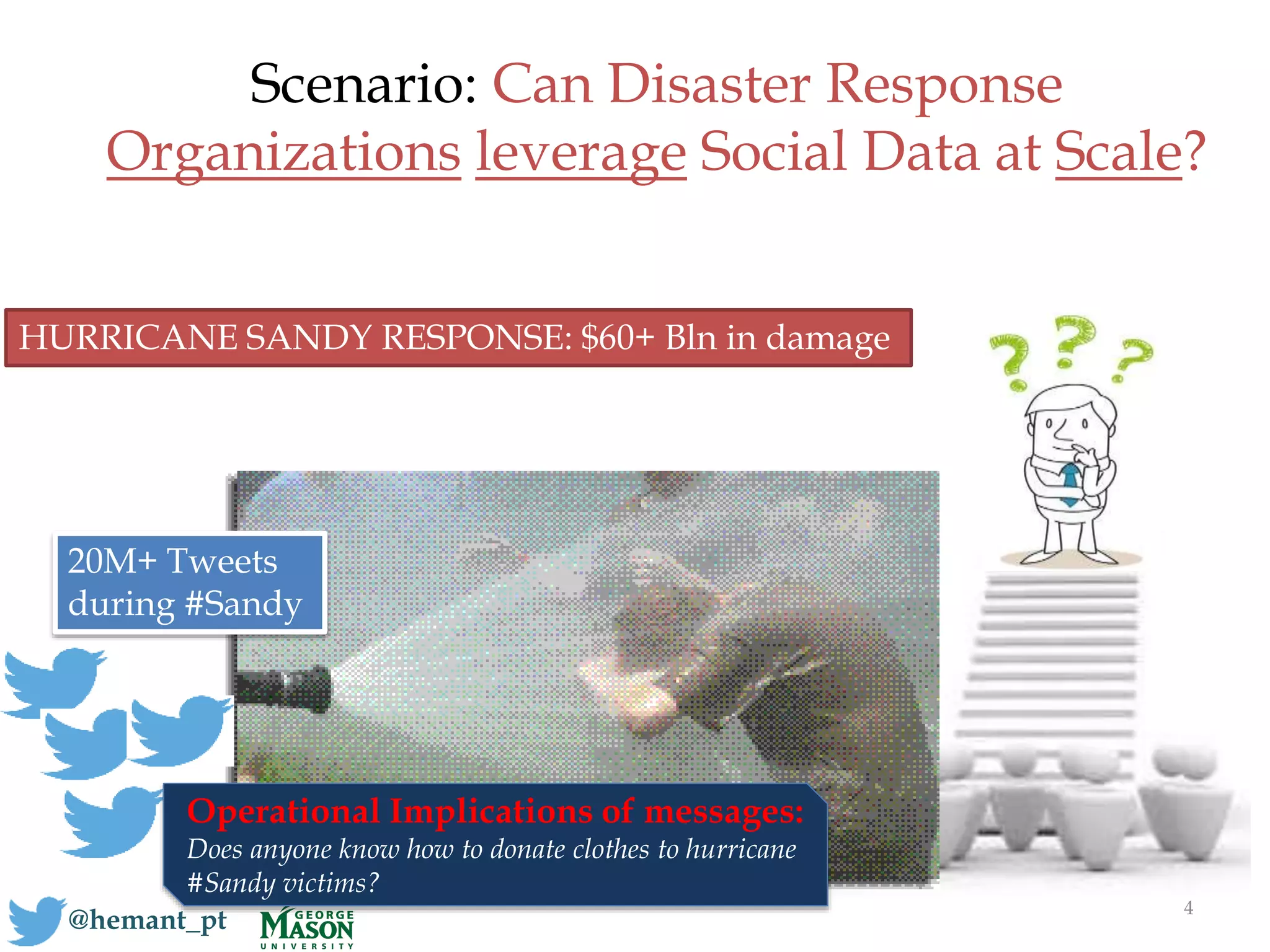
20M+ Tweets
during #Sandy
HURRICANE SANDY RESPONSE: $60+ Bln in damage
Operational Implications of messages:
Does anyone know how to donate clothes to hurricane
#Sandy victims?
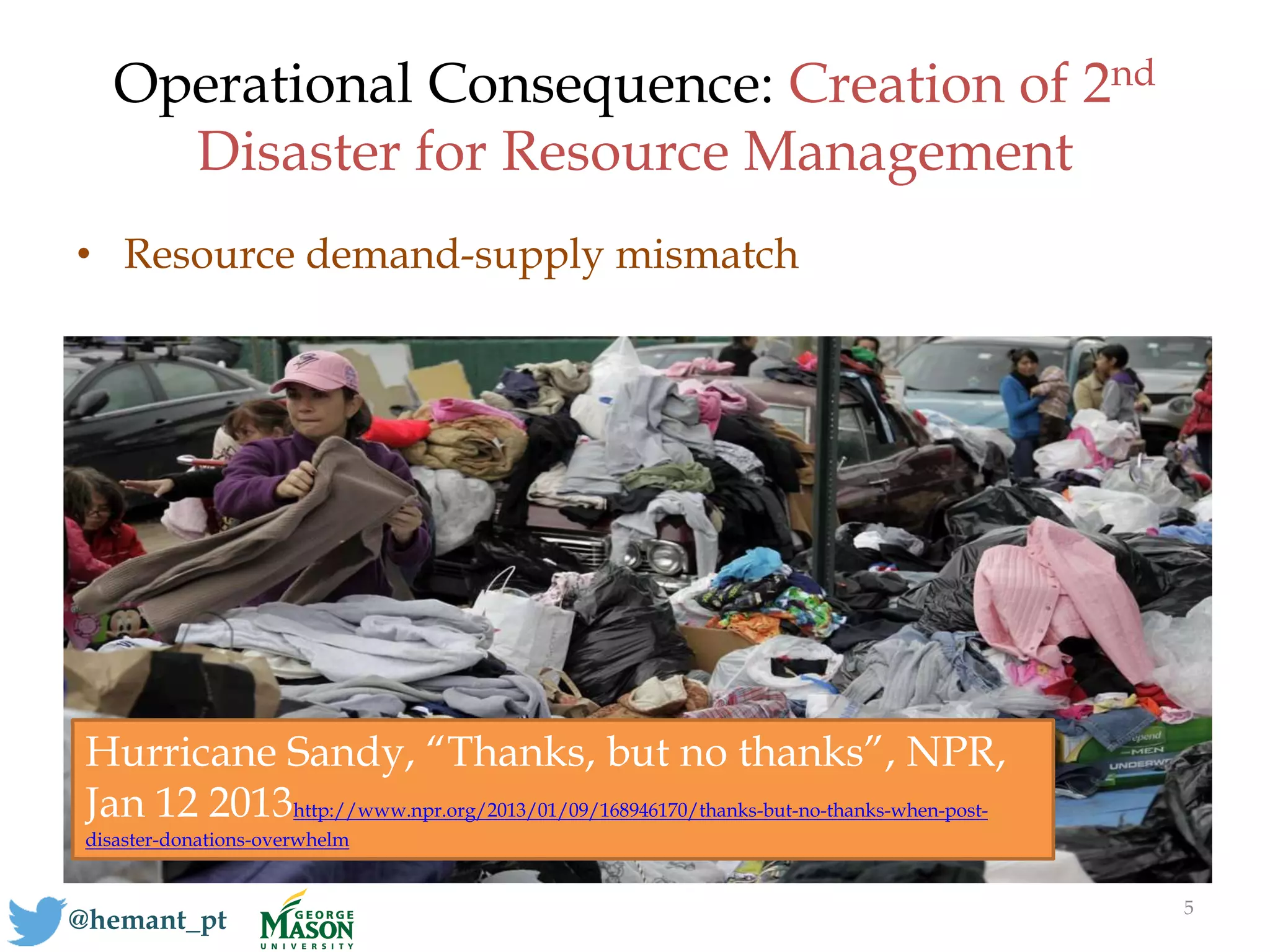
Operational Consequence: Creation of 2nd
Disaster for Resource Management
• Resource demand-supply mismatch
Hurricane Sandy, “Thanks, but no thanks”, NPR,
Jan 12 2013http://www.npr.org/2013/01/09/168946170/thanks-but-no-thanks-when-post-
disaster-donations-overwhelm
@hemant_pt
5
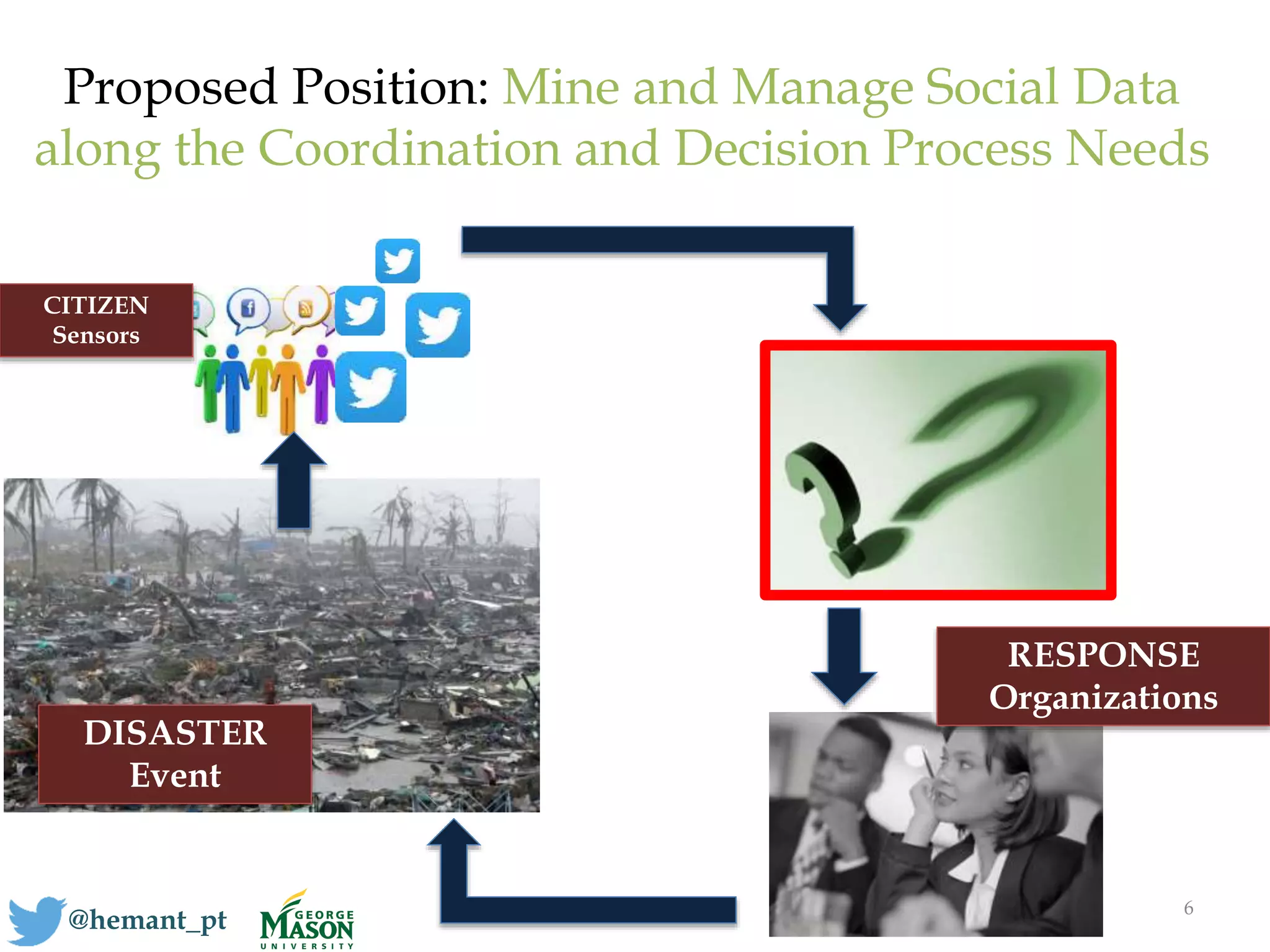
DISASTER
Event
@hemant_pt
Proposed Position: Mine and Manage Social Data
along the Coordination and Decision Process Needs
CITIZEN
Sensors
6
RESPONSE
Organizations
Proposed Position: Humanitarian Informatics
Approach
• Cooperative Information System Design between Citizens
and Organizations via Web (not limited to crises)
– Address Fundamental Challenges (Malone & Crowston 1990; Schmidt & Bannon 1992)
• Articulation
• Awareness
– Organization Characteristics
• Structured roles
• Pre-established communication, processes, and working norms
• More information needs, but less data access & resources
– (Emergent) Online Citizen Community Characteristics
• Unstructured roles and responsibilities
• No established norms
• No specified-given needs, but massive data generation & resources
7
@hemant_pt
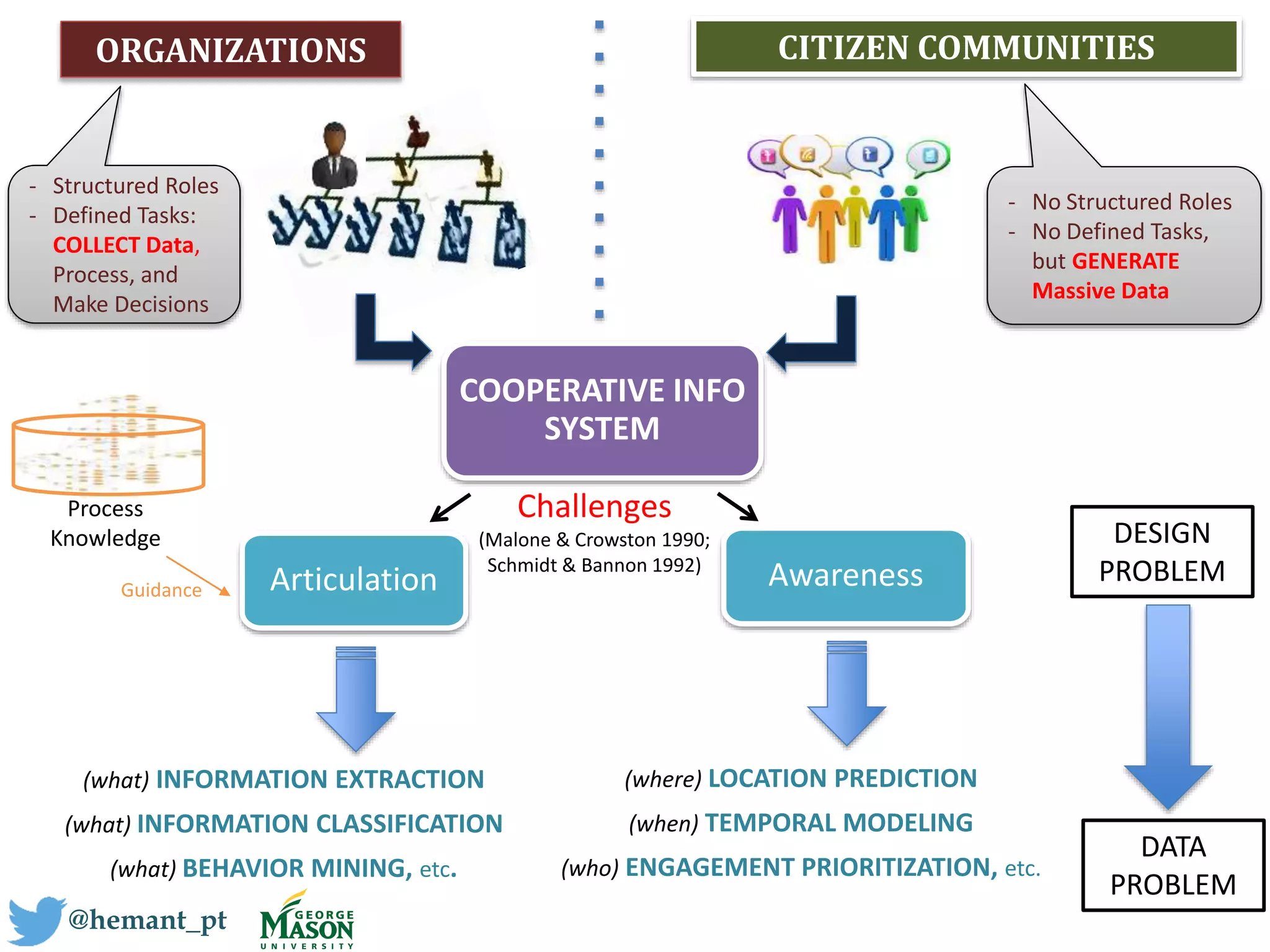
Awareness
Challenges
(Malone & Crowston 1990;
Schmidt & Bannon 1992)
(what) INFORMATION EXTRACTION
(what) INFORMATION CLASSIFICATION
(what) BEHAVIOR MINING, etc.
DATA
PROBLEM
DESIGN
PROBLEM
ORGANIZATIONS CITIZEN COMMUNITIES
COOPERATIVE INFO
SYSTEM
Articulation
- Structured Roles
- Defined Tasks:
COLLECT Data,
Process, and
Make Decisions
- No Structured Roles
- No Defined Tasks,
but GENERATE
Massive Data
(where) LOCATION PREDICTION
(when) TEMPORAL MODELING
(who) ENGAGEMENT PRIORITIZATION, etc.
Process
Knowledge
Guidance
@hemant_pt
Conclusion
• Start from organizational information needs to create
information processing systems for leveraging new
information source of citizen communties on social media
• Interdisciplinary Research a necessity to guide information
processing, for maximal benefits of humanitarian informatics
• For decision making, Less is More! -- We need to focus on
actionable information aligned with process-driven
information needs of organizations
• Informatics approach not limited to disaster response, but
also applicable for information overload solutions of other
humanitarian organizations (e.g., gender-violence policies1)
9
@hemant_pt
1 Purohit et al. (2016). Gender-based violence in 140 characters or fewer: A #BigData case study of Twitter.
First Monday, Vol. 21, 1 – 4, January 2016 http://firstmonday.org/ojs/index.php/fm/article/view/6148/5190
10
TWITTER: @hemant_pt
MAIL: hpurohit@gmu.edu
LAB: http://ist.gmu.edu/~hpurohit/humanitarian-informatics-lab.html
Acknowledgement: Respective image sources, and
Contact, Ack, and Questions?

Humanitarian Informatics Approach for Cooperation between Citizens and Organizations - CSCW16 CADMICS talk

  • 1.
    Humanitarian Informatics Approachto Cooperation between Citizens & Organizational Decision Makers Hemant Purohit Humanitarian Informatics Lab, Information Sciences and Technology 1 @hemant_pt CADMICS-2016 ‘Collaboration and Decision Making in Crisis Situations’ Workshop at ACM CSCW 2016
  • 2.
    20th Century Connectivity betweenCitizens and Organizations 2 @hemant_pt
  • 3.
    21st Century Connectivity: InformationOverload for Organizations 3 @hemant_pt
  • 4.
    Scenario: Can DisasterResponse Organizations leverage Social Data at Scale? 4 @hemant_pt 20M+ Tweets during #Sandy HURRICANE SANDY RESPONSE: $60+ Bln in damage Operational Implications of messages: Does anyone know how to donate clothes to hurricane #Sandy victims?
  • 5.
    Operational Consequence: Creationof 2nd Disaster for Resource Management • Resource demand-supply mismatch Hurricane Sandy, “Thanks, but no thanks”, NPR, Jan 12 2013http://www.npr.org/2013/01/09/168946170/thanks-but-no-thanks-when-post- disaster-donations-overwhelm @hemant_pt 5
  • 6.
    DISASTER Event @hemant_pt Proposed Position: Mineand Manage Social Data along the Coordination and Decision Process Needs CITIZEN Sensors 6 RESPONSE Organizations
  • 7.
    Proposed Position: HumanitarianInformatics Approach • Cooperative Information System Design between Citizens and Organizations via Web (not limited to crises) – Address Fundamental Challenges (Malone & Crowston 1990; Schmidt & Bannon 1992) • Articulation • Awareness – Organization Characteristics • Structured roles • Pre-established communication, processes, and working norms • More information needs, but less data access & resources – (Emergent) Online Citizen Community Characteristics • Unstructured roles and responsibilities • No established norms • No specified-given needs, but massive data generation & resources 7 @hemant_pt
  • 8.
    Awareness Challenges (Malone & Crowston1990; Schmidt & Bannon 1992) (what) INFORMATION EXTRACTION (what) INFORMATION CLASSIFICATION (what) BEHAVIOR MINING, etc. DATA PROBLEM DESIGN PROBLEM ORGANIZATIONS CITIZEN COMMUNITIES COOPERATIVE INFO SYSTEM Articulation - Structured Roles - Defined Tasks: COLLECT Data, Process, and Make Decisions - No Structured Roles - No Defined Tasks, but GENERATE Massive Data (where) LOCATION PREDICTION (when) TEMPORAL MODELING (who) ENGAGEMENT PRIORITIZATION, etc. Process Knowledge Guidance @hemant_pt
  • 9.
    Conclusion • Start fromorganizational information needs to create information processing systems for leveraging new information source of citizen communties on social media • Interdisciplinary Research a necessity to guide information processing, for maximal benefits of humanitarian informatics • For decision making, Less is More! -- We need to focus on actionable information aligned with process-driven information needs of organizations • Informatics approach not limited to disaster response, but also applicable for information overload solutions of other humanitarian organizations (e.g., gender-violence policies1) 9 @hemant_pt 1 Purohit et al. (2016). Gender-based violence in 140 characters or fewer: A #BigData case study of Twitter. First Monday, Vol. 21, 1 – 4, January 2016 http://firstmonday.org/ojs/index.php/fm/article/view/6148/5190
  • 10.
    10 TWITTER: @hemant_pt MAIL: hpurohit@gmu.edu LAB:http://ist.gmu.edu/~hpurohit/humanitarian-informatics-lab.html Acknowledgement: Respective image sources, and Contact, Ack, and Questions?

Editor's Notes

  • #2  Hello everyone! I am Hemant Purohit, My passion is to help people,
  • #3 This is how information used to flow among us..
  • #4  http://www.google.co.in/imgres?imgurl=http://uniphore.com/wp-content/uploads/2013/05/agriculture.jpg&imgrefurl=http://www.uniphore.com/blog/2013/05/the-three-biggest-benefits-of-enterprise-mobility-in-agriculture/&h=335&w=504&tbnid=IcciClOykHnBBM:&docid=QpgBGgg2B7VNAM&ei=TzwWVqmhDciz0gTS-YyIBA&tbm=isch&ved=0CCMQMygIMAhqFQoTCOmE_83MssgCFciZlAod0jwDQQ http://www.google.co.in/imgres?imgurl=https://www.fiware.org/wp-content/uploads/2015/04/pc2.png&imgrefurl=https://www.fiware.org/2015/05/26/the-battle-over-the-internet-of-things/&h=500&w=566&tbnid=uvcHhzX_YrXrOM:&docid=OYLx3T95kdFn9M&ei=wkAWVue9Loi8uASO7YXQAw&tbm=isch&ved=0CDAQMygAMABqFQoTCOemr-3QssgCFQgejgodjnYBOg
  • #5 I recall first of week of November when Hurricane Sandy was devastating the east coast of US, leaving the damage of more than 60 B And I was observing Big Social Data streams.. For example, 20 Mln messages on Twitter .. too much to process for the response org And there were interesting messages of this kind – Citizens offering to donate resources.. AVG. GLOBAL RESPONSE COST: 143+ Bln / yr Image Sources: http://www.buzzle.com/articles/organizational-development.html http://www.creativecorporateculture.com/effective-problem-solving-strategies/ http://thepaisano.wordpress.com/2008/06/11/twhirls-firehose-filter/ AVERAGE ANNUAL DAMAGE: $143+ Billion from hundreds of disasters worldwide “..The estimated economic losses from natural disasters in 2012 (US$ 157 billion) surpassed of almost 10% the annual average damages from 2001 to 2010 (US$ 143 billion)..” http://reliefweb.int/report/world/annual-disaster-statistical-review-2012-numbers-and-trends
  • #6  Citizens goodwill does not transform into useful action of help, but create problem of mismanagement instead. For example, during #Sandy – piles and piles of clothes were to be managed.. Had there been engagement with citizens, we could better respond
  • #7  So If a disaster event occurs, and we have resp org., and social data the problem is to mine important info. for example… info about medical needs, etc. How do we find the solution to leverage social data for coordination
  • #9 Awareness: shared knowledge for who-what-where-when Articulation: clear division of tasks so as to effectively perform the duties Q. The org. actors who are focusing on data collection of resource needs and availability have this question. So, we have identified specific data level problem, from the larger system design problem