


Optimizing SQL Server 2008
    For blazing fast SharePoint sites
Randy Williams
           • Enterprise Trainer & Evangelist
           • Based in San Diego, CA
           • SharePoint MVP alum (2009 – 2011)
           • Speaker at many global conferences
• 20+ years in IT
  ●   Developer, consultant, trainer, author
• Columnist: SharePoint Pro magazine
• randy.williams@avepoint.com
• @tweetraw
Agenda

•   Quick review of database basics
•   Optimize the server
•   Optimize tempdb
•   Optimize Content DBs
•   Scaling out
•   Best Practices
Quick Review of Database Basics

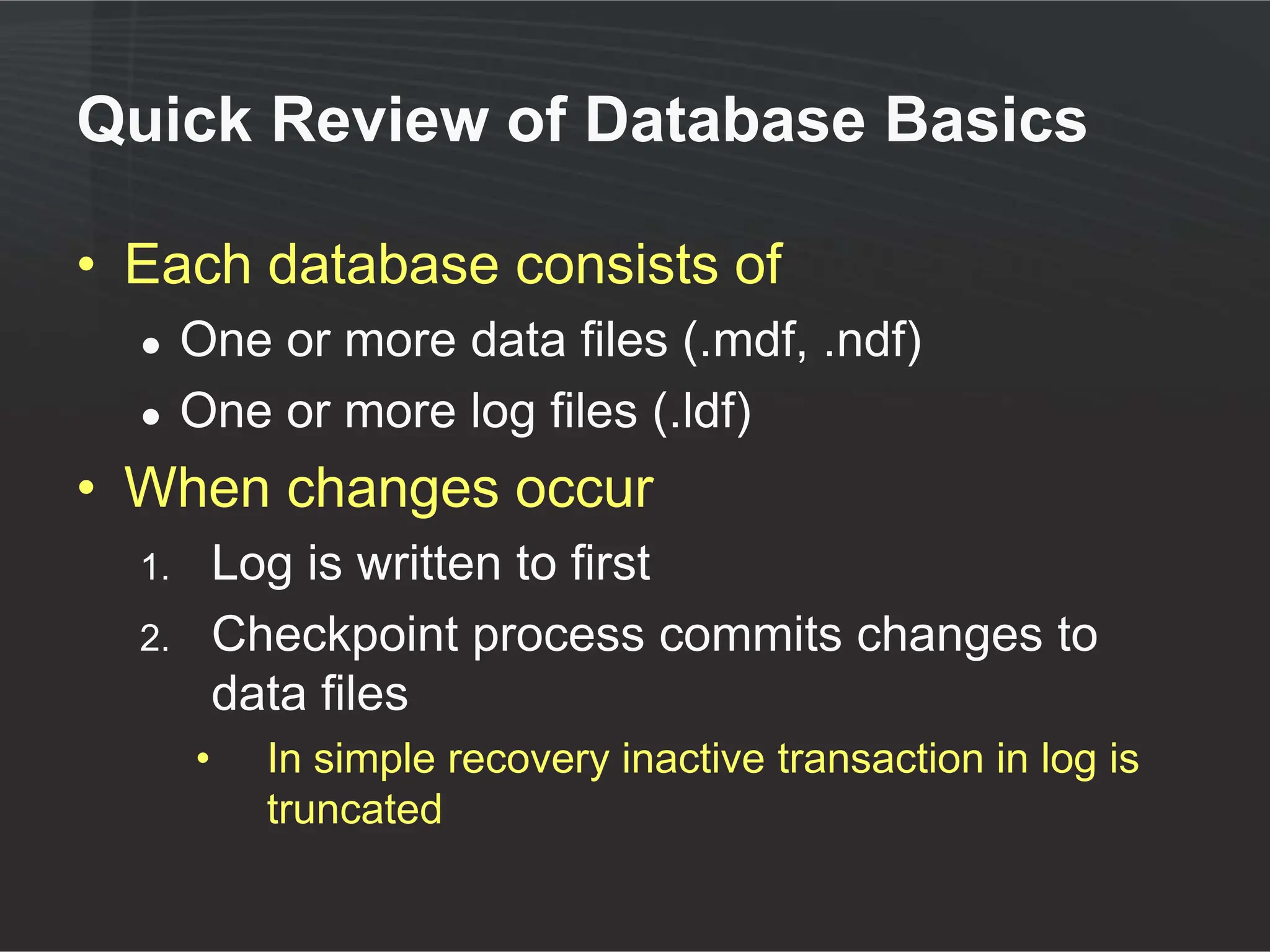
• Each database consists of
  ●    One or more data files (.mdf, .ndf)
  ●    One or more log files (.ldf)
• When changes occur
  1.       Log is written to first
  2.       Checkpoint process commits changes to
           data files
       •     In simple recovery inactive transaction in log is
             truncated
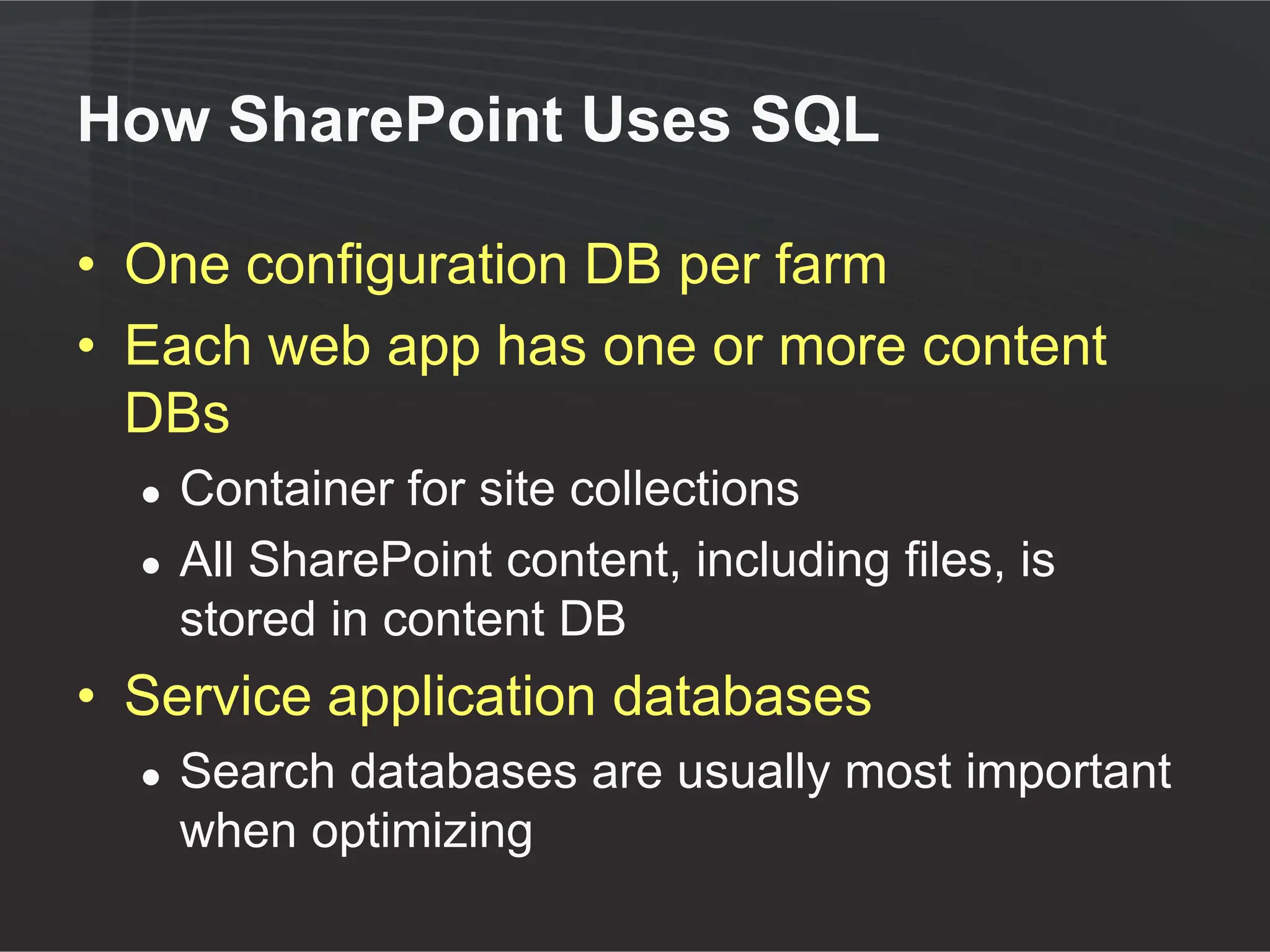
How SharePoint Uses SQL

• One configuration DB per farm
• Each web app has one or more content
  DBs
  ●   Container for site collections
  ●   All SharePoint content, including files, is
      stored in content DB
• Service application databases
  ●   Search databases are usually most important
      when optimizing
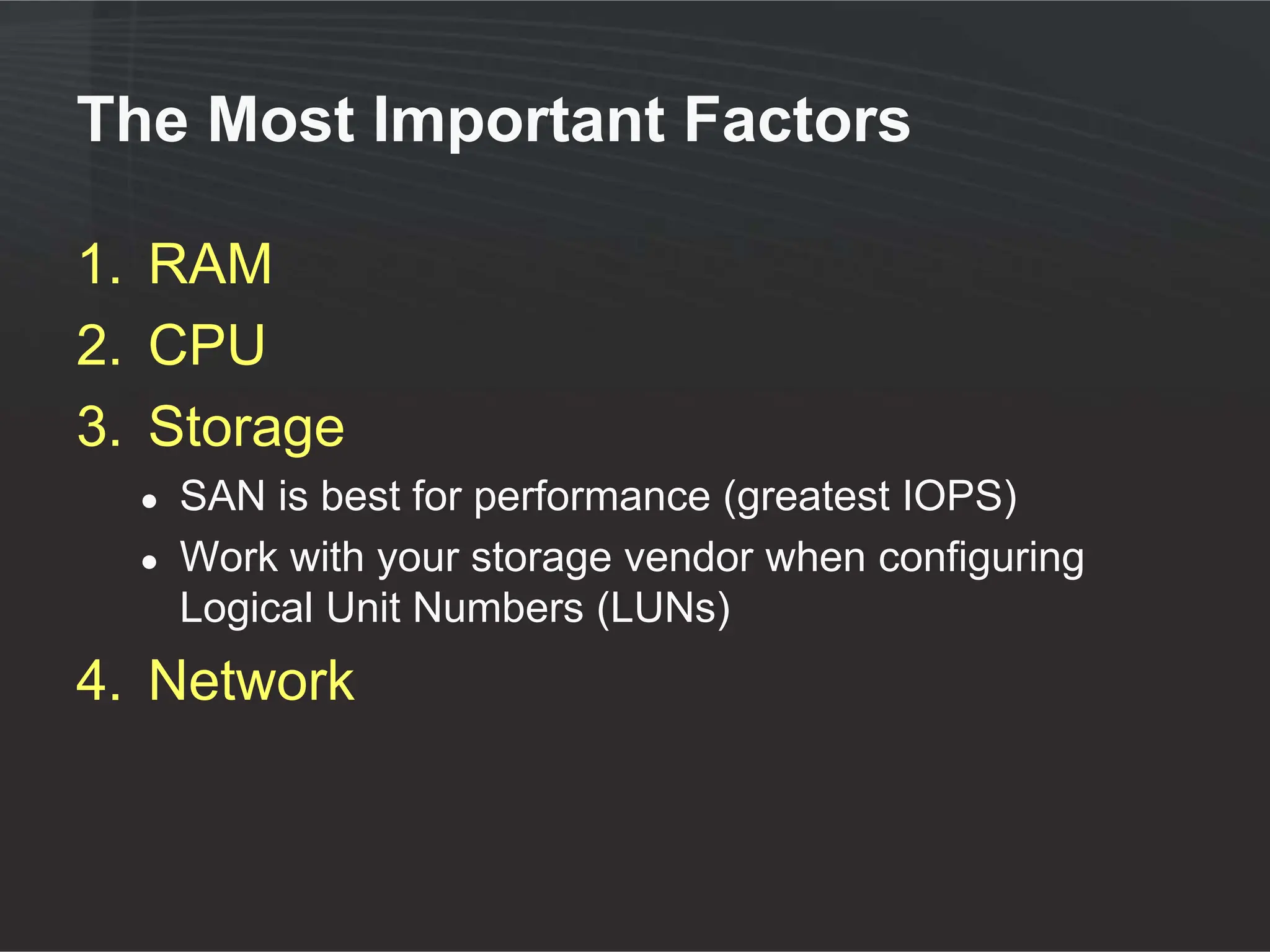
The Most Important Factors

1. RAM
2. CPU
3. Storage
  ●   SAN is best for performance (greatest IOPS)
  ●   Work with your storage vendor when configuring
      Logical Unit Numbers (LUNs)
4. Network
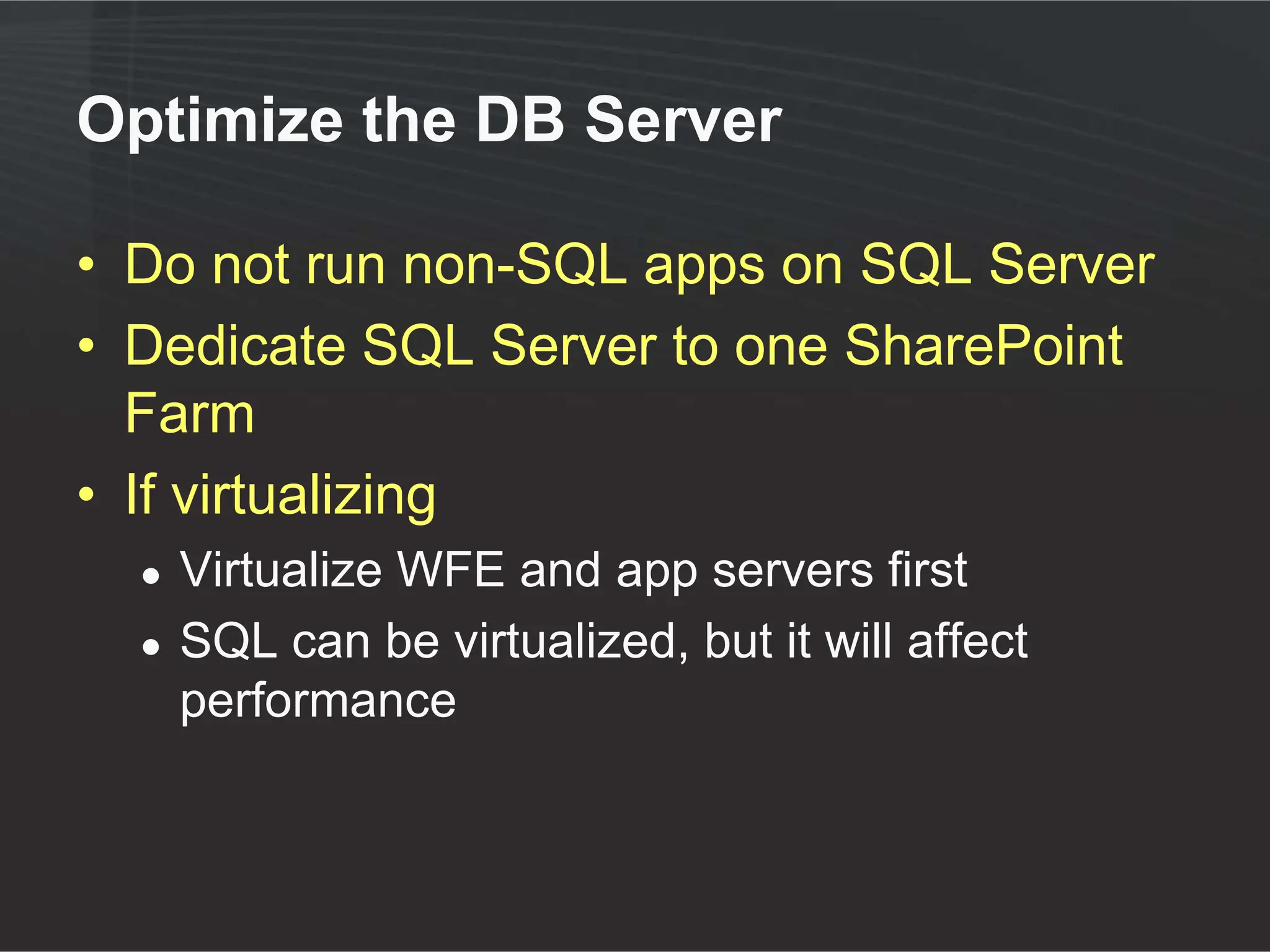
Optimize the DB Server

• Do not run non-SQL apps on SQL Server
• Dedicate SQL Server to one SharePoint
  Farm
• If virtualizing
  ●   Virtualize WFE and app servers first
  ●   SQL can be virtualized, but it will affect
      performance
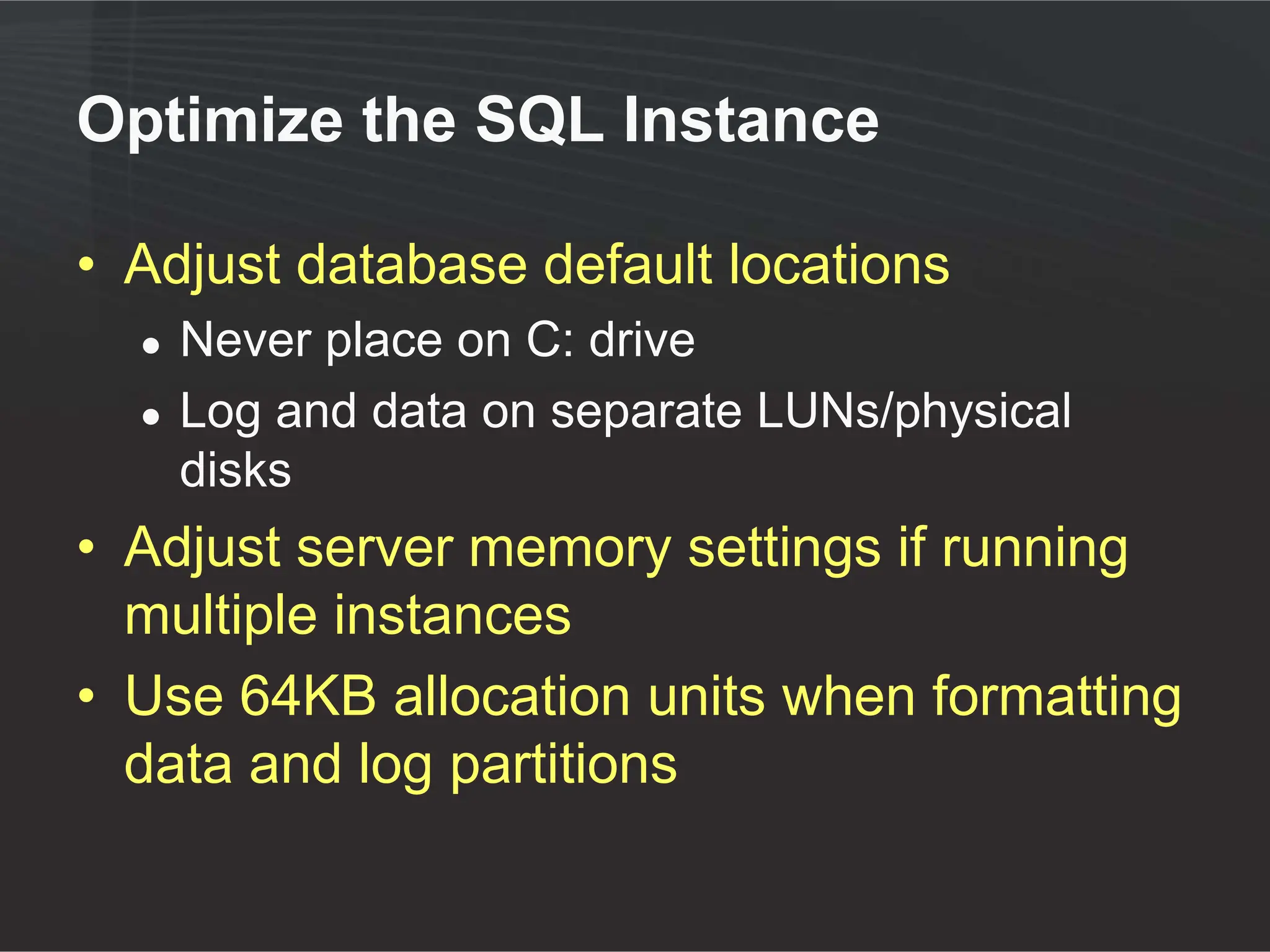
Optimize the SQL Instance

• Adjust database default locations
  ●   Never place on C: drive
  ●   Log and data on separate LUNs/physical
      disks
• Adjust server memory settings if running
  multiple instances
• Use 64KB allocation units when formatting
  data and log partitions
Demo

OPTIMIZING SQL SERVER
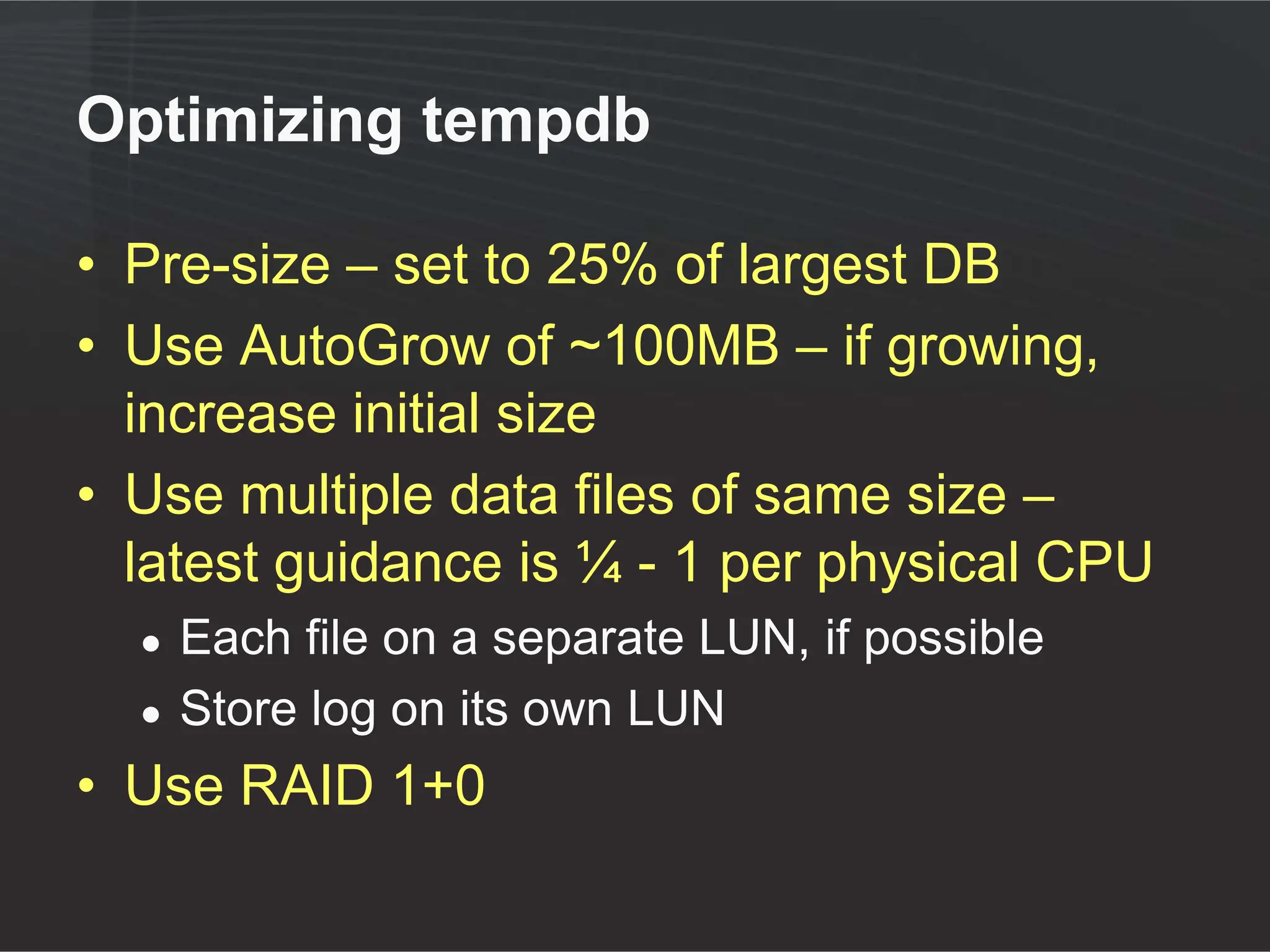
Optimizing tempdb

• Pre-size – set to 25% of largest DB
• Use AutoGrow of ~100MB – if growing,
  increase initial size
• Use multiple data files of same size –
  latest guidance is ¼ - 1 per physical CPU
  ●   Each file on a separate LUN, if possible
  ●   Store log on its own LUN
• Use RAID 1+0
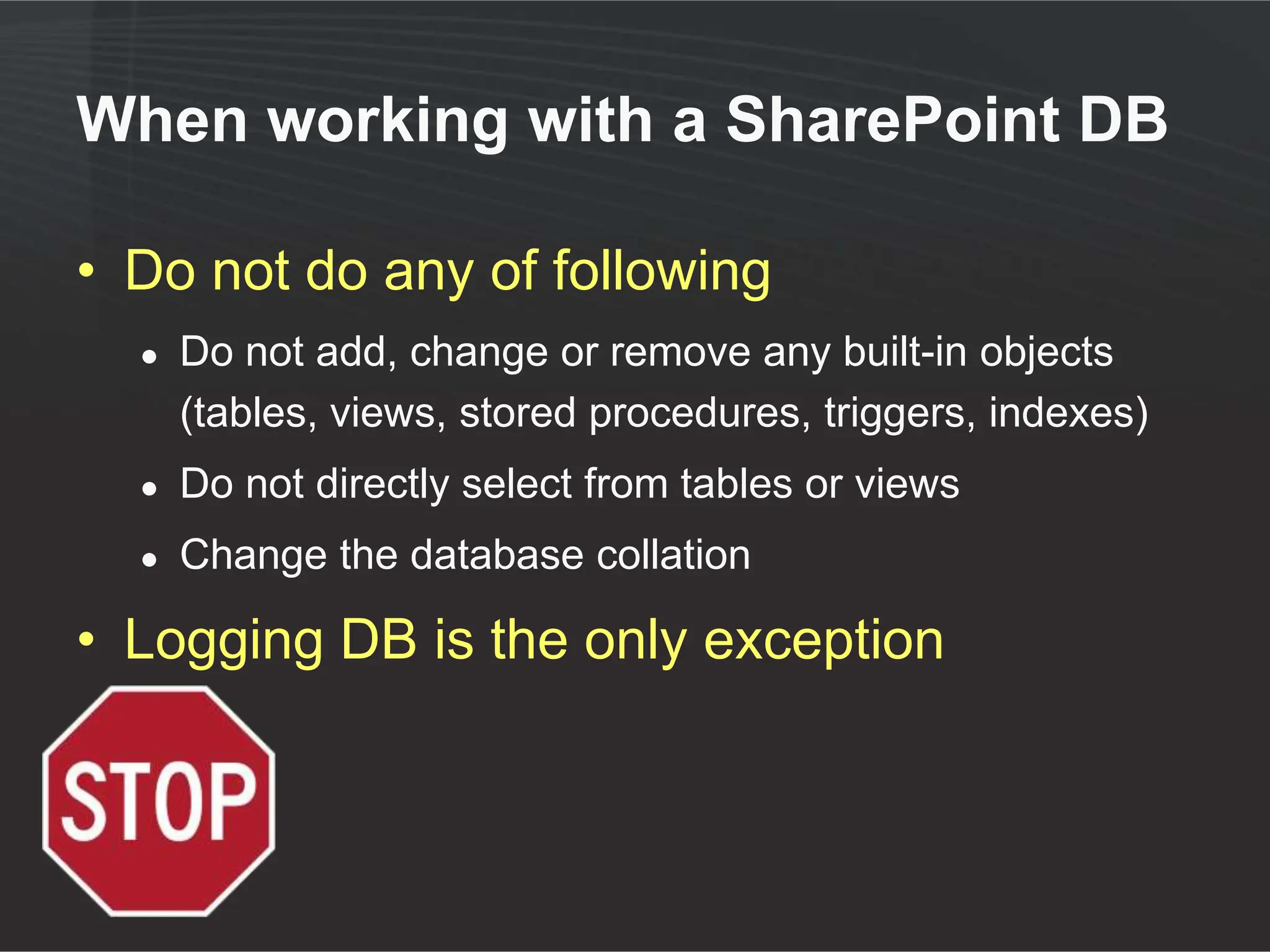
When working with a SharePoint DB

• Do not do any of following
  ●   Do not add, change or remove any built-in objects
      (tables, views, stored procedures, triggers, indexes)
  ●   Do not directly select from tables or views
  ●   Change the database collation

• Logging DB is the only exception
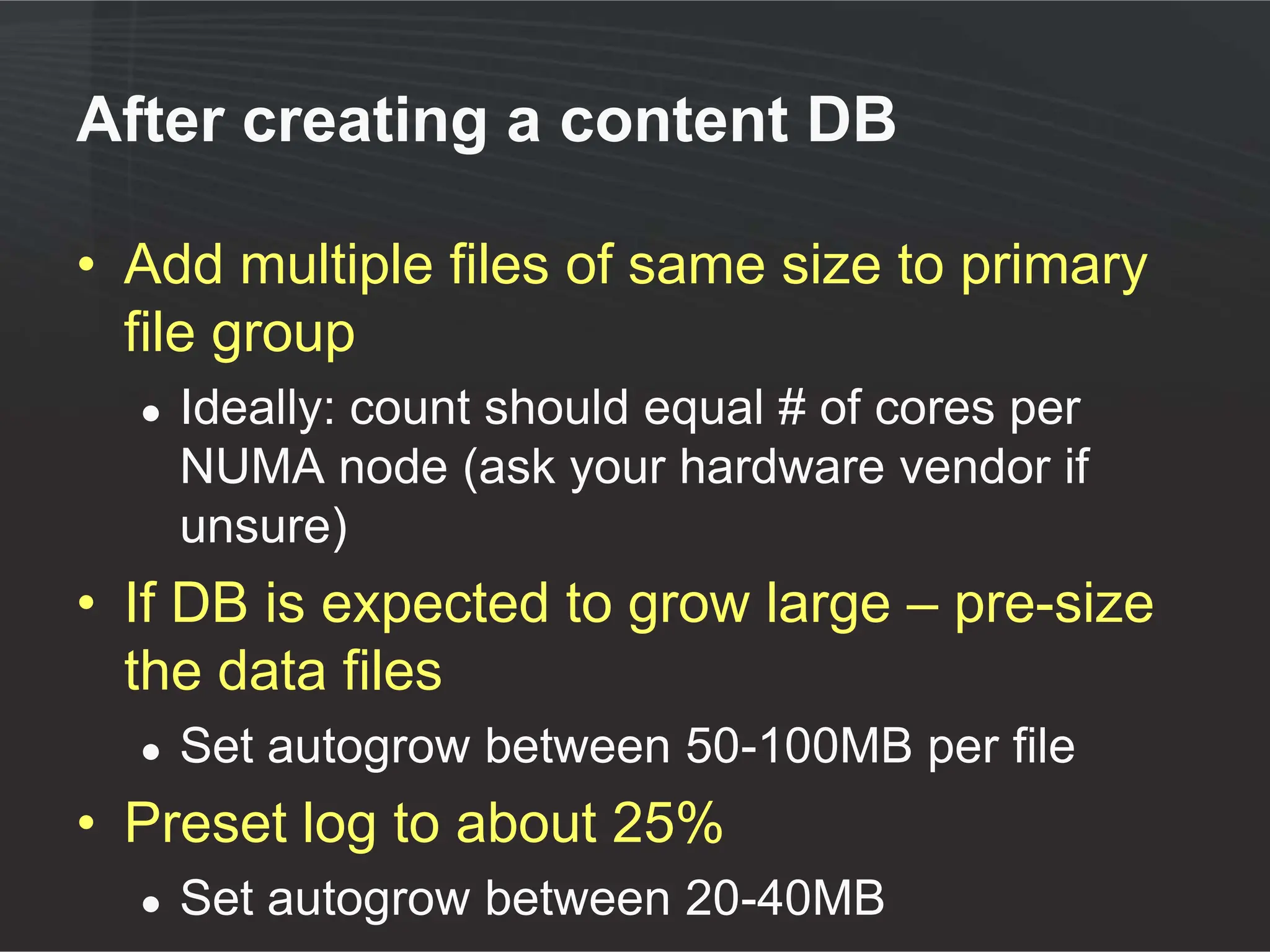
After creating a content DB

• Add multiple files of same size to primary
  file group
  ●   Ideally: count should equal # of cores per
      NUMA node (ask your hardware vendor if
      unsure)
• If DB is expected to grow large – pre-size
  the data files
  ●   Set autogrow between 50-100MB per file
• Preset log to about 25%
  ●   Set autogrow between 20-40MB
Optimizing content DBs
   • Very active content DBs should be placed
     on their own LUNs
   • Use RAID 5 or RAID 1+0
   • In most cases, keep size < 200GB
       ●   Why? Recovery and performance reasons
       ●   Use site collection quotas
       ●   Don’t forget about the 2nd stage recycle bin
       ●   Use PowerShell to create site collections -
           store in specific content DB
For more, see http://slidesha.re/t1xnxD
Why are larger DBs slower?

• Read queries take longer
  ●   More rows to filter, group and sort
• Write queries take longer
• Increased lock contention
  ●   Causes more blocking
• More data, but data cache same size
• DB maintenance takes longer
  ●   reindex
  ●   dbcc checkdb
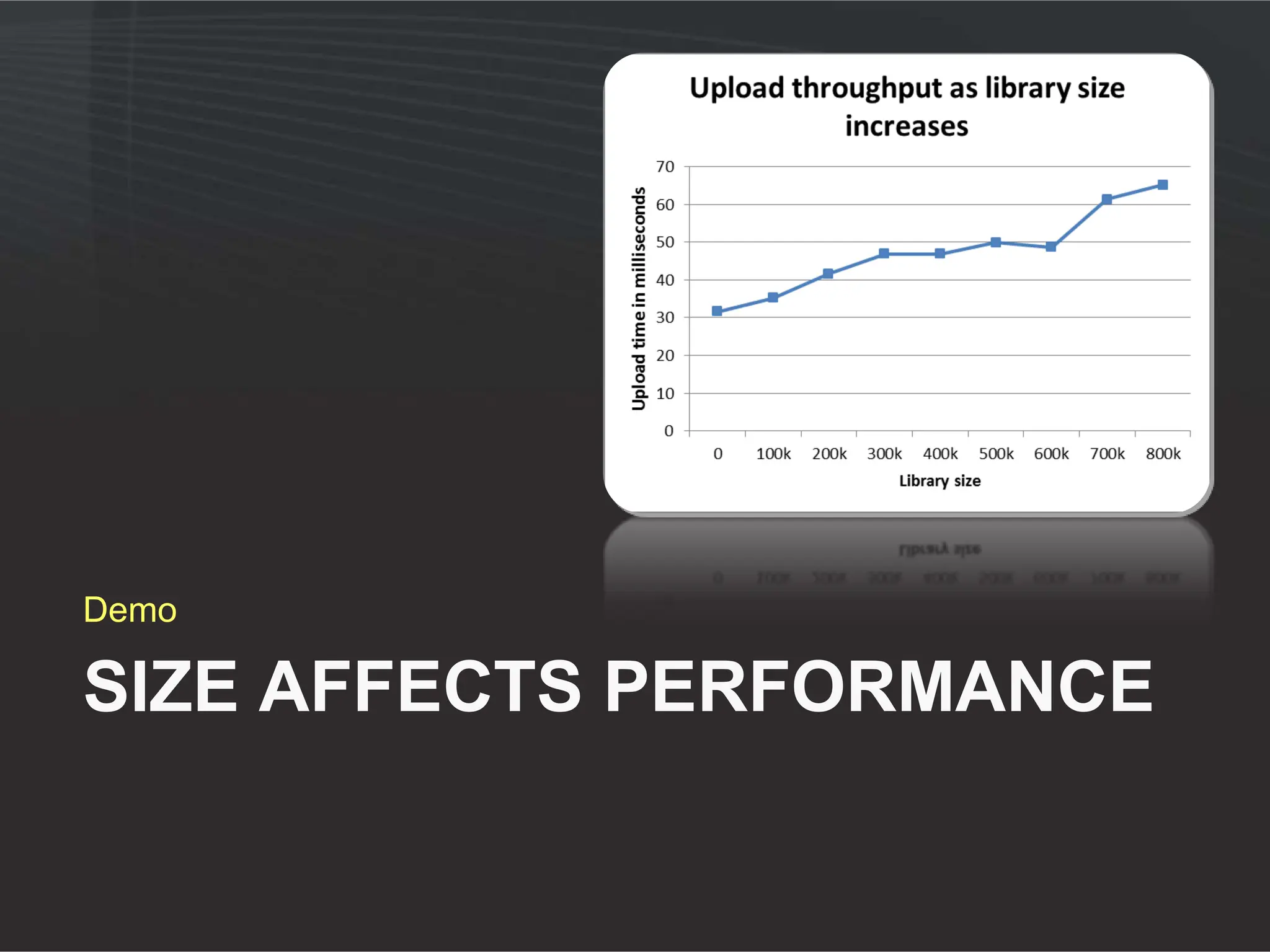
Demo

SIZE AFFECTS PERFORMANCE
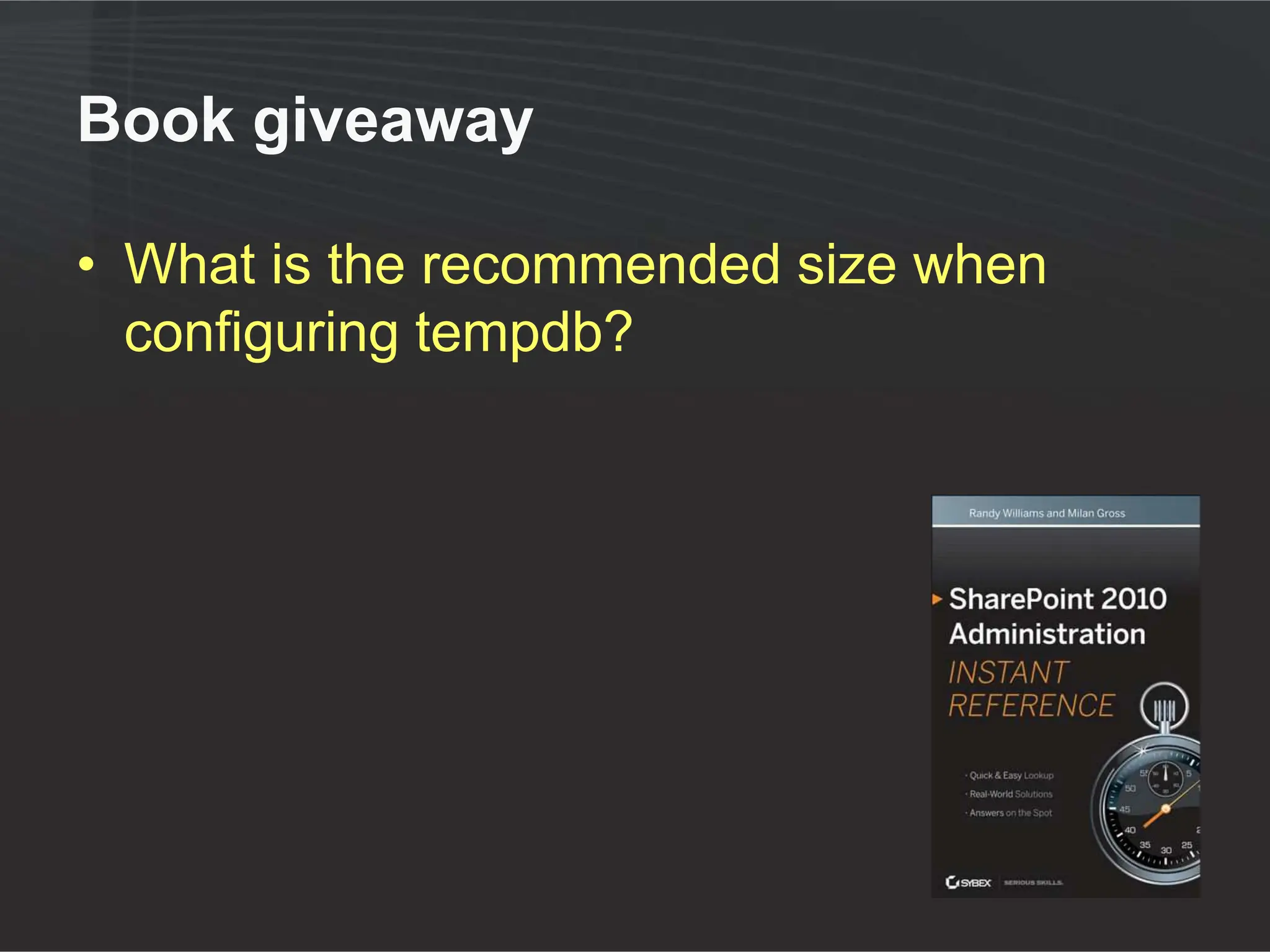
Book giveaway

• What is the recommended size when
  configuring tempdb?
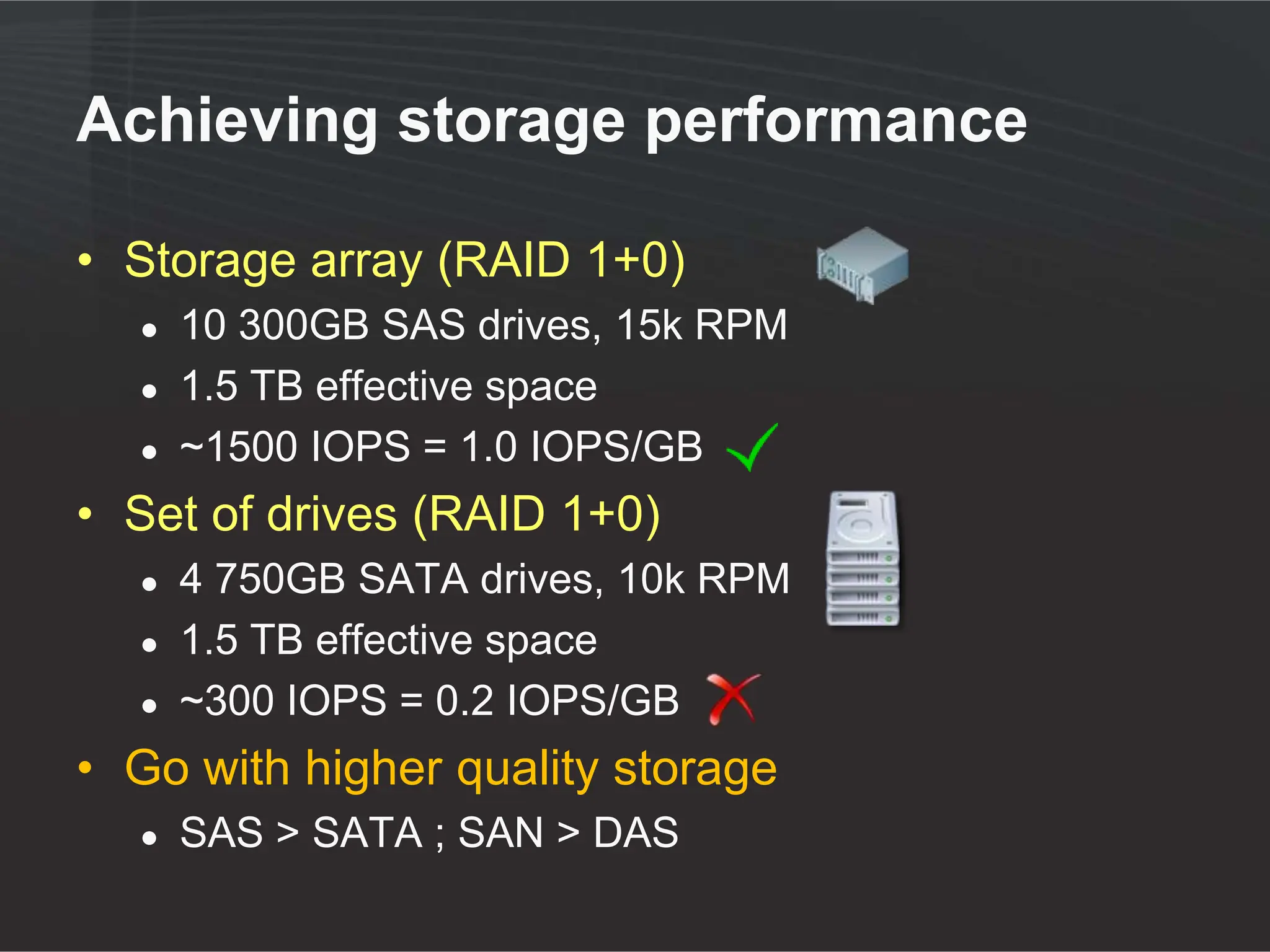
Achieving storage performance

• Storage array (RAID 1+0)
  ●   10 300GB SAS drives, 15k RPM
  ●   1.5 TB effective space
  ●   ~1500 IOPS = 1.0 IOPS/GB
• Set of drives (RAID 1+0)
  ●   4 750GB SATA drives, 10k RPM
  ●   1.5 TB effective space
  ●   ~300 IOPS = 0.2 IOPS/GB
• Go with higher quality storage
  ●   SAS > SATA ; SAN > DAS
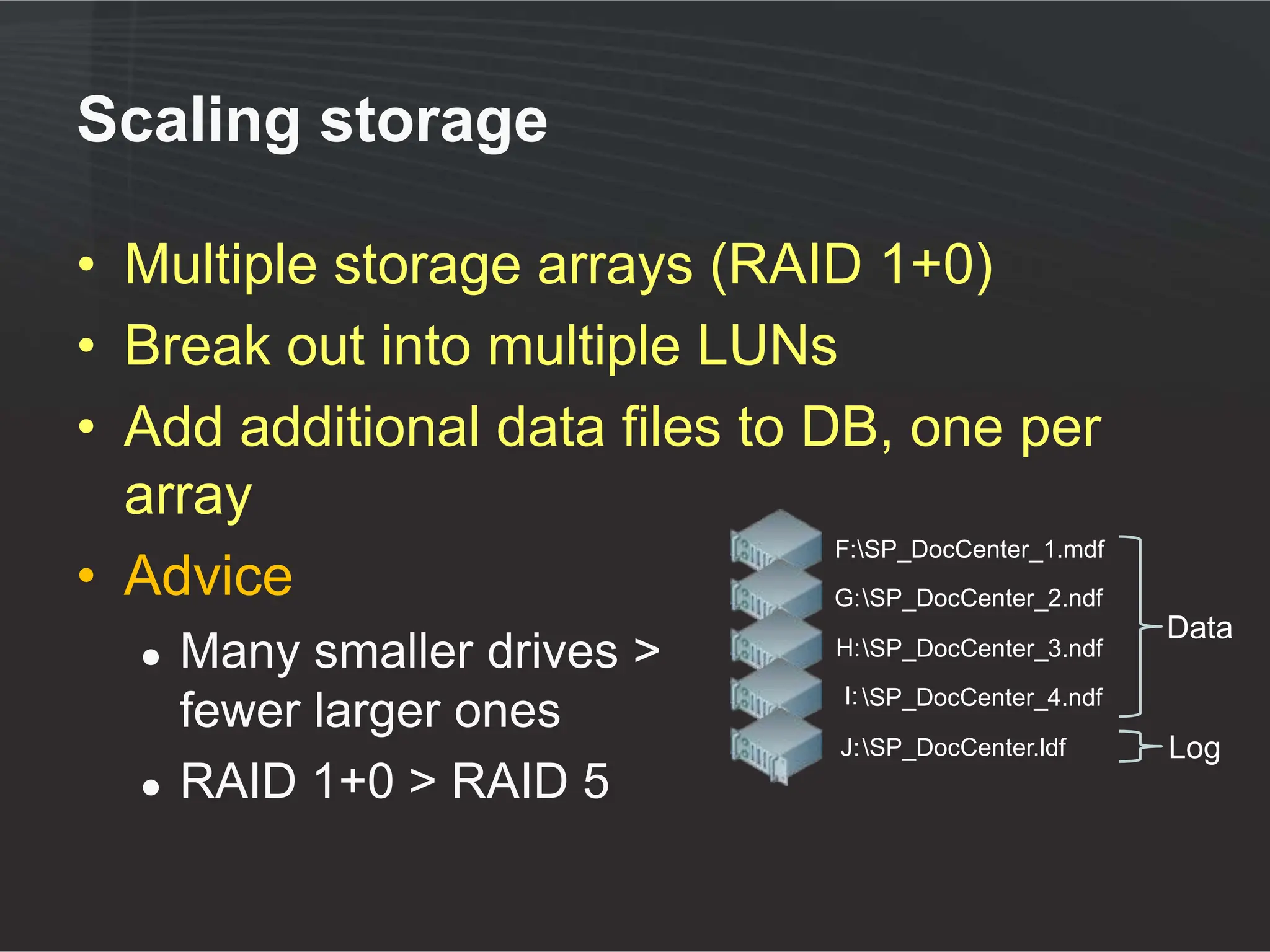
Scaling storage

• Multiple storage arrays (RAID 1+0)
• Break out into multiple LUNs
• Add additional data files to DB, one per
  array
                                F:SP_DocCenter_1.mdf
• Advice                        G: SP_DocCenter_2.ndf
                                                                 Data
   ●   Many smaller drives >           H: SP_DocCenter_3.ndf
                                        I: SP_DocCenter_4.ndf
       fewer larger ones
                                        J: SP_DocCenter.ldf     Log
   ●   RAID 1+0 > RAID 5
Optimizing Search DBs

• Max of 25 million items per each crawl and
  property DB
• Store crawl and property DBs on separate,
  dedicated LUNs
• Add data files to match Content DBs
• Use RAID 1+0 storage
• Consider storing on dedicated SQL server
Scaling out for performance

• For large, high-performance farms, scale
  out to multiple SQL servers
• No limit to the number of servers – each
  database can have its own
  ●   Best practice is to break out across some
      logical boundary (web app, service apps, etc.)
• Using clustered SQL servers?
  ●   Consider using instances and make each
      instance active on a separate physical node
Reindexing DBs

• Fragmentation happens by design –
  primary key uses GUID columns
• Indexes are rebuilt daily as part of health
  analyzer job
• No manual reindex needed
  ●   Do not drop and recreate indexes
RBS Guidance

  • Consider using in document-heavy databases
  • Trade off
       ●   Storage cost & performance benefits versus
       ●   More complex architecture (support, DR, HA)
  • Consider third party providers
       ●   More full-featured solutions
  • In general
       ●   Do not externalize documents <1MB
       ●   Ideal number varies widely
For more, see bit.ly/v4iMMm
Best Practices

• Use SQL 2008 R2 Enterprise for best performance
• Backup logs regularly to prevent runaway log files
• Do not use autoshrink
   ●   Shrink manually only when needed
• Do not use multiple file groups
   ●   Not supported by SharePoint
• Run database integrity checks
• Use Instant File Initialization
   ●   http://bit.ly/bRhdgH
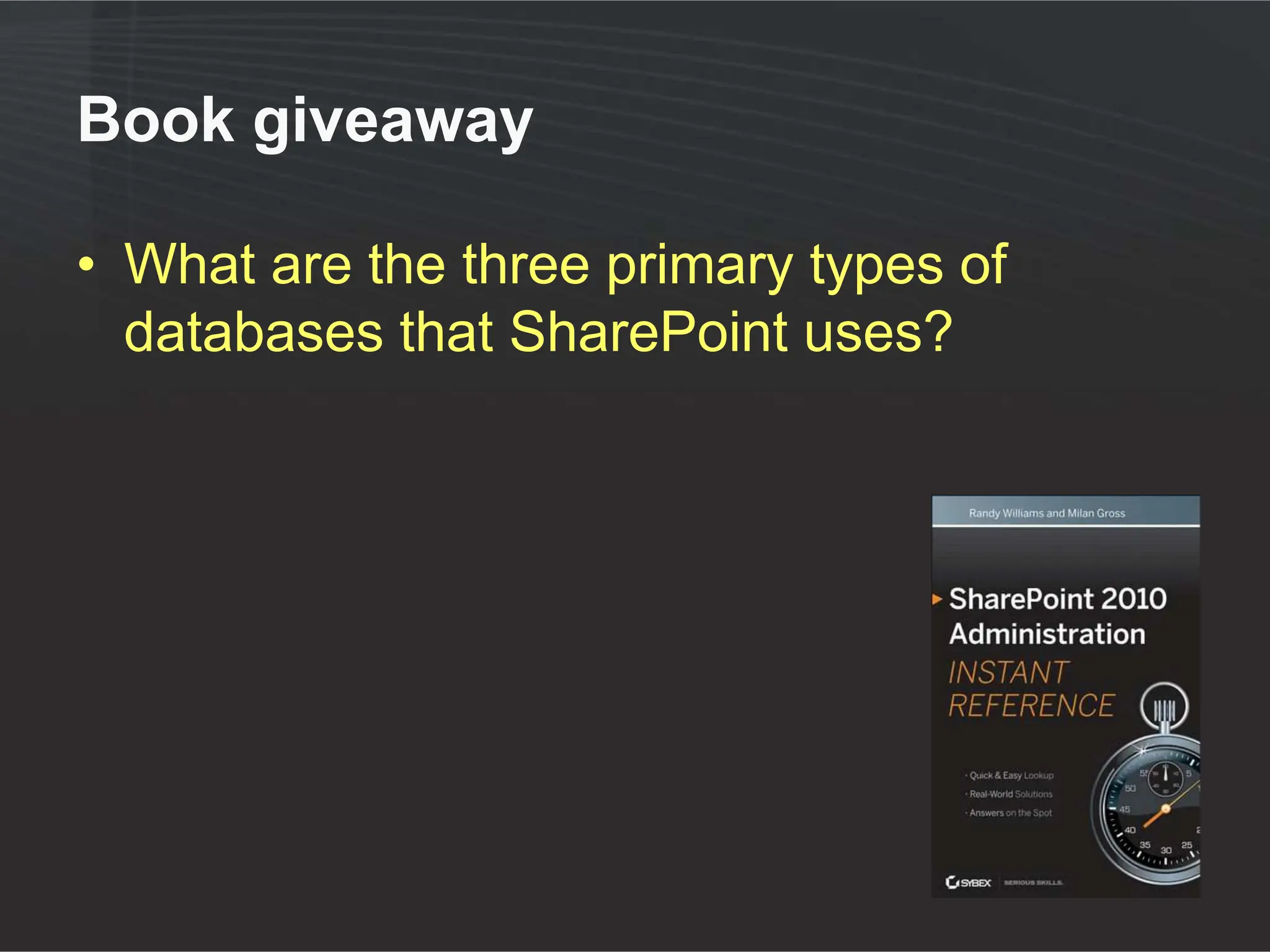
Book giveaway

• What are the three primary types of
  databases that SharePoint uses?
Questions?
  randy.williams@avepoint.com
  http://linkd.in/plEEb1
  @tweetraw
Victory Lap- social event
  "SharePoint Victory Lap" Social Event for
     SPSLA will be at: 5:30pm to 8pm at
Di Piazzas (5205 E. Pacific Coast Hwy, 90804)
We want your feedback!
                   Use this QR code or visit:
                   http://sps.la/feedback

                   Silver Sponsors:

Optimizing SQL Server 2008 for Blazing Fast SharePoint Sites

  • 1.
    Optimizing SQL Server2008 For blazing fast SharePoint sites
  • 2.
    Randy Williams • Enterprise Trainer & Evangelist • Based in San Diego, CA • SharePoint MVP alum (2009 – 2011) • Speaker at many global conferences • 20+ years in IT ● Developer, consultant, trainer, author • Columnist: SharePoint Pro magazine • randy.williams@avepoint.com • @tweetraw
  • 3.
    Agenda • Quick review of database basics • Optimize the server • Optimize tempdb • Optimize Content DBs • Scaling out • Best Practices
  • 4.
    Quick Review ofDatabase Basics • Each database consists of ● One or more data files (.mdf, .ndf) ● One or more log files (.ldf) • When changes occur 1. Log is written to first 2. Checkpoint process commits changes to data files • In simple recovery inactive transaction in log is truncated
  • 5.
    How SharePoint UsesSQL • One configuration DB per farm • Each web app has one or more content DBs ● Container for site collections ● All SharePoint content, including files, is stored in content DB • Service application databases ● Search databases are usually most important when optimizing
  • 6.
    The Most ImportantFactors 1. RAM 2. CPU 3. Storage ● SAN is best for performance (greatest IOPS) ● Work with your storage vendor when configuring Logical Unit Numbers (LUNs) 4. Network
  • 7.
    Optimize the DBServer • Do not run non-SQL apps on SQL Server • Dedicate SQL Server to one SharePoint Farm • If virtualizing ● Virtualize WFE and app servers first ● SQL can be virtualized, but it will affect performance
  • 8.
    Optimize the SQLInstance • Adjust database default locations ● Never place on C: drive ● Log and data on separate LUNs/physical disks • Adjust server memory settings if running multiple instances • Use 64KB allocation units when formatting data and log partitions
  • 9.
  • 10.
    Optimizing tempdb • Pre-size– set to 25% of largest DB • Use AutoGrow of ~100MB – if growing, increase initial size • Use multiple data files of same size – latest guidance is ¼ - 1 per physical CPU ● Each file on a separate LUN, if possible ● Store log on its own LUN • Use RAID 1+0
  • 11.
    When working witha SharePoint DB • Do not do any of following ● Do not add, change or remove any built-in objects (tables, views, stored procedures, triggers, indexes) ● Do not directly select from tables or views ● Change the database collation • Logging DB is the only exception
  • 12.
    After creating acontent DB • Add multiple files of same size to primary file group ● Ideally: count should equal # of cores per NUMA node (ask your hardware vendor if unsure) • If DB is expected to grow large – pre-size the data files ● Set autogrow between 50-100MB per file • Preset log to about 25% ● Set autogrow between 20-40MB
  • 13.
    Optimizing content DBs • Very active content DBs should be placed on their own LUNs • Use RAID 5 or RAID 1+0 • In most cases, keep size < 200GB ● Why? Recovery and performance reasons ● Use site collection quotas ● Don’t forget about the 2nd stage recycle bin ● Use PowerShell to create site collections - store in specific content DB For more, see http://slidesha.re/t1xnxD
  • 14.
    Why are largerDBs slower? • Read queries take longer ● More rows to filter, group and sort • Write queries take longer • Increased lock contention ● Causes more blocking • More data, but data cache same size • DB maintenance takes longer ● reindex ● dbcc checkdb
  • 15.
  • 16.
    Book giveaway • Whatis the recommended size when configuring tempdb?
  • 17.
    Achieving storage performance •Storage array (RAID 1+0) ● 10 300GB SAS drives, 15k RPM ● 1.5 TB effective space ● ~1500 IOPS = 1.0 IOPS/GB • Set of drives (RAID 1+0) ● 4 750GB SATA drives, 10k RPM ● 1.5 TB effective space ● ~300 IOPS = 0.2 IOPS/GB • Go with higher quality storage ● SAS > SATA ; SAN > DAS
  • 18.
    Scaling storage • Multiplestorage arrays (RAID 1+0) • Break out into multiple LUNs • Add additional data files to DB, one per array F:SP_DocCenter_1.mdf • Advice G: SP_DocCenter_2.ndf Data ● Many smaller drives > H: SP_DocCenter_3.ndf I: SP_DocCenter_4.ndf fewer larger ones J: SP_DocCenter.ldf Log ● RAID 1+0 > RAID 5
  • 19.
    Optimizing Search DBs •Max of 25 million items per each crawl and property DB • Store crawl and property DBs on separate, dedicated LUNs • Add data files to match Content DBs • Use RAID 1+0 storage • Consider storing on dedicated SQL server
  • 20.
    Scaling out forperformance • For large, high-performance farms, scale out to multiple SQL servers • No limit to the number of servers – each database can have its own ● Best practice is to break out across some logical boundary (web app, service apps, etc.) • Using clustered SQL servers? ● Consider using instances and make each instance active on a separate physical node
  • 21.
    Reindexing DBs • Fragmentationhappens by design – primary key uses GUID columns • Indexes are rebuilt daily as part of health analyzer job • No manual reindex needed ● Do not drop and recreate indexes
  • 22.
    RBS Guidance • Consider using in document-heavy databases • Trade off ● Storage cost & performance benefits versus ● More complex architecture (support, DR, HA) • Consider third party providers ● More full-featured solutions • In general ● Do not externalize documents <1MB ● Ideal number varies widely For more, see bit.ly/v4iMMm
  • 23.
    Best Practices • UseSQL 2008 R2 Enterprise for best performance • Backup logs regularly to prevent runaway log files • Do not use autoshrink ● Shrink manually only when needed • Do not use multiple file groups ● Not supported by SharePoint • Run database integrity checks • Use Instant File Initialization ● http://bit.ly/bRhdgH
  • 24.
    Book giveaway • Whatare the three primary types of databases that SharePoint uses?
  • 25.
    Questions? randy.williams@avepoint.com http://linkd.in/plEEb1 @tweetraw
  • 26.
    Victory Lap- socialevent "SharePoint Victory Lap" Social Event for SPSLA will be at: 5:30pm to 8pm at Di Piazzas (5205 E. Pacific Coast Hwy, 90804)
  • 27.
    We want yourfeedback! Use this QR code or visit: http://sps.la/feedback Silver Sponsors:

Editor's Notes