

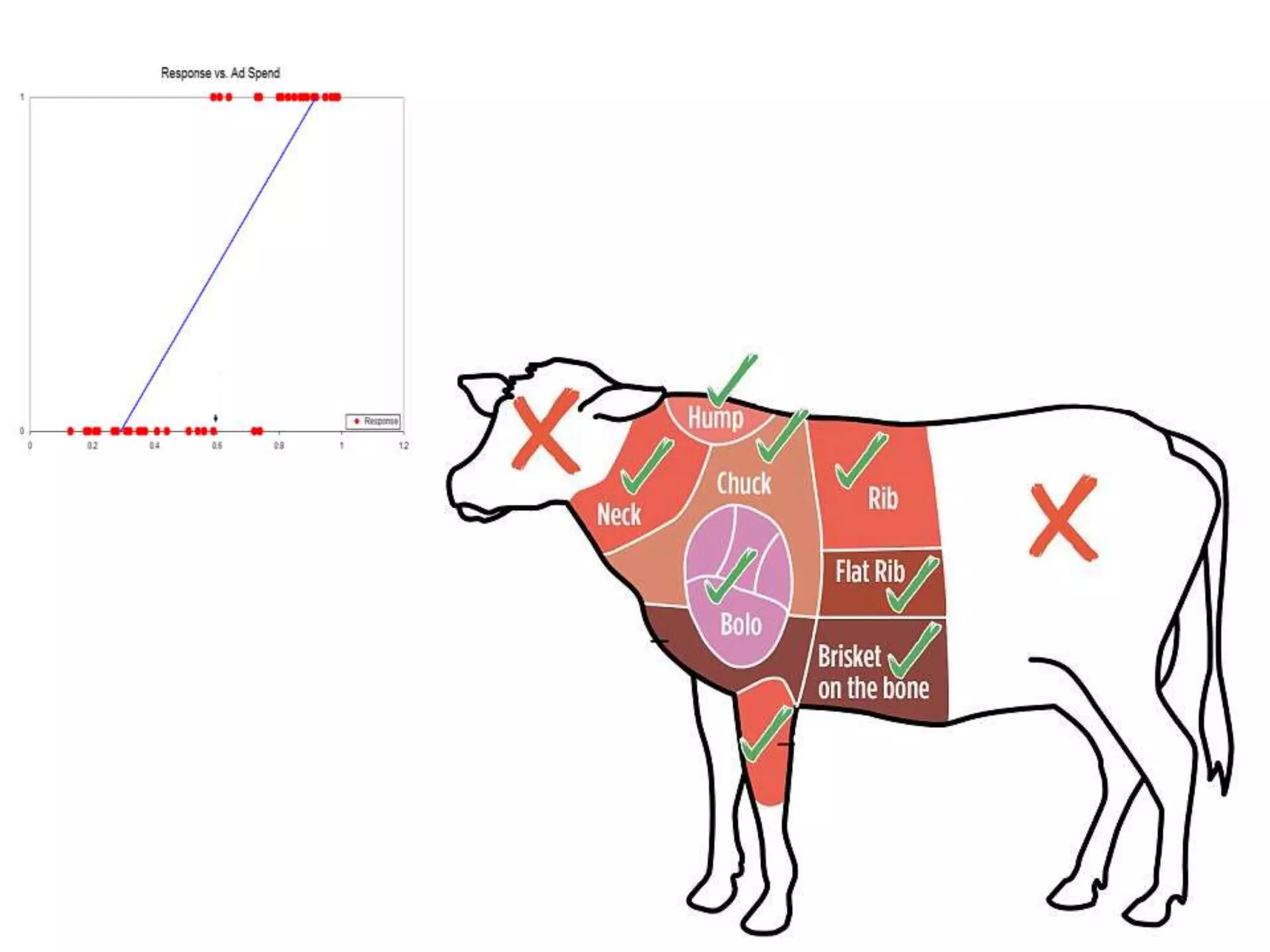
Linear Probability Models and Big Data
Kosher or Not?
Galit Shmueli & Suneel Chatla
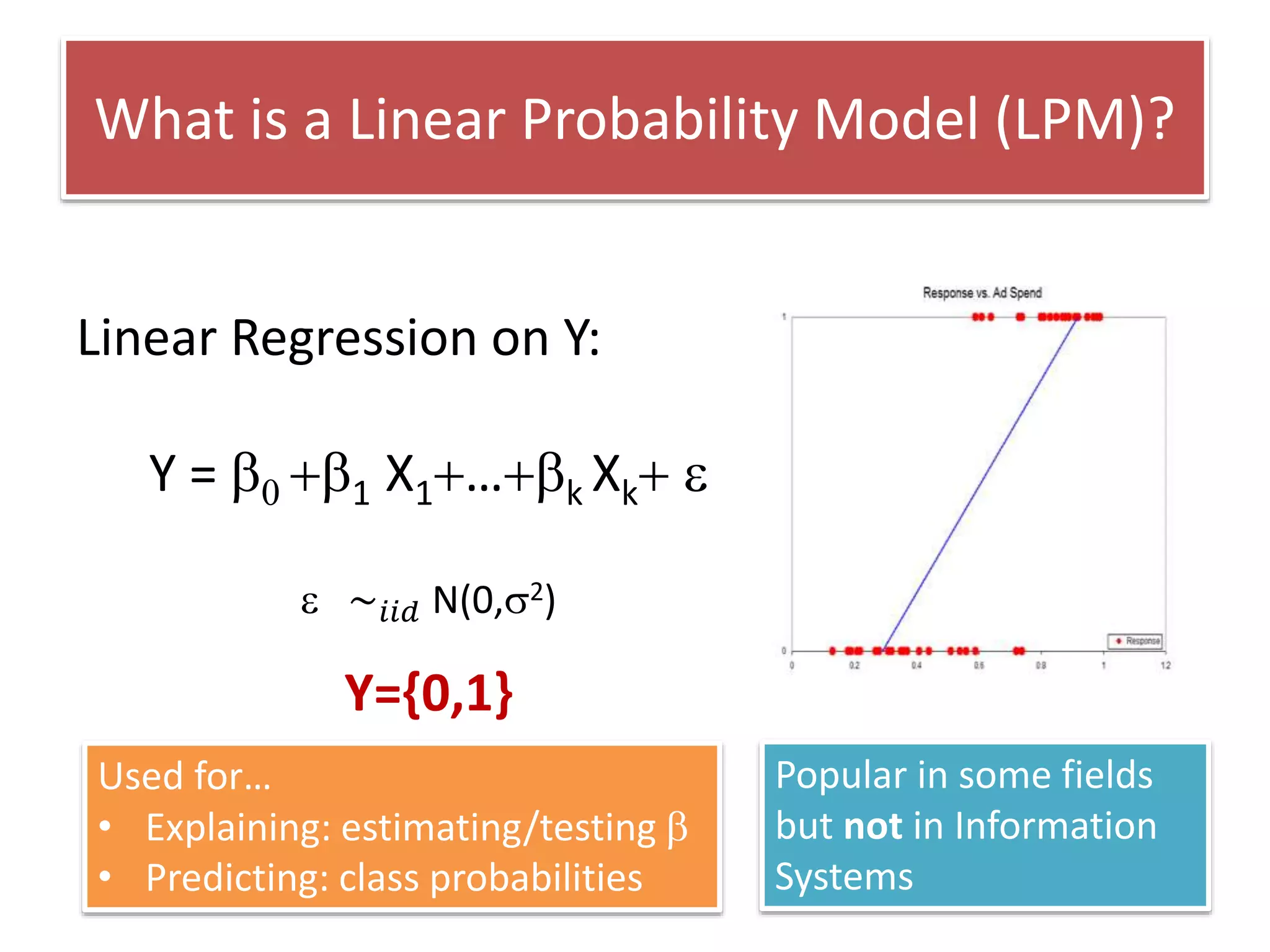
Linear Regression on Y:
Y = b0 +b1 X1+…+bk Xk+ e
e ~𝑖𝑖𝑑 N(0,s2)
Y={0,1}
What is a Linear Probability Model (LPM)?
Used for…
• Explaining: estimating/testing b
• Predicting: class probabilities
Popular in some fields
but not in Information
Systems
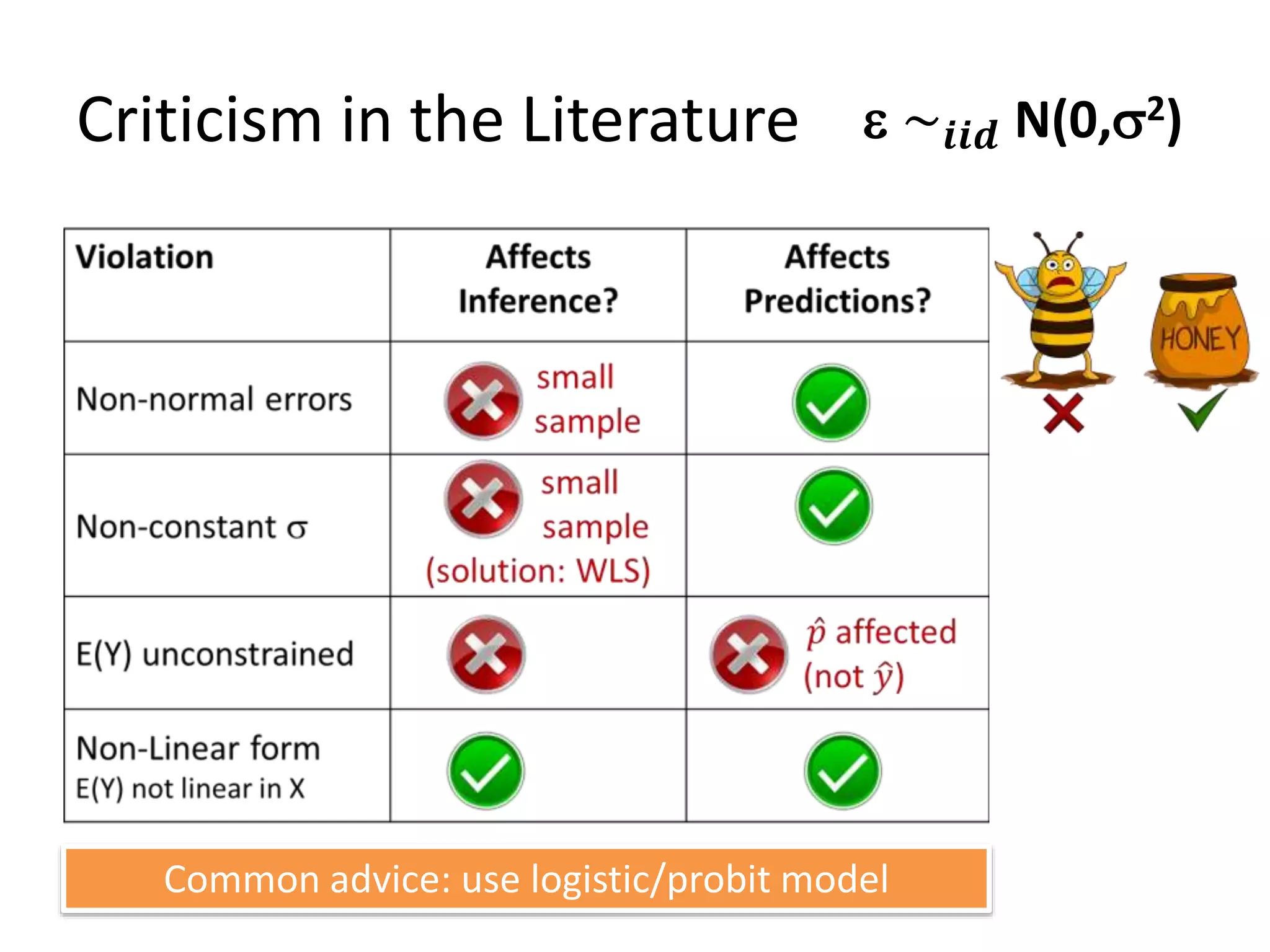
Criticism in the Literature e ~𝒊𝒊𝒅 N(0,s2)
Common advice: use logistic/probit model
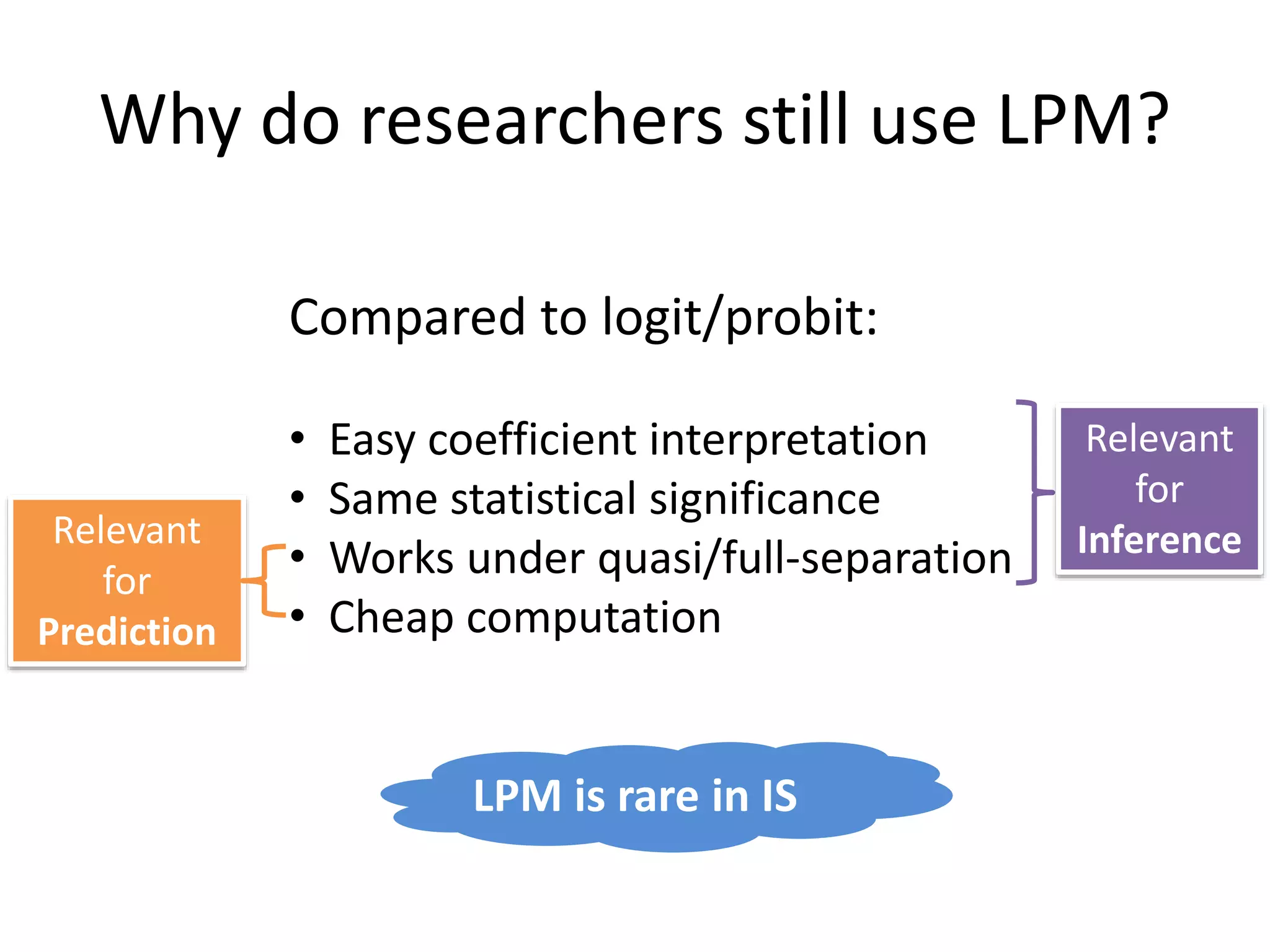
Why do researchers still use LPM?
Compared to logit/probit:
• Easy coefficient interpretation
• Same statistical significance
• Works under quasi/full-separation
• Cheap computation
Relevant
for
InferenceRelevant
for
Prediction
LPM is rare in IS
Should we use LPM?
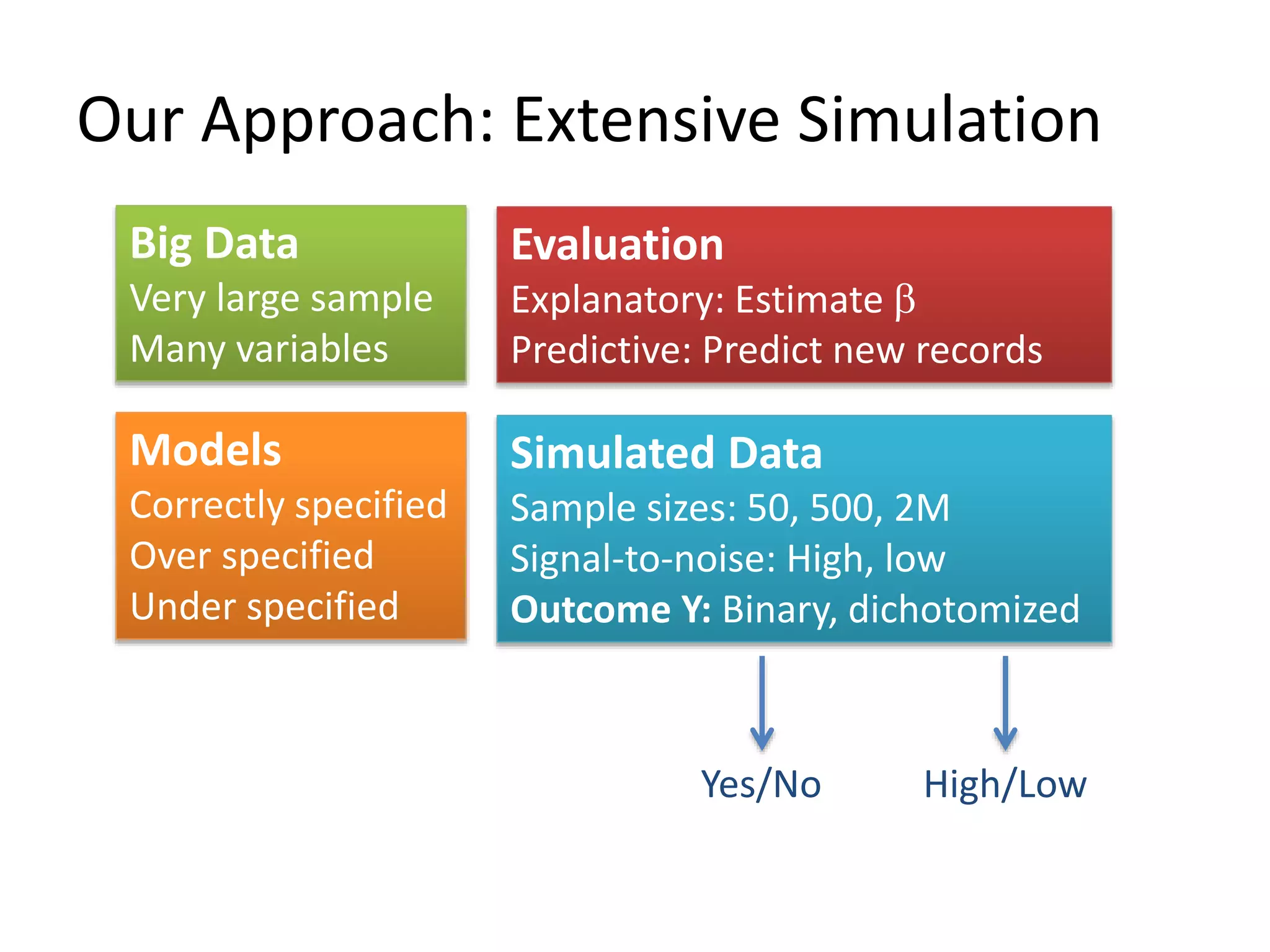
Our Approach: Extensive Simulation
Evaluation
Explanatory: Estimate b
Predictive: Predict new records
Big Data
Very large sample
Many variables
Models
Correctly specified
Over specified
Under specified
Simulated Data
Sample sizes: 50, 500, 2M
Signal-to-noise: High, low
Outcome Y: Binary, dichotomized
Yes/No High/Low
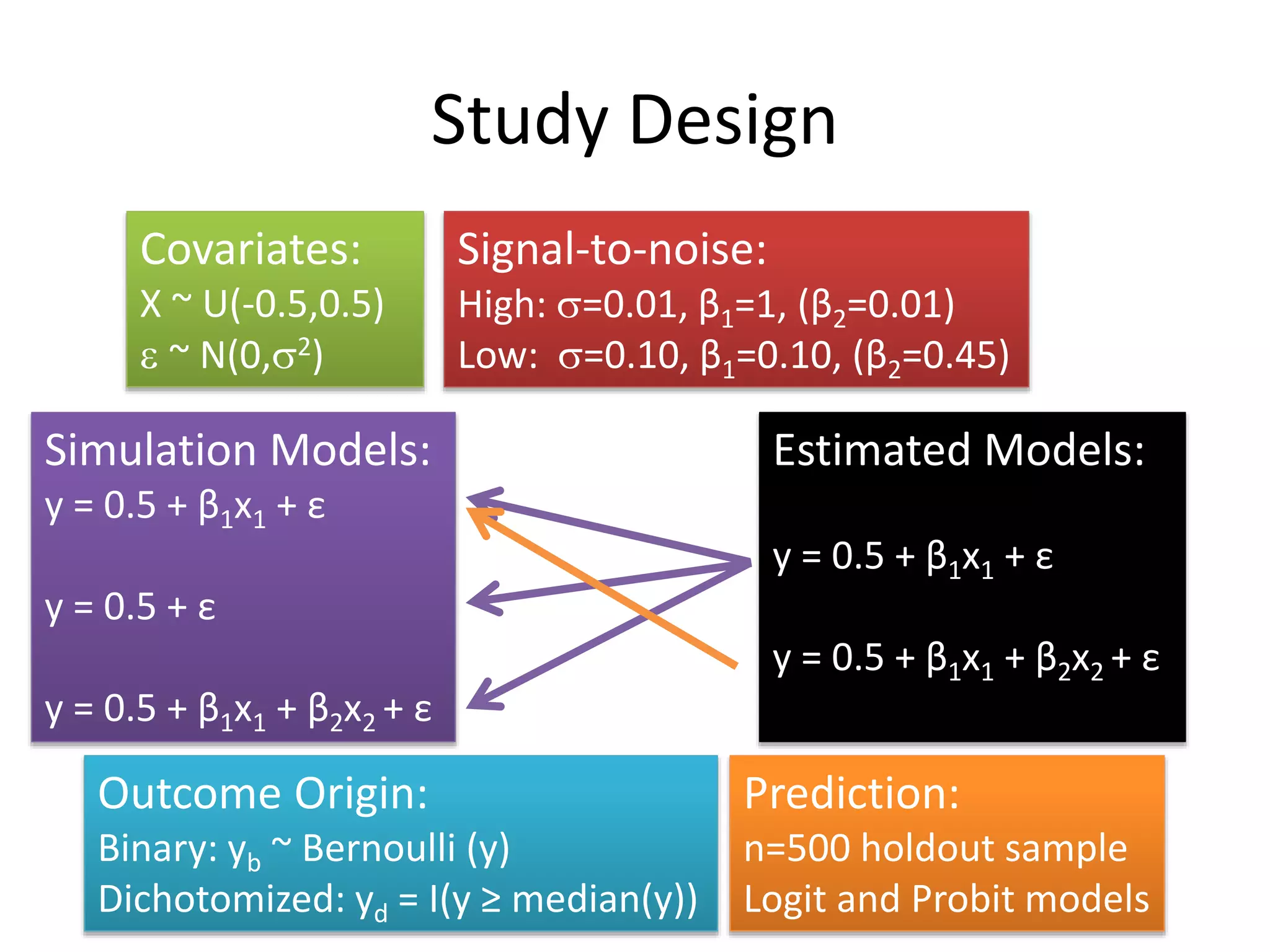
Study Design
Covariates:
X ~ U(-0.5,0.5)
e ~ N(0,s2)
Simulation Models:
y = 0.5 + β1x1 + ε
y = 0.5 + ε
y = 0.5 + β1x1 + β2x2 + ε
Signal-to-noise:
High: s=0.01, β1=1, (β2=0.01)
Low: s=0.10, β1=0.10, (β2=0.45)
Outcome Origin:
Binary: yb ~ Bernoulli (y)
Dichotomized: yd = I(y ≥ median(y))
Estimated Models:
y = 0.5 + β1x1 + ε
y = 0.5 + β1x1 + β2x2 + ε
Prediction:
n=500 holdout sample
Logit and Probit models
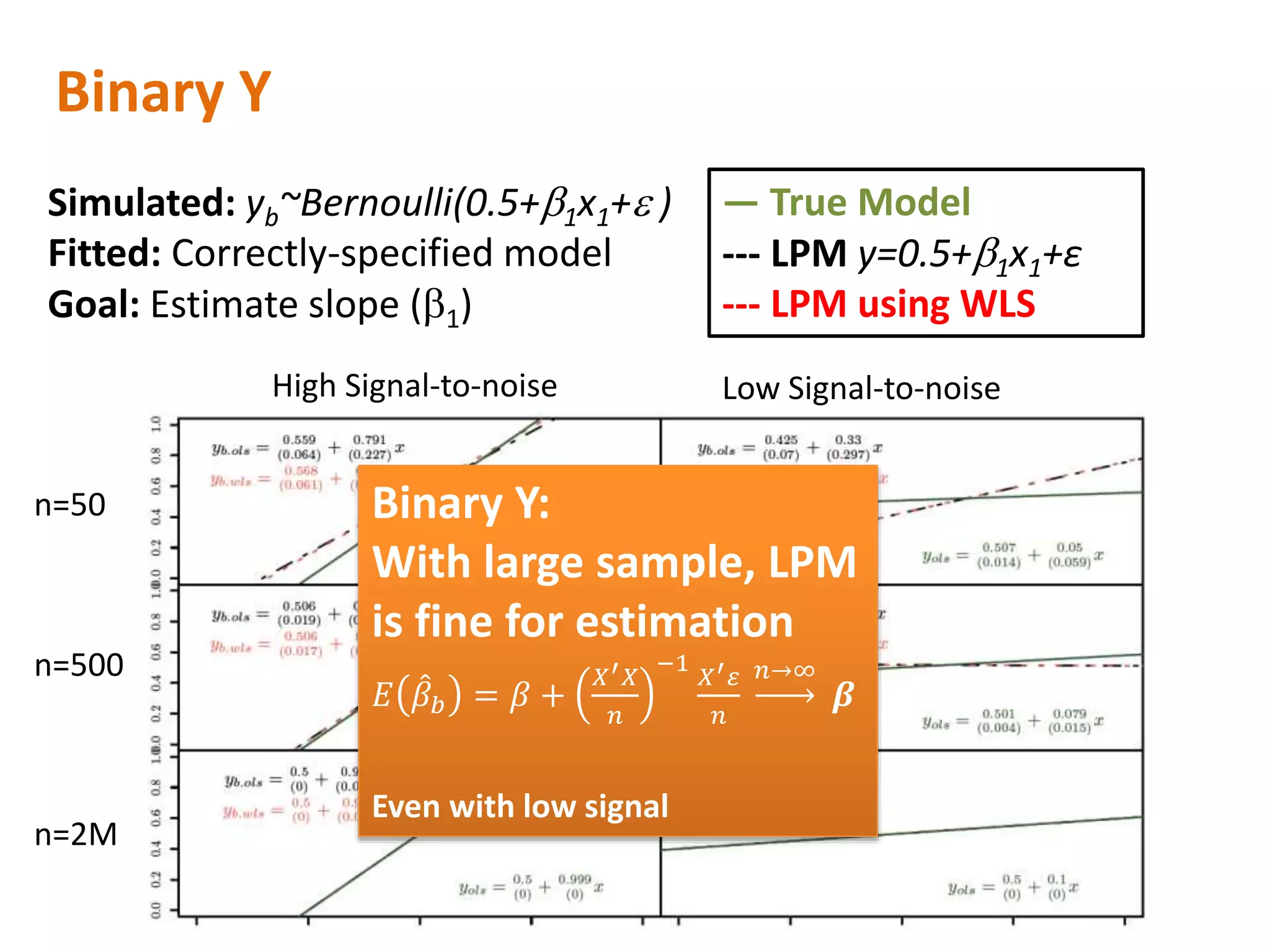
Binary Y
High Signal-to-noise Low Signal-to-noise
n=50
n=500
n=2M
— True Model
--- LPM y=0.5+b1x1+ε
--- LPM using WLS
Simulated: yb~Bernoulli(0.5+b1x1+e )
Fitted: Correctly-specified model
Goal: Estimate slope (b1)
Binary Y:
With large sample, LPM
is fine for estimation
𝐸 𝛽 𝑏 = 𝛽 +
𝑋′ 𝑋
𝑛
−1
𝑋′ 𝜀
𝑛
𝑛→∞
𝜷
Even with low signal
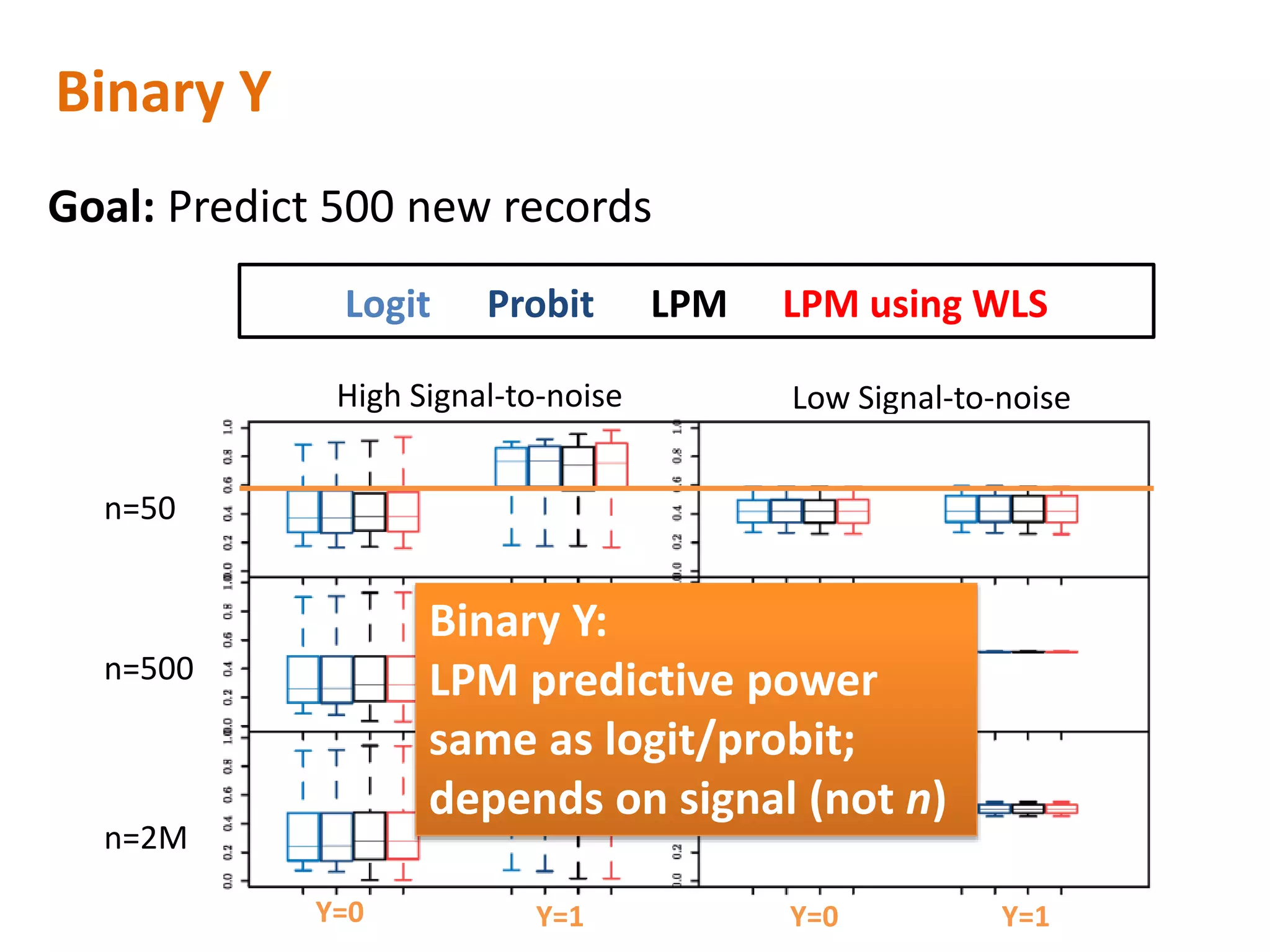
High Signal-to-noise Low Signal-to-noise
n=50
n=500
n=2M
Y=0 Y=0Y=1 Y=1
Binary Y:
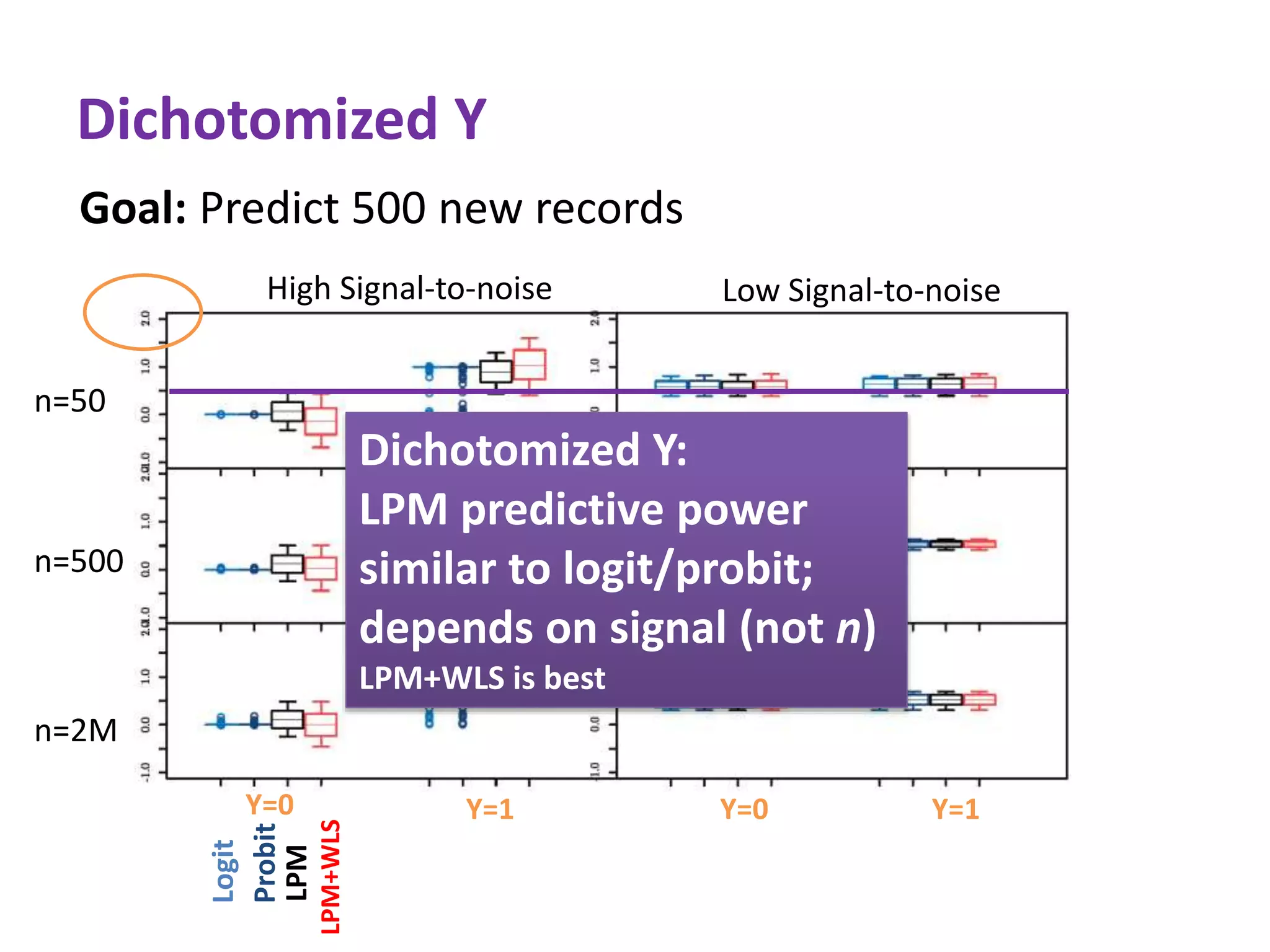
LPM predictive power
same as logit/probit;
depends on signal (not n)
Binary Y
Goal: Predict 500 new records
Logit Probit LPM LPM using WLS
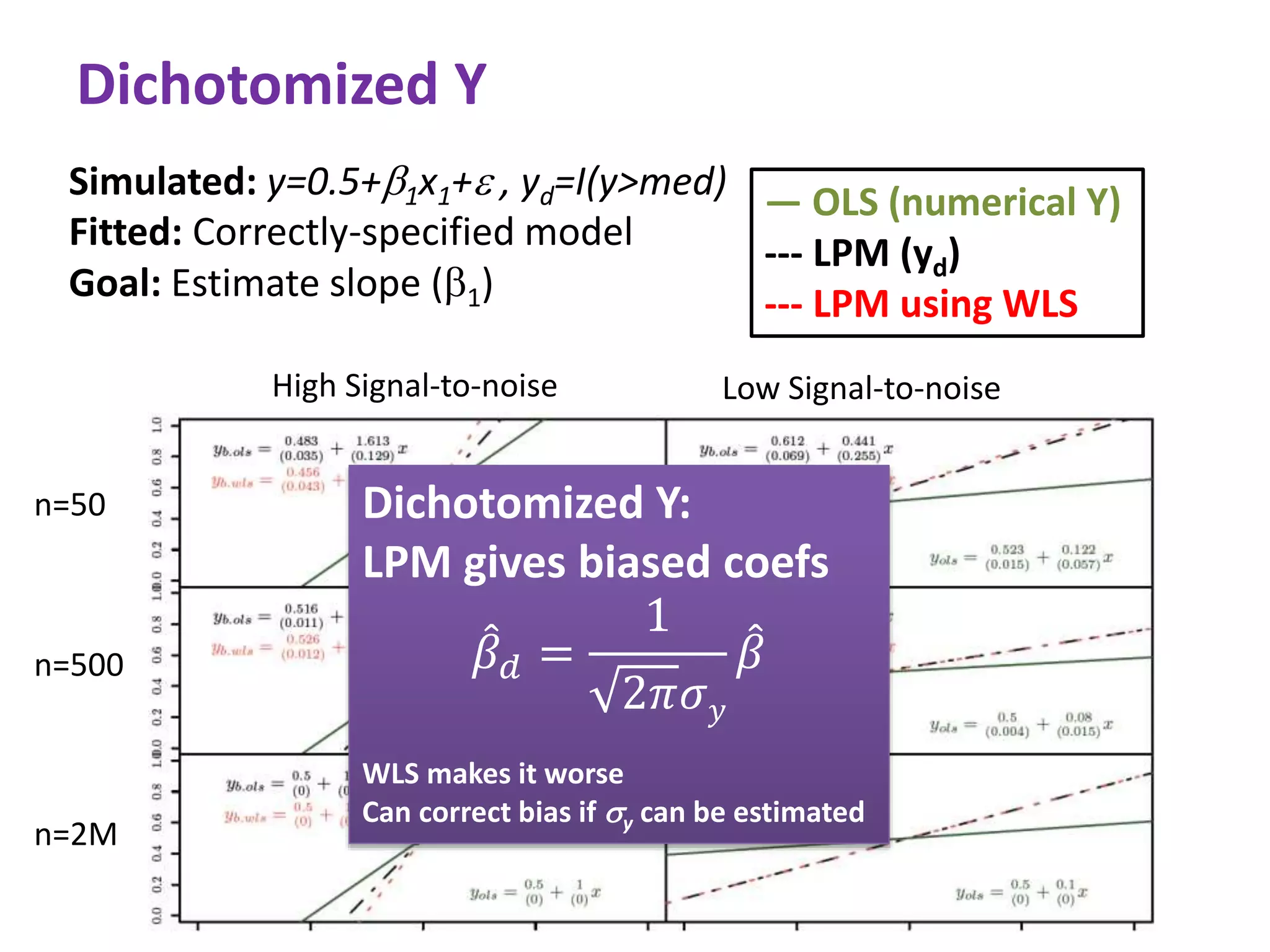
Dichotomized Y
High Signal-to-noise Low Signal-to-noise
n=50
n=500
n=2M
— OLS (numerical Y)
--- LPM (yd)
--- LPM using WLS
Dichotomized Y:
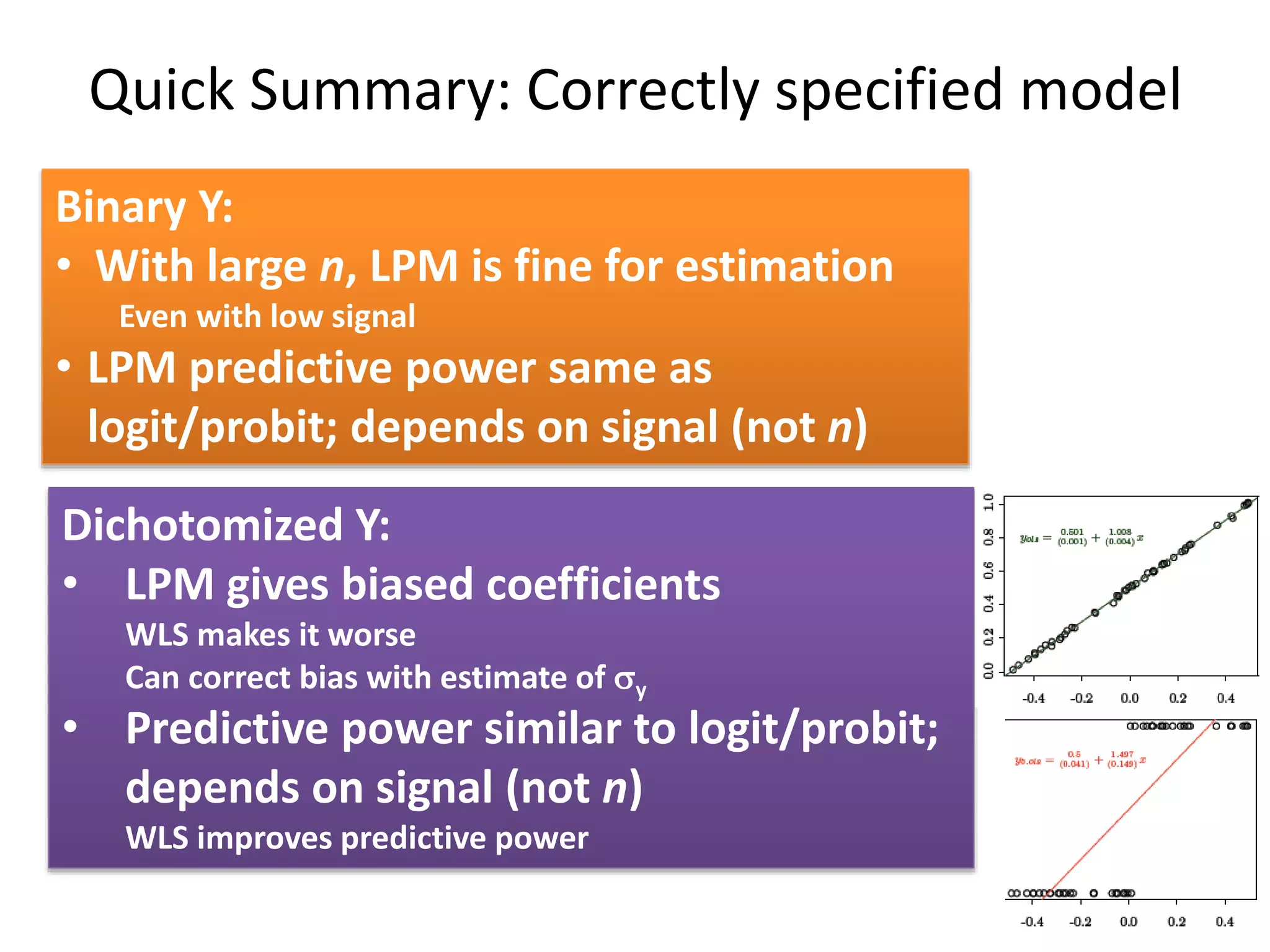
LPM gives biased coefs
𝛽 𝑑 =
1
2𝜋𝜎 𝑦
𝛽
WLS makes it worse
Can correct bias if sy can be estimated
Simulated: y=0.5+b1x1+e , yd=I(y>med)
Fitted: Correctly-specified model
Goal: Estimate slope (b1)
Dichotomized Y
High Signal-to-noise Low Signal-to-noise
n=50
n=500
n=2M
Logit
Probit
LPM
LPM+WLS
Y=0 Y=0Y=1 Y=1
Dichotomized Y:
LPM predictive power
similar to logit/probit;
depends on signal (not n)
LPM+WLS is best
Goal: Predict 500 new records
Dichotomized Y:
• LPM gives biased coefficients
WLS makes it worse
Can correct bias with estimate of sy
• Predictive power similar to logit/probit;
depends on signal (not n)
WLS improves predictive power
Quick Summary: Correctly specified model
Binary Y:
• With large n, LPM is fine for estimation
Even with low signal
• LPM predictive power same as
logit/probit; depends on signal (not n)
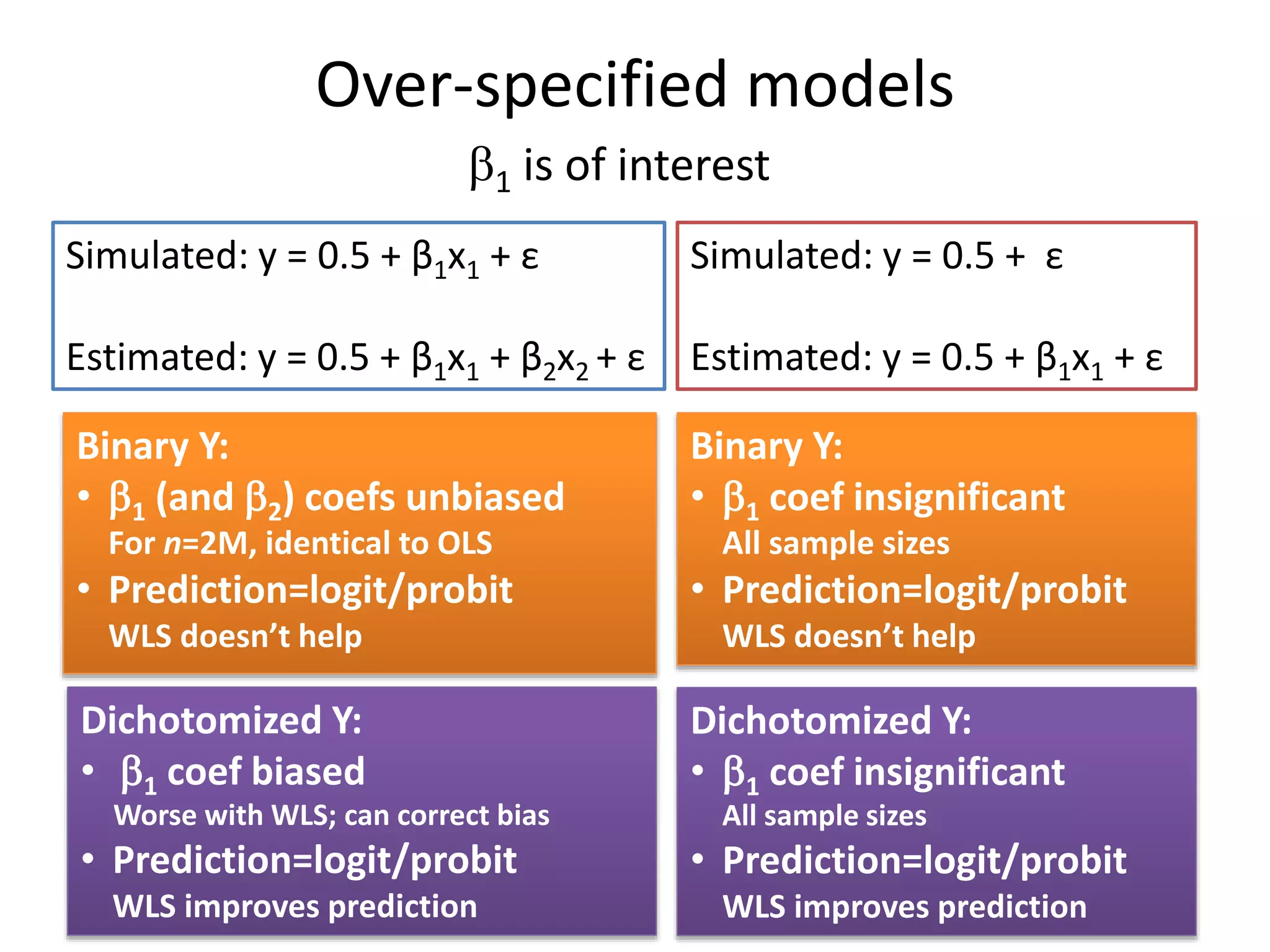
Over-specified models
b1 is of interest
Simulated: y = 0.5 + β1x1 + ε
Estimated: y = 0.5 + β1x1 + β2x2 + ε
Simulated: y = 0.5 + ε
Estimated: y = 0.5 + β1x1 + ε
Binary Y:
• b1 coef insignificant
All sample sizes
• Prediction=logit/probit
WLS doesn’t help
Binary Y:
• b1 (and b2) coefs unbiased
For n=2M, identical to OLS
• Prediction=logit/probit
WLS doesn’t help
Dichotomized Y:
• b1 coef insignificant
All sample sizes
• Prediction=logit/probit
WLS improves prediction
Dichotomized Y:
• b1 coef biased
Worse with WLS; can correct bias
• Prediction=logit/probit
WLS improves prediction
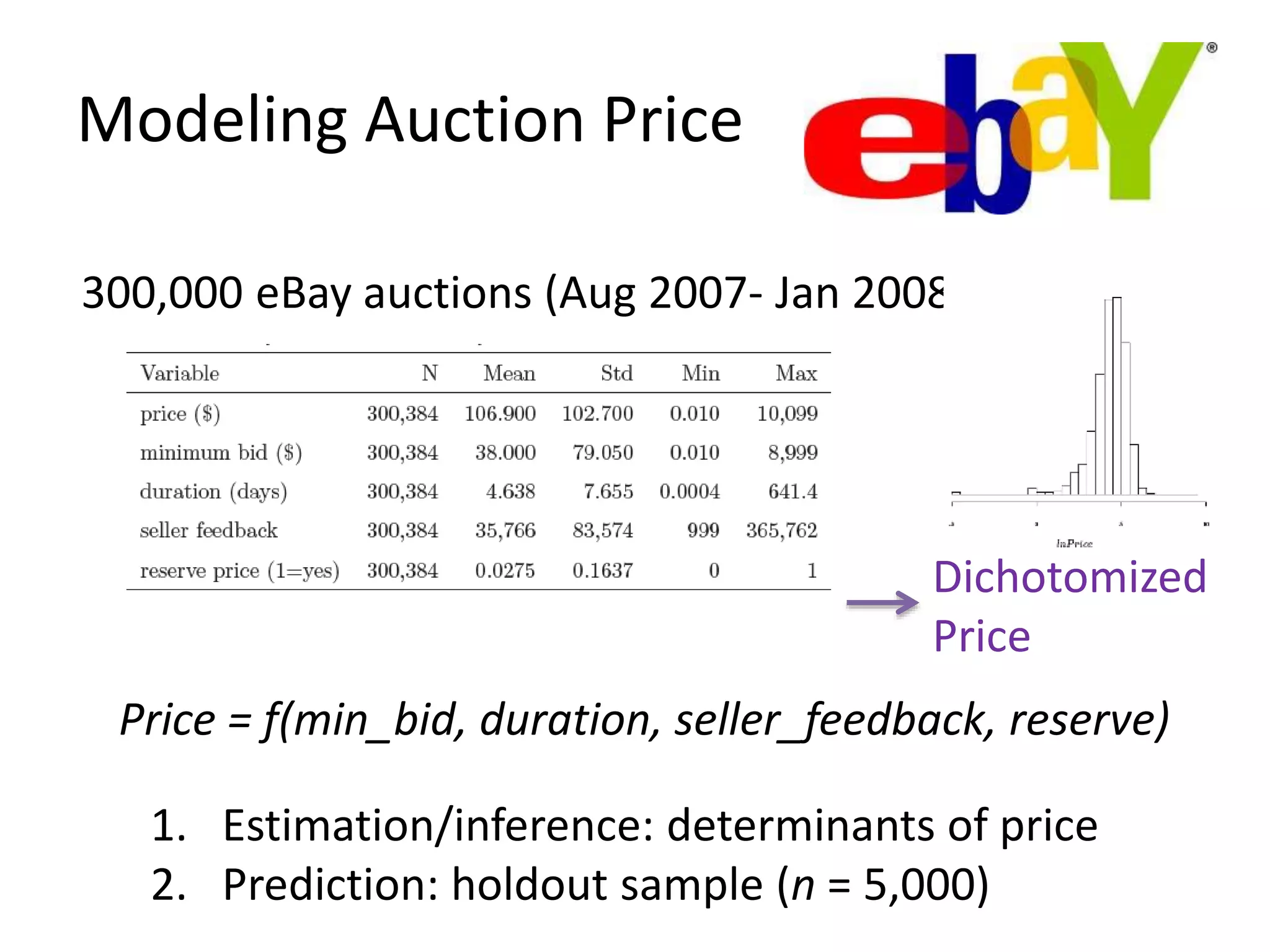
Modeling Auction Price
300,000 eBay auctions (Aug 2007- Jan 2008)
Price = f(min_bid, duration, seller_feedback, reserve)
1. Estimation/inference: determinants of price
2. Prediction: holdout sample (n = 5,000)
Dichotomized
Price
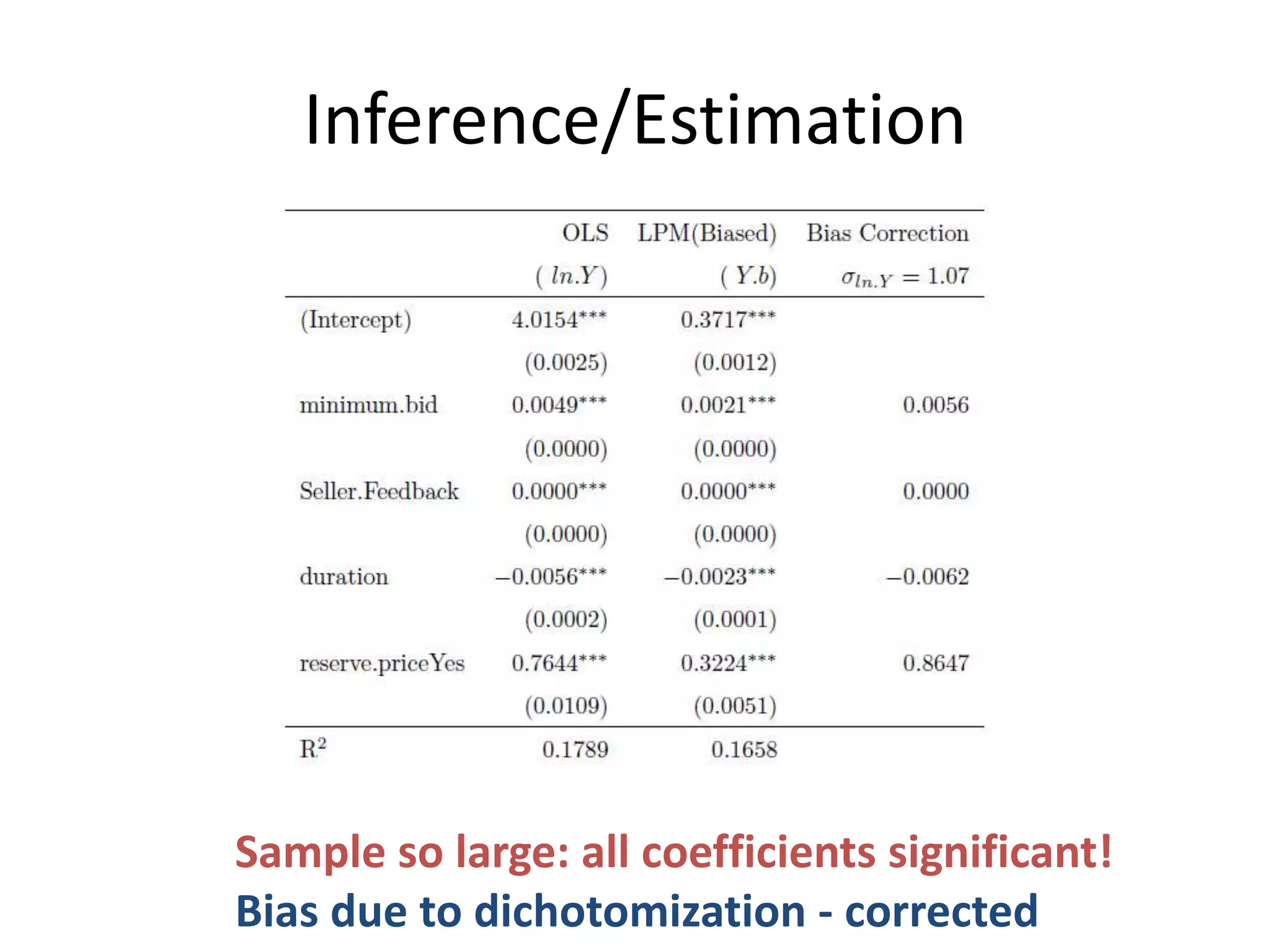
Inference/Estimation
Sample so large: all coefficients significant!
Bias due to dichotomization - corrected
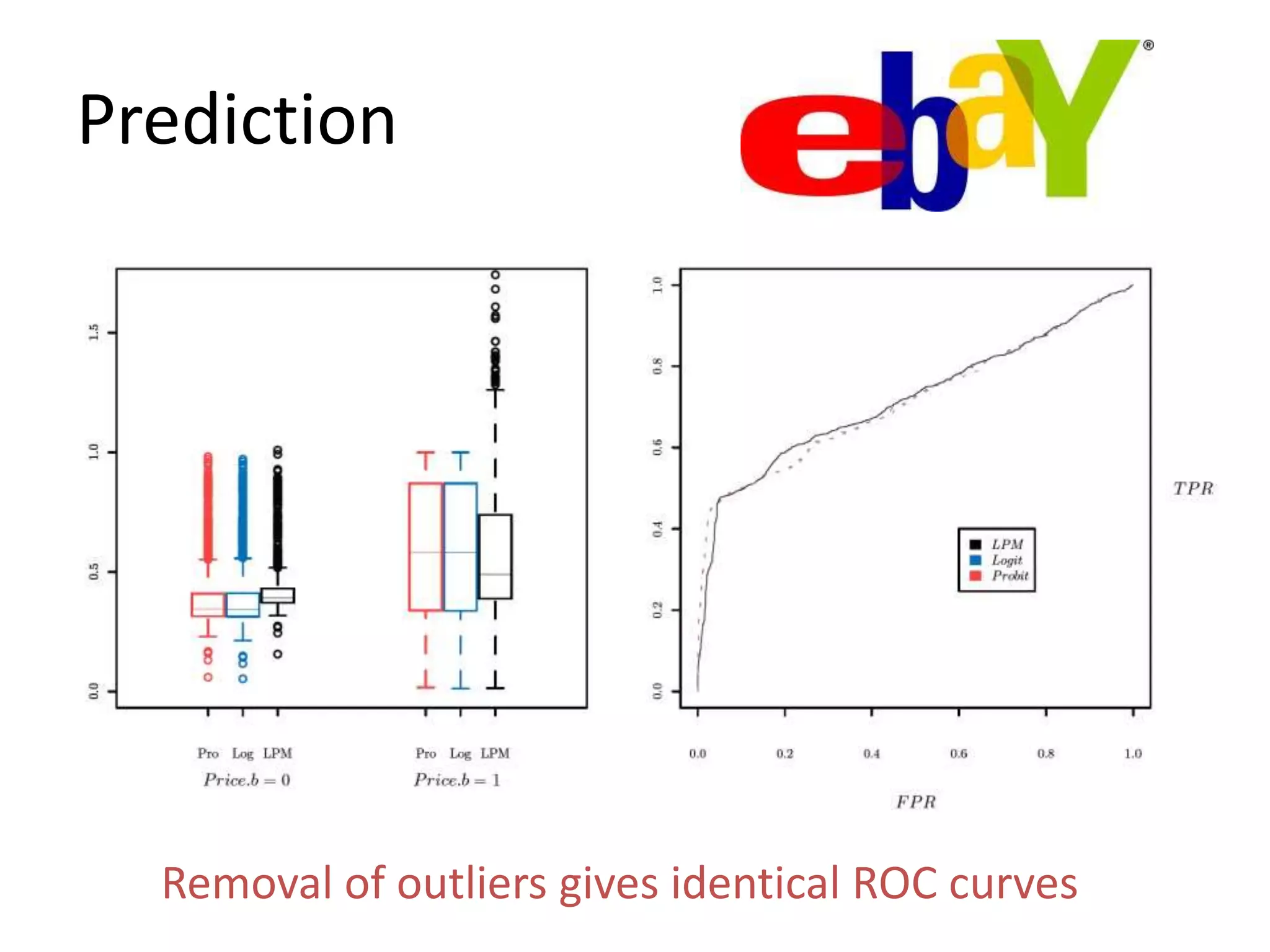
Prediction
Removal of outliers gives identical ROC curves
Study Conclusions
• Explanatory modeling with a binary outcome –
large sample needed to reduce bias.
• Explanatory modeling with dichotomous outcome
requires sy to correct bias.
• Predicting a binary outcome (without WLS) or
dichotomous outcome (with WLS) – sample size
irrelevant
• Robust to over- or under-specified models
LPM is rare in IS
Linear Probability Models and Big Data: Kosher or Not?

Linear Probability Models and Big Data: Kosher or Not?

  • 1.
    Linear Probability Modelsand Big Data Kosher or Not? Galit Shmueli & Suneel Chatla
  • 2.
    Linear Regression onY: Y = b0 +b1 X1+…+bk Xk+ e e ~𝑖𝑖𝑑 N(0,s2) Y={0,1} What is a Linear Probability Model (LPM)? Used for… • Explaining: estimating/testing b • Predicting: class probabilities Popular in some fields but not in Information Systems
  • 3.
    Criticism in theLiterature e ~𝒊𝒊𝒅 N(0,s2) Common advice: use logistic/probit model
  • 4.
    Why do researchersstill use LPM? Compared to logit/probit: • Easy coefficient interpretation • Same statistical significance • Works under quasi/full-separation • Cheap computation Relevant for InferenceRelevant for Prediction LPM is rare in IS
  • 5.
  • 6.
    Our Approach: ExtensiveSimulation Evaluation Explanatory: Estimate b Predictive: Predict new records Big Data Very large sample Many variables Models Correctly specified Over specified Under specified Simulated Data Sample sizes: 50, 500, 2M Signal-to-noise: High, low Outcome Y: Binary, dichotomized Yes/No High/Low
  • 7.
    Study Design Covariates: X ~U(-0.5,0.5) e ~ N(0,s2) Simulation Models: y = 0.5 + β1x1 + ε y = 0.5 + ε y = 0.5 + β1x1 + β2x2 + ε Signal-to-noise: High: s=0.01, β1=1, (β2=0.01) Low: s=0.10, β1=0.10, (β2=0.45) Outcome Origin: Binary: yb ~ Bernoulli (y) Dichotomized: yd = I(y ≥ median(y)) Estimated Models: y = 0.5 + β1x1 + ε y = 0.5 + β1x1 + β2x2 + ε Prediction: n=500 holdout sample Logit and Probit models
  • 8.
    Binary Y High Signal-to-noiseLow Signal-to-noise n=50 n=500 n=2M — True Model --- LPM y=0.5+b1x1+ε --- LPM using WLS Simulated: yb~Bernoulli(0.5+b1x1+e ) Fitted: Correctly-specified model Goal: Estimate slope (b1) Binary Y: With large sample, LPM is fine for estimation 𝐸 𝛽 𝑏 = 𝛽 + 𝑋′ 𝑋 𝑛 −1 𝑋′ 𝜀 𝑛 𝑛→∞ 𝜷 Even with low signal
  • 9.
    High Signal-to-noise LowSignal-to-noise n=50 n=500 n=2M Y=0 Y=0Y=1 Y=1 Binary Y: LPM predictive power same as logit/probit; depends on signal (not n) Binary Y Goal: Predict 500 new records Logit Probit LPM LPM using WLS
  • 10.
    Dichotomized Y High Signal-to-noiseLow Signal-to-noise n=50 n=500 n=2M — OLS (numerical Y) --- LPM (yd) --- LPM using WLS Dichotomized Y: LPM gives biased coefs 𝛽 𝑑 = 1 2𝜋𝜎 𝑦 𝛽 WLS makes it worse Can correct bias if sy can be estimated Simulated: y=0.5+b1x1+e , yd=I(y>med) Fitted: Correctly-specified model Goal: Estimate slope (b1)
  • 11.
    Dichotomized Y High Signal-to-noiseLow Signal-to-noise n=50 n=500 n=2M Logit Probit LPM LPM+WLS Y=0 Y=0Y=1 Y=1 Dichotomized Y: LPM predictive power similar to logit/probit; depends on signal (not n) LPM+WLS is best Goal: Predict 500 new records
  • 12.
    Dichotomized Y: • LPMgives biased coefficients WLS makes it worse Can correct bias with estimate of sy • Predictive power similar to logit/probit; depends on signal (not n) WLS improves predictive power Quick Summary: Correctly specified model Binary Y: • With large n, LPM is fine for estimation Even with low signal • LPM predictive power same as logit/probit; depends on signal (not n)
  • 13.
    Over-specified models b1 isof interest Simulated: y = 0.5 + β1x1 + ε Estimated: y = 0.5 + β1x1 + β2x2 + ε Simulated: y = 0.5 + ε Estimated: y = 0.5 + β1x1 + ε Binary Y: • b1 coef insignificant All sample sizes • Prediction=logit/probit WLS doesn’t help Binary Y: • b1 (and b2) coefs unbiased For n=2M, identical to OLS • Prediction=logit/probit WLS doesn’t help Dichotomized Y: • b1 coef insignificant All sample sizes • Prediction=logit/probit WLS improves prediction Dichotomized Y: • b1 coef biased Worse with WLS; can correct bias • Prediction=logit/probit WLS improves prediction
  • 14.
    Modeling Auction Price 300,000eBay auctions (Aug 2007- Jan 2008) Price = f(min_bid, duration, seller_feedback, reserve) 1. Estimation/inference: determinants of price 2. Prediction: holdout sample (n = 5,000) Dichotomized Price
  • 15.
    Inference/Estimation Sample so large:all coefficients significant! Bias due to dichotomization - corrected
  • 16.
    Prediction Removal of outliersgives identical ROC curves
  • 17.
    Study Conclusions • Explanatorymodeling with a binary outcome – large sample needed to reduce bias. • Explanatory modeling with dichotomous outcome requires sy to correct bias. • Predicting a binary outcome (without WLS) or dichotomous outcome (with WLS) – sample size irrelevant • Robust to over- or under-specified models LPM is rare in IS