Steve Souders [email_address] http://stevesouders.com/docs/web20expo-20090402.ppt Even Faster Web Sites Disclaimer:  This content does not necessarily reflect the opinions of my employer. Flushing the Document Early Simplifying CSS Selectors Avoiding @import
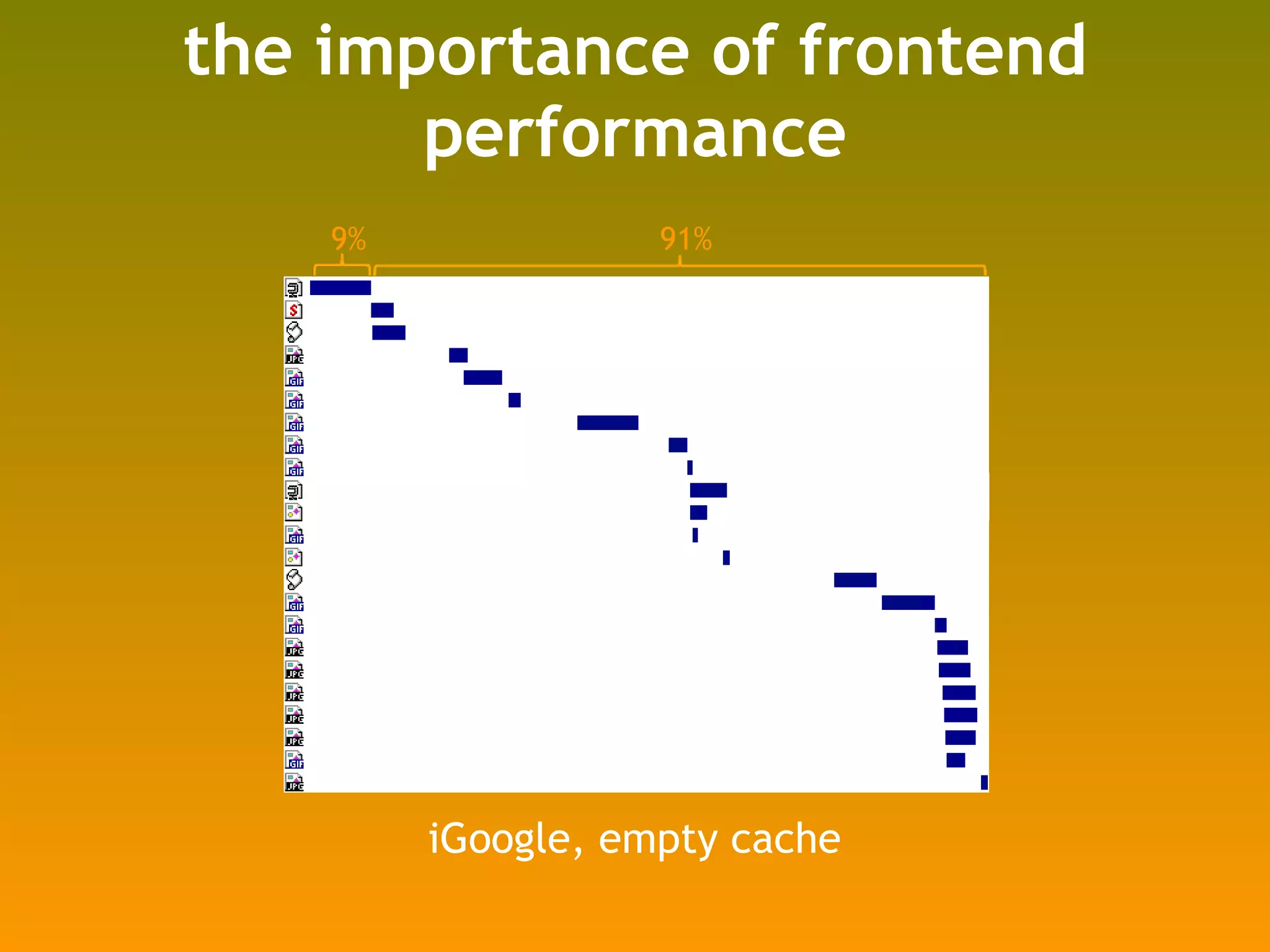
the importance of frontend performance 17% 83% iGoogle, primed cache 9% 91% iGoogle, empty cache
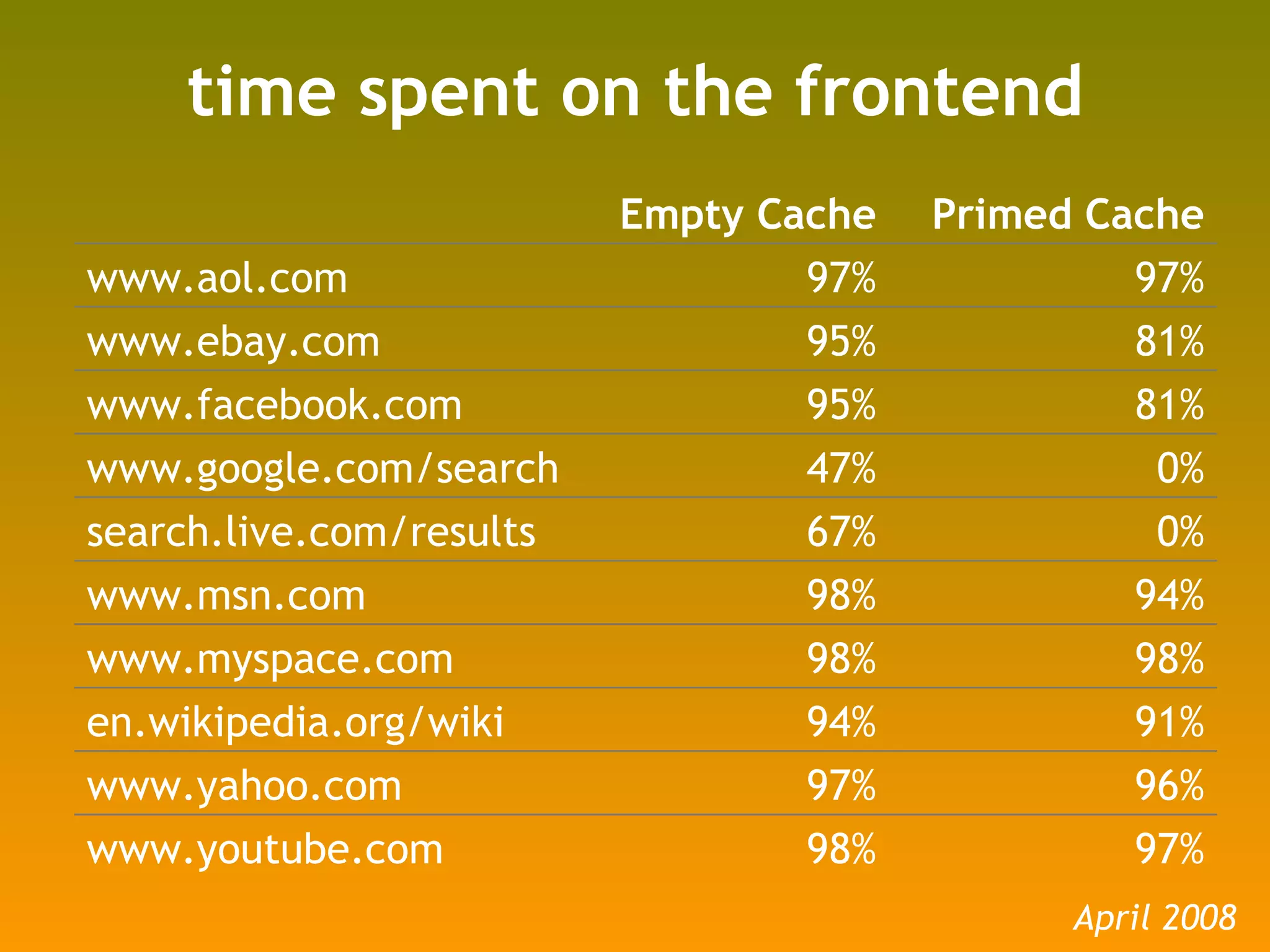
time spent on the frontend April 2008 Empty Cache Primed Cache www.aol.com 97% 97% www.ebay.com 95% 81% www.facebook.com 95% 81% www.google.com/search 47% 0% search.live.com/results 67% 0% www.msn.com 98% 94% www.myspace.com 98% 98% en.wikipedia.org/wiki 94% 91% www.yahoo.com 97% 96% www.youtube.com 98% 97%
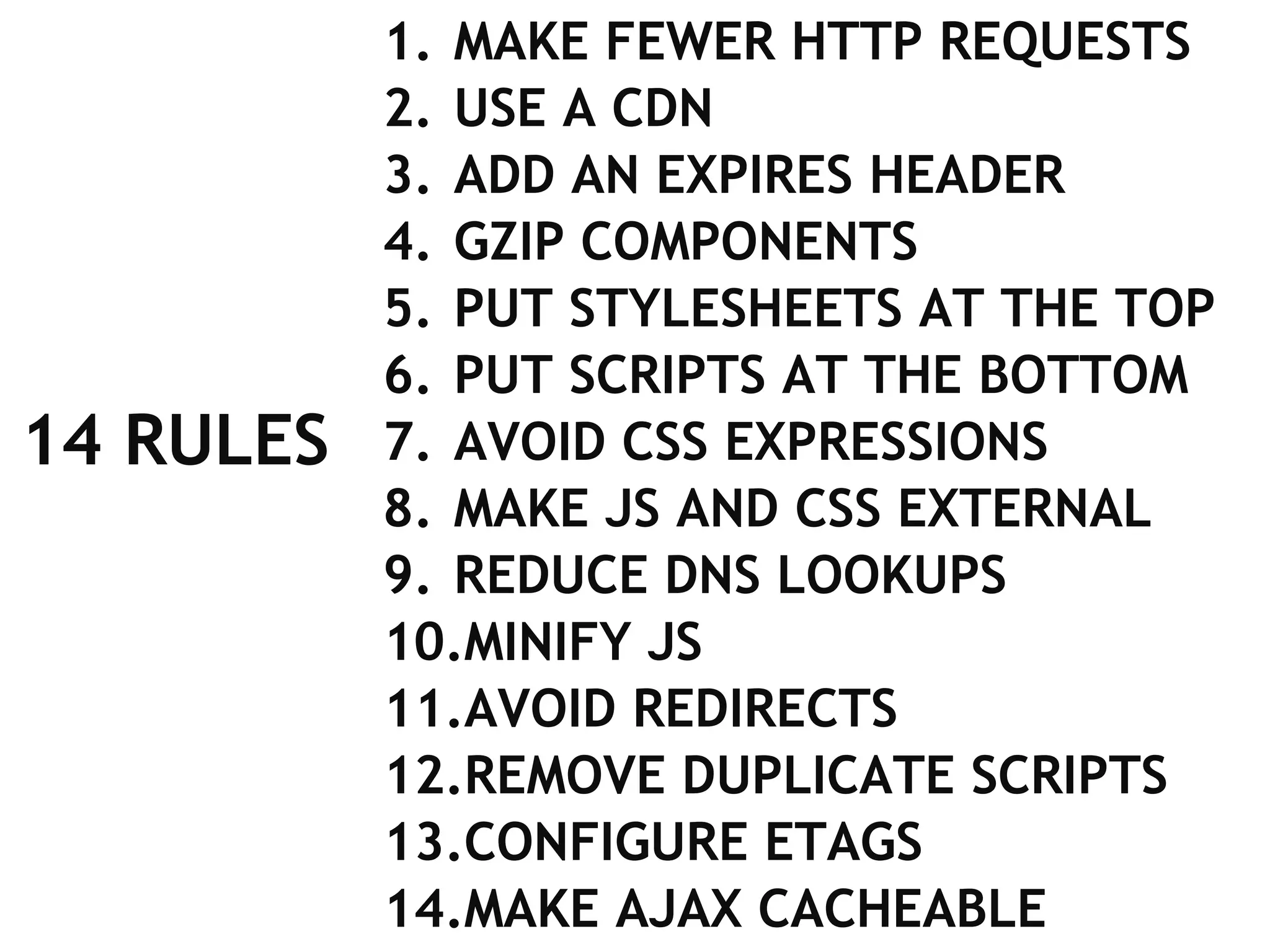
14 RULES MAKE FEWER HTTP REQUESTS USE A CDN ADD AN EXPIRES HEADER GZIP COMPONENTS PUT STYLESHEETS AT THE TOP PUT SCRIPTS AT THE BOTTOM AVOID CSS EXPRESSIONS MAKE JS AND CSS EXTERNAL REDUCE DNS LOOKUPS MINIFY JS AVOID REDIRECTS REMOVE DUPLICATE SCRIPTS CONFIGURE ETAGS MAKE AJAX CACHEABLE


Sept 2007
June 2009
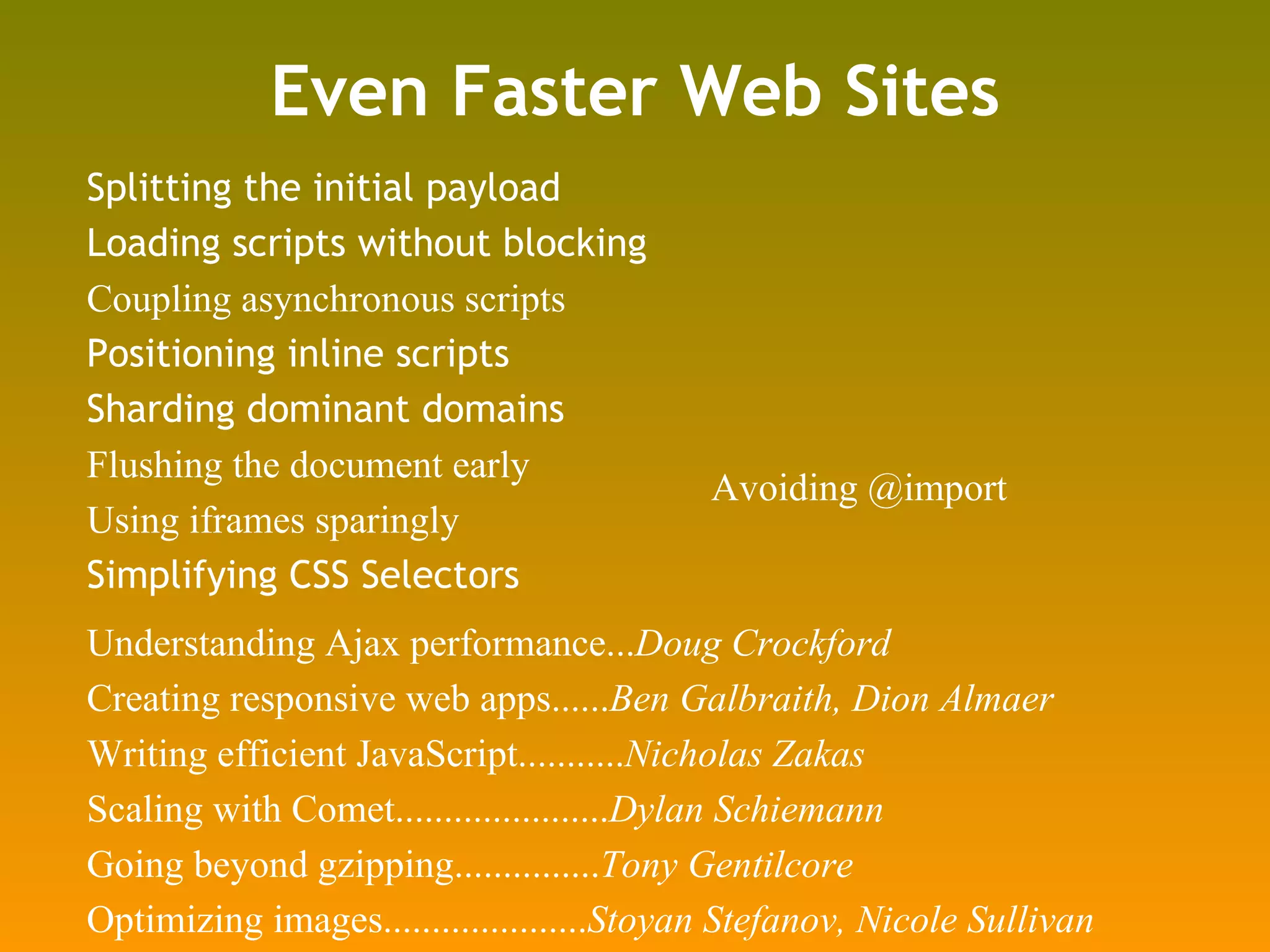
Even Faster Web Sites Splitting the initial payload Loading scripts without blocking Coupling asynchronous scripts Positioning inline scripts Sharding dominant domains Flushing the document early Using iframes sparingly Simplifying CSS Selectors Understanding Ajax performance... Doug Crockford Creating responsive web apps...... Ben Galbraith, Dion Almaer Writing efficient JavaScript........... Nicholas Zakas Scaling with Comet...................... Dylan Schiemann Going beyond gzipping............... Tony Gentilcore Optimizing images..................... Stoyan Stefanov, Nicole Sullivan Avoiding @import
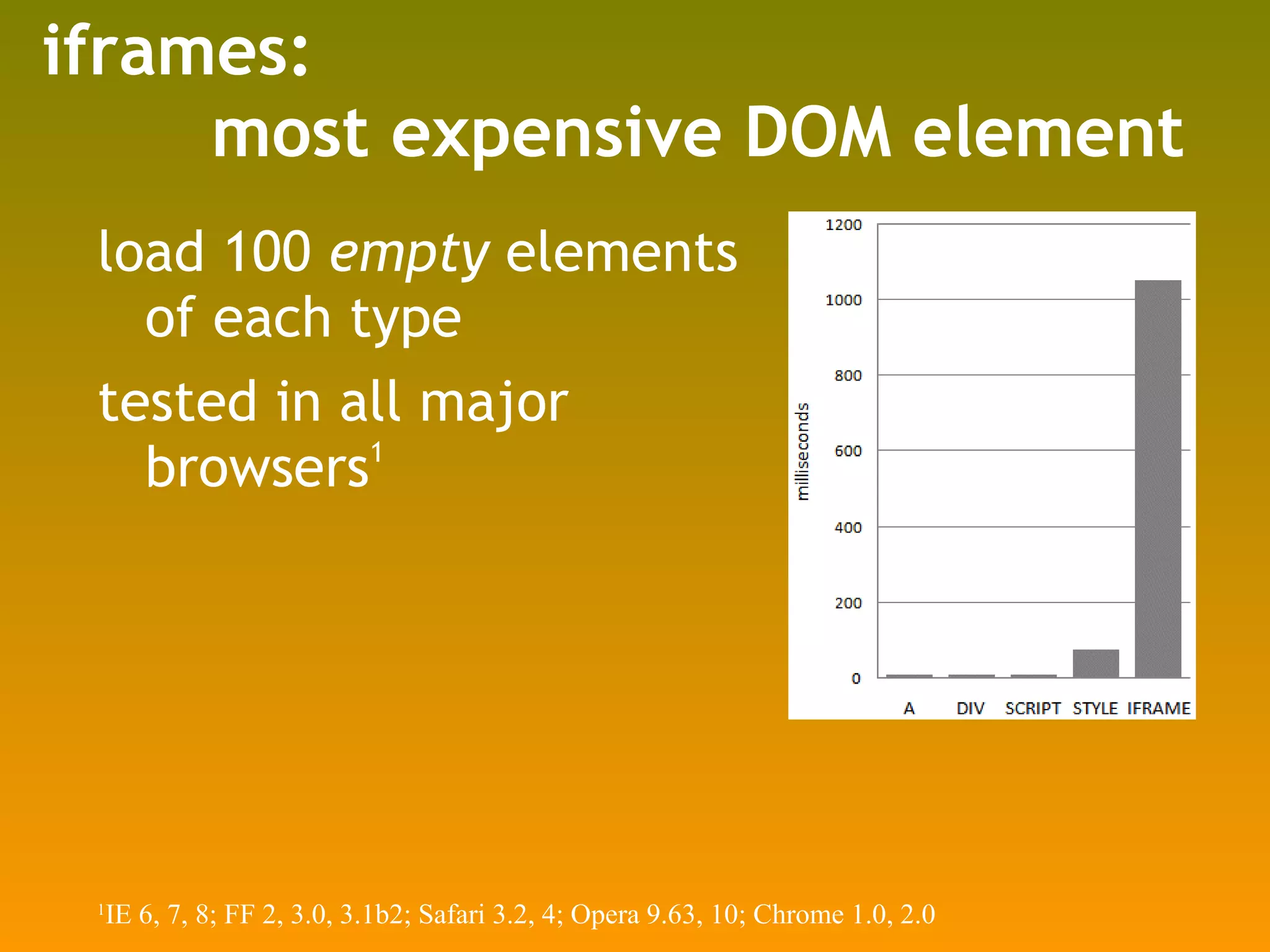
iframes:    most expensive DOM element load 100  empty  elements of each type tested in all major browsers 1 1 IE 6, 7, 8; FF 2, 3.0, 3.1b2; Safari 3.2, 4; Opera 9.63, 10; Chrome 1.0, 2.0
iframes block onload parent's onload doesn't fire until iframe and all its components are downloaded workaround for Safari and Chrome: set iframe src in JavaScript <iframe id=iframe1 src=&quot;&quot;></iframe> <script type=&quot;text/javascript&quot;> document.getElementById('iframe1').src=&quot; url &quot;; </script>
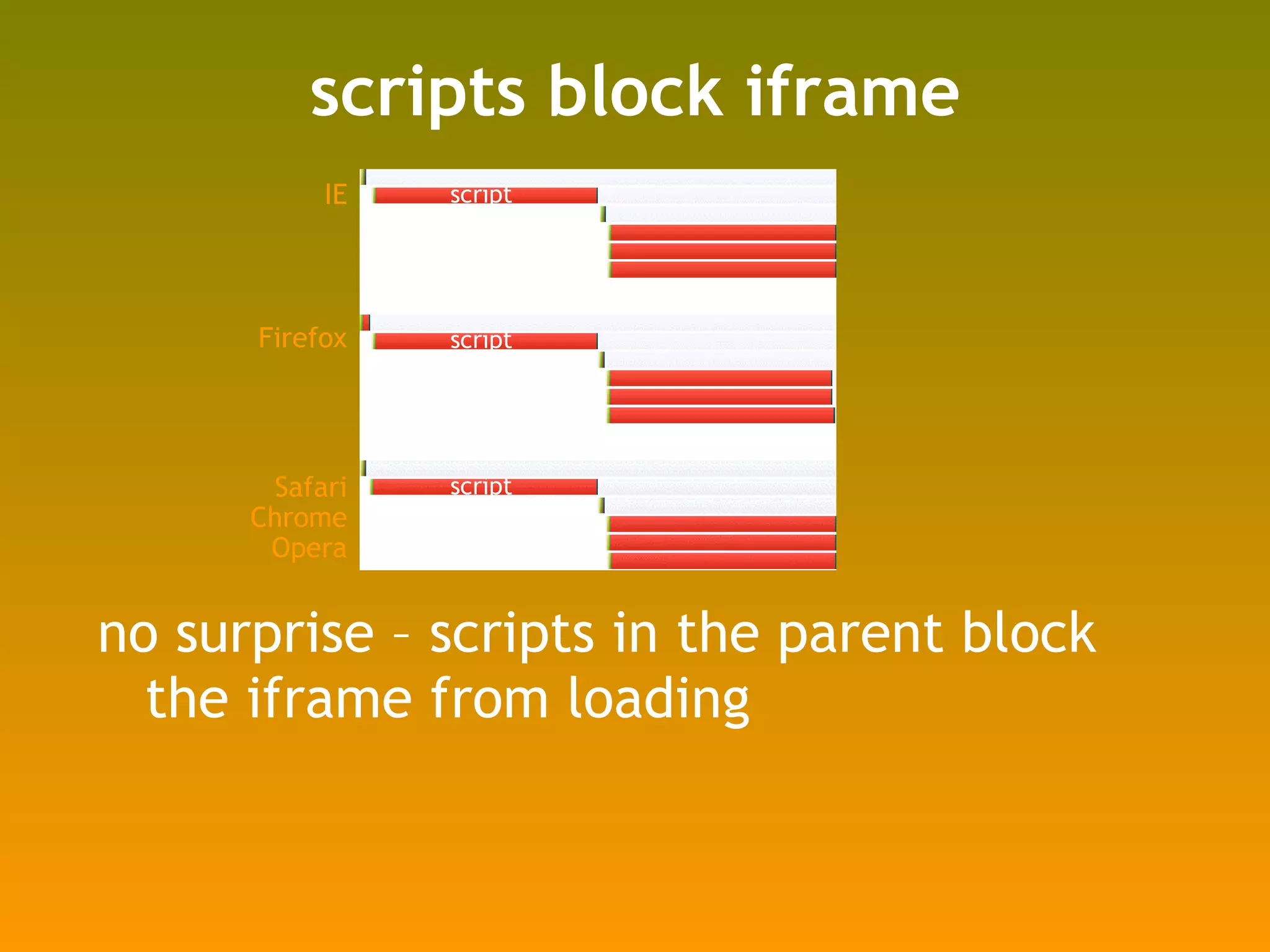
scripts block iframe no surprise – scripts in the parent block the iframe from loading IE Firefox Safari Chrome Opera script script script
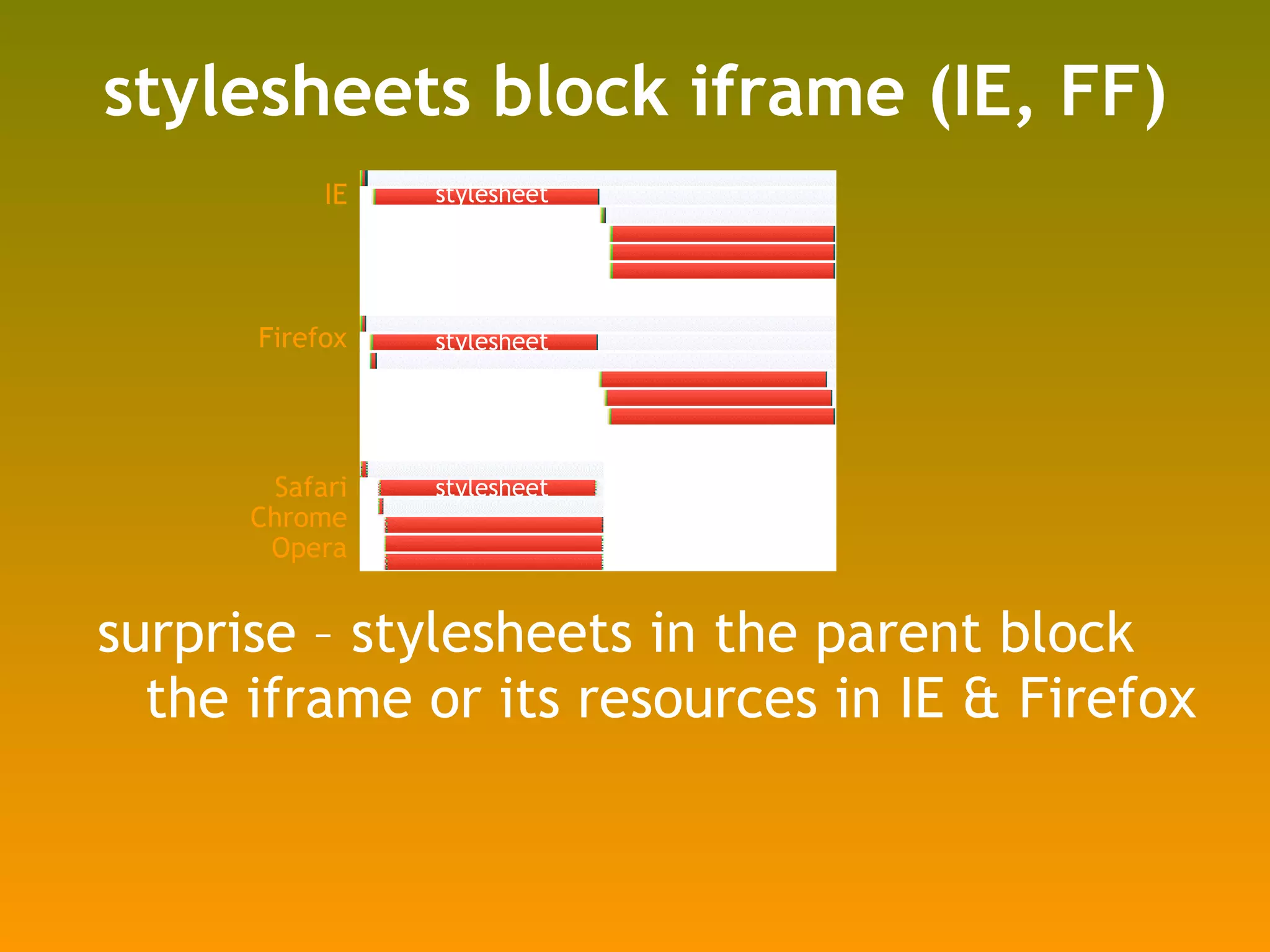
stylesheets block iframe (IE, FF) surprise – stylesheets in the parent block the iframe or its resources in IE & Firefox IE Firefox Safari Chrome Opera stylesheet stylesheet stylesheet
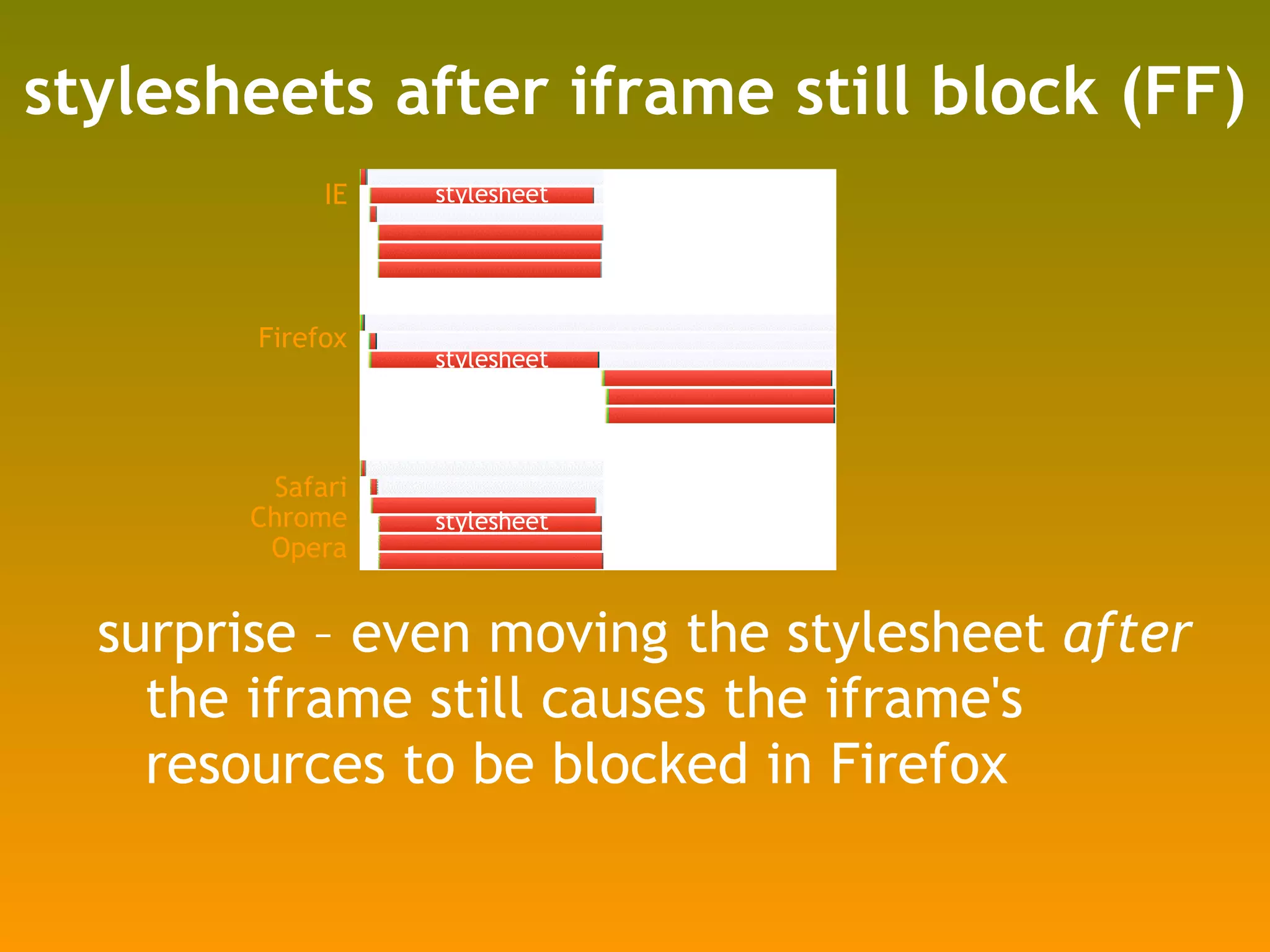
stylesheets after iframe still block (FF) surprise – even moving the stylesheet  after  the iframe still causes the iframe's resources to be blocked in Firefox IE Firefox Safari Chrome Opera stylesheet stylesheet stylesheet
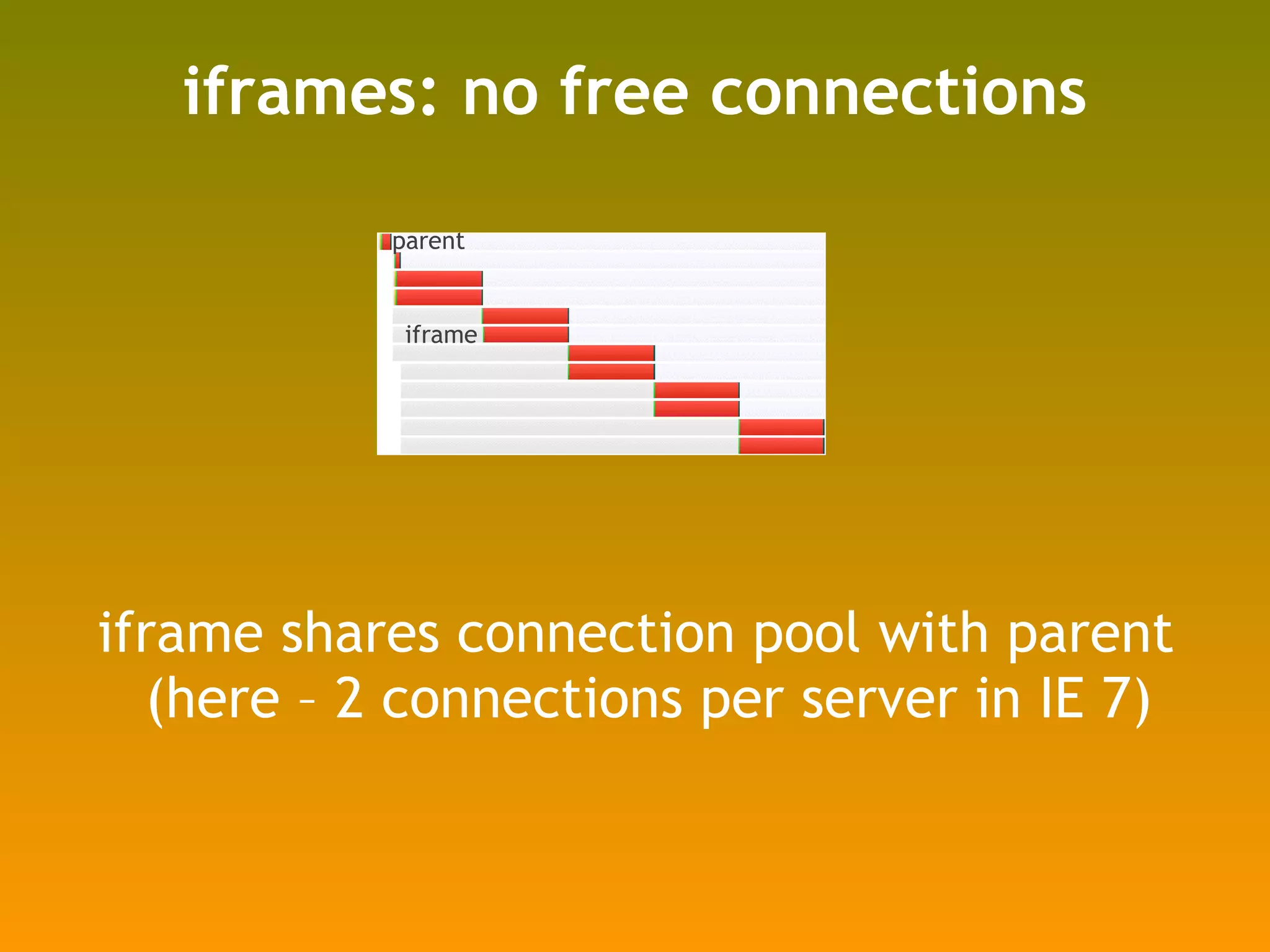
iframes: no free connections iframe shares connection pool with parent (here – 2 connections per server in IE 7) iframe parent
flushing the document early gotchas: PHP output_buffering –  ob_flush() Transfer-Encoding: chunked gzip – Apache's DeflateBufferSize before 2.2.8 proxies and anti-virus software browsers – Safari (1K), Chrome (2K) other languages:  $|  or  FileHandle autoflush  (Perl),  flush  (Python),  ios.flush  (Ruby) call PHP's  flush() html image image script html image image script
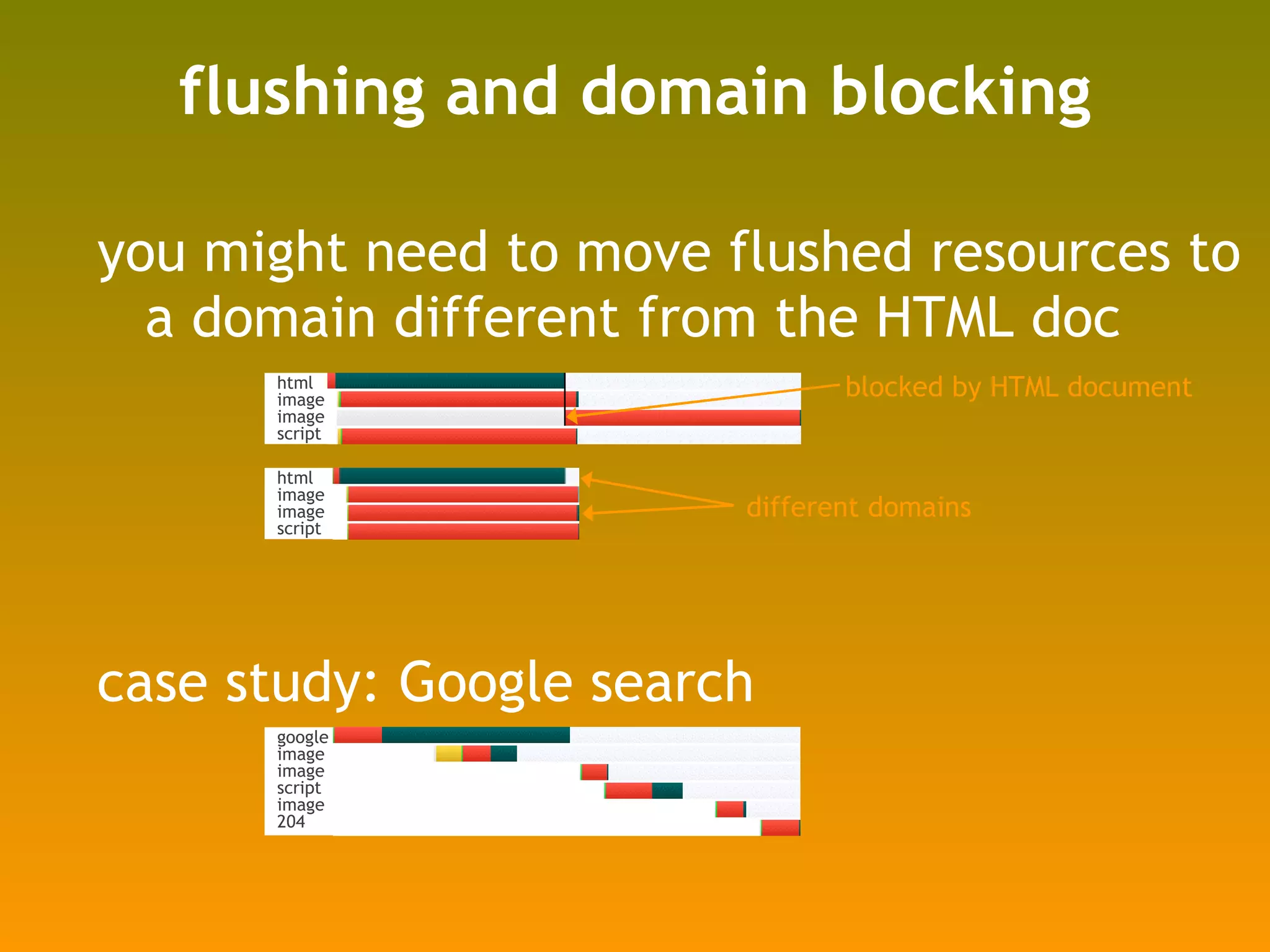
flushing and domain blocking you might need to move flushed resources to a domain different from the HTML doc case study: Google search blocked by HTML document different domains html image image script html image image script google image image script image 204
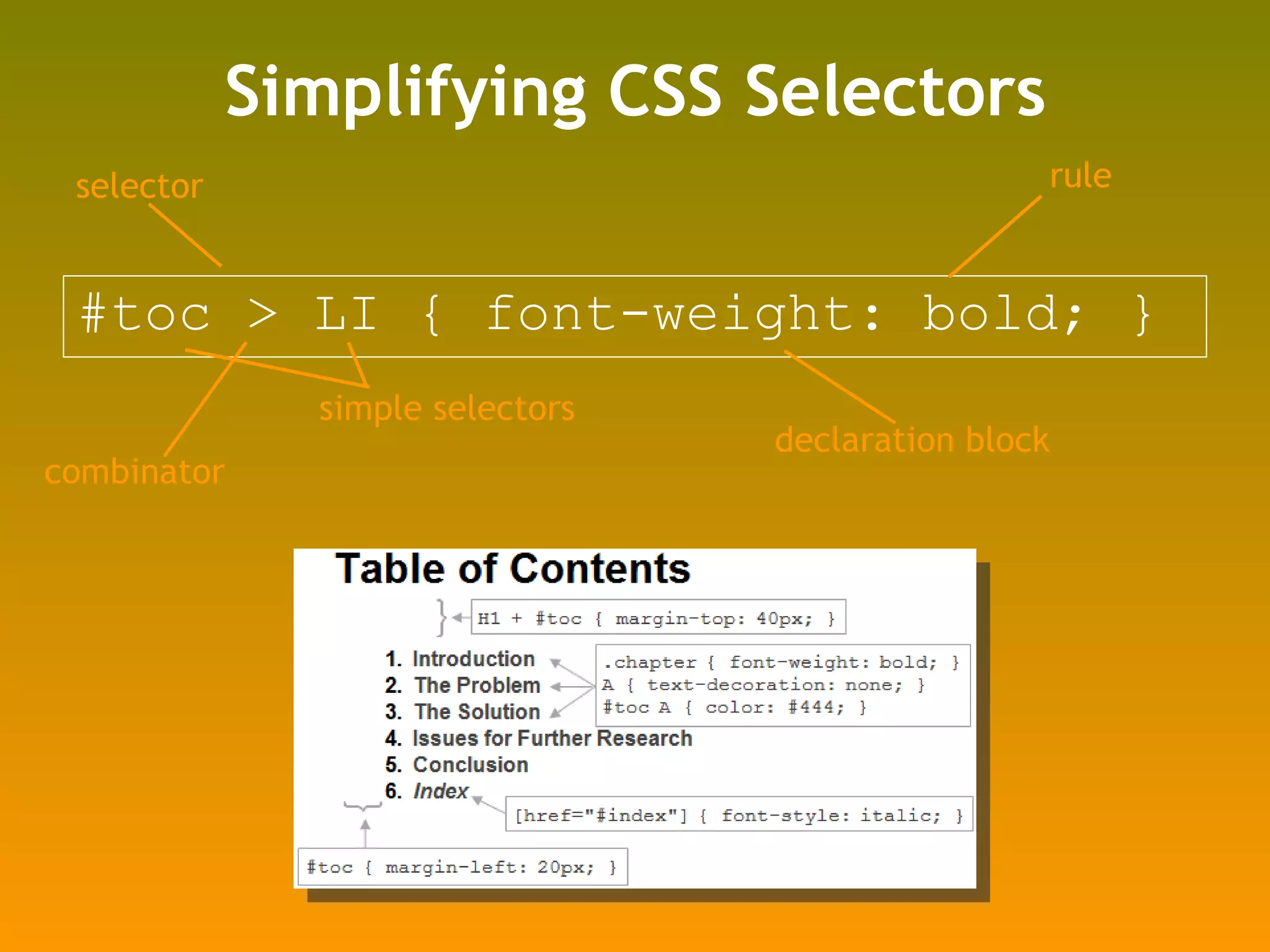
Simplifying CSS Selectors #toc > LI { font-weight: bold; } combinator simple selectors selector declaration block rule
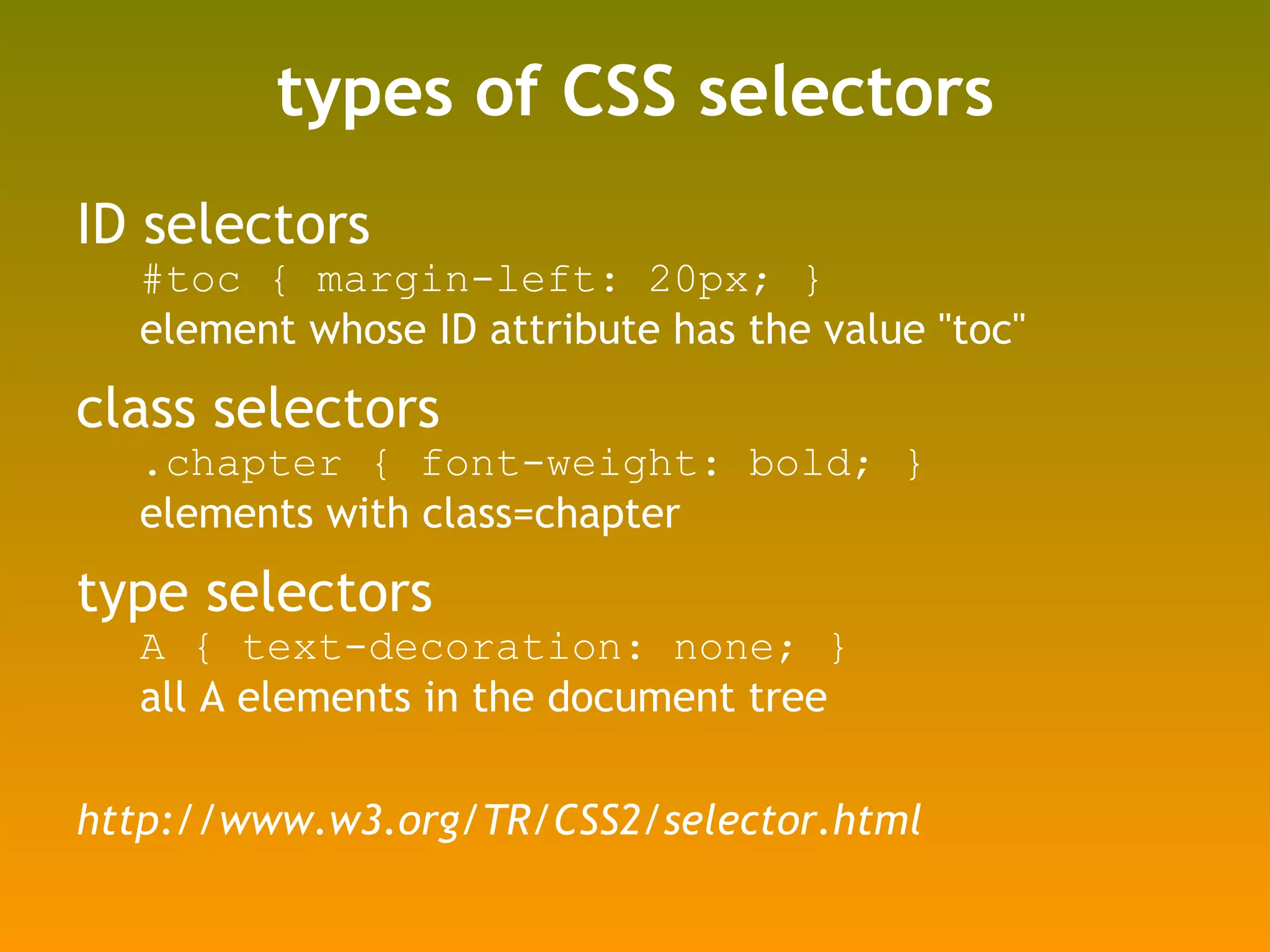
types of CSS selectors ID selectors #toc { margin-left: 20px; }  element whose ID attribute has the value &quot;toc&quot; class selectors .chapter { font-weight: bold; } elements with class=chapter type selectors A { text-decoration: none; } all A elements in the document tree http://www.w3.org/TR/CSS2/selector.html
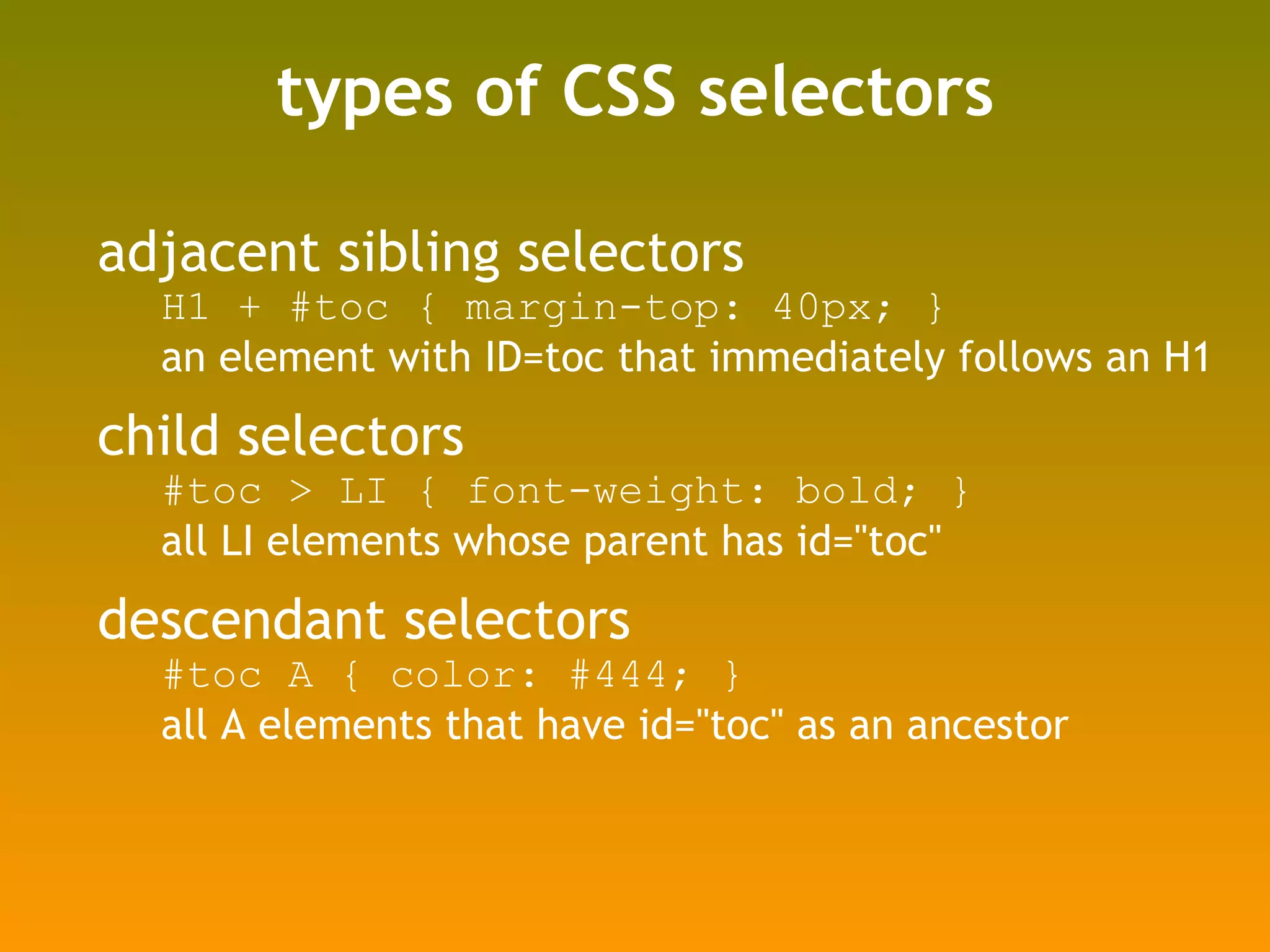
types of CSS selectors adjacent sibling selectors H1 + #toc { margin-top: 40px; }  an element with ID=toc that immediately follows an H1 child selectors #toc > LI { font-weight: bold; } all LI elements whose parent has id=&quot;toc&quot; descendant selectors #toc A { color: #444; } all A elements that have id=&quot;toc&quot; as an ancestor
types of CSS selectors universal selectors * { font-family: Arial; } all elements attribute selectors [href=&quot;#index&quot;] { font-style: italic; } all elements where the href attribute is &quot;#index&quot; psuedo classes and elements A:hover { text-decoration: underline; } non-DOM behavior others:  :visited ,  :link ,  :active ,  :focus ,  :first-child ,  :before ,  :after
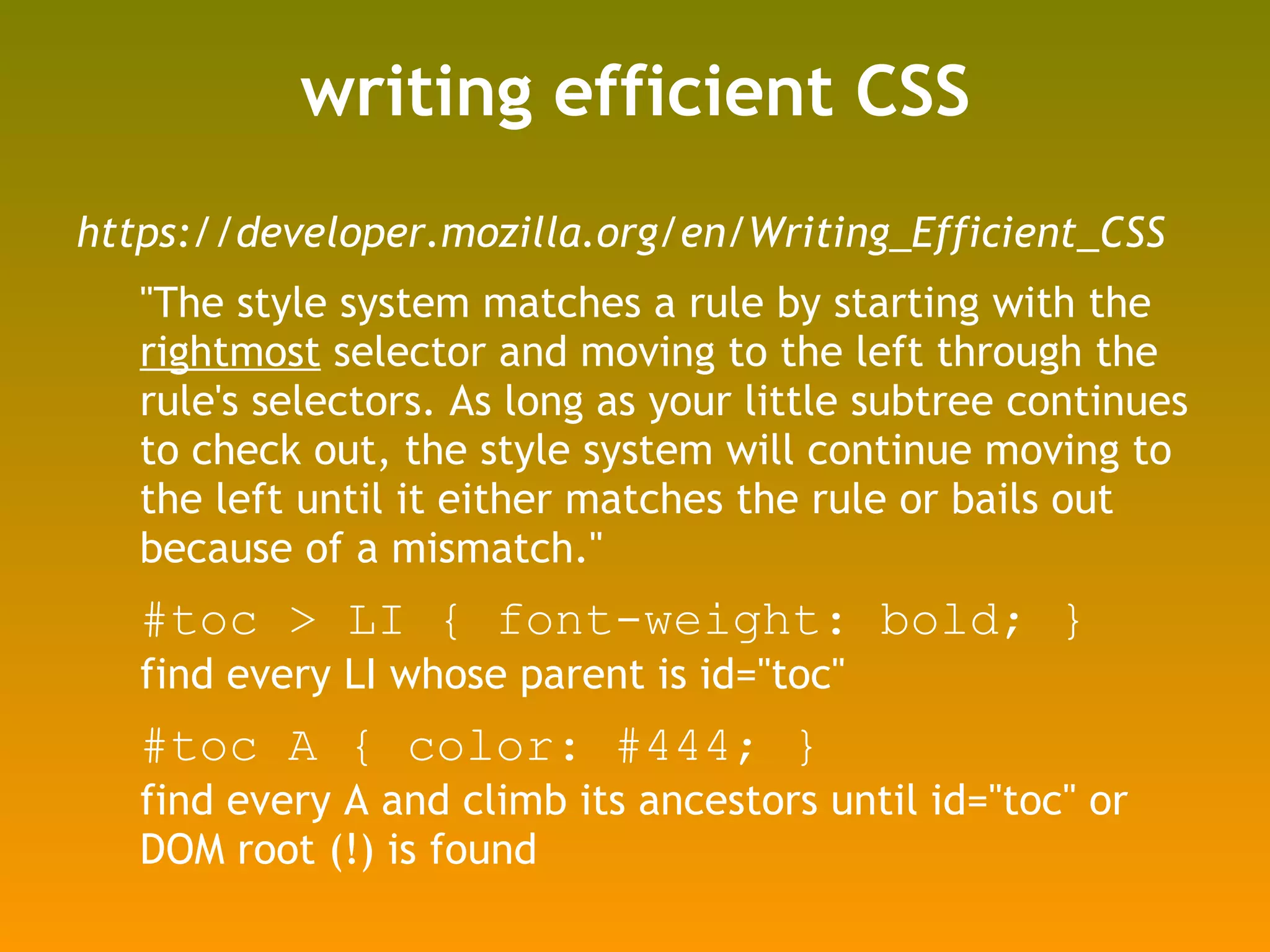
writing efficient CSS https://developer.mozilla.org/en/Writing_Efficient_CSS &quot;The style system matches a rule by starting with the  rightmost  selector and moving to the left through the rule's selectors. As long as your little subtree continues to check out, the style system will continue moving to the left until it either matches the rule or bails out because of a mismatch.&quot; #toc > LI { font-weight: bold; } find every LI whose parent is id=&quot;toc&quot; #toc A { color: #444; } find every A and climb its ancestors until id=&quot;toc&quot; or DOM root (!) is found
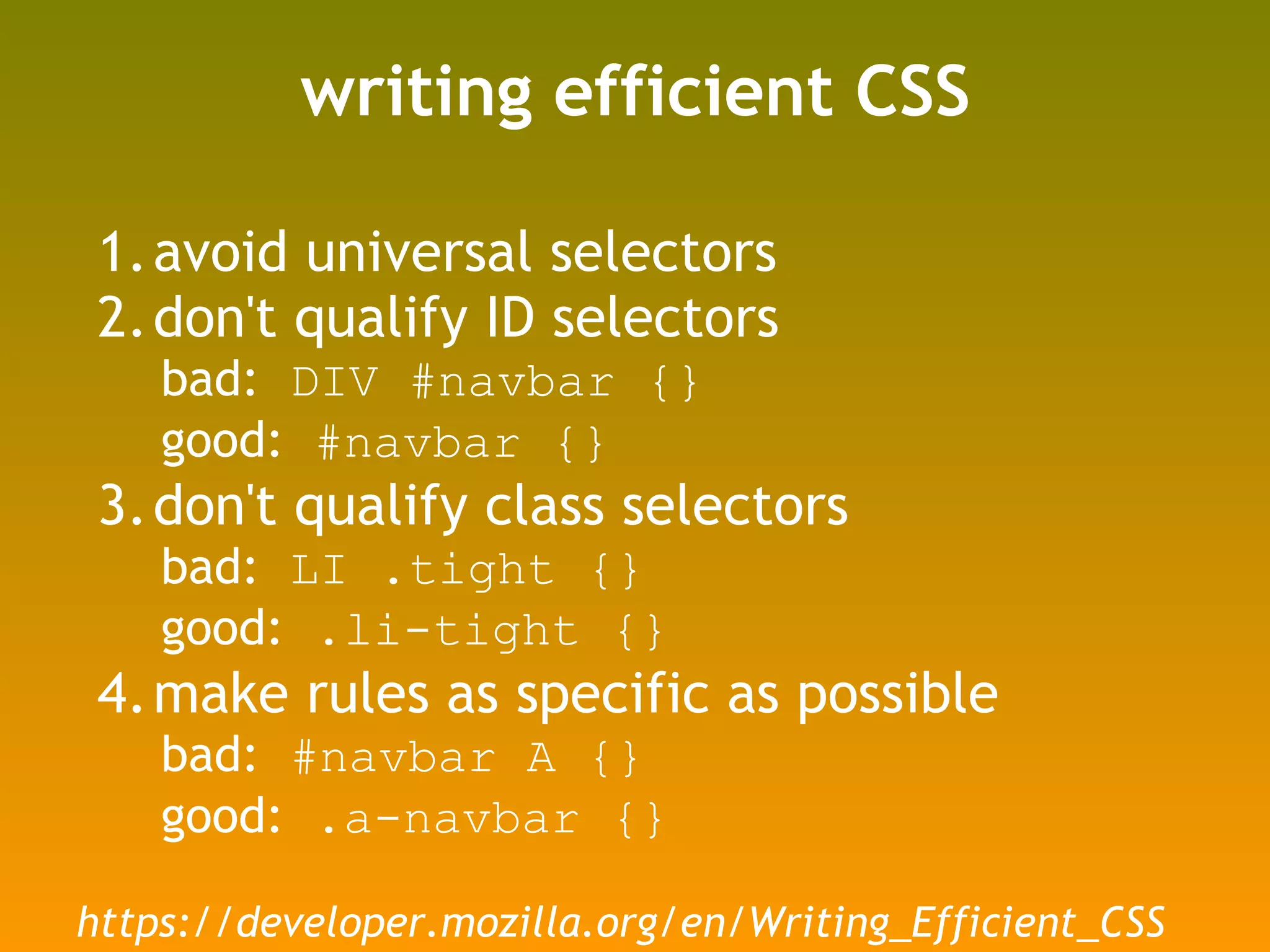
writing efficient CSS avoid universal selectors don't qualify ID selectors bad:  DIV #navbar {} good:  #navbar {} don't qualify class selectors bad:  LI .tight {} good:  .li-tight {} make rules as specific as possible bad:  #navbar A {} good:  .a-navbar {} https://developer.mozilla.org/en/Writing_Efficient_CSS
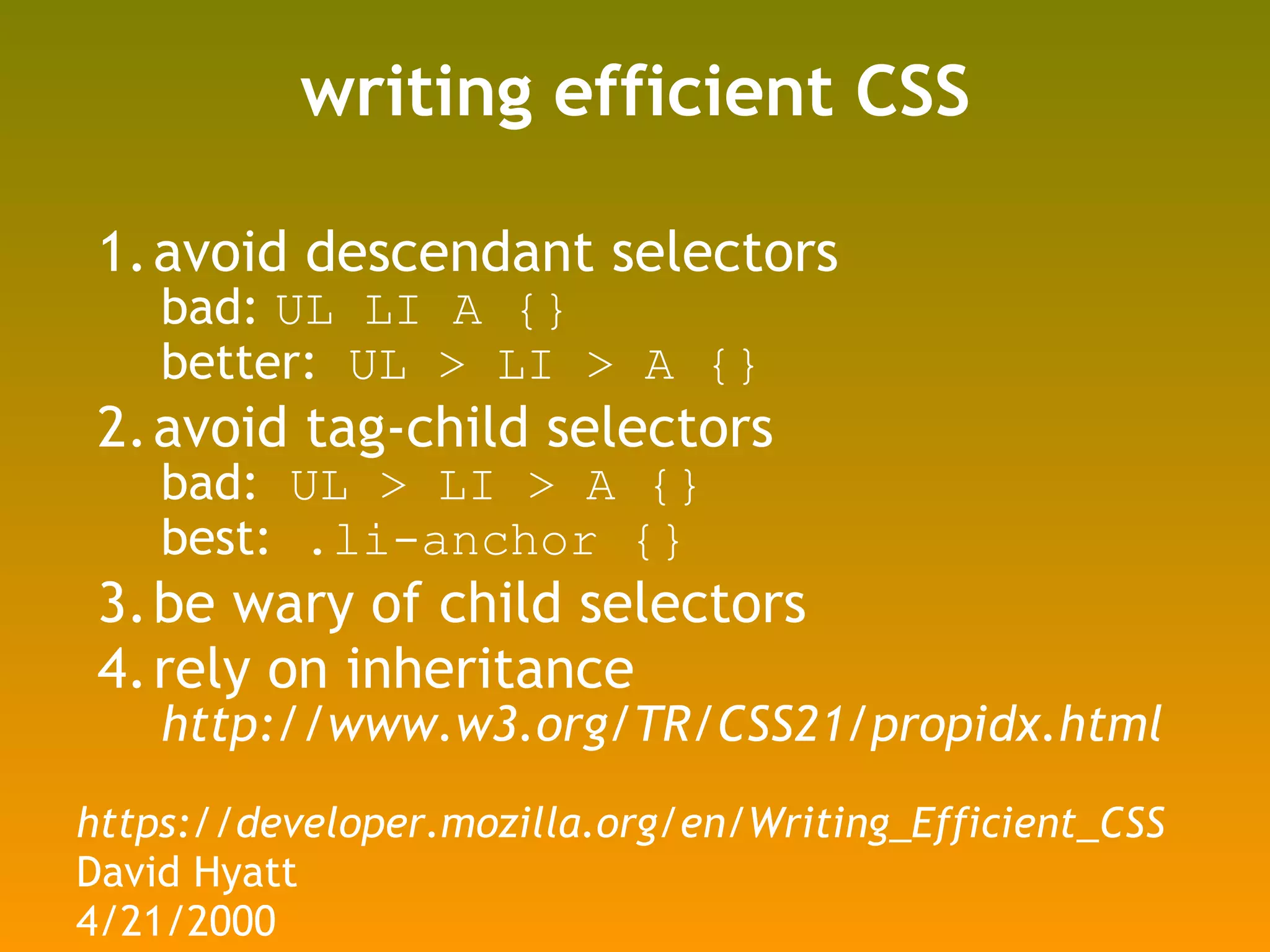
writing efficient CSS avoid descendant selectors bad:  UL LI A {} better:  UL > LI > A {} avoid tag-child selectors bad:  UL > LI > A {} best:  .li-anchor {} be wary of child selectors rely on inheritance http://www.w3.org/TR/CSS21/propidx.html https://developer.mozilla.org/en/Writing_Efficient_CSS David Hyatt 4/21/2000
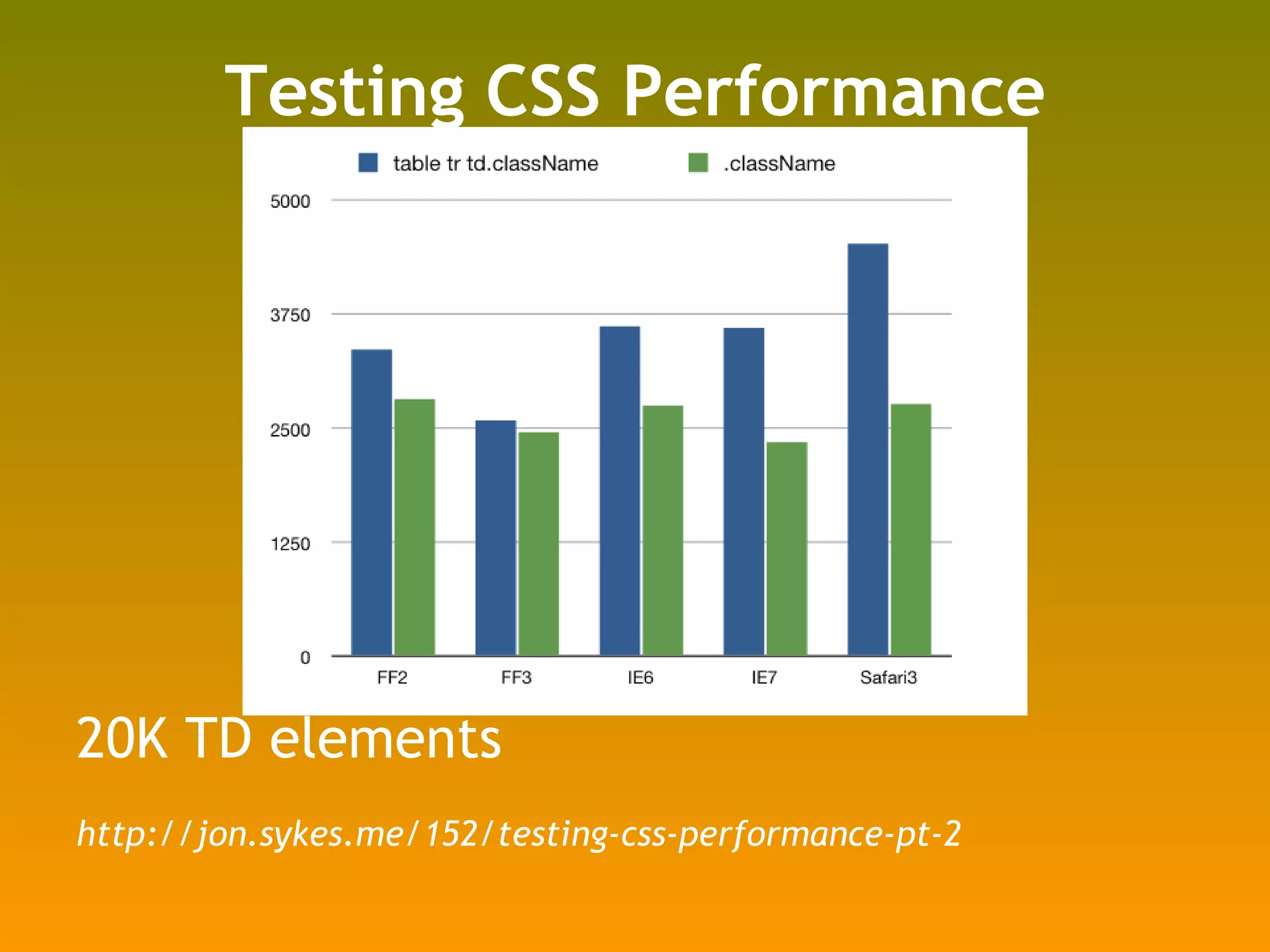
Testing CSS Performance 20K TD elements http://jon.sykes.me/152/testing-css-performance-pt-2
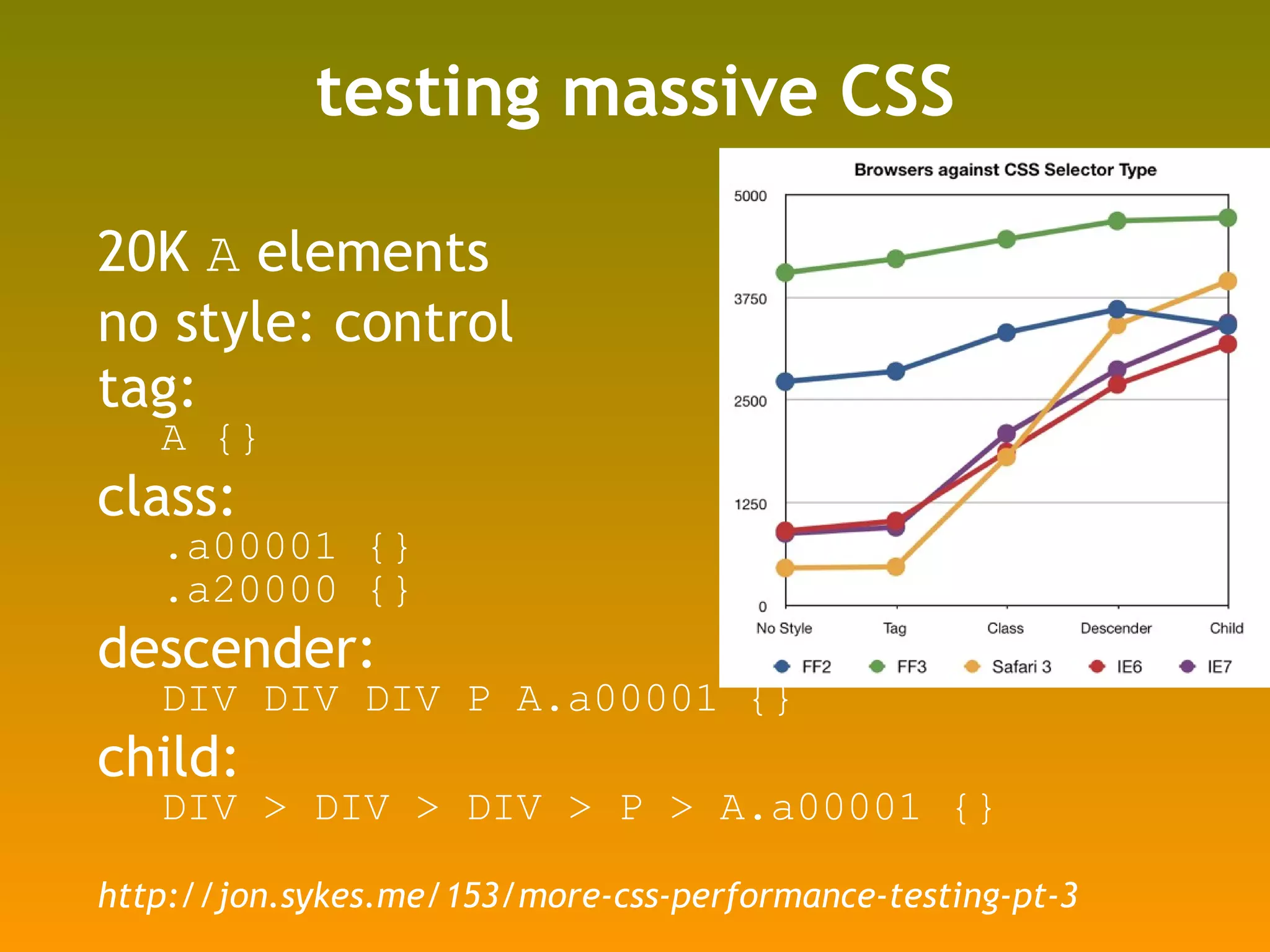
testing massive CSS 20K  A  elements no style: control tag:  A {} class:  .a00001 {} .a20000 {} descender:  DIV DIV DIV P A.a00001 {} child:  DIV > DIV > DIV > P > A.a00001 {} http://jon.sykes.me/153/more-css-performance-testing-pt-3
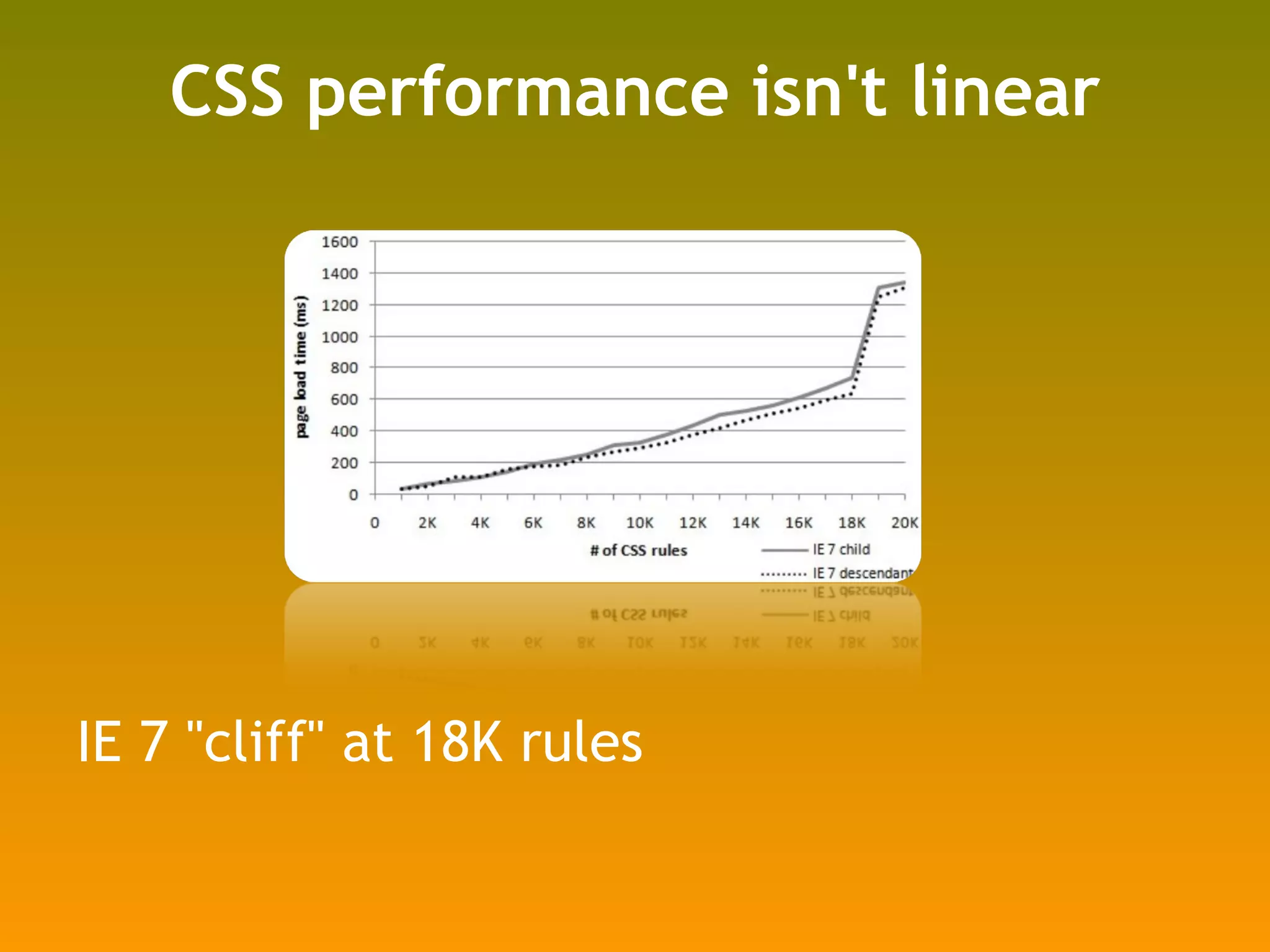
CSS performance isn't linear IE 7 &quot;cliff&quot; at 18K rules
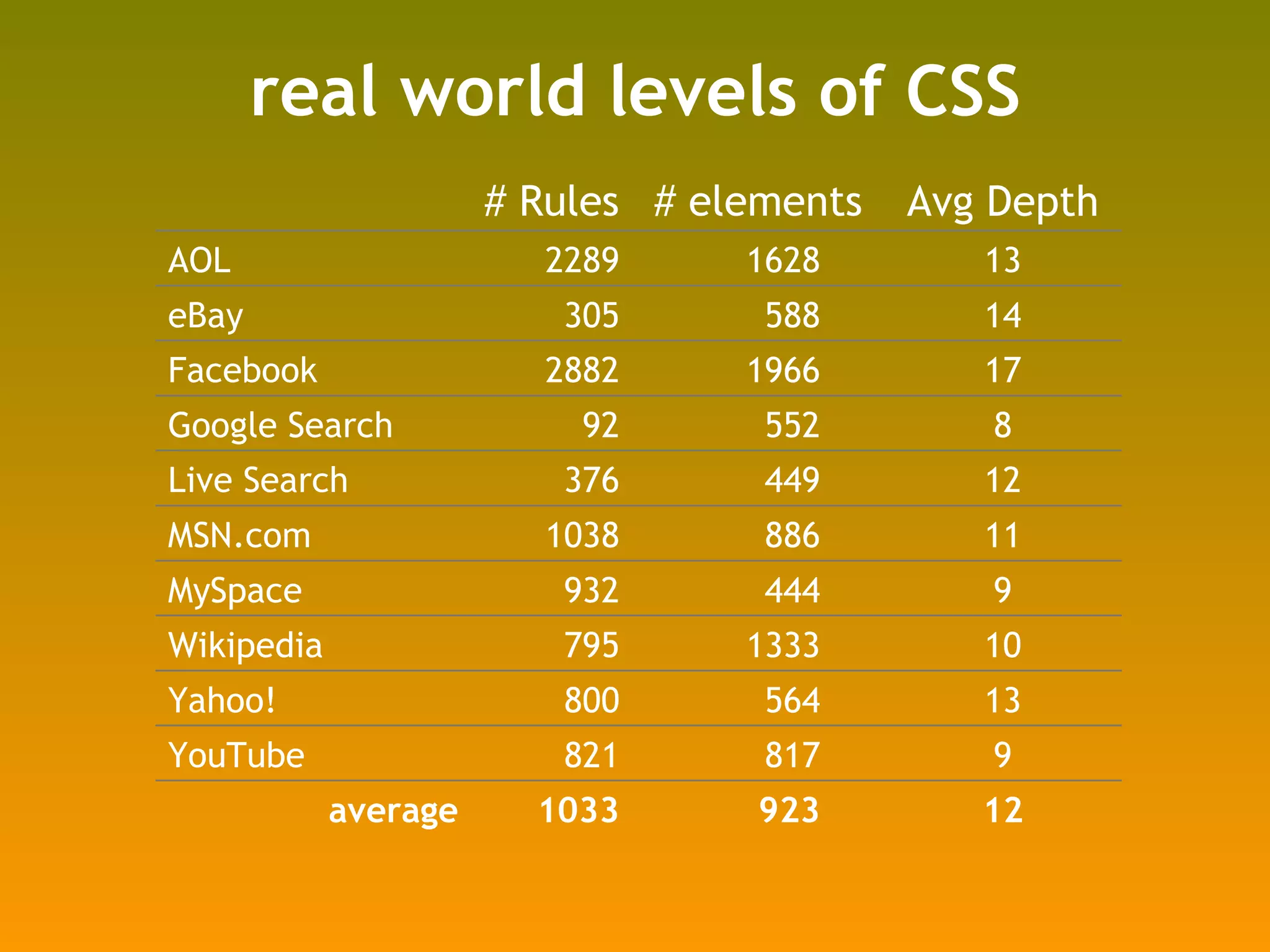
real world levels of CSS # Rules # elements Avg Depth AOL 2289 1628 13 eBay 305 588 14 Facebook 2882 1966 17 Google Search 92 552 8 Live Search 376 449 12 MSN.com 1038 886 11 MySpace 932 444 9 Wikipedia 795 1333 10 Yahoo! 800 564 13 YouTube 821 817 9 average 1033 923 12
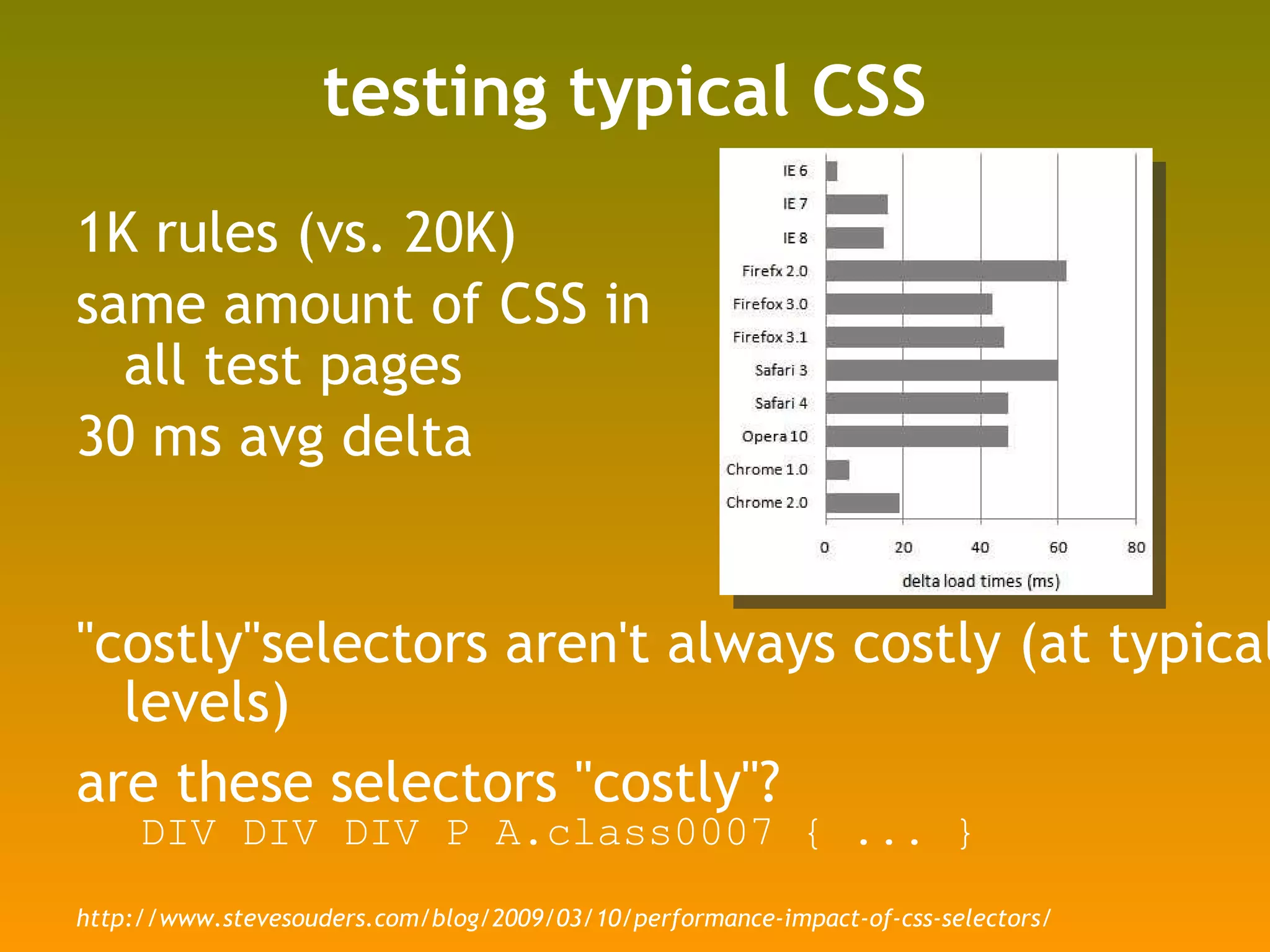
testing typical CSS  &quot;costly&quot;selectors aren't always costly (at typical levels) are these selectors &quot;costly&quot;? DIV DIV DIV P A.class0007 { ... } 1K rules (vs. 20K) same amount of CSS in all test pages 30 ms avg delta http://www.stevesouders.com/blog/2009/03/10/performance-impact-of-css-selectors/
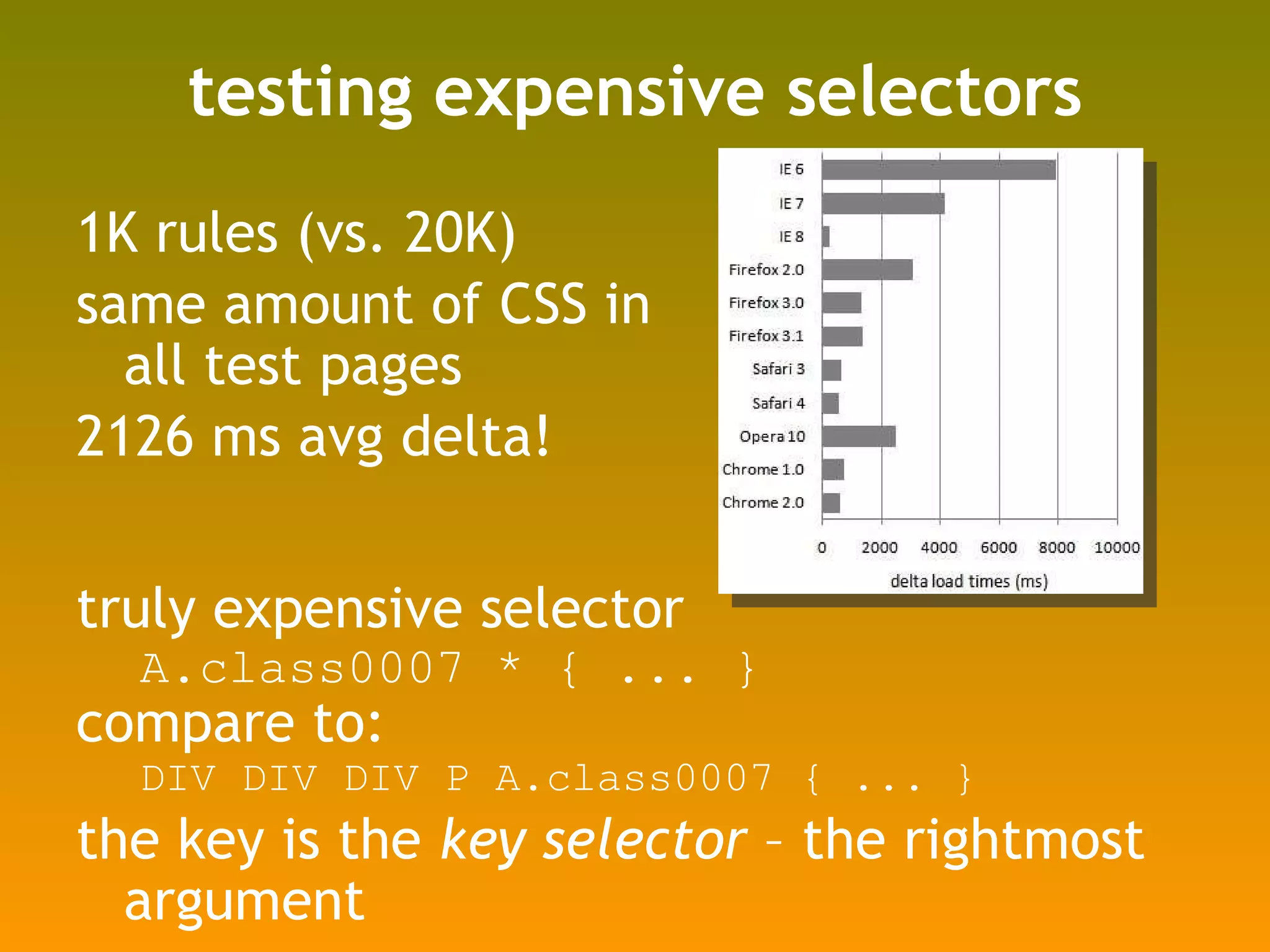
testing expensive selectors 1K rules (vs. 20K) same amount of CSS in all test pages 2126 ms avg delta! truly expensive selector A.class0007 * { ... } compare to: DIV DIV DIV P A.class0007 { ... } the key is the  key selector  – the rightmost argument
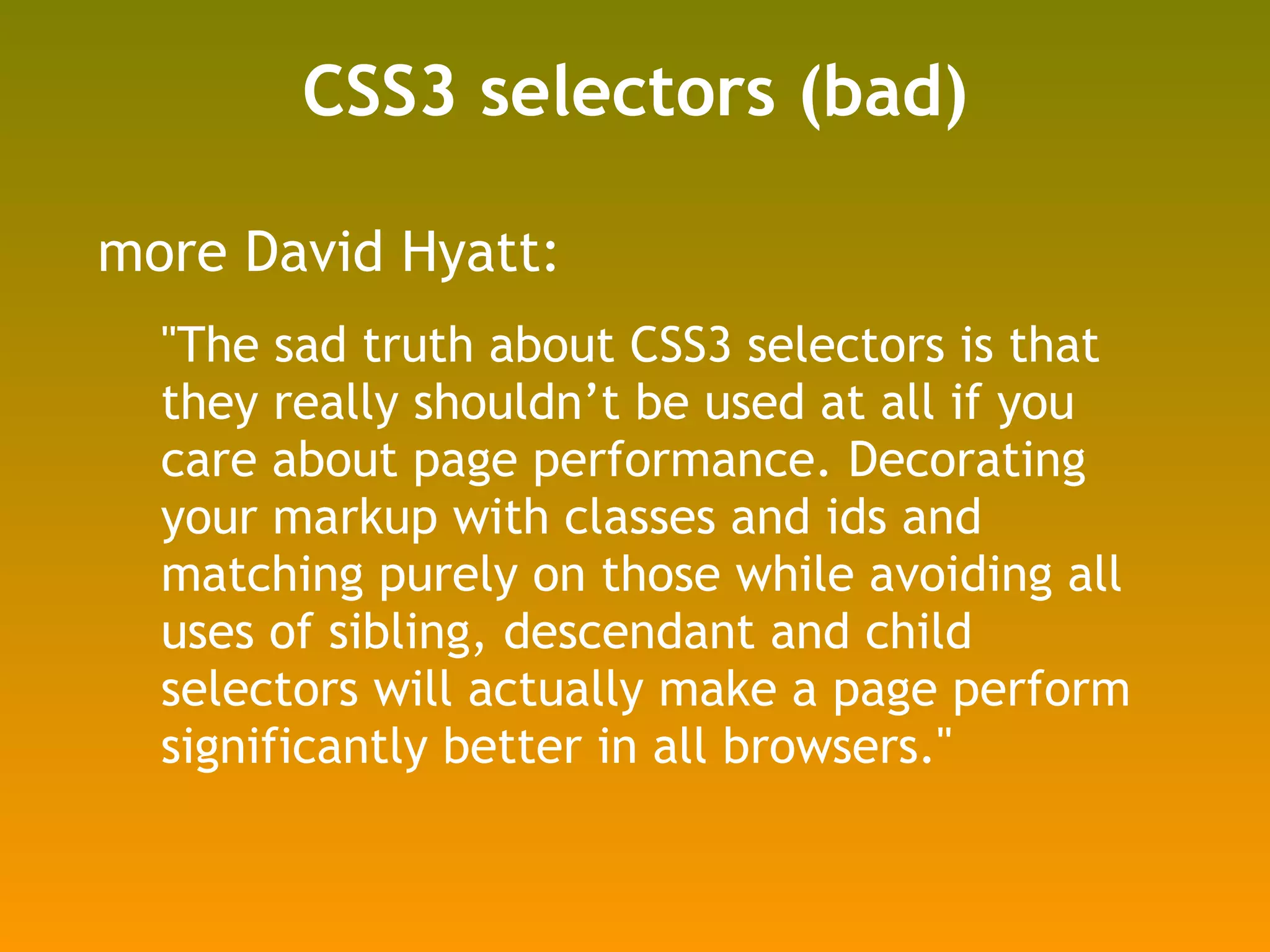
CSS3 selectors (bad) more David Hyatt: &quot;The sad truth about CSS3 selectors is that they really shouldn’t be used at all if you care about page performance. Decorating your markup with classes and ids and matching purely on those while avoiding all uses of sibling, descendant and child selectors will actually make a page perform significantly better in all browsers.&quot; http://shauninman.com/archive/2008/05/05/css_qualified_selectors#comment_3942
selectors to avoid A.class0007 DIV { ... } #id0007 > A { ... } .class0007 [href] { ... } DIV:first-child { ... }
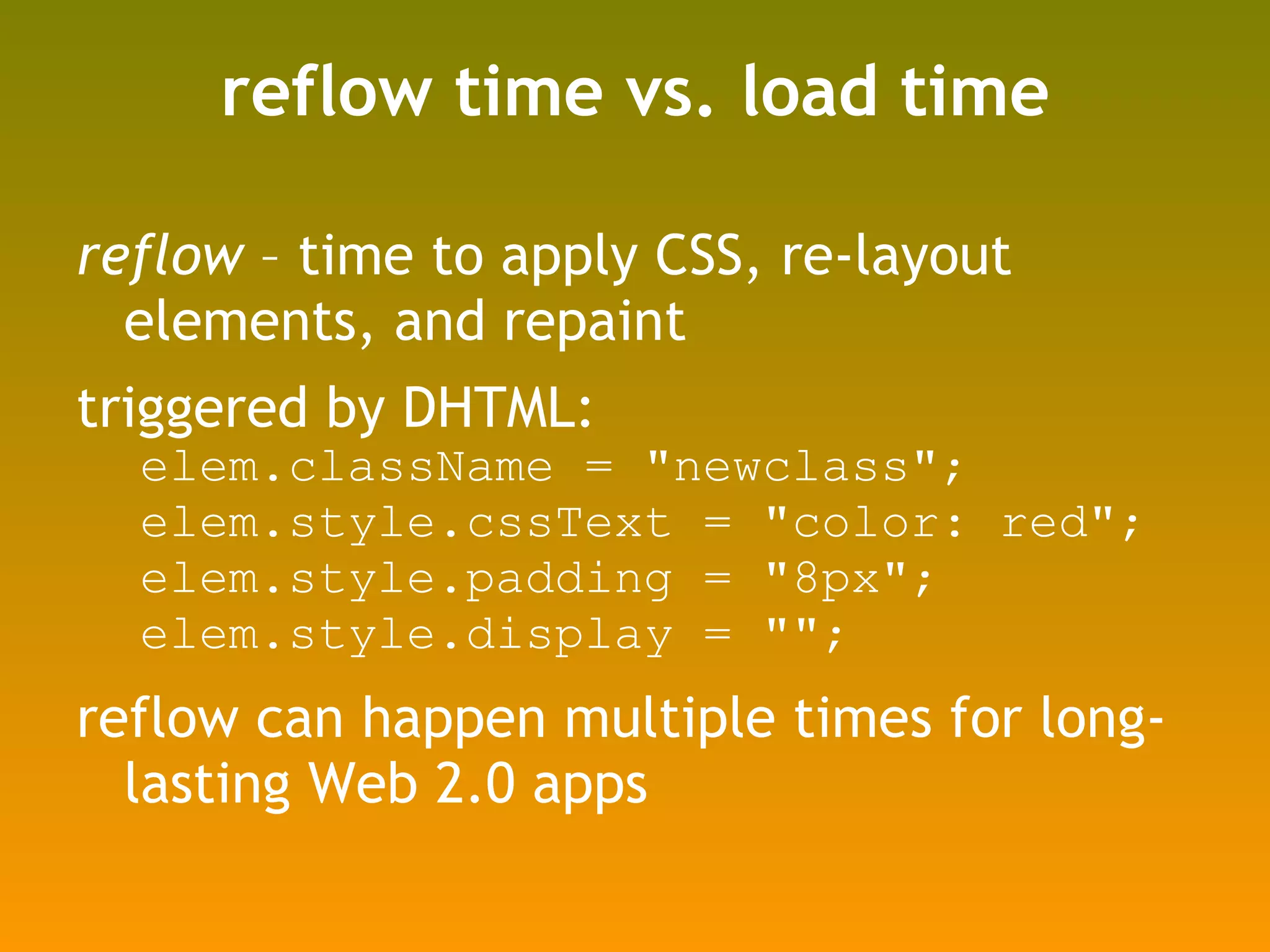
reflow time vs. load time reflow  – time to apply CSS, re-layout elements, and repaint triggered by DHTML: elem.className = &quot;newclass&quot;; elem.style.cssText = &quot;color: red&quot;; elem.style.padding = &quot;8px&quot;; elem.style.display = &quot;&quot;; reflow can happen multiple times for long-lasting Web 2.0 apps
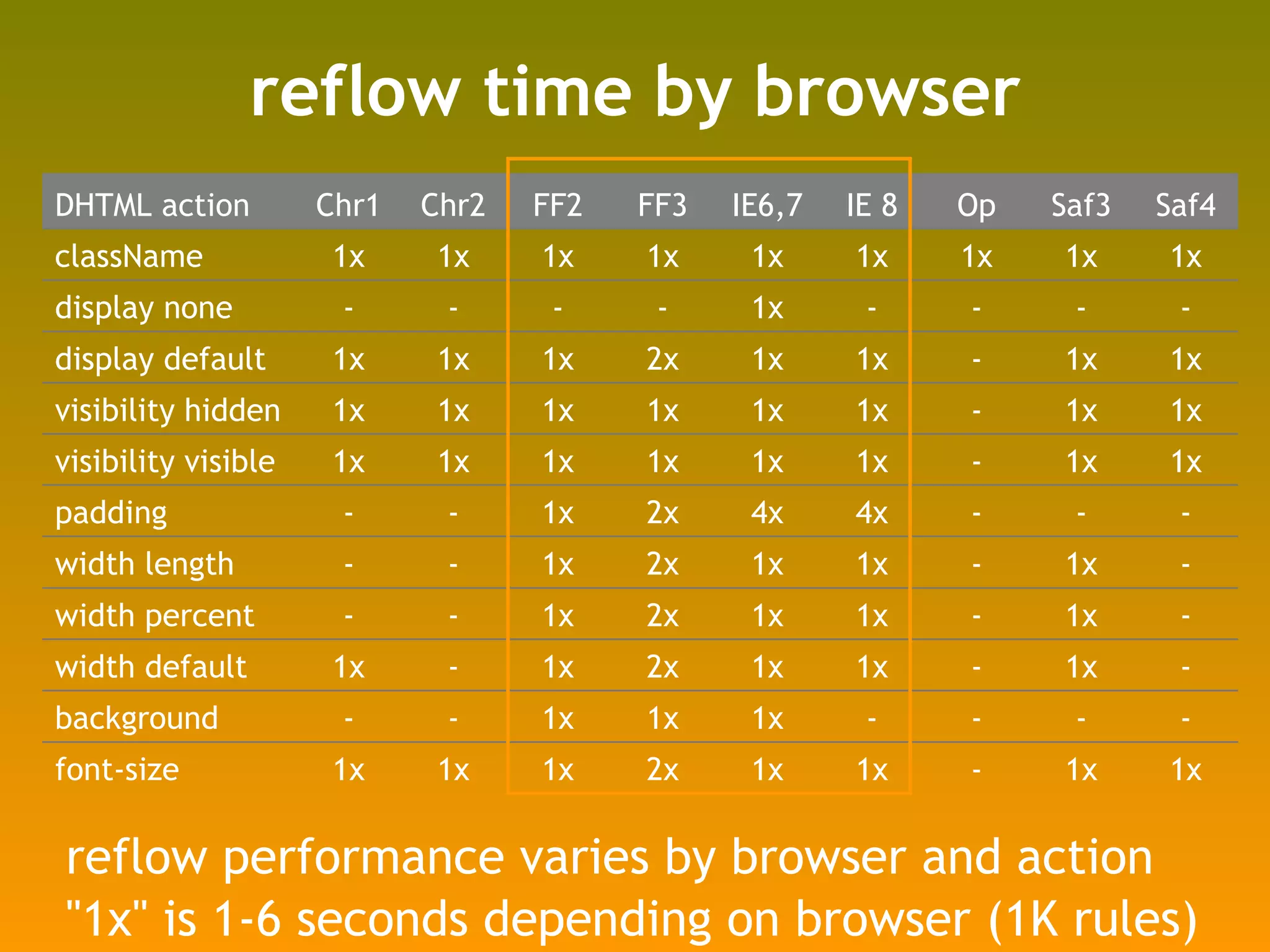
reflow time by browser reflow performance varies by browser and action &quot;1x&quot; is 1-6 seconds depending on browser (1K rules) DHTML action Chr1 Chr2 FF2 FF3 IE6,7 IE 8 Op Saf3 Saf4 className 1x 1x 1x 1x 1x 1x 1x 1x 1x display none - - - - 1x - - - - display default 1x 1x 1x 2x 1x 1x - 1x 1x visibility hidden 1x 1x 1x 1x 1x 1x - 1x 1x visibility visible 1x 1x 1x 1x 1x 1x - 1x 1x padding - - 1x 2x 4x 4x - - - width length - - 1x 2x 1x 1x - 1x - width percent - - 1x 2x 1x 1x - 1x - width default 1x - 1x 2x 1x 1x - 1x - background - - 1x 1x 1x - - - - font-size 1x 1x 1x 2x 1x 1x - 1x 1x
Simplifying CSS Selectors efficient CSS comes at a cost – page weight focus optimization on selectors where the  key selector  matches many elements reduce the number of selectors
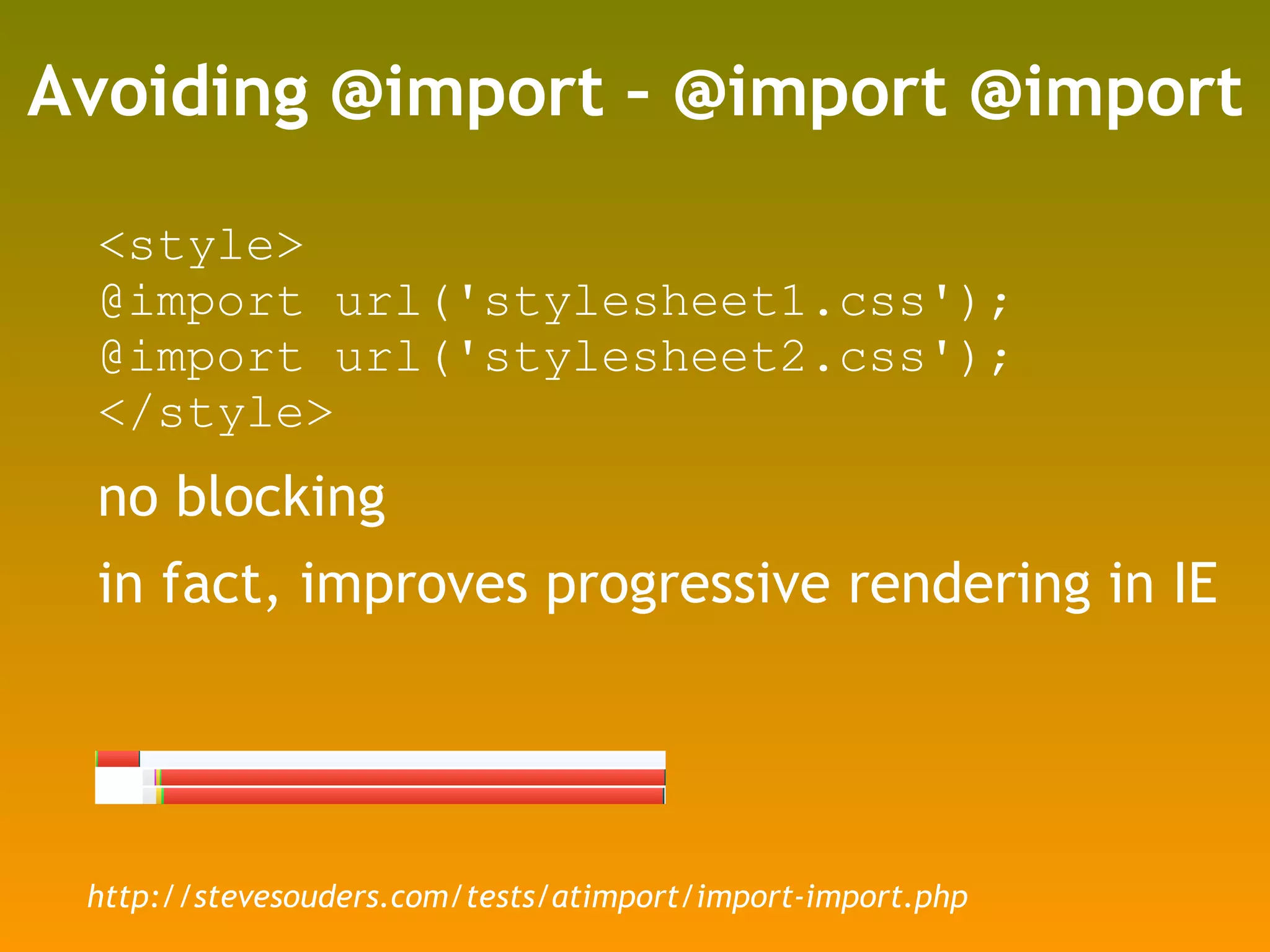
Avoiding @import – @import @import <style> @import url('stylesheet1.css'); @import url('stylesheet2.css'); </style> no blocking in fact, improves progressive rendering in IE http://stevesouders.com/tests/atimport/import-import.php
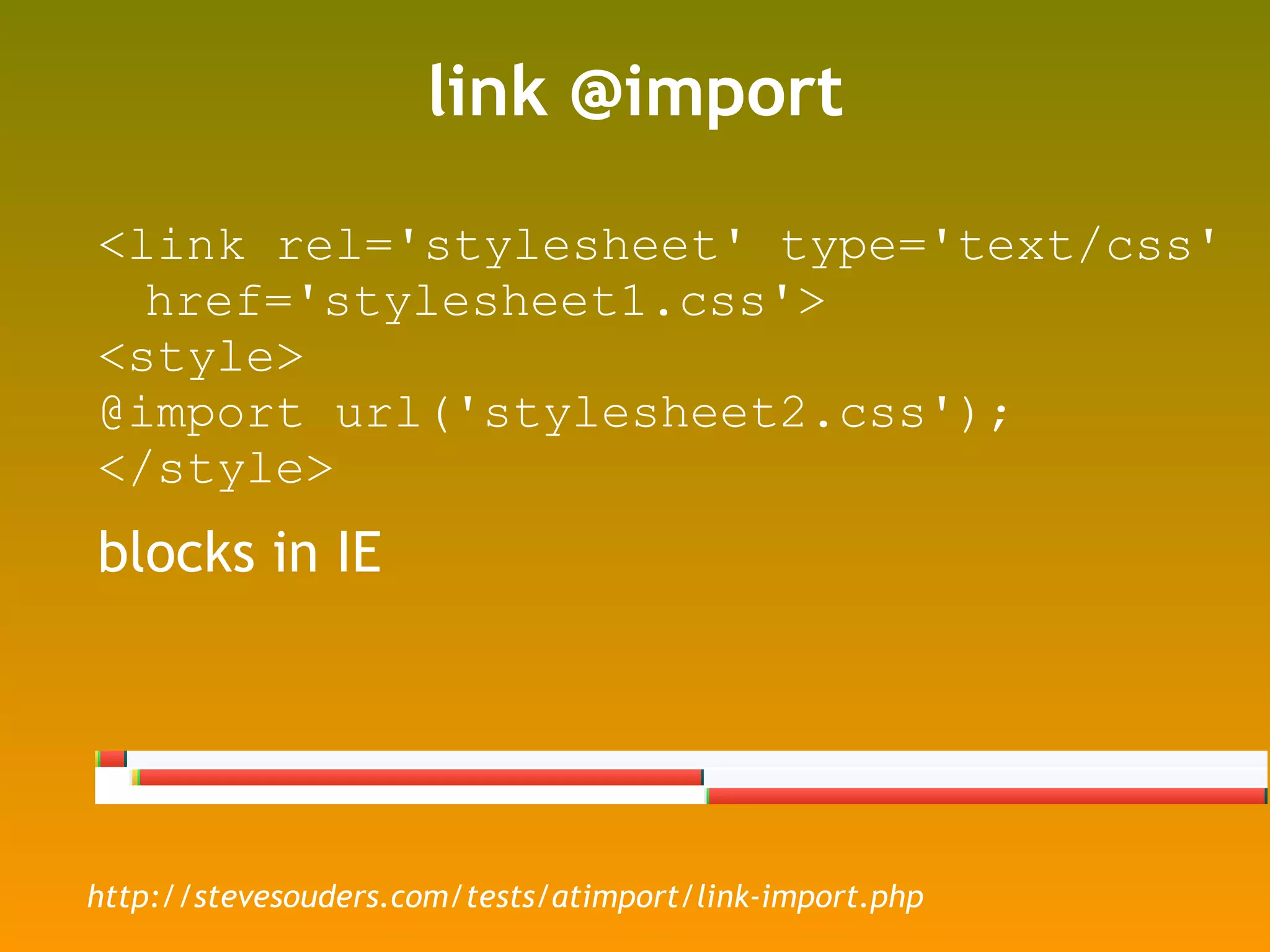
link @import <link rel='stylesheet' type='text/css' href='stylesheet1.css'> <style> @import url('stylesheet2.css'); </style> blocks in IE http://stevesouders.com/tests/atimport/link-import.php
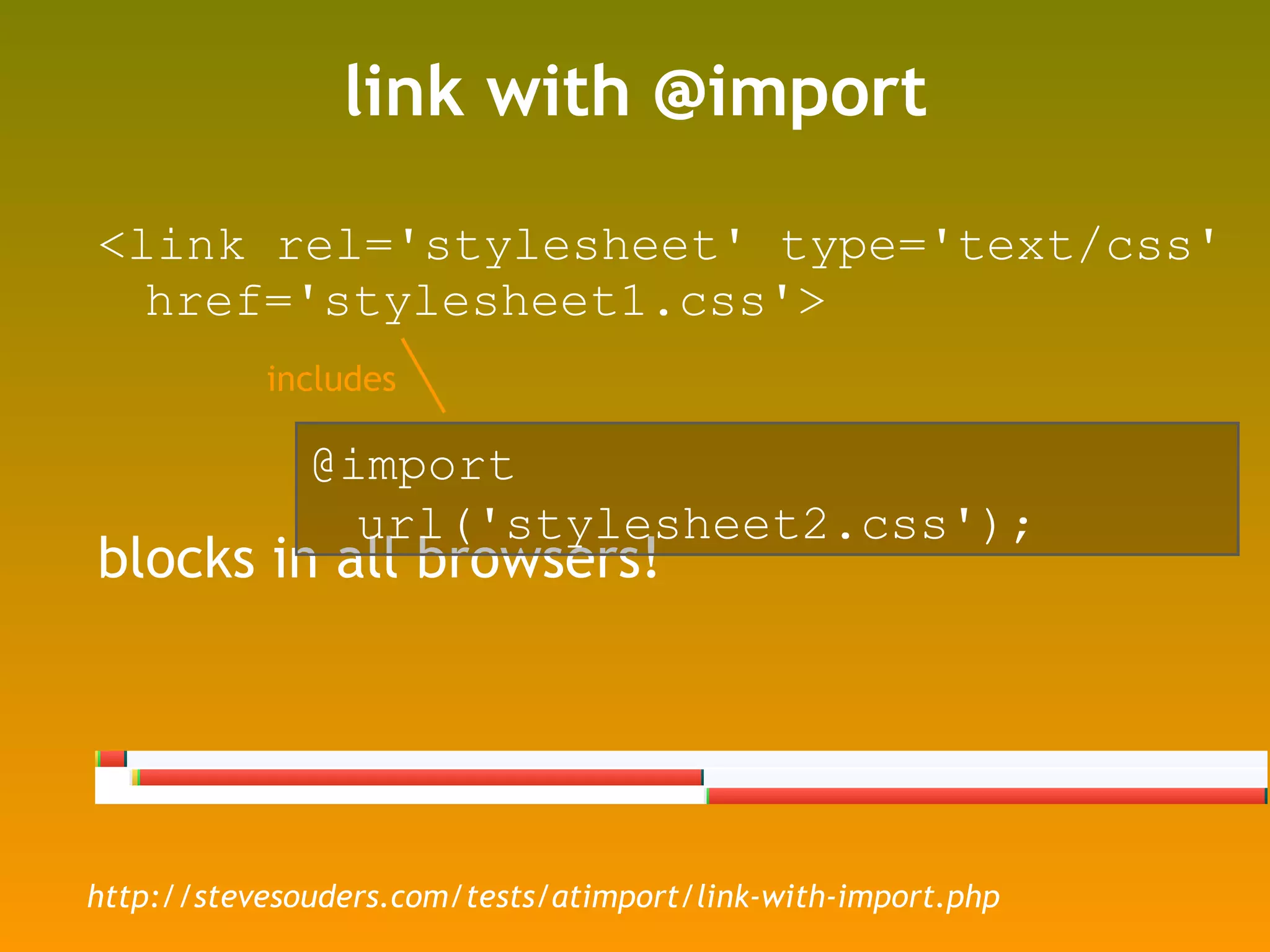
link with @import <link rel='stylesheet' type='text/css' href='stylesheet1.css'> blocks in all browsers! http://stevesouders.com/tests/atimport/link-with-import.php @import url('stylesheet2.css'); includes
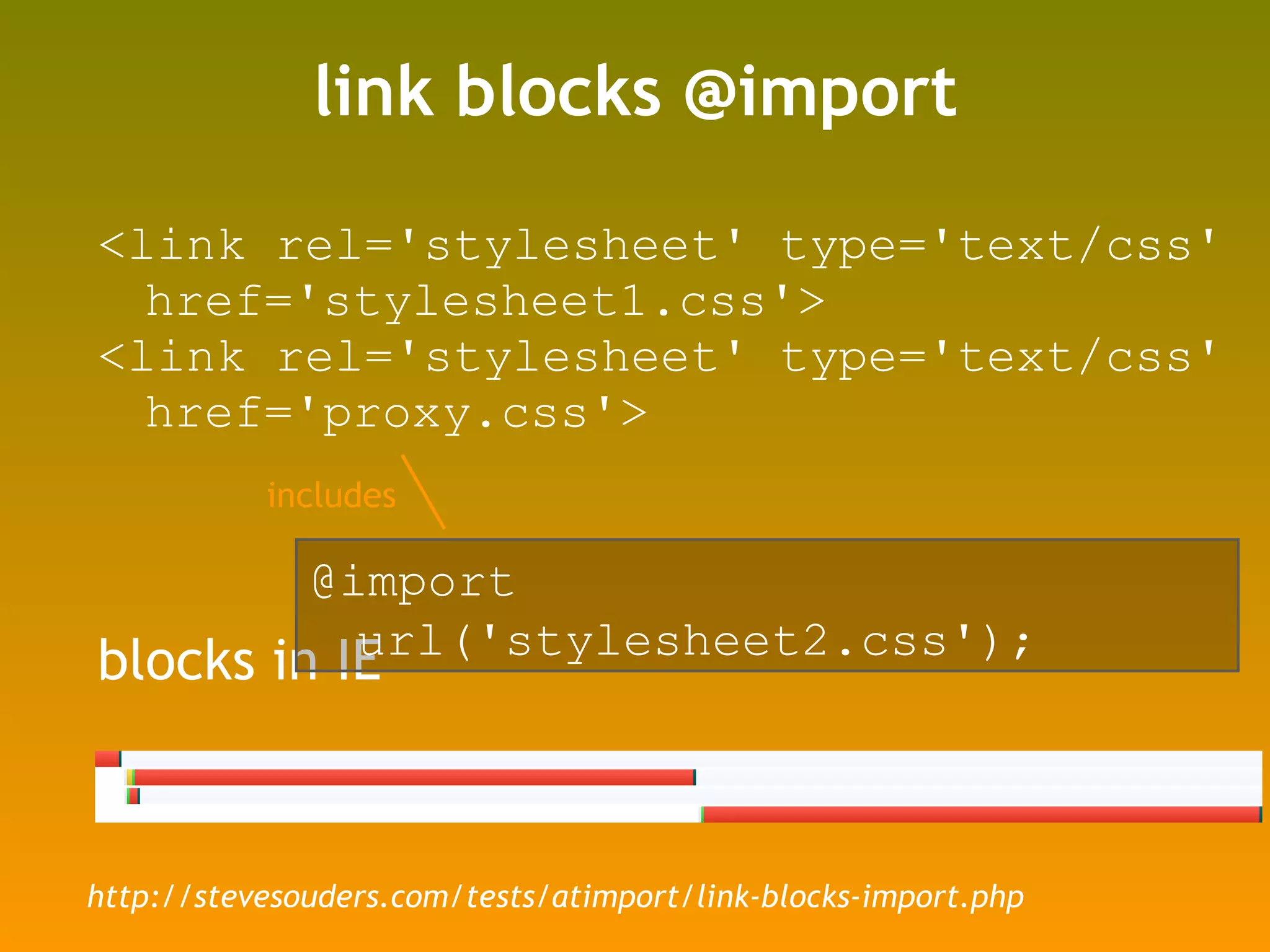
link blocks @import <link rel='stylesheet' type='text/css' href='stylesheet1.css'> <link rel='stylesheet' type='text/css' href='proxy.css'> blocks in IE http://stevesouders.com/tests/atimport/link-blocks-import.php @import url('stylesheet2.css'); includes
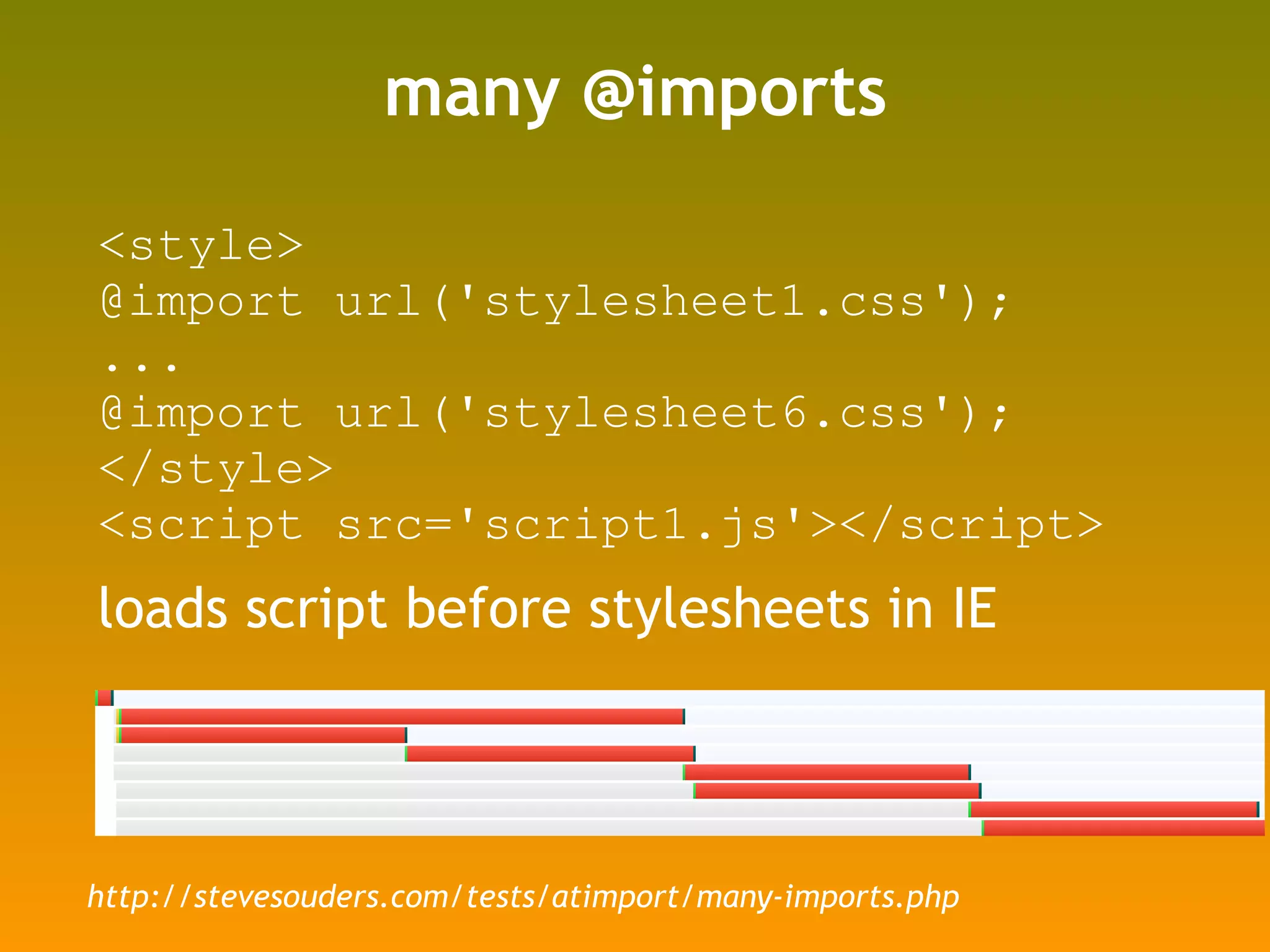
many @imports <style> @import url('stylesheet1.css'); ... @import url('stylesheet6.css'); </style> <script src='script1.js'></script> loads script before stylesheets in IE http://stevesouders.com/tests/atimport/many-imports.php
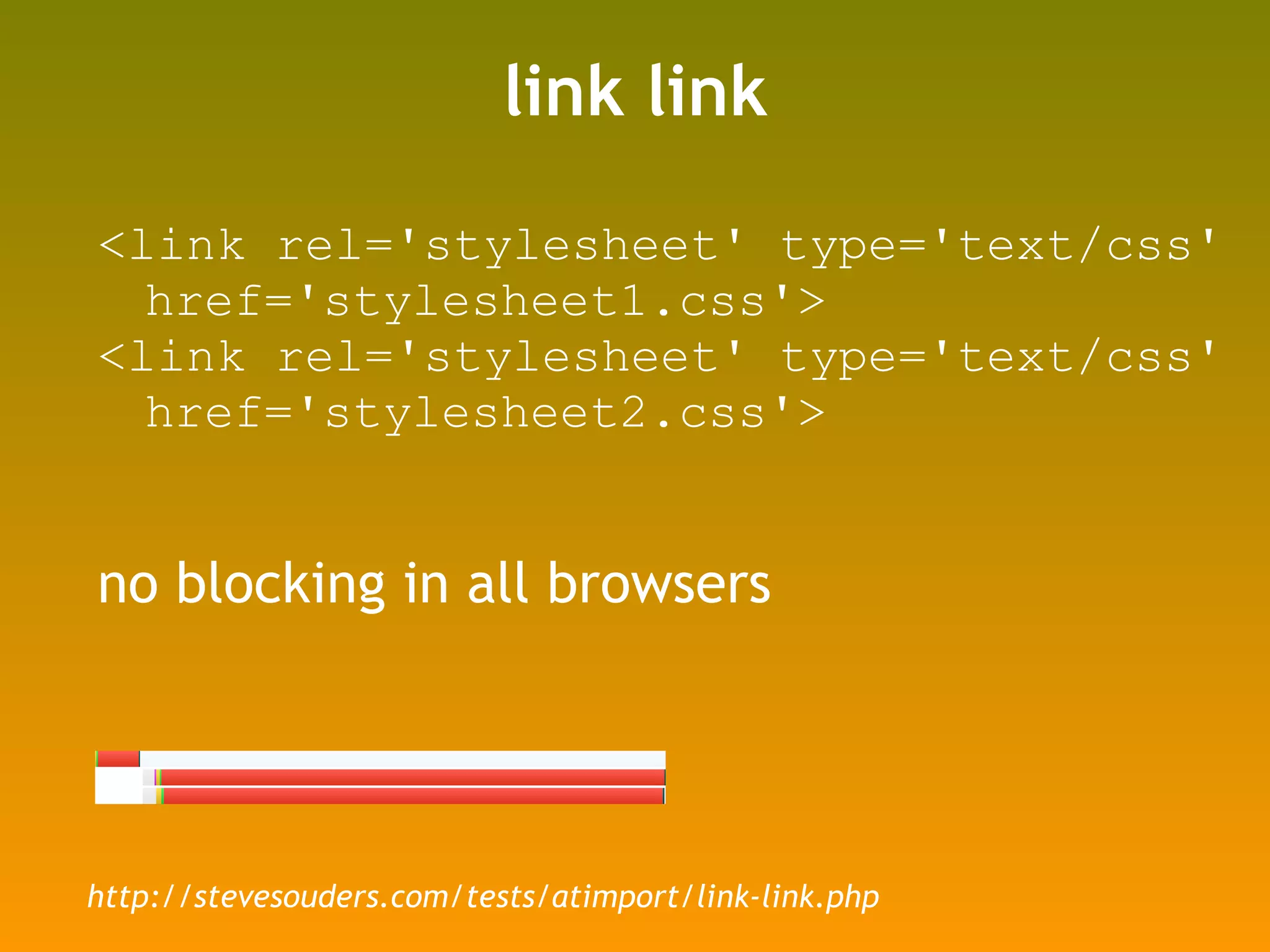
link link <link rel='stylesheet' type='text/css' href='stylesheet1.css'> <link rel='stylesheet' type='text/css' href='stylesheet2.css'> no blocking in all browsers http://stevesouders.com/tests/atimport/link-link.php
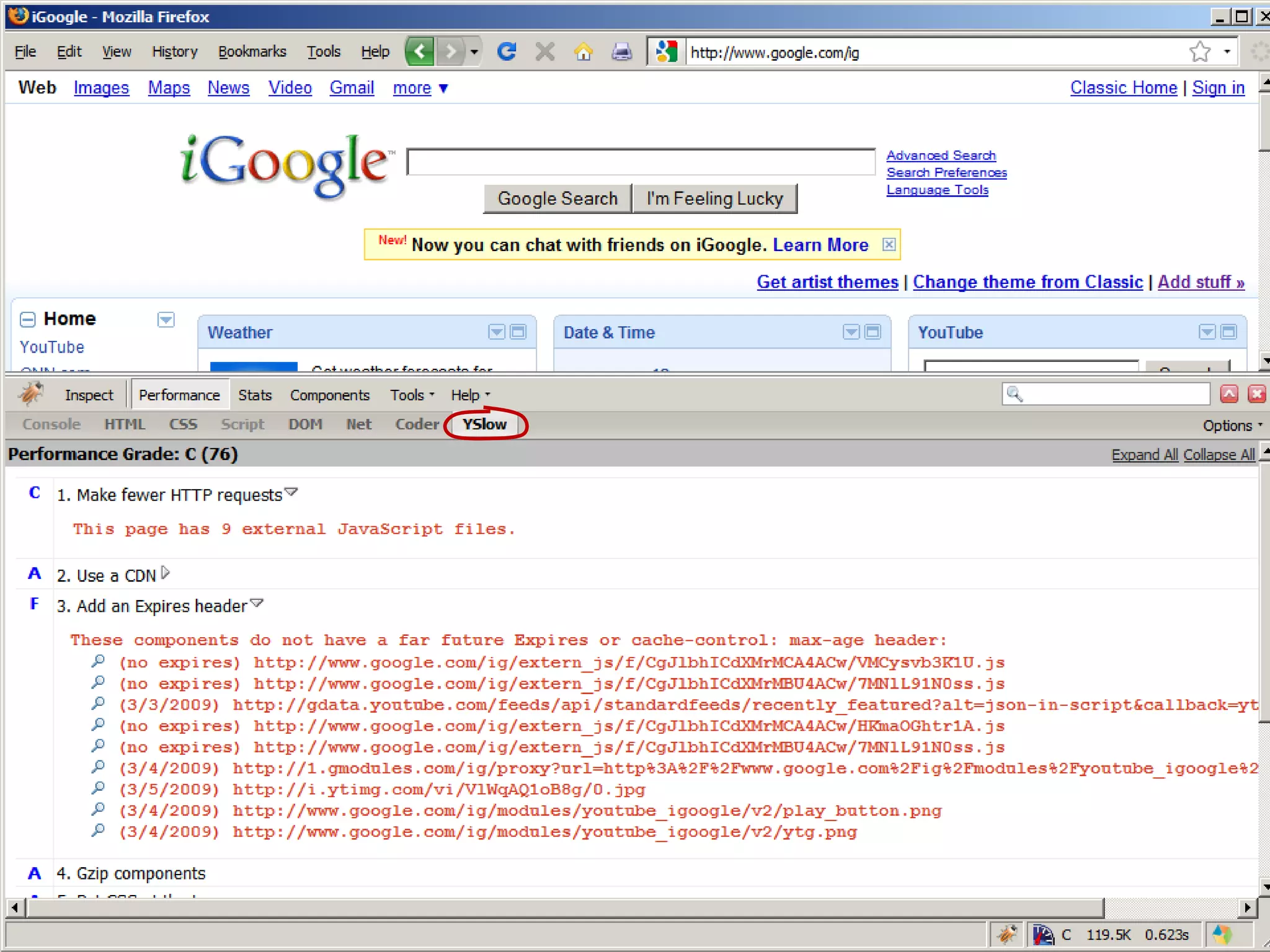
takeaways focus on the frontend run YSlow:  http://developer.yahoo.com/yslow speed matters
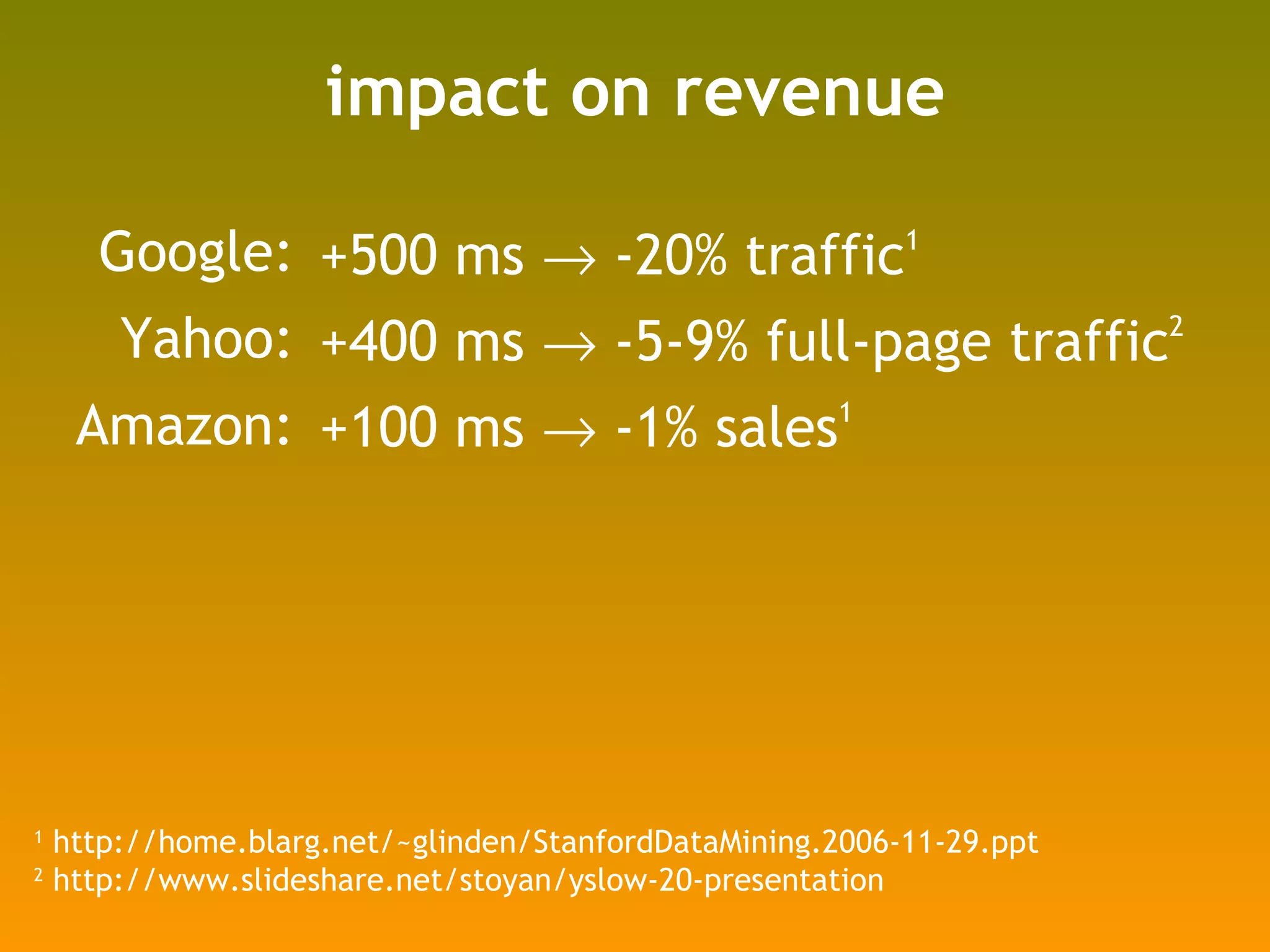
impact on revenue Google: Yahoo: Amazon: 1  http://home.blarg.net/~glinden/StanfordDataMining.2006-11-29.ppt 2  http://www.slideshare.net/stoyan/yslow-20-presentation +500 ms    -20% traffic 1 +400 ms    -5-9% full-page traffic 2 +100 ms    -1% sales 1
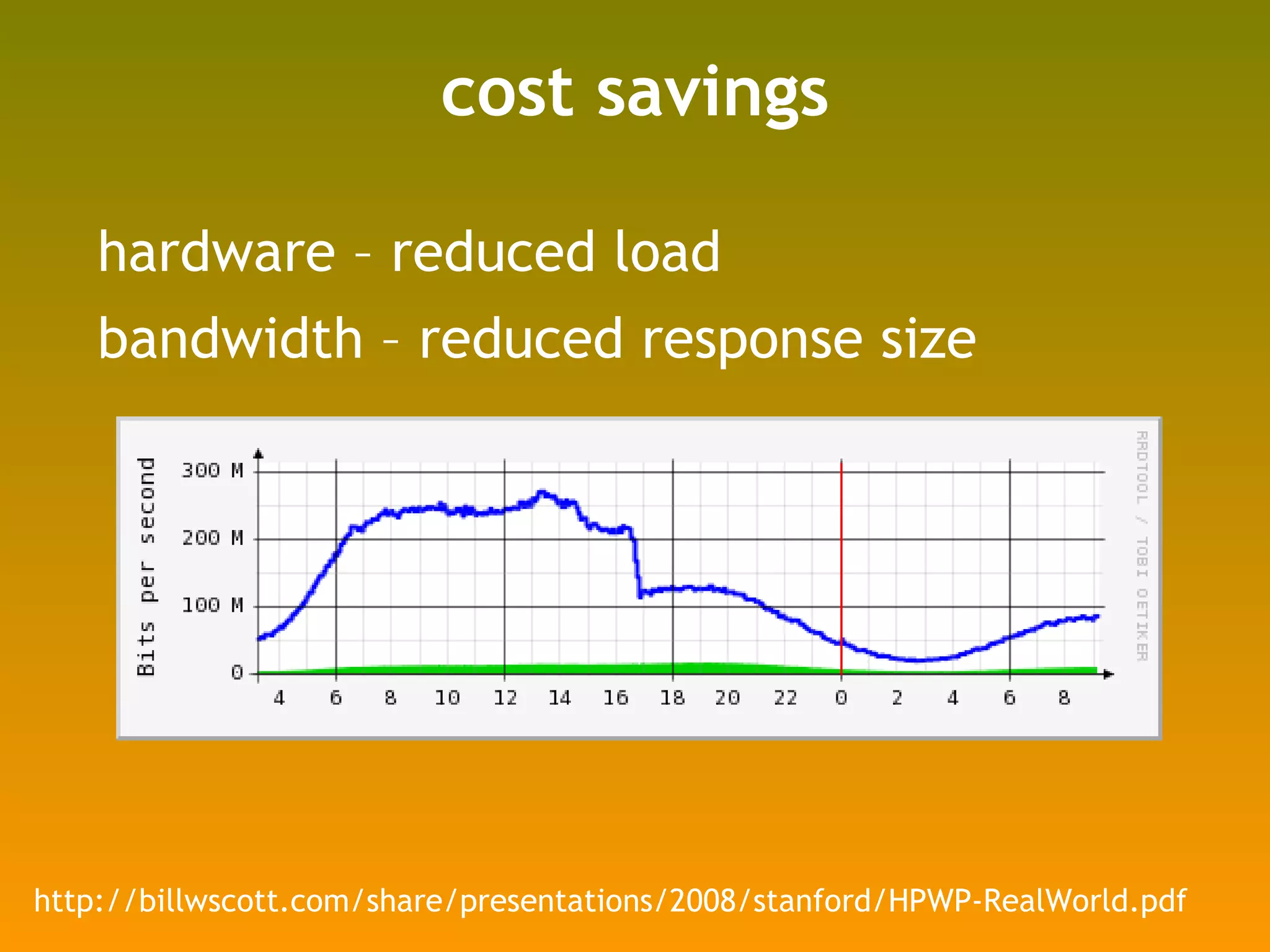
cost savings hardware – reduced load bandwidth – reduced response size http://billwscott.com/share/presentations/2008/stanford/HPWP-RealWorld.pdf
if you want better user experience more revenue reduced operating expenses the strategy is clear Even Faster Web Sites
Steve Souders [email_address] http://stevesouders.com/docs/web20expo-20090402.ppt

Even faster web sites presentation 3

  • 1.
    Steve Souders [email_address]http://stevesouders.com/docs/web20expo-20090402.ppt Even Faster Web Sites Disclaimer: This content does not necessarily reflect the opinions of my employer. Flushing the Document Early Simplifying CSS Selectors Avoiding @import
  • 2.
    the importance offrontend performance 17% 83% iGoogle, primed cache 9% 91% iGoogle, empty cache
  • 3.
    time spent onthe frontend April 2008 Empty Cache Primed Cache www.aol.com 97% 97% www.ebay.com 95% 81% www.facebook.com 95% 81% www.google.com/search 47% 0% search.live.com/results 67% 0% www.msn.com 98% 94% www.myspace.com 98% 98% en.wikipedia.org/wiki 94% 91% www.yahoo.com 97% 96% www.youtube.com 98% 97%
  • 4.
    14 RULES MAKEFEWER HTTP REQUESTS USE A CDN ADD AN EXPIRES HEADER GZIP COMPONENTS PUT STYLESHEETS AT THE TOP PUT SCRIPTS AT THE BOTTOM AVOID CSS EXPRESSIONS MAKE JS AND CSS EXTERNAL REDUCE DNS LOOKUPS MINIFY JS AVOID REDIRECTS REMOVE DUPLICATE SCRIPTS CONFIGURE ETAGS MAKE AJAX CACHEABLE
  • 5.
  • 6.
  • 7.
  • 8.
  • 9.
  • 10.
    Even Faster WebSites Splitting the initial payload Loading scripts without blocking Coupling asynchronous scripts Positioning inline scripts Sharding dominant domains Flushing the document early Using iframes sparingly Simplifying CSS Selectors Understanding Ajax performance... Doug Crockford Creating responsive web apps...... Ben Galbraith, Dion Almaer Writing efficient JavaScript........... Nicholas Zakas Scaling with Comet...................... Dylan Schiemann Going beyond gzipping............... Tony Gentilcore Optimizing images..................... Stoyan Stefanov, Nicole Sullivan Avoiding @import
  • 11.
    iframes: most expensive DOM element load 100 empty elements of each type tested in all major browsers 1 1 IE 6, 7, 8; FF 2, 3.0, 3.1b2; Safari 3.2, 4; Opera 9.63, 10; Chrome 1.0, 2.0
  • 12.
    iframes block onloadparent's onload doesn't fire until iframe and all its components are downloaded workaround for Safari and Chrome: set iframe src in JavaScript <iframe id=iframe1 src=&quot;&quot;></iframe> <script type=&quot;text/javascript&quot;> document.getElementById('iframe1').src=&quot; url &quot;; </script>
  • 13.
    scripts block iframeno surprise – scripts in the parent block the iframe from loading IE Firefox Safari Chrome Opera script script script
  • 14.
    stylesheets block iframe(IE, FF) surprise – stylesheets in the parent block the iframe or its resources in IE & Firefox IE Firefox Safari Chrome Opera stylesheet stylesheet stylesheet
  • 15.
    stylesheets after iframestill block (FF) surprise – even moving the stylesheet after the iframe still causes the iframe's resources to be blocked in Firefox IE Firefox Safari Chrome Opera stylesheet stylesheet stylesheet
  • 16.
    iframes: no freeconnections iframe shares connection pool with parent (here – 2 connections per server in IE 7) iframe parent
  • 17.
    flushing the documentearly gotchas: PHP output_buffering – ob_flush() Transfer-Encoding: chunked gzip – Apache's DeflateBufferSize before 2.2.8 proxies and anti-virus software browsers – Safari (1K), Chrome (2K) other languages: $| or FileHandle autoflush (Perl), flush (Python), ios.flush (Ruby) call PHP's flush() html image image script html image image script
  • 18.
    flushing and domainblocking you might need to move flushed resources to a domain different from the HTML doc case study: Google search blocked by HTML document different domains html image image script html image image script google image image script image 204
  • 19.
    Simplifying CSS Selectors#toc > LI { font-weight: bold; } combinator simple selectors selector declaration block rule
  • 20.
    types of CSSselectors ID selectors #toc { margin-left: 20px; } element whose ID attribute has the value &quot;toc&quot; class selectors .chapter { font-weight: bold; } elements with class=chapter type selectors A { text-decoration: none; } all A elements in the document tree http://www.w3.org/TR/CSS2/selector.html
  • 21.
    types of CSSselectors adjacent sibling selectors H1 + #toc { margin-top: 40px; } an element with ID=toc that immediately follows an H1 child selectors #toc > LI { font-weight: bold; } all LI elements whose parent has id=&quot;toc&quot; descendant selectors #toc A { color: #444; } all A elements that have id=&quot;toc&quot; as an ancestor
  • 22.
    types of CSSselectors universal selectors * { font-family: Arial; } all elements attribute selectors [href=&quot;#index&quot;] { font-style: italic; } all elements where the href attribute is &quot;#index&quot; psuedo classes and elements A:hover { text-decoration: underline; } non-DOM behavior others: :visited , :link , :active , :focus , :first-child , :before , :after
  • 23.
    writing efficient CSShttps://developer.mozilla.org/en/Writing_Efficient_CSS &quot;The style system matches a rule by starting with the rightmost selector and moving to the left through the rule's selectors. As long as your little subtree continues to check out, the style system will continue moving to the left until it either matches the rule or bails out because of a mismatch.&quot; #toc > LI { font-weight: bold; } find every LI whose parent is id=&quot;toc&quot; #toc A { color: #444; } find every A and climb its ancestors until id=&quot;toc&quot; or DOM root (!) is found
  • 24.
    writing efficient CSSavoid universal selectors don't qualify ID selectors bad: DIV #navbar {} good: #navbar {} don't qualify class selectors bad: LI .tight {} good: .li-tight {} make rules as specific as possible bad: #navbar A {} good: .a-navbar {} https://developer.mozilla.org/en/Writing_Efficient_CSS
  • 25.
    writing efficient CSSavoid descendant selectors bad: UL LI A {} better: UL > LI > A {} avoid tag-child selectors bad: UL > LI > A {} best: .li-anchor {} be wary of child selectors rely on inheritance http://www.w3.org/TR/CSS21/propidx.html https://developer.mozilla.org/en/Writing_Efficient_CSS David Hyatt 4/21/2000
  • 26.
    Testing CSS Performance20K TD elements http://jon.sykes.me/152/testing-css-performance-pt-2
  • 27.
    testing massive CSS20K A elements no style: control tag: A {} class: .a00001 {} .a20000 {} descender: DIV DIV DIV P A.a00001 {} child: DIV > DIV > DIV > P > A.a00001 {} http://jon.sykes.me/153/more-css-performance-testing-pt-3
  • 28.
    CSS performance isn'tlinear IE 7 &quot;cliff&quot; at 18K rules
  • 29.
    real world levelsof CSS # Rules # elements Avg Depth AOL 2289 1628 13 eBay 305 588 14 Facebook 2882 1966 17 Google Search 92 552 8 Live Search 376 449 12 MSN.com 1038 886 11 MySpace 932 444 9 Wikipedia 795 1333 10 Yahoo! 800 564 13 YouTube 821 817 9 average 1033 923 12
  • 30.
    testing typical CSS &quot;costly&quot;selectors aren't always costly (at typical levels) are these selectors &quot;costly&quot;? DIV DIV DIV P A.class0007 { ... } 1K rules (vs. 20K) same amount of CSS in all test pages 30 ms avg delta http://www.stevesouders.com/blog/2009/03/10/performance-impact-of-css-selectors/
  • 31.
    testing expensive selectors1K rules (vs. 20K) same amount of CSS in all test pages 2126 ms avg delta! truly expensive selector A.class0007 * { ... } compare to: DIV DIV DIV P A.class0007 { ... } the key is the key selector – the rightmost argument
  • 32.
    CSS3 selectors (bad)more David Hyatt: &quot;The sad truth about CSS3 selectors is that they really shouldn’t be used at all if you care about page performance. Decorating your markup with classes and ids and matching purely on those while avoiding all uses of sibling, descendant and child selectors will actually make a page perform significantly better in all browsers.&quot; http://shauninman.com/archive/2008/05/05/css_qualified_selectors#comment_3942
  • 33.
    selectors to avoidA.class0007 DIV { ... } #id0007 > A { ... } .class0007 [href] { ... } DIV:first-child { ... }
  • 34.
    reflow time vs.load time reflow – time to apply CSS, re-layout elements, and repaint triggered by DHTML: elem.className = &quot;newclass&quot;; elem.style.cssText = &quot;color: red&quot;; elem.style.padding = &quot;8px&quot;; elem.style.display = &quot;&quot;; reflow can happen multiple times for long-lasting Web 2.0 apps
  • 35.
    reflow time bybrowser reflow performance varies by browser and action &quot;1x&quot; is 1-6 seconds depending on browser (1K rules) DHTML action Chr1 Chr2 FF2 FF3 IE6,7 IE 8 Op Saf3 Saf4 className 1x 1x 1x 1x 1x 1x 1x 1x 1x display none - - - - 1x - - - - display default 1x 1x 1x 2x 1x 1x - 1x 1x visibility hidden 1x 1x 1x 1x 1x 1x - 1x 1x visibility visible 1x 1x 1x 1x 1x 1x - 1x 1x padding - - 1x 2x 4x 4x - - - width length - - 1x 2x 1x 1x - 1x - width percent - - 1x 2x 1x 1x - 1x - width default 1x - 1x 2x 1x 1x - 1x - background - - 1x 1x 1x - - - - font-size 1x 1x 1x 2x 1x 1x - 1x 1x
  • 36.
    Simplifying CSS Selectorsefficient CSS comes at a cost – page weight focus optimization on selectors where the key selector matches many elements reduce the number of selectors
  • 37.
    Avoiding @import –@import @import <style> @import url('stylesheet1.css'); @import url('stylesheet2.css'); </style> no blocking in fact, improves progressive rendering in IE http://stevesouders.com/tests/atimport/import-import.php
  • 38.
    link @import <linkrel='stylesheet' type='text/css' href='stylesheet1.css'> <style> @import url('stylesheet2.css'); </style> blocks in IE http://stevesouders.com/tests/atimport/link-import.php
  • 39.
    link with @import<link rel='stylesheet' type='text/css' href='stylesheet1.css'> blocks in all browsers! http://stevesouders.com/tests/atimport/link-with-import.php @import url('stylesheet2.css'); includes
  • 40.
    link blocks @import<link rel='stylesheet' type='text/css' href='stylesheet1.css'> <link rel='stylesheet' type='text/css' href='proxy.css'> blocks in IE http://stevesouders.com/tests/atimport/link-blocks-import.php @import url('stylesheet2.css'); includes
  • 41.
    many @imports <style>@import url('stylesheet1.css'); ... @import url('stylesheet6.css'); </style> <script src='script1.js'></script> loads script before stylesheets in IE http://stevesouders.com/tests/atimport/many-imports.php
  • 42.
    link link <linkrel='stylesheet' type='text/css' href='stylesheet1.css'> <link rel='stylesheet' type='text/css' href='stylesheet2.css'> no blocking in all browsers http://stevesouders.com/tests/atimport/link-link.php
  • 43.
    takeaways focus onthe frontend run YSlow: http://developer.yahoo.com/yslow speed matters
  • 44.
    impact on revenueGoogle: Yahoo: Amazon: 1 http://home.blarg.net/~glinden/StanfordDataMining.2006-11-29.ppt 2 http://www.slideshare.net/stoyan/yslow-20-presentation +500 ms  -20% traffic 1 +400 ms  -5-9% full-page traffic 2 +100 ms  -1% sales 1
  • 45.
    cost savings hardware– reduced load bandwidth – reduced response size http://billwscott.com/share/presentations/2008/stanford/HPWP-RealWorld.pdf
  • 46.
    if you wantbetter user experience more revenue reduced operating expenses the strategy is clear Even Faster Web Sites
  • 47.
    Steve Souders [email_address]http://stevesouders.com/docs/web20expo-20090402.ppt

Editor's Notes

  • #2 Permission to use photo given by Amnemona: http://www.flickr.com/photos/marinacvinhal/379111290/
  • #3 Data source: Steve Souders Tested on IE6 on Comcast cable modem (~5 mbps) medium powered PC, April 2008.
  • #4 Ten top sites according to Alexa.com. Data source: Steve Souders Tested on IE6 on Comcast cable modem (~5 mbps) medium powered PC, April 2008. http://www.aol.com/ http://www.ebay.com/ http://www.facebook.com/ http://www.google.com/search?hl=en&amp;q=flowers http://www.myspace.com/ http://www.msn.com/ http://search.live.com/results.aspx?q=flowers&amp;mkt=en-us&amp;scope=&amp;FORM=LIVSOP http://en.wikipedia.org/wiki/Flowers http://www.yahoo.com/ http://www.youtube.com/ For Google and Live Search there are so few components (2-4) and they&apos;re mostly cacheable so the HTML document is a bigger percentage.
  • #5 photo courtesy of Vicki &amp; Chuck Rogers: http://www.flickr.com/photos/two-wrongs/205467442/
  • #37 reflow times measured in FF 3.0
  • #44 72 years = 2,270,592,000 seconds = 500ms * 4.4B page views
  • #45 72 years = 2,270,592,000 seconds = 500ms * 4.4B page views
  • #46 72 years = 2,270,592,000 seconds = 500ms * 4.4B page views
  • #47 72 years = 2,270,592,000 seconds = 500ms * 4.4B page views
  • #48 &amp;quot;thank you&amp;quot; by nj dodge: http://flickr.com/photos/nj_dodge/187190601/