BEYONDTHE BIKESHED
@emmajanehw
http://drupalize.me
Wednesday, 15 May, 13
The bigger the company, the more likely you are to get dragged into meetings that waste
your time, waste your talent, and waste your company's money. Sure, it's great to be included
in the process, but wouldn't it be even nicer if the process didn't waste your time? In this
session Emma Jane Hogbin show you five simple tips to make your time in meetings more
efficient. Want to dig deeper? She'll explain why these five tips work and show you how to
make more of your interactions with (difficult) people more efficient and enjoyable.
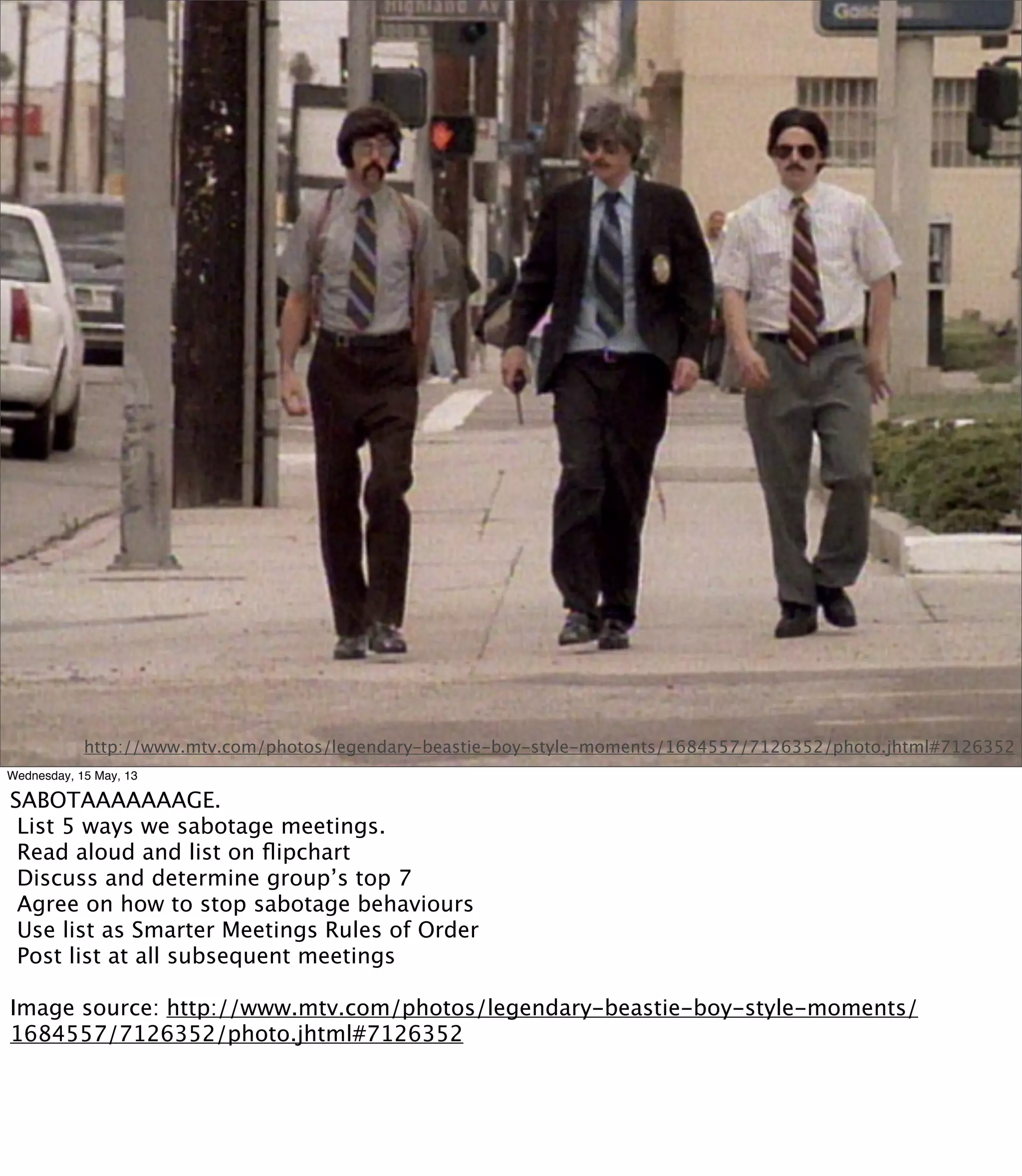
SABOTAGE!
http://www.mtv.com/photos/legendary-beastie-boy-style-moments/1684557/7126352/photo.jhtml#7126352
Wednesday, 15 May, 13
SABOTAAAAAAAGE.
List 5 ways we sabotage meetings.
Read aloud and list on flipchart
Discuss and determine group’s top 7
Agree on how to stop sabotage behaviours
Use list as Smarter Meetings Rules of Order
Post list at all subsequent meetings
Image source: http://www.mtv.com/photos/legendary-beastie-boy-style-moments/
1684557/7126352/photo.jhtml#7126352
ROOT CAUSES
OF BAD MEETINGS
1.Lack of clarity about outcome.
2.No agreed-upon system or process to follow to figure things
out.
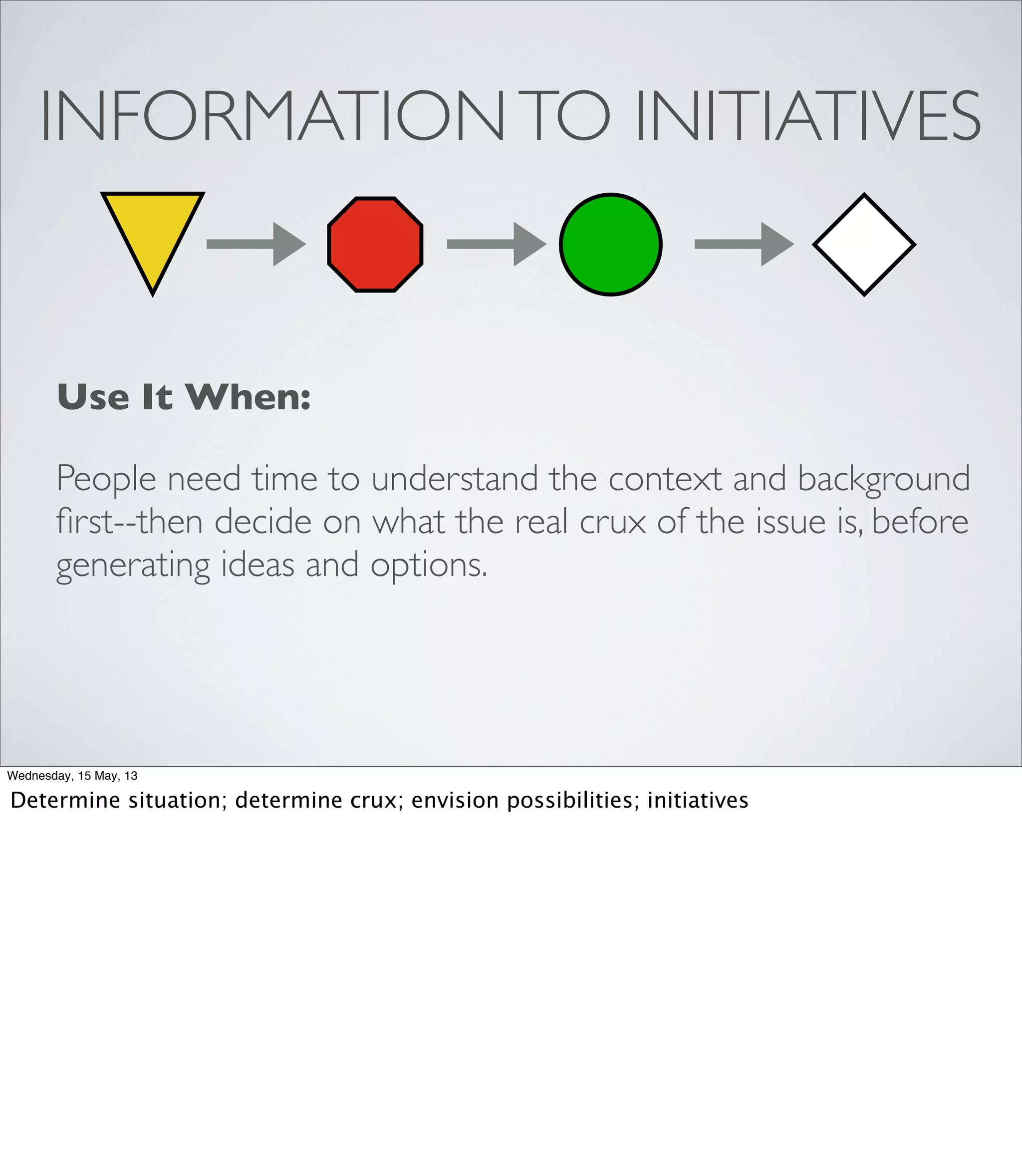
3.Focus on announcements and pronouncements.
4.No common understanding of each member’s operating style.
Wednesday, 15 May, 13
1.Lack of clarity about outcome. People in the meeting aren’t clear on the real purpose,
objective or expected outcome for each agenda item.
2. No commonly agreed-upon processes. There is no agreed-upon system or processs to
follow in order to figure things out.
3. Focus on announcements and pronouncements. There is no serious attempt to engage the
intelligence of every person in the meeting. Some meeting leaders do not know how to
engage people and may be afraid to “lose control” by giving everyone the opportunity to
speak up.
4. Too much time in yellow, sharing information. Too many meetings spend too much time in
the yellow zone - sharing and explaining information in detail - and not enough time in
green, generating alternatives, or in red, making decisions.
5. No common understanding of each member’s operating style. Smarter Meetings run on
brainpower. Different people think and operate differently. There is no understanding or
appreciation for tapping into the unique thinking that each member can offer.
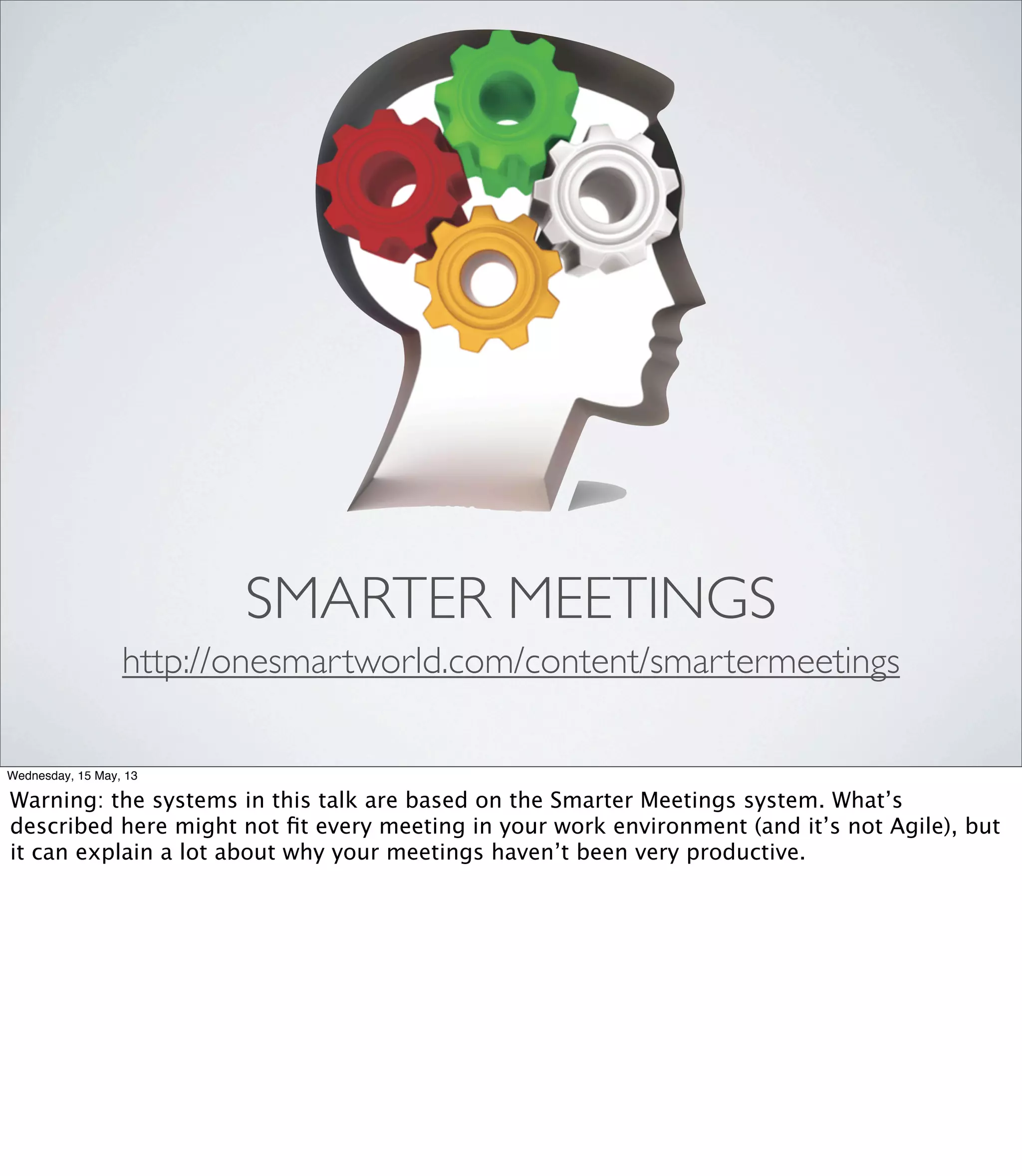
SMARTER MEETINGS
http://onesmartworld.com/content/smartermeetings
Wednesday, 15 May, 13
Warning: the systems in this talk are based on the Smarter Meetings system. What’s
described here might not fit every meeting in your work environment (and it’s not Agile), but
it can explain a lot about why your meetings haven’t been very productive.
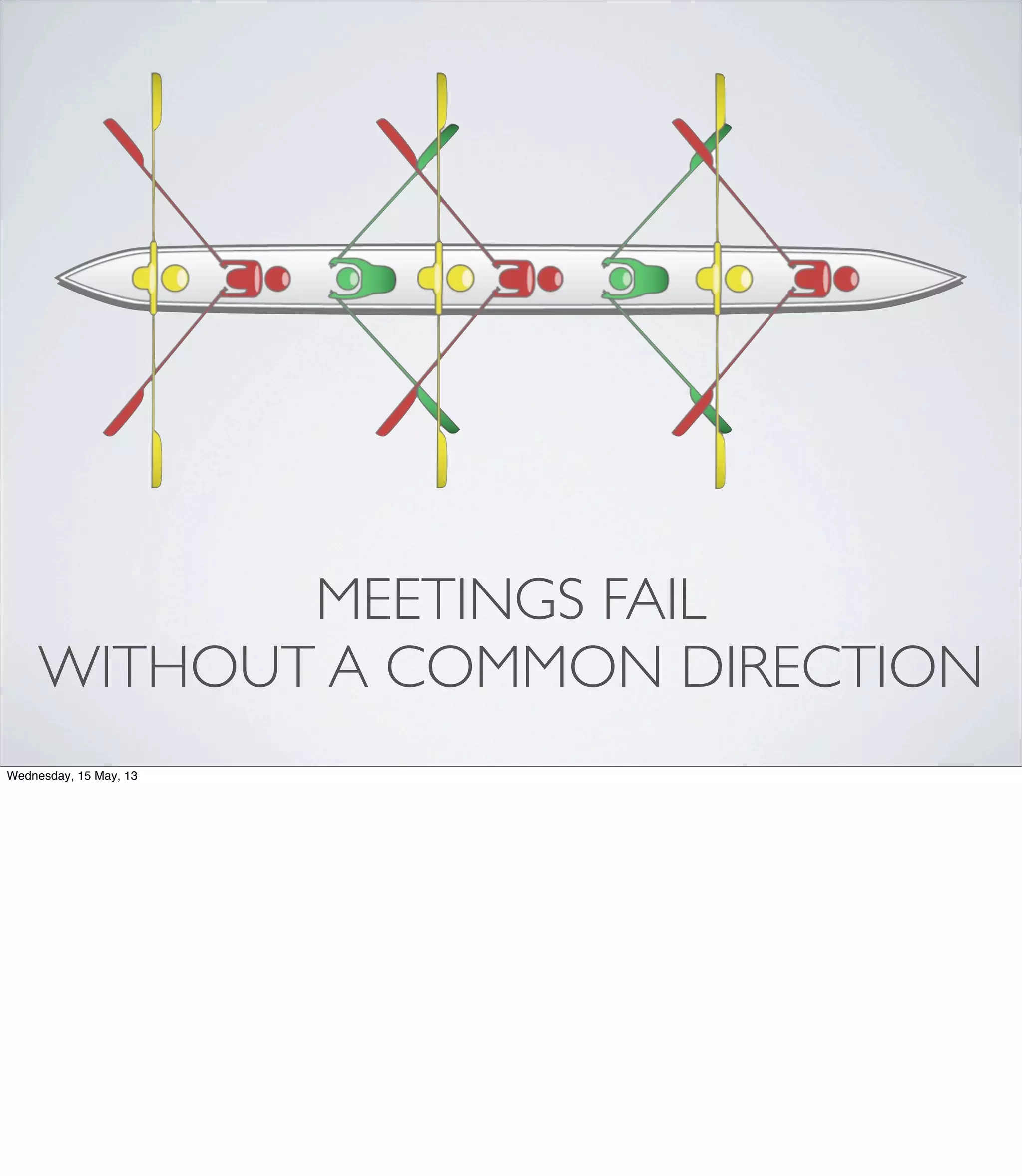
MEETINGS FAIL
WITHOUT A COMMON DIRECTION
Wednesday, 15 May, 13
A Smarter Meeting is when everyone agrees to do the
same type of thinking at the same time and follow a
disciplined process to achieve an outcome.
Wednesday, 15 May, 13
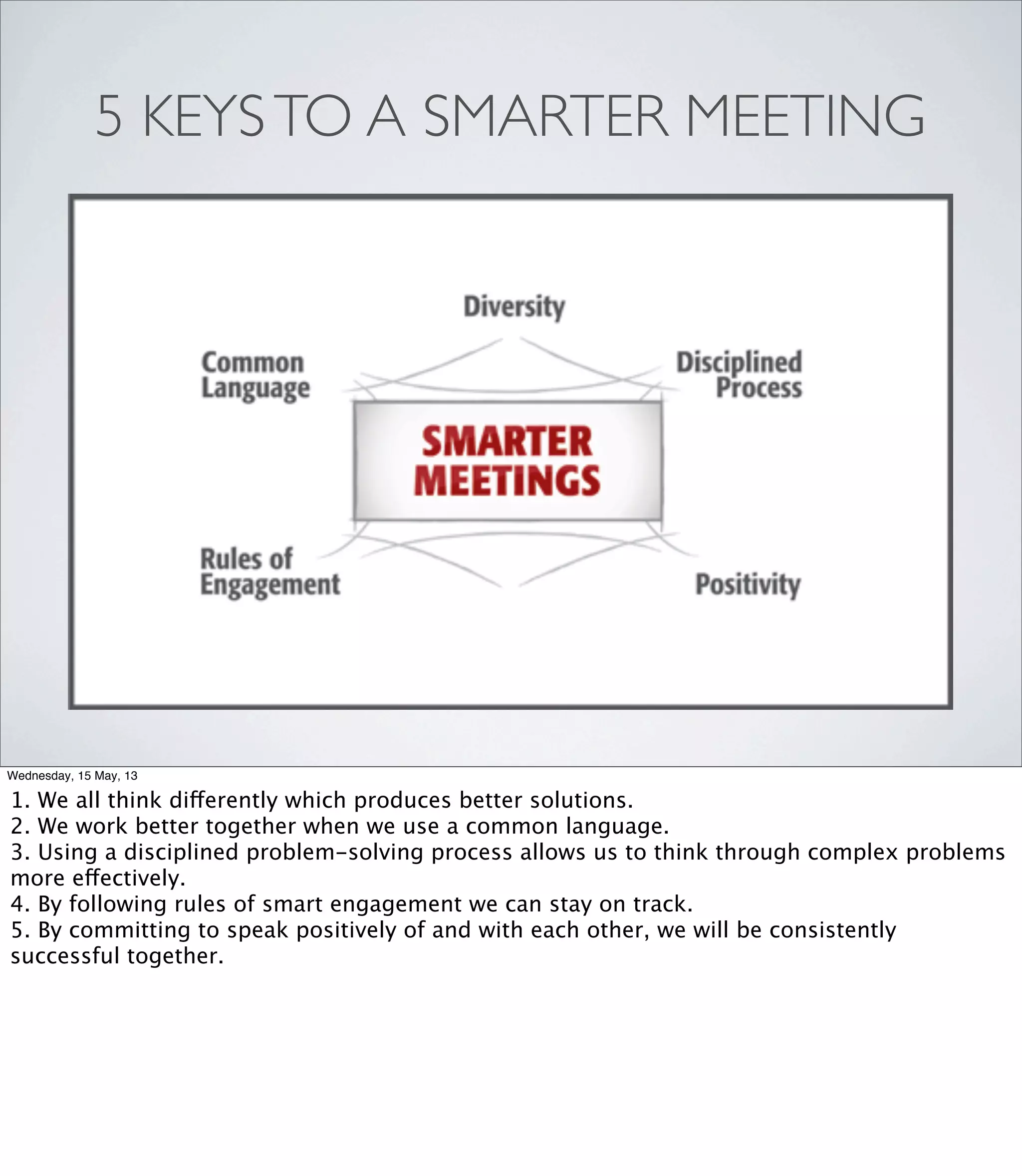
5 KEYSTO A SMARTER MEETING
Wednesday, 15 May, 13
1. We all think differently which produces better solutions.
2. We work better together when we use a common language.
3. Using a disciplined problem-solving process allows us to think through complex problems
more effectively.
4. By following rules of smart engagement we can stay on track.
5. By committing to speak positively of and with each other, we will be consistently
successful together.
PRINCIPLE 1:
DIVERSITY OFTHOUGHT
Wednesday, 15 May, 13
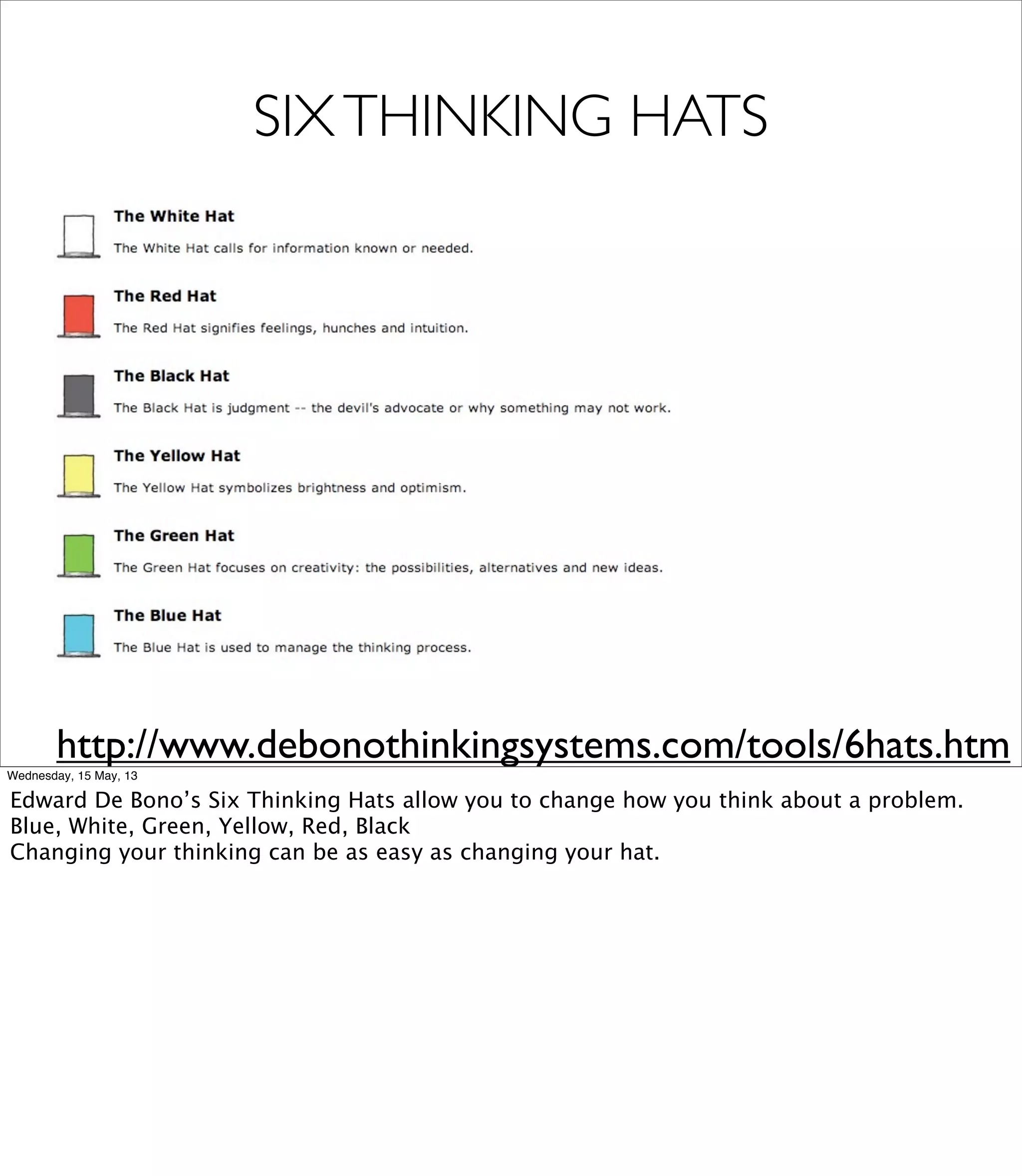
http://www.debonothinkingsystems.com/tools/6hats.htm
SIXTHINKING HATS
Wednesday, 15 May, 13
Edward De Bono’s Six Thinking Hats allow you to change how you think about a problem.
Blue, White, Green, Yellow, Red, Black
Changing your thinking can be as easy as changing your hat.
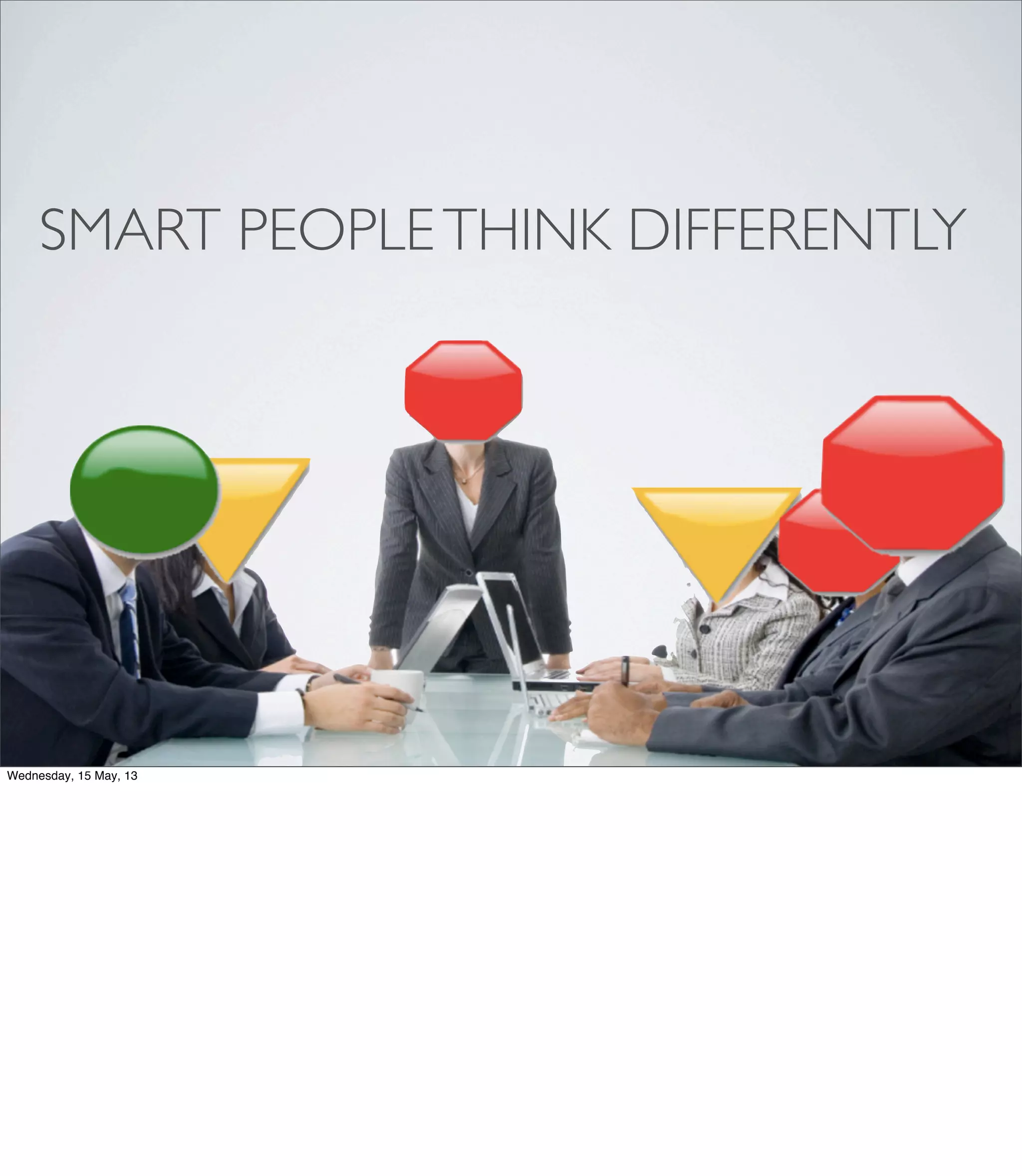
SMART PEOPLETHINK DIFFERENTLY
Wednesday, 15 May, 13
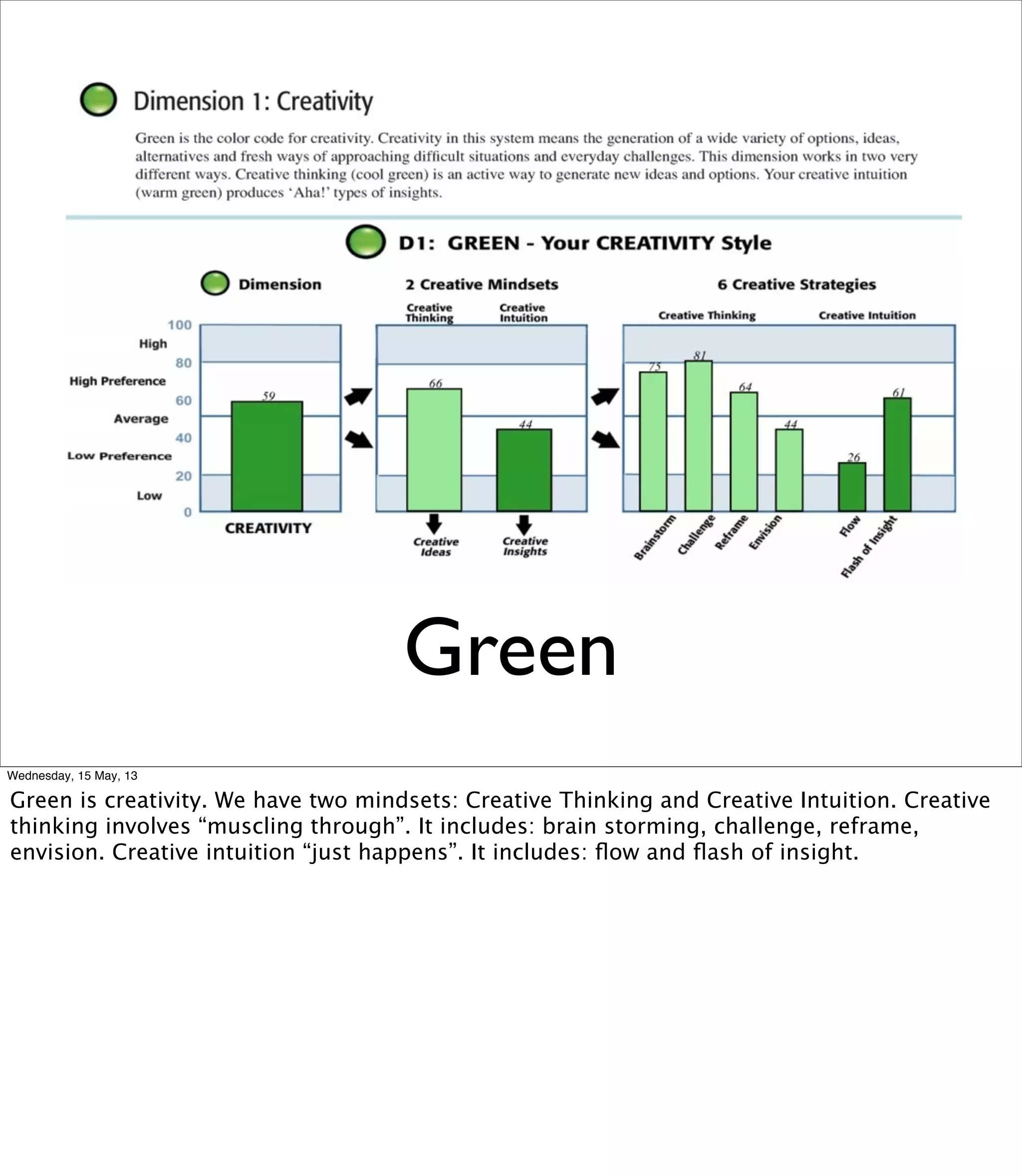
Green
Wednesday, 15 May, 13
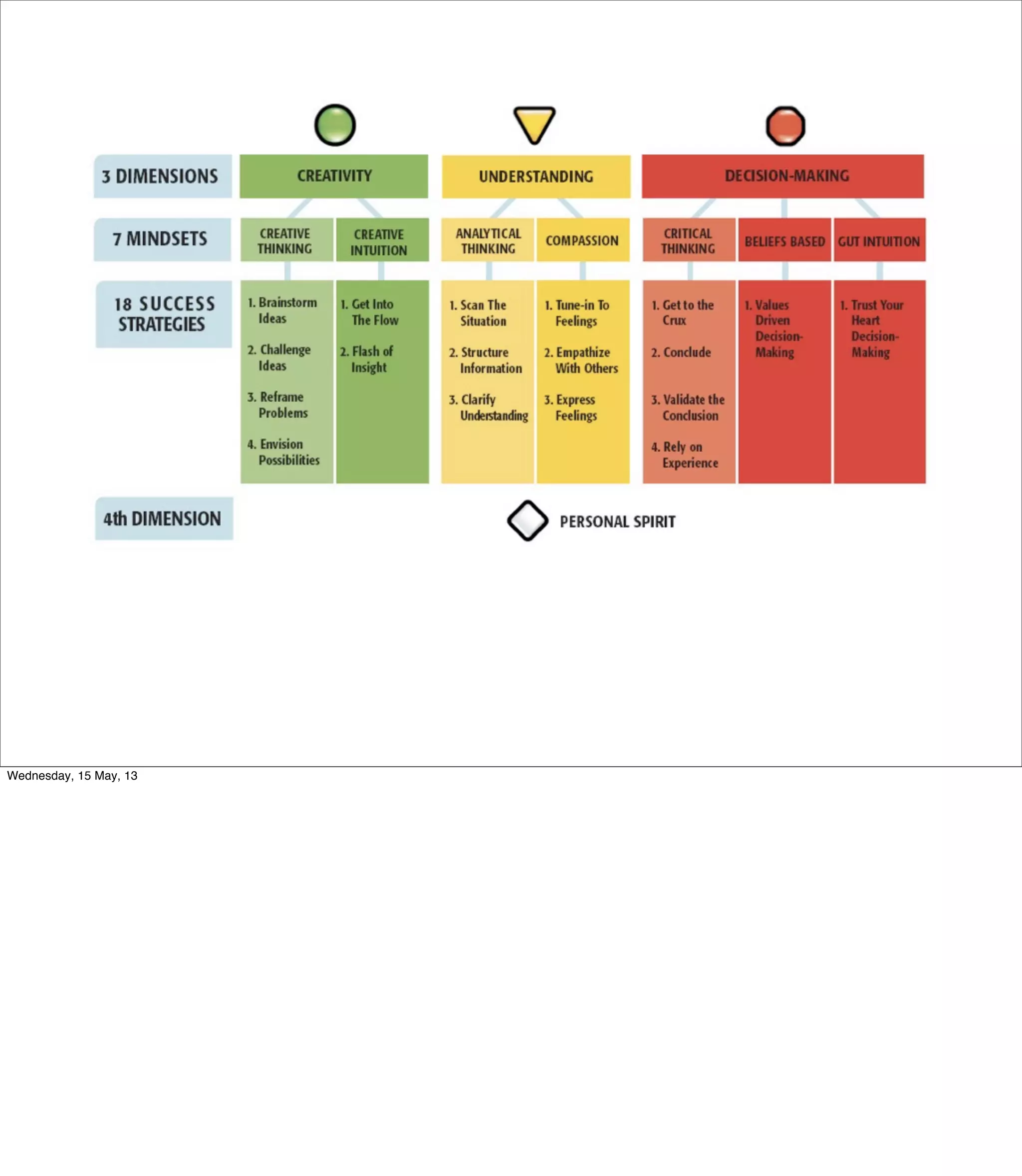
Green is creativity. We have two mindsets: Creative Thinking and Creative Intuition. Creative
thinking involves “muscling through”. It includes: brain storming, challenge, reframe,
envision. Creative intuition “just happens”. It includes: flow and flash of insight.
Yellow
Wednesday, 15 May, 13
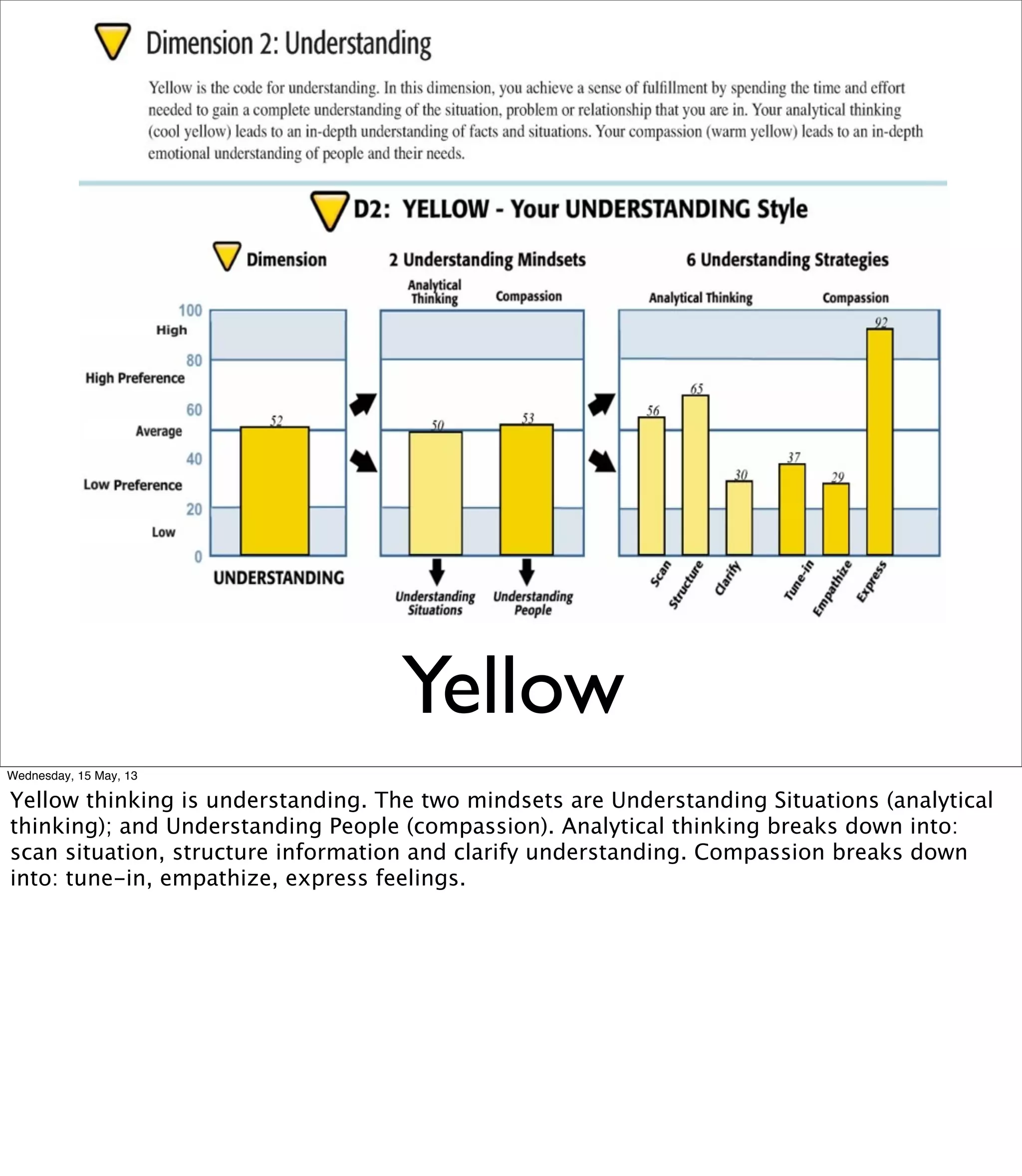
Yellow thinking is understanding. The two mindsets are Understanding Situations (analytical
thinking); and Understanding People (compassion). Analytical thinking breaks down into:
scan situation, structure information and clarify understanding. Compassion breaks down
into: tune-in, empathize, express feelings.
RedWednesday, 15 May, 13
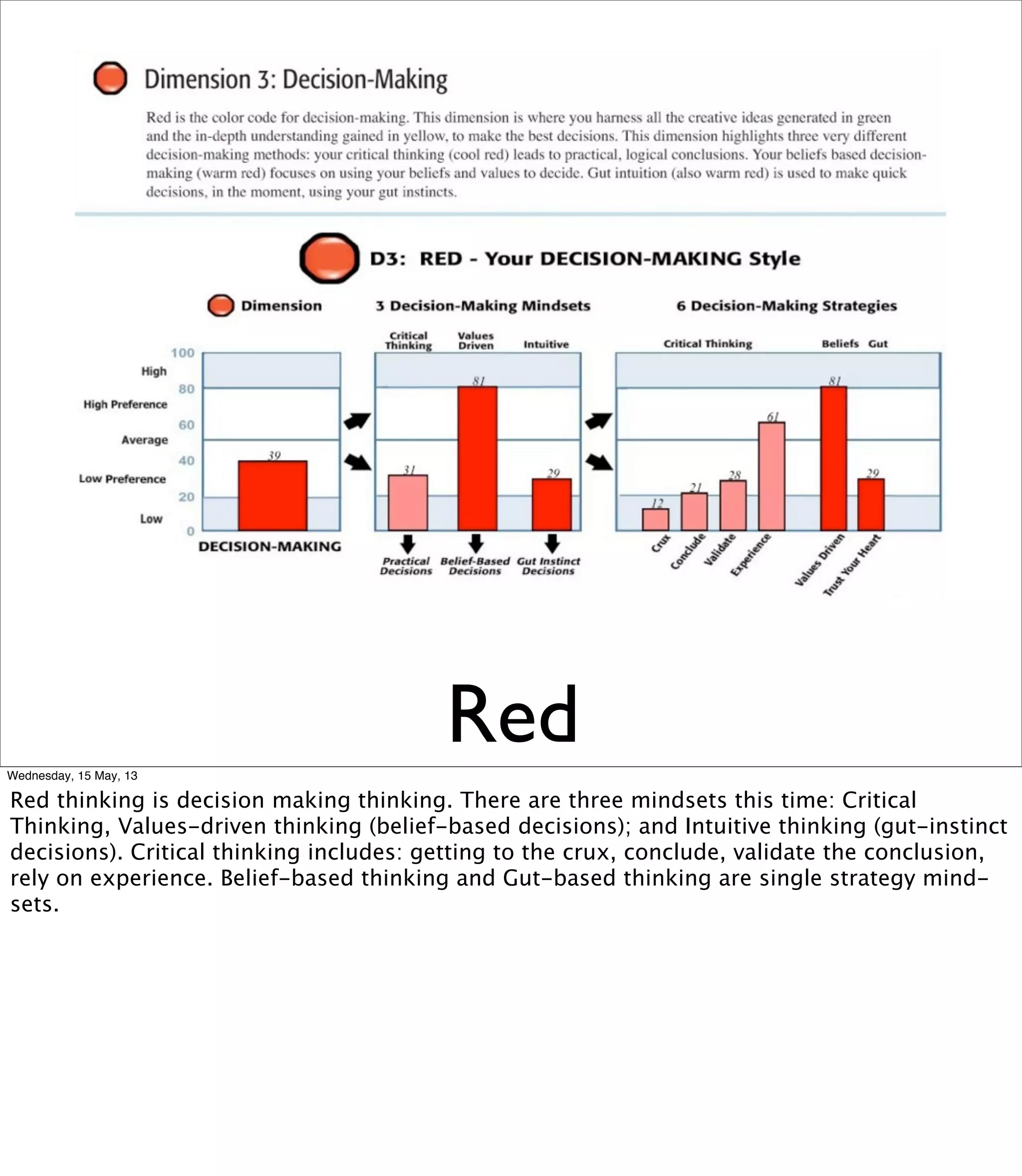
Red thinking is decision making thinking. There are three mindsets this time: Critical
Thinking, Values-driven thinking (belief-based decisions); and Intuitive thinking (gut-instinct
decisions). Critical thinking includes: getting to the crux, conclude, validate the conclusion,
rely on experience. Belief-based thinking and Gut-based thinking are single strategy mind-
sets.
What’s your preference?
These are me
Wednesday, 15 May, 13
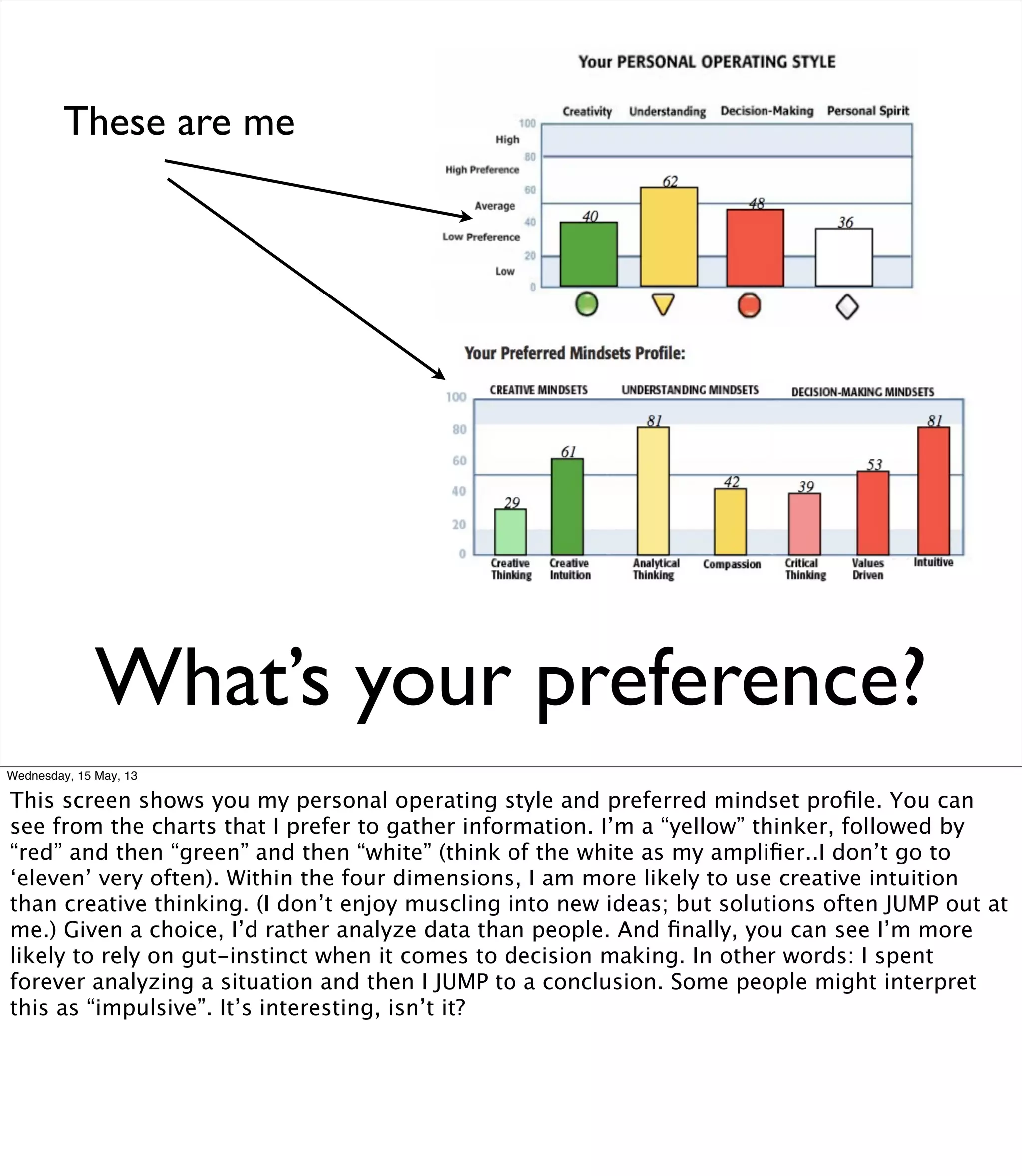
This screen shows you my personal operating style and preferred mindset profile. You can
see from the charts that I prefer to gather information. I’m a “yellow” thinker, followed by
“red” and then “green” and then “white” (think of the white as my amplifier..I don’t go to
‘eleven’ very often). Within the four dimensions, I am more likely to use creative intuition
than creative thinking. (I don’t enjoy muscling into new ideas; but solutions often JUMP out at
me.) Given a choice, I’d rather analyze data than people. And finally, you can see I’m more
likely to rely on gut-instinct when it comes to decision making. In other words: I spent
forever analyzing a situation and then I JUMP to a conclusion. Some people might interpret
this as “impulsive”. It’s interesting, isn’t it?
PRINCIPLE 2:
COMMON LANGUAGE
Wednesday, 15 May, 13
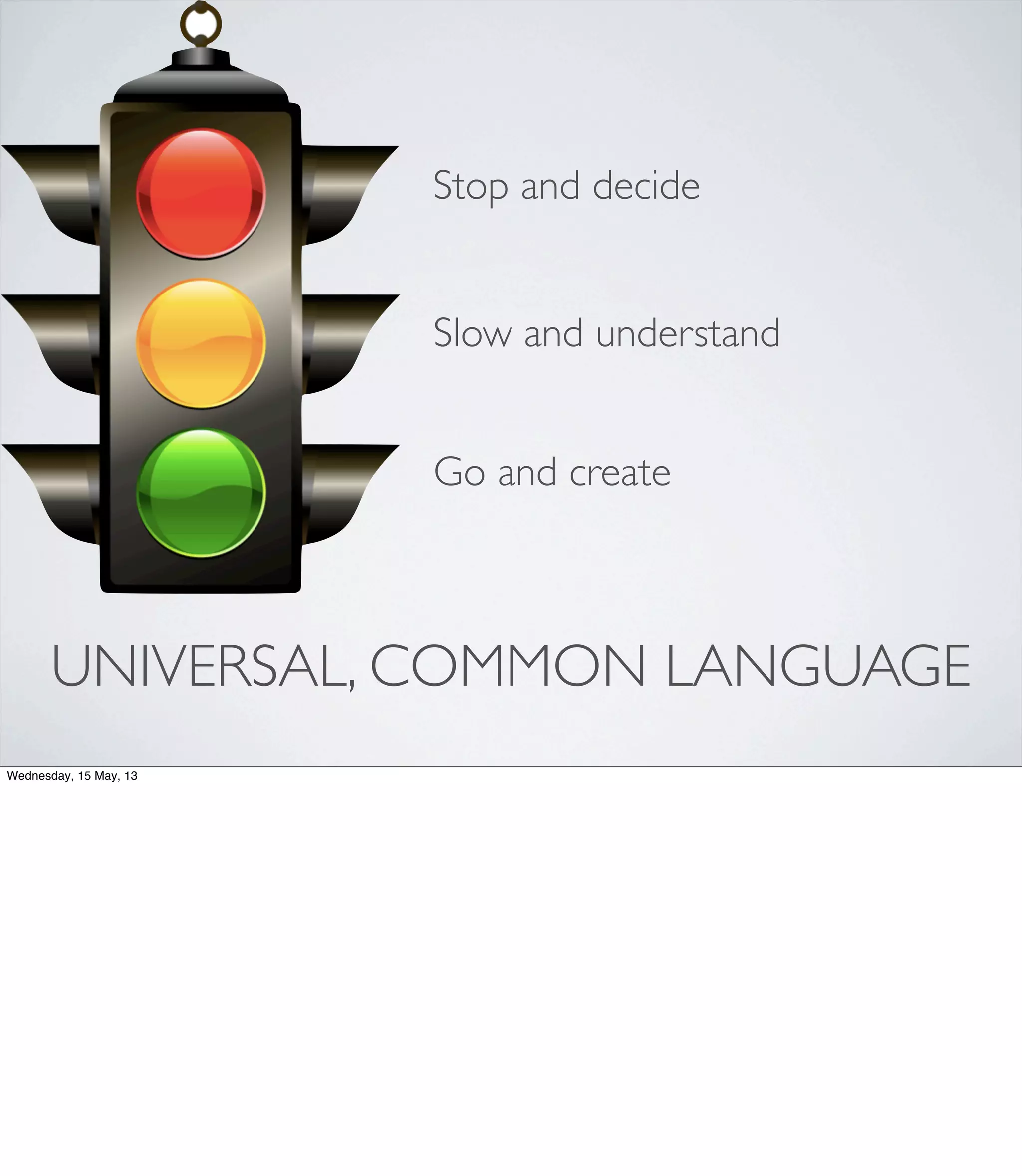
UNIVERSAL, COMMON LANGUAGE
Stop and decide
Slow and understand
Go and create
Wednesday, 15 May, 13
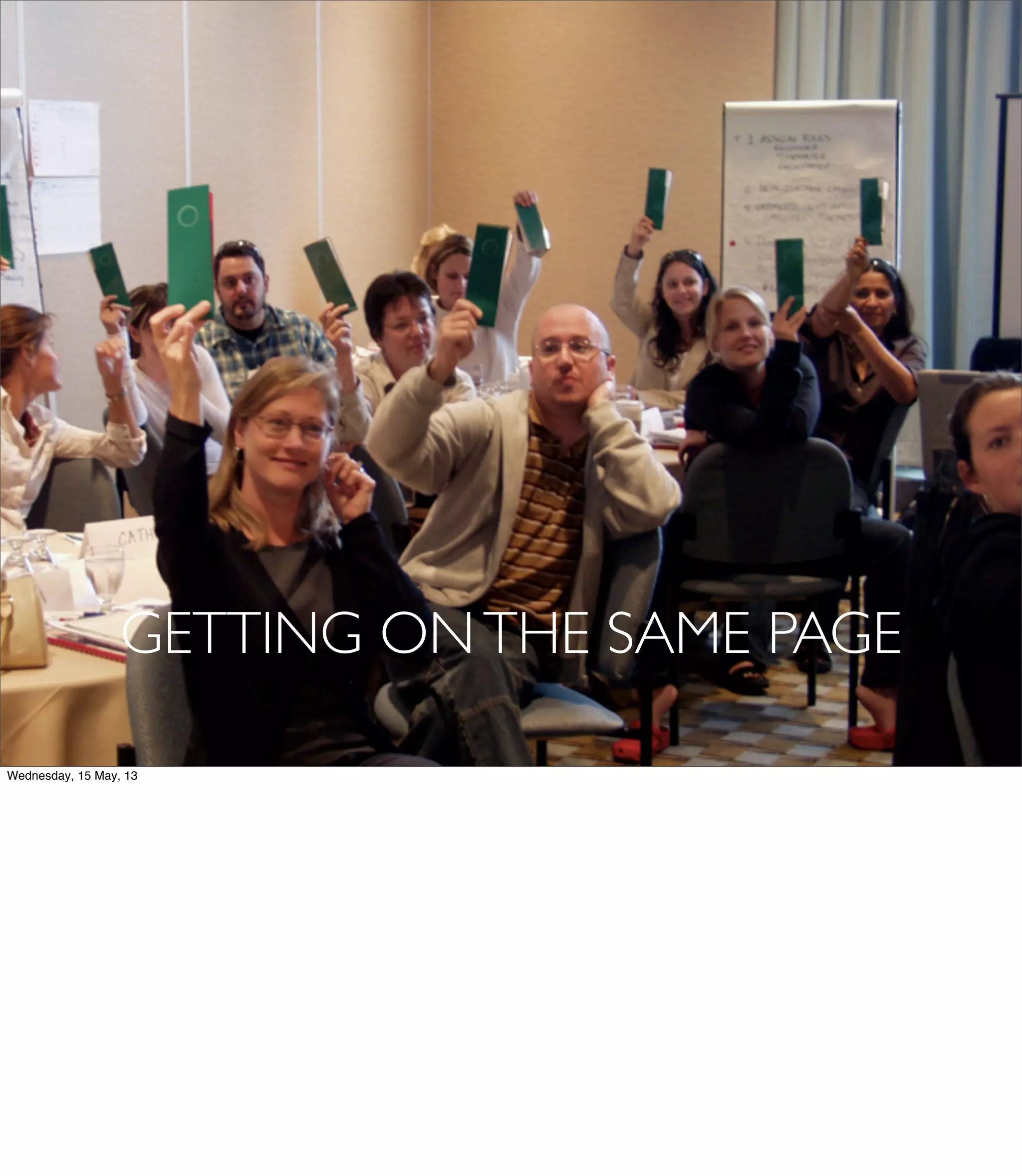
GETTING ONTHE SAME PAGE
Wednesday, 15 May, 13
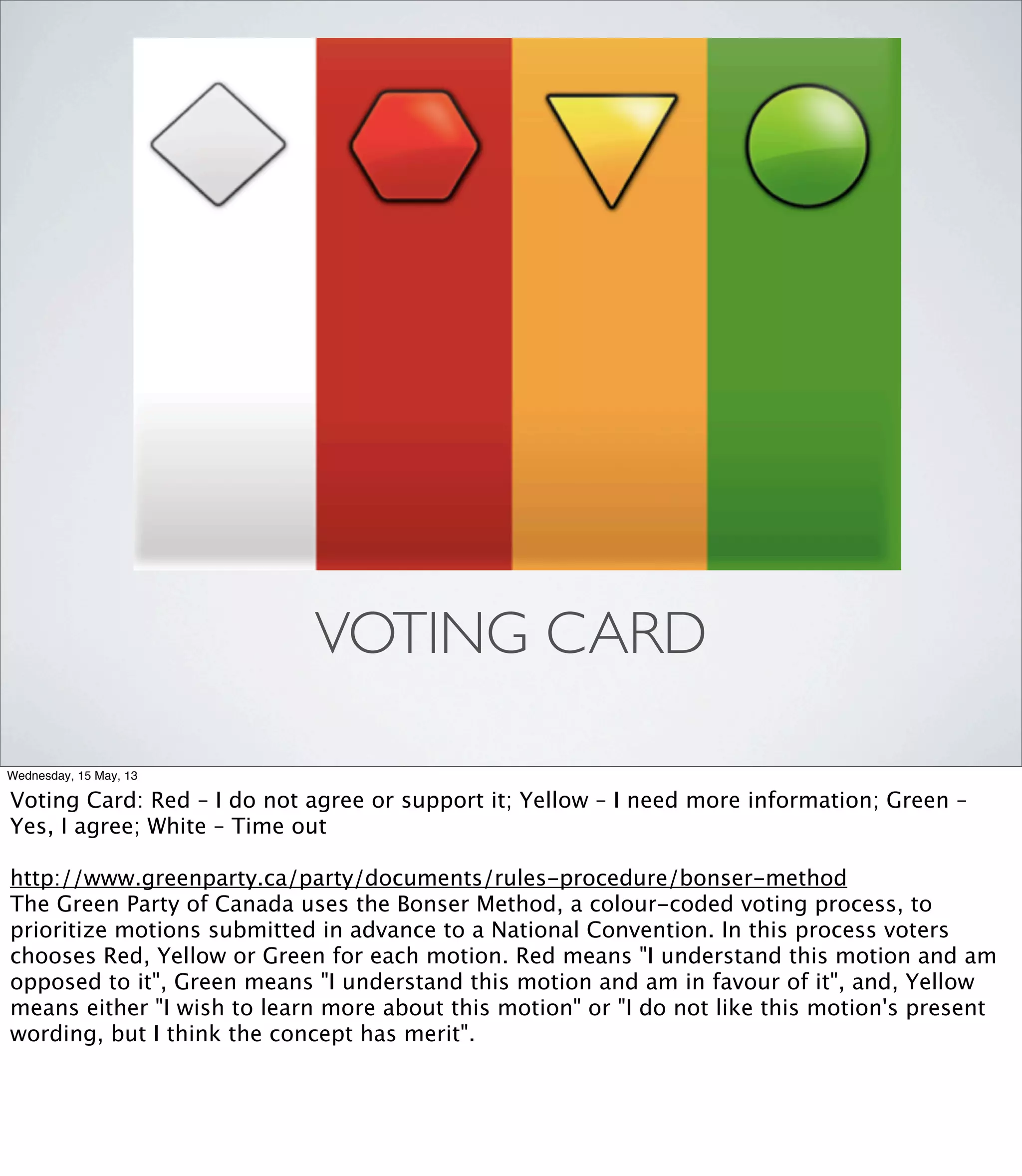
VOTING CARD
Wednesday, 15 May, 13
Voting Card: Red – I do not agree or support it; Yellow – I need more information; Green –
Yes, I agree; White – Time out
http://www.greenparty.ca/party/documents/rules-procedure/bonser-method
The Green Party of Canada uses the Bonser Method, a colour-coded voting process, to
prioritize motions submitted in advance to a National Convention. In this process voters
chooses Red, Yellow or Green for each motion. Red means "I understand this motion and am
opposed to it", Green means "I understand this motion and am in favour of it", and, Yellow
means either "I wish to learn more about this motion" or "I do not like this motion's present
wording, but I think the concept has merit".
PRINCIPLE 3:
DISCIPLINED PROCESS
Wednesday, 15 May, 13
With a disciplined process you will always know where you are, and where you’re going to
end up at the end of the meeting. There are three (ish) possible outcomes: Red, Green, and
Yellow. Let’s go through a few of the more common structures for a meeting.
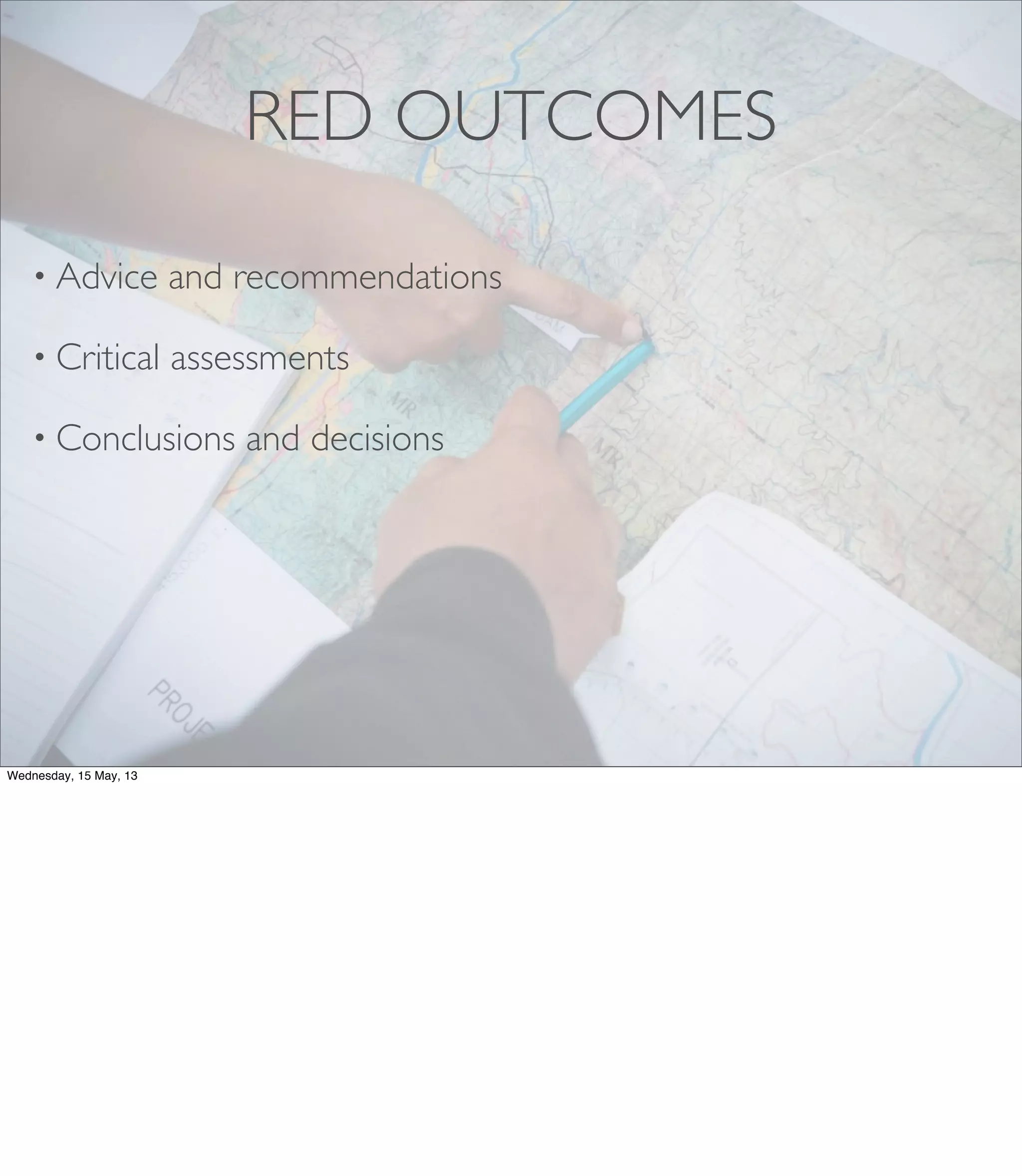
RED OUTCOMES
• Advice and recommendations
• Critical assessments
• Conclusions and decisions
Wednesday, 15 May, 13
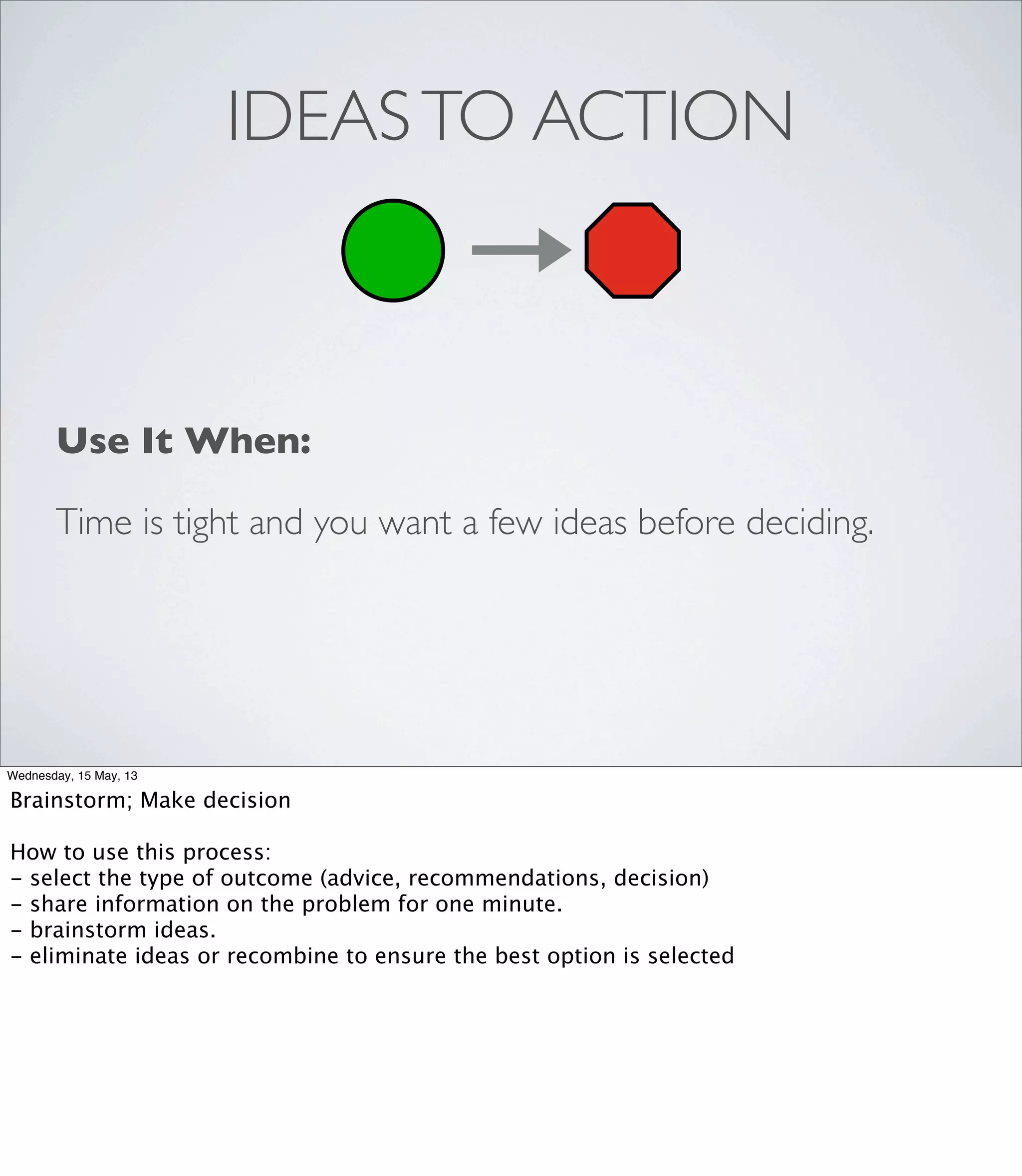
IDEASTO ACTION
Use It When:
Time is tight and you want a few ideas before deciding.
Wednesday, 15 May, 13
Brainstorm; Make decision
How to use this process:
- select the type of outcome (advice, recommendations, decision)
- share information on the problem for one minute.
- brainstorm ideas.
- eliminate ideas or recombine to ensure the best option is selected
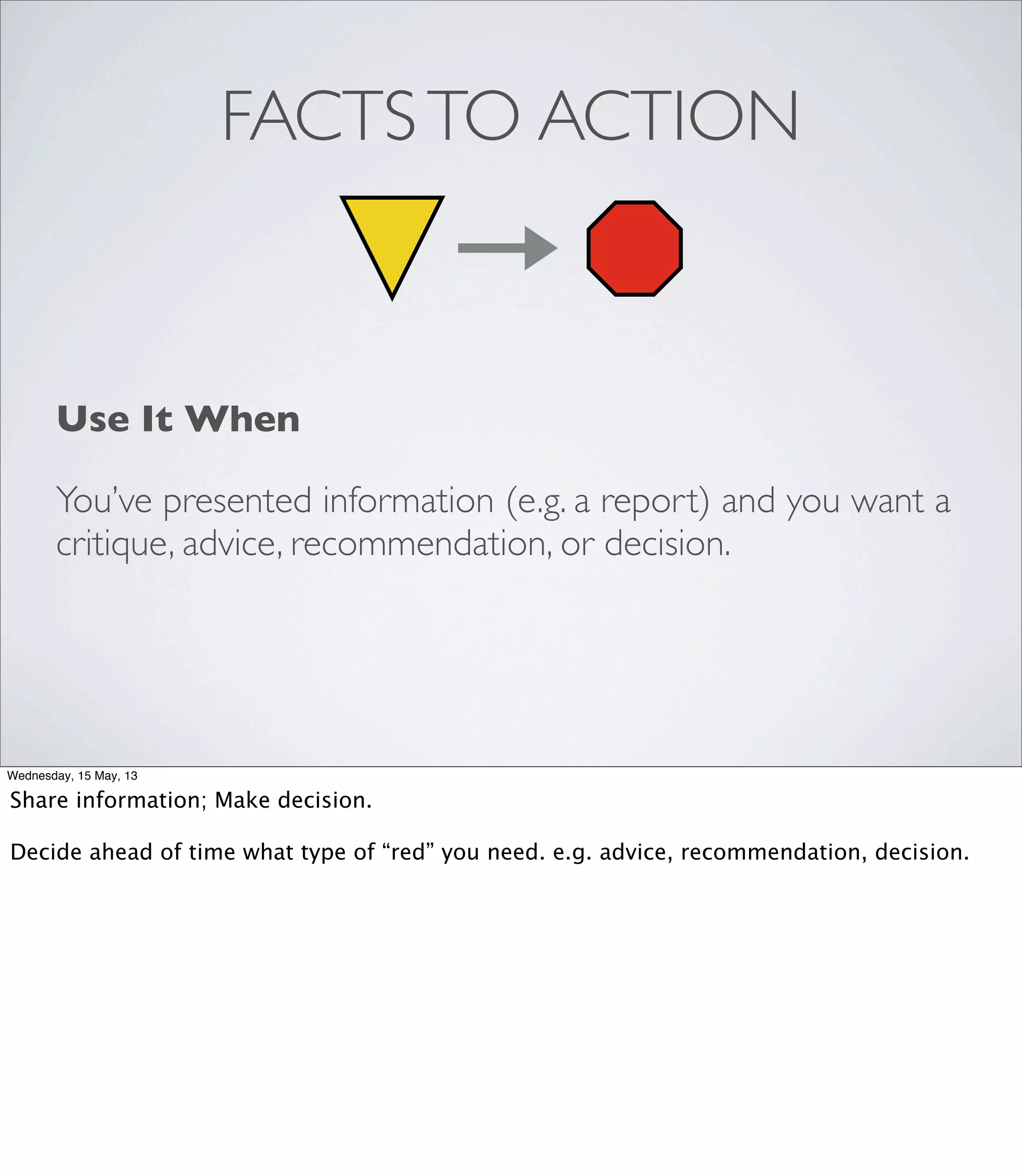
FACTSTO ACTION
Use It When
You’ve presented information (e.g. a report) and you want a
critique, advice, recommendation, or decision.
Wednesday, 15 May, 13
Share information; Make decision.
Decide ahead of time what type of “red” you need. e.g. advice, recommendation, decision.
GREEN OUTCOMES
• Idea generation
• Reframing problems
• Future scenarios
http://www.flickr.com/photos/afronie/2334879843
Wednesday, 15 May, 13
Use It When:
You need fresh input and a broader number of options,
alternatives, or ideas on how to solve a problem before you
choose which one is the right one.
INFORMATIONTO OPTIONS
Wednesday, 15 May, 13
Describe the situation; reframe + brainstorm.
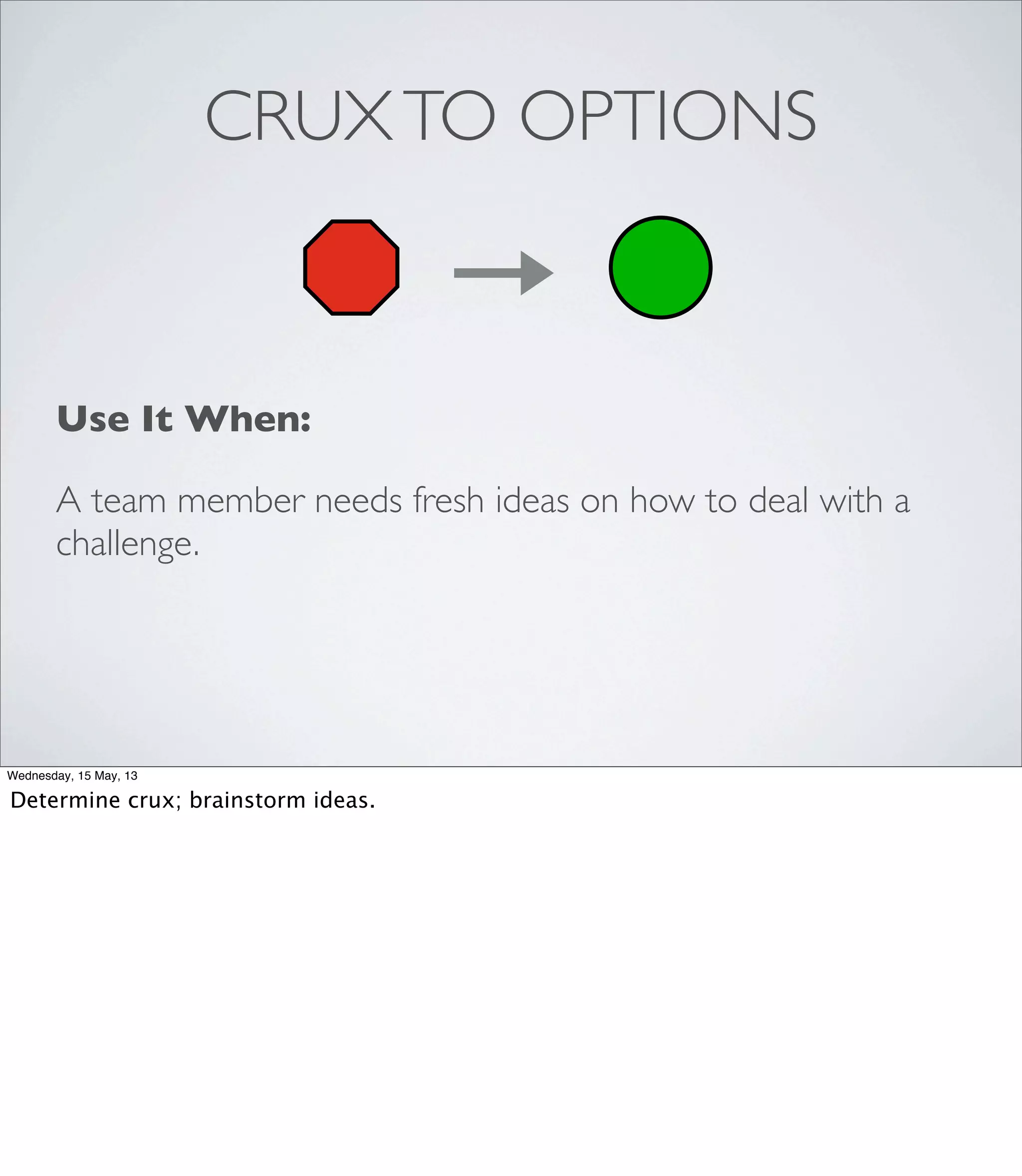
Use It When:
A team member needs fresh ideas on how to deal with a
challenge.
CRUXTO OPTIONS
Wednesday, 15 May, 13
Determine crux; brainstorm ideas.
Use It When:
People need time to understand the context and background
first--then decide on what the real crux of the issue is, before
generating ideas and options.
INFORMATIONTO INITIATIVES
Wednesday, 15 May, 13
Determine situation; determine crux; envision possibilities; initiatives
YELLOW OUTCOMES
• Information and clarification
• Analysis and a plan
• Appreciative understanding
http://www.flickr.com/photos/desiitaly/1310722870
Wednesday, 15 May, 13
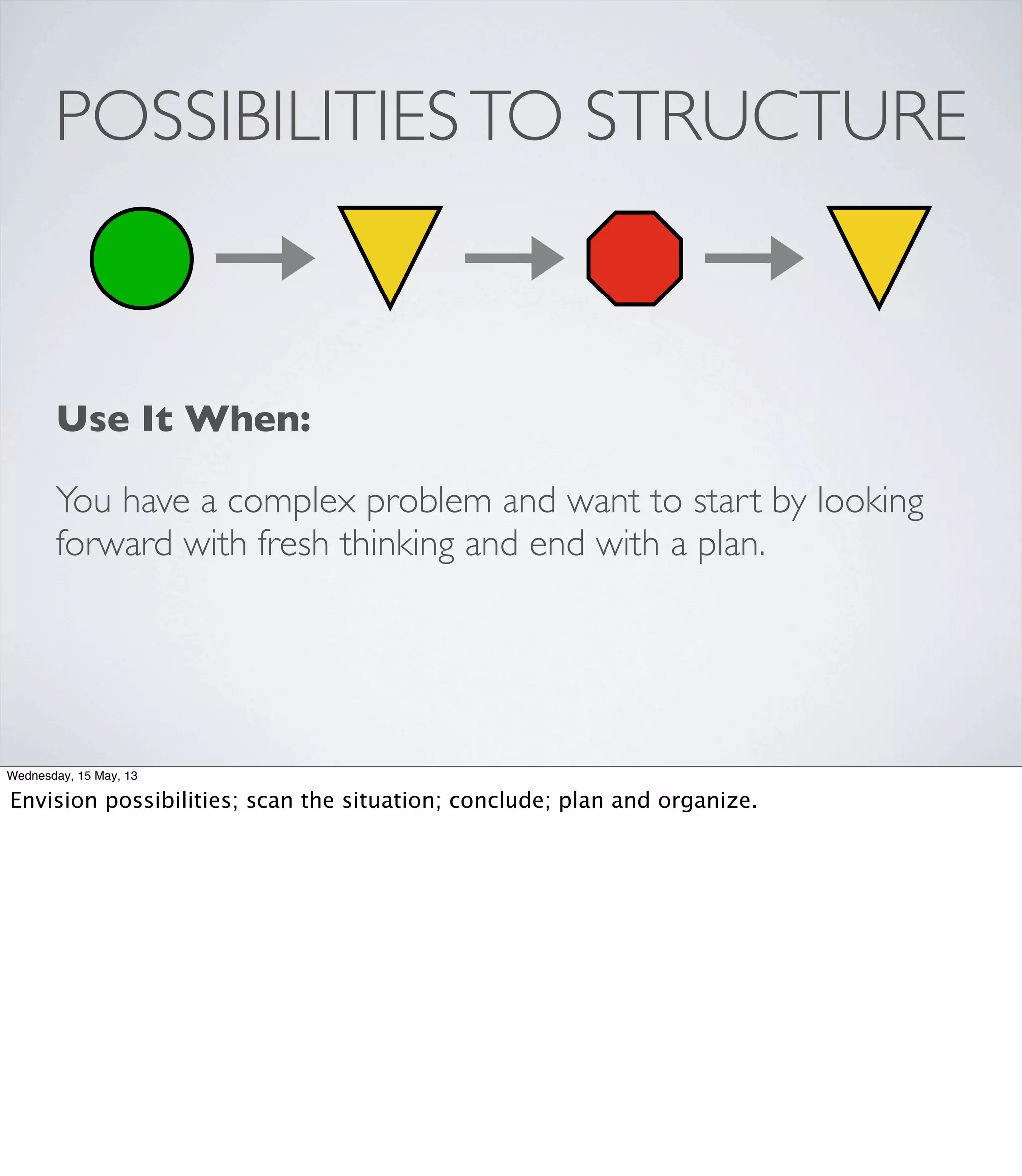
POSSIBILITIESTO STRUCTURE
Use It When:
You have a complex problem and want to start by looking
forward with fresh thinking and end with a plan.
Wednesday, 15 May, 13
Envision possibilities; scan the situation; conclude; plan and organize.
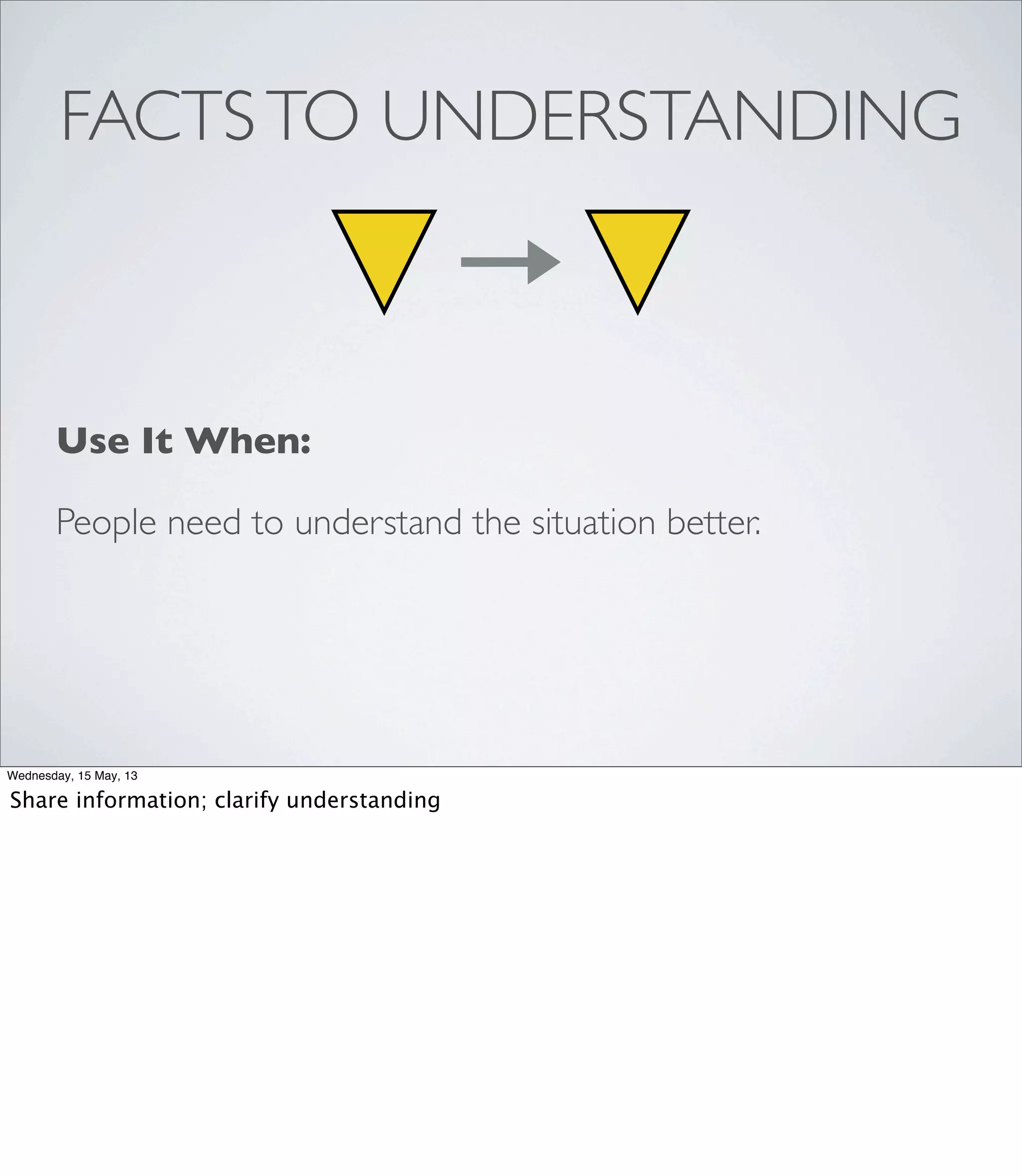
Use It When:
People need to understand the situation better.
FACTSTO UNDERSTANDING
Wednesday, 15 May, 13
Share information; clarify understanding
Use It When:
You have a challenging issue to think through and you want to
end up with both a decision and a plan of action to implement
the decision
CRUXTO ORGANIZE
Wednesday, 15 May, 13
Determine the crux; generate ideas; organize ideas; make a decision; plan and organize.
PRINCIPLE 4:
RULES OF ENGAGEMENT
Wednesday, 15 May, 13
ROLES
• Facilitator
• Time keeper
• Recorder
• Participants
Wednesday, 15 May, 13
• Scan and learn – don’t judge
• Sort and organize data into categories
• Tune in to how others are feeling
• Listen carefully to everyone
• Connect, collaborate and deepen understanding
YELLOW RULES OF ENGAGEMENT
Wednesday, 15 May, 13
GREEN RULES OF ENGAGEMENT
• Generate as many ideas as you can
• Work quickly – don’t judge any of the ideas
• See every challenge as an opportunity
• Reframe problems to find hidden potential
• Envision future solutions and possibilities
Wednesday, 15 May, 13
RED RULES OF ENGAGEMENT
• Get to the heart of the issue
• Argue and debate pros and cons
• Ask tough questions
• Push for conclusions and closure
• Make decisions
Wednesday, 15 May, 13
PRINCIPLE 5:
POSITIVITY
Wednesday, 15 May, 13
• Speak positively consistently
• Seek constructive solutions
• Be affirmative, collaborative, supportive
• Ensure 5:1 positive to negative ratio
ALOTBSOL
Wednesday, 15 May, 13
Always look on the bright side of life.
SHIFT UP!
Personal Spirit Check-in:
• “On a scale of 1-7, how are you feeling right now?”
• “What do you need from your team members today to do
your best work?”
Wednesday, 15 May, 13
5 KEYSTO A SMARTER MEETING
1.We all think differently which produces better solutions.
2. Using a common language allow us to work better together.
3. Using a disciplined problem-solving process allows us to
think through complex problems more effectively.
4. By following rules of engagement we can stay on track.
5. By speaking positively we will be successful together.
@emmajanehw
http://drupalize.me
Wednesday, 15 May, 13

Beyond the Bikeshed

  • 1.
    BEYONDTHE BIKESHED @emmajanehw http://drupalize.me Wednesday, 15May, 13 The bigger the company, the more likely you are to get dragged into meetings that waste your time, waste your talent, and waste your company's money. Sure, it's great to be included in the process, but wouldn't it be even nicer if the process didn't waste your time? In this session Emma Jane Hogbin show you five simple tips to make your time in meetings more efficient. Want to dig deeper? She'll explain why these five tips work and show you how to make more of your interactions with (difficult) people more efficient and enjoyable.
  • 2.
    SABOTAGE! http://www.mtv.com/photos/legendary-beastie-boy-style-moments/1684557/7126352/photo.jhtml#7126352 Wednesday, 15 May,13 SABOTAAAAAAAGE. List 5 ways we sabotage meetings. Read aloud and list on flipchart Discuss and determine group’s top 7 Agree on how to stop sabotage behaviours Use list as Smarter Meetings Rules of Order Post list at all subsequent meetings Image source: http://www.mtv.com/photos/legendary-beastie-boy-style-moments/ 1684557/7126352/photo.jhtml#7126352
  • 3.
    ROOT CAUSES OF BADMEETINGS 1.Lack of clarity about outcome. 2.No agreed-upon system or process to follow to figure things out. 3.Focus on announcements and pronouncements. 4.No common understanding of each member’s operating style. Wednesday, 15 May, 13 1.Lack of clarity about outcome. People in the meeting aren’t clear on the real purpose, objective or expected outcome for each agenda item. 2. No commonly agreed-upon processes. There is no agreed-upon system or processs to follow in order to figure things out. 3. Focus on announcements and pronouncements. There is no serious attempt to engage the intelligence of every person in the meeting. Some meeting leaders do not know how to engage people and may be afraid to “lose control” by giving everyone the opportunity to speak up. 4. Too much time in yellow, sharing information. Too many meetings spend too much time in the yellow zone - sharing and explaining information in detail - and not enough time in green, generating alternatives, or in red, making decisions. 5. No common understanding of each member’s operating style. Smarter Meetings run on brainpower. Different people think and operate differently. There is no understanding or appreciation for tapping into the unique thinking that each member can offer.
  • 4.
    SMARTER MEETINGS http://onesmartworld.com/content/smartermeetings Wednesday, 15May, 13 Warning: the systems in this talk are based on the Smarter Meetings system. What’s described here might not fit every meeting in your work environment (and it’s not Agile), but it can explain a lot about why your meetings haven’t been very productive.
  • 5.
    MEETINGS FAIL WITHOUT ACOMMON DIRECTION Wednesday, 15 May, 13
  • 6.
    A Smarter Meetingis when everyone agrees to do the same type of thinking at the same time and follow a disciplined process to achieve an outcome. Wednesday, 15 May, 13
  • 7.
    5 KEYSTO ASMARTER MEETING Wednesday, 15 May, 13 1. We all think differently which produces better solutions. 2. We work better together when we use a common language. 3. Using a disciplined problem-solving process allows us to think through complex problems more effectively. 4. By following rules of smart engagement we can stay on track. 5. By committing to speak positively of and with each other, we will be consistently successful together.
  • 8.
  • 9.
    http://www.debonothinkingsystems.com/tools/6hats.htm SIXTHINKING HATS Wednesday, 15May, 13 Edward De Bono’s Six Thinking Hats allow you to change how you think about a problem. Blue, White, Green, Yellow, Red, Black Changing your thinking can be as easy as changing your hat.
  • 10.
  • 11.
  • 12.
    Green Wednesday, 15 May,13 Green is creativity. We have two mindsets: Creative Thinking and Creative Intuition. Creative thinking involves “muscling through”. It includes: brain storming, challenge, reframe, envision. Creative intuition “just happens”. It includes: flow and flash of insight.
  • 13.
    Yellow Wednesday, 15 May,13 Yellow thinking is understanding. The two mindsets are Understanding Situations (analytical thinking); and Understanding People (compassion). Analytical thinking breaks down into: scan situation, structure information and clarify understanding. Compassion breaks down into: tune-in, empathize, express feelings.
  • 14.
    RedWednesday, 15 May,13 Red thinking is decision making thinking. There are three mindsets this time: Critical Thinking, Values-driven thinking (belief-based decisions); and Intuitive thinking (gut-instinct decisions). Critical thinking includes: getting to the crux, conclude, validate the conclusion, rely on experience. Belief-based thinking and Gut-based thinking are single strategy mind- sets.
  • 15.
    What’s your preference? Theseare me Wednesday, 15 May, 13 This screen shows you my personal operating style and preferred mindset profile. You can see from the charts that I prefer to gather information. I’m a “yellow” thinker, followed by “red” and then “green” and then “white” (think of the white as my amplifier..I don’t go to ‘eleven’ very often). Within the four dimensions, I am more likely to use creative intuition than creative thinking. (I don’t enjoy muscling into new ideas; but solutions often JUMP out at me.) Given a choice, I’d rather analyze data than people. And finally, you can see I’m more likely to rely on gut-instinct when it comes to decision making. In other words: I spent forever analyzing a situation and then I JUMP to a conclusion. Some people might interpret this as “impulsive”. It’s interesting, isn’t it?
  • 16.
  • 17.
    UNIVERSAL, COMMON LANGUAGE Stopand decide Slow and understand Go and create Wednesday, 15 May, 13
  • 18.
    GETTING ONTHE SAMEPAGE Wednesday, 15 May, 13
  • 19.
    VOTING CARD Wednesday, 15May, 13 Voting Card: Red – I do not agree or support it; Yellow – I need more information; Green – Yes, I agree; White – Time out http://www.greenparty.ca/party/documents/rules-procedure/bonser-method The Green Party of Canada uses the Bonser Method, a colour-coded voting process, to prioritize motions submitted in advance to a National Convention. In this process voters chooses Red, Yellow or Green for each motion. Red means "I understand this motion and am opposed to it", Green means "I understand this motion and am in favour of it", and, Yellow means either "I wish to learn more about this motion" or "I do not like this motion's present wording, but I think the concept has merit".
  • 20.
    PRINCIPLE 3: DISCIPLINED PROCESS Wednesday,15 May, 13 With a disciplined process you will always know where you are, and where you’re going to end up at the end of the meeting. There are three (ish) possible outcomes: Red, Green, and Yellow. Let’s go through a few of the more common structures for a meeting.
  • 21.
    RED OUTCOMES • Adviceand recommendations • Critical assessments • Conclusions and decisions Wednesday, 15 May, 13
  • 22.
    IDEASTO ACTION Use ItWhen: Time is tight and you want a few ideas before deciding. Wednesday, 15 May, 13 Brainstorm; Make decision How to use this process: - select the type of outcome (advice, recommendations, decision) - share information on the problem for one minute. - brainstorm ideas. - eliminate ideas or recombine to ensure the best option is selected
  • 23.
    FACTSTO ACTION Use ItWhen You’ve presented information (e.g. a report) and you want a critique, advice, recommendation, or decision. Wednesday, 15 May, 13 Share information; Make decision. Decide ahead of time what type of “red” you need. e.g. advice, recommendation, decision.
  • 24.
    GREEN OUTCOMES • Ideageneration • Reframing problems • Future scenarios http://www.flickr.com/photos/afronie/2334879843 Wednesday, 15 May, 13
  • 25.
    Use It When: Youneed fresh input and a broader number of options, alternatives, or ideas on how to solve a problem before you choose which one is the right one. INFORMATIONTO OPTIONS Wednesday, 15 May, 13 Describe the situation; reframe + brainstorm.
  • 26.
    Use It When: Ateam member needs fresh ideas on how to deal with a challenge. CRUXTO OPTIONS Wednesday, 15 May, 13 Determine crux; brainstorm ideas.
  • 27.
    Use It When: Peopleneed time to understand the context and background first--then decide on what the real crux of the issue is, before generating ideas and options. INFORMATIONTO INITIATIVES Wednesday, 15 May, 13 Determine situation; determine crux; envision possibilities; initiatives
  • 28.
    YELLOW OUTCOMES • Informationand clarification • Analysis and a plan • Appreciative understanding http://www.flickr.com/photos/desiitaly/1310722870 Wednesday, 15 May, 13
  • 29.
    POSSIBILITIESTO STRUCTURE Use ItWhen: You have a complex problem and want to start by looking forward with fresh thinking and end with a plan. Wednesday, 15 May, 13 Envision possibilities; scan the situation; conclude; plan and organize.
  • 30.
    Use It When: Peopleneed to understand the situation better. FACTSTO UNDERSTANDING Wednesday, 15 May, 13 Share information; clarify understanding
  • 31.
    Use It When: Youhave a challenging issue to think through and you want to end up with both a decision and a plan of action to implement the decision CRUXTO ORGANIZE Wednesday, 15 May, 13 Determine the crux; generate ideas; organize ideas; make a decision; plan and organize.
  • 32.
    PRINCIPLE 4: RULES OFENGAGEMENT Wednesday, 15 May, 13
  • 33.
    ROLES • Facilitator • Timekeeper • Recorder • Participants Wednesday, 15 May, 13
  • 34.
    • Scan andlearn – don’t judge • Sort and organize data into categories • Tune in to how others are feeling • Listen carefully to everyone • Connect, collaborate and deepen understanding YELLOW RULES OF ENGAGEMENT Wednesday, 15 May, 13
  • 35.
    GREEN RULES OFENGAGEMENT • Generate as many ideas as you can • Work quickly – don’t judge any of the ideas • See every challenge as an opportunity • Reframe problems to find hidden potential • Envision future solutions and possibilities Wednesday, 15 May, 13
  • 36.
    RED RULES OFENGAGEMENT • Get to the heart of the issue • Argue and debate pros and cons • Ask tough questions • Push for conclusions and closure • Make decisions Wednesday, 15 May, 13
  • 37.
  • 38.
    • Speak positivelyconsistently • Seek constructive solutions • Be affirmative, collaborative, supportive • Ensure 5:1 positive to negative ratio ALOTBSOL Wednesday, 15 May, 13 Always look on the bright side of life.
  • 39.
    SHIFT UP! Personal SpiritCheck-in: • “On a scale of 1-7, how are you feeling right now?” • “What do you need from your team members today to do your best work?” Wednesday, 15 May, 13
  • 40.
    5 KEYSTO ASMARTER MEETING 1.We all think differently which produces better solutions. 2. Using a common language allow us to work better together. 3. Using a disciplined problem-solving process allows us to think through complex problems more effectively. 4. By following rules of engagement we can stay on track. 5. By speaking positively we will be successful together. @emmajanehw http://drupalize.me Wednesday, 15 May, 13