Conversation is the
command line of tomorrow
@dancharvey #conversationalUI
COMMAND LINE
@dancharvey #conversationalUI
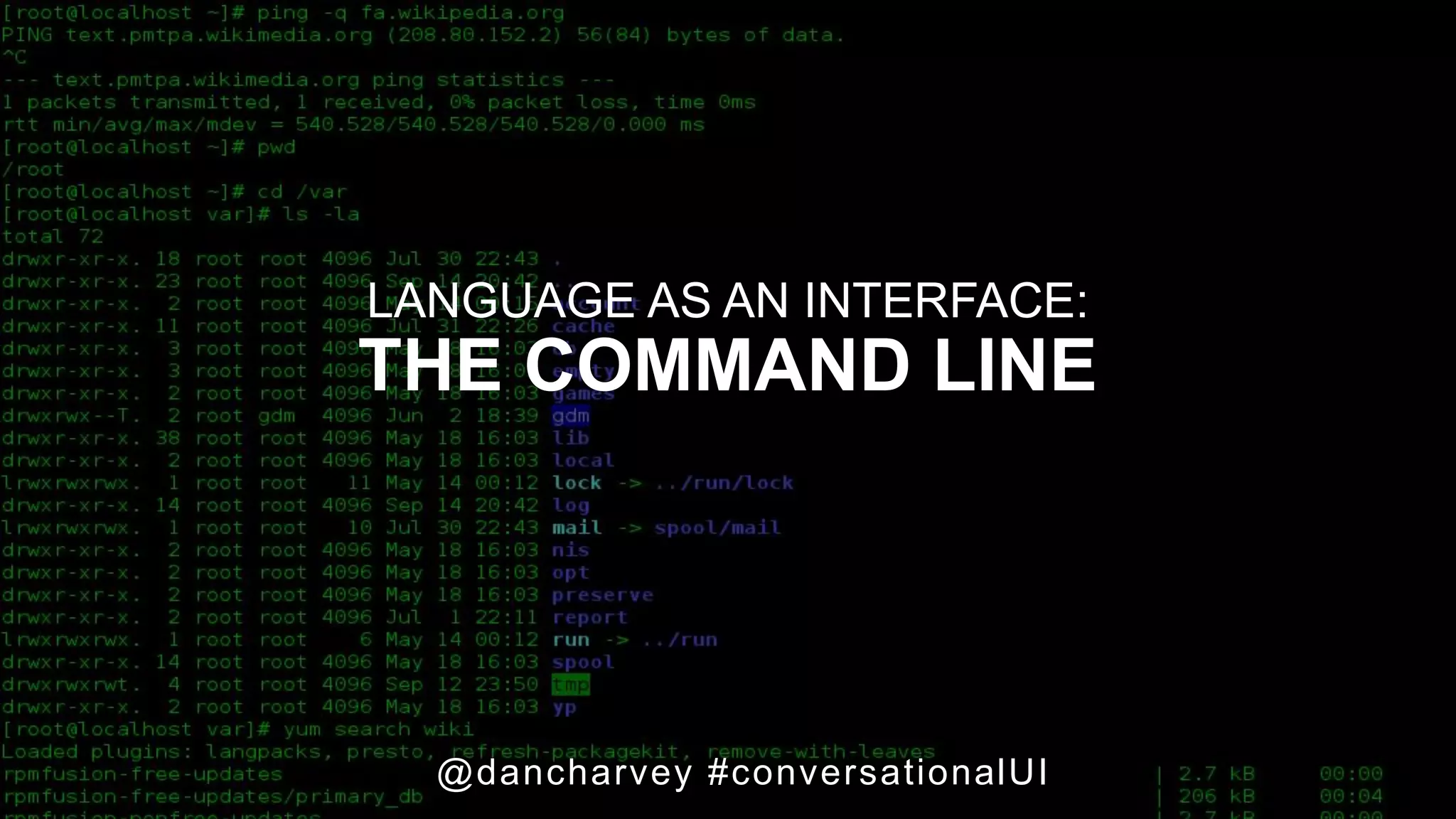
LANGUAGE AS AN INTERFACE:
THE COMMAND LINE
CHAT UI (VOICE UI)
@dancharvey #conversationalUI
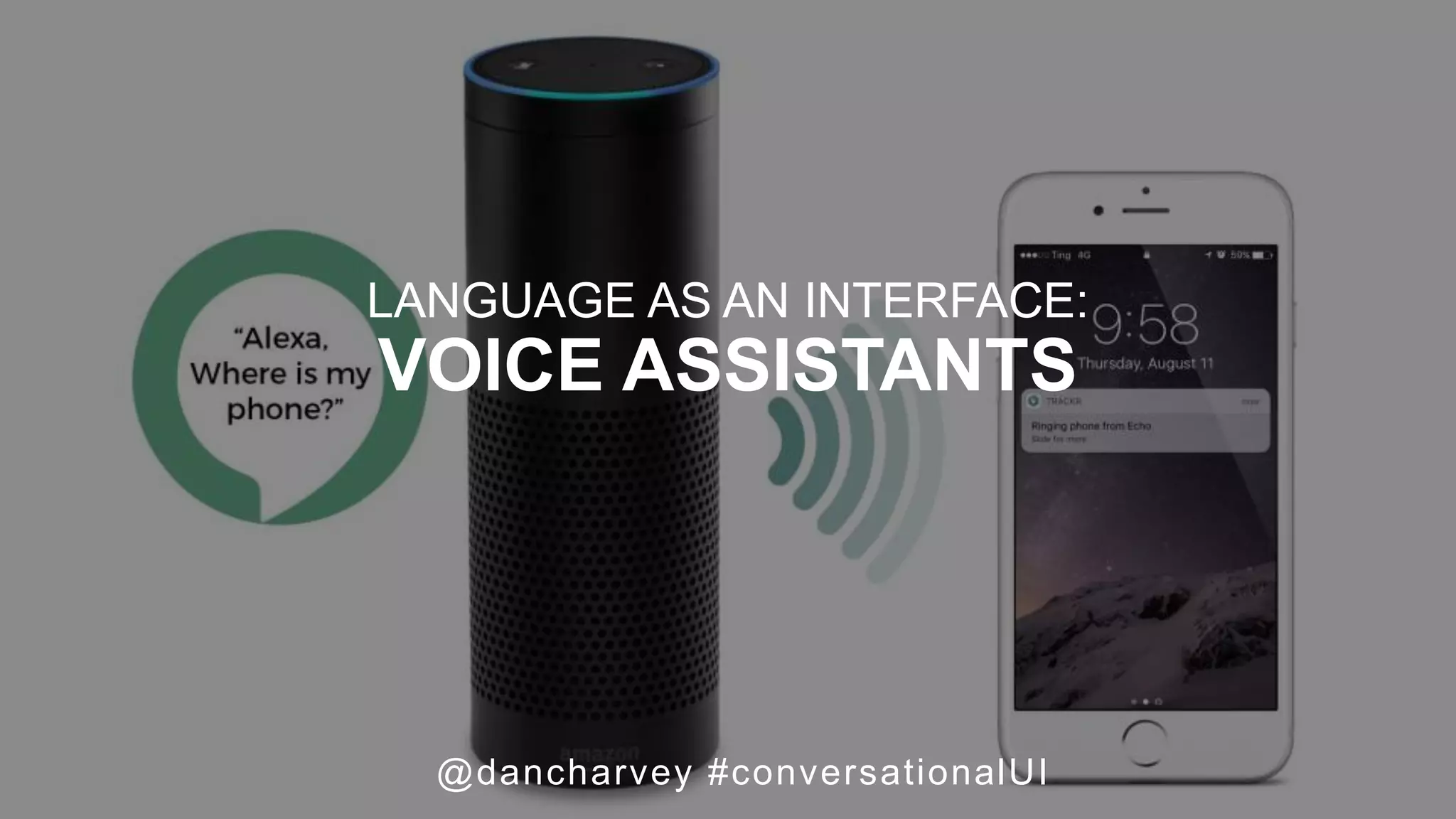
LANGUAGE AS AN INTERFACE:
VOICE ASSISTANTS
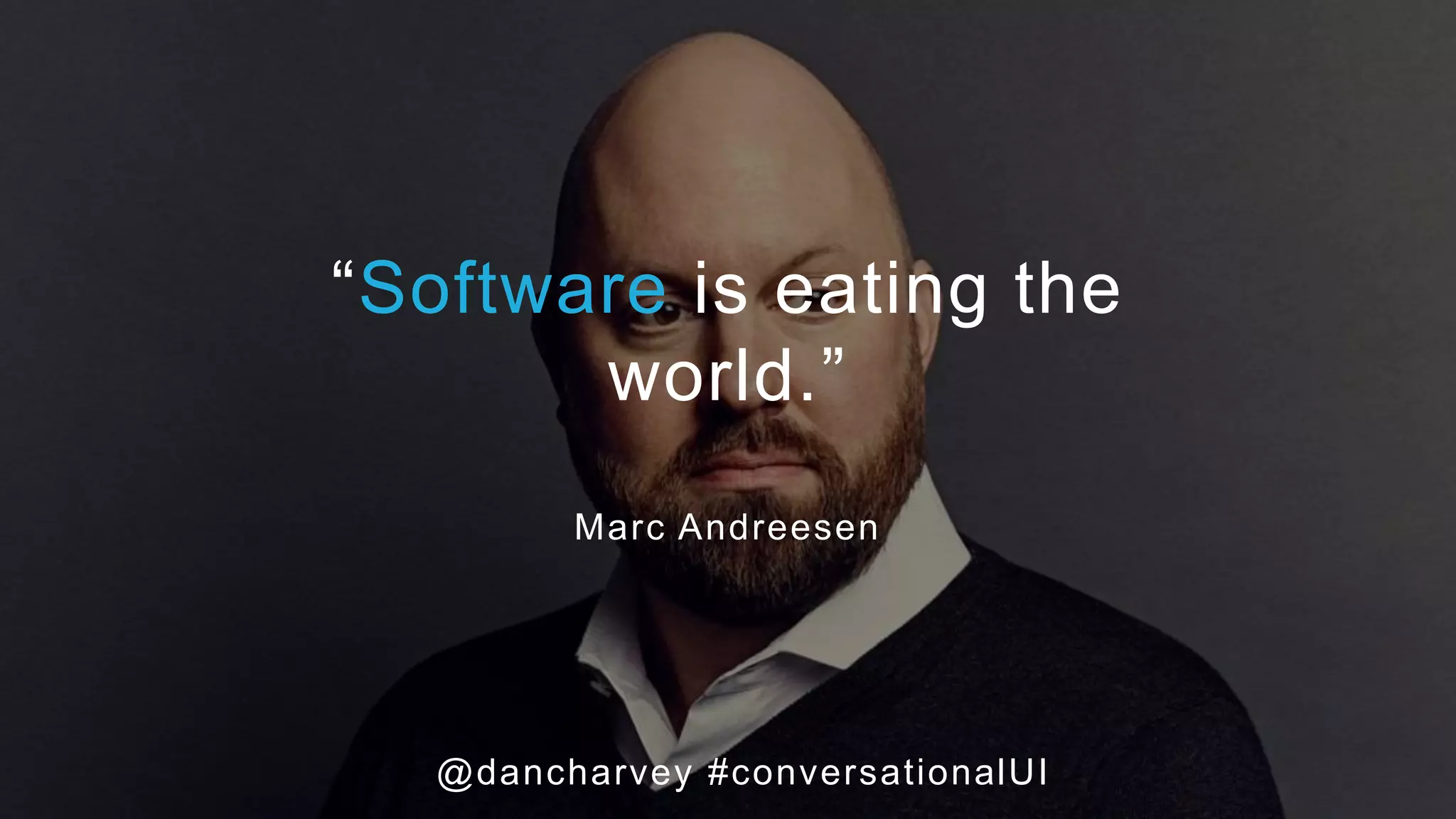
β€œSoftware is eating the
world.”
Marc Andreesen
@dancharvey #conversationalUI
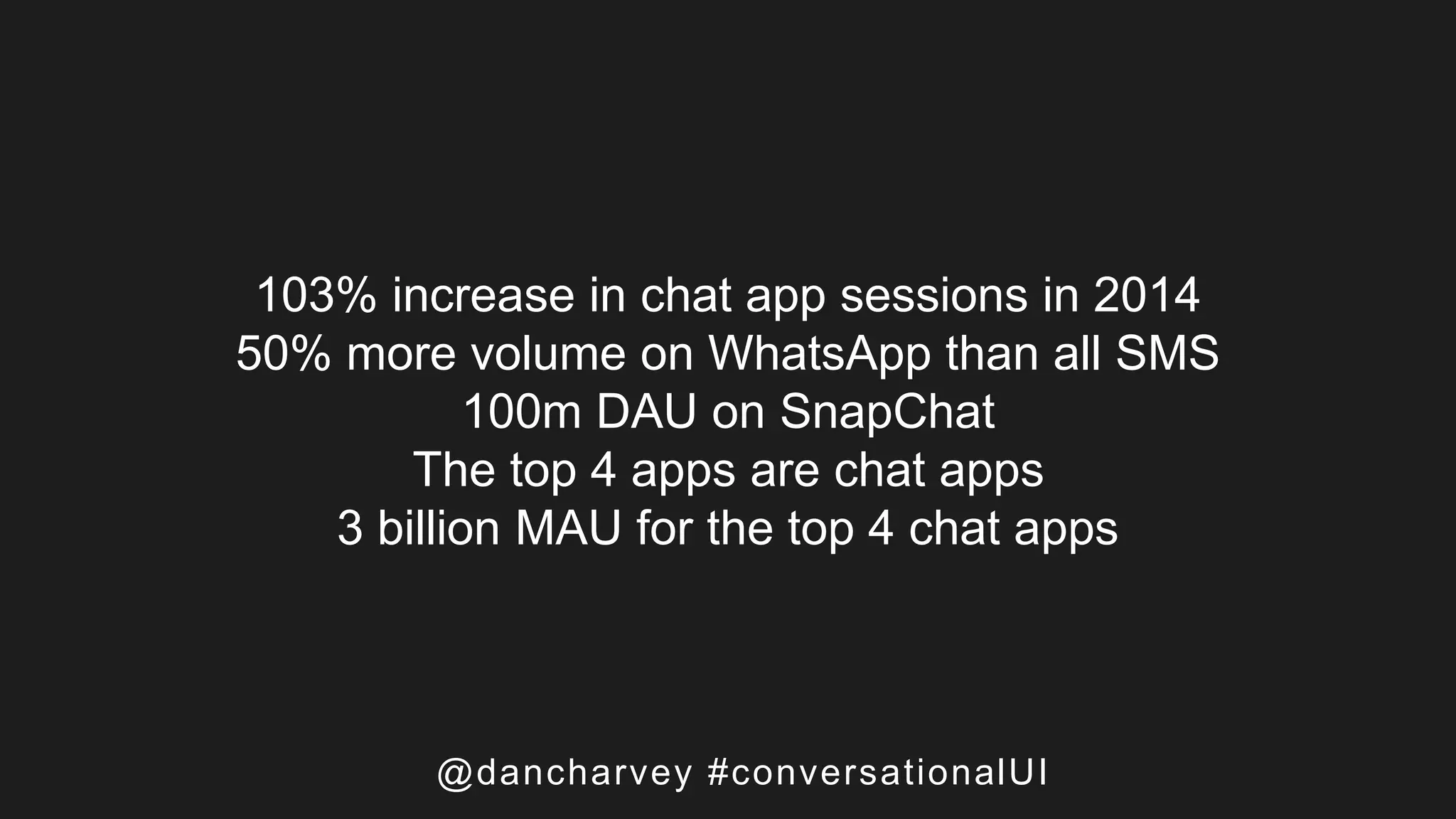
103% increase in chat app sessions in 2014
50% more volume on WhatsApp than all SMS
100m DAU on SnapChat
The top 4 apps are chat apps
3 billion MAU for the top 4 chat apps
@dancharvey #conversationalUI
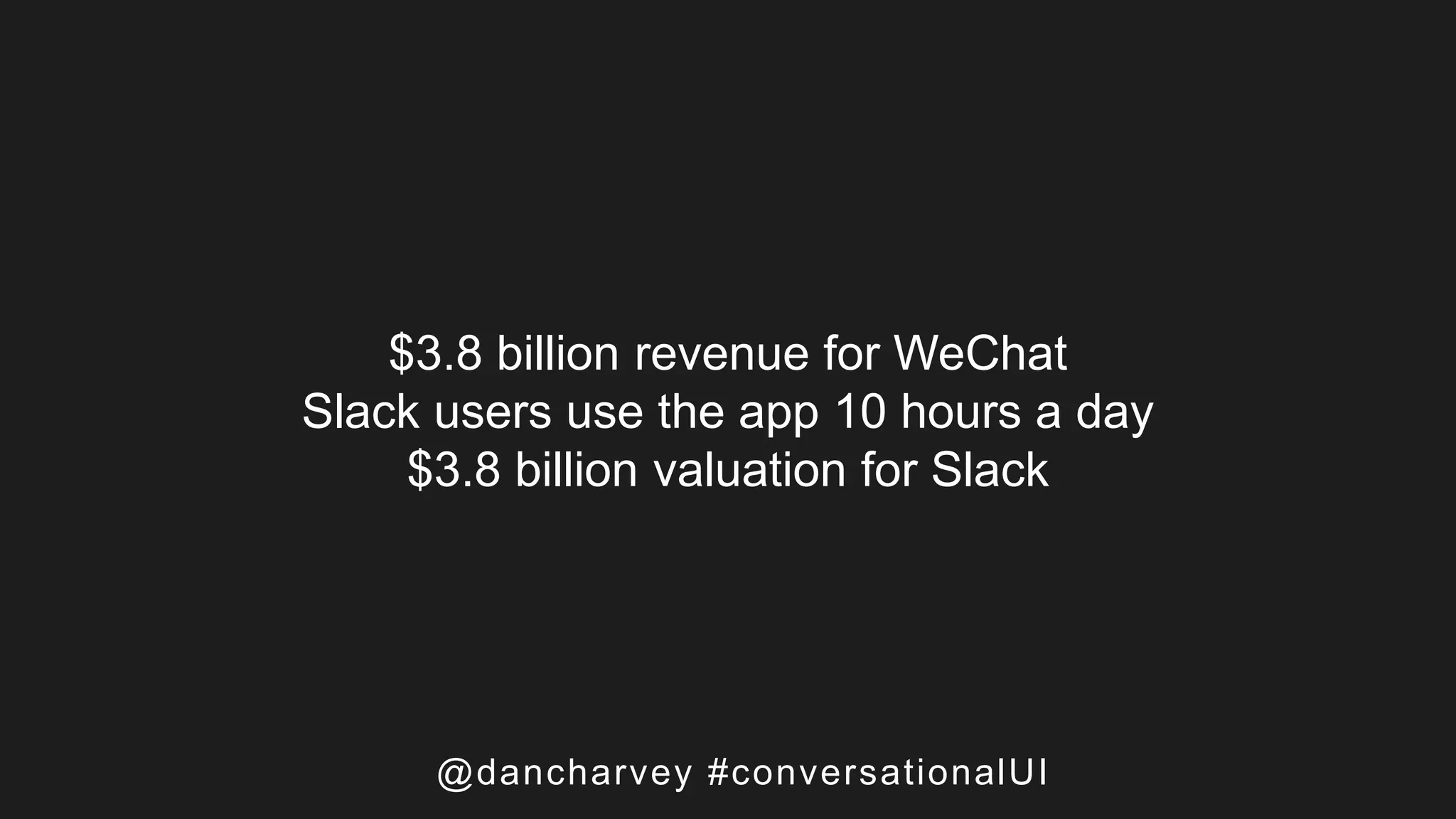
$3.8 billion revenue for WeChat
Slack users use the app 10 hours a day
$3.8 billion valuation for Slack
@dancharvey #conversationalUI
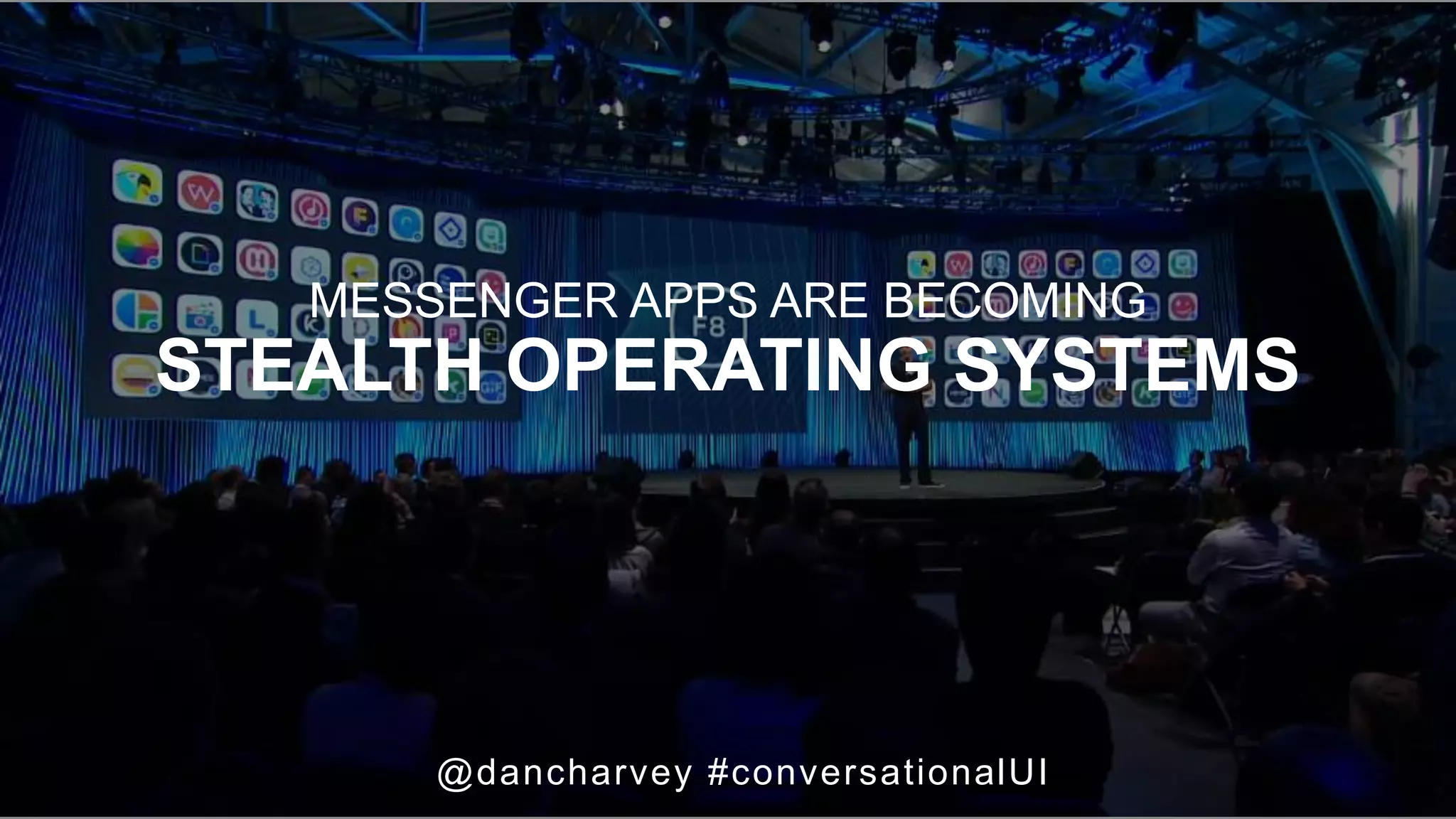
MESSAGING AS OS
MESSENGER APPS ARE BECOMING
STEALTH OPERATING SYSTEMS
@dancharvey #conversationalUI
Examples (WeChat, FB M,
etc.)
@dancharvey #conversationalUI
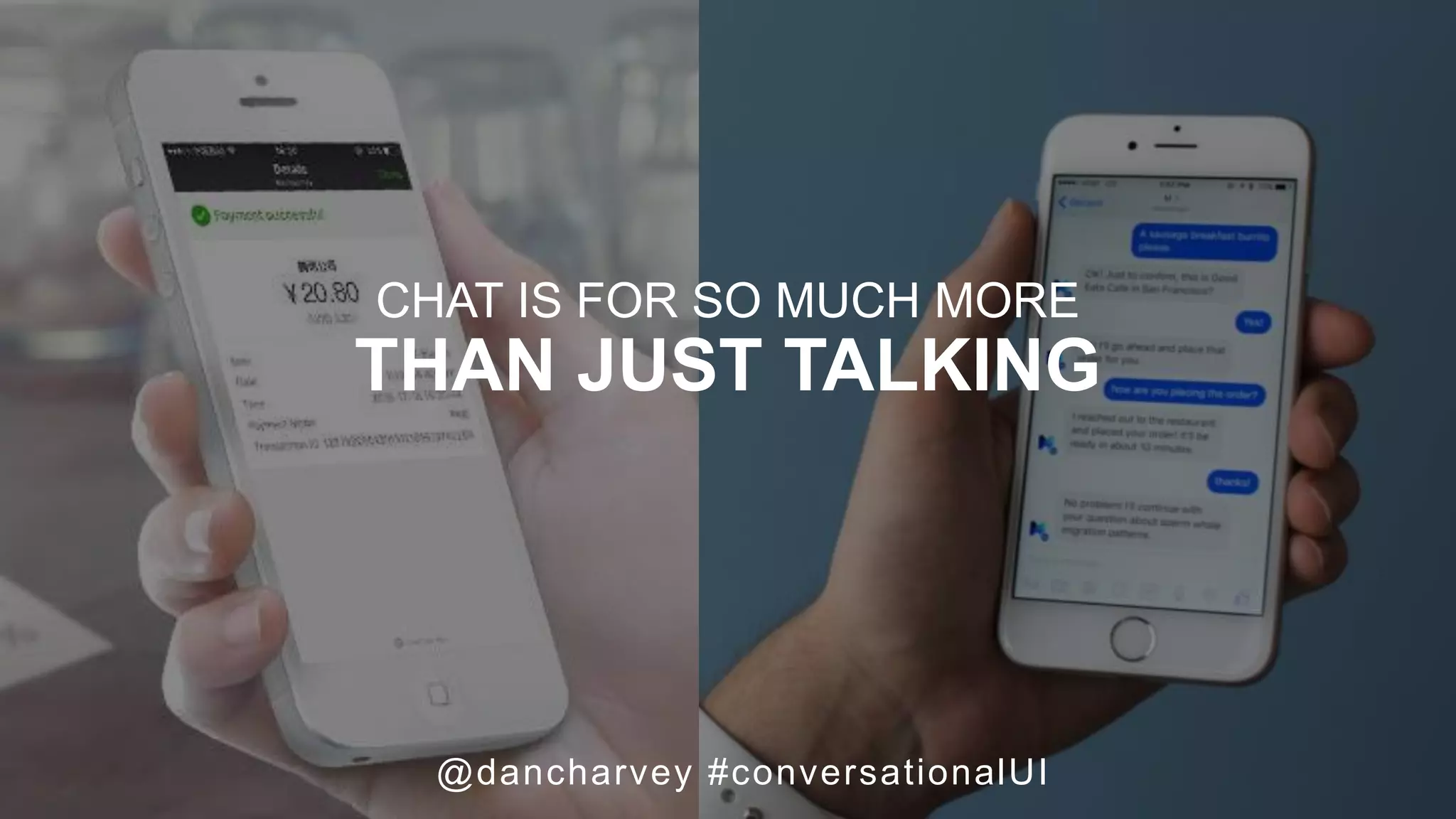
CHAT IS FOR SO MUCH MORE
THAN JUST TALKING
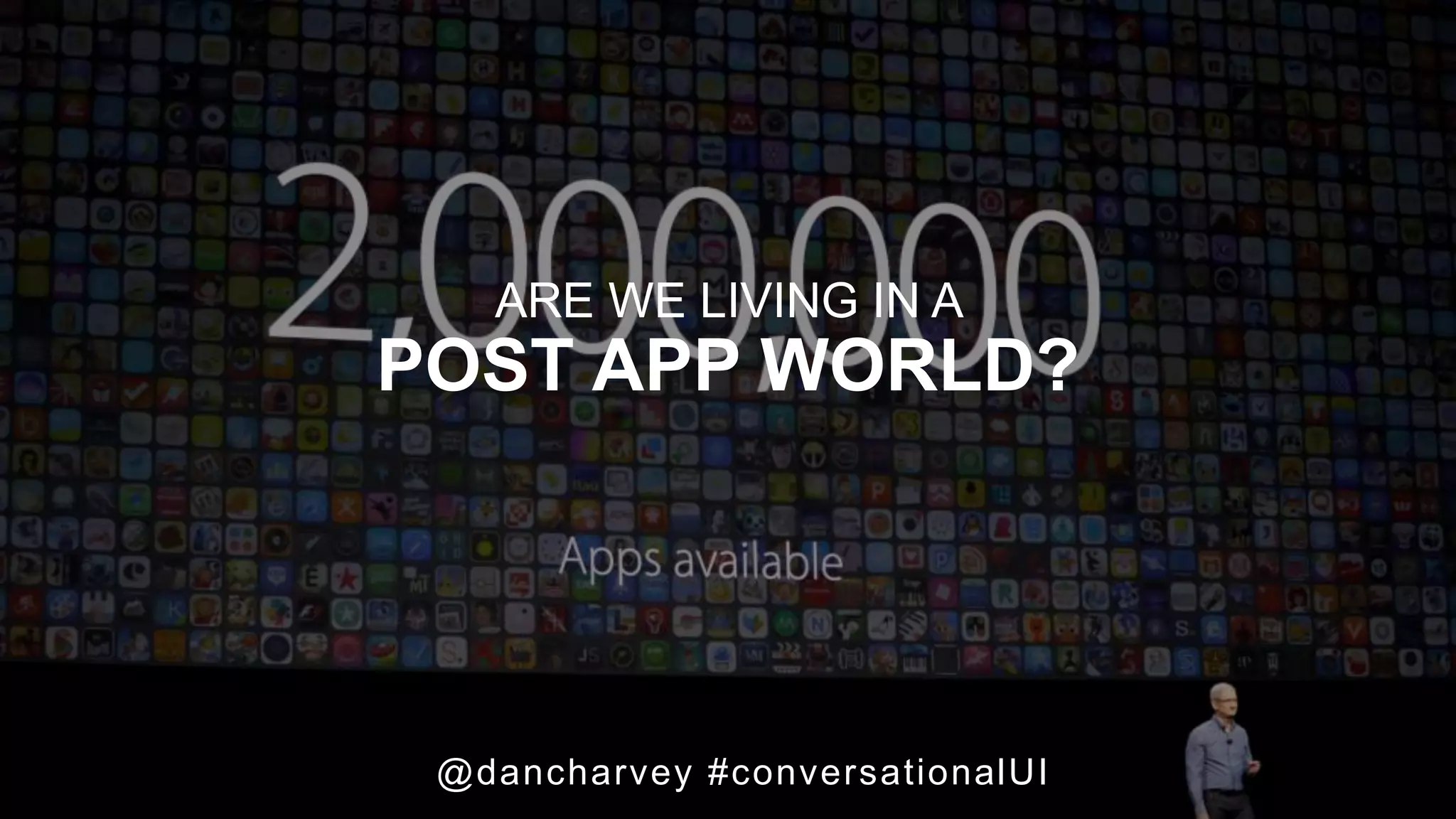
Post-app world
ARE WE LIVING IN A
POST APP WORLD?
@dancharvey #conversationalUI
ZERO LEARNING CURVE UI
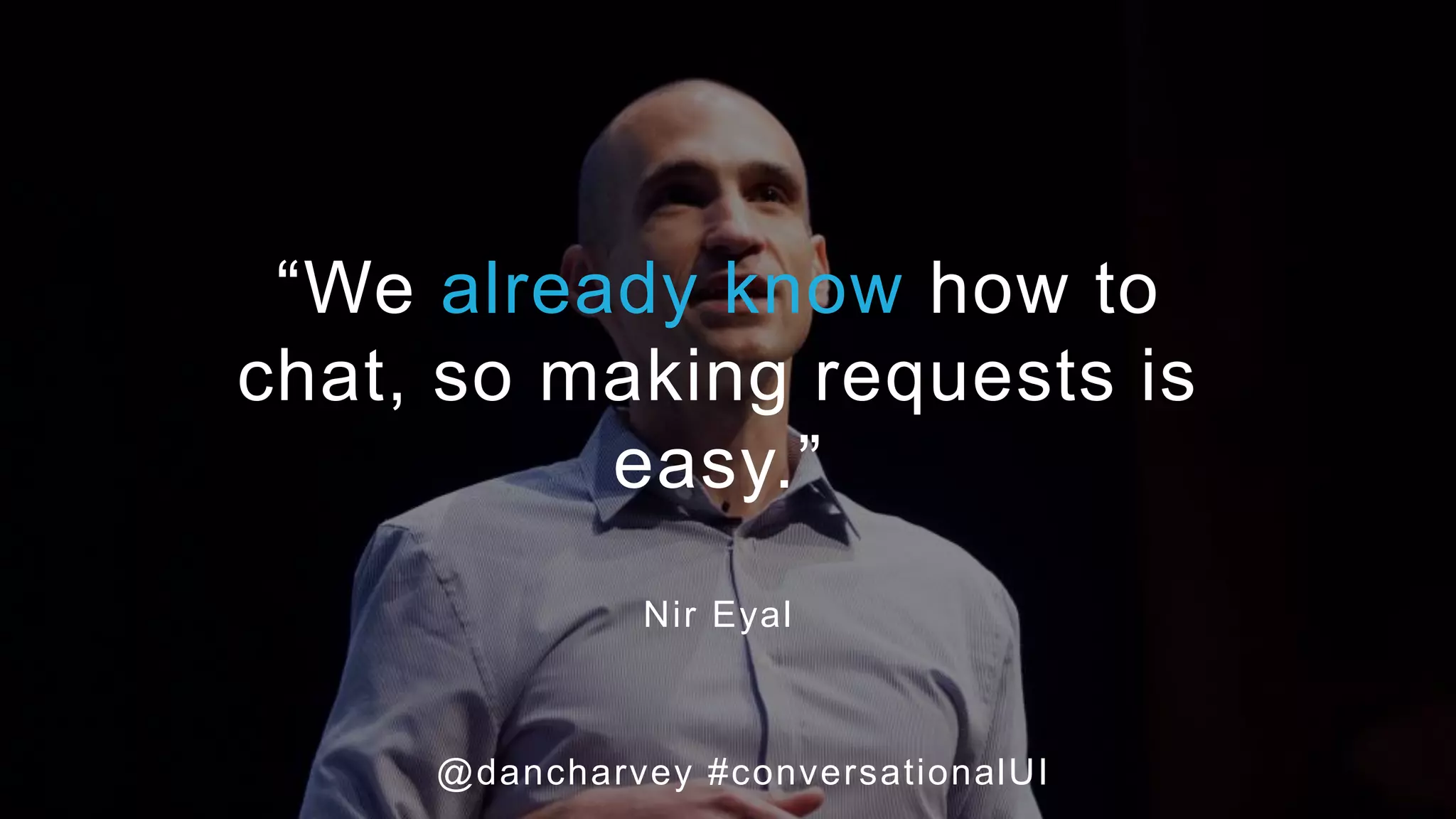
β€œWe already know how to
chat, so making requests is
easy.”
Nir Eyal
@dancharvey #conversationalUI
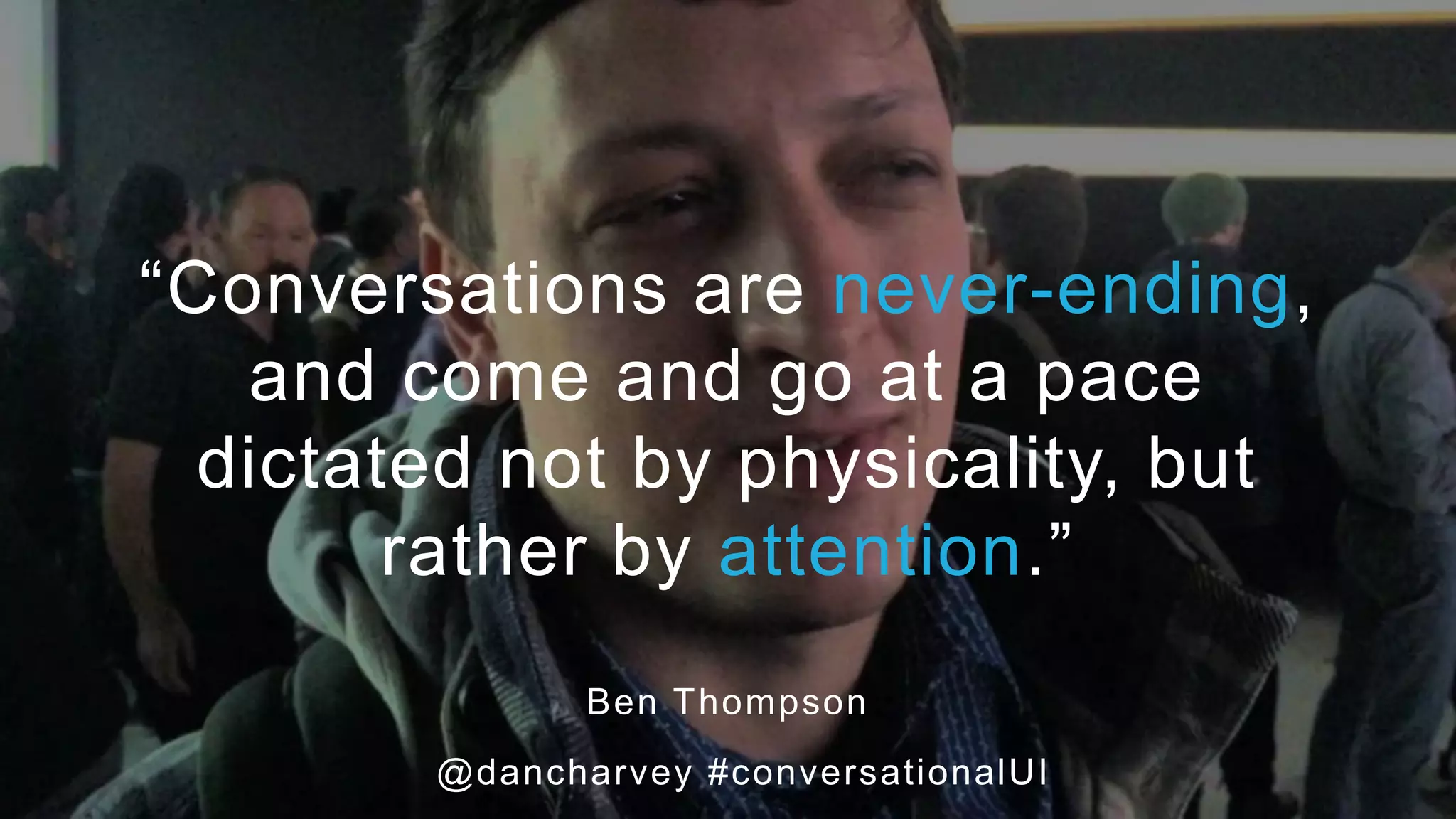
β€œConversations are never-
ending, and come and go at a
pace dictated not by physicality,
but rather by attention.”
β€œConversations are never-ending,
and come and go at a pace
dictated not by physicality, but
rather by attention.”
Ben Thompson
@dancharvey #conversationalUI
Customer experience +
Customer service
@dancharvey #conversationalUI
CHATBOTS ARE AN
IDEAL MEDIUM FOR CUSTOMER
SERVICE
Privacy
MESSENGING APPS MIGHT BE THE
LAST GREAT REFUGE FOR PRIVACY
@dancharvey #conversationalUI
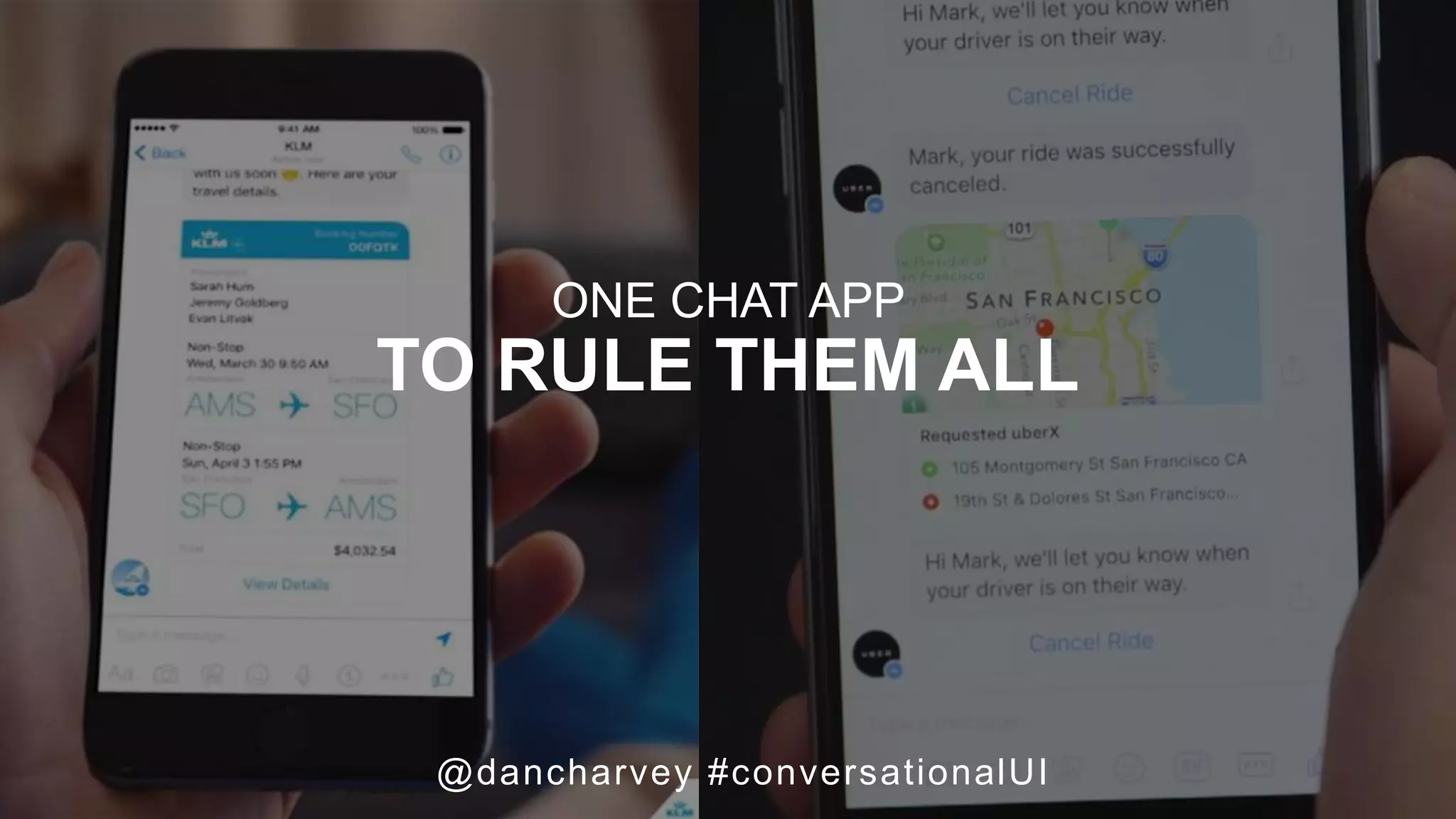
ONE CHAT APP
TO RULE THEM ALL
@dancharvey #conversationalUI
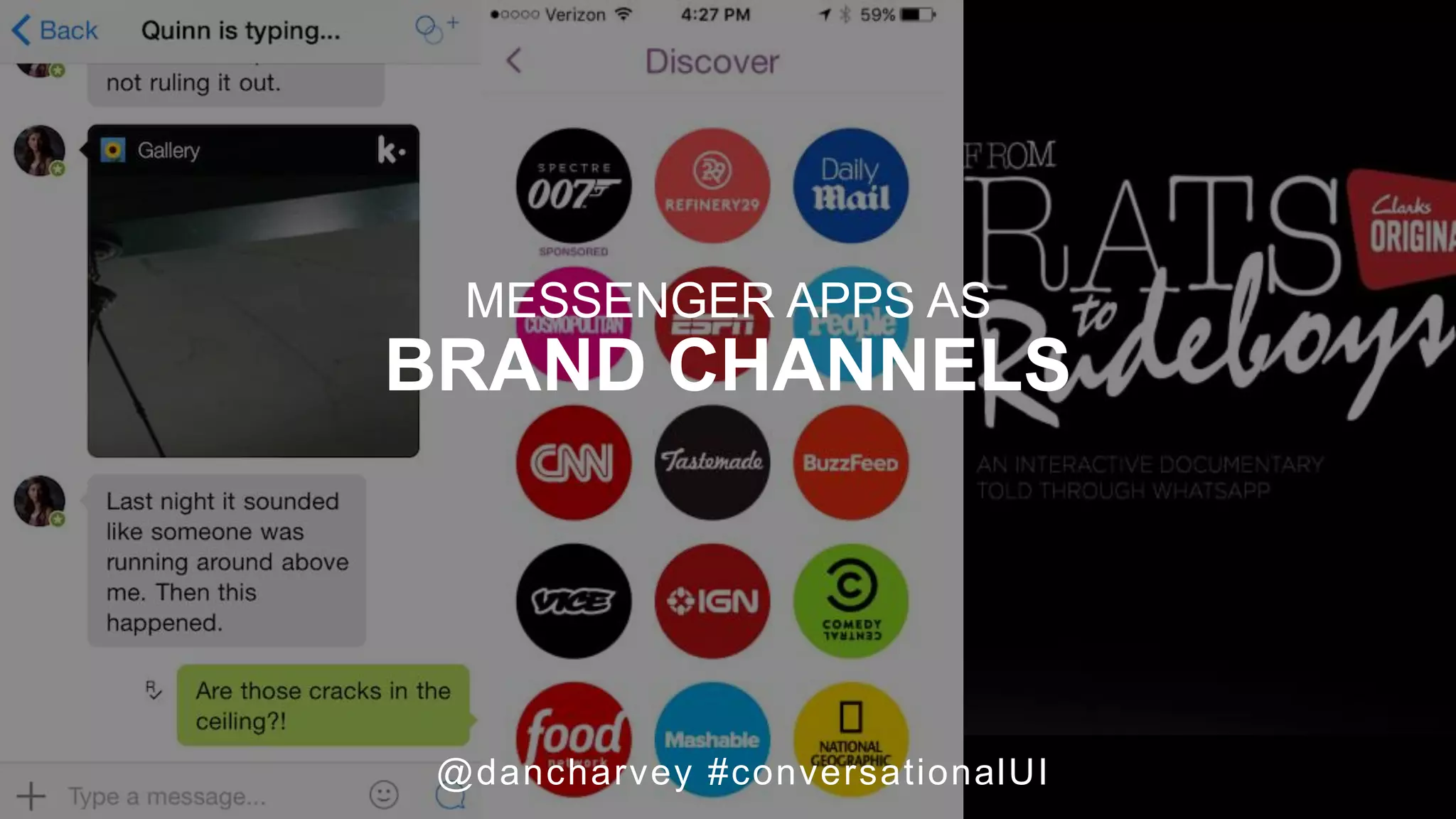
MESSENGER APPS AS
BRAND CHANNELS
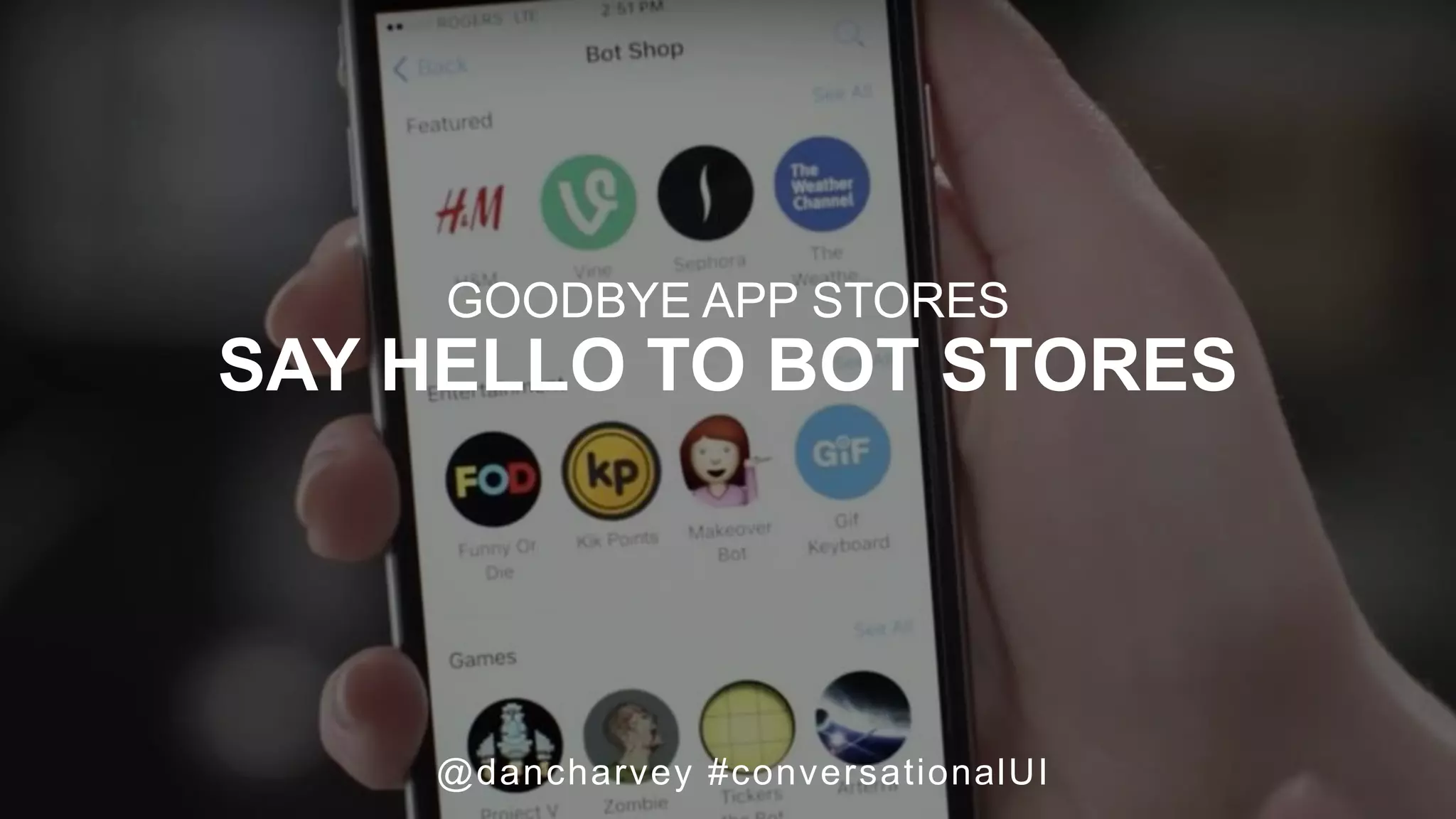
BOT STORES
GOODBYE APP STORES
SAY HELLO TO BOT STORES
@dancharvey #conversationalUI
TROJAN HORSE FOR AI
CHAT BOTS ARE THE
TROJAN HORSE FOR AI
@dancharvey #conversationalUI
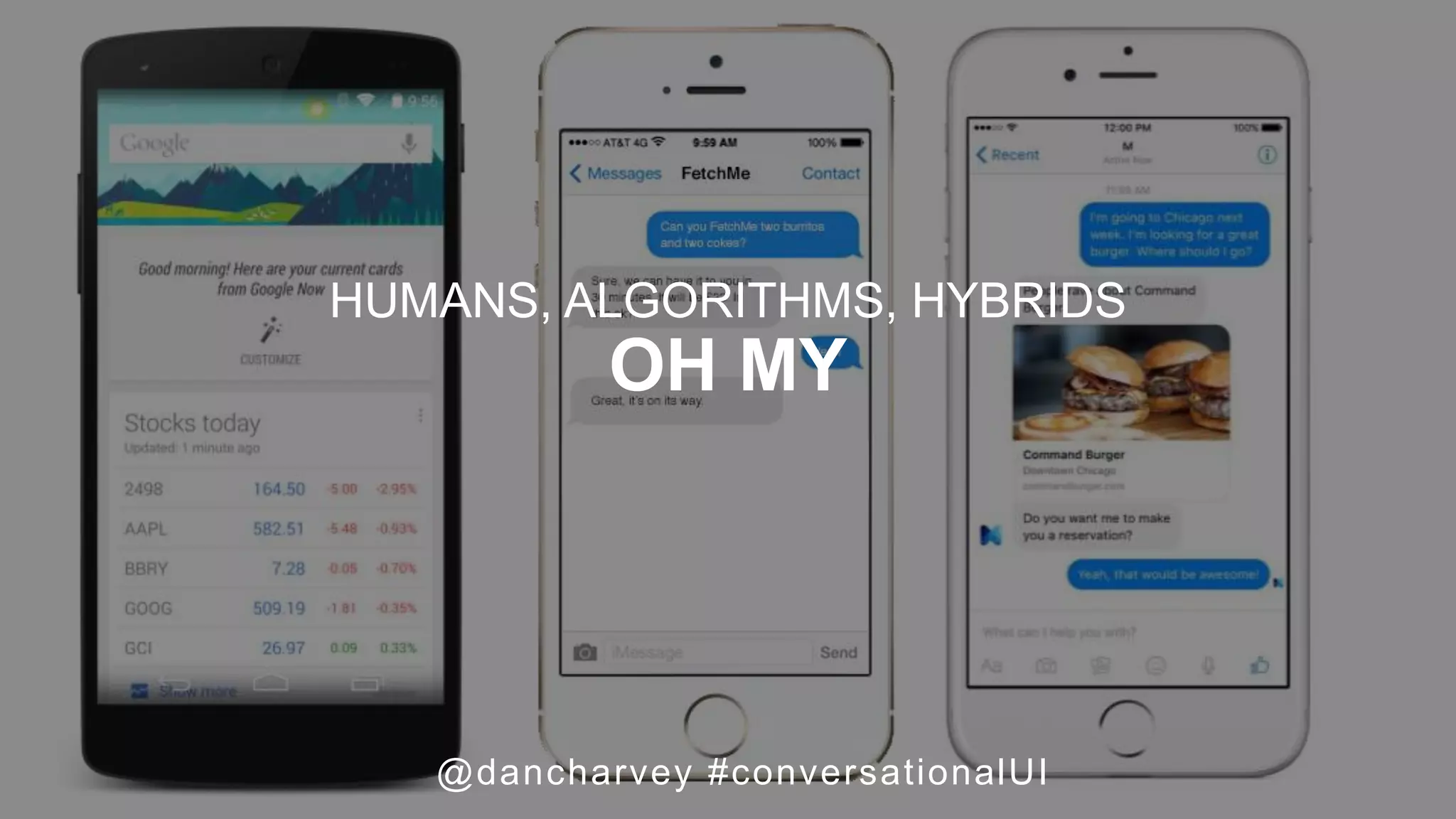
HUMANS, ALGORITHMS, HYBRIDS
OH MY
@dancharvey #conversationalUI
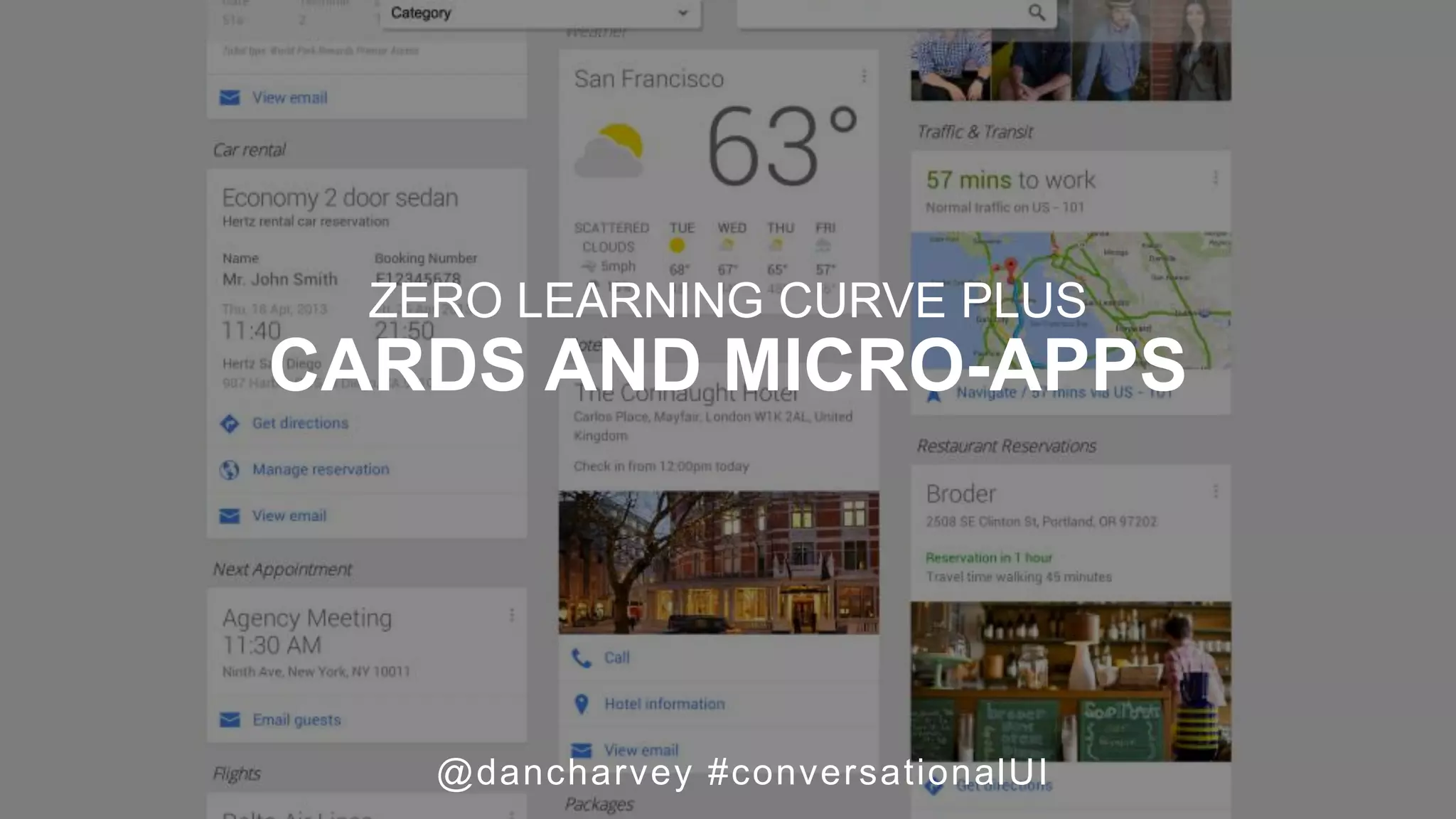
ZERO LEARNING CURVE PLUS
CARDS AND MICRO-APPS
BRANDED CHAT PERSONAS
@dancharvey #conversationalUI
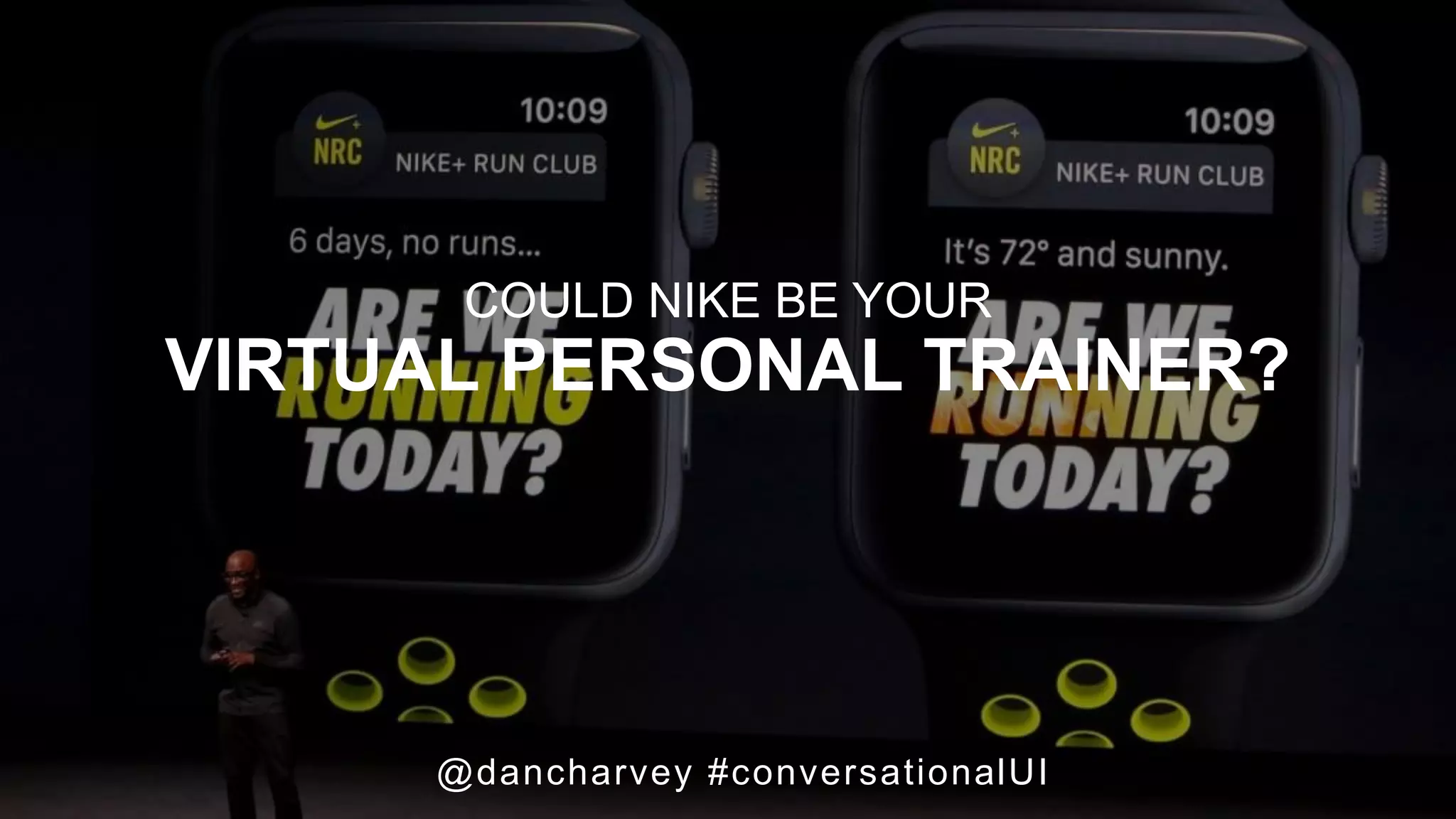
COULD NIKE BE YOUR
VIRTUAL PERSONAL TRAINER?
SAME SAME BUT DIFFERENT
@dancharvey #conversationalUI
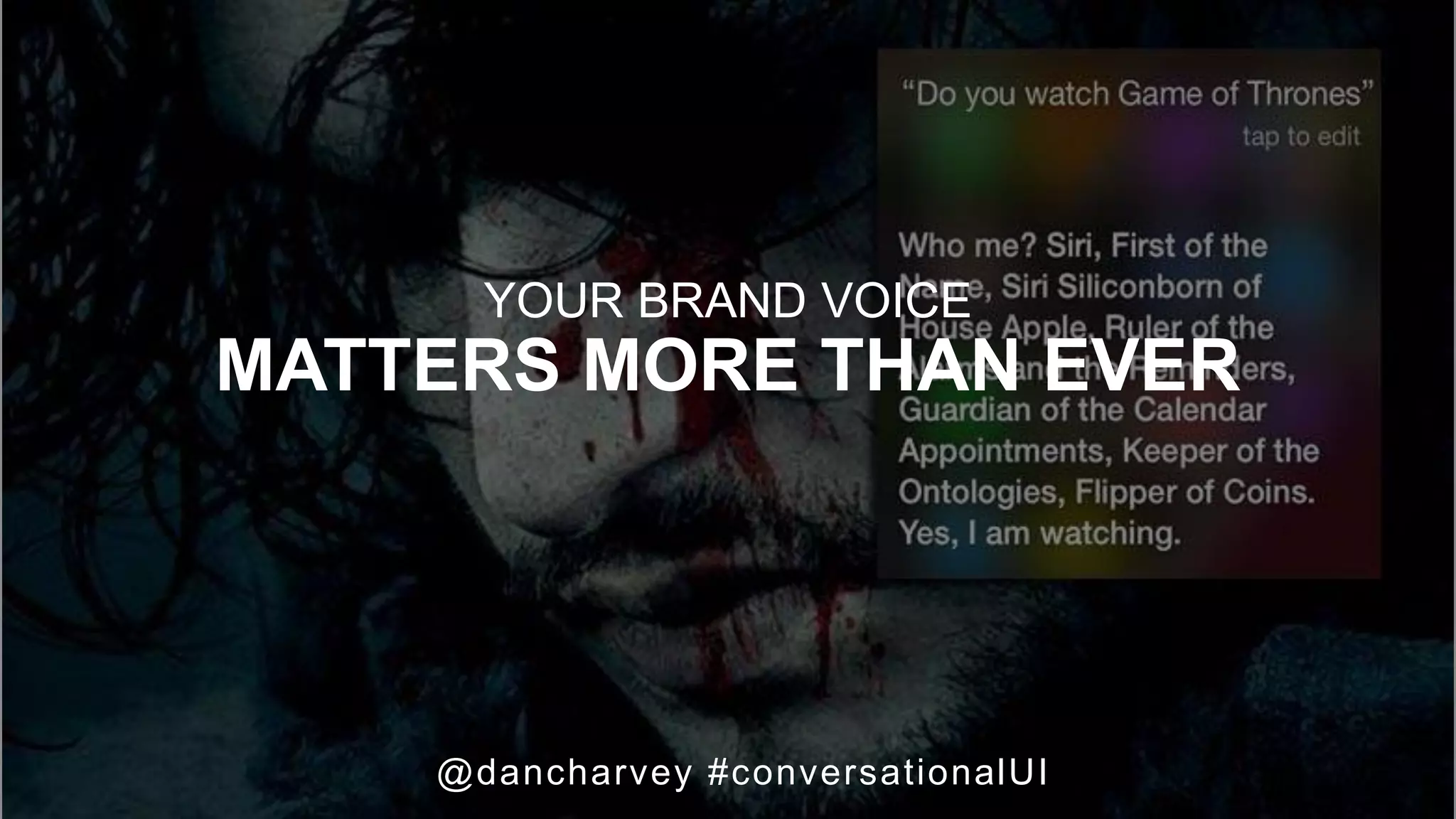
YOUR BRAND VOICE
MATTERS MORE THAN EVER
β€œWhen the conversation is the
interface, experience design is
all about crafting the right
words.”
β€œWhen the conversation is the
interface, experience design is all
about crafting the right words.”
John Pavlus
@dancharvey #conversationalUI
β€œIt used
to be that all software expands
until it includes messaging.
Now all messaging expands
until it includes software.”
β€œIt used to be that all software
expands until it includes messaging.
Now all messaging expands until it
includes software.”
Benedict Evans
@dancharvey #conversationalUI
TALKING THE TALK AND
WALKING THE WALK
thanks
@dancharvey #storylived

Conversation is the command line of tomorrow

Editor's Notes

  • #2Β Thank you for joining me today. My name is Daniel Harvey and I’m global practice lead for experience design at SapientNitro where we’re making some big bets on AI and chat. Today I’d like to talk to you about conversational UI.
  • #3Β Command line interfaces were the primary mode of human-computer interaction from the 1960s to the 1980s. It’s all about language. If you know the right SYNTAX/GRAMMAR then you have a very precise and powerful way to control programs or operating systems. Obviously the command line is still alive and well for more advanced users but for the rest of us Graphical User Interfaces popularized with Apple’s Lisa in 1983 quickly became the norm. Let’s jump over that though and talk about emerging NOUIs for a second.
  • #4Β Voice interfaces are quickly emerging as a new paradigm. Like the command line before it language is the interface. Once you know the right SYNTAX/GRAMMAR you can do a lot of precise and powerful things. But unlike the command line you don’t have to be a computer science whizkid. It’s a much more natural language dynamic. We’re going to be talking to everything that’s connected to the internet sooner or later. But before we get there the near now is going to be swarmed with chatbot interactions on our smartphones and wearables.
  • #5Β That’s not a bearded egg behind me but rather famed venture capitalist Marc Andreessen. He said that β€œSoftware is eating the world” in a Wall Street Journal article in 2011. Fast forward to now and it’s clear that he was correct – software is indeed ubiquitous. But not all software is equal. Messaging apps are experiencing a meteoric rise above all others.
  • #6Β Flurry, a mobile analytics firm, says that messaging app sessions saw a 103 percent rise globally as far back as 2014, and sustained a 51 percent rise in 2015. General-purpose chat app WhatsApp had 50 percent greater traffic than all global text message use. And Snapchat, once the domain of Millennials only, now has a daily average user count of 100 million. Furthermore, 50 percent of the top eight downloaded apps in the UK are messengers, while two out of the top three are chat apps from Facebook. And just this month the top 4 messaging apps beat out the top 4 social networks for MAU by half a billion users.
  • #7Β And it’s not just social chatter that’s commanding such inspiring figures. WeChat, the dominant chat app in China, had more mobile transactions over the 2016 Chinese New Year than PayPal had during all of 2015. The users of Slack, the darling of the enterprise, engage with the app on average ten hours per day during the work week. This extraordinary level of engagement has afforded the company an impressive valuation. This evolution of messaging platforms and the rise of chatbots represents a paradigm shift in our always-on world. Marketers now have the opportunity to be more plugged in to their target consumers’ conversations. And, as a business today, it is critical to understand this mega-trend and respond in short order. This is the dawn of the β€œpost app” era and will be as transformational for businesses and consumers as apps were a decade ago.
  • #8Β Creators of operating systems have long had a competitive advantage in the software industry. In the personal computer era, Windows’ dominance afforded Microsoft much success. In the desktop Internet era, Google functioned as an operating system (OS) of sorts for the Web. In the mobile era, iOS and Android are critical components of the Apple and Google ecosystems. But, in the cloud era, all that could change. What’s important to realize is that messaging apps are often becoming platforms. Think of them as stealth operating systems on top of your existing OS. They’re one-stop portals to everything you need on your smartphone, infiltrating your life through the notifications panel.
  • #9Β The most successful, like WeChat or Facebook Messenger, are facilitating more than just chat. WeChat supports peer-to-peer (P2P) payments, shopping, booking taxis and restaurants, and more. Facebook Messenger – with its virtual assistant, M – will be able to do all of that and who knows what else.
  • #10Β As messaging apps grow more ubiquitous and powerful, the need to have standalone apps for these individual functions becomes questionable. What impact could this have on Venmo, Jet, Hailo, OpenTable, and the like? What about Google Now, Cortana, and Siri? More important, what does this do to other types of app experiences? The average smartphone user downloads zero apps per month and, with users spending more and more time in chat apps, things look bleak for traditional apps. The aforementioned examples show that a chat user interface (UI) can work in a variety of situations. But why do some prefer it?
  • #11Β First, there’s a similarity across the user interfaces of chat apps, so there’s no need to learn a new UI or pattern. Chat boils down to text on the right/left and input on the bottom it's digital second nature now for many. It’s an example of what people call a β€œzero learning curve UI.” This instinctual understanding gives brands a head start when designing an engaging experience for their consumers. As Nir Eyal, author of Hooked, puts it, β€œWe already know how to chat, so making requests is easy.”
  • #12Β Second, chat can be instantaneous or asynchronous. If you want a bus time, then bots, artificial intelligence (AI), and schedules can share a schedule in real time. If you want to buy luchador finery, then humans can take some time to find you the best deal. Unlike the telephone or Web, messaging affords us constant communication. For example, it gives customers quick access to information and can grant them answers even when brand representatives are not available. As renowned tech strategist Ben Thompson puts it, β€œConversations are never-ending, and come and go at a pace dictated not by physicality, but rather by attention.” Brand service, therefore, becomes even more continuous and dependable.
  • #13Β Third, it’s an ideal medium for customer service. If social media has taught us anything, it’s that people love to engage with brands for everything from satisfied reviews to customer service complaints. Chat apps allow customers the same opportunity, but in a discreet venue that's more personal for the consumers and less damaging to brands. It's also just more helpful to have a one-on-one service experience.
  • #14Β Last, in a post-Snowden era, messaging apps seem to be the last great refuge for privacy. Apple and the FBI have been embroiled in a 21st-century version of the crypto-wars, while similar rows will likely erupt in the UK thanks to the Snoopers’ Charter. Messaging apps, when compared to social media, pose a safer communication stream for consumer data. Most major chat companies now have encryption enabled by default. For example, while Telegram’s encryption has long been lauded by privacy advocates, competitor WhatsApp recently made headlines when it enabled end-to-end encryption on all communications.
  • #15Β Brands have always fished where the fish are. Today, that means expeditions into messaging apps. Facebook Messenger has successful integrations with Uber to reserve a car, and KLM to provide boarding passes and flight updates, among other brands. Thanks to these advances, consumers who need to get to the airport can now do so without ever leaving the Messenger app.
  • #16Β Millennial favorite Kik has seen over eighty β€œpromoted chats” with bots for brands like MTV, Washington Post, and Skull Candy. Perhaps its most successful bot campaign was with NBCUniversal to promote the horror film Insidious 3. A bot with the personality of the haunted main character Quinn exchanged on average sixty-nine messages across nearly 350,000 participants. Snapchat, once the poster child for intimate messaging, has expanded its brand tools including its β€œDiscover” section. Several brands have created animated filters that overlay animation on video. Similarly, WhatsApp has created bot characters to help Clarks promote its Desert Boot product.
  • #17Β These integrations will only increase as each of the major players creates its own β€œbot store.” Kik and Skype both launched their own versions of bot stores in early 2015. WeChat is already home to over 10 million β€œofficial accounts” which are thin apps (light versions that don’t require installation) or bots. More so, there’s a third-party opportunity here (as we saw with app stores) for new businesses to emerge. For example, you can play poker, explore restaurant menus, and receive travel advisories. Facebook is anticipating this explosion of bot development. At the most recent F8 conference, Mark Zuckerberg announced Facebook’s entrance into the bot store arena. Media and commerce were the dominant examples, including demonstrations from CNN and 1-800-Flowers. While people are sharing less on Facebook, they are talking more than ever before on Facebook Messenger (900 million people per month, to be exact). In fact, this platform will be the first experience that many people will have with bots.
  • #18Β Bots are a preoccupation in tech because they're exploring artificial intelligence (AI) at scale. AI comes in two broad flavors: strong/general or weak/ specific. The former is recursive and can contend with a wide set of questions with open-ended answers. The latter, on the other hand, responds to narrow sets of questions with scripted answers. We don't have strong AI yet, but the current generation of bots is a good example of weak AI.
  • #19Β Today's bots are often a combination of algorithms and/or human turks. Google Now and it’s Assistant, and Siri are the former, while on-demand delivery services like Magic in the United States and FetchMe in the United Kingdom are the latter. Facebook’s virtual assistant M, on the other hand, is a hybrid.
  • #20Β Given the limitations of specific AI (those of narrow question and answer sets), we need both context and precision. Brand engagements are an interesting way to provide both because they are industry, product, or service specific. For example, you can trust that someone won't ask a banking bot a question about football. And methods such as onboarding and prompts can help people further understand what they can ask each bot. Niche domain expertise – such as bots for mortgages or asset management – are another way to focus a conversation and avoid awkward failures. The concern that some people have with bots is the risk of a tedious back-and-forth. No one wants an interactive voice response system in their pocket. To reduce such risk, many bot experiences are complementing text with cards and micro-apps. Both are ways to deliver thin, but robust, interactions inside of chats. β€œShow flights” within Google Now or ordering an Uber in Slack are both great examples.
  • #21Β Many people already use services like Nike+ or Moves for fitness tracking. But it’s easy to imagine those apps becoming more like real personal trainers via the addition of chat behaviors and bots. Likewise, your banking app could become a financial advisor that answers basic questions about mortgages. While it won’t take the place of your real banker, the chat bot offers more intuitive and efficient ways to answer standard questions, filter requests, and gather more information for a customer service specialist.
  • #22Β The requirements of designing a successful chat experience are different than building websites or delivering apps. Figuring out the personality of the brand is key. Is your brand voice funny, smart, or authoritative? How is the bot going to behave when a customer asks an unrelated question or isn’t able to clearly communicate his/ her issue? Those are questions that we’ve always asked when creating branded experiences, but now they take real prominence.
  • #23Β Writer John Pavlus recently said, β€œWhen the conversation is the interace, experience design is all about crafting the right words.” That’s exactly why AI companies like x.ai, makers of personal assistant chatbots Amy and Andrew, are hiring writers with acting and improv backgrounds as their designers. Google hired writers from Pixas and The Onion to work on it’s Assistant. Navigating stories and dialogue are tricky businesses. Fortunately, there’s an emerging sense of best practices: For example, avoiding rhetorical questions and gendered pronouns are both examples of advice offered by the x.ai design leads. They also encourage building in β€œkill switches” to give users control. In their case, telling Amy or Andrew to β€œshut up” causes the bot to retreat from the current conversation.
  • #24Β If software is eating the world, then it’s clear that messaging is eating software. Or to paraphrase another venture capitalist, Benedict Evans, β€œIt used to be that all software expands until it includes messaging. Now all messaging expands until it includes software.” As with any new era, there's a lot of experimentation. Companies ranging from Facebook and Google to CNN and Gatorade are paving the way forward. Whether that is through platforms or activations, these nascent cases can – and are – teaching us a lot.
  • #25Β The rise of chat gives marketers the unparalleled opportunity to align what their brands do with what they say. The right chat strategy, when executed well, will merge a brand’s persona with consumer expectations to create a seamless, intuitive experience. Whether that means adding chat functions to proprietary apps or creating branded bots on big platforms, organizations can now have more personalized conversations with their customers.
  • #26Β Any questions?