Opportuni)es	
  and	
  Challenges	
  in	
  
e-­‐Governance:	
  
mHealth	
  Case	
  Study	
  
Vishnu Pendyala
A Great Quote
Economy	
  grows	
  as	
  more	
  and	
  more	
  people	
  join	
  its	
  
core	
  echelons.	
  People	
  are	
  the	
  most	
  important	
  
economic	
  resources	
  at	
  all	
  )mes.	
  
Agenda
•  The	
  Healthcare	
  Challenge	
  and	
  the	
  e-­‐
Governance	
  Opportunity.	
  
•  Mo)va)on,	
  Enabling	
  Factors	
  
•  mHealth:	
  An	
  Overview	
  
•  Vision:	
  Machine	
  Augmented	
  Mindfulness	
  
•  Medical	
  Diagnosis	
  
•  Realizing	
  the	
  Vision:	
  Challenges	
  
•  Future	
  Direc)ons	
  and	
  Conclusion	
  
Questions for you
•  Why	
  is	
  technical	
  research	
  important	
  for	
  
effec)ve	
  e-­‐governance?	
  
•  How	
  is	
  mHealth	
  related	
  to	
  Machine	
  Learning,	
  
Big	
  Data	
  Analy)cs	
  and	
  Internet	
  of	
  Things?	
  
•  How	
  can	
  the	
  millions	
  who	
  do	
  not	
  have	
  access	
  to	
  
proper	
  healthcare	
  be	
  provisioned	
  with	
  it?	
  
•  Can	
  machines	
  replace	
  the	
  doctor	
  eventually?	
  
•  Can	
  machine	
  assisted	
  gene	
  therapy	
  	
  become	
  a	
  
cure-­‐all?	
  
•  What	
  are	
  some	
  of	
  the	
  opportuni)es	
  and	
  
challenges	
  in	
  the	
  mHealth	
  space?	
  
Source: ©World Health Organization
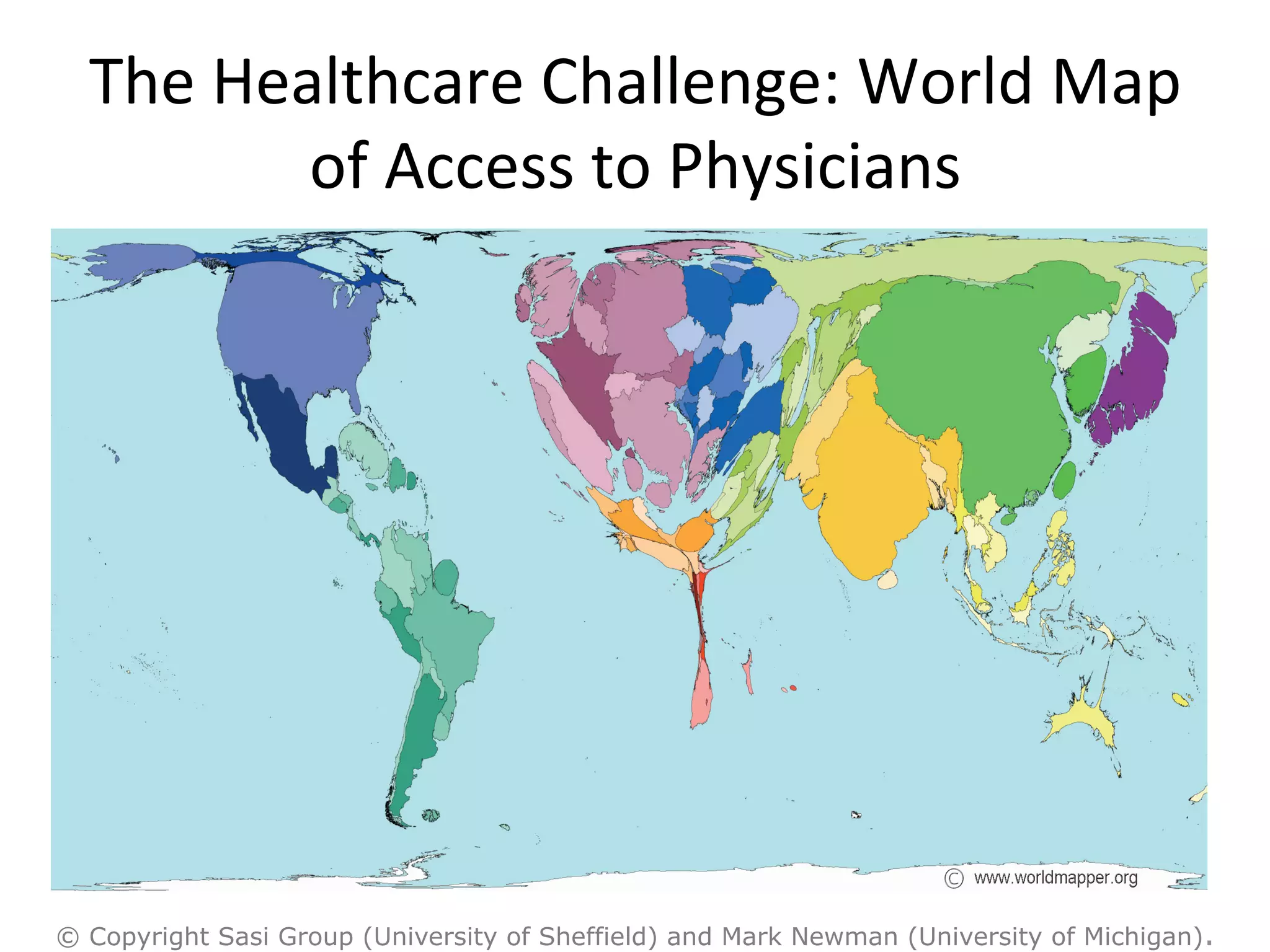
The	
  Healthcare	
  Challenge:	
  World	
  Map	
  
of	
  Access	
  to	
  Physicians	
  
© Copyright Sasi Group (University of Sheffield) and Mark Newman (University of Michigan).
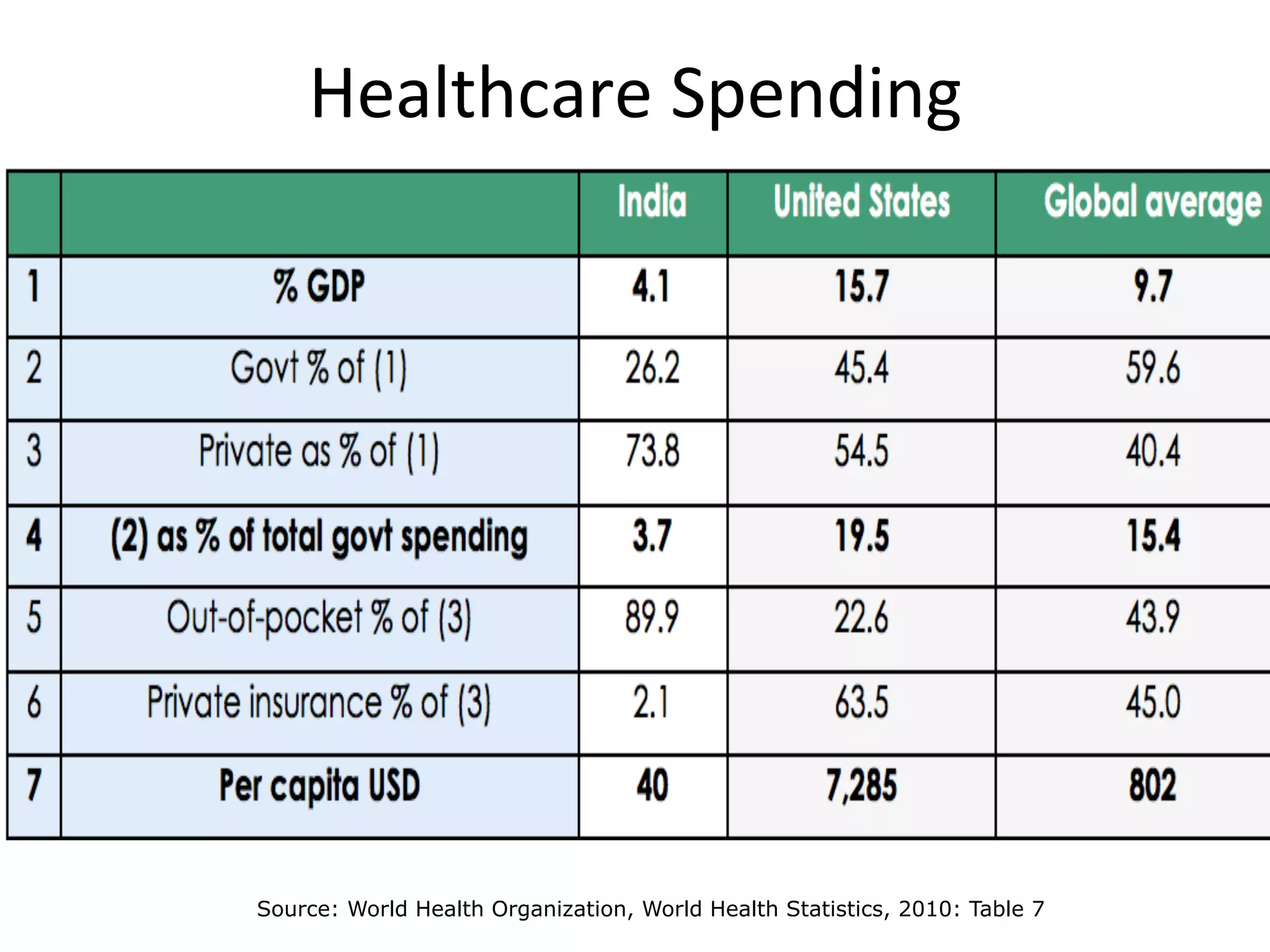
Healthcare	
  Spending	
  
Source: World Health Organization, World Health Statistics, 2010: Table 7
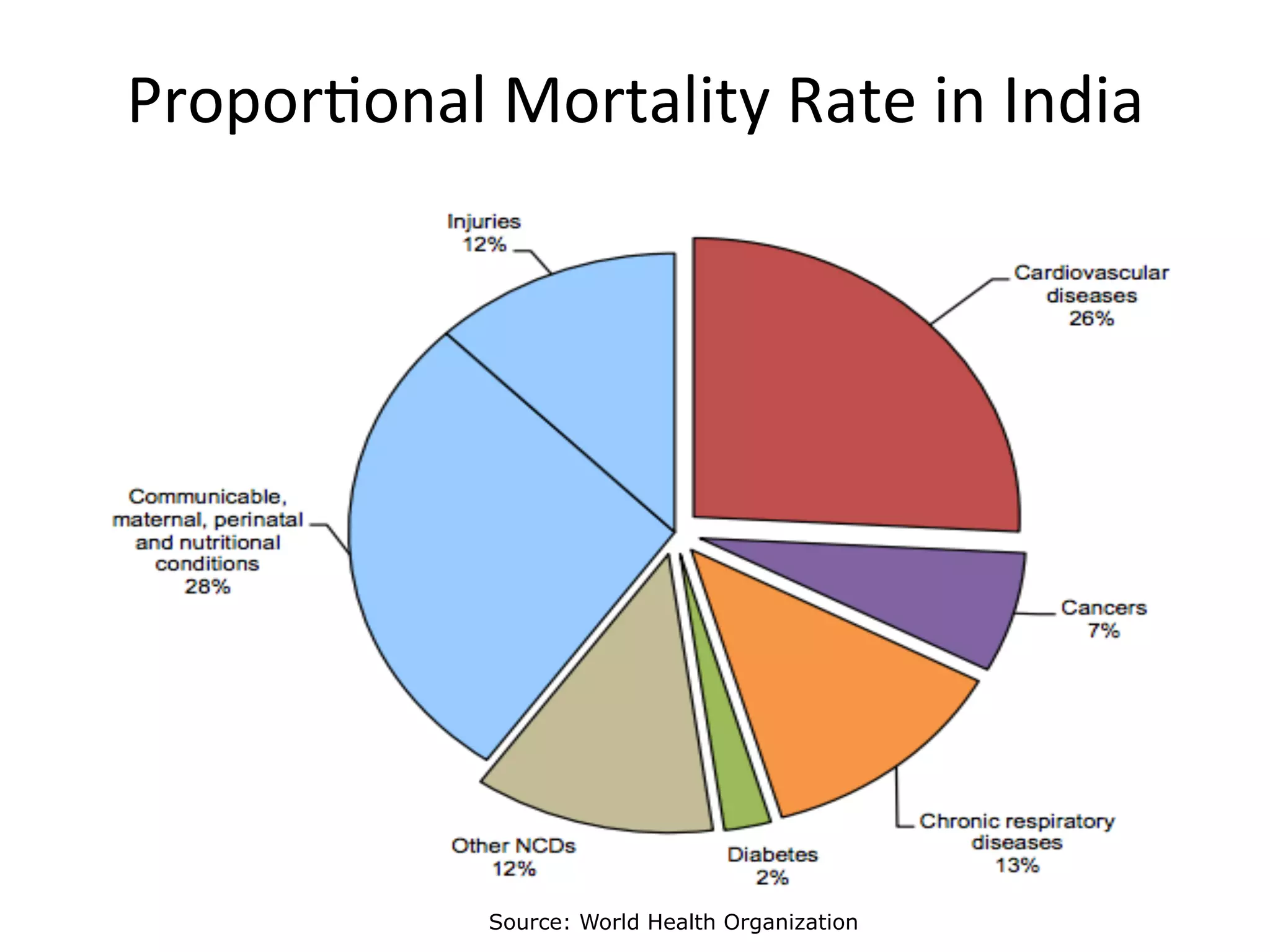
Propor)onal	
  Mortality	
  Rate	
  in	
  India	
  
Source: World Health Organization
E-­‐Governance	
  in	
  Healthcare	
  
•  Governance	
  is	
  all	
  about	
  inclusion,	
  provisioning	
  
and	
  common	
  good	
  –	
  control	
  is	
  a	
  small	
  part.	
  
•  Work	
  mostly	
  has	
  been	
  in	
  automa)ng	
  processes	
  
and	
  dissemina)ng	
  informa)on	
  to	
  masses.	
  
•  Just	
  one	
  MMP	
  in	
  NeGP:	
  mcts.	
  
•  Governments	
  have	
  the	
  power	
  to	
  influence	
  and	
  
provision	
  the	
  research	
  needs.	
  
•  Need	
  for	
  soWware	
  applica)ons	
  in	
  health	
  that	
  can	
  
reach	
  the	
  masses	
  and	
  revolu)onize	
  care.	
  
•  What	
  are	
  some	
  such	
  applica)ons?	
  
Mo)va)on	
  and	
  Enabling	
  Factors	
  
•  Millions	
  of	
  underprivileged	
  who	
  do	
  not	
  have	
  
access	
  to	
  healthcare.	
  
•  Automated	
  diagnosis	
  has	
  been	
  a	
  formidable	
  
challenge	
  for	
  the	
  past	
  4	
  decades.	
  
•  Prolifera)on	
  of	
  portable	
  compu)ng	
  devices,	
  
wearables.	
  
•  Informa)on	
  Retrieval	
  has	
  come	
  of	
  age:	
  Self-­‐
Diagnosis	
  on	
  the	
  Internet	
  is	
  common.	
  
•  Cloud	
  Compu)ng	
  gives	
  ubiquitous	
  access	
  to	
  
enormous	
  processing	
  power.	
  
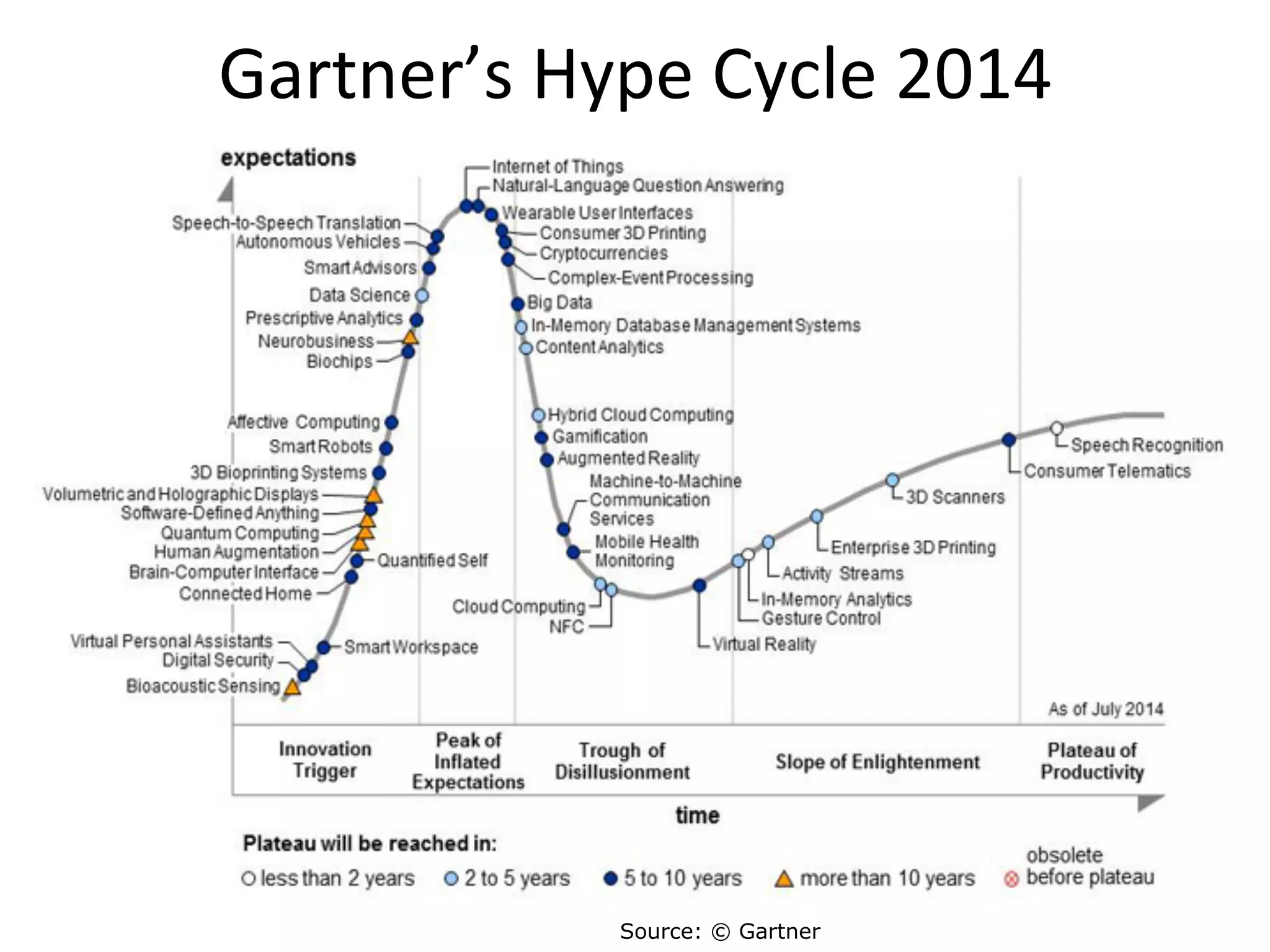
Gartner’s	
  Hype	
  Cycle	
  2014	
  	
  
Source: © Gartner
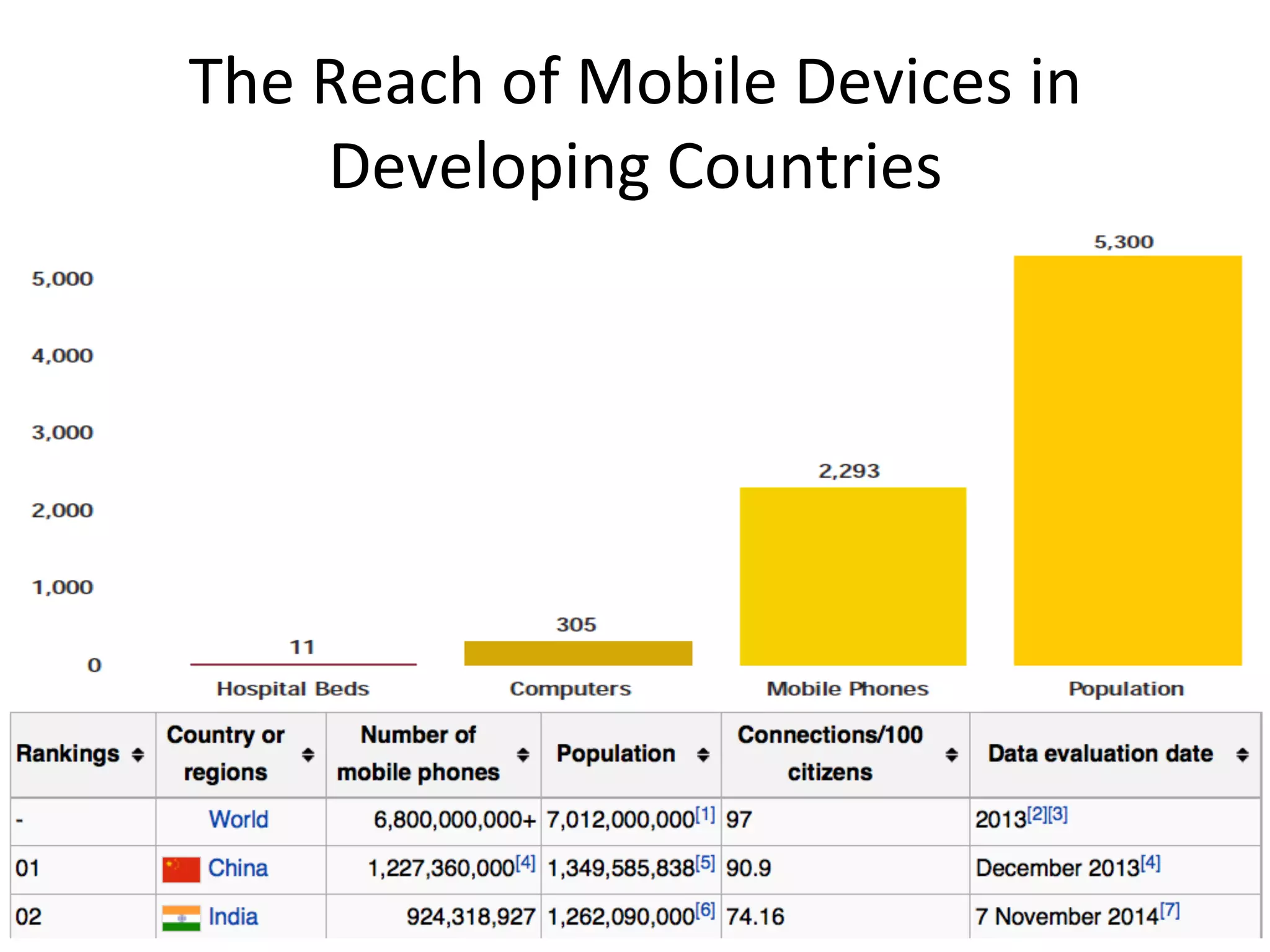
The	
  Reach	
  of	
  Mobile	
  Devices	
  in	
  
Developing	
  Countries	
  
mHealth:	
  An	
  Overview	
  
•  Use	
  of	
  mobile	
  devices	
  for	
  various	
  aspects	
  of	
  
healthcare	
  is	
  part	
  of	
  eHealth,	
  called	
  mHealth.	
  
•  From	
  Telemedicine	
  to	
  awareness	
  campaigns.	
  
•  Connect	
  pa)ents,	
  community	
  health	
  workers	
  
and	
  physicians	
  to	
  serve	
  at	
  the	
  point	
  of	
  care.	
  
•  Phone	
  as	
  a	
  point-­‐of-­‐care	
  device:	
  devices	
  such	
  
as	
  ultrasound	
  probe	
  plugged	
  into	
  the	
  phone.	
  
•  Scores	
  of	
  projects	
  already	
  func)oning	
  
successfully,	
  par)cularly	
  in	
  India.	
  
Machine	
  Augmented	
  Mindfulness	
  
•  Mind	
  monitors	
  health,	
  diagnoses	
  condi)ons	
  
and	
  even	
  cures	
  at	
  a	
  molecular	
  level.	
  
•  Harvard	
  studies	
  established	
  that	
  mindfulness	
  
creates	
  a	
  feedback	
  loop	
  to	
  govern	
  the	
  health.	
  
•  Even	
  deadly	
  diseases	
  such	
  as	
  cancer	
  are	
  found	
  
to	
  be	
  caused	
  by	
  the	
  imbalances	
  in	
  the	
  mind.	
  
•  Can	
  machines	
  take-­‐on	
  mindfulness,	
  like	
  they	
  
took	
  over	
  reasoning,	
  compu)ng	
  and	
  thinking?	


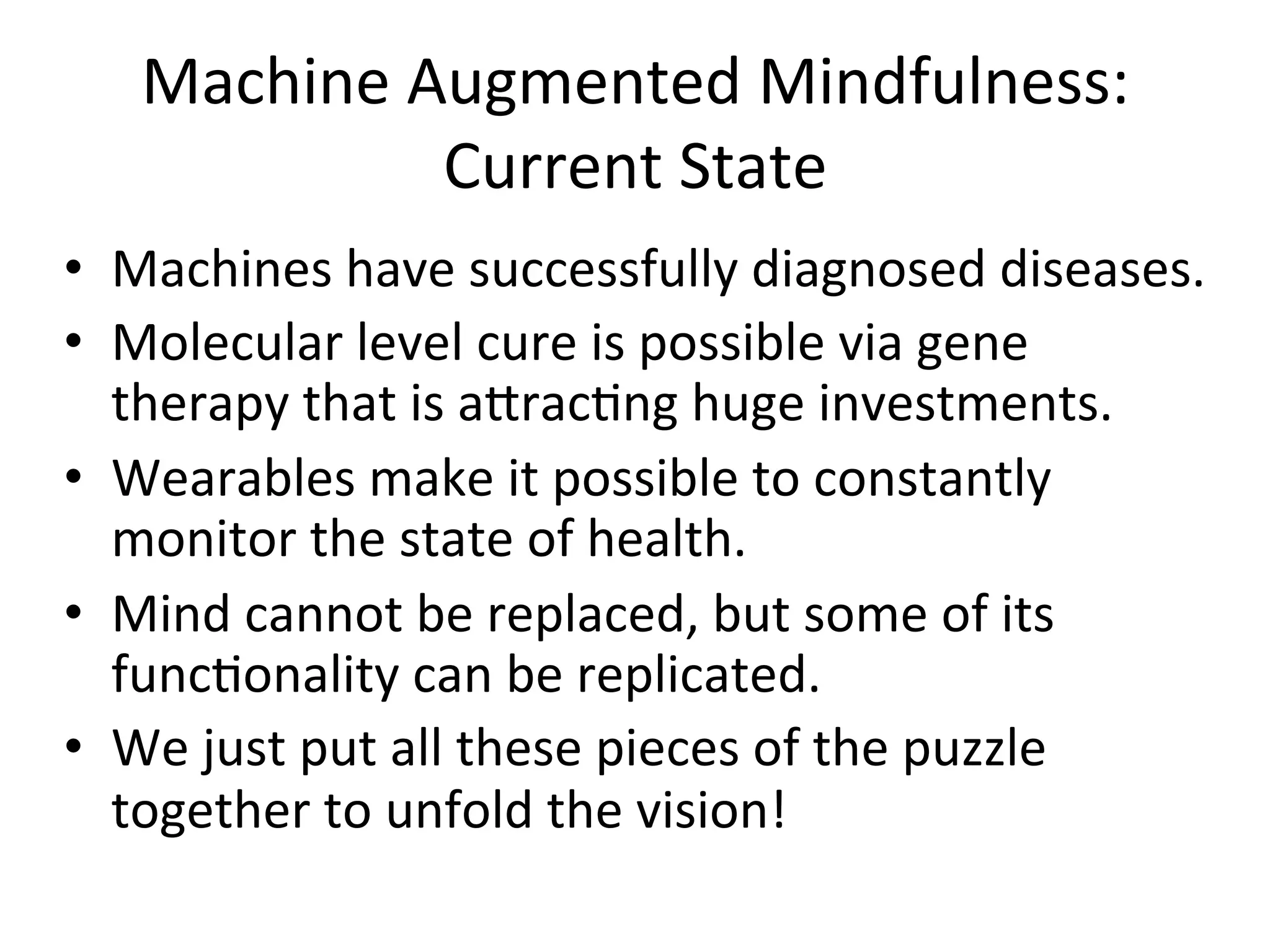
Machine	
  Augmented	
  Mindfulness:	
  
Current	
  State	
  
•  Machines	
  have	
  successfully	
  diagnosed	
  diseases.	
  
•  Molecular	
  level	
  cure	
  is	
  possible	
  via	
  gene	
  
therapy	
  that	
  is	
  a_rac)ng	
  huge	
  investments.	
  
•  Wearables	
  make	
  it	
  possible	
  to	
  constantly	
  
monitor	
  the	
  state	
  of	
  health.	
  
•  Mind	
  cannot	
  be	
  replaced,	
  but	
  some	
  of	
  its	
  
func)onality	
  can	
  be	
  replicated.	
  
•  We	
  just	
  put	
  all	
  these	
  pieces	
  of	
  the	
  puzzle	
  
together	
  to	
  unfold	
  the	
  vision!	
  
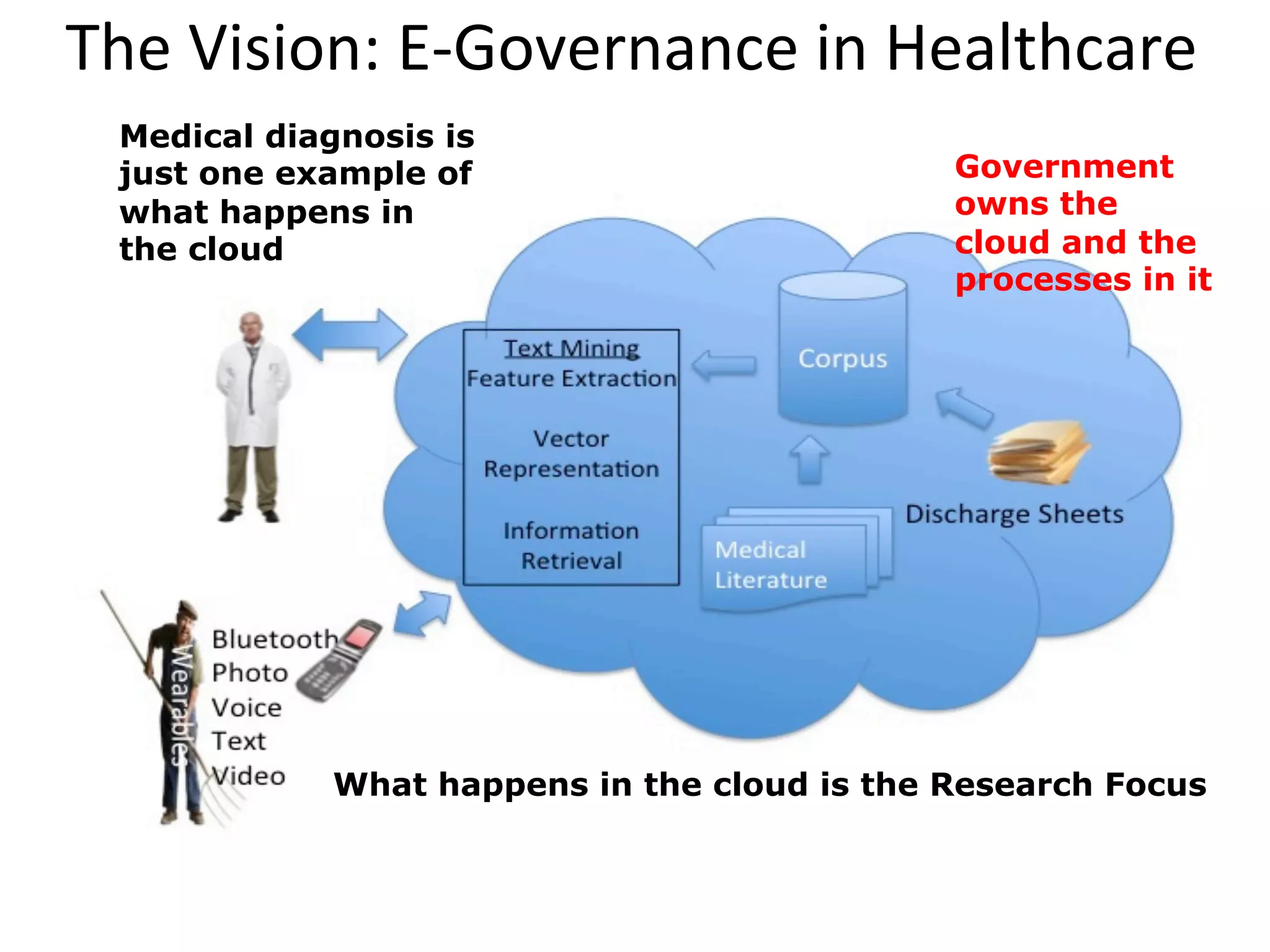
The	
  Vision:	
  E-­‐Governance	
  in	
  Healthcare	
  
What happens in the cloud is the Research Focus
Government
owns the
cloud and the
processes in it
Medical diagnosis is
just one example of
what happens in
the cloud
Approaches	
  to	
  Medical	
  Diagnosis	
  
•  Conven)onal:	
  First-­‐Order	
  Logic	
  based	
  reasoning;	
  
Rule-­‐bases	
  in	
  olden	
  days;	
  Seman)c	
  Web	
  now.	
  
•  MYCIN	
  from	
  Stanford	
  had	
  600	
  rules	
  and	
  did	
  be_er	
  
than	
  Medical	
  Experts.	
  
•  Latest	
  Trend:	
  Using	
  Machine	
  Learning	
  and	
  
Informa)on	
  Retrieval.	
  
•  None	
  of	
  the	
  solu)ons	
  so	
  far	
  are	
  general	
  purpose	
  
and	
  suitable	
  for	
  mass	
  deployment.	
  
•  Our	
  approach	
  considers	
  it	
  as	
  a	
  problem	
  in	
  Text	
  
Mining:	
  Given	
  a	
  set	
  of	
  discharge	
  sheets,	
  iden)fy	
  
the	
  one	
  that’s	
  closest	
  to	
  the	
  given	
  symptoms.	
  
Guidelines	
  
Need	
  a	
  solu)on	
  for	
  medical	
  diagnosis	
  that	
  
•  Is	
  based	
  on	
  available	
  data:	
  past	
  diagnoses	
  
•  Is	
  general,	
  inexpensive,	
  and	
  adequate	
  enough	
  
to	
  be	
  used	
  by	
  the	
  masses	
  
•  Can	
  be	
  implemented	
  using	
  current	
  
technologies	
  for	
  faster	
  availability	
  
•  Does	
  not	
  need	
  a	
  whole	
  lot	
  of	
  knowledge	
  
engineering	
  or	
  ongoing	
  expert	
  maintenance.	
  
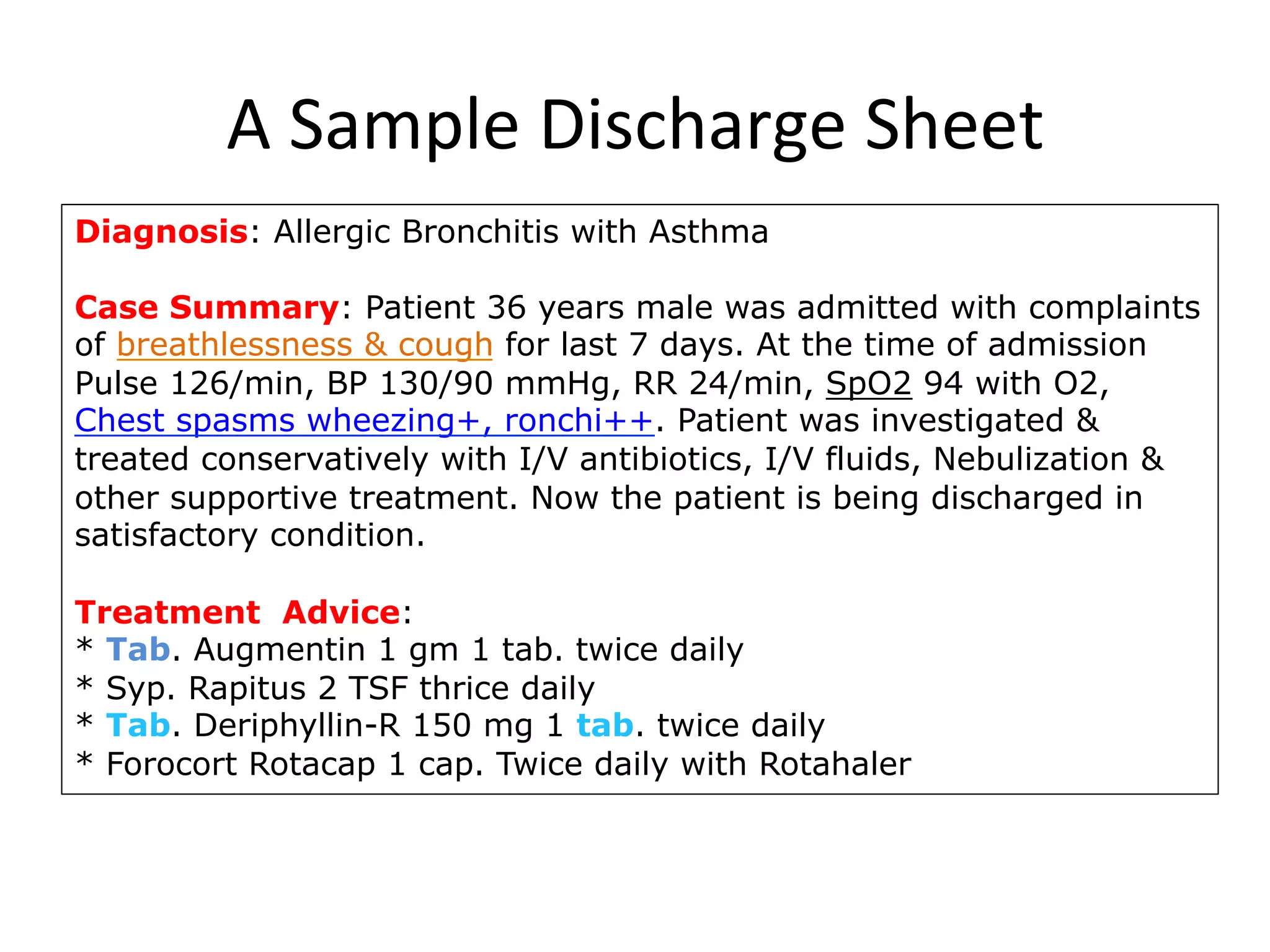
A	
  Sample	
  Discharge	
  Sheet	
  
Diagnosis: Allergic Bronchitis with Asthma
Case Summary: Patient 36 years male was admitted with complaints
of breathlessness & cough for last 7 days. At the time of admission
Pulse 126/min, BP 130/90 mmHg, RR 24/min, SpO2 94 with O2,
Chest spasms wheezing+, ronchi++. Patient was investigated &
treated conservatively with I/V antibiotics, I/V fluids, Nebulization &
other supportive treatment. Now the patient is being discharged in
satisfactory condition.
Treatment Advice:
* Tab. Augmentin 1 gm 1 tab. twice daily
* Syp. Rapitus 2 TSF thrice daily
* Tab. Deriphyllin-R 150 mg 1 tab. twice daily
* Forocort Rotacap 1 cap. Twice daily with Rotahaler
Wordcloud	
  from	
  the	
  Discharge	
  Sheets	
  
Text	
  mining	
  the	
  Corpus	
  
•  Preprocessing:	
  Remove	
  stopwords,	
  numbers,	
  
punctua)on,	
  tags,	
  sparse	
  terms	
  and	
  convert	
  case.	
  
•  Each	
  document	
  is	
  represented	
  as	
  a	
  vector	
  (a	
  
point)	
  in	
  a	
  mul)-­‐dimensional	
  space.	
  
•  Each	
  dimension	
  is	
  a	
  word	
  in	
  the	
  corpus	
  =>	
  
thousands	
  of	
  dimensions.	
  
•  Each	
  document	
  has	
  a	
  score	
  (TF-­‐IDF)	
  for	
  each	
  word	
  
used	
  in	
  it	
  that	
  determines	
  its	
  posi)on.	
  
•  Each	
  point	
  is	
  labeled	
  with	
  the	
  diagnosis.	
  
3D	
  Visualiza)on	
  of	
  the	
  Corpus	
  
Enter:	
  The	
  Pa)ent	
  
•  The	
  closer	
  the	
  points	
  in	
  the	
  vector	
  space,	
  the	
  more	
  
similar	
  the	
  documents.	
  
•  Document	
  with	
  pa)ent’s	
  symptoms	
  are	
  also	
  
represented	
  as	
  a	
  vector	
  in	
  the	
  same	
  vector	
  space.	
  
•  The	
  label	
  on	
  the	
  closest	
  point	
  to	
  this	
  symptoms	
  
document	
  in	
  the	
  vector	
  space	
  is	
  the	
  diagnosis.	
  
•  Find	
  K-­‐Nearest	
  Neighbors	
  (K-­‐NN)	
  of	
  the	
  symptoms	
  
document	
  to	
  suggest	
  possible	
  alterna)ves.	
  
•  The	
  K	
  nearest	
  neighboring	
  discharge	
  sheets	
  and	
  the	
  
symptoms	
  doc	
  can	
  be	
  used	
  to	
  find	
  K	
  relevant	
  
ar)cles	
  for	
  further	
  reference	
  and	
  decision	
  support.	
  
Simple	
  Math	
  with	
  Profound	
  Impact	
  
•  TF.IDF	
  Score	
  is	
  computed	
  as:	
  !.idft,d	
  =	
  !t,d	
  *	
  idft	


  where	


•  Similarity	
  between	
  two	
  discharge	
  sheets	
  is	
  
	
  where	
  the	
  norm	
  of	
  a	
  vector,	
  |	
  	
  |	
  is	


  being	
  the	
  m.idf	
  value	
  of	
  a	
  
	
  feature	
  (term	
  /	
  word),	
  i	
  
Challenges	
  
•  Privacy	
  and	
  Security:	
  Hacking	
  can	
  be	
  fatal.	
  
•  Cost:	
  Technology	
  is	
  s)ll	
  in	
  commercializa)on	
  zone.	
  
•  Dataset:	
  Government	
  mandate	
  may	
  be	
  needed.	
  
•  Human	
  Exper)se:	
  Interven)on	
  needed	
  at	
  )mes.	
  
•  Quality	
  of	
  available	
  dataset.	
  
•  Mul)lingual	
  support:	
  22	
  official	
  languages,	
  1,652	
  
different	
  "mother	
  tongues"	
  in	
  India	
  alone.	
  
•  High	
  Cost	
  of	
  Type	
  I	
  and	
  II	
  errors.	
  
•  Acceptance:	
  Skep)cism	
  –	
  government	
  can	
  again	
  
help	
  here	
  to	
  influence	
  posi)ve	
  outlook.	
  
Future	
  Direc)ons	
  
•  Processing	
  images,	
  video,	
  and	
  audio	
  (including	
  
ultrasound)	
  in	
  conjunc)on	
  with	
  text	
  informa)on.	
  
•  Real-­‐)me,	
  stateful	
  big	
  data	
  processing.	
  
•  Aggrega)on	
  of	
  health	
  data	
  to	
  detect	
  or	
  predict	
  
epidemics	
  and	
  health	
  trends.	
  
•  Add	
  a	
  QA	
  interface	
  using	
  NLP,	
  IVR,	
  Machine	
  
Transla)on.	
  
•  Extend	
  the	
  ideas	
  to	
  monitor	
  and	
  proac)vely	
  
remedy	
  abnormali)es.	
  
Conclusion	
  
•  ICT	
  for	
  Healthcare	
  is	
  a	
  formidable	
  challenge	
  and	
  a	
  
huge	
  opportunity	
  for	
  e-­‐governance.	
  
•  Mobile	
  is	
  the	
  www	
  of	
  90’s	
  –	
  the	
  conduit	
  to	
  take	
  
solu)ons	
  to	
  the	
  masses	
  and	
  manifold	
  the	
  RoI.	
  
•  Good	
  )me	
  to	
  revisit	
  ‘70s	
  ideas	
  –	
  we	
  now	
  have	
  the	
  
compu)ng	
  resources	
  that	
  weren’t	
  there	
  then.	
  
•  And	
  more	
  importantly…	
  
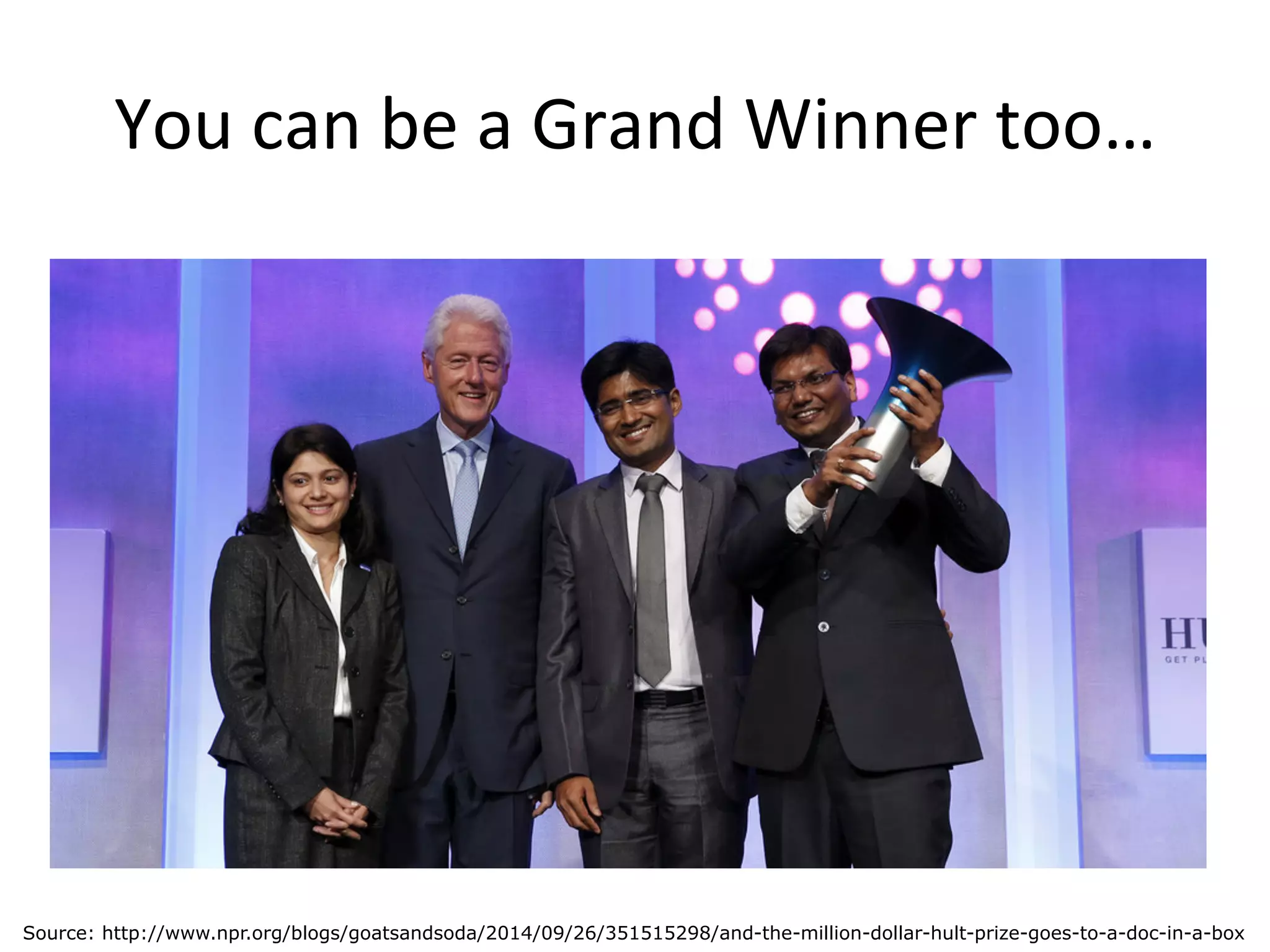
You	
  can	
  be	
  a	
  Grand	
  Winner	
  too…	
  
Source: http://www.npr.org/blogs/goatsandsoda/2014/09/26/351515298/and-the-million-dollar-hult-prize-goes-to-a-doc-in-a-box
Even	
  more	
  importantly…	
  
A	
  Great	
  Quote	


Math	
  is	
  the	
  heart	
  of	
  ma_er.	
  Once	
  expressed	
  in	
  
math,	
  the	
  ma_er	
  dissolves	
  and	
  yields,	
  just	
  like	
  when	
  
you	
  touch	
  a	
  person’s	
  heart,	
  he	
  dissolves	
  and	
  yields.	
  
Questions for you
•  Why	
  is	
  technical	
  research	
  important	
  for	
  
effec)ve	
  e-­‐governance?	
  
•  How	
  is	
  mHealth	
  related	
  to	
  Machine	
  Learning,	
  
Big	
  Data	
  Analy)cs	
  and	
  Internet	
  of	
  Things?	
  
•  How	
  can	
  the	
  millions	
  who	
  do	
  not	
  have	
  access	
  to	
  
proper	
  healthcare	
  be	
  provisioned	
  with	
  it?	
  
•  Can	
  machines	
  replace	
  the	
  doctor	
  eventually?	
  
•  Can	
  machine	
  assisted	
  gene	
  therapy	
  	
  become	
  a	
  
cure-­‐all?	
  
•  What	
  are	
  some	
  of	
  the	
  opportuni)es	
  and	
  
challenges	
  in	
  the	
  mHealth	
  space?	
  
Resources
h_p://www.ecgcheck.com/	
  
h_p://www.alivecor.com/home	
  
h_p://www.mobisante.com	
  
h_p://www.technologyreview.com/news/421827/
ultrasound-­‐gets-­‐more-­‐portable/	
  
h_ps://www.google.com/search?q=%22Mobile
%20Alliance%20for%20Maternal%20Ac)on	
  
h_p://en.wikipedia.org/wiki/Scanadu	
  
h_p://en.wikipedia.org/wiki/Lab-­‐on-­‐a-­‐chip	
  
h_p://nrhm-­‐mcts.nic.in	


References	


[1]	
  	
  Pendyala,	
  V.S.,	
  Fang,	
  Y.,	
  Holliday,	
  J.,	
  Zalzala,	
  A.,	
  (2014,	
  October).	
  A	
  Text	
  
Mining	
  Approach	
  to	
  Automated	
  Healthcare	
  for	
  the	
  Masses.	
  In	
  Global	
  
Humanitarian	
  Technology	
  Conference	
  (GHTC),	
  2014,	
  IEEE	
  Interna)onal	
  
Conference	
  on.	
  IEEE.	


[2]	
  Pendyala,	
  V.S.,	
  &	
  Shim,	
  S.	
  S.	
  (2009).	
  The	
  Web	
  as	
  the	
  Ubiquitous	
  Computer.	
  
IEEE	
  Computer,	
  42(9)	
  90-­‐92.	


[3]	
  	
  Pendyala,	
  V.S.,	
  &	
  Holliday,	
  J.	
  (2010,	
  August).	
  Performing	
  intelligent	
  mobile	
  
searches	
  in	
  the	
  cloud	
  using	
  seman)c	
  technologies.	
  In	
  Granular	
  Compu)ng	
  
(GrC),	
  2010	
  IEEE	
  Interna)onal	
  Conference	
  on	
  (pp.	
  381-­‐386).	
  IEEE.	


[4]	
  	
  Pendyala,	
  V.S.,	
  &	
  	
  Holliday,	
  J.	
  	
  (2011).	
  Cloud	
  As	
  a	
  	
  Computer.	
  Advanced	
  
Design	
  Approaches	
  to	
  Emerging	
  SoWware	
  Systems::	
  Principles,	
  Methodology	
  
and	
  Tools,	
  241.	


[5]	
  Delizonna,	
  L.	
  L.,	
  Williams,	
  R.	
  P.,	
  &	
  Langer,	
  E.	
  J.	
  (2009).	
  The	
  effect	
  of	
  
mindfulness	
  on	
  heart	
  rate	
  control.	
  Journal	
  of	
  Adult	
  Development,	
  16(2),	
  61-­‐65.	
  
References	
  (Contd.)	
  
[6]	
  Anderson,	
  C.	
  M.	
  (2000).	
  From	
  molecules	
  to	
  mindfulness:	
  How	
  ver)cally	
  
convergent	
  fractal	
  )me	
  fluctua)ons	
  unify	
  cogni)on	
  and	
  emo)on*.	
  
Consciousness	
  &	
  Emo)on,	
  1(2),	
  193-­‐226.	


[7]	
  Amritanshuram,	
  R.,	
  Nagendra,	
  H.	
  R.,	
  Shastry,	
  A.	
  S.	
  N.,	
  Raghuram,	
  N.	
  V.,	
  &	
  
Nagarathna,	
  R.	
  (2013).	
  A	
  psycho-­‐oncological	
  model	
  of	
  cancer	
  according	
  to	
  
ancient	
  texts	
  of	
  yoga.	
  Journal	
  of	
  Yoga	
  and	
  Physical	
  Therapies,	
  3,	
  129.	


[8]	
  Reibel,	
  D.	
  K.,	
  Greeson,	
  J.	
  M.,	
  Brainard,	
  G.	
  C.,	
  &	
  Rosenzweig,	
  S.	
  (2001).	
  
Mindfulness-­‐based	
  stress	
  reduc)on	
  and	
  health-­‐related	
  quality	
  of	
  life	
  in	
  a	
  
heterogeneous	
  pa)ent	
  popula)on.	
  General	
  hospital	
  psychiatry,	
  23(4),	
  183-­‐192.	


[9]	
  Chandwani,	
  K.	
  D.,	
  Chaoul-­‐Reich,	
  A.,	
  Biegler,	
  K.	
  A.,	
  &	
  Cohen,	
  L.	
  (2008).	
  Mind–
Body	
  Research	
  in	
  Cancer.	
  In	
  Integra)ve	
  Oncology	
  (pp.	
  139-­‐160).	
  Humana	
  Press.	


[10]	
  Ludwig,	
  D.	
  S.,	
  &	
  Kabat-­‐Zinn,	
  J.	
  (2008).	
  Mindfulness	
  in	
  medicine.	
  Jama,	
  
300(11),	
  1350-­‐1352.	


Q&A
MORE Q&A?
vishnu@pendyalas.org	


h3ps://www.linkedin.com/in/pendyala	
  
Twi3er:	
  @vishnupendyala	
  

M-Health

  • 1.
    Opportuni)es  and  Challenges  in   e-­‐Governance:   mHealth  Case  Study   Vishnu Pendyala
  • 2.
    A Great Quote Economy  grows  as  more  and  more  people  join  its   core  echelons.  People  are  the  most  important   economic  resources  at  all  )mes.  
  • 3.
    Agenda •  The  Healthcare  Challenge  and  the  e-­‐ Governance  Opportunity.   •  Mo)va)on,  Enabling  Factors   •  mHealth:  An  Overview   •  Vision:  Machine  Augmented  Mindfulness   •  Medical  Diagnosis   •  Realizing  the  Vision:  Challenges   •  Future  Direc)ons  and  Conclusion  
  • 4.
    Questions for you • Why  is  technical  research  important  for   effec)ve  e-­‐governance?   •  How  is  mHealth  related  to  Machine  Learning,   Big  Data  Analy)cs  and  Internet  of  Things?   •  How  can  the  millions  who  do  not  have  access  to   proper  healthcare  be  provisioned  with  it?   •  Can  machines  replace  the  doctor  eventually?   •  Can  machine  assisted  gene  therapy    become  a   cure-­‐all?   •  What  are  some  of  the  opportuni)es  and   challenges  in  the  mHealth  space?  
  • 5.
  • 6.
    The  Healthcare  Challenge:  World  Map   of  Access  to  Physicians   © Copyright Sasi Group (University of Sheffield) and Mark Newman (University of Michigan).
  • 7.
    Healthcare  Spending   Source:World Health Organization, World Health Statistics, 2010: Table 7
  • 8.
    Propor)onal  Mortality  Rate  in  India   Source: World Health Organization
  • 9.
    E-­‐Governance  in  Healthcare   •  Governance  is  all  about  inclusion,  provisioning   and  common  good  –  control  is  a  small  part.   •  Work  mostly  has  been  in  automa)ng  processes   and  dissemina)ng  informa)on  to  masses.   •  Just  one  MMP  in  NeGP:  mcts.   •  Governments  have  the  power  to  influence  and   provision  the  research  needs.   •  Need  for  soWware  applica)ons  in  health  that  can   reach  the  masses  and  revolu)onize  care.   •  What  are  some  such  applica)ons?  
  • 10.
    Mo)va)on  and  Enabling  Factors   •  Millions  of  underprivileged  who  do  not  have   access  to  healthcare.   •  Automated  diagnosis  has  been  a  formidable   challenge  for  the  past  4  decades.   •  Prolifera)on  of  portable  compu)ng  devices,   wearables.   •  Informa)on  Retrieval  has  come  of  age:  Self-­‐ Diagnosis  on  the  Internet  is  common.   •  Cloud  Compu)ng  gives  ubiquitous  access  to   enormous  processing  power.  
  • 11.
    Gartner’s  Hype  Cycle  2014     Source: © Gartner
  • 12.
    The  Reach  of  Mobile  Devices  in   Developing  Countries  
  • 13.
    mHealth:  An  Overview   •  Use  of  mobile  devices  for  various  aspects  of   healthcare  is  part  of  eHealth,  called  mHealth.   •  From  Telemedicine  to  awareness  campaigns.   •  Connect  pa)ents,  community  health  workers   and  physicians  to  serve  at  the  point  of  care.   •  Phone  as  a  point-­‐of-­‐care  device:  devices  such   as  ultrasound  probe  plugged  into  the  phone.   •  Scores  of  projects  already  func)oning   successfully,  par)cularly  in  India.  
  • 14.
    Machine  Augmented  Mindfulness   •  Mind  monitors  health,  diagnoses  condi)ons   and  even  cures  at  a  molecular  level.   •  Harvard  studies  established  that  mindfulness   creates  a  feedback  loop  to  govern  the  health.   •  Even  deadly  diseases  such  as  cancer  are  found   to  be  caused  by  the  imbalances  in  the  mind.   •  Can  machines  take-­‐on  mindfulness,  like  they   took  over  reasoning,  compu)ng  and  thinking?    
  • 15.
    Machine  Augmented  Mindfulness:   Current  State   •  Machines  have  successfully  diagnosed  diseases.   •  Molecular  level  cure  is  possible  via  gene   therapy  that  is  a_rac)ng  huge  investments.   •  Wearables  make  it  possible  to  constantly   monitor  the  state  of  health.   •  Mind  cannot  be  replaced,  but  some  of  its   func)onality  can  be  replicated.   •  We  just  put  all  these  pieces  of  the  puzzle   together  to  unfold  the  vision!  
  • 16.
    The  Vision:  E-­‐Governance  in  Healthcare   What happens in the cloud is the Research Focus Government owns the cloud and the processes in it Medical diagnosis is just one example of what happens in the cloud
  • 17.
    Approaches  to  Medical  Diagnosis   •  Conven)onal:  First-­‐Order  Logic  based  reasoning;   Rule-­‐bases  in  olden  days;  Seman)c  Web  now.   •  MYCIN  from  Stanford  had  600  rules  and  did  be_er   than  Medical  Experts.   •  Latest  Trend:  Using  Machine  Learning  and   Informa)on  Retrieval.   •  None  of  the  solu)ons  so  far  are  general  purpose   and  suitable  for  mass  deployment.   •  Our  approach  considers  it  as  a  problem  in  Text   Mining:  Given  a  set  of  discharge  sheets,  iden)fy   the  one  that’s  closest  to  the  given  symptoms.  
  • 18.
    Guidelines   Need  a  solu)on  for  medical  diagnosis  that   •  Is  based  on  available  data:  past  diagnoses   •  Is  general,  inexpensive,  and  adequate  enough   to  be  used  by  the  masses   •  Can  be  implemented  using  current   technologies  for  faster  availability   •  Does  not  need  a  whole  lot  of  knowledge   engineering  or  ongoing  expert  maintenance.  
  • 19.
    A  Sample  Discharge  Sheet   Diagnosis: Allergic Bronchitis with Asthma Case Summary: Patient 36 years male was admitted with complaints of breathlessness & cough for last 7 days. At the time of admission Pulse 126/min, BP 130/90 mmHg, RR 24/min, SpO2 94 with O2, Chest spasms wheezing+, ronchi++. Patient was investigated & treated conservatively with I/V antibiotics, I/V fluids, Nebulization & other supportive treatment. Now the patient is being discharged in satisfactory condition. Treatment Advice: * Tab. Augmentin 1 gm 1 tab. twice daily * Syp. Rapitus 2 TSF thrice daily * Tab. Deriphyllin-R 150 mg 1 tab. twice daily * Forocort Rotacap 1 cap. Twice daily with Rotahaler
  • 20.
    Wordcloud  from  the  Discharge  Sheets  
  • 21.
    Text  mining  the  Corpus   •  Preprocessing:  Remove  stopwords,  numbers,   punctua)on,  tags,  sparse  terms  and  convert  case.   •  Each  document  is  represented  as  a  vector  (a   point)  in  a  mul)-­‐dimensional  space.   •  Each  dimension  is  a  word  in  the  corpus  =>   thousands  of  dimensions.   •  Each  document  has  a  score  (TF-­‐IDF)  for  each  word   used  in  it  that  determines  its  posi)on.   •  Each  point  is  labeled  with  the  diagnosis.  
  • 22.
    3D  Visualiza)on  of  the  Corpus  
  • 23.
    Enter:  The  Pa)ent   •  The  closer  the  points  in  the  vector  space,  the  more   similar  the  documents.   •  Document  with  pa)ent’s  symptoms  are  also   represented  as  a  vector  in  the  same  vector  space.   •  The  label  on  the  closest  point  to  this  symptoms   document  in  the  vector  space  is  the  diagnosis.   •  Find  K-­‐Nearest  Neighbors  (K-­‐NN)  of  the  symptoms   document  to  suggest  possible  alterna)ves.   •  The  K  nearest  neighboring  discharge  sheets  and  the   symptoms  doc  can  be  used  to  find  K  relevant   ar)cles  for  further  reference  and  decision  support.  
  • 24.
    Simple  Math  with  Profound  Impact   •  TF.IDF  Score  is  computed  as:  !.idft,d  =  !t,d  *  idft            where     •  Similarity  between  two  discharge  sheets  is    where  the  norm  of  a  vector,  |    |  is                                                                                        being  the  m.idf  value  of  a    feature  (term  /  word),  i  
  • 25.
    Challenges   •  Privacy  and  Security:  Hacking  can  be  fatal.   •  Cost:  Technology  is  s)ll  in  commercializa)on  zone.   •  Dataset:  Government  mandate  may  be  needed.   •  Human  Exper)se:  Interven)on  needed  at  )mes.   •  Quality  of  available  dataset.   •  Mul)lingual  support:  22  official  languages,  1,652   different  "mother  tongues"  in  India  alone.   •  High  Cost  of  Type  I  and  II  errors.   •  Acceptance:  Skep)cism  –  government  can  again   help  here  to  influence  posi)ve  outlook.  
  • 26.
    Future  Direc)ons   • Processing  images,  video,  and  audio  (including   ultrasound)  in  conjunc)on  with  text  informa)on.   •  Real-­‐)me,  stateful  big  data  processing.   •  Aggrega)on  of  health  data  to  detect  or  predict   epidemics  and  health  trends.   •  Add  a  QA  interface  using  NLP,  IVR,  Machine   Transla)on.   •  Extend  the  ideas  to  monitor  and  proac)vely   remedy  abnormali)es.  
  • 27.
    Conclusion   •  ICT  for  Healthcare  is  a  formidable  challenge  and  a   huge  opportunity  for  e-­‐governance.   •  Mobile  is  the  www  of  90’s  –  the  conduit  to  take   solu)ons  to  the  masses  and  manifold  the  RoI.   •  Good  )me  to  revisit  ‘70s  ideas  –  we  now  have  the   compu)ng  resources  that  weren’t  there  then.   •  And  more  importantly…  
  • 28.
    You  can  be  a  Grand  Winner  too…   Source: http://www.npr.org/blogs/goatsandsoda/2014/09/26/351515298/and-the-million-dollar-hult-prize-goes-to-a-doc-in-a-box
  • 29.
  • 30.
    A  Great  Quote       Math  is  the  heart  of  ma_er.  Once  expressed  in   math,  the  ma_er  dissolves  and  yields,  just  like  when   you  touch  a  person’s  heart,  he  dissolves  and  yields.  
  • 31.
    Questions for you • Why  is  technical  research  important  for   effec)ve  e-­‐governance?   •  How  is  mHealth  related  to  Machine  Learning,   Big  Data  Analy)cs  and  Internet  of  Things?   •  How  can  the  millions  who  do  not  have  access  to   proper  healthcare  be  provisioned  with  it?   •  Can  machines  replace  the  doctor  eventually?   •  Can  machine  assisted  gene  therapy    become  a   cure-­‐all?   •  What  are  some  of  the  opportuni)es  and   challenges  in  the  mHealth  space?  
  • 32.
    Resources h_p://www.ecgcheck.com/   h_p://www.alivecor.com/home   h_p://www.mobisante.com   h_p://www.technologyreview.com/news/421827/ ultrasound-­‐gets-­‐more-­‐portable/   h_ps://www.google.com/search?q=%22Mobile %20Alliance%20for%20Maternal%20Ac)on   h_p://en.wikipedia.org/wiki/Scanadu   h_p://en.wikipedia.org/wiki/Lab-­‐on-­‐a-­‐chip   h_p://nrhm-­‐mcts.nic.in    
  • 33.
    References     [1]    Pendyala,  V.S.,  Fang,  Y.,  Holliday,  J.,  Zalzala,  A.,  (2014,  October).  A  Text   Mining  Approach  to  Automated  Healthcare  for  the  Masses.  In  Global   Humanitarian  Technology  Conference  (GHTC),  2014,  IEEE  Interna)onal   Conference  on.  IEEE.     [2]  Pendyala,  V.S.,  &  Shim,  S.  S.  (2009).  The  Web  as  the  Ubiquitous  Computer.   IEEE  Computer,  42(9)  90-­‐92.     [3]    Pendyala,  V.S.,  &  Holliday,  J.  (2010,  August).  Performing  intelligent  mobile   searches  in  the  cloud  using  seman)c  technologies.  In  Granular  Compu)ng   (GrC),  2010  IEEE  Interna)onal  Conference  on  (pp.  381-­‐386).  IEEE.       [4]    Pendyala,  V.S.,  &    Holliday,  J.    (2011).  Cloud  As  a    Computer.  Advanced   Design  Approaches  to  Emerging  SoWware  Systems::  Principles,  Methodology   and  Tools,  241.     [5]  Delizonna,  L.  L.,  Williams,  R.  P.,  &  Langer,  E.  J.  (2009).  The  effect  of   mindfulness  on  heart  rate  control.  Journal  of  Adult  Development,  16(2),  61-­‐65.  
  • 34.
    References  (Contd.)   [6]  Anderson,  C.  M.  (2000).  From  molecules  to  mindfulness:  How  ver)cally   convergent  fractal  )me  fluctua)ons  unify  cogni)on  and  emo)on*.   Consciousness  &  Emo)on,  1(2),  193-­‐226.     [7]  Amritanshuram,  R.,  Nagendra,  H.  R.,  Shastry,  A.  S.  N.,  Raghuram,  N.  V.,  &   Nagarathna,  R.  (2013).  A  psycho-­‐oncological  model  of  cancer  according  to   ancient  texts  of  yoga.  Journal  of  Yoga  and  Physical  Therapies,  3,  129.     [8]  Reibel,  D.  K.,  Greeson,  J.  M.,  Brainard,  G.  C.,  &  Rosenzweig,  S.  (2001).   Mindfulness-­‐based  stress  reduc)on  and  health-­‐related  quality  of  life  in  a   heterogeneous  pa)ent  popula)on.  General  hospital  psychiatry,  23(4),  183-­‐192.     [9]  Chandwani,  K.  D.,  Chaoul-­‐Reich,  A.,  Biegler,  K.  A.,  &  Cohen,  L.  (2008).  Mind– Body  Research  in  Cancer.  In  Integra)ve  Oncology  (pp.  139-­‐160).  Humana  Press.     [10]  Ludwig,  D.  S.,  &  Kabat-­‐Zinn,  J.  (2008).  Mindfulness  in  medicine.  Jama,   300(11),  1350-­‐1352.      
  • 35.
  • 36.
    MORE Q&A? vishnu@pendyalas.org     h3ps://www.linkedin.com/in/pendyala   Twi3er:  @vishnupendyala