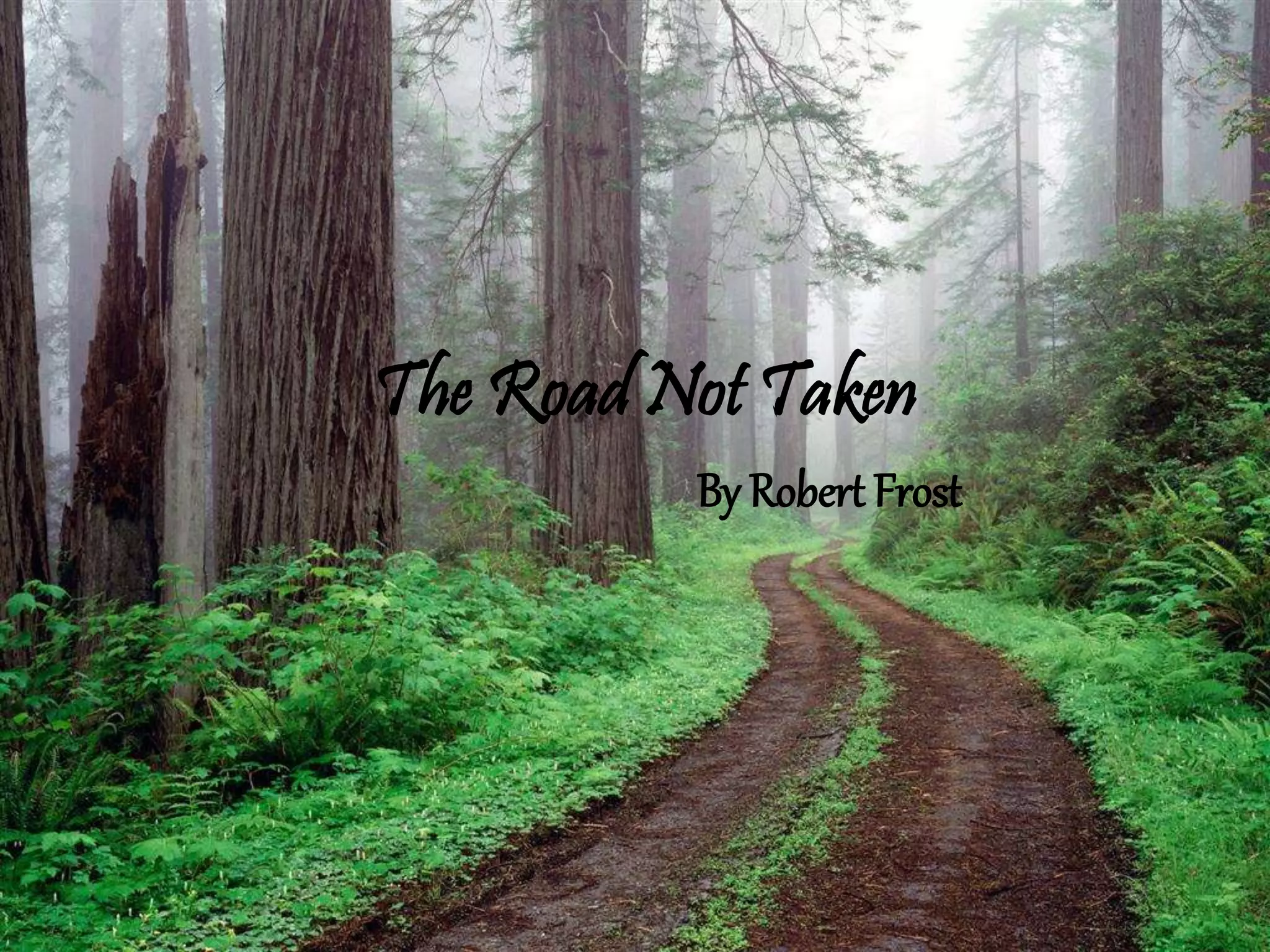
The Road Not Taken
By Robert Frost
About The Author
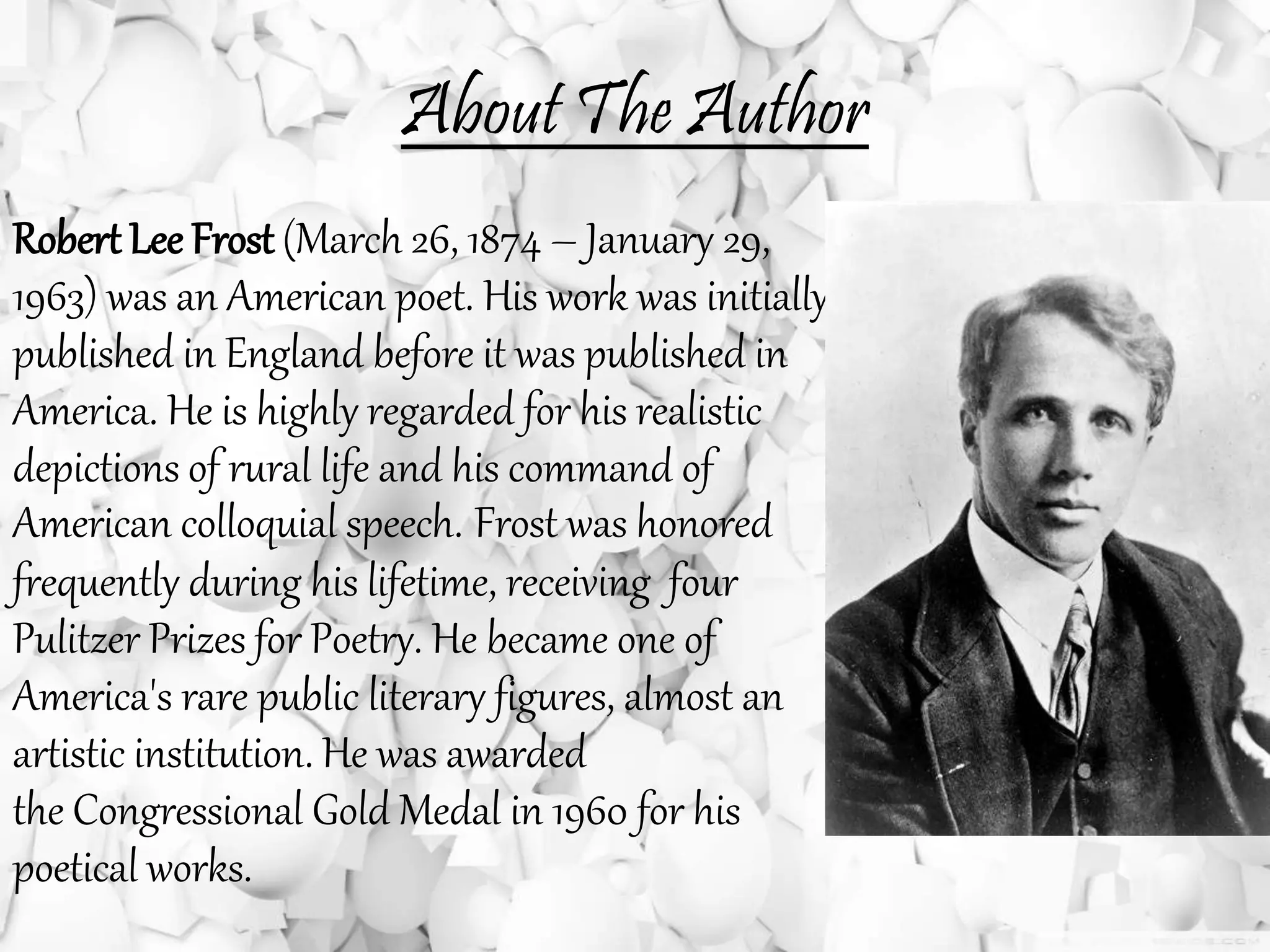
Robert Lee Frost (March 26, 1874 – January 29,
1963) was an American poet. His work was initially
published in England before it was published in
America. He is highly regarded for his realistic
depictions of rural life and his command of
American colloquial speech. Frost was honored
frequently during his lifetime, receiving four
Pulitzer Prizes for Poetry. He became one of
America's rare public literary figures, almost an
artistic institution. He was awarded
the Congressional Gold Medal in 1960 for his
poetical works.
About The Poem
First published in 1916 , “The Road Not Taken"
shows Frost at his best as a pastoral who combines
rustic simplicity with hidden , indirect and clarity
of style and language.
‘The road’ is the symbol of the choice made by us in life. Many times,
we regret the choice we make but what is done once cannot be
undone.
Man regrets for what he has denied himself in life , rather than what
he has chosen. Hence, the poet has given his poem the title “The Road
Not Taken”.
The word "road" not only means "way", it also means "journey" or a
"stage of journey". Here "road" does not signify any ordinary road,
but functions a metaphor of a vital decision in our life.
Poem’s Title
Summary Of The Poem
This poem talks about the choices one has to make
in life and their consequences. One day while
walking in a wooded area full of trees, the poet
comes to a place where he has to decide which road
he should take. He starts debating over the choices
as he realizes he cannot walk on both. However he
decides to take the second path with the intention
of travelling on the first some other time in future
The Poem-
First Stanza
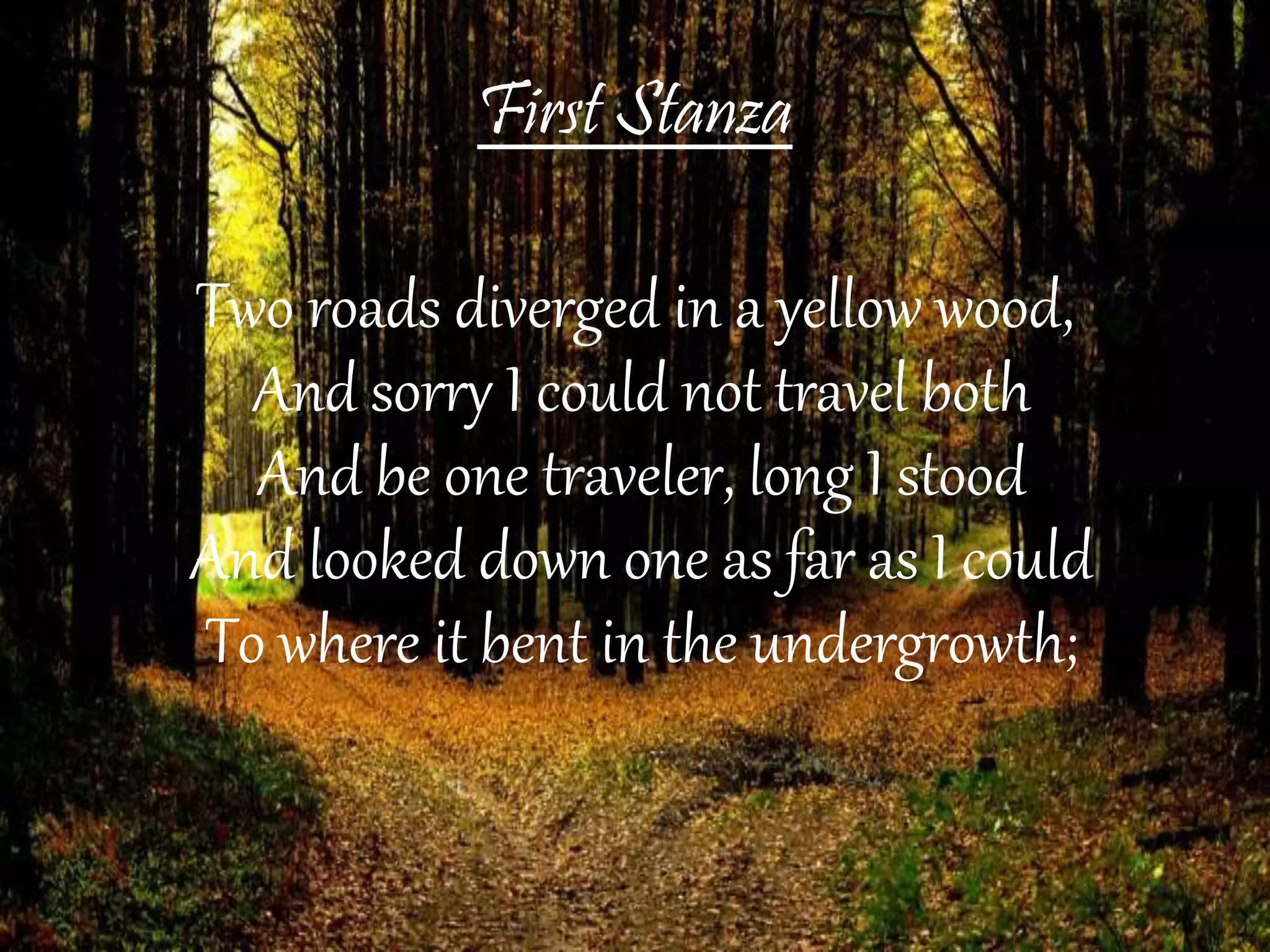
Two roads diverged in a yellow wood,
And sorry I could not travel both
And be one traveler, long I stood
And looked down one as far as I could
To where it bent in the undergrowth;
Summary Of The First Stanza
The speaker describes his position. He has been out
for walking in the woods and comes in between the
diversion of two roads, he stands there looking as
far down each one as he can see. He would like to
try out both, but doubts he could do that, so
therefore he continues to look down the roads for a
long time trying to make his decision about which
road to take.
Second Stanza
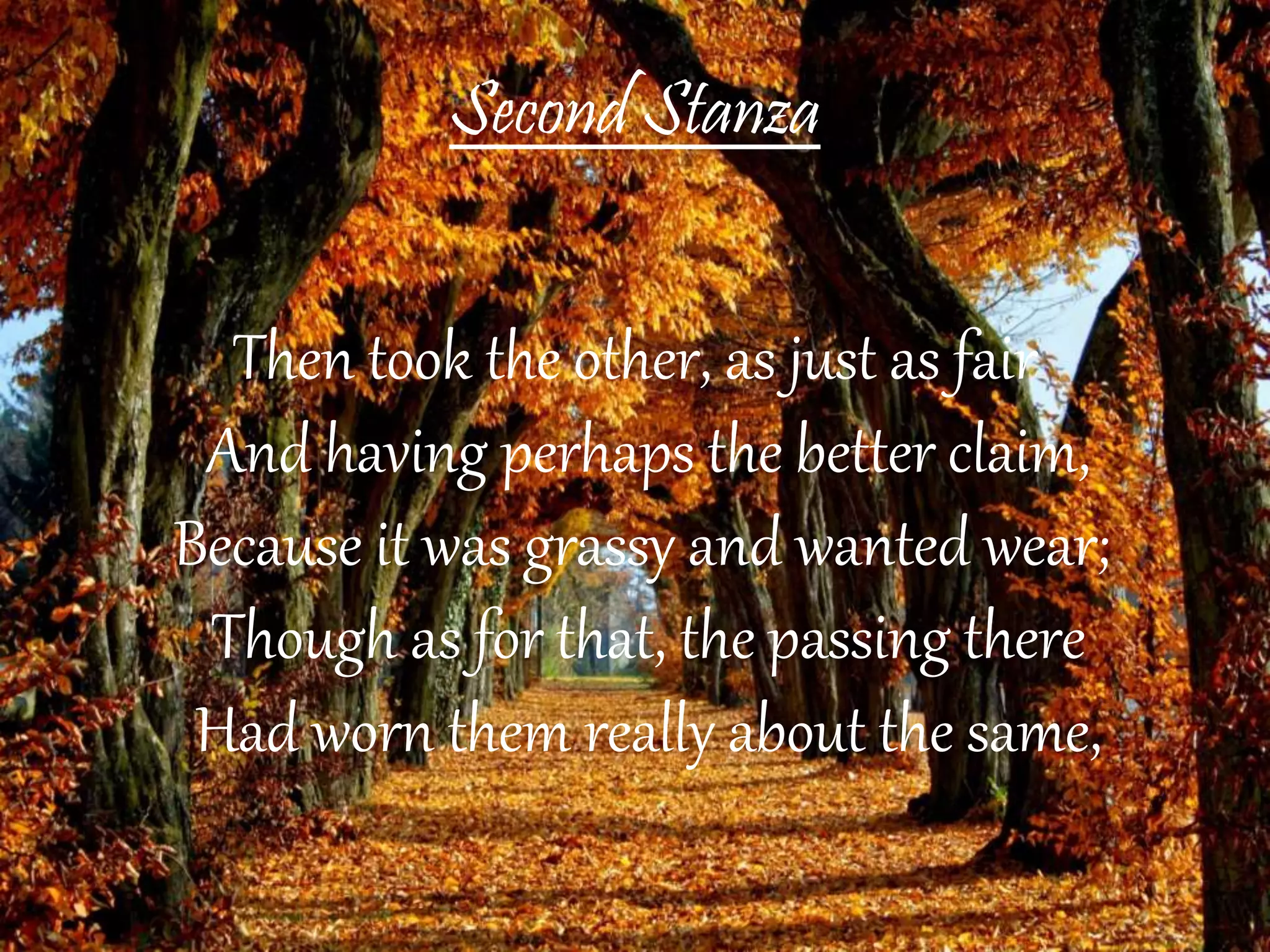
Then took the other, as just as fair
And having perhaps the better claim,
Because it was grassy and wanted wear;
Though as for that, the passing there
Had worn them really about the same,
Summary Of The Second Stanza
He looked down the first one “to where it bend in the
undergrowth”, and then the second one , and he
decided to take the other path, because it seemed to
have less traveled than the first. But then he goes on to
say that they actually were very similarly worn. The
second one that he took seems less traveled but as he
thinks about it, he realizes that they were “really about
the same”. Not exactly the same but only “about the
same”.
Third Stanza
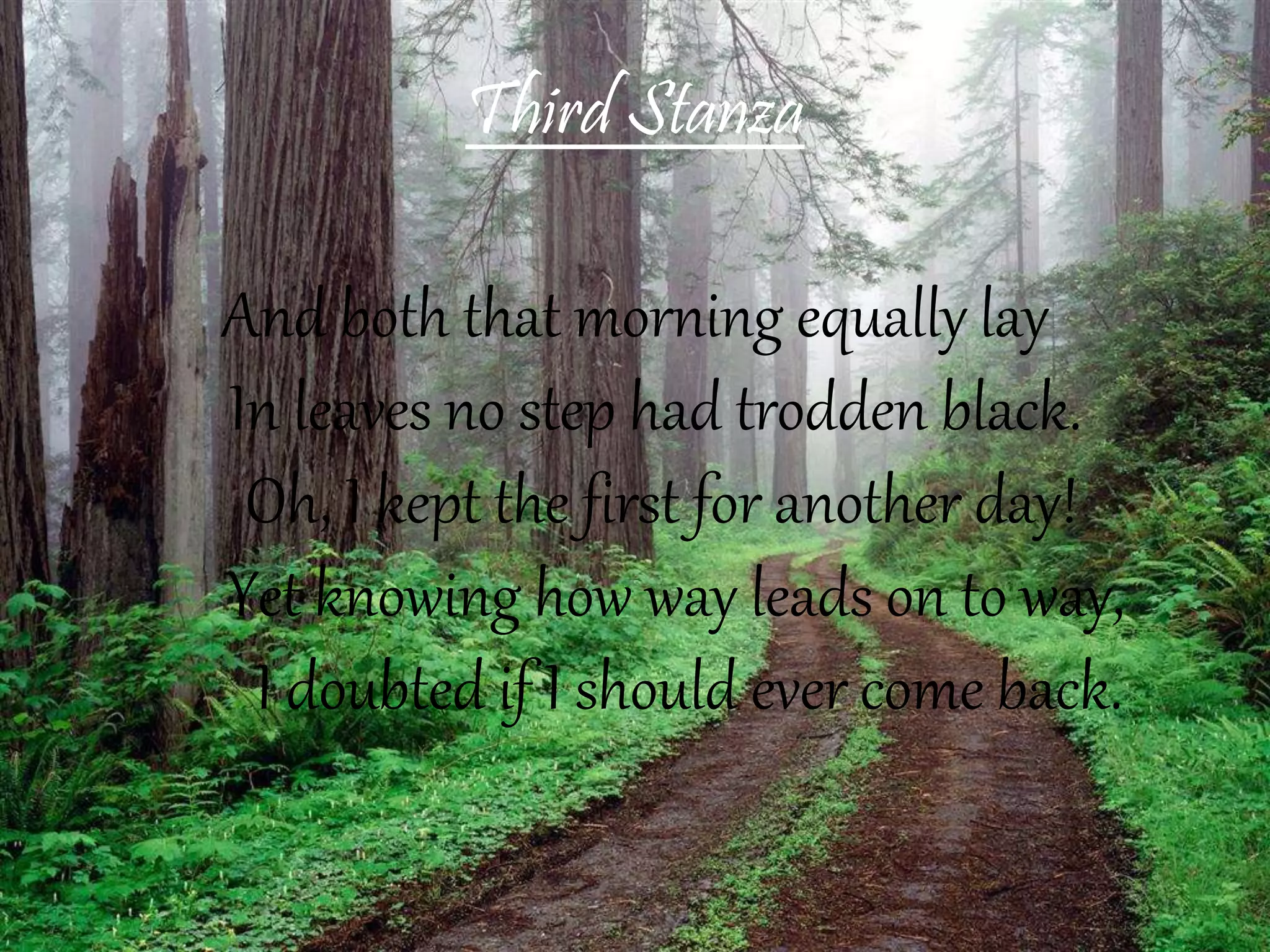
And both that morning equally lay
In leaves no step had trodden black.
Oh, I kept the first for another day!
Yet knowing how way leads on to way,
I doubted if I should ever come back.
Summary Of The Third Stanza
The third stanza continues with the cogitation about the
possible differences between the two road. He had noticed
that the leaves were both fresh fallen on them both and
had not been walked on, but then again claims that
maybe he would come back and also walk the first one
sometimes, but he doubted he would be able to, because
in life one thing leads to another and time is short.
Fourth Stanza
I shall be telling this with a sigh
Somewhere ages and ages hence:
Two roads diverged in a wood, and I --
I took the one less traveled by,
And that has made all the difference.
Summary Of The Fourth Stanza
In this poem the word “difference” is taken in a positive way. But
there is nothing in the poem that suggests that this difference
signals a positive outcome. The speaker could not offer such
information, because he has not lived the “difference” yet.
The other word that leads non-discerning readers astray is the word
“sigh.” By taking “difference” to mean a positive difference, they
think that the sigh is one of nostalgic relief; however, a sigh can also
mean regret. There is the “oh, dear” kind of sigh, but also the “what
a relief” kind of sigh. Which one is it? We do not know. If it is the
relief sigh, then the difference means the speaker is glad he took the
road he did; if it is the regret sigh, then the difference would not be
good, and the speaker would be sighing in regret.
Message Of This Poem
Robert Frost’s poem “ The road not taken” seems to hold out
the mortal that life is a continuous journey full of divergence
now and then. The important thing is to move on without
looking back whether the choice of paths taken was right or
wrong. The right or wrong are relative terms. We cannot get
everything in life and have to make choices. Whatever
direction in our life takes is determined by the choice made
by us . In the journey of life, one can seldom come back to
travel the ‘roads’ not taken earlier.
Multiple Choice Questions Based on The
Poem
Click- Start
The Poet Stood at the intersection of?
A wood painted yellow
An Autumn Forest
Trees with infected flowers
Woods which is yellow in color
The Poet Stood at the intersection of?
A wood painted yellow
An Autumn Forest
Trees with infected flowers
Woods which is yellow in color
Next
The Poet Stood at the intersection of?
A wood painted yellow
An Autumn Forest
Trees with infected flowers
Woods which is yellow in color
Try again
The Poet Stood at the intersection of?
A wood painted yellow
An Autumn Forest
Trees with infected flowers
Woods which is yellow in color
Try Again
The Poet Stood at the intersection of?
A wood painted yellow
An Autumn Forest
Trees with infected flowers
Woods which is yellow in color
Try AGain
The poet regrets that
He could not travel on both the roads simultaneously
He has become old
The roads are covered with thick undergrowth
The paths are not clearly visible
The poet regrets that
He could not travel on both the roads simultaneously
He has become old
The roads are covered with thick undergrowth
The paths are not clearly visible
Next
The poet regrets that
He could not travel on both the roads simultaneously
He has become old
The roads are covered with thick undergrowth
The paths are not clearly visible
Try Again
The poet regrets that
He could not travel on both the roads simultaneously
He has become old
The roads are covered with thick undergrowth
The paths are not clearly visible
Try Again
The poet regrets that
He could not travel on both the roads simultaneously
He has become old
The roads are covered with thick undergrowth
The paths are not clearly visible
Try Again
The poet finally chooses the road
Which has been travelled by many
Which looks more attractive
Which very few trodden on
Which has less grass
The poet finally chooses the road
Which has been travelled by many
Which looks more attractive
Which very few trodden on
Which has less grass
Which looks more attractive
Which very few trodden on
Which has less grass
Try AGain
The poet finally chooses the road
Which has been travelled by many
Which looks more attractive
Which very few trodden on
Which has less grass
Try AGain
The poet finally chooses the road
Which has been travelled by many
Which looks more attractive
Which very few trodden on
Which has less grass
Next
The poet finally chooses the road
Which has been travelled by many
Which looks more attractive
Which very few trodden on
Which has less grass
Try AGain
Quote a line from the poem to show that it was not easy for the poet to
decide which road to follow
“Two roads diverged in a yellow wood”
“And sorry I could not travel both”
“..long I stood
“And looked down as far as I could”
Quote a line from the poem to show that it was not easy for the poet to
decide which road to follow
“Two roads diverged in a yellow wood”
“And sorry I could not travel both”
“..long I stood
“And looked down as far as I could”
Try Again
Quote a line from the poem to show that it was not easy for the poet to
decide which road to follow
“Two roads diverged in a yellow wood”
“And sorry I could not travel both”
“..long I stood
“And looked down as far as I could”
Try Again
Quote a line from the poem to show that it was not easy for the poet to
decide which road to follow
“Two roads diverged in a yellow wood”
“And sorry I could not travel both”
“..long I stood
“And looked down as far as I could”
Next
Quote a line from the poem to show that it was not easy for the poet to
decide which road to follow
“Two roads diverged in a yellow wood”
“And sorry I could not travel both”
“..long I stood
“And looked down as far as I could”
Try Again
Pick out the lines which says that the two roads looked
similar that morning
“Oh,I kept the first for another day.”
“Yet knowing how way leads on to way”
“I doubted I should ever come back”
“Both that morning equally lay in leaves no step had
trodden back.”
Pick out the lines which says that the two roads looked
similar that morning
“Oh,I kept the first for another day.”
“Yet knowing how way leads on to way”
“I doubted I should ever come back”
“Both that morning equally lay in leaves no step had
trodden back.”
Try AGain
Pick out the lines which says that the two roads looked
similar that morning
“Oh,I kept the first for another day.”
“Yet knowing how way leads on to way”
“I doubted I should ever come back”
“Both that morning equally lay in leaves no step had
trodden back.”
Try AGain
Pick out the lines which says that the two roads looked
similar that morning
“Oh,I kept the first for another day.”
“Yet knowing how way leads on to way”
“I doubted I should ever come back”
“Both that morning equally lay in leaves no step had
trodden back.”
Try AGain
Pick out the lines which says that the two roads looked
similar that morning
“Oh,I kept the first for another day.”
“Yet knowing how way leads on to way”
“I doubted I should ever come back”
“Both that morning equally lay in leaves no step had
trodden back.”
Next
“way leads on to way” means:
There are many roads ahead
It is an uphill road
One road joins another road ahead
None of these
“way leads on to way” means:
There are many roads ahead
It is an uphill road
One road joins another road ahead
Try Again
None of these
“way leads on to way” means:
There are many roads ahead
It is an uphill road
One road joins another road ahead
Try Again
None of these
“way leads on to way” means:
There are many roads ahead
It is an uphill road
One road joins another road ahead
Next
None of these
“way leads on to way” means:
There are many roads ahead
It is an uphill road
One road joins another road ahead
What does “that” refer to in the last line of the poem?
It means that he chose good over evil.
It refers to his decision to take the other road
It meat he took the narrow road
Click- Last Stanza
None of these
What does “that” refer to in the last line of the poem?
It means that he chose good over evil.
It refers to his decision to take the other road
It meat he took the narrow road
Try Again
None of these
What does “that” refer to in the last line of the poem?
It means that he chose good over evil.
It refers to his decision to take the other road
It meat he took the narrow road
NextNone of these
What does “that” refer to in the last line of the poem?
It means that he chose good over evil.
It refers to his decision to take the other road
It meat he took the narrow road
Try Again
None of these
What does “that” refer to in the last line of the poem?
It means that he chose good over evil.
It refers to his decision to take the other road
It meat he took the narrow orad
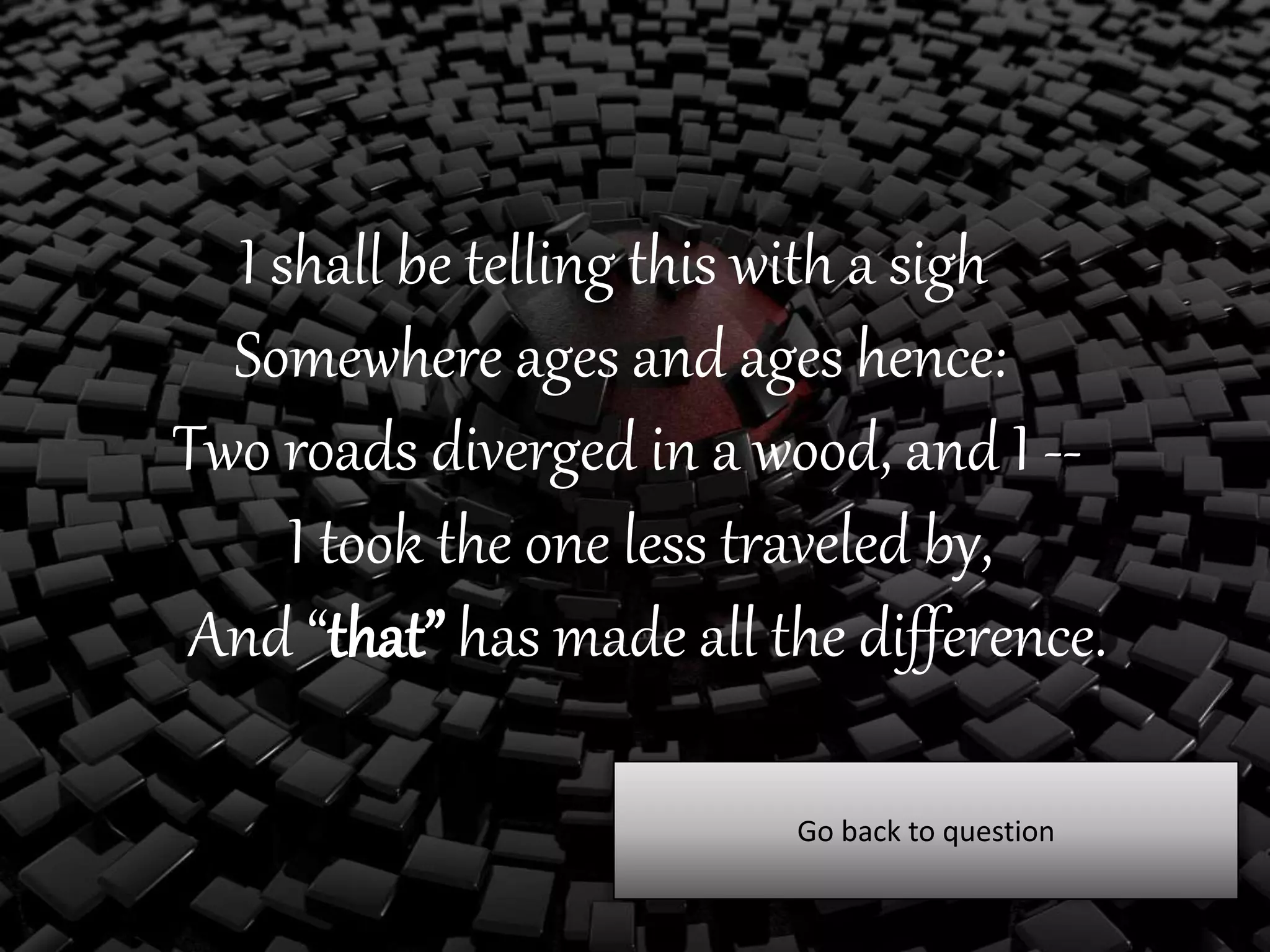
I shall be telling this with a sigh
Somewhere ages and ages hence:
Two roads diverged in a wood, and I --
I took the one less traveled by,
And “that” has made all the difference.
Go back to question
Why is “I” repeated in the last stanza?
To show that the poet’s focus is on himself
To show the poet’s hesitation
To quicken the tempo in the poem
To show the poet’s individuality
Click-Last Stanza
Why is “I” repeated in the last stanza?
To show that the poet’s focus is on himself
To show the poet’s hesitation
To quicken the tempo in the poem
To show the poet’s individuality
Try AGain
Why is “I” repeated in the last stanza?
To show that the poet’s focus is on himself
To show the poet’s hesitation
To quicken the tempo in the poem
To show the poet’s individuality
Next
Why is “I” repeated in the last stanza?
To show that the poet’s focus is on himself
To show the poet’s hesitation
To quicken the tempo in the poem
To show the poet’s individuality
Try AGain
Why is “I” repeated in the last stanza?
To show that the poet’s focus is on himself
To show the poet’s hesitation
To quicken the tempo in the poem
To show the poet’s individuality
Try AGain
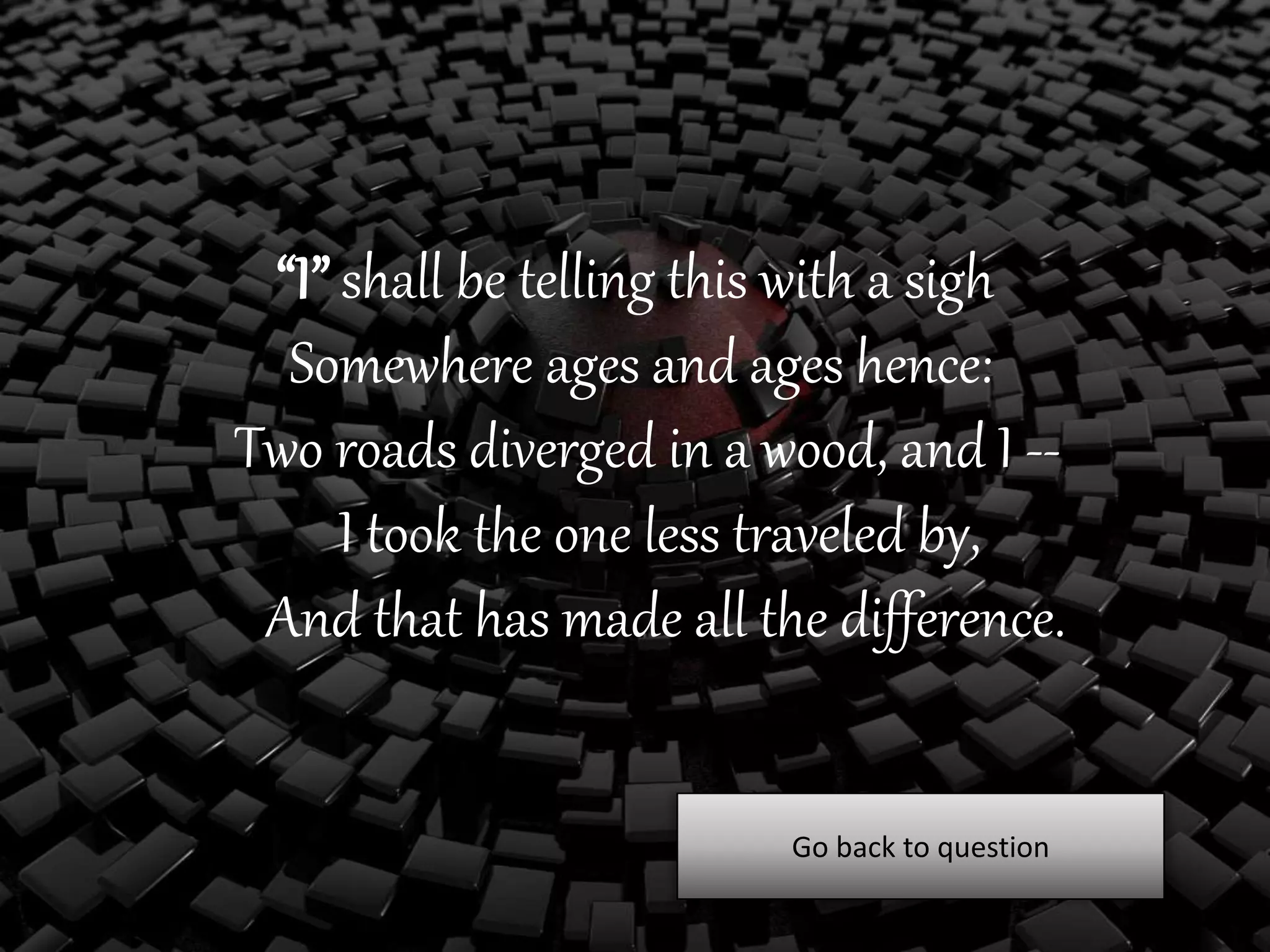
“I” shall be telling this with a sigh
Somewhere ages and ages hence:
Two roads diverged in a wood, and I --
I took the one less traveled by,
And that has made all the difference.
Go back to question
The Road in the poem stands for
A long tedious journey
challenges
Choices in life
Forward movement
The Road in the poem stands for
A long tedious journey
challenges
Choices in life
Forward movement
Try AGain
The Road in the poem stands for
A long tedious journey
challenges
Choices in life
Forward movement
Try AGain
The Road in the poem stands for
A long tedious journey
challenges
Choices in life
Forward movement
Next
The Road in the poem stands for
A long tedious journey
challenges
Choices in life
Forward movement
Try AGain
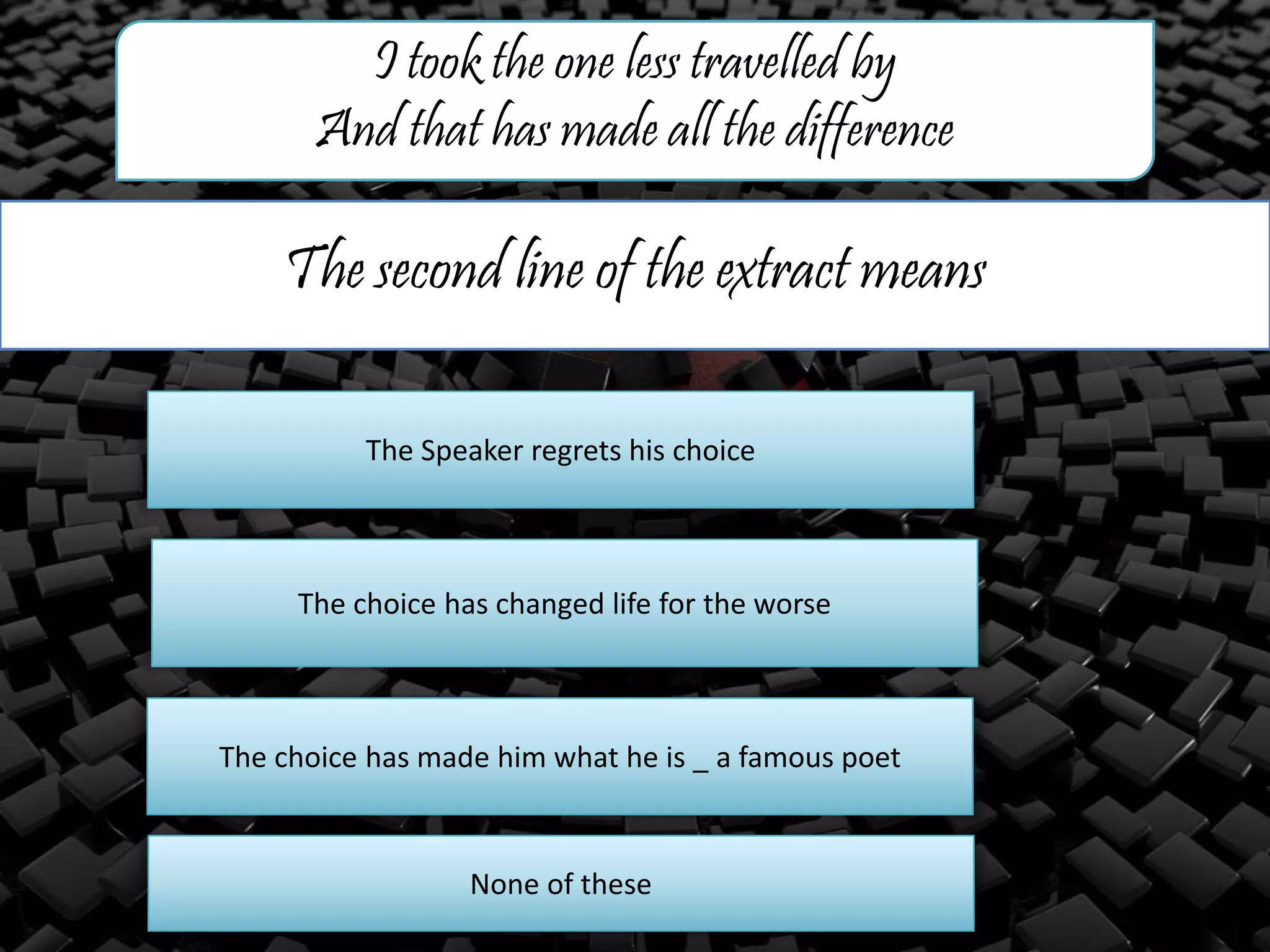
The second line of the extract means
I took the one less travelled by
And that has made all the difference
The Speaker regrets his choice
The choice has changed life for the worse
The choice has made him what he is _ a famous poet
None of these
The second line of the extract means
I took the one less travelled by
And that has made all the difference
The Speaker regrets his choice
The choice has changed life for the worse
The choice has made him what he is _ a famous poet
Try AGainNone of these
The second line of the extract means
I took the one less travelled by
And that has made all the difference
The Speaker regrets his choice
The choice has changed life for the worse
The choice has made him what he is _ a famous poet
Try AGainNone of these
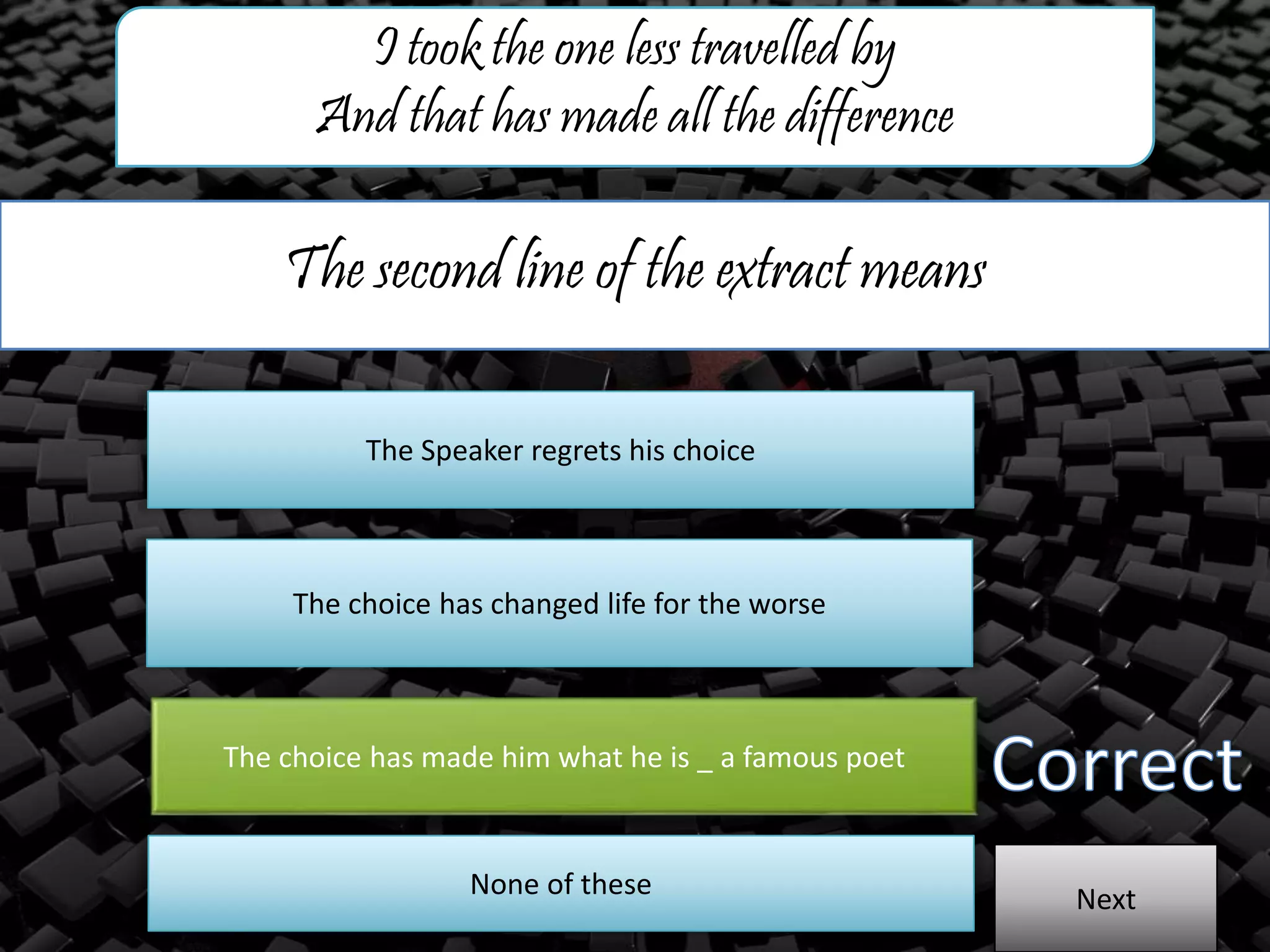
The second line of the extract means
I took the one less travelled by
And that has made all the difference
The Speaker regrets his choice
The choice has changed life for the worse
The choice has made him what he is _ a famous poet
NextNone of these
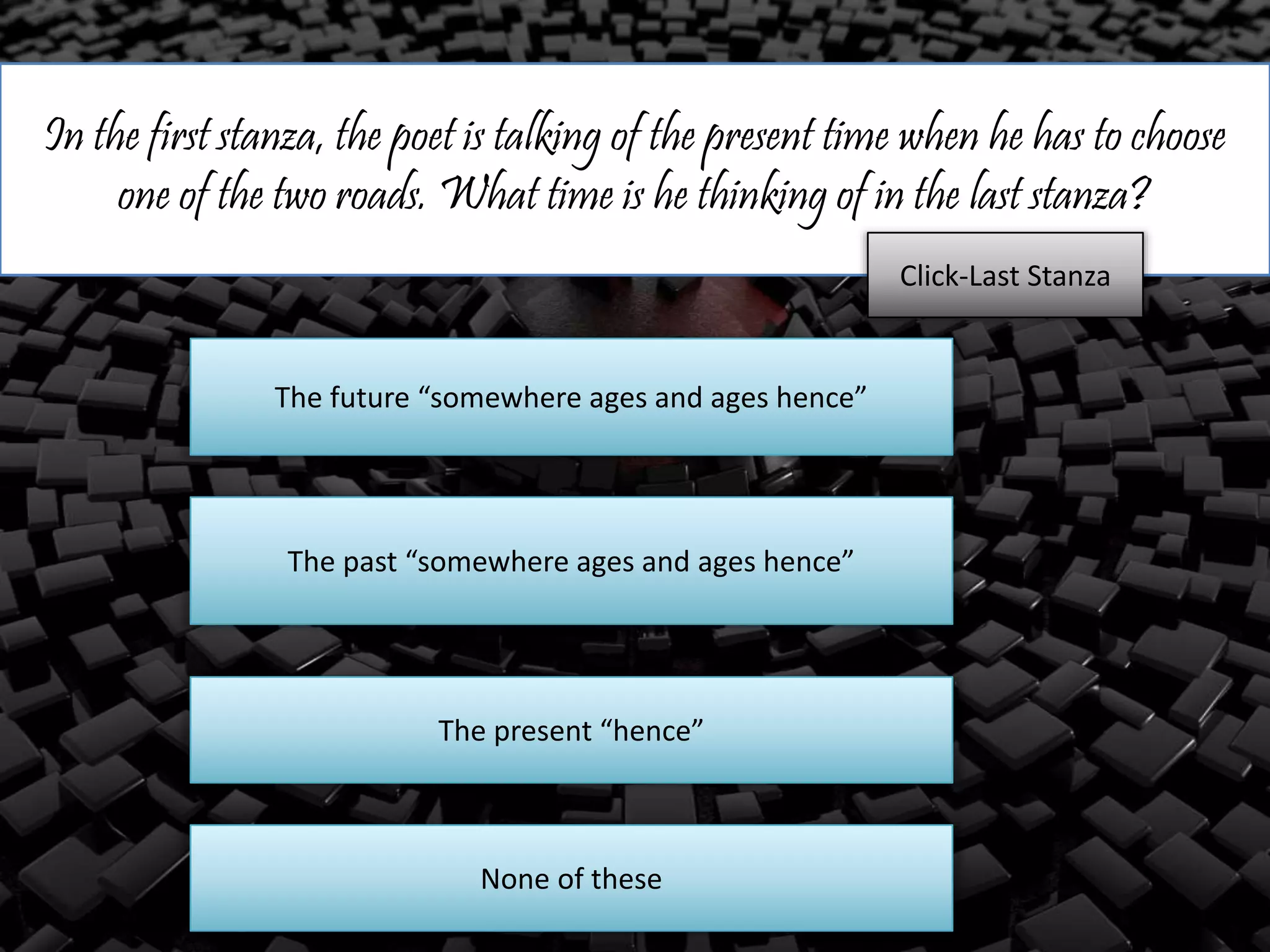
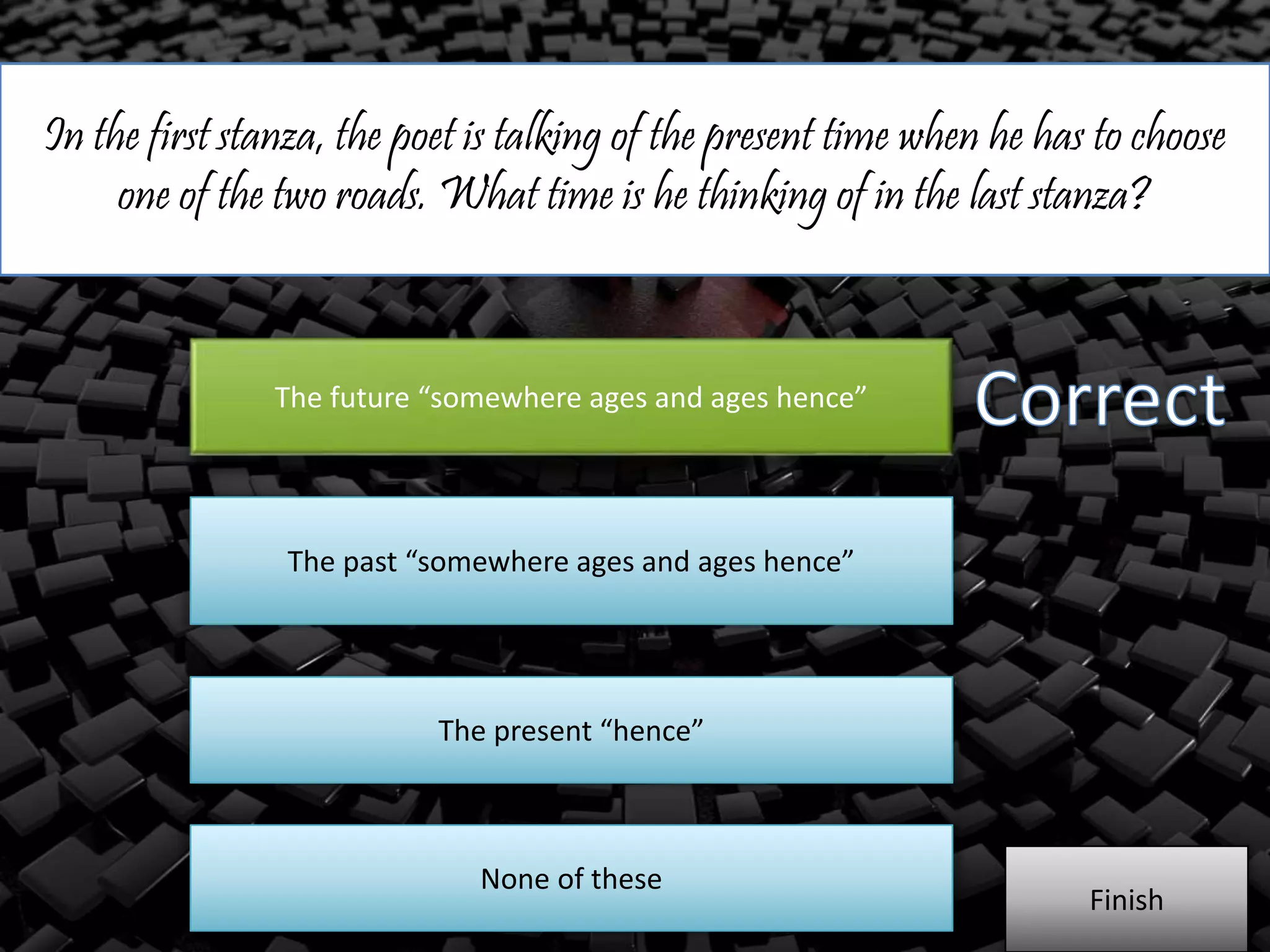
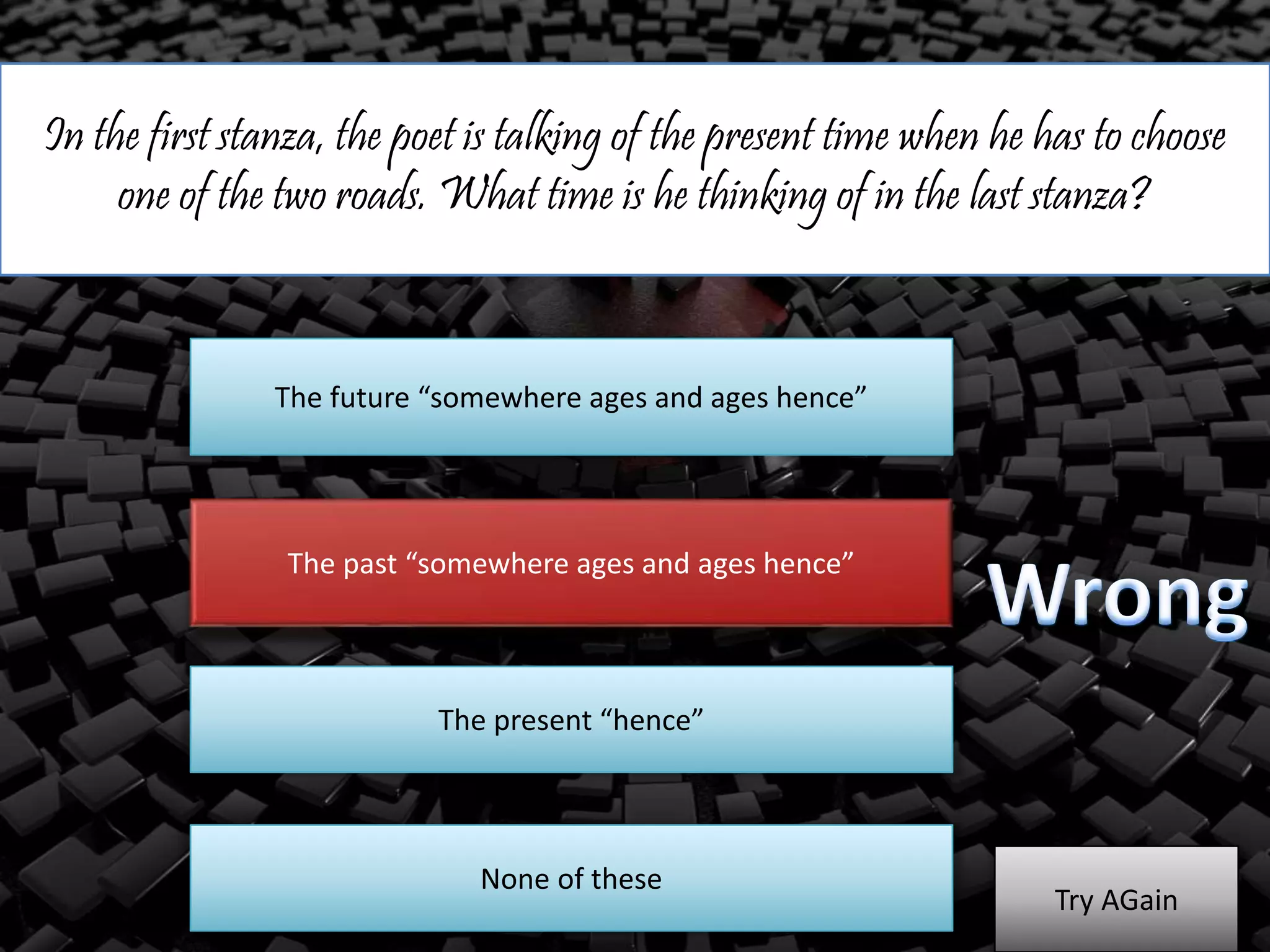
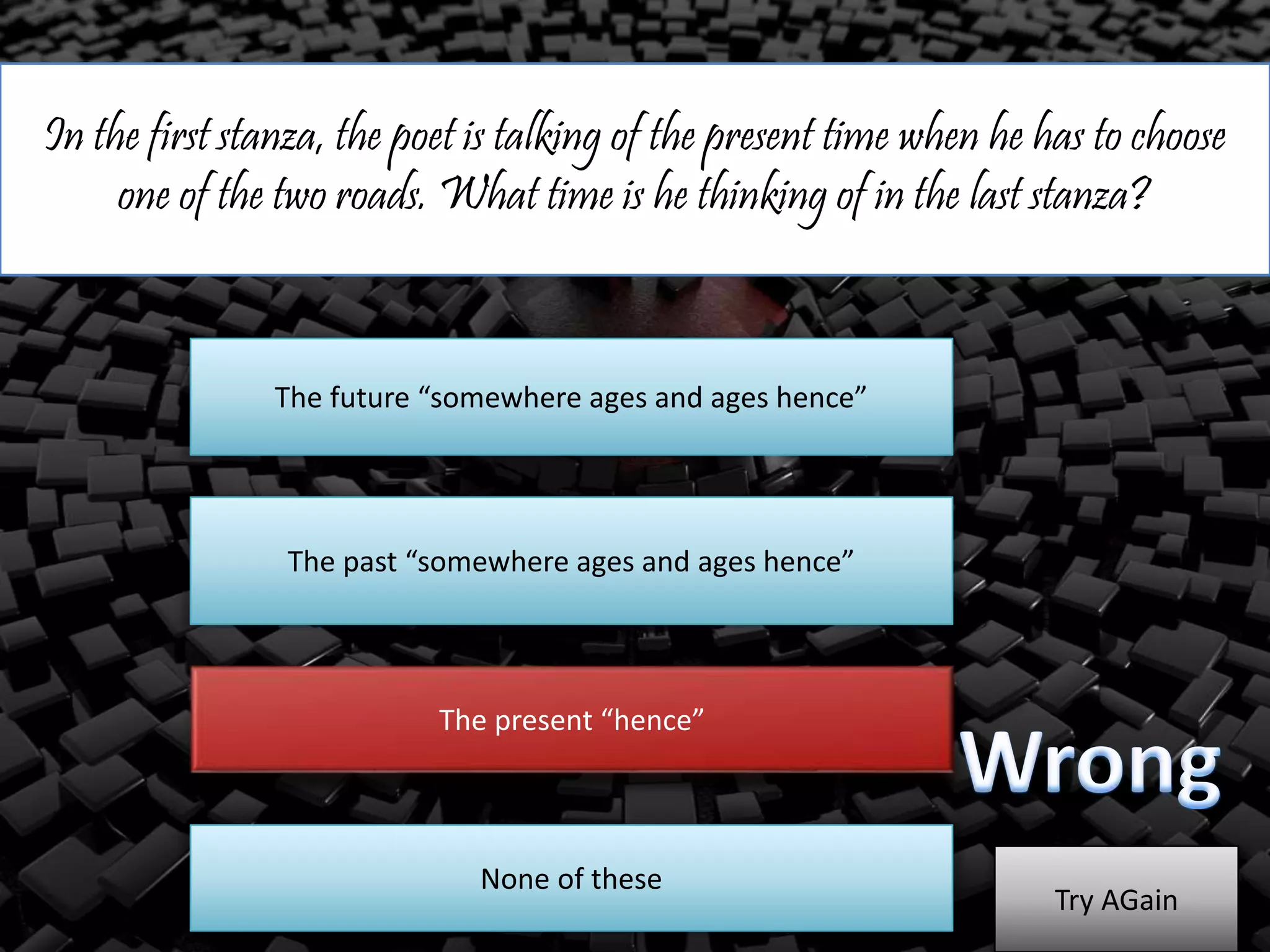
In the first stanza, the poet is talking of the present time when he has to choose
one of the two roads. What time is he thinking of in the last stanza?
The future “somewhere ages and ages hence”
The past “somewhere ages and ages hence”
The present “hence”
Click-Last Stanza
None of these
In the first stanza, the poet is talking of the present time when he has to choose
one of the two roads. What time is he thinking of in the last stanza?
The future “somewhere ages and ages hence”
The past “somewhere ages and ages hence”
The present “hence”
Finish
None of these
In the first stanza, the poet is talking of the present time when he has to choose
one of the two roads. What time is he thinking of in the last stanza?
The future “somewhere ages and ages hence”
The past “somewhere ages and ages hence”
The present “hence”
Try AGain
None of these
In the first stanza, the poet is talking of the present time when he has to choose
one of the two roads. What time is he thinking of in the last stanza?
The future “somewhere ages and ages hence”
The past “somewhere ages and ages hence”
The present “hence”
Try AGain
None of these
I shall be telling this with a sigh
Somewhere ages and ages hence:
Two roads diverged in a wood, and I --
I took the one less traveled by,
And that has made all the difference.
Go back to question
“way leads on to way” means:
There are many roads ahead
It is an uphill road
One road joins another road ahead
None of these
Try AGain
What does “that” refer to in the last line of the poem?
It means that he chose good over evil.
It refers to his decision to take the other road
It meat he took the narrow road
Click- Last Stanza
None of these Try AGain
The second line of the extract means
I took the one less travelled by
And that has made all the difference
The Speaker regrets his choice
The choice has changed life for the worse
The choice has made him what he is _ a famous poet
None of these
Try Again
In the first stanza, the poet is talking of the present time when he has to choose
one of the two roads. What time is he thinking of in the last stanza?
The future “somewhere ages and ages hence”
The past “somewhere ages and ages hence”
The present “hence”
Click-Last Stanza
None of these
Try Again
The End
Prepared by Arpan Bose
Class- IX

The Road Not Taken By Robert Frost PowerPoint Presentation with interactive quiz type of slides

  • 1.
    The Road NotTaken By Robert Frost
  • 2.
    About The Author RobertLee Frost (March 26, 1874 – January 29, 1963) was an American poet. His work was initially published in England before it was published in America. He is highly regarded for his realistic depictions of rural life and his command of American colloquial speech. Frost was honored frequently during his lifetime, receiving four Pulitzer Prizes for Poetry. He became one of America's rare public literary figures, almost an artistic institution. He was awarded the Congressional Gold Medal in 1960 for his poetical works.
  • 3.
    About The Poem Firstpublished in 1916 , “The Road Not Taken" shows Frost at his best as a pastoral who combines rustic simplicity with hidden , indirect and clarity of style and language.
  • 4.
    ‘The road’ isthe symbol of the choice made by us in life. Many times, we regret the choice we make but what is done once cannot be undone. Man regrets for what he has denied himself in life , rather than what he has chosen. Hence, the poet has given his poem the title “The Road Not Taken”. The word "road" not only means "way", it also means "journey" or a "stage of journey". Here "road" does not signify any ordinary road, but functions a metaphor of a vital decision in our life. Poem’s Title
  • 5.
    Summary Of ThePoem This poem talks about the choices one has to make in life and their consequences. One day while walking in a wooded area full of trees, the poet comes to a place where he has to decide which road he should take. He starts debating over the choices as he realizes he cannot walk on both. However he decides to take the second path with the intention of travelling on the first some other time in future
  • 6.
  • 7.
    First Stanza Two roadsdiverged in a yellow wood, And sorry I could not travel both And be one traveler, long I stood And looked down one as far as I could To where it bent in the undergrowth;
  • 8.
    Summary Of TheFirst Stanza The speaker describes his position. He has been out for walking in the woods and comes in between the diversion of two roads, he stands there looking as far down each one as he can see. He would like to try out both, but doubts he could do that, so therefore he continues to look down the roads for a long time trying to make his decision about which road to take.
  • 9.
    Second Stanza Then tookthe other, as just as fair And having perhaps the better claim, Because it was grassy and wanted wear; Though as for that, the passing there Had worn them really about the same,
  • 10.
    Summary Of TheSecond Stanza He looked down the first one “to where it bend in the undergrowth”, and then the second one , and he decided to take the other path, because it seemed to have less traveled than the first. But then he goes on to say that they actually were very similarly worn. The second one that he took seems less traveled but as he thinks about it, he realizes that they were “really about the same”. Not exactly the same but only “about the same”.
  • 11.
    Third Stanza And boththat morning equally lay In leaves no step had trodden black. Oh, I kept the first for another day! Yet knowing how way leads on to way, I doubted if I should ever come back.
  • 12.
    Summary Of TheThird Stanza The third stanza continues with the cogitation about the possible differences between the two road. He had noticed that the leaves were both fresh fallen on them both and had not been walked on, but then again claims that maybe he would come back and also walk the first one sometimes, but he doubted he would be able to, because in life one thing leads to another and time is short.
  • 13.
    Fourth Stanza I shallbe telling this with a sigh Somewhere ages and ages hence: Two roads diverged in a wood, and I -- I took the one less traveled by, And that has made all the difference.
  • 14.
    Summary Of TheFourth Stanza In this poem the word “difference” is taken in a positive way. But there is nothing in the poem that suggests that this difference signals a positive outcome. The speaker could not offer such information, because he has not lived the “difference” yet. The other word that leads non-discerning readers astray is the word “sigh.” By taking “difference” to mean a positive difference, they think that the sigh is one of nostalgic relief; however, a sigh can also mean regret. There is the “oh, dear” kind of sigh, but also the “what a relief” kind of sigh. Which one is it? We do not know. If it is the relief sigh, then the difference means the speaker is glad he took the road he did; if it is the regret sigh, then the difference would not be good, and the speaker would be sighing in regret.
  • 15.
    Message Of ThisPoem Robert Frost’s poem “ The road not taken” seems to hold out the mortal that life is a continuous journey full of divergence now and then. The important thing is to move on without looking back whether the choice of paths taken was right or wrong. The right or wrong are relative terms. We cannot get everything in life and have to make choices. Whatever direction in our life takes is determined by the choice made by us . In the journey of life, one can seldom come back to travel the ‘roads’ not taken earlier.
  • 16.
    Multiple Choice QuestionsBased on The Poem Click- Start
  • 17.
    The Poet Stoodat the intersection of? A wood painted yellow An Autumn Forest Trees with infected flowers Woods which is yellow in color
  • 18.
    The Poet Stoodat the intersection of? A wood painted yellow An Autumn Forest Trees with infected flowers Woods which is yellow in color Next
  • 19.
    The Poet Stoodat the intersection of? A wood painted yellow An Autumn Forest Trees with infected flowers Woods which is yellow in color Try again
  • 20.
    The Poet Stoodat the intersection of? A wood painted yellow An Autumn Forest Trees with infected flowers Woods which is yellow in color Try Again
  • 21.
    The Poet Stoodat the intersection of? A wood painted yellow An Autumn Forest Trees with infected flowers Woods which is yellow in color Try AGain
  • 22.
    The poet regretsthat He could not travel on both the roads simultaneously He has become old The roads are covered with thick undergrowth The paths are not clearly visible
  • 23.
    The poet regretsthat He could not travel on both the roads simultaneously He has become old The roads are covered with thick undergrowth The paths are not clearly visible Next
  • 24.
    The poet regretsthat He could not travel on both the roads simultaneously He has become old The roads are covered with thick undergrowth The paths are not clearly visible Try Again
  • 25.
    The poet regretsthat He could not travel on both the roads simultaneously He has become old The roads are covered with thick undergrowth The paths are not clearly visible Try Again
  • 26.
    The poet regretsthat He could not travel on both the roads simultaneously He has become old The roads are covered with thick undergrowth The paths are not clearly visible Try Again
  • 27.
    The poet finallychooses the road Which has been travelled by many Which looks more attractive Which very few trodden on Which has less grass
  • 28.
    The poet finallychooses the road Which has been travelled by many Which looks more attractive Which very few trodden on Which has less grass Which looks more attractive Which very few trodden on Which has less grass Try AGain
  • 29.
    The poet finallychooses the road Which has been travelled by many Which looks more attractive Which very few trodden on Which has less grass Try AGain
  • 30.
    The poet finallychooses the road Which has been travelled by many Which looks more attractive Which very few trodden on Which has less grass Next
  • 31.
    The poet finallychooses the road Which has been travelled by many Which looks more attractive Which very few trodden on Which has less grass Try AGain
  • 32.
    Quote a linefrom the poem to show that it was not easy for the poet to decide which road to follow “Two roads diverged in a yellow wood” “And sorry I could not travel both” “..long I stood “And looked down as far as I could”
  • 33.
    Quote a linefrom the poem to show that it was not easy for the poet to decide which road to follow “Two roads diverged in a yellow wood” “And sorry I could not travel both” “..long I stood “And looked down as far as I could” Try Again
  • 34.
    Quote a linefrom the poem to show that it was not easy for the poet to decide which road to follow “Two roads diverged in a yellow wood” “And sorry I could not travel both” “..long I stood “And looked down as far as I could” Try Again
  • 35.
    Quote a linefrom the poem to show that it was not easy for the poet to decide which road to follow “Two roads diverged in a yellow wood” “And sorry I could not travel both” “..long I stood “And looked down as far as I could” Next
  • 36.
    Quote a linefrom the poem to show that it was not easy for the poet to decide which road to follow “Two roads diverged in a yellow wood” “And sorry I could not travel both” “..long I stood “And looked down as far as I could” Try Again
  • 37.
    Pick out thelines which says that the two roads looked similar that morning “Oh,I kept the first for another day.” “Yet knowing how way leads on to way” “I doubted I should ever come back” “Both that morning equally lay in leaves no step had trodden back.”
  • 38.
    Pick out thelines which says that the two roads looked similar that morning “Oh,I kept the first for another day.” “Yet knowing how way leads on to way” “I doubted I should ever come back” “Both that morning equally lay in leaves no step had trodden back.” Try AGain
  • 39.
    Pick out thelines which says that the two roads looked similar that morning “Oh,I kept the first for another day.” “Yet knowing how way leads on to way” “I doubted I should ever come back” “Both that morning equally lay in leaves no step had trodden back.” Try AGain
  • 40.
    Pick out thelines which says that the two roads looked similar that morning “Oh,I kept the first for another day.” “Yet knowing how way leads on to way” “I doubted I should ever come back” “Both that morning equally lay in leaves no step had trodden back.” Try AGain
  • 41.
    Pick out thelines which says that the two roads looked similar that morning “Oh,I kept the first for another day.” “Yet knowing how way leads on to way” “I doubted I should ever come back” “Both that morning equally lay in leaves no step had trodden back.” Next
  • 42.
    “way leads onto way” means: There are many roads ahead It is an uphill road One road joins another road ahead None of these
  • 43.
    “way leads onto way” means: There are many roads ahead It is an uphill road One road joins another road ahead Try Again None of these
  • 44.
    “way leads onto way” means: There are many roads ahead It is an uphill road One road joins another road ahead Try Again None of these
  • 45.
    “way leads onto way” means: There are many roads ahead It is an uphill road One road joins another road ahead Next None of these
  • 46.
    “way leads onto way” means: There are many roads ahead It is an uphill road One road joins another road ahead
  • 47.
    What does “that”refer to in the last line of the poem? It means that he chose good over evil. It refers to his decision to take the other road It meat he took the narrow road Click- Last Stanza None of these
  • 48.
    What does “that”refer to in the last line of the poem? It means that he chose good over evil. It refers to his decision to take the other road It meat he took the narrow road Try Again None of these
  • 49.
    What does “that”refer to in the last line of the poem? It means that he chose good over evil. It refers to his decision to take the other road It meat he took the narrow road NextNone of these
  • 50.
    What does “that”refer to in the last line of the poem? It means that he chose good over evil. It refers to his decision to take the other road It meat he took the narrow road Try Again None of these
  • 51.
    What does “that”refer to in the last line of the poem? It means that he chose good over evil. It refers to his decision to take the other road It meat he took the narrow orad
  • 52.
    I shall betelling this with a sigh Somewhere ages and ages hence: Two roads diverged in a wood, and I -- I took the one less traveled by, And “that” has made all the difference. Go back to question
  • 53.
    Why is “I”repeated in the last stanza? To show that the poet’s focus is on himself To show the poet’s hesitation To quicken the tempo in the poem To show the poet’s individuality Click-Last Stanza
  • 54.
    Why is “I”repeated in the last stanza? To show that the poet’s focus is on himself To show the poet’s hesitation To quicken the tempo in the poem To show the poet’s individuality Try AGain
  • 55.
    Why is “I”repeated in the last stanza? To show that the poet’s focus is on himself To show the poet’s hesitation To quicken the tempo in the poem To show the poet’s individuality Next
  • 56.
    Why is “I”repeated in the last stanza? To show that the poet’s focus is on himself To show the poet’s hesitation To quicken the tempo in the poem To show the poet’s individuality Try AGain
  • 57.
    Why is “I”repeated in the last stanza? To show that the poet’s focus is on himself To show the poet’s hesitation To quicken the tempo in the poem To show the poet’s individuality Try AGain
  • 58.
    “I” shall betelling this with a sigh Somewhere ages and ages hence: Two roads diverged in a wood, and I -- I took the one less traveled by, And that has made all the difference. Go back to question
  • 59.
    The Road inthe poem stands for A long tedious journey challenges Choices in life Forward movement
  • 60.
    The Road inthe poem stands for A long tedious journey challenges Choices in life Forward movement Try AGain
  • 61.
    The Road inthe poem stands for A long tedious journey challenges Choices in life Forward movement Try AGain
  • 62.
    The Road inthe poem stands for A long tedious journey challenges Choices in life Forward movement Next
  • 63.
    The Road inthe poem stands for A long tedious journey challenges Choices in life Forward movement Try AGain
  • 64.
    The second lineof the extract means I took the one less travelled by And that has made all the difference The Speaker regrets his choice The choice has changed life for the worse The choice has made him what he is _ a famous poet None of these
  • 65.
    The second lineof the extract means I took the one less travelled by And that has made all the difference The Speaker regrets his choice The choice has changed life for the worse The choice has made him what he is _ a famous poet Try AGainNone of these
  • 66.
    The second lineof the extract means I took the one less travelled by And that has made all the difference The Speaker regrets his choice The choice has changed life for the worse The choice has made him what he is _ a famous poet Try AGainNone of these
  • 67.
    The second lineof the extract means I took the one less travelled by And that has made all the difference The Speaker regrets his choice The choice has changed life for the worse The choice has made him what he is _ a famous poet NextNone of these
  • 68.
    In the firststanza, the poet is talking of the present time when he has to choose one of the two roads. What time is he thinking of in the last stanza? The future “somewhere ages and ages hence” The past “somewhere ages and ages hence” The present “hence” Click-Last Stanza None of these
  • 69.
    In the firststanza, the poet is talking of the present time when he has to choose one of the two roads. What time is he thinking of in the last stanza? The future “somewhere ages and ages hence” The past “somewhere ages and ages hence” The present “hence” Finish None of these
  • 70.
    In the firststanza, the poet is talking of the present time when he has to choose one of the two roads. What time is he thinking of in the last stanza? The future “somewhere ages and ages hence” The past “somewhere ages and ages hence” The present “hence” Try AGain None of these
  • 71.
    In the firststanza, the poet is talking of the present time when he has to choose one of the two roads. What time is he thinking of in the last stanza? The future “somewhere ages and ages hence” The past “somewhere ages and ages hence” The present “hence” Try AGain None of these
  • 72.
    I shall betelling this with a sigh Somewhere ages and ages hence: Two roads diverged in a wood, and I -- I took the one less traveled by, And that has made all the difference. Go back to question
  • 73.
    “way leads onto way” means: There are many roads ahead It is an uphill road One road joins another road ahead None of these Try AGain
  • 74.
    What does “that”refer to in the last line of the poem? It means that he chose good over evil. It refers to his decision to take the other road It meat he took the narrow road Click- Last Stanza None of these Try AGain
  • 75.
    The second lineof the extract means I took the one less travelled by And that has made all the difference The Speaker regrets his choice The choice has changed life for the worse The choice has made him what he is _ a famous poet None of these Try Again
  • 76.
    In the firststanza, the poet is talking of the present time when he has to choose one of the two roads. What time is he thinking of in the last stanza? The future “somewhere ages and ages hence” The past “somewhere ages and ages hence” The present “hence” Click-Last Stanza None of these Try Again
  • 77.
    The End Prepared byArpan Bose Class- IX