
Gandhi
•Download as PPT, PDF•
1 like•525 views

Mohandas Gandhi was born in 1869 in Gujarat, India and educated in law in London. He faced discrimination as an Indian in South Africa, where he lived for 20 years developing his philosophy of non-violent civil disobedience. Through non-cooperation campaigns, Gandhi led India's independence movement and inspired millions. He fasted for religious harmony and advocated for economic self-sufficiency. Gandhi remained committed to non-violence until his assassination in 1948.

Recommended
More Related Content
What's hot
What's hot (20)
Viewers also liked
Similar to Gandhi
Similar to Gandhi (20)
More from Chimaobi Amutah
More from Chimaobi Amutah (15)
Recently uploaded
Recently uploaded (20)
Gandhi
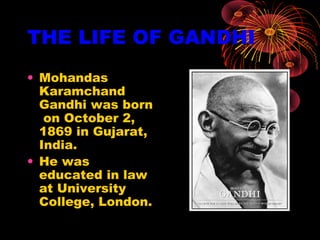
- 1. THE LIFE OF GANDHI • Mohandas Karamchand Gandhi was born on October 2, 1869 in Gujarat, India. • He was educated in law at University College, London.
- 2. THE LIFE OF GANDHI • In 1891, after having been admitted to the British bar, Gandhi returned to India and attempted to establish a law practice in Bombay.
- 3. THE LIFE OF GANDHI • Two years later, an Indian firm retained him as a legal adviser in its office in Durban. • In Durban, Gandhi was treated as a member of an inferior race.
- 4. THE LIFE OF GANDHI • He wanted to change the elementary rights for Indian immigrants in South Africa.
- 5. THE LIFE OF GANDHI • Gandhi remained in South Africa for 20 years, where he experienced imprisonment many times.
- 6. THE LIFE OF GANDHI • In 1896, after being attacked and beaten by white South Africans, Gandhi began to teach a policy of passive resistance.
- 7. THE LIFE OF GANDHI • Part of Gandhi’s inspiration comes from the Russian writer Leo Tolstoy, whom Gandhi admired very much.
- 8. THE LIFE OF GANDHI • During the Boer War, Gandhi organized an ambulance corps for the British army and commanded a Red Cross unit.
- 9. THE LIFE OF GANDHI • In 1910, he founded a cooperative colony for Indians called Tolstoy Farm. It was located near Durban.
- 10. THE LIFE OF GANDHI • In 1914 the government of the Union of South Africa made important concessions to Gandhi’s demands, including recognition of Indian marriages and abolition of the poll tax.
- 11. THE LIFE OF GANDHI • Gandhi arrived back in Bombay, India in 1915. • Europe has already fallen into World War I by this time.
- 12. THE LIFE OF GANDHI • He became the leader of the Indian campaign for home rule. • Following WWI, he launched his movement of non-violent resistance to Great Britain.
- 13. THE LIFE OF GANDHI • In 1919, Parliament passed the Rowlatt Acts, which gave the Indian colonial authorities emergency powers to deal with revolutionary activities.
- 14. THE LIFE OF GANDHI • Gandhi’s teachings spread throughout India, gaining millions of followers.
- 15. THE LIFE OF GANDHI • Activities against the Rowlatt Acts resulted in a massacre of Indians at Amritsar by British soldiers. • There were 1,516 casualties.
- 16. THE LIFE OF GANDHI • Economic independence for India, involving the complete boycott of British goods, was made of Gandhi’s “self- ruling” movement.
- 17. THE LIFE OF GANDHI • Indians saw him as a saint and began calling him “Mahatma” (Great-soul). • He thought that by using non- violence, Britain would also consider violence useless.
- 18. THE LIFE OF GANDHI • In 1921, the Indian National Congress gave Gandhi complete executive authority.
- 19. THE LIFE OF GANDHI • Series of armed revolts broke out against Great Britain, and Gandhi ended the campaign of the civil- disobedience.
- 20. THE LIFE OF GANDHI • While imprisoned, Gandhi undertook a “fast unto death” to improve the status of the Untouchables in 1932.
- 21. THE LIFE OF GANDHI • Gandhi formally resigned from politics in 1934 after being replaced as a leader of the Congress by Jawaharlal Nehru.
- 22. THE LIFE OF GANDHI • In 1939, Gandhi again returned to active political life because of the pending federation of Indian principalities with the rest of India.
- 23. THE LIFE OF GANDHI • His first action was a fast which would improve the rule of the state of Rajkot.
- 24. THE LIFE OF GANDHI • The public upset caused by the fast was so big that the government had to meet the demands.
- 25. THE LIFE OF GANDHI • By 1944, the British government has agreed to independence if the two religious groups resolve their differences.
- 26. THE LIFE OF GANDHI • India and Pakistan became separate countries after the British agreed to independence in 1947.
- 27. THE LIFE OF GANDHI • Gandhi was assassinated on January 30th , 1948 by a Hindu.