Scaled	Agile	Framework	
(SAFe®)	4.0
Satoru	Araki
3/22/2017
Presentation	Overview
3/22/17 - Agile	Project	Management	Using	Scrum	- 2
• SAFe®	Framework
• SAFe Values,	Principles,	and	Benefit
• Case	Study
• SAFe Adoption,	Objections,	Summary,	and	
Resources
Agile	with	Scrum
3
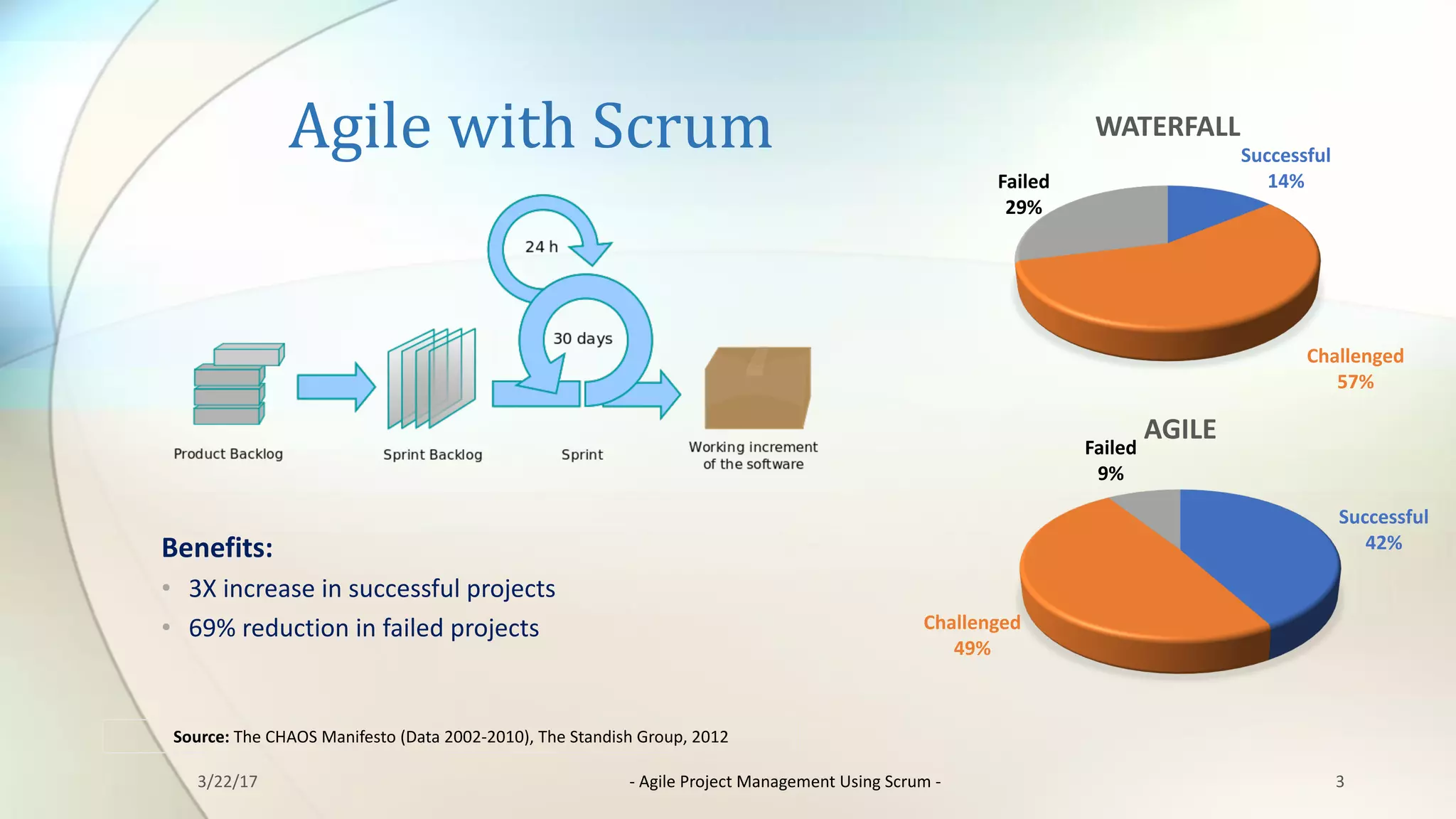
Successful
14%
Challenged	
57%
Failed
29%
WATERFALL
Source: The	CHAOS	Manifesto	(Data	2002-2010),	The	Standish	Group,	2012
Benefits:
• 3X	increase	in	successful	projects
• 69%	reduction	in	failed	projects
Successful
42%
Challenged	
49%
Failed
9%
AGILE
3/22/17 - Agile	Project	Management	Using	Scrum	-
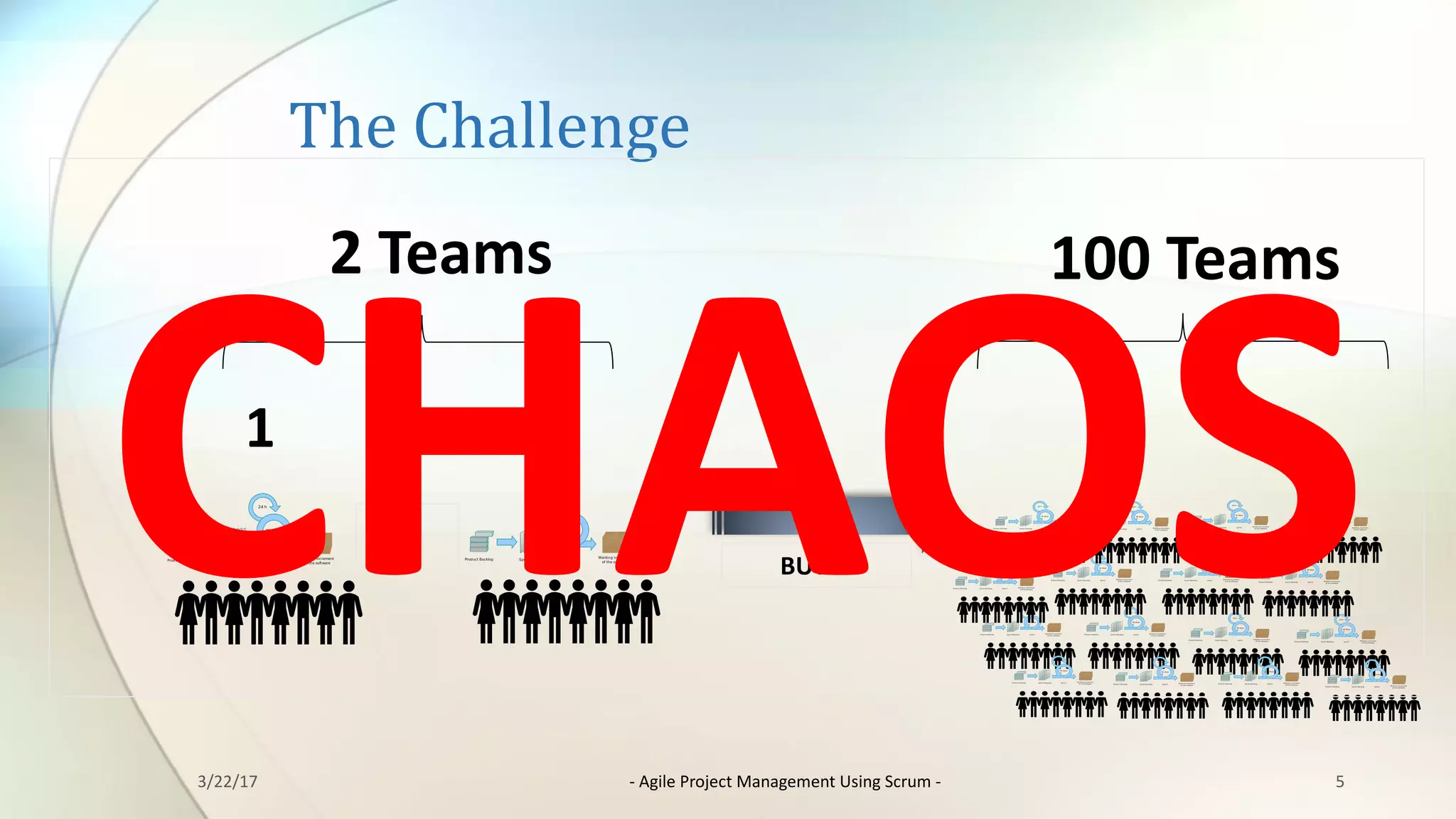
The	Challenge
4
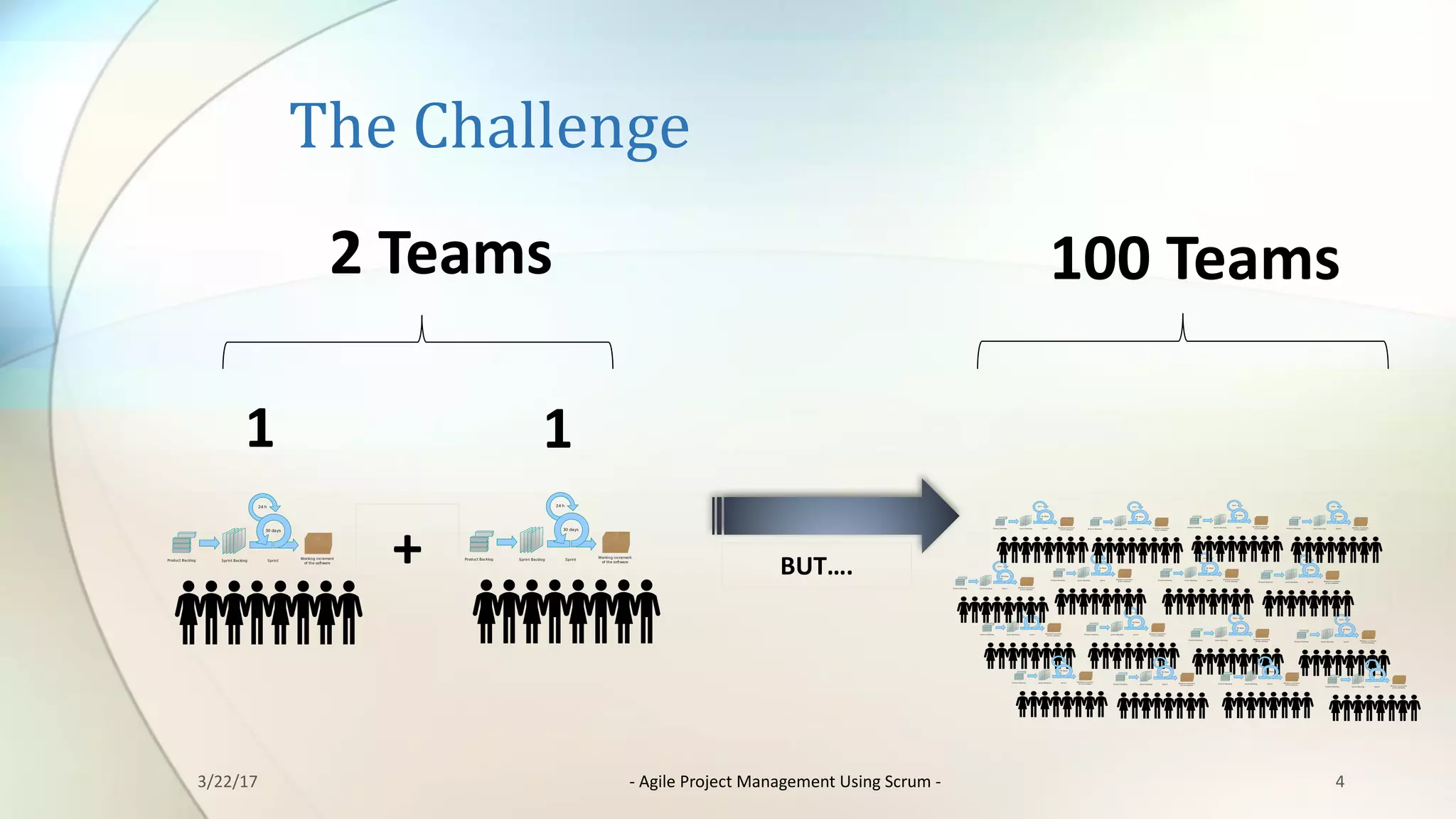
1
+
1
2	Teams
BUT….
100	Teams
3/22/17 - Agile	Project	Management	Using	Scrum	-
The	Challenge
5
1
+
1
2	Teams
BUT….
100	Teams
CHAOS3/22/17 - Agile	Project	Management	Using	Scrum	-
What	is	SAFe
®
?
6
Framework	for	actualizing	the	benefits	of	Lean-Agile	development	
at	enterprise	scale
3/22/17 - Agile	Project	Management	Using	Scrum	-
SAFe
®
Framework
Overview	
7
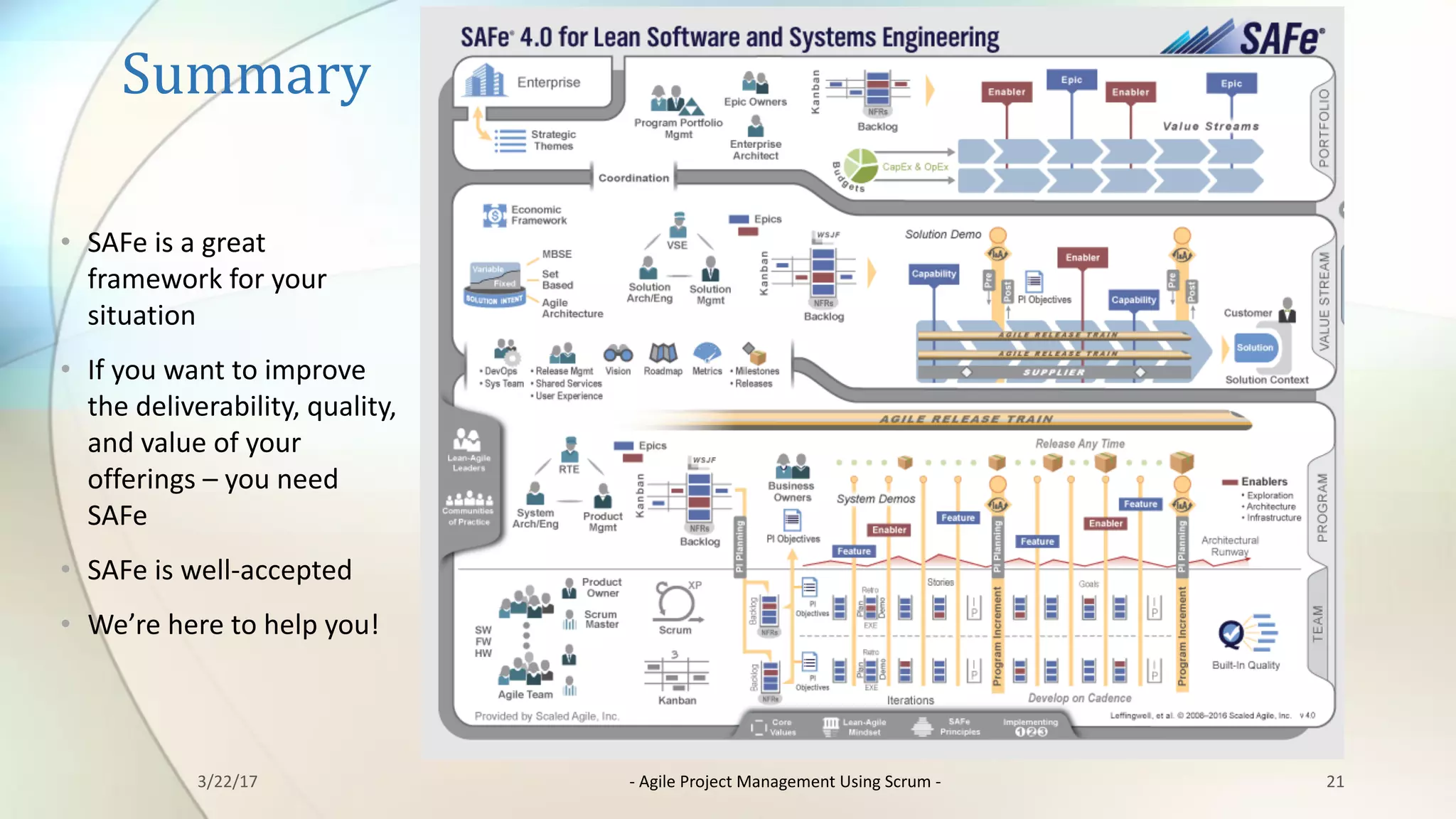
• 3	or	4	Levels
• Portfolio	Level
• Value	Stream	Level	(Optional	– large	&	complex)
• Program	Level
• Team	Level
3/22/17 - Agile	Project	Management	Using	Scrum	-
SAFe
®
Framework
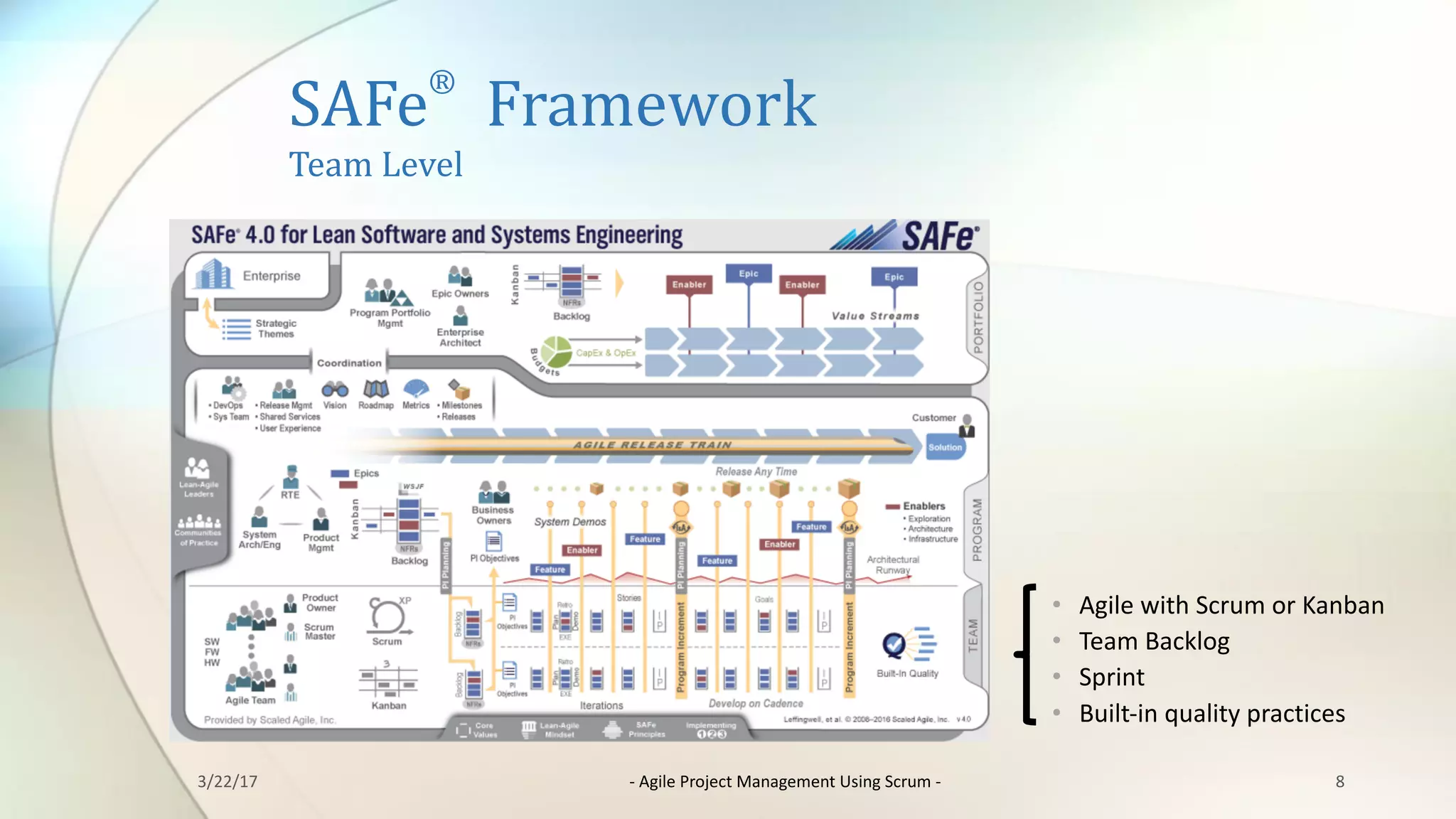
Team	Level
8
• Agile	with	Scrum	or	Kanban
• Team	Backlog
• Sprint	
• Built-in	quality	practices
3/22/17 - Agile	Project	Management	Using	Scrum	-
SAFe
®
Framework
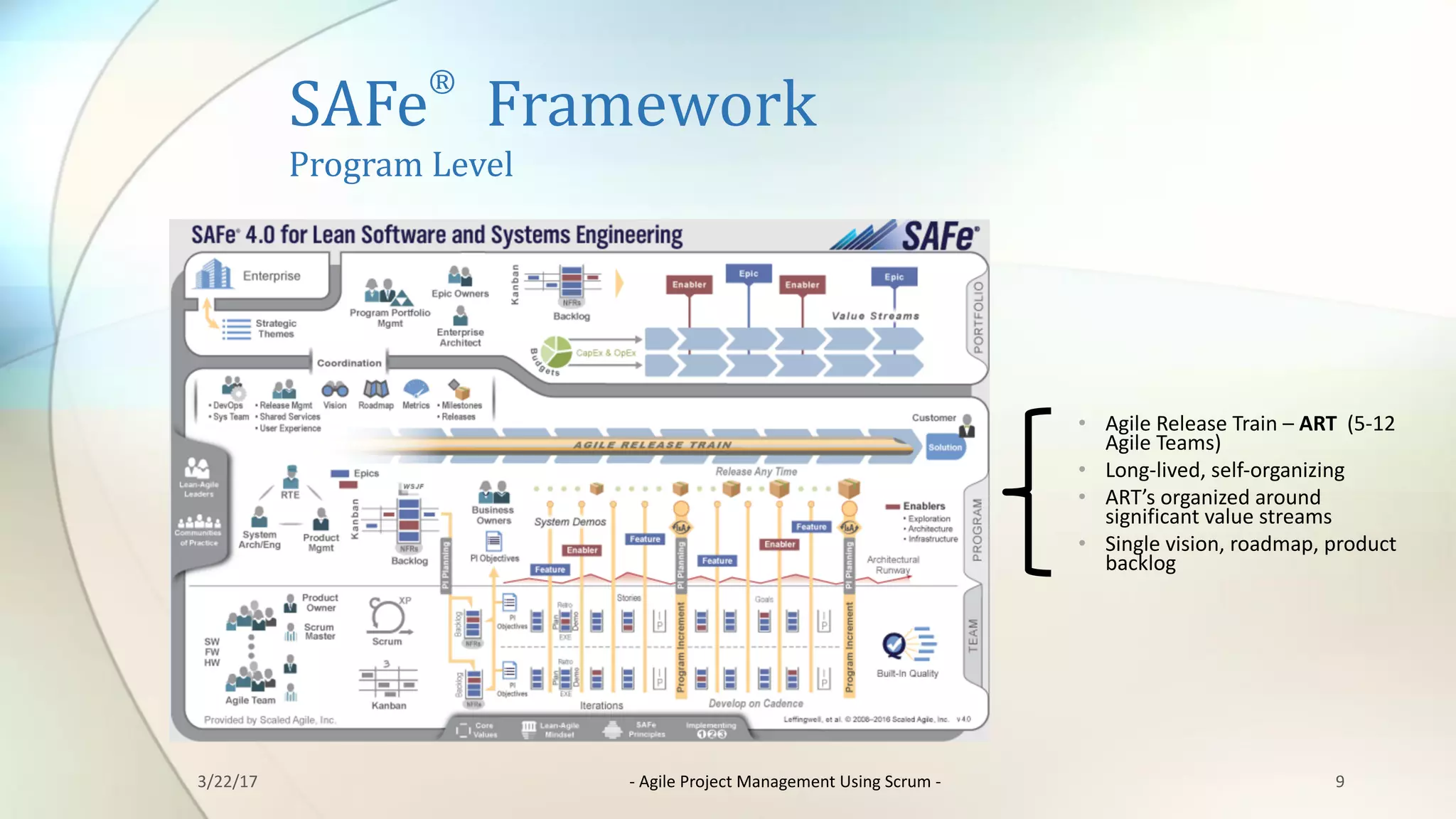
Program	Level
9
• Agile	Release	Train	– ART (5-12	
Agile	Teams)
• Long-lived,	self-organizing
• ART’s	organized	around		
significant	value	streams
• Single	vision,	roadmap,	product	
backlog
3/22/17 - Agile	Project	Management	Using	Scrum	-
SAFe
®
Framework
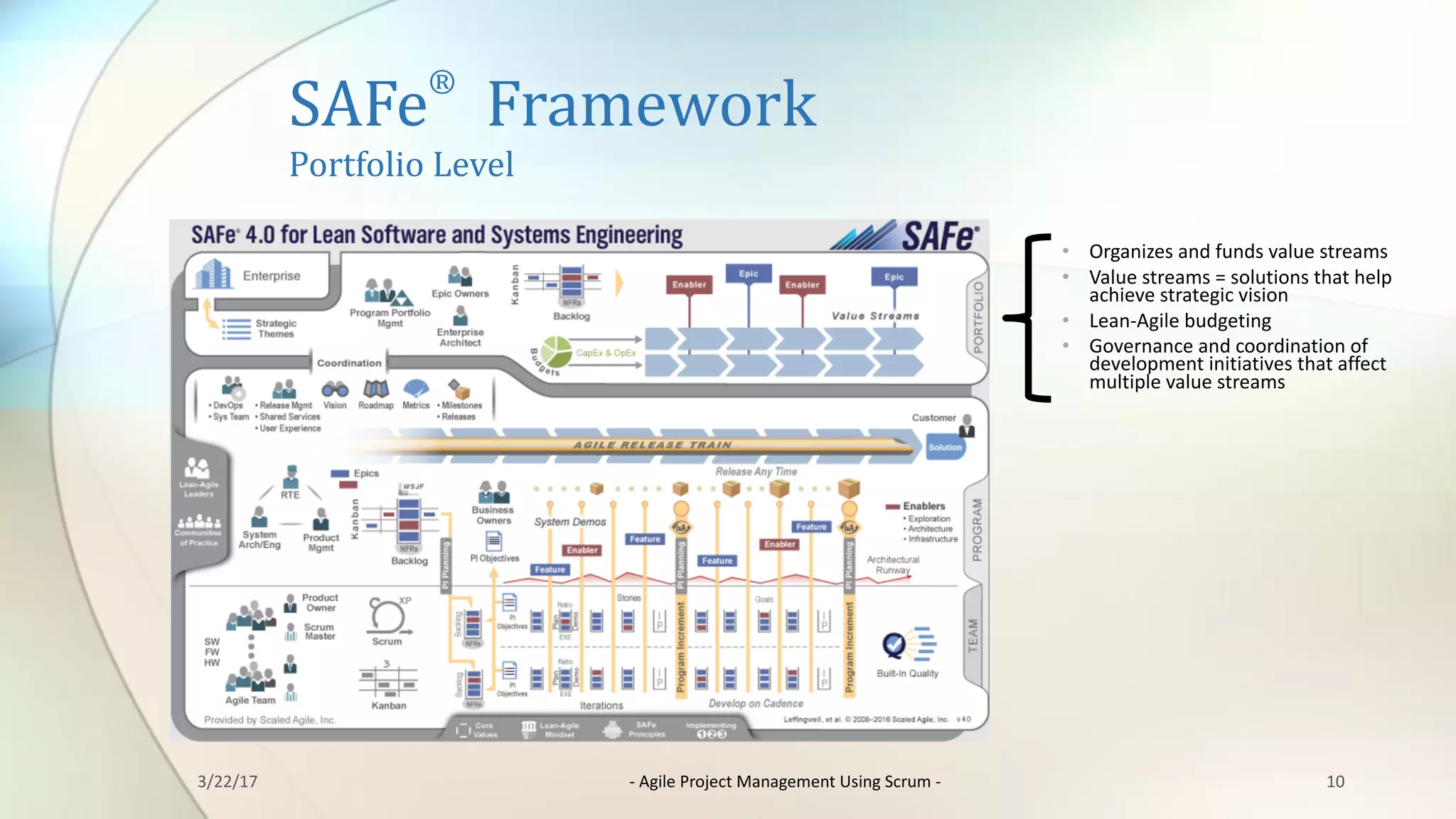
Portfolio	Level
10
• Organizes	and	funds	value	streams
• Value	streams	=	solutions	that	help	
achieve	strategic	vision	
• Lean-Agile	budgeting
• Governance	and	coordination	of	
development	initiatives	that	affect	
multiple	value	streams
3/22/17 - Agile	Project	Management	Using	Scrum	-
SAFe
®
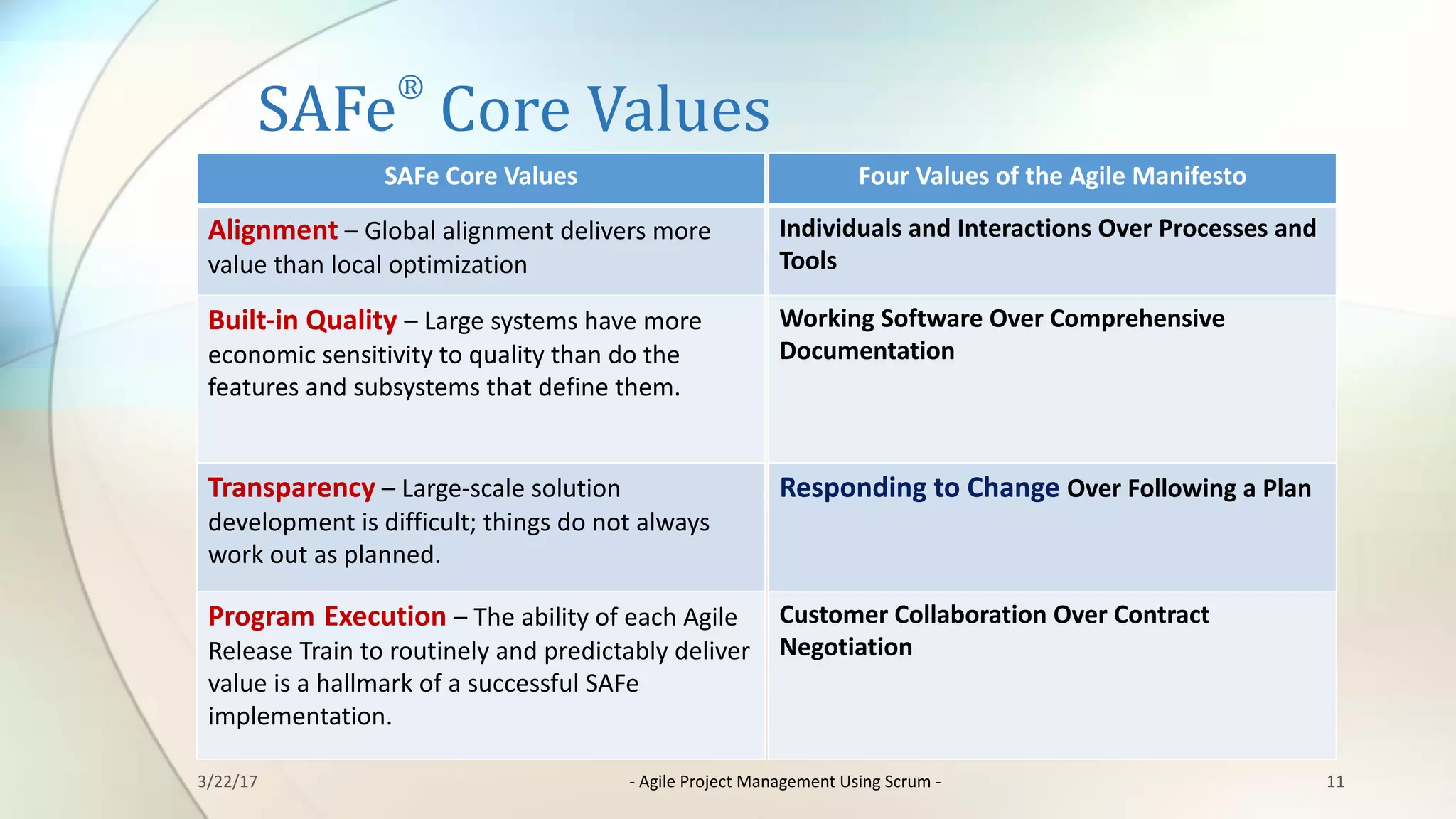
Core	Values
11
Four	Values	of	the	Agile	Manifesto
Individuals	and	Interactions	Over	Processes	and	
Tools
Working	Software	Over	Comprehensive	
Documentation
Responding	to	Change	Over	Following	a	Plan
Customer	Collaboration	Over	Contract	
Negotiation
SAFe	Core	Values
Alignment – Global	alignment	delivers	more	
value	than	local	optimization	
Built-in	Quality	– Large	systems	have	more	
economic	sensitivity	to	quality	than	do	the	
features	and	subsystems	that	define	them.
Transparency – Large-scale	solution	
development	is	difficult;	things	do	not	always	
work	out	as	planned.	
Program Execution	– The	ability	of	each	Agile	
Release	Train	to	routinely	and	predictably	deliver	
value	is	a	hallmark	of	a	successful	SAFe	
implementation.	
3/22/17 - Agile	Project	Management	Using	Scrum	-
SAFe
®
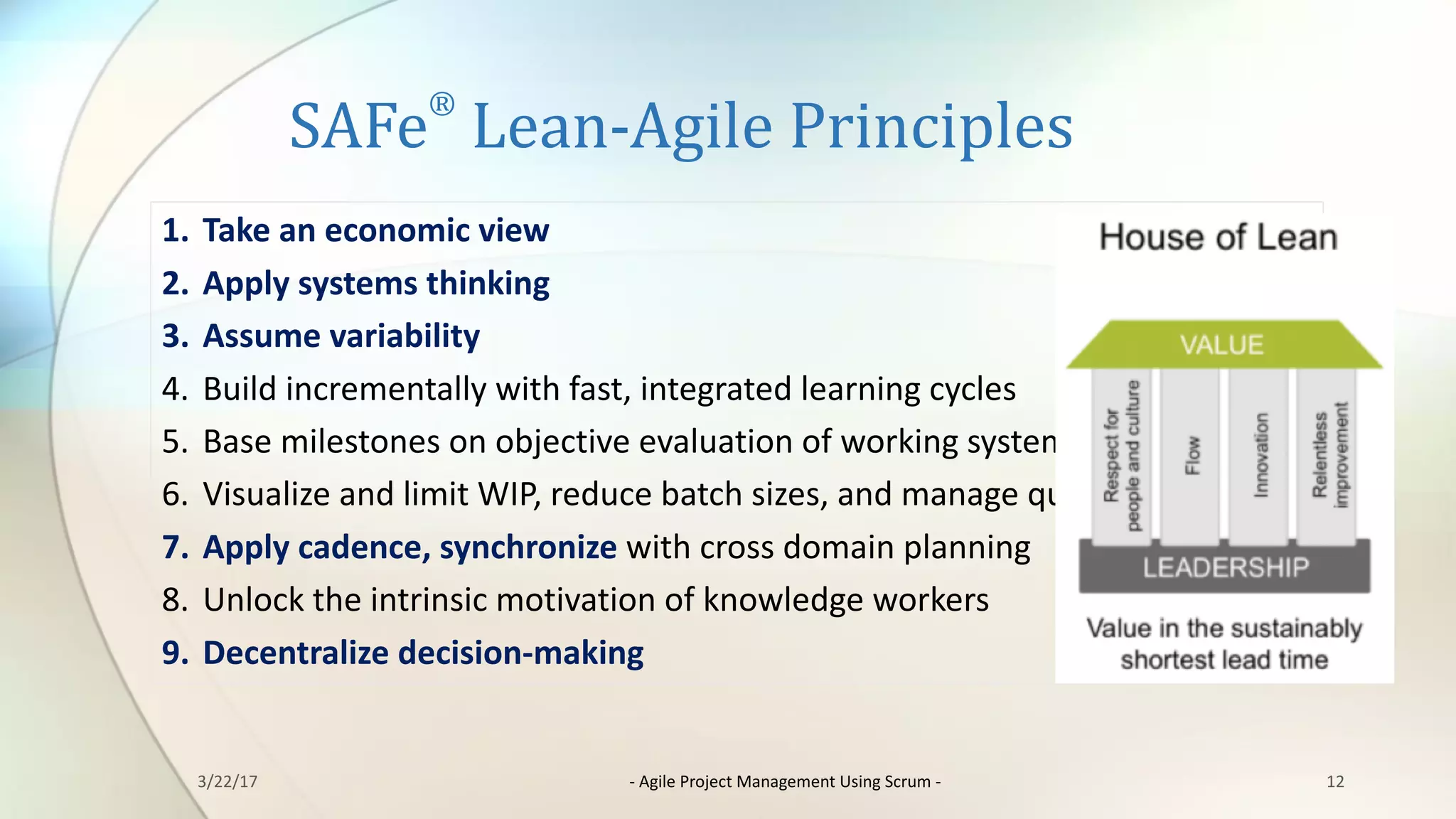
Lean-Agile	Principles
12
1. Take	an	economic	view
2. Apply	systems	thinking
3. Assume	variability
4. Build	incrementally	with	fast,	integrated	learning	cycles
5. Base	milestones	on	objective	evaluation	of	working	systems
6. Visualize	and	limit	WIP,	reduce	batch	sizes,	and	manage	queue	lengths
7. Apply	cadence,	synchronize	with	cross	domain	planning
8. Unlock	the	intrinsic	motivation	of	knowledge	workers
9. Decentralize	decision-making
3/22/17 - Agile	Project	Management	Using	Scrum	-
SAFe
®
Benefits
SAFe	is	improving	business	outcomes	for	government	agencies	
and	companies	of	all	sizes	across	the	globe,	resulting	in	dramatic	
increases	in	employee	engagement,	improved	economics,	and	
workplaces	that	are	more	productive,	engaging,	and	fun.	
• increase	in	productivity
• faster	time	to	market
• defect	reduction
• .
13
20	- 50%
30	- 75%
50%+
Happier,	more	motivated	employees
3/22/17 - Agile	Project	Management	Using	Scrum	-
When	is	SAFe
®
a	good	choice?
• Large	projects	with	highly	interdependent.
• Decompose	large	initiatives	into	smaller	streams	of	work	which	
can	be	implemented	by	a	number	of	teams	(100+)	in	parallel	
with	periodic	integrations	of	their	work	and	delivery	to	
stakeholders.
• An	enterprise	is	willing	to	tolerate	the	high	level	of	disruption	to	
implement	SAFe.
143/22/17 - Agile	Project	Management	Using	Scrum	-
SAFe
®
Case	Study	– Cisco*
Background
Cisco	IT	constantly	looks	for	new	ways	to	go	faster	and	simplify.	As	
part	of	its	digital	IT	strategy,	the	Cisco	Cloud	and	Software	IT	
(CSIT)	organization	wanted	to	adopt	more	Agile	development	as	a	
way	to	replace	periodic	major	releases	with	continuous	delivery	
of	new	features.
*	Source:	Case	Study	from	Scales	Agile,	http://www.scaledagileframework.com/cisco-case-study/
153/22/17 - Agile	Project	Management	Using	Scrum	-
SAFe
®
Case	Study	– Cisco*
The	Challenge
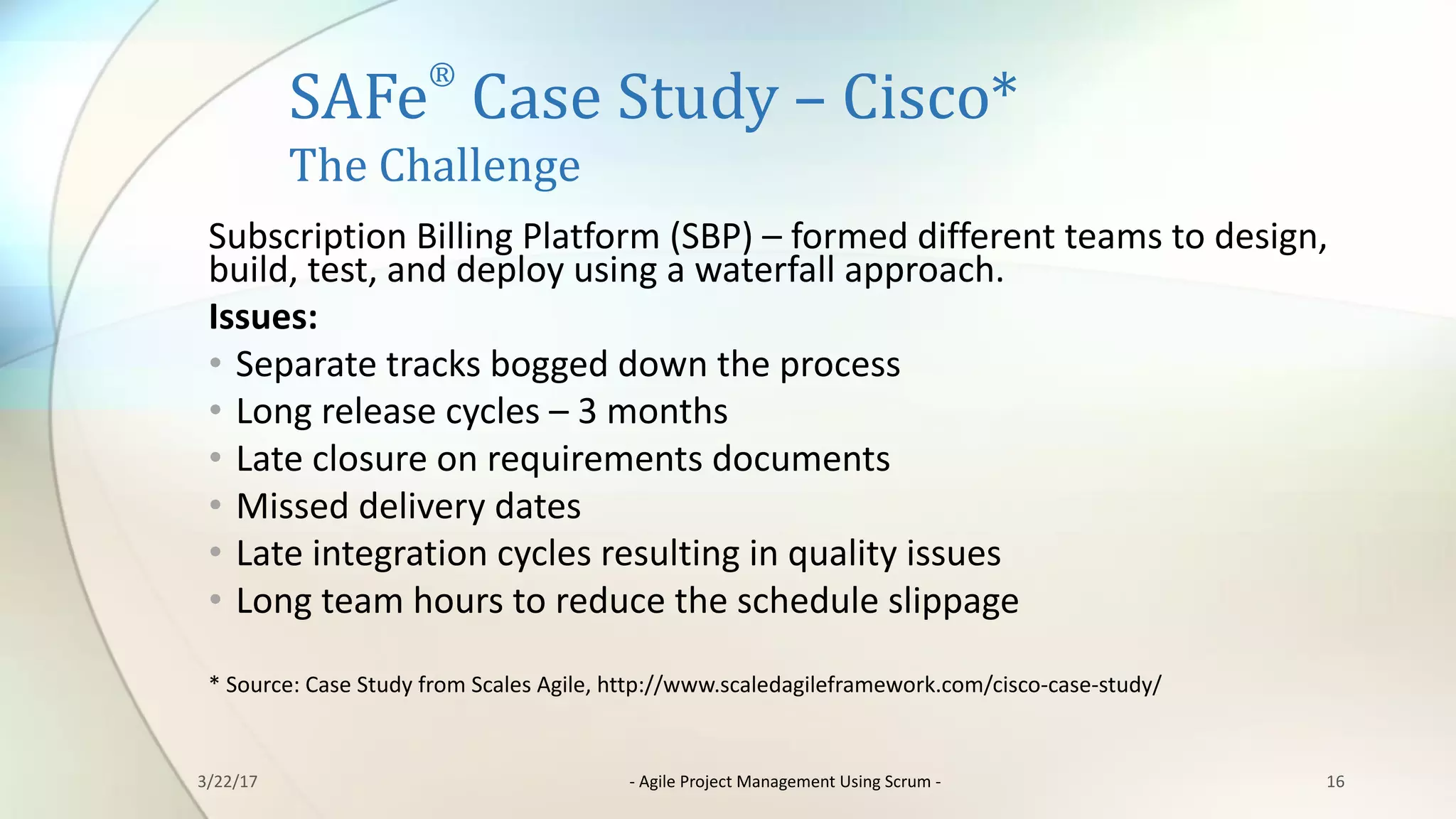
Subscription	Billing	Platform	(SBP)	– formed	different	teams	to	design,	
build,	test,	and	deploy	using	a	waterfall	approach.
Issues:
• Separate	tracks	bogged	down	the	process
• Long	release	cycles	– 3	months
• Late	closure	on	requirements	documents
• Missed	delivery	dates
• Late	integration	cycles	resulting	in	quality	issues
• Long	team	hours	to	reduce	the	schedule	slippage
*	Source:	Case	Study	from	Scales	Agile,	http://www.scaledagileframework.com/cisco-case-study/
163/22/17 - Agile	Project	Management	Using	Scrum	-
SAFe
®
Case	Study	– Cisco*
The	Solution
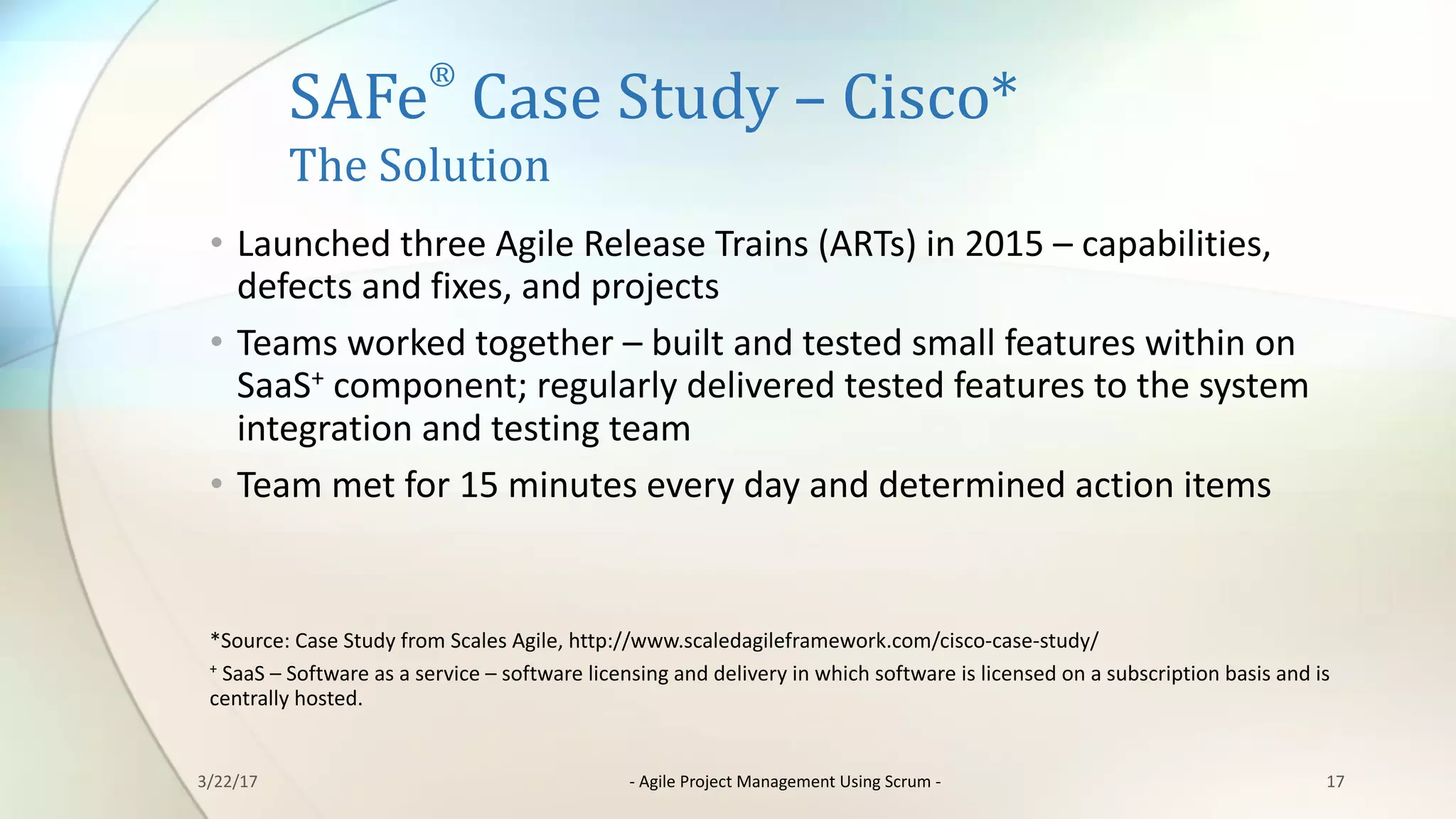
• Launched	three	Agile	Release	Trains	(ARTs)	in	2015	– capabilities,	
defects	and	fixes,	and	projects
• Teams	worked	together	– built	and	tested	small	features	within	on	
SaaS+ component;	regularly	delivered	tested	features	to	the	system	
integration	and	testing	team
• Team	met	for	15	minutes	every	day	and	determined	action	items
*Source:	Case	Study	from	Scales	Agile,	http://www.scaledagileframework.com/cisco-case-study/
+ SaaS	– Software	as	a	service	– software	licensing	and	delivery	in	which	software	is	licensed	on	a	subscription	basis	and	is	
centrally	hosted.
173/22/17 - Agile	Project	Management	Using	Scrum	-
SAFe
®
Case	Study	– Cisco*
Results
• Delivered	new	release	on-time	with	all	planned	capabilities
• 16%	drop	in	the	defect	reject	ratio	(DRR)
• 40%	reduction	in	critical	and	major	defects
• 14%	increase	in	the	defect	removal	efficiency	(DRE)	due	to	
greater	collaboration	across	the	teams
• Improved	employee	satisfaction	– eliminated	after-hours	work	
and	reduced	meetings	and	calls
*	Source:	Case	Study	from	Scales	Agile,	http://www.scaledagileframework.com/cisco-case-study/
183/22/17 - Agile	Project	Management	Using	Scrum	-
SAFe
®
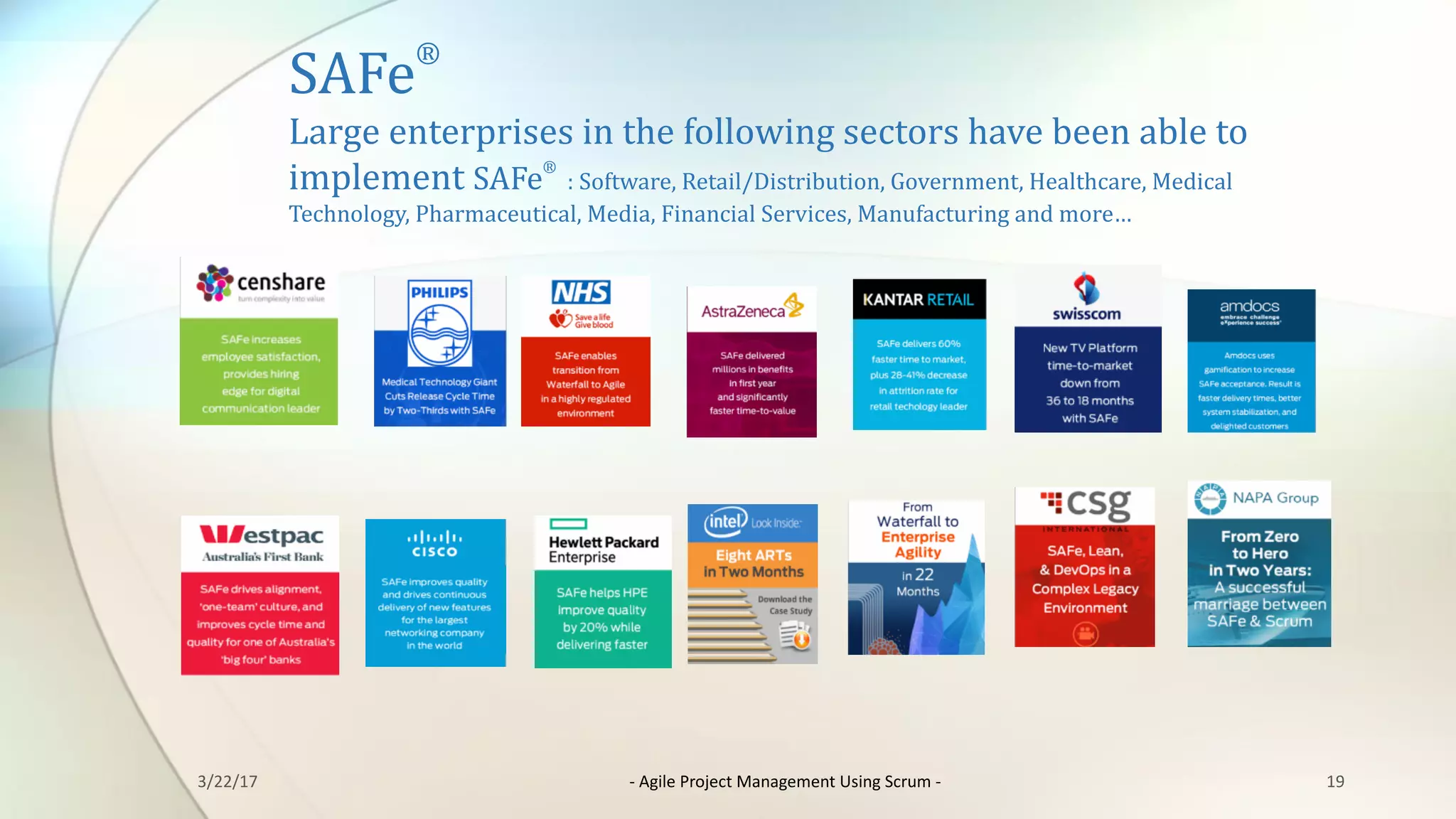
Large	enterprises	in	the	following	sectors	have	been	able	to	
implement	SAFe
®
:	Software,	Retail/Distribution,	Government,	Healthcare,	Medical	
Technology,	Pharmaceutical,	Media,	Financial	Services,	Manufacturing	and	more…
193/22/17 - Agile	Project	Management	Using	Scrum	-
Is	SAFe
®
too	safe?
Criticisms:	
• SAFe®
isn’t	really	pure	Agile	- SAFe®
lacks	the	flexibility that	is	
practically	the	essence	of	Agile
• SAFe®
is	generally	regarded	as	a too	
cautious	way	of	implementing	
Agile in	large	enterprises
• Not	as	good	as	implementing	true	
Agile
Source:	https://intland.com/blog/agile/safe/facing-criticism-is-safe-
the-fast-food-of-agile/
Realities:	
• Implementing	strict	Scrum	+	XP	
with	no	standardized	approach	has	
brought	problems	to	larger	
organizations	forcing	them	to	take	
a	new	approach	with	SAFe®	
• SAFe®		
allos large	enterprises	to	
take	advantage	of	a	framework	
and	also	reap	some	advantages	of	
Agile,	hopefully	towards	a	journey	
of	true	Agility.	
203/22/17 - Agile	Project	Management	Using	Scrum	-
Summary
• SAFe is	a	great	
framework	for	your	
situation
• If	you	want	to	improve	
the	deliverability,	quality,	
and	value	of	your	
offerings	– you	need	
SAFe
• SAFe is	well-accepted
• We’re	here	to	help	you!
213/22/17 - Agile	Project	Management	Using	Scrum	-
SAFe
®
Resources
• http://www.scaledagile.com
• http://www.scaledagileacademy.com/
• http://www.Scalingsoftwareagilityblog.com
• http://www.scaledagileframework.com/
223/22/17 - Agile	Project	Management	Using	Scrum	-
Backup
233/22/17 - Agile	Project	Management	Using	Scrum	-
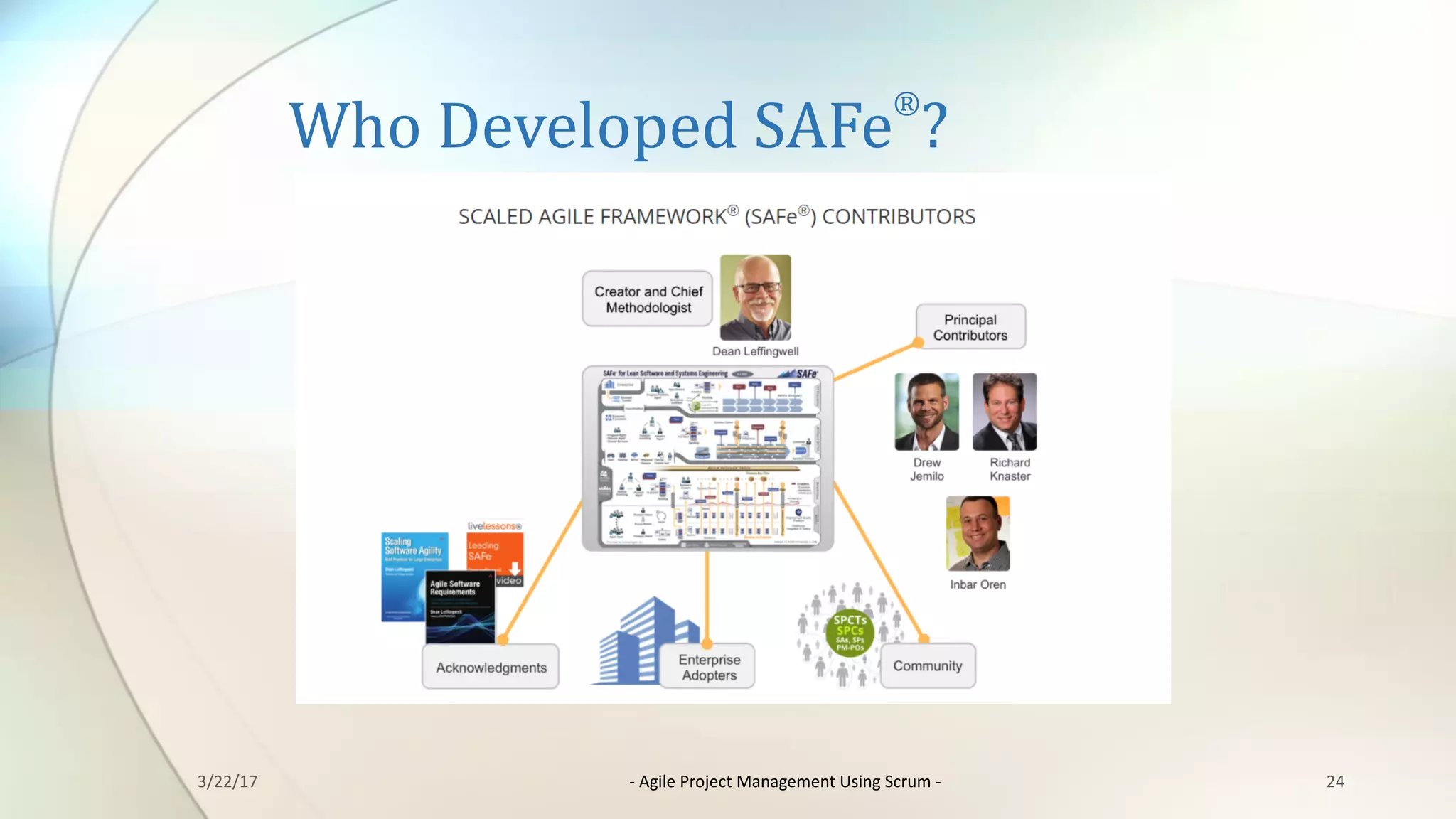
Who	Developed	SAFe
®
?
243/22/17 - Agile	Project	Management	Using	Scrum	-
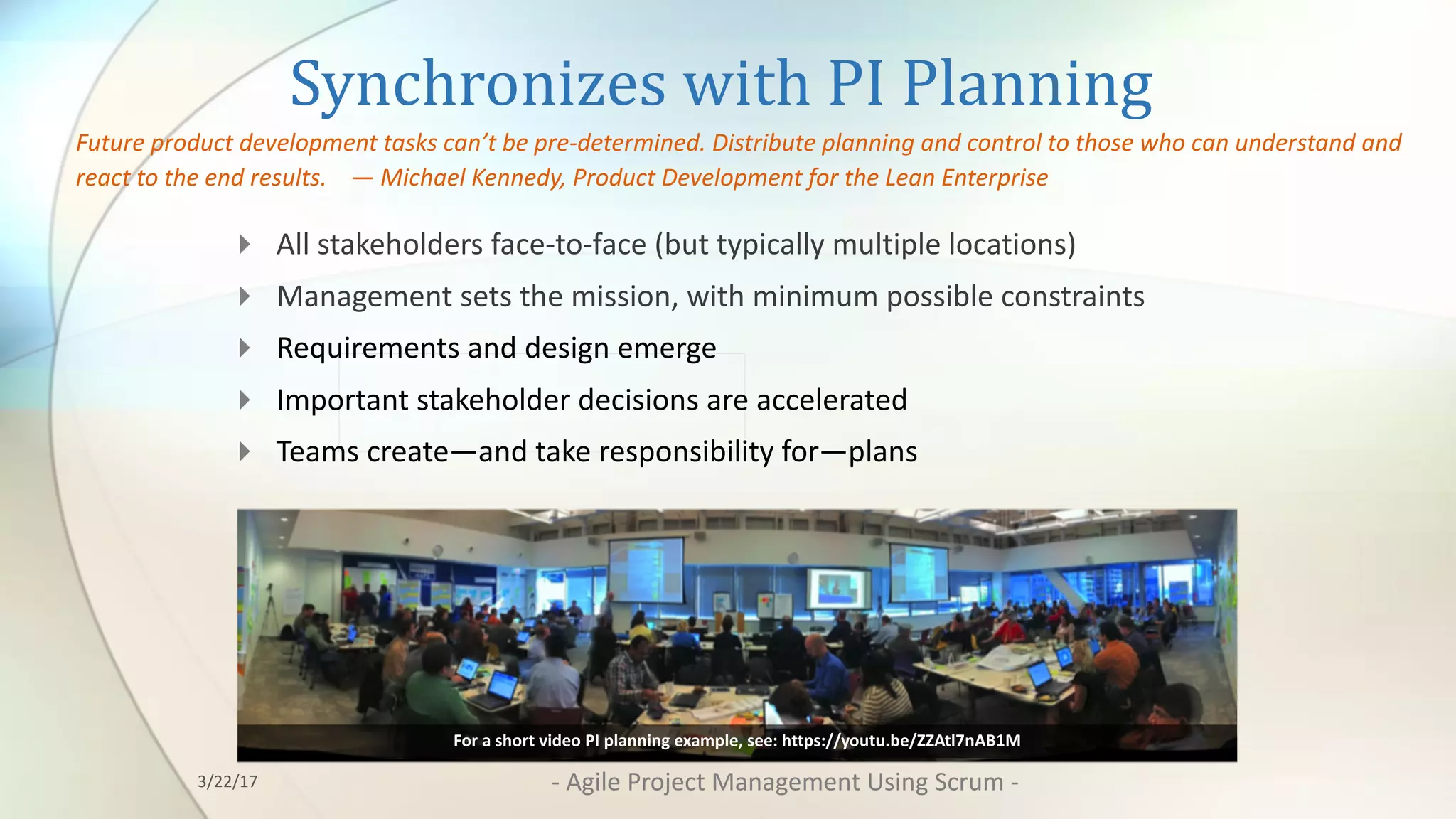
Synchronizes	with	PI	Planning
4 All	stakeholders	face-to-face	(but	typically	multiple	locations)	
4 Management	sets	the	mission,	with	minimum	possible	constraints
4 Requirements	and	design	emerge
4 Important	stakeholder	decisions	are	accelerated
4 Teams	create—and	take	responsibility	for—plans
Future	product	development	tasks	can’t	be	pre-determined.	Distribute	planning	and	control	to	those	who	can	understand	and	
react	to	the	end	results.				— Michael	Kennedy,	Product	Development	for	the	Lean	Enterprise
For	a	short	video	PI	planning	example,	see:	https://youtu.be/ZZAtl7nAB1M
3/22/17 - Agile	Project	Management	Using	Scrum	-

Scaled Agile Framework SAFe 4.0