Proprietary and Confidential
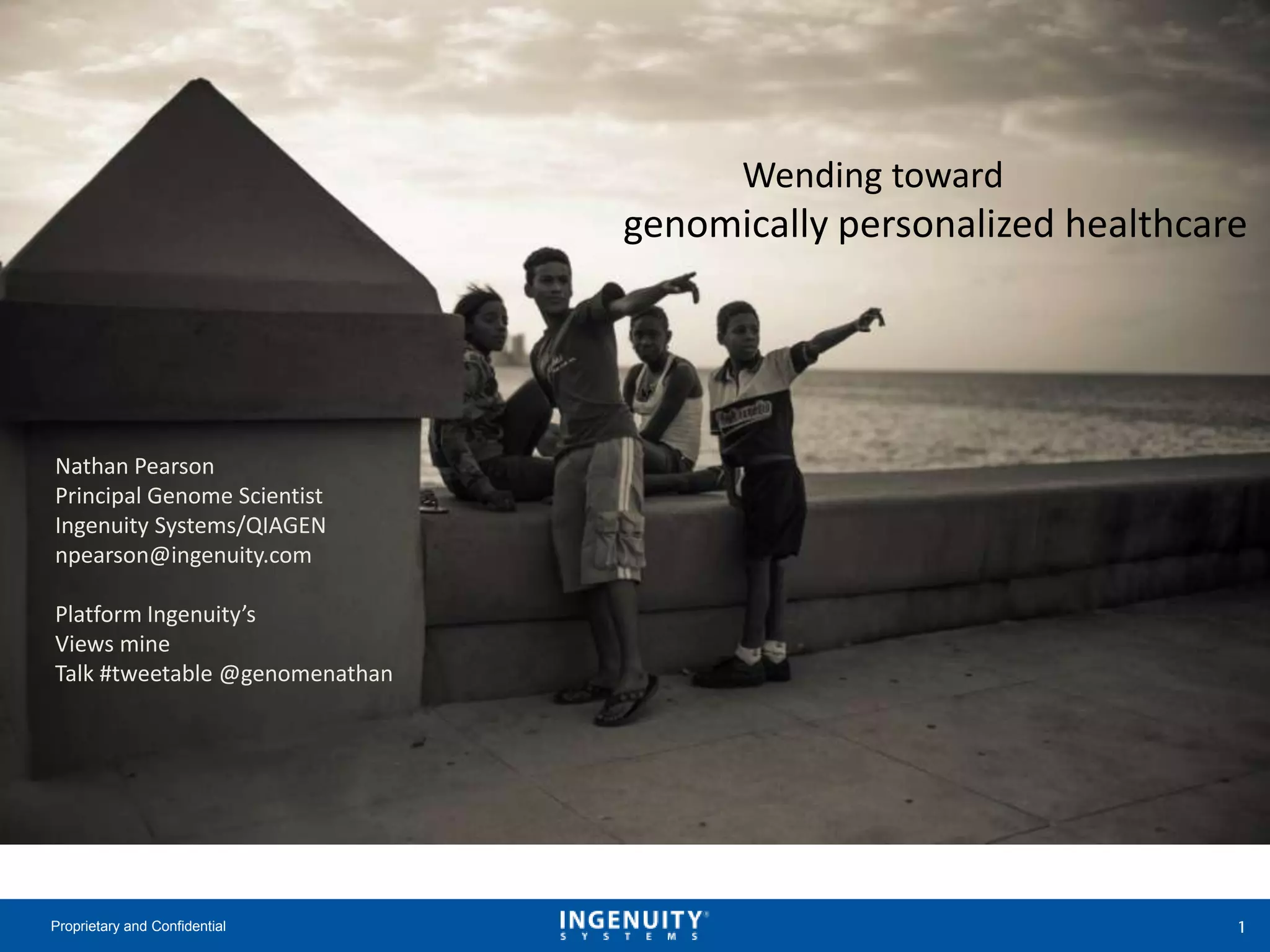
Wending toward
genomically personalized healthcare
Nathan Pearson
Principal Genome Scientist
Ingenuity Systems/QIAGEN
npearson@ingenuity.com
Platform Ingenuity’s
Views mine
Talk #tweetable @genomenathan
• Conveying how bench and drylab methods work, fail, and change
• Setting standards for pipeline validation, reporting, other sharing, and payment
• Starting to teach med students
• Convening stakeholders
• Blunting hype
Proprietary and Confidential
What we, as a community, are doing right
• Plain English (see genomena.com/variants)
• Treatment response findings
• Reference genome(s)
• Genotypes vs. variants
• Sharing individuated genomes
Proprietary and Confidential
What we, as a community, are neglecting
• Read: accurately sequence person’s chromosomes
Recommend: Align & call against a genome most like this person’s
Where hard to guess (e.g., HLA), try many
• Write: compress person’s genome; compare to others’ via common coordinates
Recommend: Report against human ancestral reference
Report no-calls
• Interpret: understand person who carries this genome
Recommend: Focus on genotypes, not variants
For QC, start with heterozygosity
Proprietary and Confidential
Reference genome: 3 distinct uses
• Arbitrary, unrealistic, and ethnocentric
• Misaligns most real people’s genomes
• Hides informative summary patterns (QC, functionally relevant evolution)
• Includes rare and risky variants
• Mismatches gene-specific references used by clinical geneticists
Proprietary and Confidential
Reference genome: Why today’s fails
Switch to common-variant-only reference?
Switch to healthy-variant-only reference?
Instead…
Switch to common-variant-only reference? What’s common varies.
Switch to healthy-variant-only reference? What’s healthy depends.
• Read: accurately sequence person’s chromosomes
Recommend: Align & call against a genome most like this person’s.
Where hard to guess (e.g., HLA), try many.
• Write: compress person’s genome; compare to others’ via common coordinates
Recommend: Report against human ancestral reference.
Report no-calls.
• Interpret: understand person who carries this genome
Recommend: Focus on genotypes, not variants.
For QC, start with heterozygosity.
Proprietary and Confidential
Reference genome: 3 distinct uses
• At each site, base carried by last forebear of all people
• Like current reference, comprises mostly common and healthy variants
• Includes source DNA for nearly all alignment-relevant chunks of real genomes
• Roughly equidistant from everyone
• Clearly reveals summary patterns of variation and evolution
• Lesson long learned for mtDNA1
But gene-specific reference discrepancies will remain, so…
1See Behar et al. 2012 (PMID 22482806), as well as Balasubramanian et al. 2011 (PMID 21205862)
Proprietary and Confidential
Report against human ancestral reference
• Reference-independent
• More clearly convey what’s risky & what’s not, in given person
• Slightly bigger data
• Needed, to capture complexity that big studies are already revealing
Neatly convey: dominant/recessive/complex site-specific effects
sex-specific risk (sex chromosome epistasis)
Readily extrapolate to: classic compound het etiology
haplotypes (and diplotypes)
other compound etiology
Proprietary and Confidential
Classify genotypes, not variants
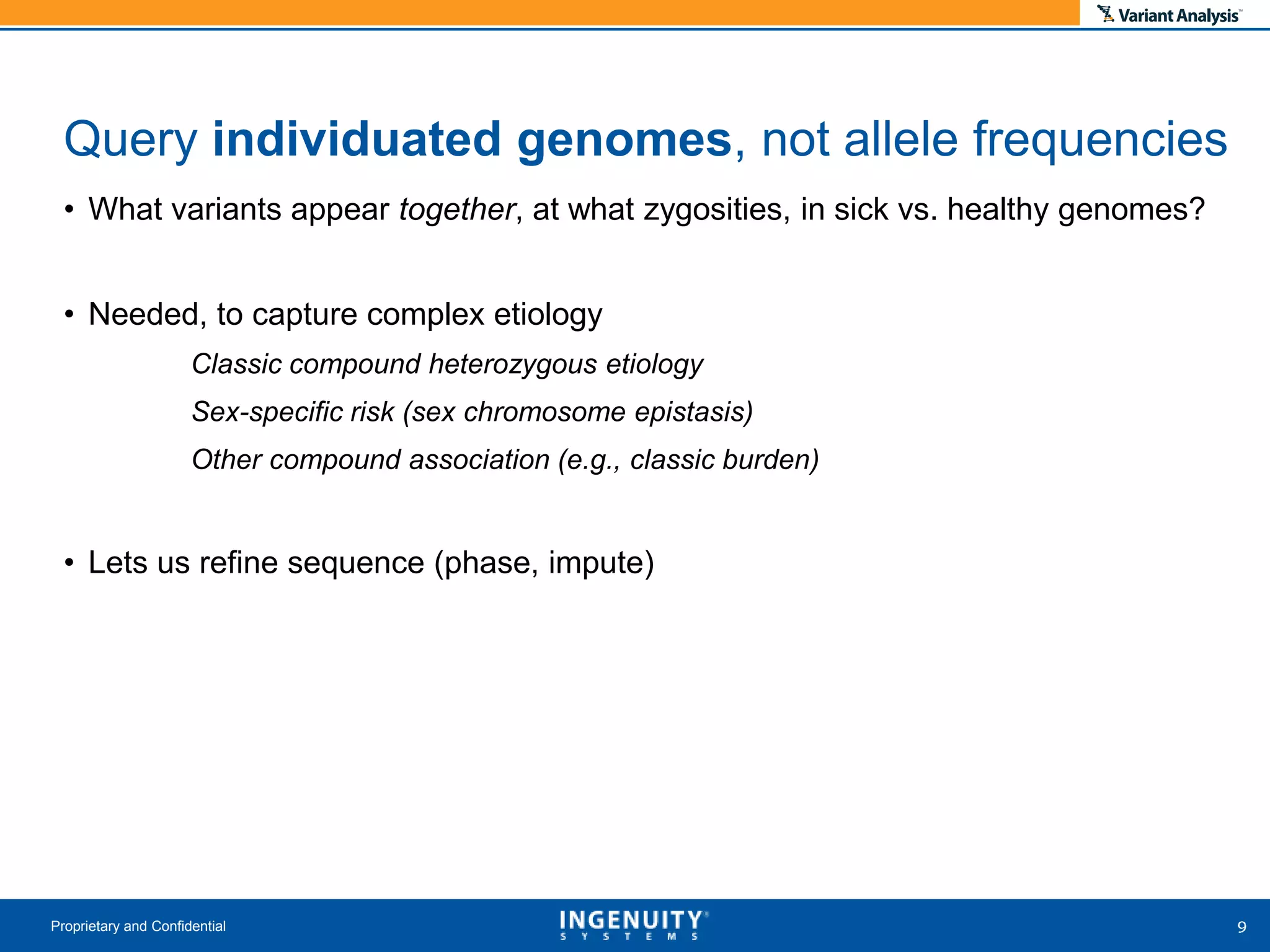
• What variants appear together, at what zygosities, in sick vs. healthy genomes?
• Needed, to capture complex etiology
Classic compound heterozygous etiology
Sex-specific risk (sex chromosome epistasis)
Other compound association (e.g., classic burden)
• Lets us refine sequence (phase, impute)
Proprietary and Confidential
Query individuated genomes, not allele frequencies
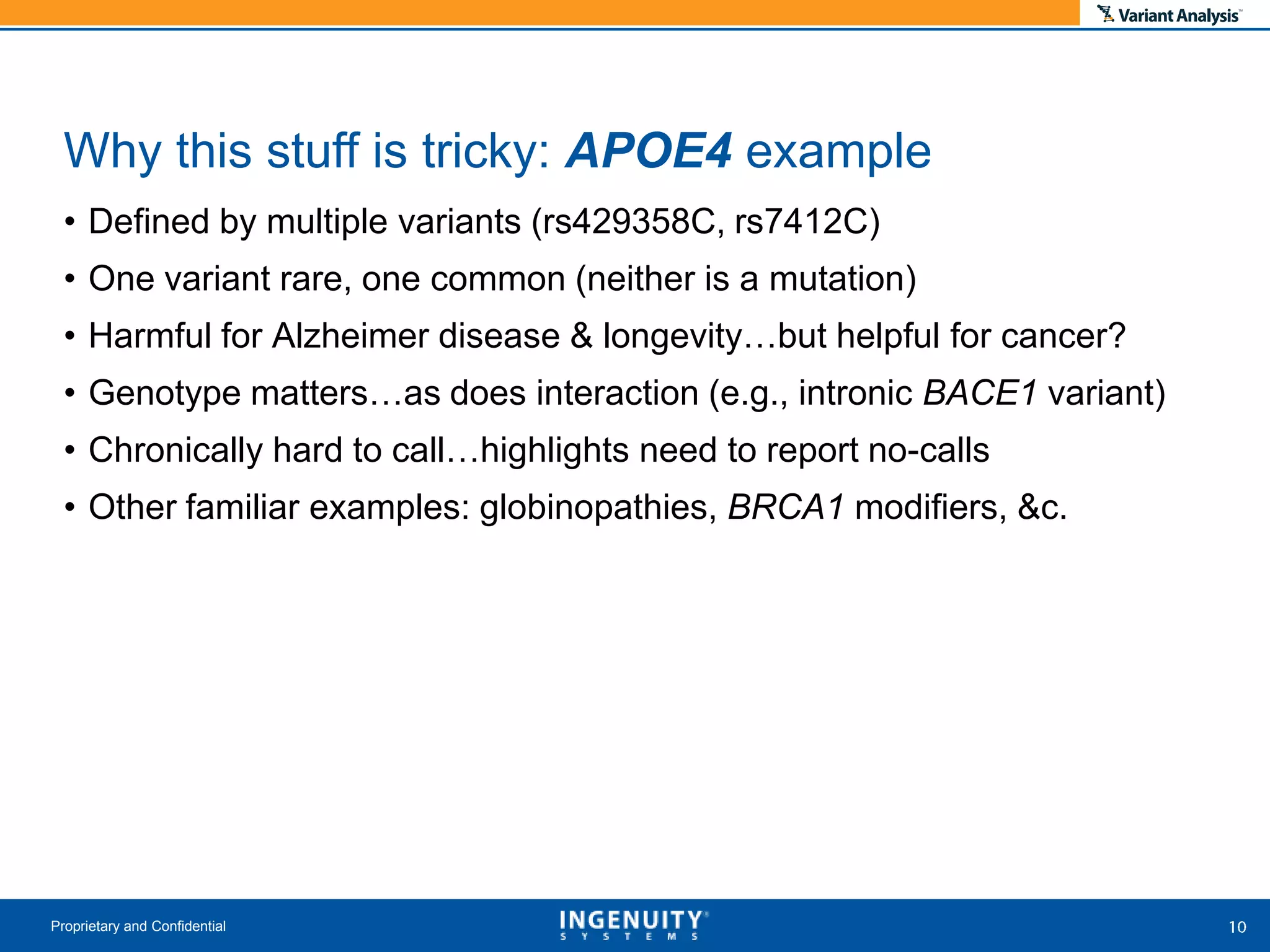
• Defined by multiple variants (rs429358C, rs7412C)
• One variant rare, one common (neither is a mutation)
• Harmful for Alzheimer disease & longevity…but helpful for cancer?
• Genotype matters…as does interaction (e.g., intronic BACE1 variant)
• Chronically hard to call…highlights need to report no-calls
• Other familiar examples: globinopathies, BRCA1 modifiers, &c.
Proprietary and Confidential
Why this stuff is tricky: APOE4 example
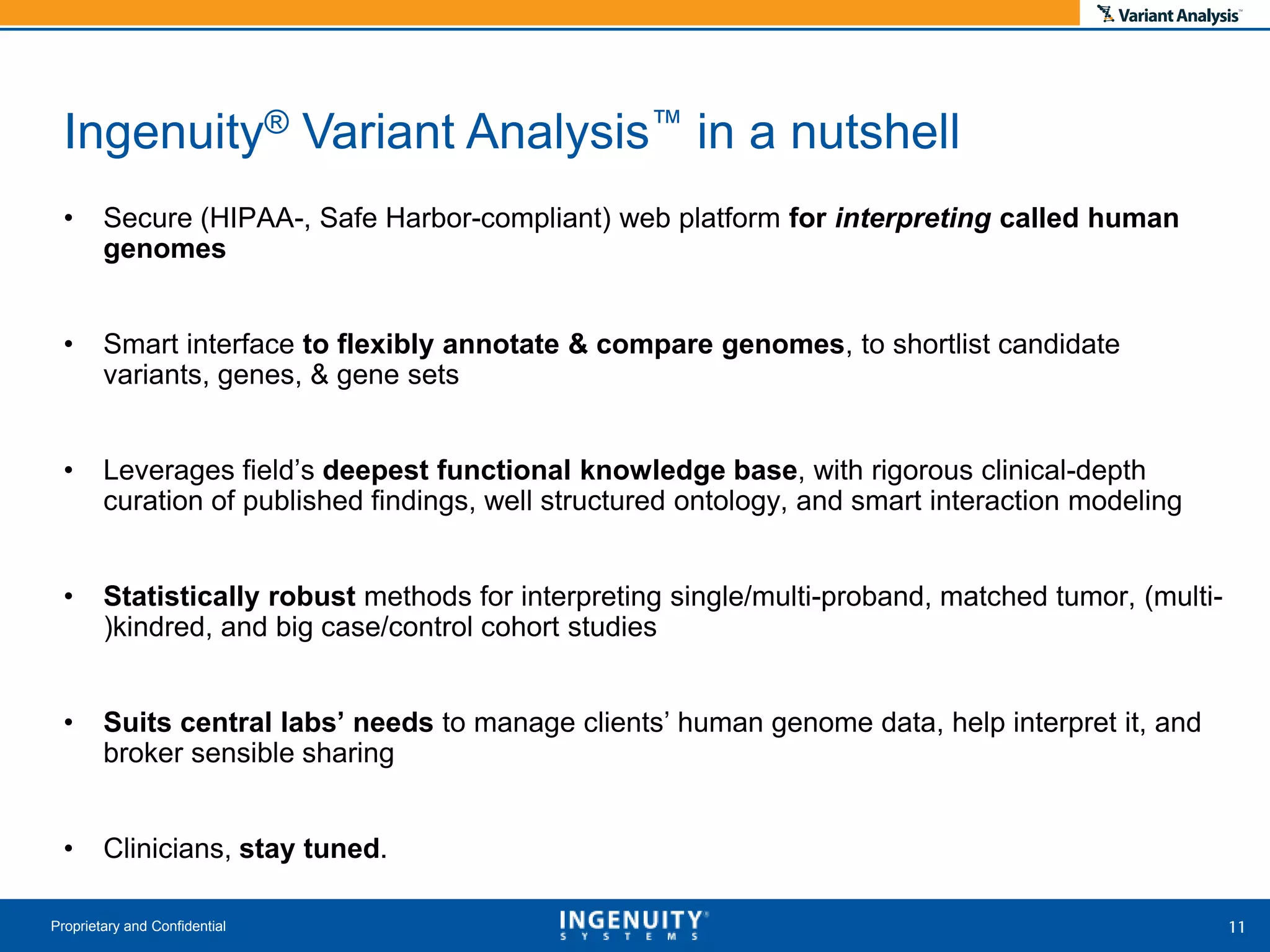
• Secure (HIPAA-, Safe Harbor-compliant) web platform for interpreting called human
genomes
• Smart interface to flexibly annotate & compare genomes, to shortlist candidate
variants, genes, & gene sets
• Leverages field’s deepest functional knowledge base, with rigorous clinical-depth
curation of published findings, well structured ontology, and smart interaction modeling
• Statistically robust methods for interpreting single/multi-proband, matched tumor, (multi-
)kindred, and big case/control cohort studies
• Suits central labs’ needs to manage clients’ human genome data, help interpret it, and
broker sensible sharing
• Clinicians, stay tuned.
Proprietary and Confidential
Ingenuity® Variant Analysis™ in a nutshell
Proprietary and Confidential
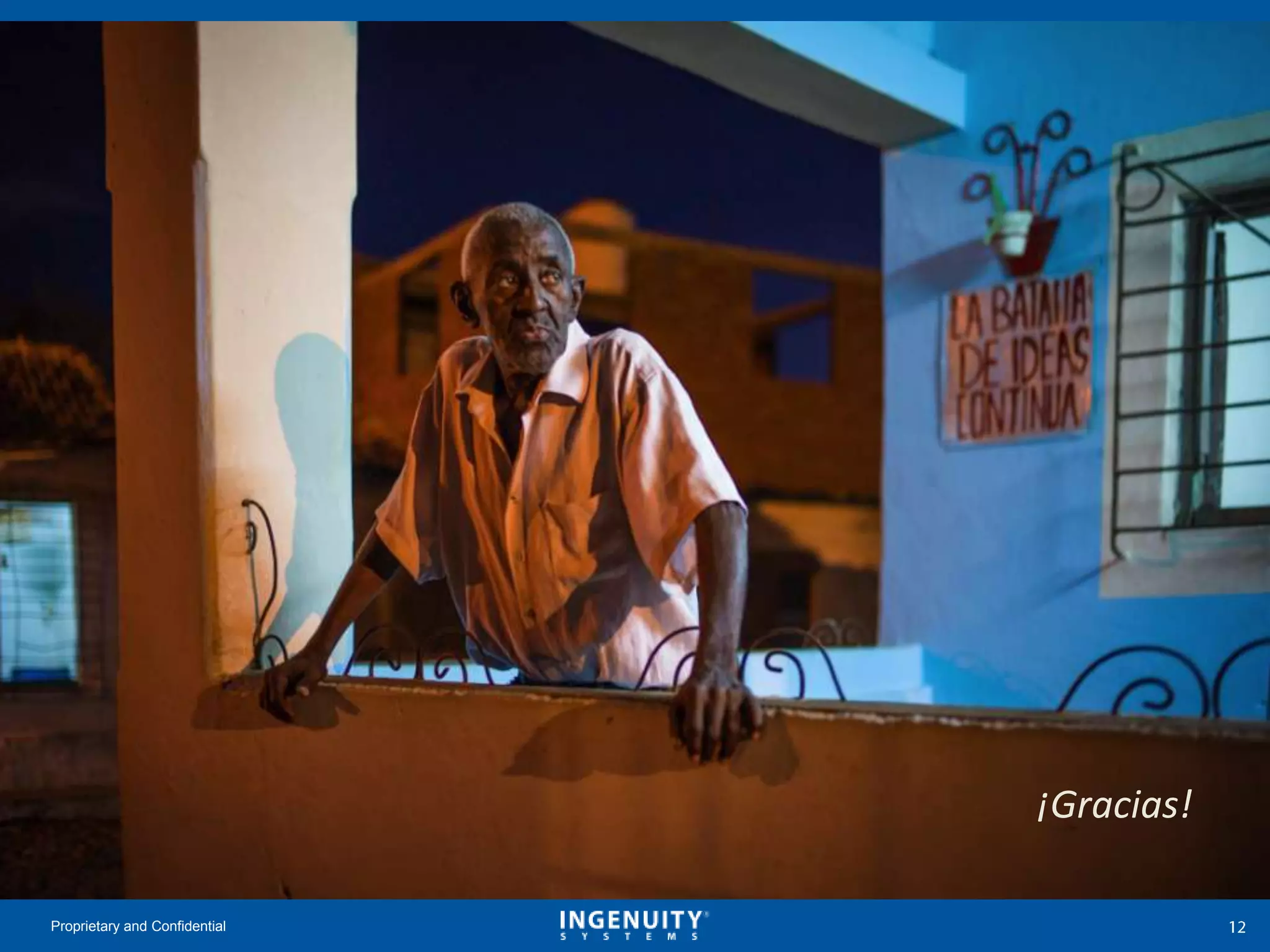
¡Gracias!

Pearson-TCGC-2013

  • 1.
    Proprietary and Confidential Wendingtoward genomically personalized healthcare Nathan Pearson Principal Genome Scientist Ingenuity Systems/QIAGEN npearson@ingenuity.com Platform Ingenuity’s Views mine Talk #tweetable @genomenathan
  • 2.
    • Conveying howbench and drylab methods work, fail, and change • Setting standards for pipeline validation, reporting, other sharing, and payment • Starting to teach med students • Convening stakeholders • Blunting hype Proprietary and Confidential What we, as a community, are doing right
  • 3.
    • Plain English(see genomena.com/variants) • Treatment response findings • Reference genome(s) • Genotypes vs. variants • Sharing individuated genomes Proprietary and Confidential What we, as a community, are neglecting
  • 4.
    • Read: accuratelysequence person’s chromosomes Recommend: Align & call against a genome most like this person’s Where hard to guess (e.g., HLA), try many • Write: compress person’s genome; compare to others’ via common coordinates Recommend: Report against human ancestral reference Report no-calls • Interpret: understand person who carries this genome Recommend: Focus on genotypes, not variants For QC, start with heterozygosity Proprietary and Confidential Reference genome: 3 distinct uses
  • 5.
    • Arbitrary, unrealistic,and ethnocentric • Misaligns most real people’s genomes • Hides informative summary patterns (QC, functionally relevant evolution) • Includes rare and risky variants • Mismatches gene-specific references used by clinical geneticists Proprietary and Confidential Reference genome: Why today’s fails Switch to common-variant-only reference? Switch to healthy-variant-only reference? Instead… Switch to common-variant-only reference? What’s common varies. Switch to healthy-variant-only reference? What’s healthy depends.
  • 6.
    • Read: accuratelysequence person’s chromosomes Recommend: Align & call against a genome most like this person’s. Where hard to guess (e.g., HLA), try many. • Write: compress person’s genome; compare to others’ via common coordinates Recommend: Report against human ancestral reference. Report no-calls. • Interpret: understand person who carries this genome Recommend: Focus on genotypes, not variants. For QC, start with heterozygosity. Proprietary and Confidential Reference genome: 3 distinct uses
  • 7.
    • At eachsite, base carried by last forebear of all people • Like current reference, comprises mostly common and healthy variants • Includes source DNA for nearly all alignment-relevant chunks of real genomes • Roughly equidistant from everyone • Clearly reveals summary patterns of variation and evolution • Lesson long learned for mtDNA1 But gene-specific reference discrepancies will remain, so… 1See Behar et al. 2012 (PMID 22482806), as well as Balasubramanian et al. 2011 (PMID 21205862) Proprietary and Confidential Report against human ancestral reference
  • 8.
    • Reference-independent • Moreclearly convey what’s risky & what’s not, in given person • Slightly bigger data • Needed, to capture complexity that big studies are already revealing Neatly convey: dominant/recessive/complex site-specific effects sex-specific risk (sex chromosome epistasis) Readily extrapolate to: classic compound het etiology haplotypes (and diplotypes) other compound etiology Proprietary and Confidential Classify genotypes, not variants
  • 9.
    • What variantsappear together, at what zygosities, in sick vs. healthy genomes? • Needed, to capture complex etiology Classic compound heterozygous etiology Sex-specific risk (sex chromosome epistasis) Other compound association (e.g., classic burden) • Lets us refine sequence (phase, impute) Proprietary and Confidential Query individuated genomes, not allele frequencies
  • 10.
    • Defined bymultiple variants (rs429358C, rs7412C) • One variant rare, one common (neither is a mutation) • Harmful for Alzheimer disease & longevity…but helpful for cancer? • Genotype matters…as does interaction (e.g., intronic BACE1 variant) • Chronically hard to call…highlights need to report no-calls • Other familiar examples: globinopathies, BRCA1 modifiers, &c. Proprietary and Confidential Why this stuff is tricky: APOE4 example
  • 11.
    • Secure (HIPAA-,Safe Harbor-compliant) web platform for interpreting called human genomes • Smart interface to flexibly annotate & compare genomes, to shortlist candidate variants, genes, & gene sets • Leverages field’s deepest functional knowledge base, with rigorous clinical-depth curation of published findings, well structured ontology, and smart interaction modeling • Statistically robust methods for interpreting single/multi-proband, matched tumor, (multi- )kindred, and big case/control cohort studies • Suits central labs’ needs to manage clients’ human genome data, help interpret it, and broker sensible sharing • Clinicians, stay tuned. Proprietary and Confidential Ingenuity® Variant Analysis™ in a nutshell
  • 12.

Editor's Notes

  • #3 Sharing:TocliniciansConsents in research & carePublication of research findingsAmong clinicians: means & formats of exchange, EHR integrationReturn of results
  • #7 Reporting no-calls has low burden of interpretation: is site already annotated, or not?
  • #13 Last, a warning: Let’s not dither, lest nationalized systems pass us.Biggest seq efforts already in such states, where individual and population-scale interests more directy align, especially where burdened with recessive disease &c.