Counterfactual evaluation
of machine learning
models
Michael Manapat
@mlmanapat
Stripe
Stripe
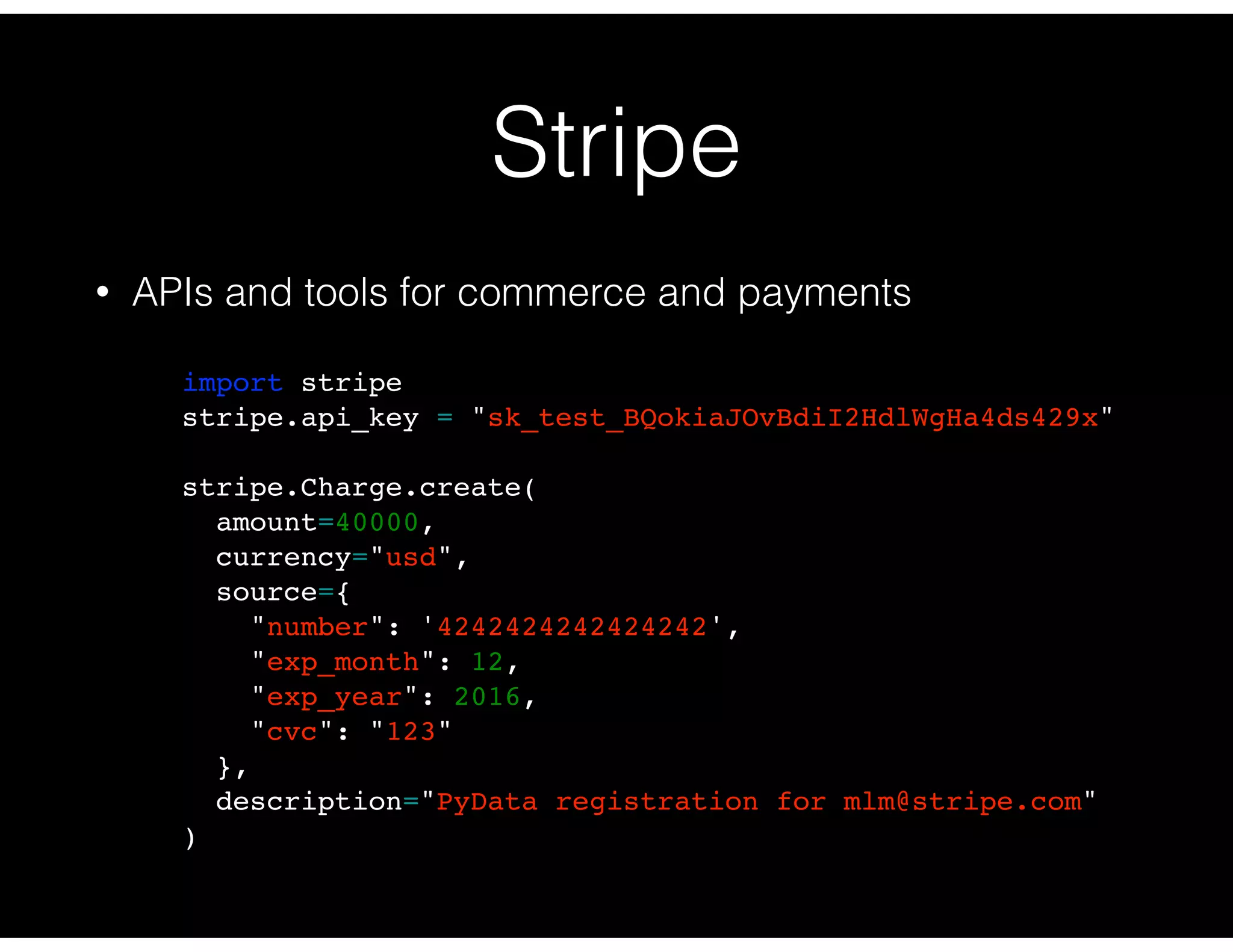
• APIs and tools for commerce and payments
import stripe
stripe.api_key = "sk_test_BQokiaJOvBdiI2HdlWgHa4ds429x"
stripe.Charge.create(
amount=40000,
currency="usd",
source={
"number": '4242424242424242',
"exp_month": 12,
"exp_year": 2016,
"cvc": "123"
},
description="PyData registration for mlm@stripe.com"
)
Machine Learning at Stripe
• Ten engineers/data scientists as of July 2015 (no
distinction between roles)
• Focus has been on fraud detection
• Continuous scoring of businesses for fraud
risk
• Synchronous classification of charges as
fraud or not
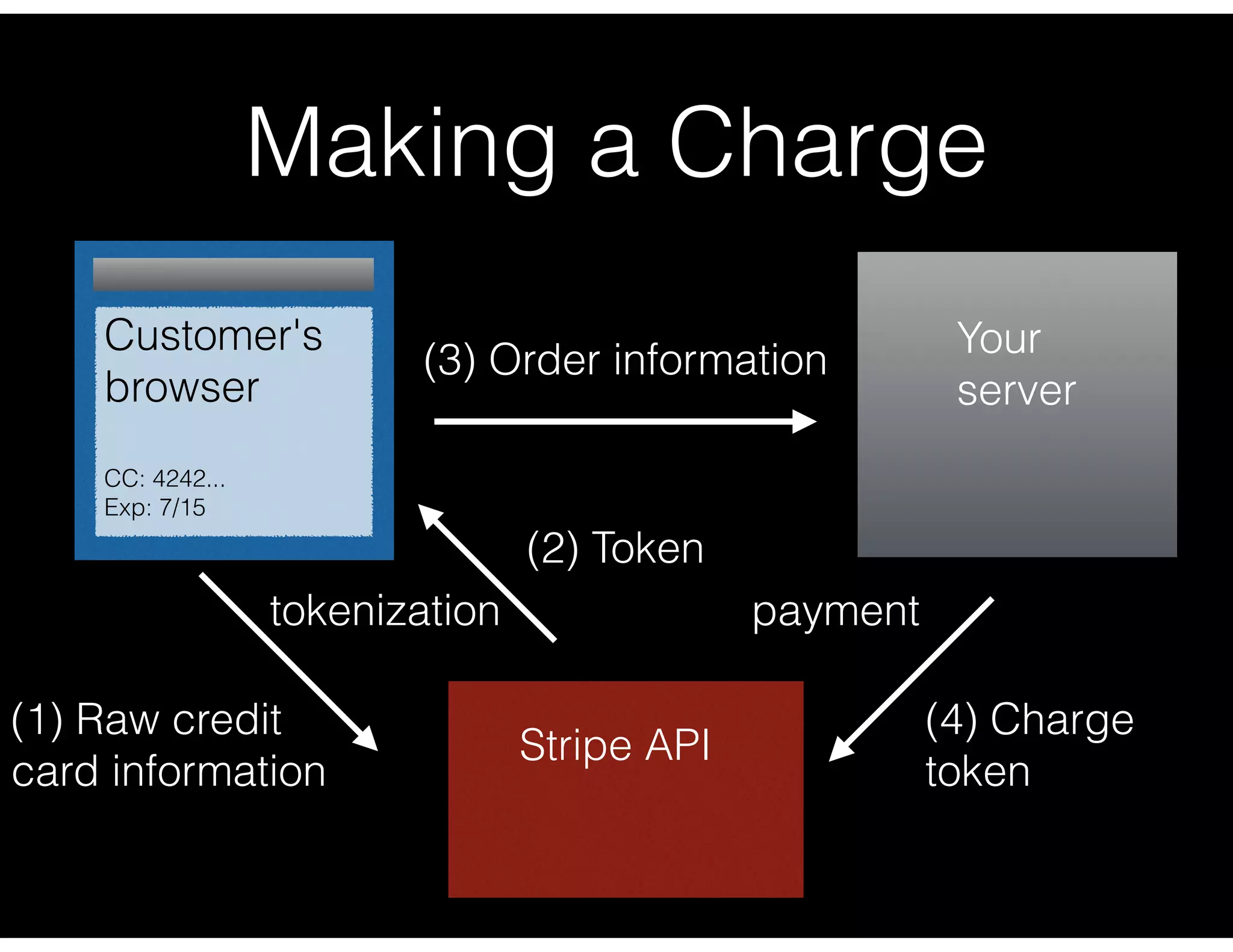
Making a Charge
Customer's
browser
CC: 4242...
Exp: 7/15
Stripe API
Your
server
(1) Raw credit
card information
(2) Token
(3) Order information
(4) Charge
token
tokenization payment
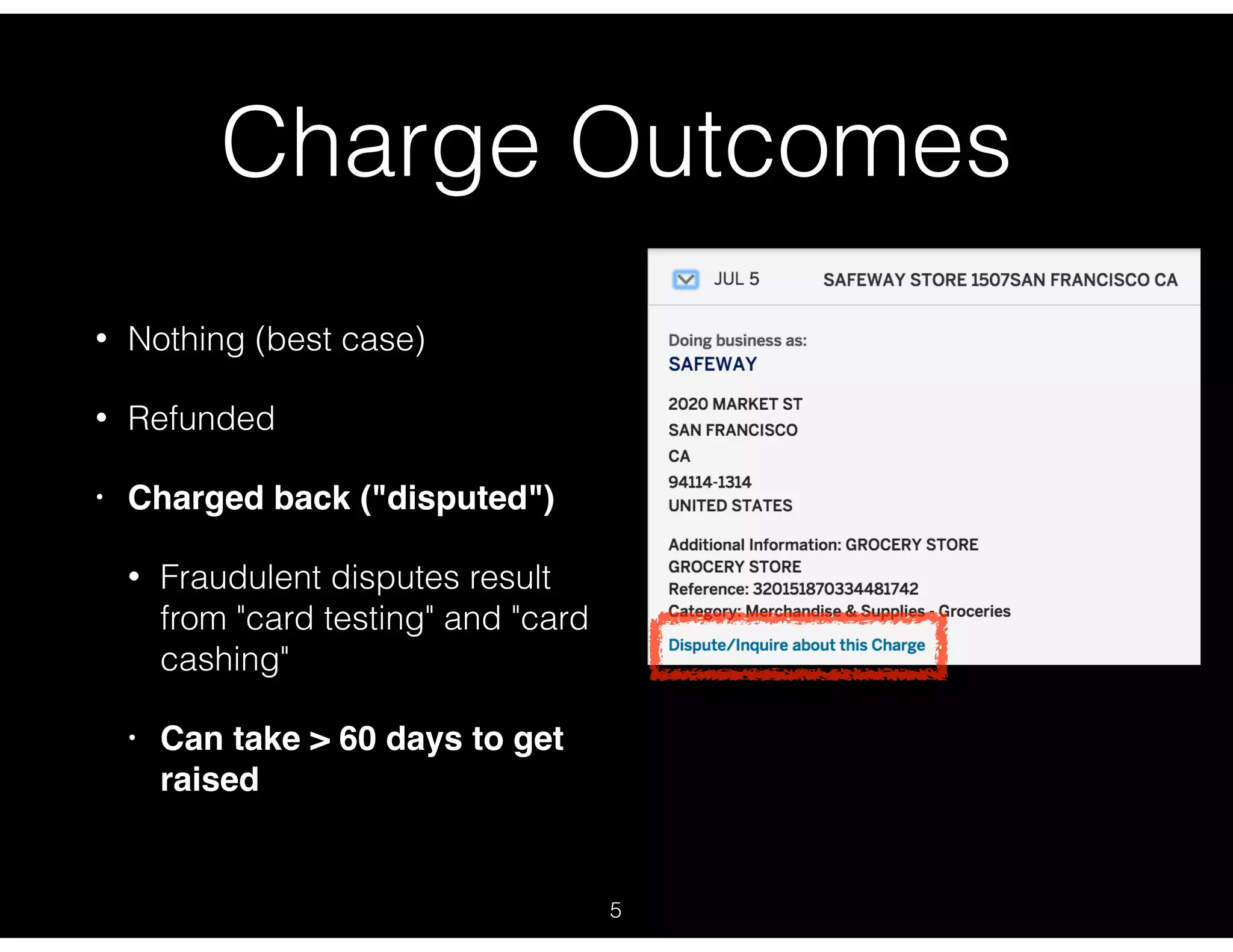
Charge Outcomes
• Nothing (best case)
• Refunded
• Charged back ("disputed")
• Fraudulent disputes result
from "card testing" and "card
cashing"
• Can take > 60 days to get
raised
5
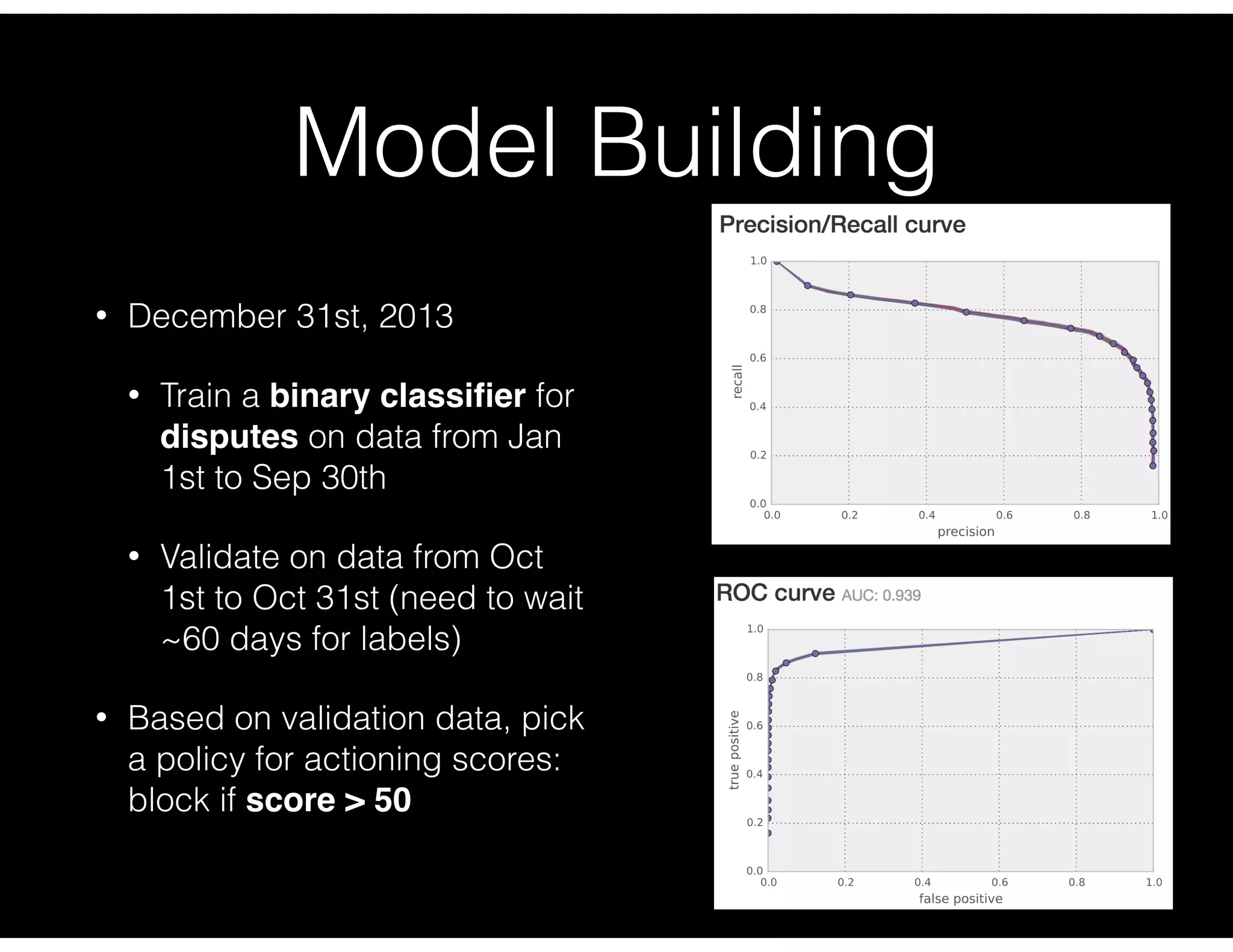
Model Building
• December 31st, 2013
• Train a binary classifier for
disputes on data from Jan
1st to Sep 30th
• Validate on data from Oct
1st to Oct 31st (need to wait
~60 days for labels)
• Based on validation data, pick
a policy for actioning scores:

block if score > 50
Questions
• Validation data is > 2 months old. How is the
model doing?
• What are the production precision and recall?
• Business complains about high false positive
rate: what would happen if we changed the
policy to "block if score > 70"?
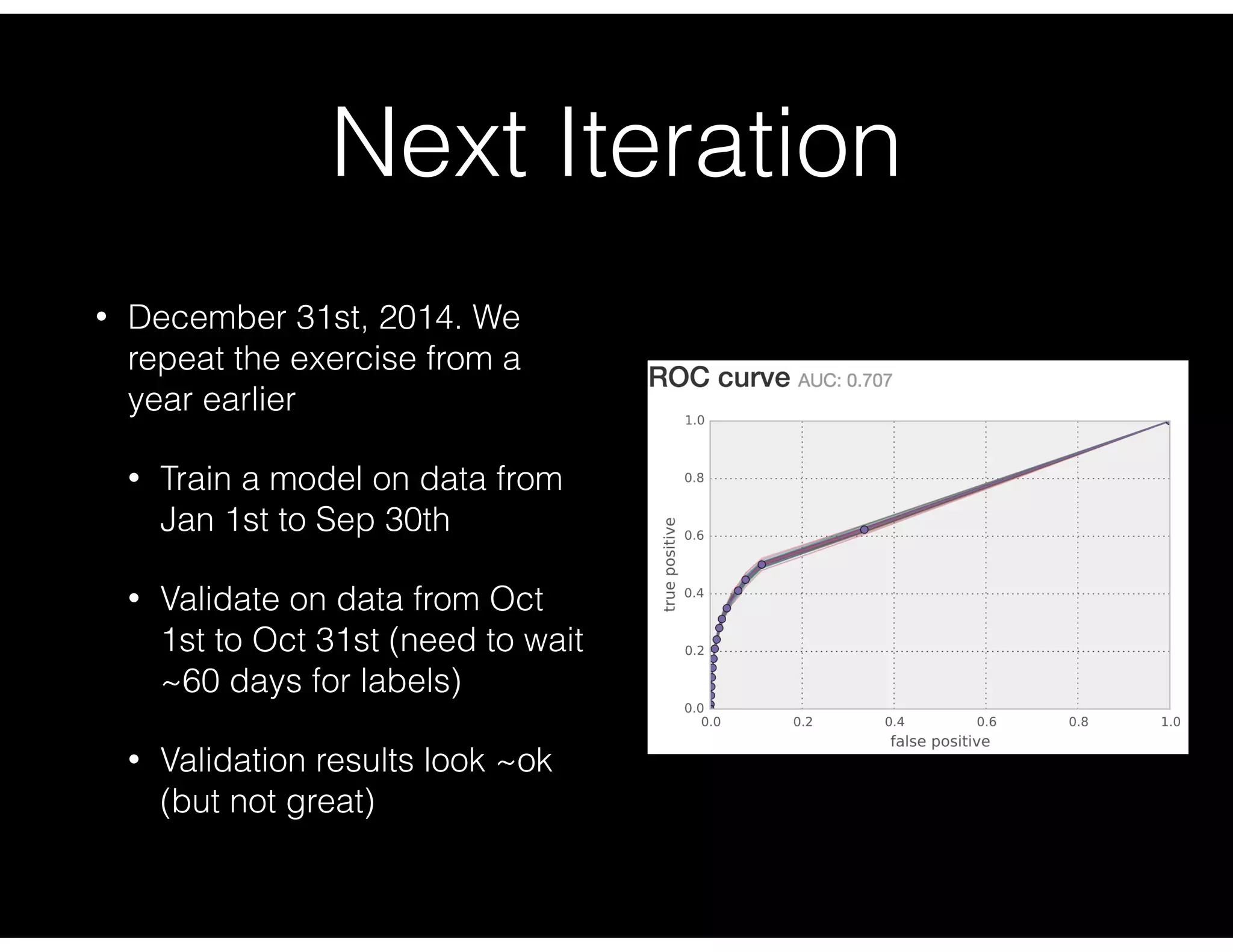
Next Iteration
• December 31st, 2014. We
repeat the exercise from a
year earlier
• Train a model on data from
Jan 1st to Sep 30th
• Validate on data from Oct
1st to Oct 31st (need to wait
~60 days for labels)
• Validation results look ~ok
(but not great)
Next Iteration
• We put the model into production, and the
results are terrible
• From spot-checking and complaints from
customers, the performance is worse than
even the validation data suggested
• What happened?
Next Iteration
• We already had a model running that was blocking a
lot of fraud
• Training and validating only on data for which we had
labels: charges that the existing model didn't catch
• Far fewer examples of fraud in number. Essentially
building a model to catch the "hardest" fraud
• Possible solution: we could run both models in
parallel...
Evaluation and Retraining
Require the Same Data
• For evaluation, policy changes, and
retraining, we want the same thing:
• An approximation of the distribution of charges
and outcomes that would exist in the absence
of our intervention (blocking)
First attempt
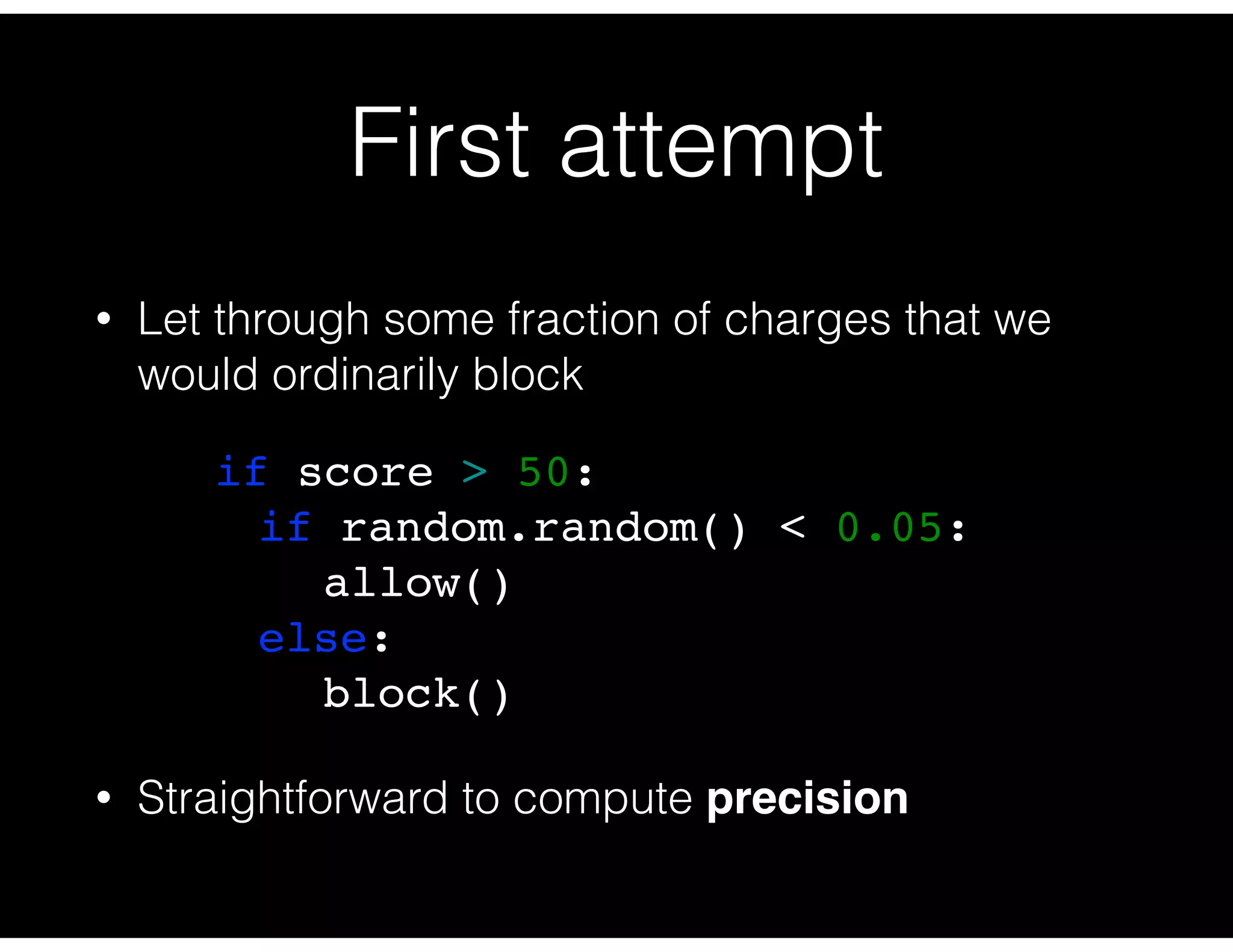
• Let through some fraction of charges that we
would ordinarily block
• Straightforward to compute precision
if score > 50:
if random.random() < 0.05:
allow()
else:
block()
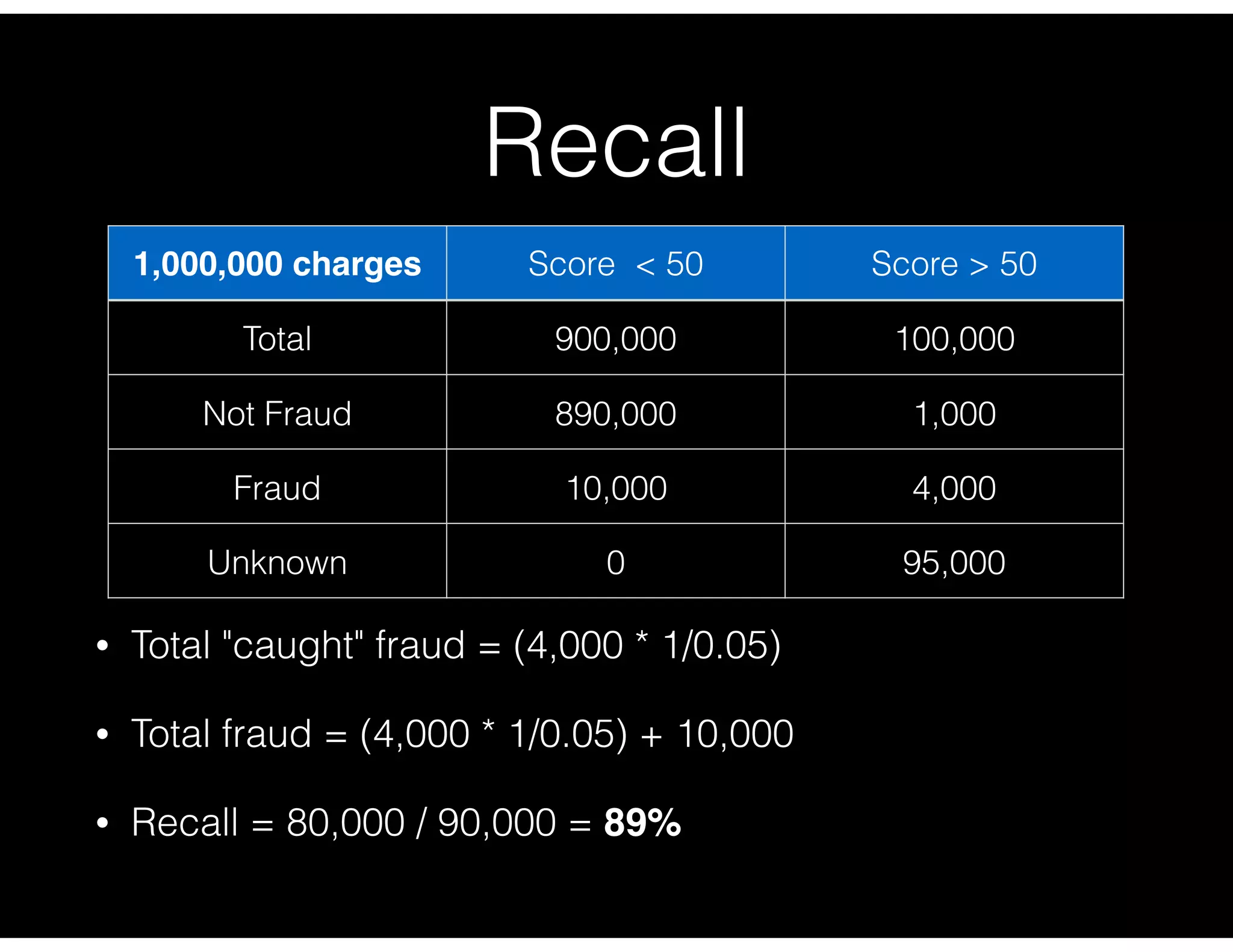
Recall
• Total "caught" fraud = (4,000 * 1/0.05)
• Total fraud = (4,000 * 1/0.05) + 10,000
• Recall = 80,000 / 90,000 = 89%
1,000,000 charges Score < 50 Score > 50
Total 900,000 100,000
Not Fraud 890,000 1,000
Fraud 10,000 4,000
Unknown 0 95,000
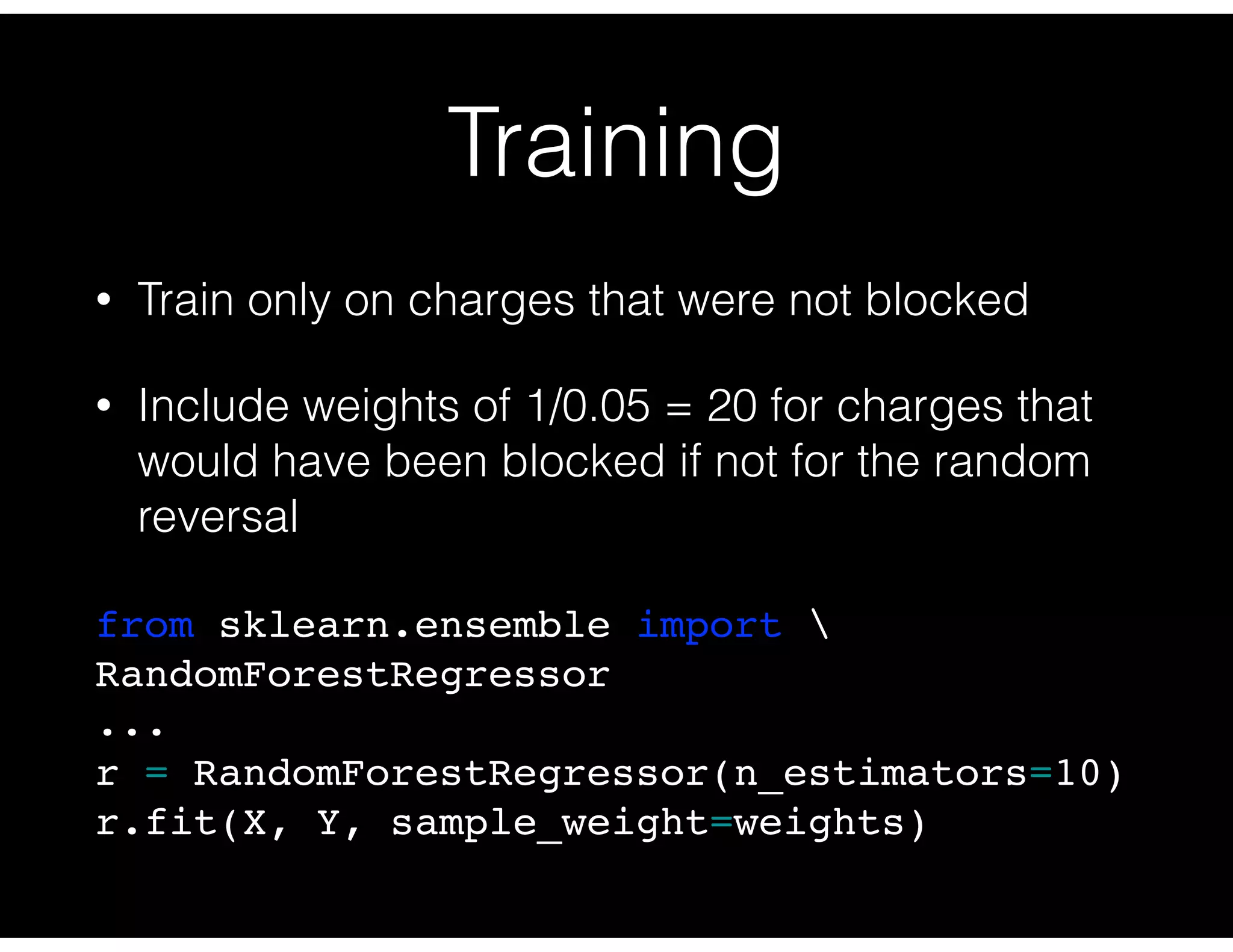
Training
• Train only on charges that were not blocked
• Include weights of 1/0.05 = 20 for charges that
would have been blocked if not for the random
reversal
from sklearn.ensemble import 
RandomForestRegressor
...
r = RandomForestRegressor(n_estimators=10)
r.fit(X, Y, sample_weight=weights)
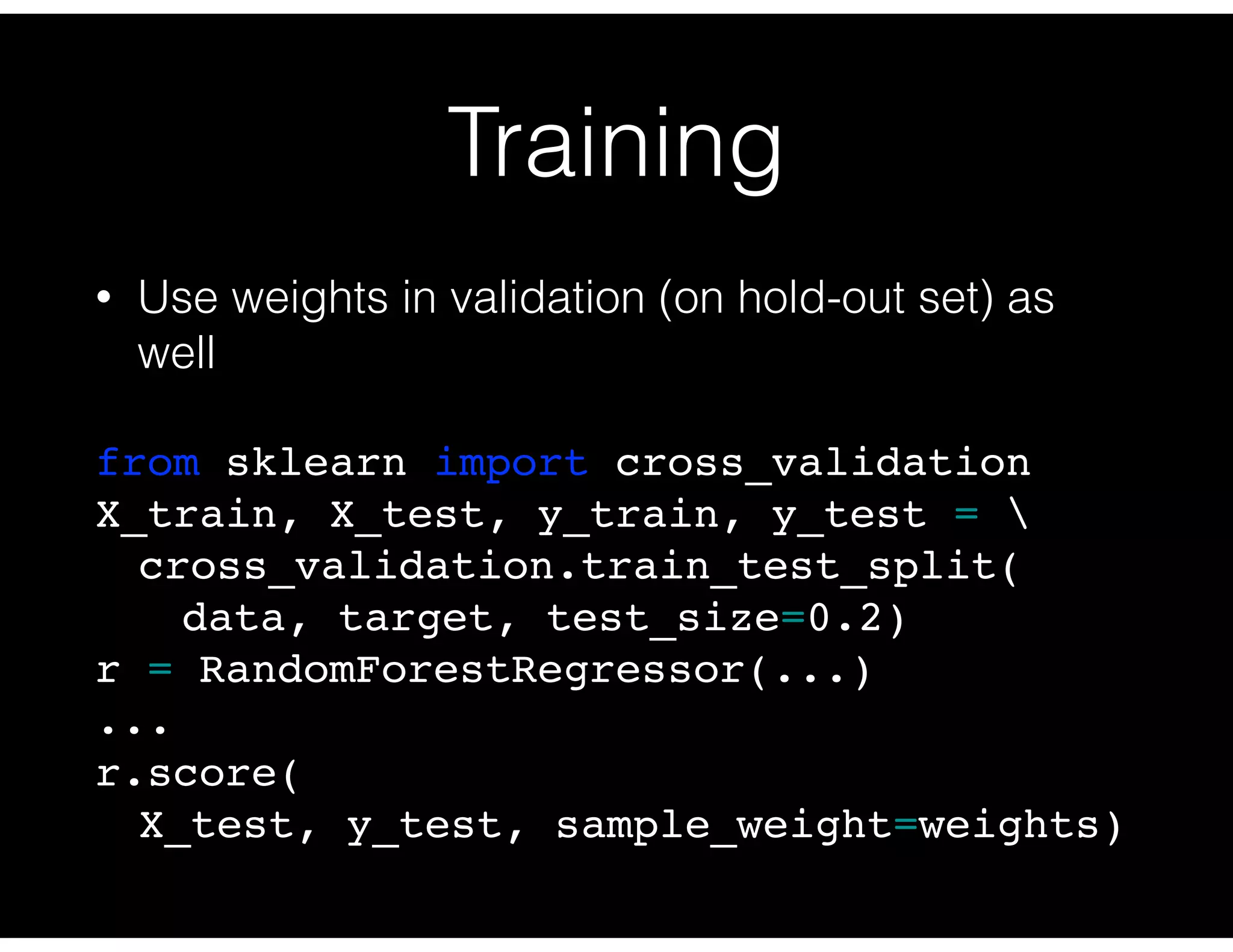
Training
• Use weights in validation (on hold-out set) as
well
from sklearn import cross_validation
X_train, X_test, y_train, y_test = 
cross_validation.train_test_split(
data, target, test_size=0.2)
r = RandomForestRegressor(...)
...
r.score(
X_test, y_test, sample_weight=weights)
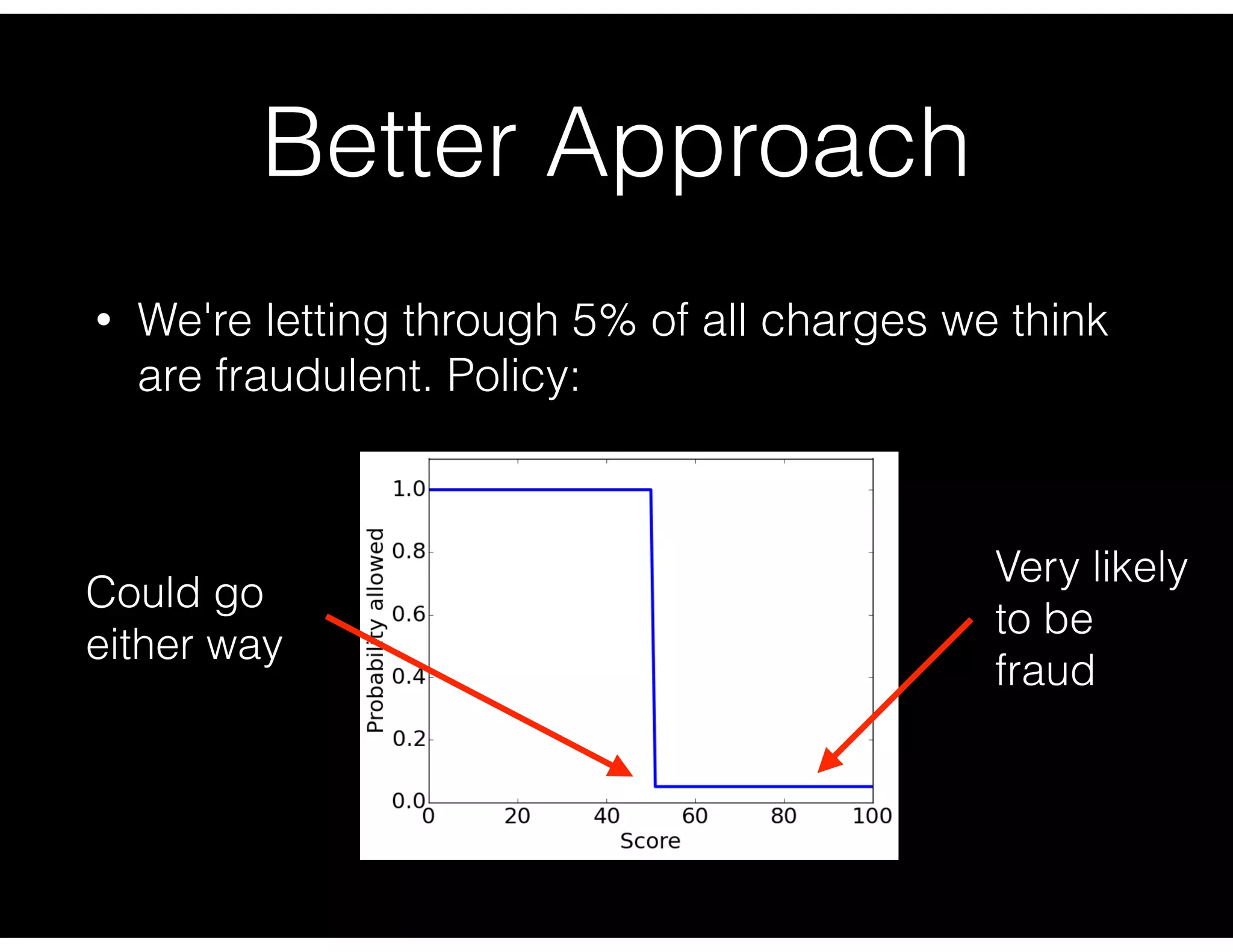
Better Approach
• We're letting through 5% of all charges we think
are fraudulent. Policy:
Very likely
to be
fraud
Could go
either way
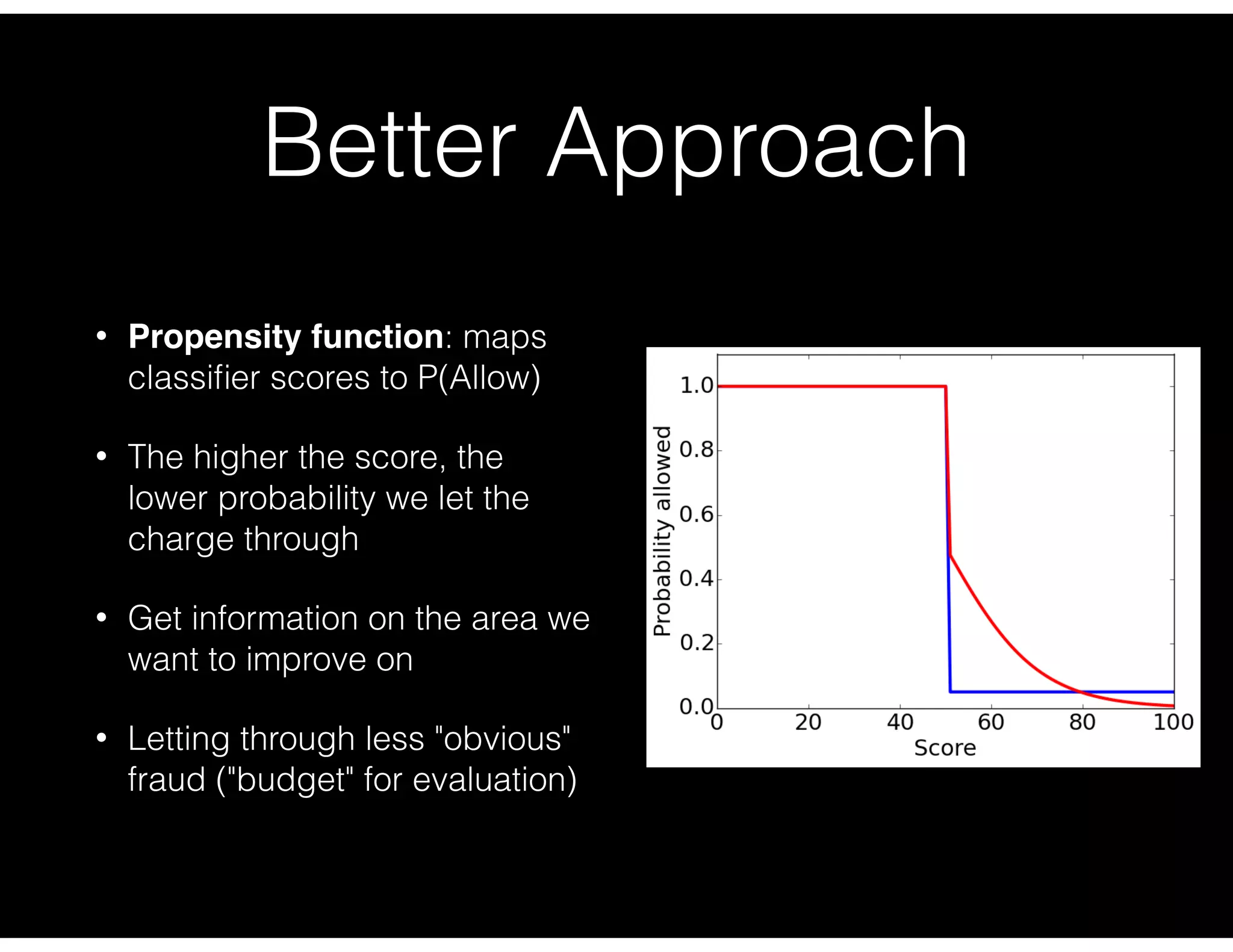
Better Approach
• Propensity function: maps
classifier scores to P(Allow)
• The higher the score, the
lower probability we let the
charge through
• Get information on the area we
want to improve on
• Letting through less "obvious"
fraud ("budget" for evaluation)
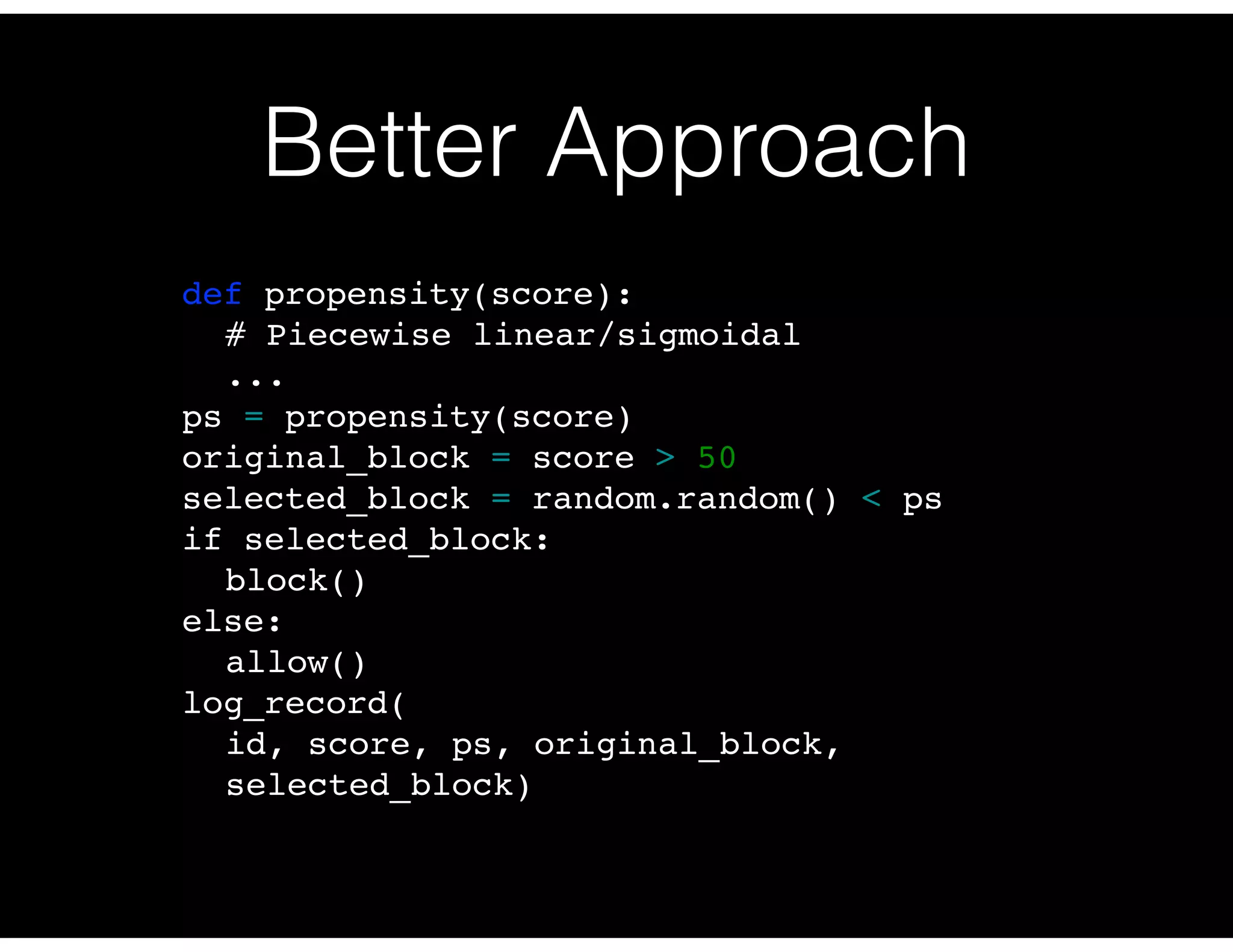
Better Approach
def propensity(score):
# Piecewise linear/sigmoidal
...
ps = propensity(score)
original_block = score > 50
selected_block = random.random() < ps
if selected_block:
block()
else:
allow()
log_record(
id, score, ps, original_block,
selected_block)
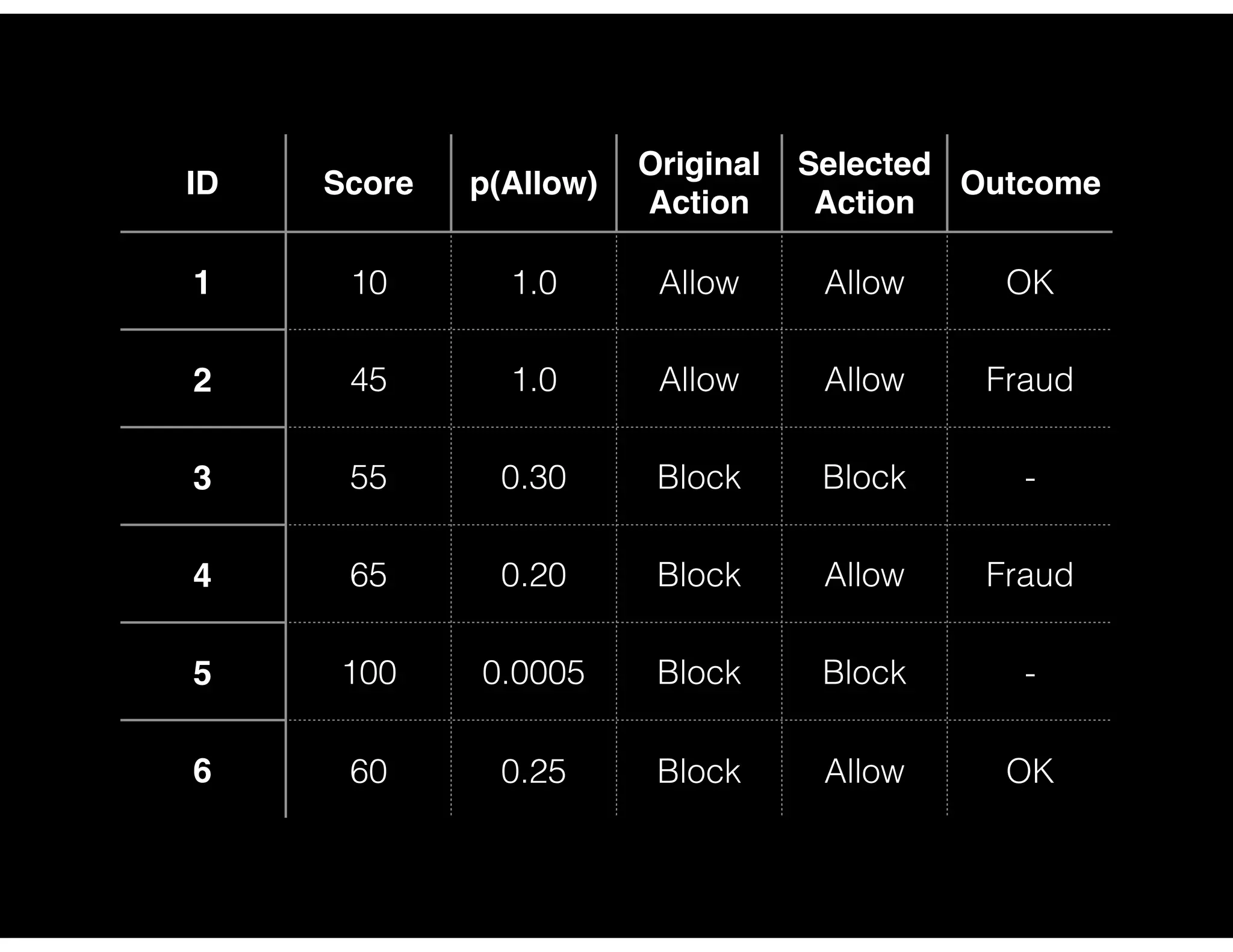
ID Score p(Allow)
Original
Action
Selected
Action
Outcome
1 10 1.0 Allow Allow OK
2 45 1.0 Allow Allow Fraud
3 55 0.30 Block Block -
4 65 0.20 Block Allow Fraud
5 100 0.0005 Block Block -
6 60 0.25 Block Allow OK
Analysis
• In any analysis, we only consider samples that
were allowed (since we don't have labels
otherwise)
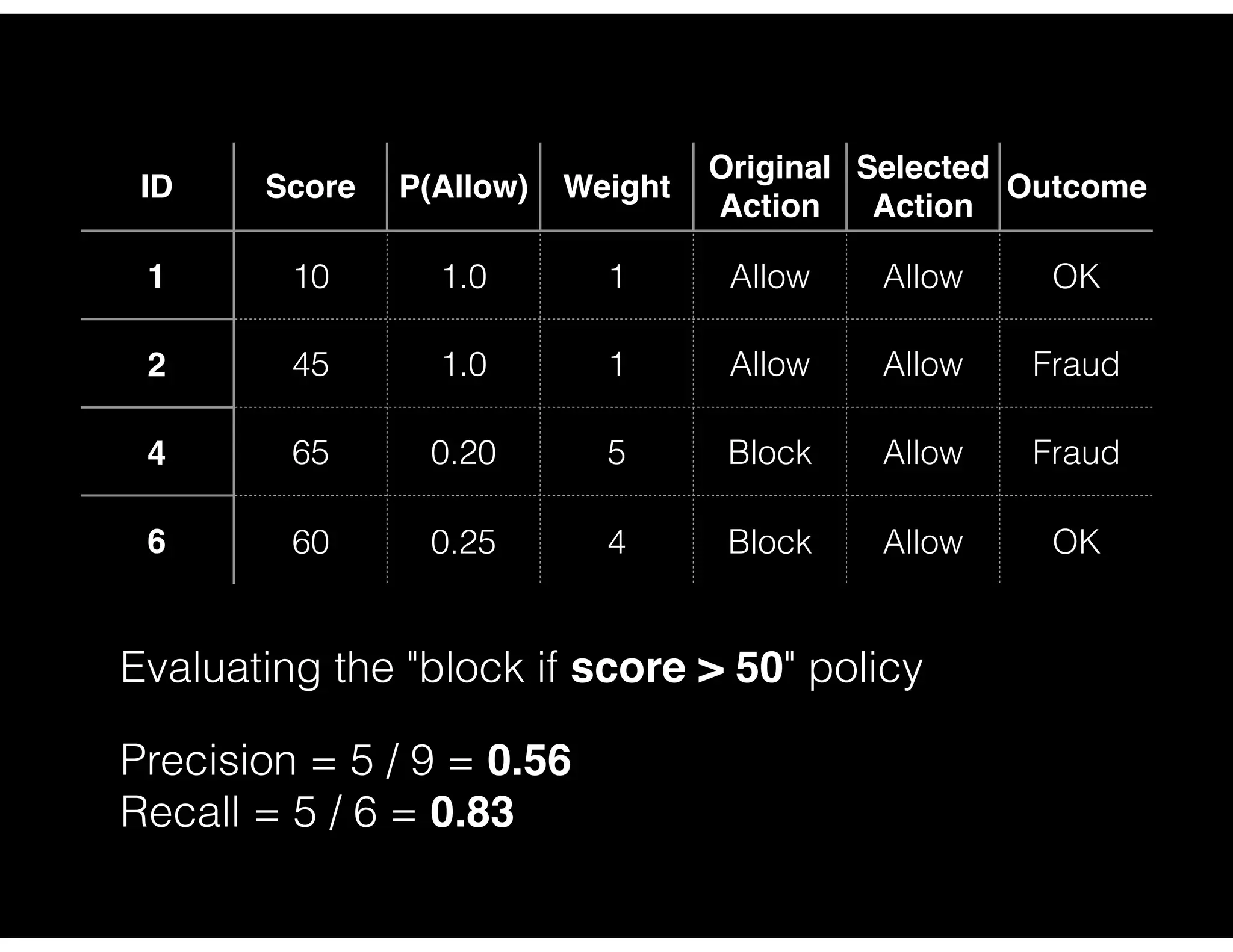
• We weight each sample by 1 / P(Allow)
• cf. weighting by 1/0.05 = 20 in the uniform
probability case
ID Score P(Allow) Weight
Original
Action
Selected
Action
Outcome
1 10 1.0 1 Allow Allow OK
2 45 1.0 1 Allow Allow Fraud
4 65 0.20 5 Block Allow Fraud
6 60 0.25 4 Block Allow OK
Evaluating the "block if score > 50" policy
Precision = 5 / 9 = 0.56
Recall = 5 / 6 = 0.83
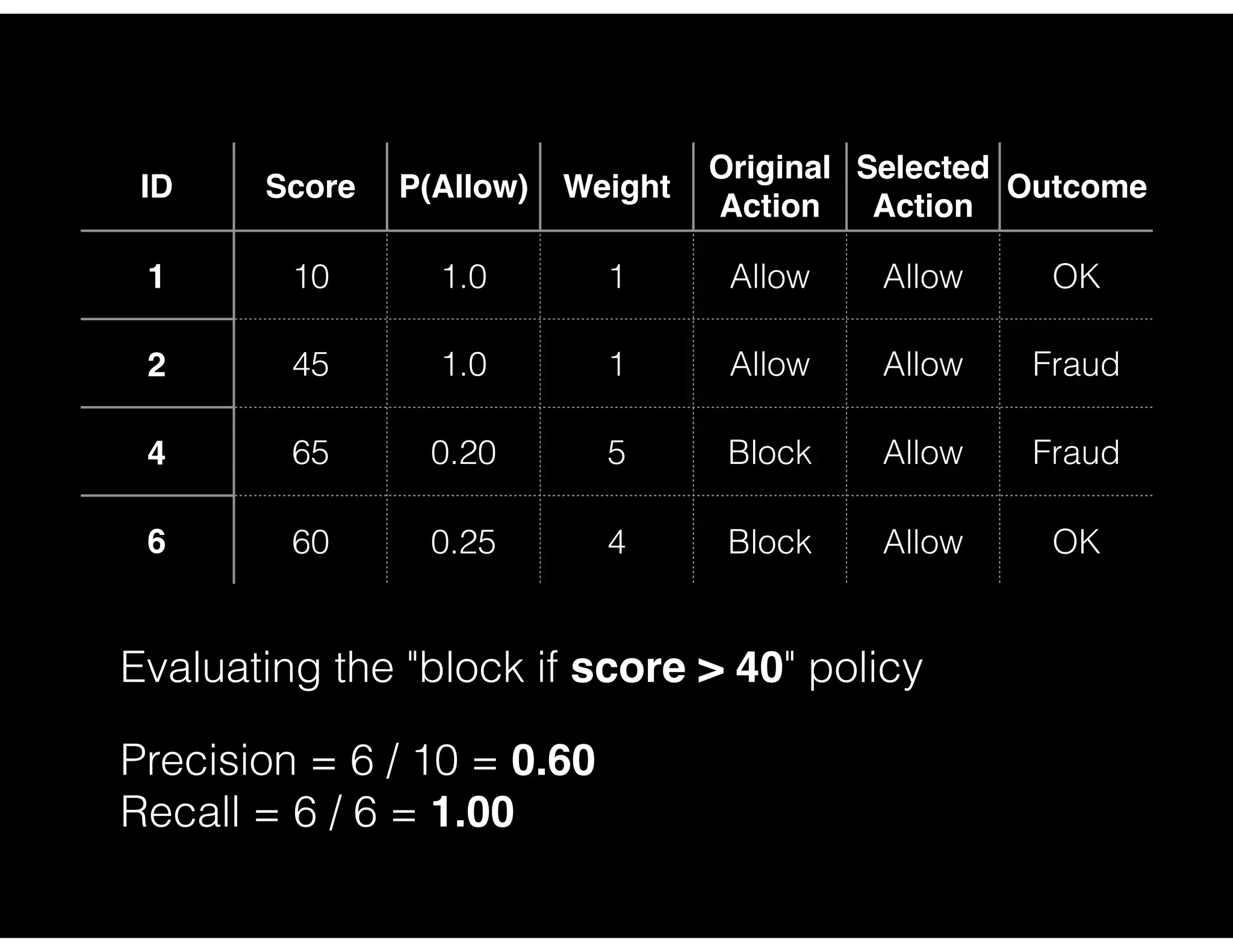
Evaluating the "block if score > 40" policy
Precision = 6 / 10 = 0.60
Recall = 6 / 6 = 1.00
ID Score P(Allow) Weight
Original
Action
Selected
Action
Outcome
1 10 1.0 1 Allow Allow OK
2 45 1.0 1 Allow Allow Fraud
4 65 0.20 5 Block Allow Fraud
6 60 0.25 4 Block Allow OK
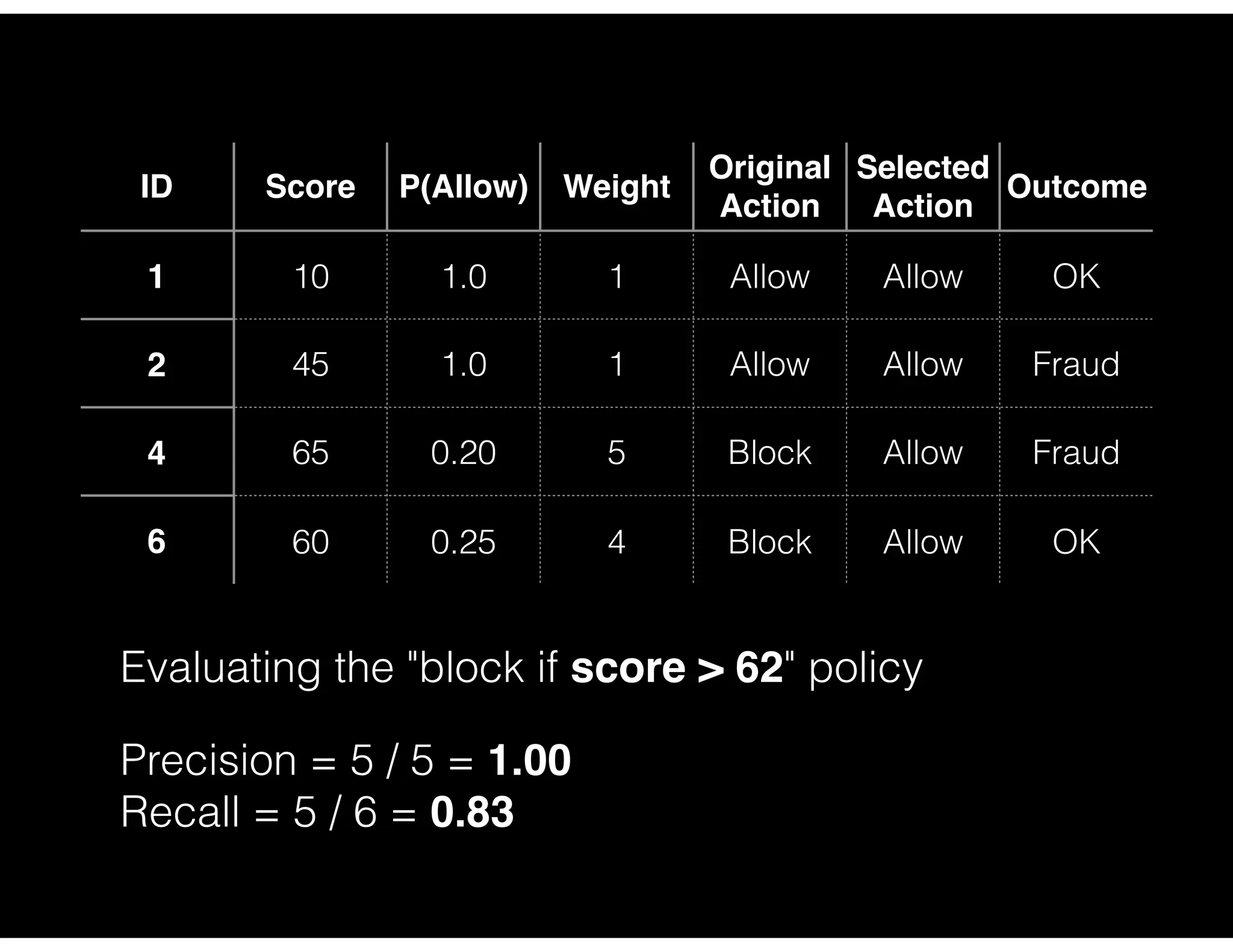
Evaluating the "block if score > 62" policy
Precision = 5 / 5 = 1.00
Recall = 5 / 6 = 0.83
ID Score P(Allow) Weight
Original
Action
Selected
Action
Outcome
1 10 1.0 1 Allow Allow OK
2 45 1.0 1 Allow Allow Fraud
4 65 0.20 5 Block Allow Fraud
6 60 0.25 4 Block Allow OK
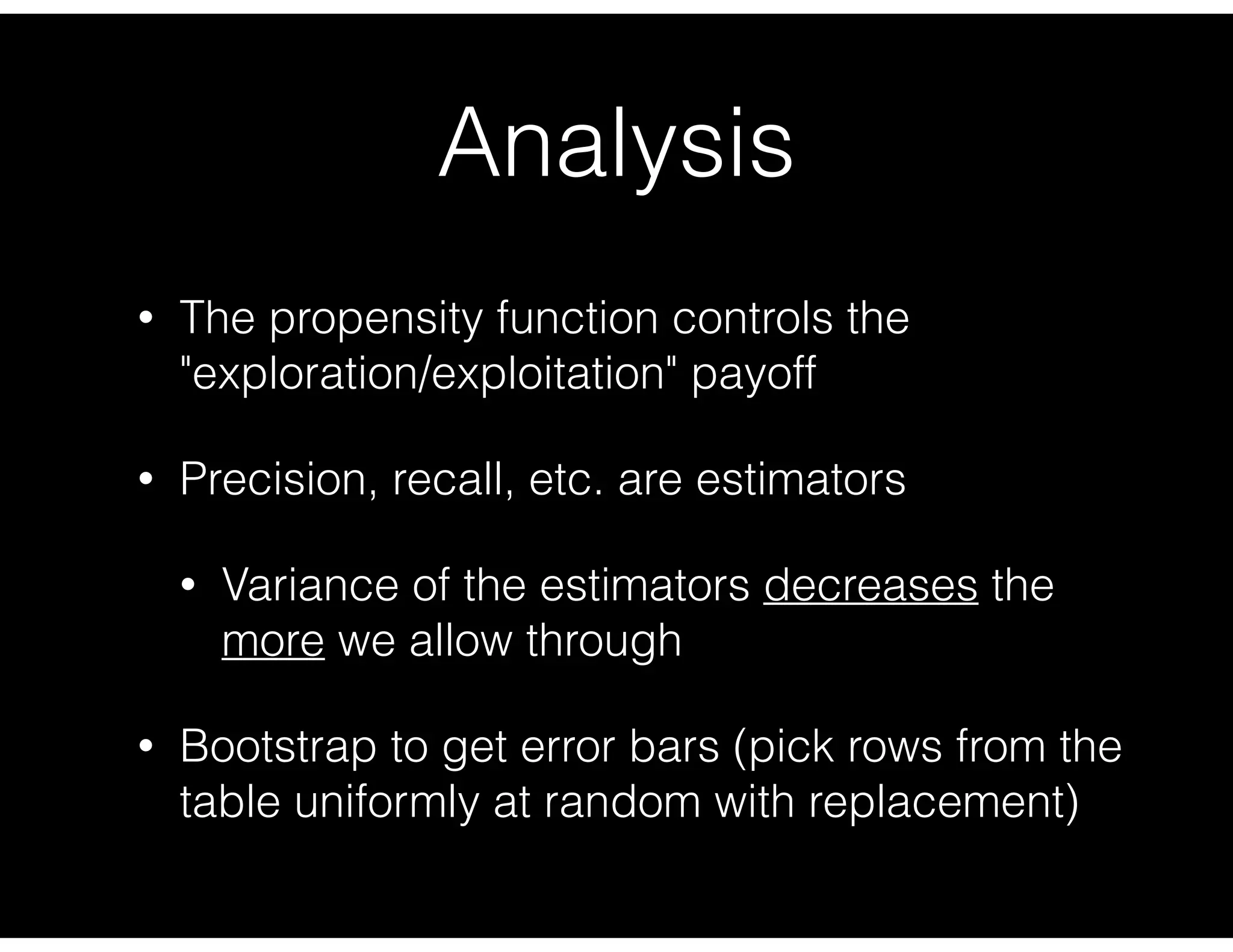
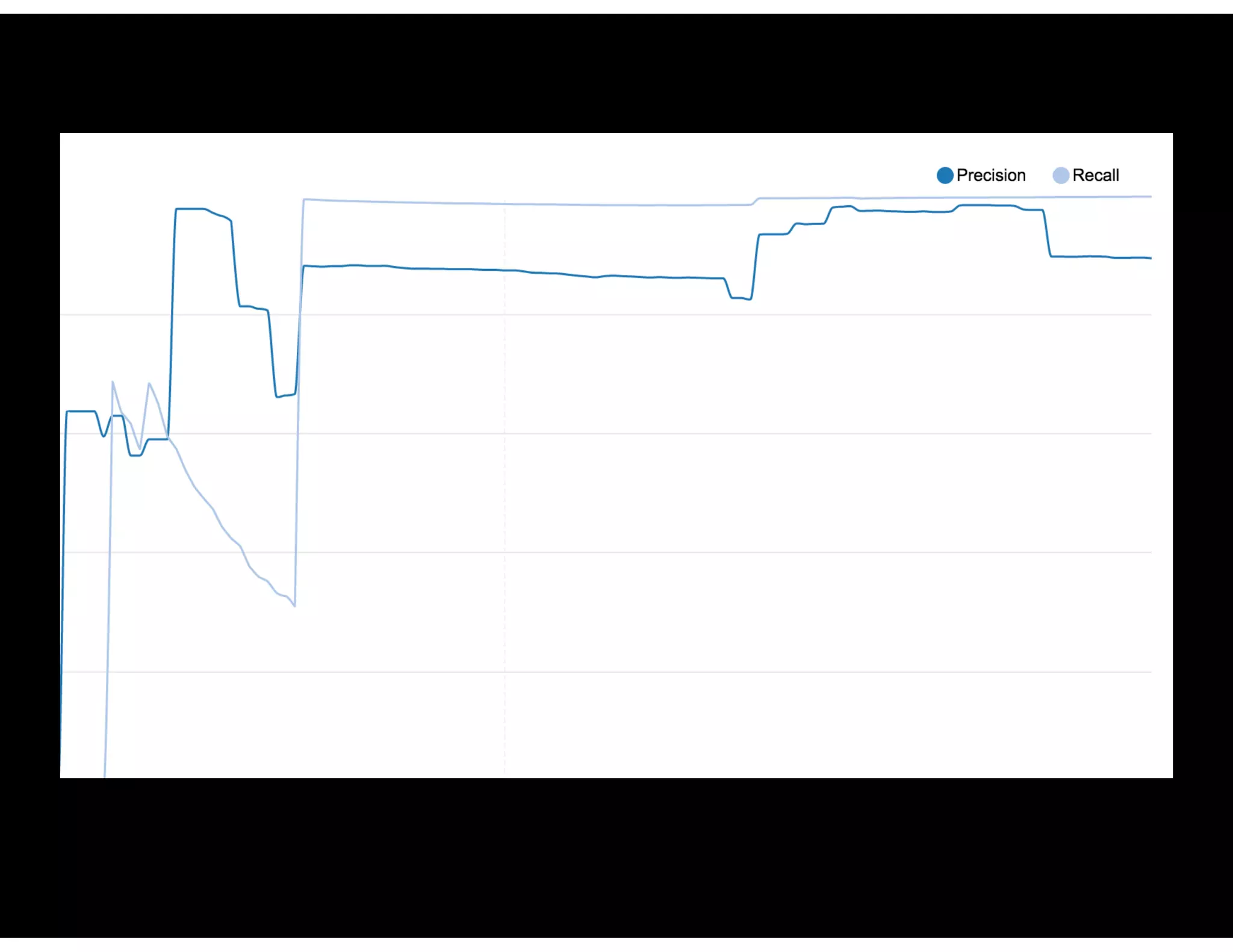
Analysis
• The propensity function controls the
"exploration/exploitation" payoff
• Precision, recall, etc. are estimators
• Variance of the estimators decreases the
more we allow through
• Bootstrap to get error bars (pick rows from the
table uniformly at random with replacement)
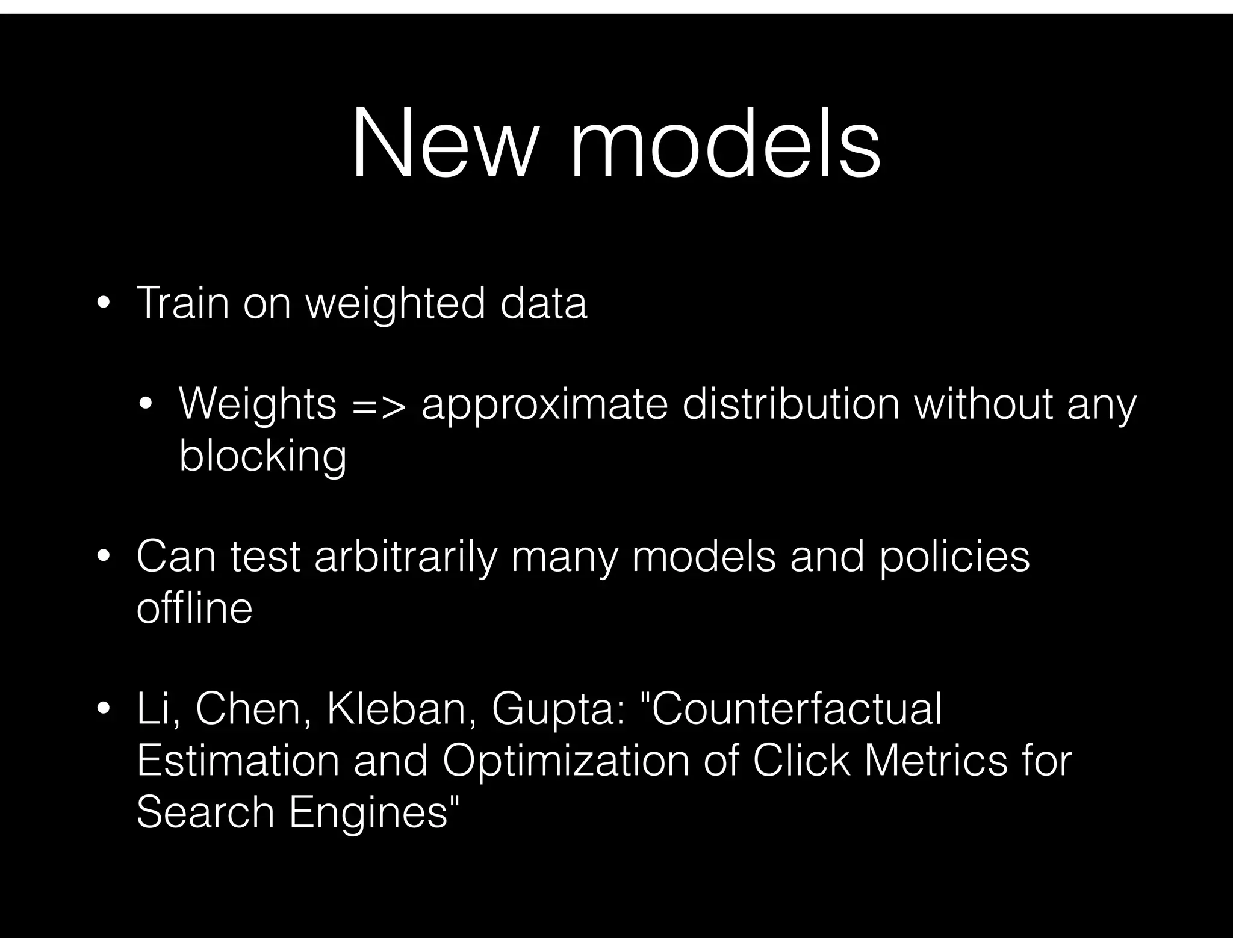
New models
• Train on weighted data
• Weights => approximate distribution without any
blocking
• Can test arbitrarily many models and policies
offline
• Li, Chen, Kleban, Gupta: "Counterfactual
Estimation and Optimization of Click Metrics for
Search Engines"
Technicalities
• Independence and random seeds
• Application-specific issues
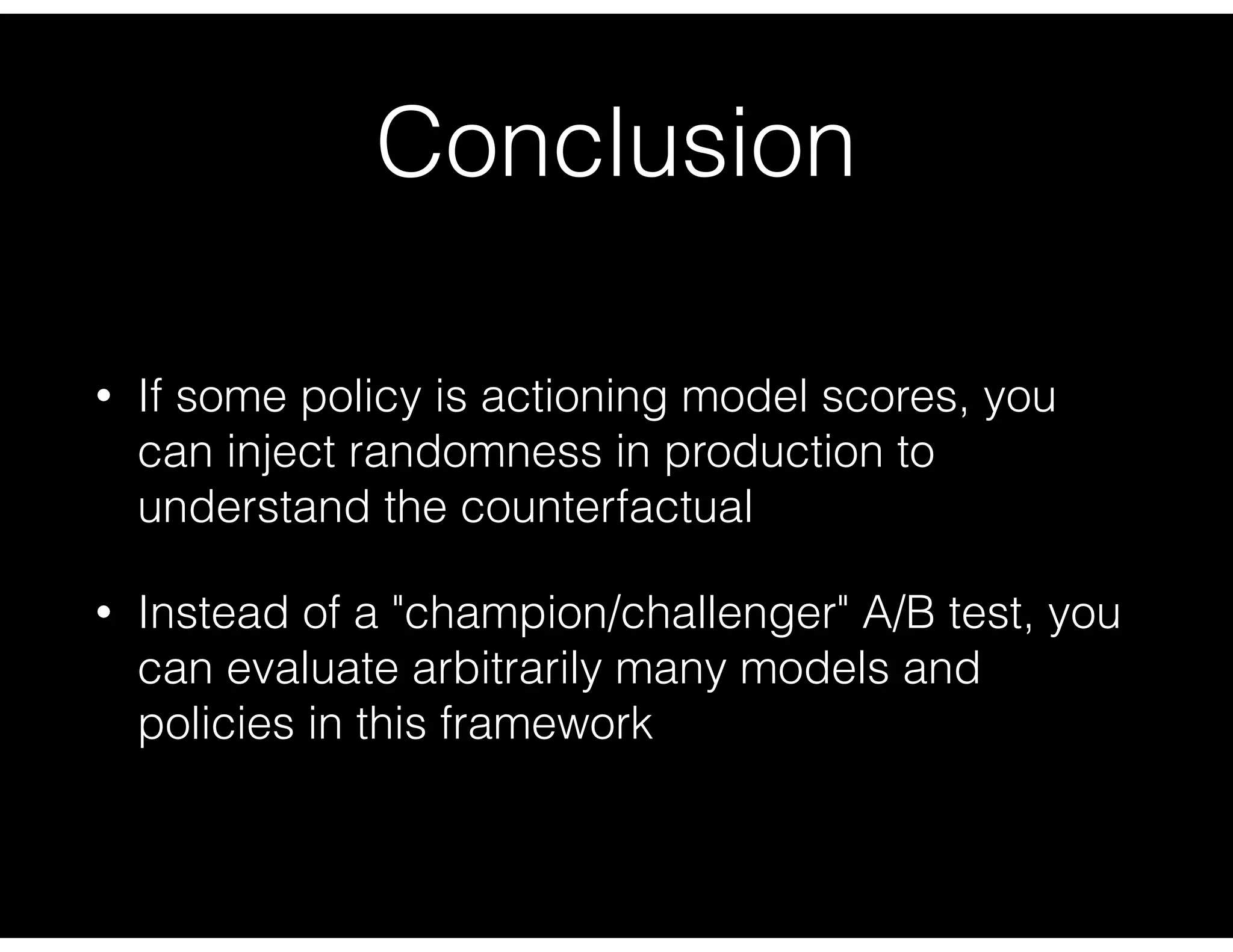
Conclusion
• If some policy is actioning model scores, you
can inject randomness in production to
understand the counterfactual
• Instead of a "champion/challenger" A/B test, you
can evaluate arbitrarily many models and
policies in this framework
Thanks!
• Work by Ryan Wang (@ryw90), Roban Kramer
(@robanhk), and Alyssa Frazee (@acfrazee)
• We're hiring engineers/data scientists!
• mlm@stripe.com (@mlmanapat)

Counterfactual evaluation of machine learning models

  • 1.
    Counterfactual evaluation of machinelearning models Michael Manapat @mlmanapat Stripe
  • 2.
    Stripe • APIs andtools for commerce and payments import stripe stripe.api_key = "sk_test_BQokiaJOvBdiI2HdlWgHa4ds429x" stripe.Charge.create( amount=40000, currency="usd", source={ "number": '4242424242424242', "exp_month": 12, "exp_year": 2016, "cvc": "123" }, description="PyData registration for mlm@stripe.com" )
  • 3.
    Machine Learning atStripe • Ten engineers/data scientists as of July 2015 (no distinction between roles) • Focus has been on fraud detection • Continuous scoring of businesses for fraud risk • Synchronous classification of charges as fraud or not
  • 4.
    Making a Charge Customer's browser CC:4242... Exp: 7/15 Stripe API Your server (1) Raw credit card information (2) Token (3) Order information (4) Charge token tokenization payment
  • 5.
    Charge Outcomes • Nothing(best case) • Refunded • Charged back ("disputed") • Fraudulent disputes result from "card testing" and "card cashing" • Can take > 60 days to get raised 5
  • 6.
    Model Building • December31st, 2013 • Train a binary classifier for disputes on data from Jan 1st to Sep 30th • Validate on data from Oct 1st to Oct 31st (need to wait ~60 days for labels) • Based on validation data, pick a policy for actioning scores:
 block if score > 50
  • 7.
    Questions • Validation datais > 2 months old. How is the model doing? • What are the production precision and recall? • Business complains about high false positive rate: what would happen if we changed the policy to "block if score > 70"?
  • 8.
    Next Iteration • December31st, 2014. We repeat the exercise from a year earlier • Train a model on data from Jan 1st to Sep 30th • Validate on data from Oct 1st to Oct 31st (need to wait ~60 days for labels) • Validation results look ~ok (but not great)
  • 9.
    Next Iteration • Weput the model into production, and the results are terrible • From spot-checking and complaints from customers, the performance is worse than even the validation data suggested • What happened?
  • 10.
    Next Iteration • Wealready had a model running that was blocking a lot of fraud • Training and validating only on data for which we had labels: charges that the existing model didn't catch • Far fewer examples of fraud in number. Essentially building a model to catch the "hardest" fraud • Possible solution: we could run both models in parallel...
  • 11.
    Evaluation and Retraining Requirethe Same Data • For evaluation, policy changes, and retraining, we want the same thing: • An approximation of the distribution of charges and outcomes that would exist in the absence of our intervention (blocking)
  • 12.
    First attempt • Letthrough some fraction of charges that we would ordinarily block • Straightforward to compute precision if score > 50: if random.random() < 0.05: allow() else: block()
  • 13.
    Recall • Total "caught"fraud = (4,000 * 1/0.05) • Total fraud = (4,000 * 1/0.05) + 10,000 • Recall = 80,000 / 90,000 = 89% 1,000,000 charges Score < 50 Score > 50 Total 900,000 100,000 Not Fraud 890,000 1,000 Fraud 10,000 4,000 Unknown 0 95,000
  • 14.
    Training • Train onlyon charges that were not blocked • Include weights of 1/0.05 = 20 for charges that would have been blocked if not for the random reversal from sklearn.ensemble import RandomForestRegressor ... r = RandomForestRegressor(n_estimators=10) r.fit(X, Y, sample_weight=weights)
  • 15.
    Training • Use weightsin validation (on hold-out set) as well from sklearn import cross_validation X_train, X_test, y_train, y_test = cross_validation.train_test_split( data, target, test_size=0.2) r = RandomForestRegressor(...) ... r.score( X_test, y_test, sample_weight=weights)
  • 16.
    Better Approach • We'reletting through 5% of all charges we think are fraudulent. Policy: Very likely to be fraud Could go either way
  • 17.
    Better Approach • Propensityfunction: maps classifier scores to P(Allow) • The higher the score, the lower probability we let the charge through • Get information on the area we want to improve on • Letting through less "obvious" fraud ("budget" for evaluation)
  • 18.
    Better Approach def propensity(score): #Piecewise linear/sigmoidal ... ps = propensity(score) original_block = score > 50 selected_block = random.random() < ps if selected_block: block() else: allow() log_record( id, score, ps, original_block, selected_block)
  • 19.
    ID Score p(Allow) Original Action Selected Action Outcome 110 1.0 Allow Allow OK 2 45 1.0 Allow Allow Fraud 3 55 0.30 Block Block - 4 65 0.20 Block Allow Fraud 5 100 0.0005 Block Block - 6 60 0.25 Block Allow OK
  • 20.
    Analysis • In anyanalysis, we only consider samples that were allowed (since we don't have labels otherwise) • We weight each sample by 1 / P(Allow) • cf. weighting by 1/0.05 = 20 in the uniform probability case
  • 21.
    ID Score P(Allow)Weight Original Action Selected Action Outcome 1 10 1.0 1 Allow Allow OK 2 45 1.0 1 Allow Allow Fraud 4 65 0.20 5 Block Allow Fraud 6 60 0.25 4 Block Allow OK Evaluating the "block if score > 50" policy Precision = 5 / 9 = 0.56 Recall = 5 / 6 = 0.83
  • 22.
    Evaluating the "blockif score > 40" policy Precision = 6 / 10 = 0.60 Recall = 6 / 6 = 1.00 ID Score P(Allow) Weight Original Action Selected Action Outcome 1 10 1.0 1 Allow Allow OK 2 45 1.0 1 Allow Allow Fraud 4 65 0.20 5 Block Allow Fraud 6 60 0.25 4 Block Allow OK
  • 23.
    Evaluating the "blockif score > 62" policy Precision = 5 / 5 = 1.00 Recall = 5 / 6 = 0.83 ID Score P(Allow) Weight Original Action Selected Action Outcome 1 10 1.0 1 Allow Allow OK 2 45 1.0 1 Allow Allow Fraud 4 65 0.20 5 Block Allow Fraud 6 60 0.25 4 Block Allow OK
  • 24.
    Analysis • The propensityfunction controls the "exploration/exploitation" payoff • Precision, recall, etc. are estimators • Variance of the estimators decreases the more we allow through • Bootstrap to get error bars (pick rows from the table uniformly at random with replacement)
  • 25.
    New models • Trainon weighted data • Weights => approximate distribution without any blocking • Can test arbitrarily many models and policies offline • Li, Chen, Kleban, Gupta: "Counterfactual Estimation and Optimization of Click Metrics for Search Engines"
  • 26.
    Technicalities • Independence andrandom seeds • Application-specific issues
  • 28.
    Conclusion • If somepolicy is actioning model scores, you can inject randomness in production to understand the counterfactual • Instead of a "champion/challenger" A/B test, you can evaluate arbitrarily many models and policies in this framework
  • 29.
    Thanks! • Work byRyan Wang (@ryw90), Roban Kramer (@robanhk), and Alyssa Frazee (@acfrazee) • We're hiring engineers/data scientists! • mlm@stripe.com (@mlmanapat)