www.cbdiforum.com


SOA Best Practice

SOA Exception Management
Framework
By Lawrence Wilkes


 Independent Guidance for
 Service Architecture and Engineering
Introduction


              This presentation provides an overview of our SOA Exception
               Management Framework
              Further detail and guidance (e.g. Specific techniques) is provided in
               the CBDI Journal report and the CBDI-SAE Knowledgebase

              This report primarily considers exception management within Service-
               based solutions. That is, how both Service Providers and Service
               Consumers should handle exceptions that may occur in the
               processing of Service requests and responses.
              That said, SOA exception management should not be distinct from
               broader exception management approaches that ought to be in place
               to deal with solutions that are not Service-based, and elements of the
               framework presented in this report should be common to both.


   2009 Everware-CBDI Inc This material may not be copied or reused without express permission
SOA Brings New Challenges

              For example,
                  The federation of participants implies that the Service Provider and
                    Consumer may be in different organization
                  Loose coupling implies there is no shared technology or infrastructure.
                    Hence, there may be no common exception handing software, systems
                    management, or error log.
                  The Service Provider and Consumer must rely on Service Contracts such
                    as the Service Specification to document exceptions and specify any
                    obligations on them when an exception occurs.
              In many cases the Service Provider and Consumer will be in the same
               organization. As such it may make sense for them to for example,
                  agree on a consistent approach to exception handing
                  standardize exception „protocols‟. For example, exception codes and
                    messages
                  provide common utilities or infrastructure for exception management
              Even where the participants are not in the same organization, they will still
               need to agree on the exception handing protocols.

   2009 Everware-CBDI Inc This material may not be copied or reused without express permission
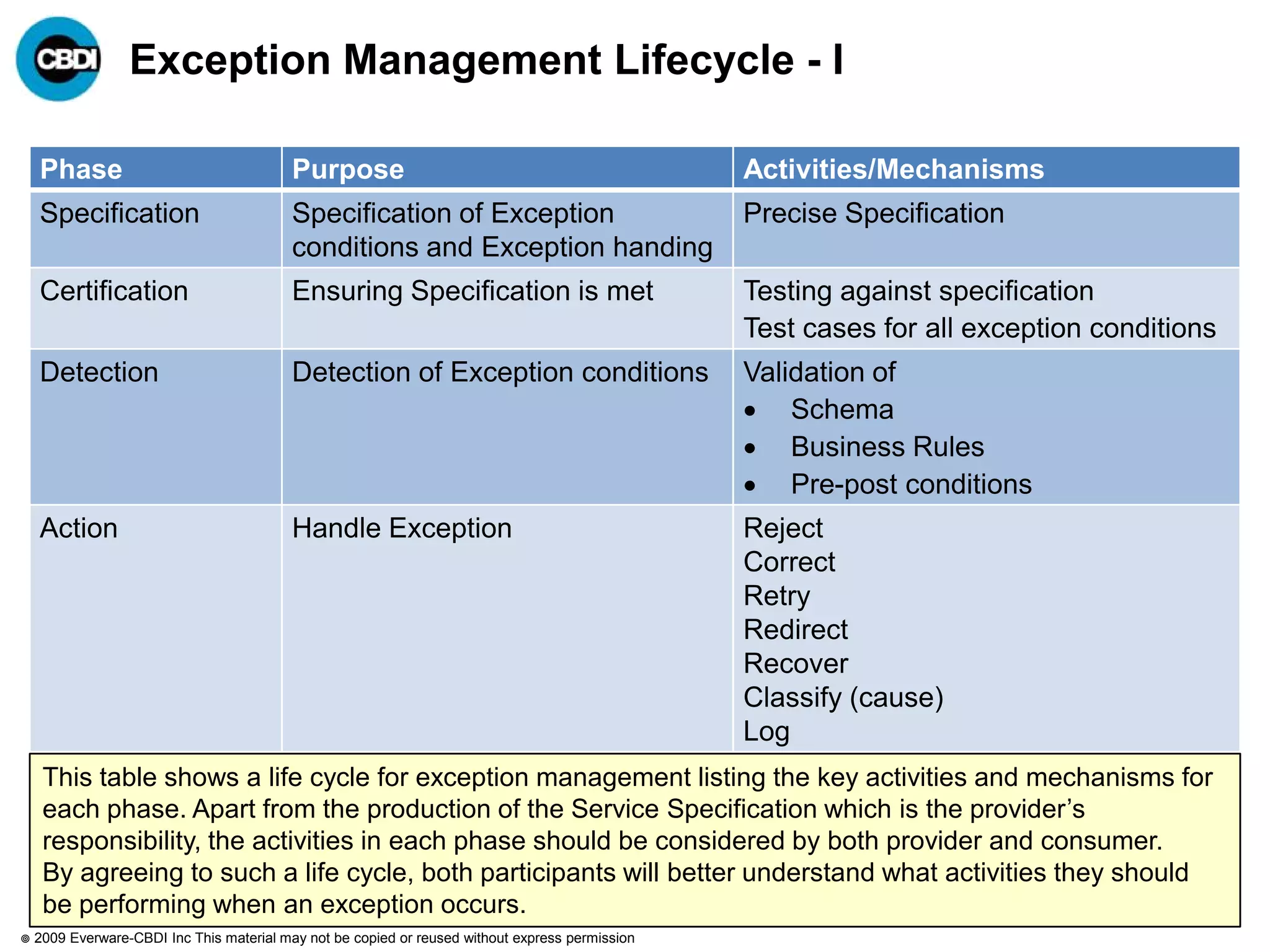
Exception Management Lifecycle - I

    Phase                                  Purpose                                                Activities/Mechanisms
    Specification                          Specification of Exception                             Precise Specification
                                           conditions and Exception handing
    Certification                          Ensuring Specification is met                          Testing against specification
                                                                                                  Test cases for all exception conditions
    Detection                              Detection of Exception conditions                      Validation of
                                                                                                   Schema
                                                                                                   Business Rules
                                                                                                   Pre-post conditions
    Action                                 Handle Exception                                       Reject
                                                                                                  Correct
                                                                                                  Retry
                                                                                                  Redirect
                                                                                                  Recover
                                                                                                  Classify (cause)
                                                                                                  Log
     This table shows a life cycle for exception management listing the key activities and mechanisms for
     each phase. Apart from the production of the Service Specification which is the provider‟s
     responsibility, the activities in each phase should be considered by both provider and consumer.
     By agreeing to such a life cycle, both participants will better understand what activities they should
     be performing when an exception occurs.
   2009 Everware-CBDI Inc This material may not be copied or reused without express permission
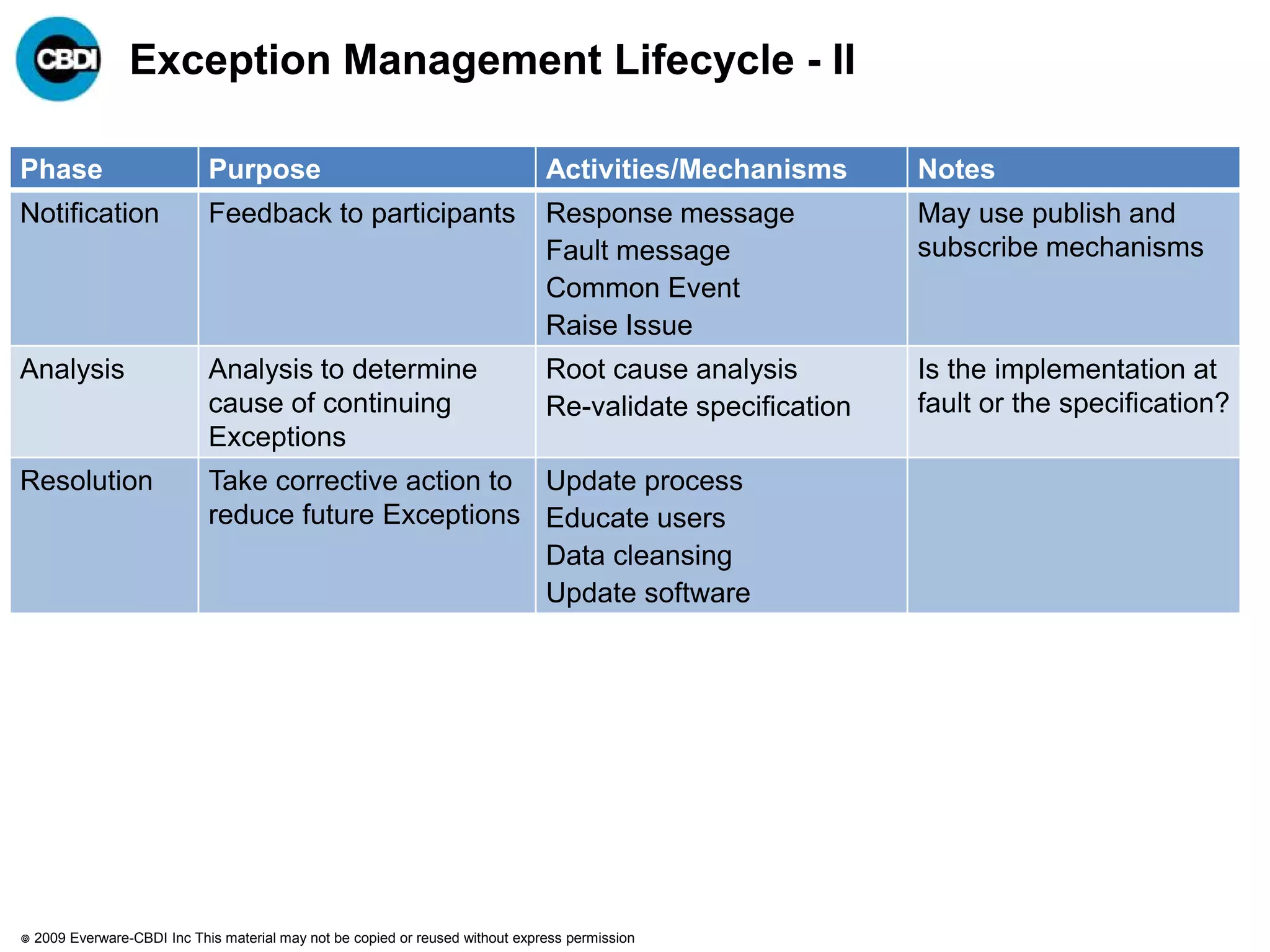
Exception Management Lifecycle - II

Phase                         Purpose                                            Activities/Mechanisms       Notes
Notification                  Feedback to participants                           Response message            May use publish and
                                                                                 Fault message               subscribe mechanisms
                                                                                 Common Event
                                                                                 Raise Issue
Analysis                      Analysis to determine                              Root cause analysis         Is the implementation at
                              cause of continuing                                Re-validate specification   fault or the specification?
                              Exceptions
Resolution                    Take corrective action to Update process
                              reduce future Exceptions Educate users
                                                        Data cleansing
                                                        Update software


   2009 Everware-CBDI Inc This material may not be copied or reused without express permission
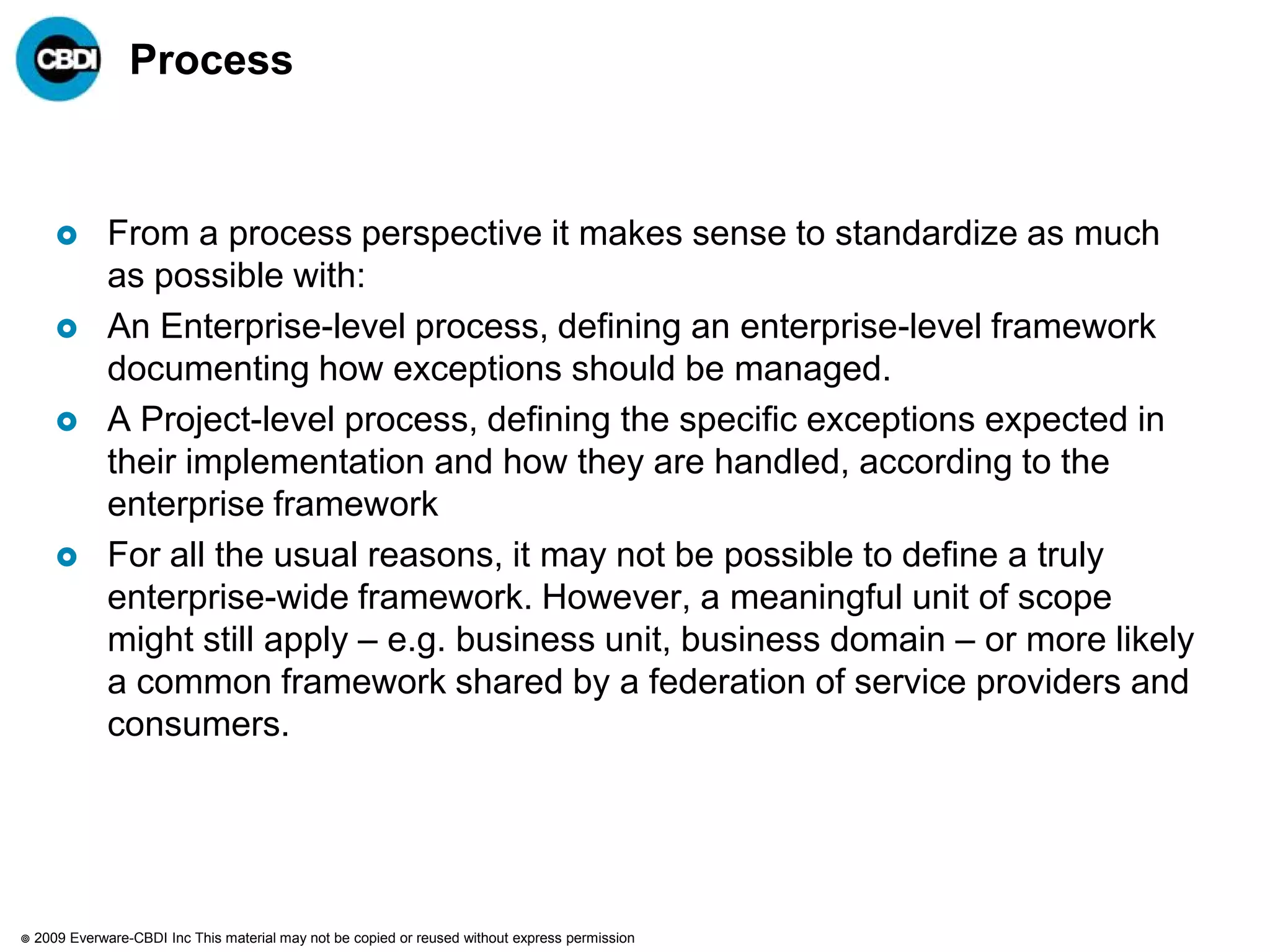
Process


              From a process perspective it makes sense to standardize as much
               as possible with:
              An Enterprise-level process, defining an enterprise-level framework
               documenting how exceptions should be managed.
              A Project-level process, defining the specific exceptions expected in
               their implementation and how they are handled, according to the
               enterprise framework
              For all the usual reasons, it may not be possible to define a truly
               enterprise-wide framework. However, a meaningful unit of scope
               might still apply – e.g. business unit, business domain – or more likely
               a common framework shared by a federation of service providers and
               consumers.


   2009 Everware-CBDI Inc This material may not be copied or reused without express permission
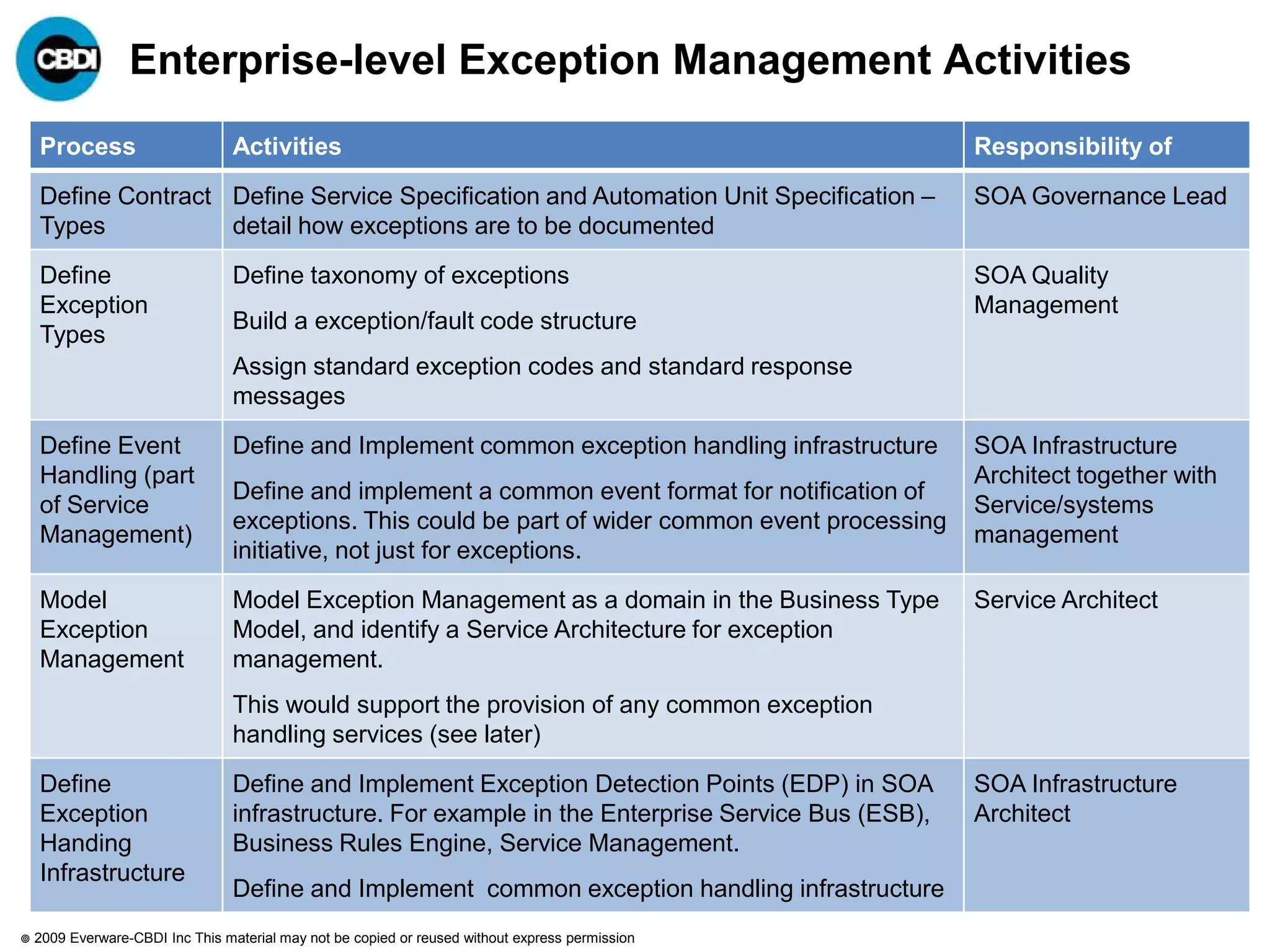
Enterprise-level Exception Management Activities
    Process                       Activities                                                         Responsibility of

    Define Contract Define Service Specification and Automation Unit Specification –                 SOA Governance Lead
    Types           detail how exceptions are to be documented

    Define                        Define taxonomy of exceptions                                      SOA Quality
    Exception                                                                                        Management
                                  Build a exception/fault code structure
    Types
                                  Assign standard exception codes and standard response
                                  messages

    Define Event                  Define and Implement common exception handling infrastructure      SOA Infrastructure
    Handling (part                                                                                   Architect together with
                                  Define and implement a common event format for notification of
    of Service                                                                                       Service/systems
                                  exceptions. This could be part of wider common event processing
    Management)                                                                                      management
                                  initiative, not just for exceptions.

    Model                         Model Exception Management as a domain in the Business Type        Service Architect
    Exception                     Model, and identify a Service Architecture for exception
    Management                    management.
                                  This would support the provision of any common exception
                                  handling services (see later)

    Define                        Define and Implement Exception Detection Points (EDP) in SOA       SOA Infrastructure
    Exception                     infrastructure. For example in the Enterprise Service Bus (ESB),   Architect
    Handing                       Business Rules Engine, Service Management.
    Infrastructure
                                  Define and Implement common exception handling infrastructure
   2009 Everware-CBDI Inc This material may not be copied or reused without express permission
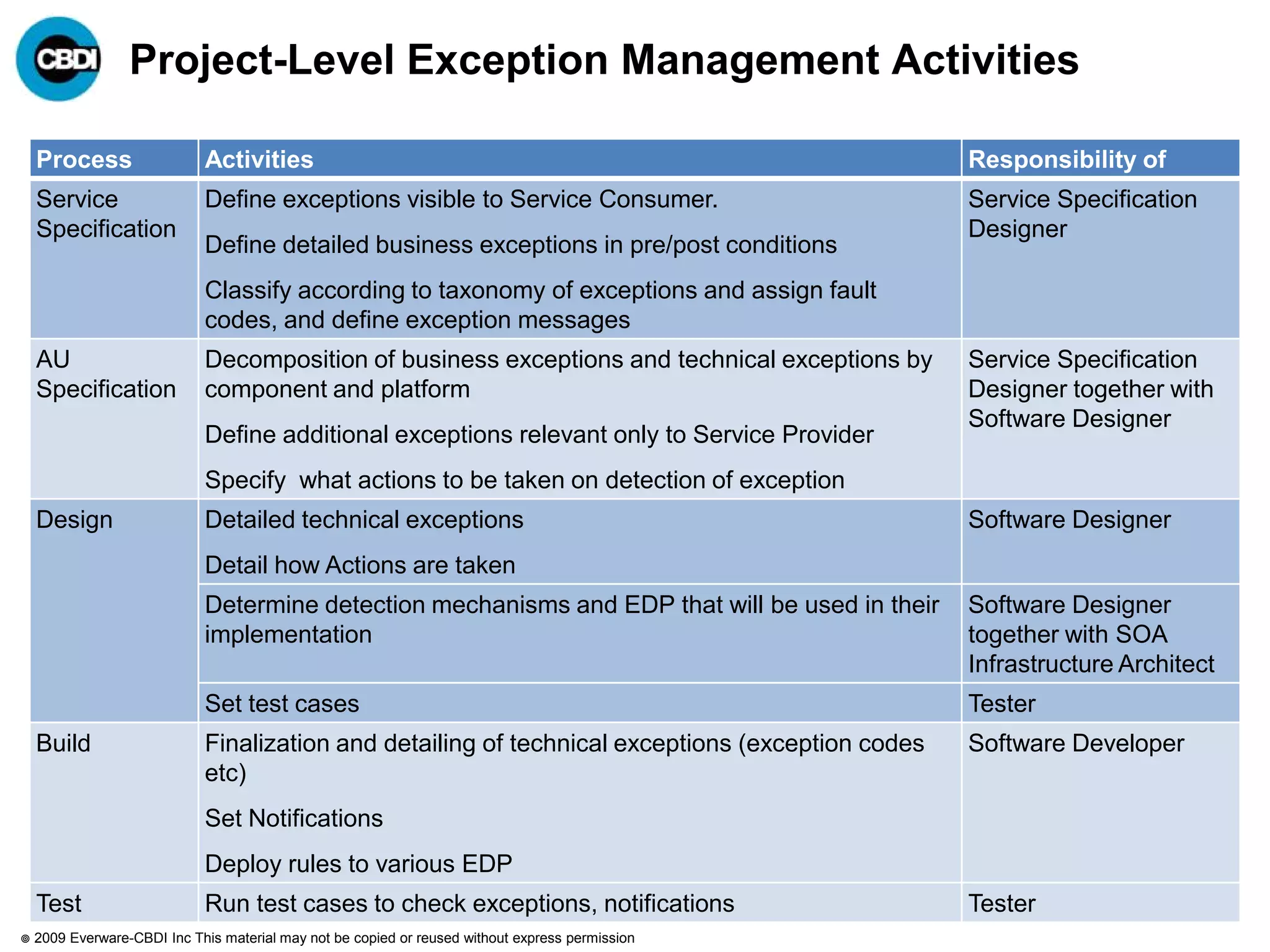
Project-Level Exception Management Activities

    Process                  Activities                                                            Responsibility of
    Service                  Define exceptions visible to Service Consumer.                        Service Specification
    Specification                                                                                  Designer
                             Define detailed business exceptions in pre/post conditions
                             Classify according to taxonomy of exceptions and assign fault
                             codes, and define exception messages
    AU                       Decomposition of business exceptions and technical exceptions by      Service Specification
    Specification            component and platform                                                Designer together with
                                                                                                   Software Designer
                             Define additional exceptions relevant only to Service Provider
                             Specify what actions to be taken on detection of exception
    Design                   Detailed technical exceptions                                         Software Designer
                             Detail how Actions are taken
                             Determine detection mechanisms and EDP that will be used in their     Software Designer
                             implementation                                                        together with SOA
                                                                                                   Infrastructure Architect
                             Set test cases                                                        Tester
    Build                    Finalization and detailing of technical exceptions (exception codes   Software Developer
                             etc)
                             Set Notifications
                             Deploy rules to various EDP
    Test                     Run test cases to check exceptions, notifications                     Tester
   2009 Everware-CBDI Inc This material may not be copied or reused without express permission
Exception Specification

              Exceptions need to be specified in either
                   Service Specification: As the prime contract between Service Provider
                    and Consumer, the Service Specification is the main place to document
                    exceptions and responses that are of consequence to the Service
                    Consumer (type 1 below)
                   Automation Unit Specification: Should also define addition exceptions
                    that are of concern only to the Service Consumer, as well as the type 2
                    response below to exceptions that are in the Service Specification.
              Exception Condition Visibility
              It may be necessary to specify two different response messages to certain
               kinds of exception;
                   Type 1, of relevance to the Service Consumer – e.g. “Technical Error”
                   Type 2, containing further information of interest only to the Service
                    Provider – e.g. “Technical Error. Customer Database CustDb07 not
                    available”
              Exception Shielding
                   guarding against the security risk exposed by exception messages that
                    reveal sensitive information or reveal too much about the implementation.

   2009 Everware-CBDI Inc This material may not be copied or reused without express permission
Certification


              The prime activity in certification is to ensure the Service and
               Automation unit Specifications are met.
              Test cases will therefore need to be run for all valid and invalid
               conditions.
              Test cases may be supplied as part of the specification (but not as a
               substitute for). Test cases typically define the output messages
               expected for each test condition. Again an example of this is provided
               in “Documenting Service Behavior”.


   2009 Everware-CBDI Inc This material may not be copied or reused without express permission
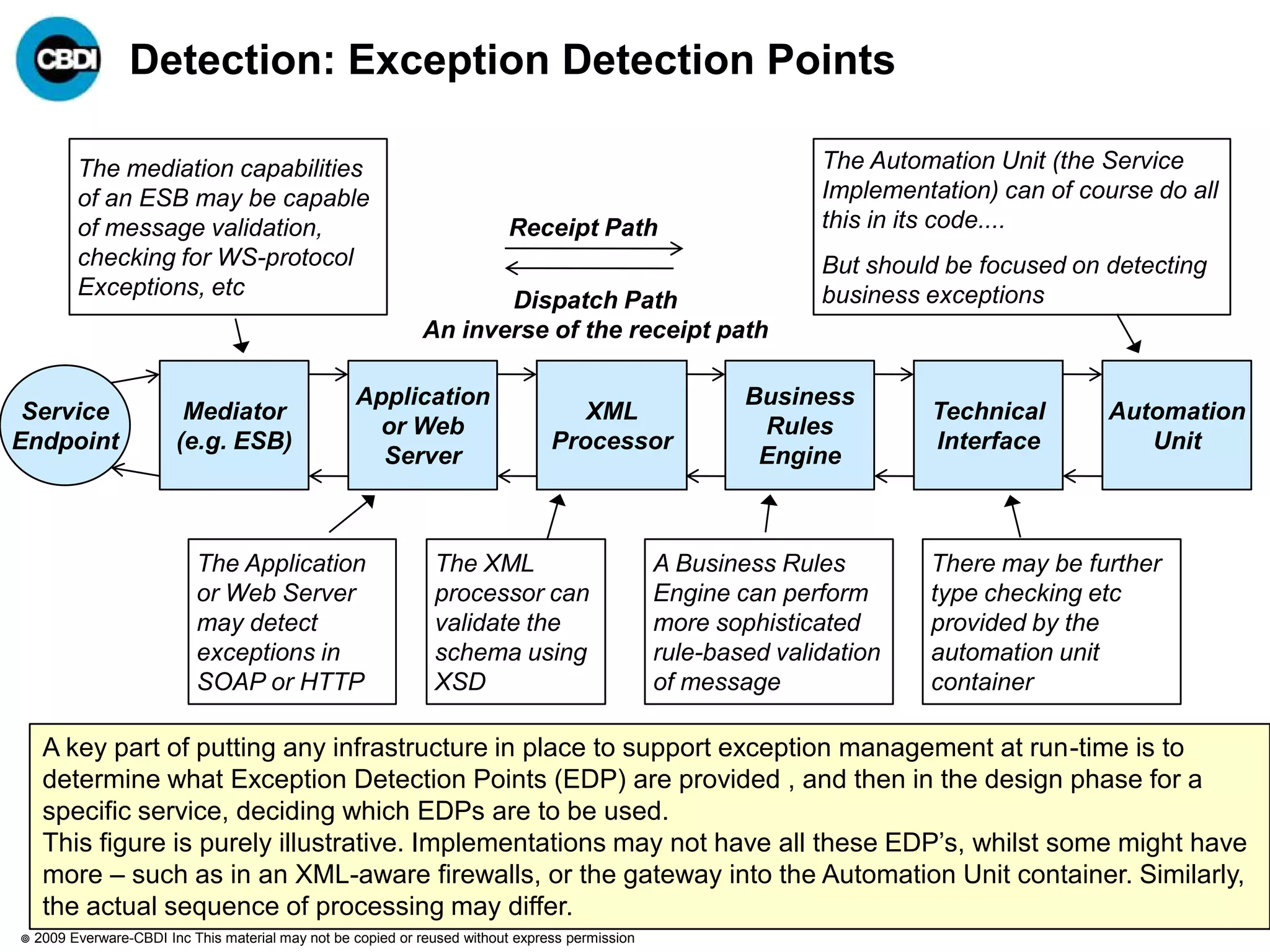
Detection: Exception Detection Points

          The mediation capabilities                                                                             The Automation Unit (the Service
          of an ESB may be capable                                                                               Implementation) can of course do all
          of message validation,                                           Receipt Path                          this in its code....
          checking for WS-protocol                                                                               But should be focused on detecting
          Exceptions, etc                                                                                        business exceptions
                                                                     Dispatch Path
                                                              An inverse of the receipt path

                                                    Application                                           Business
 Service                  Mediator                                                   XML                                  Technical        Automation
                                                      or Web                                               Rules
Endpoint                 (e.g. ESB)                                               Processor                               Interface           Unit
                                                      Server                                               Engine


                            The Application                     The XML                           A Business Rules        There may be further
                            or Web Server                       processor can                     Engine can perform      type checking etc
                            may detect                          validate the                      more sophisticated      provided by the
                            exceptions in                       schema using                      rule-based validation   automation unit
                            SOAP or HTTP                        XSD                               of message              container

     A key part of putting any infrastructure in place to support exception management at run-time is to
     determine what Exception Detection Points (EDP) are provided , and then in the design phase for a
     specific service, deciding which EDPs are to be used.
     This figure is purely illustrative. Implementations may not have all these EDP‟s, whilst some might have
     more – such as in an XML-aware firewalls, or the gateway into the Automation Unit container. Similarly,
     the actual sequence of processing may differ.
   2009 Everware-CBDI Inc This material may not be copied or reused without express permission
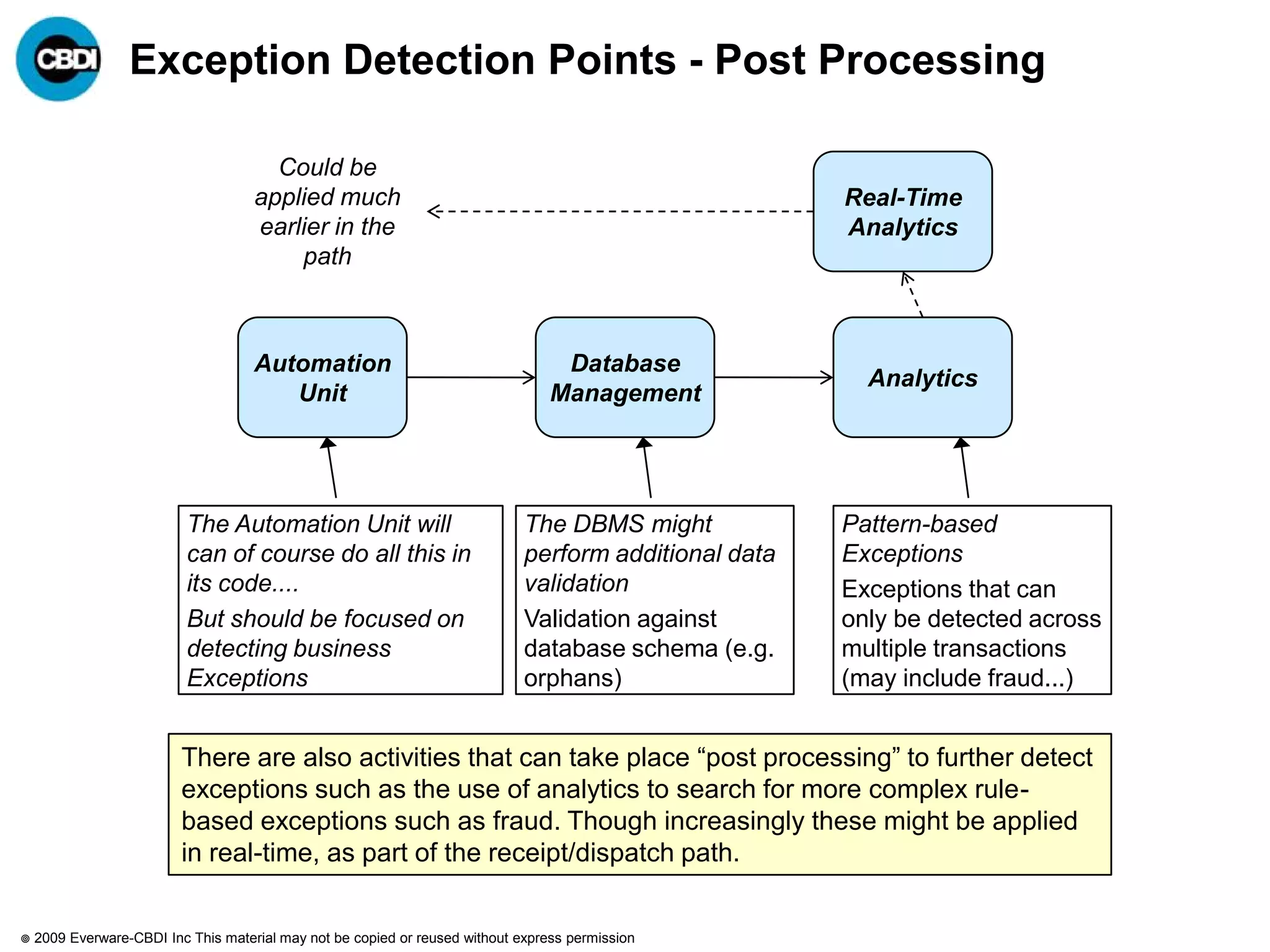
Exception Detection Points - Post Processing

                                       Could be
                                     applied much                                                       Real-Time
                                     earlier in the                                                     Analytics
                                         path


                                     Automation                                    Database
                                                                                                          Analytics
                                        Unit                                      Management


                           The Automation Unit will                           The DBMS might            Pattern-based
                           can of course do all this in                       perform additional data   Exceptions
                           its code....                                       validation                Exceptions that can
                           But should be focused on                           Validation against        only be detected across
                           detecting business                                 database schema (e.g.     multiple transactions
                           Exceptions                                         orphans)                  (may include fraud...)


                          There are also activities that can take place “post processing” to further detect
                          exceptions such as the use of analytics to search for more complex rule-
                          based exceptions such as fraud. Though increasingly these might be applied
                          in real-time, as part of the receipt/dispatch path.


   2009 Everware-CBDI Inc This material may not be copied or reused without express permission
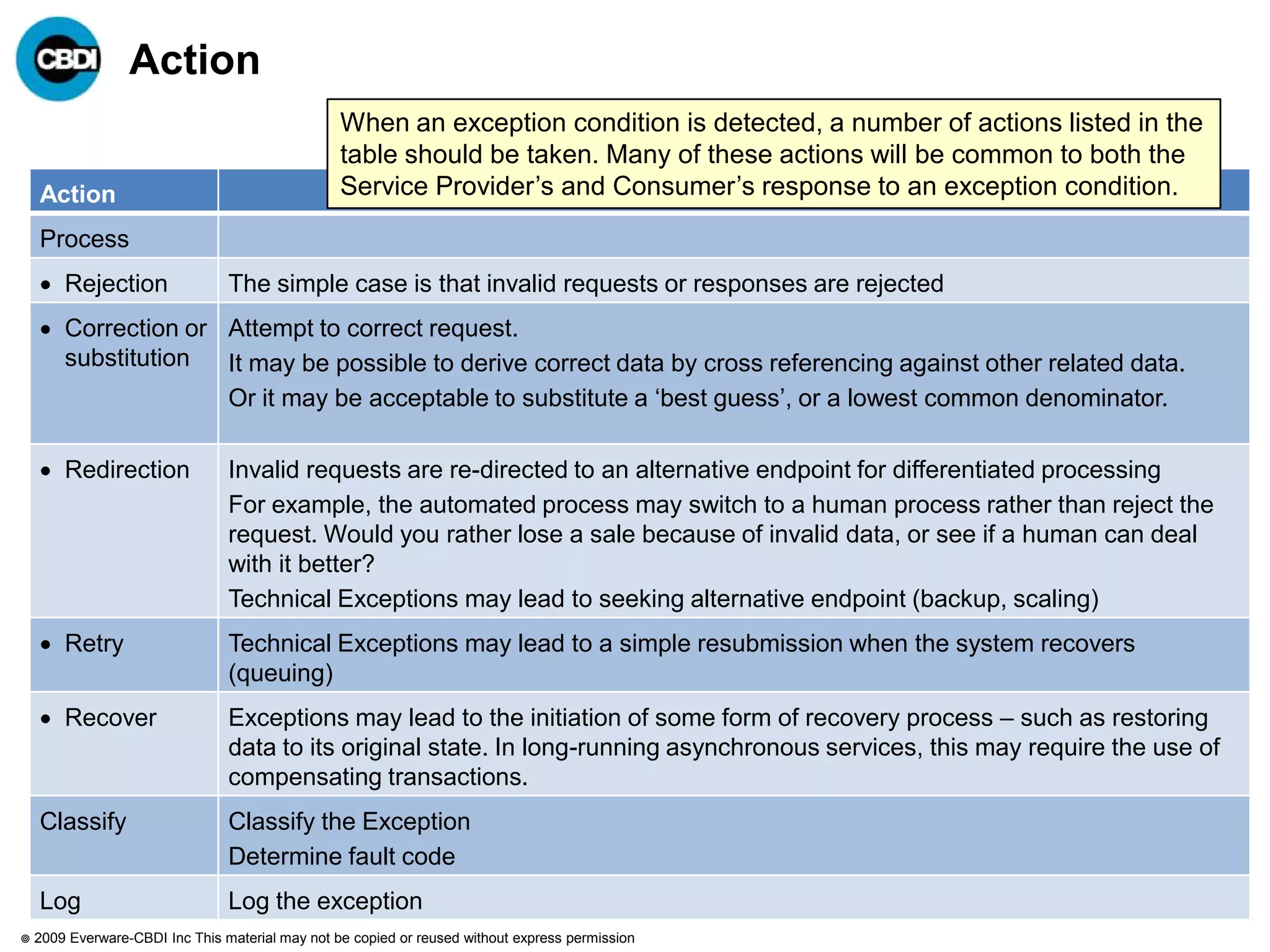
Action
                                                  When an exception condition is detected, a number of actions listed in the
                                                  table should be taken. Many of these actions will be common to both the
    Action                                        Service Provider‟s and Consumer‟s response to an exception condition.
    Process
     Rejection                  The simple case is that invalid requests or responses are rejected
     Correction or Attempt to correct request.
      substitution  It may be possible to derive correct data by cross referencing against other related data.
                    Or it may be acceptable to substitute a „best guess‟, or a lowest common denominator.

     Redirection                Invalid requests are re-directed to an alternative endpoint for differentiated processing
                                 For example, the automated process may switch to a human process rather than reject the
                                 request. Would you rather lose a sale because of invalid data, or see if a human can deal
                                 with it better?
                                 Technical Exceptions may lead to seeking alternative endpoint (backup, scaling)
     Retry                      Technical Exceptions may lead to a simple resubmission when the system recovers
                                 (queuing)
     Recover                    Exceptions may lead to the initiation of some form of recovery process – such as restoring
                                 data to its original state. In long-running asynchronous services, this may require the use of
                                 compensating transactions.
    Classify                     Classify the Exception
                                 Determine fault code
    Log                          Log the exception
   2009 Everware-CBDI Inc This material may not be copied or reused without express permission
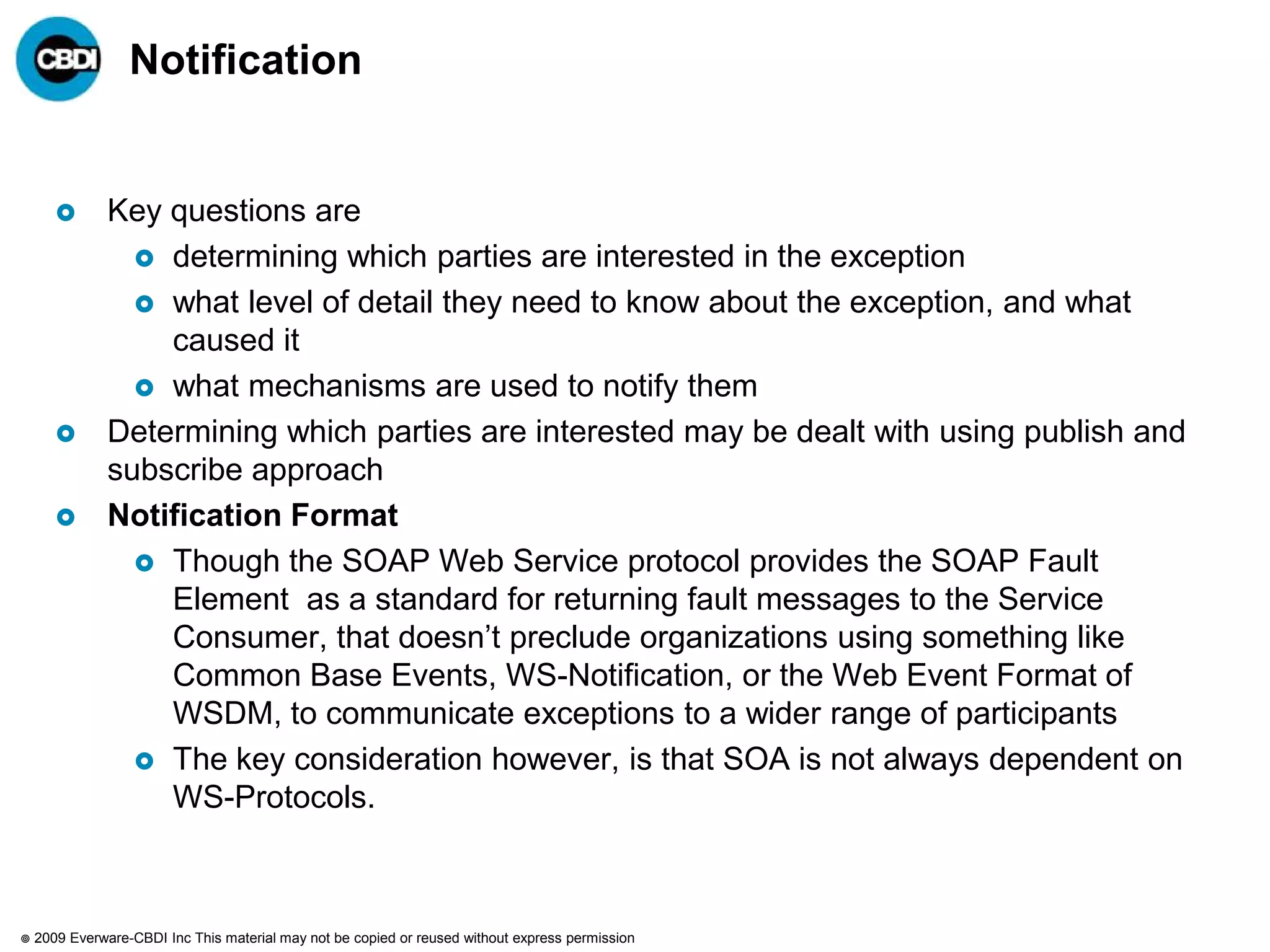
Notification


              Key questions are
                  determining which parties are interested in the exception
                  what level of detail they need to know about the exception, and what
                   caused it
                  what mechanisms are used to notify them
              Determining which parties are interested may be dealt with using publish and
               subscribe approach
              Notification Format
                  Though the SOAP Web Service protocol provides the SOAP Fault
                   Element as a standard for returning fault messages to the Service
                   Consumer, that doesn‟t preclude organizations using something like
                   Common Base Events, WS-Notification, or the Web Event Format of
                   WSDM, to communicate exceptions to a wider range of participants
                  The key consideration however, is that SOA is not always dependent on
                   WS-Protocols.


   2009 Everware-CBDI Inc This material may not be copied or reused without express permission
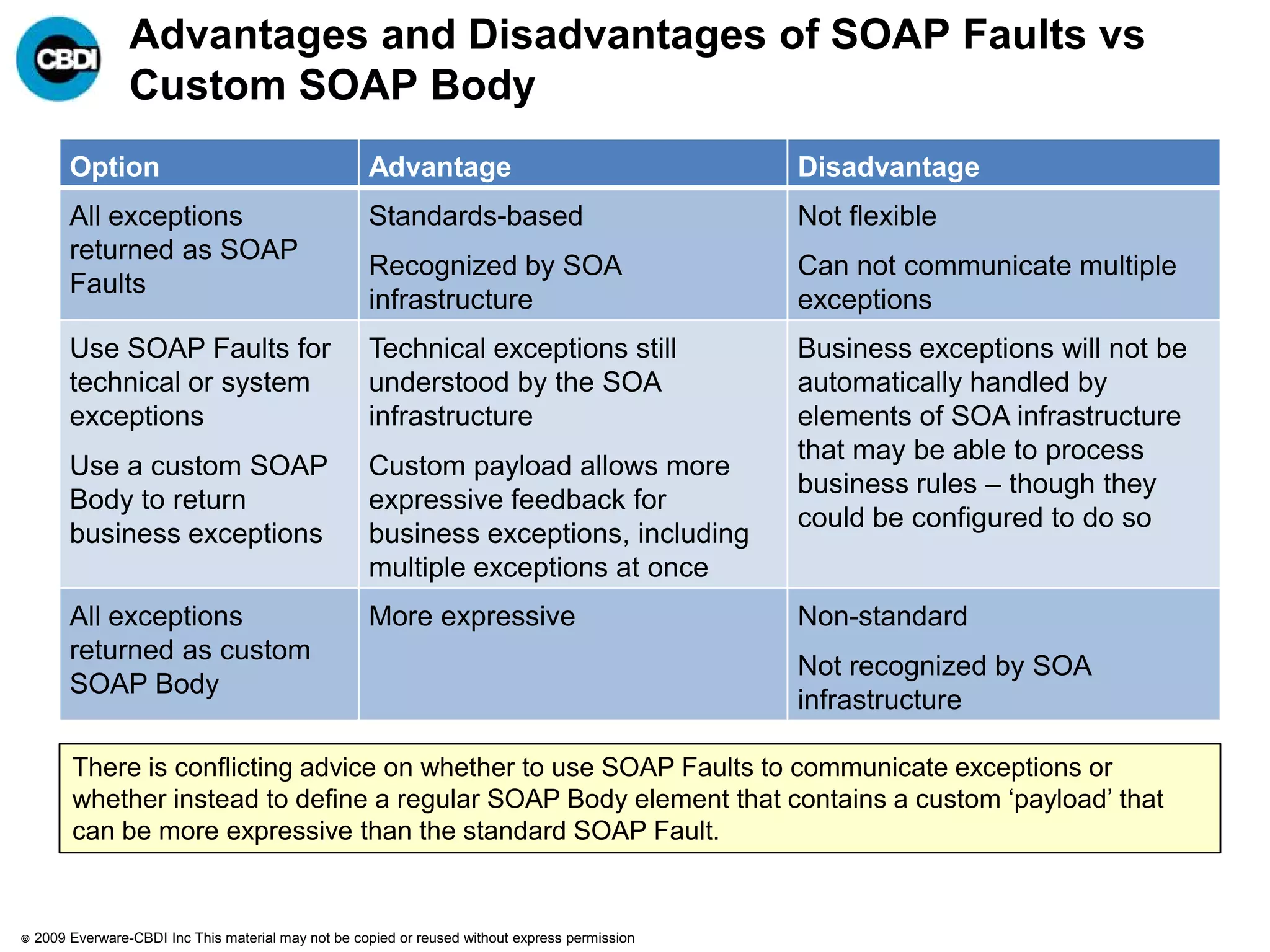
Advantages and Disadvantages of SOAP Faults vs
                  Custom SOAP Body
         Option                                       Advantage                                   Disadvantage
         All exceptions                               Standards-based                             Not flexible
         returned as SOAP
                                                      Recognized by SOA                           Can not communicate multiple
         Faults
                                                      infrastructure                              exceptions
         Use SOAP Faults for                          Technical exceptions still                  Business exceptions will not be
         technical or system                          understood by the SOA                       automatically handled by
         exceptions                                   infrastructure                              elements of SOA infrastructure
                                                                                                  that may be able to process
         Use a custom SOAP                            Custom payload allows more
                                                                                                  business rules – though they
         Body to return                               expressive feedback for
                                                                                                  could be configured to do so
         business exceptions                          business exceptions, including
                                                      multiple exceptions at once
         All exceptions                               More expressive                             Non-standard
         returned as custom
                                                                                                  Not recognized by SOA
         SOAP Body
                                                                                                  infrastructure

         There is conflicting advice on whether to use SOAP Faults to communicate exceptions or
         whether instead to define a regular SOAP Body element that contains a custom „payload‟ that
         can be more expressive than the standard SOAP Fault.


   2009 Everware-CBDI Inc This material may not be copied or reused without express permission
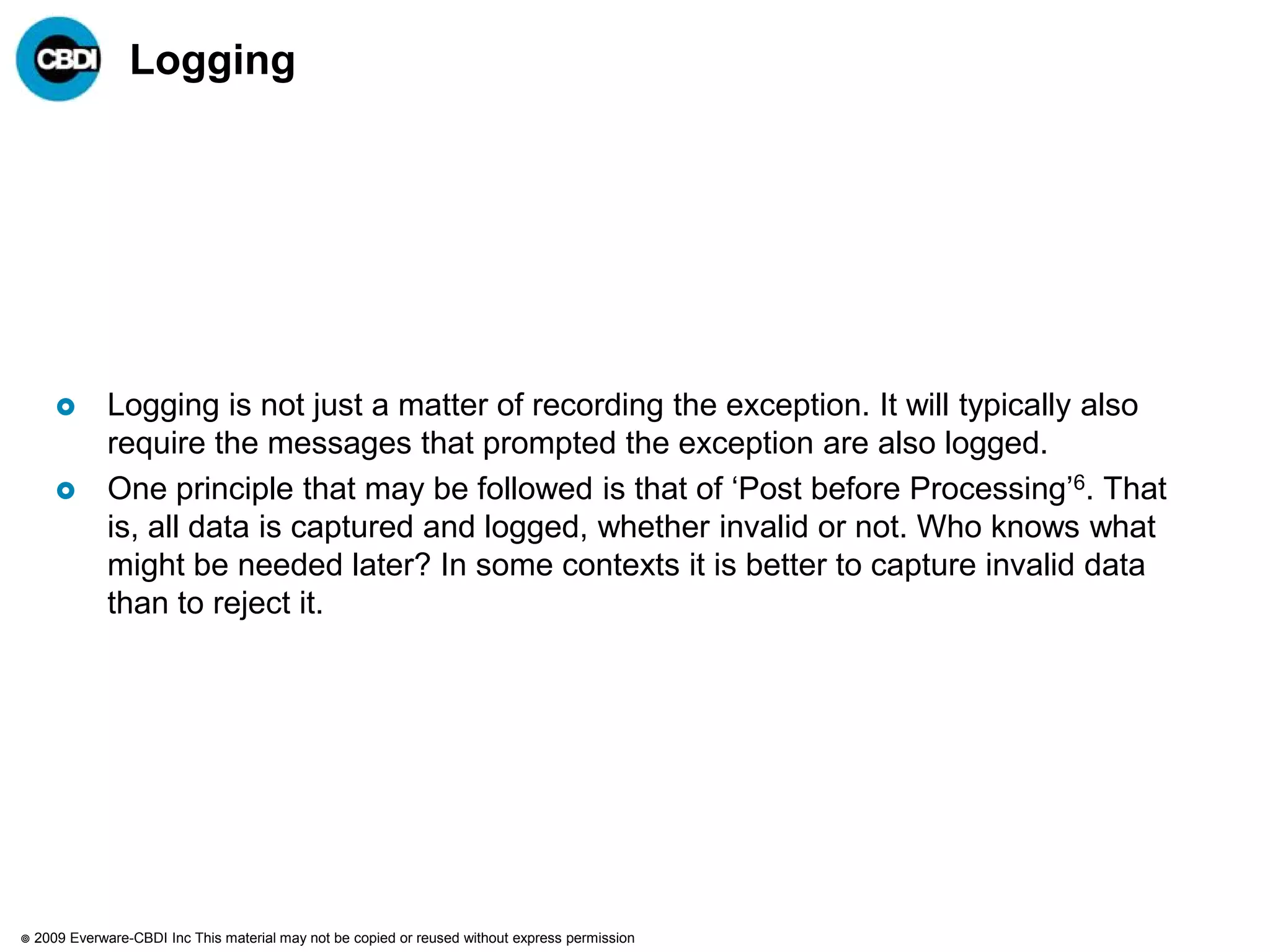
Logging


              Logging is not just a matter of recording the exception. It will typically also
               require the messages that prompted the exception are also logged.
              One principle that may be followed is that of „Post before Processing‟6. That
               is, all data is captured and logged, whether invalid or not. Who knows what
               might be needed later? In some contexts it is better to capture invalid data
               than to reject it.


   2009 Everware-CBDI Inc This material may not be copied or reused without express permission
Analysis


               Deeper analysis may be required to determine the root cause of
               exceptions. This may require the analysis of multiple related
               messages. Whilst each message has a unique ID and timestamp, this
               may require some way of identifying related messages by some
               common ID that is present in all the messages. This might be added
               in the logging process if it is not inherent already in the message
               schema used by the Service.
              With regard to „Post before Processing‟, analysis of the logged invalid
               data may help to reveal for example why some data is more frequently
               invalid than others, and help understand the root cause – such as
               poor data collection caused by poor human interface design.


   2009 Everware-CBDI Inc This material may not be copied or reused without express permission
Resolution


              By resolution we mean to take corrective action to remove or reduce
               future exceptions from occurring. This may require actions such as
                  Update processes to improve data entry and validation
                  Educate users to improve data entry
                  Data cleansing where Service requests are composed from
                    existing data
                  Update software to remove technical exceptions, trap more
                    business exceptions, improve validation
              See our „Data Quality for SOA‟ Report for further guidance


   2009 Everware-CBDI Inc This material may not be copied or reused without express permission
Links and Resources


              CBDI Wiki
                 http://cbdi.wikispaces.com/SOA+Exception+Management


              CBDI Journal Report
                 http://www.cbdiforum.com/secure/interact/2009-
                  05/soa_exception_management.php


   2009 Everware-CBDI Inc This material may not be copied or reused without express permission
www.cbdiforum.com


                  Independent Guidance for Service Architecture and Engineering


                                                             www.everware-cbdi.com


   2009 Everware-CBDI Inc This material may not be copied or reused without express permission

SOA Exception Management

  • 1.
    www.cbdiforum.com SOA Best Practice SOAException Management Framework By Lawrence Wilkes Independent Guidance for Service Architecture and Engineering
  • 2.
    Introduction  This presentation provides an overview of our SOA Exception Management Framework  Further detail and guidance (e.g. Specific techniques) is provided in the CBDI Journal report and the CBDI-SAE Knowledgebase  This report primarily considers exception management within Service- based solutions. That is, how both Service Providers and Service Consumers should handle exceptions that may occur in the processing of Service requests and responses.  That said, SOA exception management should not be distinct from broader exception management approaches that ought to be in place to deal with solutions that are not Service-based, and elements of the framework presented in this report should be common to both.  2009 Everware-CBDI Inc This material may not be copied or reused without express permission
  • 3.
    SOA Brings NewChallenges  For example,  The federation of participants implies that the Service Provider and Consumer may be in different organization  Loose coupling implies there is no shared technology or infrastructure. Hence, there may be no common exception handing software, systems management, or error log.  The Service Provider and Consumer must rely on Service Contracts such as the Service Specification to document exceptions and specify any obligations on them when an exception occurs.  In many cases the Service Provider and Consumer will be in the same organization. As such it may make sense for them to for example,  agree on a consistent approach to exception handing  standardize exception „protocols‟. For example, exception codes and messages  provide common utilities or infrastructure for exception management  Even where the participants are not in the same organization, they will still need to agree on the exception handing protocols.  2009 Everware-CBDI Inc This material may not be copied or reused without express permission
  • 4.
    Exception Management Lifecycle- I Phase Purpose Activities/Mechanisms Specification Specification of Exception Precise Specification conditions and Exception handing Certification Ensuring Specification is met Testing against specification Test cases for all exception conditions Detection Detection of Exception conditions Validation of  Schema  Business Rules  Pre-post conditions Action Handle Exception Reject Correct Retry Redirect Recover Classify (cause) Log This table shows a life cycle for exception management listing the key activities and mechanisms for each phase. Apart from the production of the Service Specification which is the provider‟s responsibility, the activities in each phase should be considered by both provider and consumer. By agreeing to such a life cycle, both participants will better understand what activities they should be performing when an exception occurs.  2009 Everware-CBDI Inc This material may not be copied or reused without express permission
  • 5.
    Exception Management Lifecycle- II Phase Purpose Activities/Mechanisms Notes Notification Feedback to participants Response message May use publish and Fault message subscribe mechanisms Common Event Raise Issue Analysis Analysis to determine Root cause analysis Is the implementation at cause of continuing Re-validate specification fault or the specification? Exceptions Resolution Take corrective action to Update process reduce future Exceptions Educate users Data cleansing Update software  2009 Everware-CBDI Inc This material may not be copied or reused without express permission
  • 6.
    Process  From a process perspective it makes sense to standardize as much as possible with:  An Enterprise-level process, defining an enterprise-level framework documenting how exceptions should be managed.  A Project-level process, defining the specific exceptions expected in their implementation and how they are handled, according to the enterprise framework  For all the usual reasons, it may not be possible to define a truly enterprise-wide framework. However, a meaningful unit of scope might still apply – e.g. business unit, business domain – or more likely a common framework shared by a federation of service providers and consumers.  2009 Everware-CBDI Inc This material may not be copied or reused without express permission
  • 7.
    Enterprise-level Exception ManagementActivities Process Activities Responsibility of Define Contract Define Service Specification and Automation Unit Specification – SOA Governance Lead Types detail how exceptions are to be documented Define Define taxonomy of exceptions SOA Quality Exception Management Build a exception/fault code structure Types Assign standard exception codes and standard response messages Define Event Define and Implement common exception handling infrastructure SOA Infrastructure Handling (part Architect together with Define and implement a common event format for notification of of Service Service/systems exceptions. This could be part of wider common event processing Management) management initiative, not just for exceptions. Model Model Exception Management as a domain in the Business Type Service Architect Exception Model, and identify a Service Architecture for exception Management management. This would support the provision of any common exception handling services (see later) Define Define and Implement Exception Detection Points (EDP) in SOA SOA Infrastructure Exception infrastructure. For example in the Enterprise Service Bus (ESB), Architect Handing Business Rules Engine, Service Management. Infrastructure Define and Implement common exception handling infrastructure  2009 Everware-CBDI Inc This material may not be copied or reused without express permission
  • 8.
    Project-Level Exception ManagementActivities Process Activities Responsibility of Service Define exceptions visible to Service Consumer. Service Specification Specification Designer Define detailed business exceptions in pre/post conditions Classify according to taxonomy of exceptions and assign fault codes, and define exception messages AU Decomposition of business exceptions and technical exceptions by Service Specification Specification component and platform Designer together with Software Designer Define additional exceptions relevant only to Service Provider Specify what actions to be taken on detection of exception Design Detailed technical exceptions Software Designer Detail how Actions are taken Determine detection mechanisms and EDP that will be used in their Software Designer implementation together with SOA Infrastructure Architect Set test cases Tester Build Finalization and detailing of technical exceptions (exception codes Software Developer etc) Set Notifications Deploy rules to various EDP Test Run test cases to check exceptions, notifications Tester  2009 Everware-CBDI Inc This material may not be copied or reused without express permission
  • 9.
    Exception Specification  Exceptions need to be specified in either  Service Specification: As the prime contract between Service Provider and Consumer, the Service Specification is the main place to document exceptions and responses that are of consequence to the Service Consumer (type 1 below)  Automation Unit Specification: Should also define addition exceptions that are of concern only to the Service Consumer, as well as the type 2 response below to exceptions that are in the Service Specification.  Exception Condition Visibility  It may be necessary to specify two different response messages to certain kinds of exception;  Type 1, of relevance to the Service Consumer – e.g. “Technical Error”  Type 2, containing further information of interest only to the Service Provider – e.g. “Technical Error. Customer Database CustDb07 not available”  Exception Shielding  guarding against the security risk exposed by exception messages that reveal sensitive information or reveal too much about the implementation.  2009 Everware-CBDI Inc This material may not be copied or reused without express permission
  • 10.
    Certification  The prime activity in certification is to ensure the Service and Automation unit Specifications are met.  Test cases will therefore need to be run for all valid and invalid conditions.  Test cases may be supplied as part of the specification (but not as a substitute for). Test cases typically define the output messages expected for each test condition. Again an example of this is provided in “Documenting Service Behavior”.  2009 Everware-CBDI Inc This material may not be copied or reused without express permission
  • 11.
    Detection: Exception DetectionPoints The mediation capabilities The Automation Unit (the Service of an ESB may be capable Implementation) can of course do all of message validation, Receipt Path this in its code.... checking for WS-protocol But should be focused on detecting Exceptions, etc business exceptions Dispatch Path An inverse of the receipt path Application Business Service Mediator XML Technical Automation or Web Rules Endpoint (e.g. ESB) Processor Interface Unit Server Engine The Application The XML A Business Rules There may be further or Web Server processor can Engine can perform type checking etc may detect validate the more sophisticated provided by the exceptions in schema using rule-based validation automation unit SOAP or HTTP XSD of message container A key part of putting any infrastructure in place to support exception management at run-time is to determine what Exception Detection Points (EDP) are provided , and then in the design phase for a specific service, deciding which EDPs are to be used. This figure is purely illustrative. Implementations may not have all these EDP‟s, whilst some might have more – such as in an XML-aware firewalls, or the gateway into the Automation Unit container. Similarly, the actual sequence of processing may differ.  2009 Everware-CBDI Inc This material may not be copied or reused without express permission
  • 12.
    Exception Detection Points- Post Processing Could be applied much Real-Time earlier in the Analytics path Automation Database Analytics Unit Management The Automation Unit will The DBMS might Pattern-based can of course do all this in perform additional data Exceptions its code.... validation Exceptions that can But should be focused on Validation against only be detected across detecting business database schema (e.g. multiple transactions Exceptions orphans) (may include fraud...) There are also activities that can take place “post processing” to further detect exceptions such as the use of analytics to search for more complex rule- based exceptions such as fraud. Though increasingly these might be applied in real-time, as part of the receipt/dispatch path.  2009 Everware-CBDI Inc This material may not be copied or reused without express permission
  • 13.
    Action When an exception condition is detected, a number of actions listed in the table should be taken. Many of these actions will be common to both the Action Service Provider‟s and Consumer‟s response to an exception condition. Process  Rejection The simple case is that invalid requests or responses are rejected  Correction or Attempt to correct request. substitution It may be possible to derive correct data by cross referencing against other related data. Or it may be acceptable to substitute a „best guess‟, or a lowest common denominator.  Redirection Invalid requests are re-directed to an alternative endpoint for differentiated processing For example, the automated process may switch to a human process rather than reject the request. Would you rather lose a sale because of invalid data, or see if a human can deal with it better? Technical Exceptions may lead to seeking alternative endpoint (backup, scaling)  Retry Technical Exceptions may lead to a simple resubmission when the system recovers (queuing)  Recover Exceptions may lead to the initiation of some form of recovery process – such as restoring data to its original state. In long-running asynchronous services, this may require the use of compensating transactions. Classify Classify the Exception Determine fault code Log Log the exception  2009 Everware-CBDI Inc This material may not be copied or reused without express permission
  • 14.
    Notification  Key questions are  determining which parties are interested in the exception  what level of detail they need to know about the exception, and what caused it  what mechanisms are used to notify them  Determining which parties are interested may be dealt with using publish and subscribe approach  Notification Format  Though the SOAP Web Service protocol provides the SOAP Fault Element as a standard for returning fault messages to the Service Consumer, that doesn‟t preclude organizations using something like Common Base Events, WS-Notification, or the Web Event Format of WSDM, to communicate exceptions to a wider range of participants  The key consideration however, is that SOA is not always dependent on WS-Protocols.  2009 Everware-CBDI Inc This material may not be copied or reused without express permission
  • 15.
    Advantages and Disadvantagesof SOAP Faults vs Custom SOAP Body Option Advantage Disadvantage All exceptions Standards-based Not flexible returned as SOAP Recognized by SOA Can not communicate multiple Faults infrastructure exceptions Use SOAP Faults for Technical exceptions still Business exceptions will not be technical or system understood by the SOA automatically handled by exceptions infrastructure elements of SOA infrastructure that may be able to process Use a custom SOAP Custom payload allows more business rules – though they Body to return expressive feedback for could be configured to do so business exceptions business exceptions, including multiple exceptions at once All exceptions More expressive Non-standard returned as custom Not recognized by SOA SOAP Body infrastructure There is conflicting advice on whether to use SOAP Faults to communicate exceptions or whether instead to define a regular SOAP Body element that contains a custom „payload‟ that can be more expressive than the standard SOAP Fault.  2009 Everware-CBDI Inc This material may not be copied or reused without express permission
  • 16.
    Logging  Logging is not just a matter of recording the exception. It will typically also require the messages that prompted the exception are also logged.  One principle that may be followed is that of „Post before Processing‟6. That is, all data is captured and logged, whether invalid or not. Who knows what might be needed later? In some contexts it is better to capture invalid data than to reject it.  2009 Everware-CBDI Inc This material may not be copied or reused without express permission
  • 17.
    Analysis  Deeper analysis may be required to determine the root cause of exceptions. This may require the analysis of multiple related messages. Whilst each message has a unique ID and timestamp, this may require some way of identifying related messages by some common ID that is present in all the messages. This might be added in the logging process if it is not inherent already in the message schema used by the Service.  With regard to „Post before Processing‟, analysis of the logged invalid data may help to reveal for example why some data is more frequently invalid than others, and help understand the root cause – such as poor data collection caused by poor human interface design.  2009 Everware-CBDI Inc This material may not be copied or reused without express permission
  • 18.
    Resolution  By resolution we mean to take corrective action to remove or reduce future exceptions from occurring. This may require actions such as  Update processes to improve data entry and validation  Educate users to improve data entry  Data cleansing where Service requests are composed from existing data  Update software to remove technical exceptions, trap more business exceptions, improve validation  See our „Data Quality for SOA‟ Report for further guidance  2009 Everware-CBDI Inc This material may not be copied or reused without express permission
  • 19.
    Links and Resources  CBDI Wiki  http://cbdi.wikispaces.com/SOA+Exception+Management  CBDI Journal Report  http://www.cbdiforum.com/secure/interact/2009- 05/soa_exception_management.php  2009 Everware-CBDI Inc This material may not be copied or reused without express permission
  • 20.
    www.cbdiforum.com Independent Guidance for Service Architecture and Engineering www.everware-cbdi.com  2009 Everware-CBDI Inc This material may not be copied or reused without express permission