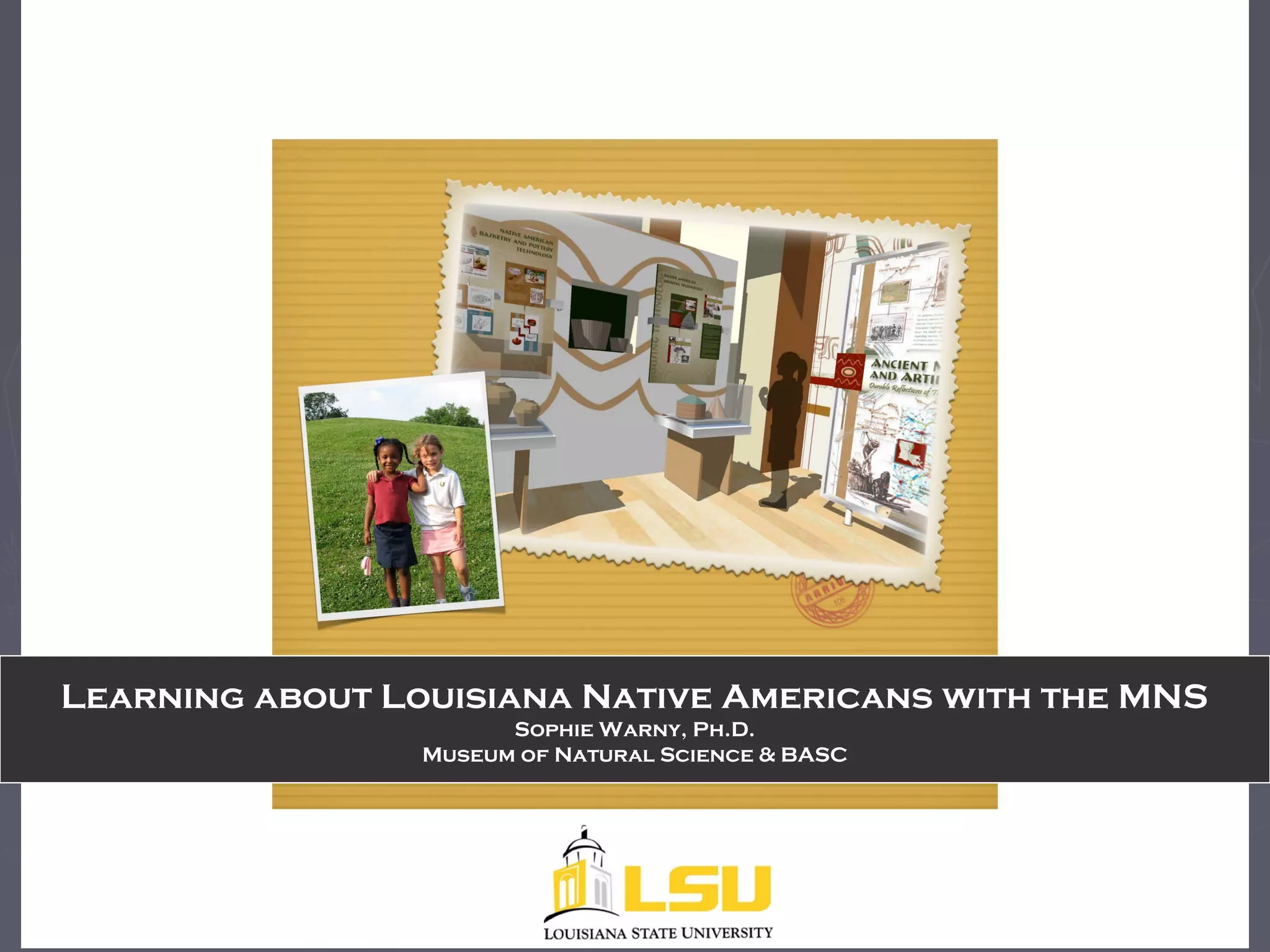
Learning about Louisiana Native Americans with the MNS
Sophie Warny, Ph.D.
Museum of Natural Science & BASC
We will talk about…We will talk about…
 1. The MNS Archaeology Collections
 2. Field trip to the MNS or in your own school!
- Learn about our new exhibit on Native Americans
 3. New children’s activity book on Native Americans
- English and French
 4. History and Archaeology of Louisiana N. A. with an expert
 5. Hands on activities to do in your schools
- Learn about the different types of Indian potteries
- Learn how to make N.A. pottery using the coiling method
- Learn about artifacts
 7 main fields of RESEARCH7 main fields of RESEARCH
 Ornithology (Birds)Ornithology (Birds)
 GeneticsGenetics
 Ichthyology (Fishes)Ichthyology (Fishes)
 MammalogyMammalogy
 Herpetology (Reptiles and Amphibians)Herpetology (Reptiles and Amphibians)
 Vertebrate PaleontologyVertebrate Paleontology
 Anthropology (Archaeology and Ethnography)Anthropology (Archaeology and Ethnography)
 EDUCATIONEDUCATION
1. The MNS collections1. The MNS collections
Collections:
More than 1.25 million specimens from 2,000 sites in
Louisiana and worldwide.
For instance:
The McIlhenny and Jastremski Chitimacha Indian Basketry
collections (two of the most important of their kind in the
nation)
Research statement:
Human adaptations through time and the evolution of
cultural complexity.
AnthropologyAnthropology
Dr. Becky Saunders
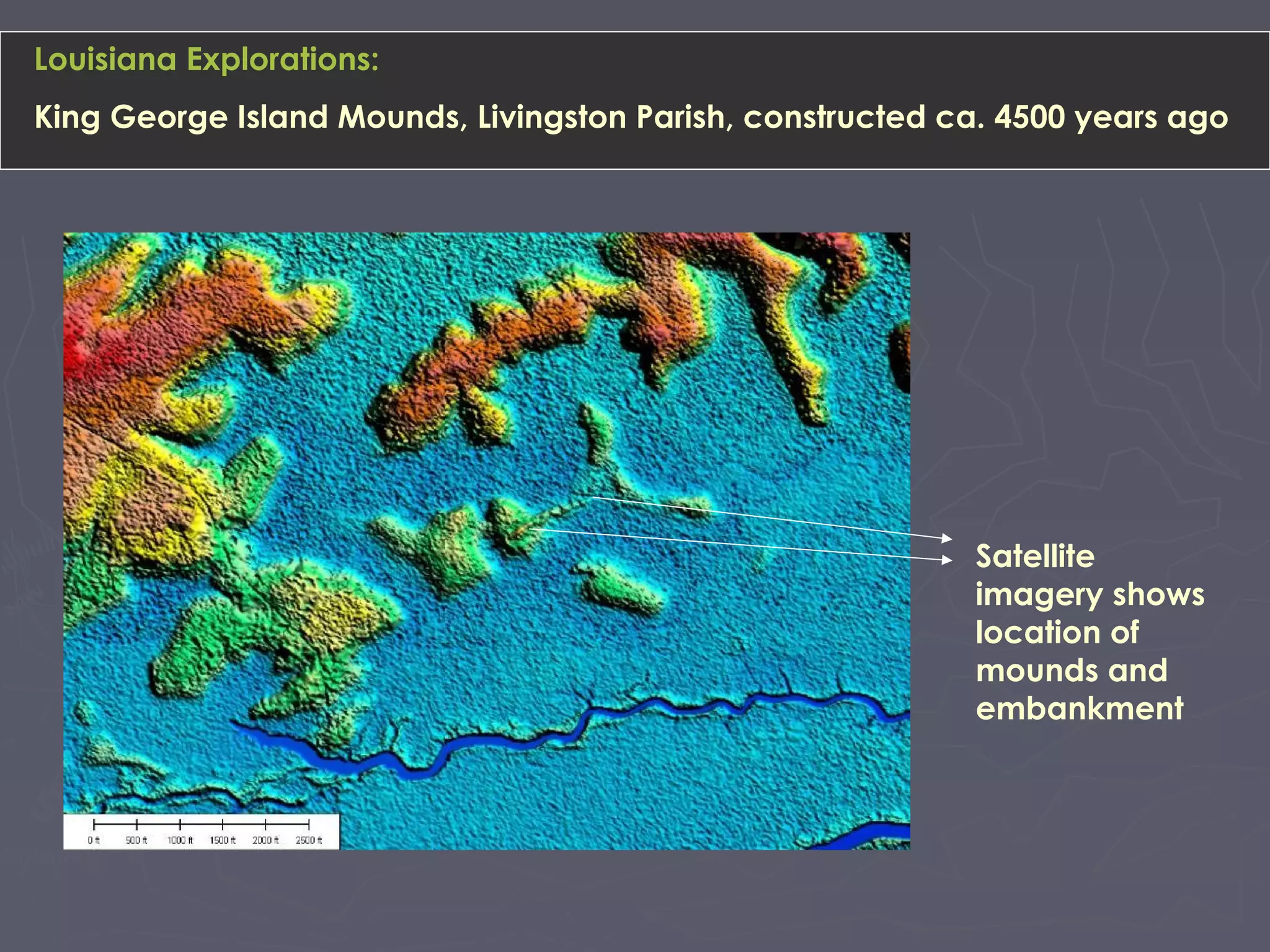
Satellite
imagery shows
location of
mounds and
embankment
Louisiana Explorations:
King George Island Mounds, Livingston Parish, constructed ca. 4500 years ago
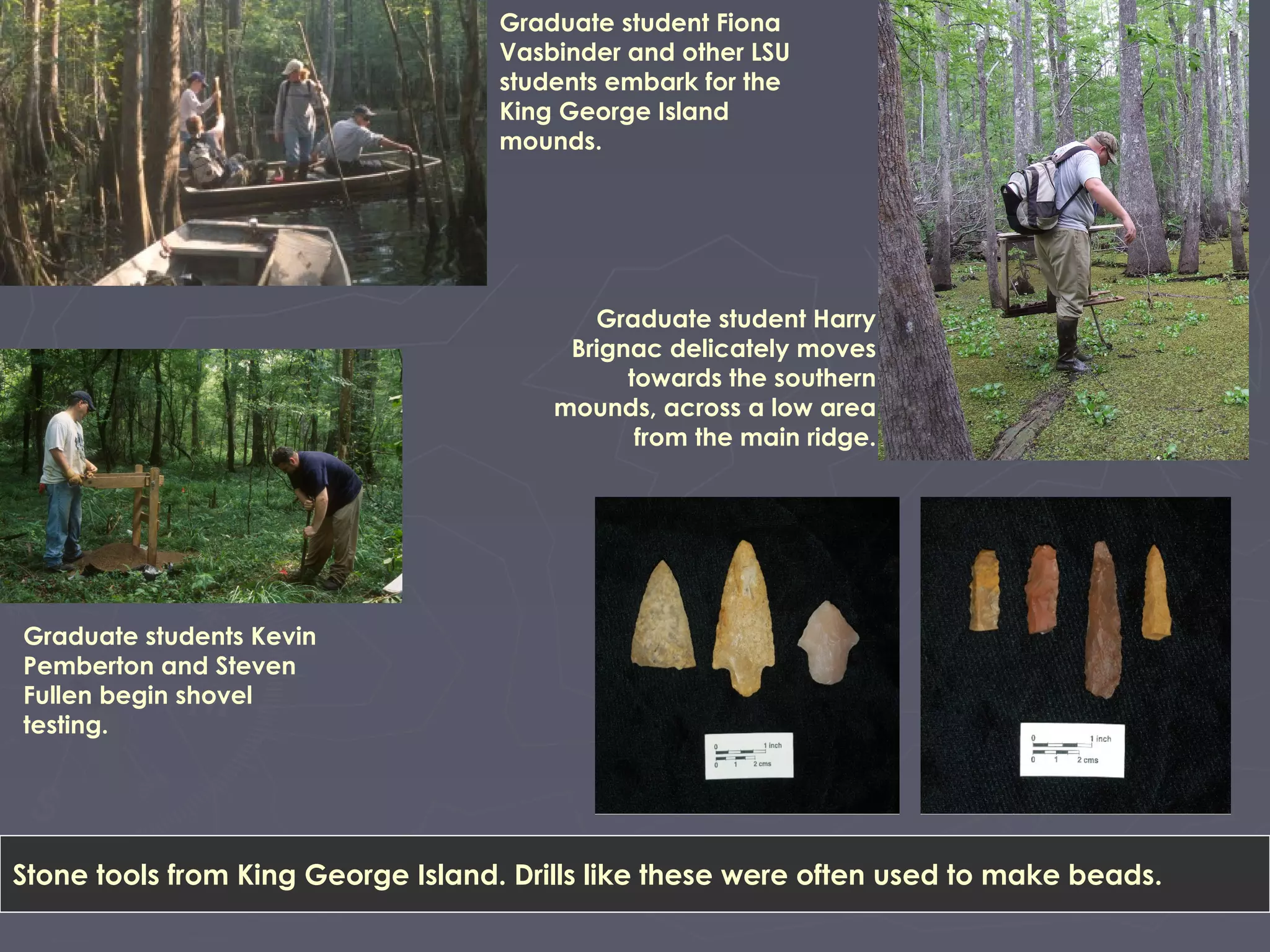
Graduate student Fiona
Vasbinder and other LSU
students embark for the
King George Island
mounds.
Graduate student Harry
Brignac delicately moves
towards the southern
mounds, across a low area
from the main ridge.
Graduate students Kevin
Pemberton and Steven
Fullen begin shovel
testing.
Stone tools from King George Island. Drills like these were often used to make beads.
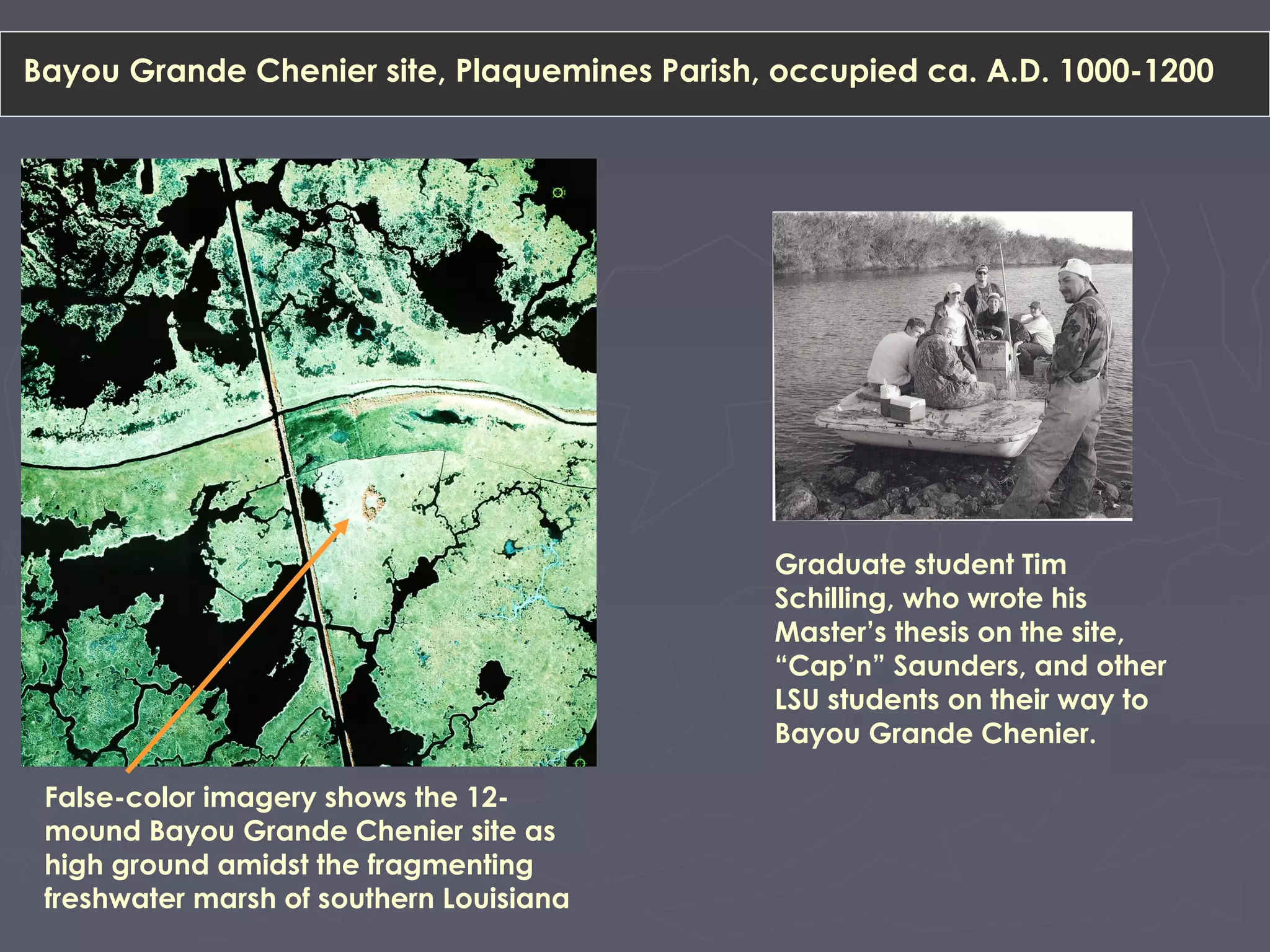
Bayou Grande Chenier site, Plaquemines Parish, occupied ca. A.D. 1000-1200
False-color imagery shows the 12-
mound Bayou Grande Chenier site as
high ground amidst the fragmenting
freshwater marsh of southern Louisiana
Graduate student Tim
Schilling, who wrote his
Master’s thesis on the site,
“Cap’n” Saunders, and other
LSU students on their way to
Bayou Grande Chenier.
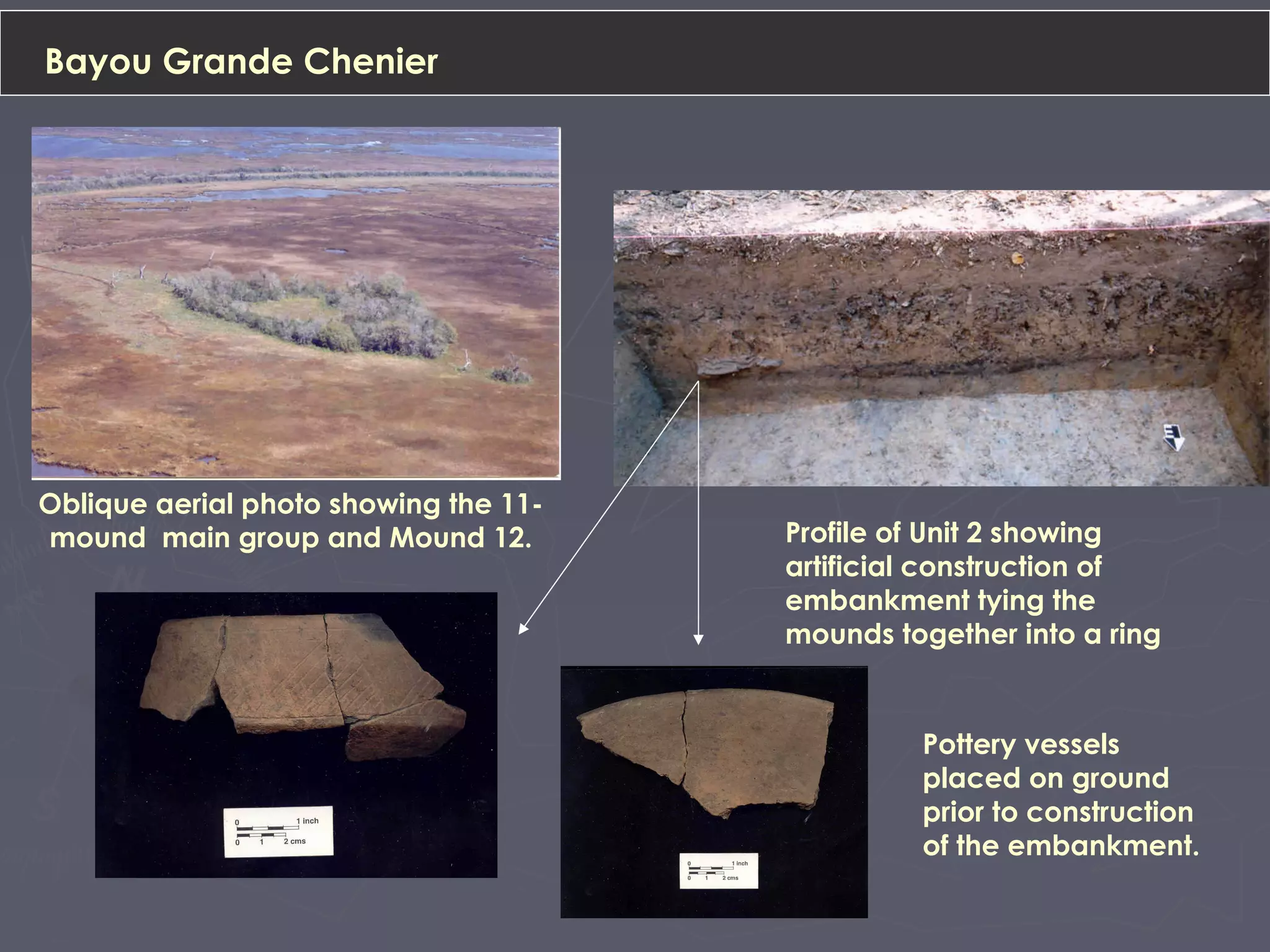
Oblique aerial photo showing the 11-
mound main group and Mound 12. Profile of Unit 2 showing
artificial construction of
embankment tying the
mounds together into a ring
Pottery vessels
placed on ground
prior to construction
of the embankment.
Bayou Grande Chenier
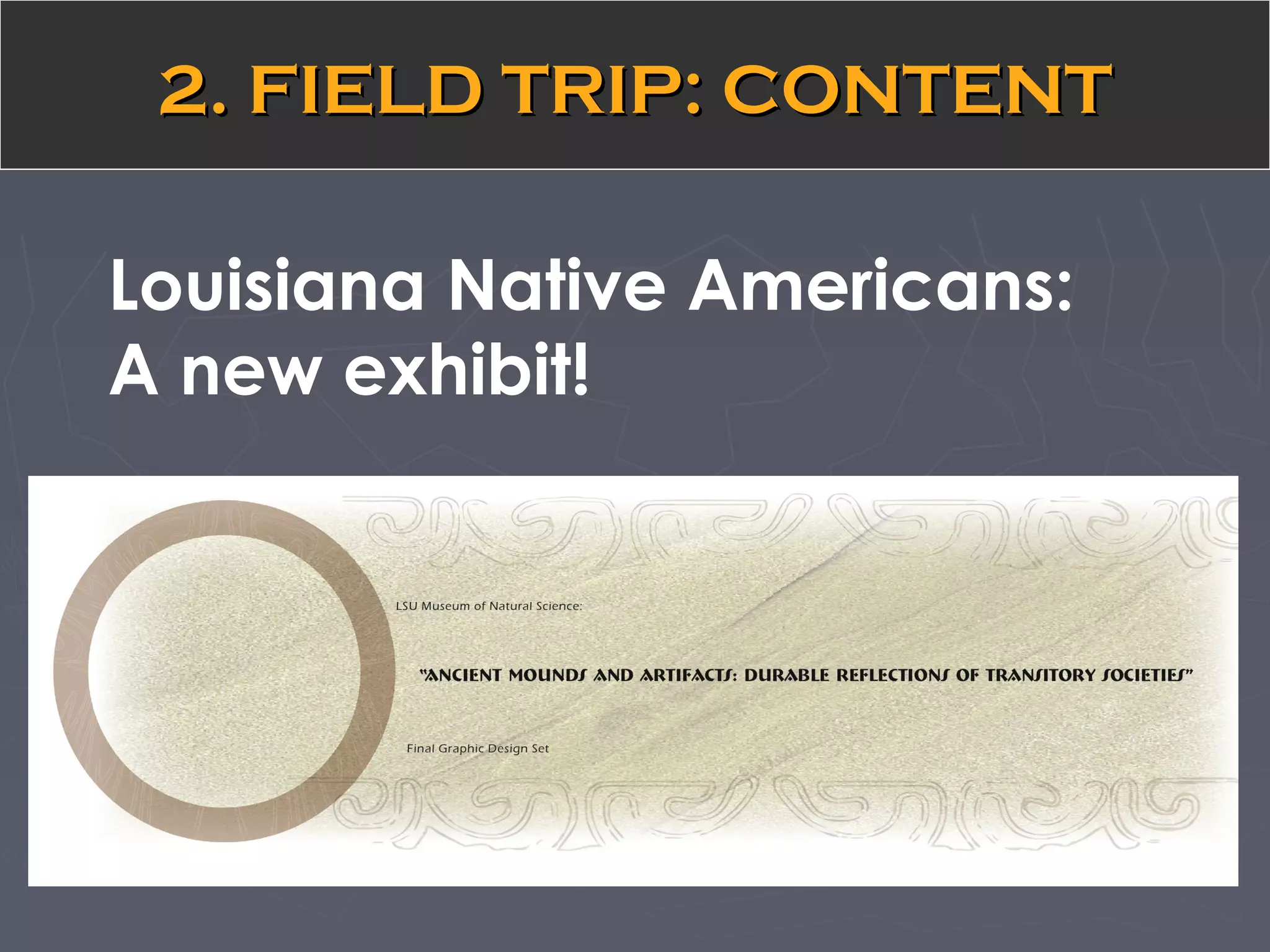
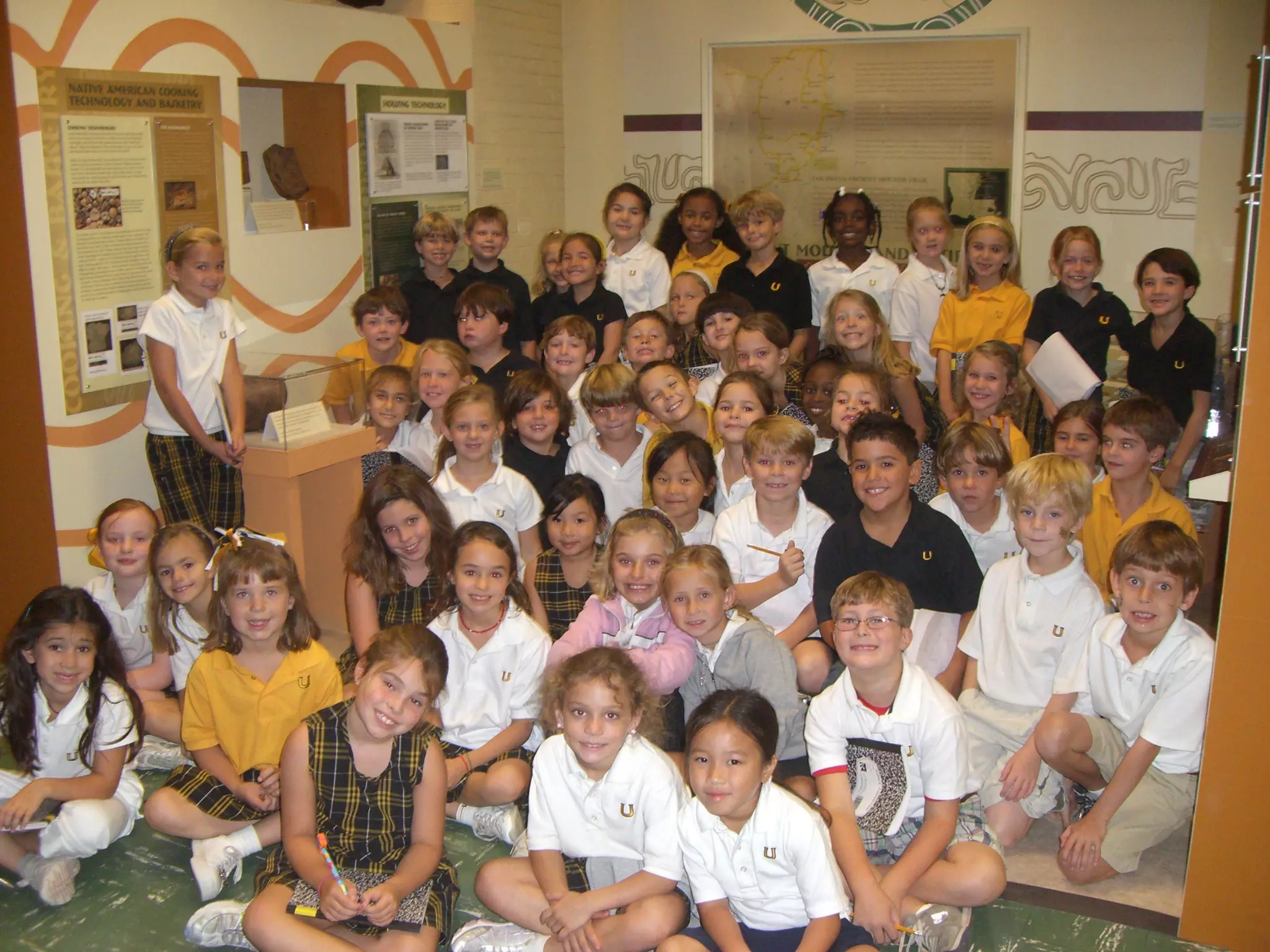
2. FIELD TRIP: CONTENT2. FIELD TRIP: CONTENT
Louisiana Native Americans:
A new exhibit!
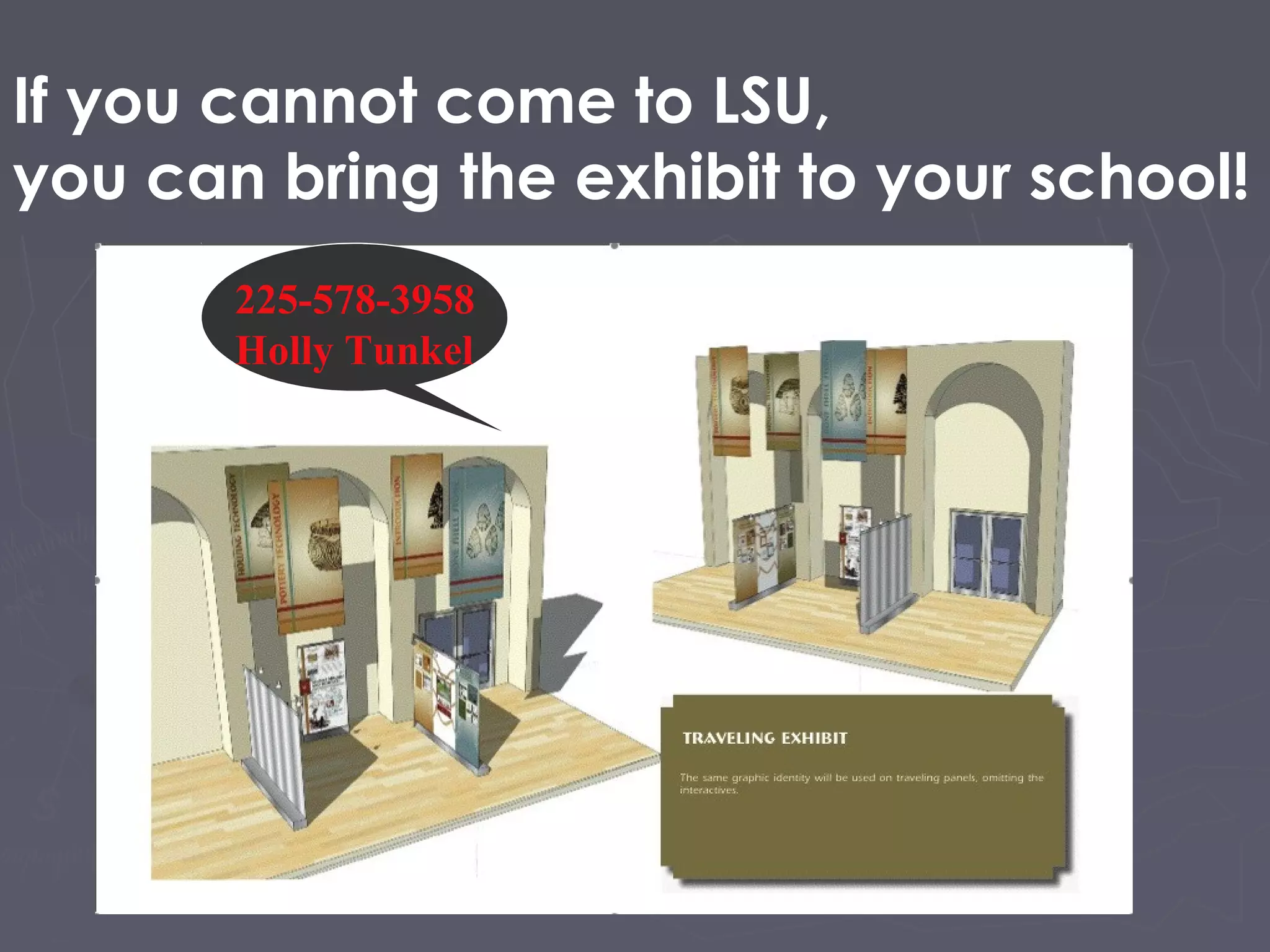
If you cannot come to LSU,
you can bring the exhibit to your school!
225-578-3958
Holly Tunkel
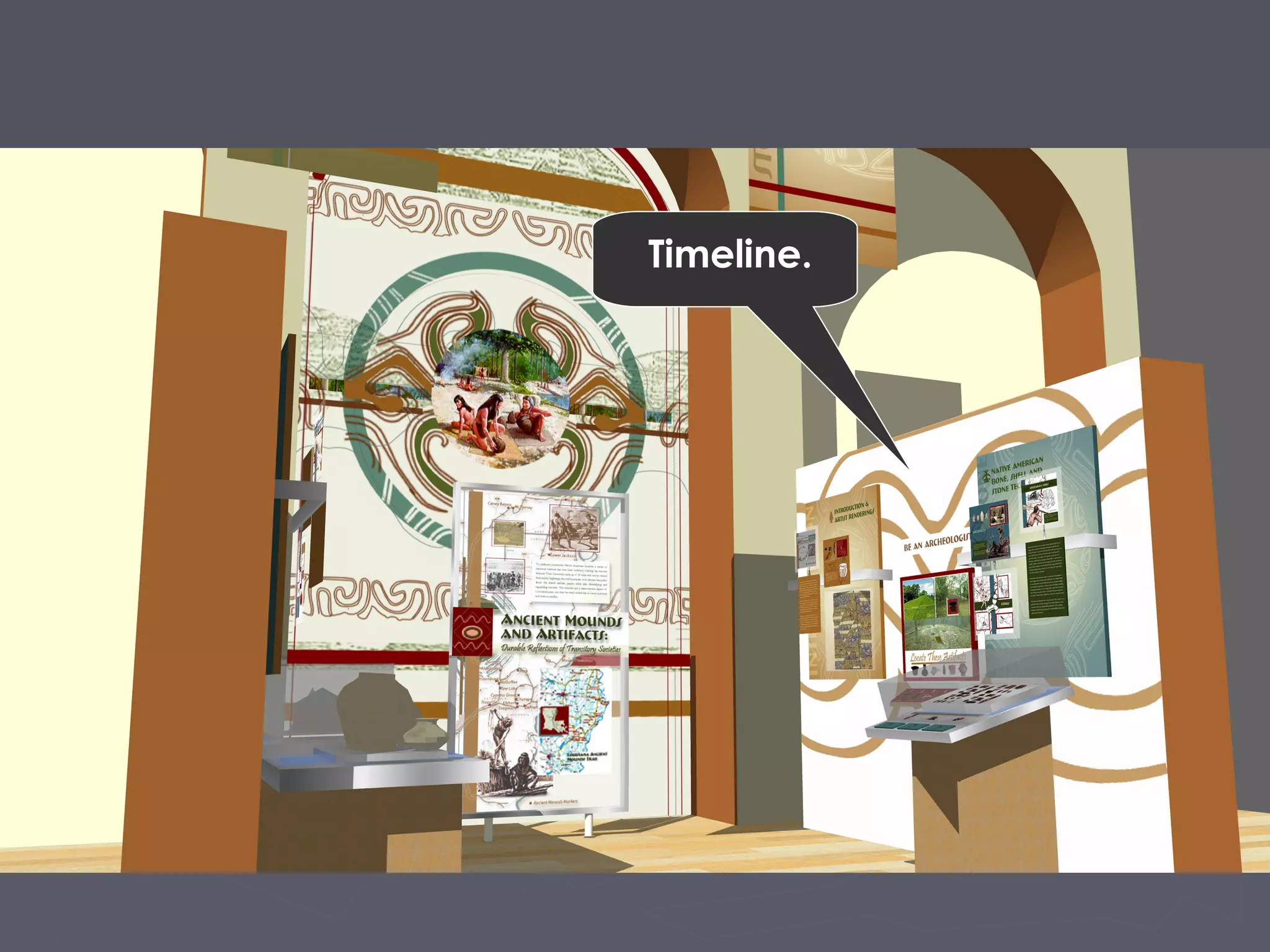
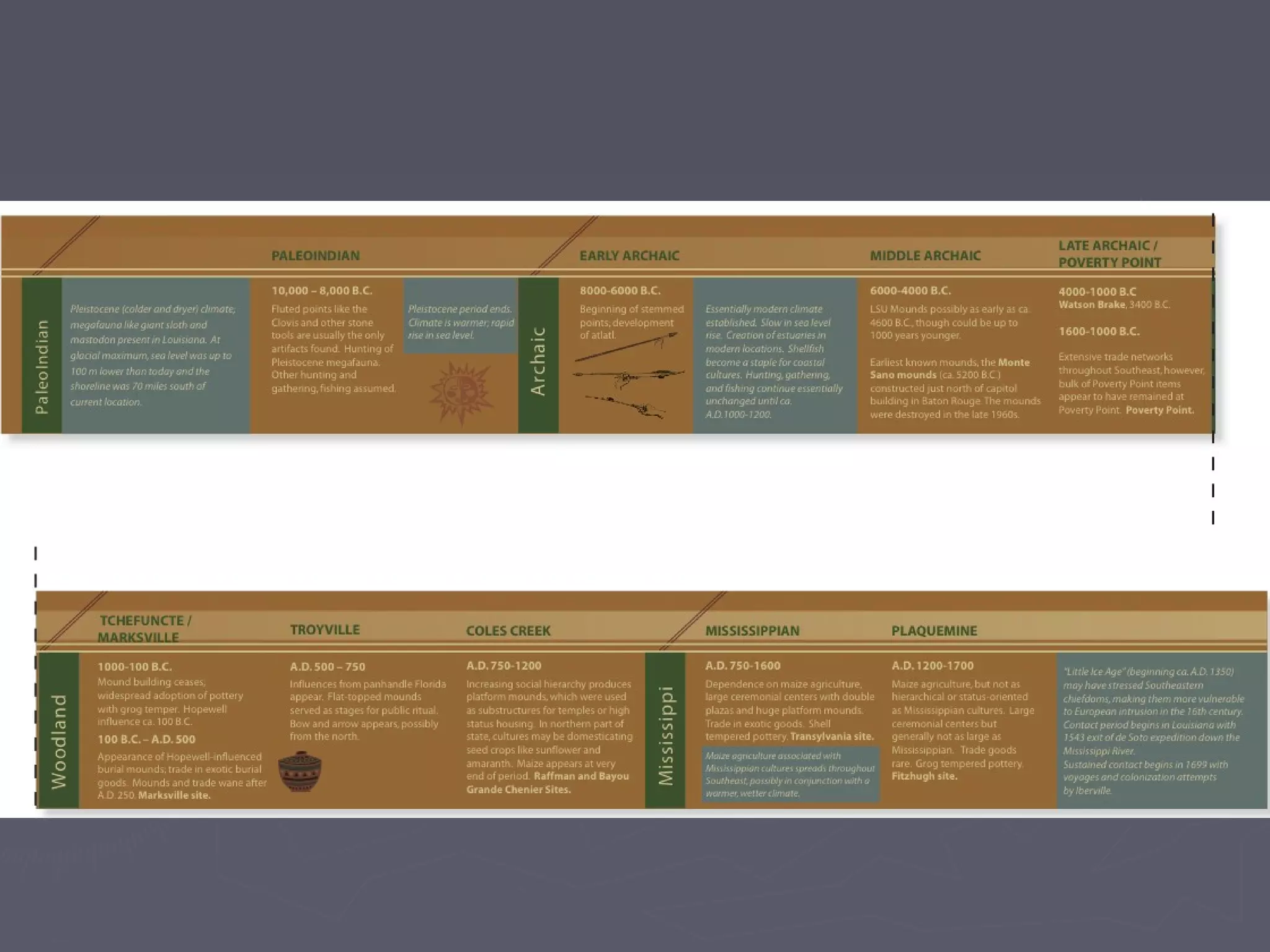
Timeline.
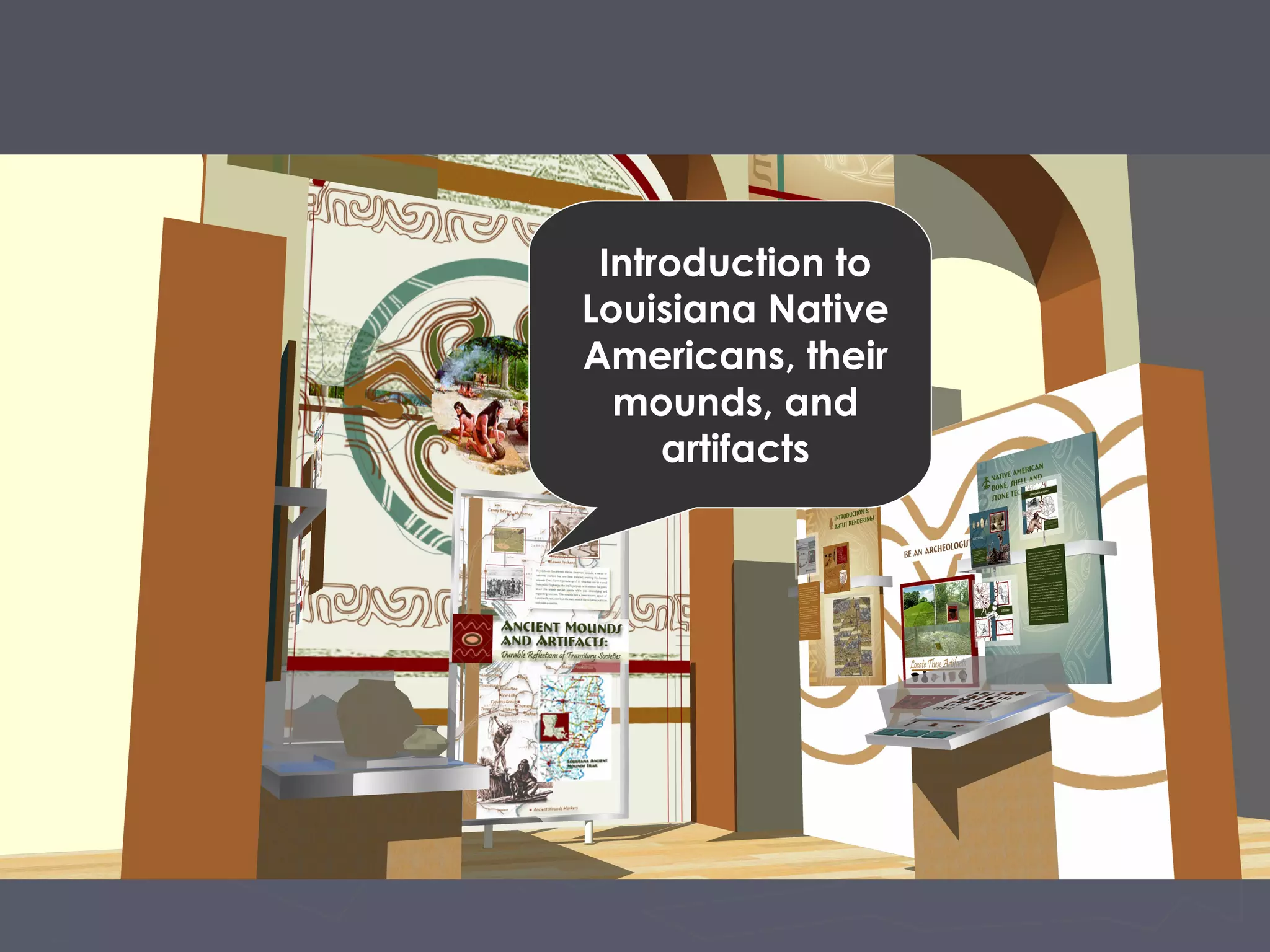
Introduction to
Louisiana Native
Americans, their
mounds, and
artifacts
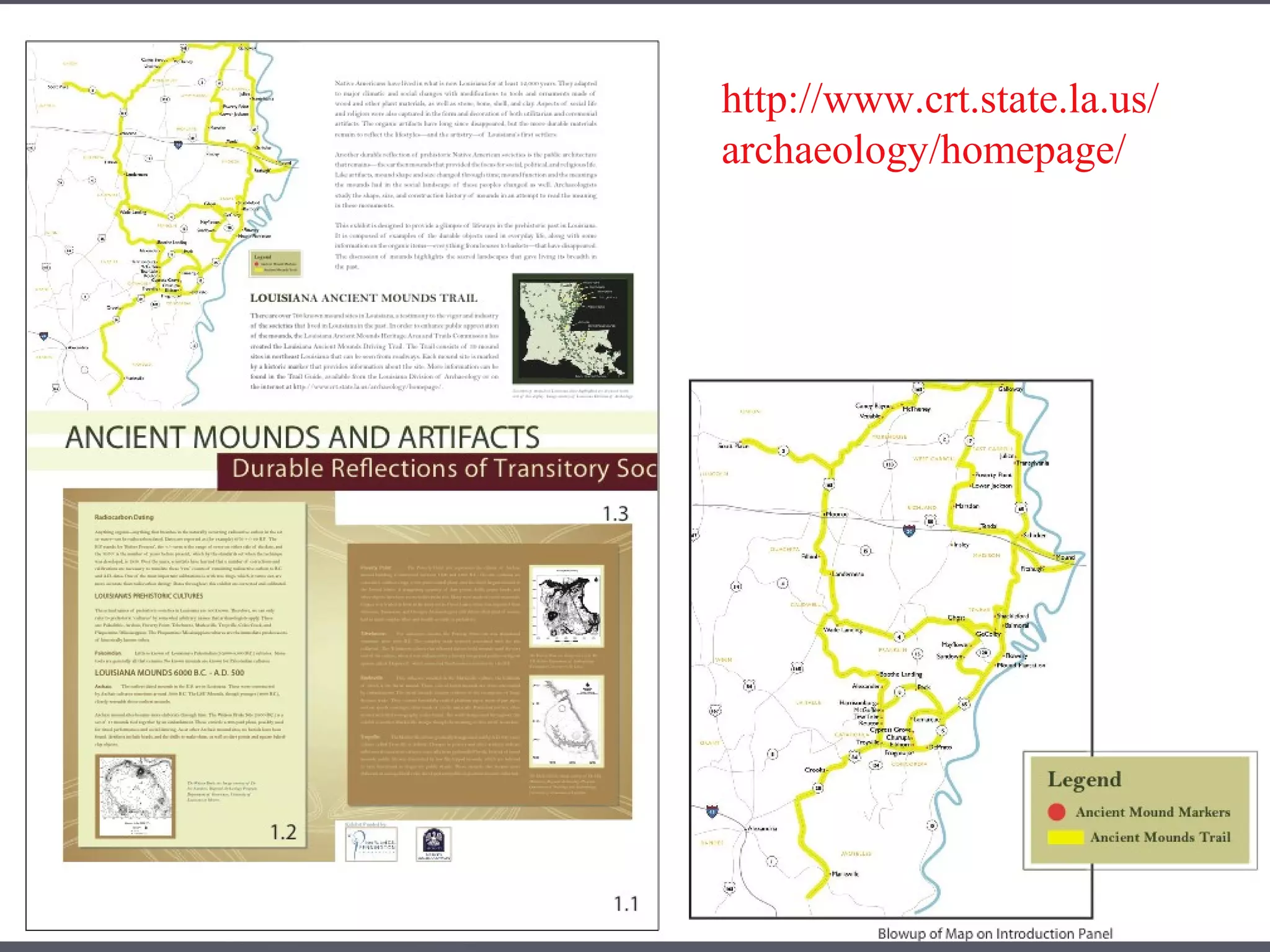
http://www.crt.state.la.us/
archaeology/homepage/
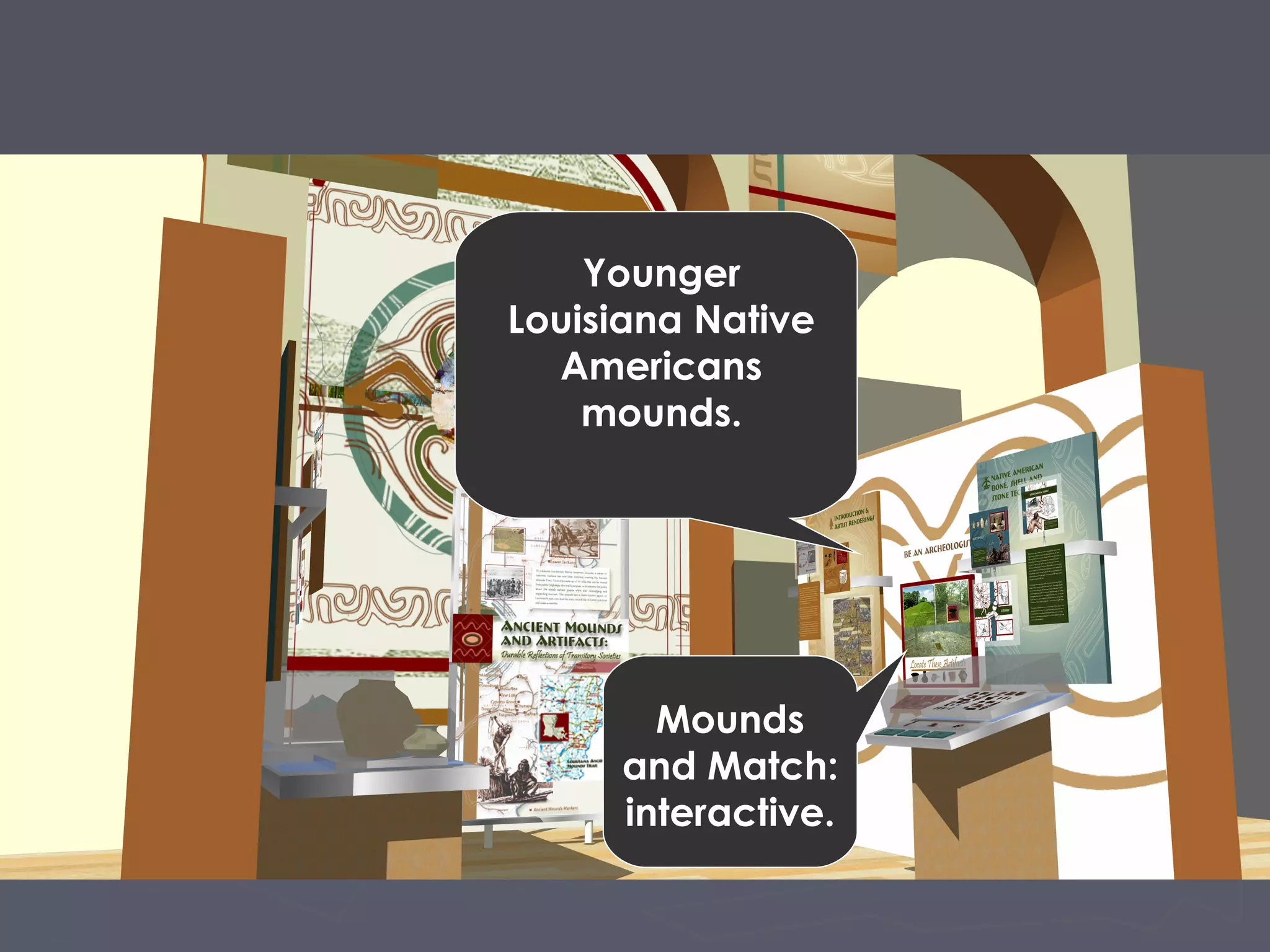
Younger
Louisiana Native
Americans
mounds.
Mounds
and Match:
interactive.
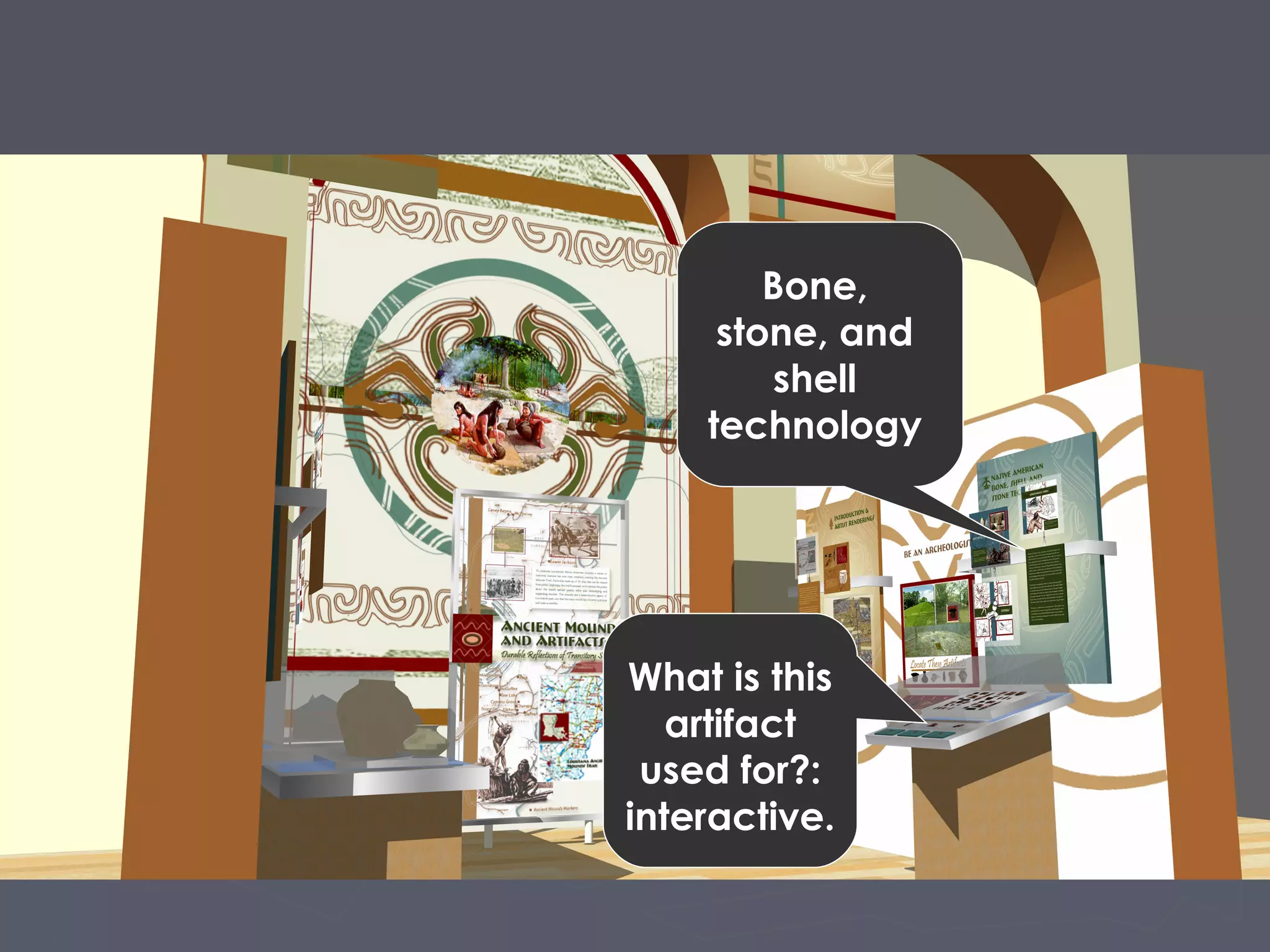
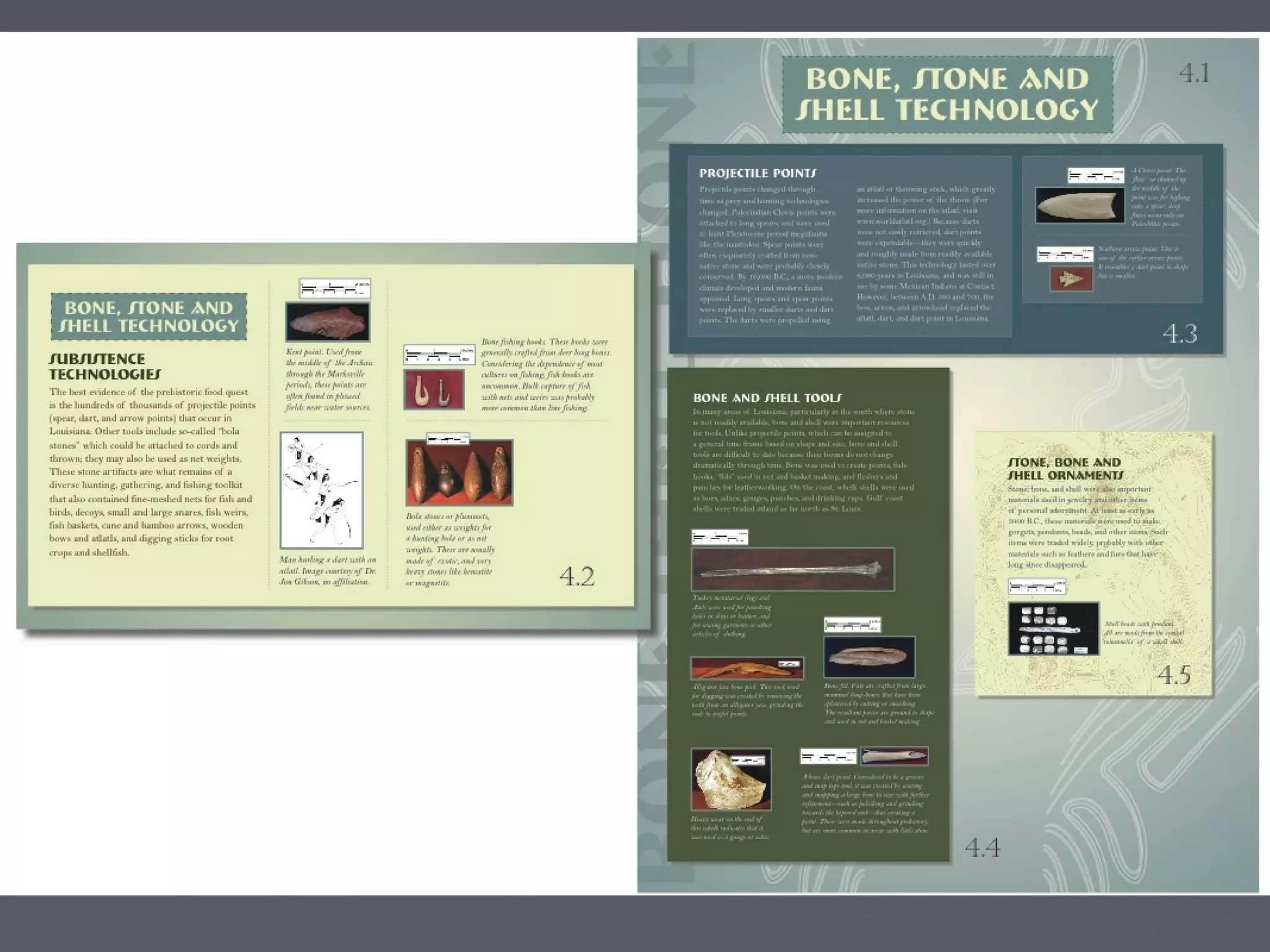
Bone,
stone, and
shell
technology
What is this
artifact
used for?:
interactive.
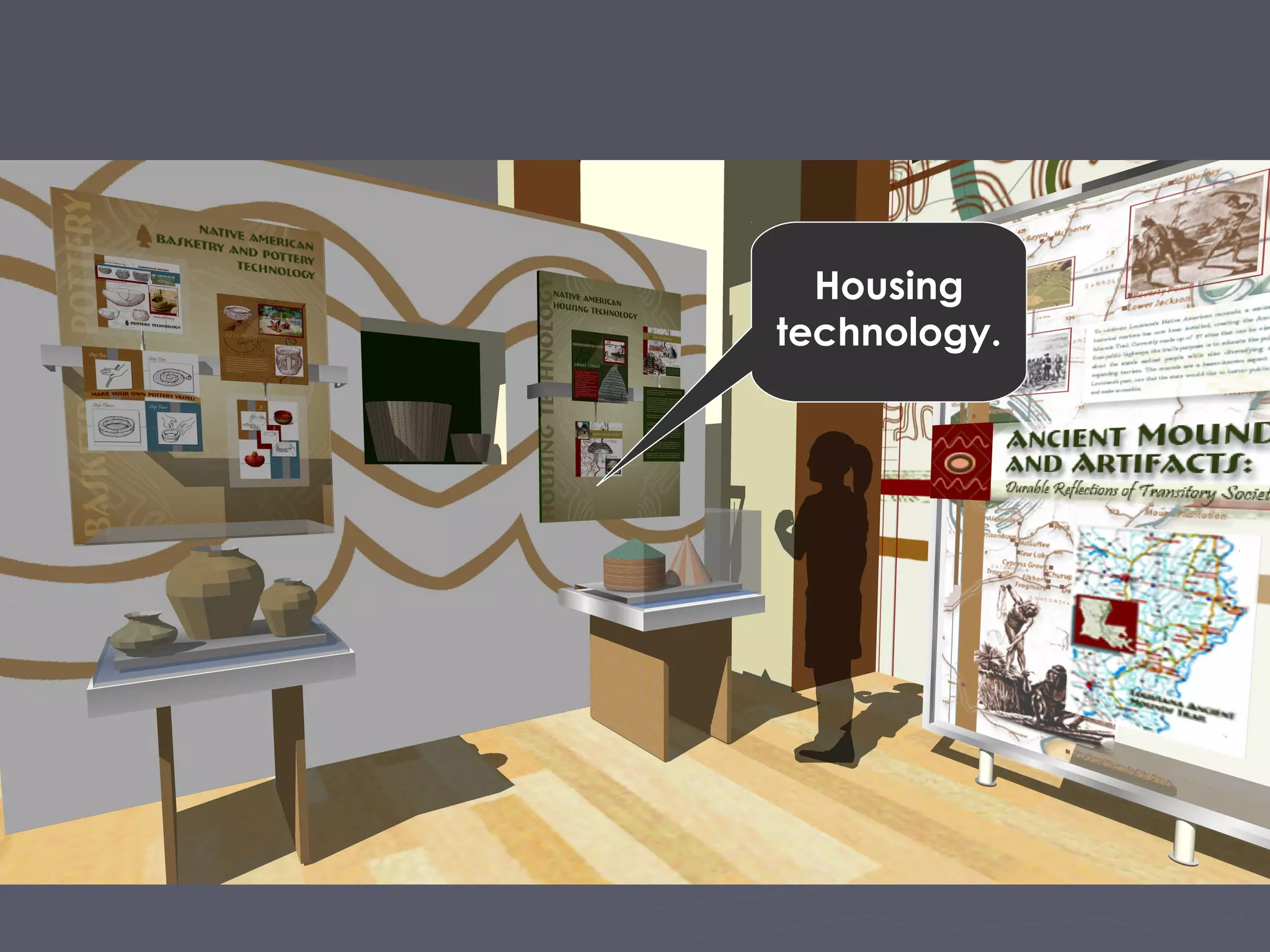
Housing
technology.
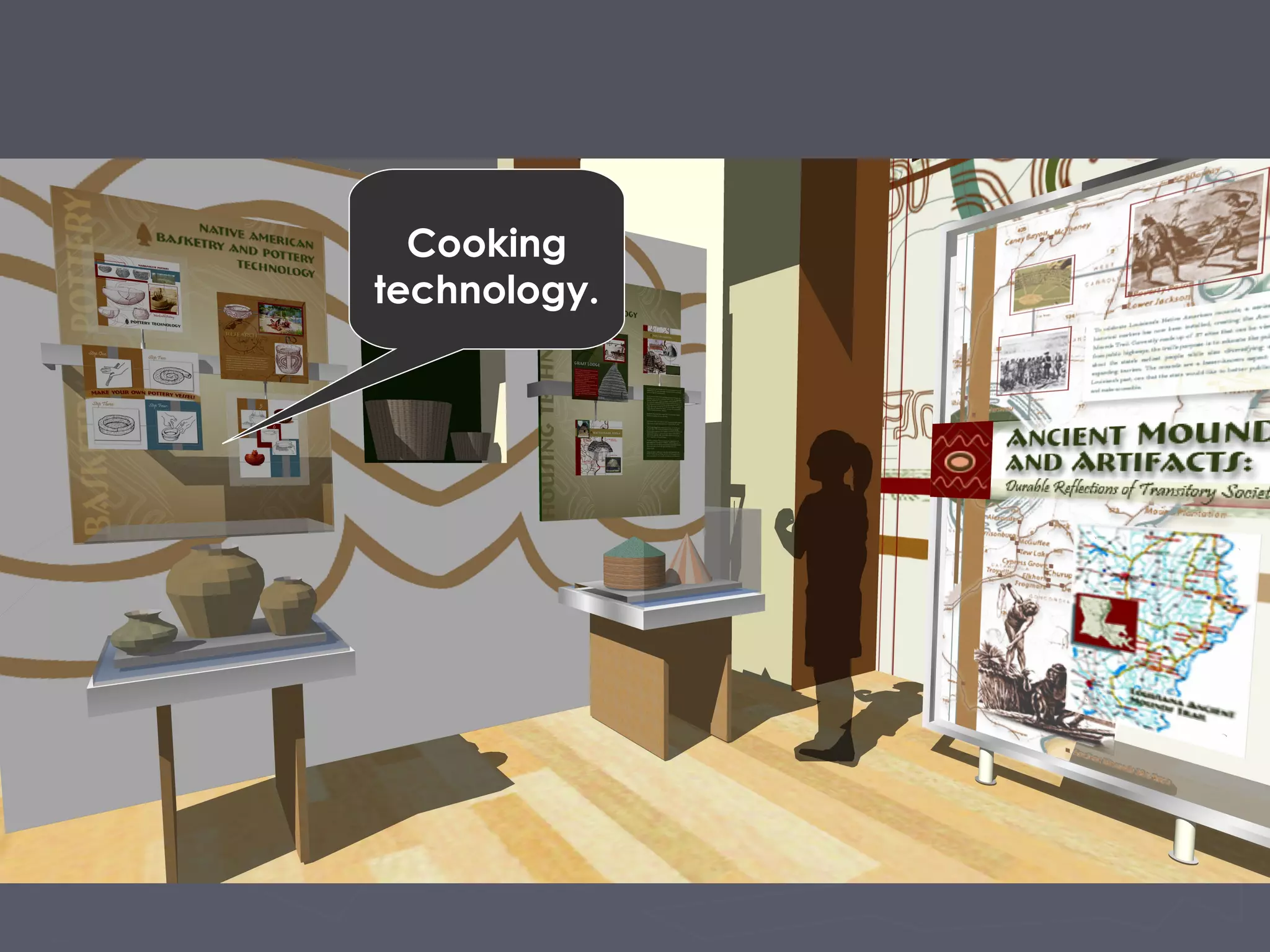
Cooking
technology.
3. FIELD TRIP: PRACTICAL DETAILS3. FIELD TRIP: PRACTICAL DETAILS
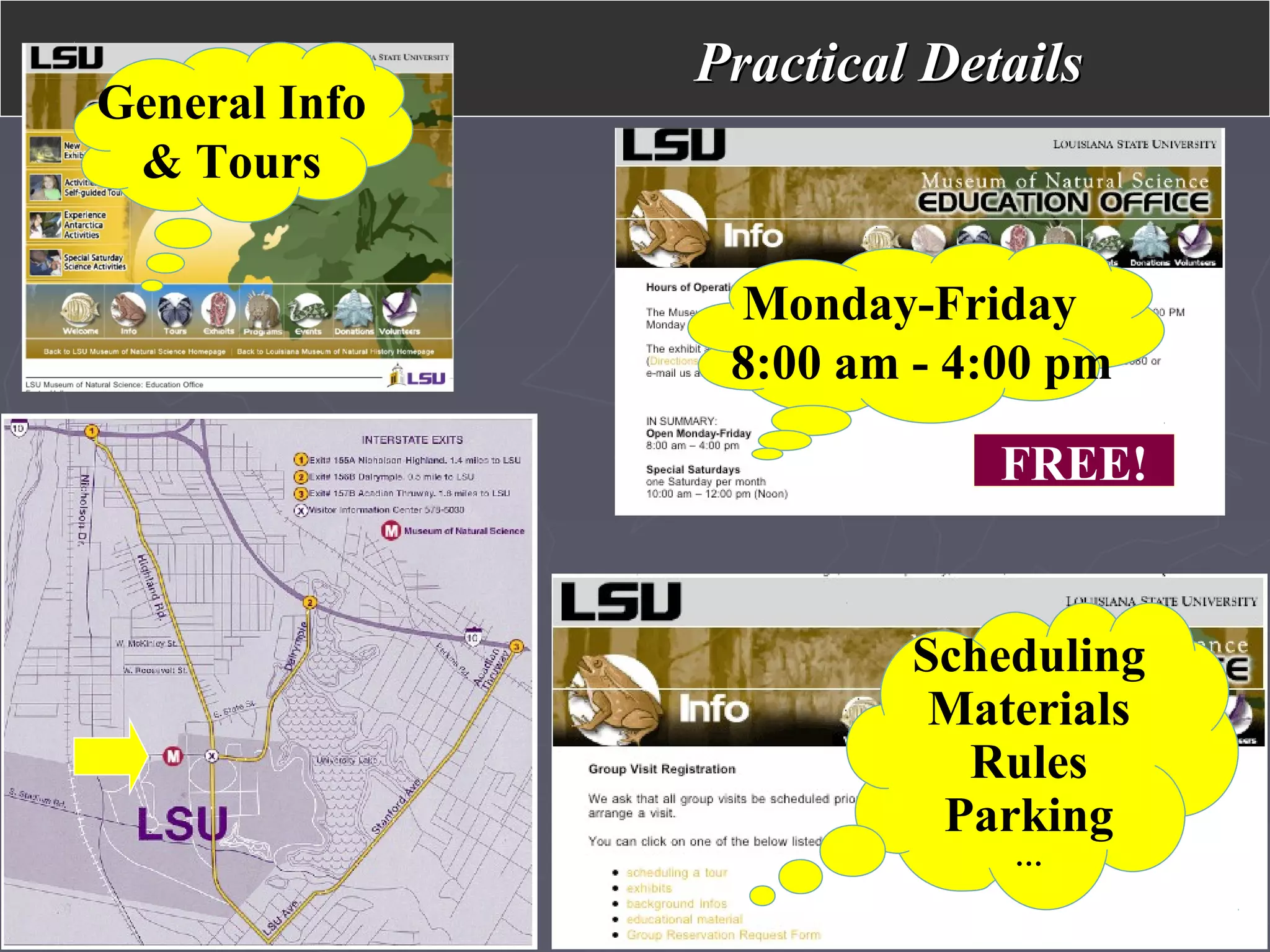
Practical DetailsPractical Details
General Info
& Tours
Monday-Friday
8:00 am - 4:00 pm
FREE!
Scheduling
Materials
Rules
Parking
…
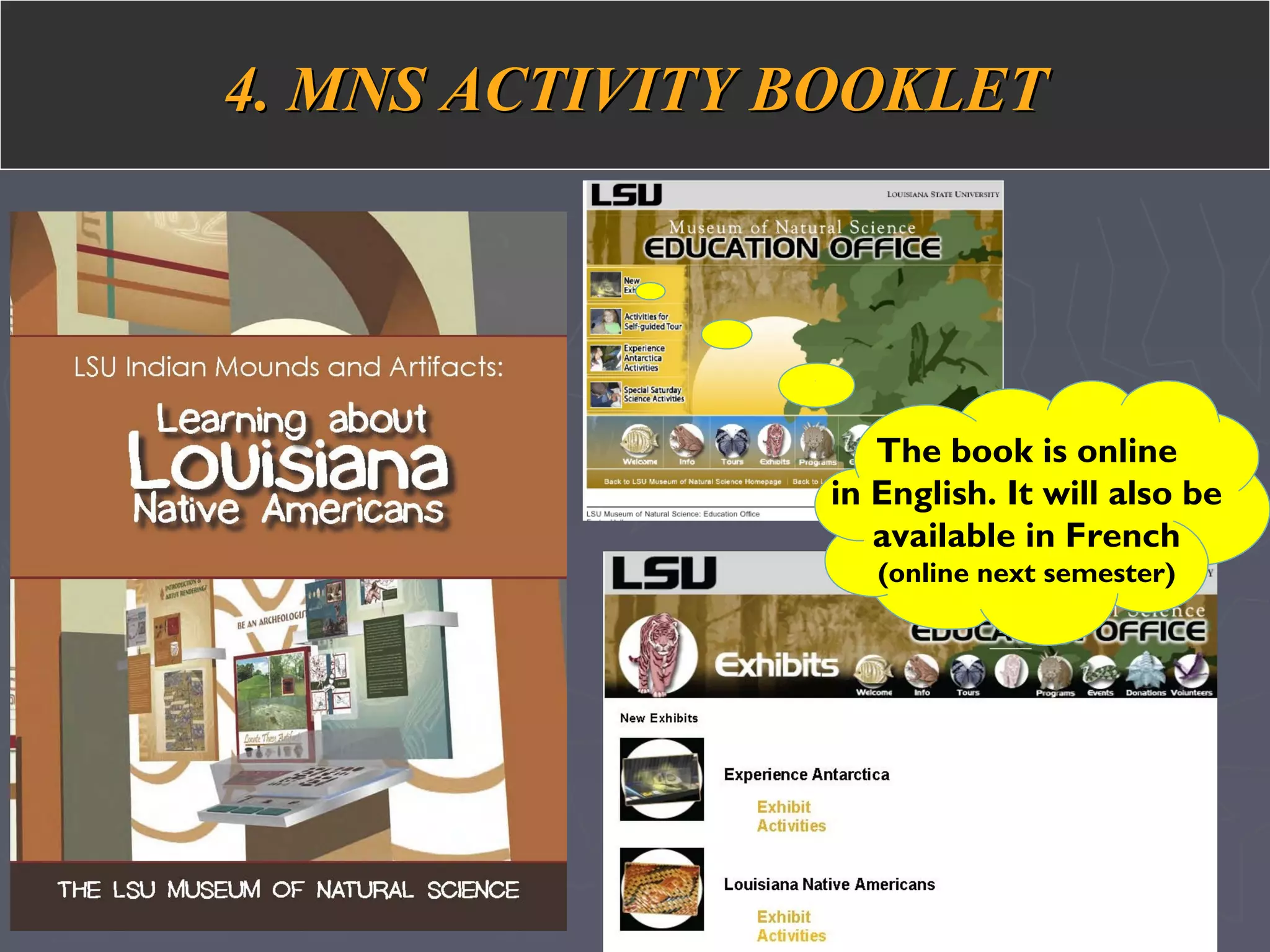
4. MNS ACTIVITY BOOKLET4. MNS ACTIVITY BOOKLET
The book is online
in English. It will also be
available in French
(online next semester)
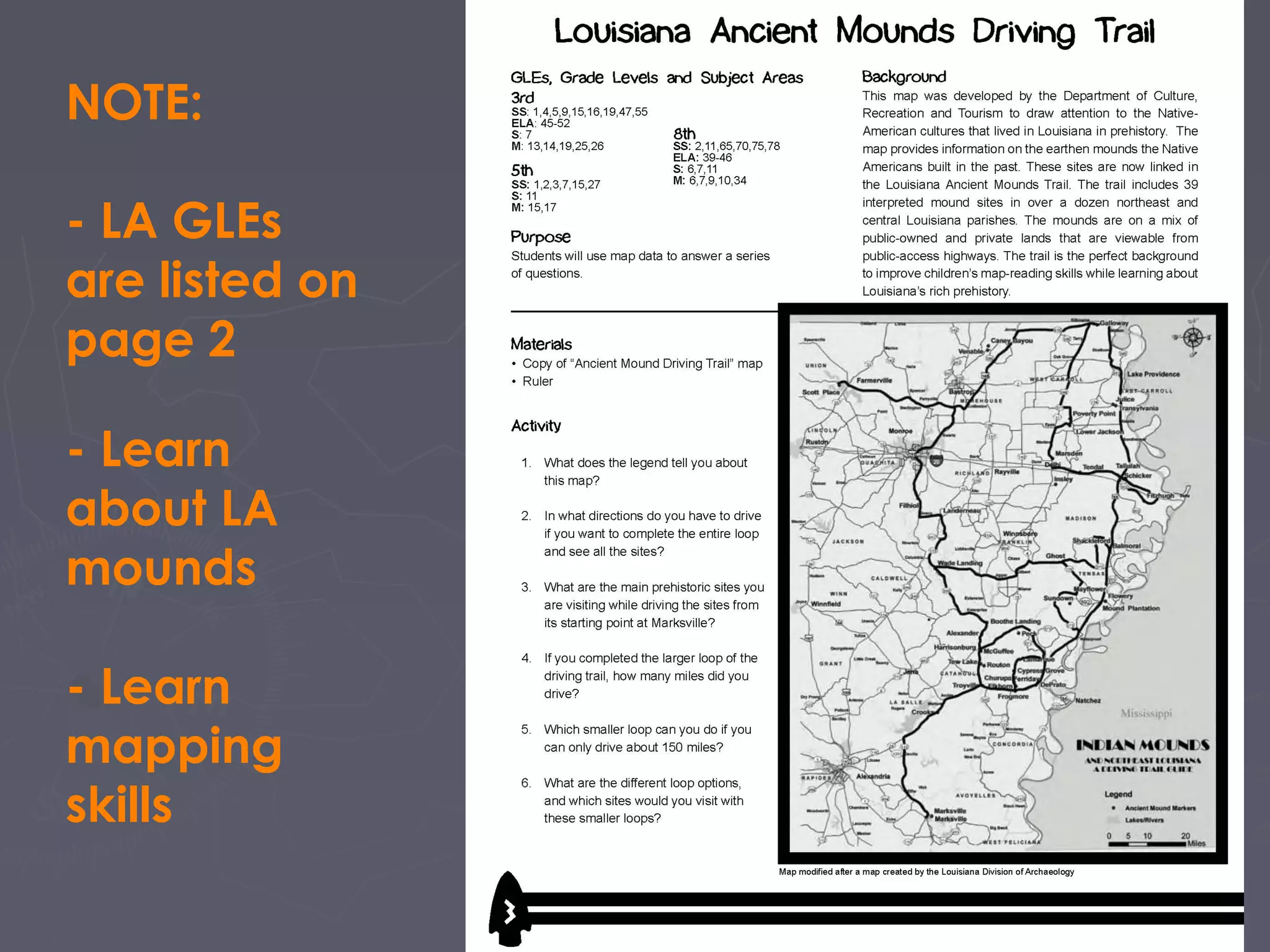
NOTE:
- LA GLEs
are listed on
page 2
- Learn
about LA
mounds
- Learn
mapping
skills
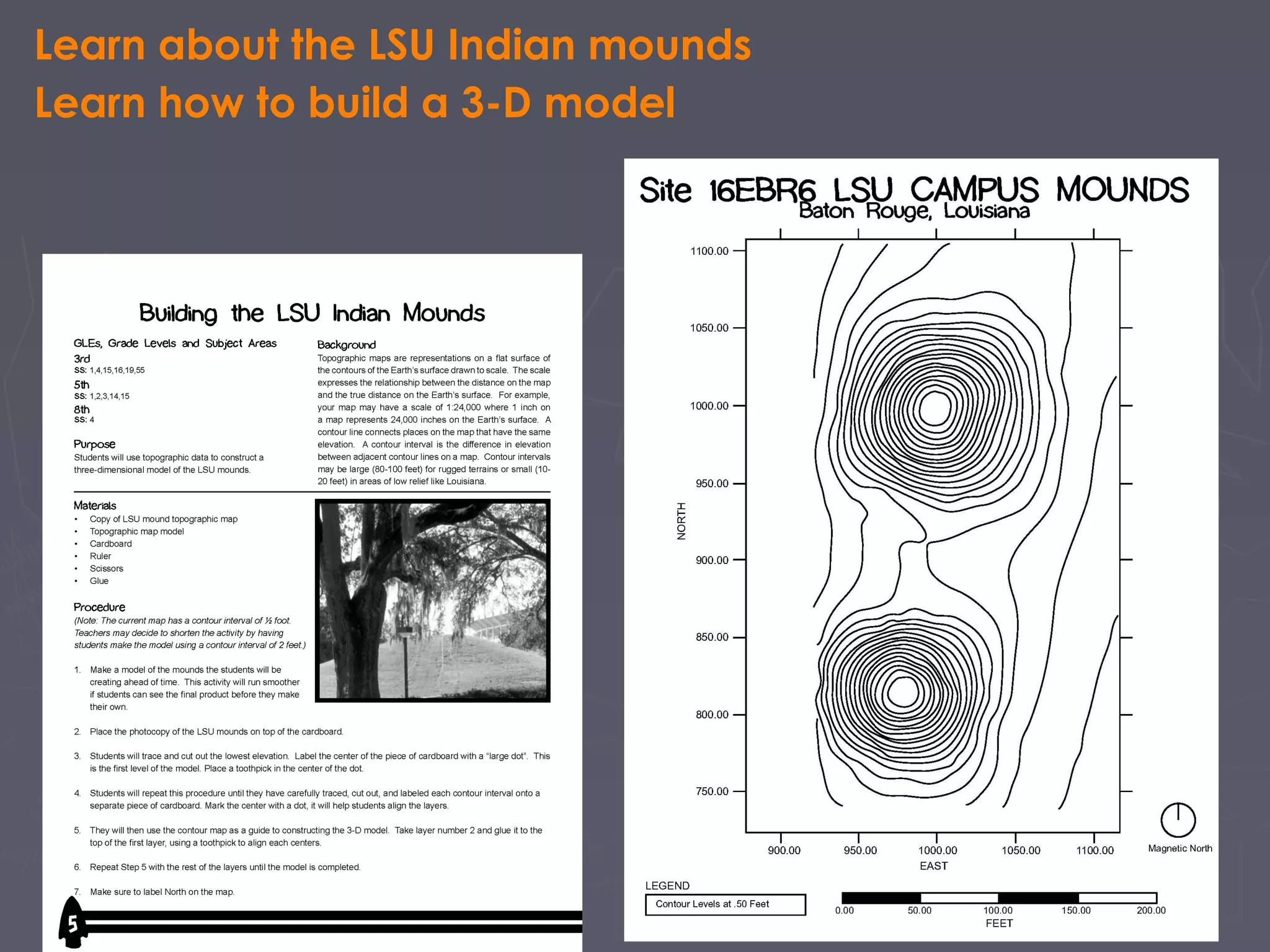
Learn about the LSU Indian mounds
Learn how to build a 3-D model
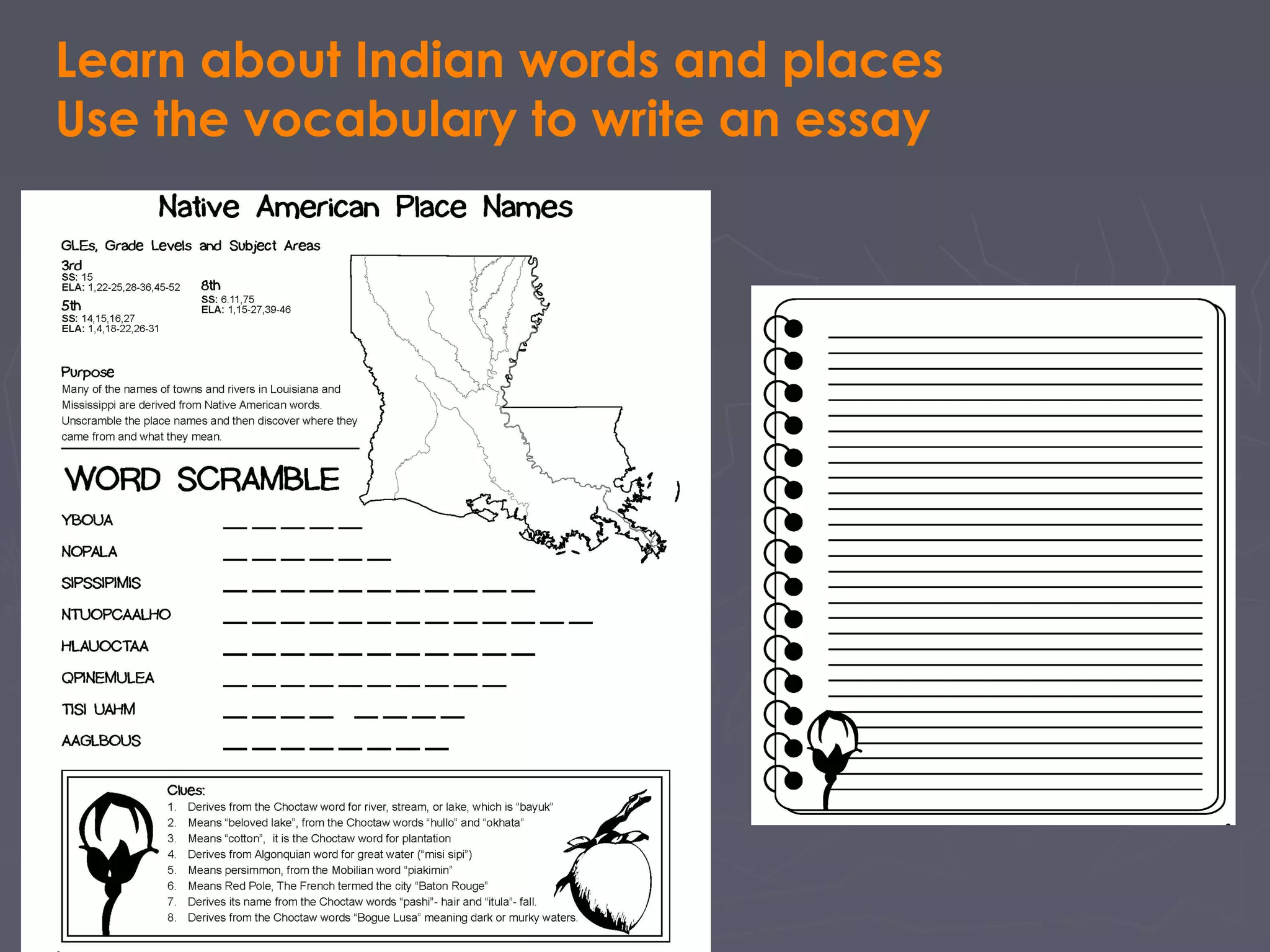
Learn about Indian words and places
Use the vocabulary to write an essay
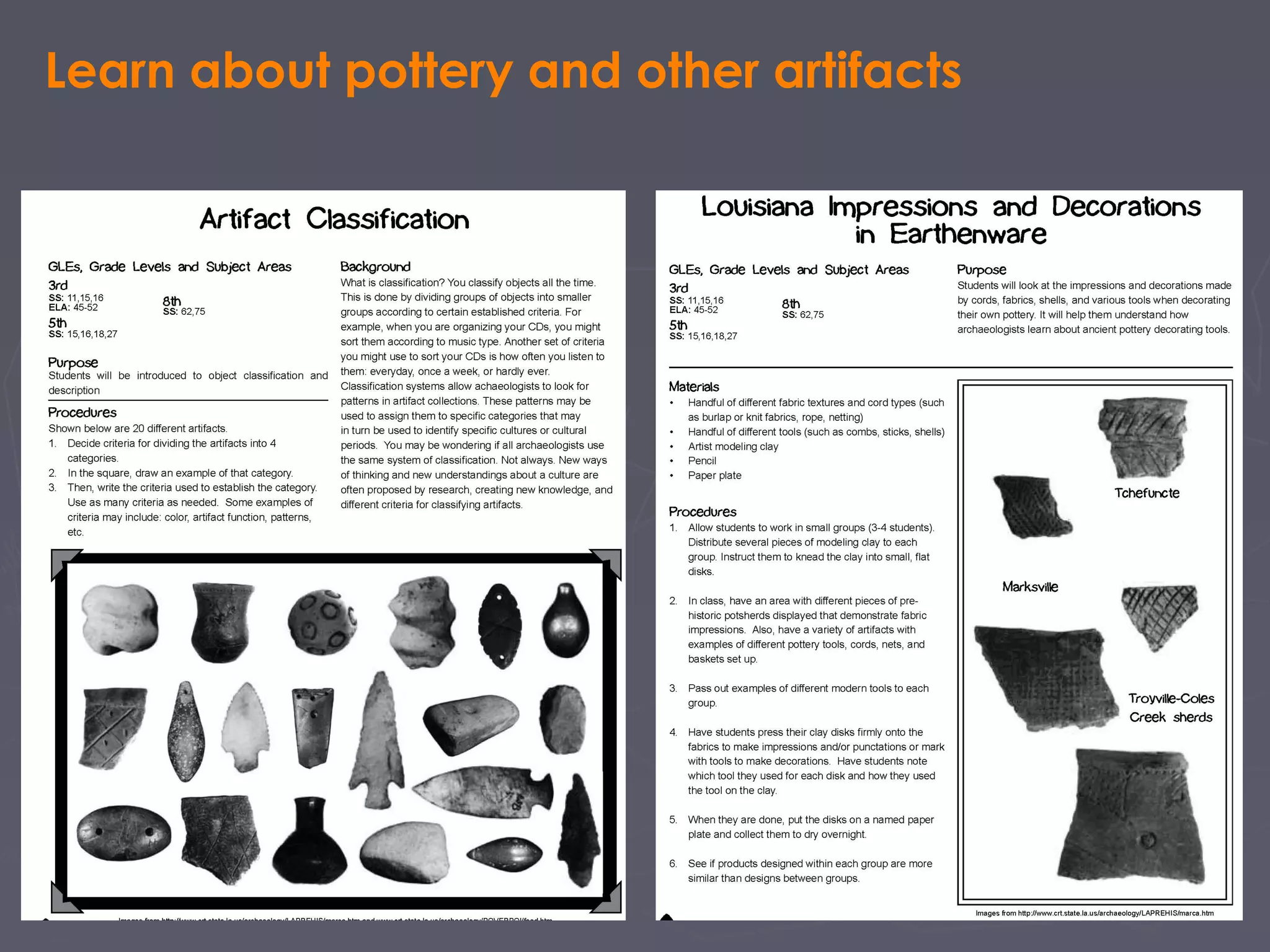
Learn about pottery and other artifacts
5. LA State Southeast Regional Archaeologist:5. LA State Southeast Regional Archaeologist:
Rob MannRob Mann
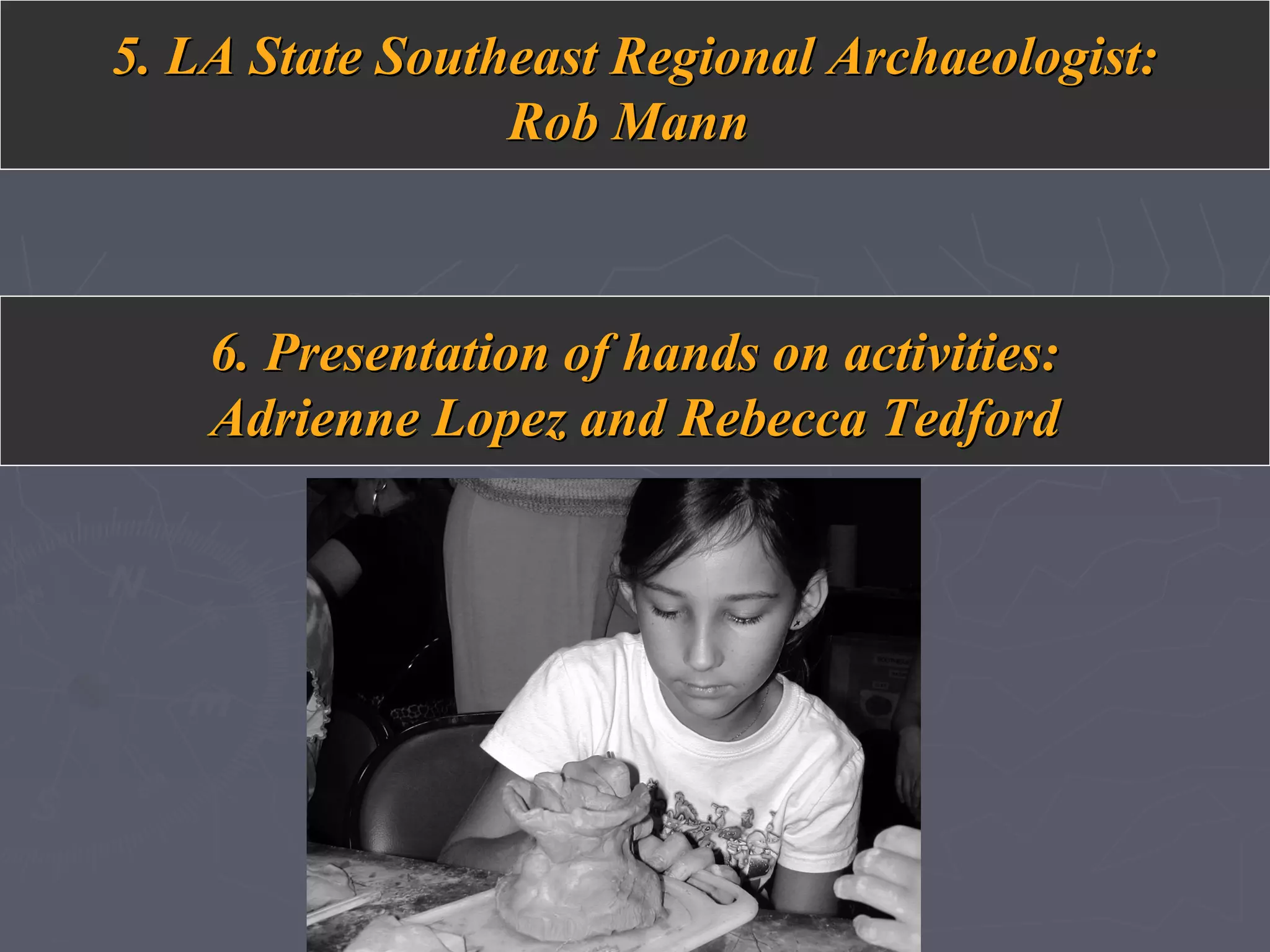
6. Presentation of hands on activities:6. Presentation of hands on activities:
Adrienne Lopez and Rebecca TedfordAdrienne Lopez and Rebecca Tedford

LSU MNS presentation on native americans

  • 1.
    Learning about LouisianaNative Americans with the MNS Sophie Warny, Ph.D. Museum of Natural Science & BASC
  • 2.
    We will talkabout…We will talk about…  1. The MNS Archaeology Collections  2. Field trip to the MNS or in your own school! - Learn about our new exhibit on Native Americans  3. New children’s activity book on Native Americans - English and French  4. History and Archaeology of Louisiana N. A. with an expert  5. Hands on activities to do in your schools - Learn about the different types of Indian potteries - Learn how to make N.A. pottery using the coiling method - Learn about artifacts
  • 3.
     7 mainfields of RESEARCH7 main fields of RESEARCH  Ornithology (Birds)Ornithology (Birds)  GeneticsGenetics  Ichthyology (Fishes)Ichthyology (Fishes)  MammalogyMammalogy  Herpetology (Reptiles and Amphibians)Herpetology (Reptiles and Amphibians)  Vertebrate PaleontologyVertebrate Paleontology  Anthropology (Archaeology and Ethnography)Anthropology (Archaeology and Ethnography)  EDUCATIONEDUCATION 1. The MNS collections1. The MNS collections
  • 4.
    Collections: More than 1.25million specimens from 2,000 sites in Louisiana and worldwide. For instance: The McIlhenny and Jastremski Chitimacha Indian Basketry collections (two of the most important of their kind in the nation) Research statement: Human adaptations through time and the evolution of cultural complexity. AnthropologyAnthropology Dr. Becky Saunders
  • 5.
    Satellite imagery shows location of moundsand embankment Louisiana Explorations: King George Island Mounds, Livingston Parish, constructed ca. 4500 years ago
  • 6.
    Graduate student Fiona Vasbinderand other LSU students embark for the King George Island mounds. Graduate student Harry Brignac delicately moves towards the southern mounds, across a low area from the main ridge. Graduate students Kevin Pemberton and Steven Fullen begin shovel testing. Stone tools from King George Island. Drills like these were often used to make beads.
  • 7.
    Bayou Grande Cheniersite, Plaquemines Parish, occupied ca. A.D. 1000-1200 False-color imagery shows the 12- mound Bayou Grande Chenier site as high ground amidst the fragmenting freshwater marsh of southern Louisiana Graduate student Tim Schilling, who wrote his Master’s thesis on the site, “Cap’n” Saunders, and other LSU students on their way to Bayou Grande Chenier.
  • 8.
    Oblique aerial photoshowing the 11- mound main group and Mound 12. Profile of Unit 2 showing artificial construction of embankment tying the mounds together into a ring Pottery vessels placed on ground prior to construction of the embankment. Bayou Grande Chenier
  • 9.
    2. FIELD TRIP:CONTENT2. FIELD TRIP: CONTENT Louisiana Native Americans: A new exhibit!
  • 11.
    If you cannotcome to LSU, you can bring the exhibit to your school! 225-578-3958 Holly Tunkel
  • 12.
  • 14.
  • 15.
  • 16.
  • 20.
    Bone, stone, and shell technology What isthis artifact used for?: interactive.
  • 22.
  • 24.
  • 26.
    3. FIELD TRIP:PRACTICAL DETAILS3. FIELD TRIP: PRACTICAL DETAILS
  • 27.
    Practical DetailsPractical Details GeneralInfo & Tours Monday-Friday 8:00 am - 4:00 pm FREE! Scheduling Materials Rules Parking …
  • 28.
    4. MNS ACTIVITYBOOKLET4. MNS ACTIVITY BOOKLET The book is online in English. It will also be available in French (online next semester)
  • 29.
    NOTE: - LA GLEs arelisted on page 2 - Learn about LA mounds - Learn mapping skills
  • 30.
    Learn about theLSU Indian mounds Learn how to build a 3-D model
  • 31.
    Learn about Indianwords and places Use the vocabulary to write an essay
  • 32.
    Learn about potteryand other artifacts
  • 33.
    5. LA StateSoutheast Regional Archaeologist:5. LA State Southeast Regional Archaeologist: Rob MannRob Mann 6. Presentation of hands on activities:6. Presentation of hands on activities: Adrienne Lopez and Rebecca TedfordAdrienne Lopez and Rebecca Tedford

Editor's Notes

  • #6 Here are some examples of current and past research projects that Dr. Saunders directed in Louisiana.
  • #10 This is what’s directly impacting you and your class and I want to spend some time describing our new exhibit. It is entitled: ….. We used ongoing research results from the Museum archaeology dept. and some of the artifacts from our collections to create this new exhibit. We made sure that it was Louisiana centric so that your students can relate to place names and learn about this unique aspect of Louisiana’s heritage.
  • #12 Describe the traveling exhibit. Then say, either way, whether you come to LSU or if you borrow this exhibit, you will see the same content in the panel, so I want to spend some time presenting each section to you so that you know what to expect. This powerpoint will be online so you will have access to it as well.
  • #13 1) First, we start the exhibit with a timeline that is not visible on this rendering, but it is located on top of this panel.
  • #14 This is a close up view of this timeline. I also want to mention that all these panels are available as pdf online so you can zoom on them and download them from your classroom. As you can see on this timeline, Native Americans have lived in what is now Louisiana since over 10,000 years. Aspects of their life have been captured and saved in the artifacts and other durable construction. And that’s what we are sharing with you in this exhibit. When you look at the timeline, please note the main Louisiana N.A. period listed in green. Each represents some major evolution in culture, etc. Read the names.
  • #15 Then, you can move your tour to this panel which contains the Introduction. This is the panel located in the center of the exhibit.
  • #16 Here is a close up view of this panel. We partnered with the Louisiana Department of Culture, Recreation, and Tourism to bring you this map. Louisiana has actually about 700 known mound sites (see map in black and green), and… the CRT map presents a driving trail that will take you to some of these best and most accessible mounds. They selected 39 mound sites in Louisiana and placed some information at each of these sites. This is a great complement field trip to a school program, or for your family, or out-of-state guests. This map is available with more info on the CRT website. The bottom part of the panel provides informations on the 5 oldest type of mounds found in Louisiana (remember the timeline: from prehistoric to Marksville).
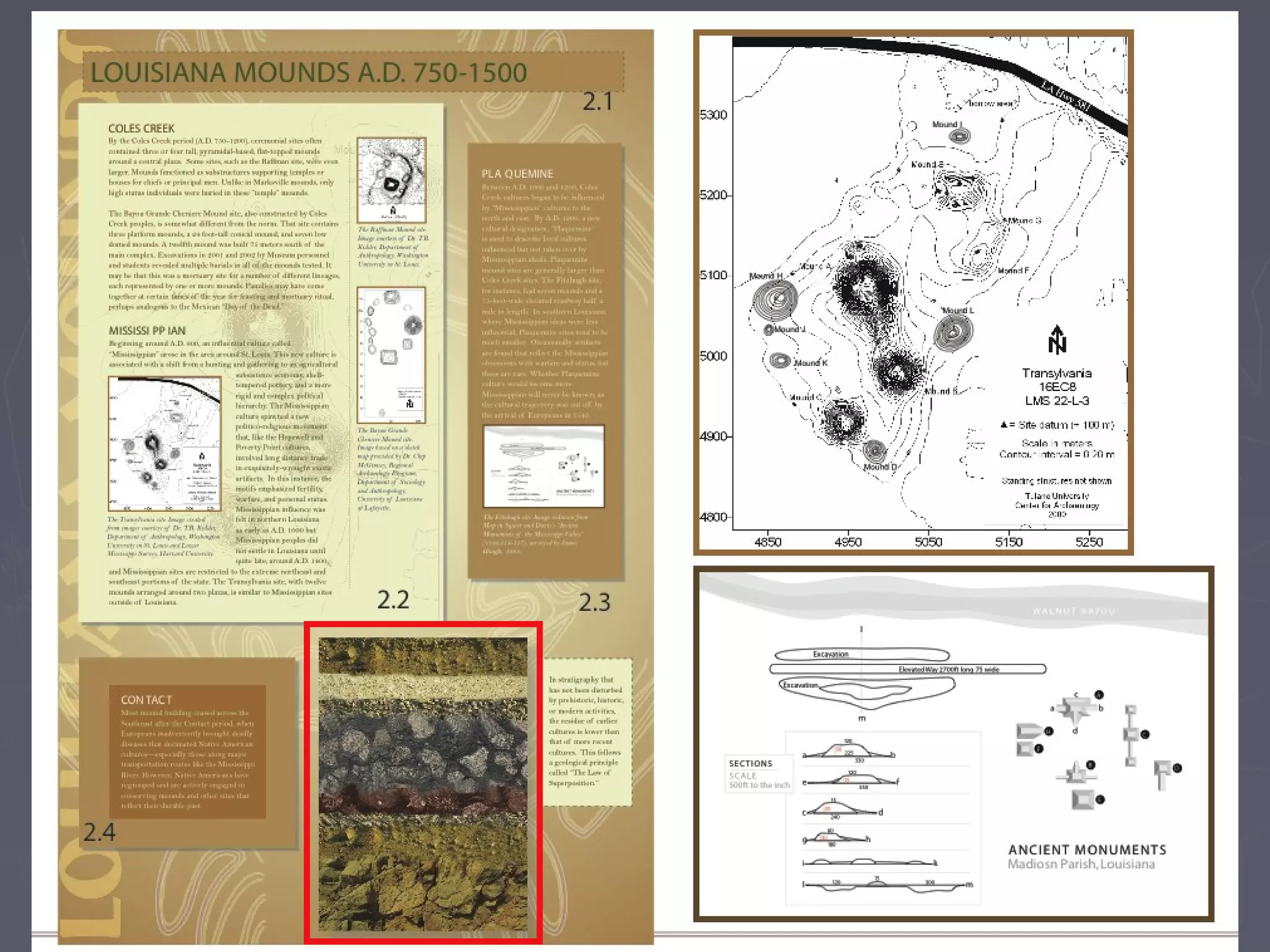
  • #18 This second panel provides information on the four youngest type of Louisiana mounds, from Coles Creek to Plaquemines and Contact. It also includes a stratigraphic model that help visualise the concept of stratigraphic sequence and age succession. Each layers includes an artifact, with the oldest inside the oldest sediment on the bottom and the youngest to the top in the younger sediment.
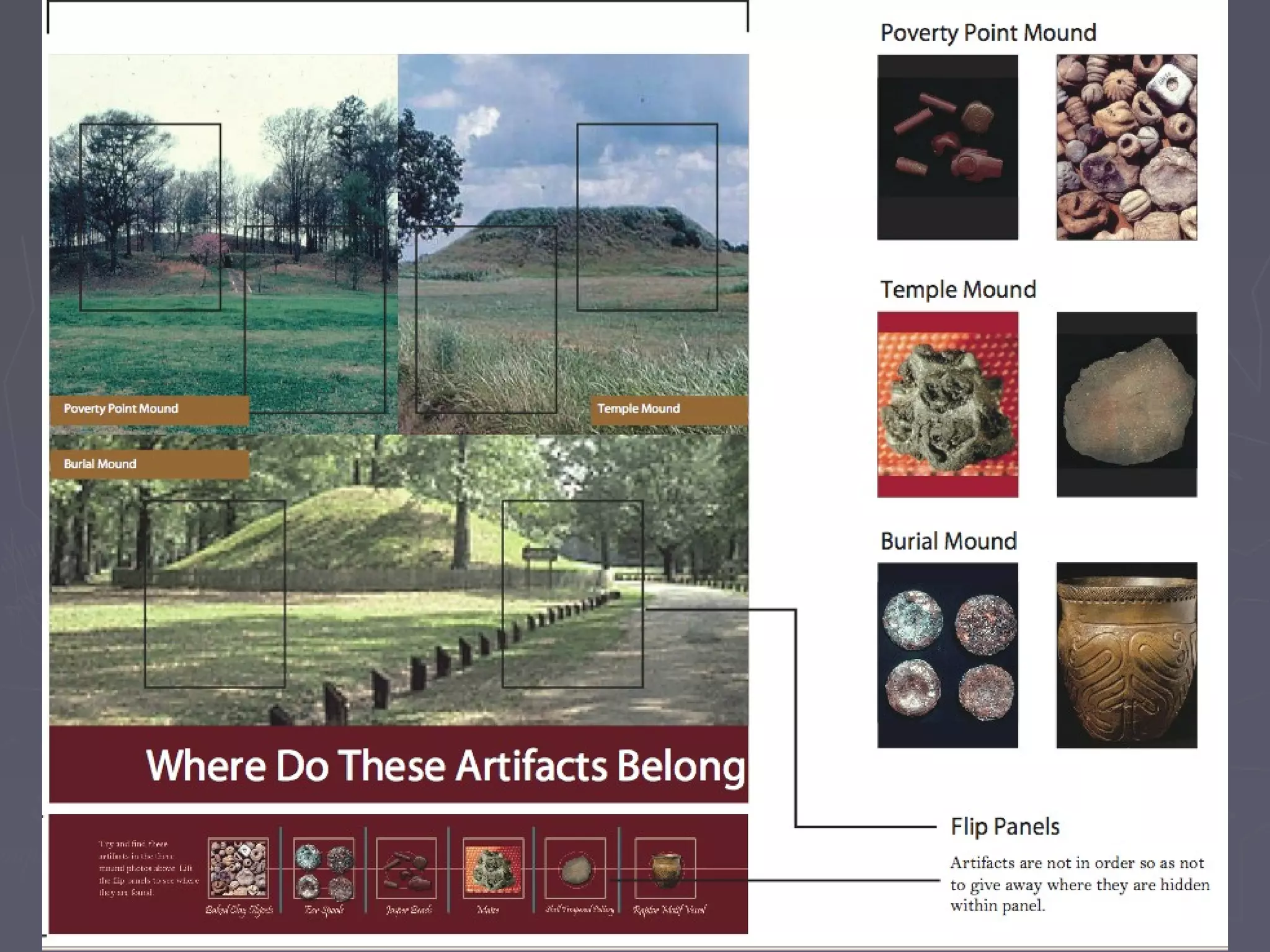
  • #19 This interactive game help tie some of the concepts discussed in the panel. Three different types of mounds are pictured on top, and a series of various artifacts are pictured on the bottom. Children have to use what they learned in the exhibit to match the artifacts to the correct mound. The solution are in flip panels inside the mounds. Items are baked clay object and jasper beads, maze and shell tempered pottery, and finally ear spools and a vessel.
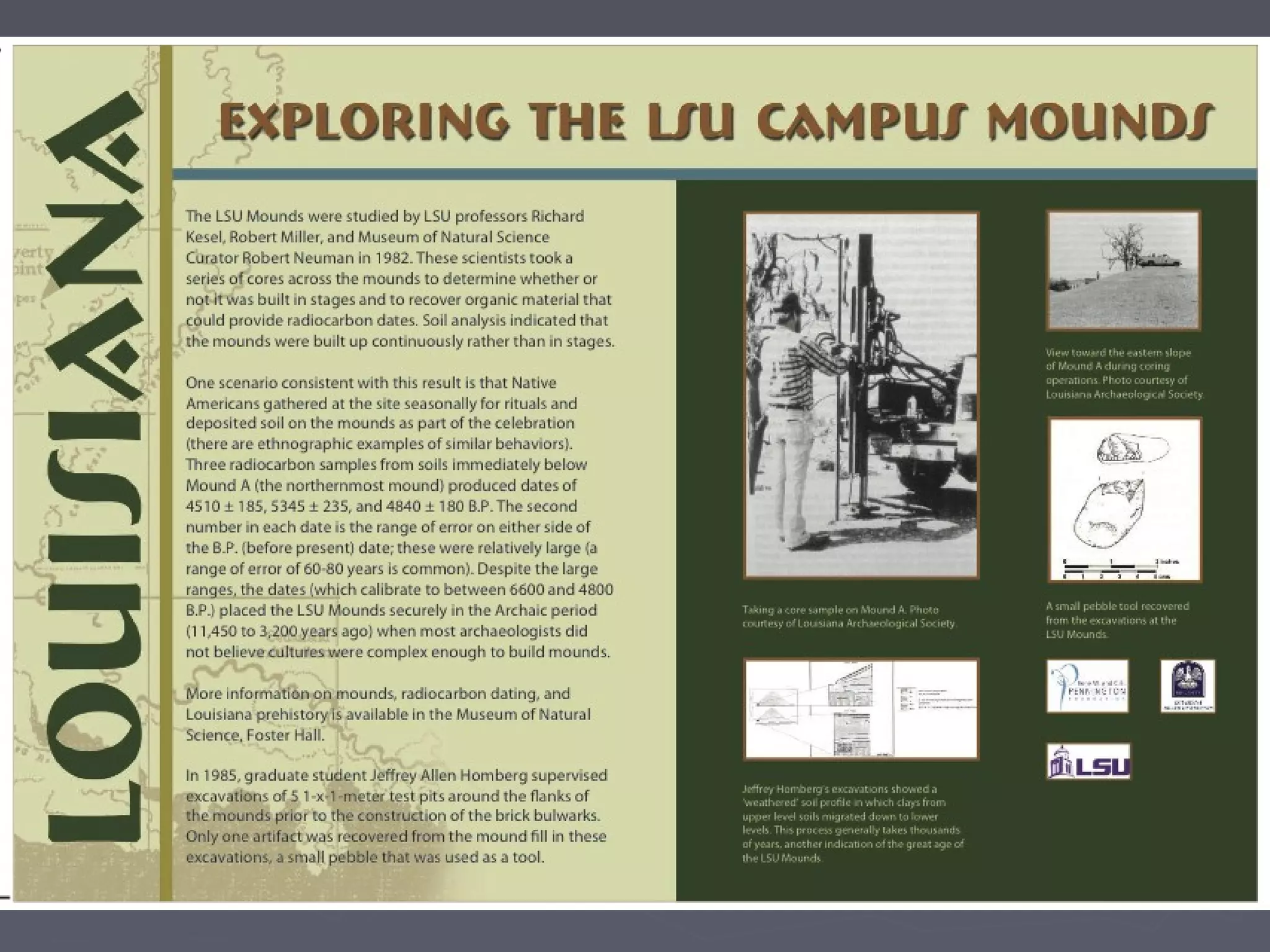
  • #20 And of course, if you are visiting the exhibit on the LSU campus, our museum is located just a short 1 minute walk to the LSU Indian Mounds. These mounds were probably used for ritual, and were build sometimes between 4000 and 6000 years before present, clearly in the Archaic period.
  • #22 Here is a close up view of the panel on bone, stone, and shell technology. This panel presents the type of tools and ornaments created by Native Americans. For instance - we present these in the panels, and have some artifacts from our collections on display in the Museum: projectile points (spears, dart, arrow points) and bola stone (attach to cord and thrown) made out of stones. fish hooks carved in bones fish net weights sculped from stones digging tools made out of shell as stones are not common in LA needles carved from turkey bones jewelry or ornaments such as beads, pendants, sculped from stones.
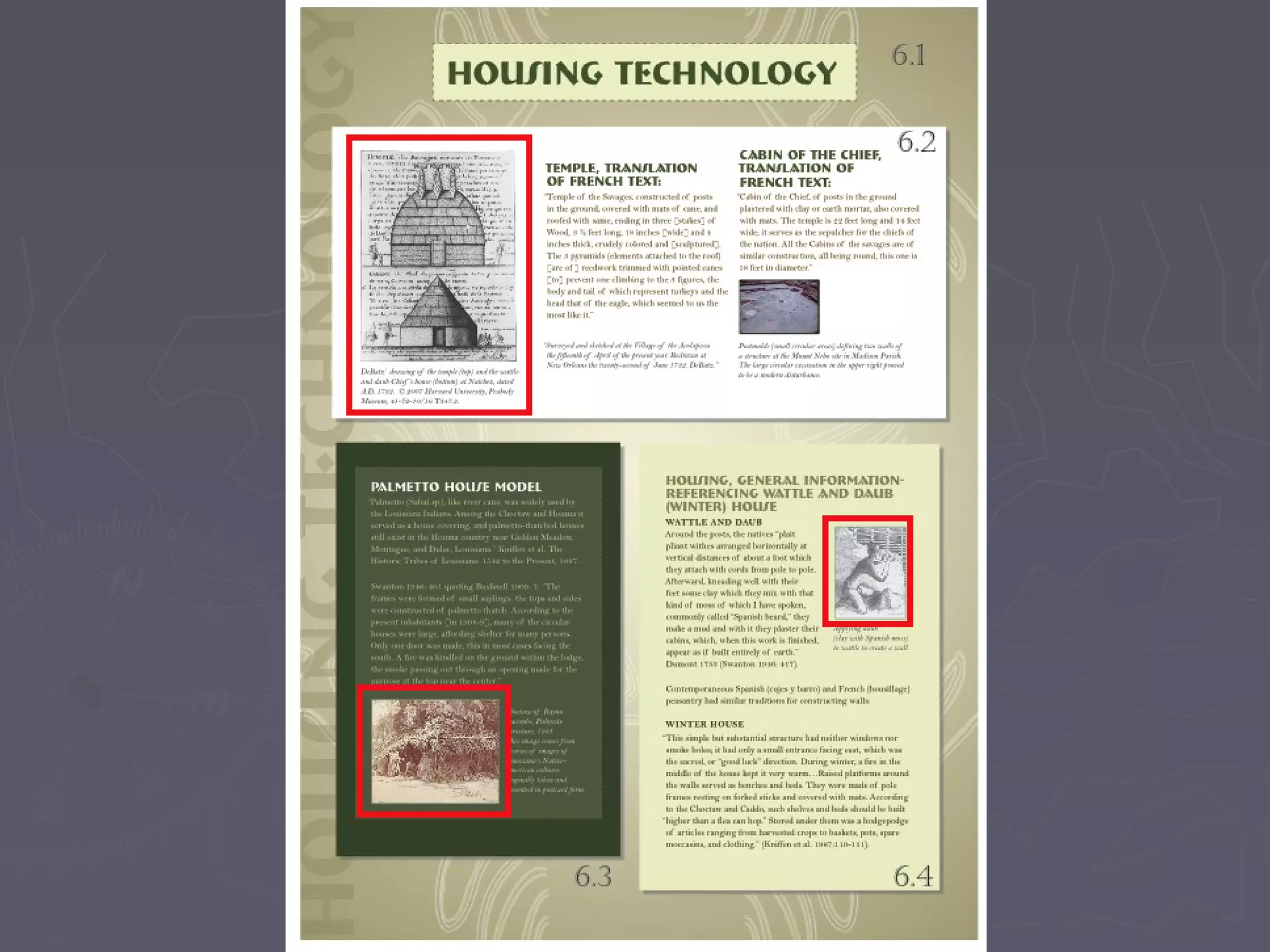
  • #23 Another topic discussed is the Native Americans housing technology in Louisiana AS you can see, we have some of the models on display.
  • #24 1) This panels describe the two main types of houses built by Native Americans in Louisiana, one is the Palmetto house, on the green panel, and the other type is the wattle and daub house. This latest technique is very similar to what we call in French “bousillage.” It is interesting to note that both technique were used about at the same time here in LA by Aative Americans, and in the French countryside. 2) Another point that is interesting for the French immersion program teachers is that the original description (here on the panel) is in old French. We provided the translation in the text to the right of the original image.
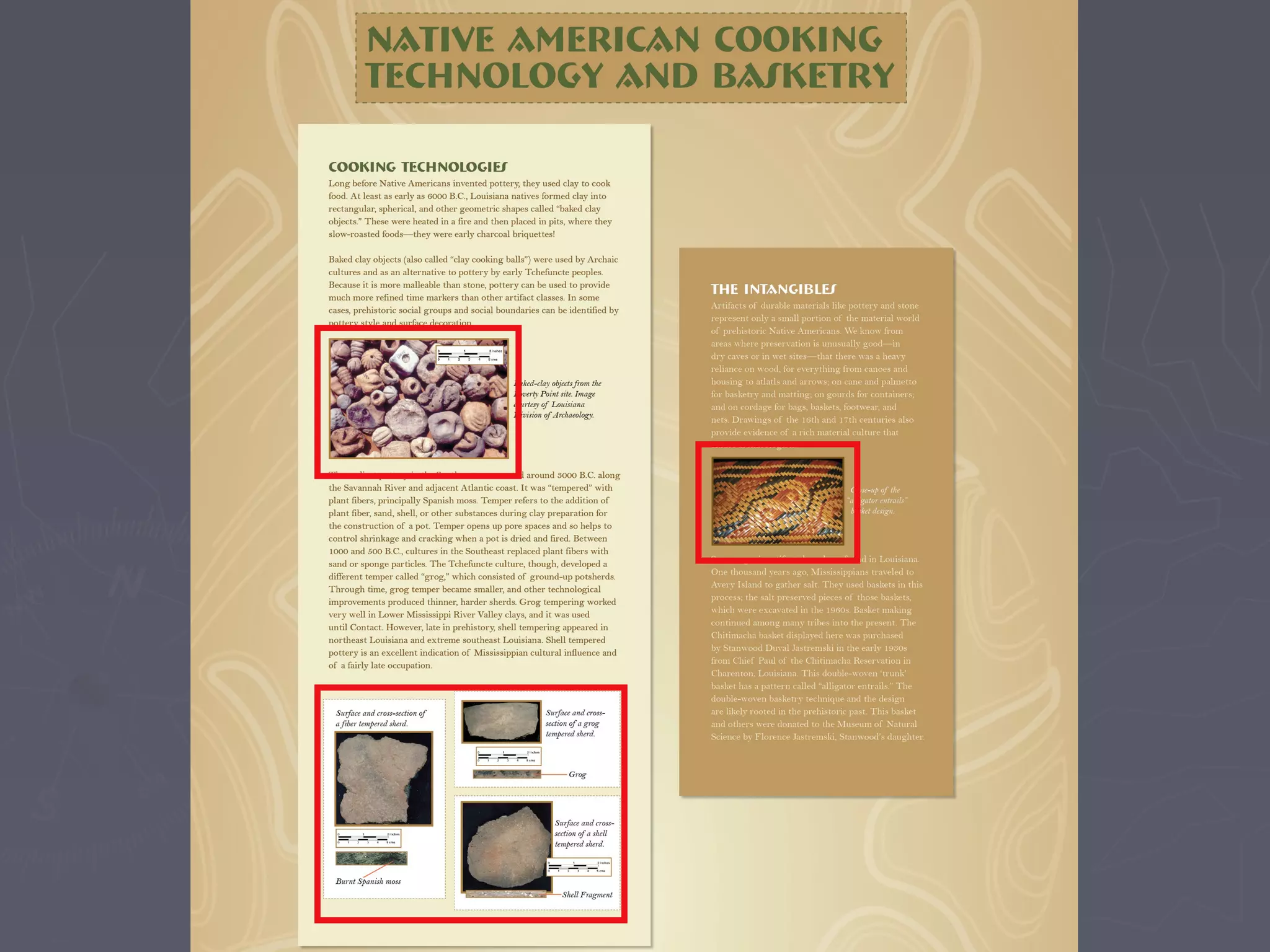
  • #25 1) Finally, the last panel is on the cooking technology. 2) We have some of the pottery and baskets discussed in the text on display.
  • #26 Again, this is a close up of the panel. Here you see some of the oldest cooking tools. These baked clay objects were used in a similar way as we use “charcoal briquettes” today, but these were used a long time ago (6,000 BC). Here, you can see the three major types of pottery. Each pottery was tempered with various material such as moss, sherds or shell. But Adrienne will discuss this in detail with you using the SOAR. And finally, to close the tour, we discussed Indian basketry.