Automatic Assessment of  Failure Recovery in Erlang Applications Jan Henry  Nyström [email_address]
Why is fault tolerance important How can we achieve fault tolerance How do we do fault tolerance in Erlang So what is the problem with that then? A solution to the problems Extracting the information What do we do with the information Correctness concerns The tool Overview
Why is fault tolerance important Obvious where a failure can have life threatening effects Nuclear power plant control systems Aircraft control systems Vending machine control systems But the dependence on 24/7 available systems is pervasive Banking Travel agent Health services Bookies Games
How can we achieve fault tolerance Problems: Hardware fails Nonconformance to specification Changed interfaces Idiots (users) There are three things in life we cannot avoid Death Taxes Bugs (code, specification and requirements)
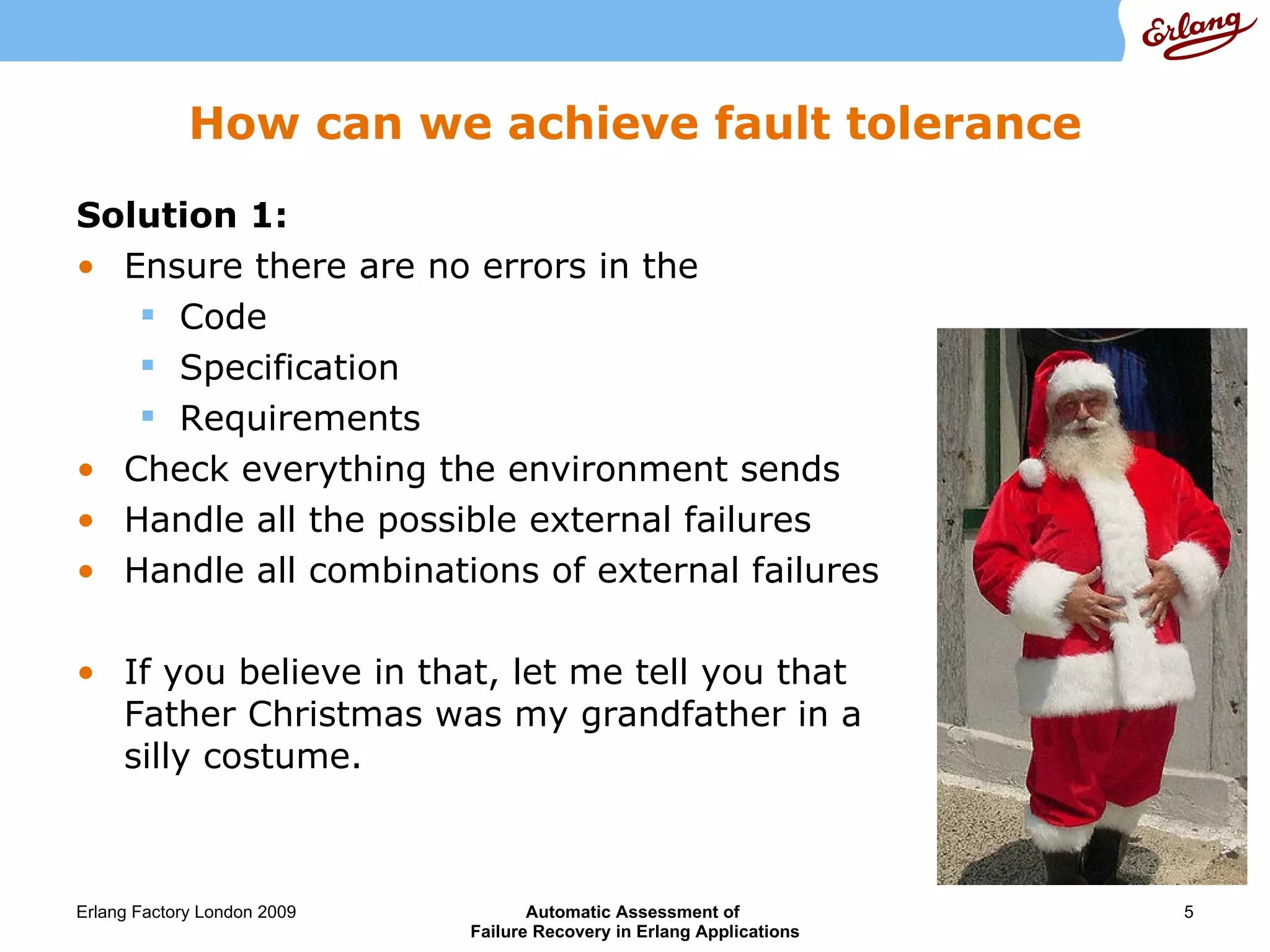
How can we achieve fault tolerance Solution 1: Ensure there are no errors in the Code Specification Requirements Check everything the environment sends Handle all the possible external failures  Handle all combinations of external failures If you believe in that, let me tell you that Father Christmas was my grandfather in a silly costume.
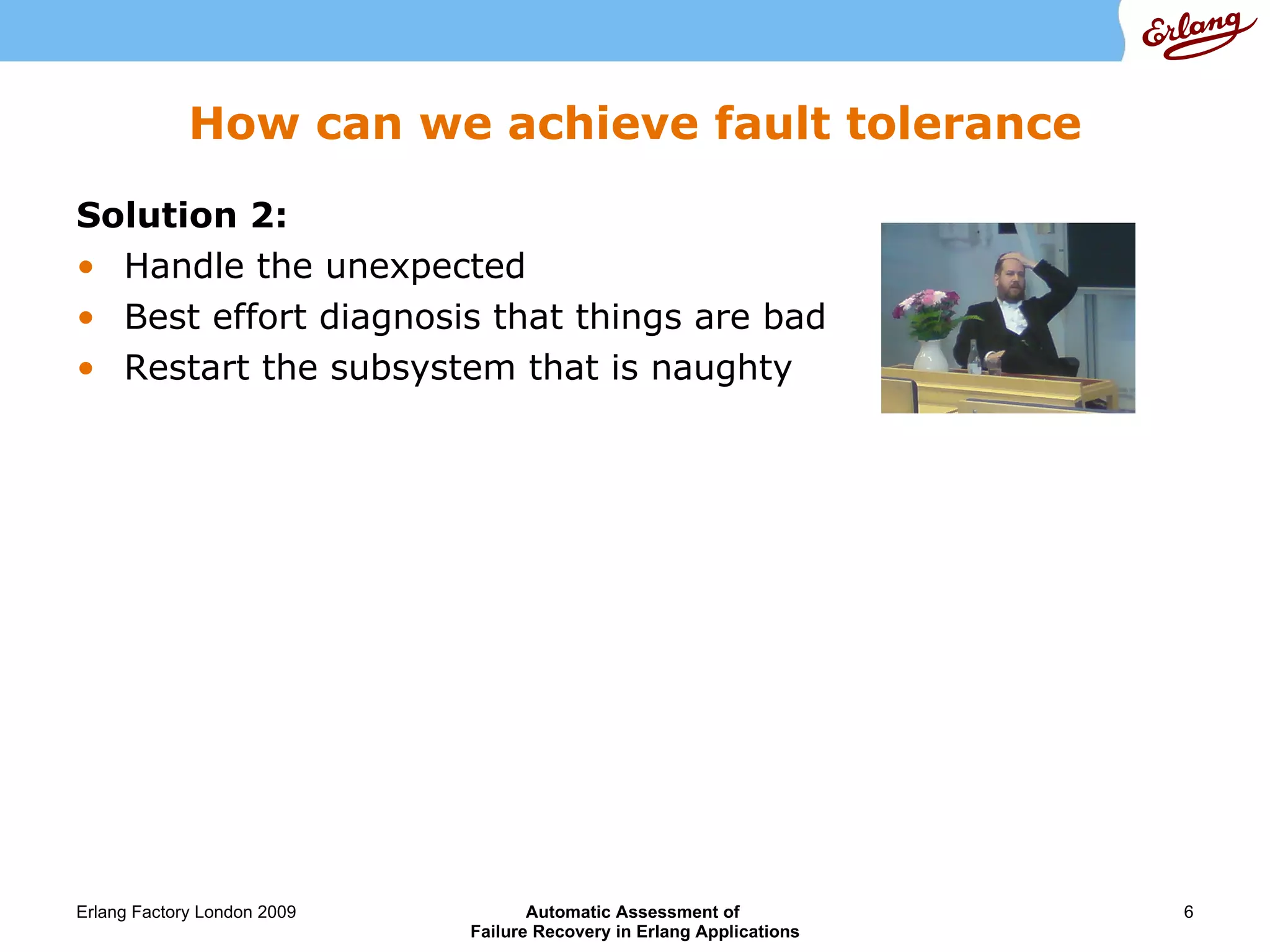
How can we achieve fault tolerance Solution 2: Handle the unexpected Best effort diagnosis that things are bad Restart the subsystem that is naughty
How do we do fault tolerance in Erlang Solution 2:   Handle the unexpected Let it crash! Exceptions are only caught when you can solve the problem here and now Best effort diagnosis that things are bad Assertional style of programming, stating the correct case rather than hedging your bets. See previous point When some process has crashed it is trivial really Restart the subsystem that is naughty Supervision of processes by other processes that restarts them, then iterate
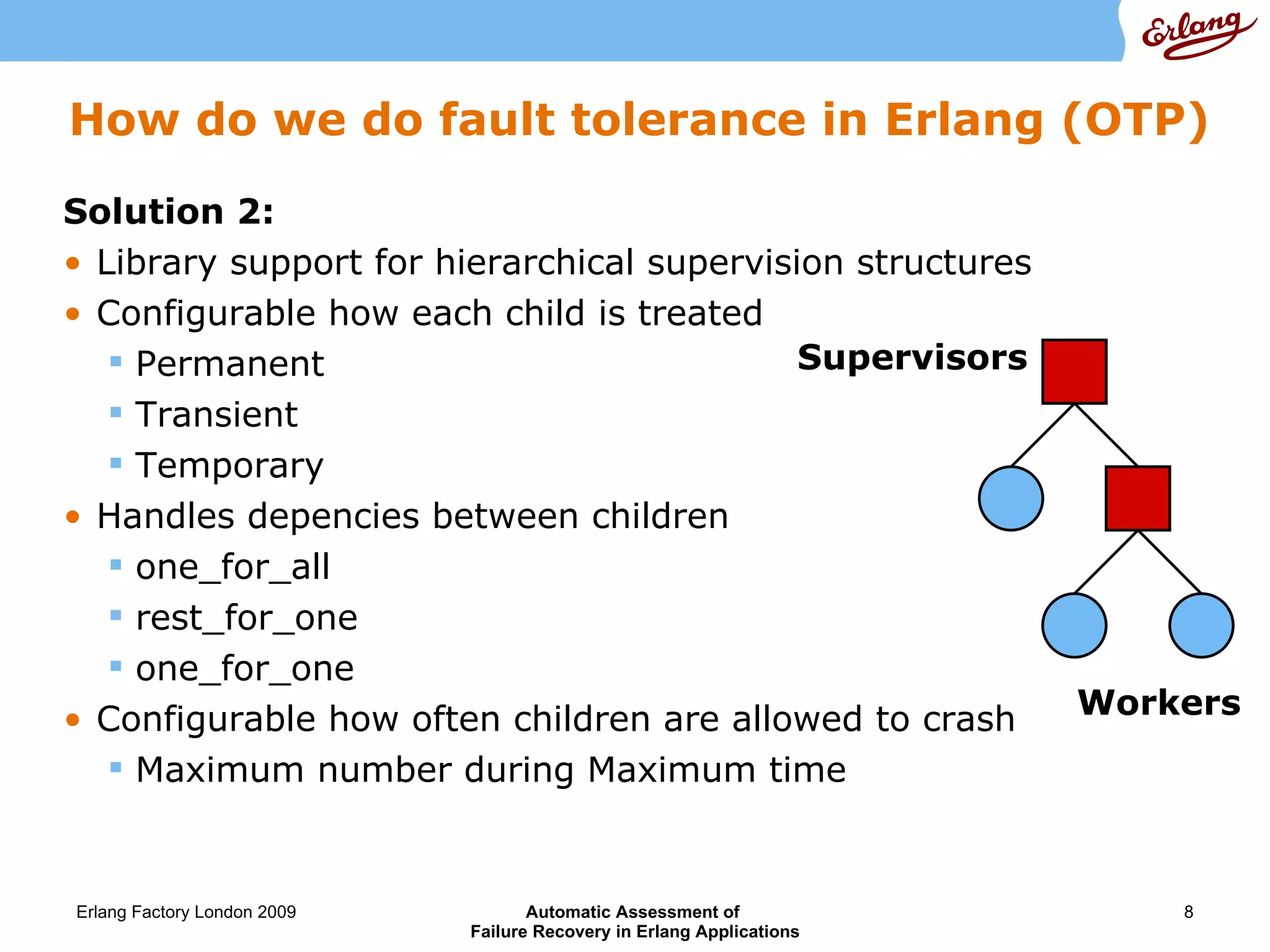
How do we do fault tolerance in Erlang (OTP) Solution 2: Library support for hierarchical supervision structures Configurable how each child is treated Permanent Transient Temporary Handles depencies between children one_for_all rest_for_one one_for_one Configurable how often children are allowed to crash Maximum number during Maximum time Supervisor s Workers
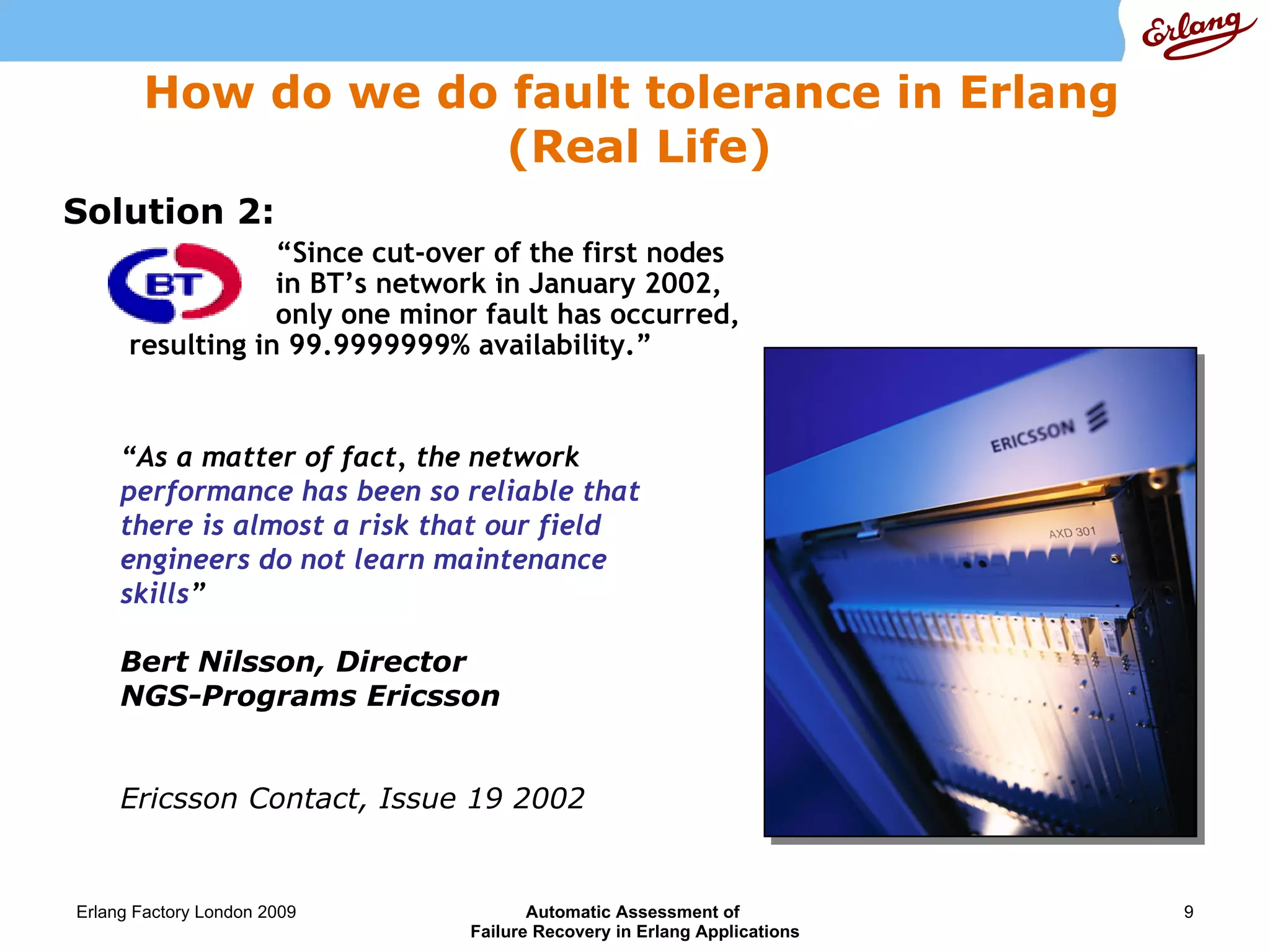
How do we do fault tolerance in Erlang  (Real Life) Solution 2:   "We are  extremely pleased with the outcome of the initial phase of this project.  This is a major step in the phased development of what we believe is a world-leading Next Generation Network," said Richard Newman, General Manager of Planning and Delivery of Network Transport at BT Wholesale. Ericsson Press Release 5 July, 2002 “ As a matter of fact, the network  performance has been so reliable that   there is almost a risk that our field engineers do not learn maintenance skills ”  Bert Nilsson, Director  NGS-Programs Ericsson Ericsson Contact, Issue 19 2002 “ Since cut-over of the first nodes    in BT’s network in January 2002,   only one minor fault has occurred, resulting in 99.9999999% availability.”
So what is the problem with that then? We have a nice framework to build fault tolerant systems in It has been proved in practice that it can be used to build large scale fault tolerant systems But, how do we now that we have actually built a system with good fault tolerance properties? Test…  good but we have to  handle all combinations of failures Understanding your supervision structure really, really helps That is actually what is talk is all about
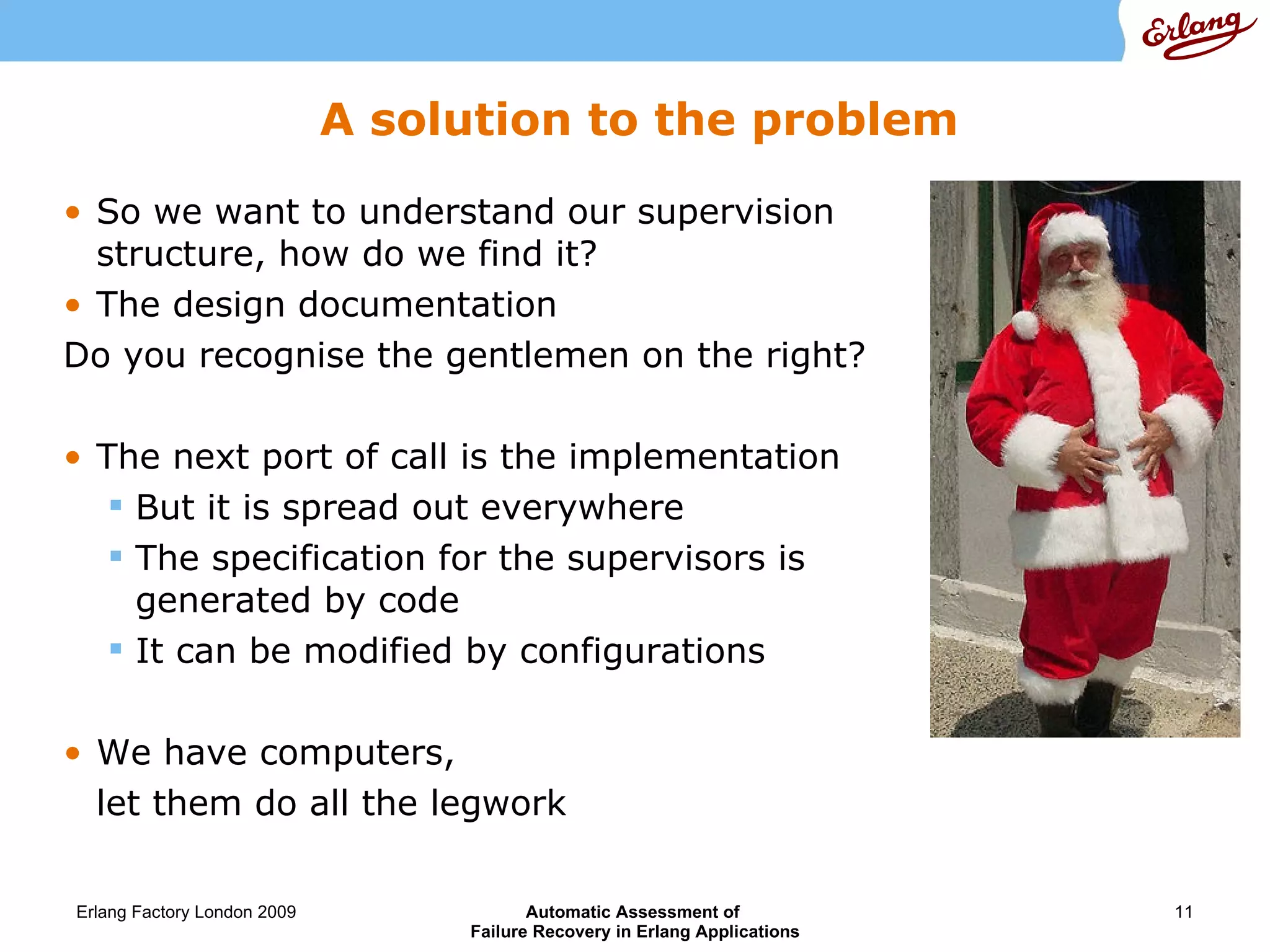
A solution to the problem So we want to understand our supervision structure, how do we find it? The design documentation Do you recognise the gentlemen on the right? The next port of call is the implementation But it is spread out everywhere The specification for the supervisors is generated by code It can be modified by configurations We have computers,  let them do all the legwork
Extracting the information So we want to have a tool that extracts the supervision structure from the source code of an Erlang system Unfortunately, it is not only impossible in the general case, it is intractable in most of the actual cases. Let’s run it and inspect it We need all the possible interleavings of starting of processes and messages between them Potentially only one structure out of many depending on configuration We have to have a runnable system before we can even start inspecting it
Extracting the information (Take 2) Limit analysis to OTP systems Well defined supervisors provided (you got the code) Synchronised start up sequence (behaviours required)  It is sufficient to look at processes in isolation Well defined initialisation part of processes that are behaviours  Symbolic evaluation Enables us to handle the case that we lack information Restrict the analysis to the  “static part of the system” Otherwise when do we stop The unit of interest is the application Natural unit in OTP
Extracting the information (In practice) Missing information Code does not exist or compile, missing configuration We introduce an “unknown” value  top element of the semantic domain But we have to be able to handle that value We introduce non determinacy in the evaluation When we have a choice depending on an unknown value we explore all the possible evaluations
Extracting the information (In practice) Evaluation Depth  Potentially the code does not terminate when we have an unknown value When should we give up, configurable Simple cycle detection
Extracting the information (In practice) Setup Paths Inclusion directories Node name
Extracting the information (In practice) Global state We cannot let the analysed system interact directly with the real world We have to be able to reset the global state for an alternative evaluation We simulate the global state of the system for the parts we cannot do without and assume no knowledge of the rest Simulated are (and possibly initialised): Registry, Erlang Term Storage(ets), Mnesia, File System The generation of global states has to have a good chaching mechanism
Extracting the information (In practice) Exception Handling  The non determinacy and exceptions are not good bedfellows Many constructs make it necessary to consider a possible exception when we evaluate with an unknown value present This can cause an intractable growth in the number of evaluations that has to be considered Three strategies to deal with this: Hope for the best Ignore uncaught exceptions, they would just crash the system anyway Ignore all exceptions, this is unsound
Extracting the information (In practice) Behaviours The behaviours’ behaviour is supposed to be well defined We do not want to analyse that The  behaviours are embedded in the evaluator for efficiency
What do we do with the information Read and inspect it manually But we have computers We can animate the supervision structure and actually show what happens when a selected process fails We can combine information and deduct properties How often a particular process has to terminate to cause  the entire structure to fail We can formally reason about properties What properties should we consider? Repair No concealment Good design principles
What do we do with the information The  Repair  property: Whenever a process that takes part in the supervision structure fails, the supervision structure returns to the process structure prior to the failure after a reasonable delay.
What do we do with the information The  Repair  property: We need to check: Each processes that fails is replaced by an equivalent “restarted” process in the structure Each process replaced by a restarted process has indeed terminated Side orders A non-supervisor that is linked to a failed process does not trap exits The initialisation of a restarted process creates the same structure as the process it replaces
What do we do with the information The  Non concealment  property: When the cause of a failure is not transient or sufficiently infrequent to let the application function acceptably, only a small number of recoveries should occur before the supervision structure fails. .
What do we do with the information Good  design principles All processes should create their children using spawn_link The max restart frequency of intermediate supervisors is 0 Only supervisors should have shutdown time infinity But most importantly one can check design rules of the company/devivsion/team
Correctness concerns Why should we trust the extracted structure? A four stage rocket Formalise a semantics for the needed subset of Erlang Formalise a semantics for Erlang that has an unknown value and where an evaluation may have several results Prove that for the supervision structure that is generated by the “real” semantics is included in the set of structures generated by the “abstract” semantics Base the symbolic evaluation on the “abstract” semantics In fact it was done the other way around,  almost
The tool Yes there is a tool It is pre-alpha Can analyse a number of OTP applications Has been used to analyse a number of applications in AXD301 The analysis results were confirmed by the designers Needs several major rewrites before going beta Packages are still experimental   Extended support for the global state More OTP libraries needs to be embedded in the evaluator Configuration simplified User interface (sigh)
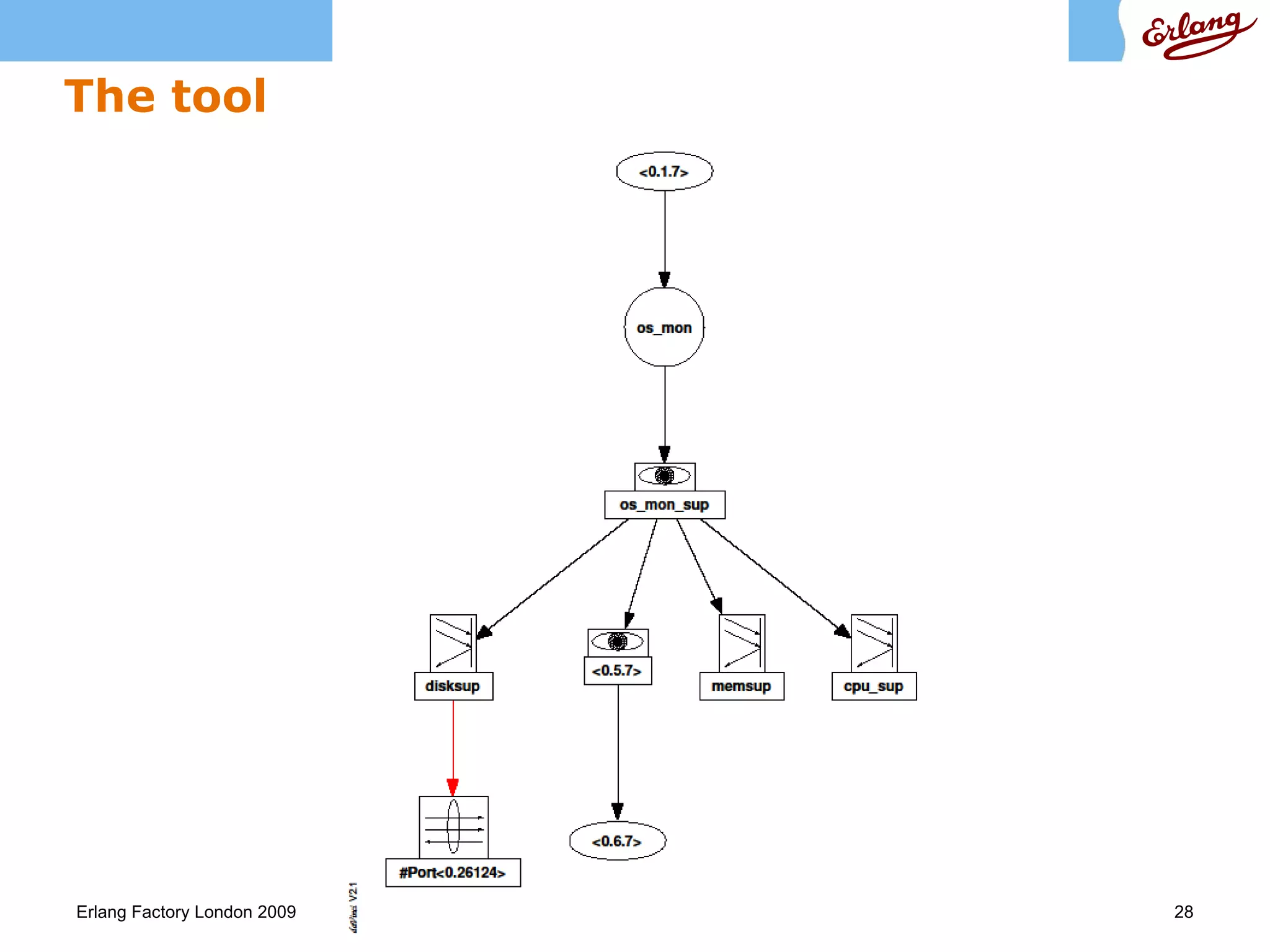
The tool Yes there is a tool The extracted supervision structure can either be pretty printed or displayed graphically The graphical display can be interacted with to: Choose the information displayed Effects of termination coloured in for a specific process The graphical display is ugly and intended changes are : New web interface The ability to animate restart sequences The possibility to draw the supervision structure  Show the difference between structures Integrated with a evaluator (analyser) GUI
The tool
Further reading My Ph.D. Thesis: Official university site http://uu.diva-portal.org/smash/record.jsf?pid =diva2:213697 All my papers  http://sites.google.com/site/janhenrynystrom/Home The ETC pages (TBD) http://www.erlang-consulting.com Workshop paper http://www.erlang.org/workshop/2009/

Automatic Assessment of Failure Recovery in Erlang Applications

  • 1.
    Automatic Assessment of Failure Recovery in Erlang Applications Jan Henry Nyström [email_address]
  • 2.
    Why is faulttolerance important How can we achieve fault tolerance How do we do fault tolerance in Erlang So what is the problem with that then? A solution to the problems Extracting the information What do we do with the information Correctness concerns The tool Overview
  • 3.
    Why is faulttolerance important Obvious where a failure can have life threatening effects Nuclear power plant control systems Aircraft control systems Vending machine control systems But the dependence on 24/7 available systems is pervasive Banking Travel agent Health services Bookies Games
  • 4.
    How can weachieve fault tolerance Problems: Hardware fails Nonconformance to specification Changed interfaces Idiots (users) There are three things in life we cannot avoid Death Taxes Bugs (code, specification and requirements)
  • 5.
    How can weachieve fault tolerance Solution 1: Ensure there are no errors in the Code Specification Requirements Check everything the environment sends Handle all the possible external failures Handle all combinations of external failures If you believe in that, let me tell you that Father Christmas was my grandfather in a silly costume.
  • 6.
    How can weachieve fault tolerance Solution 2: Handle the unexpected Best effort diagnosis that things are bad Restart the subsystem that is naughty
  • 7.
    How do wedo fault tolerance in Erlang Solution 2: Handle the unexpected Let it crash! Exceptions are only caught when you can solve the problem here and now Best effort diagnosis that things are bad Assertional style of programming, stating the correct case rather than hedging your bets. See previous point When some process has crashed it is trivial really Restart the subsystem that is naughty Supervision of processes by other processes that restarts them, then iterate
  • 8.
    How do wedo fault tolerance in Erlang (OTP) Solution 2: Library support for hierarchical supervision structures Configurable how each child is treated Permanent Transient Temporary Handles depencies between children one_for_all rest_for_one one_for_one Configurable how often children are allowed to crash Maximum number during Maximum time Supervisor s Workers
  • 9.
    How do wedo fault tolerance in Erlang (Real Life) Solution 2: "We are extremely pleased with the outcome of the initial phase of this project. This is a major step in the phased development of what we believe is a world-leading Next Generation Network," said Richard Newman, General Manager of Planning and Delivery of Network Transport at BT Wholesale. Ericsson Press Release 5 July, 2002 “ As a matter of fact, the network performance has been so reliable that there is almost a risk that our field engineers do not learn maintenance skills ” Bert Nilsson, Director NGS-Programs Ericsson Ericsson Contact, Issue 19 2002 “ Since cut-over of the first nodes in BT’s network in January 2002, only one minor fault has occurred, resulting in 99.9999999% availability.”
  • 10.
    So what isthe problem with that then? We have a nice framework to build fault tolerant systems in It has been proved in practice that it can be used to build large scale fault tolerant systems But, how do we now that we have actually built a system with good fault tolerance properties? Test… good but we have to handle all combinations of failures Understanding your supervision structure really, really helps That is actually what is talk is all about
  • 11.
    A solution tothe problem So we want to understand our supervision structure, how do we find it? The design documentation Do you recognise the gentlemen on the right? The next port of call is the implementation But it is spread out everywhere The specification for the supervisors is generated by code It can be modified by configurations We have computers, let them do all the legwork
  • 12.
    Extracting the informationSo we want to have a tool that extracts the supervision structure from the source code of an Erlang system Unfortunately, it is not only impossible in the general case, it is intractable in most of the actual cases. Let’s run it and inspect it We need all the possible interleavings of starting of processes and messages between them Potentially only one structure out of many depending on configuration We have to have a runnable system before we can even start inspecting it
  • 13.
    Extracting the information(Take 2) Limit analysis to OTP systems Well defined supervisors provided (you got the code) Synchronised start up sequence (behaviours required) It is sufficient to look at processes in isolation Well defined initialisation part of processes that are behaviours Symbolic evaluation Enables us to handle the case that we lack information Restrict the analysis to the “static part of the system” Otherwise when do we stop The unit of interest is the application Natural unit in OTP
  • 14.
    Extracting the information(In practice) Missing information Code does not exist or compile, missing configuration We introduce an “unknown” value top element of the semantic domain But we have to be able to handle that value We introduce non determinacy in the evaluation When we have a choice depending on an unknown value we explore all the possible evaluations
  • 15.
    Extracting the information(In practice) Evaluation Depth Potentially the code does not terminate when we have an unknown value When should we give up, configurable Simple cycle detection
  • 16.
    Extracting the information(In practice) Setup Paths Inclusion directories Node name
  • 17.
    Extracting the information(In practice) Global state We cannot let the analysed system interact directly with the real world We have to be able to reset the global state for an alternative evaluation We simulate the global state of the system for the parts we cannot do without and assume no knowledge of the rest Simulated are (and possibly initialised): Registry, Erlang Term Storage(ets), Mnesia, File System The generation of global states has to have a good chaching mechanism
  • 18.
    Extracting the information(In practice) Exception Handling The non determinacy and exceptions are not good bedfellows Many constructs make it necessary to consider a possible exception when we evaluate with an unknown value present This can cause an intractable growth in the number of evaluations that has to be considered Three strategies to deal with this: Hope for the best Ignore uncaught exceptions, they would just crash the system anyway Ignore all exceptions, this is unsound
  • 19.
    Extracting the information(In practice) Behaviours The behaviours’ behaviour is supposed to be well defined We do not want to analyse that The behaviours are embedded in the evaluator for efficiency
  • 20.
    What do wedo with the information Read and inspect it manually But we have computers We can animate the supervision structure and actually show what happens when a selected process fails We can combine information and deduct properties How often a particular process has to terminate to cause the entire structure to fail We can formally reason about properties What properties should we consider? Repair No concealment Good design principles
  • 21.
    What do wedo with the information The Repair property: Whenever a process that takes part in the supervision structure fails, the supervision structure returns to the process structure prior to the failure after a reasonable delay.
  • 22.
    What do wedo with the information The Repair property: We need to check: Each processes that fails is replaced by an equivalent “restarted” process in the structure Each process replaced by a restarted process has indeed terminated Side orders A non-supervisor that is linked to a failed process does not trap exits The initialisation of a restarted process creates the same structure as the process it replaces
  • 23.
    What do wedo with the information The Non concealment property: When the cause of a failure is not transient or sufficiently infrequent to let the application function acceptably, only a small number of recoveries should occur before the supervision structure fails. .
  • 24.
    What do wedo with the information Good design principles All processes should create their children using spawn_link The max restart frequency of intermediate supervisors is 0 Only supervisors should have shutdown time infinity But most importantly one can check design rules of the company/devivsion/team
  • 25.
    Correctness concerns Whyshould we trust the extracted structure? A four stage rocket Formalise a semantics for the needed subset of Erlang Formalise a semantics for Erlang that has an unknown value and where an evaluation may have several results Prove that for the supervision structure that is generated by the “real” semantics is included in the set of structures generated by the “abstract” semantics Base the symbolic evaluation on the “abstract” semantics In fact it was done the other way around, almost
  • 26.
    The tool Yesthere is a tool It is pre-alpha Can analyse a number of OTP applications Has been used to analyse a number of applications in AXD301 The analysis results were confirmed by the designers Needs several major rewrites before going beta Packages are still experimental  Extended support for the global state More OTP libraries needs to be embedded in the evaluator Configuration simplified User interface (sigh)
  • 27.
    The tool Yesthere is a tool The extracted supervision structure can either be pretty printed or displayed graphically The graphical display can be interacted with to: Choose the information displayed Effects of termination coloured in for a specific process The graphical display is ugly and intended changes are : New web interface The ability to animate restart sequences The possibility to draw the supervision structure Show the difference between structures Integrated with a evaluator (analyser) GUI
  • 28.
  • 29.
    Further reading MyPh.D. Thesis: Official university site http://uu.diva-portal.org/smash/record.jsf?pid =diva2:213697 All my papers http://sites.google.com/site/janhenrynystrom/Home The ETC pages (TBD) http://www.erlang-consulting.com Workshop paper http://www.erlang.org/workshop/2009/