Bond Prices and YieldsBond Prices and Yields
Part 1Part 1
Learning ObjectivesLearning Objectives
• Types of bonds
• Bond parameters including yield
• Bond price as discounted expected cash flow
o Applications
• Compute bond yield from a known price
• Compute bond price from a known yield
• Plot bond price v. yield
• Compute bond price when yield is not known
• Plot bond price v. time to maturity
• Compute mortgage payments
• Bond formulas
• Bond price quotes
2
Bond OverviewBond Overview
• Corporations and governments can raise capital by selling
bonds
o Long term liability (accounting)
o Debt capital (finance)
• The bond has
o Principal, par, or face value: F
o Price: P
o Yield: y (also the discount rate )
o Maturity date, time to maturity, term, or tenor: T
• Date at which the bond principal, F, is returned to investors
• This is different than the duration
o In the case of a coupon bond (not a zero coupon bond)
• Coupon rate: c (annual, simple, nominal rate)
• Annual payment frequency: m; or period ∆t
o In the U.S. semiannual coupons is typical: m = 2 or ∆t = .5
3
Zero Coupon BondsZero Coupon Bonds
• ZCBs do not pay a coupon
o No intermediate cash flow
• The rate of return or ‘yield’ is due to the bond being bought,
at P, a discount to face value, F
• U.S. Treasury bills (T – bills) are zero coupon bonds
o Time-to-maturity at issue is 4, 13, 26, 52 weeks
o Face value $100 to $5,000,000
• A ZCB yield is the interest rate,
(and the discount rate) denoted z
4
F
P
t=0
t=T
Zero Coupon BondZero Coupon Bond
• For T ≤ 1 year:
where z is the annual yield – a simple rate
• For T > 1 year
where z is the annualized yield – an effective rate
If a bond has a term of a year or less, simple interest is used,
otherwise compound annual interest is used
5
P=
F
(1+z×T)
P=
F
(1+z)T
F
P
t=0
t=T
Zero Coupon Bond ExampleZero Coupon Bond Example
• The face value is $1000, the market price is $850, and the time
to maturity is 3.5 years. What is the annualized yield ?
• The face value is $1000, the market price is $975, and the
time-to-maturity is 0.5 years. What is the annualized yield?
6
$850=
$1000
(1+y)3.5
y=
$1000
$850





÷
1
3.5
-1=4.753%
P=
F
(1+z×T)
$975=
$1000
(1+0.5×y)
y=2×
$1000
$975
-1





÷=5.128%
P =
F
(1+z)T
Zero Coupon BondZero Coupon Bond
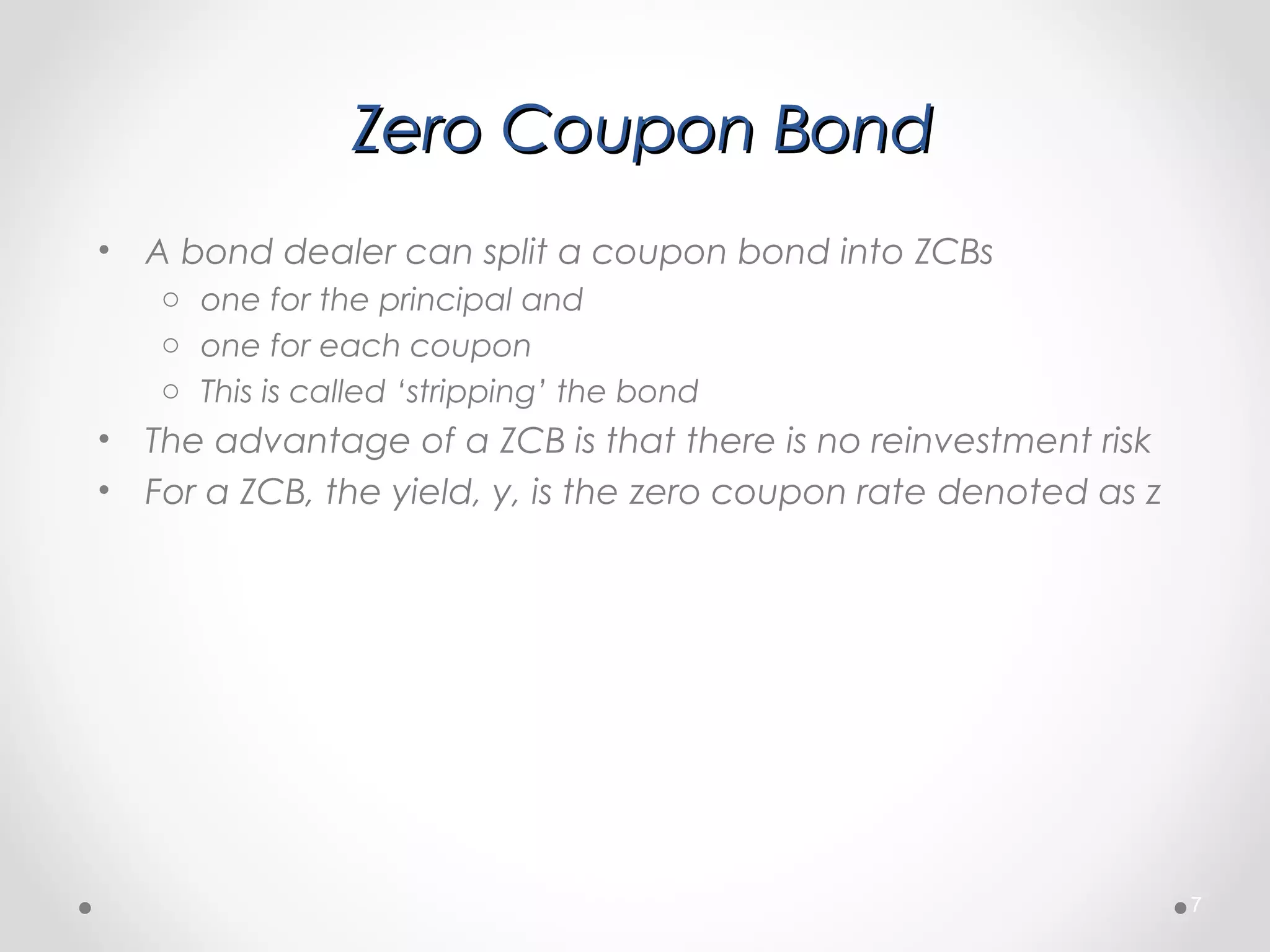
• A bond dealer can split a coupon bond into ZCBs
o one for the principal and
o one for each coupon
o This is called ‘stripping’ the bond
• The advantage of a ZCB is that there is no reinvestment risk
• For a ZCB, the yield, y, is the zero coupon rate denoted as z
7
Coupon BondCoupon Bond
8
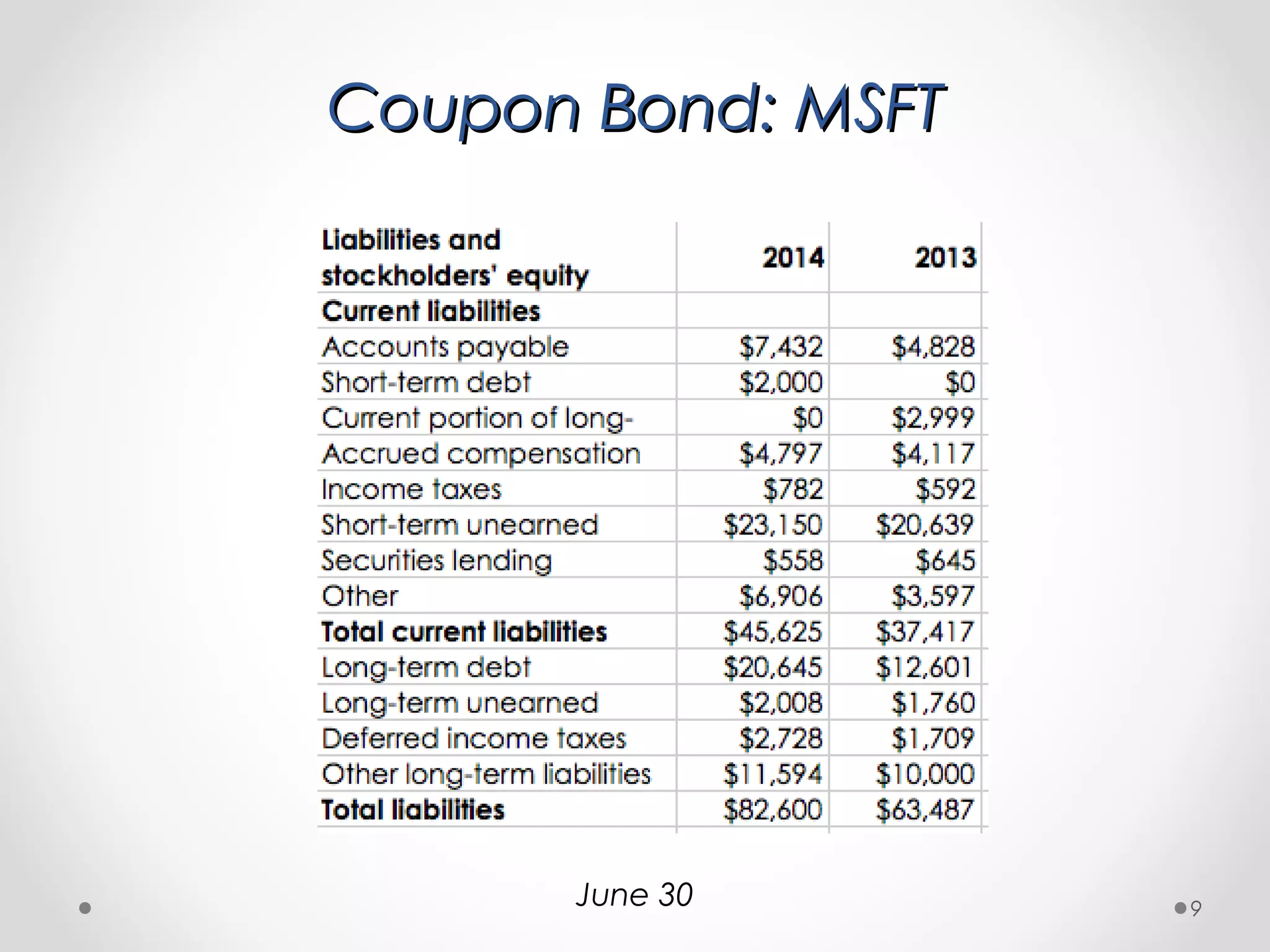
Coupon Bond: MSFTCoupon Bond: MSFT
9
June 30
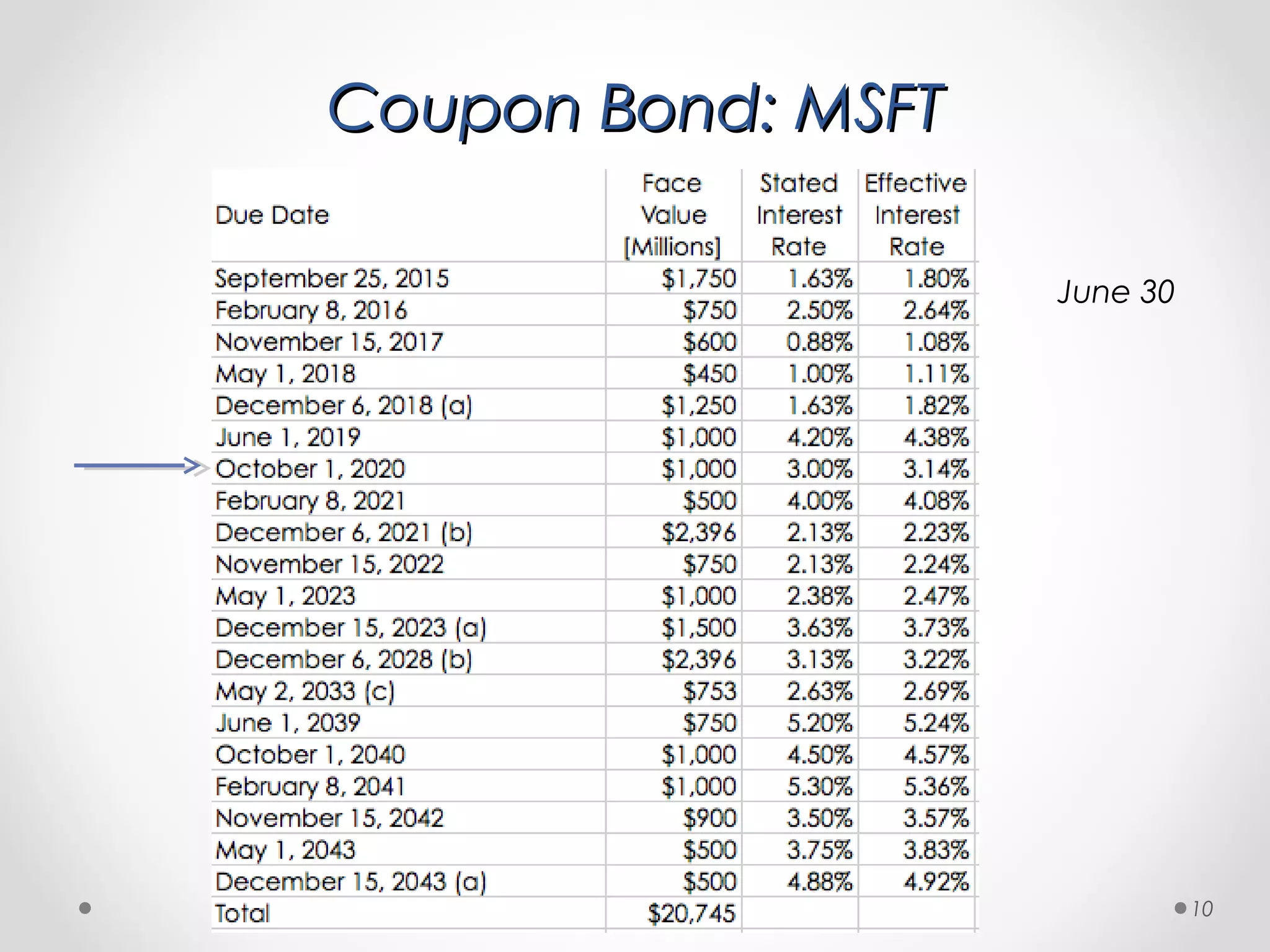
Coupon Bond: MSFTCoupon Bond: MSFT
10
June 30
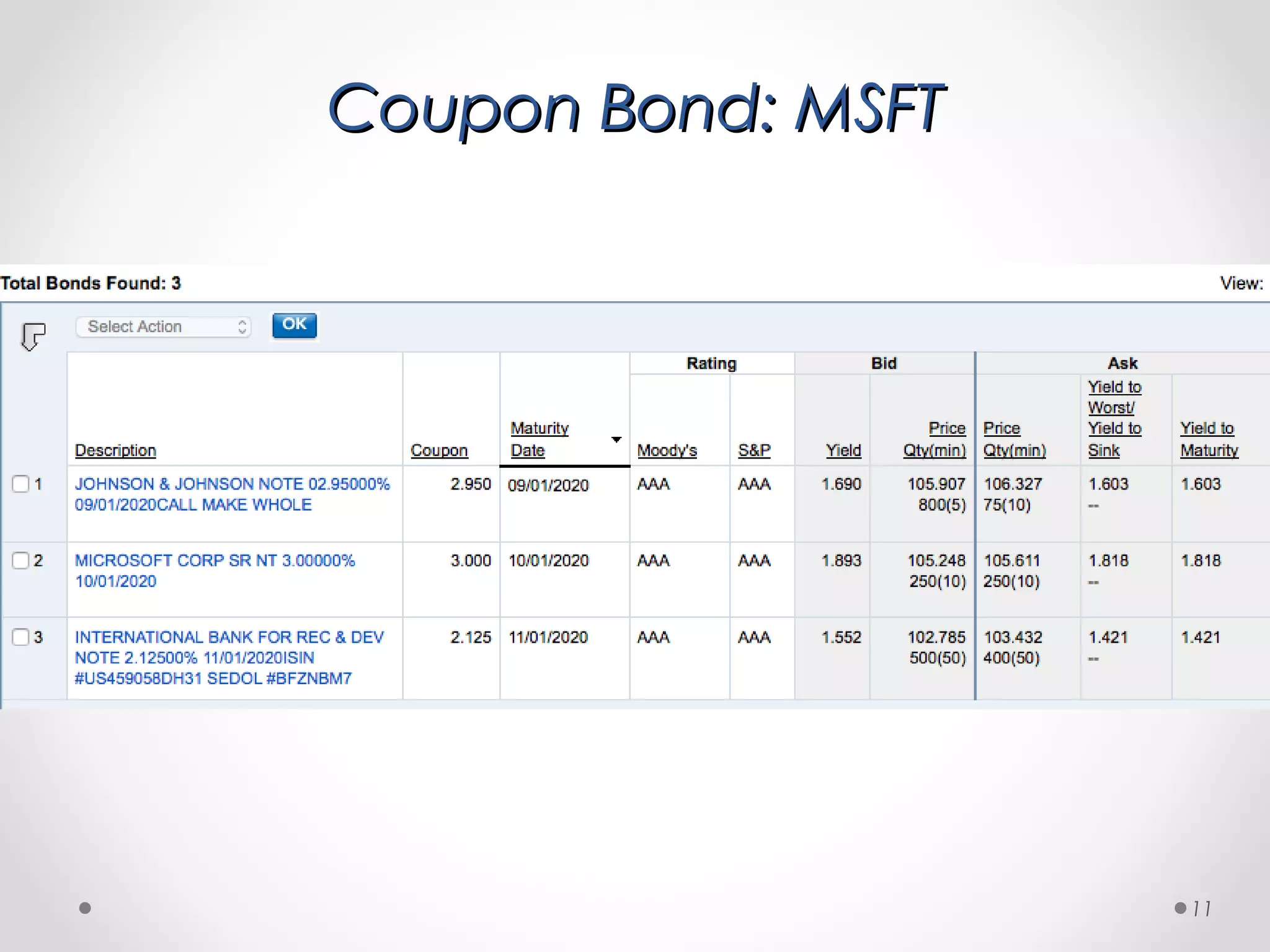
Coupon Bond: MSFTCoupon Bond: MSFT
11
Coupon BondCoupon Bond
12
P =
current
price
C = coupon payment
c = coupon rate (simple interest)
F = face
or par
value
t=0.0 t=∆t t=2∙∆t t=m∙N∙∆t=T
i=0 i=1 i=2 i=m∙N
t0=0.0 t1=∆t t2=2∆t tm∙N= m∙N∙∆t =T
12
Coupon PaymentCoupon Payment
• Bond coupon cash flows, C, are defined by a nominal, simple
coupon rate, c, and a compounding frequency per year, m,
or coupon period measured in years, ∆t
o m is always 1 or 2 for a bond
o ∆t = .5 or 1 year
• The total cash flow at time ti, CFi, is defined as:
13
CFi = C for i < m×N
CFm×N = C + F
C = c×F×∆t =
c×F
m
example
c=1.625%
F=$1000
∆t=.5
C = $8.125
Effective coupon rate
c= 1+
c
m





÷
m
-1
c= 1+
1.625%
2





÷
2
-1=1.632%
Current interest and yield summaryCurrent interest and yield summary
• Bloomberg
• Yahoo
• Bankrate
14
Coupon Bond YieldCoupon Bond Yield
• Yield to maturity is the actual yield achieved for a coupon bond if
o The bond is held to maturity, and
o Each coupon payment is reinvested at the rate of return y through time T
• The risk that coupons cannot be reinvested at a rate greater than or equal to y
due to market conditions is called “reinvestment risk”
• The yield to maturity, y, is the investor’s expected return on the
investment of P and is thus the issuer’s rate cost
o It’s the issuer’s ‘cost of debt’, kD, for the bond
• The yield reflects both the time value of money and the credit risk of
the borrower
o The expected variance of the cash flows is reflected in the yield, y
15
Bond PriceBond Price
• The discount rate y is the yield to maturity or simply the yield
on a coupon bond
• It’s the internal rate of return that sets the discounted cash
flow on the right hand side to the market price of the bond, P,
on the left hand sidex4
16
P=
CFi
(1+y)ti
i=1
M
∑P=
CFi
1+
y
m





÷
i
i=1
M
∑
y is the nominal annual
yield to maturity
y is effective annual
yield to maturity
M is the number of periods or “cash flows”
M = N * m if N is an integer number of years
M = T * m if T is floating point years
Homework 10Homework 10
• Compute the price, P, of the following bond and
the nominal yield to maturity, y
o Time to maturity 4.5 years
o Annual, nominal coupon rate is 7%
o Semi annual coupons and compounding
o Par value is $1000
o Yield to maturity 8% (effective annual rate)
• Submit a knitr pdf with explanation and echoed
code
o Print the data frame or table for clarity
17
Homework 11Homework 11
• Compute the nominal and effective yields to
maturity for this bond
o Time to maturity 4.5 years
o Annual, nominal coupon rate is 7%
o Semi annual coupons and compounding
o Par value is $1000
o Price is $900.00
• Submit a knitr pdf with explanation and echoed
code
o Print the data frame or table for clarity
18
• For a fractional initial coupon period: t1 < ∆t
Fractional Initial Time PeriodFractional Initial Time Period
For a bond with semi-annual coupons, assume that the next
coupon payment is in 3 months. The coupon payments occur at
t0=0.0, t1=0.25, t2=0.75, t3=1.25, t4 = 1.75, …
i=0 i=1 i=2 i=M
t0=0.0 t1 t2=t1+∆t tM= T
C = coupon payment
F = face
or par
value
19
Homework 12Homework 12
• Compute the price of this bond
o Time to maturity 4.25 years
o The next coupon is paid 3 months from present
o Annual, nominal coupon rate is 7%
o Semi annual coupons and compounding
o Par value is $1000
o Yield to maturity 8% (effective annual rate)
• Submit a knitr pdf with explanation and echoed
code
o Print the data frame or table for clarity
20
Bond Price to MaturityBond Price to Maturity
$825
$850
$875
$900
$925
$950
$975
$1,000
$1,025
$1,050
0.0 0.5 1.0 1.5 2.0 2.5 3.0 3.5 4.0 4.5
Time
Price
21
• For a bond with price $840.34 at time 0, here’s a plot of price as
time progresses from 0 to 4.5 years assuming a constant yield to
maturity of 12%
• The plot is computed using the DCF formula. These prices are
referred to as ‘dirty’ prices. There are also ‘clean’ prices.
Homework 13Homework 13
• Plot price v. time for the following bond
o Time to maturity 10 years
o Annual, nominal, simple coupon rate is 5%
o Par value is $1000
o Effective annual yield to maturity is a constant 6%
o (It’s a saw tooth curve)
• Submit a knitr pdf with explanation and echoed
code
o Print the data frame or table for clarity
22

Bonds part 1

  • 1.
    Bond Prices andYieldsBond Prices and Yields Part 1Part 1
  • 2.
    Learning ObjectivesLearning Objectives •Types of bonds • Bond parameters including yield • Bond price as discounted expected cash flow o Applications • Compute bond yield from a known price • Compute bond price from a known yield • Plot bond price v. yield • Compute bond price when yield is not known • Plot bond price v. time to maturity • Compute mortgage payments • Bond formulas • Bond price quotes 2
  • 3.
    Bond OverviewBond Overview •Corporations and governments can raise capital by selling bonds o Long term liability (accounting) o Debt capital (finance) • The bond has o Principal, par, or face value: F o Price: P o Yield: y (also the discount rate ) o Maturity date, time to maturity, term, or tenor: T • Date at which the bond principal, F, is returned to investors • This is different than the duration o In the case of a coupon bond (not a zero coupon bond) • Coupon rate: c (annual, simple, nominal rate) • Annual payment frequency: m; or period ∆t o In the U.S. semiannual coupons is typical: m = 2 or ∆t = .5 3
  • 4.
    Zero Coupon BondsZeroCoupon Bonds • ZCBs do not pay a coupon o No intermediate cash flow • The rate of return or ‘yield’ is due to the bond being bought, at P, a discount to face value, F • U.S. Treasury bills (T – bills) are zero coupon bonds o Time-to-maturity at issue is 4, 13, 26, 52 weeks o Face value $100 to $5,000,000 • A ZCB yield is the interest rate, (and the discount rate) denoted z 4 F P t=0 t=T
  • 5.
    Zero Coupon BondZeroCoupon Bond • For T ≤ 1 year: where z is the annual yield – a simple rate • For T > 1 year where z is the annualized yield – an effective rate If a bond has a term of a year or less, simple interest is used, otherwise compound annual interest is used 5 P= F (1+z×T) P= F (1+z)T F P t=0 t=T
  • 6.
    Zero Coupon BondExampleZero Coupon Bond Example • The face value is $1000, the market price is $850, and the time to maturity is 3.5 years. What is the annualized yield ? • The face value is $1000, the market price is $975, and the time-to-maturity is 0.5 years. What is the annualized yield? 6 $850= $1000 (1+y)3.5 y= $1000 $850      ÷ 1 3.5 -1=4.753% P= F (1+z×T) $975= $1000 (1+0.5×y) y=2× $1000 $975 -1      ÷=5.128% P = F (1+z)T
  • 7.
    Zero Coupon BondZeroCoupon Bond • A bond dealer can split a coupon bond into ZCBs o one for the principal and o one for each coupon o This is called ‘stripping’ the bond • The advantage of a ZCB is that there is no reinvestment risk • For a ZCB, the yield, y, is the zero coupon rate denoted as z 7
  • 8.
  • 9.
    Coupon Bond: MSFTCouponBond: MSFT 9 June 30
  • 10.
    Coupon Bond: MSFTCouponBond: MSFT 10 June 30
  • 11.
  • 12.
    Coupon BondCoupon Bond 12 P= current price C = coupon payment c = coupon rate (simple interest) F = face or par value t=0.0 t=∆t t=2∙∆t t=m∙N∙∆t=T i=0 i=1 i=2 i=m∙N t0=0.0 t1=∆t t2=2∆t tm∙N= m∙N∙∆t =T 12
  • 13.
    Coupon PaymentCoupon Payment •Bond coupon cash flows, C, are defined by a nominal, simple coupon rate, c, and a compounding frequency per year, m, or coupon period measured in years, ∆t o m is always 1 or 2 for a bond o ∆t = .5 or 1 year • The total cash flow at time ti, CFi, is defined as: 13 CFi = C for i < m×N CFm×N = C + F C = c×F×∆t = c×F m example c=1.625% F=$1000 ∆t=.5 C = $8.125 Effective coupon rate c= 1+ c m      ÷ m -1 c= 1+ 1.625% 2      ÷ 2 -1=1.632%
  • 14.
    Current interest andyield summaryCurrent interest and yield summary • Bloomberg • Yahoo • Bankrate 14
  • 15.
    Coupon Bond YieldCouponBond Yield • Yield to maturity is the actual yield achieved for a coupon bond if o The bond is held to maturity, and o Each coupon payment is reinvested at the rate of return y through time T • The risk that coupons cannot be reinvested at a rate greater than or equal to y due to market conditions is called “reinvestment risk” • The yield to maturity, y, is the investor’s expected return on the investment of P and is thus the issuer’s rate cost o It’s the issuer’s ‘cost of debt’, kD, for the bond • The yield reflects both the time value of money and the credit risk of the borrower o The expected variance of the cash flows is reflected in the yield, y 15
  • 16.
    Bond PriceBond Price •The discount rate y is the yield to maturity or simply the yield on a coupon bond • It’s the internal rate of return that sets the discounted cash flow on the right hand side to the market price of the bond, P, on the left hand sidex4 16 P= CFi (1+y)ti i=1 M ∑P= CFi 1+ y m      ÷ i i=1 M ∑ y is the nominal annual yield to maturity y is effective annual yield to maturity M is the number of periods or “cash flows” M = N * m if N is an integer number of years M = T * m if T is floating point years
  • 17.
    Homework 10Homework 10 •Compute the price, P, of the following bond and the nominal yield to maturity, y o Time to maturity 4.5 years o Annual, nominal coupon rate is 7% o Semi annual coupons and compounding o Par value is $1000 o Yield to maturity 8% (effective annual rate) • Submit a knitr pdf with explanation and echoed code o Print the data frame or table for clarity 17
  • 18.
    Homework 11Homework 11 •Compute the nominal and effective yields to maturity for this bond o Time to maturity 4.5 years o Annual, nominal coupon rate is 7% o Semi annual coupons and compounding o Par value is $1000 o Price is $900.00 • Submit a knitr pdf with explanation and echoed code o Print the data frame or table for clarity 18
  • 19.
    • For afractional initial coupon period: t1 < ∆t Fractional Initial Time PeriodFractional Initial Time Period For a bond with semi-annual coupons, assume that the next coupon payment is in 3 months. The coupon payments occur at t0=0.0, t1=0.25, t2=0.75, t3=1.25, t4 = 1.75, … i=0 i=1 i=2 i=M t0=0.0 t1 t2=t1+∆t tM= T C = coupon payment F = face or par value 19
  • 20.
    Homework 12Homework 12 •Compute the price of this bond o Time to maturity 4.25 years o The next coupon is paid 3 months from present o Annual, nominal coupon rate is 7% o Semi annual coupons and compounding o Par value is $1000 o Yield to maturity 8% (effective annual rate) • Submit a knitr pdf with explanation and echoed code o Print the data frame or table for clarity 20
  • 21.
    Bond Price toMaturityBond Price to Maturity $825 $850 $875 $900 $925 $950 $975 $1,000 $1,025 $1,050 0.0 0.5 1.0 1.5 2.0 2.5 3.0 3.5 4.0 4.5 Time Price 21 • For a bond with price $840.34 at time 0, here’s a plot of price as time progresses from 0 to 4.5 years assuming a constant yield to maturity of 12% • The plot is computed using the DCF formula. These prices are referred to as ‘dirty’ prices. There are also ‘clean’ prices.
  • 22.
    Homework 13Homework 13 •Plot price v. time for the following bond o Time to maturity 10 years o Annual, nominal, simple coupon rate is 5% o Par value is $1000 o Effective annual yield to maturity is a constant 6% o (It’s a saw tooth curve) • Submit a knitr pdf with explanation and echoed code o Print the data frame or table for clarity 22

Editor's Notes

  • #9 6%
  • #10 6%
  • #11 As of June 30, 2014, the aggregate unamortized discount for our long-term debt was $100 million.
  • #12 6%
  • #17 I prefer the formula on right Can compute P or ybar
  • #18 BOND2 968.43 .07846
  • #19 BOND2 .1004 .0980