42U Confidential   ©2008 42U All rights reserved  Slide  Power Strategies for Data Center Efficiency  – Identifying Cost Reduction Opportunities October 15, 2008 ________________________________
Overview Importance of Power Efficiency Power Flow Points to Monitor How to Monitor Power Management Alternatives Summary Q&A 42U Confidential   ©2008 42U All rights reserved  Slide
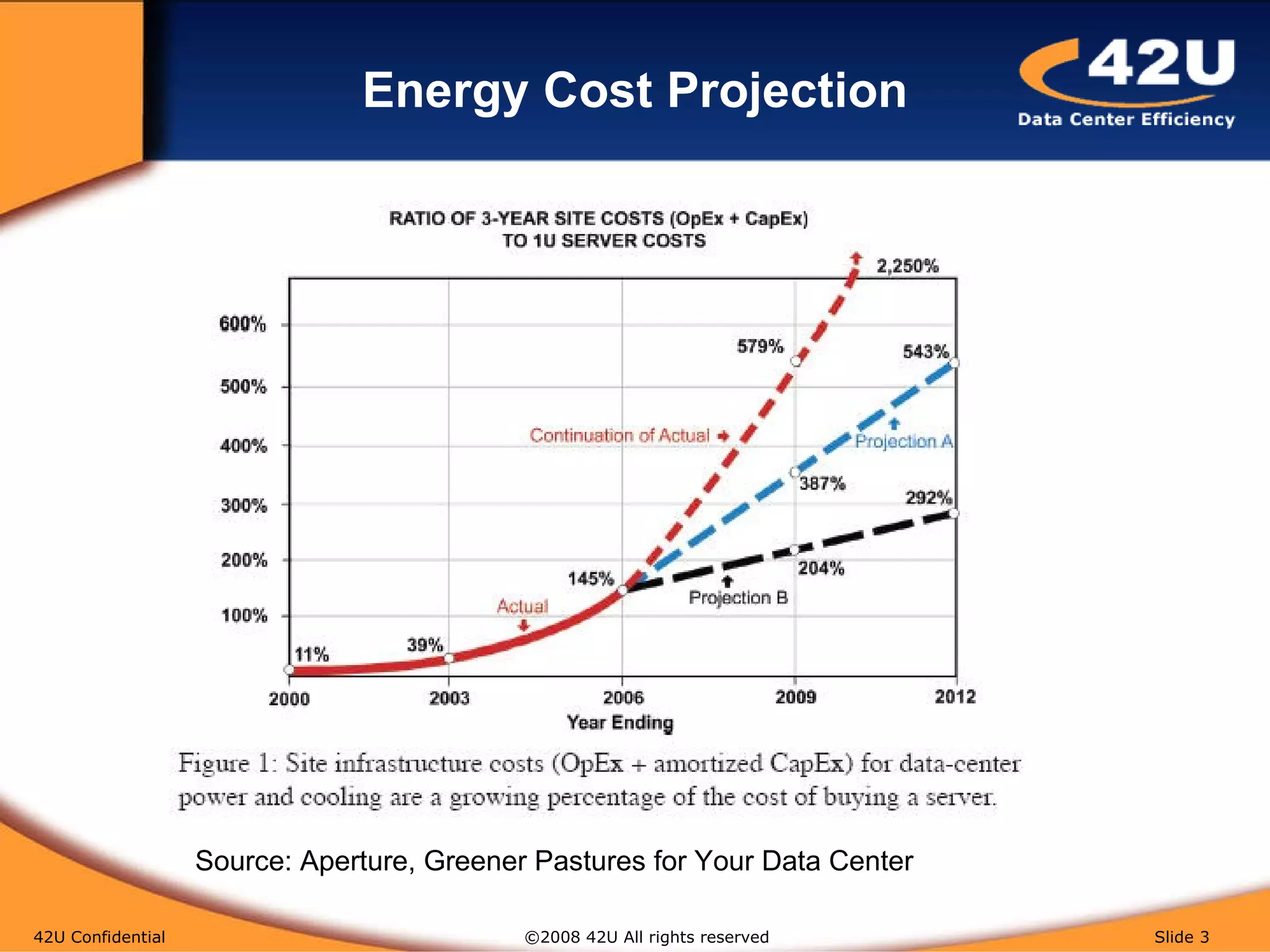
Energy Cost Projection 42U Confidential   ©2008 42U All rights reserved  Slide  Source: Aperture, Greener Pastures for Your Data Center
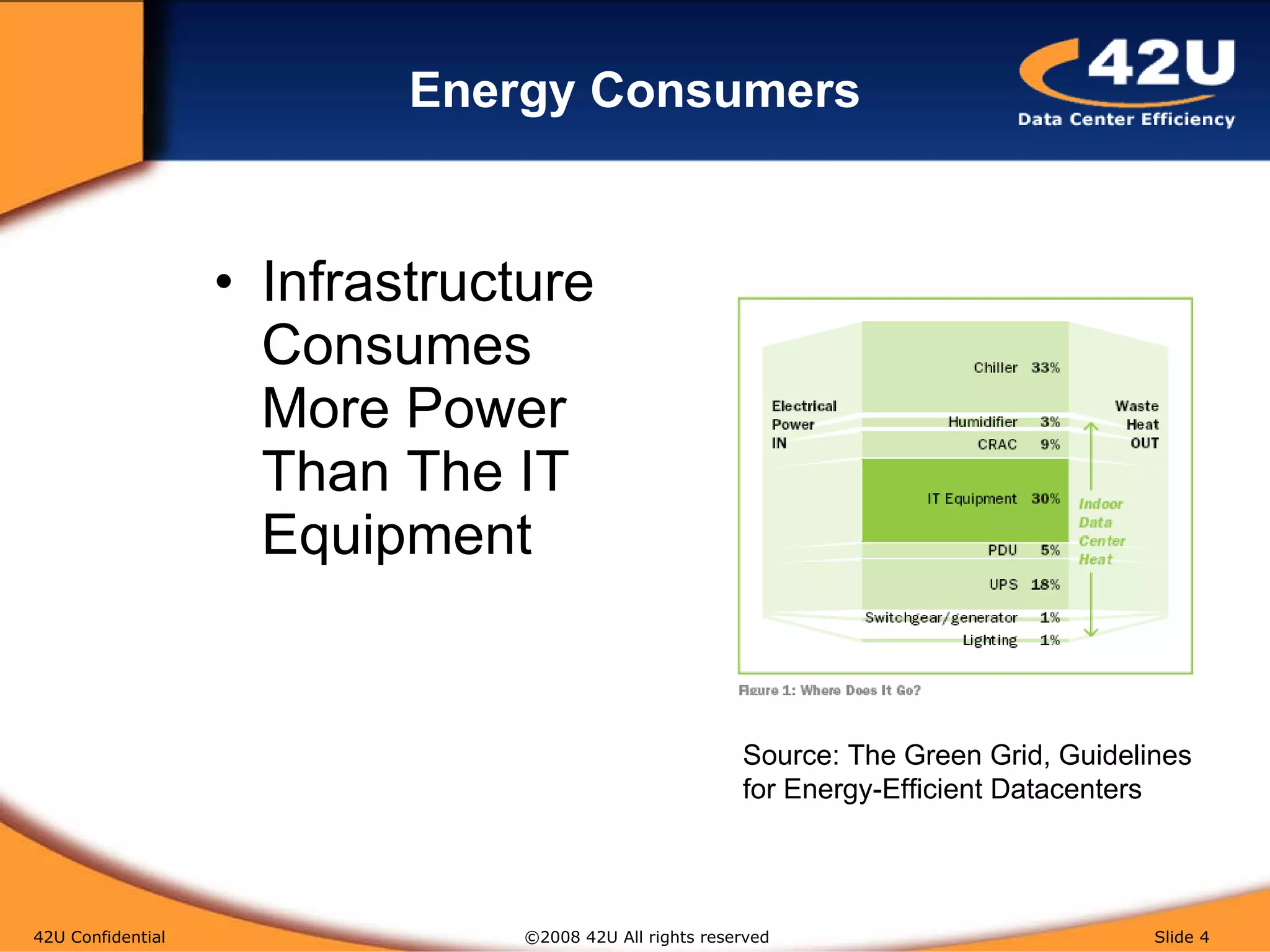
Energy Consumers Infrastructure Consumes More Power Than The IT Equipment 42U Confidential   ©2008 42U All rights reserved  Slide  Source: The Green Grid, Guidelines  for Energy-Efficient Datacenters
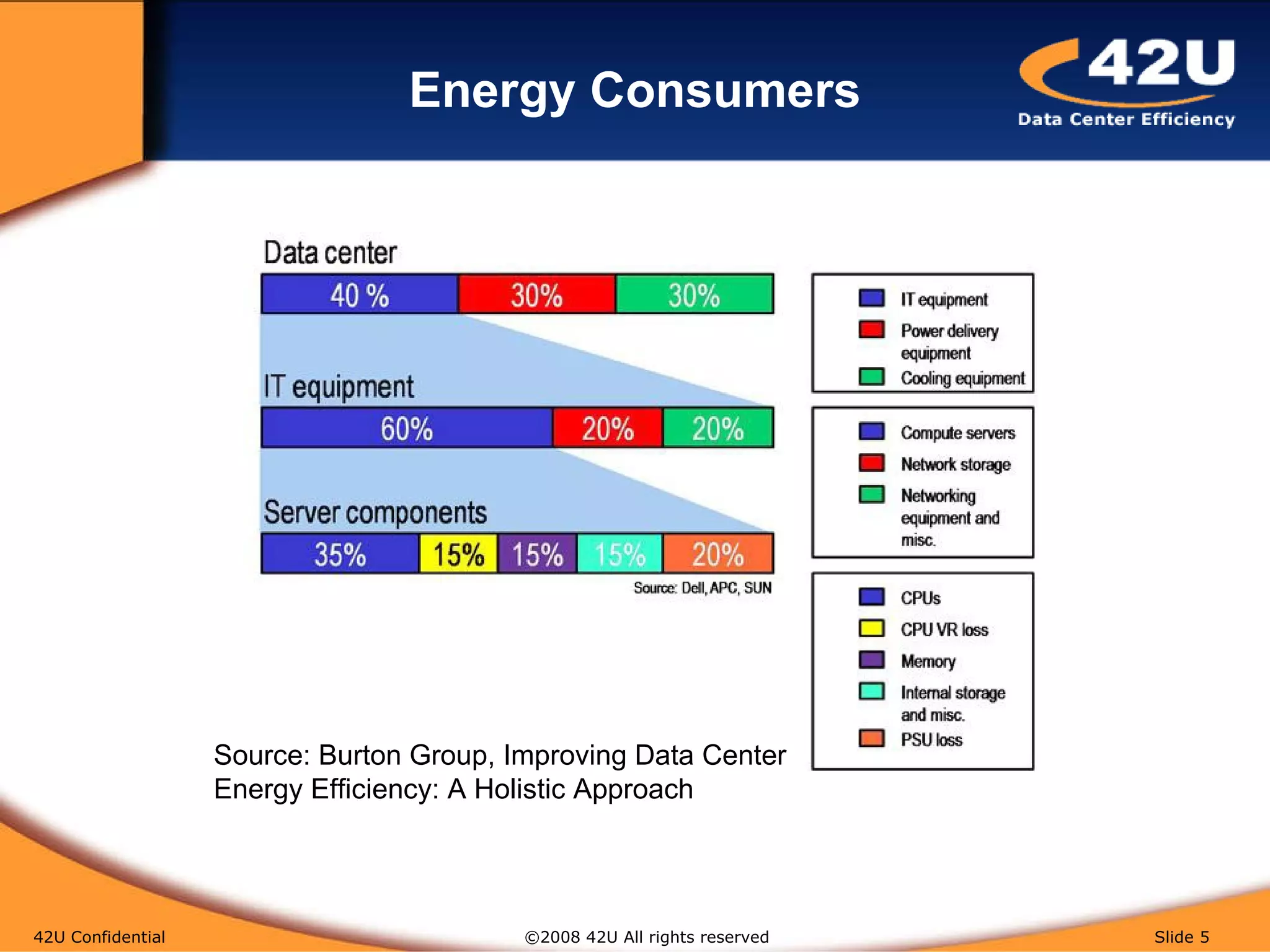
Energy Consumers 42U Confidential   ©2008 42U All rights reserved  Slide  Source: Burton Group, Improving Data Center Energy Efficiency: A Holistic Approach
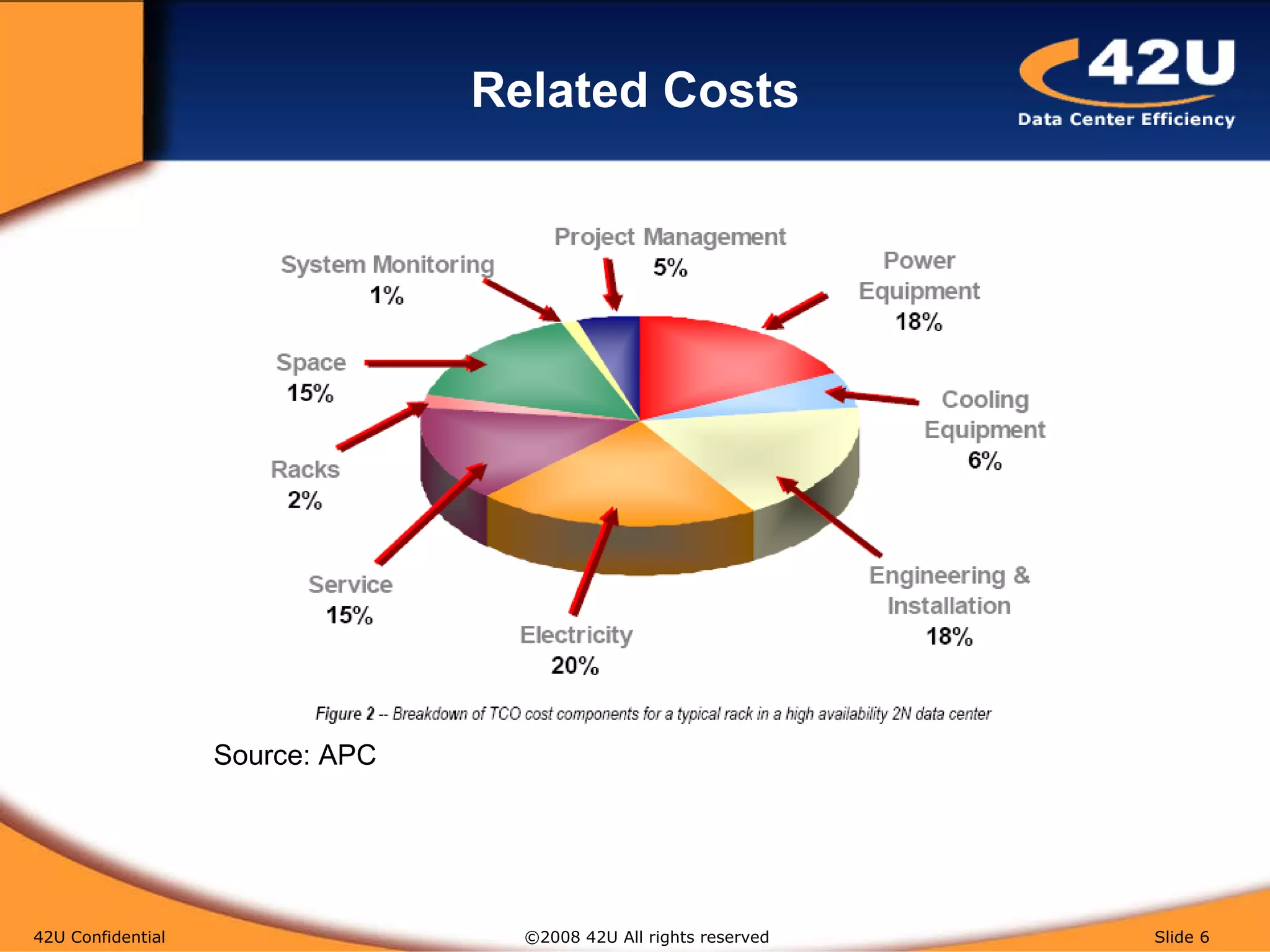
Related Costs 42U Confidential   ©2008 42U All rights reserved  Slide  Source: APC
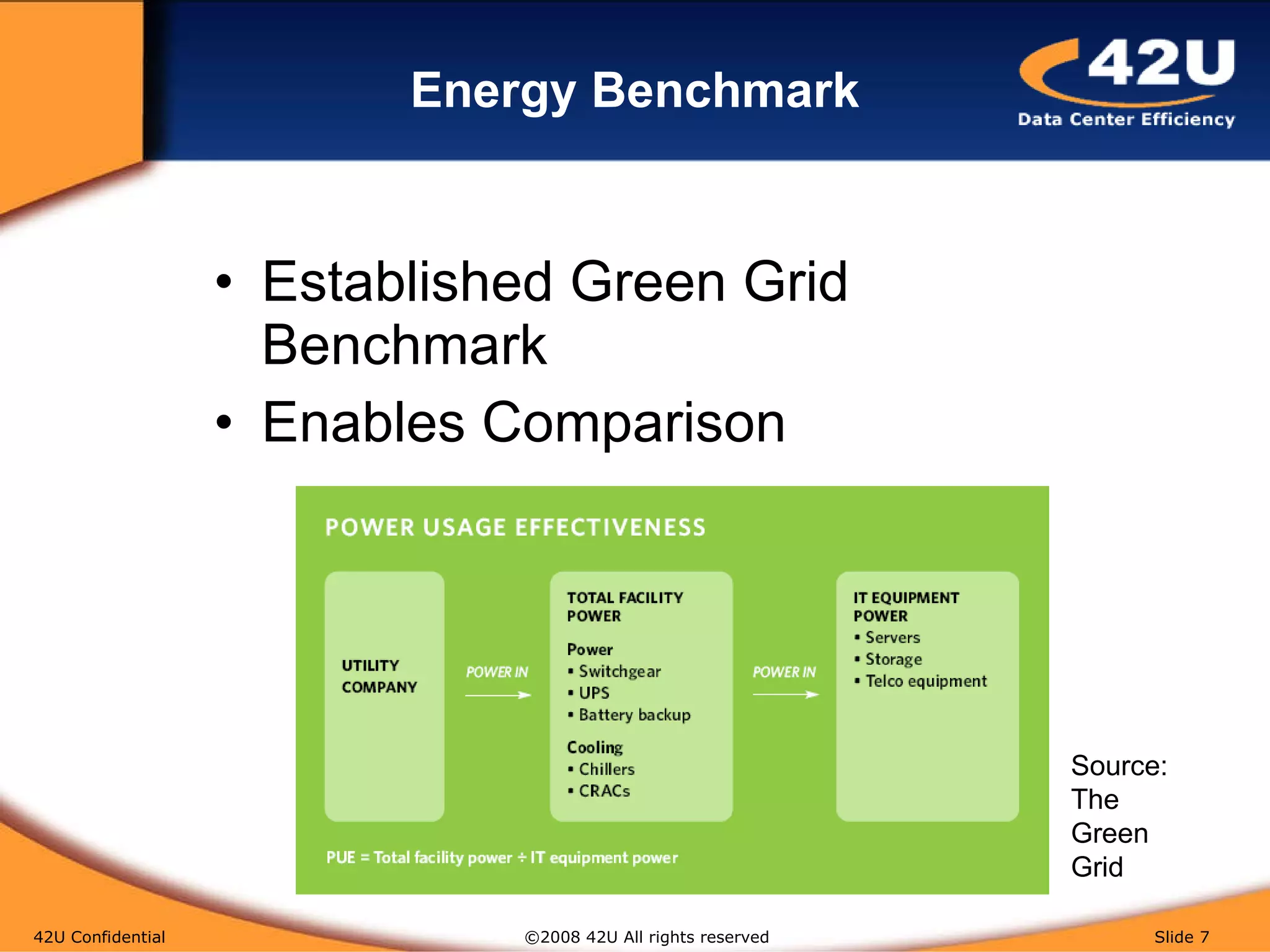
Energy Benchmark Established Green Grid Benchmark Enables Comparison 42U Confidential   ©2008 42U All rights reserved  Slide  Source: The Green Grid
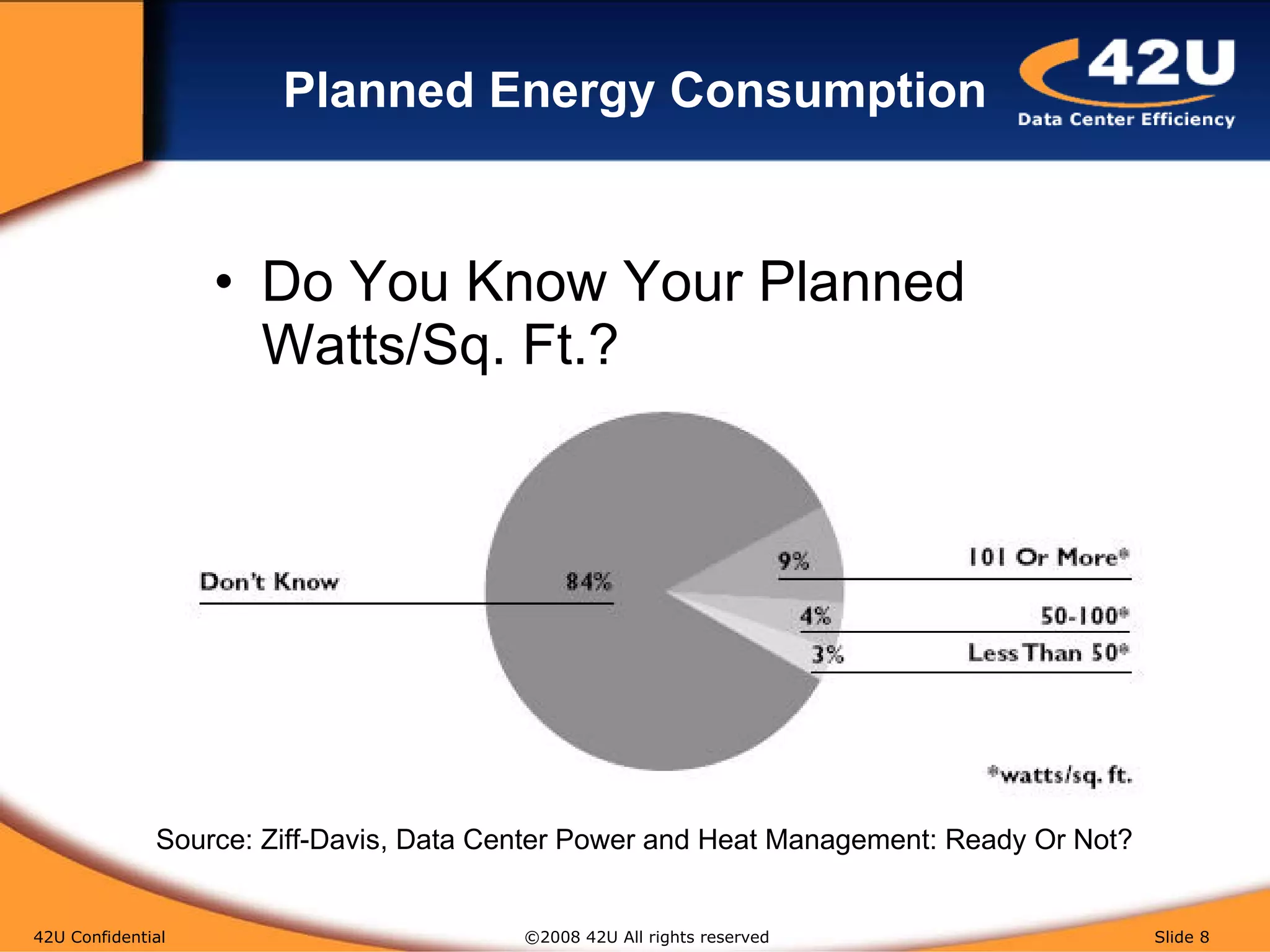
Planned Energy Consumption Do You Know Your Planned Watts/Sq. Ft.? 42U Confidential   ©2008 42U All rights reserved  Slide  Source: Ziff-Davis, Data Center Power and Heat Management: Ready Or Not?
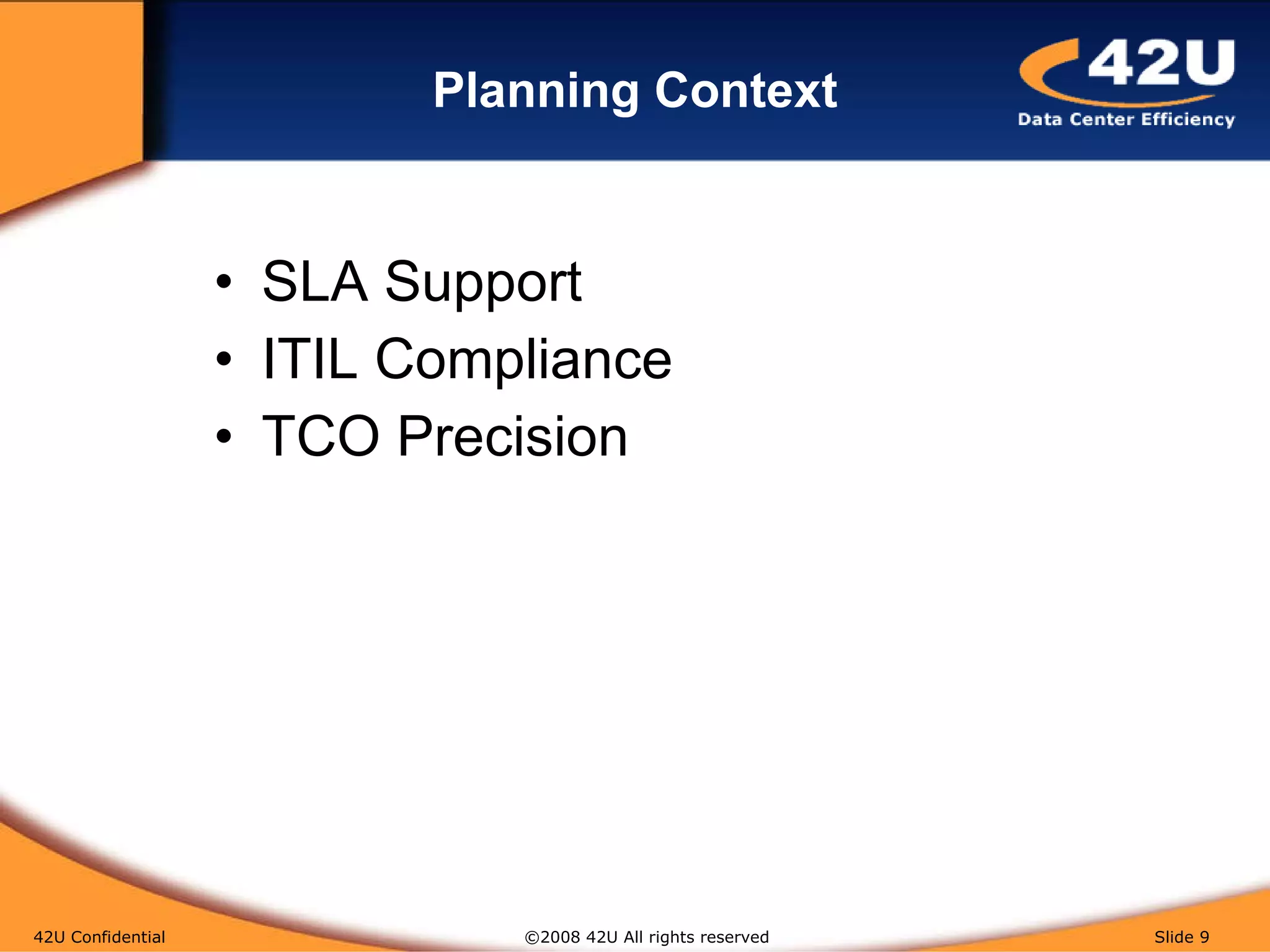
Planning Context SLA Support ITIL Compliance TCO Precision 42U Confidential   ©2008 42U All rights reserved  Slide
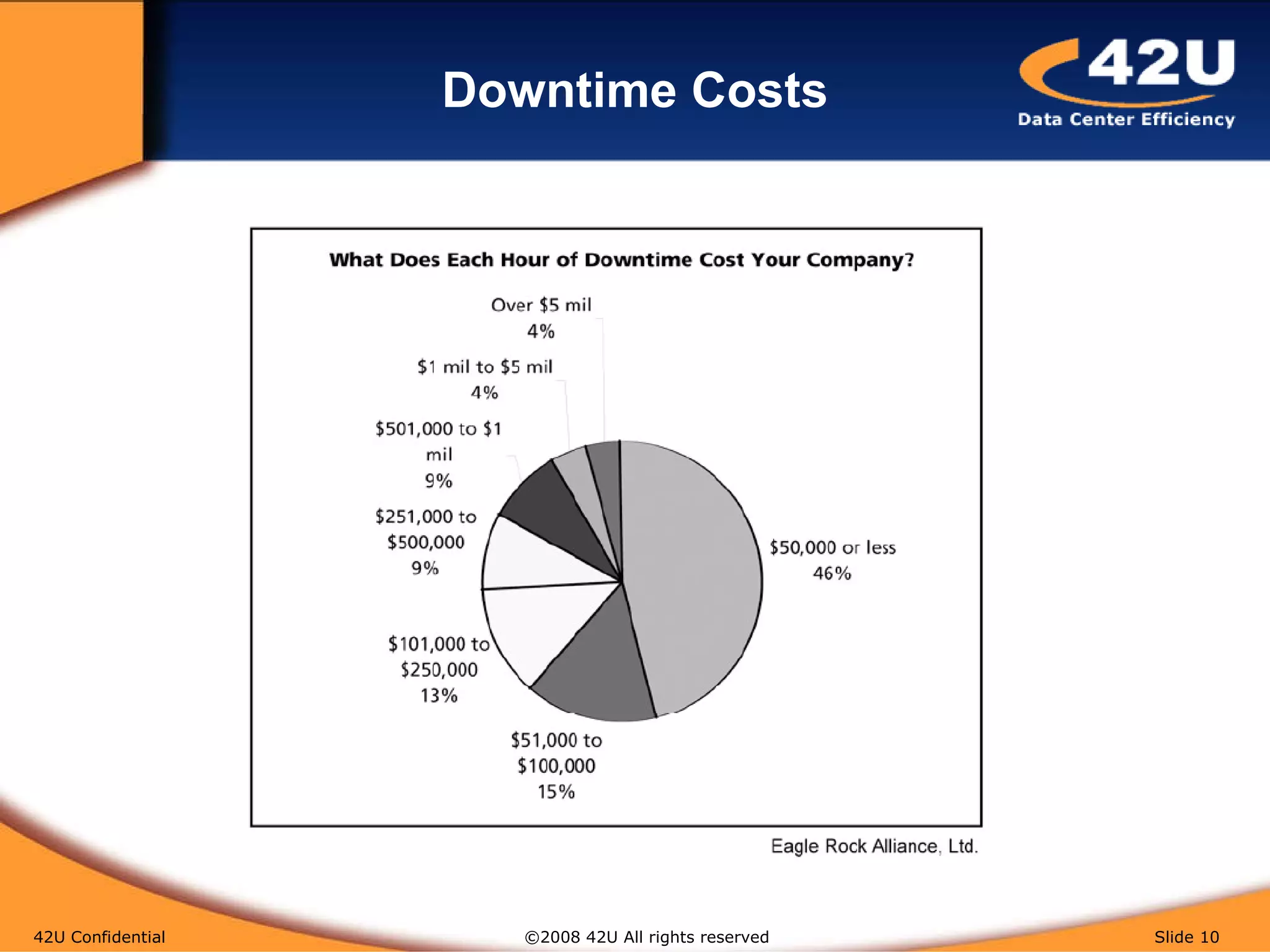
Downtime Costs 42U Confidential   ©2008 42U All rights reserved  Slide
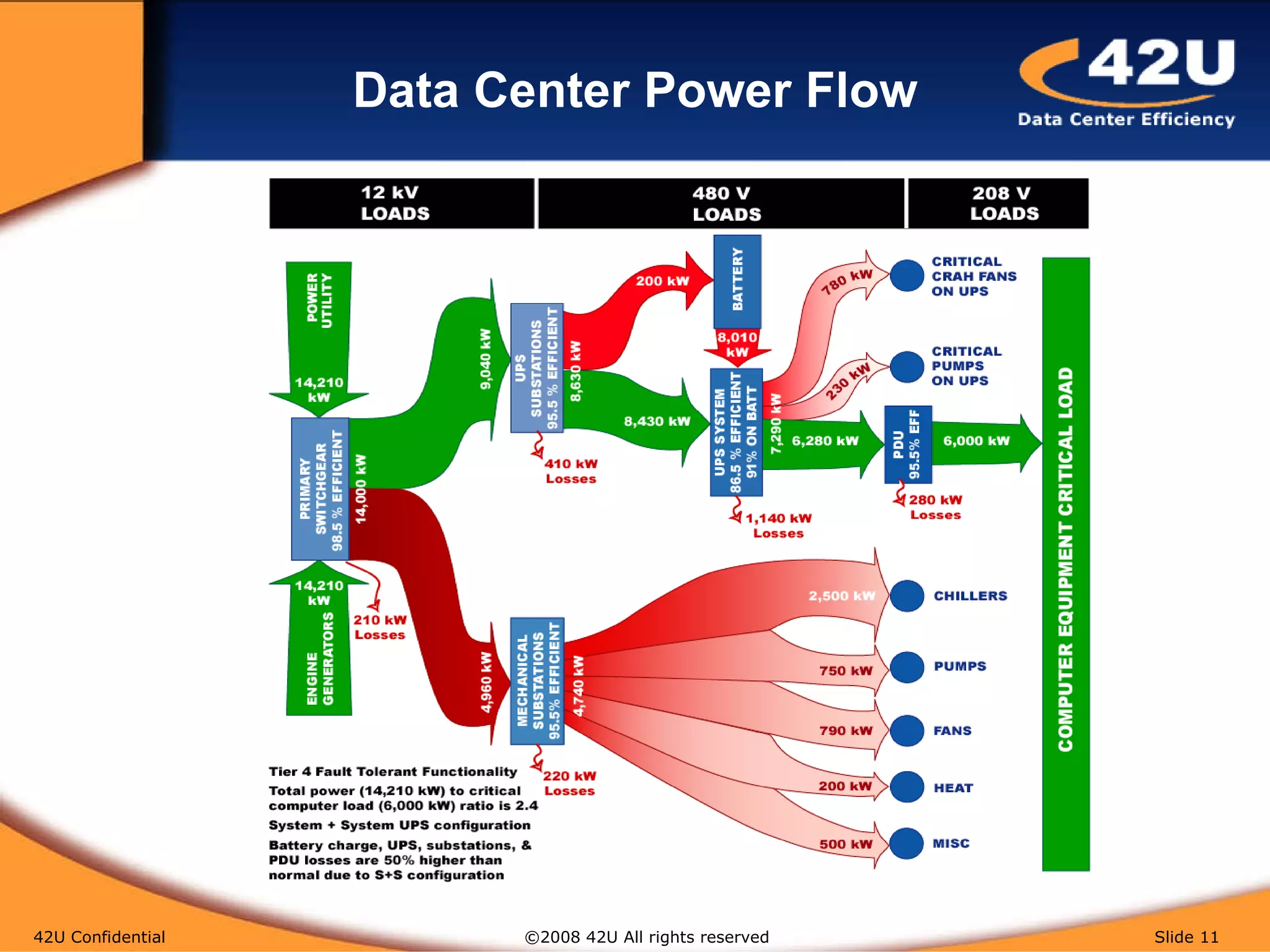
Data Center Power Flow 42U Confidential   ©2008 42U All rights reserved  Slide
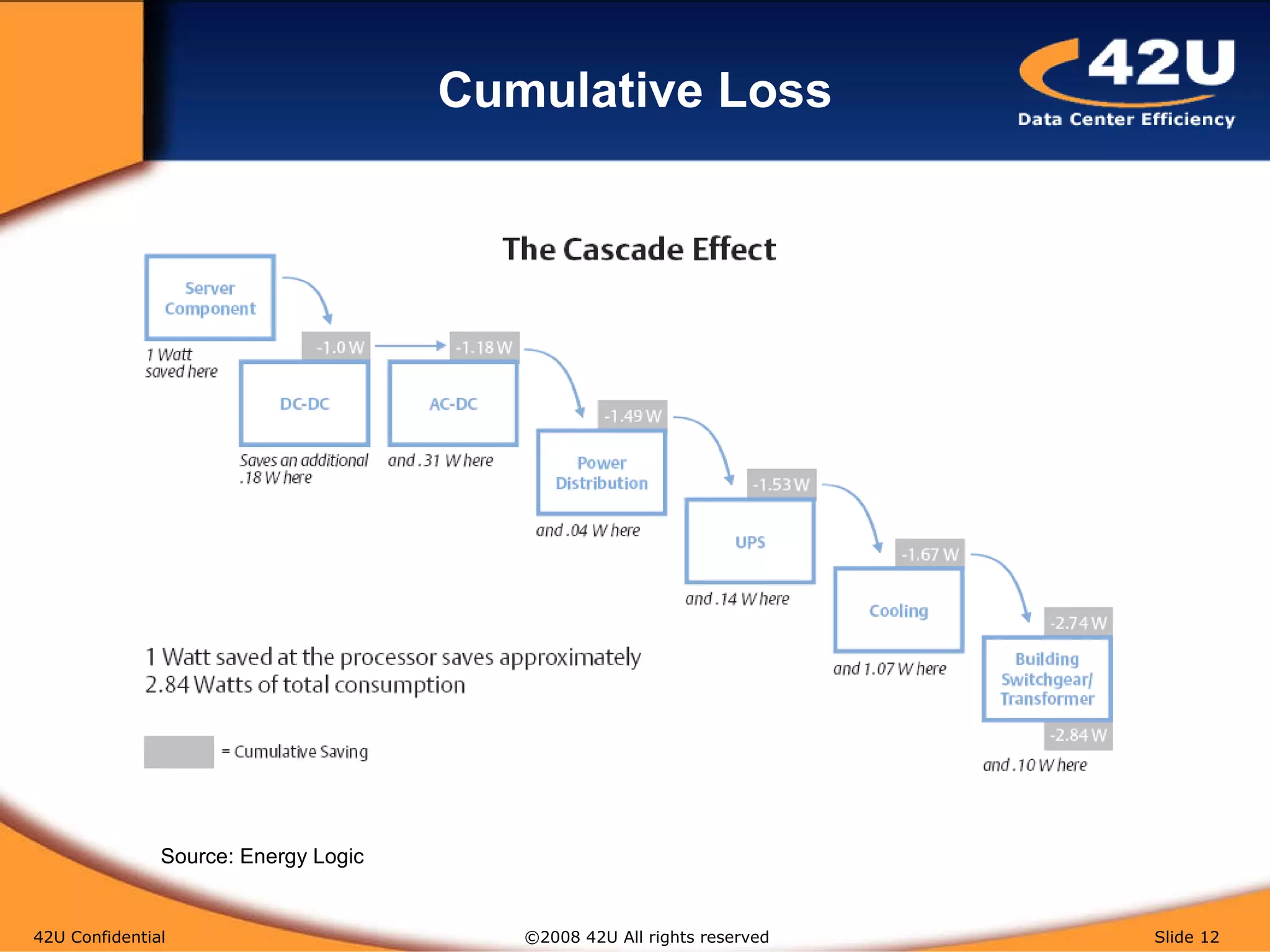
Cumulative Loss 42U Confidential   ©2008 42U All rights reserved  Slide  Source: Energy Logic
E 3  Estimator Estimation of Data Center Energy Costs Industry Benchmark Basis Multiple Research Resources Availability Spreadsheet Now 42U Website Soon 42U Confidential   ©2008 42U All rights reserved  Slide
Measuring Energy Use 42U Confidential   ©2008 42U All rights reserved  Slide  Source: The Green Grid   M M M M M M M M M M M M M M M M M M M M M M M M M M M M Utility Meter Facility Meters IT Meters M
Power Consumption Monitoring 42U Confidential   ©2008 42U All rights reserved  Slide  Rack In Cabinet Power Monitoring CRAC Fan Speed PDU Current, Voltage & Power Panel Power CRAH Fan Power
Detailed Load Analysis Measurement Techniques Smart PDUs Integrated PDU Panel Actual UPS Load 42U Confidential   ©2008 42U All rights reserved  Slide
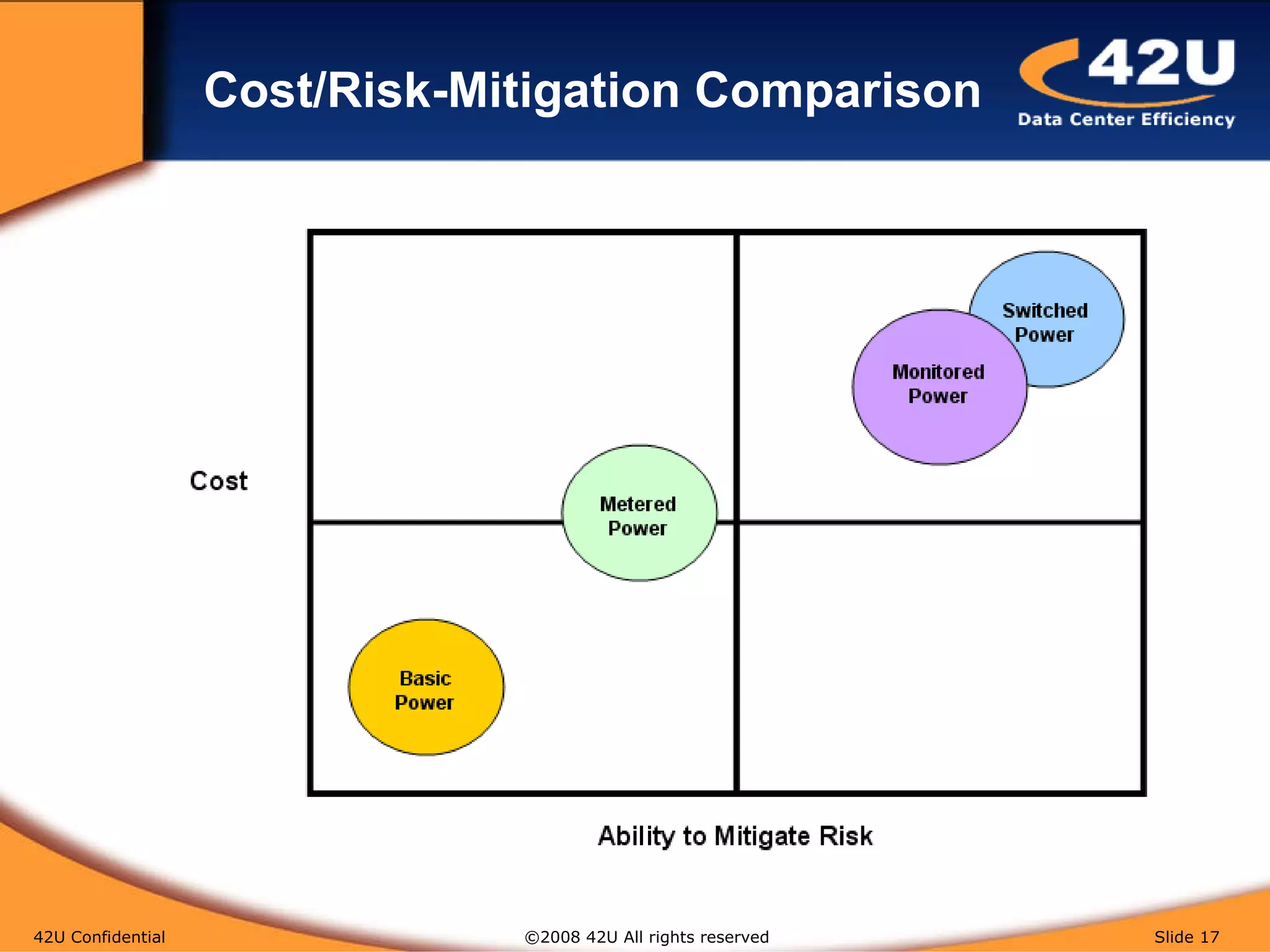
Cost/Risk-Mitigation Comparison 42U Confidential   ©2008 42U All rights reserved  Slide
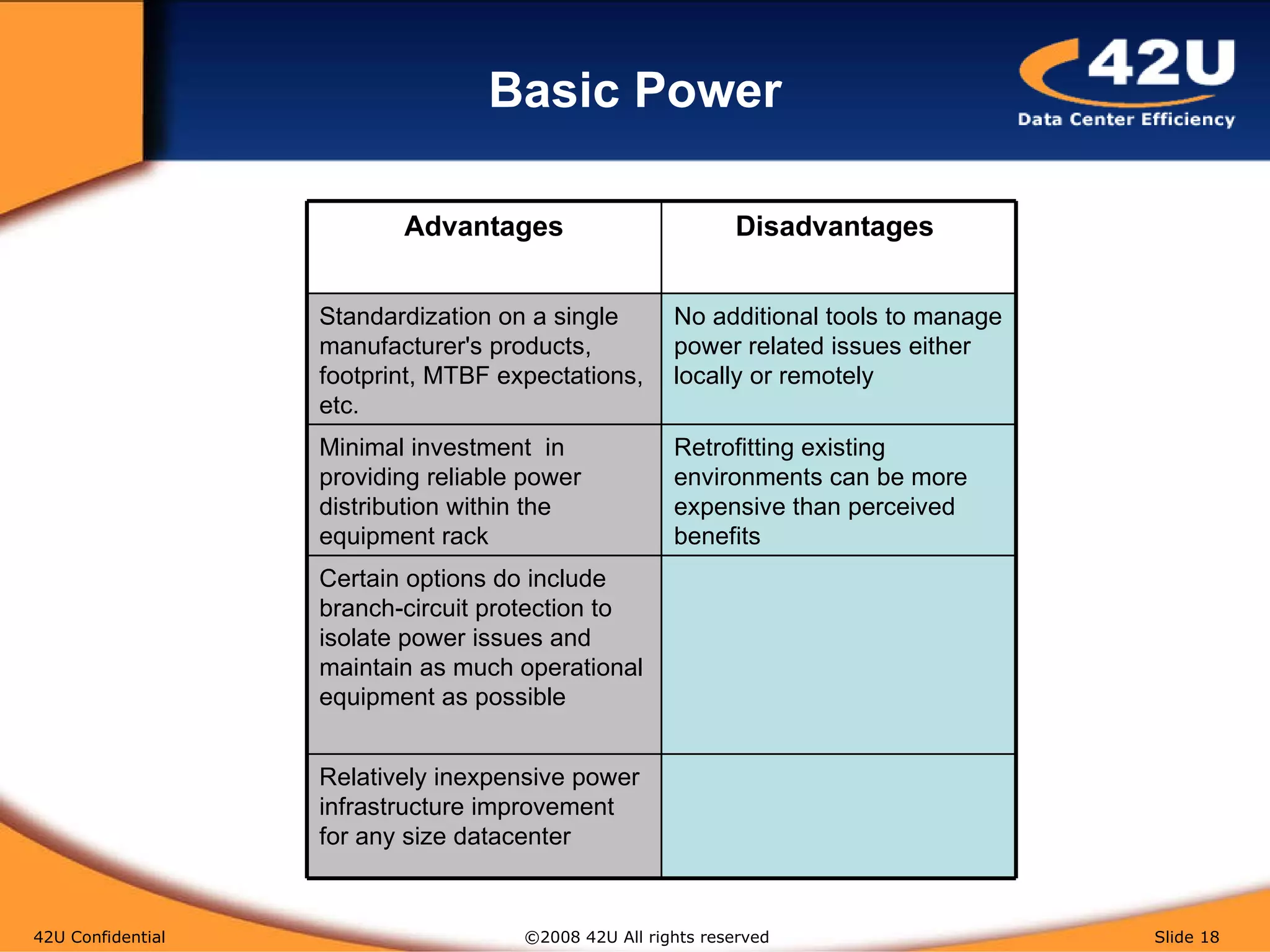
Basic Power 42U Confidential   ©2008 42U All rights reserved  Slide  Advantages Disadvantages  Standardization on a single manufacturer's products, footprint, MTBF expectations, etc.  No additional tools to manage power related issues either locally or remotely  Minimal investment  in providing reliable power distribution within the equipment rack Retrofitting existing environments can be more expensive than perceived benefits  Certain options do include branch-circuit protection to isolate power issues and maintain as much operational equipment as possible  Relatively inexpensive power infrastructure improvement for any size datacenter
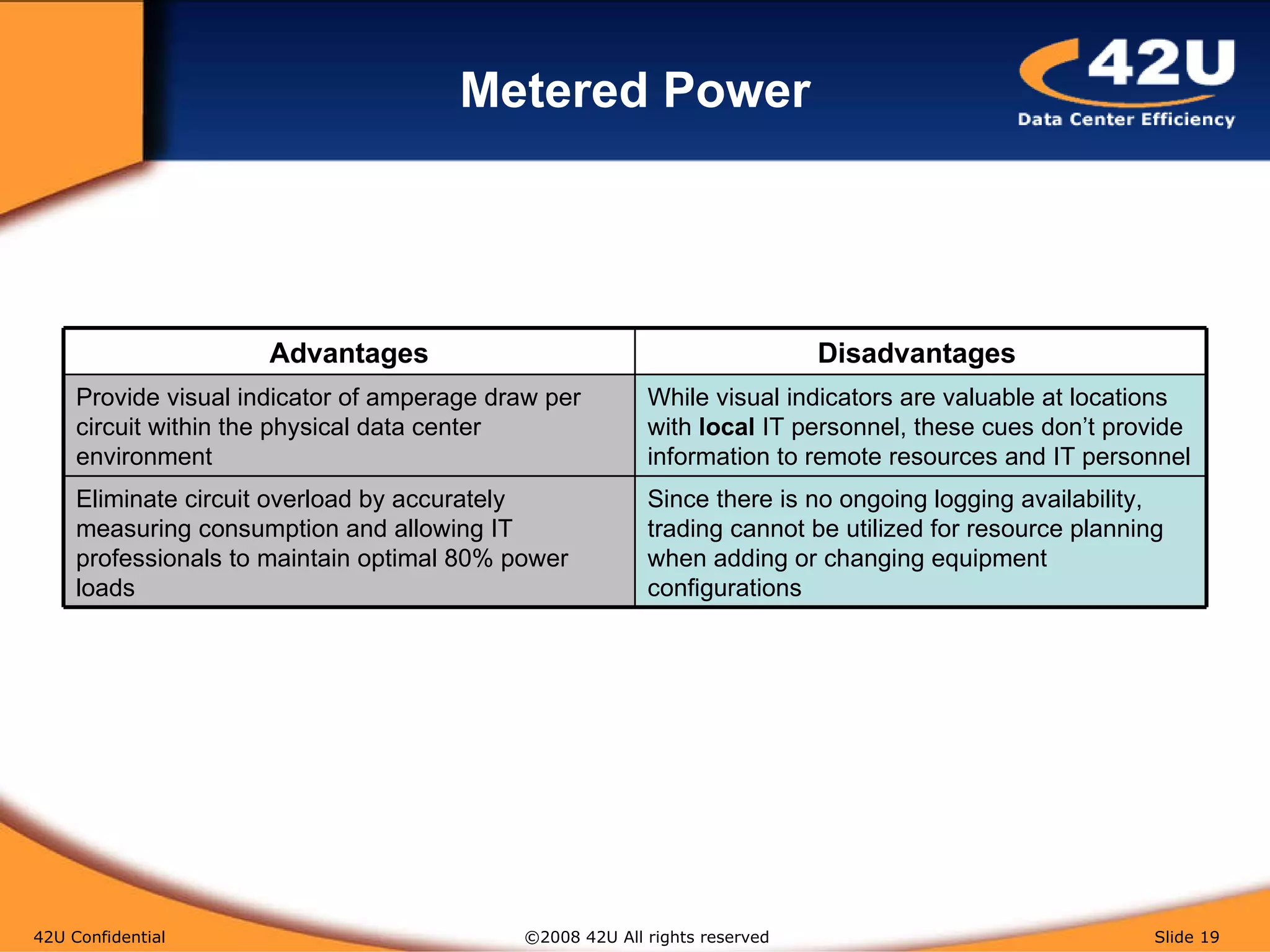
Metered Power 42U Confidential   ©2008 42U All rights reserved  Slide  Advantages Disadvantages  Provide visual indicator of amperage draw per circuit within the physical data center environment  While visual indicators are valuable at locations with  local  IT personnel, these cues don’t provide information to remote resources and IT personnel Eliminate circuit overload by accurately measuring consumption and allowing IT professionals to maintain optimal 80% power loads  Since there is no ongoing logging availability, trading cannot be utilized for resource planning when adding or changing equipment configurations
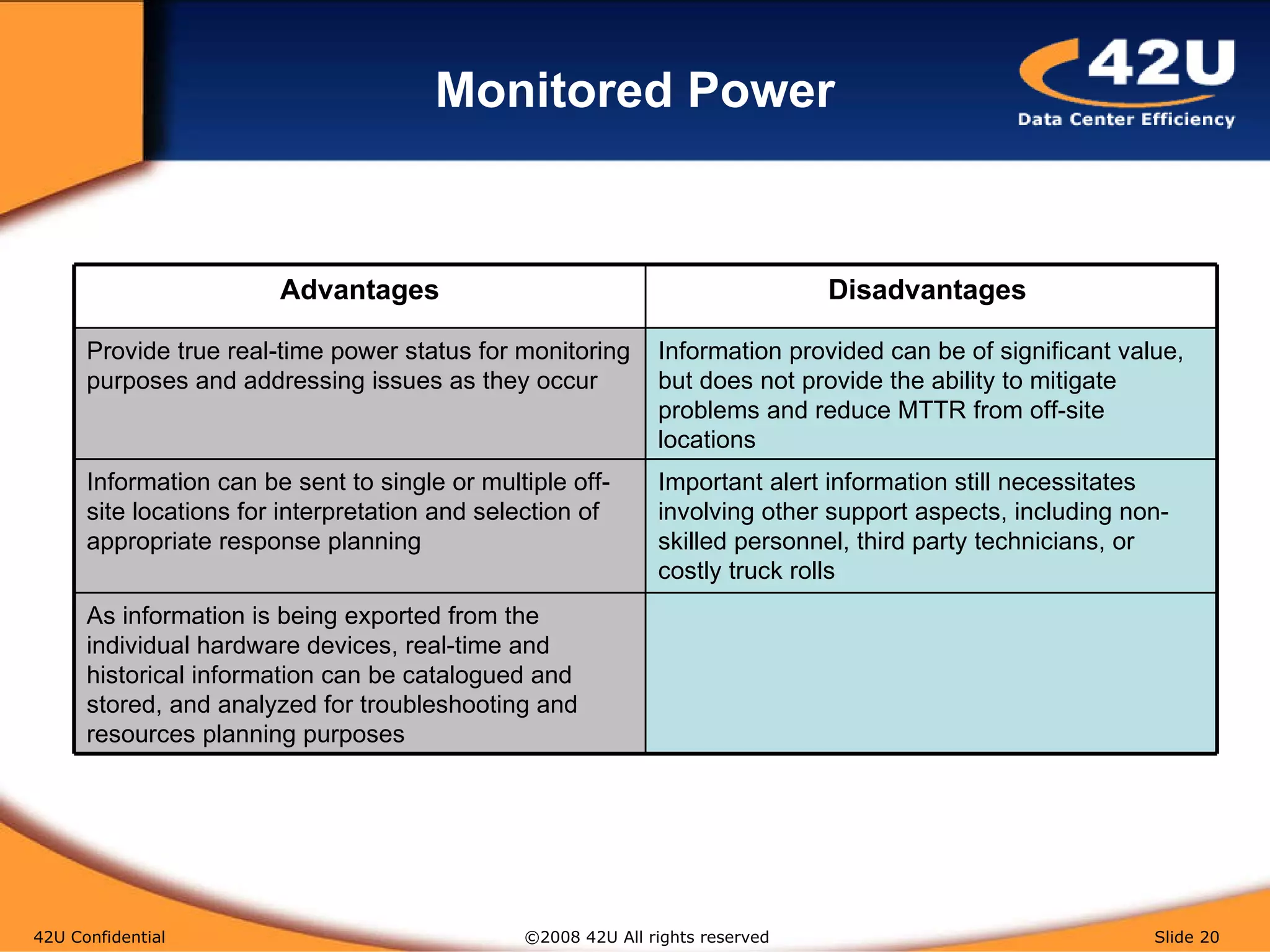
Monitored Power 42U Confidential   ©2008 42U All rights reserved  Slide  Advantages Disadvantages  Provide true real-time power status for monitoring purposes and addressing issues as they occur Information provided can be of significant value, but does not provide the ability to mitigate problems and reduce MTTR from off-site locations Information can be sent to single or multiple off-site locations for interpretation and selection of appropriate response planning Important alert information still necessitates involving other support aspects, including non-skilled personnel, third party technicians, or costly truck rolls As information is being exported from the individual hardware devices, real-time and historical information can be catalogued and stored, and analyzed for troubleshooting and resources planning purposes
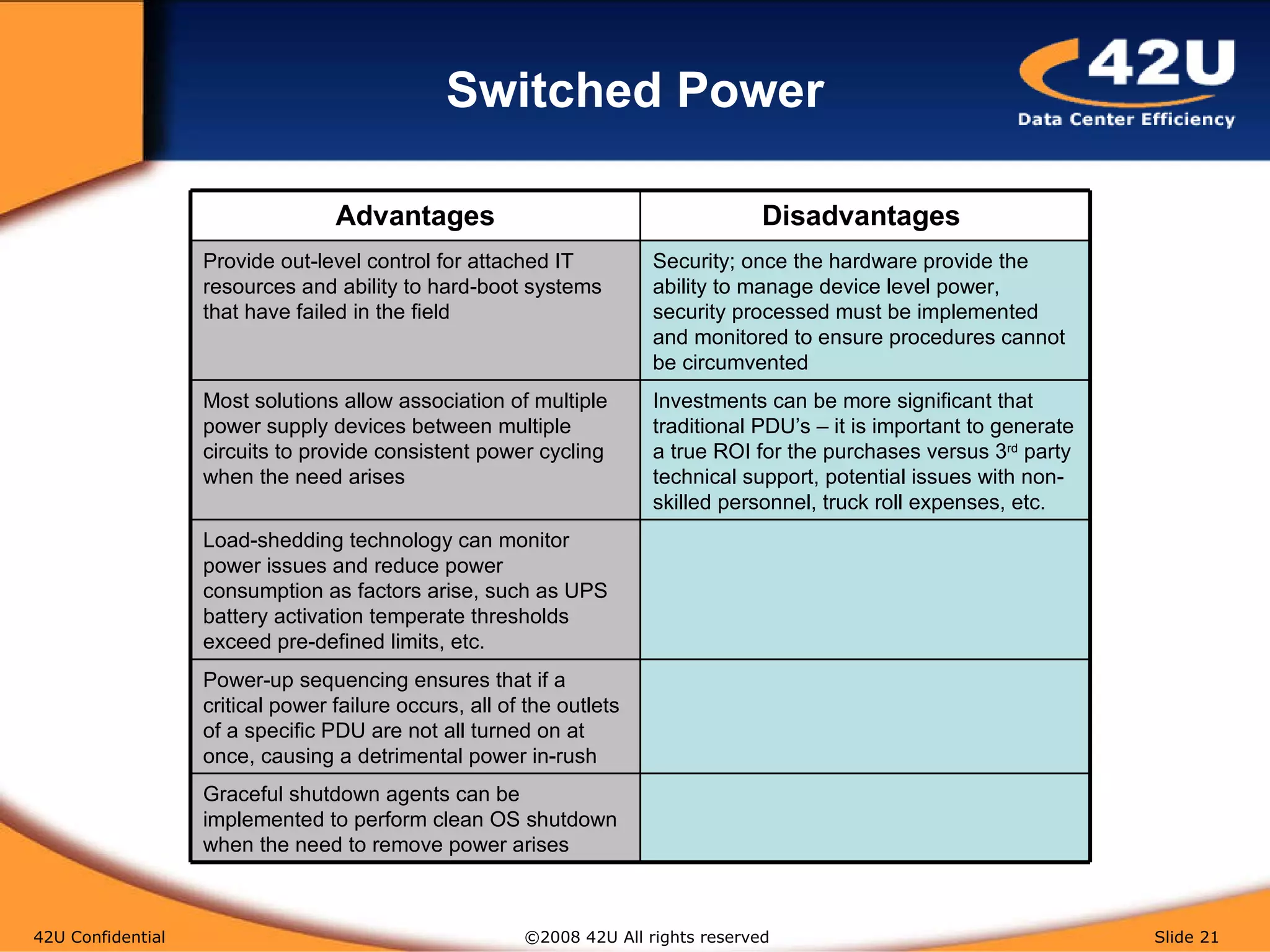
Switched Power 42U Confidential   ©2008 42U All rights reserved  Slide  Advantages Disadvantages  Provide out-level control for attached IT resources and ability to hard-boot systems that have failed in the field  Security; once the hardware provide the ability to manage device level power, security processed must be implemented and monitored to ensure procedures cannot be circumvented Most solutions allow association of multiple power supply devices between multiple circuits to provide consistent power cycling when the need arises Investments can be more significant that traditional PDU’s – it is important to generate a true ROI for the purchases versus 3 rd  party technical support, potential issues with non-skilled personnel, truck roll expenses, etc.  Load-shedding technology can monitor power issues and reduce power consumption as factors arise, such as UPS battery activation temperate thresholds exceed pre-defined limits, etc.  Power-up sequencing ensures that if a critical power failure occurs, all of the outlets of a specific PDU are not all turned on at once, causing a detrimental power in-rush Graceful shutdown agents can be implemented to perform clean OS shutdown when the need to remove power arises
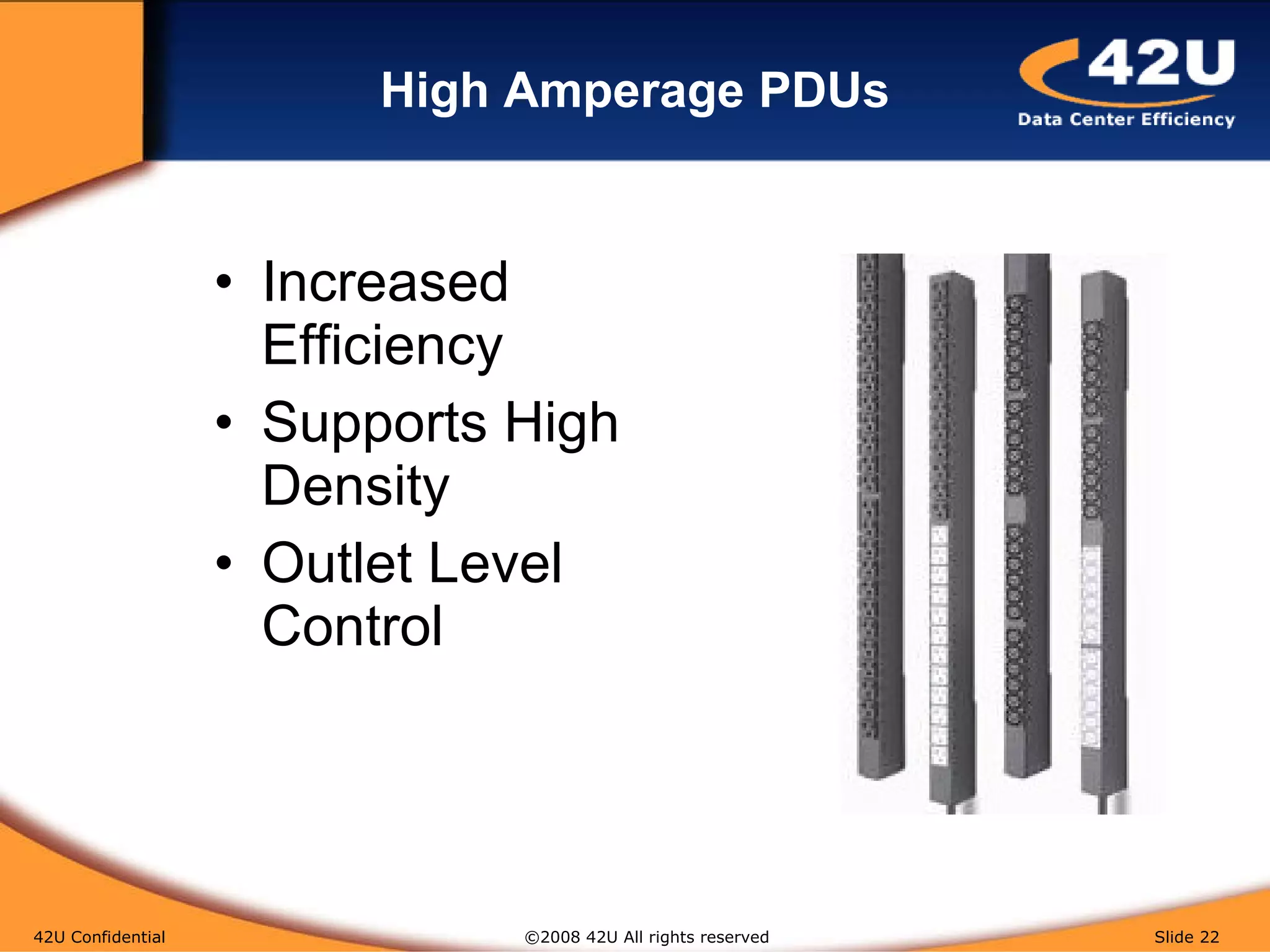
High Amperage PDUs Increased Efficiency Supports High Density Outlet Level Control 42U Confidential   ©2008 42U All rights reserved  Slide
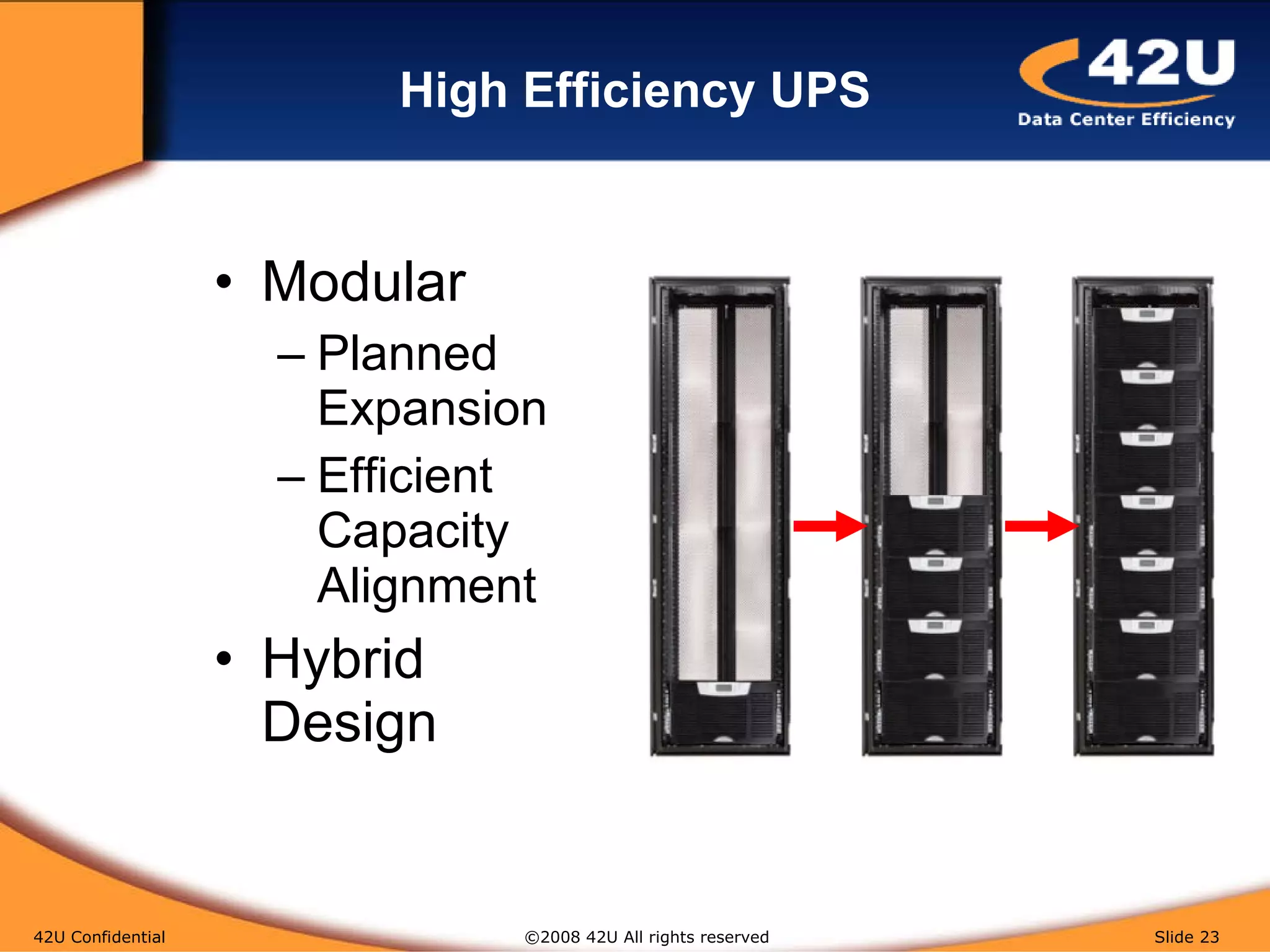
High Efficiency UPS Modular Planned Expansion Efficient Capacity Alignment Hybrid Design 42U Confidential   ©2008 42U All rights reserved  Slide
Remote Power Proactive Approach Internet Access to Infrastructure Predetermined Alerting Immediate Response to Alerts 42U Confidential   ©2008 42U All rights reserved  Slide
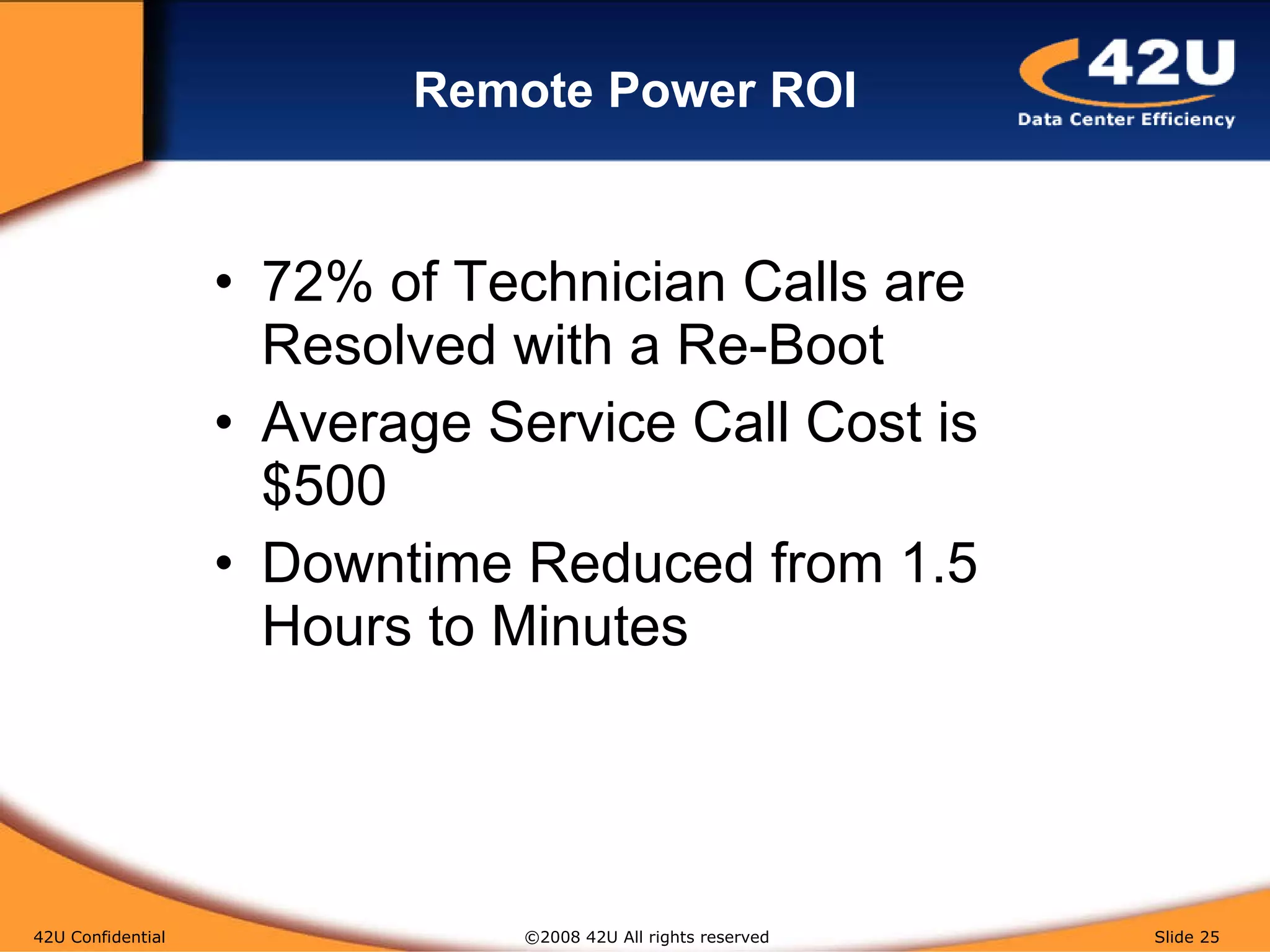
Remote Power ROI 72% of Technician Calls are Resolved with a Re-Boot Average Service Call Cost is $500 Downtime Reduced from 1.5 Hours to Minutes 42U Confidential   ©2008 42U All rights reserved  Slide
Summary Power Cost Cumulative Power Cascade Monitoring Strategies Technologies 42U Confidential   ©2008 42U All rights reserved  Slide
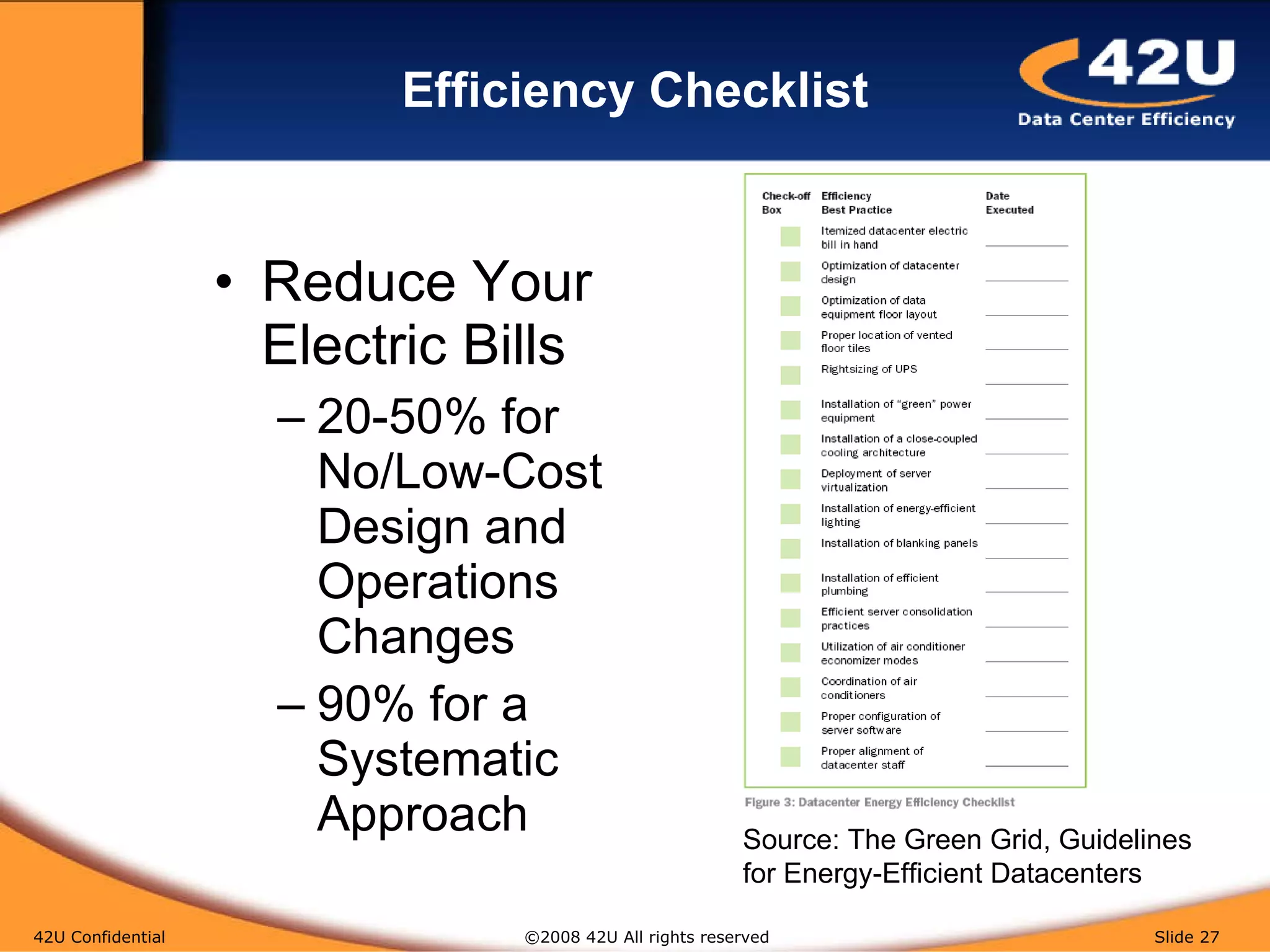
Efficiency Checklist Reduce Your Electric Bills 20-50% for No/Low-Cost Design and Operations Changes 90% for a Systematic Approach 42U Confidential   ©2008 42U All rights reserved  Slide  Source: The Green Grid, Guidelines for Energy-Efficient Datacenters
Q&A 42U Confidential   ©2008 42U All rights reserved  Slide  For More Information Contact Your 42U Data Center Efficiency Consultant: 1-800-638-2638 or  www.42U.com For a Copy of Today’s Presentation Email: [email_address] Please Type Your Questions In The Chat Window Thank You

Data Center Power Strategies

  • 1.
    42U Confidential ©2008 42U All rights reserved Slide Power Strategies for Data Center Efficiency – Identifying Cost Reduction Opportunities October 15, 2008 ________________________________
  • 2.
    Overview Importance ofPower Efficiency Power Flow Points to Monitor How to Monitor Power Management Alternatives Summary Q&A 42U Confidential ©2008 42U All rights reserved Slide
  • 3.
    Energy Cost Projection42U Confidential ©2008 42U All rights reserved Slide Source: Aperture, Greener Pastures for Your Data Center
  • 4.
    Energy Consumers InfrastructureConsumes More Power Than The IT Equipment 42U Confidential ©2008 42U All rights reserved Slide Source: The Green Grid, Guidelines for Energy-Efficient Datacenters
  • 5.
    Energy Consumers 42UConfidential ©2008 42U All rights reserved Slide Source: Burton Group, Improving Data Center Energy Efficiency: A Holistic Approach
  • 6.
    Related Costs 42UConfidential ©2008 42U All rights reserved Slide Source: APC
  • 7.
    Energy Benchmark EstablishedGreen Grid Benchmark Enables Comparison 42U Confidential ©2008 42U All rights reserved Slide Source: The Green Grid
  • 8.
    Planned Energy ConsumptionDo You Know Your Planned Watts/Sq. Ft.? 42U Confidential ©2008 42U All rights reserved Slide Source: Ziff-Davis, Data Center Power and Heat Management: Ready Or Not?
  • 9.
    Planning Context SLASupport ITIL Compliance TCO Precision 42U Confidential ©2008 42U All rights reserved Slide
  • 10.
    Downtime Costs 42UConfidential ©2008 42U All rights reserved Slide
  • 11.
    Data Center PowerFlow 42U Confidential ©2008 42U All rights reserved Slide
  • 12.
    Cumulative Loss 42UConfidential ©2008 42U All rights reserved Slide Source: Energy Logic
  • 13.
    E 3 Estimator Estimation of Data Center Energy Costs Industry Benchmark Basis Multiple Research Resources Availability Spreadsheet Now 42U Website Soon 42U Confidential ©2008 42U All rights reserved Slide
  • 14.
    Measuring Energy Use42U Confidential ©2008 42U All rights reserved Slide Source: The Green Grid M M M M M M M M M M M M M M M M M M M M M M M M M M M M Utility Meter Facility Meters IT Meters M
  • 15.
    Power Consumption Monitoring42U Confidential ©2008 42U All rights reserved Slide Rack In Cabinet Power Monitoring CRAC Fan Speed PDU Current, Voltage & Power Panel Power CRAH Fan Power
  • 16.
    Detailed Load AnalysisMeasurement Techniques Smart PDUs Integrated PDU Panel Actual UPS Load 42U Confidential ©2008 42U All rights reserved Slide
  • 17.
    Cost/Risk-Mitigation Comparison 42UConfidential ©2008 42U All rights reserved Slide
  • 18.
    Basic Power 42UConfidential ©2008 42U All rights reserved Slide Advantages Disadvantages Standardization on a single manufacturer's products, footprint, MTBF expectations, etc. No additional tools to manage power related issues either locally or remotely Minimal investment in providing reliable power distribution within the equipment rack Retrofitting existing environments can be more expensive than perceived benefits Certain options do include branch-circuit protection to isolate power issues and maintain as much operational equipment as possible Relatively inexpensive power infrastructure improvement for any size datacenter
  • 19.
    Metered Power 42UConfidential ©2008 42U All rights reserved Slide Advantages Disadvantages Provide visual indicator of amperage draw per circuit within the physical data center environment While visual indicators are valuable at locations with local IT personnel, these cues don’t provide information to remote resources and IT personnel Eliminate circuit overload by accurately measuring consumption and allowing IT professionals to maintain optimal 80% power loads Since there is no ongoing logging availability, trading cannot be utilized for resource planning when adding or changing equipment configurations
  • 20.
    Monitored Power 42UConfidential ©2008 42U All rights reserved Slide Advantages Disadvantages Provide true real-time power status for monitoring purposes and addressing issues as they occur Information provided can be of significant value, but does not provide the ability to mitigate problems and reduce MTTR from off-site locations Information can be sent to single or multiple off-site locations for interpretation and selection of appropriate response planning Important alert information still necessitates involving other support aspects, including non-skilled personnel, third party technicians, or costly truck rolls As information is being exported from the individual hardware devices, real-time and historical information can be catalogued and stored, and analyzed for troubleshooting and resources planning purposes
  • 21.
    Switched Power 42UConfidential ©2008 42U All rights reserved Slide Advantages Disadvantages Provide out-level control for attached IT resources and ability to hard-boot systems that have failed in the field Security; once the hardware provide the ability to manage device level power, security processed must be implemented and monitored to ensure procedures cannot be circumvented Most solutions allow association of multiple power supply devices between multiple circuits to provide consistent power cycling when the need arises Investments can be more significant that traditional PDU’s – it is important to generate a true ROI for the purchases versus 3 rd party technical support, potential issues with non-skilled personnel, truck roll expenses, etc. Load-shedding technology can monitor power issues and reduce power consumption as factors arise, such as UPS battery activation temperate thresholds exceed pre-defined limits, etc. Power-up sequencing ensures that if a critical power failure occurs, all of the outlets of a specific PDU are not all turned on at once, causing a detrimental power in-rush Graceful shutdown agents can be implemented to perform clean OS shutdown when the need to remove power arises
  • 22.
    High Amperage PDUsIncreased Efficiency Supports High Density Outlet Level Control 42U Confidential ©2008 42U All rights reserved Slide
  • 23.
    High Efficiency UPSModular Planned Expansion Efficient Capacity Alignment Hybrid Design 42U Confidential ©2008 42U All rights reserved Slide
  • 24.
    Remote Power ProactiveApproach Internet Access to Infrastructure Predetermined Alerting Immediate Response to Alerts 42U Confidential ©2008 42U All rights reserved Slide
  • 25.
    Remote Power ROI72% of Technician Calls are Resolved with a Re-Boot Average Service Call Cost is $500 Downtime Reduced from 1.5 Hours to Minutes 42U Confidential ©2008 42U All rights reserved Slide
  • 26.
    Summary Power CostCumulative Power Cascade Monitoring Strategies Technologies 42U Confidential ©2008 42U All rights reserved Slide
  • 27.
    Efficiency Checklist ReduceYour Electric Bills 20-50% for No/Low-Cost Design and Operations Changes 90% for a Systematic Approach 42U Confidential ©2008 42U All rights reserved Slide Source: The Green Grid, Guidelines for Energy-Efficient Datacenters
  • 28.
    Q&A 42U Confidential ©2008 42U All rights reserved Slide For More Information Contact Your 42U Data Center Efficiency Consultant: 1-800-638-2638 or www.42U.com For a Copy of Today’s Presentation Email: [email_address] Please Type Your Questions In The Chat Window Thank You

Editor's Notes

  • #4 <J> The A and B projections are for improvements in server technology efficiency. <Steve> It seems appropriate to note here Jay that in a recent study data centers accounted for 1.2% of electricity sales in the US and 0.08% globally, when you really think about it, that is a significant percentage.
  • #5 <J> <Steve chime in>And this is only 1 approach, IDC states 48% for Overhead, and 52% for IT
  • #6 <J> <Steve chime in> I think the folks attending already know the significance of energy costs in their environment but to drive the point home IDC recently conducted a study and found that energy expense represents 13% of data center costs.
  • #7 <J>That brings up an important point; the numbers move around depending on how you measure, what goes into which bucket and, to be honest, what you’re selling. The real message here is that energy costs are a significant component of the corporate budget and growing.
  • #8 <J> I prefer to use independent sources of information as opposed to those supplied by vendors. Power use efficiency is an alternative use of the acronym. <Steve> So as we focus on that gray area in the middle, we are looking at numbers in the 30%-50% range
  • #9 <J> At the end of the day, most data center people don’t actually know their planned power consumption. <Steve> The Watts per sq ft measurement is an outdated approach. Environments change constantly and unfortunately we are not always in a position to really calculate the best approach to placing equipment. Densities are mixed across the entire floor so using an average of this type that assumes standardization of density across the entire room, which is misleading and will lead to problems not only in power management, but effectively cooling the environment.
  • #10 <J> Provides actual data that can be used in data center design and management tools. Ensuring you’re not exposed to SLA failures Ensuring compliance with your ITIL compliance in areas such as supplying appropriate capacities, as opposed to sufficient capacities. More deeply, business analysis best practices, as defined in the Business Analysis Body of Knowledge (BABOK), define the techniques and ITIL v3 where the focus is on the life cycle approach. Ineffective business analysis costs U.S. businesses at least $30B every year. Improving the precision of the Total Cost of Ownership calculation to be used for informed planning. As-configured is not typically the actual experience. Blockages and inefficiencies degrade the actual performance. Identifying stranded capacities that are opportunities for efficiency improvement programs. Gartner recently reported findings (RN-G00153396) that included strong recommendations that IT improve their efficiency by first measuring their energy efficiency losses. Gartner describes operational maturity as moving from chaos through reactivity, proactive services to generation of business value. One of the first steps to take to move closer to and to maintain IT business value is to measure your data center against a meaningful benchmark, such as power usage effectiveness (PUE). Stratavia recently produced an excellent whitepaper describing this process. A measurement initiative can be the basis for a more broad greening initiative that generates considerable savings, frees budget for other efforts and contributes to corporate environmental initiatives. (need green corporate story). The Department of Energy (DOE) will soon release DC Pro, a tool that can be used to calculate data center infrastructure efficiency (DCiE) as well as provide recommendations for improvement.
  • #11 <J> Just in case you don’t know, and I’m sure most of you listening are painfully aware of these numbers, it’s costly to have downtime. Pass over to Steve <Steve> Thanks Jay, before we delve into measurement techniques lets take a look at the flow of power throughout the data center……
  • #12 <Steve> This shows the power as it starts from the utility and how it flows through the data center and finally into the server and networking gear. The blue rectangles represent the areas where power is converted, and stored, and also lost. As you can see there are multiple points throughout the delivery of power where we lose essentially what we are be charged for.
  • #13 <Steve> Here is a view of the typical conversion losses… <J> So, this view moves from the server back to the power source? <Steve> That’s right. From this slide, we see as the power cascades back from the server to its original source at the utility we are losing wattage each step of the way. These small wattage savings can add up to a significant number as you multiply it across your entire facility. Any positive changes you can make to the efficiency of this process are extremely beneficial.
  • #14 <Steve>E3 Is a calculator we developed to help our clients have a starting point for understanding the cost associated with their energy consumption. E3 stands for Estimated Energy Expense. What we found in many organizations is a disconnect between facilities and IT. This calculator helps the IT manager understand the cost of energy. The calculator is comprised of 5 key factors: kW/hour rate kW/rack design point # of racks in data center Overhead factor (infrastructure required to power and cool the equipment) Uptime requirement (how many 9s of uptime) If you do not have all 5 factors we will use industry averages. The only data you need to supply is the number of racks. Contact a 42U efficiency consultant for more information and to evaluate your energy consumption. <J> As we saw earlier there is some variability with the factors contributing to energy costs. Does this allow for that? <Steve> Good point. Yes, the algorithm allows for adjustments of the assumptions used. If a client wants to use The Green Grid data of 30% or the Burton 40% or another basis, the assumptions can be adjusted. We can user whatever approach the client is most comfortable using based on their own environment.
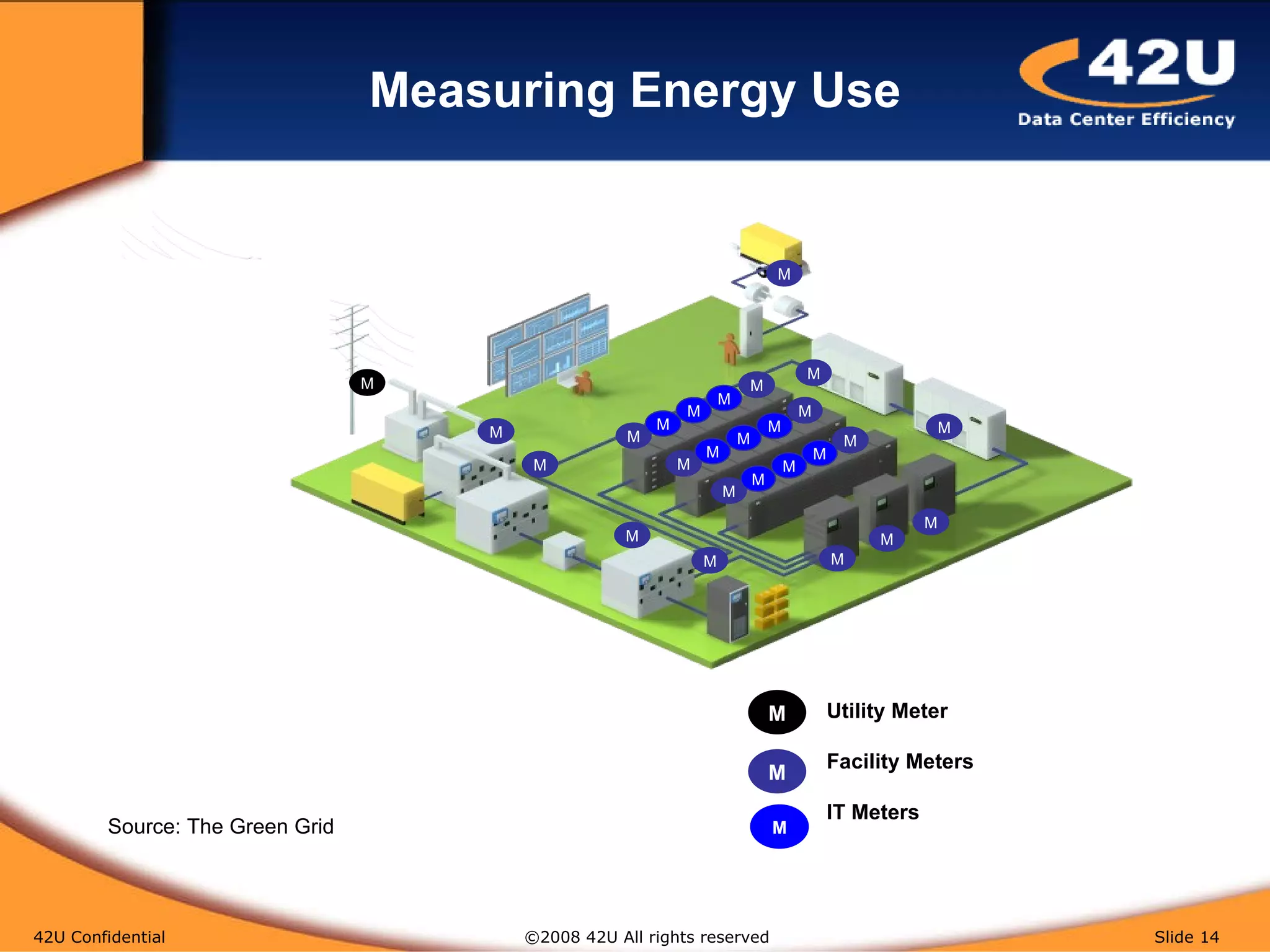
  • #15 <Steve> This shows the various points at which we can measure. All the components are broken down to categories. Energy flows from utility to the facility, and then out to IT internal to the racks Again as you can see there are various points at which you can monitor.. You should design your power infrastructure to support business requirements These requirements typically have to do with SLAs, what are the standard practices and procedures the organizaton has to follow, or charge backs, am I sharing the space and how can I accurately charge our customers for the energy they use.
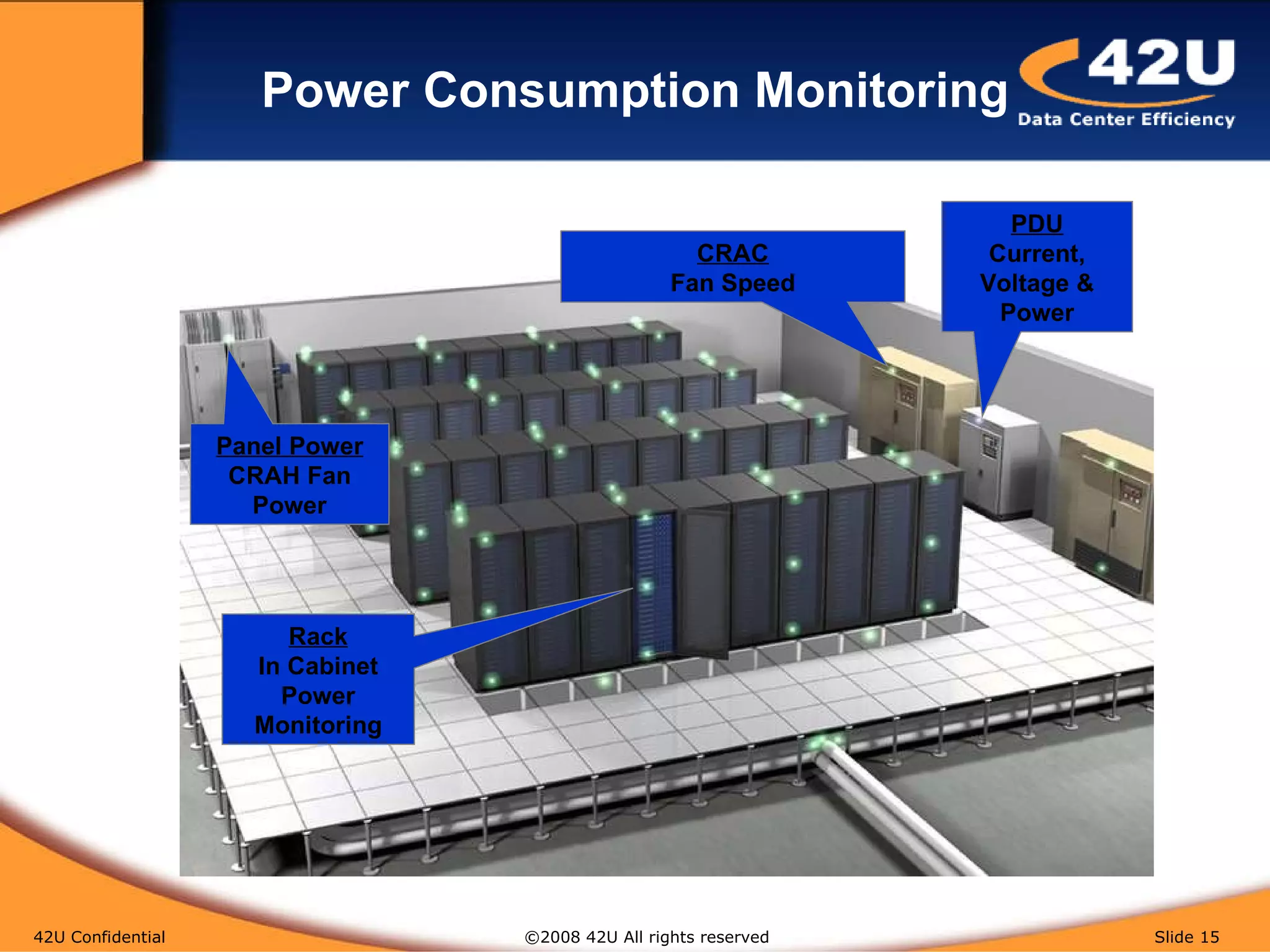
  • #16 <Steve> This is the next level of granularity. Inside the data center we are concerned with measuring at the Panel, the fan speeds of the CRAHs and CRACs. We can measure at the floor PDUs to determine current voltage and power, and then into the rack. Internal to the rack is where we can get very detailed in our approach, whether we are looking to monitoring cumulative amperage draw across a PDU, or all the way down to individual outlets on the PDU.
  • #17 <Steve> So now lets look at the big picture plan. What are the techniques I can implement for measurement? These are not just stand alone approaches, we can implement all strategies together if the business requirements deem it necessary. <J chime in>
  • #18 <Steve> What we are looking at here is the Relationship of cost vs risk. There really isn’t anything hidden to this concept. The more you are willing to invest in your measurement strategy the lesser the risk you assume in your data center. This shows 4 approaches and we will look at each individually. From Basic Power to Metered, then to Monitored, and finally Switched. Drivers: Risk Sensitivity SLAs Age of Technology
  • #19 <Steve> Explain Basic Power Manufactured for use in the Data Center Easily mounted in standard data center enclosures Fuse or circuit breaker protected When implementing this approach a single manufacturer for the PDUs is strongly recommending as this gives you a single point of contact for failures
  • #20 <Steve> Explain Metered Power All the building blocks of basic power Amperage meter located on the PDU for real time amperage consumption Where this falls short is the information is only available to the onsite IT staff. It also does not help during capacity planning as the information is not logged unless it is done manually.
  • #21 <Steve> Explain Monitored Power All benefits of Basic and Meters IP addressable with built in web interface. Ability to track consumption remotely Environmental monitoring SNMP alerts for proactive management Still no ability to react remotely
  • #22 <Steve> Explain Switched Power Proactive approach to PDU All the functionality of the previous approaches Ability to cycle power to unresponsive equipment, Grouping of outlets across circuits for true redundant control of dual, triple, or quadruple power supply devices Load shed during battery power Power sequencing to avoid power in rush during start up Options for shutdown agents to avoid hard stops. <<These are the concepts of power management now lets take a look at the physical equipment>>
  • #23 <Steve> Examples of technologies Servers are becoming smaller, we see a lot of 1 and 2U servers and blade chasis. This frees up additional U space for more equipment. Traditional single phase power does not have the capacity to handle these environments. These High density applications require 3phase power Deliver nearly 2x the amperages on a single circuit, so a single phase 30Am circuit is roughly 52amps on a 3phase circuit. Decrease footprint by densely populating racks, cooling permitting These PDUs are available in the switched technology group we discussed a moment ago <J> Harmonics management <Steve> When implemented in a controlled area we can keep the harmonics in balance and the phases synchronized. It is not easy to retrofit a single phase environment and the environments should not be mixed. 3Phase should be an approach you consider as you build out additional rows of your facility.
  • #24 <Steve> Now lets take a step back to the UPS Commission as you go vs. commission build out What is my cost to commission a UPS that meets the future capacity of my data center? How long will it take to reach that capacity? Will my UPS be obsolete by the time I am ready to fully utilize its capacity? Modular, shared buss bar, N+1 redundancy internal to the configuration 12KVA increments, 60KVA N+1
  • #25 <Steve> Remote power allows you to take a proactive approach to managing your power. The Best practice for remote power management is to deploy Switched PDUs IP UPS Monitoring tools at the breaker……. Access power infrastructure anywhere, anytime you have access to internet Alerting based on predetermined events or thresholds Ability to act on alerts instantly It may seem like a daunting/costly undertaking to implement a remote power strategy but the ROI is rather simple to calculate.
  • #26 <Steve> Most of you on the line are probably nodding rite now. Studies have shown that 72% of all technician calls are solved by simply bouncing a server. The average cost of this service is roughly $500 and the time associated with the call can take hours depending on the time of day and distance to the facility. With remote power management you can decrease this service time to minutes One other factor not listed here are the service level penalties associated with downtime.. (((Steve Done - PASS BACK TO J TO SUMMARIZE PRESO))) The take away here is there are many opportunities to improve the efficiency of your data center through the implementation of a power management strategy. Each approach detailed will yield significant savings to your organization and the approaches are customizable to meet your business requirements.
  • #27 <J>
  • #28 <J>
  • #29 <J> Reminder about E3 estimator