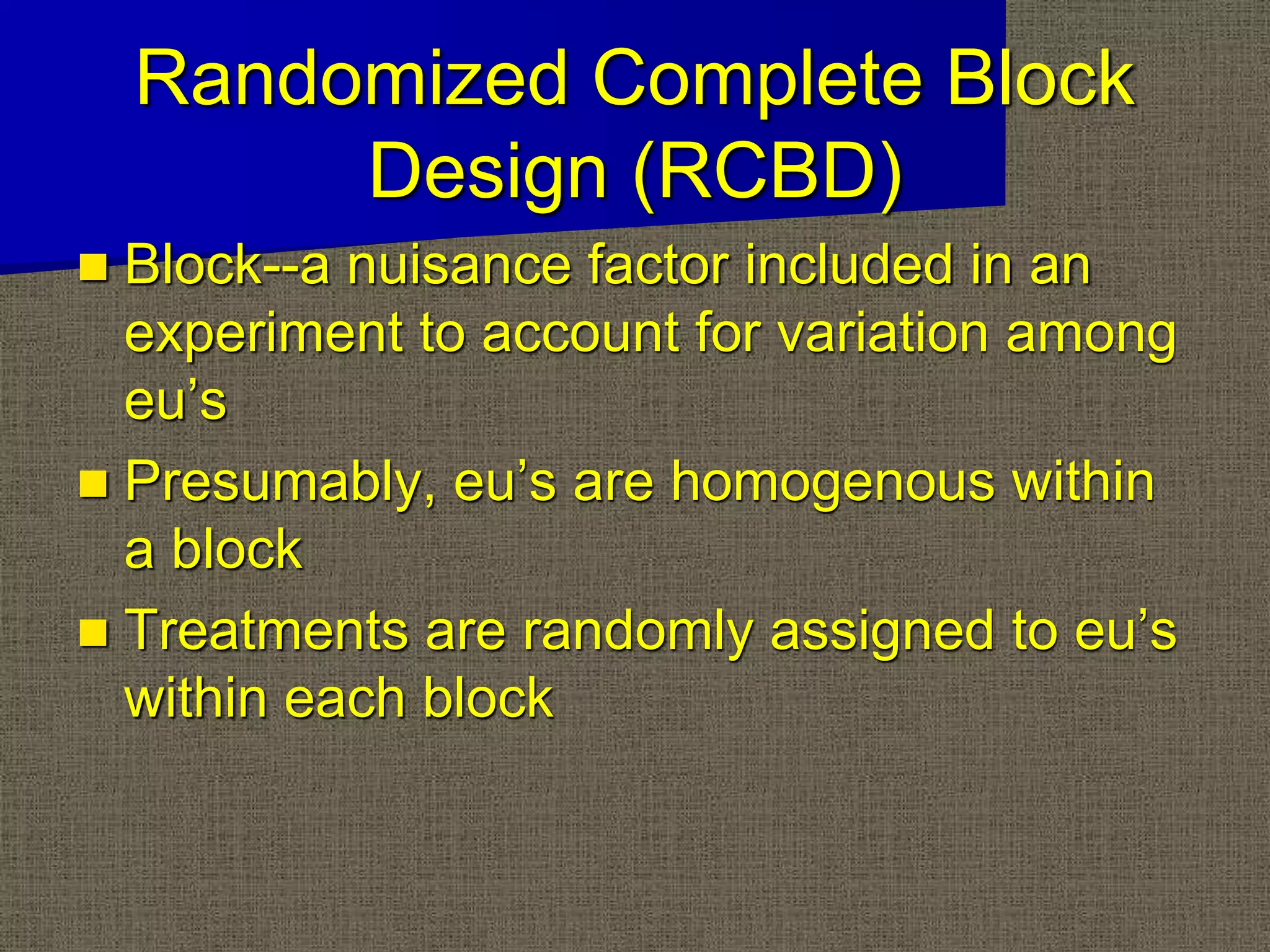
Randomized Complete Block
Design (RCBD)
 Block--a nuisance factor included in an
experiment to account for variation among
eu’s
 Presumably, eu’s are homogenous within
a block
 Treatments are randomly assigned to eu’s
within each block
 
0
:
)
,
0
(
,
2







i
o
ij
ij
ij
ij
j
i
ij
H
N
iid
Y









 The model and hypotheses
RCBD
Blocks in RCBDs
 Blocks can be modeled as both fixed and
random effects (Soil example)
– Block: Soil type (fixed or random?)
– Treatment: Nitrogen x Watering Regimen
– Response: IR/R reflection
RCBD Discussion
 There is some controversy as to whether
fixed block effects should be tested
– F test is considered at best approximate
 Additivity of the block and factor effects
– Error includes lack-of-fit
– Practical considerations
 Both block and factor could have a
factorial structure
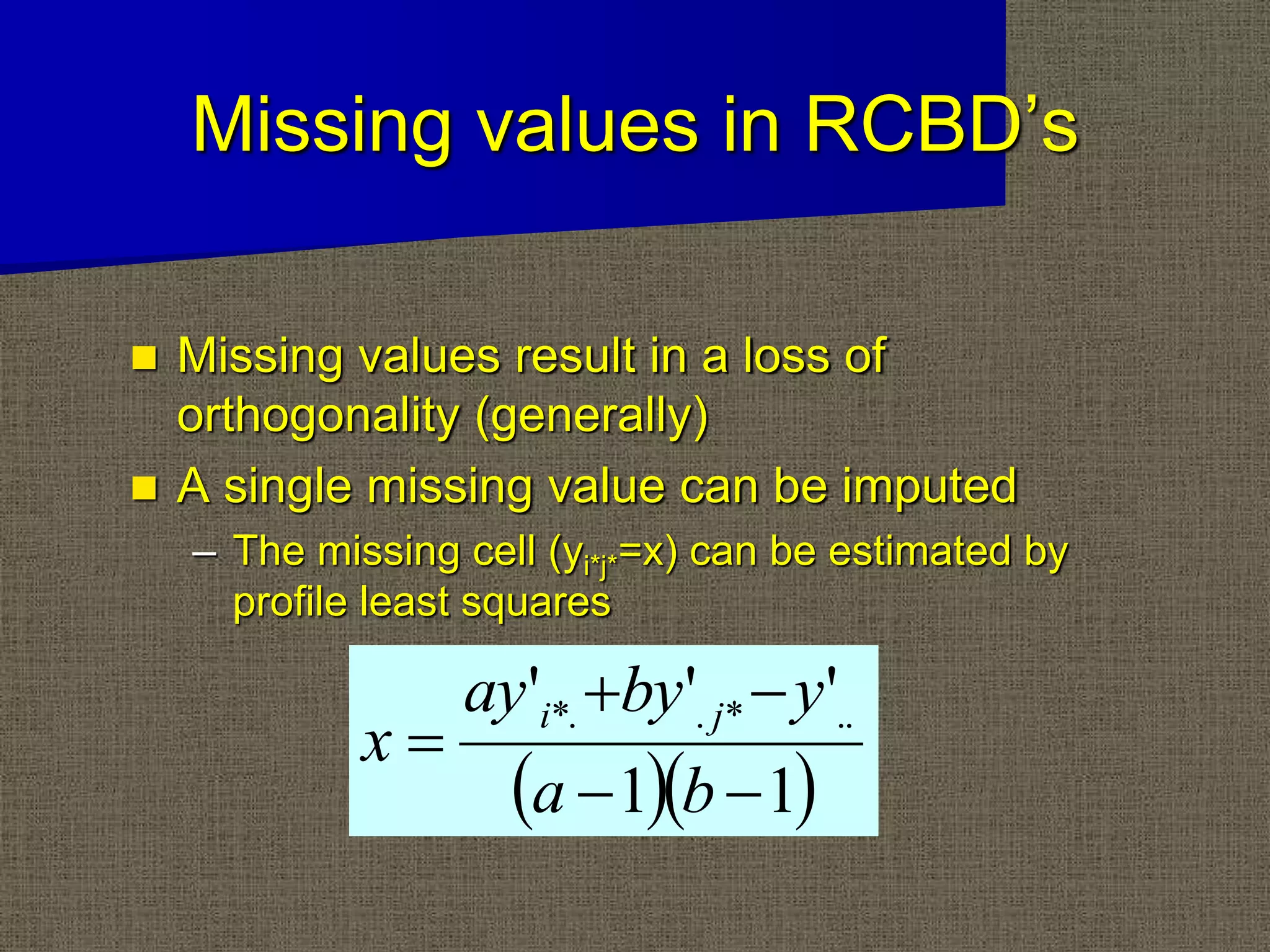
Missing values in RCBD’s
 Missing values result in a loss of
orthogonality (generally)
 A single missing value can be imputed
– The missing cell (yi*j*=x) can be estimated by
profile least squares
  
1
1
'
'
' ..
*
.
.
*





b
a
y
by
ay
x
j
i
Imputation
 The error df should be reduced by one,
since x was estimated
 SAS can compute the F statistic, but the p-
value will have to be computed separately
 The method is efficient only when a couple
cells are missing
Alternate Imputation
approaches
 The usual Type III analysis is available,
but be careful of interpretation
 Little and Rubin use MLE and simulation-
based approaches
 PROC MI in SAS v9 implements Little and
Rubin approaches
2
2
o use
,
0
:
H
For



 

 i
b


 2
2
2
o use
,
0
:
H
For
i
c
bL
L


 Power calculations change little
– b replaces n in formulas
– The error df is (a-1)(b-1)
Power analysis

rcbd research ppt.pptx

  • 1.
    Randomized Complete Block Design(RCBD)  Block--a nuisance factor included in an experiment to account for variation among eu’s  Presumably, eu’s are homogenous within a block  Treatments are randomly assigned to eu’s within each block
  • 2.
  • 3.
    Blocks in RCBDs Blocks can be modeled as both fixed and random effects (Soil example) – Block: Soil type (fixed or random?) – Treatment: Nitrogen x Watering Regimen – Response: IR/R reflection
  • 4.
    RCBD Discussion  Thereis some controversy as to whether fixed block effects should be tested – F test is considered at best approximate  Additivity of the block and factor effects – Error includes lack-of-fit – Practical considerations  Both block and factor could have a factorial structure
  • 5.
    Missing values inRCBD’s  Missing values result in a loss of orthogonality (generally)  A single missing value can be imputed – The missing cell (yi*j*=x) can be estimated by profile least squares    1 1 ' ' ' .. * . . *      b a y by ay x j i
  • 6.
    Imputation  The errordf should be reduced by one, since x was estimated  SAS can compute the F statistic, but the p- value will have to be computed separately  The method is efficient only when a couple cells are missing
  • 7.
    Alternate Imputation approaches  Theusual Type III analysis is available, but be careful of interpretation  Little and Rubin use MLE and simulation- based approaches  PROC MI in SAS v9 implements Little and Rubin approaches
  • 8.
    2 2 o use , 0 : H For       i b    2 2 2 o use , 0 : H For i c bL L    Power calculations change little – b replaces n in formulas – The error df is (a-1)(b-1) Power analysis

Editor's Notes

  • #2 Soil example—bring up pdf files from webpage (design and observed responses), SAS code
  • #3 Group interaction and error
  • #5 First bullet: F tests both the difference in means and randomization restriction. Block effects are rarely iid Normal. A permutation test argument can justify the test on blocks. Third bullet: The factor in the soil example had a factorial structure.
  • #6 The primes indicate OBSERVED values of the marginal.
  • #7 We used to derive these imputed values as a class exercise.
  • #8 Bullet 1: Plug-in imputed value will generate the wrong error df. Maybe double-check the Type III contrast. Bullet 3: We cover this later.