Software Patentability
v.2.0.1.6
January 19, 2017
A Review of 2016 Federal Circuit Opinions
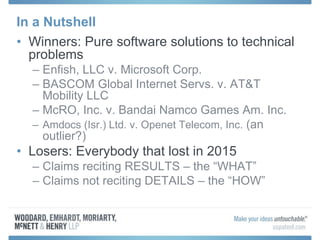
In a Nutshell
• Winners: Pure software solutions to technical
problems
– Enfish, LLC v. Microsoft Corp.
– BASCOM Global Internet Servs. v. AT&T
Mobility LLC
– McRO, Inc. v. Bandai Namco Games Am. Inc.
– Amdocs (Isr.) Ltd. v. Openet Telecom, Inc. (an
outlier?)
• Losers: Everybody that lost in 2015
– Claims reciting RESULTS – the “WHAT”
– Claims not reciting DETAILS – the “HOW”
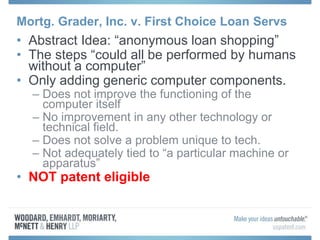
Mortg. Grader, Inc. v. First Choice Loan Servs
• Abstract Idea: “anonymous loan shopping”
• The steps “could all be performed by humans
without a computer”
• Only adding generic computer components.
– Does not improve the functioning of the
computer itself
– No improvement in any other technology or
technical field.
– Does not solve a problem unique to tech.
– Not adequately tied to “a particular machine or
apparatus”
• NOT patent eligible
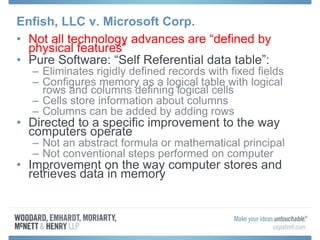
Enfish, LLC v. Microsoft Corp.
• Not all technology advances are “defined by
physical features”
• Pure Software: “Self Referential data table”:
– Eliminates rigidly defined records with fixed fields
– Configures memory as a logical table with logical
rows and columns defining logical cells
– Cells store information about columns
– Columns can be added by adding rows
• Directed to a specific improvement to the way
computers operate
– Not an abstract formula or mathematical principal
– Not conventional steps performed on computer
• Improvement on the way computer stores and
retrieves data in memory
TLI Communs. LLC v. AV Auto., L.L.C.
• Abstract Idea: Classifying and storing digital
images in an organized manner
• The steps “could all be performed by humans
without a computer”
• Using generic conventional computer tech
– Does not improve the functioning of the
computer itself
– No improvement in any other technology or
technical field
– Does not solve a problem unique to networks
• NOT patent eligible
BASCOM Global Internet Servs. v. AT&T Mobility LLC
• Abstract Idea: Filtering content on the internet
• “Something More”
– Not just an abstract idea using generic tech
– Claims do not preempt all ways of filtering
content on the Internet
– DC erred: Considered only components
separately, not the combination
– The inventive concept is a filtering tool at a
specific location, remote from the end-users, with
customizable filtering features specific to each
end user
• Tech solution: Provides advantages of local
filtering at a remote ISP.
Shortridge v. Found. Constr. Payroll Serv.
• Things NOT to do: Put “computer
implemented business method” in your
Abstract
• Abstract idea: cataloging labor data
• Using generic conventional computer tech
– Does not improve the functioning of the
computer itself
– Not solving a uniquely technical problem
– Only performing a business practice using
conventional tech
• NOT patent eligible
LendingTree, LLC v. Zillow, Inc.
• Abstract idea: a loan-application
clearinghouse, i.e. coordinating loans
• Using generic conventional computer tech to
address a very old business problem
– Nothing more than facilitating the claimed loan-
application process using generic technology
– Does not improve the functioning of the
computer itself
– Not solving a uniquely technical problem
– Only performing a business practice using
conventional tech
• NOT patent eligible
Elec. Power Group, LLC v. Alstom S.A
• CAFC: Falls into a familiar class of claims
"directed to" a patent-ineligible concept
• Abstract idea: Power grid monitoring
– Nothing but selecting, collecting, analyzing, and
displaying certain results
– Nothing but an ordinary mental process
– “result-focused, functional character of claim
language has been a frequent feature of claims held
ineligible” -- especially when “using generic
computer and network technology to carry out
economic transactions.
• Theme: CAFC says claim the “how” (details) not
the “what” (results)
• NOT patent eligible
In re Chorna
• An "organized securities exchange, commodities
exchange, alternative trading system, and 'over
the counter' system."
• Abstract idea: Same as Alice Corp
– "intermediated settlement, i.e., the use of a third
party to mitigate settlement risk [also known as a
clearing house].”
• No something more here
– No improvement to computer tech
– Using generic computer to issue automated
instructions
– Claims are directed at financial instruments that are
valued using an allocation formula and are traded
and cleared through conventional processes
• NOT patent eligible
TDE Petroleum Data Solutions, Inc. v. AKM Enter.
• Abstract Idea: Like Electric Power - selecting,
collecting, analyzing but without the displaying
• Involves monitoring state of an oil well using
known tech
• Nothing more claimed here
– “the specification arguably provides specific
embodiments for the step of ‘automatically selecting
one of the states as the state of the well operation’”
– The claim “recites none of those details.”
– “the claims of the '812 patent recite the what of the
invention, but none of the how that is necessary to
turn the abstract idea into a patent-eligible
application.”
• NOT patent eligible
McRO, Inc. v. Bandai Namco Games Am. Inc.
• Abstract Idea
– DC: automated rules-based use of morph targets
and delta sets for lip-synchronized three-dimensional
animation
– CAFC: DC “avoid oversimplifying the claims” – fails
“to account for the specific requirements”
• Patent is “focused on a specific asserted improvement in
computer animation, i.e., the automatic use of rules of a
particular type
– an animator's process was driven by subjective
determinations rather than specific, limited
mathematical rules
– uses a combined order of specific rules that renders
information into a specific format that is then used
and applied to create desired results: a sequence of
synchronized, animated characters
McRO, Inc. Cont.
• Patent is not
– Routine or conventional: No evidence animators
used these rules in the past, with or without
computers
– Simply "organizing [existing] information into a new
form“
– Carrying out a fundamental economic practice
– Tangible. . . But it doesn’t have to be
• “By incorporating the specific features of the
rules as claim limitations, claim 1 is limited to a
specific process for automatically animating
characters using particular information and
techniques”
• No preemption problem
Affinity Labs of Tex., LLC v. Amazon.com, Inc.
• Abstract Idea: delivering user-selected media
content to portable devices
• Nothing more here
– Conventional / generic tech
– “the claims do no more than describe a desired
function or outcome, without providing any
limiting detail that confines the claim to a
particular solution to an identified problem”
– “features set forth are described generically
rather than with specificity necessary to show
how those components provide a concrete
solution to the problem addressed by the
patent”
• NOT patent eligible
Affinity Labs of Tex. v. DIRECTV, LLC
• Abstract Idea: providing out-of-region access to
regional broadcast content
• No “something more”
– Only recites the general concept of out-of-region
delivery of broadcast content through the use of
conventional devices
– “Result-focused, functional claims” only limited to
cellular telephone with graphical user interface
• Patent is not
– directed to the solution of a technological problem
– directed to an improvement in computer or network
functionality
• NOT patent eligible
Intellectual Ventures I LLC v. Symantec Corp.
• Abstract Idea: filtering files/e-mail (virus/spam
protection)
• No “something more”
– No improvement to the functioning of the
computer
– Uses generic computers to perform generic
computer functions.
– Recites no improvement to conventional virus
screening software
• NOT patent eligible
FairWarning IP, LLC v. Iatric Sys.
• Abstract Idea: analyzing records of human
activity to detect suspicious behavior
• No “something more”
– No improvement to the functioning of the
computer
– Argument that this is technological advance
relating to accessing and combining disparate
information sources won’t fly because “its
claims do not recite any such improvement.”
– Claims directed to the broad concept of
monitoring audit log data.
• NOT patent eligible
Synopsys, Inc. v. Mentor Graphics Corp.
• Abstract Idea: translating a functional
description of a logic circuit into a hardware
component description of the logic circuit
• No “something more”
– Mental process
– The claims do not require a computer. . . So you
can’t characterize this as an improvement to a
computer
– No technical advance in the claims
• NOT patent eligible
Amdocs (Isr.) Ltd. v. Openet Telecom, Inc.
• Four patents: filtering, aggregating, and
reporting network usage information
• Previous appeal, CAFC approved and
expanded on the DC’s claim construction of
certain key terms
• This appeal CAFC says
– Claims involve an unconventional tech solution
(enhancing data in a distributed fashion)
– to a tech problem (massive record flows which
previously required massive databases)
– specific to computer networks
Amdocs cont.
• Dissent:
– Never really said whether this is directed to an
abstract idea or said what it is
– Relying on prior claim construction for concepts
not in the claim
– Relying on the specification to “import innovative
limitations into the claims”
“Inquiry is about whether the claims are directed to a
patent-eligible invention, not whether the specification
is so directed.”
– Eligibility determination rests on construction of
terms that is not in all the claims
Tranxition, Inc. v. Lenovo (United States) Inc
• Abstract Idea: migration, or transitioning, of
settings between two computers
• No “something more”
– No improvement to the functioning of the
computer
– Stating an abstract idea while only adding the
words “apply it” with a computer
– Routine conventional activities
• NOT patent eligible
Apple, Inc. v. Ameranth, Inc.
• Abstract Idea: generating [restaurant] menus
• No “something more”
– Ameranth argued some of this was “difficult”, and
this “difficulty” means it can’t be abstract
– “The difficulty of the programming details for this
functionality is immaterial because these
details are not recited in the actual claims.”
– “The degree of difficulty in implementing an
abstract idea in this circumstance does not itself
render an abstract idea patentable.”
• NOT patent eligible
Practice Tips for Software
• Define the technical problem, claim the
solution
• Functional claiming is not dead: Claim more
“how”, less “what”
• New life for patents on pure software. Absent
controlling a machine:
– Can it be presented as a software solution to a
technical problem?
– Does it make the computer do less work, fewer
steps, faster/fewer calculations?
– But you have to claim it.
Practice Tips Cont.
• Patents solving business problems still face a
tough road through USPTO and CAFC
• Do not include the words “computer
implemented business method” in your
application
• If you want to argue this is an improvement to
a computer, don’t forget to recite the computer

Alice Corp Update 2016 Cases

  • 1.
    Software Patentability v.2.0.1.6 January 19,2017 A Review of 2016 Federal Circuit Opinions
  • 2.
    In a Nutshell •Winners: Pure software solutions to technical problems – Enfish, LLC v. Microsoft Corp. – BASCOM Global Internet Servs. v. AT&T Mobility LLC – McRO, Inc. v. Bandai Namco Games Am. Inc. – Amdocs (Isr.) Ltd. v. Openet Telecom, Inc. (an outlier?) • Losers: Everybody that lost in 2015 – Claims reciting RESULTS – the “WHAT” – Claims not reciting DETAILS – the “HOW”
  • 3.
    Mortg. Grader, Inc.v. First Choice Loan Servs • Abstract Idea: “anonymous loan shopping” • The steps “could all be performed by humans without a computer” • Only adding generic computer components. – Does not improve the functioning of the computer itself – No improvement in any other technology or technical field. – Does not solve a problem unique to tech. – Not adequately tied to “a particular machine or apparatus” • NOT patent eligible
  • 4.
    Enfish, LLC v.Microsoft Corp. • Not all technology advances are “defined by physical features” • Pure Software: “Self Referential data table”: – Eliminates rigidly defined records with fixed fields – Configures memory as a logical table with logical rows and columns defining logical cells – Cells store information about columns – Columns can be added by adding rows • Directed to a specific improvement to the way computers operate – Not an abstract formula or mathematical principal – Not conventional steps performed on computer • Improvement on the way computer stores and retrieves data in memory
  • 5.
    TLI Communs. LLCv. AV Auto., L.L.C. • Abstract Idea: Classifying and storing digital images in an organized manner • The steps “could all be performed by humans without a computer” • Using generic conventional computer tech – Does not improve the functioning of the computer itself – No improvement in any other technology or technical field – Does not solve a problem unique to networks • NOT patent eligible
  • 6.
    BASCOM Global InternetServs. v. AT&T Mobility LLC • Abstract Idea: Filtering content on the internet • “Something More” – Not just an abstract idea using generic tech – Claims do not preempt all ways of filtering content on the Internet – DC erred: Considered only components separately, not the combination – The inventive concept is a filtering tool at a specific location, remote from the end-users, with customizable filtering features specific to each end user • Tech solution: Provides advantages of local filtering at a remote ISP.
  • 7.
    Shortridge v. Found.Constr. Payroll Serv. • Things NOT to do: Put “computer implemented business method” in your Abstract • Abstract idea: cataloging labor data • Using generic conventional computer tech – Does not improve the functioning of the computer itself – Not solving a uniquely technical problem – Only performing a business practice using conventional tech • NOT patent eligible
  • 8.
    LendingTree, LLC v.Zillow, Inc. • Abstract idea: a loan-application clearinghouse, i.e. coordinating loans • Using generic conventional computer tech to address a very old business problem – Nothing more than facilitating the claimed loan- application process using generic technology – Does not improve the functioning of the computer itself – Not solving a uniquely technical problem – Only performing a business practice using conventional tech • NOT patent eligible
  • 9.
    Elec. Power Group,LLC v. Alstom S.A • CAFC: Falls into a familiar class of claims "directed to" a patent-ineligible concept • Abstract idea: Power grid monitoring – Nothing but selecting, collecting, analyzing, and displaying certain results – Nothing but an ordinary mental process – “result-focused, functional character of claim language has been a frequent feature of claims held ineligible” -- especially when “using generic computer and network technology to carry out economic transactions. • Theme: CAFC says claim the “how” (details) not the “what” (results) • NOT patent eligible
  • 10.
    In re Chorna •An "organized securities exchange, commodities exchange, alternative trading system, and 'over the counter' system." • Abstract idea: Same as Alice Corp – "intermediated settlement, i.e., the use of a third party to mitigate settlement risk [also known as a clearing house].” • No something more here – No improvement to computer tech – Using generic computer to issue automated instructions – Claims are directed at financial instruments that are valued using an allocation formula and are traded and cleared through conventional processes • NOT patent eligible
  • 11.
    TDE Petroleum DataSolutions, Inc. v. AKM Enter. • Abstract Idea: Like Electric Power - selecting, collecting, analyzing but without the displaying • Involves monitoring state of an oil well using known tech • Nothing more claimed here – “the specification arguably provides specific embodiments for the step of ‘automatically selecting one of the states as the state of the well operation’” – The claim “recites none of those details.” – “the claims of the '812 patent recite the what of the invention, but none of the how that is necessary to turn the abstract idea into a patent-eligible application.” • NOT patent eligible
  • 12.
    McRO, Inc. v.Bandai Namco Games Am. Inc. • Abstract Idea – DC: automated rules-based use of morph targets and delta sets for lip-synchronized three-dimensional animation – CAFC: DC “avoid oversimplifying the claims” – fails “to account for the specific requirements” • Patent is “focused on a specific asserted improvement in computer animation, i.e., the automatic use of rules of a particular type – an animator's process was driven by subjective determinations rather than specific, limited mathematical rules – uses a combined order of specific rules that renders information into a specific format that is then used and applied to create desired results: a sequence of synchronized, animated characters
  • 13.
    McRO, Inc. Cont. •Patent is not – Routine or conventional: No evidence animators used these rules in the past, with or without computers – Simply "organizing [existing] information into a new form“ – Carrying out a fundamental economic practice – Tangible. . . But it doesn’t have to be • “By incorporating the specific features of the rules as claim limitations, claim 1 is limited to a specific process for automatically animating characters using particular information and techniques” • No preemption problem
  • 14.
    Affinity Labs ofTex., LLC v. Amazon.com, Inc. • Abstract Idea: delivering user-selected media content to portable devices • Nothing more here – Conventional / generic tech – “the claims do no more than describe a desired function or outcome, without providing any limiting detail that confines the claim to a particular solution to an identified problem” – “features set forth are described generically rather than with specificity necessary to show how those components provide a concrete solution to the problem addressed by the patent” • NOT patent eligible
  • 15.
    Affinity Labs ofTex. v. DIRECTV, LLC • Abstract Idea: providing out-of-region access to regional broadcast content • No “something more” – Only recites the general concept of out-of-region delivery of broadcast content through the use of conventional devices – “Result-focused, functional claims” only limited to cellular telephone with graphical user interface • Patent is not – directed to the solution of a technological problem – directed to an improvement in computer or network functionality • NOT patent eligible
  • 16.
    Intellectual Ventures ILLC v. Symantec Corp. • Abstract Idea: filtering files/e-mail (virus/spam protection) • No “something more” – No improvement to the functioning of the computer – Uses generic computers to perform generic computer functions. – Recites no improvement to conventional virus screening software • NOT patent eligible
  • 17.
    FairWarning IP, LLCv. Iatric Sys. • Abstract Idea: analyzing records of human activity to detect suspicious behavior • No “something more” – No improvement to the functioning of the computer – Argument that this is technological advance relating to accessing and combining disparate information sources won’t fly because “its claims do not recite any such improvement.” – Claims directed to the broad concept of monitoring audit log data. • NOT patent eligible
  • 18.
    Synopsys, Inc. v.Mentor Graphics Corp. • Abstract Idea: translating a functional description of a logic circuit into a hardware component description of the logic circuit • No “something more” – Mental process – The claims do not require a computer. . . So you can’t characterize this as an improvement to a computer – No technical advance in the claims • NOT patent eligible
  • 19.
    Amdocs (Isr.) Ltd.v. Openet Telecom, Inc. • Four patents: filtering, aggregating, and reporting network usage information • Previous appeal, CAFC approved and expanded on the DC’s claim construction of certain key terms • This appeal CAFC says – Claims involve an unconventional tech solution (enhancing data in a distributed fashion) – to a tech problem (massive record flows which previously required massive databases) – specific to computer networks
  • 20.
    Amdocs cont. • Dissent: –Never really said whether this is directed to an abstract idea or said what it is – Relying on prior claim construction for concepts not in the claim – Relying on the specification to “import innovative limitations into the claims” “Inquiry is about whether the claims are directed to a patent-eligible invention, not whether the specification is so directed.” – Eligibility determination rests on construction of terms that is not in all the claims
  • 21.
    Tranxition, Inc. v.Lenovo (United States) Inc • Abstract Idea: migration, or transitioning, of settings between two computers • No “something more” – No improvement to the functioning of the computer – Stating an abstract idea while only adding the words “apply it” with a computer – Routine conventional activities • NOT patent eligible
  • 22.
    Apple, Inc. v.Ameranth, Inc. • Abstract Idea: generating [restaurant] menus • No “something more” – Ameranth argued some of this was “difficult”, and this “difficulty” means it can’t be abstract – “The difficulty of the programming details for this functionality is immaterial because these details are not recited in the actual claims.” – “The degree of difficulty in implementing an abstract idea in this circumstance does not itself render an abstract idea patentable.” • NOT patent eligible
  • 23.
    Practice Tips forSoftware • Define the technical problem, claim the solution • Functional claiming is not dead: Claim more “how”, less “what” • New life for patents on pure software. Absent controlling a machine: – Can it be presented as a software solution to a technical problem? – Does it make the computer do less work, fewer steps, faster/fewer calculations? – But you have to claim it.
  • 24.
    Practice Tips Cont. •Patents solving business problems still face a tough road through USPTO and CAFC • Do not include the words “computer implemented business method” in your application • If you want to argue this is an improvement to a computer, don’t forget to recite the computer