Communicating Science
Through Social Media:
Tools and Techniques
Wasim Ahmed (BA, MSc)
Twitter (was3210)
Email: wahmed1@Sheffield.ac.uk
Saturday 13th of May 2017
About me
• Third Year PhD student in the Health Informatics Research
Group, Information School, University of Sheffield. (Faculty
Scholarship).
• Worked as a Teaching Assistant and Research Associate
teaching and researching social media
• Run an analytics blog with readership in over 136 countries.
Read across media, government, and academia.
13/05/2017 © The University of Sheffield
3
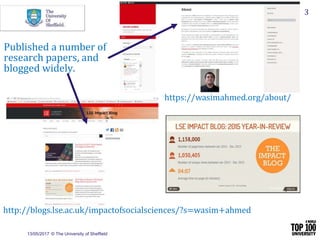
https://wasimahmed.org/about/
http://blogs.lse.ac.uk/impactofsocialsciences/?s=wasim+ahmed
Published a number of
research papers, and
blogged widely.
13/05/2017 © The University of Sheffield
4
• Delivered a number of talks related to my research such
as to the government , media , and industry.
• Featured in White Rose DTC Researchers in the News
(2014/2015/2016)
• Upcoming talk to delegates at the European Centre for
Nuclear Research at CERN in Geneva. June, 2017.
Recent and Upcoming talks
Aims
• Provide an overview of how I utilised social
media and blogging to reach new audiences.
• Gain new insight on strategies you can adopt in
order to potentially attract new readership
• Develop knowledge on the tools to support
dissemination as well as social media research
13/05/2017 © The University of Sheffield
5
Initial thoughts on Twitter
• Was sceptical of social media and Twitter –
wasn’t aware of the potential
• Fear of the unknown and having a public facing
account
• Joined in 2014 when I started my PhD and
followed the #PhDChat and #NSMNSS hashtags
13/05/2017 © The University of Sheffield
6
Starting out
• Started off tweeting news articles and papers
related to social media
• Would use Twitter to tweet during conferences
and network (I know you from Twitter…)
• Found it useful for asking questions about
research e.g., asking if people know about
papers related to a specific topic
13/05/2017 © The University of Sheffield
7
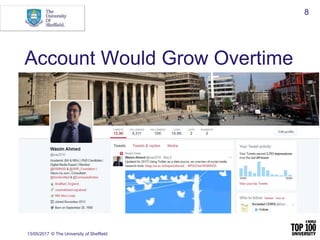
Account Would Grow Overtime
13/05/2017 © The University of Sheffield
8
13/05/2017 © The University of Sheffield
9
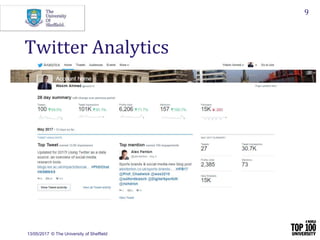
Twitter Analytics
Why I Started to Blog
• Found that it can take a long time to publish
journal and/or conference papers
• Started a research blog which facilities instant
publishing
• Also acted as a way of linking publications and
workshop slides in one place
13/05/2017 © The University of Sheffield
10
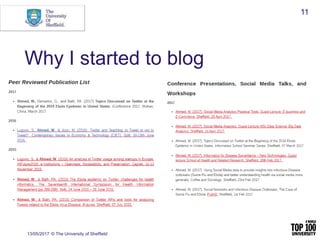
Why I started to blog
13/05/2017 © The University of Sheffield
11
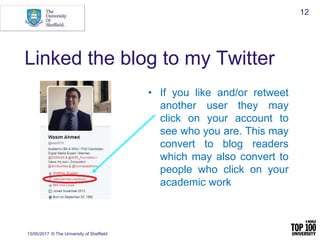
Linked the blog to my Twitter
13/05/2017 © The University of Sheffield
12
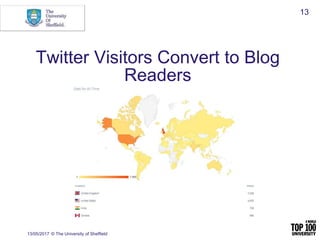
• If you like and/or retweet
another user they may
click on your account to
see who you are. This may
convert to blog readers
which may also convert to
people who click on your
academic work
Twitter Visitors Convert to Blog
Readers
13/05/2017 © The University of Sheffield
13
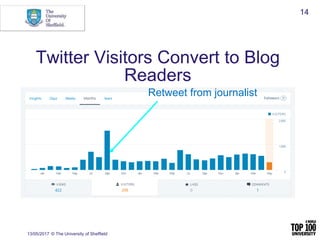
Twitter Visitors Convert to Blog
Readers
13/05/2017 © The University of Sheffield
14
Retweet from journalist
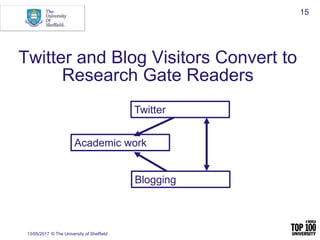
Twitter and Blog Visitors Convert to
Research Gate Readers
13/05/2017 © The University of Sheffield
15
Academic work
Twitter
Blogging
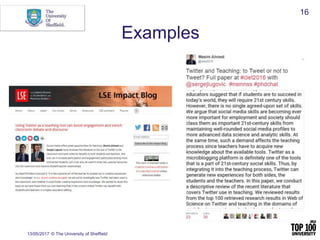
Examples
13/05/2017 © The University of Sheffield
16
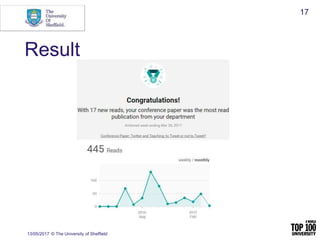
Result
13/05/2017 © The University of Sheffield
17
Other Social Media Platforms
• Cross post to LinkedIn
• Cross post to departmental blog
• Occasionally cross post to Facebook
• Not found a use for Instagram (yet)
13/05/2017 © The University of Sheffield
18
Tips for starting out on Twitter
• Start a Twitter account and Tweet
interesting content
• Find other researchers in your discipline
and/or the community hashtag e.g.,
#NSMNSS
• Start a hashtag and/or a community if one
does not exist for your discipline
13/05/2017 © The University of Sheffield
19
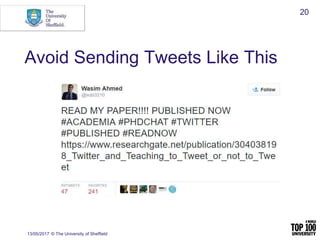
Avoid Sending Tweets Like This
13/05/2017 © The University of Sheffield
20
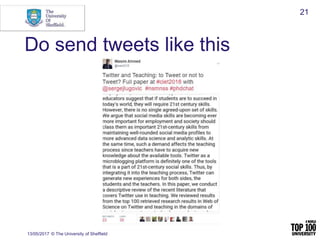
Do send tweets like this
13/05/2017 © The University of Sheffield
21
• Guest blog (LSE Impact) and/or create
your own blog (WordPress/ Medium)
• Make sure to adjust your writing to a non-
academic audience
• Connect your blog to your Twitter and
make sure to forward to people who may
be interested in reading it
13/05/2017 © The University of Sheffield
22
Tips for blogging
13/05/2017 © The University of Sheffield
23
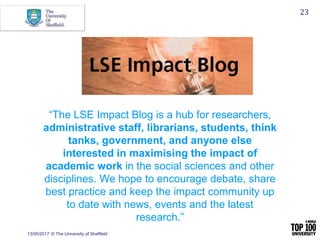
“The LSE Impact Blog is a hub for researchers,
administrative staff, librarians, students, think
tanks, government, and anyone else
interested in maximising the impact of
academic work in the social sciences and other
disciplines. We hope to encourage debate, share
best practice and keep the impact community up
to date with news, events and the latest
research.”
Guest Blogging for the London School of
Economics and Political Sciences Impact
Blog
13/05/2017 © The University of Sheffield
24
• My most popular post has over 20 thousand
page views and cited in journals, conferences,
and a PhD thesis
• Led to event invitations, and increased visibility
of my academic work as blog has a strong
readership
• Very friendly team and editors who are
extremely supportive
Tools to Facilitate
Communication
13/05/2017 © The University of Sheffield
25
13/05/2017 © The University of Sheffield
26
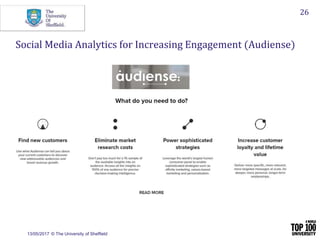
Social Media Analytics for Increasing Engagement (Audiense)
13/05/2017 © The University of Sheffield
27
Social Media Analytics for Consumer Engagement
(Audiense)
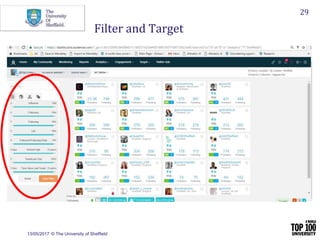
• You can leverage the metadata provided by
Twitter to build specific audiences.
• You can use this information target users and
monitor the performance of the message that
you send.
DHL #AfricaAsOne
• Wanted to increase awareness and target
influencers – used Audiense
• They were able to find over 65 thousand
influencers across 45 Countries
• Secured a reach of 1,200,750,000, with an
advertising value equivalent of
£12,112,8671
13/05/2017 © The University of Sheffield
28
13/05/2017 © The University of Sheffield
29
Filter and Target
13/05/2017 © The University of Sheffield
30
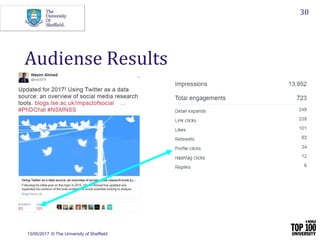
Audiense Results
13/05/2017 © The University of Sheffield
31
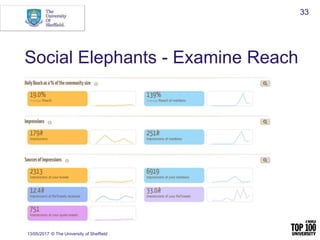
Social Elephants
13/05/2017 © The University of Sheffield
32
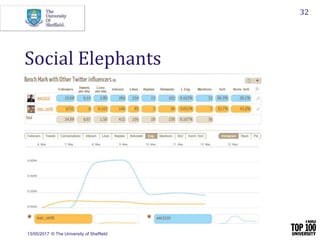
Social Elephants
Social Elephants - Examine Reach
13/05/2017 © The University of Sheffield
33
Trial for Social Elephants and
Audiense
• Social Elephants 2 Month Trial use code:
SRUK and email
support@socialelephants.com with code in
subject.
• Audiense Community Manager 14 days
https://buy.audiense.com/trial/new
13/05/2017 © The University of Sheffield
34
13/05/2017 © The University of Sheffield
35
• Twitter has over 313 million monthly active users1 –
consumers can use this channel to express their views.
• Research on Twitter has the potential to cut across many
disciplines
• Questions arise over how to obtain and analyse social
media data
1 https://about.twitter.com/company
Twitter for academic research
DiscoverText
13/05/2017 © The University of Sheffield
36
• This presentation will focus on the potential of
DiscoverText for analysing Twitter data for academic
research.
• However, there are many more potential uses of
DiscoverText
DiscoverText used in…
• Consumer industries
• Education
• Human Resources
• Legal
• Medical & Pharma
• Government
• Military
13/05/2017 © The University of Sheffield
37
DiscoverText as Data Science
• DiscoverText has a number of very powerful text
mining, human coding, and machine learning
features
• Access to the free Twitter Search API data
• Access to premium Gnip PowerTrack 2.0
Twitter data
13/05/2017 © The University of Sheffield
38
Fiver Pillars of Text Analytics
• Search
• Filtering
• De-duplication and Clustering
• Human Coding
• Machine-Learning
13/05/2017 © The University of Sheffield
39
For a topic overview you could
• Retrieve Twitter data on a topic of interest
search and filter out non-relevant data.
• Generate duplicates and near-duplicate
clusters.
• This would allow you to more easily code
the data.
13/05/2017 © The University of Sheffield
40
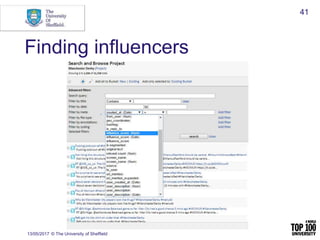
Finding influencers
13/05/2017 © The University of Sheffield
41
DiscoverText has Active Learning
• You can manually code a sub-set of data
in DiscoverText then allow a machine to
code the next iteration
• You can check for quality (adjust coding
parameters) and run the cycle again
• So humans and machines work together
13/05/2017 © The University of Sheffield
42
Twitter as a Consumer Panel
• According to one statistic there are on average 6
thousand tweets a second!
• So around 350,000 tweets are sent every minute
• Which makes it around 500 million tweets per
day
13/05/2017 © The University of Sheffield
43
An example: Manchester Derby
• During a football game users were tweeting
about a buzzing sound, and some were not
happy with Sky’s camera angles
• You could use DiscoverText to filter the
data
13/05/2017 © The University of Sheffield
44
13/05/2017 © The University of Sheffield
45
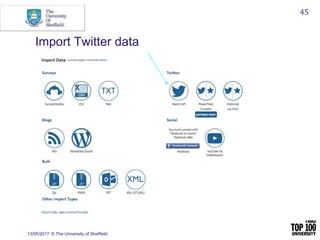
Import Twitter data
Applying Text Analytics
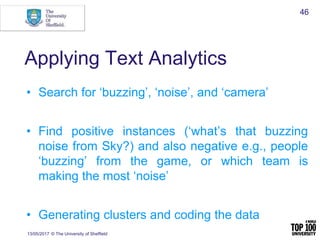
• Search for ‘buzzing’, ‘noise’, and ‘camera’
• Find positive instances (‘what’s that buzzing
noise from Sky?) and also negative e.g., people
‘buzzing’ from the game, or which team is
making the most ‘noise’
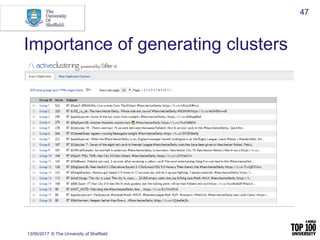
• Generating clusters and coding the data
13/05/2017 © The University of Sheffield
46
Importance of generating clusters
13/05/2017 © The University of Sheffield
47
DiscoverText
• Request a 3 day trial
• http://discovertext.com/start-a-free-trial/
13/05/2017 © The University of Sheffield
48
Conclusion
• Provided an overview of how I utilised social
media and blogging to reach new audiences.
• Provided a list of strategies you can adopt in
order to potentially attract new readership
• Outlined tools to support scientific dissemination
as well as social media research
13/05/2017 © The University of Sheffield
49
Questions?
13/05/2017 © The University of Sheffield
50
To
Discover
And
Understand.

Communicating Science Through Social Media: Tools and Techniques

  • 1.
    Communicating Science Through SocialMedia: Tools and Techniques Wasim Ahmed (BA, MSc) Twitter (was3210) Email: wahmed1@Sheffield.ac.uk Saturday 13th of May 2017
  • 2.
    About me • ThirdYear PhD student in the Health Informatics Research Group, Information School, University of Sheffield. (Faculty Scholarship). • Worked as a Teaching Assistant and Research Associate teaching and researching social media • Run an analytics blog with readership in over 136 countries. Read across media, government, and academia.
  • 3.
    13/05/2017 © TheUniversity of Sheffield 3 https://wasimahmed.org/about/ http://blogs.lse.ac.uk/impactofsocialsciences/?s=wasim+ahmed Published a number of research papers, and blogged widely.
  • 4.
    13/05/2017 © TheUniversity of Sheffield 4 • Delivered a number of talks related to my research such as to the government , media , and industry. • Featured in White Rose DTC Researchers in the News (2014/2015/2016) • Upcoming talk to delegates at the European Centre for Nuclear Research at CERN in Geneva. June, 2017. Recent and Upcoming talks
  • 5.
    Aims • Provide anoverview of how I utilised social media and blogging to reach new audiences. • Gain new insight on strategies you can adopt in order to potentially attract new readership • Develop knowledge on the tools to support dissemination as well as social media research 13/05/2017 © The University of Sheffield 5
  • 6.
    Initial thoughts onTwitter • Was sceptical of social media and Twitter – wasn’t aware of the potential • Fear of the unknown and having a public facing account • Joined in 2014 when I started my PhD and followed the #PhDChat and #NSMNSS hashtags 13/05/2017 © The University of Sheffield 6
  • 7.
    Starting out • Startedoff tweeting news articles and papers related to social media • Would use Twitter to tweet during conferences and network (I know you from Twitter…) • Found it useful for asking questions about research e.g., asking if people know about papers related to a specific topic 13/05/2017 © The University of Sheffield 7
  • 8.
    Account Would GrowOvertime 13/05/2017 © The University of Sheffield 8
  • 9.
    13/05/2017 © TheUniversity of Sheffield 9 Twitter Analytics
  • 10.
    Why I Startedto Blog • Found that it can take a long time to publish journal and/or conference papers • Started a research blog which facilities instant publishing • Also acted as a way of linking publications and workshop slides in one place 13/05/2017 © The University of Sheffield 10
  • 11.
    Why I startedto blog 13/05/2017 © The University of Sheffield 11
  • 12.
    Linked the blogto my Twitter 13/05/2017 © The University of Sheffield 12 • If you like and/or retweet another user they may click on your account to see who you are. This may convert to blog readers which may also convert to people who click on your academic work
  • 13.
    Twitter Visitors Convertto Blog Readers 13/05/2017 © The University of Sheffield 13
  • 14.
    Twitter Visitors Convertto Blog Readers 13/05/2017 © The University of Sheffield 14 Retweet from journalist
  • 15.
    Twitter and BlogVisitors Convert to Research Gate Readers 13/05/2017 © The University of Sheffield 15 Academic work Twitter Blogging
  • 16.
    Examples 13/05/2017 © TheUniversity of Sheffield 16
  • 17.
    Result 13/05/2017 © TheUniversity of Sheffield 17
  • 18.
    Other Social MediaPlatforms • Cross post to LinkedIn • Cross post to departmental blog • Occasionally cross post to Facebook • Not found a use for Instagram (yet) 13/05/2017 © The University of Sheffield 18
  • 19.
    Tips for startingout on Twitter • Start a Twitter account and Tweet interesting content • Find other researchers in your discipline and/or the community hashtag e.g., #NSMNSS • Start a hashtag and/or a community if one does not exist for your discipline 13/05/2017 © The University of Sheffield 19
  • 20.
    Avoid Sending TweetsLike This 13/05/2017 © The University of Sheffield 20
  • 21.
    Do send tweetslike this 13/05/2017 © The University of Sheffield 21
  • 22.
    • Guest blog(LSE Impact) and/or create your own blog (WordPress/ Medium) • Make sure to adjust your writing to a non- academic audience • Connect your blog to your Twitter and make sure to forward to people who may be interested in reading it 13/05/2017 © The University of Sheffield 22 Tips for blogging
  • 23.
    13/05/2017 © TheUniversity of Sheffield 23 “The LSE Impact Blog is a hub for researchers, administrative staff, librarians, students, think tanks, government, and anyone else interested in maximising the impact of academic work in the social sciences and other disciplines. We hope to encourage debate, share best practice and keep the impact community up to date with news, events and the latest research.”
  • 24.
    Guest Blogging forthe London School of Economics and Political Sciences Impact Blog 13/05/2017 © The University of Sheffield 24 • My most popular post has over 20 thousand page views and cited in journals, conferences, and a PhD thesis • Led to event invitations, and increased visibility of my academic work as blog has a strong readership • Very friendly team and editors who are extremely supportive
  • 25.
    Tools to Facilitate Communication 13/05/2017© The University of Sheffield 25
  • 26.
    13/05/2017 © TheUniversity of Sheffield 26 Social Media Analytics for Increasing Engagement (Audiense)
  • 27.
    13/05/2017 © TheUniversity of Sheffield 27 Social Media Analytics for Consumer Engagement (Audiense) • You can leverage the metadata provided by Twitter to build specific audiences. • You can use this information target users and monitor the performance of the message that you send.
  • 28.
    DHL #AfricaAsOne • Wantedto increase awareness and target influencers – used Audiense • They were able to find over 65 thousand influencers across 45 Countries • Secured a reach of 1,200,750,000, with an advertising value equivalent of £12,112,8671 13/05/2017 © The University of Sheffield 28
  • 29.
    13/05/2017 © TheUniversity of Sheffield 29 Filter and Target
  • 30.
    13/05/2017 © TheUniversity of Sheffield 30 Audiense Results
  • 31.
    13/05/2017 © TheUniversity of Sheffield 31 Social Elephants
  • 32.
    13/05/2017 © TheUniversity of Sheffield 32 Social Elephants
  • 33.
    Social Elephants -Examine Reach 13/05/2017 © The University of Sheffield 33
  • 34.
    Trial for SocialElephants and Audiense • Social Elephants 2 Month Trial use code: SRUK and email support@socialelephants.com with code in subject. • Audiense Community Manager 14 days https://buy.audiense.com/trial/new 13/05/2017 © The University of Sheffield 34
  • 35.
    13/05/2017 © TheUniversity of Sheffield 35 • Twitter has over 313 million monthly active users1 – consumers can use this channel to express their views. • Research on Twitter has the potential to cut across many disciplines • Questions arise over how to obtain and analyse social media data 1 https://about.twitter.com/company Twitter for academic research
  • 36.
    DiscoverText 13/05/2017 © TheUniversity of Sheffield 36 • This presentation will focus on the potential of DiscoverText for analysing Twitter data for academic research. • However, there are many more potential uses of DiscoverText
  • 37.
    DiscoverText used in… •Consumer industries • Education • Human Resources • Legal • Medical & Pharma • Government • Military 13/05/2017 © The University of Sheffield 37
  • 38.
    DiscoverText as DataScience • DiscoverText has a number of very powerful text mining, human coding, and machine learning features • Access to the free Twitter Search API data • Access to premium Gnip PowerTrack 2.0 Twitter data 13/05/2017 © The University of Sheffield 38
  • 39.
    Fiver Pillars ofText Analytics • Search • Filtering • De-duplication and Clustering • Human Coding • Machine-Learning 13/05/2017 © The University of Sheffield 39
  • 40.
    For a topicoverview you could • Retrieve Twitter data on a topic of interest search and filter out non-relevant data. • Generate duplicates and near-duplicate clusters. • This would allow you to more easily code the data. 13/05/2017 © The University of Sheffield 40
  • 41.
    Finding influencers 13/05/2017 ©The University of Sheffield 41
  • 42.
    DiscoverText has ActiveLearning • You can manually code a sub-set of data in DiscoverText then allow a machine to code the next iteration • You can check for quality (adjust coding parameters) and run the cycle again • So humans and machines work together 13/05/2017 © The University of Sheffield 42
  • 43.
    Twitter as aConsumer Panel • According to one statistic there are on average 6 thousand tweets a second! • So around 350,000 tweets are sent every minute • Which makes it around 500 million tweets per day 13/05/2017 © The University of Sheffield 43
  • 44.
    An example: ManchesterDerby • During a football game users were tweeting about a buzzing sound, and some were not happy with Sky’s camera angles • You could use DiscoverText to filter the data 13/05/2017 © The University of Sheffield 44
  • 45.
    13/05/2017 © TheUniversity of Sheffield 45 Import Twitter data
  • 46.
    Applying Text Analytics •Search for ‘buzzing’, ‘noise’, and ‘camera’ • Find positive instances (‘what’s that buzzing noise from Sky?) and also negative e.g., people ‘buzzing’ from the game, or which team is making the most ‘noise’ • Generating clusters and coding the data 13/05/2017 © The University of Sheffield 46
  • 47.
    Importance of generatingclusters 13/05/2017 © The University of Sheffield 47
  • 48.
    DiscoverText • Request a3 day trial • http://discovertext.com/start-a-free-trial/ 13/05/2017 © The University of Sheffield 48
  • 49.
    Conclusion • Provided anoverview of how I utilised social media and blogging to reach new audiences. • Provided a list of strategies you can adopt in order to potentially attract new readership • Outlined tools to support scientific dissemination as well as social media research 13/05/2017 © The University of Sheffield 49
  • 50.
    Questions? 13/05/2017 © TheUniversity of Sheffield 50
  • 51.