Public-Access
Television
The Alternative Media Broadcaster
By: Virginia Krusteva
Purpose
To examine if Public Access
Television has the potential to
fill the gap caused by PBS
budget cuts
Brief Overview:
Public – Access Television
(PEG)
 A form of Non – Commercial Mass Media
 Grouped with Public, Educational &
Government Access TV Channels = PEG
 Goal: To give voice to ordinary citizens
who otherwise wouldn’t be able to voice
opinions publicly
 Was only available on Cable TV Systems
 Began with the rise of cable TV in the late
70’s and early 80’s
 Cable companies required to donate portion
of revenue to provide domain for public
comments
 1984: the Cable Franchise Policy and
Communications Act prohibited cable
operators from exercising any editorial
control over public-access channels (USA)
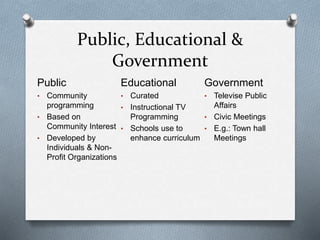
Public, Educational &
Government
Public
• Community
programming
• Based on
Community Interest
• Developed by
Individuals & Non-
Profit Organizations
Educational
• Curated
• Instructional TV
Programming
• Schools use to
enhance curriculum
Government
• Televise Public
Affairs
• Civic Meetings
• E.g.: Town hall
Meetings
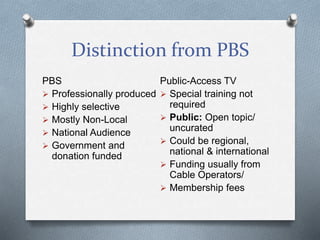
Distinction from PBS
PBS
 Professionally produced
 Highly selective
 Mostly Non-Local
 National Audience
 Government and
donation funded
Public-Access TV
 Special training not
required
 Public: Open topic/
uncurated
 Could be regional,
national & international
 Funding usually from
Cable Operators/
 Membership fees
Why we need PEG
 For the community, by the community
 Provides diverse programming based on the
community
 Two-way form of communication
 Gives a medium to minority groups
 Non-restrictive forum of free speech - not based
on skills or financial position
 Educational
 Transmits important government affairs
The Bad…
 Lack of involvement from the community
 Lack of interest in local happenings
 Not objective
 Limits pushed too far
PEG in Danger!
 Cable providers try to phase out PEG Stations,
because there are now so many other forums for
people who want to create their own media
 Possible Agenda: Cable companies want more
bandwidth?
 Who Suffers?
 Lower income communities do not have the
access to the same technology
 Internet: We receive what we look for – information
about our community is not simply given to us
Canada and PEG
“Community channels give Canadians the
unique ability to see themselves and their
neighbourhoods, towns and cities
reflected on television”
-Michel Arpin, the CRTC’s Vice-Chairman of Broadcasting
 CRTC changed community television policy to
enhance local participation
 Community members must be involved in
creation of at least 50% of community
channel’s programming
(August 26,
2010)
What do you think?
Is PEG programming an
appropriate focus when
filling the gap caused by
PBS budget cuts?
Bibliography
“Community TV“ by www.freepress.net
“CRTC changes community television policy to enhance local participation” Canadian Radio-
television and Telecommunications Commission
“How Public Access TV Evolved into Community Media Centers” By Colin Rhinesmith
“Public Access Television: An Ongoing Effort to Restrict Your Free Speech” By Duke Gomez-
Schempp - The People’s Press Project
“Public-Access TV Fights for Relevance in the YouTube Age” By Mike Rosen-Molina
“Who needs public access TV?” By Adrian McCoy Pittsburgh Post-Gazette

Public Access Television

  • 1.
    Public-Access Television The Alternative MediaBroadcaster By: Virginia Krusteva
  • 2.
    Purpose To examine ifPublic Access Television has the potential to fill the gap caused by PBS budget cuts
  • 3.
    Brief Overview: Public –Access Television (PEG)  A form of Non – Commercial Mass Media  Grouped with Public, Educational & Government Access TV Channels = PEG  Goal: To give voice to ordinary citizens who otherwise wouldn’t be able to voice opinions publicly
  • 4.
     Was onlyavailable on Cable TV Systems  Began with the rise of cable TV in the late 70’s and early 80’s  Cable companies required to donate portion of revenue to provide domain for public comments  1984: the Cable Franchise Policy and Communications Act prohibited cable operators from exercising any editorial control over public-access channels (USA)
  • 5.
    Public, Educational & Government Public •Community programming • Based on Community Interest • Developed by Individuals & Non- Profit Organizations Educational • Curated • Instructional TV Programming • Schools use to enhance curriculum Government • Televise Public Affairs • Civic Meetings • E.g.: Town hall Meetings
  • 6.
    Distinction from PBS PBS Professionally produced  Highly selective  Mostly Non-Local  National Audience  Government and donation funded Public-Access TV  Special training not required  Public: Open topic/ uncurated  Could be regional, national & international  Funding usually from Cable Operators/  Membership fees
  • 7.
    Why we needPEG  For the community, by the community  Provides diverse programming based on the community  Two-way form of communication  Gives a medium to minority groups  Non-restrictive forum of free speech - not based on skills or financial position  Educational  Transmits important government affairs
  • 8.
    The Bad…  Lackof involvement from the community  Lack of interest in local happenings  Not objective  Limits pushed too far
  • 9.
    PEG in Danger! Cable providers try to phase out PEG Stations, because there are now so many other forums for people who want to create their own media  Possible Agenda: Cable companies want more bandwidth?  Who Suffers?  Lower income communities do not have the access to the same technology  Internet: We receive what we look for – information about our community is not simply given to us
  • 10.
    Canada and PEG “Communitychannels give Canadians the unique ability to see themselves and their neighbourhoods, towns and cities reflected on television” -Michel Arpin, the CRTC’s Vice-Chairman of Broadcasting  CRTC changed community television policy to enhance local participation  Community members must be involved in creation of at least 50% of community channel’s programming (August 26, 2010)
  • 11.
    What do youthink? Is PEG programming an appropriate focus when filling the gap caused by PBS budget cuts?
  • 12.
    Bibliography “Community TV“ bywww.freepress.net “CRTC changes community television policy to enhance local participation” Canadian Radio- television and Telecommunications Commission “How Public Access TV Evolved into Community Media Centers” By Colin Rhinesmith “Public Access Television: An Ongoing Effort to Restrict Your Free Speech” By Duke Gomez- Schempp - The People’s Press Project “Public-Access TV Fights for Relevance in the YouTube Age” By Mike Rosen-Molina “Who needs public access TV?” By Adrian McCoy Pittsburgh Post-Gazette