Heidi L. Rehm, PhD
Partners Healthcare and Harvard Medical School
ClinGen
Clinical Genome Resource
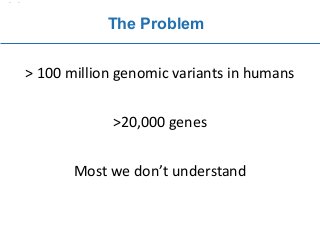
The Problem
> 100 million genomic variants in humans
>20,000 genes
Most we don’t understand
0
200
400
600
800
1000
1200
1 2 3 4 5 6 7 8 9 10 11 12 13 14 15 16 17 18 19 20
0
2
4
6
8
10
12
14
16
18
20
Lung Cancer
KRAS EGFR
G12C L858R
GJB2
35delG
GJB2
M34T PTPN11
N308D
MYBPC3
R502W
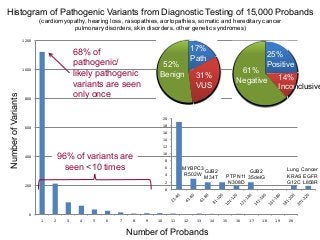
68% of
pathogenic/
likely pathogenic
variants are seen
only once
96% of variants are
seen <10 times
Number of Probands
NumberofVariantsHistogram of Pathogenic Variants from Diagnostic Testing of 15,000 Probands
(cardiomyopathy, hearing loss, rasopathies, aortopathies, somatic and hereditary cancer
pulmonary disorders, skin disorders, other genetic syndromes)
31%
VUS
25%
Positive
61%
Negative 14%
Inconclusivenclusive
52%
Benign
17%
Path
Clinical Domain WGs
Chairs: Jonathan Berg &
Sharon Plon
Cancer co-chairs:
Matthew Ferber, Ken
Offit, Sharon Plon
Cardiovascular co-
chairs: Euan Ashley,
Birgit Funke, Ray
Hershberger
Metabolic co-chairs:
Rong Mao, Robert
Steiner, David Valle
Pharmacogenomic co-
chairs: Teri Klein,
Howard McLeod
ClinGen Working Groups (WG)ClinGen Working Groups (WG)
Actionability WG
Chair: Jim Evans
Informatics WG
Chair: Carlos
Bustamante
EHR WG
Chair: Marc Williams
ClinVar IT Standards
and Data Submission
WG
Chairs: Sandy Aronson
& Karen Eilbeck
Gene Curation WG
Chairs: Jonathan Berg
& Christa Martin
Sequence Variant WG
Chairs: Sherri Bale,
Heidi Rehm, &
Madhuri Hegde
Structural Variant WG
Chairs: Swaroop
Arahdya & Erik
Thorland ELSI and Genetic
Counseling WG
Chair: Andy Faucett &
Kelly Ormond
Education,
Engagement, Access
WG
Chair: Andy Faucett
Phenotyping WG
Chair: David Miller
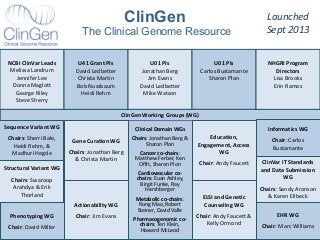
ClinGen
The Clinical Genome Resource
Launched
Sept 2013
NCBI ClinVar Leads
Melissa Landrum
Jennifer Lee
Donna Maglott
George Riley
Steve Sherry
U41 Grant PIs
David Ledbetter
Christa Martin
Bob Nussbaum
Heidi Rehm
U01 PIs
Jonathan Berg
Jim Evans
David Ledbetter
Mike Watson
U01 PIs
Carlos Bustamante
Sharon Plon
NHGRI Program
Directors
Lisa Brooks
Erin Ramos
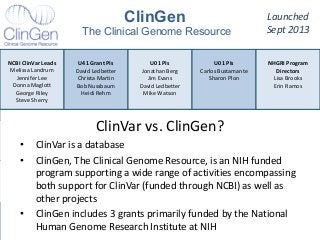
ClinVar vs. ClinGen?
• ClinVar is a database
• ClinGen, The Clinical Genome Resource, is an NIH funded
program supporting a wide range of activities encompassing
both support for ClinVar (funded through NCBI) as well as
other projects
• ClinGen includes 3 grants primarily funded by the National
Human Genome Research Institute at NIH
Clinical Domain WGs
Chairs: Jonathan Berg &
Sharon Plon
Cancer co-chairs:
Matthew Ferber, Ken
Offit, Sharon Plon
Cardiovascular co-
chairs: Euan Ashley,
Birgit Funke, Ray
Hershberger
Metabolic co-chairs:
Rong Mao, Robert
Steiner, David Valle
Pharmacogenomic co-
chairs: Teri Klein,
Howard McLeod
ClinGen Working Groups (WG)ClinGen Working Groups (WG)
Actionability WG
Chair: Jim Evans
Informatics WG
Chair: Carlos
Bustamante
EHR WG
Chair: Marc Williams
ClinVar IT Standards
and Data Submission
WG
Chairs: Sandy Aronson
& Karen Eilbeck
Gene Curation WG
Chairs: Jonathan Berg
& Christa Martin
Sequence Variant WG
Chairs: Sherri Bale,
Heidi Rehm, &
Madhuri Hegde
Structural Variant WG
Chairs: Swaroop
Arahdya & Erik
Thorland ELSI and Genetic
Counseling WG
Chair: Andy Faucett &
Kelly Ormond
Education,
Engagement, Access
WG
Chair: Andy Faucett
Phenotyping WG
Chair: David Miller
ClinGen
The Clinical Genome Resource
Launched
Sept 2013
NCBI ClinVar Leads
Melissa Landrum
Jennifer Lee
Donna Maglott
George Riley
Steve Sherry
U41 Grant PIs
David Ledbetter
Christa Martin
Bob Nussbaum
Heidi Rehm
U01 PIs
Jonathan Berg
Jim Evans
David Ledbetter
Mike Watson
U01 PIs
Carlos Bustamante
Sharon Plon
NHGRI Program
Directors
Lisa Brooks
Erin Ramos
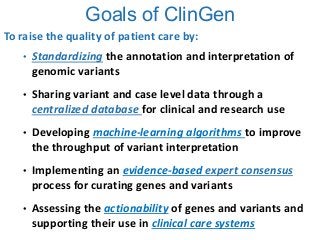
Goals of ClinGen
To raise the quality of patient care by:
• Standardizing the annotation and interpretation of
genomic variants
• Sharing variant and case level data through a
centralized database for clinical and research use
• Developing machine-learning algorithms to improve
the throughput of variant interpretation
• Implementing an evidence-based expert consensus
process for curating genes and variants
• Assessing the actionability of genes and variants and
supporting their use in clinical care systems
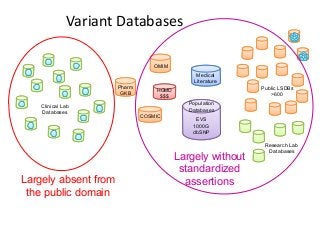
Public LSDBs
>600
Pharm
GKB
Population
Databases
EVS
1000G
dbSNP
Medical
Literature
Clinical Lab
Databases
OMIM
Variant Databases
COSMIC
HGMD
$$$
HGMD
$$$
Research Lab
Databases
Largely absent from
the public domain
Largely without
standardized
assertions
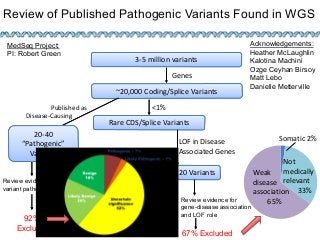
Review of Published Pathogenic Variants Found in WGS
3-5 million variants3-5 million variants
~20,000 Coding/Splice Variants~20,000 Coding/Splice Variants
20-40
“Pathogenic”
Variants
20-40
“Pathogenic”
Variants
Published as
Disease-Causing
Genes
<1%
Rare CDS/Splice VariantsRare CDS/Splice Variants
LOF in Disease
Associated Genes
10-20 Variants10-20 Variants
Review evidence for
gene-disease association
and LOF role
Review evidence for
variant pathogenicity
92%
Excluded
67% Excluded
Acknowledgements:
Heather McLaughlin
Kalotina Machini
Ozge Ceyhan Birsoy
Matt Lebo
Danielle Metterville
Weak
disease
association
65%
Not
medically
relevant
33%
Somatic 2%
MedSeq Project:
PI: Robert Green
Rating System for Gene Dosage
Highest -- 3, 2, 1, 0, unlikely dosage sensitive -- Lowest
Proposed Revisions to ACMG
Guideline for Interpretation of
Sequence Variants
ACMG
Sue Richards, Chair Heidi Rehm, Co-chair
Sherri Bale Wayne Grody
David Bick Madhuri Hegde
Soma Das Elaine Spector
AMP
Elaine Lyon Julie Gastier-Foster
CAP
Karl Voelkerding Nazneen Aziz
On behalf of the ACMG Laboratory Quality Assurance
Committee
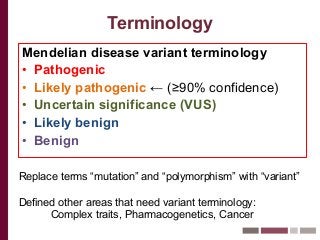
Terminology
Mendelian disease variant terminology
• Pathogenic
• Likely pathogenic ← (≥90% confidence)
• Uncertain significance (VUS)
• Likely benign
• Benign
Replace terms “mutation” and “polymorphism” with “variant”
Defined other areas that need variant terminology:
Complex traits, Pharmacogenetics, Cancer
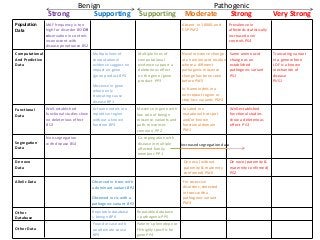
Population
Data
Computational
And Predictive
Data
Segregation
Data
Other
Database
Prevalence in
affecteds statistically
increased over
controls PS4
MAF frequency is too
high for disorder BSI OR
observation in controls
inconsistent with
disease penetrance BS2
Truncating variant
in a gene where
LOF is a known
mechanism of
disease
PVS1
De novo (paternity &
maternity confirmed)
PS2
Well-established
functional studies
show a deleterious
effect PS3
Novel missense change
at an amino acid residue
where a different
pathogenic missense
change has been seen
before PM5
Multiple lines of
computational
evidence support a
deleterious effect
on the gene /gene
product PP3
De novo (without
paternity & maternity
confirmed) PM6
Non-segregation
with disease BS4
Patient’s phenotype or
FH highly specific for
gene PP4
For recessive
disorders, detected
in trans with a
pathogenic variant
PM3
Found in case with
an alternate cause
BP5
Missense in gene
where only
truncating cause
disease BP1
Multiple lines of
computational
evidence suggest no
impact on gene
/gene product BP4
Well-established
functional studies show
no deleterious effect
BS3
Located in a
mutational hot spot
and/or known
functional domain
PM1
In-frame indels in a
repetitive region
without a known
function BP3
Same amino acid
change as an
established
pathogenic variant
PS1
In-frame indels in a
non-repeat region or
stop-loss variants PM4
Observed in trans with
a dominant variant BP2
Functional
Data
Co-segregation with
disease in multiple
affected family
members PP1
De novo
Data
Allelic Data
Absent in 1000G and
ESP PM2
Strong
Observed in cis with a
pathogenic variant BP2
Reputable database
= benign BP6
Strong Very StrongModerateSupporting Supporting
Reputable database
= pathogenic PP5
Missense in gene with
low rate of benign
missense variants and
path. missenses
common PP2
Other Data
Benign Pathogenic
Increased segregation data
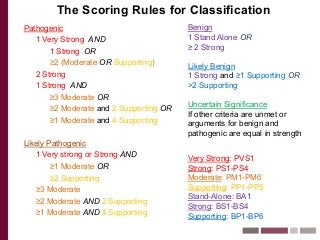
The Scoring Rules for Classification
Pathogenic
1 Very Strong AND
1 Strong OR
≥2 (Moderate OR Supporting)
2 Strong
1 Strong AND
≥3 Moderate OR
≥2 Moderate and 2 Supporting OR
≥1 Moderate and 4 Supporting
Likely Pathogenic
1 Very strong or Strong AND
≥1 Moderate OR
≥2 Supporting
≥3 Moderate
≥2 Moderate AND 2 Supporting
≥1 Moderate AND 4 Supporting
Very Strong: PVS1
Strong: PS1-PS4
Moderate: PM1-PM6
Supporting: PP1-PP5
Stand-Alone: BA1
Strong: BS1-BS4
Supporting: BP1-BP6
Benign
1 Stand Alone OR
≥ 2 Strong
Likely Benign
1 Strong and ≥1 Supporting OR
>2 Supporting
Uncertain Significance
If other criteria are unmet or
arguments for benign and
pathogenic are equal in strength
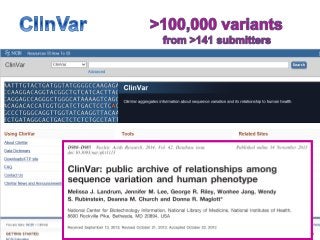
www.ncbi.nlm.nih.gov/clinvar
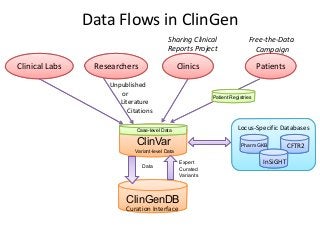
ClinGenDBClinGenDB
Data Flows in ClinGen
Expert
Curated
Variants
Case-level Data
Variant-level Data
ClinVar
Data
Locus-Specific DatabasesLocus-Specific Databases
Clinical LabsClinical Labs ClinicsClinics PatientsPatients
Sharing Clinical
Reports Project
Curation Interface
Free-the-Data
Campaign
Patient Registries
ResearchersResearchers
Unpublished
or
Literature
Citations
InSiGHT
CFTR2PharmGKB
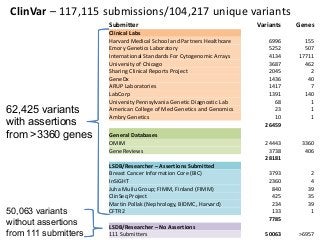
Submitter Variants Genes
Clinical Labs
Harvard Medical School and Partners Healthcare 6996 155
Emory Genetics Laboratory 5252 507
International Standards For Cytogenomic Arrays 4134 17711
University of Chicago 3687 462
Sharing Clinical Reports Project 2045 2
GeneDx 1436 40
ARUP Laboratories 1417 7
LabCorp 1391 140
University Pennsylvania Genetic Diagnostic Lab 68 1
American College of Med Genetics and Genomics 23 1
Ambry Genetics 10 1
26459
General Databases
OMIM 24443 3360
GeneReviews 3738 406
28181
LSDB/Researcher – Assertions Submitted
Breast Cancer Information Core (BIC) 3793 2
InSiGHT 2360 4
Juha Muilu Group; FIMM, Finland (FIMM) 840 39
ClinSeq Project 425 35
Martin Pollak (Nephrology, BIDMC, Harvard) 234 39
CFTR2 133 1
7785
LSDB/Researcher – No Assertions
111 Submitters 50063 >6957
ClinVar – 117,115 submissions/104,217 unique variants
50,063 variants
without assertions
from 111 submitters
62,425 variants
with assertions
from >3360 genes
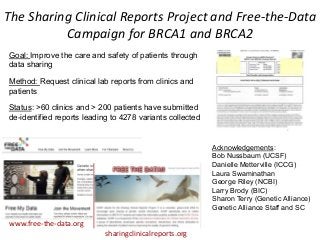
The Sharing Clinical Reports Project and Free-the-Data
Campaign for BRCA1 and BRCA2
Goal: Improve the care and safety of patients through
data sharing
Method: Request clinical lab reports from clinics and
patients
Status: >60 clinics and > 200 patients have submitted
de-identified reports leading to 4278 variants collected
sharingclinicalreports.org
Acknowledgements:
Bob Nussbaum (UCSF)
Danielle Metterville (ICCG)
Laura Swaminathan
George Riley (NCBI)
Larry Brody (BIC)
Sharon Terry (Genetic Alliance)
Genetic Alliance Staff and SC
www.free-the-data.org
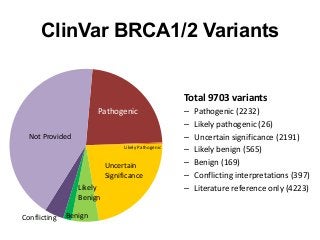
ClinVar BRCA1/2 Variants
Total 9703 variants
– Pathogenic (2232)
– Likely pathogenic (26)
– Uncertain significance (2191)
– Likely benign (565)
– Benign (169)
– Conflicting interpretations (397)
– Literature reference only (4223)
Pathogenic
Uncertain
Significance
Likely
Benign
Benign
Not Provided
Conflicting
Likely Pathogenic
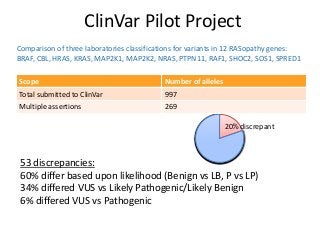
53 discrepancies:
60% differ based upon likelihood (Benign vs LB, P vs LP)
34% differed VUS vs Likely Pathogenic/Likely Benign
6% differed VUS vs Pathogenic
20% discrepant
ClinVar Pilot Project
Scope Number of alleles
Total submitted to ClinVar 997
Multiple assertions 269
Comparison of three laboratories classifications for variants in 12 RASopathy genes:
BRAF, CBL, HRAS, KRAS, MAP2K1, MAP2K2, NRAS, PTPN11, RAF1, SHOC2, SOS1, SPRED1
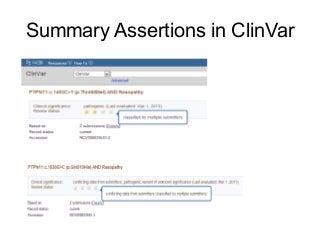
Summary Assertions in ClinVar
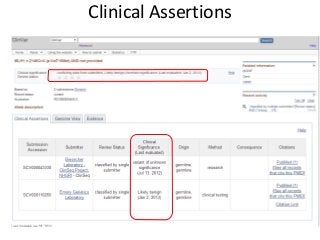
Clinical Assertions
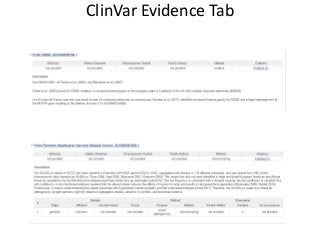
ClinVar Evidence Tab
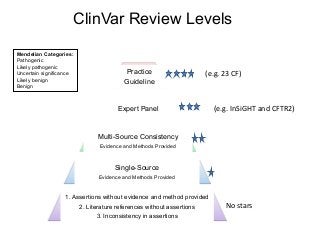
Expert Panel
Single-Source
Evidence and Methods Provided
1. Assertions without evidence and method provided
2. Literature references without assertions
3. Inconsistency in assertions
Multi-Source Consistency
Evidence and Methods Provided
Practice
Guideline
ClinVar Review Levels
Mendelian Categories:
Pathogenic
Likely pathogenic
Uncertain significance
Likely benign
Benign
(e.g. InSiGHT and CFTR2)
(e.g. 23 CF)
No stars
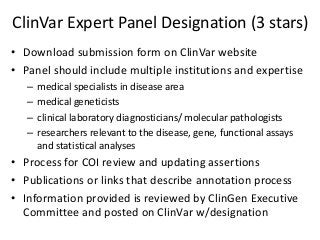
ClinVar Expert Panel Designation (3 stars)
• Download submission form on ClinVar website
• Panel should include multiple institutions and expertise
– medical specialists in disease area
– medical geneticists
– clinical laboratory diagnosticians/ molecular pathologists
– researchers relevant to the disease, gene, functional assays
and statistical analyses
• Process for COI review and updating assertions
• Publications or links that describe annotation process
• Information provided is reviewed by ClinGen Executive
Committee and posted on ClinVar w/designation
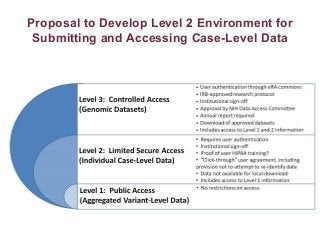
Proposal to Develop Level 2 Environment for
Submitting and Accessing Case-Level Data
ICCG Annual Conference
June 10-12, 2014, Bethesda, MD
www.iccg.org
clinicalgenome.org
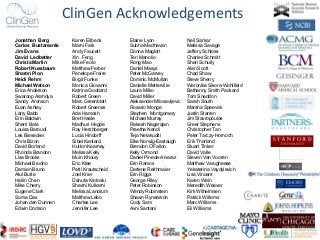
ClinGen Acknowledgements
Jonathan Berg
Carlos Bustamante
Jim Evans
David Ledbetter
Christa Martin
Robert Nussbaum
Sharon Plon
Heidi Rehm
Michael Watson
Erica Anderson
Swaroop Arahdya
Sandy Aronson
Euan Ashley
Larry Babb
Erin Baldwin
Sherri Bale
Louisa Baroudi
Les Biesecker
Chris Bizon
David Borland
Rhonda Brandon
Lisa Brooks
Michael Brudno
Damien Bruno
Atul Butte
Hailin Chen
Mike Cherry
Eugene Clark
Soma Das
Johan den Dunnen
Edwin Dodson
Karen Eilbeck
Marni Falk
Andy Faucett
Xin Feng
Mike Feolo
Matthew Ferber
Penelope Freire
Birgit Funke
Monica Giovanni
Katrina Goddard
Robert Green
Marc Greenblatt
Robert Greenes
Ada Hamosh
Bret Heale
Madhuri Hegde
Ray Hershberger
Lucia Hindorff
Sibel Kantarci
Hutton Kearney
Melissa Kelly
Muin Khoury
Eric Klee
Patti Krautscheid
Joel Krier
Danuta Krotoski
Shashi Kulkarni
Melissa Landrum
Matthew Lebo
Charles Lee
Jennifer Lee
Elaine Lyon
Subha Madhavan
Donna Maglott
Teri Manolio
Rong Mao
Daniel Masys
Peter McGarvey
Dominic McMullan
Danielle Metterville
Laura Milko
David Miller
Aleksander Milosavljevic
Rosario Monge
Stephen Montgomery
Michael Murray
Rakesh Nagarajan
Preetha Nandi
Teja Nelakuditi
Elke Norwig-Eastaugh
Brendon O’Fallon
Kelly Ormond
Daniel Pineda-Alvaraz
Erin Ramos
Darlene Reithmaier
Erin Riggs
George Riley
Peter Robinson
Wendy Rubinstein
Shawn Rynearson
Cody Sam
Avni Santani
Neil Sarkar
Melissa Savage
Jeffery Schloss
Charles Schmitt
Sheri Schully
Alan Scott
Chad Shaw
Steve Sherry
Weronika Sikora-Wohlfield
Bethanny Smith Packard
Tam Sneddon
Sarah South
Marsha Speevak
Justin Starren
Jim Stavropoulos
Greer Stephens
Christopher Tan
Peter Tarczy-Hornoch
Erik Thorland
Stuart Tinker
David Valle
Steven Van Vooren
Matthew Varugheese
Yekaterina Vaydylevich
Lisa Vincent
Karen Wain
Meredith Weaver
Kirk Wilhelmsen
Patrick Willems
Marc Williams
Eli Williams

ClinGen: The Clinical Genome Resource - Heidi Rehm

  • 1.
    Heidi L. Rehm,PhD Partners Healthcare and Harvard Medical School ClinGen Clinical Genome Resource
  • 2.
    The Problem > 100million genomic variants in humans >20,000 genes Most we don’t understand
  • 3.
    0 200 400 600 800 1000 1200 1 2 34 5 6 7 8 9 10 11 12 13 14 15 16 17 18 19 20 0 2 4 6 8 10 12 14 16 18 20 Lung Cancer KRAS EGFR G12C L858R GJB2 35delG GJB2 M34T PTPN11 N308D MYBPC3 R502W 68% of pathogenic/ likely pathogenic variants are seen only once 96% of variants are seen <10 times Number of Probands NumberofVariantsHistogram of Pathogenic Variants from Diagnostic Testing of 15,000 Probands (cardiomyopathy, hearing loss, rasopathies, aortopathies, somatic and hereditary cancer pulmonary disorders, skin disorders, other genetic syndromes) 31% VUS 25% Positive 61% Negative 14% Inconclusivenclusive 52% Benign 17% Path
  • 4.
    Clinical Domain WGs Chairs:Jonathan Berg & Sharon Plon Cancer co-chairs: Matthew Ferber, Ken Offit, Sharon Plon Cardiovascular co- chairs: Euan Ashley, Birgit Funke, Ray Hershberger Metabolic co-chairs: Rong Mao, Robert Steiner, David Valle Pharmacogenomic co- chairs: Teri Klein, Howard McLeod ClinGen Working Groups (WG)ClinGen Working Groups (WG) Actionability WG Chair: Jim Evans Informatics WG Chair: Carlos Bustamante EHR WG Chair: Marc Williams ClinVar IT Standards and Data Submission WG Chairs: Sandy Aronson & Karen Eilbeck Gene Curation WG Chairs: Jonathan Berg & Christa Martin Sequence Variant WG Chairs: Sherri Bale, Heidi Rehm, & Madhuri Hegde Structural Variant WG Chairs: Swaroop Arahdya & Erik Thorland ELSI and Genetic Counseling WG Chair: Andy Faucett & Kelly Ormond Education, Engagement, Access WG Chair: Andy Faucett Phenotyping WG Chair: David Miller ClinGen The Clinical Genome Resource Launched Sept 2013 NCBI ClinVar Leads Melissa Landrum Jennifer Lee Donna Maglott George Riley Steve Sherry U41 Grant PIs David Ledbetter Christa Martin Bob Nussbaum Heidi Rehm U01 PIs Jonathan Berg Jim Evans David Ledbetter Mike Watson U01 PIs Carlos Bustamante Sharon Plon NHGRI Program Directors Lisa Brooks Erin Ramos ClinVar vs. ClinGen? • ClinVar is a database • ClinGen, The Clinical Genome Resource, is an NIH funded program supporting a wide range of activities encompassing both support for ClinVar (funded through NCBI) as well as other projects • ClinGen includes 3 grants primarily funded by the National Human Genome Research Institute at NIH
  • 5.
    Clinical Domain WGs Chairs:Jonathan Berg & Sharon Plon Cancer co-chairs: Matthew Ferber, Ken Offit, Sharon Plon Cardiovascular co- chairs: Euan Ashley, Birgit Funke, Ray Hershberger Metabolic co-chairs: Rong Mao, Robert Steiner, David Valle Pharmacogenomic co- chairs: Teri Klein, Howard McLeod ClinGen Working Groups (WG)ClinGen Working Groups (WG) Actionability WG Chair: Jim Evans Informatics WG Chair: Carlos Bustamante EHR WG Chair: Marc Williams ClinVar IT Standards and Data Submission WG Chairs: Sandy Aronson & Karen Eilbeck Gene Curation WG Chairs: Jonathan Berg & Christa Martin Sequence Variant WG Chairs: Sherri Bale, Heidi Rehm, & Madhuri Hegde Structural Variant WG Chairs: Swaroop Arahdya & Erik Thorland ELSI and Genetic Counseling WG Chair: Andy Faucett & Kelly Ormond Education, Engagement, Access WG Chair: Andy Faucett Phenotyping WG Chair: David Miller ClinGen The Clinical Genome Resource Launched Sept 2013 NCBI ClinVar Leads Melissa Landrum Jennifer Lee Donna Maglott George Riley Steve Sherry U41 Grant PIs David Ledbetter Christa Martin Bob Nussbaum Heidi Rehm U01 PIs Jonathan Berg Jim Evans David Ledbetter Mike Watson U01 PIs Carlos Bustamante Sharon Plon NHGRI Program Directors Lisa Brooks Erin Ramos
  • 6.
    Goals of ClinGen Toraise the quality of patient care by: • Standardizing the annotation and interpretation of genomic variants • Sharing variant and case level data through a centralized database for clinical and research use • Developing machine-learning algorithms to improve the throughput of variant interpretation • Implementing an evidence-based expert consensus process for curating genes and variants • Assessing the actionability of genes and variants and supporting their use in clinical care systems
  • 7.
    Public LSDBs >600 Pharm GKB Population Databases EVS 1000G dbSNP Medical Literature Clinical Lab Databases OMIM VariantDatabases COSMIC HGMD $$$ HGMD $$$ Research Lab Databases Largely absent from the public domain Largely without standardized assertions
  • 8.
    Review of PublishedPathogenic Variants Found in WGS 3-5 million variants3-5 million variants ~20,000 Coding/Splice Variants~20,000 Coding/Splice Variants 20-40 “Pathogenic” Variants 20-40 “Pathogenic” Variants Published as Disease-Causing Genes <1% Rare CDS/Splice VariantsRare CDS/Splice Variants LOF in Disease Associated Genes 10-20 Variants10-20 Variants Review evidence for gene-disease association and LOF role Review evidence for variant pathogenicity 92% Excluded 67% Excluded Acknowledgements: Heather McLaughlin Kalotina Machini Ozge Ceyhan Birsoy Matt Lebo Danielle Metterville Weak disease association 65% Not medically relevant 33% Somatic 2% MedSeq Project: PI: Robert Green
  • 9.
    Rating System forGene Dosage Highest -- 3, 2, 1, 0, unlikely dosage sensitive -- Lowest
  • 10.
    Proposed Revisions toACMG Guideline for Interpretation of Sequence Variants ACMG Sue Richards, Chair Heidi Rehm, Co-chair Sherri Bale Wayne Grody David Bick Madhuri Hegde Soma Das Elaine Spector AMP Elaine Lyon Julie Gastier-Foster CAP Karl Voelkerding Nazneen Aziz On behalf of the ACMG Laboratory Quality Assurance Committee
  • 11.
    Terminology Mendelian disease variantterminology • Pathogenic • Likely pathogenic ← (≥90% confidence) • Uncertain significance (VUS) • Likely benign • Benign Replace terms “mutation” and “polymorphism” with “variant” Defined other areas that need variant terminology: Complex traits, Pharmacogenetics, Cancer
  • 12.
    Population Data Computational And Predictive Data Segregation Data Other Database Prevalence in affectedsstatistically increased over controls PS4 MAF frequency is too high for disorder BSI OR observation in controls inconsistent with disease penetrance BS2 Truncating variant in a gene where LOF is a known mechanism of disease PVS1 De novo (paternity & maternity confirmed) PS2 Well-established functional studies show a deleterious effect PS3 Novel missense change at an amino acid residue where a different pathogenic missense change has been seen before PM5 Multiple lines of computational evidence support a deleterious effect on the gene /gene product PP3 De novo (without paternity & maternity confirmed) PM6 Non-segregation with disease BS4 Patient’s phenotype or FH highly specific for gene PP4 For recessive disorders, detected in trans with a pathogenic variant PM3 Found in case with an alternate cause BP5 Missense in gene where only truncating cause disease BP1 Multiple lines of computational evidence suggest no impact on gene /gene product BP4 Well-established functional studies show no deleterious effect BS3 Located in a mutational hot spot and/or known functional domain PM1 In-frame indels in a repetitive region without a known function BP3 Same amino acid change as an established pathogenic variant PS1 In-frame indels in a non-repeat region or stop-loss variants PM4 Observed in trans with a dominant variant BP2 Functional Data Co-segregation with disease in multiple affected family members PP1 De novo Data Allelic Data Absent in 1000G and ESP PM2 Strong Observed in cis with a pathogenic variant BP2 Reputable database = benign BP6 Strong Very StrongModerateSupporting Supporting Reputable database = pathogenic PP5 Missense in gene with low rate of benign missense variants and path. missenses common PP2 Other Data Benign Pathogenic Increased segregation data
  • 13.
    The Scoring Rulesfor Classification Pathogenic 1 Very Strong AND 1 Strong OR ≥2 (Moderate OR Supporting) 2 Strong 1 Strong AND ≥3 Moderate OR ≥2 Moderate and 2 Supporting OR ≥1 Moderate and 4 Supporting Likely Pathogenic 1 Very strong or Strong AND ≥1 Moderate OR ≥2 Supporting ≥3 Moderate ≥2 Moderate AND 2 Supporting ≥1 Moderate AND 4 Supporting Very Strong: PVS1 Strong: PS1-PS4 Moderate: PM1-PM6 Supporting: PP1-PP5 Stand-Alone: BA1 Strong: BS1-BS4 Supporting: BP1-BP6 Benign 1 Stand Alone OR ≥ 2 Strong Likely Benign 1 Strong and ≥1 Supporting OR >2 Supporting Uncertain Significance If other criteria are unmet or arguments for benign and pathogenic are equal in strength
  • 14.
  • 15.
    ClinGenDBClinGenDB Data Flows inClinGen Expert Curated Variants Case-level Data Variant-level Data ClinVar Data Locus-Specific DatabasesLocus-Specific Databases Clinical LabsClinical Labs ClinicsClinics PatientsPatients Sharing Clinical Reports Project Curation Interface Free-the-Data Campaign Patient Registries ResearchersResearchers Unpublished or Literature Citations InSiGHT CFTR2PharmGKB
  • 16.
    Submitter Variants Genes ClinicalLabs Harvard Medical School and Partners Healthcare 6996 155 Emory Genetics Laboratory 5252 507 International Standards For Cytogenomic Arrays 4134 17711 University of Chicago 3687 462 Sharing Clinical Reports Project 2045 2 GeneDx 1436 40 ARUP Laboratories 1417 7 LabCorp 1391 140 University Pennsylvania Genetic Diagnostic Lab 68 1 American College of Med Genetics and Genomics 23 1 Ambry Genetics 10 1 26459 General Databases OMIM 24443 3360 GeneReviews 3738 406 28181 LSDB/Researcher – Assertions Submitted Breast Cancer Information Core (BIC) 3793 2 InSiGHT 2360 4 Juha Muilu Group; FIMM, Finland (FIMM) 840 39 ClinSeq Project 425 35 Martin Pollak (Nephrology, BIDMC, Harvard) 234 39 CFTR2 133 1 7785 LSDB/Researcher – No Assertions 111 Submitters 50063 >6957 ClinVar – 117,115 submissions/104,217 unique variants 50,063 variants without assertions from 111 submitters 62,425 variants with assertions from >3360 genes
  • 17.
    The Sharing ClinicalReports Project and Free-the-Data Campaign for BRCA1 and BRCA2 Goal: Improve the care and safety of patients through data sharing Method: Request clinical lab reports from clinics and patients Status: >60 clinics and > 200 patients have submitted de-identified reports leading to 4278 variants collected sharingclinicalreports.org Acknowledgements: Bob Nussbaum (UCSF) Danielle Metterville (ICCG) Laura Swaminathan George Riley (NCBI) Larry Brody (BIC) Sharon Terry (Genetic Alliance) Genetic Alliance Staff and SC www.free-the-data.org
  • 18.
    ClinVar BRCA1/2 Variants Total9703 variants – Pathogenic (2232) – Likely pathogenic (26) – Uncertain significance (2191) – Likely benign (565) – Benign (169) – Conflicting interpretations (397) – Literature reference only (4223) Pathogenic Uncertain Significance Likely Benign Benign Not Provided Conflicting Likely Pathogenic
  • 19.
    53 discrepancies: 60% differbased upon likelihood (Benign vs LB, P vs LP) 34% differed VUS vs Likely Pathogenic/Likely Benign 6% differed VUS vs Pathogenic 20% discrepant ClinVar Pilot Project Scope Number of alleles Total submitted to ClinVar 997 Multiple assertions 269 Comparison of three laboratories classifications for variants in 12 RASopathy genes: BRAF, CBL, HRAS, KRAS, MAP2K1, MAP2K2, NRAS, PTPN11, RAF1, SHOC2, SOS1, SPRED1
  • 20.
  • 21.
  • 22.
  • 23.
    Expert Panel Single-Source Evidence andMethods Provided 1. Assertions without evidence and method provided 2. Literature references without assertions 3. Inconsistency in assertions Multi-Source Consistency Evidence and Methods Provided Practice Guideline ClinVar Review Levels Mendelian Categories: Pathogenic Likely pathogenic Uncertain significance Likely benign Benign (e.g. InSiGHT and CFTR2) (e.g. 23 CF) No stars
  • 24.
    ClinVar Expert PanelDesignation (3 stars) • Download submission form on ClinVar website • Panel should include multiple institutions and expertise – medical specialists in disease area – medical geneticists – clinical laboratory diagnosticians/ molecular pathologists – researchers relevant to the disease, gene, functional assays and statistical analyses • Process for COI review and updating assertions • Publications or links that describe annotation process • Information provided is reviewed by ClinGen Executive Committee and posted on ClinVar w/designation
  • 25.
    Proposal to DevelopLevel 2 Environment for Submitting and Accessing Case-Level Data
  • 26.
    ICCG Annual Conference June10-12, 2014, Bethesda, MD www.iccg.org clinicalgenome.org
  • 27.
    ClinGen Acknowledgements Jonathan Berg CarlosBustamante Jim Evans David Ledbetter Christa Martin Robert Nussbaum Sharon Plon Heidi Rehm Michael Watson Erica Anderson Swaroop Arahdya Sandy Aronson Euan Ashley Larry Babb Erin Baldwin Sherri Bale Louisa Baroudi Les Biesecker Chris Bizon David Borland Rhonda Brandon Lisa Brooks Michael Brudno Damien Bruno Atul Butte Hailin Chen Mike Cherry Eugene Clark Soma Das Johan den Dunnen Edwin Dodson Karen Eilbeck Marni Falk Andy Faucett Xin Feng Mike Feolo Matthew Ferber Penelope Freire Birgit Funke Monica Giovanni Katrina Goddard Robert Green Marc Greenblatt Robert Greenes Ada Hamosh Bret Heale Madhuri Hegde Ray Hershberger Lucia Hindorff Sibel Kantarci Hutton Kearney Melissa Kelly Muin Khoury Eric Klee Patti Krautscheid Joel Krier Danuta Krotoski Shashi Kulkarni Melissa Landrum Matthew Lebo Charles Lee Jennifer Lee Elaine Lyon Subha Madhavan Donna Maglott Teri Manolio Rong Mao Daniel Masys Peter McGarvey Dominic McMullan Danielle Metterville Laura Milko David Miller Aleksander Milosavljevic Rosario Monge Stephen Montgomery Michael Murray Rakesh Nagarajan Preetha Nandi Teja Nelakuditi Elke Norwig-Eastaugh Brendon O’Fallon Kelly Ormond Daniel Pineda-Alvaraz Erin Ramos Darlene Reithmaier Erin Riggs George Riley Peter Robinson Wendy Rubinstein Shawn Rynearson Cody Sam Avni Santani Neil Sarkar Melissa Savage Jeffery Schloss Charles Schmitt Sheri Schully Alan Scott Chad Shaw Steve Sherry Weronika Sikora-Wohlfield Bethanny Smith Packard Tam Sneddon Sarah South Marsha Speevak Justin Starren Jim Stavropoulos Greer Stephens Christopher Tan Peter Tarczy-Hornoch Erik Thorland Stuart Tinker David Valle Steven Van Vooren Matthew Varugheese Yekaterina Vaydylevich Lisa Vincent Karen Wain Meredith Weaver Kirk Wilhelmsen Patrick Willems Marc Williams Eli Williams