WHAT EVERY PHYSICIAN
NEEDS TO KNOW:
TMB PAIN MANAGEMENT
RULES
TEXAS MEDICAL
BOARD RULES
Chapter 170 – Prescription
of Controlled Substances
In July 2020, the Texas Medical
Board (TMB) adopted final rules
for physicians to comply with pain
management legislation passed in
2019.
2
TEXAS PMP
REQUIREMENT
Since 2019, physicians have been required to check the Texas
Prescription Monitoring Program (PMP) before prescribing
opioids, benzodiazepines, barbiturates, or carisoprodol. The
following slides describe the TMB’s clarifiication of these
rules.
3
TEXAS PMP
REQUIREMENT
The review of the patient’s PMP prescribing history must be
completed before and each time a prescription is issued for opioids,
benzodiazepines, barbiturates, or carisoprodol to a patient for:
•	 take-home use, upon leaving an outpatient setting such as
doctor’s office, or ambulatory surgical center; or
•	 upon discharge from an inpatient setting, such as a hospital
admission or discharge from an emergency department visit.
4
TEXAS PMP
REQUIREMENT
A mandatory PMP check is not required before or during
an inpatient stay, such as a hospital admission, or during
an outpatient encounter in settings, such as an emergency
department or ambulatory surgical center visit.
5
TEXAS PMP
REQUIREMENT
•	 PMP checks must be documented in the patient’s medical record.
•	 Exceptions to the mandated PMP check include prescriptions for
hospice care, cancer care, and treatment for sickle-cell disease.
•	 Another exception occurs if a prescriber tries to access the PMP,
but cannot because of circumstances out of the prescriber’s
control.
•	 Any exception needs to be documented in the patient’s record.
6
LIMITS ON PRESCRIBING
FOR ACUTE PAIN
A 2019 Texas law limits prescriptions for opioids to treat
acute pain to 10 days. In response, the TMB has created new
definitions of acute and chronic pain.
7
•	 Acute pain: Pain that is time-limited to no more than 30 days from the
date of the initial prescription for opioids during a period of treatment
related to the acute condition or injury.;
LIMITS ON PRESCRIBING
FOR ACUTE PAIN
8
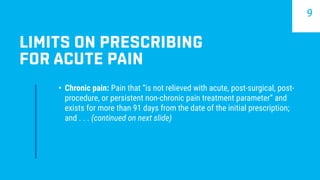
•	 Chronic pain: Pain that “is not relieved with acute, post-surgical, post-
procedure, or persistent non-chronic pain treatment parameter” and
exists for more than 91 days from the date of the initial prescription;
and . . . (continued on next slide)
LIMITS ON PRESCRIBING
FOR ACUTE PAIN
9
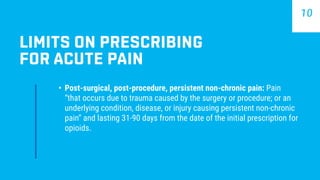
•	 Post-surgical, post-procedure, persistent non-chronic pain: Pain
“that occurs due to trauma caused by the surgery or procedure; or an
underlying condition, disease, or injury causing persistent non-chronic
pain” and lasting 31-90 days from the date of the initial prescription for
opioids.
LIMITS ON PRESCRIBING
FOR ACUTE PAIN
10
LIMITS ON PRESCRIBING
FOR ACUTE PAIN
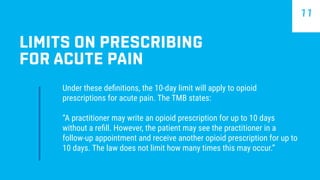
Under these definitions, the 10-day limit will apply to opioid
prescriptions for acute pain. The TMB states:
“A practitioner may write an opioid prescription for up to 10 days
without a refill. However, the patient may see the practitioner in a
follow-up appointment and receive another opioid prescription for up to
10 days. The law does not limit how many times this may occur.”
11
LIMITS ON PRESCRIBING
FOR ACUTE PAIN
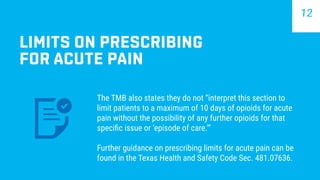
The TMB also states they do not “interpret this section to
limit patients to a maximum of 10 days of opioids for acute
pain without the possibility of any further opioids for that
specific issue or ‘episode of care.’”
Further guidance on prescribing limits for acute pain can be
found in the Texas Health and Safety Code Sec. 481.07636.
12
OPIOID CME
REQUIREMENTS
The TMB now requires physicians to take two hours of CME
in pain management and the prescription of opioids and
other controlled substances.
For more information, please see the TMB Adopted Rules
Title 22.
13
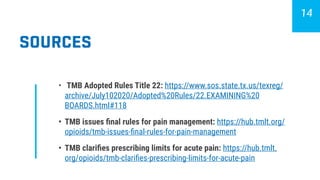
SOURCES
•	 TMB Adopted Rules Title 22: https://www.sos.state.tx.us/texreg/
archive/July102020/Adopted%20Rules/22.EXAMINING%20
BOARDS.html#118
•	 TMB issues final rules for pain management: https://hub.tmlt.org/
opioids/tmb-issues-final-rules-for-pain-management
•	 TMB clarifies prescribing limits for acute pain: https://hub.tmlt.
org/opioids/tmb-clarifies-prescribing-limits-for-acute-pain
14
PROTECTION FOR A
NEW ERA OF MEDICINE
ABOUT TMLT:
With more than 20,000 health care professionals in its care, Texas Medical
Liability Trust (TMLT) provides malpractice insurance and related products
to physicians. Our purpose is to make a positive impact on the quality of
health care for patients by educating, protecting, and defending physicians.
www.tmlt.org
TMB pain management rules

TMB pain management rules

  • 1.
    WHAT EVERY PHYSICIAN NEEDSTO KNOW: TMB PAIN MANAGEMENT RULES
  • 2.
    TEXAS MEDICAL BOARD RULES Chapter170 – Prescription of Controlled Substances In July 2020, the Texas Medical Board (TMB) adopted final rules for physicians to comply with pain management legislation passed in 2019. 2
  • 3.
    TEXAS PMP REQUIREMENT Since 2019,physicians have been required to check the Texas Prescription Monitoring Program (PMP) before prescribing opioids, benzodiazepines, barbiturates, or carisoprodol. The following slides describe the TMB’s clarifiication of these rules. 3
  • 4.
    TEXAS PMP REQUIREMENT The reviewof the patient’s PMP prescribing history must be completed before and each time a prescription is issued for opioids, benzodiazepines, barbiturates, or carisoprodol to a patient for: • take-home use, upon leaving an outpatient setting such as doctor’s office, or ambulatory surgical center; or • upon discharge from an inpatient setting, such as a hospital admission or discharge from an emergency department visit. 4
  • 5.
    TEXAS PMP REQUIREMENT A mandatoryPMP check is not required before or during an inpatient stay, such as a hospital admission, or during an outpatient encounter in settings, such as an emergency department or ambulatory surgical center visit. 5
  • 6.
    TEXAS PMP REQUIREMENT • PMPchecks must be documented in the patient’s medical record. • Exceptions to the mandated PMP check include prescriptions for hospice care, cancer care, and treatment for sickle-cell disease. • Another exception occurs if a prescriber tries to access the PMP, but cannot because of circumstances out of the prescriber’s control. • Any exception needs to be documented in the patient’s record. 6
  • 7.
    LIMITS ON PRESCRIBING FORACUTE PAIN A 2019 Texas law limits prescriptions for opioids to treat acute pain to 10 days. In response, the TMB has created new definitions of acute and chronic pain. 7
  • 8.
    • Acute pain:Pain that is time-limited to no more than 30 days from the date of the initial prescription for opioids during a period of treatment related to the acute condition or injury.; LIMITS ON PRESCRIBING FOR ACUTE PAIN 8
  • 9.
    • Chronic pain:Pain that “is not relieved with acute, post-surgical, post- procedure, or persistent non-chronic pain treatment parameter” and exists for more than 91 days from the date of the initial prescription; and . . . (continued on next slide) LIMITS ON PRESCRIBING FOR ACUTE PAIN 9
  • 10.
    • Post-surgical, post-procedure,persistent non-chronic pain: Pain “that occurs due to trauma caused by the surgery or procedure; or an underlying condition, disease, or injury causing persistent non-chronic pain” and lasting 31-90 days from the date of the initial prescription for opioids. LIMITS ON PRESCRIBING FOR ACUTE PAIN 10
  • 11.
    LIMITS ON PRESCRIBING FORACUTE PAIN Under these definitions, the 10-day limit will apply to opioid prescriptions for acute pain. The TMB states: “A practitioner may write an opioid prescription for up to 10 days without a refill. However, the patient may see the practitioner in a follow-up appointment and receive another opioid prescription for up to 10 days. The law does not limit how many times this may occur.” 11
  • 12.
    LIMITS ON PRESCRIBING FORACUTE PAIN The TMB also states they do not “interpret this section to limit patients to a maximum of 10 days of opioids for acute pain without the possibility of any further opioids for that specific issue or ‘episode of care.’” Further guidance on prescribing limits for acute pain can be found in the Texas Health and Safety Code Sec. 481.07636. 12
  • 13.
    OPIOID CME REQUIREMENTS The TMBnow requires physicians to take two hours of CME in pain management and the prescription of opioids and other controlled substances. For more information, please see the TMB Adopted Rules Title 22. 13
  • 14.
    SOURCES • TMB AdoptedRules Title 22: https://www.sos.state.tx.us/texreg/ archive/July102020/Adopted%20Rules/22.EXAMINING%20 BOARDS.html#118 • TMB issues final rules for pain management: https://hub.tmlt.org/ opioids/tmb-issues-final-rules-for-pain-management • TMB clarifies prescribing limits for acute pain: https://hub.tmlt. org/opioids/tmb-clarifies-prescribing-limits-for-acute-pain 14
  • 15.
    PROTECTION FOR A NEWERA OF MEDICINE ABOUT TMLT: With more than 20,000 health care professionals in its care, Texas Medical Liability Trust (TMLT) provides malpractice insurance and related products to physicians. Our purpose is to make a positive impact on the quality of health care for patients by educating, protecting, and defending physicians. www.tmlt.org