A rchitecture  T radeoff and  A nalysis  M ethod NASA IV&V West Virginia University Introduction An Introduction to ATAM Date:  August 17, 2008 Presented by: Aaron Higgins, Intern, NASA ATL at WVU  [email_address]
A rchitecture  T radeoff and  A nalysis  M ethod NASA IV&V West Virginia University Applied Technology Lab Established:  2007 Partnership between West Virginia University (WVU) and NASA's Independent Verification and Validation (IV&V) facility. Goal to research software engineering techniques that improve and enhance the way NASA produces safe and reliable system software. Director:  Dr. Tim Menzies Website:  atl.wvu.edu
A rchitecture  T radeoff and  A nalysis  M ethod NASA IV&V West Virginia University Overview Purpose ATAM Overview Benefits Requirements Output Summary Contact Information Questions
A rchitecture  T radeoff and  A nalysis  M ethod NASA IV&V West Virginia University Purpose Created by Carnegie Mellon Software Engineering Institute Formal method to evaluate software architectures Looks for Architectural risks How architecture achieves goals How goals interact and tradeoff between one another
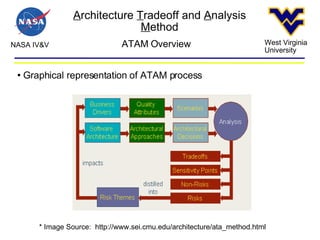
A rchitecture  T radeoff and  A nalysis  M ethod NASA IV&V West Virginia University ATAM Overview Graphical representation of ATAM process  * Image Source:  http://www.sei.cmu.edu/architecture/ata_method.html
A rchitecture  T radeoff and  A nalysis  M ethod NASA IV&V West Virginia University Benefits clarified quality attribute requirements improved architecture documentation documented basis for architectural decisions identified risks early in the life-cycle increased communication among stakeholders * Source:  http://www.sei.cmu.edu/architecture/ata_method.html
A rchitecture  T radeoff and  A nalysis  M ethod NASA IV&V West Virginia University Requirements Requirements for an evaluation Trained evaluation team Three to four days  System architects Representatives from stakeholders
A rchitecture  T radeoff and  A nalysis  M ethod NASA IV&V West Virginia University Output (1)‏ Output reports major findings by  Presentation and/or Written report
A rchitecture  T radeoff and  A nalysis  M ethod NASA IV&V West Virginia University Output (2)‏ Presentation/report contents typically include the architectural styles identified a "utility tree" - a hierarchic model of the driving architectural requirements the set of scenarios generated and the subset that were mapped onto the architecture a set of quality-attribute specific questions that were applied to the architecture and the responses to these questions a set of identified risks a set of identified non-risks
A rchitecture  T radeoff and  A nalysis  M ethod NASA IV&V West Virginia University Summary Created by the Carnegie Mellon Software Engineering Institute Method for evaluating system architectures Exposes flaws in architecture Shows tradeoffs between system goals Benefits include more system documentation Evaluation requires trained team and system architects and users Output in the form of a presentation and/or report
A rchitecture  T radeoff and  A nalysis  M ethod NASA IV&V West Virginia University Contact Information Applied Technology Lab at West Virginia University [email_address] Dr. Tim Menzies, ATL administrator [email_address] Aaron Higgins, ATL intern [email_address] Eddie Jesinsky, ATL intern [email_address]
A rchitecture  T radeoff and  A nalysis  M ethod NASA IV&V West Virginia University Questions?

Architecture Tradeoff Analysis Method

  • 1.
    A rchitecture T radeoff and A nalysis M ethod NASA IV&V West Virginia University Introduction An Introduction to ATAM Date: August 17, 2008 Presented by: Aaron Higgins, Intern, NASA ATL at WVU [email_address]
  • 2.
    A rchitecture T radeoff and A nalysis M ethod NASA IV&V West Virginia University Applied Technology Lab Established: 2007 Partnership between West Virginia University (WVU) and NASA's Independent Verification and Validation (IV&V) facility. Goal to research software engineering techniques that improve and enhance the way NASA produces safe and reliable system software. Director: Dr. Tim Menzies Website: atl.wvu.edu
  • 3.
    A rchitecture T radeoff and A nalysis M ethod NASA IV&V West Virginia University Overview Purpose ATAM Overview Benefits Requirements Output Summary Contact Information Questions
  • 4.
    A rchitecture T radeoff and A nalysis M ethod NASA IV&V West Virginia University Purpose Created by Carnegie Mellon Software Engineering Institute Formal method to evaluate software architectures Looks for Architectural risks How architecture achieves goals How goals interact and tradeoff between one another
  • 5.
    A rchitecture T radeoff and A nalysis M ethod NASA IV&V West Virginia University ATAM Overview Graphical representation of ATAM process * Image Source: http://www.sei.cmu.edu/architecture/ata_method.html
  • 6.
    A rchitecture T radeoff and A nalysis M ethod NASA IV&V West Virginia University Benefits clarified quality attribute requirements improved architecture documentation documented basis for architectural decisions identified risks early in the life-cycle increased communication among stakeholders * Source: http://www.sei.cmu.edu/architecture/ata_method.html
  • 7.
    A rchitecture T radeoff and A nalysis M ethod NASA IV&V West Virginia University Requirements Requirements for an evaluation Trained evaluation team Three to four days System architects Representatives from stakeholders
  • 8.
    A rchitecture T radeoff and A nalysis M ethod NASA IV&V West Virginia University Output (1)‏ Output reports major findings by Presentation and/or Written report
  • 9.
    A rchitecture T radeoff and A nalysis M ethod NASA IV&V West Virginia University Output (2)‏ Presentation/report contents typically include the architectural styles identified a "utility tree" - a hierarchic model of the driving architectural requirements the set of scenarios generated and the subset that were mapped onto the architecture a set of quality-attribute specific questions that were applied to the architecture and the responses to these questions a set of identified risks a set of identified non-risks
  • 10.
    A rchitecture T radeoff and A nalysis M ethod NASA IV&V West Virginia University Summary Created by the Carnegie Mellon Software Engineering Institute Method for evaluating system architectures Exposes flaws in architecture Shows tradeoffs between system goals Benefits include more system documentation Evaluation requires trained team and system architects and users Output in the form of a presentation and/or report
  • 11.
    A rchitecture T radeoff and A nalysis M ethod NASA IV&V West Virginia University Contact Information Applied Technology Lab at West Virginia University [email_address] Dr. Tim Menzies, ATL administrator [email_address] Aaron Higgins, ATL intern [email_address] Eddie Jesinsky, ATL intern [email_address]
  • 12.
    A rchitecture T radeoff and A nalysis M ethod NASA IV&V West Virginia University Questions?