Cable fault location in power cables

Systematics for
cable testing, diagnosis and cable fault location
Contents:
1. Testing, diagnosing and partial discharge measurements
2. Cable fault location
Regarding the task to be performed, a distinction must be made between two main groups:
Testing, diagnosing and partial discharge measurement
Condition-oriented maintenance
Localising all types of cable faults
Result-oriented maintenance

1.

Testing, diagnosing and partial discharge measurement

Objective of the cable test:
Checking quality before running and fitting a cable
Correcting weak points in the cable which can jeopardise the operation
During the cable test, flash-overs are generated at the weak points in a cable. These faulty
points must then be localised (cable fault location). Depending on the insulation and the
test object, the following voltage forms are mandatory:
Paper-insulated lead-covered cable (PILC)

DC voltage
AC voltage 50 – 60 Hz
VLF (0.1 Hz)

PE/XLPE cable

AC voltage 50 – 60 Hz
VLF (0.1 Hz)

Components

DC voltage and AC voltage 50 – 60 Hz

2
Objective of the dielectric diagnosis and partial discharge measurement:
A non-destructive check for testing the condition of the insulation in cables and fittings and
localising faulty points.
Dielectric diagnosing
Integral check of how the cable has aged by means of IRC analysis (isothermal
relaxation current analysis) in PE and XLPE cable insulation types
Integral check of the moisture content by means of RVM analysis (return voltage
measurement) in paper-insulated lead-covered cables
Partial discharge measurement (PD measurement)
Recording, location and evaluation of partial discharges (PD) in the insulation and fittings
of medium voltage cables.
Remark: These subjects are dealt with separately in the following articles.

2.

Localising all different types of cable faults

The steps necessary for determining fault locations can be sub-divided into five main
catagories.
1.

Fault classification – identifying the type of fault

2.

Pre-location – determining the distance to the fault

3.

Route tracing – determining the route of the cable at the site

4.

Pinpointing – determining the exact position of the cable the site

5.

Cable identification – determining the faulty cable amongst several cables

3
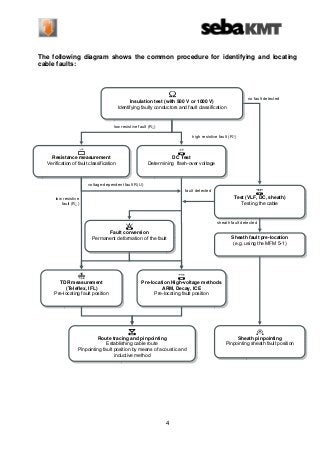
The following diagram shows the common procedure for identifying and locating
cable faults:

no fault detected

Insulation test (with 500 V or 1000 V)
Identifying faulty conductors and fault classification

low resistive fault (R↓)
high resistive fault (R↑)

DC Test
Determining flash-over voltage

Resistance measurement
Verification of fault classification

voltage-dependent fault R(U)
fault detected

Test (VLF, DC, sheath)
Testing the cable

low resistive
fault (R↓)

sheath fault detected

Fault conversion
Permanent deformation of the fault

TDR measurement
(Teleflex, IFL)
Pre-locating fault position

Sheath fault pre-location
(e.g. using the MFM 5-1)

Pre-location High-voltage methods
ARM, Decay, ICE
Pre-locating fault position

Route tracing and pinpointing
Establishing cable route
Pinpointing fault position by means of acoustic and
inductive method

4

Sheath pinpointing
Pinpointing sheath fault position
Measuring methods in cable fault location:
Insulation test, measuring the resistance of a fault
Testing
DC test (determining the flash-over voltage)
Sheath fault test
VLF test (determining the flash-over voltage)
Pre-location
Teleflex measurements (pulse reflection measurements,
TDR measurements)
ARM (Arc Reflection Method)
ARM Plus (Arc Reflection Method Plus)
ARM power burning
Decay Plus (Arc Reflection Method – igniting the fault using DC generator)
Decay (travelling wave method, oscillation method)
Current catching (ICE)
Three-phase current catching (ICE)
ICE Plus (low-voltage networks only)
High-voltage bridge method (pre-locating sheath faults)
Voltage drop method (pre-locating sheath faults)
Fault conversion
Burning
Performance burning
Route tracing
Line location
Line routing
Pinpointing
Audio frequency generator (twist field method, minimum turbidity method)
Shock discharges (acoustic field method, acoustic pinpointing)
Pinpointing sheath fault
Cable and phase identification
Phase identification when earthed
Phase identification and phase determination on live systems

5

SEBA KMT Cable Fault Location in Power Cables Guide - SEBA KMT Cable Testers & Fault Locators

  • 1.
    Cable fault locationin power cables Systematics for cable testing, diagnosis and cable fault location
  • 2.
    Contents: 1. Testing, diagnosingand partial discharge measurements 2. Cable fault location Regarding the task to be performed, a distinction must be made between two main groups: Testing, diagnosing and partial discharge measurement Condition-oriented maintenance Localising all types of cable faults Result-oriented maintenance 1. Testing, diagnosing and partial discharge measurement Objective of the cable test: Checking quality before running and fitting a cable Correcting weak points in the cable which can jeopardise the operation During the cable test, flash-overs are generated at the weak points in a cable. These faulty points must then be localised (cable fault location). Depending on the insulation and the test object, the following voltage forms are mandatory: Paper-insulated lead-covered cable (PILC) DC voltage AC voltage 50 – 60 Hz VLF (0.1 Hz) PE/XLPE cable AC voltage 50 – 60 Hz VLF (0.1 Hz) Components DC voltage and AC voltage 50 – 60 Hz 2
  • 3.
    Objective of thedielectric diagnosis and partial discharge measurement: A non-destructive check for testing the condition of the insulation in cables and fittings and localising faulty points. Dielectric diagnosing Integral check of how the cable has aged by means of IRC analysis (isothermal relaxation current analysis) in PE and XLPE cable insulation types Integral check of the moisture content by means of RVM analysis (return voltage measurement) in paper-insulated lead-covered cables Partial discharge measurement (PD measurement) Recording, location and evaluation of partial discharges (PD) in the insulation and fittings of medium voltage cables. Remark: These subjects are dealt with separately in the following articles. 2. Localising all different types of cable faults The steps necessary for determining fault locations can be sub-divided into five main catagories. 1. Fault classification – identifying the type of fault 2. Pre-location – determining the distance to the fault 3. Route tracing – determining the route of the cable at the site 4. Pinpointing – determining the exact position of the cable the site 5. Cable identification – determining the faulty cable amongst several cables 3
  • 4.
    The following diagramshows the common procedure for identifying and locating cable faults: no fault detected Insulation test (with 500 V or 1000 V) Identifying faulty conductors and fault classification low resistive fault (R↓) high resistive fault (R↑) DC Test Determining flash-over voltage Resistance measurement Verification of fault classification voltage-dependent fault R(U) fault detected Test (VLF, DC, sheath) Testing the cable low resistive fault (R↓) sheath fault detected Fault conversion Permanent deformation of the fault TDR measurement (Teleflex, IFL) Pre-locating fault position Sheath fault pre-location (e.g. using the MFM 5-1) Pre-location High-voltage methods ARM, Decay, ICE Pre-locating fault position Route tracing and pinpointing Establishing cable route Pinpointing fault position by means of acoustic and inductive method 4 Sheath pinpointing Pinpointing sheath fault position
  • 5.
    Measuring methods incable fault location: Insulation test, measuring the resistance of a fault Testing DC test (determining the flash-over voltage) Sheath fault test VLF test (determining the flash-over voltage) Pre-location Teleflex measurements (pulse reflection measurements, TDR measurements) ARM (Arc Reflection Method) ARM Plus (Arc Reflection Method Plus) ARM power burning Decay Plus (Arc Reflection Method – igniting the fault using DC generator) Decay (travelling wave method, oscillation method) Current catching (ICE) Three-phase current catching (ICE) ICE Plus (low-voltage networks only) High-voltage bridge method (pre-locating sheath faults) Voltage drop method (pre-locating sheath faults) Fault conversion Burning Performance burning Route tracing Line location Line routing Pinpointing Audio frequency generator (twist field method, minimum turbidity method) Shock discharges (acoustic field method, acoustic pinpointing) Pinpointing sheath fault Cable and phase identification Phase identification when earthed Phase identification and phase determination on live systems 5