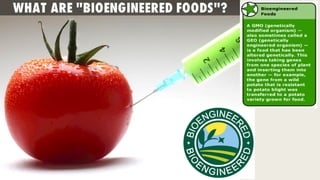
Bio-engineered
Foods
Presentation by
Primary Information Services
www.primaryinfo.com
mailto:primaryinfo@gmail.com
GMOs are
highly
controversial,
but there are
legitimate
arguments on
both sides of
the debate.
The USDA
certifies that
organic foods
are not
bio-engineered
in any way.
• Genetically modified foods have been around for
about two decades and are deemed generally safe,
yet they continue to generate controversy.
• While some studies show that these engineered
foods are as safe as traditionally grown foods, other
studies show deleterious effects in animals.
• In a meta-analysis, most of the studies showing
genetically modified foods in a positive light were
noted to have a conflict of interest.
• The scientific community is concerned about industry
restrictions on testing of genetically modified seeds.
• Also, there is concern that profit may be fueling the
adoption of genetically modified crops.
• Ongoing independent studies to evaluate safety are
needed. Scientific, economic, environmental, social,
ethical, and political perspectives will need to be
considered.
Standards -
https://www.ams.usda.gov/
1.The National Bioengineered Food Disclosure Law, passed by Congress in
July of 2016, directed USDA to establish this national mandatory standard
for disclosing foods that are or may be bioengineered.
2.The Standard defines bioengineered foods as those that contain detectable
genetic material that has been modified through certain lab techniques and
cannot be created through conventional breeding or found in nature.
3.The Standard requires food manufacturers, importers, and certain retailers
to ensure bioengineered foods are appropriately disclosed. Regulated entities
have several disclosure options: text, symbol, electronic or digital link,
and/or text message. Additional options such as a phone number or web
address are available to small food manufacturers or for small and very small
packages.
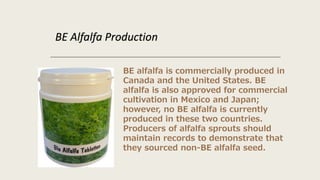
BE Alfalfa Production
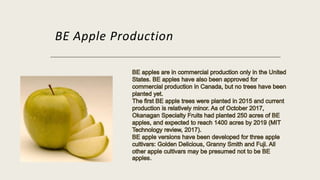
BE Apple Production
.
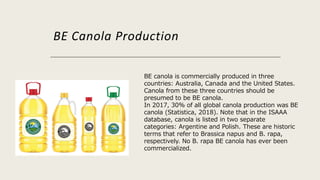
BE Canola Production
BE canola is commercially produced in three
countries: Australia, Canada and the United States.
Canola from these three countries should be
presumed to be BE canola.
In 2017, 30% of all global canola production was BE
canola (Statistica, 2018). Note that in the ISAAA
database, canola is listed in two separate
categories: Argentine and Polish. These are historic
terms that refer to Brassica napus and B. rapa,
respectively. No B. rapa BE canola has ever been
commercialized.
Questions? mailto:primaryinfo@gmail
We find the inside information
and get inside the information
make it knowledgeable !

Bio engineered-foods

  • 1.
    Bio-engineered Foods Presentation by Primary InformationServices www.primaryinfo.com mailto:primaryinfo@gmail.com
  • 3.
    GMOs are highly controversial, but thereare legitimate arguments on both sides of the debate. The USDA certifies that organic foods are not bio-engineered in any way.
  • 5.
    • Genetically modifiedfoods have been around for about two decades and are deemed generally safe, yet they continue to generate controversy. • While some studies show that these engineered foods are as safe as traditionally grown foods, other studies show deleterious effects in animals. • In a meta-analysis, most of the studies showing genetically modified foods in a positive light were noted to have a conflict of interest. • The scientific community is concerned about industry restrictions on testing of genetically modified seeds. • Also, there is concern that profit may be fueling the adoption of genetically modified crops. • Ongoing independent studies to evaluate safety are needed. Scientific, economic, environmental, social, ethical, and political perspectives will need to be considered.
  • 6.
    Standards - https://www.ams.usda.gov/ 1.The NationalBioengineered Food Disclosure Law, passed by Congress in July of 2016, directed USDA to establish this national mandatory standard for disclosing foods that are or may be bioengineered. 2.The Standard defines bioengineered foods as those that contain detectable genetic material that has been modified through certain lab techniques and cannot be created through conventional breeding or found in nature. 3.The Standard requires food manufacturers, importers, and certain retailers to ensure bioengineered foods are appropriately disclosed. Regulated entities have several disclosure options: text, symbol, electronic or digital link, and/or text message. Additional options such as a phone number or web address are available to small food manufacturers or for small and very small packages.
  • 7.
  • 8.
  • 9.
    BE Canola Production BEcanola is commercially produced in three countries: Australia, Canada and the United States. Canola from these three countries should be presumed to be BE canola. In 2017, 30% of all global canola production was BE canola (Statistica, 2018). Note that in the ISAAA database, canola is listed in two separate categories: Argentine and Polish. These are historic terms that refer to Brassica napus and B. rapa, respectively. No B. rapa BE canola has ever been commercialized.
  • 12.
    Questions? mailto:primaryinfo@gmail We findthe inside information and get inside the information make it knowledgeable !