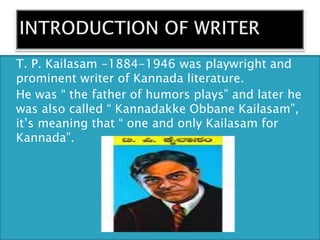
 T. P. Kailasam -1884-1946 was playwright and
prominent writer of Kannada literature.
 He was “ the father of humors plays” and later he
was also called “ Kannadakke Obbane Kailasam”,
it’s meaning that “ one and only Kailasam for
Kannada”.
 The term “ perspective” comes from the language
of vision .
 Perspectivism is the term coined by Friedrich
Nietzsche in developing the philosophical view that
all idea take place from particular perspectives.
 Kailasam highlighted something which in original
myth was neglected .
 The playwright has made change in the original
myth and gave it a totally new form .
 The story told by Maharshi Ved Vyasa in the
Mahabharata is conflicting with the story told by
T.P Kailasam in the Purpose.
 In “Mahabharata” Arjuna is drawn as a heroic
character possessing super human quality.
 He is drawn as a noble , kind and warrior
committed to his duty kind of person, we can not
imagine him doing any bad things but Kailasam
challenges this myth and makes an attempt to
present.
 This myth in a totally different way, with his own
perspective.
 In the play the purpose , Kailasam has drawn
Ekalavya a marginalized character in Mahabharata
as a hero of the play, where as Arjuna is drawn as
not good character in the play.
 Arjuna’s intention behind learning archery was not
noble .
 He wanted to learn only because he wanted to
become archer in the world.
 We can not imagine a character like him thinking
so selfishly but in this play it is not so.
 In contrast to this Ekalavya, is a Nishada boy
wanted to learn archery not for his personal
ambition but he wanted to protect save animals his
intention was noble.
 He has no personal aspirations he behaves like real
hero.
 Ekalavya is drawn here as a fast learner, noble and
greater kind of character in comparison to Arjuna.
 This all the things when Kailasam’s perspective
differs from the myth of Mahabharata.
 In the second act Ekalavya is far ahead than
Arjuna in archery. In anger Arjuna says that he
will tell everyone that Guru Drona has not kept
his vow. To save his Guruji from social criticism.
Ekalavya gives his thumb as Gurudakshina.
 This is change made by Kailasam. Here the
perspective differs. The behavior of Arjuna is
unexpected in this play. And Arjuna says “I have
trouble” at that time Drona says you usually
have problem in learning, and your aim is
wrong.
 This has double meaning. Now this Arjuna is
different from Mahabharata.
 In the play he is a self obsessed child. His
understanding is very limited.
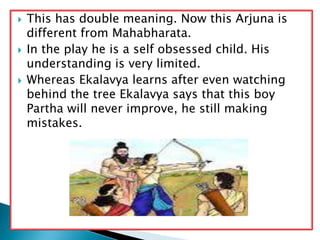
 Whereas Ekalavya learns after even watching
behind the tree Ekalavya says that this boy
Partha will never improve, he still making
mistakes.
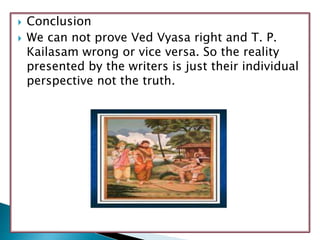
 Conclusion
 We can not prove Ved Vyasa right and T. P.
Kailasam wrong or vice versa. So the reality
presented by the writers is just their individual
perspective not the truth.
Perspectivism in the Purpose

Perspectivism in the Purpose

  • 2.
     T. P.Kailasam -1884-1946 was playwright and prominent writer of Kannada literature.  He was “ the father of humors plays” and later he was also called “ Kannadakke Obbane Kailasam”, it’s meaning that “ one and only Kailasam for Kannada”.
  • 3.
     The term“ perspective” comes from the language of vision .  Perspectivism is the term coined by Friedrich Nietzsche in developing the philosophical view that all idea take place from particular perspectives.
  • 4.
     Kailasam highlightedsomething which in original myth was neglected .  The playwright has made change in the original myth and gave it a totally new form .  The story told by Maharshi Ved Vyasa in the Mahabharata is conflicting with the story told by T.P Kailasam in the Purpose.  In “Mahabharata” Arjuna is drawn as a heroic character possessing super human quality.
  • 5.
     He isdrawn as a noble , kind and warrior committed to his duty kind of person, we can not imagine him doing any bad things but Kailasam challenges this myth and makes an attempt to present.  This myth in a totally different way, with his own perspective.  In the play the purpose , Kailasam has drawn Ekalavya a marginalized character in Mahabharata as a hero of the play, where as Arjuna is drawn as not good character in the play.  Arjuna’s intention behind learning archery was not noble .
  • 6.
     He wantedto learn only because he wanted to become archer in the world.  We can not imagine a character like him thinking so selfishly but in this play it is not so.  In contrast to this Ekalavya, is a Nishada boy wanted to learn archery not for his personal ambition but he wanted to protect save animals his intention was noble.  He has no personal aspirations he behaves like real hero.  Ekalavya is drawn here as a fast learner, noble and greater kind of character in comparison to Arjuna.
  • 7.
     This allthe things when Kailasam’s perspective differs from the myth of Mahabharata.  In the second act Ekalavya is far ahead than Arjuna in archery. In anger Arjuna says that he will tell everyone that Guru Drona has not kept his vow. To save his Guruji from social criticism. Ekalavya gives his thumb as Gurudakshina.  This is change made by Kailasam. Here the perspective differs. The behavior of Arjuna is unexpected in this play. And Arjuna says “I have trouble” at that time Drona says you usually have problem in learning, and your aim is wrong.
  • 8.
     This hasdouble meaning. Now this Arjuna is different from Mahabharata.  In the play he is a self obsessed child. His understanding is very limited.  Whereas Ekalavya learns after even watching behind the tree Ekalavya says that this boy Partha will never improve, he still making mistakes.
  • 9.
     Conclusion  Wecan not prove Ved Vyasa right and T. P. Kailasam wrong or vice versa. So the reality presented by the writers is just their individual perspective not the truth.