Compiling openCypher graph queries
with Spark Catalyst
Gábor Szárnyas
pre-holiday Spark des fêtes @ Montréal
BACKGROUND
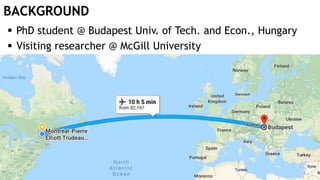
 PhD student @ Budapest Univ. of Tech. and Econ., Hungary
 Visiting researcher @ McGill University
RESEARCH TOPIC
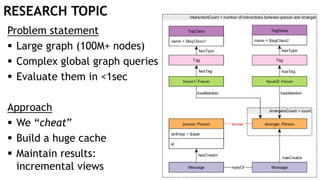
Problem statement
 Large graph (100M+ nodes)
 Complex global graph queries
 Evaluate them in <1sec
Approach
 We “cheat”
 Build a huge cache
 Maintain results:
incremental views
RESEARCH OBJECTIVES
Create a scalable graph query engine with incremental views
1. graph queries
2. incremental views
3. making it scale
Graph queries
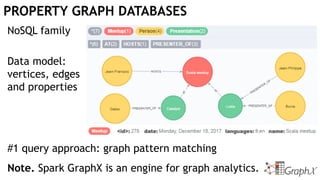
PROPERTY GRAPH DATABASES
NoSQL family
Data model:
vertices, edges
and properties
#1 query approach: graph pattern matching
Note. Spark GraphX is an engine for graph analytics.
CYPHER AND OPENCYPHER
Cypher: query language of the Neo4j graph database.
„Cypher is a declarative, SQL-inspired language for describing
patterns in graphs visually using an ascii-art syntax.”
MATCH
(p:Person)-[:PRESENTER_OF]->(:Presentation)-[:AT]->(m:Meetup)
WHERE m.date = 'Monday, December 18, 2017'
RETURN p
„The openCypher project aims to deliver a full and open
specification of the industry’s most widely adopted graph
database query language: Cypher.” (late 2015)
OPENCYPHER SYSTEMS
 Increasing adoption
 Relational databases:
o SAP HANA
o AGENS Graph
 Research prototypes:
o Graphflow (Univesity of Waterloo)
o ingraph (incremental graph engine)
(Source: Keynote talk @ GraphConnect NYC 2017)
LINKED DATA BENCHMARK COUNCIL
LDBC is a non-profit organization dedicated to establishing
benchmarks, benchmark practices and benchmark results for
graph data management software.
LDBC’s Social Network Benchmark is an industrial and academic
initiative, formed by principal actors in the field of graph-like
data management.
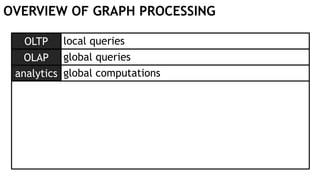
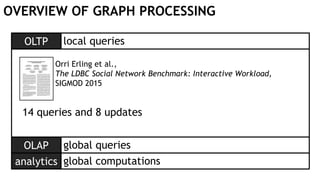
OVERVIEW OF GRAPH PROCESSING
OLTP
analytics
OLAP
local queries
global queries
global computations
OLAP global queries
OVERVIEW OF GRAPH PROCESSING
OLTP
analytics
local queries
global computations
Example: „Friends’ recent likes”
MATCH (u:User {id: $userId})-[:FRIEND]-
(f:User)-[l:LIKES]->(p:Post)
RETURN f, p
ORDER BY l.timestamp DESC
LIMIT 10
OLAP global queries
OVERVIEW OF GRAPH PROCESSING
OLTP
analytics
local queries
global computations
Orri Erling et al.,
The LDBC Social Network Benchmark: Interactive Workload,
SIGMOD 2015
14 queries and 8 updates
OVERVIEW OF GRAPH PROCESSING
OLTP
analytics
local queries
global computations
OLAP global queries
Example: „One-sided friendships”
MATCH (u1:User)-[:FRIEND]-(u2:User)-[l:LIKES]->(p:Post),
(u1)-[:AUTHOR_OF]->(p)
WITH u1, u2, count(l) AS likes
WHERE likes > 10
AND NOT (u1)-[:LIKES]->(:Post)<-[:AUTHOR_OF]-(u2)
RETURN u1, u2
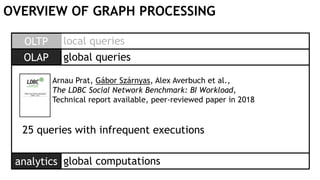
OVERVIEW OF GRAPH PROCESSING
OLTP
analytics
local queries
global computations
Arnau Prat, Gábor Szárnyas, Alex Averbuch et al.,
The LDBC Social Network Benchmark: BI Workload,
Technical report available, peer-reviewed paper in 2018
OLAP global queries
25 queries with infrequent executions
OVERVIEW OF GRAPH PROCESSING
OLTP
analytics
OLAP
local queries
global queries
global computations
• PageRank
• Shortest paths
• Clustering coefficient
Example: „Find the most central individuals.”
Spark: GraphX | Flink: Gelly | Neo4j: Graph Algorithms library
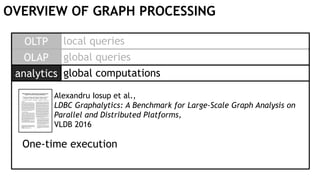
OVERVIEW OF GRAPH PROCESSING
OLTP
analytics
OLAP
local queries
global queries
global computations
Alexandru Iosup et al.,
LDBC Graphalytics: A Benchmark for Large-Scale Graph Analysis on
Parallel and Distributed Platforms,
VLDB 2016
One-time execution
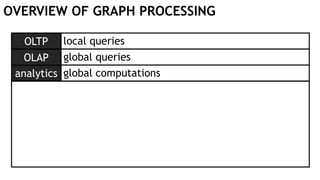
OVERVIEW OF GRAPH PROCESSING
OLTP
analytics
OLAP
local queries
global queries
global computations
Incremental view maintenance
CYBER-PHYSICAL SYSTEMS: LIVE RAILWAY MODEL
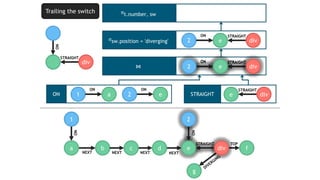
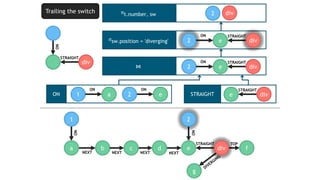
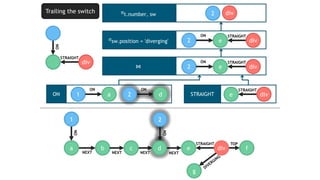
Trailing the switch
Proximity detection
CYBER-PHYSICAL SYSTEMS: LIVE RAILWAY MODEL
c d e
g
fdiv
2
NEXT NEXT
STRAIGHT TOP
ON
a b
1
NEXT
ON
NEXT
PROXIMITY DETECTION
seg
1
NEXT: 1..2
t1
ON
MATCH
(t1:Train)-[:ON]->(seg1:Segment)
-[:NEXT*1..2]->(seg2:Segment)
<-[:ON]-(t2:Train)
RETURN t1, t2, seg1, seg2
seg
2
t2
ON
≤ 𝟏 segments
TRAILING THE SWITCH
seg div
t
STRAIGHT
ON
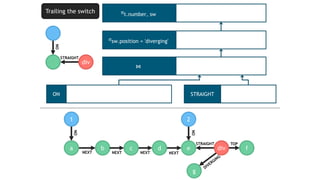
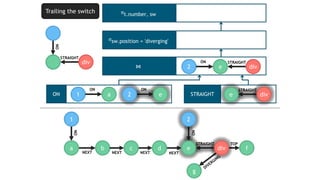
MATCH (t:Train)-[:ON]->(seg:Segment)
<-[:STRAIGHT]-(sw:Switch)
WHERE sw.position = 'diverging'
RETURN t.number, sw
Evaluate
continuously
INCREMENTAL QUERIES
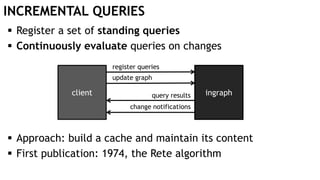
 Register a set of standing queries
 Continuously evaluate queries on changes
 Approach: build a cache and maintain its content
 First publication: 1974, the Rete algorithm
ingraphclient
register queries
query results
change notifications
update graph
πt.number, sw
σsw.position = ′diverging′
⋈
STRAIGHTON
c d e
g
fdiv
2
NEXT NEXT
STRAIGHT TOP
a b
1
NEXT NEXT
ON
ON
div
STRAIGHT
Trailing the switch
ON
πt.number, sw
σsw.position = ′diverging′
⋈
STRAIGHTON e2
ON
a1
ON
c d e
g
fdiv
2
NEXT NEXT
STRAIGHT TOP
a b
1
NEXT NEXT
ON
ON
div
STRAIGHT
Trailing the switch
ON
a
1
ON
e
2
ON
πt.number, sw
σsw.position = ′diverging′
⋈
STRAIGHTON e2
ON
a1
ON
c d e
g
fdiv
2
NEXT NEXT
STRAIGHT TOP
a b
1
NEXT NEXT
ON
ON
div
STRAIGHT
Trailing the switch
ON
e div
STRAIGHT
e div
STRAIGHT
πt.number, sw
σsw.position = ′diverging′
⋈
STRAIGHTON e div
STRAIGHT
e2
ON
a1
ON
e div
STRAIGHT
2
ON
c d e
g
fdiv
2
NEXT NEXT
STRAIGHT TOP
a b
1
NEXT NEXT
ON
ON
div
STRAIGHT
Trailing the switch
ON
e div
STRAIGHT
e2
ON
e div
2
STRAIGHT
ON
πt.number, sw
σsw.position = ′diverging′
⋈
STRAIGHTON e div
STRAIGHT
e2
ON
a1
ON
div
STRAIGHTON
e div
STRAIGHT
2
ON
c d e
g
fdiv
2
NEXT NEXT
STRAIGHT TOP
a b
1
NEXT NEXT
ON
ON
div
STRAIGHT
Trailing the switch
ON
e2 div
STRAIGHTON
e2
πt.number, sw
σsw.position = ′diverging′
⋈
STRAIGHTON e div
STRAIGHT
e2
ON
a1
ON
e div
STRAIGHT
2
ON
e div
STRAIGHT
2
ON
div2
c d e
g
fdiv
2
NEXT NEXT
STRAIGHT TOP
a b
1
NEXT NEXT
ON
ON
div
STRAIGHT
Trailing the switch
ON
div
2
πt.number, sw
σsw.position = ′diverging′
⋈
STRAIGHTON e div
STRAIGHT
e2
ON
a1
ON
e div
STRAIGHT
2
ON
e div
STRAIGHT
2
ON
div2
c d e
g
fdiv
2
NEXT NEXT
STRAIGHT TOP
a b
1
NEXT NEXT
ON
ON
div
STRAIGHT
Trailing the switch
ON
div
2
πt.number, sw
σsw.position = ′diverging′
⋈
STRAIGHTON e div
STRAIGHT
e2
ON
a1
ON
e div
STRAIGHT
2
ON
e div
STRAIGHT
2
ON
div2
c e
g
fdiv
NEXT NEXT
STRAIGHT TOP
a b
1
NEXT NEXT
ON
div
STRAIGHT
Trailing the switch
ON
div
ON
2
d
πt.number, sw
σsw.position = ′diverging′
⋈
STRAIGHTON e div
STRAIGHT
d2
ON
a1
ON
e div
STRAIGHT
2
ON
e div
STRAIGHT
2
ON
div2
c e
g
fdiv
NEXT NEXT
STRAIGHT TOP
a b
1
NEXT NEXT
ON
div
STRAIGHT
Trailing the switch
ON
div
ON
2
d
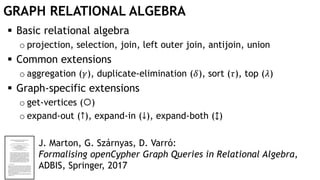
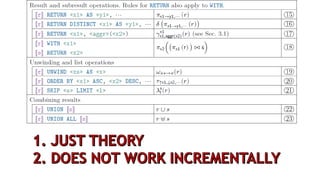
GRAPH RELATIONAL ALGEBRA
 Basic relational algebra
o projection, selection, join, left outer join, antijoin, union
 Common extensions
o aggregation (𝛾), duplicate-elimination (𝛿), sort (𝜏), top (𝜆)
 Graph-specific extensions
o get-vertices ()
o expand-out (↑), expand-in (↓), expand-both (↕)
J. Marton, G. Szárnyas, D. Varró:
Formalising openCypher Graph Queries in Relational Algebra,
ADBIS, Springer, 2017
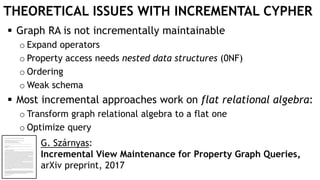
THEORETICAL ISSUES WITH INCREMENTAL CYPHER
 Graph RA is not incrementally maintainable
o Expand operators
o Property access needs nested data structures (0NF)
o Ordering
o Weak schema
 Most incremental approaches work on flat relational algebra:
o Transform graph relational algebra to a flat one
o Optimize query
G. Szárnyas:
Incremental View Maintenance for Property Graph Queries,
arXiv preprint, 2017
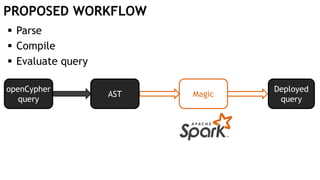
PROPOSED WORKFLOW
 Parse
 Compile
 Evaluate query
openCypher
query
Magic
Deployed
query
AST
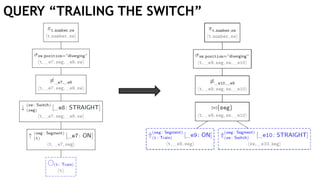
QUERY “TRAILING THE SWITCH”
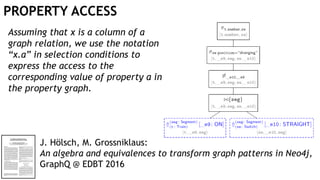
PROPERTY ACCESS
Assuming that x is a column of a
graph relation, we use the notation
“x.a” in selection conditions to
express the access to the
corresponding value of property a in
the property graph.
J. Hölsch, M. Grossniklaus:
An algebra and equivalences to transform graph patterns in Neo4j,
GraphQ @ EDBT 2016
t, seg
t, seg, t.number
sw, seg
sw, seg, sw.position
t.number, sw.position
πt.number, sw
σsw.position = ′diverging′
⋈
(sw:Switch)−[:STRAIGHT]−>(seg:Segment)(t:Train)−[:ON]−>(seg:Segment)
t.number, sw
t.number, sw
t, seg, sw
t, seg, t.number, sw, sw.position
t, seg, sw
t, seg, t.number, sw, sw.position
t.number
t.number, sw.position
sw.positiont.number
2
1. external schema
2. extra attributes
3. internal schema
This is the current
implementation
SCHEMA
INFERENCING
MATCH (t:Train)-[:ON]->(seg:Segment)
<-[:STRAIGHT]-(sw:Switch)
WHERE sw.position = 'diverging'
RETURN t.number, sw
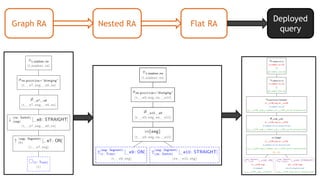
openCypher
query
AST Graph RA
Graph RA Flat RANested RA
Deployed
query
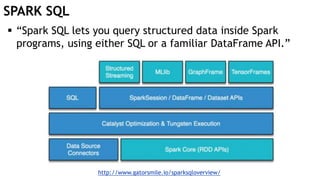
SPARK SQL
 “Spark SQL lets you query structured data inside Spark
programs, using either SQL or a familiar DataFrame API.”
http://www.gatorsmile.io/sparksqloverview/
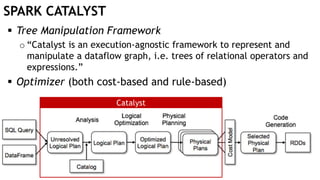
SPARK CATALYST
 Tree Manipulation Framework
o “Catalyst is an execution-agnostic framework to represent and
manipulate a dataflow graph, i.e. trees of relational operators and
expressions.”
 Optimizer (both cost-based and rule-based)
Catalyst
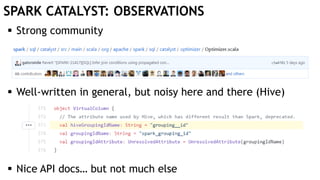
SPARK CATALYST: OBSERVATIONS
 Strong community
 Well-written in general, but noisy here and there (Hive)
 Nice API docs… but not much else
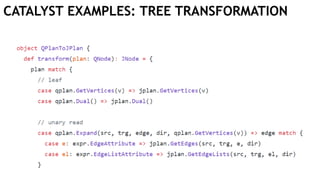
CATALYST EXAMPLES: TREE TRANSFORMATION
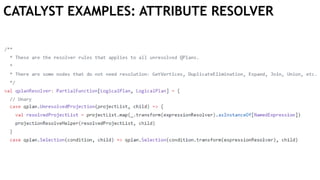
CATALYST EXAMPLES: ATTRIBUTE RESOLVER
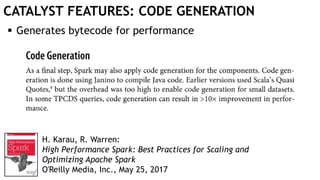
CATALYST FEATURES: CODE GENERATION
 Generates bytecode for performance
H. Karau, R. Warren:
High Performance Spark: Best Practices for Scaling and
Optimizing Apache Spark
O'Reilly Media, Inc., May 25, 2017
Scalable graph queries
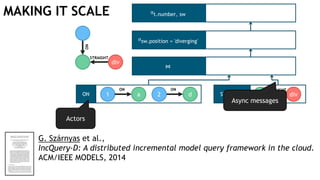
MAKING IT SCALE πt.number, sw
σsw.position = ′diverging′
⋈
STRAIGHTON e div
STRAIGHT
d2
ON
a1
ON
div
STRAIGHT
ON
Actors
Async messages
G. Szárnyas et al.,
IncQuery-D: A distributed incremental model query framework in the cloud.
ACM/IEEE MODELS, 2014
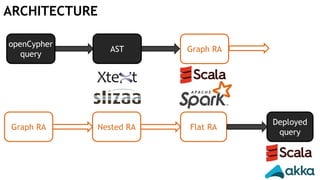
openCypher
query
AST Graph RA
Graph RA Flat RANested RA
Deployed
query
ARCHITECTURE
Related work and summary
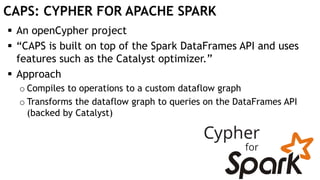
CAPS: CYPHER FOR APACHE SPARK
 An openCypher project
 “CAPS is built on top of the Spark DataFrames API and uses
features such as the Catalyst optimizer.”
 Approach
o Compiles to operations to a custom dataflow graph
o Transforms the dataflow graph to queries on the DataFrames API
(backed by Catalyst)
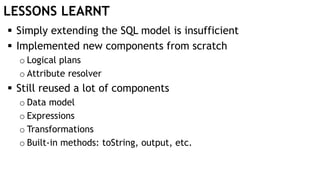
LESSONS LEARNT
 Simply extending the SQL model is insufficient
 Implemented new components from scratch
o Logical plans
o Attribute resolver
 Still reused a lot of components
o Data model
o Expressions
o Transformations
o Built-in methods: toString, output, etc.
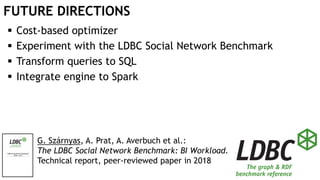
FUTURE DIRECTIONS
 Cost-based optimizer
 Experiment with the LDBC Social Network Benchmark
 Transform queries to SQL
 Integrate engine to Spark
G. Szárnyas, A. Prat, A. Averbuch et al.:
The LDBC Social Network Benchmark: BI Workload.
Technical report, peer-reviewed paper in 2018
RELATED RESOURCES
Ingraph github.com/ftsrg/ingraph
Cypher for Apache Spark github.com/opencypher/cypher-for-apache-spark
Slizaa openCypher github.com/slizaa/slizaa-opencypher-xtext
Mastering Apache Spark jaceklaskowski.gitbooks.io/mastering-apache-spark
Scala Days presentation people.apache.org/… | youtu.be/6bCpISym_0w
Deep dive blogpost databricks.com/blog/2015/04/13/deep-dive-…
Thanks for the contributions to the ingraph team.

Compiling openCypher graph queries with Spark Catalyst

  • 1.
    Compiling openCypher graphqueries with Spark Catalyst Gábor Szárnyas pre-holiday Spark des fêtes @ Montréal
  • 2.
    BACKGROUND  PhD student@ Budapest Univ. of Tech. and Econ., Hungary  Visiting researcher @ McGill University
  • 3.
    RESEARCH TOPIC Problem statement Large graph (100M+ nodes)  Complex global graph queries  Evaluate them in <1sec Approach  We “cheat”  Build a huge cache  Maintain results: incremental views
  • 4.
    RESEARCH OBJECTIVES Create ascalable graph query engine with incremental views 1. graph queries 2. incremental views 3. making it scale
  • 5.
  • 6.
    PROPERTY GRAPH DATABASES NoSQLfamily Data model: vertices, edges and properties #1 query approach: graph pattern matching Note. Spark GraphX is an engine for graph analytics.
  • 7.
    CYPHER AND OPENCYPHER Cypher:query language of the Neo4j graph database. „Cypher is a declarative, SQL-inspired language for describing patterns in graphs visually using an ascii-art syntax.” MATCH (p:Person)-[:PRESENTER_OF]->(:Presentation)-[:AT]->(m:Meetup) WHERE m.date = 'Monday, December 18, 2017' RETURN p „The openCypher project aims to deliver a full and open specification of the industry’s most widely adopted graph database query language: Cypher.” (late 2015)
  • 8.
    OPENCYPHER SYSTEMS  Increasingadoption  Relational databases: o SAP HANA o AGENS Graph  Research prototypes: o Graphflow (Univesity of Waterloo) o ingraph (incremental graph engine) (Source: Keynote talk @ GraphConnect NYC 2017)
  • 9.
    LINKED DATA BENCHMARKCOUNCIL LDBC is a non-profit organization dedicated to establishing benchmarks, benchmark practices and benchmark results for graph data management software. LDBC’s Social Network Benchmark is an industrial and academic initiative, formed by principal actors in the field of graph-like data management.
  • 10.
    OVERVIEW OF GRAPHPROCESSING OLTP analytics OLAP local queries global queries global computations
  • 11.
    OLAP global queries OVERVIEWOF GRAPH PROCESSING OLTP analytics local queries global computations Example: „Friends’ recent likes” MATCH (u:User {id: $userId})-[:FRIEND]- (f:User)-[l:LIKES]->(p:Post) RETURN f, p ORDER BY l.timestamp DESC LIMIT 10
  • 12.
    OLAP global queries OVERVIEWOF GRAPH PROCESSING OLTP analytics local queries global computations Orri Erling et al., The LDBC Social Network Benchmark: Interactive Workload, SIGMOD 2015 14 queries and 8 updates
  • 13.
    OVERVIEW OF GRAPHPROCESSING OLTP analytics local queries global computations OLAP global queries Example: „One-sided friendships” MATCH (u1:User)-[:FRIEND]-(u2:User)-[l:LIKES]->(p:Post), (u1)-[:AUTHOR_OF]->(p) WITH u1, u2, count(l) AS likes WHERE likes > 10 AND NOT (u1)-[:LIKES]->(:Post)<-[:AUTHOR_OF]-(u2) RETURN u1, u2
  • 14.
    OVERVIEW OF GRAPHPROCESSING OLTP analytics local queries global computations Arnau Prat, Gábor Szárnyas, Alex Averbuch et al., The LDBC Social Network Benchmark: BI Workload, Technical report available, peer-reviewed paper in 2018 OLAP global queries 25 queries with infrequent executions
  • 15.
    OVERVIEW OF GRAPHPROCESSING OLTP analytics OLAP local queries global queries global computations • PageRank • Shortest paths • Clustering coefficient Example: „Find the most central individuals.” Spark: GraphX | Flink: Gelly | Neo4j: Graph Algorithms library
  • 16.
    OVERVIEW OF GRAPHPROCESSING OLTP analytics OLAP local queries global queries global computations Alexandru Iosup et al., LDBC Graphalytics: A Benchmark for Large-Scale Graph Analysis on Parallel and Distributed Platforms, VLDB 2016 One-time execution
  • 17.
    OVERVIEW OF GRAPHPROCESSING OLTP analytics OLAP local queries global queries global computations
  • 18.
  • 19.
    CYBER-PHYSICAL SYSTEMS: LIVERAILWAY MODEL Trailing the switch Proximity detection
  • 20.
    CYBER-PHYSICAL SYSTEMS: LIVERAILWAY MODEL c d e g fdiv 2 NEXT NEXT STRAIGHT TOP ON a b 1 NEXT ON NEXT
  • 21.
  • 22.
    TRAILING THE SWITCH segdiv t STRAIGHT ON MATCH (t:Train)-[:ON]->(seg:Segment) <-[:STRAIGHT]-(sw:Switch) WHERE sw.position = 'diverging' RETURN t.number, sw Evaluate continuously
  • 23.
    INCREMENTAL QUERIES  Registera set of standing queries  Continuously evaluate queries on changes  Approach: build a cache and maintain its content  First publication: 1974, the Rete algorithm ingraphclient register queries query results change notifications update graph
  • 24.
    πt.number, sw σsw.position =′diverging′ ⋈ STRAIGHTON c d e g fdiv 2 NEXT NEXT STRAIGHT TOP a b 1 NEXT NEXT ON ON div STRAIGHT Trailing the switch ON
  • 25.
    πt.number, sw σsw.position =′diverging′ ⋈ STRAIGHTON e2 ON a1 ON c d e g fdiv 2 NEXT NEXT STRAIGHT TOP a b 1 NEXT NEXT ON ON div STRAIGHT Trailing the switch ON a 1 ON e 2 ON
  • 26.
    πt.number, sw σsw.position =′diverging′ ⋈ STRAIGHTON e2 ON a1 ON c d e g fdiv 2 NEXT NEXT STRAIGHT TOP a b 1 NEXT NEXT ON ON div STRAIGHT Trailing the switch ON e div STRAIGHT e div STRAIGHT
  • 27.
    πt.number, sw σsw.position =′diverging′ ⋈ STRAIGHTON e div STRAIGHT e2 ON a1 ON e div STRAIGHT 2 ON c d e g fdiv 2 NEXT NEXT STRAIGHT TOP a b 1 NEXT NEXT ON ON div STRAIGHT Trailing the switch ON e div STRAIGHT e2 ON e div 2 STRAIGHT ON
  • 28.
    πt.number, sw σsw.position =′diverging′ ⋈ STRAIGHTON e div STRAIGHT e2 ON a1 ON div STRAIGHTON e div STRAIGHT 2 ON c d e g fdiv 2 NEXT NEXT STRAIGHT TOP a b 1 NEXT NEXT ON ON div STRAIGHT Trailing the switch ON e2 div STRAIGHTON e2
  • 29.
    πt.number, sw σsw.position =′diverging′ ⋈ STRAIGHTON e div STRAIGHT e2 ON a1 ON e div STRAIGHT 2 ON e div STRAIGHT 2 ON div2 c d e g fdiv 2 NEXT NEXT STRAIGHT TOP a b 1 NEXT NEXT ON ON div STRAIGHT Trailing the switch ON div 2
  • 30.
    πt.number, sw σsw.position =′diverging′ ⋈ STRAIGHTON e div STRAIGHT e2 ON a1 ON e div STRAIGHT 2 ON e div STRAIGHT 2 ON div2 c d e g fdiv 2 NEXT NEXT STRAIGHT TOP a b 1 NEXT NEXT ON ON div STRAIGHT Trailing the switch ON div 2
  • 31.
    πt.number, sw σsw.position =′diverging′ ⋈ STRAIGHTON e div STRAIGHT e2 ON a1 ON e div STRAIGHT 2 ON e div STRAIGHT 2 ON div2 c e g fdiv NEXT NEXT STRAIGHT TOP a b 1 NEXT NEXT ON div STRAIGHT Trailing the switch ON div ON 2 d
  • 32.
    πt.number, sw σsw.position =′diverging′ ⋈ STRAIGHTON e div STRAIGHT d2 ON a1 ON e div STRAIGHT 2 ON e div STRAIGHT 2 ON div2 c e g fdiv NEXT NEXT STRAIGHT TOP a b 1 NEXT NEXT ON div STRAIGHT Trailing the switch ON div ON 2 d
  • 33.
    GRAPH RELATIONAL ALGEBRA Basic relational algebra o projection, selection, join, left outer join, antijoin, union  Common extensions o aggregation (𝛾), duplicate-elimination (𝛿), sort (𝜏), top (𝜆)  Graph-specific extensions o get-vertices () o expand-out (↑), expand-in (↓), expand-both (↕) J. Marton, G. Szárnyas, D. Varró: Formalising openCypher Graph Queries in Relational Algebra, ADBIS, Springer, 2017
  • 36.
    THEORETICAL ISSUES WITHINCREMENTAL CYPHER  Graph RA is not incrementally maintainable o Expand operators o Property access needs nested data structures (0NF) o Ordering o Weak schema  Most incremental approaches work on flat relational algebra: o Transform graph relational algebra to a flat one o Optimize query G. Szárnyas: Incremental View Maintenance for Property Graph Queries, arXiv preprint, 2017
  • 37.
    PROPOSED WORKFLOW  Parse Compile  Evaluate query openCypher query Magic Deployed query AST
  • 38.
  • 39.
    PROPERTY ACCESS Assuming thatx is a column of a graph relation, we use the notation “x.a” in selection conditions to express the access to the corresponding value of property a in the property graph. J. Hölsch, M. Grossniklaus: An algebra and equivalences to transform graph patterns in Neo4j, GraphQ @ EDBT 2016
  • 40.
    t, seg t, seg,t.number sw, seg sw, seg, sw.position t.number, sw.position πt.number, sw σsw.position = ′diverging′ ⋈ (sw:Switch)−[:STRAIGHT]−>(seg:Segment)(t:Train)−[:ON]−>(seg:Segment) t.number, sw t.number, sw t, seg, sw t, seg, t.number, sw, sw.position t, seg, sw t, seg, t.number, sw, sw.position t.number t.number, sw.position sw.positiont.number 2 1. external schema 2. extra attributes 3. internal schema This is the current implementation SCHEMA INFERENCING
  • 42.
    MATCH (t:Train)-[:ON]->(seg:Segment) <-[:STRAIGHT]-(sw:Switch) WHERE sw.position= 'diverging' RETURN t.number, sw openCypher query AST Graph RA
  • 43.
    Graph RA FlatRANested RA Deployed query
  • 44.
    SPARK SQL  “SparkSQL lets you query structured data inside Spark programs, using either SQL or a familiar DataFrame API.” http://www.gatorsmile.io/sparksqloverview/ http://www.gatorsmile.io/sparksqloverview/
  • 45.
    SPARK CATALYST  TreeManipulation Framework o “Catalyst is an execution-agnostic framework to represent and manipulate a dataflow graph, i.e. trees of relational operators and expressions.”  Optimizer (both cost-based and rule-based) Catalyst
  • 46.
    SPARK CATALYST: OBSERVATIONS Strong community  Well-written in general, but noisy here and there (Hive)  Nice API docs… but not much else
  • 47.
  • 48.
  • 49.
    CATALYST FEATURES: CODEGENERATION  Generates bytecode for performance H. Karau, R. Warren: High Performance Spark: Best Practices for Scaling and Optimizing Apache Spark O'Reilly Media, Inc., May 25, 2017
  • 50.
  • 51.
    MAKING IT SCALEπt.number, sw σsw.position = ′diverging′ ⋈ STRAIGHTON e div STRAIGHT d2 ON a1 ON div STRAIGHT ON Actors Async messages G. Szárnyas et al., IncQuery-D: A distributed incremental model query framework in the cloud. ACM/IEEE MODELS, 2014
  • 52.
    openCypher query AST Graph RA GraphRA Flat RANested RA Deployed query ARCHITECTURE
  • 53.
  • 54.
    CAPS: CYPHER FORAPACHE SPARK  An openCypher project  “CAPS is built on top of the Spark DataFrames API and uses features such as the Catalyst optimizer.”  Approach o Compiles to operations to a custom dataflow graph o Transforms the dataflow graph to queries on the DataFrames API (backed by Catalyst)
  • 55.
    LESSONS LEARNT  Simplyextending the SQL model is insufficient  Implemented new components from scratch o Logical plans o Attribute resolver  Still reused a lot of components o Data model o Expressions o Transformations o Built-in methods: toString, output, etc.
  • 56.
    FUTURE DIRECTIONS  Cost-basedoptimizer  Experiment with the LDBC Social Network Benchmark  Transform queries to SQL  Integrate engine to Spark G. Szárnyas, A. Prat, A. Averbuch et al.: The LDBC Social Network Benchmark: BI Workload. Technical report, peer-reviewed paper in 2018
  • 57.
    RELATED RESOURCES Ingraph github.com/ftsrg/ingraph Cypherfor Apache Spark github.com/opencypher/cypher-for-apache-spark Slizaa openCypher github.com/slizaa/slizaa-opencypher-xtext Mastering Apache Spark jaceklaskowski.gitbooks.io/mastering-apache-spark Scala Days presentation people.apache.org/… | youtu.be/6bCpISym_0w Deep dive blogpost databricks.com/blog/2015/04/13/deep-dive-… Thanks for the contributions to the ingraph team.