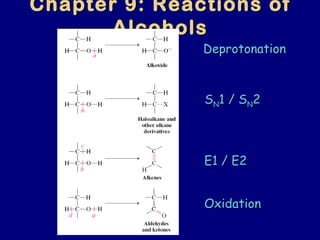
DeprotonationDeprotonation
SSNN1 / S1 / SNN22
E1 / E2E1 / E2
OxidationOxidation
Chapter 9: Reactions ofChapter 9: Reactions of
AlcoholsAlcohols
1. Deprotonation:1. Deprotonation:
ppKKaa (ROH) ~ 15-18.(ROH) ~ 15-18.
Need base stronger than RO :Need base stronger than RO :
a. RLi , e.g., CHa. RLi , e.g., CH33Li [pLi [pKKaa(CH(CH44) ~ 50];) ~ 50];
b. Na NHb. Na NH22 ( NH( NH33, 35); LDA (R, 35); LDA (R22NH, 40);NH, 40);
c.c. K H or Li H (HK H or Li H (H22, 38);, 38);
d. (CHd. (CH33))33CO [(CHCO [(CH33))33COH, 18]COH, 18]
--
::::
::
::
::
--++ ::
::
::
--
::
::
::
--++
::
--++
2. Protonation2. Protonation
a.a. RRprimprim
::::
OOHH
::::
HXHX
RRprimprim OHOH22
::
++ XX
SSNN22
--:: ::
RR XX
::
::
::
b.b. RRsec/tertsec/tert
::
OOHH
::::
HH
++
HH22OO
::
RR
++ SSNN11
EE11
RR NuNu
AlkeneAlkene
OHOH BrBr
OHOH II
HBrHBr
HIHI
Problem: MixturesProblem: Mixtures
DehydrationDehydration
Oxonium ionOxonium ion
Note: NeedsNote: Needs HH++
with a goodwith a good NuNu
((XX))
There is another general problem with SThere is another general problem with SNN1:1:
3. Carbocation Rearrangement by3. Carbocation Rearrangement by HH ShiftShift
--
::
Best when RBest when Rsecsec RRterttert, but “degenerate” shifts, but “degenerate” shifts
possible Rpossible Rsecsec RRsecsec, R, Rterttert RRterttert..
++
++
++ ++ ++
HH
CCCC
OOHH
HH
++
HH22OO
CC CC
++
HH
CCCC
HH
++ SSNN11
EE11
++
Mechanism ofMechanism of
CarbocationCarbocation
RearrangementRearrangementStep 1Step 1 Step 2Step 2
Step 3Step 3 Step 4Step 4
Fast!
The Hydride ShiftThe Hydride Shift
HydrideShiftHydrideShift
LipshutzLipshutz
BeachBBeachB
++
BrBr
::
:: ::
CHCH33
CHCH22CHCH33
HH HH
BrBr
::
:: ::
::
CHCH33
++
HH
BrBr
::
:: ::
::
--
CHCH33
CHCH22CHCH33
CHCH33
CHCH22CHCH33
BrBr
::
::
::
Cis/trans mixture, in addition to HCis/trans mixture, in addition to H
shiftshift
OHOH BrBr
BrBr
BrBr BrBr
HHBrBr
11 22 22 111313
CC
CHCH22CHCH33
--
HH
StatisticalStatistical distribution.distribution.
In other words:In other words: Complete scramblingComplete scrambling of labelof label
Note:Note: HH stays on same sidestays on same side
++
++
OHOH
HH22SOSO44
HH22OO
Intermediate cations can be trapped by SIntermediate cations can be trapped by SNN1,1,
but this is reversible with strongbut this is reversible with strong HH++
++
HH
++
‘‘
∆∆H shiftH shift
OOHH
E1 from rearranged carbocations:E1 from rearranged carbocations: MoreMore
substitutedsubstituted double bonddouble bond more stablemore stable..
H shiftH shift
HH++
HH++
HH
++
Note
ReversibilityReversibility meansmeans thermodynamicthermodynamic
controlcontrol. Thermodynamic products. Thermodynamic products
may needmay need prolongedprolonged reaction timereaction time
(or heat) to form.(or heat) to form. IntermediateIntermediate SSNN11
or E1 products may be isolated inor E1 products may be isolated in
thethe earlyearly stages of a reaction (or atstages of a reaction (or at
lowlow temperature).temperature).
CC CC
++
RR
CCCC
RR
++
Best RBest Rsecsec RRterttert
++ ++
4. Carbocations Also Rearrange by4. Carbocations Also Rearrange by
Alkyl Shifts (Slower Than H Shifts)Alkyl Shifts (Slower Than H Shifts)
Especially when there are no hydrogens to shift:Especially when there are no hydrogens to shift:
RRsecsec RRterttert
Alkyl shifts are fast when theyAlkyl shifts are fast when they relieverelieve ringring strainstrain::
Good!Good!
OHOH
::
::
HH22OO
::::
++++
OHOH
::::
HH
HH22OO
::::
++
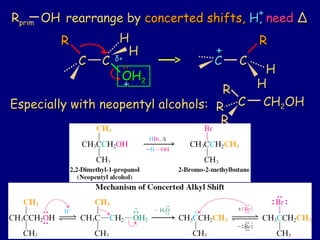
Mechanism of AlkylMechanism of Alkyl
ShiftShift
--HH++
RRprimprim OHOH rearrange byrearrange by concerted shifts,concerted shifts, H,H, needneed ΔΔ++
CC CC
RR
CCCC
RR
++
HH
HH
HH
HH
OHOH22
δδ++
++
::
Especially with neopentyl alcohols:Especially with neopentyl alcohols: CC CHCH22OHOHRR
RR
RR
5. Esters5. Esters from ROH and Acidsfrom ROH and Acids
General “esterification”:General “esterification”:
OO
AA
OOHH HHOROR++
OO
AA
OROR HH22OO++
A =A = C, N, S, P, Cr, etc.C, N, S, P, Cr, etc.
Organic esters:Organic esters: EquilibriaEquilibria
RCRCOHOH
OO
ROROHH
HH22SOSO44 cat.cat.
KK ~ 1~ 1
RCRCOROR
OO
HOHOHH++ ++
AcidAcid EsterEster
Use of Inorganic EstersUse of Inorganic Esters
Mild way to convert ROH RXMild way to convert ROH RX withoutwithout HH++
Reagents:Reagents: PPBrBr33 for Rfor RBrBr;; PPClCl33 oror ClClSSClCl for Rfor RClCl..
OO
3R3ROOHH ++ PPBrBr33 3R3RBrBr ++ HH33PPOO33 [“[“PP((OOHH))33”]”]
Phosphorous acidPhosphorous acid
Mechanisms go through inorganic esters asMechanisms go through inorganic esters as
reactive intermediates (not isolated).reactive intermediates (not isolated).
Mechanism:Mechanism:
Step 1Step 1
Step 2Step 2
RepeatRepeat
Chloroalkane Synthesis UsingChloroalkane Synthesis Using
SOClSOCl22
CHCH33CHCH22CHCH22OHOH CHCH33CHCH22CHCH22ClCl
OO
ClSClClSCl NN++
++ SOSO22
++NN
HH ClCl
--
++
NN
PyridinePyridine
HH ClCl
++ --
++NN
HH ClCl
--
++ ““Mops up” acidMops up” acid
::
91%91%
RCHRCH22OOHH
::::
OO
SS
ClClClCl
++ HHClCl
O S OO S O ClCl
--
RCHRCH22ClCl
RCHRCH22 O S ClO S Cl
::::
OO
ClCl
::
:: ::
::
--
++
++ ++
Mechanism:Mechanism:
++
IsolableIsolable Sulfonates RSulfonates R LL
ROHROH CHCH33SOSO22ClCl
NN
RR O SCHO SCH33
OO
OO
Methane-Methane-
sulfonate,sulfonate,
“mesylate”“mesylate”
CHCH33 SOSO22ClCl R O SOR O SO22 CHCH33
4-Methylbenzenesulfonate, “tosylate”4-Methylbenzenesulfonate, “tosylate”
NN
React byReact by SSNN1/2: Substitution of OH function1/2: Substitution of OH function
++ROHROH
EthersEthers
No hydrogen bonds:No hydrogen bonds:
relativelyrelatively low b.p.slow b.p.s
OO
::::
OO
::::
OO
::::
RR RRRRHH HH HH ‘‘
““Ether”Ether”
OO
OO
Dimethoxyethane,Dimethoxyethane,
“glyme”“glyme”
CCHH33OO
OOCCHH33
TetrahydrofuranTetrahydrofuran
(THF)(THF)
NoNo acidic hydrogens: Relativelyacidic hydrogens: Relatively unreactive,unreactive,
hence used ashence used as solventssolvents
CyclicCyclic polyethers:polyethers: Crown ethersCrown ethers
Hole perfect for KHole perfect for K++
Crown Ethers SolvateCrown Ethers Solvate
CationsCations
Names:Names: AlkoxyAlkoxyalkane. Same rules as for RH.alkane. Same rules as for RH.
OO EthoxyEthoxyethaneethane OO 11 22 33 44 11--MethoxyMethoxy--
OCHOCH33
OCHOCH22CHCH33
butanebutane
CisCis-1-ethoxy-2-methoxy--1-ethoxy-2-methoxy-
cyclopentanecyclopentane
Synthesis:Synthesis: WilliamsonWilliamson ether synthesis: Old stuffether synthesis: Old stuff
SSNN22
RRprimprim X + R’X + R’OO RR OOR’R’
::
::
::
Best: good X = L, unhindered R, R’; polar aproticBest: good X = L, unhindered R, R’; polar aprotic
solvent; otherwisesolvent; otherwise EE22!!
--
OOOO ClCl
++
60% yield in butanol solvent60% yield in butanol solvent(Use 1-butanol(Use 1-butanol
+ NaOH)+ NaOH)
--
95% in DMSO (CH95% in DMSO (CH33SOCHSOCH33))
++
RRsecsec OO
is O.K.:is O.K.:
--
OO
--
BrBr OO
2-Ethoxypropane2-Ethoxypropane
85%85%
HMPAHMPA
Other way no good:Other way no good: BrBr --++ OO EE22
Cyclic EthersCyclic Ethers
IntramolecularIntramolecular Williamson synthesisWilliamson synthesis
High Dilution FavorsHigh Dilution Favors
IntramolecularIntramolecular
ReactionReaction
Trading offTrading off ΔΔHH andand ΔΔSS effects in the variouseffects in the various
transition states:transition states:
Relative rates:Relative rates: 33 > 5 > 6 >> 5 > 6 > 44 > 7 > 8> 7 > 8
ProximityProximity
beats strainbeats strain
StrainedStrained andand
distantdistant
L
O-
L
O-
L
-
O
L
-
O
Proximity effectProximity effect: enthalpic: enthalpic
ground state activationground state activation
SuperfastSuperfast
FastFast
FastFastSlowSlow
Good!Good! Not goodNot good
Remember: SRemember: SNN2 is stereospecific.2 is stereospecific.
Backside displacement with inversion.Backside displacement with inversion.
Ethers from AlcoholsEthers from Alcohols
SSNN2 and S2 and SNN11
RRprimprim OHOH
HH22SOSO44
HH22OO
R O RR O R
Mechanism SMechanism SNN2 via:2 via: RROOHH
::::
RR OO
::
HH
HH
++ Needs heat!Needs heat!
SymmetricalSymmetrical
Poor NuPoor Nu
RRsec/tertsec/tert OHOH :: SSNN11 via Rvia R
++
OOHH
:::: HH
-H-H22OO OO
::::
Via:Via:
++
++
HOHO
::::
ProductProductOHOH22
::
++
++ OHOH HH++
R O C CHR O C CH33
CHCH33
CHCH33
SymmetricalSymmetrical
UnymmetricalUnymmetrical
Can be used for “protection” of alcohols asCan be used for “protection” of alcohols as
tt-butyl ethers:-butyl ethers:
ROHROH
ReactiveReactive UnreactiveUnreactive
Ethers by Alcoholysis of REthers by Alcoholysis of Rsec/tertsec/tert X:X:
ClCl OCHOCH33
CHCH33OHOH
SSNN11
OHOH ++ RCHRCH22OHOH HH
++ CHCH33
CHCH33
HH33CC CC ++ RCHRCH22OOHH
::::
--HH++ RCHRCH22OO
ExcessExcess
This works because the t-Bu cation is formed fast:This works because the t-Bu cation is formed fast:
Reactions of EthersReactions of Ethers
RRprimprim ethers:ethers:
Stable to base, RLi, RMgBr, dilute aqueous HStable to base, RLi, RMgBr, dilute aqueous H++
But, strong H : SBut, strong H : SNN22++
OO
HBrHBr BrBr
HOHO
BrBr
BrBr
HBrHBr
MixedMixed prim/secprim/sec ethers: Both Sethers: Both SNN1/21/2
OO
::::
HHII
OO
++
HH
II
::::
--
:: ::
II
++OOHH
::::
Less hindered;Less hindered;
InversionInversion Good NuGood Nu
SSNN2:2:
SSNN1:1:
OO
::::
HH++
, H, H22OO
OO
++
HH
++
::::
OOHH
HOHO--
Poor NuPoor Nu
HH22OO
-H-H++
Useful Application:Useful Application:
++
RR OO
::::
HH++
ROHROH ++++RR
::
HH
++
OO
ΔΔ
HH++
Sequence:Sequence:
RROHOH RR OO RROHOH
ProtectionProtection DeprotectionDeprotection
terttert-Bu ether hydrolysis: H , H-Bu ether hydrolysis: H , H22O mildO mild
GasGas
TertTert-Butyl Protection of-Butyl Protection of
AlcoholsAlcohols
Strained EthersStrained Ethers
BasicBasic conditions:conditions: NuNu attacks directly!attacks directly!
OO
::
CHCH33SS++
::
::
::
-- HH22OO
Work-upWork-up
SCHSCH33
HOHO
::::
::
::
HydroxyethylationHydroxyethylation of Nu :of Nu :::
HOHO
NuNu
::
--::
React by ringReact by ring openingopening, release ring, release ring
strainstrain (~ 27 kcal mol(~ 27 kcal mol-1-1
).).
CHCH33
HH
CHCH33
OHOH
Regio- and stereocontrolRegio- and stereocontrol
ManyMany NuNu work:work:::--
OO
LiALLiALDD44
CHCH33
HH
CHCH33
HH
DD
OHOH
CHCH33LiLi
Regioselective:Regioselective: SSNN2 at2 at less hinderedless hindered sitesite
Recall: RLi or RMgX do not react with RX normally!Recall: RLi or RMgX do not react with RX normally!
WithWith neutralneutral NuNu, we need, we need acidicacidic conditionsconditions
toto activateactivate the ether to nucleophilic attackthe ether to nucleophilic attack..
::
OO
::::
OO
++ CHCH33OHOH HH++
OCHOCH33
HOHO
No reactionNo reaction
without Hwithout H++
++ HH++ OO
::
++ HH
CHCH33OOHH
::::
OO
HOHO CHCH33
HH
++
::
HOHO
OCHOCH33
HH++
Mechanism:Mechanism:
::::
For unsymmetrical systems, mixturesFor unsymmetrical systems, mixtures
ensue, but reaction is oftenensue, but reaction is often
regioselectiveregioselective toto more hinderedmore hindered side!side!
OO
HH
HH CHCH33
CHCH33
++ CHCH33OHOH
OCHOCH33
HOHO
HH++
!!
Selectivity is induced bySelectivity is induced by electronicelectronic effect:effect:
the more substituted carbon bearsthe more substituted carbon bears δδ betterbetter
Coulomb’s Law winsCoulomb’s Law wins
++
RegioselectiveRegioselective
Mechanism:Mechanism:
ProtonatedProtonated
oxygenoxygen
Sulfur Analogs of ROH and ROR’:Sulfur Analogs of ROH and ROR’:
AlkaneAlkanethiolsthiols and Alkyland Alkyl SulfidesSulfides
RR SHSH
::::
andand RR SS R’R’
::::
Names:Names:
CHCH33SHSH
MethaneMethanethiolthiol
SHSH
11
22
33
44
2-Methyl-1-butanethiol2-Methyl-1-butanethiol
SHSH
33
22
11
SulfidesSulfides::
3-Pentanethiol3-Pentanethiol
CHCH33SSCHCH22CHCH33 Ethyl methylEthyl methyl sulfidesulfide
Substituents:Substituents: SHSH MercaptoMercapto,, SSRR AlkylAlkylthiothio
Priority:Priority: HOHO HSHS>> 2-Mercaptoethanol2-MercaptoethanolHSHS
OHOH22
11
Acidity:Acidity:
RSRSHH HH22OO RRSS HHOHOH22++ ++
++
::::
::
::
::
--
Less hydrogen bondingLess hydrogen bonding than ROH:than ROH:
RR SS HH less polar, worse overlap to H .less polar, worse overlap to H .
HH22S is a gas!S is a gas!
::
::
::
--
δδ++
δδ--
CHCH33SH: pSH: pKKaa = 10, b.p. 6.2 °C= 10, b.p. 6.2 °C
::
ppKKaa ~ 9-12~ 9-12
MoreMore acidicacidic than ROH, because RS Hthan ROH, because RS H
weakerweaker and Rand RSS moremore polarizablepolarizable
δδ++
CHCH33OH: pOH: pKKaa = 15.5, b.p. 65 °C= 15.5, b.p. 65 °C
Nucleophilicity:Nucleophilicity:
RRSSR’R’R’R’ XXRRSS ++ ++
::::
::
::
::
--
::::
XX
::
:: ::
::
--
SSNN22
New:New:
EvenEven neutralneutral RRSSR’ undergo SR’ undergo SNN2 (like NH2 (like NH33, PR, PR33))
CHCH33 S CHS CH33
::::
CHCH33 II++
::
::
::
(CH(CH33))22SSCHCH33
++
::
II
::
:: ::
::
--
++
::::
::
::
::
--
::
Much better than RO , less basic, moreMuch better than RO , less basic, more
polarizable. No problem with Rpolarizable. No problem with RsecsecX.X.
Compare: CHCompare: CH33OCHOCH33 no reaction. ROH only in Sno reaction. ROH only in SNN1.1.
(CH(CH33))22SS CHCH33 ++ ::NuNu
::::
(CH(CH33))22SS CHCH33 NuNu
++
++
::++
New:New:
Oxidation to disulfides (reversible by reduction)Oxidation to disulfides (reversible by reduction)
2 R2 R SS HH
::::
II22
Li, NHLi, NH33 liqliq
RR S SS S RR ++ 22HHII
Nature:Nature: polypeptide cross linking.polypeptide cross linking.
S SS S
SHSH
SHSH
enzymeenzyme
Neutral sulfides are good leaving groups (likeNeutral sulfides are good leaving groups (like
HH22O): Sulfonium salts areO): Sulfonium salts are alkylatingalkylating agents.agents.
New:New:
HH22OO22
HH33CC CHCH33
OO:: ::
SS
OO:: ::
HH33CC CHCH33SS
::::
HH22OO22
Dimethyl sulfideDimethyl sulfide
Dimethylsulfoxide,Dimethylsulfoxide,
(DMSO)(DMSO)
DimethylsulfoneDimethylsulfone
Valence shell expansion (Valence shell expansion (dd orbitals).orbitals).
Octet forms:Octet forms:
--
HH33CC CHCH33
OO:: ::
SS
::::
++ StrongStrong
contributorscontributors
OO
HH33CC CHCH33
:: ::
SS
::
10e10e
12e12e
--
HH33CC CHCH33
OO:: ::
SS
::::
++22
OO:: ::
--
Oxidation to Sulfoxides and SulfonesOxidation to Sulfoxides and Sulfones
Thiols (and sulfides)Thiols (and sulfides)
stink….stink….
Decomposing food, passing gas, power plants,Decomposing food, passing gas, power plants,
natural gas additive methanethiol, stink bombs,natural gas additive methanethiol, stink bombs,
waste water, feces, some chemistry departments… .waste water, feces, some chemistry departments… .
Skunk chemical defense:Skunk chemical defense:
……but may be verybut may be very
pleasant in lowpleasant in low
concentrations.concentrations.
Dimethylsulfide: Black teaDimethylsulfide: Black tea
Can be tastedCan be tasted
at the 10at the 10-5-5
ppb level!!ppb level!!
1 mg in a large1 mg in a large
swimming pool.swimming pool.
HH33CC CHCH33SS
::::
GrapefruitGrapefruit
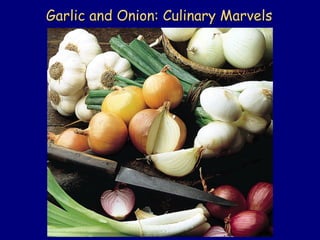
Garlic and Onion: Culinary MarvelsGarlic and Onion: Culinary Marvels
Allicin
GarlicGarlic
AntibacterialAntibacterial
AntimicrobialAntimicrobial
FungicidalFungicidal
AnticancerAnticancer
CardiovascularCardiovascular
CholesterolCholesterol
reducerreducer
AnticoagulantAnticoagulant
LDLD5050 = 60mg/kg= 60mg/kg
Plants: chemicalPlants: chemical
protectionprotection
against insectsagainst insects
When cut:When cut:
Chapter9醇的反应

Chapter9醇的反应

  • 1.
    DeprotonationDeprotonation SSNN1 / S1/ SNN22 E1 / E2E1 / E2 OxidationOxidation Chapter 9: Reactions ofChapter 9: Reactions of AlcoholsAlcohols
  • 2.
    1. Deprotonation:1. Deprotonation: ppKKaa(ROH) ~ 15-18.(ROH) ~ 15-18. Need base stronger than RO :Need base stronger than RO : a. RLi , e.g., CHa. RLi , e.g., CH33Li [pLi [pKKaa(CH(CH44) ~ 50];) ~ 50]; b. Na NHb. Na NH22 ( NH( NH33, 35); LDA (R, 35); LDA (R22NH, 40);NH, 40); c.c. K H or Li H (HK H or Li H (H22, 38);, 38); d. (CHd. (CH33))33CO [(CHCO [(CH33))33COH, 18]COH, 18] -- :::: :: :: :: --++ :: :: :: -- :: :: :: --++ :: --++
  • 3.
    2. Protonation2. Protonation a.a.RRprimprim :::: OOHH :::: HXHX RRprimprim OHOH22 :: ++ XX SSNN22 --:: :: RR XX :: :: :: b.b. RRsec/tertsec/tert :: OOHH :::: HH ++ HH22OO :: RR ++ SSNN11 EE11 RR NuNu AlkeneAlkene OHOH BrBr OHOH II HBrHBr HIHI Problem: MixturesProblem: Mixtures DehydrationDehydration Oxonium ionOxonium ion Note: NeedsNote: Needs HH++ with a goodwith a good NuNu ((XX))
  • 4.
    There is anothergeneral problem with SThere is another general problem with SNN1:1: 3. Carbocation Rearrangement by3. Carbocation Rearrangement by HH ShiftShift -- :: Best when RBest when Rsecsec RRterttert, but “degenerate” shifts, but “degenerate” shifts possible Rpossible Rsecsec RRsecsec, R, Rterttert RRterttert.. ++ ++ ++ ++ ++ HH CCCC OOHH HH ++ HH22OO CC CC ++ HH CCCC HH ++ SSNN11 EE11 ++
  • 5.
    Mechanism ofMechanism of CarbocationCarbocation RearrangementRearrangementStep1Step 1 Step 2Step 2 Step 3Step 3 Step 4Step 4 Fast!
  • 6.
    The Hydride ShiftTheHydride Shift HydrideShiftHydrideShift LipshutzLipshutz BeachBBeachB
  • 7.
    ++ BrBr :: :: :: CHCH33 CHCH22CHCH33 HH HH BrBr :: :::: :: CHCH33 ++ HH BrBr :: :: :: :: -- CHCH33 CHCH22CHCH33 CHCH33 CHCH22CHCH33 BrBr :: :: :: Cis/trans mixture, in addition to HCis/trans mixture, in addition to H shiftshift OHOH BrBr BrBr BrBr BrBr HHBrBr 11 22 22 111313 CC CHCH22CHCH33 -- HH StatisticalStatistical distribution.distribution. In other words:In other words: Complete scramblingComplete scrambling of labelof label Note:Note: HH stays on same sidestays on same side
  • 8.
    ++ ++ OHOH HH22SOSO44 HH22OO Intermediate cations canbe trapped by SIntermediate cations can be trapped by SNN1,1, but this is reversible with strongbut this is reversible with strong HH++ ++ HH ++ ‘‘ ∆∆H shiftH shift OOHH E1 from rearranged carbocations:E1 from rearranged carbocations: MoreMore substitutedsubstituted double bonddouble bond more stablemore stable.. H shiftH shift HH++ HH++ HH ++
  • 9.
    Note ReversibilityReversibility meansmeans thermodynamicthermodynamic controlcontrol.Thermodynamic products. Thermodynamic products may needmay need prolongedprolonged reaction timereaction time (or heat) to form.(or heat) to form. IntermediateIntermediate SSNN11 or E1 products may be isolated inor E1 products may be isolated in thethe earlyearly stages of a reaction (or atstages of a reaction (or at lowlow temperature).temperature).
  • 10.
    CC CC ++ RR CCCC RR ++ Best RBestRsecsec RRterttert ++ ++ 4. Carbocations Also Rearrange by4. Carbocations Also Rearrange by Alkyl Shifts (Slower Than H Shifts)Alkyl Shifts (Slower Than H Shifts) Especially when there are no hydrogens to shift:Especially when there are no hydrogens to shift:
  • 11.
    RRsecsec RRterttert Alkyl shiftsare fast when theyAlkyl shifts are fast when they relieverelieve ringring strainstrain:: Good!Good! OHOH :: :: HH22OO :::: ++++ OHOH :::: HH HH22OO :::: ++ Mechanism of AlkylMechanism of Alkyl ShiftShift --HH++
  • 12.
    RRprimprim OHOH rearrangebyrearrange by concerted shifts,concerted shifts, H,H, needneed ΔΔ++ CC CC RR CCCC RR ++ HH HH HH HH OHOH22 δδ++ ++ :: Especially with neopentyl alcohols:Especially with neopentyl alcohols: CC CHCH22OHOHRR RR RR
  • 13.
    5. Esters5. Estersfrom ROH and Acidsfrom ROH and Acids General “esterification”:General “esterification”: OO AA OOHH HHOROR++ OO AA OROR HH22OO++ A =A = C, N, S, P, Cr, etc.C, N, S, P, Cr, etc. Organic esters:Organic esters: EquilibriaEquilibria RCRCOHOH OO ROROHH HH22SOSO44 cat.cat. KK ~ 1~ 1 RCRCOROR OO HOHOHH++ ++ AcidAcid EsterEster
  • 14.
    Use of InorganicEstersUse of Inorganic Esters Mild way to convert ROH RXMild way to convert ROH RX withoutwithout HH++ Reagents:Reagents: PPBrBr33 for Rfor RBrBr;; PPClCl33 oror ClClSSClCl for Rfor RClCl.. OO 3R3ROOHH ++ PPBrBr33 3R3RBrBr ++ HH33PPOO33 [“[“PP((OOHH))33”]”] Phosphorous acidPhosphorous acid Mechanisms go through inorganic esters asMechanisms go through inorganic esters as reactive intermediates (not isolated).reactive intermediates (not isolated).
  • 15.
  • 16.
    Chloroalkane Synthesis UsingChloroalkaneSynthesis Using SOClSOCl22 CHCH33CHCH22CHCH22OHOH CHCH33CHCH22CHCH22ClCl OO ClSClClSCl NN++ ++ SOSO22 ++NN HH ClCl -- ++ NN PyridinePyridine HH ClCl ++ -- ++NN HH ClCl -- ++ ““Mops up” acidMops up” acid :: 91%91%
  • 17.
    RCHRCH22OOHH :::: OO SS ClClClCl ++ HHClCl O SOO S O ClCl -- RCHRCH22ClCl RCHRCH22 O S ClO S Cl :::: OO ClCl :: :: :: :: -- ++ ++ ++ Mechanism:Mechanism:
  • 18.
    ++ IsolableIsolable Sulfonates RSulfonatesR LL ROHROH CHCH33SOSO22ClCl NN RR O SCHO SCH33 OO OO Methane-Methane- sulfonate,sulfonate, “mesylate”“mesylate” CHCH33 SOSO22ClCl R O SOR O SO22 CHCH33 4-Methylbenzenesulfonate, “tosylate”4-Methylbenzenesulfonate, “tosylate” NN React byReact by SSNN1/2: Substitution of OH function1/2: Substitution of OH function ++ROHROH
  • 19.
    EthersEthers No hydrogen bonds:Nohydrogen bonds: relativelyrelatively low b.p.slow b.p.s OO :::: OO :::: OO :::: RR RRRRHH HH HH ‘‘
  • 20.
    ““Ether”Ether” OO OO Dimethoxyethane,Dimethoxyethane, “glyme”“glyme” CCHH33OO OOCCHH33 TetrahydrofuranTetrahydrofuran (THF)(THF) NoNo acidic hydrogens:Relativelyacidic hydrogens: Relatively unreactive,unreactive, hence used ashence used as solventssolvents CyclicCyclic polyethers:polyethers: Crown ethersCrown ethers Hole perfect for KHole perfect for K++
  • 21.
    Crown Ethers SolvateCrownEthers Solvate CationsCations
  • 23.
    Names:Names: AlkoxyAlkoxyalkane. Samerules as for RH.alkane. Same rules as for RH. OO EthoxyEthoxyethaneethane OO 11 22 33 44 11--MethoxyMethoxy-- OCHOCH33 OCHOCH22CHCH33 butanebutane CisCis-1-ethoxy-2-methoxy--1-ethoxy-2-methoxy- cyclopentanecyclopentane Synthesis:Synthesis: WilliamsonWilliamson ether synthesis: Old stuffether synthesis: Old stuff SSNN22 RRprimprim X + R’X + R’OO RR OOR’R’ :: :: :: Best: good X = L, unhindered R, R’; polar aproticBest: good X = L, unhindered R, R’; polar aprotic solvent; otherwisesolvent; otherwise EE22!! --
  • 24.
    OOOO ClCl ++ 60% yieldin butanol solvent60% yield in butanol solvent(Use 1-butanol(Use 1-butanol + NaOH)+ NaOH) -- 95% in DMSO (CH95% in DMSO (CH33SOCHSOCH33)) ++ RRsecsec OO is O.K.:is O.K.: -- OO -- BrBr OO 2-Ethoxypropane2-Ethoxypropane 85%85% HMPAHMPA Other way no good:Other way no good: BrBr --++ OO EE22
  • 25.
    Cyclic EthersCyclic Ethers IntramolecularIntramolecularWilliamson synthesisWilliamson synthesis
  • 26.
    High Dilution FavorsHighDilution Favors IntramolecularIntramolecular ReactionReaction
  • 27.
    Trading offTrading offΔΔHH andand ΔΔSS effects in the variouseffects in the various transition states:transition states: Relative rates:Relative rates: 33 > 5 > 6 >> 5 > 6 > 44 > 7 > 8> 7 > 8 ProximityProximity beats strainbeats strain StrainedStrained andand distantdistant L O- L O- L - O L - O Proximity effectProximity effect: enthalpic: enthalpic ground state activationground state activation SuperfastSuperfast FastFast FastFastSlowSlow
  • 28.
    Good!Good! Not goodNotgood Remember: SRemember: SNN2 is stereospecific.2 is stereospecific. Backside displacement with inversion.Backside displacement with inversion.
  • 29.
    Ethers from AlcoholsEthersfrom Alcohols SSNN2 and S2 and SNN11 RRprimprim OHOH HH22SOSO44 HH22OO R O RR O R Mechanism SMechanism SNN2 via:2 via: RROOHH :::: RR OO :: HH HH ++ Needs heat!Needs heat! SymmetricalSymmetrical Poor NuPoor Nu
  • 30.
    RRsec/tertsec/tert OHOH ::SSNN11 via Rvia R ++ OOHH :::: HH -H-H22OO OO :::: Via:Via: ++ ++ HOHO :::: ProductProductOHOH22 :: ++ ++ OHOH HH++ R O C CHR O C CH33 CHCH33 CHCH33 SymmetricalSymmetrical UnymmetricalUnymmetrical Can be used for “protection” of alcohols asCan be used for “protection” of alcohols as tt-butyl ethers:-butyl ethers: ROHROH ReactiveReactive UnreactiveUnreactive
  • 31.
    Ethers by Alcoholysisof REthers by Alcoholysis of Rsec/tertsec/tert X:X: ClCl OCHOCH33 CHCH33OHOH SSNN11 OHOH ++ RCHRCH22OHOH HH ++ CHCH33 CHCH33 HH33CC CC ++ RCHRCH22OOHH :::: --HH++ RCHRCH22OO ExcessExcess This works because the t-Bu cation is formed fast:This works because the t-Bu cation is formed fast:
  • 32.
    Reactions of EthersReactionsof Ethers RRprimprim ethers:ethers: Stable to base, RLi, RMgBr, dilute aqueous HStable to base, RLi, RMgBr, dilute aqueous H++ But, strong H : SBut, strong H : SNN22++ OO HBrHBr BrBr HOHO BrBr BrBr HBrHBr
  • 33.
    MixedMixed prim/secprim/sec ethers:Both Sethers: Both SNN1/21/2 OO :::: HHII OO ++ HH II :::: -- :: :: II ++OOHH :::: Less hindered;Less hindered; InversionInversion Good NuGood Nu SSNN2:2: SSNN1:1: OO :::: HH++ , H, H22OO OO ++ HH ++ :::: OOHH HOHO-- Poor NuPoor Nu HH22OO -H-H++
  • 34.
    Useful Application:Useful Application: ++ RROO :::: HH++ ROHROH ++++RR :: HH ++ OO ΔΔ HH++ Sequence:Sequence: RROHOH RR OO RROHOH ProtectionProtection DeprotectionDeprotection terttert-Bu ether hydrolysis: H , H-Bu ether hydrolysis: H , H22O mildO mild GasGas
  • 35.
    TertTert-Butyl Protection of-ButylProtection of AlcoholsAlcohols
  • 36.
    Strained EthersStrained Ethers BasicBasicconditions:conditions: NuNu attacks directly!attacks directly! OO :: CHCH33SS++ :: :: :: -- HH22OO Work-upWork-up SCHSCH33 HOHO :::: :: :: HydroxyethylationHydroxyethylation of Nu :of Nu ::: HOHO NuNu :: --:: React by ringReact by ring openingopening, release ring, release ring strainstrain (~ 27 kcal mol(~ 27 kcal mol-1-1 ).).
  • 37.
    CHCH33 HH CHCH33 OHOH Regio- and stereocontrolRegio-and stereocontrol ManyMany NuNu work:work:::-- OO LiALLiALDD44 CHCH33 HH CHCH33 HH DD OHOH CHCH33LiLi Regioselective:Regioselective: SSNN2 at2 at less hinderedless hindered sitesite Recall: RLi or RMgX do not react with RX normally!Recall: RLi or RMgX do not react with RX normally!
  • 38.
    WithWith neutralneutral NuNu,we need, we need acidicacidic conditionsconditions toto activateactivate the ether to nucleophilic attackthe ether to nucleophilic attack.. :: OO :::: OO ++ CHCH33OHOH HH++ OCHOCH33 HOHO No reactionNo reaction without Hwithout H++ ++ HH++ OO :: ++ HH CHCH33OOHH :::: OO HOHO CHCH33 HH ++ :: HOHO OCHOCH33 HH++ Mechanism:Mechanism: ::::
  • 39.
    For unsymmetrical systems,mixturesFor unsymmetrical systems, mixtures ensue, but reaction is oftenensue, but reaction is often regioselectiveregioselective toto more hinderedmore hindered side!side! OO HH HH CHCH33 CHCH33 ++ CHCH33OHOH OCHOCH33 HOHO HH++ !! Selectivity is induced bySelectivity is induced by electronicelectronic effect:effect: the more substituted carbon bearsthe more substituted carbon bears δδ betterbetter Coulomb’s Law winsCoulomb’s Law wins ++ RegioselectiveRegioselective
  • 40.
  • 41.
    Sulfur Analogs ofROH and ROR’:Sulfur Analogs of ROH and ROR’: AlkaneAlkanethiolsthiols and Alkyland Alkyl SulfidesSulfides RR SHSH :::: andand RR SS R’R’ :::: Names:Names: CHCH33SHSH MethaneMethanethiolthiol SHSH 11 22 33 44 2-Methyl-1-butanethiol2-Methyl-1-butanethiol SHSH 33 22 11 SulfidesSulfides:: 3-Pentanethiol3-Pentanethiol CHCH33SSCHCH22CHCH33 Ethyl methylEthyl methyl sulfidesulfide Substituents:Substituents: SHSH MercaptoMercapto,, SSRR AlkylAlkylthiothio Priority:Priority: HOHO HSHS>> 2-Mercaptoethanol2-MercaptoethanolHSHS OHOH22 11
  • 42.
    Acidity:Acidity: RSRSHH HH22OO RRSSHHOHOH22++ ++ ++ :::: :: :: :: -- Less hydrogen bondingLess hydrogen bonding than ROH:than ROH: RR SS HH less polar, worse overlap to H .less polar, worse overlap to H . HH22S is a gas!S is a gas! :: :: :: -- δδ++ δδ-- CHCH33SH: pSH: pKKaa = 10, b.p. 6.2 °C= 10, b.p. 6.2 °C :: ppKKaa ~ 9-12~ 9-12 MoreMore acidicacidic than ROH, because RS Hthan ROH, because RS H weakerweaker and Rand RSS moremore polarizablepolarizable δδ++ CHCH33OH: pOH: pKKaa = 15.5, b.p. 65 °C= 15.5, b.p. 65 °C
  • 43.
    Nucleophilicity:Nucleophilicity: RRSSR’R’R’R’ XXRRSS ++++ :::: :: :: :: -- :::: XX :: :: :: :: -- SSNN22 New:New: EvenEven neutralneutral RRSSR’ undergo SR’ undergo SNN2 (like NH2 (like NH33, PR, PR33)) CHCH33 S CHS CH33 :::: CHCH33 II++ :: :: :: (CH(CH33))22SSCHCH33 ++ :: II :: :: :: :: -- ++ :::: :: :: :: -- :: Much better than RO , less basic, moreMuch better than RO , less basic, more polarizable. No problem with Rpolarizable. No problem with RsecsecX.X. Compare: CHCompare: CH33OCHOCH33 no reaction. ROH only in Sno reaction. ROH only in SNN1.1.
  • 44.
    (CH(CH33))22SS CHCH33 ++::NuNu :::: (CH(CH33))22SS CHCH33 NuNu ++ ++ ::++ New:New: Oxidation to disulfides (reversible by reduction)Oxidation to disulfides (reversible by reduction) 2 R2 R SS HH :::: II22 Li, NHLi, NH33 liqliq RR S SS S RR ++ 22HHII Nature:Nature: polypeptide cross linking.polypeptide cross linking. S SS S SHSH SHSH enzymeenzyme Neutral sulfides are good leaving groups (likeNeutral sulfides are good leaving groups (like HH22O): Sulfonium salts areO): Sulfonium salts are alkylatingalkylating agents.agents.
  • 45.
    New:New: HH22OO22 HH33CC CHCH33 OO:: :: SS OO:::: HH33CC CHCH33SS :::: HH22OO22 Dimethyl sulfideDimethyl sulfide Dimethylsulfoxide,Dimethylsulfoxide, (DMSO)(DMSO) DimethylsulfoneDimethylsulfone Valence shell expansion (Valence shell expansion (dd orbitals).orbitals). Octet forms:Octet forms: -- HH33CC CHCH33 OO:: :: SS :::: ++ StrongStrong contributorscontributors OO HH33CC CHCH33 :: :: SS :: 10e10e 12e12e -- HH33CC CHCH33 OO:: :: SS :::: ++22 OO:: :: -- Oxidation to Sulfoxides and SulfonesOxidation to Sulfoxides and Sulfones
  • 46.
    Thiols (and sulfides)Thiols(and sulfides) stink….stink…. Decomposing food, passing gas, power plants,Decomposing food, passing gas, power plants, natural gas additive methanethiol, stink bombs,natural gas additive methanethiol, stink bombs, waste water, feces, some chemistry departments… .waste water, feces, some chemistry departments… . Skunk chemical defense:Skunk chemical defense:
  • 47.
    ……but may beverybut may be very pleasant in lowpleasant in low concentrations.concentrations. Dimethylsulfide: Black teaDimethylsulfide: Black tea Can be tastedCan be tasted at the 10at the 10-5-5 ppb level!!ppb level!! 1 mg in a large1 mg in a large swimming pool.swimming pool. HH33CC CHCH33SS :::: GrapefruitGrapefruit
  • 48.
    Garlic and Onion:Culinary MarvelsGarlic and Onion: Culinary Marvels
  • 49.

Editor's Notes

  • #6 1:53 BeachBoys Be true to your scholl