Devin Savoy
“ ‘ Why don't you cry again, you little wretch?’ ‘Because I'll never cry for you again,’ said I. Which was, I suppose, as false a declaration as ever was made; for I was inwardly crying for her then, and I know what I know of the pain she cost me afterwards.” (Dickens, Chapter 11)
“ Let us go hence and rest; she will not love. She shall not hear us if we sing hereof, Nor see love's ways, how sore they are and steep. Come hence, let be, lie still; it is enough. Love is a barren sea, bitter and deep; And though she saw all heaven in flower above,          She would not love.” (Swinburne, “A Leave Taking”)
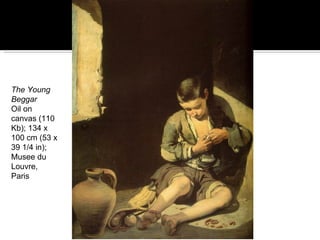
The Young Beggar   Oil on canvas (110 Kb); 134 x 100 cm (53 x 39 1/4 in); Musee du Louvre, Paris
“ I never could have believed it without experience, but as Joe and Biddy became more at their cheerful ease again, I became quite gloomy. Dissatisfied with my fortune, of course I could not be; but it is possible that I may have been, without quite knowing it, dissatisfied with myself.” (Dickens, Chapter 18)
“ His heart, that strained and yearned and strove As toward the sundawn strives the lark, Is cold as all the old joy thereof.” (Swinburne, “Dead Love”)
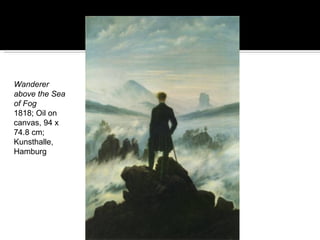
Wanderer above the Sea of Fog   1818; Oil on canvas, 94 x 74.8 cm; Kunsthalle, Hamburg
“ ‘ We are friends,’ said I, rising and bending over her, as she rose from the bench. ‘And will continue friends apart,’ said Estella. I took her hand in mine, and we went out of the ruined place; and, as the morning mists had risen long ago when I first left the forge, so, the evening mists were rising now, and in all the broad expanse of tranquil light they showed to me, I saw no shadow of another parting from her.” (Dickens, Chapter 59)
“ Now slides the silent meteor on, and leaves A shining furrow, as thy thoughts in me.”   (Tennyson, “The Princess: Now Sleeps the Crimson Petal)
Rinaldo and Armida in the Garden   c. 1752; Oil on canvas, 105 x 140 cm; Residenz, Weurzburg

Great expectations presentation

  • 1.
  • 2.
    “ ‘ Whydon't you cry again, you little wretch?’ ‘Because I'll never cry for you again,’ said I. Which was, I suppose, as false a declaration as ever was made; for I was inwardly crying for her then, and I know what I know of the pain she cost me afterwards.” (Dickens, Chapter 11)
  • 3.
    “ Let usgo hence and rest; she will not love. She shall not hear us if we sing hereof, Nor see love's ways, how sore they are and steep. Come hence, let be, lie still; it is enough. Love is a barren sea, bitter and deep; And though she saw all heaven in flower above,          She would not love.” (Swinburne, “A Leave Taking”)
  • 4.
    The Young Beggar Oil on canvas (110 Kb); 134 x 100 cm (53 x 39 1/4 in); Musee du Louvre, Paris
  • 5.
    “ I nevercould have believed it without experience, but as Joe and Biddy became more at their cheerful ease again, I became quite gloomy. Dissatisfied with my fortune, of course I could not be; but it is possible that I may have been, without quite knowing it, dissatisfied with myself.” (Dickens, Chapter 18)
  • 6.
    “ His heart,that strained and yearned and strove As toward the sundawn strives the lark, Is cold as all the old joy thereof.” (Swinburne, “Dead Love”)
  • 7.
    Wanderer above theSea of Fog 1818; Oil on canvas, 94 x 74.8 cm; Kunsthalle, Hamburg
  • 8.
    “ ‘ Weare friends,’ said I, rising and bending over her, as she rose from the bench. ‘And will continue friends apart,’ said Estella. I took her hand in mine, and we went out of the ruined place; and, as the morning mists had risen long ago when I first left the forge, so, the evening mists were rising now, and in all the broad expanse of tranquil light they showed to me, I saw no shadow of another parting from her.” (Dickens, Chapter 59)
  • 9.
    “ Now slidesthe silent meteor on, and leaves A shining furrow, as thy thoughts in me.”   (Tennyson, “The Princess: Now Sleeps the Crimson Petal)
  • 10.
    Rinaldo and Armidain the Garden c. 1752; Oil on canvas, 105 x 140 cm; Residenz, Weurzburg

Editor's Notes

  • #3 This quote is found in a passage that describes one of the first meetings between Estella and Pip. Within the passage Estella is clearly dominant over Pip, and there is foreshadowing of the pain he will continue to feel for her throughout the rest of his life. Words such as, “false” “inward” “pain” “cost” and “crying” determine the tone of this passage to be resentful and regretful. The author is already describing the hurt that Pip feels over this girl and foreshadows the massive amounts of regret that Pip will feel in the time to come.
  • #4 This poem also relates to the pain a boy feels over a girl. The speaker in this poem, a fictional character made up by the author or the author himself, can easily be replaced with Pip and his feelings about Estella. Words such as, “sore” “steep” “barren” all give a similar tone of bitterness and regret, just as the passage does.
  • #5 This painting, with the dark colors scheme and highlight on the painting’s depressed looking male subject, completely represents the character of Pip at this point in the novel. Pip is confused, depressed, and hurt by Estella. This painting, entitled “The Young Beggar” shows all of these emotions. While you cannot directly tell from the painting the color scheme matches the feelings of regret, resentment, and bitterness that Pip feels over his own past. http://www.ibiblio.org/wm/paint/auth/murillo/
  • #6 Continuing with the idea that from time to time within the story Pip reminisces about his past, this passage talks about how Pip feels about his own fortune. Words such as, “gloomy” and “dissatisfied” give the passage a sense of distain and a borderline bitterness about Pip’s past. At this point Pip is upset with the way his life has turned out and blames this on himself.
  • #7 This poem matches the text because the poem tells a story of a man searching for purpose and meaning. The poem states, “his heart…strained and yearned”. This is the same story as Pip, who at this moment in the book is dissatisfied with both himself and his life. The book follows Pip and his story is one of finding himself and striving to be better, and to make a better life for himself. This is the same as in Swinburne’s poem.
  • #8 This painting is representational of how Pip feels about himself. This painting, like the previous one, has a darkened color scheme, which goes along with the theme of Pip’s depression. This painting is entitled, “Wanderer above the Sea of Fog”. This is exactly what Pip is, a wanderer. Pip is on a journey of self discovery, the fog represents the confusion he feels and the figure, who is deep in thought while looking out over the mysterious foggy ocean, represents Pip and his continuous contemplation over his seemingly overwhelming, confusing, and dissatisfying life. http://www. ibiblio .org/wm/paint/auth/ friedrich /
  • #9 This passage, which is the end of the book, finally resolves the conflict between Estella and Pip. They finally confess their feelings for each other and end up in a state of happily ever after. This completely turns around the previous feelings and tone that both the book and Pip had. The passage uses words such as, “tranquil” “light” “no shadow” and “risen”. These give the passage a tone of change, finality, and resolution. The tone in this passage also represents the love between Pip and Estella.
  • #10 This passage from Tennyson’s poem represents the love between Pip and Estella as well. The passage is talking about the feelings a man has for a woman and directly compares them to that of the shining of a meteor. This is similar to the nature comparisons found within the passage from the novel. The idea that the mist is rising and walking off into the sunset with Estella is similar to the comparison of the brillance of the thoughts that resolve the conflict in this poem.
  • #11 This painting is representational of the relationship between Pip and Estella throughout the entire novel and within this passage. The bright colors that are worn by a figure, who would in this case represent Estella and the darker colors that are worn by the male figure, who would represent Pip are exactly their personalities. Also the positioning of the two figures in this painting. The woman, or Estella, is still perceived as dominant just as she has been throughout Pip’s life. Also the yearning for this woman, as shown in this man’s face is just like Pip’s continuous feelings for Estella. However, in this painting just as in the passage there is a sense that the conflict has been resolved. The man and woman in this painting are finally together, just as Estella and Pip are. http://www.ibiblio.org/wm/paint/auth/tiepolo/i/rinaldo.jpg