





Demystifying the
Engineering Org Chart
sumbry@sumbry.com
1
About Me
2
Name: Sumbry
Email: sumbry@sumbry.com
Twitter: @sumbry
Aliases: Sumbrizzle, Sumbrymatic, Gumby
Quotes: “Never trust a skinny cook”
The Why
3
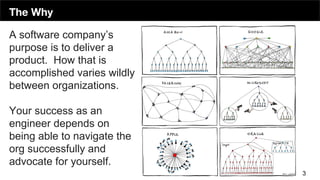
A software company’s
purpose is to deliver a
product. How that is
accomplished varies wildly
between organizations.
Your success as an
engineer depends on
being able to navigate the
org successfully and
advocate for yourself.
The Agenda
4
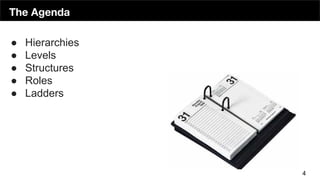
● Hierarchies
● Levels
● Structures
● Roles
● Ladders
A Story
5
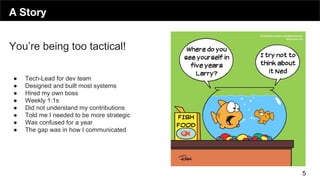
● Tech-Lead for dev team
● Designed and built most systems
● Hired my own boss
● Weekly 1:1s
● Did not understand my contributions
● Told me I needed to be more strategic
● Was confused for a year
● The gap was in how I communicated
You’re being too tactical!
Human Hierarchies
6
We Need Order
7
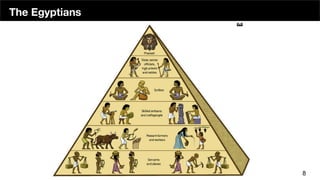
The term organizational structure refers to how the people in
an organization are grouped and to whom they report.
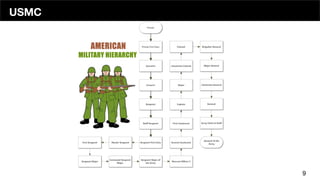
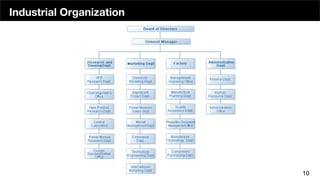
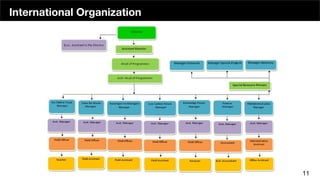
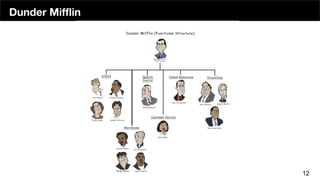
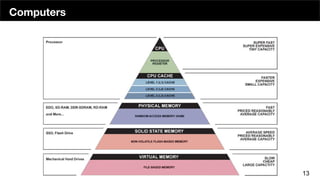
Humans have always loved hierarchies.
The Egyptians
8
USMC
9
Industrial Organization
10
International Organization
11
Dunder Mifflin
12
Computers
13
The Kobe Effect
14
You cannot change the rules of an organization unless you first
learn to play by them.
No one is going to listen to you if you do not play the game.
Humans have always loved hierarchies … and games.
Operating Levels
15
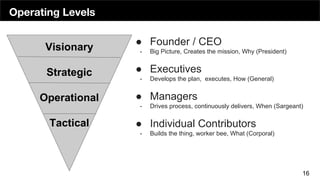
Operating Levels
16
Visionary
Strategic
Operational
Tactical
● Founder / CEO
- Big Picture, Creates the mission, Why (President)
● Executives
- Develops the plan, executes, How (General)
● Managers
- Drives process, continuously delivers, When (Sargeant)
● Individual Contributors
- Builds the thing, worker bee, What (Corporal)
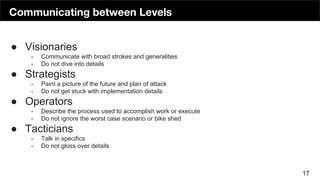
Communicating between Levels
17
● Visionaries
- Communicate with broad strokes and generalities
- Do not dive into details
● Strategists
- Paint a picture of the future and plan of attack
- Do not get stuck with implementation details
● Operators
- Describe the process used to accomplish work or execute
- Do not ignore the worst case scenario or bike shed
● Tacticians
- Talk in specifics
- Do not gloss over details
Org Structures
18
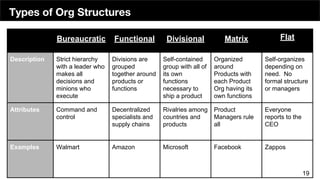
Types of Org Structures
19
Bureaucratic Functional Divisional Matrix Flat
Description Strict hierarchy
with a leader who
makes all
decisions and
minions who
execute
Divisions are
grouped
together around
products or
functions
Self-contained
group with all of
its own
functions
necessary to
ship a product
Organized
around
Products with
each Product
Org having its
own functions
Self-organizes
depending on
need. No
formal structure
or managers
Attributes Command and
control
Decentralized
specialists and
supply chains
Rivalries among
countries and
products
Product
Managers rule
all
Everyone
reports to the
CEO
Examples Walmart Amazon Microsoft Facebook Zappos
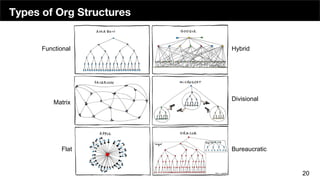
Types of Org Structures
20
Flat
Matrix
Functional
Divisional
Hybrid
Bureaucratic
Org Roles
21
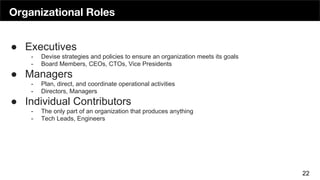
Organizational Roles
22
● Executives
- Devise strategies and policies to ensure an organization meets its goals
- Board Members, CEOs, CTOs, Vice Presidents
● Managers
- Plan, direct, and coordinate operational activities
- Directors, Managers
● Individual Contributors
- The only part of an organization that produces anything
- Tech Leads, Engineers
Corporate Ladders
23
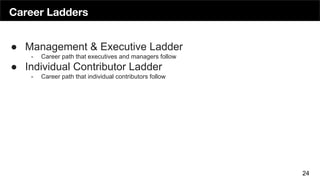
Career Ladders
24
● Management & Executive Ladder
- Career path that executives and managers follow
● Individual Contributor Ladder
- Career path that individual contributors follow
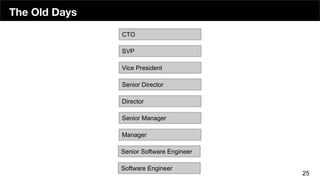
The Old Days
25
Software Engineer
Senior Software Engineer
Manager
Senior Manager
Director
Senior Director
Vice President
SVP
CTO
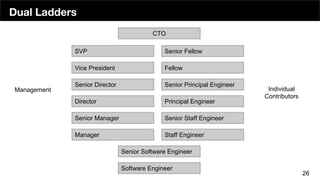
Dual Ladders
26
Software Engineer
Senior Software Engineer
Staff Engineer
Senior Staff Engineer
Principal Engineer
Senior Principal Engineer
Fellow
Senior Fellow
Manager
Senior Manager
Director
Senior Director
Vice President
SVP
CTO
Management Individual
Contributors
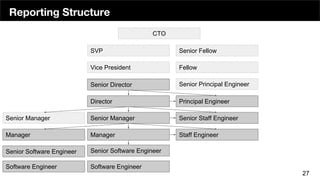
Reporting Structure
27
Senior Software Engineer Senior Software Engineer
Staff Engineer
Senior Staff Engineer
Principal Engineer
Senior Principal Engineer
Fellow
Senior Fellow
Manager
Senior Manager
Director
Senior Director
Vice President
SVP
CTO
Software Engineer Software Engineer
Manager
Senior Manager
Engineering Individual Contributors
28
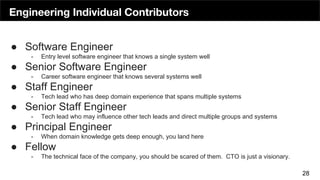
● Software Engineer
- Entry level software engineer that knows a single system well
● Senior Software Engineer
- Career software engineer that knows several systems well
● Staff Engineer
- Tech lead who has deep domain experience that spans multiple systems
● Senior Staff Engineer
- Tech lead who may influence other tech leads and direct multiple groups and systems
● Principal Engineer
- When domain knowledge gets deep enough, you land here
● Fellow
- The technical face of the company, you should be scared of them. CTO is just a visionary.
Different Types of Engineers
29
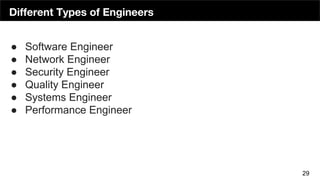
● Software Engineer
● Network Engineer
● Security Engineer
● Quality Engineer
● Systems Engineer
● Performance Engineer
In Summary
30
In Conclusion
31
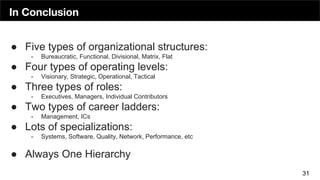
● Five types of organizational structures:
- Bureaucratic, Functional, Divisional, Matrix, Flat
● Four types of operating levels:
- Visionary, Strategic, Operational, Tactical
● Three types of roles:
- Executives, Managers, Individual Contributors
● Two types of career ladders:
- Management, ICs
● Lots of specializations:
- Systems, Software, Quality, Network, Performance, etc
● Always One Hierarchy
Don’t Forget
32
You cannot change the rules of an organization unless you first
learn to play by them.
Know the career ladder of your organization.
Humans have always loved hierarchies.
Questions?
33

Demystifying the Engineering Org Chart

  • 1.
    Demystifying the Engineering OrgChart sumbry@sumbry.com 1
  • 2.
    About Me 2 Name: Sumbry Email:sumbry@sumbry.com Twitter: @sumbry Aliases: Sumbrizzle, Sumbrymatic, Gumby Quotes: “Never trust a skinny cook”
  • 3.
    The Why 3 A softwarecompany’s purpose is to deliver a product. How that is accomplished varies wildly between organizations. Your success as an engineer depends on being able to navigate the org successfully and advocate for yourself.
  • 4.
    The Agenda 4 ● Hierarchies ●Levels ● Structures ● Roles ● Ladders
  • 5.
    A Story 5 ● Tech-Leadfor dev team ● Designed and built most systems ● Hired my own boss ● Weekly 1:1s ● Did not understand my contributions ● Told me I needed to be more strategic ● Was confused for a year ● The gap was in how I communicated You’re being too tactical!
  • 6.
  • 7.
    We Need Order 7 Theterm organizational structure refers to how the people in an organization are grouped and to whom they report. Humans have always loved hierarchies.
  • 8.
  • 9.
  • 10.
  • 11.
  • 12.
  • 13.
  • 14.
    The Kobe Effect 14 Youcannot change the rules of an organization unless you first learn to play by them. No one is going to listen to you if you do not play the game. Humans have always loved hierarchies … and games.
  • 15.
  • 16.
    Operating Levels 16 Visionary Strategic Operational Tactical ● Founder/ CEO - Big Picture, Creates the mission, Why (President) ● Executives - Develops the plan, executes, How (General) ● Managers - Drives process, continuously delivers, When (Sargeant) ● Individual Contributors - Builds the thing, worker bee, What (Corporal)
  • 17.
    Communicating between Levels 17 ●Visionaries - Communicate with broad strokes and generalities - Do not dive into details ● Strategists - Paint a picture of the future and plan of attack - Do not get stuck with implementation details ● Operators - Describe the process used to accomplish work or execute - Do not ignore the worst case scenario or bike shed ● Tacticians - Talk in specifics - Do not gloss over details
  • 18.
  • 19.
    Types of OrgStructures 19 Bureaucratic Functional Divisional Matrix Flat Description Strict hierarchy with a leader who makes all decisions and minions who execute Divisions are grouped together around products or functions Self-contained group with all of its own functions necessary to ship a product Organized around Products with each Product Org having its own functions Self-organizes depending on need. No formal structure or managers Attributes Command and control Decentralized specialists and supply chains Rivalries among countries and products Product Managers rule all Everyone reports to the CEO Examples Walmart Amazon Microsoft Facebook Zappos
  • 20.
    Types of OrgStructures 20 Flat Matrix Functional Divisional Hybrid Bureaucratic
  • 21.
  • 22.
    Organizational Roles 22 ● Executives -Devise strategies and policies to ensure an organization meets its goals - Board Members, CEOs, CTOs, Vice Presidents ● Managers - Plan, direct, and coordinate operational activities - Directors, Managers ● Individual Contributors - The only part of an organization that produces anything - Tech Leads, Engineers
  • 23.
  • 24.
    Career Ladders 24 ● Management& Executive Ladder - Career path that executives and managers follow ● Individual Contributor Ladder - Career path that individual contributors follow
  • 25.
    The Old Days 25 SoftwareEngineer Senior Software Engineer Manager Senior Manager Director Senior Director Vice President SVP CTO
  • 26.
    Dual Ladders 26 Software Engineer SeniorSoftware Engineer Staff Engineer Senior Staff Engineer Principal Engineer Senior Principal Engineer Fellow Senior Fellow Manager Senior Manager Director Senior Director Vice President SVP CTO Management Individual Contributors
  • 27.
    Reporting Structure 27 Senior SoftwareEngineer Senior Software Engineer Staff Engineer Senior Staff Engineer Principal Engineer Senior Principal Engineer Fellow Senior Fellow Manager Senior Manager Director Senior Director Vice President SVP CTO Software Engineer Software Engineer Manager Senior Manager
  • 28.
    Engineering Individual Contributors 28 ●Software Engineer - Entry level software engineer that knows a single system well ● Senior Software Engineer - Career software engineer that knows several systems well ● Staff Engineer - Tech lead who has deep domain experience that spans multiple systems ● Senior Staff Engineer - Tech lead who may influence other tech leads and direct multiple groups and systems ● Principal Engineer - When domain knowledge gets deep enough, you land here ● Fellow - The technical face of the company, you should be scared of them. CTO is just a visionary.
  • 29.
    Different Types ofEngineers 29 ● Software Engineer ● Network Engineer ● Security Engineer ● Quality Engineer ● Systems Engineer ● Performance Engineer
  • 30.
  • 31.
    In Conclusion 31 ● Fivetypes of organizational structures: - Bureaucratic, Functional, Divisional, Matrix, Flat ● Four types of operating levels: - Visionary, Strategic, Operational, Tactical ● Three types of roles: - Executives, Managers, Individual Contributors ● Two types of career ladders: - Management, ICs ● Lots of specializations: - Systems, Software, Quality, Network, Performance, etc ● Always One Hierarchy
  • 32.
    Don’t Forget 32 You cannotchange the rules of an organization unless you first learn to play by them. Know the career ladder of your organization. Humans have always loved hierarchies.
  • 33.