M E M O / N O T E D E S E R V I C E
The following information is provided to inform Council of the results of the vote for a Nuisance
Mosquito Control Program and the means of implementing the program.
At the February 2nd
FEDCO Meeting the Following Motion was passed:
WHEREAS staff has advised that they need more time to review the recommendations and
approach in the report, and that Council needs more information provided (such as a map
delineating the area for the levy, more precise information on how the levy will be applied and
identifying those City staff who would be delegated the authority to implement the contract should
Council approve the levy) prior to making its decision; and
WHEREAS staff has advised that, based on the additional information, the recommendations will
need to be amended; and
WHEREAS the report will not rise to City Council until February 24, 2016 and the Ward
Councillor will be continuing to work with staff to refine the recommendations;
THEREFORE BE IT RESOLVED that the Finance and Economic Development Committee
refer Item 14, the Councillor’s Report entitled, “Nuisance Mosquito Control Program and
Mosquito Research Program – Special Area Levy” to the City Council meeting of February 24,
2019 without recommendation.
Background
Since the FEDCO meeting a vote of ratepayers in Kanata has been taken with the results
favouring implementation of a nuisance mosquito program and research project. I have also
met with staff to work out the details to implement the project. The attached motion
(attachment 1) has been prepared for Council to support the project funded by a special levy in
To / Destinataire Ottawa City Council File/N° de fichier: ACS2016-
CMR-FED-0001
From / Expéditeur Councillor M. Wilkinson
Subject / Objet Addendum to the “Nuisance Mosquito
Control Program and Mosquito
Research Program” (ACS2016-CMR-
FED-0001) Report”
Date: 19 February 2016
2
Ward 4, Kanata North. After Council approves this motion a By-law with details of the special
levy will be placed on a later Council agenda.
I have provided the following information on the project and how it will be implemented as
background to the motion.
Community Vote
On January 25, 2016 Canada Post was provided envelopes containing information, a ballot and
return envelope to deliver to homeowners in Kanata North. Each Envelope had BALLOT
ENCLOSED FOR MOSQUITO PROGRAM IN KANATA NORTH printed diagonally across the
envelope in heavy type. Residents were to return their ballot, one per household, by February
16, 2016. Those who contacted my office because they did not have the mailing (evidently
Canada Post does not deliver bulk City mail to those who have asked that they not receive ‘junk’
mail) were sent the information for their dwelling by email. The mailing was also hand delivered
to approximately 400 homes that were part of a Canada Post delivery area, that included areas
outside the ward, to avoid delivery outside the ward. Ballots could be mailed to the Ward 4 office
in City Hall, or dropped off at the Richcraft Recreation Complex-Kanata, Beaverbrook Library, at
local meetings, at the Ward sponsored Family Day activity or at the Ward Office.
A total of 2,525 ballots were received and counted on February 17th
.
 1,827 voted in favour of the Nuisance Mosquito Program
 678 voted against the Nuisance Mosquito Program
 20 spoiled ballots were not included in the final count (these were from streets outside the
Ward or lacked information on the address or did not mark their vote)
Those counting the ballots included Ward 4 staff and volunteers, all of whom signed a non
disclosure statement. The Minister from a local church was present to ensure that the vote was
carried out professionally and fairly.
Information Provided to the Community
Discussion on what to do about the number of mosquitoes in the community started in 2015 when
many emails and a petition signed by more than 400 residents was received. It was discussed at
a Town Hall meeting on May 20, 2015 and at a meeting on July 15, 2015 called to discuss what
could be done about mosquitoes. Information was regularly provided through updates in
Councillor Wilkinson’s column in the Kanata Kourier-Standard and monthly e-newsletters. An
outline of the project and voting system was included in a Ward wide community mailing in
December 2015. Information was included in the mailing along with the ballot, which also gave
3
notice of three meetings to explain the program and answer questions. Those meetings took
place on January 28, February 1 and February 6, 2016. As well as those meetings, information
about the mosquito issue and program was included in 7 e-newsletters (between June 2015 and
January 2016), 16 newspaper columns (between May 2015 and February 2016) 5 Town Hall
meetings (between May 2015 and January 2016 and a media release. Articles occurred in the
Kanata Kourier Standard and the Ottawa Citizen. Information was also posted on my website,
tweeted and posted on FaceBook.
Procurement
City staff assisted in putting out a request for proposals for a Nuisance Mosquito Control Program
and a Research Project with a closing date of January 14th
, 2016. The results were evaluated by
a group comprising a representative from Procurement, representatives from Ottawa Public
Health (who manage the West Nile Mosquito Program), a Natural Systems Planning Group Staff
member and the Ward Councillor. It was unanimously agreed that the proposal from GDG
Environment be awarded the contract, subject to the vote from the community supporting the
program. GDG Environment is the company that does the West Nile Mosquito Program for
Ottawa Health and many other municipalities in Ontario so they are both experienced and
knowledgeable about the area.
Financing the Project
In most nuisance mosquito programs in other communities in other provinces funding is by a
specific amount on the tax bill. That method was considered as one way of funding the program.
However, after discussions with the City Treasurer and legal representative, it was decided that
the method permitted under the Municipal Act was the best way to fund it. Hence financing will be
by a special levy on all taxpayers in Ward 4, Kanata North over the four years of the mosquito
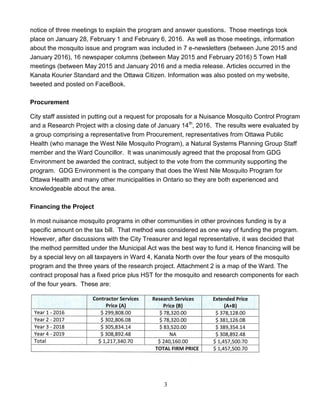
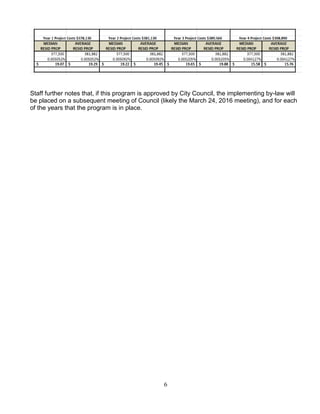
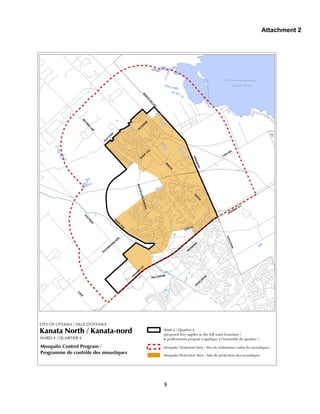
program and the three years of the research project. Attachment 2 is a map of the Ward. The
contract proposal has a fixed price plus HST for the mosquito and research components for each
of the four years. These are:
4
The Nuisance Mosquito Program
The program, as outlined by GDG Environment in their response to the bid, deals with treating
mosquito larva in wetlands so that they won’t hatch. The program is carried out from early spring
to mid-September. No part of the program deals with live mosquitoes.
The program is done primarily with Bti, (Bacillus Thuringiensis Israelensis) a natural occurring
bacteria that is put directly into the water where the larva are found. Feeding larva draw it in with
the water, which stops it from becoming an adult mosquito. The product breaks down within 48
hours. The Health Canada Regulatory Agency states that Bti has no effect on humans, birds,
fish, animals or other insects, but destroys the stomachs of mosquito and black fly larvae that
hatch in water. One of the 40 species of mosquitoes in our area attaches to cattails. Another
bacterium, Bs is used for that species. A granular form of Bti, made of ground corn on which Bti
is absorbed, is applied by air where sites are large or where it would disturb fauna, such as
nesting turtles. Mosquito larva control will be carried out on wetlands within Kanata North and in
a 2 km treatment buffer to ensure there is an 80% or greater reduction in nuisance mosquitoes.
Quality control includes weekly Nuisance tests at five sites at the perimeter, at sites approved by
the City of Ottawa, with an independent witness present. They also will do post-treatment larva
surveillance and reapply if needed.
The Research Project
Staff from the Land Use and Natural Systems Unit of the Planning and Growth Management
Department put together a research project to ensure that more comprehensive mosquito
abatement program would not damage the environmental areas that the City owns and has
protected. This project is to evaluate the possible impacts of Bti and Bs application on wetland
food webs and on pollination success of mosquito pollinated plants. It is being carried out by the
University of Ottawa, with research students under the direction of Research Professors at the
University. A Research Advisory Committee will include representation from the Natural Systems
Unit of the Planning and Growth Management Department.
Implementation
City staff from legal, procurement, planning, finance and administration have assisted in
developing this proposal. The City’s role in implementing the mosquito problem will be carried
out through the Deputy City Manager Operations who will assign staff to provide Overall Project
Management. It will consist of monitoring the program to ensure that it is carried out as detailed
in the proposal from DGD Environment, receiving reports on the ongoing operations, attending
5
weekly meetings during the treatment season and keeping the Ward Councillor informed. He/she
will review invoices to verify charges and review and comment on annual and final reports.
The City’s role in the Research Project will be carried out by Nick Stow from the Land Use and
Natural Systems Unit. His role will be to:
 Review of the research section of the initial contract.
 Provision of direction and high-level oversight on the research activities.
 Attendance at two or three meetings of the research committee per year.
 Attendance at initial/project launch public meetings.
 An annual site visit (probably in conjunction with other normal fieldwork).
 Review of invoices to verify only research-related activities.
 Review and comment on the annual and final reports.
 Recommendations on continuance of the program from an ecological perspective.
Risks
There is no appreciable risk to the City as GDG Environmental has full responsibility to obtain all
permits and approvals needed to move forward with the program and all costs will be covered
through the special area levy.
There are no legal impediments to adopting the recommendations outlined in this report. Council
holds the authority to impose a levy for special services pursuant to Section 326 of the Municipal
Act, 2001.
In the event Council approves the recommendations in the report, the service provider who
receives the contractor will have to comply with the Pesticides Act and apply for and receive
appropriate permits from the Ministry of Environment and Climate Change.
Staff Comments
Finance staff estimates that the special services levy for Ward 4, based on 2016 assessment and
preliminary 2016 notional ratios, will be approximately as follows:
6
Staff further notes that, if this program is approved by City Council, the implementing by-law will
be placed on a subsequent meeting of Council (likely the March 24, 2016 meeting), and for each
of the years that the program is in place.
7
Attachment 1
Moved by Councillor Wilkinson
Seconded by Councillor Qaqish
That City Council:
1) Receive the information in the “Addendum to the “Nuisance Mosquito Control Program and
Mosquito Research Program” (ACS2016-CMR-FED-0001) Report”, issued by Councillor
Wilkinson on February 19, 2016, and approve that it be appended to the “Nuisance Mosquito
Control Program and Mosquito Research Program” (ACS2016-CMR-FED-0001) Report;
2) Approve a levy for special services be applied to Ward 4 (Kanata North), the area identified in
Document 1, for a four-year Kanata North Nuisance Mosquito Program, as described in this
report;
3) Approved the City’s participation in a three-year research program on the Kanata North
Nuisance Mosquito Program, as described in this report;
4) Delegate the authority to the Deputy City Manager, Operations, in consultation with the City
Clerk and Solicitor and the Ward Councillor, to take the necessary steps to award the contract
to undertake these programs to GDG Environmental and any other actions that may be
required to manage this contract, as described in this report.
8
Attachment 2

Kanata North Mosquito Memo

  • 1.
    M E MO / N O T E D E S E R V I C E The following information is provided to inform Council of the results of the vote for a Nuisance Mosquito Control Program and the means of implementing the program. At the February 2nd FEDCO Meeting the Following Motion was passed: WHEREAS staff has advised that they need more time to review the recommendations and approach in the report, and that Council needs more information provided (such as a map delineating the area for the levy, more precise information on how the levy will be applied and identifying those City staff who would be delegated the authority to implement the contract should Council approve the levy) prior to making its decision; and WHEREAS staff has advised that, based on the additional information, the recommendations will need to be amended; and WHEREAS the report will not rise to City Council until February 24, 2016 and the Ward Councillor will be continuing to work with staff to refine the recommendations; THEREFORE BE IT RESOLVED that the Finance and Economic Development Committee refer Item 14, the Councillor’s Report entitled, “Nuisance Mosquito Control Program and Mosquito Research Program – Special Area Levy” to the City Council meeting of February 24, 2019 without recommendation. Background Since the FEDCO meeting a vote of ratepayers in Kanata has been taken with the results favouring implementation of a nuisance mosquito program and research project. I have also met with staff to work out the details to implement the project. The attached motion (attachment 1) has been prepared for Council to support the project funded by a special levy in To / Destinataire Ottawa City Council File/N° de fichier: ACS2016- CMR-FED-0001 From / Expéditeur Councillor M. Wilkinson Subject / Objet Addendum to the “Nuisance Mosquito Control Program and Mosquito Research Program” (ACS2016-CMR- FED-0001) Report” Date: 19 February 2016
  • 2.
    2 Ward 4, KanataNorth. After Council approves this motion a By-law with details of the special levy will be placed on a later Council agenda. I have provided the following information on the project and how it will be implemented as background to the motion. Community Vote On January 25, 2016 Canada Post was provided envelopes containing information, a ballot and return envelope to deliver to homeowners in Kanata North. Each Envelope had BALLOT ENCLOSED FOR MOSQUITO PROGRAM IN KANATA NORTH printed diagonally across the envelope in heavy type. Residents were to return their ballot, one per household, by February 16, 2016. Those who contacted my office because they did not have the mailing (evidently Canada Post does not deliver bulk City mail to those who have asked that they not receive ‘junk’ mail) were sent the information for their dwelling by email. The mailing was also hand delivered to approximately 400 homes that were part of a Canada Post delivery area, that included areas outside the ward, to avoid delivery outside the ward. Ballots could be mailed to the Ward 4 office in City Hall, or dropped off at the Richcraft Recreation Complex-Kanata, Beaverbrook Library, at local meetings, at the Ward sponsored Family Day activity or at the Ward Office. A total of 2,525 ballots were received and counted on February 17th .  1,827 voted in favour of the Nuisance Mosquito Program  678 voted against the Nuisance Mosquito Program  20 spoiled ballots were not included in the final count (these were from streets outside the Ward or lacked information on the address or did not mark their vote) Those counting the ballots included Ward 4 staff and volunteers, all of whom signed a non disclosure statement. The Minister from a local church was present to ensure that the vote was carried out professionally and fairly. Information Provided to the Community Discussion on what to do about the number of mosquitoes in the community started in 2015 when many emails and a petition signed by more than 400 residents was received. It was discussed at a Town Hall meeting on May 20, 2015 and at a meeting on July 15, 2015 called to discuss what could be done about mosquitoes. Information was regularly provided through updates in Councillor Wilkinson’s column in the Kanata Kourier-Standard and monthly e-newsletters. An outline of the project and voting system was included in a Ward wide community mailing in December 2015. Information was included in the mailing along with the ballot, which also gave
  • 3.
    3 notice of threemeetings to explain the program and answer questions. Those meetings took place on January 28, February 1 and February 6, 2016. As well as those meetings, information about the mosquito issue and program was included in 7 e-newsletters (between June 2015 and January 2016), 16 newspaper columns (between May 2015 and February 2016) 5 Town Hall meetings (between May 2015 and January 2016 and a media release. Articles occurred in the Kanata Kourier Standard and the Ottawa Citizen. Information was also posted on my website, tweeted and posted on FaceBook. Procurement City staff assisted in putting out a request for proposals for a Nuisance Mosquito Control Program and a Research Project with a closing date of January 14th , 2016. The results were evaluated by a group comprising a representative from Procurement, representatives from Ottawa Public Health (who manage the West Nile Mosquito Program), a Natural Systems Planning Group Staff member and the Ward Councillor. It was unanimously agreed that the proposal from GDG Environment be awarded the contract, subject to the vote from the community supporting the program. GDG Environment is the company that does the West Nile Mosquito Program for Ottawa Health and many other municipalities in Ontario so they are both experienced and knowledgeable about the area. Financing the Project In most nuisance mosquito programs in other communities in other provinces funding is by a specific amount on the tax bill. That method was considered as one way of funding the program. However, after discussions with the City Treasurer and legal representative, it was decided that the method permitted under the Municipal Act was the best way to fund it. Hence financing will be by a special levy on all taxpayers in Ward 4, Kanata North over the four years of the mosquito program and the three years of the research project. Attachment 2 is a map of the Ward. The contract proposal has a fixed price plus HST for the mosquito and research components for each of the four years. These are:
  • 4.
    4 The Nuisance MosquitoProgram The program, as outlined by GDG Environment in their response to the bid, deals with treating mosquito larva in wetlands so that they won’t hatch. The program is carried out from early spring to mid-September. No part of the program deals with live mosquitoes. The program is done primarily with Bti, (Bacillus Thuringiensis Israelensis) a natural occurring bacteria that is put directly into the water where the larva are found. Feeding larva draw it in with the water, which stops it from becoming an adult mosquito. The product breaks down within 48 hours. The Health Canada Regulatory Agency states that Bti has no effect on humans, birds, fish, animals or other insects, but destroys the stomachs of mosquito and black fly larvae that hatch in water. One of the 40 species of mosquitoes in our area attaches to cattails. Another bacterium, Bs is used for that species. A granular form of Bti, made of ground corn on which Bti is absorbed, is applied by air where sites are large or where it would disturb fauna, such as nesting turtles. Mosquito larva control will be carried out on wetlands within Kanata North and in a 2 km treatment buffer to ensure there is an 80% or greater reduction in nuisance mosquitoes. Quality control includes weekly Nuisance tests at five sites at the perimeter, at sites approved by the City of Ottawa, with an independent witness present. They also will do post-treatment larva surveillance and reapply if needed. The Research Project Staff from the Land Use and Natural Systems Unit of the Planning and Growth Management Department put together a research project to ensure that more comprehensive mosquito abatement program would not damage the environmental areas that the City owns and has protected. This project is to evaluate the possible impacts of Bti and Bs application on wetland food webs and on pollination success of mosquito pollinated plants. It is being carried out by the University of Ottawa, with research students under the direction of Research Professors at the University. A Research Advisory Committee will include representation from the Natural Systems Unit of the Planning and Growth Management Department. Implementation City staff from legal, procurement, planning, finance and administration have assisted in developing this proposal. The City’s role in implementing the mosquito problem will be carried out through the Deputy City Manager Operations who will assign staff to provide Overall Project Management. It will consist of monitoring the program to ensure that it is carried out as detailed in the proposal from DGD Environment, receiving reports on the ongoing operations, attending
  • 5.
    5 weekly meetings duringthe treatment season and keeping the Ward Councillor informed. He/she will review invoices to verify charges and review and comment on annual and final reports. The City’s role in the Research Project will be carried out by Nick Stow from the Land Use and Natural Systems Unit. His role will be to:  Review of the research section of the initial contract.  Provision of direction and high-level oversight on the research activities.  Attendance at two or three meetings of the research committee per year.  Attendance at initial/project launch public meetings.  An annual site visit (probably in conjunction with other normal fieldwork).  Review of invoices to verify only research-related activities.  Review and comment on the annual and final reports.  Recommendations on continuance of the program from an ecological perspective. Risks There is no appreciable risk to the City as GDG Environmental has full responsibility to obtain all permits and approvals needed to move forward with the program and all costs will be covered through the special area levy. There are no legal impediments to adopting the recommendations outlined in this report. Council holds the authority to impose a levy for special services pursuant to Section 326 of the Municipal Act, 2001. In the event Council approves the recommendations in the report, the service provider who receives the contractor will have to comply with the Pesticides Act and apply for and receive appropriate permits from the Ministry of Environment and Climate Change. Staff Comments Finance staff estimates that the special services levy for Ward 4, based on 2016 assessment and preliminary 2016 notional ratios, will be approximately as follows:
  • 6.
    6 Staff further notesthat, if this program is approved by City Council, the implementing by-law will be placed on a subsequent meeting of Council (likely the March 24, 2016 meeting), and for each of the years that the program is in place.
  • 7.
    7 Attachment 1 Moved byCouncillor Wilkinson Seconded by Councillor Qaqish That City Council: 1) Receive the information in the “Addendum to the “Nuisance Mosquito Control Program and Mosquito Research Program” (ACS2016-CMR-FED-0001) Report”, issued by Councillor Wilkinson on February 19, 2016, and approve that it be appended to the “Nuisance Mosquito Control Program and Mosquito Research Program” (ACS2016-CMR-FED-0001) Report; 2) Approve a levy for special services be applied to Ward 4 (Kanata North), the area identified in Document 1, for a four-year Kanata North Nuisance Mosquito Program, as described in this report; 3) Approved the City’s participation in a three-year research program on the Kanata North Nuisance Mosquito Program, as described in this report; 4) Delegate the authority to the Deputy City Manager, Operations, in consultation with the City Clerk and Solicitor and the Ward Councillor, to take the necessary steps to award the contract to undertake these programs to GDG Environmental and any other actions that may be required to manage this contract, as described in this report.
  • 8.