소프트웨어 아키텍처 평가 : ATAM
(ATAM : Architecture Trade-off Analysis Method)
Software Engineering Lab
김영기 책임
resinous@gmail.com
ATAM
(Architecture Trade-off Analysis Method)
What is ATAM ?
 ATAM is
 Architecture Trade-off Analysis Method
 To assess the consequences of architectural decisions in light of quality
attribute requirements
 Primarily a risk identification mechanism
 Not a predictor of quality achievement
 Vocabulary
Vocabulary Description
Scenario
 A scenario is a shot statement describing an interaction of one of
the stakeholders with the system
Stakeholder
 An individual, team or organization (or classes thereof) with
interested in, or concerns relative to, a system
Architectural view
 A representation of a whole system from the perspective of a related
set of concerns
Functional requirements
 specify what software has to do
Non-functional requirements
 specify how well it should be done
Purpose of ATAM
 ATAM is for …
 Evaluation design decision
 Evaluate if the design decision satisfactorily address the quality requirements
 Elicit rationale of design decisions (traceability)
 Discover risks
 Alternatives that might create (future) problems in some quality attribute
 Discover sensitivity points
 Alternatives for which a slight change makes a significant difference in a quality
attribute
 Discover tradeoffs
 Decisions affecting more than one quality attribute
 Side-effect of ATAM
 Improve the architecture documentation
 Foster stakeholder communication & consensus
Output of ATAM
 ATAM Outputs …
 Precise description of the architecture
 Articulation of the business goals
 Quality requirements in terms of scenario‟s
 Risks
 Trade-off points
 Sensitivity points
 Result depends on the quality of the architecture specification
 Garbage in, Garbage out
 Not an attempt to predict quality attributes
 Quality properties that are not easily expressed quantitatively, such as usability,
interoperability …
 ATAM Weakness
 Subjective judgment that depends on the experience of the participants
 No guidelines for definition of useful change cases
 Risk : check list thinking
ATAM Benefits
 The results are improved architectures
 ATAM „buys‟ time to think about an architecture while development processes
are often under time-pressure
 Identification of risks early in the life-cycle
 Focuses on features that are essential for the stakeholders and not on
technical details
 Improved architecture documentation
 Forces stakeholder to
 Think about qualitative requirements
 Prioritize qualitative requirements
 Documented basis for architectural decisions
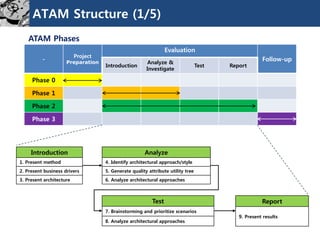
ATAM Structure (1/5)
-
Project
Preparation
Evaluation
Follow-up
Introduction
Analyze &
Investigate
Test Report
Phase 0
Phase 1
Phase 2
Phase 3
Introduction
1. Present method
2. Present business drivers
3. Present architecture
Analyze
4. Identify architectural approach/style
5. Generate quality attribute utility tree
6. Analyze architectural approaches
Test
7. Brainstorming and prioritize scenarios
8. Analyze architectural approaches
Report
9. Present results
ATAM Phases
ATAM Structure (2/5)
 Phase 0 : Partnership, Preparation (Informally)
 Attendee : Evaluation team leader / Project decision makers
 Activities
 Building a partnership
 평가 팀 리더는 아키텍처 평가 방법을 간단히 소개한다.
 평가대상 조직은 아키텍처에 대한 자료를 제공하고 평가 팀 리더는 프로젝트
짂행을 결정한다.
 평가대상 조직과 평가수행 조직은 계약을 체결한다.
 정보열람 권리와 정보보호 의무를 확인한다.
 아키텍처 평가 비용과 이득을 평가대상 조직이 충분히 이해하도록 해야 한다.
 Preparation of architecture evaluation
 평가 팀 구성 : 팀을 구성하고 팀원의 역할을 결정한다.
 Kick-off 미팅 : 팀원들이 자싞의 역할을 이해하고 아키텍처 평가에 대한 지식을
공유한다.
 Phase 1 준비
ATAM Structure (3/5)
 Phase 1 : Evaluation 1
 Attendee : Evaluation team leader / Project decision makers
 Period : 1 day
 Activities
 ATAM Execution : Execution from 1 step to 6 step
 Phase 2 Preparation
 Phase 2 짂행 여부 결정
 Phase 2 참여자 결정
 부족한 정보를 파악한다.
 Features
 아키텍처 중심 : 아키텍처에 대한 정보를 발굴하고 분석한다.
 아키텍처를 파악하는데 초점을 맞춘다. (자세한 분석은 Phase 2에서 수행한다.)
 파악한 아키텍처를 기반으로 아키텍처 평가팀 구성을 최종 결정한다.
 Phase 1과 Phase 2 사이에 2~3주 공백 기간을 두고 이 기간 동앆 계속 아키텍처
에 대한 정보를 발견하고 수집한다.
ATAM Structure (4/5)
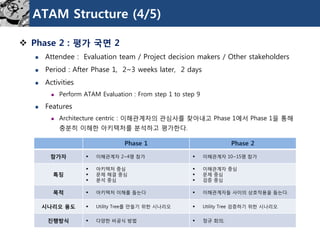
 Phase 2 : 평가 국면 2
 Attendee : Evaluation team / Project decision makers / Other stakeholders
 Period : After Phase 1, 2~3 weeks later, 2 days
 Activities
 Perform ATAM Evaluation : From step 1 to step 9
 Features
 Architecture centric : 이해관계자의 관심사를 찾아내고 Phase 1에서 Phase 1을 통해
충분히 이해한 아키텍처를 분석하고 평가한다.
Phase 1 Phase 2
참가자  이해관계자 2~4명 참가  이해관계자 10~15명 참가
특징
 아키텍처 중심
 문제 해결 중심
 분석 중심
 이해관계자 중심
 문제 중심
 검증 중심
목적  아키텍처 이해를 돕는다  이해관계자들 사이의 상호작용을 돕는다.
시나리오 용도  Utility Tree를 만들기 위한 시나리오  Utility Tree 검증하기 위한 시나리오
진행방식  다양한 비공식 방법  정규 회의;
ATAM Structure (5/5)
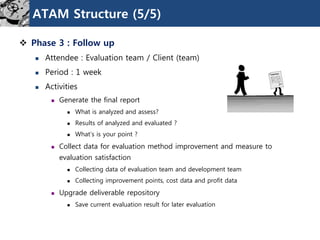
 Phase 3 : Follow up
 Attendee : Evaluation team / Client (team)
 Period : 1 week
 Activities
 Generate the final report
 What is analyzed and assess?
 Results of analyzed and evaluated ?
 What‟s is your point ?
 Collect data for evaluation method improvement and measure to
evaluation satisfaction
 Collecting data of evaluation team and development team
 Collecting improvement points, cost data and profit data
 Upgrade deliverable repository
 Save current evaluation result for later evaluation
Architecture Evaluation Step (1/6)
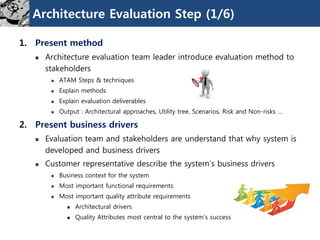
1. Present method
 Architecture evaluation team leader introduce evaluation method to
stakeholders
 ATAM Steps & techniques
 Explain methods
 Explain evaluation deliverables
 Output : Architectural approaches, Utility tree, Scenarios, Risk and Non-risks …
2. Present business drivers
 Evaluation team and stakeholders are understand that why system is
developed and business drivers
 Customer representative describe the system‟s business drivers
 Business context for the system
 Most important functional requirements
 Most important quality attribute requirements
 Architectural drivers
 Quality Attributes most central to the system‟s success
Architecture Evaluation Step (2/6)
3. Present architecture
 Senior Architect introduce architecture to evaluation team
 Technical constraints & external systems must to interaction
 Architectural approaches for satisfaction of the quality attributes
 Use the important architecture view among the architecture views
 Architecture team may make initial architecture version with their
architectural approach
 Evaluation team begins probing for and capturing risks
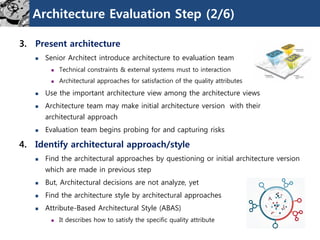
4. Identify architectural approach/style
 Find the architectural approaches by questioning or initial architecture version
which are made in previous step
 But, Architectural decisions are not analyze, yet
 Find the architecture style by architectural approaches
 Attribute-Based Architectural Style (ABAS)
 It describes how to satisfy the specific quality attribute
Architecture Evaluation Step (3/6)
5. Generate quality attribute utility tree
 Find the most important quality attribute and set priority by evaluation team
and decision maker and share the priority of quality attribute
 Generate a document for quality attribute requirement and priority
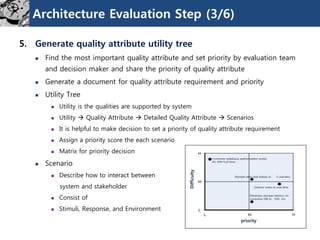
 Utility Tree
 Utility is the qualities are supported by system
 Utility  Quality Attribute  Detailed Quality Attribute  Scenarios
 It is helpful to make decision to set a priority of quality attribute requirement
 Assign a priority score the each scenario
 Matrix for priority decision
 Scenario
 Describe how to interact between
system and stakeholder
 Consist of
 Stimuli, Response, and Environment
priority
Difficulty
[Appendix] Utility Tree
 Example of Utility Tree
Architecture Evaluation Step (4/6)
6. Analyze architectural approaches
 The evaluation team probes architectural approaches specific quality
attributes to identify risks
 Identify the approaches that pertain to the highest priority quality attribute
requirements
 Generate quality attribute specific questions for highest priority quality attribute
requirement
 Ask quality attribute specific questions
 Identify and record risks and non-risk, sensitivity points and tradeoffs
 Risk and Non-risks
 Risks are potentially important architectural decisions that need to be made explicit
 Non-risks are good decisions frequently relying on implicit assumptions
 Risk and non-risk constituents
 Architectural decision
 Quality attribute requirements
 Rationale
 Sensitivity points are candidate risks
[Appendix] Sensitivity & trade-off Point
A Sensitivity point is a parameter of the architectural to which some quality attribute is highly related
Subsystem 1 Subsystem 2
Suppose throughput depends on one channel !!!
Increase channel Speed  Increase performance
A trade-off point is a parameter of the architecture that affects multiple quality attributes in opposite
direction
A system requires high performance, high reliability, high security
Increase channel Speed  Increase performance & decrease reliability
Increase encryption  Increase security & decrease performance
Architecture Evaluation Step (5/6)
7. Brainstorming and prioritize scenarios
 Stakeholders generate scenarios using a facilitated brainstorming process
 Examples are used to facilitate the step
 The new scenarios are added to the leaves of the utility tree
8. Analyze architectural approaches
 Identify the architectural approaches impacted by the scenarios generated in
the previous step
 This step continues the analysis started in step 6 using the new scenarios
 Continue identifying risks and non-risks
 Continue annotating architectural information
 Essentially a process steps above …
 Include a larger group of stakeholders
 Extend consensus (on priorities)
 Extend confidence in completeness of scenario’s
Architecture Evaluation Step (6/6)
9. Present results
 Recapitulate steps of the ATAM
 Present ATAM outputs
 Architectural approaches
 Utility tree
 Scenarios
 Risks and “non-risks”
 Sensitivity points and trade-offs

소프트웨어 아키텍처 평가(Atam)

  • 1.
    소프트웨어 아키텍처 평가: ATAM (ATAM : Architecture Trade-off Analysis Method) Software Engineering Lab 김영기 책임 resinous@gmail.com
  • 2.
  • 3.
    What is ATAM?  ATAM is  Architecture Trade-off Analysis Method  To assess the consequences of architectural decisions in light of quality attribute requirements  Primarily a risk identification mechanism  Not a predictor of quality achievement  Vocabulary Vocabulary Description Scenario  A scenario is a shot statement describing an interaction of one of the stakeholders with the system Stakeholder  An individual, team or organization (or classes thereof) with interested in, or concerns relative to, a system Architectural view  A representation of a whole system from the perspective of a related set of concerns Functional requirements  specify what software has to do Non-functional requirements  specify how well it should be done
  • 4.
    Purpose of ATAM ATAM is for …  Evaluation design decision  Evaluate if the design decision satisfactorily address the quality requirements  Elicit rationale of design decisions (traceability)  Discover risks  Alternatives that might create (future) problems in some quality attribute  Discover sensitivity points  Alternatives for which a slight change makes a significant difference in a quality attribute  Discover tradeoffs  Decisions affecting more than one quality attribute  Side-effect of ATAM  Improve the architecture documentation  Foster stakeholder communication & consensus
  • 5.
    Output of ATAM ATAM Outputs …  Precise description of the architecture  Articulation of the business goals  Quality requirements in terms of scenario‟s  Risks  Trade-off points  Sensitivity points  Result depends on the quality of the architecture specification  Garbage in, Garbage out  Not an attempt to predict quality attributes  Quality properties that are not easily expressed quantitatively, such as usability, interoperability …  ATAM Weakness  Subjective judgment that depends on the experience of the participants  No guidelines for definition of useful change cases  Risk : check list thinking
  • 6.
    ATAM Benefits  Theresults are improved architectures  ATAM „buys‟ time to think about an architecture while development processes are often under time-pressure  Identification of risks early in the life-cycle  Focuses on features that are essential for the stakeholders and not on technical details  Improved architecture documentation  Forces stakeholder to  Think about qualitative requirements  Prioritize qualitative requirements  Documented basis for architectural decisions
  • 7.
    ATAM Structure (1/5) - Project Preparation Evaluation Follow-up Introduction Analyze& Investigate Test Report Phase 0 Phase 1 Phase 2 Phase 3 Introduction 1. Present method 2. Present business drivers 3. Present architecture Analyze 4. Identify architectural approach/style 5. Generate quality attribute utility tree 6. Analyze architectural approaches Test 7. Brainstorming and prioritize scenarios 8. Analyze architectural approaches Report 9. Present results ATAM Phases
  • 8.
    ATAM Structure (2/5) Phase 0 : Partnership, Preparation (Informally)  Attendee : Evaluation team leader / Project decision makers  Activities  Building a partnership  평가 팀 리더는 아키텍처 평가 방법을 간단히 소개한다.  평가대상 조직은 아키텍처에 대한 자료를 제공하고 평가 팀 리더는 프로젝트 짂행을 결정한다.  평가대상 조직과 평가수행 조직은 계약을 체결한다.  정보열람 권리와 정보보호 의무를 확인한다.  아키텍처 평가 비용과 이득을 평가대상 조직이 충분히 이해하도록 해야 한다.  Preparation of architecture evaluation  평가 팀 구성 : 팀을 구성하고 팀원의 역할을 결정한다.  Kick-off 미팅 : 팀원들이 자싞의 역할을 이해하고 아키텍처 평가에 대한 지식을 공유한다.  Phase 1 준비
  • 9.
    ATAM Structure (3/5) Phase 1 : Evaluation 1  Attendee : Evaluation team leader / Project decision makers  Period : 1 day  Activities  ATAM Execution : Execution from 1 step to 6 step  Phase 2 Preparation  Phase 2 짂행 여부 결정  Phase 2 참여자 결정  부족한 정보를 파악한다.  Features  아키텍처 중심 : 아키텍처에 대한 정보를 발굴하고 분석한다.  아키텍처를 파악하는데 초점을 맞춘다. (자세한 분석은 Phase 2에서 수행한다.)  파악한 아키텍처를 기반으로 아키텍처 평가팀 구성을 최종 결정한다.  Phase 1과 Phase 2 사이에 2~3주 공백 기간을 두고 이 기간 동앆 계속 아키텍처 에 대한 정보를 발견하고 수집한다.
  • 10.
    ATAM Structure (4/5) Phase 2 : 평가 국면 2  Attendee : Evaluation team / Project decision makers / Other stakeholders  Period : After Phase 1, 2~3 weeks later, 2 days  Activities  Perform ATAM Evaluation : From step 1 to step 9  Features  Architecture centric : 이해관계자의 관심사를 찾아내고 Phase 1에서 Phase 1을 통해 충분히 이해한 아키텍처를 분석하고 평가한다. Phase 1 Phase 2 참가자  이해관계자 2~4명 참가  이해관계자 10~15명 참가 특징  아키텍처 중심  문제 해결 중심  분석 중심  이해관계자 중심  문제 중심  검증 중심 목적  아키텍처 이해를 돕는다  이해관계자들 사이의 상호작용을 돕는다. 시나리오 용도  Utility Tree를 만들기 위한 시나리오  Utility Tree 검증하기 위한 시나리오 진행방식  다양한 비공식 방법  정규 회의;
  • 11.
    ATAM Structure (5/5) Phase 3 : Follow up  Attendee : Evaluation team / Client (team)  Period : 1 week  Activities  Generate the final report  What is analyzed and assess?  Results of analyzed and evaluated ?  What‟s is your point ?  Collect data for evaluation method improvement and measure to evaluation satisfaction  Collecting data of evaluation team and development team  Collecting improvement points, cost data and profit data  Upgrade deliverable repository  Save current evaluation result for later evaluation
  • 12.
    Architecture Evaluation Step(1/6) 1. Present method  Architecture evaluation team leader introduce evaluation method to stakeholders  ATAM Steps & techniques  Explain methods  Explain evaluation deliverables  Output : Architectural approaches, Utility tree, Scenarios, Risk and Non-risks … 2. Present business drivers  Evaluation team and stakeholders are understand that why system is developed and business drivers  Customer representative describe the system‟s business drivers  Business context for the system  Most important functional requirements  Most important quality attribute requirements  Architectural drivers  Quality Attributes most central to the system‟s success
  • 13.
    Architecture Evaluation Step(2/6) 3. Present architecture  Senior Architect introduce architecture to evaluation team  Technical constraints & external systems must to interaction  Architectural approaches for satisfaction of the quality attributes  Use the important architecture view among the architecture views  Architecture team may make initial architecture version with their architectural approach  Evaluation team begins probing for and capturing risks 4. Identify architectural approach/style  Find the architectural approaches by questioning or initial architecture version which are made in previous step  But, Architectural decisions are not analyze, yet  Find the architecture style by architectural approaches  Attribute-Based Architectural Style (ABAS)  It describes how to satisfy the specific quality attribute
  • 14.
    Architecture Evaluation Step(3/6) 5. Generate quality attribute utility tree  Find the most important quality attribute and set priority by evaluation team and decision maker and share the priority of quality attribute  Generate a document for quality attribute requirement and priority  Utility Tree  Utility is the qualities are supported by system  Utility  Quality Attribute  Detailed Quality Attribute  Scenarios  It is helpful to make decision to set a priority of quality attribute requirement  Assign a priority score the each scenario  Matrix for priority decision  Scenario  Describe how to interact between system and stakeholder  Consist of  Stimuli, Response, and Environment priority Difficulty
  • 15.
    [Appendix] Utility Tree Example of Utility Tree
  • 16.
    Architecture Evaluation Step(4/6) 6. Analyze architectural approaches  The evaluation team probes architectural approaches specific quality attributes to identify risks  Identify the approaches that pertain to the highest priority quality attribute requirements  Generate quality attribute specific questions for highest priority quality attribute requirement  Ask quality attribute specific questions  Identify and record risks and non-risk, sensitivity points and tradeoffs  Risk and Non-risks  Risks are potentially important architectural decisions that need to be made explicit  Non-risks are good decisions frequently relying on implicit assumptions  Risk and non-risk constituents  Architectural decision  Quality attribute requirements  Rationale  Sensitivity points are candidate risks
  • 17.
    [Appendix] Sensitivity &trade-off Point A Sensitivity point is a parameter of the architectural to which some quality attribute is highly related Subsystem 1 Subsystem 2 Suppose throughput depends on one channel !!! Increase channel Speed  Increase performance A trade-off point is a parameter of the architecture that affects multiple quality attributes in opposite direction A system requires high performance, high reliability, high security Increase channel Speed  Increase performance & decrease reliability Increase encryption  Increase security & decrease performance
  • 18.
    Architecture Evaluation Step(5/6) 7. Brainstorming and prioritize scenarios  Stakeholders generate scenarios using a facilitated brainstorming process  Examples are used to facilitate the step  The new scenarios are added to the leaves of the utility tree 8. Analyze architectural approaches  Identify the architectural approaches impacted by the scenarios generated in the previous step  This step continues the analysis started in step 6 using the new scenarios  Continue identifying risks and non-risks  Continue annotating architectural information  Essentially a process steps above …  Include a larger group of stakeholders  Extend consensus (on priorities)  Extend confidence in completeness of scenario’s
  • 19.
    Architecture Evaluation Step(6/6) 9. Present results  Recapitulate steps of the ATAM  Present ATAM outputs  Architectural approaches  Utility tree  Scenarios  Risks and “non-risks”  Sensitivity points and trade-offs