- A B H I J I T S A N Z G I R I
C H A R T E R E D A C C O U N T A N T
Audit Sampling, Techniques &
Procedures
What is Auditing
 Auditing - Expression of an opinion
 Systematic  independent examination of books, accounts,
documents  vouchers of an organization
 Ascertain that the financial statements present a true  fair
view of the concern.
 Ensure that the books of accounts are maintained as
required by law.
Types of audit
Statutory Audit
Internal Audit
Concurrent Audit
Tax Audit
Tax Audit
Stock Audit
RBI Inspections
Special Audit
Special Assignment
Due diligence Reporting
Audit Sampling
 Applying audit procedure to  100% of the population
 Based on objective of the Audit
 sufficient understanding of internal control structure to plan the
audit  determine nature, timing  extent of tests to be
performed
 Standards on Auditing 530 applies when auditor decides to use
audit sampling in performing audit procedures
 Deals with auditor’s use of statistical  non statistical sampling in
designing  selecting the audit sample.
Selection of audit sample
 Consider the objectives of the audit procedure.
 Characteristics of the population.
 Assist in effective  efficient design of sample,
stratification maybe appropriate.
 Stratification - Process of dividing a population into sub-
populations
Key points - Audit Sampling
When determining sample size, auditor should consider-
Sampling risk
• Risk is an
uncertainty, threat
Tolerable error
• Tolerable Error is
the maximum error
Expected error
• Determining
expected error
uncertainty, threat
or vulnerability
derailing the
achievement of an
objective
• Risk is a function of
probability 
demand
the maximum error
in the population
that the auditor
would be willing to
accept.
expected error
consider matters as-
• the size  frequency
of errors identified
in previous audit,
• changes in Entity’s
procedures 
evidence available
from other
procedures.
If error is
expected to be
present in the
population, a
larger sample
need to be
examined.
Risk that the results from the sample
selected may not be representative of the
entire population.
Auditor should
select sample
items in such a
way that the
sample can be
expected to be
representative of
the population.
Analysing Audit Sample
 Investigate nature  cause of any deviation or
misstatements identified  their possible effects.
 To conclude that a misstatement or deviation is an
anomaly.
anomaly.
 Auditor to obtain a high level of certainty that misstatement
or deviation is not representative of the population.
Methods of Audit Sampling
Statistical Sampling
 Random Sampling - selecting items from the
population so that each item has an equal chance of
being selected.
 Systematic Sampling - selecting every nth item
from the population after a random start.
Non-Statistical Sampling
 Haphazard Sampling - selecting items from the
population without consideration to known
characteristics of the items in the population (i.e. any
conscious bias in the selection of population items).
 Block Sampling - selecting items from the population
in contiguous groups (or blocks).
 Directed Sampling - selecting items from the
population using some pre specified criteria (i.e.,
selecting accounts receivable for confirmation based on
amount of outstanding)
Disadvantages of sampling
 Sample transactions could be proper accounting methods, but other
transactions not included in the sample could show evidence of fraud.
 Auditors may find few incriminating sample data points  extrapolate a deeper
level of fraud from these when one does not necessarily exist.
The risk of incorrect acceptance-
Recorded account balance is not materially
misstated when it is materially misstated.
The risk of incorrect rejection-
Recorded account balance is materially
misstated when it is not materially misstated.
Sampling Advantage  Disadvantage
Audit techniques
Audit techniques Audit procedures
Audit procedures
 Tools, methods or
processes by means of
which an auditor
 Ways of applying
techniques to
particular phase of an
Audit Techniques  Procedures
which an auditor
collects necessary
evidence to support his
opinion in respect of
the propositions 
assertions submitted
by the client to him for
his examination.
particular phase of an
audit
Audit
Techniques
1) Posting
Verification
2) Vouching
3) Confirmation
4) Physical
4) Physical
Examination
5) Reconciliation
6) Testing
7) Analyses of
Financial Statements
8) Inspection
9) Observation
Audit
Techniques
10) Documentary
examination
11) Scanning
12) Electronic Data
processing
13) Enquiry
13) Enquiry
14) Computation
15) Analytical Review
16) Compliance test
17) Substantive test
18) Use of computer
Assisted audit
techniques
Allowable Audit Risk
AR = IR x CR x DR
 AR - Allowable audit risk that a material misstatement
remains undetected
remains undetected
 IR - Inherent risk of a material misstatement assuming there
were no related controls.
 CR - Control risk that a material misstatement could occur 
will not be prevented or detected on a timely basis by internal
control.
 DR - Detection risk that the auditors’ procedures will fail to
detect a material misstatement if it exists.
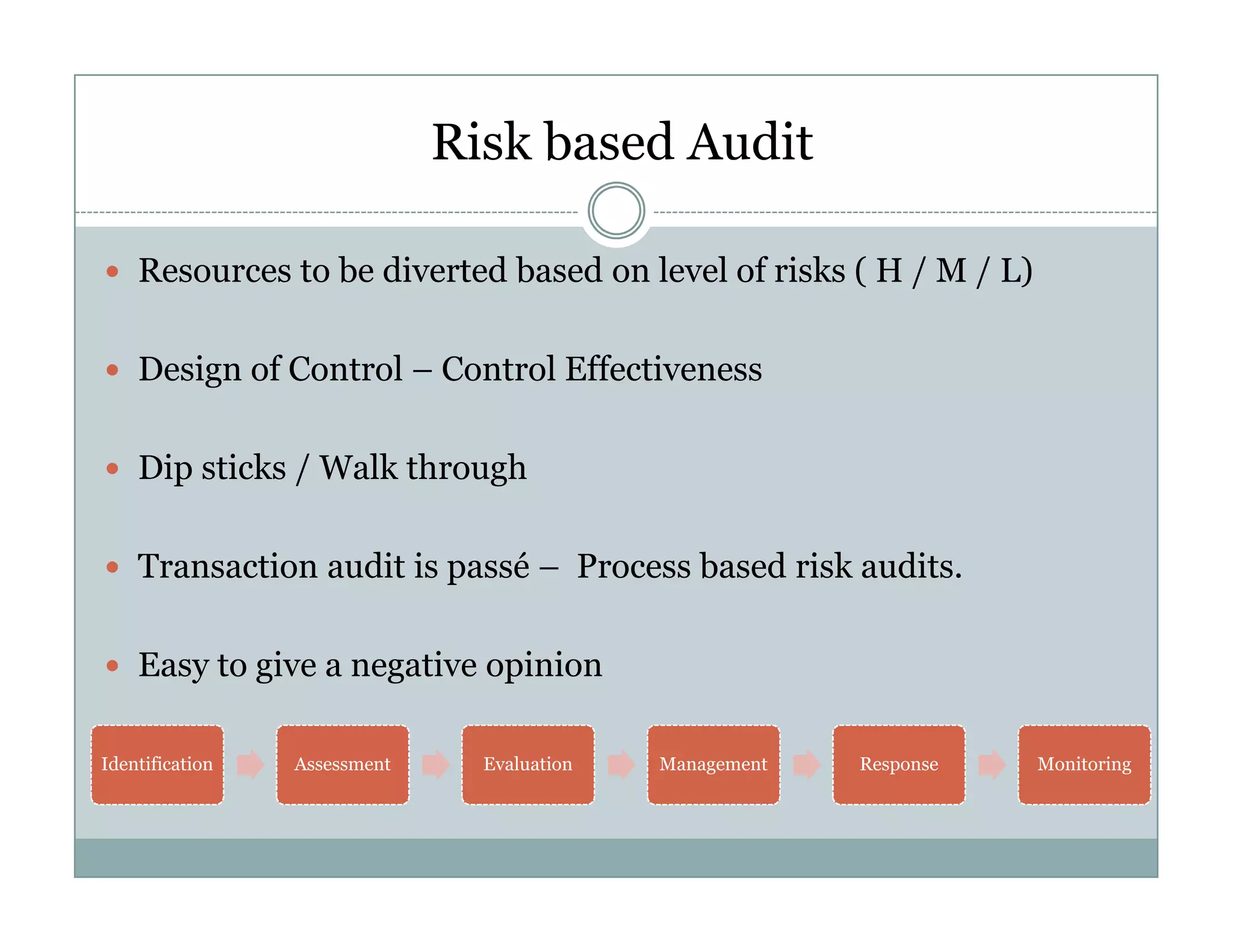
Risk based Audit
 Resources to be diverted based on level of risks ( H / M / L)
 Design of Control – Control Effectiveness
 Dip sticks / Walk through
 Dip sticks / Walk through
 Transaction audit is passé – Process based risk audits.
 Easy to give a negative opinion
Identification Assessment Evaluation Management Response Monitoring
Continuous Control Monitoring
 Set of technologies to reduce business losses through continuous
monitoring.
 Reducing the cost of audits through continuous auditing of the
controls in financial  other transactional applications.
 100% real time monitoring.
 Deviations / Exceptions highlighted.
 Entry not allowed to be processed.
Continuous Audit
 “Continuous aspect refers to the -real-time or near real-time capability for
financial information to be checked  shared.
 Indicates integrity of information to be evaluated at any given point of time.
 Information verified constantly for errors, fraud  inefficiency.
 Automatic method used to perform auditing activities- control  risk assessments
on a more frequent basis.
 Technology - key role helping automate identification of exceptions or anomalies.
 Analyze patterns within the digits of key numeric fields, review trends  test
controls.
 Most detailed audit
Advantages of Continuous Audit
 Detailed analyses of data
 Minimal Audit risk
 No sampling risk
 Detection of errors  frauds at an early stage
Challenges in Continuous audit
 Accessing complex, diverse system environment
 Reluctance to expand the use of technology
 Overwhelming results
 Training
Documentation
 Work papers
 Records of planning  performance of work
 Demonstrates that the work was actually performed
 Evidential support for conclusions reached
 Assessment of quality  compliance
T H A N K Y O U
Perfection is not attainable ,but if
we chase perfection we can catch
excellence

Final-Audit-Sampling.pdf

  • 1.
    - A BH I J I T S A N Z G I R I C H A R T E R E D A C C O U N T A N T Audit Sampling, Techniques & Procedures
  • 2.
    What is Auditing Auditing - Expression of an opinion Systematic independent examination of books, accounts, documents vouchers of an organization Ascertain that the financial statements present a true fair view of the concern. Ensure that the books of accounts are maintained as required by law.
  • 3.
    Types of audit StatutoryAudit Internal Audit Concurrent Audit Tax Audit Tax Audit Stock Audit RBI Inspections Special Audit Special Assignment Due diligence Reporting
  • 4.
    Audit Sampling Applyingaudit procedure to 100% of the population Based on objective of the Audit sufficient understanding of internal control structure to plan the audit determine nature, timing extent of tests to be performed Standards on Auditing 530 applies when auditor decides to use audit sampling in performing audit procedures Deals with auditor’s use of statistical non statistical sampling in designing selecting the audit sample.
  • 5.
    Selection of auditsample Consider the objectives of the audit procedure. Characteristics of the population. Assist in effective efficient design of sample, stratification maybe appropriate. Stratification - Process of dividing a population into sub- populations
  • 6.
    Key points -Audit Sampling When determining sample size, auditor should consider- Sampling risk • Risk is an uncertainty, threat Tolerable error • Tolerable Error is the maximum error Expected error • Determining expected error uncertainty, threat or vulnerability derailing the achievement of an objective • Risk is a function of probability demand the maximum error in the population that the auditor would be willing to accept. expected error consider matters as- • the size frequency of errors identified in previous audit, • changes in Entity’s procedures evidence available from other procedures.
  • 7.
    If error is expectedto be present in the population, a larger sample need to be examined. Risk that the results from the sample selected may not be representative of the entire population. Auditor should select sample items in such a way that the sample can be expected to be representative of the population.
  • 8.
    Analysing Audit Sample Investigate nature cause of any deviation or misstatements identified their possible effects. To conclude that a misstatement or deviation is an anomaly. anomaly. Auditor to obtain a high level of certainty that misstatement or deviation is not representative of the population.
  • 9.
  • 10.
    Statistical Sampling RandomSampling - selecting items from the population so that each item has an equal chance of being selected. Systematic Sampling - selecting every nth item from the population after a random start.
  • 11.
    Non-Statistical Sampling HaphazardSampling - selecting items from the population without consideration to known characteristics of the items in the population (i.e. any conscious bias in the selection of population items). Block Sampling - selecting items from the population in contiguous groups (or blocks). Directed Sampling - selecting items from the population using some pre specified criteria (i.e., selecting accounts receivable for confirmation based on amount of outstanding)
  • 12.
    Disadvantages of sampling Sample transactions could be proper accounting methods, but other transactions not included in the sample could show evidence of fraud. Auditors may find few incriminating sample data points extrapolate a deeper level of fraud from these when one does not necessarily exist. The risk of incorrect acceptance- Recorded account balance is not materially misstated when it is materially misstated. The risk of incorrect rejection- Recorded account balance is materially misstated when it is not materially misstated.
  • 13.
    Sampling Advantage Disadvantage
  • 14.
    Audit techniques Audit techniquesAudit procedures Audit procedures Tools, methods or processes by means of which an auditor Ways of applying techniques to particular phase of an Audit Techniques Procedures which an auditor collects necessary evidence to support his opinion in respect of the propositions assertions submitted by the client to him for his examination. particular phase of an audit
  • 15.
    Audit Techniques 1) Posting Verification 2) Vouching 3)Confirmation 4) Physical 4) Physical Examination 5) Reconciliation 6) Testing 7) Analyses of Financial Statements 8) Inspection 9) Observation
  • 16.
    Audit Techniques 10) Documentary examination 11) Scanning 12)Electronic Data processing 13) Enquiry 13) Enquiry 14) Computation 15) Analytical Review 16) Compliance test 17) Substantive test 18) Use of computer Assisted audit techniques
  • 17.
    Allowable Audit Risk AR= IR x CR x DR AR - Allowable audit risk that a material misstatement remains undetected remains undetected IR - Inherent risk of a material misstatement assuming there were no related controls. CR - Control risk that a material misstatement could occur will not be prevented or detected on a timely basis by internal control. DR - Detection risk that the auditors’ procedures will fail to detect a material misstatement if it exists.
  • 18.
    Risk based Audit Resources to be diverted based on level of risks ( H / M / L) Design of Control – Control Effectiveness Dip sticks / Walk through Dip sticks / Walk through Transaction audit is passé – Process based risk audits. Easy to give a negative opinion Identification Assessment Evaluation Management Response Monitoring
  • 19.
    Continuous Control Monitoring Set of technologies to reduce business losses through continuous monitoring. Reducing the cost of audits through continuous auditing of the controls in financial other transactional applications. 100% real time monitoring. Deviations / Exceptions highlighted. Entry not allowed to be processed.
  • 20.
    Continuous Audit “Continuousaspect refers to the -real-time or near real-time capability for financial information to be checked shared. Indicates integrity of information to be evaluated at any given point of time. Information verified constantly for errors, fraud inefficiency. Automatic method used to perform auditing activities- control risk assessments on a more frequent basis. Technology - key role helping automate identification of exceptions or anomalies. Analyze patterns within the digits of key numeric fields, review trends test controls. Most detailed audit
  • 21.
    Advantages of ContinuousAudit Detailed analyses of data Minimal Audit risk No sampling risk Detection of errors frauds at an early stage
  • 22.
    Challenges in Continuousaudit Accessing complex, diverse system environment Reluctance to expand the use of technology Overwhelming results Training
  • 23.
    Documentation Work papers Records of planning performance of work Demonstrates that the work was actually performed Evidential support for conclusions reached Assessment of quality compliance
  • 24.
    T H AN K Y O U Perfection is not attainable ,but if we chase perfection we can catch excellence