SRI-LMB in Laos
This project is funded by the
European Union
Presented by: Viengxay Photakoun and Kongsy Xayavong
from DAEC, MAF Laos.
Second Regional Review & Planning Workshop on SRI-LMB
24-25th April, 2017
Hilton Garden Inn Hotel, Hanoi, Vietnam.
Food and Agriculture Organization
of the United Nations
Ministry of Agriculture and
Forestry
A project implemented by the Asian
Institute of Technology
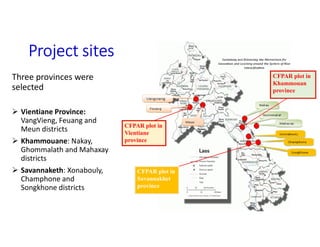
Project sites
Three provinces were
selected
 Vientiane Province:
VangVieng, Feuang and
Meun districts
 Khammouane: Nakay,
Ghommalath and Mahaxay
districts
 Savannaketh: Xonabouly,
Champhone and
Songkhone districts
CFPAR plot in
Savannakhet
province
CFPAR plot in
Khammouan
province
CFPAR plot in
Vientiane
province
Activities completed
 Conduct Inception Workshop in Thalath, Keooudom district, VTP (June
2014).
 Baseline survey (2014)
 Provided 3 Training Courses (CFPARs) (Dry and Wet Season 2015)
 46 FPARs for three provinces (wet season 2015 (28)-2016 (46)
 Monitoring and Evaluation FPAR activities (wet season 2015-2016)
 Reporting and entry of data in data base for FPAR (2015-2016)
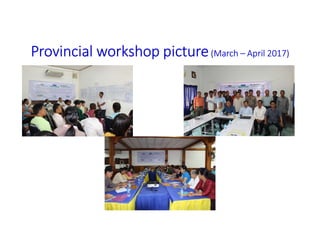
 Organized 3 Provincial Workshops (March-April 2017).
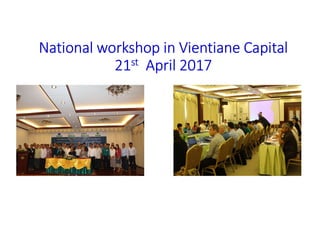
 Organized 1 National Workshop (Vientiane, 21st April, 2017)
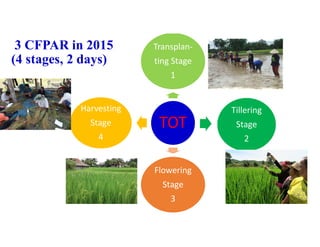
3 CFPAR in 2015
(4 stages, 2 days)
TOT
Transplan-
ting Stage
1
Tillering
Stage
2
Flowering
Stage
3
Harvesting
Stage
4
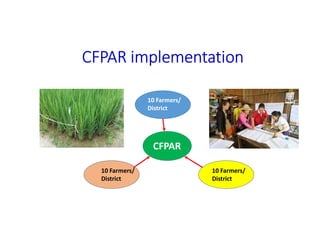
CFPAR implementation
10 Farmers/
District
CFPAR
10 Farmers/
District
10 Farmers/
District
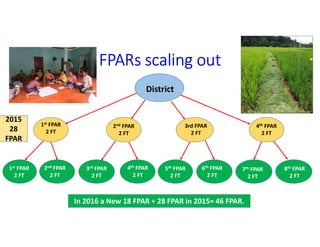
FPARs scaling out
District
1st FPAR
2 FT
2nd FPAR
2 FT
3rd FPAR
2 FT
4th FPAR
2 FT
1st FPAR
2 FT
2nd FPAR
2 FT
3rd FPAR
2 FT
4th FPAR
2 FT
5th FPAR
2 FT
6th FPAR
2 FT
7th FPAR
2 FT
8th FPAR
2 FT
2015
28
FPAR
In 2016 a New 18 FPAR + 28 FPAR in 2015= 46 FPAR.
No Province District
2015 2016
No. of
FPAR
No. of
sessions/
FPAR
No. of
farmers
reached
Women
farmers
reached
No. of
FPAR
No. of
sessions/
FPAR
No. of
farmers
reached
Women
farmers
reached
1 Vientiane
Muen 4 4 102 53 8 4 215 120
Fouang 2 4 46 26 4 4 118 58
Vangvieng 4 4 97 63 8 4 208 145
Sub Total 1 10 12 245 142 20 12 541 323
2 Khammouan
Gnommalat 2 4 50 28 4 4 103 48
Mahaxay 4 4 100 49 4 4 112 43
Nakai 4 4 100 54 4 4 105 54
Sub Total 2 10 12 250 131 12 12 320 145
3 Savannakhet
Champone 2 4 56 23 6 4 158 67
Songkhone 4 4 111 57 4 4 98 44
Sonnabouly 2 4 56 27 4 4 110 49
Sub Total 3 8 12 223 107 14 12 366 160
Total 28 718 380 46 1,227 628
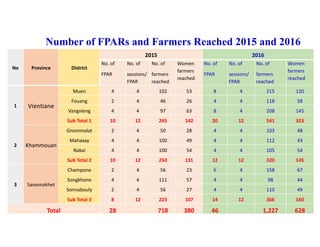
Number of FPARs and Farmers Reached 2015 and 2016
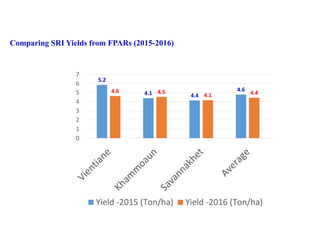
Comparing SRI Yields from FPARs (2015-2016)
5.2
4.1 4.4
4.64.6 4.5
4.1 4.4
0
1
2
3
4
5
6
7
Yield -2015 (Ton/ha) Yield -2016 (Ton/ha)
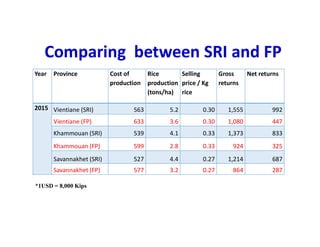
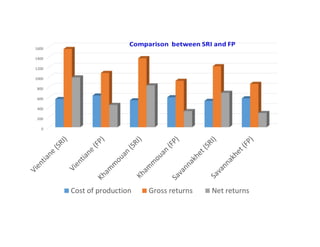
Comparing between SRI and FP
Year Province Cost of
production
Rice
production
(tons/ha)
Selling
price / Kg
rice
Gross
returns
Net returns
2015 Vientiane (SRI) 563 5.2 0.30 1,555 992
Vientiane (FP) 633 3.6 0.30 1,080 447
Khammouan (SRI) 539 4.1 0.33 1,373 833
Khammouan (FP) 599 2.8 0.33 924 325
Savannakhet (SRI) 527 4.4 0.27 1,214 687
Savannakhet (FP) 577 3.2 0.27 864 287
*1USD = 8,000 Kips
0
200
400
600
800
1000
1200
1400
1600
Cost of production Gross returns Net returns
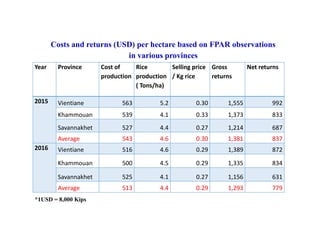
Costs and returns (USD) per hectare based on FPAR observations
in various provinces
Year Province Cost of
production
Rice
production
( Tons/ha)
Selling price
/ Kg rice
Gross
returns
Net returns
2015 Vientiane 563 5.2 0.30 1,555 992
Khammouan 539 4.1 0.33 1,373 833
Savannakhet 527 4.4 0.27 1,214 687
Average 543 4.6 0.30 1,381 837
2016 Vientiane 516 4.6 0.29 1,389 872
Khammouan 500 4.5 0.29 1,335 834
Savannakhet 525 4.1 0.27 1,156 631
Average 513 4.4 0.29 1,293 779
*1USD = 8,000 Kips
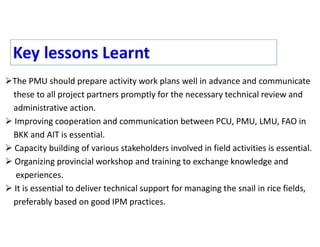
The PMU should prepare activity work plans well in advance and communicate
these to all project partners promptly for the necessary technical review and
administrative action.
 Improving cooperation and communication between PCU, PMU, LMU, FAO in
BKK and AIT is essential.
 Capacity building of various stakeholders involved in field activities is essential.
 Organizing provincial workshop and training to exchange knowledge and
experiences.
 It is essential to deliver technical support for managing the snail in rice fields,
preferably based on good IPM practices.
Key lessons Learnt
Key lessons Learnt (cont..)
 Duck raising activity could be integrated with rice production to
manage weeds and snails.
FPAR training started late, when farmers were already transplanting.
So farmers attending the training were not able to adopt the practices
in the same season. So it is better to start FPAR training at start of the
season when rains allow so that farmers can practice in their own
field simultaneously what they have learned in the FPAR training.
 Some farmers’ experiences more weed problems in their SRI Rice
fields. Since there were no rains after transplanting, it was difficult to
manage weeds. Families where men migrated for employment faced
labor shortage, which also affected weed management.
Key lessons Learnt (Cont..)
 Data collection was mostly done along the bunds in the FPAR fields
in VangVieng and Muen districts. So there is a chance of “border
effect”. It is essential to build the capacity of the District
Coordinators and Farmer Trainers for better science-based action
research designs and implementation.
 Using young seedlings, single seedling and wider spacing during
transplanting and drained water out for two weeks during vegetative
growth stage can provide yield advantage in rice cultivation.
Recommendation for future activities
 Providing assistance for farm mechanization, by conducting trials
exploring direct-seeded and/or single seedling transplants and weed
management can help families deal with labour shortage; this
especially will be useful for those families where male members
migrate away from their farms in search of employment.
 In Vientiane province the farmers adopted SRI practices without
chemical fertilizer and pesticide usage. We can promote organic rice
farming among these farmers and link them with organic produce
markets as to avail of premium prices and to enhance their incomes.
Recommendation for future activities (cont.)
 SRI practices should be integrated with duck and fish rearing in
order to increase rice yields and incomes. The design of the rice-
fish farms should allow for regular draining of fields for purposes
of creating alternate wet and dry conditions, as key SRI practice
to promote soil and crop health.
 SRI practice is also suitable for rice seed production. For
example in Songkhone and Xonaboouly districts the Farmer
Trainers have experienced.
Work plan for the year 2017
 Conduct Provincial Workshops in the three provinces (March-
April 2017).
 Conduct 1st National Workshop in Vientiane (21 April 2017).
 Attend the 2nd RRPW in Hanoi, Vietnam (22 to 26 April, 2017).
 Writing concept note for conducting 82 FPARs
 Conduct 82 FPAR trainings (4 session, 2 days during June,
August, September and October 2017).
Work plan for the year 2017
 Ensure implementation and completion of all activities, including
data collection, in 82 FPARs in three provinces (May-October 2017).
 Monitoring FPAR implementation activities.
 Facilitate exchange of experiences between and among FPAR farmers.
 Field day within district and cross visits for FPAR district to district..
 Develop curriculum on SRI-LMB in Laos (Hand Books, Posters, case
studies VDO,….(tentative, pending confirmation of available budget)
 Prepare FPAR Report for 2017 (November-December 2017).
Provincial workshop picture(March – April 2017)
National workshop in Vientiane Capital
21st April 2017
Thank you

Key FPAR Learning and Draft Work Plans, Lao PDR

  • 1.
    SRI-LMB in Laos Thisproject is funded by the European Union Presented by: Viengxay Photakoun and Kongsy Xayavong from DAEC, MAF Laos. Second Regional Review & Planning Workshop on SRI-LMB 24-25th April, 2017 Hilton Garden Inn Hotel, Hanoi, Vietnam. Food and Agriculture Organization of the United Nations Ministry of Agriculture and Forestry A project implemented by the Asian Institute of Technology
  • 2.
    Project sites Three provinceswere selected  Vientiane Province: VangVieng, Feuang and Meun districts  Khammouane: Nakay, Ghommalath and Mahaxay districts  Savannaketh: Xonabouly, Champhone and Songkhone districts CFPAR plot in Savannakhet province CFPAR plot in Khammouan province CFPAR plot in Vientiane province
  • 3.
    Activities completed  ConductInception Workshop in Thalath, Keooudom district, VTP (June 2014).  Baseline survey (2014)  Provided 3 Training Courses (CFPARs) (Dry and Wet Season 2015)  46 FPARs for three provinces (wet season 2015 (28)-2016 (46)  Monitoring and Evaluation FPAR activities (wet season 2015-2016)  Reporting and entry of data in data base for FPAR (2015-2016)  Organized 3 Provincial Workshops (March-April 2017).  Organized 1 National Workshop (Vientiane, 21st April, 2017)
  • 4.
    3 CFPAR in2015 (4 stages, 2 days) TOT Transplan- ting Stage 1 Tillering Stage 2 Flowering Stage 3 Harvesting Stage 4
  • 5.
    CFPAR implementation 10 Farmers/ District CFPAR 10Farmers/ District 10 Farmers/ District
  • 6.
    FPARs scaling out District 1stFPAR 2 FT 2nd FPAR 2 FT 3rd FPAR 2 FT 4th FPAR 2 FT 1st FPAR 2 FT 2nd FPAR 2 FT 3rd FPAR 2 FT 4th FPAR 2 FT 5th FPAR 2 FT 6th FPAR 2 FT 7th FPAR 2 FT 8th FPAR 2 FT 2015 28 FPAR In 2016 a New 18 FPAR + 28 FPAR in 2015= 46 FPAR.
  • 7.
    No Province District 20152016 No. of FPAR No. of sessions/ FPAR No. of farmers reached Women farmers reached No. of FPAR No. of sessions/ FPAR No. of farmers reached Women farmers reached 1 Vientiane Muen 4 4 102 53 8 4 215 120 Fouang 2 4 46 26 4 4 118 58 Vangvieng 4 4 97 63 8 4 208 145 Sub Total 1 10 12 245 142 20 12 541 323 2 Khammouan Gnommalat 2 4 50 28 4 4 103 48 Mahaxay 4 4 100 49 4 4 112 43 Nakai 4 4 100 54 4 4 105 54 Sub Total 2 10 12 250 131 12 12 320 145 3 Savannakhet Champone 2 4 56 23 6 4 158 67 Songkhone 4 4 111 57 4 4 98 44 Sonnabouly 2 4 56 27 4 4 110 49 Sub Total 3 8 12 223 107 14 12 366 160 Total 28 718 380 46 1,227 628 Number of FPARs and Farmers Reached 2015 and 2016
  • 8.
    Comparing SRI Yieldsfrom FPARs (2015-2016) 5.2 4.1 4.4 4.64.6 4.5 4.1 4.4 0 1 2 3 4 5 6 7 Yield -2015 (Ton/ha) Yield -2016 (Ton/ha)
  • 9.
    Comparing between SRIand FP Year Province Cost of production Rice production (tons/ha) Selling price / Kg rice Gross returns Net returns 2015 Vientiane (SRI) 563 5.2 0.30 1,555 992 Vientiane (FP) 633 3.6 0.30 1,080 447 Khammouan (SRI) 539 4.1 0.33 1,373 833 Khammouan (FP) 599 2.8 0.33 924 325 Savannakhet (SRI) 527 4.4 0.27 1,214 687 Savannakhet (FP) 577 3.2 0.27 864 287 *1USD = 8,000 Kips
  • 10.
  • 11.
    Costs and returns(USD) per hectare based on FPAR observations in various provinces Year Province Cost of production Rice production ( Tons/ha) Selling price / Kg rice Gross returns Net returns 2015 Vientiane 563 5.2 0.30 1,555 992 Khammouan 539 4.1 0.33 1,373 833 Savannakhet 527 4.4 0.27 1,214 687 Average 543 4.6 0.30 1,381 837 2016 Vientiane 516 4.6 0.29 1,389 872 Khammouan 500 4.5 0.29 1,335 834 Savannakhet 525 4.1 0.27 1,156 631 Average 513 4.4 0.29 1,293 779 *1USD = 8,000 Kips
  • 12.
    The PMU shouldprepare activity work plans well in advance and communicate these to all project partners promptly for the necessary technical review and administrative action.  Improving cooperation and communication between PCU, PMU, LMU, FAO in BKK and AIT is essential.  Capacity building of various stakeholders involved in field activities is essential.  Organizing provincial workshop and training to exchange knowledge and experiences.  It is essential to deliver technical support for managing the snail in rice fields, preferably based on good IPM practices. Key lessons Learnt
  • 13.
    Key lessons Learnt(cont..)  Duck raising activity could be integrated with rice production to manage weeds and snails. FPAR training started late, when farmers were already transplanting. So farmers attending the training were not able to adopt the practices in the same season. So it is better to start FPAR training at start of the season when rains allow so that farmers can practice in their own field simultaneously what they have learned in the FPAR training.  Some farmers’ experiences more weed problems in their SRI Rice fields. Since there were no rains after transplanting, it was difficult to manage weeds. Families where men migrated for employment faced labor shortage, which also affected weed management.
  • 14.
    Key lessons Learnt(Cont..)  Data collection was mostly done along the bunds in the FPAR fields in VangVieng and Muen districts. So there is a chance of “border effect”. It is essential to build the capacity of the District Coordinators and Farmer Trainers for better science-based action research designs and implementation.  Using young seedlings, single seedling and wider spacing during transplanting and drained water out for two weeks during vegetative growth stage can provide yield advantage in rice cultivation.
  • 15.
    Recommendation for futureactivities  Providing assistance for farm mechanization, by conducting trials exploring direct-seeded and/or single seedling transplants and weed management can help families deal with labour shortage; this especially will be useful for those families where male members migrate away from their farms in search of employment.  In Vientiane province the farmers adopted SRI practices without chemical fertilizer and pesticide usage. We can promote organic rice farming among these farmers and link them with organic produce markets as to avail of premium prices and to enhance their incomes.
  • 16.
    Recommendation for futureactivities (cont.)  SRI practices should be integrated with duck and fish rearing in order to increase rice yields and incomes. The design of the rice- fish farms should allow for regular draining of fields for purposes of creating alternate wet and dry conditions, as key SRI practice to promote soil and crop health.  SRI practice is also suitable for rice seed production. For example in Songkhone and Xonaboouly districts the Farmer Trainers have experienced.
  • 17.
    Work plan forthe year 2017  Conduct Provincial Workshops in the three provinces (March- April 2017).  Conduct 1st National Workshop in Vientiane (21 April 2017).  Attend the 2nd RRPW in Hanoi, Vietnam (22 to 26 April, 2017).  Writing concept note for conducting 82 FPARs  Conduct 82 FPAR trainings (4 session, 2 days during June, August, September and October 2017).
  • 18.
    Work plan forthe year 2017  Ensure implementation and completion of all activities, including data collection, in 82 FPARs in three provinces (May-October 2017).  Monitoring FPAR implementation activities.  Facilitate exchange of experiences between and among FPAR farmers.  Field day within district and cross visits for FPAR district to district..  Develop curriculum on SRI-LMB in Laos (Hand Books, Posters, case studies VDO,….(tentative, pending confirmation of available budget)  Prepare FPAR Report for 2017 (November-December 2017).
  • 19.
  • 20.
    National workshop inVientiane Capital 21st April 2017
  • 21.