Solar Equipment for Ghanaian Schools as Incentive for Tree Planting
(A Light house Project of the Association “School Forest for West Africa” from the Diaspora).
The impact of increasing forest degradation in West Africa is remarkable and
unfortunately has direct consequence on rural forest dwelling communities,
particularly school children in these areas. In Ghana for instance, the rain
forest decreased from 8 to 1, 4 million hectares within a period of 80 years.
In previous times, there were shade trees on school compounds and rural
community settlement areas where school children and adults could sit,
play and study. However, many of these places are now void of trees,
become eroded and dusty places, exposing the foundation of some school
and old buildings, leaving them “hanging”, which pose risk of collapse with
the dust from the exposed soils also causing health risks to these children.
Reforestation is therefore extremely necessary if children and people living in
the country side are to have a secured future.
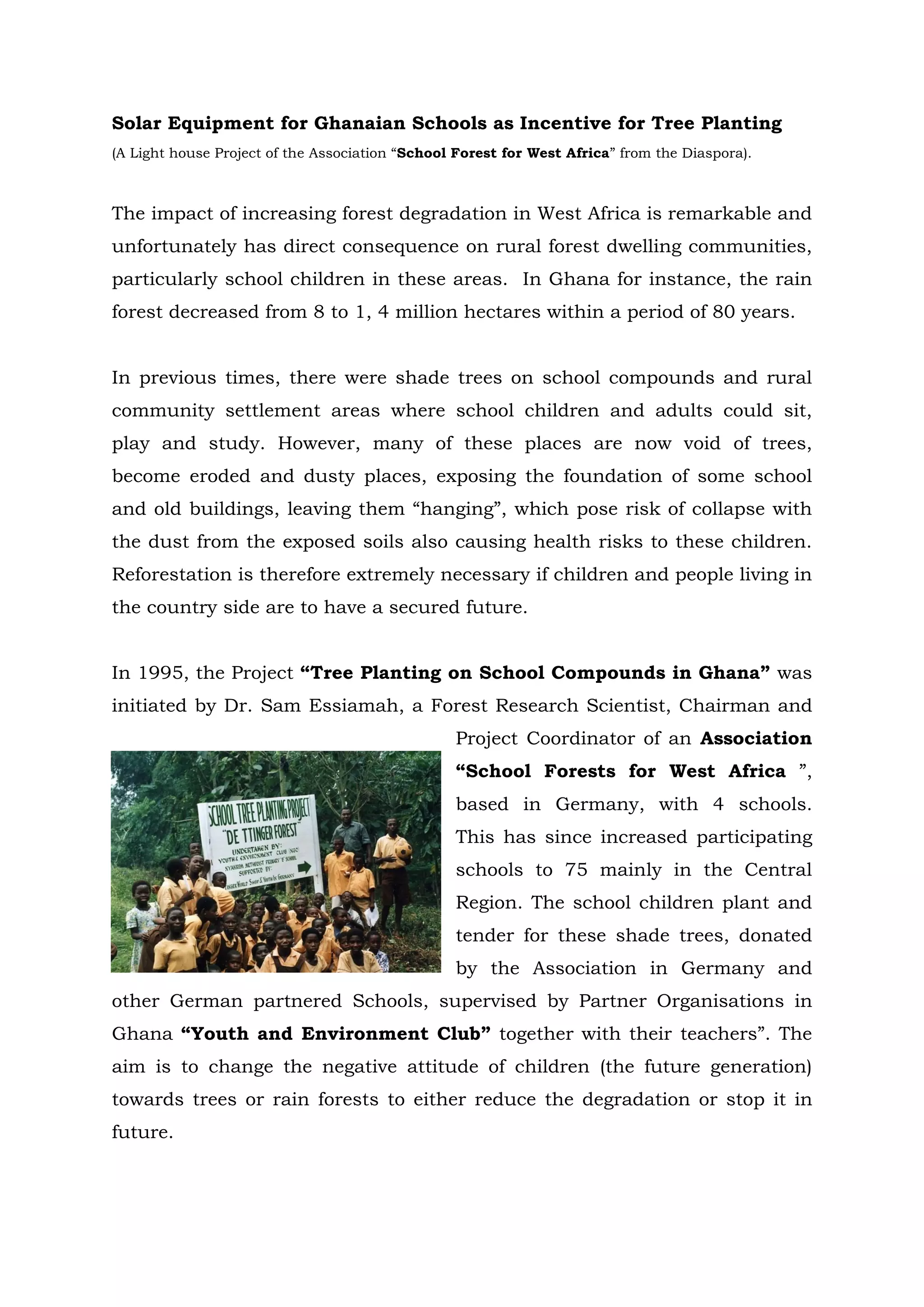
In 1995, the Project “Tree Planting on School Compounds in Ghana” was
initiated by Dr. Sam Essiamah, a Forest Research Scientist, Chairman and
Project Coordinator of an Association
“School Forests for West Africa ”,
based in Germany, with 4 schools.
This has since increased participating
schools to 75 mainly in the Central
Region. The school children plant and
tender for these shade trees, donated
by the Association in Germany and
other German partnered Schools, supervised by Partner Organisations in
Ghana “Youth and Environment Club” together with their teachers”. The
aim is to change the negative attitude of children (the future generation)
towards trees or rain forests to either reduce the degradation or stop it in
future.
The project is now being embraced by schools in Ghana not only because of
its aesthetic and shade-giving nature but prevent school lands to be
encroached.
Introduction of “Waterboxx” technology
To date, all the tree planting
school projects are in the
Southern parts of Ghana where
water is available for planting.
Activities were not extended to
dry and arid areas like the
Northern Region where
afforestation is a chance of
survival because of scarcity of
water which makes planting expensive and unsuccessful.
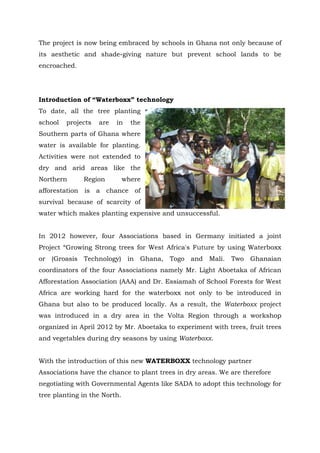
In 2012 however, four Associations based in Germany initiated a joint
Project “Growing Strong trees for West Africa's Future by using Waterboxx
or (Groasis Technology) in Ghana, Togo and Mali. Two Ghanaian
coordinators of the four Associations namely Mr. Light Aboetaka of African
Afforestation Association (AAA) and Dr. Essiamah of School Forests for West
Africa are working hard for the waterboxx not only to be introduced in
Ghana but also to be produced locally. As a result, the Waterboxx project
was introduced in a dry area in the Volta Region through a workshop
organized in April 2012 by Mr. Aboetaka to experiment with trees, fruit trees
and vegetables during dry seasons by using Waterboxx.
With the introduction of this new WATERBOXX technology partner
Associations have the chance to plant trees in dry areas. We are therefore
negotiating with Governmental Agents like SADA to adopt this technology for
tree planting in the North.
Incentives for our Project Schools in Ghana include:
- Exchange of letters between partner school children in Ghana and
Germany
- Building of toilets in Ghanaian Project Schools
- Providing water facilities on Partner School compounds
- Supporting needy but intelligent school children
- Sending German volunteers to teach environmental education
including hygienic measures in Project Schools
- Providing solar lamps as incentive to replace kerosene lamps
Solar equipment as incentive for tree planting
Since 1997, as an incentive for planting trees, solar equipments are being
introduced into the Project to motivate teachers and the children to involve
themselves in the Project.
In 1978 solar cookers were introduced to reduce the use of fuel wood which
amounts to over 70% of household energy but have to be abandoned due to
lack of interest. Since 2007 solar lamps are being successfully introduced
under the Motto “Tree planting for solar lamps” in order to realize the
Project-idea “Solar lamp for each School Child”.
A child qualifies for a free solar lamp by planting and tendering for four (4)
trees a year while some parents use the lamps for micro-credit. This is to
enable children to have decent light to study at night while their parents to
do micro-businesses at night (selling on the streets). The aim is also to
replace the thousands of kerosene lamps which are unhealthy but at the
same time ensure the reforestation of degraded areas. This project titled
“One Child One Solar Light” which provided small powerful LED solar lamps
was among 16 selected projects which won World Bank prize in Accra in
2008 (s. link)
http://www.modernghana.com/news/164842/1/ghanaian-engineer-wins-
us200000.html
Solar powered Computer Project at Nyakrom SHS as an incentive for
tree planting
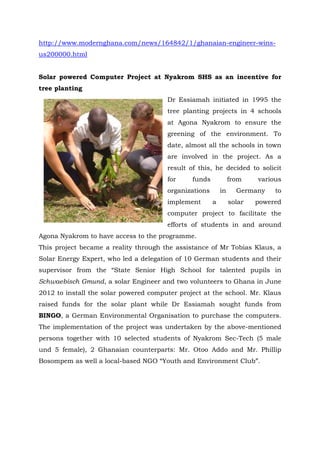
Dr Essiamah initiated in 1995 the
tree planting projects in 4 schools
at Agona Nyakrom to ensure the
greening of the environment. To
date, almost all the schools in town
are involved in the project. As a
result of this, he decided to solicit
for funds from various
organizations in Germany to
implement a solar powered
computer project to facilitate the
efforts of students in and around
Agona Nyakrom to have access to the programme.
This project became a reality through the assistance of Mr Tobias Klaus, a
Solar Energy Expert, who led a delegation of 10 German students and their
supervisor from the “State Senior High School for talented pupils in
Schwaebisch Gmund, a solar Engineer and two volunteers to Ghana in June
2012 to install the solar powered computer project at the school. Mr. Klaus
raised funds for the solar plant while Dr Essiamah sought funds from
BINGO, a German Environmental Organisation to purchase the computers.
The implementation of the project was undertaken by the above-mentioned
persons together with 10 selected students of Nyakrom Sec-Tech (5 male
und 5 female), 2 Ghanaian counterparts: Mr. Otoo Addo and Mr. Phillip
Bosompem as well a local-based NGO “Youth and Environment Club”.
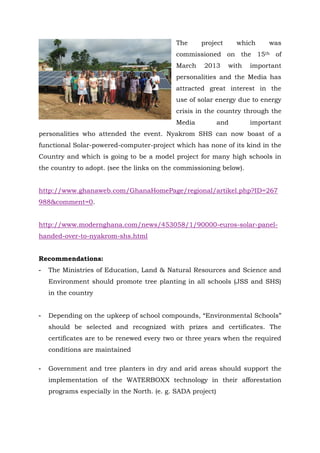
The project which was
commissioned on the 15th of
March 2013 with important
personalities and the Media has
attracted great interest in the
use of solar energy due to energy
crisis in the country through the
Media and important
personalities who attended the event. Nyakrom SHS can now boast of a
functional Solar-powered-computer-project which has none of its kind in the
Country and which is going to be a model project for many high schools in
the country to adopt. (see the links on the commissioning below).
http://www.ghanaweb.com/GhanaHomePage/regional/artikel.php?ID=267
988&comment=0.
http://www.modernghana.com/news/453058/1/90000-euros-solar-panel-
handed-over-to-nyakrom-shs.html
Recommendations:
- The Ministries of Education, Land & Natural Resources and Science and
Environment should promote tree planting in all schools (JSS and SHS)
in the country
- Depending on the upkeep of school compounds, “Environmental Schools”
should be selected and recognized with prizes and certificates. The
certificates are to be renewed every two or three years when the required
conditions are maintained
- Government and tree planters in dry and arid areas should support the
implementation of the WATERBOXX technology in their afforestation
programs especially in the North. (e. g. SADA project)
- Old Students Associations and individuals in Diaspora and Ghana
should support the installations of solar plants to their schools and
institutions not only to promote solar technology but also help reduce
electricity costs and even sell surplus energy to the Electricity Company
of Ghana.
The Project is being presented as a lighthouse project to serve as a model for
other African countries to promote reforestation through school children and
to focus on solar as the future energy source for Africa
………….
For more Info on the activities of the Association “School Forests For West
Africa, please contact:
Dr. Sam Essiamah
Brauweg 53
37073 Göttingen
Germany
Tel: +49-551 717 96
info@schulwaelder.org
WWW.schulwaelder.org

Ghana School Project - Introduction of Waterboxx Technology Facilitates Trees Planting in Dry Regions

  • 1.
    Solar Equipment forGhanaian Schools as Incentive for Tree Planting (A Light house Project of the Association “School Forest for West Africa” from the Diaspora). The impact of increasing forest degradation in West Africa is remarkable and unfortunately has direct consequence on rural forest dwelling communities, particularly school children in these areas. In Ghana for instance, the rain forest decreased from 8 to 1, 4 million hectares within a period of 80 years. In previous times, there were shade trees on school compounds and rural community settlement areas where school children and adults could sit, play and study. However, many of these places are now void of trees, become eroded and dusty places, exposing the foundation of some school and old buildings, leaving them “hanging”, which pose risk of collapse with the dust from the exposed soils also causing health risks to these children. Reforestation is therefore extremely necessary if children and people living in the country side are to have a secured future. In 1995, the Project “Tree Planting on School Compounds in Ghana” was initiated by Dr. Sam Essiamah, a Forest Research Scientist, Chairman and Project Coordinator of an Association “School Forests for West Africa ”, based in Germany, with 4 schools. This has since increased participating schools to 75 mainly in the Central Region. The school children plant and tender for these shade trees, donated by the Association in Germany and other German partnered Schools, supervised by Partner Organisations in Ghana “Youth and Environment Club” together with their teachers”. The aim is to change the negative attitude of children (the future generation) towards trees or rain forests to either reduce the degradation or stop it in future.
  • 2.
    The project isnow being embraced by schools in Ghana not only because of its aesthetic and shade-giving nature but prevent school lands to be encroached. Introduction of “Waterboxx” technology To date, all the tree planting school projects are in the Southern parts of Ghana where water is available for planting. Activities were not extended to dry and arid areas like the Northern Region where afforestation is a chance of survival because of scarcity of water which makes planting expensive and unsuccessful. In 2012 however, four Associations based in Germany initiated a joint Project “Growing Strong trees for West Africa's Future by using Waterboxx or (Groasis Technology) in Ghana, Togo and Mali. Two Ghanaian coordinators of the four Associations namely Mr. Light Aboetaka of African Afforestation Association (AAA) and Dr. Essiamah of School Forests for West Africa are working hard for the waterboxx not only to be introduced in Ghana but also to be produced locally. As a result, the Waterboxx project was introduced in a dry area in the Volta Region through a workshop organized in April 2012 by Mr. Aboetaka to experiment with trees, fruit trees and vegetables during dry seasons by using Waterboxx. With the introduction of this new WATERBOXX technology partner Associations have the chance to plant trees in dry areas. We are therefore negotiating with Governmental Agents like SADA to adopt this technology for tree planting in the North.
  • 3.
    Incentives for ourProject Schools in Ghana include: - Exchange of letters between partner school children in Ghana and Germany - Building of toilets in Ghanaian Project Schools - Providing water facilities on Partner School compounds - Supporting needy but intelligent school children - Sending German volunteers to teach environmental education including hygienic measures in Project Schools - Providing solar lamps as incentive to replace kerosene lamps Solar equipment as incentive for tree planting Since 1997, as an incentive for planting trees, solar equipments are being introduced into the Project to motivate teachers and the children to involve themselves in the Project. In 1978 solar cookers were introduced to reduce the use of fuel wood which amounts to over 70% of household energy but have to be abandoned due to lack of interest. Since 2007 solar lamps are being successfully introduced under the Motto “Tree planting for solar lamps” in order to realize the Project-idea “Solar lamp for each School Child”. A child qualifies for a free solar lamp by planting and tendering for four (4) trees a year while some parents use the lamps for micro-credit. This is to enable children to have decent light to study at night while their parents to do micro-businesses at night (selling on the streets). The aim is also to replace the thousands of kerosene lamps which are unhealthy but at the same time ensure the reforestation of degraded areas. This project titled “One Child One Solar Light” which provided small powerful LED solar lamps was among 16 selected projects which won World Bank prize in Accra in 2008 (s. link)
  • 4.
    http://www.modernghana.com/news/164842/1/ghanaian-engineer-wins- us200000.html Solar powered ComputerProject at Nyakrom SHS as an incentive for tree planting Dr Essiamah initiated in 1995 the tree planting projects in 4 schools at Agona Nyakrom to ensure the greening of the environment. To date, almost all the schools in town are involved in the project. As a result of this, he decided to solicit for funds from various organizations in Germany to implement a solar powered computer project to facilitate the efforts of students in and around Agona Nyakrom to have access to the programme. This project became a reality through the assistance of Mr Tobias Klaus, a Solar Energy Expert, who led a delegation of 10 German students and their supervisor from the “State Senior High School for talented pupils in Schwaebisch Gmund, a solar Engineer and two volunteers to Ghana in June 2012 to install the solar powered computer project at the school. Mr. Klaus raised funds for the solar plant while Dr Essiamah sought funds from BINGO, a German Environmental Organisation to purchase the computers. The implementation of the project was undertaken by the above-mentioned persons together with 10 selected students of Nyakrom Sec-Tech (5 male und 5 female), 2 Ghanaian counterparts: Mr. Otoo Addo and Mr. Phillip Bosompem as well a local-based NGO “Youth and Environment Club”.
  • 5.
    The project whichwas commissioned on the 15th of March 2013 with important personalities and the Media has attracted great interest in the use of solar energy due to energy crisis in the country through the Media and important personalities who attended the event. Nyakrom SHS can now boast of a functional Solar-powered-computer-project which has none of its kind in the Country and which is going to be a model project for many high schools in the country to adopt. (see the links on the commissioning below). http://www.ghanaweb.com/GhanaHomePage/regional/artikel.php?ID=267 988&comment=0. http://www.modernghana.com/news/453058/1/90000-euros-solar-panel- handed-over-to-nyakrom-shs.html Recommendations: - The Ministries of Education, Land & Natural Resources and Science and Environment should promote tree planting in all schools (JSS and SHS) in the country - Depending on the upkeep of school compounds, “Environmental Schools” should be selected and recognized with prizes and certificates. The certificates are to be renewed every two or three years when the required conditions are maintained - Government and tree planters in dry and arid areas should support the implementation of the WATERBOXX technology in their afforestation programs especially in the North. (e. g. SADA project)
  • 6.
    - Old StudentsAssociations and individuals in Diaspora and Ghana should support the installations of solar plants to their schools and institutions not only to promote solar technology but also help reduce electricity costs and even sell surplus energy to the Electricity Company of Ghana. The Project is being presented as a lighthouse project to serve as a model for other African countries to promote reforestation through school children and to focus on solar as the future energy source for Africa …………. For more Info on the activities of the Association “School Forests For West Africa, please contact: Dr. Sam Essiamah Brauweg 53 37073 Göttingen Germany Tel: +49-551 717 96 info@schulwaelder.org WWW.schulwaelder.org