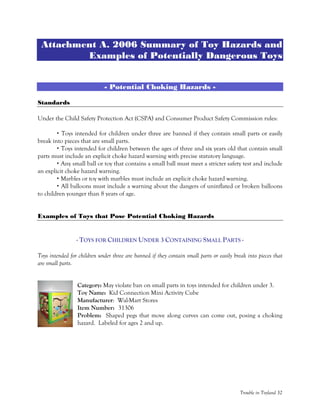
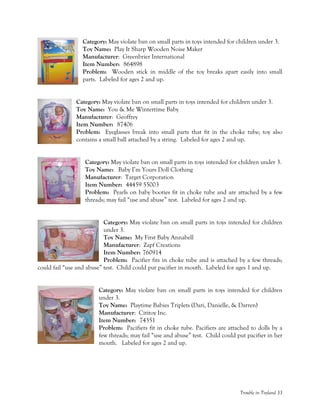
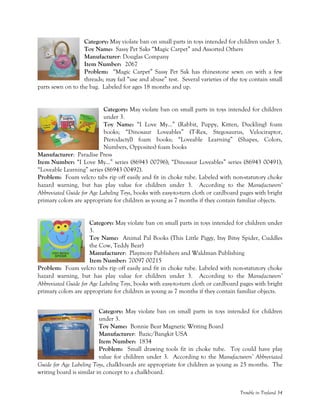
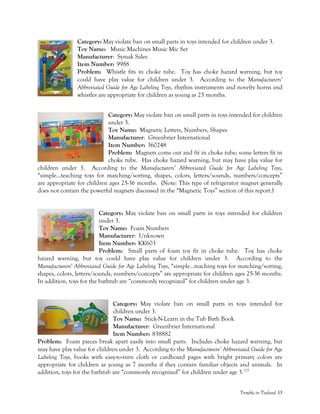
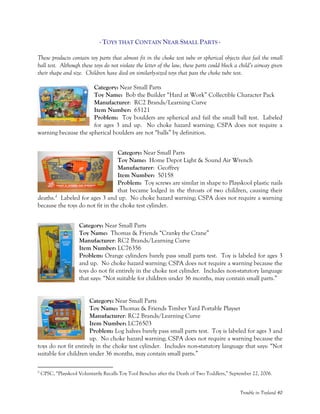
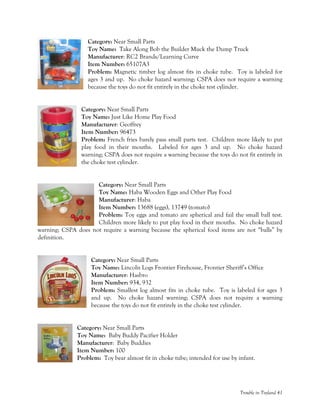
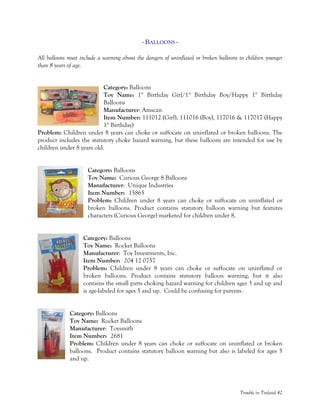
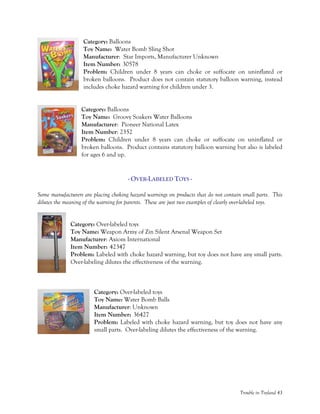
21st Annual Toy
Safety Survey
U.S. PIRG Education Fund November 2006
Trouble in Toyland
The 21st
Annual Survey of Toy Safety
U.S. PIRG Education Fund
November 2006
Trouble in Toyland 2
Acknowledgements
Written by Alison Cassady, Research Director with the U.S. PIRG Education Fund.
U.S. PIRG Education Fund issues this report under a Creative Commons “some
rights reserved” license. You are free to copy, distribute or display the work for non-
commercial purposes, with attribution. For more information about this Creative
Commons license, visit http://creativecommons.org/licenses/by-nc-nd/2.5/.
Cover photos: iStockPhoto (background photo, child with balloons); Ana Abejon/iStockPhoto
(baby with rubber duck); and Monika Adamczyk/iStockPhoto (child with blocks).
The author would like to thank Nancy A. Cowles, Executive Director of Kids in Danger; Alexa
Engelman, Public Interest Litigation Coordinator, Center for Environmental Health; and Rachel
Weintraub, Director of Product Safety and Senior Counsel, Consumer Federation of America, for
their help with this report. Special thanks to the Colston Warne program of Consumers Union
for supporting our work on consumer protection issues. Additional thanks to the Beldon Fund
and individual contributors for their generous support of our work on environmental health and
toxics issues.
U.S. PIRG, the federation of state Public Interest Research Groups (PIRGs), takes on powerful
interests on behalf of the American public, working to win concrete results for our health and our
well-being. The state PIRGs are a nationwide network of nonprofit, nonpartisan, state-based
public interest advocacy organizations. The state PIRGs’ mission is to deliver persistent, result-
oriented activism that protects the environment, encourages a fair marketplace for consumers, and
fosters responsive, democratic government.
For a copy of this report, visit our website or send a check for $30 made payable to U.S PIRG
Education Fund at the following address:
U.S. PIRG Education Fund
218 D Street SE
Washington, DC 20003
(202) 546-9707
www.uspirg.org
Trouble in Toyland 3
Table of Contents
Executive Summary ................................................................................................................. 4
Introduction............................................................................................................................ 6
Choking Hazards ..................................................................................................................... 7
CPSC Bans Small Parts for Children Under Age 3.......................................................................7
Labeling Requirements for Toys with Small Parts for Children Over Age 3 ................................8
Toy Survey Findings: Choking Hazards.........................................................................................9
Magnetic Toys.........................................................................................................................12
Dangers of Powerful Magnets.......................................................................................................12
MEGA Brands’ Magnetix Toys ....................................................................................................12
Magnets in Jewelry........................................................................................................................13
Standards for Magnets in Toys.....................................................................................................14
Excessively Loud Toys .............................................................................................................15
Standards for Loud Toys..............................................................................................................15
Toy Survey Findings: Loud Toys..................................................................................................16
Recommendations........................................................................................................................16
Toxic Chemicals in Toys .........................................................................................................17
Lead in Children’s Jewelry ...........................................................................................................17
Phthalates in Products Intended for Small Children...................................................................20
Toxic Chemicals in Children’s Cosmetics...................................................................................23
Strangulation Hazards.............................................................................................................25
Water Yo-Yo Balls.........................................................................................................................25
Cords and Elastics in Toys ...........................................................................................................26
Crib Mobiles.................................................................................................................................27
Drawstring Clothing.....................................................................................................................27
Other Toy Hazards .................................................................................................................28
Projectiles......................................................................................................................................28
Scooters ........................................................................................................................................28
Holes in the Toy Safety Net.....................................................................................................29
Loopholes in Toy Safety Regulation ............................................................................................29
Ineffective Toy Recalls..................................................................................................................29
Methodology...........................................................................................................................31
Attachment A. 2006 Summary of Toy Hazards and Examples of Potentially Dangerous Toys ..32
Attachment B. Toy-Related Deaths, 1990-2004 .......................................................................51
Attachment C. Lead in Children’s Jewelry: Test Results ..........................................................52
Attachment D. Putting the “Phthalate-Free” Label to the Test: Laboratory Test Results.........53
End Notes...............................................................................................................................54
Trouble in Toyland 4
Executive Summary
oys are safer than ever before, thanks to
decades of work by product safety
advocates and parents and the leadership of
Congress, state legislatures and the
Consumer Product Safety Commission
(CPSC). Nevertheless, as parents venture
into crowded malls this holiday season, they
should remain vigilant about often hidden
hazards posed by toys on store shelves.
The 2006 Trouble in Toyland report is the 21st
annual Public Interest Research Group
(PIRG) survey of toy safety. This report
provides safety guidelines for parents when
purchasing toys for small children and
provides examples of toys currently on store
shelves that may pose potential safety
hazards. This year, we focused on four
categories of toys: toys that may pose choking
hazards, magnetic toys, toys that are
excessively loud, and toys that contain
potentially toxic chemicals.
We visited numerous toy stores and other
retailers to find potentially dangerous toys
and identify trends in toy safety. Key
findings include:
- CHOKING HAZARDS -
Choking on small parts, small balls and
balloons remains a leading cause of toy-
related deaths and injuries. Between 1990
and 2004, at least 157 children died after
choking or asphyxiating on a toy or toy part;
seven children died in 2004 alone. The law
bans small parts in toys for children under
three and requires a warning label on toys
with small parts for children between the
ages of three and six.
Although most toys on store shelves are safe,
we still found some toys that may pose
choking hazards. Specifically:
We found toys for children under three
with small parts and toys with small parts for
children under six without the required
choke hazard warning label. Balloons, which
cause the most choking deaths, are still
marketed inappropriately for young children.
Some toys may pose a choking or
suffocation hazard even if they meet the letter
of the law. This year, two small children
suffocated when oversized, plastic toy nails
sold with a play tool bench became forcefully
lodged in their throats.
We recommend making the test for small
parts more protective of children under
three. CPSC also should consider, at
minimum, special labeling for toys shaped
like corks or the toy nails, which pose special
suffocation risks because of their shape.
- MAGNETIC TOYS -
Over the last year, one child died and several
others were gravely injured after swallowing
tiny but powerful magnets now commonly
used in magnetic building toys and magnetic
jewelry. If a child swallows more than one of
these magnets, the magnets can attract to
each other and cause intestinal perforation or
blockage. CPSC should adopt and enforce
strong mandatory guidelines for labeling
magnetic toys to ensure parents know to seek
immediate medical attention if a child
swallows magnets.
T
Trouble in Toyland 5
- LOUD TOYS -
Almost 15 percent of children ages 6 to 17
show signs of hearing loss. In November
2003, the American Society for Testing and
Materials adopted a voluntary acoustics
standard for toys, setting the loudness
threshold for most toys at 90 decibels. We
found that several toys currently on store
shelves may not meet the standards for
appropriately loud toys; in fact, several toys
we tested exceed 100 decibels when
measured at close range.
CPSC should enforce the acoustics standards
for loud toys and consider strengthening
them to be more protective of children’s
hearing.
- TOXIC CHEMICALS IN TOYS -
Some toys can pose hidden hazards, exposing
children to dangerous chemicals that are
linked to serious health problems. We
found:
Some children’s jewelry may contain
high levels of lead, which can cause
developmental delays or even death in
children exposed to this heavy metal. We
found four examples of jewelry on store
shelves containing lead at levels ranging from
1.8% to 34% of the item’s weight. CPSC has
recalled more than 150 million pieces of lead-
laden children’s jewelry since 2004, but
CPSC needs to do more to keep this jewelry
off the shelves in the first place by enacting
and enforcing requirements for jewelry
manufacturers, retailers, and suppliers to test
their products for lead.
Manufacturers are selling play cosmetic
sets that include nail polish containing toxic
chemicals, such as toluene and xylene. Since
children often put their hands in their
mouths, nail polish offers a direct route of
exposure. CPSC should team up with the
Food and Drug Administration to require
manufacturers to stop using toxic chemicals
in cosmetics marketed for children.
Last year, we commissioned laboratory
tests of eight soft plastic toys labeled as not
containing phthalates, a class of chemicals
linked to reproductive defects and other
health problems. We found that six of the
eight “phthalate-free” products actually
contained phthalates. This year, we again
tested 10 toys labeled as “phthalate-free.” Of
the 10 toys tested, two contained detectable
levels of phthalates. Although this may be
better news for consumers, nothing in the
law has changed to hold toymakers
accountable to the “phthalate-free” label.
CPSC should ban phthalates in toys and
other products intended for children under
five and work with the Federal Trade
Commission to ensure that toys labeled
“phthalate-free” do not contain phthalates.
- RECOMMENDATIONS FOR CONSUMERS -
Be vigilant this holiday season, and
remember:
The CPSC does not test all toys, and
not all toys on store shelves meet CPSC
standards.
Our report includes only a sample of
potentially hazardous toys. Examine toys
carefully for potential dangers before you
make a purchase.
Report unsafe toys or toy-related
injuries to the CPSC.
Trouble in Toyland 6
Introduction
oys should entertain and educate
children; however, poorly designed and
constructed toys can cause injury and even
death. According to data from the
Consumer Product Safety Commission
(CPSC), at least 16 children, none older than
nine years old, died in 2004 from toy-related
injuries. Seven of the children died from
choking or asphyxiating on a toy or toy part.
Approximately 210,300 people sought
treatment in hospital emergency rooms in
2004 for toy-related injuries; at least 72,800
(35 percent) of those injured were younger
than five years old. Riding toys, such as non-
powered scooters, accounted for more
injuries than any other category of toy—34
percent.1
Since 1986, we have conducted toy safety
research and education projects to avoid such
tragic and preventable deaths and injuries.
Our toy safety reports over the last 20 years
have led to at least 120 corrective actions or
recalls by the CPSC and manufacturers.a
Much of our advocacy has focused on the
leading cause of toy deaths: choking. Despite
federal regulations designed to reduce toy-
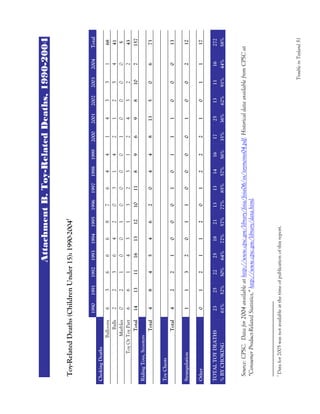
related choking deaths, at least 157 children
choked to death on children’s products
between 1990 and 2004, a rate of about 10
deaths a year, accounting for more than half
of all toy-related deaths. See Attachment B
for more data on toy-related deaths.
a
Over the last few years, CPSC has not responded to
our numerous Freedom of Information Act (FOIA)
requests for information about recalls and
enforcement actions taken as a result of our Trouble in
Toyland report. As of 2002, CPSC had informed us of
105 PIRG-initiated recalls and enforcement actions.
We estimate that the last three reports resulted in at
least 15 additional CPSC enforcement actions,
including two recalls.
T
Choking Hazards
CPSC Bans Small Parts for
Children Under Age 3
In 1979, CPSC banned the sale of toys
containing small parts if they are intended
for use by children under the age of three,
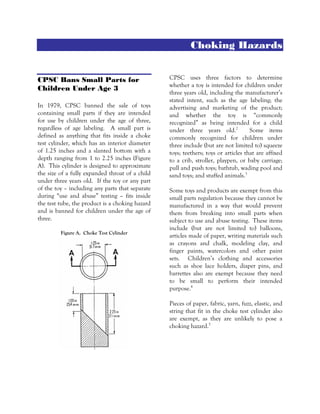
regardless of age labeling. A small part is
defined as anything that fits inside a choke
test cylinder, which has an interior diameter
of 1.25 inches and a slanted bottom with a
depth ranging from 1 to 2.25 inches (Figure
A). This cylinder is designed to approximate
the size of a fully expanded throat of a child
under three years old. If the toy or any part
of the toy – including any parts that separate
during “use and abuse” testing – fits inside
the test tube, the product is a choking hazard
and is banned for children under the age of
three.
Figure A. Choke Test Cylinder
CPSC uses three factors to determine
whether a toy is intended for children under
three years old, including the manufacturer’s
stated intent, such as the age labeling; the
advertising and marketing of the product;
and whether the toy is “commonly
recognized” as being intended for a child
under three years old.2
Some items
commonly recognized for children under
three include (but are not limited to) squeeze
toys; teethers; toys or articles that are affixed
to a crib, stroller, playpen, or baby carriage;
pull and push toys; bathtub, wading pool and
sand toys; and stuffed animals.3
Some toys and products are exempt from this
small parts regulation because they cannot be
manufactured in a way that would prevent
them from breaking into small parts when
subject to use and abuse testing. These items
include (but are not limited to) balloons,
articles made of paper, writing materials such
as crayons and chalk, modeling clay, and
finger paints, watercolors and other paint
sets. Children’s clothing and accessories
such as shoe lace holders, diaper pins, and
barrettes also are exempt because they need
to be small to perform their intended
purpose.4
Pieces of paper, fabric, yarn, fuzz, elastic, and
string that fit in the choke test cylinder also
are exempt, as they are unlikely to pose a
choking hazard.5
Trouble in Toyland 8
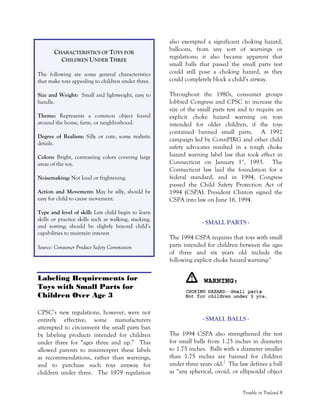
CHARACTERISTICS OF TOYS FOR
CHILDREN UNDER THREE
The following are some general characteristics
that make toys appealing to children under three.
Size and Weight: Small and lightweight, easy to
handle.
Theme: Represents a common object found
around the home, farm, or neighborhood.
Degree of Realism: Silly or cute, some realistic
details.
Colors: Bright, contrasting colors covering large
areas of the toy.
Noisemaking: Not loud or frightening.
Action and Movement: May be silly, should be
easy for child to cause movement.
Type and level of skill: Lets child begin to learn
skills or practice skills such as walking, stacking,
and sorting; should be slightly beyond child’s
capabilities to maintain interest.
Source: Consumer Product Safety Commission
Labeling Requirements for
Toys with Small Parts for
Children Over Age 3
CPSC’s new regulations, however, were not
entirely effective; some manufacturers
attempted to circumvent the small parts ban
by labeling products intended for children
under three for “ages three and up.” This
allowed parents to misinterpret these labels
as recommendations, rather than warnings,
and to purchase such toys anyway for
children under three. The 1979 regulation
also exempted a significant choking hazard,
balloons, from any sort of warnings or
regulations; it also became apparent that
small balls that passed the small parts test
could still pose a choking hazard, as they
could completely block a child’s airway.
Throughout the 1980s, consumer groups
lobbied Congress and CPSC to increase the
size of the small parts test and to require an
explicit choke hazard warning on toys
intended for older children, if the toys
contained banned small parts. A 1992
campaign led by ConnPIRG and other child
safety advocates resulted in a tough choke
hazard warning label law that took effect in
Connecticut on January 1st
, 1993. The
Connecticut law laid the foundation for a
federal standard, and in 1994, Congress
passed the Child Safety Protection Act of
1994 (CSPA). President Clinton signed the
CSPA into law on June 16, 1994.
- SMALL PARTS -
The 1994 CSPA requires that toys with small
parts intended for children between the ages
of three and six years old include the
following explicit choke hazard warning:6
- SMALL BALLS -
The 1994 CSPA also strengthened the test
for small balls from 1.25 inches in diameter
to 1.75 inches. Balls with a diameter smaller
than 1.75 inches are banned for children
under three years old.7
The law defines a ball
as “any spherical, ovoid, or ellipsoidal object
Trouble in Toyland 9
that is designed or intended to be thrown,
hit, kicked, rolled, dropped, or bounced.”8
According to this definition, toys that are
spherical or have spherical parts but are not
intended for use as a ball do not have to
meet this test.
Round objects are more likely to choke
children because they can completely block a
child’s airway. Any small ball intended for
children over the age of three must include
the following warning:9
Any toy or game containing a small ball and
intended for children between ages three and
eight must include the following warning:
- BALLOONS -
Balloons pose a grave choking hazard to
children, causing more choking deaths than
any other children’s product. Almost half
(43 percent) of the choking fatalities reported
to the CPSC between 1990 and 2004
involved balloons. The 1994 law requires the
following choke hazard warning on all
balloons:10
- MARBLES -
Any marble intended for children three years
of age or older must bear the following
cautionary statement on its packaging:11
Any toy or game containing a marble and
intended for children between ages three and
eight must include the following warning:
- BINS AND VENDING MACHINES -
Finally, the CSPA requires choke hazard
labels on bins and vending machines. If toys
or small balls requiring labels are sold in
vending machines or unpackaged in bins,
these vending machines and bins must
display the statutory warnings.12
Toy Survey Findings: Choking
Hazards
PIRG researchers surveying toy stores in the
fall of 2006 identified the following trends:
- MOST TOYS ARE SAFE AND
PROPERLY LABELED -
Overall, manufacturers and toy retailers are
doing a good job of marketing and labeling
small balls, balloons, small toys and toys with
small parts, ensuring either that the bin in
which the toy is sold or the toy packaging is
Trouble in Toyland 10
labeled with the required choke hazard
warning.
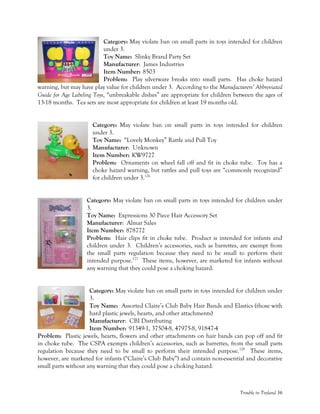
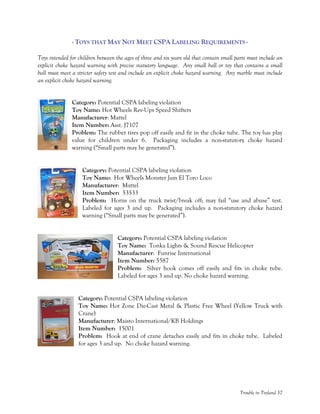
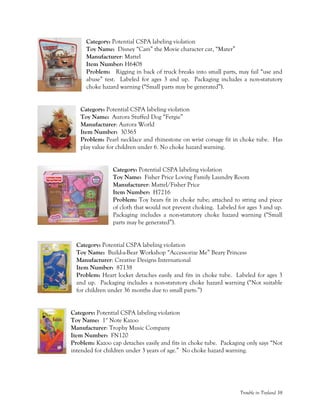
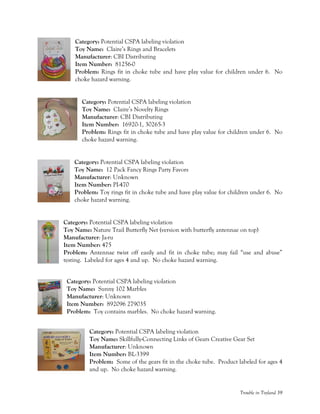
- SOME TOYS MAY NOT MEET CSPC
REQUIREMENTS -
The law bans small parts in toys for children
under three and requires a warning label on
toys with small parts for children between the
ages of three and six. PIRG researchers,
however, still found toys for children under
three with small parts and toys with small
parts for children under six without the
statutory choke hazard warning. See
Attachment A for a list of toys that may not
meet the CPSC standards for choking
hazards.
- NEAR-SMALL PARTS MAY POSE
CHOKING HAZARDS -
In September 2006,
CPSC and Playskool
voluntarily recalled about
255,000 Team Talkin’
Tool Bench toys following
the deaths of two young
children. A 19-month-old West Virginia boy
and a 2-year-old Texas boy suffocated when
oversized, plastic toy nails sold with the tool
bench toys became forcefully lodged in their
throats.13
The toy was labeled for children three and
older but did not include a choke hazard
warning; the toy nails in question, measuring
three inches in height, passed the small parts
test. This tragic incident is a reminder that
some toys may pose a choking or suffocation
hazard even if they pass the small parts test.
In particular, toys shaped like corks or with
spherical, hemispherical, or circular flared
ends and attached to a shaft, like the toy nails
that caused the two suffocation deaths, could
pose particular hazards, even if they pass the
small parts test. To “address a potential
impaction hazard,” the Standard Consumer
Safety Specification for Toy Safety lays out
requirements for toys with spherical ends
that are intended for children under 18
months.14
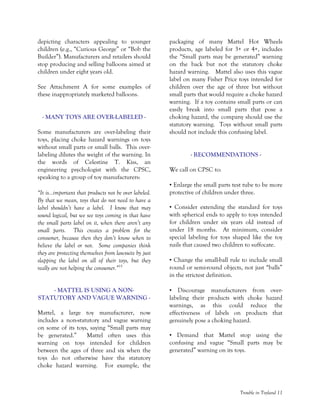
Under these specifications, toys of
this design weighing less than 1.1 pounds,
and intended for children up to 18 months
of age, should not be capable of entering and
penetrating past the full depth of the cavity
of the supplemental test fixture, also used for
some rattles and teethers (Figure B). A
similar standard for toys intended for
children over 18 months does not exist.
Figure B. Supplemental Test Fixture for Rattles,
Squeeze Toys, and Teethers
- BALLOONS ARE MARKETED TO
YOUNG CHILDREN -
The 1994 CSPA requires that all balloons
include a choke hazard warning alerting
parents to the dangers of balloons and
broken balloons for children under eight.
Some balloons, however, are marketed for
children under eight. For example, we found
balloons marketed specifically for toddlers
(e.g., “Baby’s First Birthday”) and balloons
Trouble in Toyland 11
depicting characters appealing to younger
children (e.g., “Curious George” or “Bob the
Builder”). Manufacturers and retailers should
stop producing and selling balloons aimed at
children under eight years old.
See Attachment A for some examples of
these inappropriately marketed balloons.
- MANY TOYS ARE OVER-LABELED -
Some manufacturers are over-labeling their
toys, placing choke hazard warnings on toys
without small parts or small balls. This over-
labeling dilutes the weight of the warning. In
the words of Celestine T. Kiss, an
engineering psychologist with the CPSC,
speaking to a group of toy manufacturers:
“It is…important that products not be over labeled.
By that we mean, toys that do not need to have a
label shouldn’t have a label. I know that may
sound logical, but we see toys coming in that have
the small parts label on it, when there aren’t any
small parts. This creates a problem for the
consumer, because then they don’t know when to
believe the label or not. Some companies think
they are protecting themselves from lawsuits by just
slapping the label on all of their toys, but they
really are not helping the consumer.”15
- MATTEL IS USING A NON-
STATUTORY AND VAGUE WARNING -
Mattel, a large toy manufacturer, now
includes a non-statutory and vague warning
on some of its toys, saying “Small parts may
be generated.” Mattel often uses this
warning on toys intended for children
between the ages of three and six when the
toys do not otherwise have the statutory
choke hazard warning. For example, the
packaging of many Mattel Hot Wheels
products, age labeled for 3+ or 4+, includes
the “Small parts may be generated” warning
on the back but not the statutory choke
hazard warning. Mattel also uses this vague
label on many Fisher Price toys intended for
children over the age of three but without
small parts that would require a choke hazard
warning. If a toy contains small parts or can
easily break into small parts that pose a
choking hazard, the company should use the
statutory warning. Toys without small parts
should not include this confusing label.
- RECOMMENDATIONS -
We call on CPSC to:
• Enlarge the small parts test tube to be more
protective of children under three.
• Consider extending the standard for toys
with spherical ends to apply to toys intended
for children under six years old instead of
under 18 months. At minimum, consider
special labeling for toys shaped like the toy
nails that caused two children to suffocate.
• Change the small-ball rule to include small
round or semi-round objects, not just “balls”
in the strictest definition.
• Discourage manufacturers from over-
labeling their products with choke hazard
warnings, as this could reduce the
effectiveness of labels on products that
genuinely pose a choking hazard.
• Demand that Mattel stop using the
confusing and vague “Small parts may be
generated” warning on its toys.
Trouble in Toyland 12
Magnetic Toys
mall but powerful magnets used in
magnetic building toys and magnetic
jewelry have come under increased scrutiny
after CPSC received reports of several serious
injuries and one death due to swallowing
magnets.
Dangers of Powerful
Magnets
Many magnetic toys on the market today use
neodymium iron boron (NIB) magnets,
which have increased in popularity with toy
manufacturers as they have become available
at lower cost from Chinese exporters. NIB
magnets are most common in magnetic
building sets, such as those manufactured
under the brand names Magnetix and
GeoMag, and magnetic jewelry, especially
earrings and bracelets. The NIB magnets
used in these toys are often the size of
popcorn kernels, but slightly larger NIB
magnets are so strong they can severely pinch
fingers and other body parts and damage
items ranging from credit cards to computers
to pacemakers.
Dr. Marsha Kay of the Cleveland Clinic has
stated: “Magnets are not like nickels and
quarters, which simply pass through the
digestive system. Magnets are much more
serious. They should be treated like batteries
or other foreign objects when they are
swallowed.”16
If swallowed, one magnet may
pass through the digestive system without
incident. If two or more magnets are
swallowed, however, they can attract each
other in the body. If one magnet is in the
stomach and another is in the small
intestine, for example, they can cling together
and quickly work their way through tissue,
perforating the wall or creating a hole. Two
or more magnets attracted to each other in
the intestine also can create a bowel
obstruction or perforation.17
As early as 2004, Dr. Alan E. Oestreich of
Cincinnati Children’s Hospital’s Department
of Radiology warned of the dangers of
multiple magnet ingestion. In the journal
Radiology, he wrote that “any time more than
one magnet passes beyond the pylorus of a
child (or, for that matter, an adult), an
emergency danger of necrosis and perforation
exists, and urgent surgical consideration is
required. When two magnets lie in adjacent
bowel loops, they may attract each other
across the walls, leading to necrosis and
eventually perforation and peritonitis.”18
He
also warned radiologists suspecting magnet
ingestion to avoid using MRIs to diagnose,
since the magnetic imaging could tear the
magnets through tissue if they are present.
MEGA Brands’ Magnetix Toys
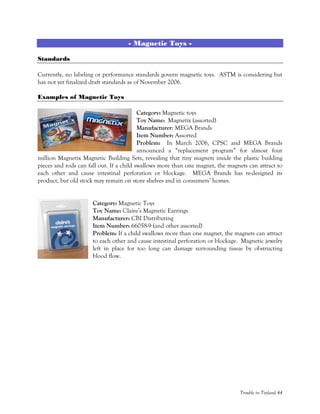
In March 2006, CPSC and Rose Art
Industries (a subsidiary of MEGA Brands)
announced a “replacement program” for
almost four million Magnetix magnetic
building sets. In the release announcing the
replacement program, CPSC stated that tiny
magnets inside the plastic building pieces and
rods can fall out. At the time of the
announcement, CPSC was aware of 34
incidents involving small magnets, including
one death and three intestinal perforations.19
S
Trouble in Toyland 13
In August 2005, a four
year old named
William Finley of
California swallowed
three magnets from a
Magnetix toy. After
he began experiencing extreme stomach pain,
doctors found the powerful magnets he had
swallowed had torn a hole in his intestine,
causing bacteria to flow into his abdomen.
In November 2005, a 21-month old boy
named Kenneth Sweet Jr. died of blood
poisoning and tissue necrosis; an autopsy
showed that two separate sets of magnets had
pinched parts of his small intestine.20
CPSC and Rose Art did not recall Magnetix
toys on store shelves. Instead, Rose Art told
consumers who are “uncomfortable having
the product in your home” to return the sets
to the company for a free replacement
product suitable for children under the age
of six.21
As of September 30, 2006, MEGA
Brands had received approximately 13,000
requests for replacements.22
This means that
most of the four million Magnetix toys sold
before March 31 have not been returned and
could remain in homes across the United
States.
To address the design flaw that allowed the
small magnets to fall out, the company
reinforced the magnets with resin and
instituted a quality control process at its
manufacturing facilities, according to a
company spokesman.23
As of November
2006, it is unclear whether CPSC has
investigated whether these design
modifications solved the problem.
MEGA Brands also modified the toy’s
packaging. The company now recommends
the toys for children six or older, so standard
Magnetix toys are no longer recommended
for three year-olds. In addition, the company
started adding a new warning to Magnetix
packaging that states: “CAUTION: Do not
ingest or inhale magnets. Attraction of
magnets in the body may cause serious injury
and require immediate medical care.”
Because the company did not issue a recall of
the faulty toys already in stores, however,
older stock may remain on shelves; as of early
November, we were able to find Magnetix
toys on store shelves without the design
modification or new magnet warning.
In October 2006, the company settled a
lawsuit with the families of 15 victims for
$13.5 million. Terms of the settlement,
which include no admission of liability, are
confidential.24
Magnets in Jewelry
In a 2002 article, four physicians from
Sheffield Children’s Hospital (Sheffield, UK)
discussed a rash of cases they had seen where
children used magnetic jewelry to imitate
pierced ears, noses, tongues and even penises.
Some children they saw swallowed the
magnets while attempting to use them,
resulting in one near fatal surgical
complication. Among the cases they saw:25
• A 10 year old boy presented with one
magnet in each nostril, the magnetic force
causing them to adhere tightly to the nasal
septum. The magnetic attraction was so
strong that even after only a few hours, an
area of pressure necrosis (tissue death) had
started developing around each magnet.
• After swallowing a number of small
magnets over a period of time while imitating
tongue piercing, a nine year old girl
complaining of abdominal pain, vomiting,
Trouble in Toyland 14
and diarrhea was found to have five
perforations in the small bowel and one in
the cecum. She stayed in intensive care for
one week and an additional week in the
general ward.
Standards for Magnets in
Toys
The CPSC has launched an ongoing
investigation into magnetic toys and the
dangers of NIB magnets in children’s toys.
In addition, a working group of ASTM
International (formerly known as the
American Society for Testing and Materials)
is looking into the idea of labeling toys
containing powerful magnets. At a
September 2006 meeting, the working group,
comprised mainly of representatives of toy
manufacturers, tentatively agreed to a draft
label for certain magnetic toys. According to
draft language, if the magnets can fall out of
the toy or if the toy pieces are small enough
to be swallowed, the ASTM guidelines would
require a label warning of the potentially
serious health impacts of swallowing
magnets. CPSC has the authority to enforce
the ASTM voluntary standards (once
finalized) and exercises that authority at its
discretion.
ASTM should adopt the most protective
labeling guidelines possible with a clear
warning for parents, stating: “Magnets can
attach across intestines and cause injury and
death. Seek immediate medical attention if a
child swallows one or more magnets.” CPSC
should enforce the ASTM standard for all
magnetic toys sold in the United States.
Trouble in Toyland 15
Excessively Loud Toys
etween one-quarter and one-third of
Americans with hearing loss can
attribute it, at least in part, to noise.26
Children are especially vulnerable to noise-
induced hearing loss, which often happens
gradually and without pain, from over-
exposure to loud noises.27
Almost 15 percent
of children ages 6 to 17 show signs of hearing
loss.28
Noise-induced hearing loss can be
caused by a one-time exposure to loud sound
as well as by repeated exposure to sounds at
various loudness levels over an extended
period of time.29
The Occupational Safety and Health
Administration reports that prolonged
exposure to sounds at 85 decibels (dB) or
higher can result in hearing damage.30
The
American Academy of Pediatrics and the
National Campaign for Hearing Health also
use 85 decibels as a threshold for dangerous
levels of noise.
The symptoms of noise-induced hearing loss
increase gradually over a period of
continuous exposure. Sounds may become
distorted or muffled, and it may be difficult
for the person to understand speech. Even
minor hearing loss in children can affect
their ability to speak and understand
language at a critical time in their
development.
The following are the accepted standards for
recommended permissible exposure time
before hearing damage can occur. For every
three decibels over 85 decibels, the
permissible exposure time before possible
damage is cut in half.31
Decibel Exposure Time Before Hearing
Damage Can Occur32
Continuous
dB
Permissible Exposure
Time
85 dB 8 hours
88 dB 4 hours
91 dB 2 hours
94 dB 1 hour
97 dB 30 minutes
100 dB 15 minutes
103 dB 7.5 minutes
106 dB < 4 minutes
109 dB < 2 minutes
112 dB 1 minute
115 dB 30 seconds
A report commissioned by the European
Union about noise from toys concluded that
children are unlikely to play with toys for
more than three hours per day on average;
they also are unlikely to be exposed to noise
from toys for more than 1.5 hours per day.
The report also notes, however, that children
“are exposed to many sources of noise, not
just toys, during everyday life. Any
consideration of permissible noise exposures
from toys, and of corresponding noise
emission limits for toys, needs to take these
other noise sources into account.”33
Standards for Loud Toys
In November 2003, ASTM finalized new
specifications for sound-producing toys that
are “intended to minimize the possibility of
hearing damage that might be caused by toys
that are designed to produce sound.”34
CPSC has the authority to enforce the
B
Trouble in Toyland 16
ASTM voluntary standards and exercises that
authority at its discretion. These standards
include the following:35
Hand-held, table-top, floor, and crib
toys should not produce continuous sound
that exceeds 90 dB when measured from 25
centimeters.
Close-to-the-ear toys should not
produce continuous sound that exceeds 70
dB when measured from 25 centimeters.
Toys with impact-type impulsive
sounds should not produce a peak sound in
excess of 120 dB when measured from 25
centimeters.
Toys with explosive-type sounds
should not produce a peak sound in excess of
138 dB when measured from 25 centimeters.
These standards, while a solid step in the
right direction, may not be sufficient to
ensure that loud toys will not harm children’s
hearing. Overall, the sound limits are too
high, since exposure to sounds at 85-90
decibels over two hours and sounds at 120
decibels over just 30 seconds can cause
hearing loss. Moreover, these standards are
voluntary for toy manufacturers, not
mandatory. CPSC has the authority to
enforce the ASTM voluntary standards and
exercises that authority at its discretion.
Finally, the standards are based on peak
sound pressure levels measured from a
distance of 25 centimeters. Children often
play with toys at a much closer distance than
25 centimeters—even holding a toy up to
their ears—and therefore could experience the
noise at a more powerful level. 36
Toy Survey Findings: Loud
Toys
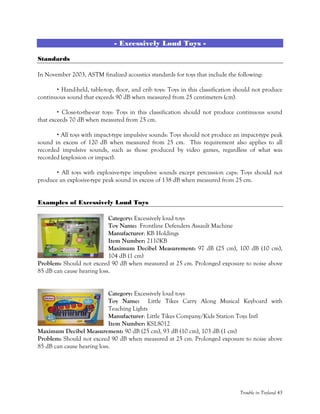
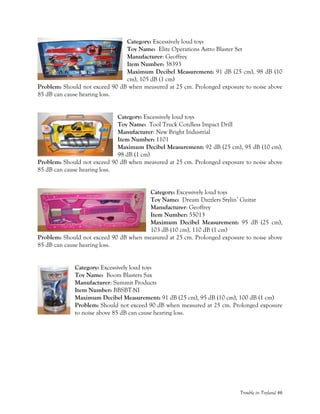
We measured the loudness of several toys,
taking the readings from 25 centimeters (9.84
inches), 10 centimeters (3.94 inches) and 1
centimeter (.39 inches) to determine the
range of noise to which a child playing with a
toy could be exposed. We found that several
toys currently on toy store shelves may not
meet the ASTM standards for appropriately
loud toys. In fact, some exceed 100 decibels
when measured at close range. Our results
are in Attachment A.
Recommendations
To protect children from loud toys, we offer
the following advice for parents:
If a toy seems too loud for you, then it
is probably too loud for your child.
Put tape over the speakers of any toys
you already own that are too loud or remove
the batteries.
Report a loud toy to the CPSC.
CPSC should:
Enforce the new ASTM standards to
the fullest extent.
Consider strengthening the standards
to be more protective of children’s delicate
ears. Specifically, CPSC and ASTM should
consider lowering the threshold for hand-
held toys from 90 decibels to no higher than
85 decibels.
Trouble in Toyland 17
Toxic Chemicals in Toys
Lead in Children’s Jewelry
Health officials and children’s health
advocates have long sought to reduce
children’s daily exposure to lead, which can
stunt mental and physical development.
Lead-based paint is a common concern, but
another hazard has come to the fore: lead in
children’s jewelry. Lead is used in pewter
alloys and as a component in lower-grade tin
commonly used in inexpensive and costume
jewelry. Lead also may be present in plastic
or polyvinyl chloride (PVC) jewelry
components and in the paint used on fake
pearls. Most of the lead-tainted jewelry sold
in the United States originates from Asian
manufacturing facilities, but some of it is
manufactured domestically.
- THE DANGERS OF LEAD -
Exposure to lead can affect almost every
organ and system in the human body,
especially the central nervous system. Lead is
especially toxic to the brains of young
children. A child exposed to a single high
dose of lead—such as by swallowing a piece of
metal jewelry containing lead—can suffer
permanent neurological and behavioral
damage, blood poisoning, and life-
threatening encephalopathy. Exposure to
low doses of lead can cause IQ deficits,
attention deficit hyperactivity disorder, and
deficits in vocabulary, fine motor skills,
reaction time, and hand-eye coordination.37
Children are more vulnerable to lead
exposure than adults, since young children
often put their hands and other objects in
their mouths; their growing bodies absorb
more lead; and children’s developing brains
and nervous systems are more sensitive to the
damaging effects of lead.
Scientists have not identified a “safe” level of
lead exposure for children.38
Research
published in the New England Journal of
Medicine in 2003 showed that children can
lose IQ points at levels of lead in blood below
the “official” level of concern as defined by
the Centers for Disease Control.39
- FEDERAL STANDARDS FOR LEAD IN
CHILDREN’S JEWELRY -
Two federal statutes address the lead content
of toys. Under the Consumer Product Safety
Act, regulations ban paint containing lead in
a concentration of greater than 600 parts per
million (0.06% by weight).40
Under the
Federal Hazardous Substances Act, CPSC
may deem articles of metal jewelry as
“hazardous substances” if they contain toxic
quantities of lead sufficient to cause
substantial illness as a result of reasonably
foreseeable handling or use, including
ingestion.41
If such jewelry is intended for
use by children and the toxic lead content is
accessible by a child, then it constitutes a
banned hazardous substance under the law.42
In February 2005, CPSC issued an interim
enforcement policy for children’s metal
jewelry containing lead to give
“manufacturers, importers, and retailers clear
guidance on steps they should take to
minimize the risk for children.”43
The policy
Trouble in Toyland 18
states that if the total lead concentration of
any component of the metal jewelry exceeds
600 parts per million (0.06% by weight) and
the accessible lead from the same component
exceeds 175 micrograms, then CPSC staff
will decide whether to perform a corrective
action on a case by case basis. In making this
decision, the staff will take into account the
age grading of the jewelry, the level of
accessible lead, the probable routes of
exposure, and the number of items on the
market.44
The Center for Environmental Health, a
non-profit organization that has tested
hundreds of jewelry items for lead since
2003, argues that the interim CPSC policy
falls short of what is necessary to protect
children, for several reasons, including:45
• The policy is premised on the false claim
that the “scientific community generally
recognizes a blood lead level of 10
micrograms per deciliter (ug/dl) of blood as a
level of concern.”46
In fact, CDC has
concluded that “no ‘safe’ threshold for blood
lead levels … in young children has been
identified.”47
CDC also has rejected CPSC’s
regulatory approach of modeling risk based
on blood lead levels over 10 micrograms per
deciliter.48
• The policy is based on “accessible” lead,
which is more subjective than the total lead
contained in a product. A child who
swallows a metal pendant could be exposed
to all of the lead in the item.
• The policy calls for testing each jewelry
component but does not take into account
potential exposure from multiple
components. Under the CPSC policy, for
example, each charm on a bracelet with
multiple charms could contain up to 175
micrograms of accessible lead without
triggering any agency action.
• The policy refers only to children’s “metal
jewelry” even though PVC plastic and other
materials used in children’s jewelry can
contain lead.
• The policy is an “interim” guidance, not an
agency rule, and therefore does not establish
any new regulations or requirements for
manufacturers or importers to test children’s
jewelry.
Members of Congress have called for CPSC
to take stronger action on lead in children’s
products. In December 2005, Senator
Barack Obama (IL) introduced the Lead Free
Toys Act, which directs the CPSC to
prescribe regulations classifying any
children’s product containing lead as a
banned substance under the Federal
Hazardous Substances Act. This would
include any product marketed or used by
children under age six that contains more
than trace amounts of lead.49
Congressman
Henry Waxman (CA) first introduced the
legislation in the House in February 2005.50
- CPSC ISSUES VOLUNTARY RECALLS -
The CPSC has issued voluntary recalls of
lead-containing jewelry, many stemming from
incidents of lead-poisoning from the lead-
tainted products. In 2004, the agency
announced recalls of more than 150 million
pieces of children’s jewelry sold in vending
machines and retail stores.51
CPSC’s interim enforcement policy has not
prevented jewelry with dangerous levels of
lead from falling through the cracks. In
Trouble in Toyland 19
March 2006, CPSC recalled 300,000 Reebok
heart-shaped charm bracelets. A four year-
old child from Minneapolis died in February
of acute lead poisoning after he swallowed a
piece from one of these bracelets.52
During
autopsy, doctors removed the Reebok charm
from the boy’s stomach and learned that it
contained 99% lead by weight.53
Since the February 2005 enforcement policy
went into effect, CPSC has issued numerous
additional recalls affecting millions of pieces
of jewelry. In May 2006, for example, CPSC
recalled 730,000 metal charms included as a
free giveaway in certain Shirley Temple movie
DVDs.54
- LABORATORY TEST RESULTS: LEAD
IN CHILDREN’S JEWELRY -
In order to demonstrate how prevalent lead-
tainted jewelry is, we set out to find and test
several pieces of jewelry that could appeal to
children. We did not attempt to perform an
exhaustive search for children’s jewelry
containing lead; instead, looking in just a few
stores, including major retailers and dollar
stores, we found four lead-tainted pieces of
jewelry. Specifically, we found lead at levels
far exceeding CPSC’s 600 parts per million
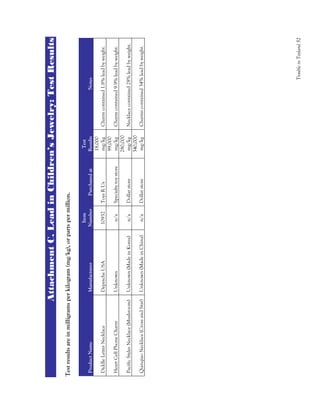
(ppm) action level:
• A necklace sold at a dollar store with two
metal charms (a cross and star) containing
34% lead (340,000 ppm);
• A necklace sold at a dollar store with a lead-
tainted plastic cord and metal mushroom
pendant, totaling 28% lead (280,000 ppm);
• A heart-shaped metal charm for a cell
phone containing 9.9% lead (99,000 ppm);
and
• A necklace (available in each letter of the
alphabet) sold at Toys R Us with a charm
containing 1.8% lead (18,000 ppm).
See Appendix A for photos of these jewelry
items, Appendix C for the complete test
results, and the methodology for a
description of the testing protocol.
- LITIGATION AND REGULATION AT
STATE AND MUNICIPAL LEVELS -
Major Retailers Agree to Stop Selling Lead-
Laden Jewelry
The Center for Environmental Health (CEH)
announced in January 2006 that 71 major
retailers of children’s jewelry, including
Target, Kmart, Macy’s, Nordstrom’s, Claire’s,
Mervyn’s, Sears, and Toys R Us, agreed to
stop selling lead-laden jewelry, creating the
first legally binding standards for lead in
jewelry in the nation.55
As of October 31,
2006, almost 100 retailers, manufacturers
and others have joined the settlement.
CEH initiated legal action against the jewelry
companies in late 2003 and, with the
California Attorney General, sued the
companies in June 2004.
The settlement states that metal components
in and coatings on children’s jewelry must
contain less than 600 ppm of lead, while
plastic (PVC) components can contain no
more than 200 ppm. The agreement
requires that companies stop shipping lead-
tainted children’s jewelry to retail stores by
February 1, 2007; retailers must stop selling it
by September 1, 2007.56
The settlement is
legally binding only in California, but since
California is such a large market, most if not
Trouble in Toyland 20
all the companies likely will implement the
settlement nationally.
In addition, on September 14, 2006, the
Sierra Club sued the EPA to force the agency
to use its authority under the Toxic
Substances Control Act to address the
problem of lead in toy jewelry.57
Local and State Regulation of Lead-Tainted
Jewelry
A new California law (AB 1681), signed by
the governor on September 22, 2006,
codified the standard set by settlement
agreements between the California Attorney
General’s Office, the Center for
Environmental Health and stakeholders in
the jewelry industry.58
California’s action has
spurred other states and localities to consider
standards aimed at regulating lead in
children’s jewelry and other products. For
example:
• The Baltimore Health Commissioner has
proposed regulations for the sale of lead-
containing jewelry in the city of Baltimore.
The proposal would declare children’s
jewelry with excess levels of lead to be a
nuisance, defining “excess levels” as any piece
of children’s jewelry in which any component
part contains lead levels over 600 ppm.59
• In June 2006, the state of Illinois banned
the sale of toys, furniture, clothing,
accessories, jewelry, decorative objects, edible
items, candy, food, dietary supplements, or
other articles used by or intended to be
chewable by children if the lead content is
more 0.06% lead by weight.60
- RECOMMENDATIONS -
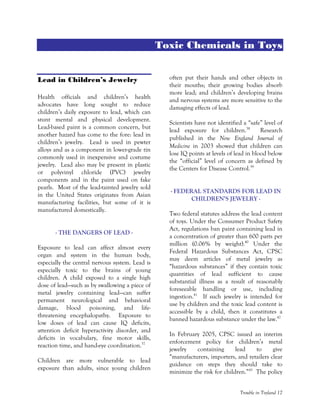
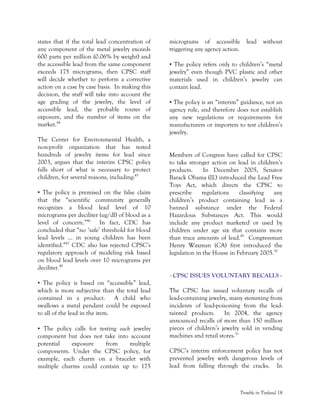
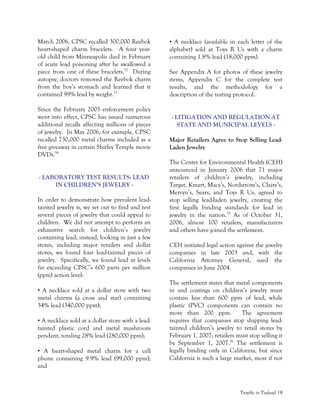
Lead-tainted jewelry should never end up on
store shelves. The CPSC must enact
mandatory requirements for manufacturers,
retailers, and suppliers to test all jewelry for
lead and step up enforcement of these
standards.
Phthalates in Products
Intended for Small Children
Phthalates are a family of chemicals,
including diethyl phthalate (DEP),
diethylhexyl phthalate (DEHP), dibutyl
phthalate (DBP), butyl benzyl phthalate
(BBP), diisodecyl phthalate (DIDP),
diisononyl phthalate (DINP), di-n-octyl
phthalate (DNOP), and many other distinct
types. The polyvinyl chloride (PVC) plastic
industry uses large amounts of phthalates as
additives to improve the flexibility of its
products, including home siding, flooring,
furniture, food packaging, toys, clothing, car
interiors, and medical equipment, including
IV bags. In addition, other manufacturers
use phthalates in personal care products such
as soap, shampoo, deodorant, hand lotion,
nail polish, cosmetics, and perfume, as well
as industrial products like solvents,
lubricants, glue, paint, sealants, insecticides,
detergent, and ink.61
Phthalates are pervasive in the environment
and in human bodies. In 2000, the Centers
for Disease Control (CDC) found high levels
of phthalates and their transformation
products (known as metabolites) in every one
of 289 adult Americans tested, including
women of childbearing age.62
A larger CDC
study in 2003 again found high levels of
phthalates in almost every person tested.63
Trouble in Toyland 21
- PHTHALATE EXPOSURE LINKED TO
HEALTH EFFECTS -
Numerous scientists have documented the
potential health effects of exposure to
phthalates in the womb or at crucial stages of
development, including (but not limited to):
• Reproductive Defects. Scientists have
demonstrated links between exposure to
phthalates in the womb with abnormal
genital development in baby boys and
disruption in sexual development.64
In
October 2005, an independent panel of
scientists convened by the National Institute
of Environmental Health Sciences and the
National Toxicology Program released its
review of one type of phthalate, diethylhexyl
phthalate (DEHP). The panel confirmed
that DEHP poses a risk to reproductive and
developmental health.65
• Premature Delivery. A study published in
November 2003 suggests a link between
exposure to phthalates and pre-term birth.
The scientists found phthalates and their
breakdown products in the blood of
newborn infants, with higher levels leading
to a higher incidence of premature delivery.66
• Early Onset Puberty. One study of Puerto
Rican girls suggests that phthalates may be
playing a role in trends toward earlier sexual
maturity.67
Scientists found that levels of
DEHP were seven times higher in girls with
premature breast development than levels in
normal girls.
• Lower Sperm Counts. In 2003, Drs. Susan
Duty and Russ Hauser of the Harvard School
of Public Health published one of the first
studies linking phthalate exposure with harm
to human reproductive health.68
Men who
had monobutyl or monobenzyl phthalate in
their urine tended to have lower sperm
counts, with the highest concentrations
leading to the lowest sperm counts.
- U.S. FAILS TO TAKE ACTION ON
PHTHALATES -
In 1998, the state PIRGs and several other
environmental and consumer groups
petitioned the CPSC, asking the agency to
ban polyvinyl chloride (PVC) plastic in all
toys intended for children under the age of
five because of the potential health hazards
posed by diisononyl phthalates (DINP).
While noting its position that “few if any
children are at risk from the chemical,”69
in
December 1998 CPSC asked the toy and
baby products industry to remove DINP from
soft rattles and teethers. About 90 percent of
manufacturers indicated at that time that
they had or would remove DINP from soft
rattles and teethers by early 1999. CPSC staff
also asked the industry to find a substitute
for phthalates in other products intended for
children under three years old that are likely
to be mouthed or chewed.70
CPSC also convened a Chronic Hazard
Advisory Panel to examine the existing
scientific data concerning the potential risks
of phthalates to humans. In June 2001, the
panel concluded that while the majority of
children would not be adversely affected by
diisononyl phthalate, “there may be a DINP
risk for any young children who routinely
mouth DINP-plasticized toys for seventy-five
minutes per day or more.”71
Unfortunately, in February 2003, CPSC
denied the state PIRGs’ petition to ban PVC
plastic in toys for young children.72
Trouble in Toyland 22
Other countries have taken action, however,
to protect children’s health. In September
2004, the European Union (EU) agreed to
impose wide restrictions on the use of six
phthalates in toys and childcare products.73
The EU banned three phthalates classified as
reproductive toxicants – diethylhexyl
phthalate (DEHP), butyl benzyl phthalate
(BBP), and dibutyl phthalate (DBP) – in all
toys and childcare articles. The EU banned
three other phthalates – DINP, diisodecyl
phthalate (DIDP) and di-n-octyl phthalate
(DNOP) – in toys and childcare articles
intended for children under three years of
age and that can be put in the mouth.74
- SAN FRANCISCO TAKES ACTION,
CHEMICAL INDUSTRY RESPONDS -
In June 2006, the San Francisco Board of
Supervisors unanimously adopted an
ordinance prohibiting the sale, distribution
or manufacture of toys and child care
products intended for use by children under
the age of three if they contain phthalates or
bisphenol A. In October, the American
Chemistry Council, California Retailers
Association, California Grocers Association,
Juvenile Products Manufacturers Association
and others filed a lawsuit challenging San
Francisco’s ban, arguing that state law
preempts the San Francisco ordinance.75
- “PHTHALATE-FREE” PRODUCTS -
Some manufacturers are beginning to label
their baby products and toys as “phthalate-
free,” ostensibly giving parents the
information they need to make educated
purchasing decisions. The U.S. government,
however, does not regulate the “phthalate-
free” label or ensure that products labeled
“phthalate-free” actually do not contain
phthalates. Since the U.S. government has
not established any guidelines for what the
label means, or established any standards for
the phthalate content in children’s products,
consumers can only assume that it means
phthalates are not present in the item.
In 2005, to test the reliability of the
“phthalate-free” label, we commissioned
STAT Analysis Corporation in Chicago,
Illinois to test eight soft plastic toys labeled as
not containing phthalates. Of the eight toys
tested, six contained detectable levels of
phthalates.76
Based on these results, we
asked the Federal Trade Commission (FTC)
to investigate whether manufacturers’ use of
the “phthalate-free” label constitutes unfair
or deceptive marketing practices when the
product actually contains phthalates.77
With the results of the FTC investigation still
pending, we once again commissioned STAT
Analysis Corporation in the fall of 2006 to
test 10 soft plastic toys labeled as not
containing phthalates.b
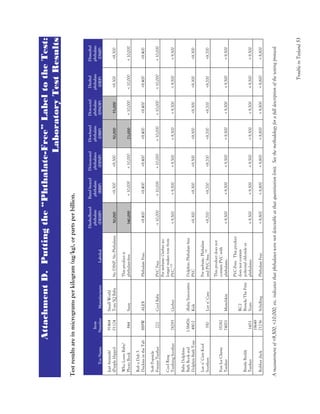
Of the 10 toys tested,
just two contained detectable levels of
phthalates. See Attachment D for more
information.
Some of the items that tested positive for
phthalates last year did not this year. While
this may be good news for consumers,
nothing in U.S. law has changed to hold
manufacturers accountable to their
“phthalate-free” label or require them to stop
using phthalates. Consumers still have no
guarantee that the “phthalate-free” products
b
Eight of the toys were labeled “phthalate-free” on the
packaging. One item was labeled “phthalate-free” on
the manufacturer’s website. For the last item, the
manufacturer’s website claimed not to use phthalates
in any of its children’s products.
Trouble in Toyland 23
they purchase truly are phthalate-free, as
evidenced by our test results.
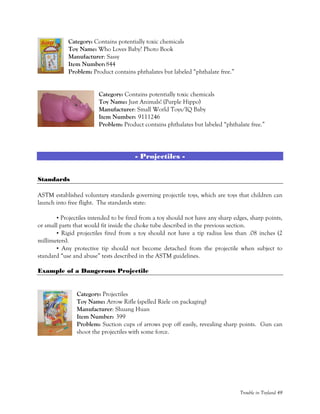
Toys Labeled “Phthalate-Free” that Tested
Positive for Phthalates (October 2006)
Who Loves Baby? Photo
Book (Sassy, Item #844)
Product label says “This
product is phthalate-free.”
Lab tests found diethylhexyl
phthalate (DEHP) and Di-n-
butyl phthalate (DBP).
Just Animals! Purple
Hippo (Small World Toys,
Item #9111246)
Product label says “No
DINP, No Phthalates.” Lab tests found
diethylhexyl phthalate (DEHP), di-n-butyl
phthalate (DBP), and di-n-octyl phthalate
(DNOP).
- RECOMMENDATIONS -
CPSC should ban the use of phthalates in all
toys and products for children five years old
and under. In addition, CPSC and the
Federal Trade Commission should look into
manufacturers’ use of the “phthalate-free”
label and take action against manufacturers
that may be misleading consumers.
Toxic Chemicals in Children’s
Cosmetics
Play cosmetics—cosmetics intended for
children under 14—must conform to the
requirements of the Federal Food, Drug and
Cosmetic Act.78
In addition, the CPSC has
issued guidance to manufacturers, retailers,
and distributors about children’s products
containing liquid chemicals. This guidance
states that in order to “reduce the risk of
exposure to hazardous chemicals, such as
mercury, ethylene glycol, diethylene glycol,
methanol, methylene chloride, petroleum
distillates, toluene, xylene, and related
chemicals, the Commission requests
manufacturers to eliminate the use of such
chemicals in children’s products.”79
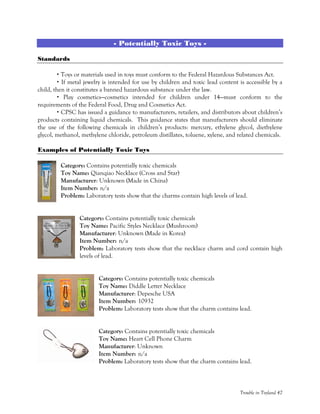
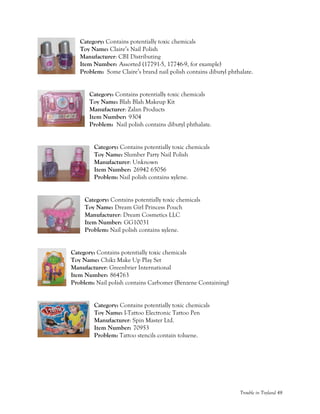
We found several examples of play cosmetic
sets marketed for children with nail polish
containing toxic chemicals, such as toluene,
xylene, dibutyl phthalate and benzene. Since
children are prone to putting their hands in
their mouths, nail polish offers a direct route
of exposure. Children could face additional
exposure by inhaling vapors from the nail
polish when applying the product. See
Attachment A for a list of products found
containing these chemicals.
- TOLUENE -
We found a children’s temporary tattoo set
on store shelves containing toluene, a
recognized developmental toxicant.80
Human studies have reported developmental
effects, such as central nervous system
damage, attention deficits, and birth defects,
in the children of pregnant women exposed
to toluene by inhalation. Other studies have
linked women’s exposure to toluene with an
increased incidence of spontaneous
abortions.81
Exposure to low levels of
toluene can cause confusion, weakness,
memory loss, nausea, and hearing and color
vision loss. Inhaling high levels of toluene in
a short time can cause similar symptoms,
unconsciousness and even death.82
Trouble in Toyland 24
- XYLENE -
We found examples of play cosmetics
containing xylene. Short-term exposure to
high levels of xylene can cause irritation of
the skin, eyes, nose, and throat; difficulty in
breathing; impaired function of the lungs;
delayed response to visual stimulus; impaired
memory; and possible changes in the liver
and kidneys. Both short- and long-term
exposure to high concentrations of xylene
also can affect the nervous system, causing
headaches, lack of muscle coordination,
dizziness, and confusion.83
Long-term exposure to low concentrations of
xylene may harm the kidneys (with oral
exposure) or the nervous system (with
inhalation exposure). Children may be more
sensitive to acute inhalation exposure than
adults because their narrower airways are
more sensitive to swelling effects.84
- DIBUTYL PHTHALATE -
We also found examples of play cosmetics
containing dibutyl phthalate, one of the
phthalates recently banned by the European
Union in all toys. OPI, Orly International,
and Sally Hansen have pledged to remove
dibutyl phthalate from their nail polishes.
OPI and Orly already have started selling nail
polish without dibutyl phthalate; Sally
Hansen will start selling its reformulated
products (free of dibutyl phthalate, toluene,
and formaldehyde) in 2007.85
Researchers have observed birth defects in
animals exposed to high levels of dibutyl
phthalate during development. Death, low
body weights, skeletal deformities, cleft
palate, and damage to the testes have been
observed in the offspring of animals ingesting
large amounts of dibutyl phthalate.86
A 2004 study examined nail polishes and
perfumes and concluded that the amount of
exposure to dibutyl phthalate from these
cosmetics is relatively small. The study
cautioned, however, that total exposure to
the chemical from multiple sources may be
greater and requires further investigation.87
- BENZENE -
Benzene is a known human carcinogen.
Breathing in high levels of benzene can cause
drowsiness, dizziness, rapid heart rate,
headaches, tremors, confusion, and
unconsciousness. Similarly, eating foods
tainted with high levels of benzene can cause
vomiting, dizziness, sleepiness, convulsions,
rapid heart rate, and even death.88
Long-term exposure to benzene has a
damaging effect on the blood, harming the
bone marrow and causing anemia or
leukemia.89
Acute exposure to benzene in
liquid or vapor form may irritate the skin,
eyes, and upper respiratory tract in humans.
Redness and blisters may result from dermal
exposure to benzene.90
- RECOMMENDATIONS -
Parents should read the labels of children’s
cosmetics carefully and purchase nail polish
without these toxic chemicals. CPSC also
should enforce its guidance to
manufacturers, retailers, and distributors
about children’s products containing liquid
chemicals and expand it to include other
toxic chemicals that may expose children to
hidden health hazards. The Food and Drug
Administration, which has jurisdiction over
cosmetics, should require manufacturers to
remove the toxic chemicals listed in CPSC’s
guidance (at minimum) from products
marketed for children.
Strangulation Hazards
Water Yo-Yo Balls
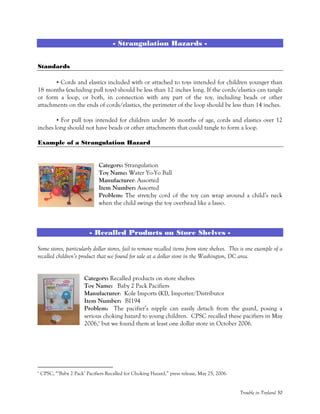
The yo-yo water ball (or water
yo-yo) emerged in 2003 as the
latest toy fad. The toy is a
liquid filled ball on a stretchy
bungee cord string with a
finger loop at the end, allowing a child to
swing the toy around, stretching the string
and bouncing back like a yo-yo. The ball also
can be bounced and twirled like a lasso.
There are dozens of different types of yo-yo
water balls distributed in the United States
by many different companies, often without a
brand name. Based on information from
industry sources, CPSC believes that
approximately 11-15 million yo-yo ball toys
were distributed in the U.S. in 2003, selling
for between $1 and $5.91
As word has spread
about the potential hazard associated with
the toy, and as major retailers have stopped
selling it, the toy is much harder to find than
it was a few years ago.
- DANGERS OF WATER YO-YOS -
Consumer safety agencies around the world
have fielded complaints from parents
reporting incidents in which water yo-yos
wrapped tightly around their children’s necks
or caused other injuries to the eyes, face and
head. The cord is made of a rubbery plastic,
which extends approximately four feet. The
toy is often difficult to control, as the water
ball at the end of the toy is heavy enough to
generate significant momentum when swung.
Children between ages four and eight may be
most vulnerable to injury, since they have the
strength to swing the yo-yo quickly but may
lack the dexterity to control the toy’s
momentum. Consumer Reports tested more
than a dozen of these toys, deeming the toy
“Not Acceptable” because of the potential for
the cord to wrap around a child’s neck and
restrict or cut off circulation. Consumer
Reports also found that the elastic finger loop
could stretch enough to fit over a child’s
head and around his or her neck.92
The CPSC has received about 400 injury
reports related to water yo-yo balls since the
end of 2002.93
Parents have found their
children suffocating with yo-yo balls wrapped
multiple times around their children’s necks.
Parents report using knives, scissors, and
even their teeth to cut the elastic cords of the
tightly wrapped yo-yo balls. As recently as
October 2006, a five year-old boy from
Bellevue, Washington almost suffocated
when a water yo-yo wrapped tightly around
his neck three times.94
Other reported
incidents over the last few years include a
child passing out and hitting his head so
hard he fractured his skull; another child was
found bleeding from his mouth and nose
and needed CPR; and two other children
have had to have lens implant surgery in
their eyes because the toy snapped back with
such force that it shattered the lens.95
Since
the end of 2003, complaints have dropped in
number although not in severity, likely
because many major retailers no longer sell
the toys due to consumer concerns.96
Trouble in Toyland 26
- REGULATORY ACTION -
The U.S. government has taken little action
to remove the product from the market. In
September 2003, CPSC announced the
results of an investigation into the yo-yo
water ball, finding that “there is a low but
potential risk of strangulation from the yo-yo
water ball toy.” At that time, the CPSC
noted that it had received 186 reports of
incidents in which the yo-yo ball toy’s cord
wrapped around a child’s neck. According to
the commission, there were no lasting
injuries, although seven cases reported
broken blood vessels affecting eyes, eyelids,
cheeks, neck, scalp or the area behind the
ears.97
CPSC decided to not recall the
product; instead, the agency advised parents
to supervise use of the toy, cut its cord, or
throw it away. The CPSC has not taken any
additional action to remove the toy from the
market or ban its sale in the United States.
Most major retailers have stopped selling the
toy;98
however, the toy remains on some store
shelves and widely available over the Internet.
In response to the CPSC’s inaction, both
state and federal lawmakers have taken steps
to ban the toy. At the national level,
Congressman Robert Andrews (NJ)
introduced a bill with Congresswoman Jan
Schakowsky (IL) on September 13, 2005 to
ban the sale of water yo-yos.99
In June 2005,
Illinois became the first state to ban the sale
of water yo-yos. State legislatures in at least
New Jersey, New York, and Wisconsin also
have introduced bills to ban the toy.100
Injuries associated with the water yo-yo also
have prompted strong action in countries
around the world. In 2003, Canada’s
Consumer Product Safety Bureau announced
that “yo-yo type balls and similar products are
prohibited from advertising, sale or
importation in Canada.”101
The sale of yo-yo
water balls also is banned in France,
Switzerland, Australia, Luxembourg, Brazil
and the United Kingdom.102
Consumer Reports also reported that
variations of the water yo-yo pose
additional hazards. Rather than a
water-filled ball, some versions of
this toy contain a battery and
components to make it flash.
During lab tests and real-life tests
with supervised four-year-olds, the battery or
other components fell out of the squishy
material or tore through it in four of the six
toys Consumer Reports tested. Kids could
choke on the parts, and a battery could eat
away at the esophagus or stomach lining.
Some of these toys come in packaging with
choke hazard warnings; others do not.103
- RECOMMENDATIONS -
The growing numbers of injuries sustained
by children playing with the yo-yo water ball
are strong evidence that the toy should be
banned in the United States. The CPSC
should not wait until a child dies to protect
children from the dangers posed by playing
with this toy.
Cords and Elastics in Toys
ASTM maintains a voluntary standard for
cords and elastics that may pose
entanglement or strangulation hazards. It
states that cords and elastics included with or
attached to toys intended for children less
than 18 months of age must be less than 12
inches long. If the cords or elastics can
tangle or form a loop in connection with any
part of the toy, such as beads at the end of
Trouble in Toyland 27
the cord, then the perimeter of the loop must
be less than 14 inches.104
ASTM published a separate voluntary
standard for pull toys, stating that “cords and
elastics greater than 12 inches long for pull
toys intended for children under 36 months
of age shall not be provided with beads or
other attachments that could tangle to form a
loop.”105
The cord could become tangled
around a child’s neck and be locked into
place by the knob.
CPSC has the authority to enforce the
ASTM voluntary standards. Parents should
remove beads or other attachments from
elastics/cords on their children’s toys if the
cords measure more than 12 inches.
Crib Mobiles
Crib mobiles present a special hazard for
infants. Around the age of five months,
children become more mobile and begin to
push themselves up on their hands and
knees. At that point, mobiles left within
reach of a child become hazardous; a child
may be able to entangle herself in them but
lack the physical strength or motor skills to
free herself. According to the voluntary
standard published by ASTM, crib mobiles
require labels with the following warning:
“Caution: possible entanglement injury: keep
toy out of baby’s reach. Remove mobiles
from crib or playpen when baby begins to
push up on hands and knees.”106
Drawstring Clothing
Drawstrings on children’s clothing can lead
to deaths and injuries when they catch on
such items as playground equipment, bus
doors, or cribs.107
From January 1985
through June 1997, CPSC received reports of
21 deaths and 43 incidents involving
drawstrings on children’s upper outerwear.108
In February 1996, CPSC issued guidelines to
help prevent these injuries, which ASTM
adopted as a voluntary standard in June
1997.109
In the period since, CPSC has seen
a marked decrease in fatalities and incidents.
CPSC recommends that parents remove
drawstrings from all children’s upper
outerwear sized 2T to 12 and buy clothing
that has alternative closures, such as snaps,
buttons, and Velcro.110
In May 2006, CPSC sent a letter to
manufacturers and retailers of children’s
upper outerwear, urging them to make sure
that all clothing sold in the U.S. complies
with the voluntary safety standard.111
The
letter also stated that CPSC “considers
children’s upper outerwear with drawstrings
at the hood or neck area to be defective” and
subject to recall.
Since January 2006, CPSC has announced at
least 13 recalls of children’s clothing items
with drawstrings.112
Trouble in Toyland 28
Other Toy Hazards
Projectiles
ASTM established standards governing
projectile toys, defined as toys “intended to
launch projectiles into free flight by means of
a discharge mechanism in which the kinetic
energy of the projectile is determined by the
toy and not by the user.”113
The standards
state that projectiles intended to be fired
from a toy “shall not have any sharp edges,
sharp points, or small parts” that would fit
inside the choke tube.114
In addition, the
standard states that rigid projectiles fired
from a toy should not have a tip radius less
than .08 inches (2 millimeters).115
Any
protective tip should not become detached
from the projectile when subject to standard
“use and abuse” tests described in the ASTM
guidelines.116
CPSC has the authority to enforce the
ASTM voluntary standards and exercises that
authority when necessary.
See Appendix A for an example of a toy
posing a projectile hazard.
Scooters
Popular lightweight scooters, which first
entered the U.S. market in 1999, continue to
pose a serious threat of injury to children.
Injuries from riding toys, including scooters,
skyrocketed between 2000 and 2001, from
65,000 to 121,700 injuries. This number has
fallen since 2001, with 71,100 injuries in
2004, but scooters and other riding toys still
cause more injuries than any other category
of toy (34 percent).117
This decline is likely
due in part to increased parental awareness
of the dangers posed by scooters.
To prevent injuries while using both
motorized and non-powered scooters, we join
the CPSC in its recommendations to
consumers:
• Wear proper safety gear, including a
helmet that meets CPSC’s standard, knee
and elbow pads, and wrist guards.
• Ride the scooters on smooth, paved
surfaces without any traffic.
• Do not ride the scooter at night.
• Children under age 8 should not use non-
powered scooters without close adult
supervision.
Trouble in Toyland 29
Holes in the Toy Safety Net
espite improvements in toy regulations
and labeling requirements, parents
should remain vigilant. Consumers looking
for toys still face an industry full of safety
loopholes; once toys fall through, it is
difficult to remove them from the market.
Loopholes in Toy Safety
Regulation
- NEAR SMALL PARTS -
Even when companies comply, current
regulations do not address all choking
hazards posed by toys. While the choke test
cylinder eliminates most objects small
enough to enter a child’s lower throat and air
passages, it does not eliminate all objects that
can block the airway by obstructing the
mouth and upper throat.
Children continue to choke on toys that do
not technically violate the CPSC regulations.
In September 2006, CPSC and Playskool
voluntarily recalled about 255,000 Team
Talkin’ Tool Bench toys following the deaths
of two young children. A 19-month-old West
Virginia boy and a 2-year-old Texas boy
suffocated when three-inch plastic toy nails
sold with the tool bench toys became
forcefully lodged in their throats.118
Many
toys with parts similar in size and shape to
these toy nails remain on store shelves
without choke hazard warning labels.
We call on CPSC to:
• Enlarge the small parts test tube to be more
protective of children under three; and
• Consider extending the ASTM specification
for toys with spherical ends to apply to toys
intended for children under six years old
instead of under 18 months. At minimum,
CPSC should consider special labeling for
toys shaped like the toy nails that caused the
two children to suffocate.
- ONLINE SHOPPING –
A new factor complicating toy safety is the
growing popularity of online toy retailers.
The convenience of online toy stores draws
increasing numbers of consumers each year,
yet these stores pose special difficulties for
consumers. The CPSC has yet to require
online retailers to include choke hazard
warnings for toys with small parts on their
websites. Last year, we surveyed 37 online
toy retailers and found that two-thirds do not
include any choke hazard labeling on their
websites, even when the toy requires such
labeling on the packaging.119
We call on CPSC to require Internet toy
retailers to prominently display choke hazard
warning labels next to toys that require such
labeling on their packaging.
Ineffective Toy Recalls
Even though CPSC announces recalls
publicly through the Internet, national
television, toy stores and pediatricians’
offices, many consumers still do not find out
about recalled toys. For obvious reasons,
companies do not like publicizing that they
sold a defective product. CPSC has recorded
D
Trouble in Toyland 30
extremely low return rates on its recalls of
toys and consumer products. The agency
does not know if consumers who do not
return the toys just throw them away or never
heard of the recall in the first place.120
CPSC’s hands often are tied as well. CPSC
can say little about ongoing safety
investigations; after a recall is announced,
CPSC cannot disclose anything that the
recalling company does not want released to
the public.121
In addition, not all stores remove recalled
products from their shelves. Most major
retailers using computerized scanners can
catch recalled products at the register, but
stores relying on older registers, such as
dollar stores, may allow consumers to
purchase recalled items. PIRG researchers,
for example, were able to purchase recalled
pacifiers for sale at one dollar store in the
Washington, DC metro area (see Appendix
A).
Finally, many consumers may not know if
they even own the product being recalled.
The failure of toy manufacturers to label
their products – not just the packaging – with
contact information or even the name of the
manufacturer makes identifying recalled
products difficult if not impossible.
Manufacturers, on the other hand, rarely
have any way of contacting consumers who
have purchased their products. Few
consumers fill out “warranty” cards provided
with some products, because the questions
asked are so clearly intended for marketing
purposes, giving consumers legitimate privacy
concerns.
We support the Consumer Federation of
America (CFA) in its call for Consumer
Registration Cards. In 2001, CFA petitioned
CPSC, asking that the agency require all
manufacturers (or distributors, retailers or
importers) of children’s products to provide a
Consumer Registration Card that allows the
purchaser to register information through the
mail or electronically. These cards would
allow manufacturers to contact consumers
about recall and safety actions taken by the
CPSC or the manufacturer of the product.
The petition specified that the cards would
collect only enough information to contact
the purchaser (name and address or email
address) and nothing for marketing
purposes.122
Trouble in Toyland 31
Methodology
Choking hazards: We categorized toys as a
potential choking hazard if a) if a toy labeled
for children under three contains small parts
or breaks easily into small parts;c
b) a toy
contains small parts or small balls but is
intended for children under three, regardless
of age labeling if any; c) a toy contains small
parts or small balls, is intended for children
over three, but lacks the statutory choke
hazard warning; or d) the toy is intended for
children under six, lacks the statutory choke
hazard warning and appears to fail the “use
and abuse” test, breaking easily into small
parts that fit in the choke tube.
Noise hazards: Using a digital sound level
meter, we measured the loudness of each toy
(in decibels) from 25 cm, 10 cm, and 1 cm.
The toy (still in its packaging) was placed on a
flat table with the sound meter placed on a
tripod pointed at the toy. We tested each toy
for 30 seconds and recorded the highest
continuous maximum measurement, the
loudest sound level recorded during a one
second sampling period.
Toxic chemicals in children’s cosmetics:
We did not test the children’s cosmetics
identified in Attachment A of this report to
determine their chemical content. We relied
solely upon the list of ingredients provided
on the product packaging.
c
If a toy broke into small parts with little effort or
force, we assumed that the toy may not comply with
CPSC use and abuse testing procedures.
Testing of “phthalate-free” products: STAT
Analysis Corporation in Chicago, a
laboratory accredited by the Illinois
Environmental Protection Agency in
accordance with the National Environmental
Laboratory Accreditation Program,
performed the phthalates testing. STAT
Analysis followed standard procedures, using
EPA Method 8270C and EPA Method
3580A.123
The reporting/quantitation limits
varied based on the product tested, as
detailed in Attachment D.
Testing of lead-tainted jewelry: We
purchased several items of jewelry from major
retailers and dollar stores and used home
lead testers available at most hardware stores
to identify items potentially containing lead.
We sent these items to STAT Analysis (see
above) for additional testing. STAT Analysis
used EPA Method 6020 (Inductively
Coupled Plasma-Mass Spectrometry) and
EPA Method 3050B (Acid Digestion of
Sediments, Sludges, and Soils) to determine
the quantity of lead in each item.124
Trouble in Toyland 32
Attachment A. 2006 Summary of Toy Hazards and
Examples of Potentially Dangerous Toys
- Potential Choking Hazards -
Standards
Under the Child Safety Protection Act (CSPA) and Consumer Product Safety Commission rules:
Toys intended for children under three are banned if they contain small parts or easily
break into pieces that are small parts.
Toys intended for children between the ages of three and six years old that contain small
parts must include an explicit choke hazard warning with precise statutory language.
Any small ball or toy that contains a small ball must meet a stricter safety test and include
an explicit choke hazard warning.
Marbles or toy with marbles must include an explicit choke hazard warning.
All balloons must include a warning about the dangers of uninflated or broken balloons
to children younger than 8 years of age.
Examples of Toys that Pose Potential Choking Hazards
- TOYS FOR CHILDREN UNDER 3 CONTAINING SMALL PARTS -
Toys intended for children under three are banned if they contain small parts or easily break into pieces that
are small parts.
Category: May violate ban on small parts in toys intended for children under 3.
Toy Name: Kid Connection Mini Activity Cube
Manufacturer: Wal-Mart Stores
Item Number: 31306
Problem: Shaped pegs that move along curves can come out, posing a choking
hazard. Labeled for ages 2 and up.
Trouble in Toyland 33
Category: May violate ban on small parts in toys intended for children under 3.
Toy Name: Play It Sharp Wooden Noise Maker
Manufacturer: Greenbrier International
Item Number: 864898
Problem: Wooden stick in middle of the toy breaks apart easily into small
parts. Labeled for ages 2 and up.
Category: May violate ban on small parts in toys intended for children under 3.
Toy Name: You & Me Wintertime Baby
Manufacturer: Geoffrey
Item Number: 87406
Problem: Eyeglasses break into small parts that fit in the choke tube; toy also
contains a small ball attached by a string. Labeled for ages 2 and up.
Category: May violate ban on small parts in toys intended for children under 3.
Toy Name: Baby I’m Yours Doll Clothing
Manufacturer: Target Corporation
Item Number: 44459 55003
Problem: Pearls on baby booties fit in choke tube and are attached by a few
threads; may fail “use and abuse” test. Labeled for ages 2 and up.
Category: May violate ban on small parts in toys intended for children
under 3.
Toy Name: My First Baby Annabell
Manufacturer: Zapf Creations
Item Number: 760914
Problem: Pacifier fits in choke tube and is attached by a few threads;
could fail “use and abuse” test. Child could put pacifier in mouth. Labeled for ages 1 and up.
Category: May violate ban on small parts in toys intended for children
under 3.
Toy Name: Playtime Babies Triplets (Dari, Danielle, & Darren)
Manufacturer: Cititoy Inc.
Item Number: 74351
Problem: Pacifiers fit in choke tube. Pacifiers are attached to dolls by a
few threads; may fail “use and abuse” test. Child could put pacifier in her
mouth. Labeled for ages 2 and up.
Trouble in Toyland 34
Category: May violate ban on small parts in toys intended for children under 3.
Toy Name: Sassy Pet Saks “Magic Carpet” and Assorted Others
Manufacturer: Douglas Company
Item Number: 2067
Problem: “Magic Carpet” Sassy Pet Sak has rhinestone sewn on with a few
threads; may fail “use and abuse” test. Several varieties of the toy contain small
parts sewn on to the bag. Labeled for ages 18 months and up.
Category: May violate ban on small parts in toys intended for children
under 3.
Toy Name: “I Love My…” (Rabbit, Puppy, Kitten, Duckling) foam
books; “Dinosaur Loveables” (T-Rex, Stegosaurus, Velociraptor,
Pterodactyl) foam books; “Loveable Learning” (Shapes, Colors,
Numbers, Opposites) foam books
Manufacturer: Paradise Press
Item Number: “I Love My…” series (86943 00796); “Dinosaur Loveables” series (86943 00491);
“Loveable Learning” series (86943 00492).
Problem: Foam velcro tabs rip off easily and fit in choke tube. Labeled with non-statutory choke
hazard warning, but has play value for children under 3. According to the Manufacturers’
Abbreviated Guide for Age Labeling Toys, books with easy-to-turn cloth or cardboard pages with bright
primary colors are appropriate for children as young as 7 months if they contain familiar objects.
Category: May violate ban on small parts in toys intended for children under
3.
Toy Name: Animal Pal Books (This Little Piggy, Itsy Bitsy Spider, Cuddles
the Cow, Teddy Bear)
Manufacturer: Playmore Publishers and Waldman Publishing
Item Number: 70097 00215
Problem: Foam velcro tabs rip off easily and fit in choke tube. Labeled with non-statutory choke
hazard warning, but has play value for children under 3. According to the Manufacturers’
Abbreviated Guide for Age Labeling Toys, books with easy-to-turn cloth or cardboard pages with bright
primary colors are appropriate for children as young as 7 months if they contain familiar objects.
Category: May violate ban on small parts in toys intended for children
under 3.
Toy Name: Bonnie Bear Magnetic Writing Board
Manufacturer: Bazic/Bangkit USA
Item Number: 1834
Problem: Small drawing tools fit in choke tube. Toy could have play
value for children under 3. According to the Manufacturers’ Abbreviated
Guide for Age Labeling Toys, chalkboards are appropriate for children as young as 25 months. The
writing board is similar in concept to a chalkboard.
Trouble in Toyland 35
Category: May violate ban on small parts in toys intended for children under 3.
Toy Name: Music Machines Music Mic Set
Manufacturer: Symak Sales
Item Number: 9988
Problem: Whistle fits in choke tube. Toy has choke hazard warning, but toy
could have play value for children under 3. According to the Manufacturers’
Abbreviated Guide for Age Labeling Toys, rhythm instruments and novelty horns and
whistles are appropriate for children as young as 25 months.
Category: May violate ban on small parts in toys intended for children
under 3.
Toy Name: Magnetic Letters, Numbers, Shapes
Manufacturer: Greenbrier International
Item Number: 360248
Problem: Magnets come out and fit in choke tube; some letters fit in
choke tube. Has choke hazard warning, but may have play value for
children under 3. According to the Manufacturers’ Abbreviated Guide for Age Labeling Toys,
“simple…teaching toys for matching/sorting, shapes, colors, letters/sounds, numbers/concepts”
are appropriate for children ages 25-36 months. (Note: This type of refrigerator magnet generally
does not contain the powerful magnets discussed in the “Magnetic Toys” section of this report.)
Category: May violate ban on small parts in toys intended for children
under 3.
Toy Name: Foam Numbers
Manufacturer: Unknown
Item Number: KK603
Problem: Small parts of foam toy fit in choke tube. Toy has choke
hazard warning, but toy could have play value for children under 3. According to the
Manufacturers’ Abbreviated Guide for Age Labeling Toys, “simple…teaching toys for matching/sorting,
shapes, colors, letters/sounds, numbers/concepts” are appropriate for children ages 25-36 months.
In addition, toys for the bathtub are “commonly recognized” for children under age 3.
Category: May violate ban on small parts in toys intended for
children under 3.
Toy Name: Stick-N-Learn in the Tub Bath Book
Manufacturer: Greenbrier International
Item Number: 838882
Problem: Foam pieces break apart easily into small parts. Includes choke hazard warning, but
may have play value for children under 3. According to the Manufacturers’ Abbreviated Guide for Age
Labeling Toys, books with easy-to-turn cloth or cardboard pages with bright primary colors are
appropriate for children as young as 7 months if they contain familiar objects and animals. In
addition, toys for the bathtub are “commonly recognized” for children under age 3.125
Trouble in Toyland 36
Category: May violate ban on small parts in toys intended for children
under 3.
Toy Name: Slinky Brand Party Set
Manufacturer: James Industries
Item Number: 8503
Problem: Play silverware breaks into small parts. Has choke hazard
warning, but may have play value for children under 3. According to the Manufacturers’ Abbreviated
Guide for Age Labeling Toys, “unbreakable dishes” are appropriate for children between the ages of
13-18 months. Tea sets are most appropriate for children at least 19 months old.
Category: May violate ban on small parts in toys intended for children
under 3.
Toy Name: “Lovely Monkey” Rattle and Pull Toy
Manufacturer: Unknown
Item Number: KW9727
Problem: Ornaments on wheel fall off and fit in choke tube. Toy has a
choke hazard warning, but rattles and pull toys are “commonly recognized”
for children under 3.126
Category: May violate ban on small parts in toys intended for children under
3.
Toy Name: Expressions 30 Piece Hair Accessory Set
Manufacturer: Almar Sales
Item Number: 878772
Problem: Hair clips fit in choke tube. Product is intended for infants and
children under 3. Children’s accessories, such as barrettes, are exempt from
the small parts regulation because they need to be small to perform their
intended purpose.127
These items, however, are marketed for infants without
any warning that they could pose a choking hazard.
Category: May violate ban on small parts in toys intended for children under
3.
Toy Name: Assorted Claire’s Club Baby Hair Bands and Elastics (those with
hard plastic jewels, hearts, and other attachments)
Manufacturer: CBI Distributing
Item Number: 91349-1, 37504-8, 47975-8, 91847-4
Problem: Plastic jewels, hearts, flowers and other attachments on hair bands can pop off and fit
in choke tube. The CSPA exempts children’s accessories, such as barrettes, from the small parts
regulation because they need to be small to perform their intended purpose.128
These items,
however, are marketed for infants (“Claire’s Club Baby”) and contain non-essential and decorative
small parts without any warning that they could pose a choking hazard.
Trouble in Toyland 37
- TOYS THAT MAY NOT MEET CSPA LABELING REQUIREMENTS -
Toys intended for children between the ages of three and six years old that contain small parts must include an
explicit choke hazard warning with precise statutory language. Any small ball or toy that contains a small
ball must meet a stricter safety test and include an explicit choke hazard warning. Any marble must include
an explicit choke hazard warning.
Category: Potential CSPA labeling violation
Toy Name: Hot Wheels Rev-Ups Speed Shifters
Manufacturer: Mattel
Item Number: Asst. J7107
Problem: The rubber tires pop off easily and fit in the choke tube. The toy has play
value for children under 6. Packaging includes a non-statutory choke hazard
warning (“Small parts may be generated”).
Category: Potential CSPA labeling violation
Toy Name: Hot Wheels Monster Jam El Toro Loco
Manufacturer: Mattel
Item Number: 53533
Problem: Horns on the truck twist/break off; may fail “use and abuse” test.
Labeled for ages 3 and up. Packaging includes a non-statutory choke hazard
warning (“Small parts may be generated”).
Category: Potential CSPA labeling violation
Toy Name: Tonka Lights & Sound Rescue Helicopter
Manufacturer: Funrise International
Item Number: 5587
Problem: Silver hook comes off easily and fits in choke tube.
Labeled for ages 3 and up. No choke hazard warning.
Category: Potential CSPA labeling violation
Toy Name: Hot Zone Die-Cast Metal & Plastic Free Wheel (Yellow Truck with
Crane)
Manufacturer: Maisto International/KB Holdings
Item Number: 15001
Problem: Hook at end of crane detaches easily and fits in choke tube. Labeled
for ages 3 and up. No choke hazard warning.
Trouble in Toyland 38
Category: Potential CSPA labeling violation
Toy Name: Disney “Cars” the Movie character car, “Mater”
Manufacturer: Mattel
Item Number: H6408
Problem: Rigging in back of truck breaks into small parts, may fail “use and
abuse” test. Labeled for ages 3 and up. Packaging includes a non-statutory
choke hazard warning (“Small parts may be generated”).
Category: Potential CSPA labeling violation
Toy Name: Aurora Stuffed Dog “Fergie”
Manufacturer: Aurora World
Item Number: 30365
Problem: Pearl necklace and rhinestone on wrist corsage fit in choke tube. Has
play value for children under 6. No choke hazard warning.
Category: Potential CSPA labeling violation
Toy Name: Fisher Price Loving Family Laundry Room
Manufacturer: Mattel/Fisher Price
Item Number: H7216
Problem: Toy bears fit in choke tube; attached to string and piece
of cloth that would not prevent choking. Labeled for ages 3 and up.
Packaging includes a non-statutory choke hazard warning (“Small
parts may be generated”).
Category: Potential CSPA labeling violation
Toy Name: Build-a-Bear Workshop “Accessorize Me” Beary Princess
Manufacturer: Creative Designs International
Item Number: 87138
Problem: Heart locket detaches easily and fits in choke tube. Labeled for ages 3
and up. Packaging includes a non-statutory choke hazard warning (“Not suitable
for children under 36 months due to small parts.”)
Category: Potential CSPA labeling violation
Toy Name: 1st
Note Kazoo
Manufacturer: Trophy Music Company
Item Number: FN120
Problem: Kazoo cap detaches easily and fits in choke tube. Packaging only says “Not
intended for children under 3 years of age.” No choke hazard warning.
Trouble in Toyland 39
Category: Potential CSPA labeling violation
Toy Name: Claire’s Rings and Bracelets
Manufacturer: CBI Distributing
Item Number: 81256-0
Problem: Rings fit in choke tube and have play value for children under 6. No
choke hazard warning.
Category: Potential CSPA labeling violation
Toy Name: Claire’s Novelty Rings
Manufacturer: CBI Distributing
Item Number: 16920-1, 30265-3
Problem: Rings fit in choke tube and have play value for children under 6. No
choke hazard warning.
Category: Potential CSPA labeling violation
Toy Name: 12 Pack Fancy Rings Party Favors
Manufacturer: Unknown
Item Number: PI-470
Problem: Toy rings fit in choke tube and have play value for children under 6. No
choke hazard warning.
Category: Potential CSPA labeling violation
Toy Name: Nature Trail Butterfly Net (version with butterfly antennae on top)
Manufacturer: Ja-ru
Item Number: 475
Problem: Antennae twist off easily and fit in choke tube; may fail “use and abuse”
testing. Labeled for ages 4 and up. No choke hazard warning.
Category: Potential CSPA labeling violation
Toy Name: Sunny 102 Marbles
Manufacturer: Unknown
Item Number: 892096 279035
Problem: Toy contains marbles. No choke hazard warning.
Category: Potential CSPA labeling violation
Toy Name: Skillfully-Connecting Links of Gears Creative Gear Set
Manufacturer: Unknown
Item Number: BL-3399
Problem: Some of the gears fit in the choke tube. Product labeled for ages 4
and up. No choke hazard warning.
Trouble in Toyland 40
- TOYS THAT CONTAIN NEAR SMALL PARTS -
These products contain toy parts that almost fit in the choke test tube or spherical objects that fail the small
ball test. Although these toys do not violate the letter of the law, these parts could block a child’s airway given
their shape and size. Children have died on similarly-sized toys that pass the choke tube test.
Category: Near Small Parts
Toy Name: Bob the Builder “Hard at Work” Collectible Character Pack
Manufacturer: RC2 Brands/Learning Curve
Item Number: 65121
Problem: Toy boulders are spherical and fail the small ball test. Labeled
for ages 3 and up. No choke hazard warning; CSPA does not require a
warning because the spherical boulders are not “balls” by definition.
Category: Near Small Parts
Toy Name: Home Depot Light & Sound Air Wrench
Manufacturer: Geoffrey
Item Number: 50158
Problem: Toy screws are similar in shape to Playskool plastic nails
that became lodged in the throats of two children, causing their
deaths.d
Labeled for ages 3 and up. No choke hazard warning; CSPA does not require a warning
because the toys do not fit in the choke test cylinder.
Category: Near Small Parts
Toy Name: Thomas & Friends “Cranky the Crane”
Manufacturer: RC2 Brands/Learning Curve
Item Number: LC76356
Problem: Orange cylinders barely pass small parts test. Toy is labeled for ages 3
and up. No choke hazard warning; CSPA does not require a warning because the
toys do not fit entirely in the choke test cylinder. Includes non-statutory language
that says: “Not suitable for children under 36 months, may contain small parts.”
Category: Near Small Parts
Toy Name: Thomas & Friends Timber Yard Portable Playset
Manufacturer: RC2 Brands/Learning Curve
Item Number: LC76503
Problem: Log halves barely pass small parts test. Toy is labeled for ages 3 and
up. No choke hazard warning; CSPA does not require a warning because the
toys do not fit entirely in the choke test cylinder. Includes non-statutory language that says: “Not
suitable for children under 36 months, may contain small parts.”
d
CPSC, “Playskool Voluntarily Recalls Toy Tool Benches after the Death of Two Toddlers,” September 22, 2006.
Trouble in Toyland 41
Category: Near Small Parts
Toy Name: Take Along Bob the Builder Muck the Dump Truck
Manufacturer: RC2 Brands/Learning Curve
Item Number: 65107A3
Problem: Magnetic timber log almost fits in choke tube. Toy is labeled for
ages 3 and up. No choke hazard warning; CSPA does not require a warning
because the toys do not fit entirely in the choke test cylinder.
Category: Near Small Parts
Toy Name: Just Like Home Play Food
Manufacturer: Geoffrey
Item Number: 96473
Problem: French fries barely pass small parts test. Children more likely to put
play food in their mouths. Labeled for ages 3 and up. No choke hazard
warning; CSPA does not require a warning because the toys do not fit entirely in
the choke test cylinder.
Category: Near Small Parts
Toy Name: Haba Wooden Eggs and Other Play Food
Manufacturer: Haba
Item Number: 13688 (eggs), 13749 (tomato)
Problem: Toy eggs and tomato are spherical and fail the small ball test.
Children more likely to put play food in their mouths. No choke hazard
warning; CSPA does not require a warning because the spherical food items are not “balls” by
definition.
Category: Near Small Parts
Toy Name: Lincoln Logs Frontier Firehouse, Frontier Sheriff’s Office
Manufacturer: Hasbro
Item Number: 934, 932
Problem: Smallest log almost fits in choke tube. Toy is labeled for ages 3
and up. No choke hazard warning; CSPA does not require a warning
because the toys do not fit entirely in the choke test cylinder.
Category: Near Small Parts
Toy Name: Baby Buddy Pacifier Holder
Manufacturer: Baby Buddies
Item Number: 100
Problem: Toy bear almost fit in choke tube; intended for use by infant.
Trouble in Toyland 42
- BALLOONS -
All balloons must include a warning about the dangers of uninflated or broken balloons to children younger
than 8 years of age.
Category: Balloons
Toy Name: 1st
Birthday Girl/1st
Birthday Boy/Happy 1st
Birthday
Balloons
Manufacturer: Amscan
Item Number: 111012 (Girl), 111016 (Boy), 117016 & 117017 (Happy
1st
Birthday)
Problem: Children under 8 years can choke or suffocate on uninflated or broken balloons. The
product includes the statutory choke hazard warning, but these balloons are intended for use by
children under 8 years old.
Category: Balloons
Toy Name: Curious George 8 Balloons
Manufacturer: Unique Industries
Item Number: 15865
Problem: Children under 8 years can choke or suffocate on uninflated or
broken balloons. Product contains statutory balloon warning but features
characters (Curious George) marketed for children under 8.
Category: Balloons
Toy Name: Rocket Balloons
Manufacturer: Toy Investments, Inc.
Item Number: 204 12 0757
Problem: Children under 8 years can choke or suffocate on uninflated or
broken balloons. Product contains statutory balloon warning, but it also
contains the small parts choking hazard warning for children ages 3 and up and
is age-labeled for ages 5 and up. Could be confusing for parents.
Category: Balloons
Toy Name: Rocket Balloons
Manufacturer: Toysmith
Item Number: 2681
Problem: Children under 8 years can choke or suffocate on uninflated or broken
balloons. Product contains statutory balloon warning but also is labeled for ages 5
and up.
Trouble in Toyland 43
Category: Balloons
Toy Name: Water Bomb Sling Shot
Manufacturer: Star Imports, Manufacturer Unknown
Item Number: 30578
Problem: Children under 8 years can choke or suffocate on uninflated or
broken balloons. Product does not contain statutory balloon warning, instead
includes choke hazard warning for children under 3.
Category: Balloons
Toy Name: Groovy Soakers Water Balloons
Manufacturer: Pioneer National Latex
Item Number: 2352
Problem: Children under 8 years can choke or suffocate on uninflated or
broken balloons. Product contains statutory balloon warning but also is labeled
for ages 6 and up.
- OVER-LABELED TOYS -
Some manufacturers are placing choking hazard warnings on products that do not contain small parts. This
dilutes the meaning of the warning for parents. These are just two examples of clearly over-labeled toys.
Category: Over-labeled toys
Toy Name: Weapon Army of Zin Silent Arsenal Weapon Set
Manufacturer: Axiom International
Item Number: 42347
Problem: Labeled with choke hazard warning, but toy does not have any small parts.
Over-labeling dilutes the effectiveness of the warning.
Category: Over-labeled toys
Toy Name: Water Bomb Balls
Manufacturer: Unknown
Item Number: 36427
Problem: Labeled with choke hazard warning, but toy does not have any
small parts. Over-labeling dilutes the effectiveness of the warning.
Trouble in Toyland 44
- Magnetic Toys -
Standards
Currently, no labeling or performance standards govern magnetic toys. ASTM is considering but
has not yet finalized draft standards as of November 2006.
Examples of Magnetic Toys
Category: Magnetic toys
Toy Name: Magnetix (assorted)
Manufacturer: MEGA Brands
Item Number: Assorted
Problem: In March 2006, CPSC and MEGA Brands
announced a “replacement program” for almost four
million Magnetix Magnetic Building Sets, revealing that tiny magnets inside the plastic building
pieces and rods can fall out. If a child swallows more than one magnet, the magnets can attract to
each other and cause intestinal perforation or blockage. MEGA Brands has re-designed its
product, but old stock may remain on store shelves and in consumers’ homes.
Category: Magnetic Toys
Toy Name: Claire’s Magnetic Earrings
Manufacturer: CBI Distributing
Item Number: 66058-9 (and other assorted)
Problem: If a child swallows more than one magnet, the magnets can attract
to each other and cause intestinal perforation or blockage. Magnetic jewelry
left in place for too long can damage surrounding tissue by obstructing
blood flow.
Trouble in Toyland 45
- Excessively Loud Toys -
Standards
In November 2003, ASTM finalized acoustics standards for toys that include the following:
Hand-held, table-top, floor, and crib toys: Toys in this classification should not produce
continuous sound that exceeds 90 dB when measured from 25 centimeters (cm).
Close-to-the-ear toys: Toys in this classification should not produce continuous sound
that exceeds 70 dB when measured from 25 cm.
All toys with impact-type impulsive sounds: Toys should not produce an impact-type peak
sound in excess of 120 dB when measured from 25 cm. This requirement also applies to all
recorded impulsive sounds, such as those produced by video games, regardless of what was
recorded (explosion or impact).
All toys with explosive-type impulsive sounds except percussion caps: Toys should not
produce an explosive-type peak sound in excess of 138 dB when measured from 25 cm.
Examples of Excessively Loud Toys
Category: Excessively loud toys
Toy Name: Frontline Defenders Assault Machine
Manufacturer: KB Holdings
Item Number: 2110KB
Maximum Decibel Measurement: 97 dB (25 cm), 100 dB (10 cm),
104 dB (1 cm)
Problem: Should not exceed 90 dB when measured at 25 cm. Prolonged exposure to noise above
85 dB can cause hearing loss.
Category: Excessively loud toys
Toy Name: Little Tikes Carry Along Musical Keyboard with
Teaching Lights
Manufacturer: Little Tikes Company/Kids Station Toys Intl
Item Number: KSL8012
Maximum Decibel Measurement: 90 dB (25 cm), 93 dB (10 cm), 103 dB (1 cm)
Problem: Should not exceed 90 dB when measured at 25 cm. Prolonged exposure to noise above
85 dB can cause hearing loss.
Trouble in Toyland 46
Category: Excessively loud toys
Toy Name: Elite Operations Astro Blaster Set
Manufacturer: Geoffrey
Item Number: 38393
Maximum Decibel Measurement: 91 dB (25 cm), 98 dB (10
cm), 105 dB (1 cm)
Problem: Should not exceed 90 dB when measured at 25 cm. Prolonged exposure to noise above
85 dB can cause hearing loss.
Category: Excessively loud toys
Toy Name: Tool Truck Cordless Impact Drill
Manufacturer: New Bright Industrial
Item Number: 1101
Maximum Decibel Measurement: 92 dB (25 cm), 95 dB (10 cm),
98 dB (1 cm)
Problem: Should not exceed 90 dB when measured at 25 cm. Prolonged exposure to noise above
85 dB can cause hearing loss.
Category: Excessively loud toys
Toy Name: Dream Dazzlers Stylin’ Guitar
Manufacturer: Geoffrey
Item Number: 55013
Maximum Decibel Measurement: 95 dB (25 cm),
103 dB (10 cm), 110 dB (1 cm)
Problem: Should not exceed 90 dB when measured at 25 cm. Prolonged exposure to noise above
85 dB can cause hearing loss.
Category: Excessively loud toys
Toy Name: Boom Blasters Sax
Manufacturer: Summit Products
Item Number: BBSBT-NI
Maximum Decibel Measurement: 91 dB (25 cm), 95 dB (10 cm), 100 dB (1 cm)
Problem: Should not exceed 90 dB when measured at 25 cm. Prolonged exposure
to noise above 85 dB can cause hearing loss.
Trouble in Toyland 47
- Potentially Toxic Toys -
Standards
Toys or materials used in toys must conform to the Federal Hazardous Substances Act.
If metal jewelry is intended for use by children and toxic lead content is accessible by a
child, then it constitutes a banned hazardous substance under the law.
Play cosmetics—cosmetics intended for children under 14—must conform to the
requirements of the Federal Food, Drug and Cosmetics Act.
CPSC has issued a guidance to manufacturers, retailers, and distributors about children’s
products containing liquid chemicals. This guidance states that manufacturers should eliminate
the use of the following chemicals in children’s products: mercury, ethylene glycol, diethylene
glycol, methanol, methylene chloride, petroleum distillates, toluene, xylene, and related chemicals.
Examples of Potentially Toxic Toys
Category: Contains potentially toxic chemicals
Toy Name: Qianqiao Necklace (Cross and Star)
Manufacturer: Unknown (Made in China)
Item Number: n/a
Problem: Laboratory tests show that the charms contain high levels of lead.
Category: Contains potentially toxic chemicals
Toy Name: Pacific Styles Necklace (Mushroom)
Manufacturer: Unknown (Made in Korea)
Item Number: n/a
Problem: Laboratory tests show that the necklace charm and cord contain high
levels of lead.
Category: Contains potentially toxic chemicals
Toy Name: Diddle Letter Necklace
Manufacturer: Depesche USA
Item Number: 10932
Problem: Laboratory tests show that the charm contains lead.
Category: Contains potentially toxic chemicals
Toy Name: Heart Cell Phone Charm
Manufacturer: Unknown
Item Number: n/a
Problem: Laboratory tests show that the charm contains lead.
Trouble in Toyland 48
Category: Contains potentially toxic chemicals
Toy Name: Claire’s Nail Polish
Manufacturer: CBI Distributing
Item Number: Assorted (17791-5, 17746-9, for example)
Problem: Some Claire’s brand nail polish contains dibutyl phthalate.
Category: Contains potentially toxic chemicals
Toy Name: Blah Blah Makeup Kit
Manufacturer: Zalan Products
Item Number: 9304
Problem: Nail polish contains dibutyl phthalate.
Category: Contains potentially toxic chemicals
Toy Name: Slumber Party Nail Polish
Manufacturer: Unknown
Item Number: 26942 65056
Problem: Nail polish contains xylene.
Category: Contains potentially toxic chemicals
Toy Name: Dream Girl Princess Pouch
Manufacturer: Dream Cosmetics LLC
Item Number: GG10031
Problem: Nail polish contains xylene.
Category: Contains potentially toxic chemicals
Toy Name: Chikz Make Up Play Set
Manufacturer: Greenbrier International
Item Number: 864763
Problem: Nail polish contains Carbomer (Benzene Containing)
Category: Contains potentially toxic chemicals
Toy Name: I-Tattoo Electronic Tattoo Pen
Manufacturer: Spin Master Ltd.
Item Number: 70953
Problem: Tattoo stencils contain toluene.
Trouble in Toyland 49
Category: Contains potentially toxic chemicals
Toy Name: Who Loves Baby? Photo Book
Manufacturer: Sassy
Item Number:844
Problem: Product contains phthalates but labeled “phthalate free.”
Category: Contains potentially toxic chemicals
Toy Name: Just Animals! (Purple Hippo)
Manufacturer: Small World Toys/IQ Baby
Item Number: 9111246
Problem: Product contains phthalates but labeled “phthalate free.”
- Projectiles -
Standards
ASTM established voluntary standards governing projectile toys, which are toys that children can
launch into free flight. The standards state:
• Projectiles intended to be fired from a toy should not have any sharp edges, sharp points,
or small parts that would fit inside the choke tube described in the previous section.
• Rigid projectiles fired from a toy should not have a tip radius less than .08 inches (2
millimeters).
• Any protective tip should not become detached from the projectile when subject to
standard “use and abuse” tests described in the ASTM guidelines.
Example of a Dangerous Projectile
Category: Projectiles
Toy Name: Arrow Rifle (spelled Riele on packaging)
Manufacturer: Shuang Huan
Item Number: 399
Problem: Suction cups of arrows pop off easily, revealing sharp points. Gun can
shoot the projectiles with some force.
Trouble in Toyland 50
- Strangulation Hazards -
Standards
• Cords and elastics included with or attached to toys intended for children younger than
18 months (excluding pull toys) should be less than 12 inches long. If the cords/elastics can tangle
or form a loop, or both, in connection with any part of the toy, including beads or other
attachments on the ends of cords/elastics, the perimeter of the loop should be less than 14 inches.
• For pull toys intended for children under 36 months of age, cords and elastics over 12
inches long should not have beads or other attachments that could tangle to form a loop.
Example of a Strangulation Hazard
Category: Strangulation
Toy Name: Water Yo-Yo Ball
Manufacturer: Assorted
Item Number: Assorted
Problem: The stretchy cord of the toy can wrap around a child’s neck
when the child swings the toy overhead like a lasso.
- Recalled Products on Store Shelves -
Some stores, particularly dollar stores, fail to remove recalled items from store shelves. This is one example of a
recalled children’s product that we found for sale at a dollar store in the Washington, DC area.
Category: Recalled products on store shelves
Toy Name: Baby 2 Pack Pacifiers
Manufacturer: Kole Imports (KI), Importer/Distributor
Item Number: BI194
Problem: The pacifier’s nipple can easily detach from the guard, posing a
serious choking hazard to young children. CPSC recalled these pacifiers in May
2006,e
but we found them at least one dollar store in October 2006.
e
CPSC, “‘Baby 2 Pack’ Pacifiers Recalled for Choking Hazard,” press release, May 25, 2006.
TroubleinToyland51
AttachmentB.Toy-RelatedDeaths,1990-2004
Toy-RelatedDeaths(ChildrenUnder15):1990-2004f
199019911992199319941995199619971998199920002001200220032004Total
ChokingDeaths
Balloons63666876441433168
Balls22364203142125441
Marbles0210010000100005
ToyOrToyPart66143132312432243
Total141311161312101189698107157
RidingToys,Scooters
Total484546204481350673
ToyChests
Total42210001011100013
Strangulation11320110000100212
Other01211201222101117
TOTALTOYDEATHS232522251821131314161725131116272
%BYCHOKING61%52%50%64%72%57%77%85%57%56%35%36%62%91%44%58%
Source:CPSC.Datafor2004availableathttp://www.cpsc.gov/library/foia/foia06/os/toymemo04.pdf.HistoricaldataavailablefromCPSCat
“ConsumerProduct-RelatedStatistics,”http://www.cpsc.gov/library/data.html.
f
Datafor2005wasnotavailableatthetimeofpublicationofthisreport.
TroubleinToyland52
AttachmentC.LeadinChildren’sJewelry:TestResults
Testresultsareinmilligramsperkilogram(mg/kg),orpartspermillion.
ProductNameManufacturer
Item
NumberPurchasedat
Test
ResultsNotes
DiddleLetterNecklaceDepescheUSA10932ToysRUs
18,000
mg/kgCharmcontained1.8%leadbyweight.
HeartCellPhoneCharmUnknownn/aSpecialtytoystore
99,000
mg/kgCharmcontained9.9%leadbyweight.
PacificStylesNecklace(Mushroom)Unknown(MadeinKorea)n/aDollarstore
280,000
mg/kgNecklacecontained28%leadbyweight.
QianqiaoNecklace(CrossandStar)Unknown(MadeinChina)n/aDollarstore
340,000
mg/kgCharmscontained34%leadbyweight.
TroubleinToyland53
AttachmentD.Puttingthe“Phthalate-Free”LabeltotheTest:
LaboratoryTestResults
Testresultsareinmicrogramsperkilogram(ug/kg),orpartsperbillion.
ToyName
Item
NumberManufacturerLabeled
Diethylhexyl
phthalate
(DEHP)
Butylbenzyl
phthalate
(BBP)
Di-isononyl
phthalates
(DINP)
Di-n-butyl
phthalate
(DBP)
Di-n-octyl
phthalate
(DNOP)
Diethyl
phthalate
(DEP)
Dimethyl
phthalate
(DMP)
JustAnimals!
(PurpleHippo)
91464
01124
SmallWorld
Toys/IQBabyNoDINP,NoPhthalates50,000<9,300<9,30050,00055,000<9,300<9,300
WhoLovesBaby?
PhotoBook844Sassy
Thisproductis
phthalate-free.340,000<10,000<10,00023,000<10,000<10,000<10,000
RubaDub3
DuckiesintheTub889WALEXPhthalateFree.<9,400<9,400<9,400<9,400<9,400<9,400<9,400
SoftPopsicle
FreezerTeether222CoolBabyPVCFree<10,000<10,000<10,000<10,000<10,000<10,000<10,000
CoolRing
TeethingSoother78293Gerber
Perwebsite:Gerberno
longermakestoysfrom
PVC.129
<9,500<9,500<9,500<9,500<9,500<9,500<9,500
BabyDolphins
BathBookand
DolphinBathToys
1-58476-
490-2
iBaby/Innovative
Kids
Dolphin:Phthalatefree
PVC<9,300<9,300<9,300<9,300<9,300<9,300<9,300
Luvn’CareKool
Soothers350Luvn’Care
Perwebsite:Phthalate
andPVCfree.130
<9,700<9,700<9,700<9,700<9,700<9,700<9,700
FunIceChewy
Teether
35282
74001Munchkin
Thisproductdoesnot
containPVCwith
phthalates.<9,500<9,500<9,500<9,500<9,500<9,500<9,500
BristleBuddy
Teether1453
RC2
Brands/TheFirst
Years
PVC-Free.Thisproduct
doesnotcontain
polyvinylchlorideor
phthalates.<9,500<9,500<9,500<9,500<9,500<9,500<9,500
Rubberduck
19649
21236SchyllingPhthalateFree<8,800<8,800<8,800<8,800<8,800<8,800<8,800
Ameasurementof<9,500,<10,000,etc.indicatesthatphthalateswerenotdetectableatthatquantitationlimit.Seethemethodologyforafulldescriptionofthetestingprotocol.
Trouble in Toyland 54
End Notes
1
Memo from Joyce McDonald, Consumer Product Safety Commission (CPSC), “Toy Related Deaths and Injuries,
Calendar Year 2004,” dated October 13, 2005.
2
16 CFR 1501.2(b)
3
16 CFR 1501.2(a)
4
16 CFR 1501.3
5
16 CFR 1501.4(b)(2)
6
16 CFR 1500.19
7
16 CFR 1500.18(a)(17)
8
16 CFR 1500.18(a)(17)
9
16 CFR 1500.19(b)(3)
10
16 CFR 1500.19(a)(2)
11
16 CFR 1500.19(a)(4)
12
16 CFR 1500.19(a)(8)
13
CPSC, “Playskool Voluntarily Recalls Toy Tool Benches after the Death of Two Toddlers,” press release, September
22, 2006.
14
ASTM International, “Standard Consumer Safety Specification for Toy Safety,” F963.4.33.
15
Statement of Celestine T. Kiss, Engineering Psychologist, CPSC, at the CPSC Premium Toys Seminar, Bethesda,
MD, January 9, 2001. Accessed October 30, 2006 at http://www.cpsc.gov/businfo/celstalk.pdf.
16
Dr. Marsha Kay, Cleveland Clinic, “Magnetic Toys: When Attraction is a Health Problem,” Health Extra Newsletter,
accessed October 28, 2006 at http://www.clevelandclinic.org/health/health-info/docs/4000/4024.asp?index=12952.
17
Dr. Marsha Kay, Cleveland Clinic, “Magnetic Toys: When Attraction is a Health Problem,” Health Extra Newsletter,
accessed October 28, 2006 at http://www.clevelandclinic.org/health/health-info/docs/4000/4024.asp?index=12952;
L. Suk-Koo, B. Nam-seon, K. Hyun-Hahk, “Mischievous magnets: unexpected health hazard in children,” J Pediatr Surg
1996;31:1694–5; M. Honzumi, C. Shigemor, H. Ito et al, “An intestinal fistula in a 3-year-old child caused by the
ingestion of magnets: report of a case,” Surg Today 1995;25:552–3.
18
Alan E. Oestreich, MD, “Multiple Magnet Ingestion Alert”, Letters to the Editor, Radiology 2004; 233:615. Accessed
October 28, 2006 at http://radiology.rsnajnls.org/cgi/content/full/233/2/615.
19
CPSC, “Child’s Death Prompts Replacement Program of Magnetic Building Sets,” press release, March 31, 2006,
accessed October 20, 2006 at http://www.cpsc.gov/cpscpub/prerel/prhtml06/06127.html.
20
Osborn Machler, “Family Sues Toy Manufacturer for Child’s Death,” press release, March 15, 2006, accessed
November 2, 2006 at http://www.osbornmachler.com/documents/sweetpressrelease.pdf; Reiner, Simpson, Timmons
& Slaughter, LLP, “Injured Calif. Child’s Family Alerted Toy Maker Before Death of Another Child,” press release,
April 10, 2006. See also http://magnetscankill.spaces.live.com/, a blog about magnetic toys maintained by the friend
of the mother of the boy who died after swallowing magnets from a Magnetix toy.
21
Mega Bloks, “Magnetix Replacement Program,” accessed October 20, 2006 at
http://www.megabloks.com/en/customerservice/magnetix_safety_information.php.
22
Personal communication with Alex Radmanovich, Mega Brands, October 23, 2006.
23
Personal communication with Alex Radmanovich, Mega Brands, October 23, 2006.
24
“Company to pay $13.5 million to settle toy magnet complaints,” Associated Press, October 25, 2006; Mega Brands,
“Mega Brands Settles Virtually All Product Liability Lawsuits and Claims,” press release, October 25, 2006.
25
S. McCormick, P. Brennan, J. Yassa1 and R. Shawis, “Children and mini-magnets: an almost fatal attraction,” Emerg
Med J 2002; 19:71-73.
26
See Dangerous Decibels, a project of Oregon Hearing Research Center at the Oregon Health & Science University,
at http://www.dangerousdecibels.org/hearingloss.cfm, accessed November 1, 2006; National Institute on Deafness
and Other Communication Disorders, National Institutes of Health, “Noise Induced Hearing Loss,” accessed
November 1, 2006 at http://www.nidcd.nih.gov/health/hearing/noise.htm.
27
Karen A. Bilich, “Protect Your Child’s Hearing,” American Baby, August 9, 2001.
28
AS Niskar et al, “Prevalence of hearing loss among children 6 to 19 years of age: The Third National Health and
Nutrition Examination Survey,” JAMA 1998; 279: 1071-1075.
Trouble in Toyland 55
29
See Dangerous Decibels, a project of Oregon Hearing Research Center at the Oregon Health & Science University,
at http://www.dangerousdecibels.org/hearingloss.cfm, accessed November 1, 2006; also see the National Institute on
Deafness and Other Communication Disorders, National Institutes of Health, “Noise Induced Hearing Loss,”
accessed November 1, 2006 at http://www.nidcd.nih.gov/health/hearing/noise.htm.
30
OSHA Noise Exposure Standard, 39 FR 23502 (as amended) section 19010.95
31
See Dangerous Decibels, a project of Oregon Hearing Research Center at the Oregon Health & Science University,
at http://www.dangerousdecibels.org/hearingloss.cfm, accessed November 1, 2006; also see the National Institute on
Deafness and Other Communication Disorders, National Institutes of Health, “Noise-Induced Hearing Loss,”
accessed November 1, 2006 at http://www.nidcd.nih.gov/health/hearing/noise.htm.
32
See Dangerous Decibels, a project of Oregon Hearing Research Center at the Oregon Health & Science University,
at http://www.dangerousdecibels.org/hearingloss.cfm, accessed November 1, 2006.
33
MC Lower, BW Lawton, ME Lutman ME and RA Davi, ISVR Consultancy Services, University of Southampton,
Noise from toys and its effect on hearing, 1997, Report #5304 R02.
34
ASTM F963, Section 4.5.
35
ASTM F963, Section 4.5 and Annex A5.5 (Acoustics).
36
Analysis based on a conversation with Rachel Weintraub, Assistant General Counsel at the Consumer Federation of
America, October 29, 2003. Ms. Weintraub sat on the ASTM committee drafting the new acoustics standard.
37
ATSDR, Case Studies in Environmental Medicine: Lead Toxicity, October 2000; American Academy of Pediatrics, “Lead
Exposure in Children: Prevention, Detection and Management,” Pediatrics, 1036-1048 (October 2005).
38
Centers for Disease Control and Prevention, Preventing Lead Poisoning in Young Children, August 2005.
39
Richard L. Canfield, Ph.D., Charles R. Henderson, Jr., M.A., Deborah A. Cory-Slechta, Ph.D., Christopher Cox,
Ph.D., Todd A. Jusko, B.S., and Bruce P. Lanphear, M.D., M.P.H., “Intellectual Impairment in Children with Blood
Lead Concentrations below 10 µg per Deciliter,” New England Journal of Medicine, April 17, 2003, Volume 348:1517-
1526.
40
16 CFR 1303.
41
15 U.S.C. 1261(f)(1)
42
15 U.S.C. 1261(q)(1)
43
CPSC, “CPSC Announces New Policy Addressing Lead in Children’s Metal Jewelry,” press release, February 3,
2005.
44
CPSC, Office of Compliance, “Interim Enforcement Policy for Children’s Metal Jewelry Containing Lead,”
February 3, 2005. Accessed October 30, 2006 at http://www.cpsc.gov/businfo/pbjewelgd.pdf.
45
Center for Environmental Health, “Analysis of CPSC Policy on Lead-Tainted Children’s Jewelry,” February 9, 2005.
Accessed October 30, 2006 at http://www.cehca.org/jewelry.htm#analysis.
46
CPSC, “CPSC Announces New Policy Addressing Lead in Children’s Metal Jewelry,” press release, February 3,
2005.
47
Centers for Disease Control and Prevention, Preventing Lead Poisoning in Young Children, August 2005.
48
Centers for Disease Control and Prevention, Preventing Lead Poisoning in Young Children, August 2005.
49
Office of Senator Barack Obama, “Obama Asks Congress to Deliver Law Banning Dangerous Lead in Toys in Time
for the Holiday Season,” press release, December 1, 2005. The bill, S. 2048, is available at http://thomas.loc.gov/.
50
The bill, HR 668, is available at http://thomas.loc.gov/.
51
CPSC, Office of Compliance, “Interim Enforcement Policy for Children’s Metal Jewelry Containing Lead,”
February 3, 2005. Accessed October 30, 2006 at http://www.cpsc.gov/businfo/pbjewelgd.pdf.
52
CPSC, “Reebok Recalls Bracelet Linked to Child’s Lead Poisoning Death,” press release, March 23, 2006. Accessed
October 30, 2006 at http://www.cpsc.gov/cpscpub/prerel/prhtml06/06119.html.
53
Centers for Disease Control, “Death of a Child After Ingestion of a Metallic Charm --- Minnesota, 2006,” Morbidity
and Mortality Weekly Report, March 23, 2006.
54
CPSC, “Metal Charms Sold with Twentieth Century Fox DVDs Recalled for Toxic Lead Hazard,” press release, May
5, 2006.
55
Center for Environmental Health, “Major Retailers Agree to Eliminate Lead Risks from Children’s Jewelry,” press
release, January 27, 2006. Accessed October 30, 2006 at http://www.cehca.org/jewelry.htm.
56
Center for Environmental Health, “Major Retailers Agree to Eliminate Lead Risks from Children’s Jewelry,” press
release, January 27, 2006. Accessed October 30, 2006 at http://www.cehca.org/jewelry.htm.
Trouble in Toyland 56
57
Sierra Club, “Sierra Club Asks Court to Help Protect Kids from Toxic Toys,” press release, September 14, 2006.
58
The text of AB 1681 is available at http://www.assembly.ca.gov.
59
Baltimore City Health Department, “Proposed Regulatory Action on Lead in Children’s Jewelry: Request for Public
Comment,” August 14, 2006. Accessed November 5, 2006 at
http://www.baltimorecity.gov/government/health/press/ProposedRegulationJewelry.pdf.
60
Illinois General Assembly, Lead Poisoning Prevention Act of 2006, Public Act 094-0879.
61
Phthalate Esters Panel of the American Chemistry Council, What are Phthalates?, downloaded from
www.phthalates.org on 14 April 2004; Catherine Dorey, Greenpeace, Chemical Legacy: Contamination of the Child,
October 2003.
62
BC Blount et al, “Levels of Seven Urinary Phthalate Metabolites in a Human Reference Population,” Environmental
Health Perspectives 108: 979-982, 2000.
63
Manori J Silva et al, “Urinary Levels of Seven Phthalate Metabolites in the U.S. Population from the National
Health and Nutrition Examination Survey (NHANES) 1999-2000,” Environmental Health Perspectives 112: 331-338,
March 2004.
64
Shanna H. Swan et al, “Decrease in anogenital distance among male infants with prenatal phthalate exposure,”
Environmental Health Perspectives 113: 1056-1061, August 2005; LE Gray et al, “Perinatal Exposure to the Phthalates
DEHP, BBP, and DINP, but not DEP, DMP, or DOTP, Alters Sexual Differentiation of the Male Rat,” Toxicological
Science 58: 350-365, December 2000; Vickie Wilson et al, “Phthalate Ester-Induced Gubernacular Lesions are
Associated with Reduced Insl3 Gene Expression in the Fetal Rat Testis,” Toxicology Letters 146: 207-215, 2 February
2004; JS Fisher et al, “Human ‘Testicular Dysgenesis Syndrome’: A Possible Model Using in-utero Exposure of the Rat
to Dibutyl Phthalate,” Human Reproduction 18: 1383-1394, 2003.
65
NIEHS, “Independent Panel to Evaluate a Chemical Used in Some Plastics (Di (2-ethylhexyl) phthalate) for Hazards
to Human Development or Reproduction,” press release, October 5, 2005.
66
G Latini et al, “In-Utero Exposure to Di-(2-ethylhexyl)-phthalate and Human Pregnancy Duration,” Environmental
Health Perspectives 111:1783-1785, 2003.
67
I. Colón, D Caro, CJ Bourdony and O Rosario, “Identification of Phthalate Esters in the Serum of Young Puerto
Rican Girls with Premature Breast Development,” Environmental Health Perspectives 108: 895-900, 2000.
68
SM Duty et al, “Phthalate Exposure and Human Semen Parameters,” Epidemiology 14: 269-277, 2003; SM Duty et al,
“The Relationship Between Environmental Exposures to Phthalates and DNA Damage in Human Sperm Using the
Neutral Comet Assay,” Environmental Health Perspectives 111: 1164-1169, 2003.
69
CPSC, “CPSC Releases Study on Phthalates in Teethers, Rattles and Other Children’s Products,” press release,
December 2, 1998, accessed November 7, 2006 at www.cpsc.gov/CPSCPUB/PREREL/PRHTML99/99031.html.
70
CPSC, “CPSC Releases Study on Phthalates in Teethers, Rattles and Other Children’s Products,” press release,
December 2, 1998, accessed November 7, 2006 at www.cpsc.gov/CPSCPUB/PREREL/PRHTML99/99031.html.
71
Report to the U.S. Consumer Product Safety Commission by the Chronic Hazard Advisory Panel on Diisononyl
Phthalate, June 2001. Accessed November 7, 2006 at http://www.cpsc.gov/LIBRARY/FOIA/Foia01/os/dinp.pdf.
72
CPSC, Letter to Jeffrey Becker Wise, National Environmental Trust, February 26, 2003, accessed November 7, 2006
at http://www.cpsc.gov/library/foia/foia03/petition/ageunder.PDF.
73
“Results of Competitiveness Council, Brussels, 24th
September 2004,” Memo/04/225.
74
Bette Hileman, “EU Bans Three Phthalates from Toys, Restricts Three More,” Chemical and Engineering News, July
11, 2005.
75
Jane Kay, “City sued over ban on children’s products using suspect chemicals,” San Francisco Chronicle, October 26,
2006.
76
U.S. PIRG Education Fund, Trouble in Toyland: The 20th Annual Survey of Toy Safety, November 2005.
77
Letter to The Honorable Deborah Platt Majoras, Chairman, FTC, November 21, 2005. On file with the author.
78
ASTM F963, Section 4.3.4.
79
16 CFR 1500.231.
80
Office of Environmental Health Hazard Assessment (OEHHA) of the California Environmental Protection Agency,
Proposition 65, Proposition 65 List of Chemicals, Current as of September 29, 2006, available at
http://www.oehha.ca.gov/prop65/prop65_list/Newlist.html.
81
U.S. EPA, Technology Transfer Network, Air Toxics Website, Hazard Summary for Toluene, accessed November 6,
2006 at http://www.epa.gov/ttn/atw/hlthef/toluene.html.
Trouble in Toyland 57
82
ATSDR, Toxicological Profile for Toluene CAS# 108-88-3, accessed November 6, 2006 at
http://www.atsdr.cdc.gov/toxprofiles/tp56.html.
83
ATSDR, Public Health Statement for Xylene, http://www.atsdr.cdc.gov/toxprofiles/phs71.html, accessed
November 1, 2006.
84
ATSDR, Public Health Statement for Xylene, http://www.atsdr.cdc.gov/toxprofiles/phs71.html, accessed
November 6, 2006.
85
The Campaign for Safe Cosmetics, “NAIL POLISHES TO BECOME A LITTLE SAFER,” press release, August 30,
2006; Natasha Singer, “Nail Polish Makers Yield on Disputed Chemical,” The New York Times, September 7, 2006.
86
ATSDR, Public Health Statement for Di-n-butyl Phthalate, http://www.atsdr.cdc.gov/toxprofiles/phs135.html,
accessed November 6, 2006; U.S. EPA, Technology Transfer Network Air Toxics Website, Dibutyl Phthalate Hazard
Summary, http://www.epa.gov/ttn/atw/hlthef/di-n-but.html, accessed November 6, 2006.
87
Hyun Jung Koo and Byung Mu Lee, “ESTIMATED EXPOSURE TO PHTHALATES IN COSMETICS AND RISK
ASSESSMENT,” Journal of Toxicology and Environmental Health, Volume 67, December 2004: 1901-1914.
88
ATSDR, “ToxFAQs for Benzene,” CAS # 71-43-2, accessed October 31, 2006 at
http://www.atsdr.cdc.gov/tfacts3.html.
89
ATSDR, “ToxFAQs for Benzene,” CAS # 71-43-2, accessed October 31, 2006 at
http://www.atsdr.cdc.gov/tfacts3.html.
90
U.S. EPA, Technology Transfer Network, Air Toxics Website, “Hazard Summary for Benzene,” revised January
2000, accessed October 31, 2006 at http://www.epa.gov/ttn/atw/hlthef/benzene.html; U.S. Department of Health
and Human Services. Registry of Toxic Effects of Chemical Substances (RTECS, online database). National
Toxicology Information Program, National Library of Medicine, Bethesda, MD. 1993.
91
CPSC press release, “CPSC Announces Results of Investigation of Yo-Yo Water Ball Toys,” September 24, 2003.
Available at http://www.cpsc.gov/cpscpub/prerel/prhtml03/03190.html.
92
“Safety Alert: Be Aware of the Yo-Yo Ball,” Consumer Reports, December 2003.
93
Personal communication with Lisa Lipin, who maintains a website dedicated to educating the public about water yo-
yos, http://www.dangersofwateryoyos.com/, November 2, 2006.
94
Herb Weisbaum, “Yo-Yo Balls: Why are these toys being sold?,” MSNBC.com, November 7, 2006.
95
Data compiled by Lisa Lipin from incident reports received by the Consumer Product Safety Commission and
posted on her website, http://www.dangersofwateryoyos.com.
96
“Yo-yo toys pose new concerns,” Consumer Reports, October 2005.
97
CPSC press release, “CPSC Announces Results of Investigation of Yo-Yo Water Ball Toys,” September 24, 2003.
Available at http://www.cpsc.gov/cpscpub/prerel/prhtml03/03190.html.
98
CPSC press release, “CPSC Announces Results of Investigation of Yo-Yo Water Ball Toys,” September 24, 2003.
99
H.R.3738, introduced in the 109th
Congress, available at http://thomas.loc.gov/home/thomas.html.
100
In New Jersey, A3010, sponsored by David R. Mayer and Robert J. Smith, passed the Assembly (71-5-1) on October
7, 2004. In New York, Assembly Bill A9048 was introduced on August 12, 2005. Senate Bill S5960 was introduced
on September 12, 2005. In Wisconsin, Assembly Bill A692 was introduced on September 26, 2005; Senate Bill S335
was introduced on September 16, 2005.
101
Health Canada, Consumer Product Safety Bureau, “Immediate Prohibition of Yo-yo Type Balls and Similar
Products,” press release, October 2, 2003.
102
UK Department of Trade and Industry press release, April 24, 2003. See also Australia Office of Consumer and
Business Affairs press release, May 22, 2003..
103
“Yo-yo toys pose new concerns,” Consumer Reports, October 2005; personal communication with Donald L. Mays,
Senior Director, Product Safety and Consumer Sciences, Consumers Union / Consumer Reports, October 30, 2005.
104
ASTM F963, Section 4.13.1
105
ASTM F963, Section 4.13.2
106
ASTM F963 (96a), Section 5.11.
107
CPSC, “Guidelines for Drawstrings on Children’s Upper Outerwear,” accessed October 31, 2006 at
http://www.cpsc.gov/CPSCPUB/PUBS/208.pdf.
108
CPSC, Letter to Manufacturers, Importers and Retailers of Children’s Upper Outerwear, May 19, 2006, accessed
October 31, 2006 at http://www.cpsc.gov/BUSINFO/Drawstring.pdf.
109
ASTM F1816-97, “Standard Safety Specification for Drawstrings on Children’s Upper Outerwear.”
Trouble in Toyland 58
110
CPSC, “Guidelines for Drawstrings on Children’s Upper Outerwear,” accessed October 31, 2006 at
http://www.cpsc.gov/CPSCPUB/PUBS/208.pdf.
111
CPSC, Letter to Manufacturers, Importers and Retailers of Children’s Upper Outerwear, May 19, 2006, accessed
October 31, 2006 at http://www.cpsc.gov/BUSINFO/Drawstring.pdf.
112
As of October 31, 2006. CPSC, “Infant/Child Product Recalls (not including toys),”
http://www.cpsc.gov/cpscpub/prerel/category/child.html.
113
ASTM F963, Section 4.20.
114
ASTM F963, Section 4.20.1.1.
115
ASTM F963, Section 4.20.1.2.
116
ASTM F963, Section 4.20.1.4.
117
Memo from Joyce McDonald, Consumer Product Safety Commission, “Toy Related Deaths and Injuries, Calendar
Year 2004,” dated October 13, 2005; Memo from Consumer Product Safety Commission, “Toy Related Deaths and
Injuries, Calendar Year 2002,” dated October 10, 2003; Memo from Consumer Product Safety Commission, “Toy
Related Deaths and Injuries, Calendar Year 2001,” dated October 23, 2002.
118
CPSC, “Playskool Voluntarily Recalls Toy Tool Benches after the Death of Two Toddlers,” press release, September
22, 2006.
119
U.S. PIRG Education Fund, Trouble in Toyland: The 20th Annual Survey of Toy Safety, November 2005.
120
Testimony of Rachel Weintraub, Assistant General Counsel, Consumer Federation of America, before the U.S
Consumer Product Safety Commission, Product Registration Card Hearing, February 21, 2003.
121
Damon Darlin, “Reluctance and Silence on Recalls,” New York Times, October 28, 2006.
122
Testimony of Rachel Weintraub, Assistant General Counsel, Consumer Federation of America, before the U.S
Consumer Product Safety Commission, Product Registration Card Hearing, February 21, 2003.
123
A technical description of EPA Test Method 8270C is available at U.S. EPA, “Semivolatile Organic Compounds by
Gas Chromatography/Mass Spectrometry, accessed November 7, 2006 at
http://www.epa.gov/epaoswer/hazwaste/test/pdfs/8270c.pdf. A technical description of EPA Test Method 3580A is
available at U.S. EPA, “Waste Dilution,” accessed November 7, 2006 at
http://www.epa.gov/epaoswer/hazwaste/test/pdfs/3580a.pdf.
124
A technical description of EPA Test Method 6020 is available at U.S. EPA, “Inductively Coupled Plasma-Mass
Spectrometry,” accessed November 3, 2006 at http://www.epa.gov/epaoswer/hazwaste/test/pdfs/6020.pdf. A
technical description of EPA Test Method 3050B is available at U.S. EPA, “Acid Digestion of Sediments, Sludges, and
Soils,” accessed November 3, 2006 at http://www.epa.gov/epaoswer/hazwaste/test/pdfs/3050b.pdf.
125
16 CFR 1501.2(a)
126
16 CFR 1501.2(a)
127
16 CFR 1501.3
128
16 CFR 1501.3
129
Gerber website, “Frequently Asked Questions,” accessed November 1, 2006 at
http://www.gerber.com/faq?catid=52#187.
130
Luv n Care website, “Luv n Care Kool Soothers,” accessed November 1, 2006 at
http://www.luvncare.com/db_gifs/luv/0350.gif.

Trouble in Toyland - Survey of Toy Safety

  • 1.
    21st Annual Toy SafetySurvey U.S. PIRG Education Fund November 2006
  • 2.
    Trouble in Toyland The21st Annual Survey of Toy Safety U.S. PIRG Education Fund November 2006
  • 3.
    Trouble in Toyland2 Acknowledgements Written by Alison Cassady, Research Director with the U.S. PIRG Education Fund. U.S. PIRG Education Fund issues this report under a Creative Commons “some rights reserved” license. You are free to copy, distribute or display the work for non- commercial purposes, with attribution. For more information about this Creative Commons license, visit http://creativecommons.org/licenses/by-nc-nd/2.5/. Cover photos: iStockPhoto (background photo, child with balloons); Ana Abejon/iStockPhoto (baby with rubber duck); and Monika Adamczyk/iStockPhoto (child with blocks). The author would like to thank Nancy A. Cowles, Executive Director of Kids in Danger; Alexa Engelman, Public Interest Litigation Coordinator, Center for Environmental Health; and Rachel Weintraub, Director of Product Safety and Senior Counsel, Consumer Federation of America, for their help with this report. Special thanks to the Colston Warne program of Consumers Union for supporting our work on consumer protection issues. Additional thanks to the Beldon Fund and individual contributors for their generous support of our work on environmental health and toxics issues. U.S. PIRG, the federation of state Public Interest Research Groups (PIRGs), takes on powerful interests on behalf of the American public, working to win concrete results for our health and our well-being. The state PIRGs are a nationwide network of nonprofit, nonpartisan, state-based public interest advocacy organizations. The state PIRGs’ mission is to deliver persistent, result- oriented activism that protects the environment, encourages a fair marketplace for consumers, and fosters responsive, democratic government. For a copy of this report, visit our website or send a check for $30 made payable to U.S PIRG Education Fund at the following address: U.S. PIRG Education Fund 218 D Street SE Washington, DC 20003 (202) 546-9707 www.uspirg.org
  • 4.
    Trouble in Toyland3 Table of Contents Executive Summary ................................................................................................................. 4 Introduction............................................................................................................................ 6 Choking Hazards ..................................................................................................................... 7 CPSC Bans Small Parts for Children Under Age 3.......................................................................7 Labeling Requirements for Toys with Small Parts for Children Over Age 3 ................................8 Toy Survey Findings: Choking Hazards.........................................................................................9 Magnetic Toys.........................................................................................................................12 Dangers of Powerful Magnets.......................................................................................................12 MEGA Brands’ Magnetix Toys ....................................................................................................12 Magnets in Jewelry........................................................................................................................13 Standards for Magnets in Toys.....................................................................................................14 Excessively Loud Toys .............................................................................................................15 Standards for Loud Toys..............................................................................................................15 Toy Survey Findings: Loud Toys..................................................................................................16 Recommendations........................................................................................................................16 Toxic Chemicals in Toys .........................................................................................................17 Lead in Children’s Jewelry ...........................................................................................................17 Phthalates in Products Intended for Small Children...................................................................20 Toxic Chemicals in Children’s Cosmetics...................................................................................23 Strangulation Hazards.............................................................................................................25 Water Yo-Yo Balls.........................................................................................................................25 Cords and Elastics in Toys ...........................................................................................................26 Crib Mobiles.................................................................................................................................27 Drawstring Clothing.....................................................................................................................27 Other Toy Hazards .................................................................................................................28 Projectiles......................................................................................................................................28 Scooters ........................................................................................................................................28 Holes in the Toy Safety Net.....................................................................................................29 Loopholes in Toy Safety Regulation ............................................................................................29 Ineffective Toy Recalls..................................................................................................................29 Methodology...........................................................................................................................31 Attachment A. 2006 Summary of Toy Hazards and Examples of Potentially Dangerous Toys ..32 Attachment B. Toy-Related Deaths, 1990-2004 .......................................................................51 Attachment C. Lead in Children’s Jewelry: Test Results ..........................................................52 Attachment D. Putting the “Phthalate-Free” Label to the Test: Laboratory Test Results.........53 End Notes...............................................................................................................................54
  • 5.
    Trouble in Toyland4 Executive Summary oys are safer than ever before, thanks to decades of work by product safety advocates and parents and the leadership of Congress, state legislatures and the Consumer Product Safety Commission (CPSC). Nevertheless, as parents venture into crowded malls this holiday season, they should remain vigilant about often hidden hazards posed by toys on store shelves. The 2006 Trouble in Toyland report is the 21st annual Public Interest Research Group (PIRG) survey of toy safety. This report provides safety guidelines for parents when purchasing toys for small children and provides examples of toys currently on store shelves that may pose potential safety hazards. This year, we focused on four categories of toys: toys that may pose choking hazards, magnetic toys, toys that are excessively loud, and toys that contain potentially toxic chemicals. We visited numerous toy stores and other retailers to find potentially dangerous toys and identify trends in toy safety. Key findings include: - CHOKING HAZARDS - Choking on small parts, small balls and balloons remains a leading cause of toy- related deaths and injuries. Between 1990 and 2004, at least 157 children died after choking or asphyxiating on a toy or toy part; seven children died in 2004 alone. The law bans small parts in toys for children under three and requires a warning label on toys with small parts for children between the ages of three and six. Although most toys on store shelves are safe, we still found some toys that may pose choking hazards. Specifically: We found toys for children under three with small parts and toys with small parts for children under six without the required choke hazard warning label. Balloons, which cause the most choking deaths, are still marketed inappropriately for young children. Some toys may pose a choking or suffocation hazard even if they meet the letter of the law. This year, two small children suffocated when oversized, plastic toy nails sold with a play tool bench became forcefully lodged in their throats. We recommend making the test for small parts more protective of children under three. CPSC also should consider, at minimum, special labeling for toys shaped like corks or the toy nails, which pose special suffocation risks because of their shape. - MAGNETIC TOYS - Over the last year, one child died and several others were gravely injured after swallowing tiny but powerful magnets now commonly used in magnetic building toys and magnetic jewelry. If a child swallows more than one of these magnets, the magnets can attract to each other and cause intestinal perforation or blockage. CPSC should adopt and enforce strong mandatory guidelines for labeling magnetic toys to ensure parents know to seek immediate medical attention if a child swallows magnets. T
  • 6.
    Trouble in Toyland5 - LOUD TOYS - Almost 15 percent of children ages 6 to 17 show signs of hearing loss. In November 2003, the American Society for Testing and Materials adopted a voluntary acoustics standard for toys, setting the loudness threshold for most toys at 90 decibels. We found that several toys currently on store shelves may not meet the standards for appropriately loud toys; in fact, several toys we tested exceed 100 decibels when measured at close range. CPSC should enforce the acoustics standards for loud toys and consider strengthening them to be more protective of children’s hearing. - TOXIC CHEMICALS IN TOYS - Some toys can pose hidden hazards, exposing children to dangerous chemicals that are linked to serious health problems. We found: Some children’s jewelry may contain high levels of lead, which can cause developmental delays or even death in children exposed to this heavy metal. We found four examples of jewelry on store shelves containing lead at levels ranging from 1.8% to 34% of the item’s weight. CPSC has recalled more than 150 million pieces of lead- laden children’s jewelry since 2004, but CPSC needs to do more to keep this jewelry off the shelves in the first place by enacting and enforcing requirements for jewelry manufacturers, retailers, and suppliers to test their products for lead. Manufacturers are selling play cosmetic sets that include nail polish containing toxic chemicals, such as toluene and xylene. Since children often put their hands in their mouths, nail polish offers a direct route of exposure. CPSC should team up with the Food and Drug Administration to require manufacturers to stop using toxic chemicals in cosmetics marketed for children. Last year, we commissioned laboratory tests of eight soft plastic toys labeled as not containing phthalates, a class of chemicals linked to reproductive defects and other health problems. We found that six of the eight “phthalate-free” products actually contained phthalates. This year, we again tested 10 toys labeled as “phthalate-free.” Of the 10 toys tested, two contained detectable levels of phthalates. Although this may be better news for consumers, nothing in the law has changed to hold toymakers accountable to the “phthalate-free” label. CPSC should ban phthalates in toys and other products intended for children under five and work with the Federal Trade Commission to ensure that toys labeled “phthalate-free” do not contain phthalates. - RECOMMENDATIONS FOR CONSUMERS - Be vigilant this holiday season, and remember: The CPSC does not test all toys, and not all toys on store shelves meet CPSC standards. Our report includes only a sample of potentially hazardous toys. Examine toys carefully for potential dangers before you make a purchase. Report unsafe toys or toy-related injuries to the CPSC.
  • 7.
    Trouble in Toyland6 Introduction oys should entertain and educate children; however, poorly designed and constructed toys can cause injury and even death. According to data from the Consumer Product Safety Commission (CPSC), at least 16 children, none older than nine years old, died in 2004 from toy-related injuries. Seven of the children died from choking or asphyxiating on a toy or toy part. Approximately 210,300 people sought treatment in hospital emergency rooms in 2004 for toy-related injuries; at least 72,800 (35 percent) of those injured were younger than five years old. Riding toys, such as non- powered scooters, accounted for more injuries than any other category of toy—34 percent.1 Since 1986, we have conducted toy safety research and education projects to avoid such tragic and preventable deaths and injuries. Our toy safety reports over the last 20 years have led to at least 120 corrective actions or recalls by the CPSC and manufacturers.a Much of our advocacy has focused on the leading cause of toy deaths: choking. Despite federal regulations designed to reduce toy- related choking deaths, at least 157 children choked to death on children’s products between 1990 and 2004, a rate of about 10 deaths a year, accounting for more than half of all toy-related deaths. See Attachment B for more data on toy-related deaths. a Over the last few years, CPSC has not responded to our numerous Freedom of Information Act (FOIA) requests for information about recalls and enforcement actions taken as a result of our Trouble in Toyland report. As of 2002, CPSC had informed us of 105 PIRG-initiated recalls and enforcement actions. We estimate that the last three reports resulted in at least 15 additional CPSC enforcement actions, including two recalls. T
  • 8.
    Choking Hazards CPSC BansSmall Parts for Children Under Age 3 In 1979, CPSC banned the sale of toys containing small parts if they are intended for use by children under the age of three, regardless of age labeling. A small part is defined as anything that fits inside a choke test cylinder, which has an interior diameter of 1.25 inches and a slanted bottom with a depth ranging from 1 to 2.25 inches (Figure A). This cylinder is designed to approximate the size of a fully expanded throat of a child under three years old. If the toy or any part of the toy – including any parts that separate during “use and abuse” testing – fits inside the test tube, the product is a choking hazard and is banned for children under the age of three. Figure A. Choke Test Cylinder CPSC uses three factors to determine whether a toy is intended for children under three years old, including the manufacturer’s stated intent, such as the age labeling; the advertising and marketing of the product; and whether the toy is “commonly recognized” as being intended for a child under three years old.2 Some items commonly recognized for children under three include (but are not limited to) squeeze toys; teethers; toys or articles that are affixed to a crib, stroller, playpen, or baby carriage; pull and push toys; bathtub, wading pool and sand toys; and stuffed animals.3 Some toys and products are exempt from this small parts regulation because they cannot be manufactured in a way that would prevent them from breaking into small parts when subject to use and abuse testing. These items include (but are not limited to) balloons, articles made of paper, writing materials such as crayons and chalk, modeling clay, and finger paints, watercolors and other paint sets. Children’s clothing and accessories such as shoe lace holders, diaper pins, and barrettes also are exempt because they need to be small to perform their intended purpose.4 Pieces of paper, fabric, yarn, fuzz, elastic, and string that fit in the choke test cylinder also are exempt, as they are unlikely to pose a choking hazard.5
  • 9.
    Trouble in Toyland8 CHARACTERISTICS OF TOYS FOR CHILDREN UNDER THREE The following are some general characteristics that make toys appealing to children under three. Size and Weight: Small and lightweight, easy to handle. Theme: Represents a common object found around the home, farm, or neighborhood. Degree of Realism: Silly or cute, some realistic details. Colors: Bright, contrasting colors covering large areas of the toy. Noisemaking: Not loud or frightening. Action and Movement: May be silly, should be easy for child to cause movement. Type and level of skill: Lets child begin to learn skills or practice skills such as walking, stacking, and sorting; should be slightly beyond child’s capabilities to maintain interest. Source: Consumer Product Safety Commission Labeling Requirements for Toys with Small Parts for Children Over Age 3 CPSC’s new regulations, however, were not entirely effective; some manufacturers attempted to circumvent the small parts ban by labeling products intended for children under three for “ages three and up.” This allowed parents to misinterpret these labels as recommendations, rather than warnings, and to purchase such toys anyway for children under three. The 1979 regulation also exempted a significant choking hazard, balloons, from any sort of warnings or regulations; it also became apparent that small balls that passed the small parts test could still pose a choking hazard, as they could completely block a child’s airway. Throughout the 1980s, consumer groups lobbied Congress and CPSC to increase the size of the small parts test and to require an explicit choke hazard warning on toys intended for older children, if the toys contained banned small parts. A 1992 campaign led by ConnPIRG and other child safety advocates resulted in a tough choke hazard warning label law that took effect in Connecticut on January 1st , 1993. The Connecticut law laid the foundation for a federal standard, and in 1994, Congress passed the Child Safety Protection Act of 1994 (CSPA). President Clinton signed the CSPA into law on June 16, 1994. - SMALL PARTS - The 1994 CSPA requires that toys with small parts intended for children between the ages of three and six years old include the following explicit choke hazard warning:6 - SMALL BALLS - The 1994 CSPA also strengthened the test for small balls from 1.25 inches in diameter to 1.75 inches. Balls with a diameter smaller than 1.75 inches are banned for children under three years old.7 The law defines a ball as “any spherical, ovoid, or ellipsoidal object
  • 10.
    Trouble in Toyland9 that is designed or intended to be thrown, hit, kicked, rolled, dropped, or bounced.”8 According to this definition, toys that are spherical or have spherical parts but are not intended for use as a ball do not have to meet this test. Round objects are more likely to choke children because they can completely block a child’s airway. Any small ball intended for children over the age of three must include the following warning:9 Any toy or game containing a small ball and intended for children between ages three and eight must include the following warning: - BALLOONS - Balloons pose a grave choking hazard to children, causing more choking deaths than any other children’s product. Almost half (43 percent) of the choking fatalities reported to the CPSC between 1990 and 2004 involved balloons. The 1994 law requires the following choke hazard warning on all balloons:10 - MARBLES - Any marble intended for children three years of age or older must bear the following cautionary statement on its packaging:11 Any toy or game containing a marble and intended for children between ages three and eight must include the following warning: - BINS AND VENDING MACHINES - Finally, the CSPA requires choke hazard labels on bins and vending machines. If toys or small balls requiring labels are sold in vending machines or unpackaged in bins, these vending machines and bins must display the statutory warnings.12 Toy Survey Findings: Choking Hazards PIRG researchers surveying toy stores in the fall of 2006 identified the following trends: - MOST TOYS ARE SAFE AND PROPERLY LABELED - Overall, manufacturers and toy retailers are doing a good job of marketing and labeling small balls, balloons, small toys and toys with small parts, ensuring either that the bin in which the toy is sold or the toy packaging is
  • 11.
    Trouble in Toyland10 labeled with the required choke hazard warning. - SOME TOYS MAY NOT MEET CSPC REQUIREMENTS - The law bans small parts in toys for children under three and requires a warning label on toys with small parts for children between the ages of three and six. PIRG researchers, however, still found toys for children under three with small parts and toys with small parts for children under six without the statutory choke hazard warning. See Attachment A for a list of toys that may not meet the CPSC standards for choking hazards. - NEAR-SMALL PARTS MAY POSE CHOKING HAZARDS - In September 2006, CPSC and Playskool voluntarily recalled about 255,000 Team Talkin’ Tool Bench toys following the deaths of two young children. A 19-month-old West Virginia boy and a 2-year-old Texas boy suffocated when oversized, plastic toy nails sold with the tool bench toys became forcefully lodged in their throats.13 The toy was labeled for children three and older but did not include a choke hazard warning; the toy nails in question, measuring three inches in height, passed the small parts test. This tragic incident is a reminder that some toys may pose a choking or suffocation hazard even if they pass the small parts test. In particular, toys shaped like corks or with spherical, hemispherical, or circular flared ends and attached to a shaft, like the toy nails that caused the two suffocation deaths, could pose particular hazards, even if they pass the small parts test. To “address a potential impaction hazard,” the Standard Consumer Safety Specification for Toy Safety lays out requirements for toys with spherical ends that are intended for children under 18 months.14 Under these specifications, toys of this design weighing less than 1.1 pounds, and intended for children up to 18 months of age, should not be capable of entering and penetrating past the full depth of the cavity of the supplemental test fixture, also used for some rattles and teethers (Figure B). A similar standard for toys intended for children over 18 months does not exist. Figure B. Supplemental Test Fixture for Rattles, Squeeze Toys, and Teethers - BALLOONS ARE MARKETED TO YOUNG CHILDREN - The 1994 CSPA requires that all balloons include a choke hazard warning alerting parents to the dangers of balloons and broken balloons for children under eight. Some balloons, however, are marketed for children under eight. For example, we found balloons marketed specifically for toddlers (e.g., “Baby’s First Birthday”) and balloons
  • 12.
    Trouble in Toyland11 depicting characters appealing to younger children (e.g., “Curious George” or “Bob the Builder”). Manufacturers and retailers should stop producing and selling balloons aimed at children under eight years old. See Attachment A for some examples of these inappropriately marketed balloons. - MANY TOYS ARE OVER-LABELED - Some manufacturers are over-labeling their toys, placing choke hazard warnings on toys without small parts or small balls. This over- labeling dilutes the weight of the warning. In the words of Celestine T. Kiss, an engineering psychologist with the CPSC, speaking to a group of toy manufacturers: “It is…important that products not be over labeled. By that we mean, toys that do not need to have a label shouldn’t have a label. I know that may sound logical, but we see toys coming in that have the small parts label on it, when there aren’t any small parts. This creates a problem for the consumer, because then they don’t know when to believe the label or not. Some companies think they are protecting themselves from lawsuits by just slapping the label on all of their toys, but they really are not helping the consumer.”15 - MATTEL IS USING A NON- STATUTORY AND VAGUE WARNING - Mattel, a large toy manufacturer, now includes a non-statutory and vague warning on some of its toys, saying “Small parts may be generated.” Mattel often uses this warning on toys intended for children between the ages of three and six when the toys do not otherwise have the statutory choke hazard warning. For example, the packaging of many Mattel Hot Wheels products, age labeled for 3+ or 4+, includes the “Small parts may be generated” warning on the back but not the statutory choke hazard warning. Mattel also uses this vague label on many Fisher Price toys intended for children over the age of three but without small parts that would require a choke hazard warning. If a toy contains small parts or can easily break into small parts that pose a choking hazard, the company should use the statutory warning. Toys without small parts should not include this confusing label. - RECOMMENDATIONS - We call on CPSC to: • Enlarge the small parts test tube to be more protective of children under three. • Consider extending the standard for toys with spherical ends to apply to toys intended for children under six years old instead of under 18 months. At minimum, consider special labeling for toys shaped like the toy nails that caused two children to suffocate. • Change the small-ball rule to include small round or semi-round objects, not just “balls” in the strictest definition. • Discourage manufacturers from over- labeling their products with choke hazard warnings, as this could reduce the effectiveness of labels on products that genuinely pose a choking hazard. • Demand that Mattel stop using the confusing and vague “Small parts may be generated” warning on its toys.
  • 13.
    Trouble in Toyland12 Magnetic Toys mall but powerful magnets used in magnetic building toys and magnetic jewelry have come under increased scrutiny after CPSC received reports of several serious injuries and one death due to swallowing magnets. Dangers of Powerful Magnets Many magnetic toys on the market today use neodymium iron boron (NIB) magnets, which have increased in popularity with toy manufacturers as they have become available at lower cost from Chinese exporters. NIB magnets are most common in magnetic building sets, such as those manufactured under the brand names Magnetix and GeoMag, and magnetic jewelry, especially earrings and bracelets. The NIB magnets used in these toys are often the size of popcorn kernels, but slightly larger NIB magnets are so strong they can severely pinch fingers and other body parts and damage items ranging from credit cards to computers to pacemakers. Dr. Marsha Kay of the Cleveland Clinic has stated: “Magnets are not like nickels and quarters, which simply pass through the digestive system. Magnets are much more serious. They should be treated like batteries or other foreign objects when they are swallowed.”16 If swallowed, one magnet may pass through the digestive system without incident. If two or more magnets are swallowed, however, they can attract each other in the body. If one magnet is in the stomach and another is in the small intestine, for example, they can cling together and quickly work their way through tissue, perforating the wall or creating a hole. Two or more magnets attracted to each other in the intestine also can create a bowel obstruction or perforation.17 As early as 2004, Dr. Alan E. Oestreich of Cincinnati Children’s Hospital’s Department of Radiology warned of the dangers of multiple magnet ingestion. In the journal Radiology, he wrote that “any time more than one magnet passes beyond the pylorus of a child (or, for that matter, an adult), an emergency danger of necrosis and perforation exists, and urgent surgical consideration is required. When two magnets lie in adjacent bowel loops, they may attract each other across the walls, leading to necrosis and eventually perforation and peritonitis.”18 He also warned radiologists suspecting magnet ingestion to avoid using MRIs to diagnose, since the magnetic imaging could tear the magnets through tissue if they are present. MEGA Brands’ Magnetix Toys In March 2006, CPSC and Rose Art Industries (a subsidiary of MEGA Brands) announced a “replacement program” for almost four million Magnetix magnetic building sets. In the release announcing the replacement program, CPSC stated that tiny magnets inside the plastic building pieces and rods can fall out. At the time of the announcement, CPSC was aware of 34 incidents involving small magnets, including one death and three intestinal perforations.19 S
  • 14.
    Trouble in Toyland13 In August 2005, a four year old named William Finley of California swallowed three magnets from a Magnetix toy. After he began experiencing extreme stomach pain, doctors found the powerful magnets he had swallowed had torn a hole in his intestine, causing bacteria to flow into his abdomen. In November 2005, a 21-month old boy named Kenneth Sweet Jr. died of blood poisoning and tissue necrosis; an autopsy showed that two separate sets of magnets had pinched parts of his small intestine.20 CPSC and Rose Art did not recall Magnetix toys on store shelves. Instead, Rose Art told consumers who are “uncomfortable having the product in your home” to return the sets to the company for a free replacement product suitable for children under the age of six.21 As of September 30, 2006, MEGA Brands had received approximately 13,000 requests for replacements.22 This means that most of the four million Magnetix toys sold before March 31 have not been returned and could remain in homes across the United States. To address the design flaw that allowed the small magnets to fall out, the company reinforced the magnets with resin and instituted a quality control process at its manufacturing facilities, according to a company spokesman.23 As of November 2006, it is unclear whether CPSC has investigated whether these design modifications solved the problem. MEGA Brands also modified the toy’s packaging. The company now recommends the toys for children six or older, so standard Magnetix toys are no longer recommended for three year-olds. In addition, the company started adding a new warning to Magnetix packaging that states: “CAUTION: Do not ingest or inhale magnets. Attraction of magnets in the body may cause serious injury and require immediate medical care.” Because the company did not issue a recall of the faulty toys already in stores, however, older stock may remain on shelves; as of early November, we were able to find Magnetix toys on store shelves without the design modification or new magnet warning. In October 2006, the company settled a lawsuit with the families of 15 victims for $13.5 million. Terms of the settlement, which include no admission of liability, are confidential.24 Magnets in Jewelry In a 2002 article, four physicians from Sheffield Children’s Hospital (Sheffield, UK) discussed a rash of cases they had seen where children used magnetic jewelry to imitate pierced ears, noses, tongues and even penises. Some children they saw swallowed the magnets while attempting to use them, resulting in one near fatal surgical complication. Among the cases they saw:25 • A 10 year old boy presented with one magnet in each nostril, the magnetic force causing them to adhere tightly to the nasal septum. The magnetic attraction was so strong that even after only a few hours, an area of pressure necrosis (tissue death) had started developing around each magnet. • After swallowing a number of small magnets over a period of time while imitating tongue piercing, a nine year old girl complaining of abdominal pain, vomiting,
  • 15.
    Trouble in Toyland14 and diarrhea was found to have five perforations in the small bowel and one in the cecum. She stayed in intensive care for one week and an additional week in the general ward. Standards for Magnets in Toys The CPSC has launched an ongoing investigation into magnetic toys and the dangers of NIB magnets in children’s toys. In addition, a working group of ASTM International (formerly known as the American Society for Testing and Materials) is looking into the idea of labeling toys containing powerful magnets. At a September 2006 meeting, the working group, comprised mainly of representatives of toy manufacturers, tentatively agreed to a draft label for certain magnetic toys. According to draft language, if the magnets can fall out of the toy or if the toy pieces are small enough to be swallowed, the ASTM guidelines would require a label warning of the potentially serious health impacts of swallowing magnets. CPSC has the authority to enforce the ASTM voluntary standards (once finalized) and exercises that authority at its discretion. ASTM should adopt the most protective labeling guidelines possible with a clear warning for parents, stating: “Magnets can attach across intestines and cause injury and death. Seek immediate medical attention if a child swallows one or more magnets.” CPSC should enforce the ASTM standard for all magnetic toys sold in the United States.
  • 16.
    Trouble in Toyland15 Excessively Loud Toys etween one-quarter and one-third of Americans with hearing loss can attribute it, at least in part, to noise.26 Children are especially vulnerable to noise- induced hearing loss, which often happens gradually and without pain, from over- exposure to loud noises.27 Almost 15 percent of children ages 6 to 17 show signs of hearing loss.28 Noise-induced hearing loss can be caused by a one-time exposure to loud sound as well as by repeated exposure to sounds at various loudness levels over an extended period of time.29 The Occupational Safety and Health Administration reports that prolonged exposure to sounds at 85 decibels (dB) or higher can result in hearing damage.30 The American Academy of Pediatrics and the National Campaign for Hearing Health also use 85 decibels as a threshold for dangerous levels of noise. The symptoms of noise-induced hearing loss increase gradually over a period of continuous exposure. Sounds may become distorted or muffled, and it may be difficult for the person to understand speech. Even minor hearing loss in children can affect their ability to speak and understand language at a critical time in their development. The following are the accepted standards for recommended permissible exposure time before hearing damage can occur. For every three decibels over 85 decibels, the permissible exposure time before possible damage is cut in half.31 Decibel Exposure Time Before Hearing Damage Can Occur32 Continuous dB Permissible Exposure Time 85 dB 8 hours 88 dB 4 hours 91 dB 2 hours 94 dB 1 hour 97 dB 30 minutes 100 dB 15 minutes 103 dB 7.5 minutes 106 dB < 4 minutes 109 dB < 2 minutes 112 dB 1 minute 115 dB 30 seconds A report commissioned by the European Union about noise from toys concluded that children are unlikely to play with toys for more than three hours per day on average; they also are unlikely to be exposed to noise from toys for more than 1.5 hours per day. The report also notes, however, that children “are exposed to many sources of noise, not just toys, during everyday life. Any consideration of permissible noise exposures from toys, and of corresponding noise emission limits for toys, needs to take these other noise sources into account.”33 Standards for Loud Toys In November 2003, ASTM finalized new specifications for sound-producing toys that are “intended to minimize the possibility of hearing damage that might be caused by toys that are designed to produce sound.”34 CPSC has the authority to enforce the B
  • 17.
    Trouble in Toyland16 ASTM voluntary standards and exercises that authority at its discretion. These standards include the following:35 Hand-held, table-top, floor, and crib toys should not produce continuous sound that exceeds 90 dB when measured from 25 centimeters. Close-to-the-ear toys should not produce continuous sound that exceeds 70 dB when measured from 25 centimeters. Toys with impact-type impulsive sounds should not produce a peak sound in excess of 120 dB when measured from 25 centimeters. Toys with explosive-type sounds should not produce a peak sound in excess of 138 dB when measured from 25 centimeters. These standards, while a solid step in the right direction, may not be sufficient to ensure that loud toys will not harm children’s hearing. Overall, the sound limits are too high, since exposure to sounds at 85-90 decibels over two hours and sounds at 120 decibels over just 30 seconds can cause hearing loss. Moreover, these standards are voluntary for toy manufacturers, not mandatory. CPSC has the authority to enforce the ASTM voluntary standards and exercises that authority at its discretion. Finally, the standards are based on peak sound pressure levels measured from a distance of 25 centimeters. Children often play with toys at a much closer distance than 25 centimeters—even holding a toy up to their ears—and therefore could experience the noise at a more powerful level. 36 Toy Survey Findings: Loud Toys We measured the loudness of several toys, taking the readings from 25 centimeters (9.84 inches), 10 centimeters (3.94 inches) and 1 centimeter (.39 inches) to determine the range of noise to which a child playing with a toy could be exposed. We found that several toys currently on toy store shelves may not meet the ASTM standards for appropriately loud toys. In fact, some exceed 100 decibels when measured at close range. Our results are in Attachment A. Recommendations To protect children from loud toys, we offer the following advice for parents: If a toy seems too loud for you, then it is probably too loud for your child. Put tape over the speakers of any toys you already own that are too loud or remove the batteries. Report a loud toy to the CPSC. CPSC should: Enforce the new ASTM standards to the fullest extent. Consider strengthening the standards to be more protective of children’s delicate ears. Specifically, CPSC and ASTM should consider lowering the threshold for hand- held toys from 90 decibels to no higher than 85 decibels.
  • 18.
    Trouble in Toyland17 Toxic Chemicals in Toys Lead in Children’s Jewelry Health officials and children’s health advocates have long sought to reduce children’s daily exposure to lead, which can stunt mental and physical development. Lead-based paint is a common concern, but another hazard has come to the fore: lead in children’s jewelry. Lead is used in pewter alloys and as a component in lower-grade tin commonly used in inexpensive and costume jewelry. Lead also may be present in plastic or polyvinyl chloride (PVC) jewelry components and in the paint used on fake pearls. Most of the lead-tainted jewelry sold in the United States originates from Asian manufacturing facilities, but some of it is manufactured domestically. - THE DANGERS OF LEAD - Exposure to lead can affect almost every organ and system in the human body, especially the central nervous system. Lead is especially toxic to the brains of young children. A child exposed to a single high dose of lead—such as by swallowing a piece of metal jewelry containing lead—can suffer permanent neurological and behavioral damage, blood poisoning, and life- threatening encephalopathy. Exposure to low doses of lead can cause IQ deficits, attention deficit hyperactivity disorder, and deficits in vocabulary, fine motor skills, reaction time, and hand-eye coordination.37 Children are more vulnerable to lead exposure than adults, since young children often put their hands and other objects in their mouths; their growing bodies absorb more lead; and children’s developing brains and nervous systems are more sensitive to the damaging effects of lead. Scientists have not identified a “safe” level of lead exposure for children.38 Research published in the New England Journal of Medicine in 2003 showed that children can lose IQ points at levels of lead in blood below the “official” level of concern as defined by the Centers for Disease Control.39 - FEDERAL STANDARDS FOR LEAD IN CHILDREN’S JEWELRY - Two federal statutes address the lead content of toys. Under the Consumer Product Safety Act, regulations ban paint containing lead in a concentration of greater than 600 parts per million (0.06% by weight).40 Under the Federal Hazardous Substances Act, CPSC may deem articles of metal jewelry as “hazardous substances” if they contain toxic quantities of lead sufficient to cause substantial illness as a result of reasonably foreseeable handling or use, including ingestion.41 If such jewelry is intended for use by children and the toxic lead content is accessible by a child, then it constitutes a banned hazardous substance under the law.42 In February 2005, CPSC issued an interim enforcement policy for children’s metal jewelry containing lead to give “manufacturers, importers, and retailers clear guidance on steps they should take to minimize the risk for children.”43 The policy
  • 19.
    Trouble in Toyland18 states that if the total lead concentration of any component of the metal jewelry exceeds 600 parts per million (0.06% by weight) and the accessible lead from the same component exceeds 175 micrograms, then CPSC staff will decide whether to perform a corrective action on a case by case basis. In making this decision, the staff will take into account the age grading of the jewelry, the level of accessible lead, the probable routes of exposure, and the number of items on the market.44 The Center for Environmental Health, a non-profit organization that has tested hundreds of jewelry items for lead since 2003, argues that the interim CPSC policy falls short of what is necessary to protect children, for several reasons, including:45 • The policy is premised on the false claim that the “scientific community generally recognizes a blood lead level of 10 micrograms per deciliter (ug/dl) of blood as a level of concern.”46 In fact, CDC has concluded that “no ‘safe’ threshold for blood lead levels … in young children has been identified.”47 CDC also has rejected CPSC’s regulatory approach of modeling risk based on blood lead levels over 10 micrograms per deciliter.48 • The policy is based on “accessible” lead, which is more subjective than the total lead contained in a product. A child who swallows a metal pendant could be exposed to all of the lead in the item. • The policy calls for testing each jewelry component but does not take into account potential exposure from multiple components. Under the CPSC policy, for example, each charm on a bracelet with multiple charms could contain up to 175 micrograms of accessible lead without triggering any agency action. • The policy refers only to children’s “metal jewelry” even though PVC plastic and other materials used in children’s jewelry can contain lead. • The policy is an “interim” guidance, not an agency rule, and therefore does not establish any new regulations or requirements for manufacturers or importers to test children’s jewelry. Members of Congress have called for CPSC to take stronger action on lead in children’s products. In December 2005, Senator Barack Obama (IL) introduced the Lead Free Toys Act, which directs the CPSC to prescribe regulations classifying any children’s product containing lead as a banned substance under the Federal Hazardous Substances Act. This would include any product marketed or used by children under age six that contains more than trace amounts of lead.49 Congressman Henry Waxman (CA) first introduced the legislation in the House in February 2005.50 - CPSC ISSUES VOLUNTARY RECALLS - The CPSC has issued voluntary recalls of lead-containing jewelry, many stemming from incidents of lead-poisoning from the lead- tainted products. In 2004, the agency announced recalls of more than 150 million pieces of children’s jewelry sold in vending machines and retail stores.51 CPSC’s interim enforcement policy has not prevented jewelry with dangerous levels of lead from falling through the cracks. In
  • 20.
    Trouble in Toyland19 March 2006, CPSC recalled 300,000 Reebok heart-shaped charm bracelets. A four year- old child from Minneapolis died in February of acute lead poisoning after he swallowed a piece from one of these bracelets.52 During autopsy, doctors removed the Reebok charm from the boy’s stomach and learned that it contained 99% lead by weight.53 Since the February 2005 enforcement policy went into effect, CPSC has issued numerous additional recalls affecting millions of pieces of jewelry. In May 2006, for example, CPSC recalled 730,000 metal charms included as a free giveaway in certain Shirley Temple movie DVDs.54 - LABORATORY TEST RESULTS: LEAD IN CHILDREN’S JEWELRY - In order to demonstrate how prevalent lead- tainted jewelry is, we set out to find and test several pieces of jewelry that could appeal to children. We did not attempt to perform an exhaustive search for children’s jewelry containing lead; instead, looking in just a few stores, including major retailers and dollar stores, we found four lead-tainted pieces of jewelry. Specifically, we found lead at levels far exceeding CPSC’s 600 parts per million (ppm) action level: • A necklace sold at a dollar store with two metal charms (a cross and star) containing 34% lead (340,000 ppm); • A necklace sold at a dollar store with a lead- tainted plastic cord and metal mushroom pendant, totaling 28% lead (280,000 ppm); • A heart-shaped metal charm for a cell phone containing 9.9% lead (99,000 ppm); and • A necklace (available in each letter of the alphabet) sold at Toys R Us with a charm containing 1.8% lead (18,000 ppm). See Appendix A for photos of these jewelry items, Appendix C for the complete test results, and the methodology for a description of the testing protocol. - LITIGATION AND REGULATION AT STATE AND MUNICIPAL LEVELS - Major Retailers Agree to Stop Selling Lead- Laden Jewelry The Center for Environmental Health (CEH) announced in January 2006 that 71 major retailers of children’s jewelry, including Target, Kmart, Macy’s, Nordstrom’s, Claire’s, Mervyn’s, Sears, and Toys R Us, agreed to stop selling lead-laden jewelry, creating the first legally binding standards for lead in jewelry in the nation.55 As of October 31, 2006, almost 100 retailers, manufacturers and others have joined the settlement. CEH initiated legal action against the jewelry companies in late 2003 and, with the California Attorney General, sued the companies in June 2004. The settlement states that metal components in and coatings on children’s jewelry must contain less than 600 ppm of lead, while plastic (PVC) components can contain no more than 200 ppm. The agreement requires that companies stop shipping lead- tainted children’s jewelry to retail stores by February 1, 2007; retailers must stop selling it by September 1, 2007.56 The settlement is legally binding only in California, but since California is such a large market, most if not
  • 21.
    Trouble in Toyland20 all the companies likely will implement the settlement nationally. In addition, on September 14, 2006, the Sierra Club sued the EPA to force the agency to use its authority under the Toxic Substances Control Act to address the problem of lead in toy jewelry.57 Local and State Regulation of Lead-Tainted Jewelry A new California law (AB 1681), signed by the governor on September 22, 2006, codified the standard set by settlement agreements between the California Attorney General’s Office, the Center for Environmental Health and stakeholders in the jewelry industry.58 California’s action has spurred other states and localities to consider standards aimed at regulating lead in children’s jewelry and other products. For example: • The Baltimore Health Commissioner has proposed regulations for the sale of lead- containing jewelry in the city of Baltimore. The proposal would declare children’s jewelry with excess levels of lead to be a nuisance, defining “excess levels” as any piece of children’s jewelry in which any component part contains lead levels over 600 ppm.59 • In June 2006, the state of Illinois banned the sale of toys, furniture, clothing, accessories, jewelry, decorative objects, edible items, candy, food, dietary supplements, or other articles used by or intended to be chewable by children if the lead content is more 0.06% lead by weight.60 - RECOMMENDATIONS - Lead-tainted jewelry should never end up on store shelves. The CPSC must enact mandatory requirements for manufacturers, retailers, and suppliers to test all jewelry for lead and step up enforcement of these standards. Phthalates in Products Intended for Small Children Phthalates are a family of chemicals, including diethyl phthalate (DEP), diethylhexyl phthalate (DEHP), dibutyl phthalate (DBP), butyl benzyl phthalate (BBP), diisodecyl phthalate (DIDP), diisononyl phthalate (DINP), di-n-octyl phthalate (DNOP), and many other distinct types. The polyvinyl chloride (PVC) plastic industry uses large amounts of phthalates as additives to improve the flexibility of its products, including home siding, flooring, furniture, food packaging, toys, clothing, car interiors, and medical equipment, including IV bags. In addition, other manufacturers use phthalates in personal care products such as soap, shampoo, deodorant, hand lotion, nail polish, cosmetics, and perfume, as well as industrial products like solvents, lubricants, glue, paint, sealants, insecticides, detergent, and ink.61 Phthalates are pervasive in the environment and in human bodies. In 2000, the Centers for Disease Control (CDC) found high levels of phthalates and their transformation products (known as metabolites) in every one of 289 adult Americans tested, including women of childbearing age.62 A larger CDC study in 2003 again found high levels of phthalates in almost every person tested.63
  • 22.
    Trouble in Toyland21 - PHTHALATE EXPOSURE LINKED TO HEALTH EFFECTS - Numerous scientists have documented the potential health effects of exposure to phthalates in the womb or at crucial stages of development, including (but not limited to): • Reproductive Defects. Scientists have demonstrated links between exposure to phthalates in the womb with abnormal genital development in baby boys and disruption in sexual development.64 In October 2005, an independent panel of scientists convened by the National Institute of Environmental Health Sciences and the National Toxicology Program released its review of one type of phthalate, diethylhexyl phthalate (DEHP). The panel confirmed that DEHP poses a risk to reproductive and developmental health.65 • Premature Delivery. A study published in November 2003 suggests a link between exposure to phthalates and pre-term birth. The scientists found phthalates and their breakdown products in the blood of newborn infants, with higher levels leading to a higher incidence of premature delivery.66 • Early Onset Puberty. One study of Puerto Rican girls suggests that phthalates may be playing a role in trends toward earlier sexual maturity.67 Scientists found that levels of DEHP were seven times higher in girls with premature breast development than levels in normal girls. • Lower Sperm Counts. In 2003, Drs. Susan Duty and Russ Hauser of the Harvard School of Public Health published one of the first studies linking phthalate exposure with harm to human reproductive health.68 Men who had monobutyl or monobenzyl phthalate in their urine tended to have lower sperm counts, with the highest concentrations leading to the lowest sperm counts. - U.S. FAILS TO TAKE ACTION ON PHTHALATES - In 1998, the state PIRGs and several other environmental and consumer groups petitioned the CPSC, asking the agency to ban polyvinyl chloride (PVC) plastic in all toys intended for children under the age of five because of the potential health hazards posed by diisononyl phthalates (DINP). While noting its position that “few if any children are at risk from the chemical,”69 in December 1998 CPSC asked the toy and baby products industry to remove DINP from soft rattles and teethers. About 90 percent of manufacturers indicated at that time that they had or would remove DINP from soft rattles and teethers by early 1999. CPSC staff also asked the industry to find a substitute for phthalates in other products intended for children under three years old that are likely to be mouthed or chewed.70 CPSC also convened a Chronic Hazard Advisory Panel to examine the existing scientific data concerning the potential risks of phthalates to humans. In June 2001, the panel concluded that while the majority of children would not be adversely affected by diisononyl phthalate, “there may be a DINP risk for any young children who routinely mouth DINP-plasticized toys for seventy-five minutes per day or more.”71 Unfortunately, in February 2003, CPSC denied the state PIRGs’ petition to ban PVC plastic in toys for young children.72
  • 23.
    Trouble in Toyland22 Other countries have taken action, however, to protect children’s health. In September 2004, the European Union (EU) agreed to impose wide restrictions on the use of six phthalates in toys and childcare products.73 The EU banned three phthalates classified as reproductive toxicants – diethylhexyl phthalate (DEHP), butyl benzyl phthalate (BBP), and dibutyl phthalate (DBP) – in all toys and childcare articles. The EU banned three other phthalates – DINP, diisodecyl phthalate (DIDP) and di-n-octyl phthalate (DNOP) – in toys and childcare articles intended for children under three years of age and that can be put in the mouth.74 - SAN FRANCISCO TAKES ACTION, CHEMICAL INDUSTRY RESPONDS - In June 2006, the San Francisco Board of Supervisors unanimously adopted an ordinance prohibiting the sale, distribution or manufacture of toys and child care products intended for use by children under the age of three if they contain phthalates or bisphenol A. In October, the American Chemistry Council, California Retailers Association, California Grocers Association, Juvenile Products Manufacturers Association and others filed a lawsuit challenging San Francisco’s ban, arguing that state law preempts the San Francisco ordinance.75 - “PHTHALATE-FREE” PRODUCTS - Some manufacturers are beginning to label their baby products and toys as “phthalate- free,” ostensibly giving parents the information they need to make educated purchasing decisions. The U.S. government, however, does not regulate the “phthalate- free” label or ensure that products labeled “phthalate-free” actually do not contain phthalates. Since the U.S. government has not established any guidelines for what the label means, or established any standards for the phthalate content in children’s products, consumers can only assume that it means phthalates are not present in the item. In 2005, to test the reliability of the “phthalate-free” label, we commissioned STAT Analysis Corporation in Chicago, Illinois to test eight soft plastic toys labeled as not containing phthalates. Of the eight toys tested, six contained detectable levels of phthalates.76 Based on these results, we asked the Federal Trade Commission (FTC) to investigate whether manufacturers’ use of the “phthalate-free” label constitutes unfair or deceptive marketing practices when the product actually contains phthalates.77 With the results of the FTC investigation still pending, we once again commissioned STAT Analysis Corporation in the fall of 2006 to test 10 soft plastic toys labeled as not containing phthalates.b Of the 10 toys tested, just two contained detectable levels of phthalates. See Attachment D for more information. Some of the items that tested positive for phthalates last year did not this year. While this may be good news for consumers, nothing in U.S. law has changed to hold manufacturers accountable to their “phthalate-free” label or require them to stop using phthalates. Consumers still have no guarantee that the “phthalate-free” products b Eight of the toys were labeled “phthalate-free” on the packaging. One item was labeled “phthalate-free” on the manufacturer’s website. For the last item, the manufacturer’s website claimed not to use phthalates in any of its children’s products.
  • 24.
    Trouble in Toyland23 they purchase truly are phthalate-free, as evidenced by our test results. Toys Labeled “Phthalate-Free” that Tested Positive for Phthalates (October 2006) Who Loves Baby? Photo Book (Sassy, Item #844) Product label says “This product is phthalate-free.” Lab tests found diethylhexyl phthalate (DEHP) and Di-n- butyl phthalate (DBP). Just Animals! Purple Hippo (Small World Toys, Item #9111246) Product label says “No DINP, No Phthalates.” Lab tests found diethylhexyl phthalate (DEHP), di-n-butyl phthalate (DBP), and di-n-octyl phthalate (DNOP). - RECOMMENDATIONS - CPSC should ban the use of phthalates in all toys and products for children five years old and under. In addition, CPSC and the Federal Trade Commission should look into manufacturers’ use of the “phthalate-free” label and take action against manufacturers that may be misleading consumers. Toxic Chemicals in Children’s Cosmetics Play cosmetics—cosmetics intended for children under 14—must conform to the requirements of the Federal Food, Drug and Cosmetic Act.78 In addition, the CPSC has issued guidance to manufacturers, retailers, and distributors about children’s products containing liquid chemicals. This guidance states that in order to “reduce the risk of exposure to hazardous chemicals, such as mercury, ethylene glycol, diethylene glycol, methanol, methylene chloride, petroleum distillates, toluene, xylene, and related chemicals, the Commission requests manufacturers to eliminate the use of such chemicals in children’s products.”79 We found several examples of play cosmetic sets marketed for children with nail polish containing toxic chemicals, such as toluene, xylene, dibutyl phthalate and benzene. Since children are prone to putting their hands in their mouths, nail polish offers a direct route of exposure. Children could face additional exposure by inhaling vapors from the nail polish when applying the product. See Attachment A for a list of products found containing these chemicals. - TOLUENE - We found a children’s temporary tattoo set on store shelves containing toluene, a recognized developmental toxicant.80 Human studies have reported developmental effects, such as central nervous system damage, attention deficits, and birth defects, in the children of pregnant women exposed to toluene by inhalation. Other studies have linked women’s exposure to toluene with an increased incidence of spontaneous abortions.81 Exposure to low levels of toluene can cause confusion, weakness, memory loss, nausea, and hearing and color vision loss. Inhaling high levels of toluene in a short time can cause similar symptoms, unconsciousness and even death.82
  • 25.
    Trouble in Toyland24 - XYLENE - We found examples of play cosmetics containing xylene. Short-term exposure to high levels of xylene can cause irritation of the skin, eyes, nose, and throat; difficulty in breathing; impaired function of the lungs; delayed response to visual stimulus; impaired memory; and possible changes in the liver and kidneys. Both short- and long-term exposure to high concentrations of xylene also can affect the nervous system, causing headaches, lack of muscle coordination, dizziness, and confusion.83 Long-term exposure to low concentrations of xylene may harm the kidneys (with oral exposure) or the nervous system (with inhalation exposure). Children may be more sensitive to acute inhalation exposure than adults because their narrower airways are more sensitive to swelling effects.84 - DIBUTYL PHTHALATE - We also found examples of play cosmetics containing dibutyl phthalate, one of the phthalates recently banned by the European Union in all toys. OPI, Orly International, and Sally Hansen have pledged to remove dibutyl phthalate from their nail polishes. OPI and Orly already have started selling nail polish without dibutyl phthalate; Sally Hansen will start selling its reformulated products (free of dibutyl phthalate, toluene, and formaldehyde) in 2007.85 Researchers have observed birth defects in animals exposed to high levels of dibutyl phthalate during development. Death, low body weights, skeletal deformities, cleft palate, and damage to the testes have been observed in the offspring of animals ingesting large amounts of dibutyl phthalate.86 A 2004 study examined nail polishes and perfumes and concluded that the amount of exposure to dibutyl phthalate from these cosmetics is relatively small. The study cautioned, however, that total exposure to the chemical from multiple sources may be greater and requires further investigation.87 - BENZENE - Benzene is a known human carcinogen. Breathing in high levels of benzene can cause drowsiness, dizziness, rapid heart rate, headaches, tremors, confusion, and unconsciousness. Similarly, eating foods tainted with high levels of benzene can cause vomiting, dizziness, sleepiness, convulsions, rapid heart rate, and even death.88 Long-term exposure to benzene has a damaging effect on the blood, harming the bone marrow and causing anemia or leukemia.89 Acute exposure to benzene in liquid or vapor form may irritate the skin, eyes, and upper respiratory tract in humans. Redness and blisters may result from dermal exposure to benzene.90 - RECOMMENDATIONS - Parents should read the labels of children’s cosmetics carefully and purchase nail polish without these toxic chemicals. CPSC also should enforce its guidance to manufacturers, retailers, and distributors about children’s products containing liquid chemicals and expand it to include other toxic chemicals that may expose children to hidden health hazards. The Food and Drug Administration, which has jurisdiction over cosmetics, should require manufacturers to remove the toxic chemicals listed in CPSC’s guidance (at minimum) from products marketed for children.
  • 26.
    Strangulation Hazards Water Yo-YoBalls The yo-yo water ball (or water yo-yo) emerged in 2003 as the latest toy fad. The toy is a liquid filled ball on a stretchy bungee cord string with a finger loop at the end, allowing a child to swing the toy around, stretching the string and bouncing back like a yo-yo. The ball also can be bounced and twirled like a lasso. There are dozens of different types of yo-yo water balls distributed in the United States by many different companies, often without a brand name. Based on information from industry sources, CPSC believes that approximately 11-15 million yo-yo ball toys were distributed in the U.S. in 2003, selling for between $1 and $5.91 As word has spread about the potential hazard associated with the toy, and as major retailers have stopped selling it, the toy is much harder to find than it was a few years ago. - DANGERS OF WATER YO-YOS - Consumer safety agencies around the world have fielded complaints from parents reporting incidents in which water yo-yos wrapped tightly around their children’s necks or caused other injuries to the eyes, face and head. The cord is made of a rubbery plastic, which extends approximately four feet. The toy is often difficult to control, as the water ball at the end of the toy is heavy enough to generate significant momentum when swung. Children between ages four and eight may be most vulnerable to injury, since they have the strength to swing the yo-yo quickly but may lack the dexterity to control the toy’s momentum. Consumer Reports tested more than a dozen of these toys, deeming the toy “Not Acceptable” because of the potential for the cord to wrap around a child’s neck and restrict or cut off circulation. Consumer Reports also found that the elastic finger loop could stretch enough to fit over a child’s head and around his or her neck.92 The CPSC has received about 400 injury reports related to water yo-yo balls since the end of 2002.93 Parents have found their children suffocating with yo-yo balls wrapped multiple times around their children’s necks. Parents report using knives, scissors, and even their teeth to cut the elastic cords of the tightly wrapped yo-yo balls. As recently as October 2006, a five year-old boy from Bellevue, Washington almost suffocated when a water yo-yo wrapped tightly around his neck three times.94 Other reported incidents over the last few years include a child passing out and hitting his head so hard he fractured his skull; another child was found bleeding from his mouth and nose and needed CPR; and two other children have had to have lens implant surgery in their eyes because the toy snapped back with such force that it shattered the lens.95 Since the end of 2003, complaints have dropped in number although not in severity, likely because many major retailers no longer sell the toys due to consumer concerns.96
  • 27.
    Trouble in Toyland26 - REGULATORY ACTION - The U.S. government has taken little action to remove the product from the market. In September 2003, CPSC announced the results of an investigation into the yo-yo water ball, finding that “there is a low but potential risk of strangulation from the yo-yo water ball toy.” At that time, the CPSC noted that it had received 186 reports of incidents in which the yo-yo ball toy’s cord wrapped around a child’s neck. According to the commission, there were no lasting injuries, although seven cases reported broken blood vessels affecting eyes, eyelids, cheeks, neck, scalp or the area behind the ears.97 CPSC decided to not recall the product; instead, the agency advised parents to supervise use of the toy, cut its cord, or throw it away. The CPSC has not taken any additional action to remove the toy from the market or ban its sale in the United States. Most major retailers have stopped selling the toy;98 however, the toy remains on some store shelves and widely available over the Internet. In response to the CPSC’s inaction, both state and federal lawmakers have taken steps to ban the toy. At the national level, Congressman Robert Andrews (NJ) introduced a bill with Congresswoman Jan Schakowsky (IL) on September 13, 2005 to ban the sale of water yo-yos.99 In June 2005, Illinois became the first state to ban the sale of water yo-yos. State legislatures in at least New Jersey, New York, and Wisconsin also have introduced bills to ban the toy.100 Injuries associated with the water yo-yo also have prompted strong action in countries around the world. In 2003, Canada’s Consumer Product Safety Bureau announced that “yo-yo type balls and similar products are prohibited from advertising, sale or importation in Canada.”101 The sale of yo-yo water balls also is banned in France, Switzerland, Australia, Luxembourg, Brazil and the United Kingdom.102 Consumer Reports also reported that variations of the water yo-yo pose additional hazards. Rather than a water-filled ball, some versions of this toy contain a battery and components to make it flash. During lab tests and real-life tests with supervised four-year-olds, the battery or other components fell out of the squishy material or tore through it in four of the six toys Consumer Reports tested. Kids could choke on the parts, and a battery could eat away at the esophagus or stomach lining. Some of these toys come in packaging with choke hazard warnings; others do not.103 - RECOMMENDATIONS - The growing numbers of injuries sustained by children playing with the yo-yo water ball are strong evidence that the toy should be banned in the United States. The CPSC should not wait until a child dies to protect children from the dangers posed by playing with this toy. Cords and Elastics in Toys ASTM maintains a voluntary standard for cords and elastics that may pose entanglement or strangulation hazards. It states that cords and elastics included with or attached to toys intended for children less than 18 months of age must be less than 12 inches long. If the cords or elastics can tangle or form a loop in connection with any part of the toy, such as beads at the end of
  • 28.
    Trouble in Toyland27 the cord, then the perimeter of the loop must be less than 14 inches.104 ASTM published a separate voluntary standard for pull toys, stating that “cords and elastics greater than 12 inches long for pull toys intended for children under 36 months of age shall not be provided with beads or other attachments that could tangle to form a loop.”105 The cord could become tangled around a child’s neck and be locked into place by the knob. CPSC has the authority to enforce the ASTM voluntary standards. Parents should remove beads or other attachments from elastics/cords on their children’s toys if the cords measure more than 12 inches. Crib Mobiles Crib mobiles present a special hazard for infants. Around the age of five months, children become more mobile and begin to push themselves up on their hands and knees. At that point, mobiles left within reach of a child become hazardous; a child may be able to entangle herself in them but lack the physical strength or motor skills to free herself. According to the voluntary standard published by ASTM, crib mobiles require labels with the following warning: “Caution: possible entanglement injury: keep toy out of baby’s reach. Remove mobiles from crib or playpen when baby begins to push up on hands and knees.”106 Drawstring Clothing Drawstrings on children’s clothing can lead to deaths and injuries when they catch on such items as playground equipment, bus doors, or cribs.107 From January 1985 through June 1997, CPSC received reports of 21 deaths and 43 incidents involving drawstrings on children’s upper outerwear.108 In February 1996, CPSC issued guidelines to help prevent these injuries, which ASTM adopted as a voluntary standard in June 1997.109 In the period since, CPSC has seen a marked decrease in fatalities and incidents. CPSC recommends that parents remove drawstrings from all children’s upper outerwear sized 2T to 12 and buy clothing that has alternative closures, such as snaps, buttons, and Velcro.110 In May 2006, CPSC sent a letter to manufacturers and retailers of children’s upper outerwear, urging them to make sure that all clothing sold in the U.S. complies with the voluntary safety standard.111 The letter also stated that CPSC “considers children’s upper outerwear with drawstrings at the hood or neck area to be defective” and subject to recall. Since January 2006, CPSC has announced at least 13 recalls of children’s clothing items with drawstrings.112
  • 29.
    Trouble in Toyland28 Other Toy Hazards Projectiles ASTM established standards governing projectile toys, defined as toys “intended to launch projectiles into free flight by means of a discharge mechanism in which the kinetic energy of the projectile is determined by the toy and not by the user.”113 The standards state that projectiles intended to be fired from a toy “shall not have any sharp edges, sharp points, or small parts” that would fit inside the choke tube.114 In addition, the standard states that rigid projectiles fired from a toy should not have a tip radius less than .08 inches (2 millimeters).115 Any protective tip should not become detached from the projectile when subject to standard “use and abuse” tests described in the ASTM guidelines.116 CPSC has the authority to enforce the ASTM voluntary standards and exercises that authority when necessary. See Appendix A for an example of a toy posing a projectile hazard. Scooters Popular lightweight scooters, which first entered the U.S. market in 1999, continue to pose a serious threat of injury to children. Injuries from riding toys, including scooters, skyrocketed between 2000 and 2001, from 65,000 to 121,700 injuries. This number has fallen since 2001, with 71,100 injuries in 2004, but scooters and other riding toys still cause more injuries than any other category of toy (34 percent).117 This decline is likely due in part to increased parental awareness of the dangers posed by scooters. To prevent injuries while using both motorized and non-powered scooters, we join the CPSC in its recommendations to consumers: • Wear proper safety gear, including a helmet that meets CPSC’s standard, knee and elbow pads, and wrist guards. • Ride the scooters on smooth, paved surfaces without any traffic. • Do not ride the scooter at night. • Children under age 8 should not use non- powered scooters without close adult supervision.
  • 30.
    Trouble in Toyland29 Holes in the Toy Safety Net espite improvements in toy regulations and labeling requirements, parents should remain vigilant. Consumers looking for toys still face an industry full of safety loopholes; once toys fall through, it is difficult to remove them from the market. Loopholes in Toy Safety Regulation - NEAR SMALL PARTS - Even when companies comply, current regulations do not address all choking hazards posed by toys. While the choke test cylinder eliminates most objects small enough to enter a child’s lower throat and air passages, it does not eliminate all objects that can block the airway by obstructing the mouth and upper throat. Children continue to choke on toys that do not technically violate the CPSC regulations. In September 2006, CPSC and Playskool voluntarily recalled about 255,000 Team Talkin’ Tool Bench toys following the deaths of two young children. A 19-month-old West Virginia boy and a 2-year-old Texas boy suffocated when three-inch plastic toy nails sold with the tool bench toys became forcefully lodged in their throats.118 Many toys with parts similar in size and shape to these toy nails remain on store shelves without choke hazard warning labels. We call on CPSC to: • Enlarge the small parts test tube to be more protective of children under three; and • Consider extending the ASTM specification for toys with spherical ends to apply to toys intended for children under six years old instead of under 18 months. At minimum, CPSC should consider special labeling for toys shaped like the toy nails that caused the two children to suffocate. - ONLINE SHOPPING – A new factor complicating toy safety is the growing popularity of online toy retailers. The convenience of online toy stores draws increasing numbers of consumers each year, yet these stores pose special difficulties for consumers. The CPSC has yet to require online retailers to include choke hazard warnings for toys with small parts on their websites. Last year, we surveyed 37 online toy retailers and found that two-thirds do not include any choke hazard labeling on their websites, even when the toy requires such labeling on the packaging.119 We call on CPSC to require Internet toy retailers to prominently display choke hazard warning labels next to toys that require such labeling on their packaging. Ineffective Toy Recalls Even though CPSC announces recalls publicly through the Internet, national television, toy stores and pediatricians’ offices, many consumers still do not find out about recalled toys. For obvious reasons, companies do not like publicizing that they sold a defective product. CPSC has recorded D
  • 31.
    Trouble in Toyland30 extremely low return rates on its recalls of toys and consumer products. The agency does not know if consumers who do not return the toys just throw them away or never heard of the recall in the first place.120 CPSC’s hands often are tied as well. CPSC can say little about ongoing safety investigations; after a recall is announced, CPSC cannot disclose anything that the recalling company does not want released to the public.121 In addition, not all stores remove recalled products from their shelves. Most major retailers using computerized scanners can catch recalled products at the register, but stores relying on older registers, such as dollar stores, may allow consumers to purchase recalled items. PIRG researchers, for example, were able to purchase recalled pacifiers for sale at one dollar store in the Washington, DC metro area (see Appendix A). Finally, many consumers may not know if they even own the product being recalled. The failure of toy manufacturers to label their products – not just the packaging – with contact information or even the name of the manufacturer makes identifying recalled products difficult if not impossible. Manufacturers, on the other hand, rarely have any way of contacting consumers who have purchased their products. Few consumers fill out “warranty” cards provided with some products, because the questions asked are so clearly intended for marketing purposes, giving consumers legitimate privacy concerns. We support the Consumer Federation of America (CFA) in its call for Consumer Registration Cards. In 2001, CFA petitioned CPSC, asking that the agency require all manufacturers (or distributors, retailers or importers) of children’s products to provide a Consumer Registration Card that allows the purchaser to register information through the mail or electronically. These cards would allow manufacturers to contact consumers about recall and safety actions taken by the CPSC or the manufacturer of the product. The petition specified that the cards would collect only enough information to contact the purchaser (name and address or email address) and nothing for marketing purposes.122
  • 32.
    Trouble in Toyland31 Methodology Choking hazards: We categorized toys as a potential choking hazard if a) if a toy labeled for children under three contains small parts or breaks easily into small parts;c b) a toy contains small parts or small balls but is intended for children under three, regardless of age labeling if any; c) a toy contains small parts or small balls, is intended for children over three, but lacks the statutory choke hazard warning; or d) the toy is intended for children under six, lacks the statutory choke hazard warning and appears to fail the “use and abuse” test, breaking easily into small parts that fit in the choke tube. Noise hazards: Using a digital sound level meter, we measured the loudness of each toy (in decibels) from 25 cm, 10 cm, and 1 cm. The toy (still in its packaging) was placed on a flat table with the sound meter placed on a tripod pointed at the toy. We tested each toy for 30 seconds and recorded the highest continuous maximum measurement, the loudest sound level recorded during a one second sampling period. Toxic chemicals in children’s cosmetics: We did not test the children’s cosmetics identified in Attachment A of this report to determine their chemical content. We relied solely upon the list of ingredients provided on the product packaging. c If a toy broke into small parts with little effort or force, we assumed that the toy may not comply with CPSC use and abuse testing procedures. Testing of “phthalate-free” products: STAT Analysis Corporation in Chicago, a laboratory accredited by the Illinois Environmental Protection Agency in accordance with the National Environmental Laboratory Accreditation Program, performed the phthalates testing. STAT Analysis followed standard procedures, using EPA Method 8270C and EPA Method 3580A.123 The reporting/quantitation limits varied based on the product tested, as detailed in Attachment D. Testing of lead-tainted jewelry: We purchased several items of jewelry from major retailers and dollar stores and used home lead testers available at most hardware stores to identify items potentially containing lead. We sent these items to STAT Analysis (see above) for additional testing. STAT Analysis used EPA Method 6020 (Inductively Coupled Plasma-Mass Spectrometry) and EPA Method 3050B (Acid Digestion of Sediments, Sludges, and Soils) to determine the quantity of lead in each item.124
  • 33.
    Trouble in Toyland32 Attachment A. 2006 Summary of Toy Hazards and Examples of Potentially Dangerous Toys - Potential Choking Hazards - Standards Under the Child Safety Protection Act (CSPA) and Consumer Product Safety Commission rules: Toys intended for children under three are banned if they contain small parts or easily break into pieces that are small parts. Toys intended for children between the ages of three and six years old that contain small parts must include an explicit choke hazard warning with precise statutory language. Any small ball or toy that contains a small ball must meet a stricter safety test and include an explicit choke hazard warning. Marbles or toy with marbles must include an explicit choke hazard warning. All balloons must include a warning about the dangers of uninflated or broken balloons to children younger than 8 years of age. Examples of Toys that Pose Potential Choking Hazards - TOYS FOR CHILDREN UNDER 3 CONTAINING SMALL PARTS - Toys intended for children under three are banned if they contain small parts or easily break into pieces that are small parts. Category: May violate ban on small parts in toys intended for children under 3. Toy Name: Kid Connection Mini Activity Cube Manufacturer: Wal-Mart Stores Item Number: 31306 Problem: Shaped pegs that move along curves can come out, posing a choking hazard. Labeled for ages 2 and up.
  • 34.
    Trouble in Toyland33 Category: May violate ban on small parts in toys intended for children under 3. Toy Name: Play It Sharp Wooden Noise Maker Manufacturer: Greenbrier International Item Number: 864898 Problem: Wooden stick in middle of the toy breaks apart easily into small parts. Labeled for ages 2 and up. Category: May violate ban on small parts in toys intended for children under 3. Toy Name: You & Me Wintertime Baby Manufacturer: Geoffrey Item Number: 87406 Problem: Eyeglasses break into small parts that fit in the choke tube; toy also contains a small ball attached by a string. Labeled for ages 2 and up. Category: May violate ban on small parts in toys intended for children under 3. Toy Name: Baby I’m Yours Doll Clothing Manufacturer: Target Corporation Item Number: 44459 55003 Problem: Pearls on baby booties fit in choke tube and are attached by a few threads; may fail “use and abuse” test. Labeled for ages 2 and up. Category: May violate ban on small parts in toys intended for children under 3. Toy Name: My First Baby Annabell Manufacturer: Zapf Creations Item Number: 760914 Problem: Pacifier fits in choke tube and is attached by a few threads; could fail “use and abuse” test. Child could put pacifier in mouth. Labeled for ages 1 and up. Category: May violate ban on small parts in toys intended for children under 3. Toy Name: Playtime Babies Triplets (Dari, Danielle, & Darren) Manufacturer: Cititoy Inc. Item Number: 74351 Problem: Pacifiers fit in choke tube. Pacifiers are attached to dolls by a few threads; may fail “use and abuse” test. Child could put pacifier in her mouth. Labeled for ages 2 and up.
  • 35.
    Trouble in Toyland34 Category: May violate ban on small parts in toys intended for children under 3. Toy Name: Sassy Pet Saks “Magic Carpet” and Assorted Others Manufacturer: Douglas Company Item Number: 2067 Problem: “Magic Carpet” Sassy Pet Sak has rhinestone sewn on with a few threads; may fail “use and abuse” test. Several varieties of the toy contain small parts sewn on to the bag. Labeled for ages 18 months and up. Category: May violate ban on small parts in toys intended for children under 3. Toy Name: “I Love My…” (Rabbit, Puppy, Kitten, Duckling) foam books; “Dinosaur Loveables” (T-Rex, Stegosaurus, Velociraptor, Pterodactyl) foam books; “Loveable Learning” (Shapes, Colors, Numbers, Opposites) foam books Manufacturer: Paradise Press Item Number: “I Love My…” series (86943 00796); “Dinosaur Loveables” series (86943 00491); “Loveable Learning” series (86943 00492). Problem: Foam velcro tabs rip off easily and fit in choke tube. Labeled with non-statutory choke hazard warning, but has play value for children under 3. According to the Manufacturers’ Abbreviated Guide for Age Labeling Toys, books with easy-to-turn cloth or cardboard pages with bright primary colors are appropriate for children as young as 7 months if they contain familiar objects. Category: May violate ban on small parts in toys intended for children under 3. Toy Name: Animal Pal Books (This Little Piggy, Itsy Bitsy Spider, Cuddles the Cow, Teddy Bear) Manufacturer: Playmore Publishers and Waldman Publishing Item Number: 70097 00215 Problem: Foam velcro tabs rip off easily and fit in choke tube. Labeled with non-statutory choke hazard warning, but has play value for children under 3. According to the Manufacturers’ Abbreviated Guide for Age Labeling Toys, books with easy-to-turn cloth or cardboard pages with bright primary colors are appropriate for children as young as 7 months if they contain familiar objects. Category: May violate ban on small parts in toys intended for children under 3. Toy Name: Bonnie Bear Magnetic Writing Board Manufacturer: Bazic/Bangkit USA Item Number: 1834 Problem: Small drawing tools fit in choke tube. Toy could have play value for children under 3. According to the Manufacturers’ Abbreviated Guide for Age Labeling Toys, chalkboards are appropriate for children as young as 25 months. The writing board is similar in concept to a chalkboard.
  • 36.
    Trouble in Toyland35 Category: May violate ban on small parts in toys intended for children under 3. Toy Name: Music Machines Music Mic Set Manufacturer: Symak Sales Item Number: 9988 Problem: Whistle fits in choke tube. Toy has choke hazard warning, but toy could have play value for children under 3. According to the Manufacturers’ Abbreviated Guide for Age Labeling Toys, rhythm instruments and novelty horns and whistles are appropriate for children as young as 25 months. Category: May violate ban on small parts in toys intended for children under 3. Toy Name: Magnetic Letters, Numbers, Shapes Manufacturer: Greenbrier International Item Number: 360248 Problem: Magnets come out and fit in choke tube; some letters fit in choke tube. Has choke hazard warning, but may have play value for children under 3. According to the Manufacturers’ Abbreviated Guide for Age Labeling Toys, “simple…teaching toys for matching/sorting, shapes, colors, letters/sounds, numbers/concepts” are appropriate for children ages 25-36 months. (Note: This type of refrigerator magnet generally does not contain the powerful magnets discussed in the “Magnetic Toys” section of this report.) Category: May violate ban on small parts in toys intended for children under 3. Toy Name: Foam Numbers Manufacturer: Unknown Item Number: KK603 Problem: Small parts of foam toy fit in choke tube. Toy has choke hazard warning, but toy could have play value for children under 3. According to the Manufacturers’ Abbreviated Guide for Age Labeling Toys, “simple…teaching toys for matching/sorting, shapes, colors, letters/sounds, numbers/concepts” are appropriate for children ages 25-36 months. In addition, toys for the bathtub are “commonly recognized” for children under age 3. Category: May violate ban on small parts in toys intended for children under 3. Toy Name: Stick-N-Learn in the Tub Bath Book Manufacturer: Greenbrier International Item Number: 838882 Problem: Foam pieces break apart easily into small parts. Includes choke hazard warning, but may have play value for children under 3. According to the Manufacturers’ Abbreviated Guide for Age Labeling Toys, books with easy-to-turn cloth or cardboard pages with bright primary colors are appropriate for children as young as 7 months if they contain familiar objects and animals. In addition, toys for the bathtub are “commonly recognized” for children under age 3.125
  • 37.
    Trouble in Toyland36 Category: May violate ban on small parts in toys intended for children under 3. Toy Name: Slinky Brand Party Set Manufacturer: James Industries Item Number: 8503 Problem: Play silverware breaks into small parts. Has choke hazard warning, but may have play value for children under 3. According to the Manufacturers’ Abbreviated Guide for Age Labeling Toys, “unbreakable dishes” are appropriate for children between the ages of 13-18 months. Tea sets are most appropriate for children at least 19 months old. Category: May violate ban on small parts in toys intended for children under 3. Toy Name: “Lovely Monkey” Rattle and Pull Toy Manufacturer: Unknown Item Number: KW9727 Problem: Ornaments on wheel fall off and fit in choke tube. Toy has a choke hazard warning, but rattles and pull toys are “commonly recognized” for children under 3.126 Category: May violate ban on small parts in toys intended for children under 3. Toy Name: Expressions 30 Piece Hair Accessory Set Manufacturer: Almar Sales Item Number: 878772 Problem: Hair clips fit in choke tube. Product is intended for infants and children under 3. Children’s accessories, such as barrettes, are exempt from the small parts regulation because they need to be small to perform their intended purpose.127 These items, however, are marketed for infants without any warning that they could pose a choking hazard. Category: May violate ban on small parts in toys intended for children under 3. Toy Name: Assorted Claire’s Club Baby Hair Bands and Elastics (those with hard plastic jewels, hearts, and other attachments) Manufacturer: CBI Distributing Item Number: 91349-1, 37504-8, 47975-8, 91847-4 Problem: Plastic jewels, hearts, flowers and other attachments on hair bands can pop off and fit in choke tube. The CSPA exempts children’s accessories, such as barrettes, from the small parts regulation because they need to be small to perform their intended purpose.128 These items, however, are marketed for infants (“Claire’s Club Baby”) and contain non-essential and decorative small parts without any warning that they could pose a choking hazard.
  • 38.
    Trouble in Toyland37 - TOYS THAT MAY NOT MEET CSPA LABELING REQUIREMENTS - Toys intended for children between the ages of three and six years old that contain small parts must include an explicit choke hazard warning with precise statutory language. Any small ball or toy that contains a small ball must meet a stricter safety test and include an explicit choke hazard warning. Any marble must include an explicit choke hazard warning. Category: Potential CSPA labeling violation Toy Name: Hot Wheels Rev-Ups Speed Shifters Manufacturer: Mattel Item Number: Asst. J7107 Problem: The rubber tires pop off easily and fit in the choke tube. The toy has play value for children under 6. Packaging includes a non-statutory choke hazard warning (“Small parts may be generated”). Category: Potential CSPA labeling violation Toy Name: Hot Wheels Monster Jam El Toro Loco Manufacturer: Mattel Item Number: 53533 Problem: Horns on the truck twist/break off; may fail “use and abuse” test. Labeled for ages 3 and up. Packaging includes a non-statutory choke hazard warning (“Small parts may be generated”). Category: Potential CSPA labeling violation Toy Name: Tonka Lights & Sound Rescue Helicopter Manufacturer: Funrise International Item Number: 5587 Problem: Silver hook comes off easily and fits in choke tube. Labeled for ages 3 and up. No choke hazard warning. Category: Potential CSPA labeling violation Toy Name: Hot Zone Die-Cast Metal & Plastic Free Wheel (Yellow Truck with Crane) Manufacturer: Maisto International/KB Holdings Item Number: 15001 Problem: Hook at end of crane detaches easily and fits in choke tube. Labeled for ages 3 and up. No choke hazard warning.
  • 39.
    Trouble in Toyland38 Category: Potential CSPA labeling violation Toy Name: Disney “Cars” the Movie character car, “Mater” Manufacturer: Mattel Item Number: H6408 Problem: Rigging in back of truck breaks into small parts, may fail “use and abuse” test. Labeled for ages 3 and up. Packaging includes a non-statutory choke hazard warning (“Small parts may be generated”). Category: Potential CSPA labeling violation Toy Name: Aurora Stuffed Dog “Fergie” Manufacturer: Aurora World Item Number: 30365 Problem: Pearl necklace and rhinestone on wrist corsage fit in choke tube. Has play value for children under 6. No choke hazard warning. Category: Potential CSPA labeling violation Toy Name: Fisher Price Loving Family Laundry Room Manufacturer: Mattel/Fisher Price Item Number: H7216 Problem: Toy bears fit in choke tube; attached to string and piece of cloth that would not prevent choking. Labeled for ages 3 and up. Packaging includes a non-statutory choke hazard warning (“Small parts may be generated”). Category: Potential CSPA labeling violation Toy Name: Build-a-Bear Workshop “Accessorize Me” Beary Princess Manufacturer: Creative Designs International Item Number: 87138 Problem: Heart locket detaches easily and fits in choke tube. Labeled for ages 3 and up. Packaging includes a non-statutory choke hazard warning (“Not suitable for children under 36 months due to small parts.”) Category: Potential CSPA labeling violation Toy Name: 1st Note Kazoo Manufacturer: Trophy Music Company Item Number: FN120 Problem: Kazoo cap detaches easily and fits in choke tube. Packaging only says “Not intended for children under 3 years of age.” No choke hazard warning.
  • 40.
    Trouble in Toyland39 Category: Potential CSPA labeling violation Toy Name: Claire’s Rings and Bracelets Manufacturer: CBI Distributing Item Number: 81256-0 Problem: Rings fit in choke tube and have play value for children under 6. No choke hazard warning. Category: Potential CSPA labeling violation Toy Name: Claire’s Novelty Rings Manufacturer: CBI Distributing Item Number: 16920-1, 30265-3 Problem: Rings fit in choke tube and have play value for children under 6. No choke hazard warning. Category: Potential CSPA labeling violation Toy Name: 12 Pack Fancy Rings Party Favors Manufacturer: Unknown Item Number: PI-470 Problem: Toy rings fit in choke tube and have play value for children under 6. No choke hazard warning. Category: Potential CSPA labeling violation Toy Name: Nature Trail Butterfly Net (version with butterfly antennae on top) Manufacturer: Ja-ru Item Number: 475 Problem: Antennae twist off easily and fit in choke tube; may fail “use and abuse” testing. Labeled for ages 4 and up. No choke hazard warning. Category: Potential CSPA labeling violation Toy Name: Sunny 102 Marbles Manufacturer: Unknown Item Number: 892096 279035 Problem: Toy contains marbles. No choke hazard warning. Category: Potential CSPA labeling violation Toy Name: Skillfully-Connecting Links of Gears Creative Gear Set Manufacturer: Unknown Item Number: BL-3399 Problem: Some of the gears fit in the choke tube. Product labeled for ages 4 and up. No choke hazard warning.
  • 41.
    Trouble in Toyland40 - TOYS THAT CONTAIN NEAR SMALL PARTS - These products contain toy parts that almost fit in the choke test tube or spherical objects that fail the small ball test. Although these toys do not violate the letter of the law, these parts could block a child’s airway given their shape and size. Children have died on similarly-sized toys that pass the choke tube test. Category: Near Small Parts Toy Name: Bob the Builder “Hard at Work” Collectible Character Pack Manufacturer: RC2 Brands/Learning Curve Item Number: 65121 Problem: Toy boulders are spherical and fail the small ball test. Labeled for ages 3 and up. No choke hazard warning; CSPA does not require a warning because the spherical boulders are not “balls” by definition. Category: Near Small Parts Toy Name: Home Depot Light & Sound Air Wrench Manufacturer: Geoffrey Item Number: 50158 Problem: Toy screws are similar in shape to Playskool plastic nails that became lodged in the throats of two children, causing their deaths.d Labeled for ages 3 and up. No choke hazard warning; CSPA does not require a warning because the toys do not fit in the choke test cylinder. Category: Near Small Parts Toy Name: Thomas & Friends “Cranky the Crane” Manufacturer: RC2 Brands/Learning Curve Item Number: LC76356 Problem: Orange cylinders barely pass small parts test. Toy is labeled for ages 3 and up. No choke hazard warning; CSPA does not require a warning because the toys do not fit entirely in the choke test cylinder. Includes non-statutory language that says: “Not suitable for children under 36 months, may contain small parts.” Category: Near Small Parts Toy Name: Thomas & Friends Timber Yard Portable Playset Manufacturer: RC2 Brands/Learning Curve Item Number: LC76503 Problem: Log halves barely pass small parts test. Toy is labeled for ages 3 and up. No choke hazard warning; CSPA does not require a warning because the toys do not fit entirely in the choke test cylinder. Includes non-statutory language that says: “Not suitable for children under 36 months, may contain small parts.” d CPSC, “Playskool Voluntarily Recalls Toy Tool Benches after the Death of Two Toddlers,” September 22, 2006.
  • 42.
    Trouble in Toyland41 Category: Near Small Parts Toy Name: Take Along Bob the Builder Muck the Dump Truck Manufacturer: RC2 Brands/Learning Curve Item Number: 65107A3 Problem: Magnetic timber log almost fits in choke tube. Toy is labeled for ages 3 and up. No choke hazard warning; CSPA does not require a warning because the toys do not fit entirely in the choke test cylinder. Category: Near Small Parts Toy Name: Just Like Home Play Food Manufacturer: Geoffrey Item Number: 96473 Problem: French fries barely pass small parts test. Children more likely to put play food in their mouths. Labeled for ages 3 and up. No choke hazard warning; CSPA does not require a warning because the toys do not fit entirely in the choke test cylinder. Category: Near Small Parts Toy Name: Haba Wooden Eggs and Other Play Food Manufacturer: Haba Item Number: 13688 (eggs), 13749 (tomato) Problem: Toy eggs and tomato are spherical and fail the small ball test. Children more likely to put play food in their mouths. No choke hazard warning; CSPA does not require a warning because the spherical food items are not “balls” by definition. Category: Near Small Parts Toy Name: Lincoln Logs Frontier Firehouse, Frontier Sheriff’s Office Manufacturer: Hasbro Item Number: 934, 932 Problem: Smallest log almost fits in choke tube. Toy is labeled for ages 3 and up. No choke hazard warning; CSPA does not require a warning because the toys do not fit entirely in the choke test cylinder. Category: Near Small Parts Toy Name: Baby Buddy Pacifier Holder Manufacturer: Baby Buddies Item Number: 100 Problem: Toy bear almost fit in choke tube; intended for use by infant.
  • 43.
    Trouble in Toyland42 - BALLOONS - All balloons must include a warning about the dangers of uninflated or broken balloons to children younger than 8 years of age. Category: Balloons Toy Name: 1st Birthday Girl/1st Birthday Boy/Happy 1st Birthday Balloons Manufacturer: Amscan Item Number: 111012 (Girl), 111016 (Boy), 117016 & 117017 (Happy 1st Birthday) Problem: Children under 8 years can choke or suffocate on uninflated or broken balloons. The product includes the statutory choke hazard warning, but these balloons are intended for use by children under 8 years old. Category: Balloons Toy Name: Curious George 8 Balloons Manufacturer: Unique Industries Item Number: 15865 Problem: Children under 8 years can choke or suffocate on uninflated or broken balloons. Product contains statutory balloon warning but features characters (Curious George) marketed for children under 8. Category: Balloons Toy Name: Rocket Balloons Manufacturer: Toy Investments, Inc. Item Number: 204 12 0757 Problem: Children under 8 years can choke or suffocate on uninflated or broken balloons. Product contains statutory balloon warning, but it also contains the small parts choking hazard warning for children ages 3 and up and is age-labeled for ages 5 and up. Could be confusing for parents. Category: Balloons Toy Name: Rocket Balloons Manufacturer: Toysmith Item Number: 2681 Problem: Children under 8 years can choke or suffocate on uninflated or broken balloons. Product contains statutory balloon warning but also is labeled for ages 5 and up.
  • 44.
    Trouble in Toyland43 Category: Balloons Toy Name: Water Bomb Sling Shot Manufacturer: Star Imports, Manufacturer Unknown Item Number: 30578 Problem: Children under 8 years can choke or suffocate on uninflated or broken balloons. Product does not contain statutory balloon warning, instead includes choke hazard warning for children under 3. Category: Balloons Toy Name: Groovy Soakers Water Balloons Manufacturer: Pioneer National Latex Item Number: 2352 Problem: Children under 8 years can choke or suffocate on uninflated or broken balloons. Product contains statutory balloon warning but also is labeled for ages 6 and up. - OVER-LABELED TOYS - Some manufacturers are placing choking hazard warnings on products that do not contain small parts. This dilutes the meaning of the warning for parents. These are just two examples of clearly over-labeled toys. Category: Over-labeled toys Toy Name: Weapon Army of Zin Silent Arsenal Weapon Set Manufacturer: Axiom International Item Number: 42347 Problem: Labeled with choke hazard warning, but toy does not have any small parts. Over-labeling dilutes the effectiveness of the warning. Category: Over-labeled toys Toy Name: Water Bomb Balls Manufacturer: Unknown Item Number: 36427 Problem: Labeled with choke hazard warning, but toy does not have any small parts. Over-labeling dilutes the effectiveness of the warning.
  • 45.
    Trouble in Toyland44 - Magnetic Toys - Standards Currently, no labeling or performance standards govern magnetic toys. ASTM is considering but has not yet finalized draft standards as of November 2006. Examples of Magnetic Toys Category: Magnetic toys Toy Name: Magnetix (assorted) Manufacturer: MEGA Brands Item Number: Assorted Problem: In March 2006, CPSC and MEGA Brands announced a “replacement program” for almost four million Magnetix Magnetic Building Sets, revealing that tiny magnets inside the plastic building pieces and rods can fall out. If a child swallows more than one magnet, the magnets can attract to each other and cause intestinal perforation or blockage. MEGA Brands has re-designed its product, but old stock may remain on store shelves and in consumers’ homes. Category: Magnetic Toys Toy Name: Claire’s Magnetic Earrings Manufacturer: CBI Distributing Item Number: 66058-9 (and other assorted) Problem: If a child swallows more than one magnet, the magnets can attract to each other and cause intestinal perforation or blockage. Magnetic jewelry left in place for too long can damage surrounding tissue by obstructing blood flow.
  • 46.
    Trouble in Toyland45 - Excessively Loud Toys - Standards In November 2003, ASTM finalized acoustics standards for toys that include the following: Hand-held, table-top, floor, and crib toys: Toys in this classification should not produce continuous sound that exceeds 90 dB when measured from 25 centimeters (cm). Close-to-the-ear toys: Toys in this classification should not produce continuous sound that exceeds 70 dB when measured from 25 cm. All toys with impact-type impulsive sounds: Toys should not produce an impact-type peak sound in excess of 120 dB when measured from 25 cm. This requirement also applies to all recorded impulsive sounds, such as those produced by video games, regardless of what was recorded (explosion or impact). All toys with explosive-type impulsive sounds except percussion caps: Toys should not produce an explosive-type peak sound in excess of 138 dB when measured from 25 cm. Examples of Excessively Loud Toys Category: Excessively loud toys Toy Name: Frontline Defenders Assault Machine Manufacturer: KB Holdings Item Number: 2110KB Maximum Decibel Measurement: 97 dB (25 cm), 100 dB (10 cm), 104 dB (1 cm) Problem: Should not exceed 90 dB when measured at 25 cm. Prolonged exposure to noise above 85 dB can cause hearing loss. Category: Excessively loud toys Toy Name: Little Tikes Carry Along Musical Keyboard with Teaching Lights Manufacturer: Little Tikes Company/Kids Station Toys Intl Item Number: KSL8012 Maximum Decibel Measurement: 90 dB (25 cm), 93 dB (10 cm), 103 dB (1 cm) Problem: Should not exceed 90 dB when measured at 25 cm. Prolonged exposure to noise above 85 dB can cause hearing loss.
  • 47.
    Trouble in Toyland46 Category: Excessively loud toys Toy Name: Elite Operations Astro Blaster Set Manufacturer: Geoffrey Item Number: 38393 Maximum Decibel Measurement: 91 dB (25 cm), 98 dB (10 cm), 105 dB (1 cm) Problem: Should not exceed 90 dB when measured at 25 cm. Prolonged exposure to noise above 85 dB can cause hearing loss. Category: Excessively loud toys Toy Name: Tool Truck Cordless Impact Drill Manufacturer: New Bright Industrial Item Number: 1101 Maximum Decibel Measurement: 92 dB (25 cm), 95 dB (10 cm), 98 dB (1 cm) Problem: Should not exceed 90 dB when measured at 25 cm. Prolonged exposure to noise above 85 dB can cause hearing loss. Category: Excessively loud toys Toy Name: Dream Dazzlers Stylin’ Guitar Manufacturer: Geoffrey Item Number: 55013 Maximum Decibel Measurement: 95 dB (25 cm), 103 dB (10 cm), 110 dB (1 cm) Problem: Should not exceed 90 dB when measured at 25 cm. Prolonged exposure to noise above 85 dB can cause hearing loss. Category: Excessively loud toys Toy Name: Boom Blasters Sax Manufacturer: Summit Products Item Number: BBSBT-NI Maximum Decibel Measurement: 91 dB (25 cm), 95 dB (10 cm), 100 dB (1 cm) Problem: Should not exceed 90 dB when measured at 25 cm. Prolonged exposure to noise above 85 dB can cause hearing loss.
  • 48.
    Trouble in Toyland47 - Potentially Toxic Toys - Standards Toys or materials used in toys must conform to the Federal Hazardous Substances Act. If metal jewelry is intended for use by children and toxic lead content is accessible by a child, then it constitutes a banned hazardous substance under the law. Play cosmetics—cosmetics intended for children under 14—must conform to the requirements of the Federal Food, Drug and Cosmetics Act. CPSC has issued a guidance to manufacturers, retailers, and distributors about children’s products containing liquid chemicals. This guidance states that manufacturers should eliminate the use of the following chemicals in children’s products: mercury, ethylene glycol, diethylene glycol, methanol, methylene chloride, petroleum distillates, toluene, xylene, and related chemicals. Examples of Potentially Toxic Toys Category: Contains potentially toxic chemicals Toy Name: Qianqiao Necklace (Cross and Star) Manufacturer: Unknown (Made in China) Item Number: n/a Problem: Laboratory tests show that the charms contain high levels of lead. Category: Contains potentially toxic chemicals Toy Name: Pacific Styles Necklace (Mushroom) Manufacturer: Unknown (Made in Korea) Item Number: n/a Problem: Laboratory tests show that the necklace charm and cord contain high levels of lead. Category: Contains potentially toxic chemicals Toy Name: Diddle Letter Necklace Manufacturer: Depesche USA Item Number: 10932 Problem: Laboratory tests show that the charm contains lead. Category: Contains potentially toxic chemicals Toy Name: Heart Cell Phone Charm Manufacturer: Unknown Item Number: n/a Problem: Laboratory tests show that the charm contains lead.
  • 49.
    Trouble in Toyland48 Category: Contains potentially toxic chemicals Toy Name: Claire’s Nail Polish Manufacturer: CBI Distributing Item Number: Assorted (17791-5, 17746-9, for example) Problem: Some Claire’s brand nail polish contains dibutyl phthalate. Category: Contains potentially toxic chemicals Toy Name: Blah Blah Makeup Kit Manufacturer: Zalan Products Item Number: 9304 Problem: Nail polish contains dibutyl phthalate. Category: Contains potentially toxic chemicals Toy Name: Slumber Party Nail Polish Manufacturer: Unknown Item Number: 26942 65056 Problem: Nail polish contains xylene. Category: Contains potentially toxic chemicals Toy Name: Dream Girl Princess Pouch Manufacturer: Dream Cosmetics LLC Item Number: GG10031 Problem: Nail polish contains xylene. Category: Contains potentially toxic chemicals Toy Name: Chikz Make Up Play Set Manufacturer: Greenbrier International Item Number: 864763 Problem: Nail polish contains Carbomer (Benzene Containing) Category: Contains potentially toxic chemicals Toy Name: I-Tattoo Electronic Tattoo Pen Manufacturer: Spin Master Ltd. Item Number: 70953 Problem: Tattoo stencils contain toluene.
  • 50.
    Trouble in Toyland49 Category: Contains potentially toxic chemicals Toy Name: Who Loves Baby? Photo Book Manufacturer: Sassy Item Number:844 Problem: Product contains phthalates but labeled “phthalate free.” Category: Contains potentially toxic chemicals Toy Name: Just Animals! (Purple Hippo) Manufacturer: Small World Toys/IQ Baby Item Number: 9111246 Problem: Product contains phthalates but labeled “phthalate free.” - Projectiles - Standards ASTM established voluntary standards governing projectile toys, which are toys that children can launch into free flight. The standards state: • Projectiles intended to be fired from a toy should not have any sharp edges, sharp points, or small parts that would fit inside the choke tube described in the previous section. • Rigid projectiles fired from a toy should not have a tip radius less than .08 inches (2 millimeters). • Any protective tip should not become detached from the projectile when subject to standard “use and abuse” tests described in the ASTM guidelines. Example of a Dangerous Projectile Category: Projectiles Toy Name: Arrow Rifle (spelled Riele on packaging) Manufacturer: Shuang Huan Item Number: 399 Problem: Suction cups of arrows pop off easily, revealing sharp points. Gun can shoot the projectiles with some force.
  • 51.
    Trouble in Toyland50 - Strangulation Hazards - Standards • Cords and elastics included with or attached to toys intended for children younger than 18 months (excluding pull toys) should be less than 12 inches long. If the cords/elastics can tangle or form a loop, or both, in connection with any part of the toy, including beads or other attachments on the ends of cords/elastics, the perimeter of the loop should be less than 14 inches. • For pull toys intended for children under 36 months of age, cords and elastics over 12 inches long should not have beads or other attachments that could tangle to form a loop. Example of a Strangulation Hazard Category: Strangulation Toy Name: Water Yo-Yo Ball Manufacturer: Assorted Item Number: Assorted Problem: The stretchy cord of the toy can wrap around a child’s neck when the child swings the toy overhead like a lasso. - Recalled Products on Store Shelves - Some stores, particularly dollar stores, fail to remove recalled items from store shelves. This is one example of a recalled children’s product that we found for sale at a dollar store in the Washington, DC area. Category: Recalled products on store shelves Toy Name: Baby 2 Pack Pacifiers Manufacturer: Kole Imports (KI), Importer/Distributor Item Number: BI194 Problem: The pacifier’s nipple can easily detach from the guard, posing a serious choking hazard to young children. CPSC recalled these pacifiers in May 2006,e but we found them at least one dollar store in October 2006. e CPSC, “‘Baby 2 Pack’ Pacifiers Recalled for Choking Hazard,” press release, May 25, 2006.
  • 52.
    TroubleinToyland51 AttachmentB.Toy-RelatedDeaths,1990-2004 Toy-RelatedDeaths(ChildrenUnder15):1990-2004f 199019911992199319941995199619971998199920002001200220032004Total ChokingDeaths Balloons63666876441433168 Balls22364203142125441 Marbles0210010000100005 ToyOrToyPart66143132312432243 Total141311161312101189698107157 RidingToys,Scooters Total484546204481350673 ToyChests Total42210001011100013 Strangulation11320110000100212 Other01211201222101117 TOTALTOYDEATHS232522251821131314161725131116272 %BYCHOKING61%52%50%64%72%57%77%85%57%56%35%36%62%91%44%58% Source:CPSC.Datafor2004availableathttp://www.cpsc.gov/library/foia/foia06/os/toymemo04.pdf.HistoricaldataavailablefromCPSCat “ConsumerProduct-RelatedStatistics,”http://www.cpsc.gov/library/data.html. f Datafor2005wasnotavailableatthetimeofpublicationofthisreport.
  • 53.
  • 54.
    TroubleinToyland53 AttachmentD.Puttingthe“Phthalate-Free”LabeltotheTest: LaboratoryTestResults Testresultsareinmicrogramsperkilogram(ug/kg),orpartsperbillion. ToyName Item NumberManufacturerLabeled Diethylhexyl phthalate (DEHP) Butylbenzyl phthalate (BBP) Di-isononyl phthalates (DINP) Di-n-butyl phthalate (DBP) Di-n-octyl phthalate (DNOP) Diethyl phthalate (DEP) Dimethyl phthalate (DMP) JustAnimals! (PurpleHippo) 91464 01124 SmallWorld Toys/IQBabyNoDINP,NoPhthalates50,000<9,300<9,30050,00055,000<9,300<9,300 WhoLovesBaby? PhotoBook844Sassy Thisproductis phthalate-free.340,000<10,000<10,00023,000<10,000<10,000<10,000 RubaDub3 DuckiesintheTub889WALEXPhthalateFree.<9,400<9,400<9,400<9,400<9,400<9,400<9,400 SoftPopsicle FreezerTeether222CoolBabyPVCFree<10,000<10,000<10,000<10,000<10,000<10,000<10,000 CoolRing TeethingSoother78293Gerber Perwebsite:Gerberno longermakestoysfrom PVC.129 <9,500<9,500<9,500<9,500<9,500<9,500<9,500 BabyDolphins BathBookand DolphinBathToys 1-58476- 490-2 iBaby/Innovative Kids Dolphin:Phthalatefree PVC<9,300<9,300<9,300<9,300<9,300<9,300<9,300 Luvn’CareKool Soothers350Luvn’Care Perwebsite:Phthalate andPVCfree.130 <9,700<9,700<9,700<9,700<9,700<9,700<9,700 FunIceChewy Teether 35282 74001Munchkin Thisproductdoesnot containPVCwith phthalates.<9,500<9,500<9,500<9,500<9,500<9,500<9,500 BristleBuddy Teether1453 RC2 Brands/TheFirst Years PVC-Free.Thisproduct doesnotcontain polyvinylchlorideor phthalates.<9,500<9,500<9,500<9,500<9,500<9,500<9,500 Rubberduck 19649 21236SchyllingPhthalateFree<8,800<8,800<8,800<8,800<8,800<8,800<8,800 Ameasurementof<9,500,<10,000,etc.indicatesthatphthalateswerenotdetectableatthatquantitationlimit.Seethemethodologyforafulldescriptionofthetestingprotocol.
  • 55.
    Trouble in Toyland54 End Notes 1 Memo from Joyce McDonald, Consumer Product Safety Commission (CPSC), “Toy Related Deaths and Injuries, Calendar Year 2004,” dated October 13, 2005. 2 16 CFR 1501.2(b) 3 16 CFR 1501.2(a) 4 16 CFR 1501.3 5 16 CFR 1501.4(b)(2) 6 16 CFR 1500.19 7 16 CFR 1500.18(a)(17) 8 16 CFR 1500.18(a)(17) 9 16 CFR 1500.19(b)(3) 10 16 CFR 1500.19(a)(2) 11 16 CFR 1500.19(a)(4) 12 16 CFR 1500.19(a)(8) 13 CPSC, “Playskool Voluntarily Recalls Toy Tool Benches after the Death of Two Toddlers,” press release, September 22, 2006. 14 ASTM International, “Standard Consumer Safety Specification for Toy Safety,” F963.4.33. 15 Statement of Celestine T. Kiss, Engineering Psychologist, CPSC, at the CPSC Premium Toys Seminar, Bethesda, MD, January 9, 2001. Accessed October 30, 2006 at http://www.cpsc.gov/businfo/celstalk.pdf. 16 Dr. Marsha Kay, Cleveland Clinic, “Magnetic Toys: When Attraction is a Health Problem,” Health Extra Newsletter, accessed October 28, 2006 at http://www.clevelandclinic.org/health/health-info/docs/4000/4024.asp?index=12952. 17 Dr. Marsha Kay, Cleveland Clinic, “Magnetic Toys: When Attraction is a Health Problem,” Health Extra Newsletter, accessed October 28, 2006 at http://www.clevelandclinic.org/health/health-info/docs/4000/4024.asp?index=12952; L. Suk-Koo, B. Nam-seon, K. Hyun-Hahk, “Mischievous magnets: unexpected health hazard in children,” J Pediatr Surg 1996;31:1694–5; M. Honzumi, C. Shigemor, H. Ito et al, “An intestinal fistula in a 3-year-old child caused by the ingestion of magnets: report of a case,” Surg Today 1995;25:552–3. 18 Alan E. Oestreich, MD, “Multiple Magnet Ingestion Alert”, Letters to the Editor, Radiology 2004; 233:615. Accessed October 28, 2006 at http://radiology.rsnajnls.org/cgi/content/full/233/2/615. 19 CPSC, “Child’s Death Prompts Replacement Program of Magnetic Building Sets,” press release, March 31, 2006, accessed October 20, 2006 at http://www.cpsc.gov/cpscpub/prerel/prhtml06/06127.html. 20 Osborn Machler, “Family Sues Toy Manufacturer for Child’s Death,” press release, March 15, 2006, accessed November 2, 2006 at http://www.osbornmachler.com/documents/sweetpressrelease.pdf; Reiner, Simpson, Timmons & Slaughter, LLP, “Injured Calif. Child’s Family Alerted Toy Maker Before Death of Another Child,” press release, April 10, 2006. See also http://magnetscankill.spaces.live.com/, a blog about magnetic toys maintained by the friend of the mother of the boy who died after swallowing magnets from a Magnetix toy. 21 Mega Bloks, “Magnetix Replacement Program,” accessed October 20, 2006 at http://www.megabloks.com/en/customerservice/magnetix_safety_information.php. 22 Personal communication with Alex Radmanovich, Mega Brands, October 23, 2006. 23 Personal communication with Alex Radmanovich, Mega Brands, October 23, 2006. 24 “Company to pay $13.5 million to settle toy magnet complaints,” Associated Press, October 25, 2006; Mega Brands, “Mega Brands Settles Virtually All Product Liability Lawsuits and Claims,” press release, October 25, 2006. 25 S. McCormick, P. Brennan, J. Yassa1 and R. Shawis, “Children and mini-magnets: an almost fatal attraction,” Emerg Med J 2002; 19:71-73. 26 See Dangerous Decibels, a project of Oregon Hearing Research Center at the Oregon Health & Science University, at http://www.dangerousdecibels.org/hearingloss.cfm, accessed November 1, 2006; National Institute on Deafness and Other Communication Disorders, National Institutes of Health, “Noise Induced Hearing Loss,” accessed November 1, 2006 at http://www.nidcd.nih.gov/health/hearing/noise.htm. 27 Karen A. Bilich, “Protect Your Child’s Hearing,” American Baby, August 9, 2001. 28 AS Niskar et al, “Prevalence of hearing loss among children 6 to 19 years of age: The Third National Health and Nutrition Examination Survey,” JAMA 1998; 279: 1071-1075.
  • 56.
    Trouble in Toyland55 29 See Dangerous Decibels, a project of Oregon Hearing Research Center at the Oregon Health & Science University, at http://www.dangerousdecibels.org/hearingloss.cfm, accessed November 1, 2006; also see the National Institute on Deafness and Other Communication Disorders, National Institutes of Health, “Noise Induced Hearing Loss,” accessed November 1, 2006 at http://www.nidcd.nih.gov/health/hearing/noise.htm. 30 OSHA Noise Exposure Standard, 39 FR 23502 (as amended) section 19010.95 31 See Dangerous Decibels, a project of Oregon Hearing Research Center at the Oregon Health & Science University, at http://www.dangerousdecibels.org/hearingloss.cfm, accessed November 1, 2006; also see the National Institute on Deafness and Other Communication Disorders, National Institutes of Health, “Noise-Induced Hearing Loss,” accessed November 1, 2006 at http://www.nidcd.nih.gov/health/hearing/noise.htm. 32 See Dangerous Decibels, a project of Oregon Hearing Research Center at the Oregon Health & Science University, at http://www.dangerousdecibels.org/hearingloss.cfm, accessed November 1, 2006. 33 MC Lower, BW Lawton, ME Lutman ME and RA Davi, ISVR Consultancy Services, University of Southampton, Noise from toys and its effect on hearing, 1997, Report #5304 R02. 34 ASTM F963, Section 4.5. 35 ASTM F963, Section 4.5 and Annex A5.5 (Acoustics). 36 Analysis based on a conversation with Rachel Weintraub, Assistant General Counsel at the Consumer Federation of America, October 29, 2003. Ms. Weintraub sat on the ASTM committee drafting the new acoustics standard. 37 ATSDR, Case Studies in Environmental Medicine: Lead Toxicity, October 2000; American Academy of Pediatrics, “Lead Exposure in Children: Prevention, Detection and Management,” Pediatrics, 1036-1048 (October 2005). 38 Centers for Disease Control and Prevention, Preventing Lead Poisoning in Young Children, August 2005. 39 Richard L. Canfield, Ph.D., Charles R. Henderson, Jr., M.A., Deborah A. Cory-Slechta, Ph.D., Christopher Cox, Ph.D., Todd A. Jusko, B.S., and Bruce P. Lanphear, M.D., M.P.H., “Intellectual Impairment in Children with Blood Lead Concentrations below 10 µg per Deciliter,” New England Journal of Medicine, April 17, 2003, Volume 348:1517- 1526. 40 16 CFR 1303. 41 15 U.S.C. 1261(f)(1) 42 15 U.S.C. 1261(q)(1) 43 CPSC, “CPSC Announces New Policy Addressing Lead in Children’s Metal Jewelry,” press release, February 3, 2005. 44 CPSC, Office of Compliance, “Interim Enforcement Policy for Children’s Metal Jewelry Containing Lead,” February 3, 2005. Accessed October 30, 2006 at http://www.cpsc.gov/businfo/pbjewelgd.pdf. 45 Center for Environmental Health, “Analysis of CPSC Policy on Lead-Tainted Children’s Jewelry,” February 9, 2005. Accessed October 30, 2006 at http://www.cehca.org/jewelry.htm#analysis. 46 CPSC, “CPSC Announces New Policy Addressing Lead in Children’s Metal Jewelry,” press release, February 3, 2005. 47 Centers for Disease Control and Prevention, Preventing Lead Poisoning in Young Children, August 2005. 48 Centers for Disease Control and Prevention, Preventing Lead Poisoning in Young Children, August 2005. 49 Office of Senator Barack Obama, “Obama Asks Congress to Deliver Law Banning Dangerous Lead in Toys in Time for the Holiday Season,” press release, December 1, 2005. The bill, S. 2048, is available at http://thomas.loc.gov/. 50 The bill, HR 668, is available at http://thomas.loc.gov/. 51 CPSC, Office of Compliance, “Interim Enforcement Policy for Children’s Metal Jewelry Containing Lead,” February 3, 2005. Accessed October 30, 2006 at http://www.cpsc.gov/businfo/pbjewelgd.pdf. 52 CPSC, “Reebok Recalls Bracelet Linked to Child’s Lead Poisoning Death,” press release, March 23, 2006. Accessed October 30, 2006 at http://www.cpsc.gov/cpscpub/prerel/prhtml06/06119.html. 53 Centers for Disease Control, “Death of a Child After Ingestion of a Metallic Charm --- Minnesota, 2006,” Morbidity and Mortality Weekly Report, March 23, 2006. 54 CPSC, “Metal Charms Sold with Twentieth Century Fox DVDs Recalled for Toxic Lead Hazard,” press release, May 5, 2006. 55 Center for Environmental Health, “Major Retailers Agree to Eliminate Lead Risks from Children’s Jewelry,” press release, January 27, 2006. Accessed October 30, 2006 at http://www.cehca.org/jewelry.htm. 56 Center for Environmental Health, “Major Retailers Agree to Eliminate Lead Risks from Children’s Jewelry,” press release, January 27, 2006. Accessed October 30, 2006 at http://www.cehca.org/jewelry.htm.
  • 57.
    Trouble in Toyland56 57 Sierra Club, “Sierra Club Asks Court to Help Protect Kids from Toxic Toys,” press release, September 14, 2006. 58 The text of AB 1681 is available at http://www.assembly.ca.gov. 59 Baltimore City Health Department, “Proposed Regulatory Action on Lead in Children’s Jewelry: Request for Public Comment,” August 14, 2006. Accessed November 5, 2006 at http://www.baltimorecity.gov/government/health/press/ProposedRegulationJewelry.pdf. 60 Illinois General Assembly, Lead Poisoning Prevention Act of 2006, Public Act 094-0879. 61 Phthalate Esters Panel of the American Chemistry Council, What are Phthalates?, downloaded from www.phthalates.org on 14 April 2004; Catherine Dorey, Greenpeace, Chemical Legacy: Contamination of the Child, October 2003. 62 BC Blount et al, “Levels of Seven Urinary Phthalate Metabolites in a Human Reference Population,” Environmental Health Perspectives 108: 979-982, 2000. 63 Manori J Silva et al, “Urinary Levels of Seven Phthalate Metabolites in the U.S. Population from the National Health and Nutrition Examination Survey (NHANES) 1999-2000,” Environmental Health Perspectives 112: 331-338, March 2004. 64 Shanna H. Swan et al, “Decrease in anogenital distance among male infants with prenatal phthalate exposure,” Environmental Health Perspectives 113: 1056-1061, August 2005; LE Gray et al, “Perinatal Exposure to the Phthalates DEHP, BBP, and DINP, but not DEP, DMP, or DOTP, Alters Sexual Differentiation of the Male Rat,” Toxicological Science 58: 350-365, December 2000; Vickie Wilson et al, “Phthalate Ester-Induced Gubernacular Lesions are Associated with Reduced Insl3 Gene Expression in the Fetal Rat Testis,” Toxicology Letters 146: 207-215, 2 February 2004; JS Fisher et al, “Human ‘Testicular Dysgenesis Syndrome’: A Possible Model Using in-utero Exposure of the Rat to Dibutyl Phthalate,” Human Reproduction 18: 1383-1394, 2003. 65 NIEHS, “Independent Panel to Evaluate a Chemical Used in Some Plastics (Di (2-ethylhexyl) phthalate) for Hazards to Human Development or Reproduction,” press release, October 5, 2005. 66 G Latini et al, “In-Utero Exposure to Di-(2-ethylhexyl)-phthalate and Human Pregnancy Duration,” Environmental Health Perspectives 111:1783-1785, 2003. 67 I. Colón, D Caro, CJ Bourdony and O Rosario, “Identification of Phthalate Esters in the Serum of Young Puerto Rican Girls with Premature Breast Development,” Environmental Health Perspectives 108: 895-900, 2000. 68 SM Duty et al, “Phthalate Exposure and Human Semen Parameters,” Epidemiology 14: 269-277, 2003; SM Duty et al, “The Relationship Between Environmental Exposures to Phthalates and DNA Damage in Human Sperm Using the Neutral Comet Assay,” Environmental Health Perspectives 111: 1164-1169, 2003. 69 CPSC, “CPSC Releases Study on Phthalates in Teethers, Rattles and Other Children’s Products,” press release, December 2, 1998, accessed November 7, 2006 at www.cpsc.gov/CPSCPUB/PREREL/PRHTML99/99031.html. 70 CPSC, “CPSC Releases Study on Phthalates in Teethers, Rattles and Other Children’s Products,” press release, December 2, 1998, accessed November 7, 2006 at www.cpsc.gov/CPSCPUB/PREREL/PRHTML99/99031.html. 71 Report to the U.S. Consumer Product Safety Commission by the Chronic Hazard Advisory Panel on Diisononyl Phthalate, June 2001. Accessed November 7, 2006 at http://www.cpsc.gov/LIBRARY/FOIA/Foia01/os/dinp.pdf. 72 CPSC, Letter to Jeffrey Becker Wise, National Environmental Trust, February 26, 2003, accessed November 7, 2006 at http://www.cpsc.gov/library/foia/foia03/petition/ageunder.PDF. 73 “Results of Competitiveness Council, Brussels, 24th September 2004,” Memo/04/225. 74 Bette Hileman, “EU Bans Three Phthalates from Toys, Restricts Three More,” Chemical and Engineering News, July 11, 2005. 75 Jane Kay, “City sued over ban on children’s products using suspect chemicals,” San Francisco Chronicle, October 26, 2006. 76 U.S. PIRG Education Fund, Trouble in Toyland: The 20th Annual Survey of Toy Safety, November 2005. 77 Letter to The Honorable Deborah Platt Majoras, Chairman, FTC, November 21, 2005. On file with the author. 78 ASTM F963, Section 4.3.4. 79 16 CFR 1500.231. 80 Office of Environmental Health Hazard Assessment (OEHHA) of the California Environmental Protection Agency, Proposition 65, Proposition 65 List of Chemicals, Current as of September 29, 2006, available at http://www.oehha.ca.gov/prop65/prop65_list/Newlist.html. 81 U.S. EPA, Technology Transfer Network, Air Toxics Website, Hazard Summary for Toluene, accessed November 6, 2006 at http://www.epa.gov/ttn/atw/hlthef/toluene.html.
  • 58.
    Trouble in Toyland57 82 ATSDR, Toxicological Profile for Toluene CAS# 108-88-3, accessed November 6, 2006 at http://www.atsdr.cdc.gov/toxprofiles/tp56.html. 83 ATSDR, Public Health Statement for Xylene, http://www.atsdr.cdc.gov/toxprofiles/phs71.html, accessed November 1, 2006. 84 ATSDR, Public Health Statement for Xylene, http://www.atsdr.cdc.gov/toxprofiles/phs71.html, accessed November 6, 2006. 85 The Campaign for Safe Cosmetics, “NAIL POLISHES TO BECOME A LITTLE SAFER,” press release, August 30, 2006; Natasha Singer, “Nail Polish Makers Yield on Disputed Chemical,” The New York Times, September 7, 2006. 86 ATSDR, Public Health Statement for Di-n-butyl Phthalate, http://www.atsdr.cdc.gov/toxprofiles/phs135.html, accessed November 6, 2006; U.S. EPA, Technology Transfer Network Air Toxics Website, Dibutyl Phthalate Hazard Summary, http://www.epa.gov/ttn/atw/hlthef/di-n-but.html, accessed November 6, 2006. 87 Hyun Jung Koo and Byung Mu Lee, “ESTIMATED EXPOSURE TO PHTHALATES IN COSMETICS AND RISK ASSESSMENT,” Journal of Toxicology and Environmental Health, Volume 67, December 2004: 1901-1914. 88 ATSDR, “ToxFAQs for Benzene,” CAS # 71-43-2, accessed October 31, 2006 at http://www.atsdr.cdc.gov/tfacts3.html. 89 ATSDR, “ToxFAQs for Benzene,” CAS # 71-43-2, accessed October 31, 2006 at http://www.atsdr.cdc.gov/tfacts3.html. 90 U.S. EPA, Technology Transfer Network, Air Toxics Website, “Hazard Summary for Benzene,” revised January 2000, accessed October 31, 2006 at http://www.epa.gov/ttn/atw/hlthef/benzene.html; U.S. Department of Health and Human Services. Registry of Toxic Effects of Chemical Substances (RTECS, online database). National Toxicology Information Program, National Library of Medicine, Bethesda, MD. 1993. 91 CPSC press release, “CPSC Announces Results of Investigation of Yo-Yo Water Ball Toys,” September 24, 2003. Available at http://www.cpsc.gov/cpscpub/prerel/prhtml03/03190.html. 92 “Safety Alert: Be Aware of the Yo-Yo Ball,” Consumer Reports, December 2003. 93 Personal communication with Lisa Lipin, who maintains a website dedicated to educating the public about water yo- yos, http://www.dangersofwateryoyos.com/, November 2, 2006. 94 Herb Weisbaum, “Yo-Yo Balls: Why are these toys being sold?,” MSNBC.com, November 7, 2006. 95 Data compiled by Lisa Lipin from incident reports received by the Consumer Product Safety Commission and posted on her website, http://www.dangersofwateryoyos.com. 96 “Yo-yo toys pose new concerns,” Consumer Reports, October 2005. 97 CPSC press release, “CPSC Announces Results of Investigation of Yo-Yo Water Ball Toys,” September 24, 2003. Available at http://www.cpsc.gov/cpscpub/prerel/prhtml03/03190.html. 98 CPSC press release, “CPSC Announces Results of Investigation of Yo-Yo Water Ball Toys,” September 24, 2003. 99 H.R.3738, introduced in the 109th Congress, available at http://thomas.loc.gov/home/thomas.html. 100 In New Jersey, A3010, sponsored by David R. Mayer and Robert J. Smith, passed the Assembly (71-5-1) on October 7, 2004. In New York, Assembly Bill A9048 was introduced on August 12, 2005. Senate Bill S5960 was introduced on September 12, 2005. In Wisconsin, Assembly Bill A692 was introduced on September 26, 2005; Senate Bill S335 was introduced on September 16, 2005. 101 Health Canada, Consumer Product Safety Bureau, “Immediate Prohibition of Yo-yo Type Balls and Similar Products,” press release, October 2, 2003. 102 UK Department of Trade and Industry press release, April 24, 2003. See also Australia Office of Consumer and Business Affairs press release, May 22, 2003.. 103 “Yo-yo toys pose new concerns,” Consumer Reports, October 2005; personal communication with Donald L. Mays, Senior Director, Product Safety and Consumer Sciences, Consumers Union / Consumer Reports, October 30, 2005. 104 ASTM F963, Section 4.13.1 105 ASTM F963, Section 4.13.2 106 ASTM F963 (96a), Section 5.11. 107 CPSC, “Guidelines for Drawstrings on Children’s Upper Outerwear,” accessed October 31, 2006 at http://www.cpsc.gov/CPSCPUB/PUBS/208.pdf. 108 CPSC, Letter to Manufacturers, Importers and Retailers of Children’s Upper Outerwear, May 19, 2006, accessed October 31, 2006 at http://www.cpsc.gov/BUSINFO/Drawstring.pdf. 109 ASTM F1816-97, “Standard Safety Specification for Drawstrings on Children’s Upper Outerwear.”
  • 59.
    Trouble in Toyland58 110 CPSC, “Guidelines for Drawstrings on Children’s Upper Outerwear,” accessed October 31, 2006 at http://www.cpsc.gov/CPSCPUB/PUBS/208.pdf. 111 CPSC, Letter to Manufacturers, Importers and Retailers of Children’s Upper Outerwear, May 19, 2006, accessed October 31, 2006 at http://www.cpsc.gov/BUSINFO/Drawstring.pdf. 112 As of October 31, 2006. CPSC, “Infant/Child Product Recalls (not including toys),” http://www.cpsc.gov/cpscpub/prerel/category/child.html. 113 ASTM F963, Section 4.20. 114 ASTM F963, Section 4.20.1.1. 115 ASTM F963, Section 4.20.1.2. 116 ASTM F963, Section 4.20.1.4. 117 Memo from Joyce McDonald, Consumer Product Safety Commission, “Toy Related Deaths and Injuries, Calendar Year 2004,” dated October 13, 2005; Memo from Consumer Product Safety Commission, “Toy Related Deaths and Injuries, Calendar Year 2002,” dated October 10, 2003; Memo from Consumer Product Safety Commission, “Toy Related Deaths and Injuries, Calendar Year 2001,” dated October 23, 2002. 118 CPSC, “Playskool Voluntarily Recalls Toy Tool Benches after the Death of Two Toddlers,” press release, September 22, 2006. 119 U.S. PIRG Education Fund, Trouble in Toyland: The 20th Annual Survey of Toy Safety, November 2005. 120 Testimony of Rachel Weintraub, Assistant General Counsel, Consumer Federation of America, before the U.S Consumer Product Safety Commission, Product Registration Card Hearing, February 21, 2003. 121 Damon Darlin, “Reluctance and Silence on Recalls,” New York Times, October 28, 2006. 122 Testimony of Rachel Weintraub, Assistant General Counsel, Consumer Federation of America, before the U.S Consumer Product Safety Commission, Product Registration Card Hearing, February 21, 2003. 123 A technical description of EPA Test Method 8270C is available at U.S. EPA, “Semivolatile Organic Compounds by Gas Chromatography/Mass Spectrometry, accessed November 7, 2006 at http://www.epa.gov/epaoswer/hazwaste/test/pdfs/8270c.pdf. A technical description of EPA Test Method 3580A is available at U.S. EPA, “Waste Dilution,” accessed November 7, 2006 at http://www.epa.gov/epaoswer/hazwaste/test/pdfs/3580a.pdf. 124 A technical description of EPA Test Method 6020 is available at U.S. EPA, “Inductively Coupled Plasma-Mass Spectrometry,” accessed November 3, 2006 at http://www.epa.gov/epaoswer/hazwaste/test/pdfs/6020.pdf. A technical description of EPA Test Method 3050B is available at U.S. EPA, “Acid Digestion of Sediments, Sludges, and Soils,” accessed November 3, 2006 at http://www.epa.gov/epaoswer/hazwaste/test/pdfs/3050b.pdf. 125 16 CFR 1501.2(a) 126 16 CFR 1501.2(a) 127 16 CFR 1501.3 128 16 CFR 1501.3 129 Gerber website, “Frequently Asked Questions,” accessed November 1, 2006 at http://www.gerber.com/faq?catid=52#187. 130 Luv n Care website, “Luv n Care Kool Soothers,” accessed November 1, 2006 at http://www.luvncare.com/db_gifs/luv/0350.gif.