THE HAZARDS OF HEALTH & BEAUTY PRODUCTS
Did you know that the skin absorbs up to 60% of what is applied to it? (1,2,3) With the skin’s high absorbency percentage, why would you want to
risk putting something hazardous onto it? Another rising concern is the inhalation risks of airborne chemicals and nanoparticles found in personal care
products and cosmetics and their impact on our lungs. Unfortunately, many of the personal care products you find on today’s shelves contain
hazardous materials such as chemicals, synthetic preservatives, additives and fragrances, which are known to cause allergies, skin irritations,
biochemical changes, hormone disruption, reproductive and developmental toxicity and even cancer! If this is the case, shouldn’t we be more
informed? What about regulations governing these ingredients and testing? One of the problems rests with the current regulatory system and the lack
of regulations requiring testing of personal care products, specifically with the health and beauty industry. At this time, no federal law exists for
companies to test their products before they get to market. Fortunately, a DC­based watchdog group called the Environmental Working Group (EWG)
has been monitoring the industry since 2004, researching over 67,000 products and 2,511 brands, and compiling that data into a massive database
known as Skin Deep (www.ewg.org/skindeep).
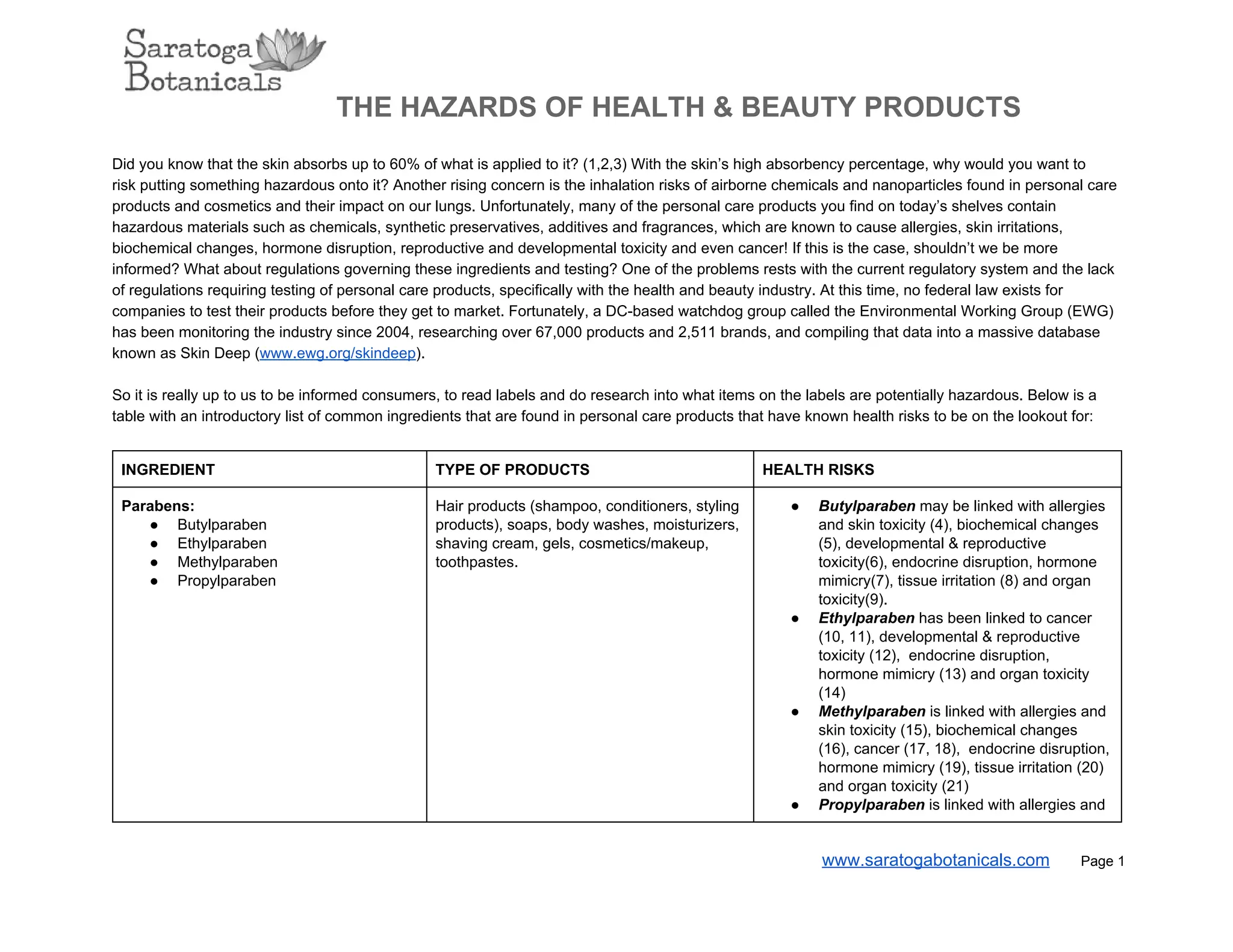
So it is really up to us to be informed consumers, to read labels and do research into what items on the labels are potentially hazardous. Below is a
table with an introductory list of common ingredients that are found in personal care products that have known health risks to be on the lookout for:
INGREDIENT TYPE OF PRODUCTS HEALTH RISKS
Parabens:
● Butylparaben
● Ethylparaben
● Methylparaben
● Propylparaben
Hair products (shampoo, conditioners, styling
products), soaps, body washes, moisturizers,
shaving cream, gels, cosmetics/makeup,
toothpastes.
● Butylparaben may be linked with allergies
and skin toxicity (4), biochemical changes
(5), developmental & reproductive
toxicity(6), endocrine disruption, hormone
mimicry(7), tissue irritation (8) and organ
toxicity(9).
● Ethylparaben has been linked to cancer
(10, 11), developmental & reproductive
toxicity (12),  endocrine disruption,
hormone mimicry (13) and organ toxicity
(14)
● Methylparaben is linked with allergies and
skin toxicity (15), biochemical changes
(16), cancer (17, 18),  endocrine disruption,
hormone mimicry (19), tissue irritation (20)
and organ toxicity (21)
● Propylparaben is linked with allergies and
www.saratogabotanicals.com        Page 1
THE HAZARDS OF HEALTH & BEAUTY PRODUCTS
skin toxicity (22), developmental &
reproductive toxicity (23), endocrine
disruption, hormone mimicry (24) and organ
toxicity (25) and has been found to be toxic
environmentally (26)
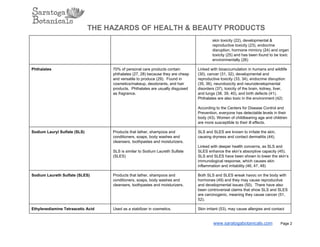
Phthalates 70% of personal care products contain
phthalates (27, 28) because they are cheap
and versatile to produce (29).  Found in
cosmetics/makeup, deodorants, and hair
products.  Phthalates are usually disguised
as fragrance.
Linked with bioaccumulation in humans and wildlife
(30), cancer (31, 32), developmental and
reproductive toxicity (33, 34), endocrine disruption
(35, 36), neurotoxicity and neurodevelopmental
disorders (37), toxicity of the brain, kidney, liver,
and lungs (38, 39, 40), and birth defects (41).
Phthalates are also toxic in the environment (42)
According to the Centers for Disease Control and
Prevention, everyone has detectable levels in their
body (43). Women of childbearing age and children
are more susceptible to their ill effects.
Sodium Lauryl Sulfate (SLS) Products that lather, shampoos and
conditioners, soaps, body washes and
cleansers, toothpastes and moisturizers.
SLS is similar to Sodium Laureth Sulfate
(SLES)
SLS and SLES are known to irritate the skin,
causing dryness and contact dermatitis (44).
Linked with deeper health concerns, as SLS and
SLES enhance the skin’s absorptive capacity (45).
SLS and SLES have been shown to lower the skin’s
immunological response, which causes skin
inflammation and irritability (46, 47, 48)
Sodium Laureth Sulfate (SLES) Products that lather, shampoos and
conditioners, soaps, body washes and
cleansers, toothpastes and moisturizers.
Both SLS and SLES wreak havoc on the body with
hormones (49) and they may cause reproductive
and developmental issues (50).  There have also
been controversial claims that show SLS and SLES
are carcinogenic, meaning they cause cancer (51,
52).
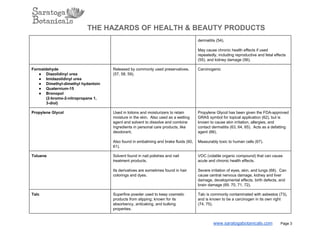
Ethylenediamine Tetraacetic Acid Used as a stabilizer in cosmetics. Skin irritant (53), may cause allergies and contact
www.saratogabotanicals.com        Page 2
THE HAZARDS OF HEALTH & BEAUTY PRODUCTS
dermatitis (54).
May cause chronic health effects if used
repeatedly, including reproductive and fetal effects
(55), and kidney damage (56).
Formaldehyde
● Diazolidinyl urea
● Imidazolidinyl urea
● Dimethyl­dimethyl hydantoin
● Quaternium­15
● Bronopol
(2­bromo­2­nitropropane 1,
3­diol)
Released by commonly used preservatives.
(57, 58, 59).
Carcinogenic
Propylene Glycol Used in lotions and moisturizers to retain
moisture in the skin.  Also used as a wetting
agent and solvent to dissolve and combine
ingredients in personal care products, like
deodorant.
Also found in embalming and brake fluids (60,
61).
Propylene Glycol has been given the FDA­approved
GRAS symbol for topical application (62), but is
known to cause skin irritation, allergies, and
contact dermatitis (63, 64, 65).  Acts as a defatting
agent (66).
Measurably toxic to human cells (67).
Toluene Solvent found in nail polishes and nail
treatment products.
Its derivatives are sometimes found in hair
colorings and dyes.
VOC (volatile organic compound) that can cause
acute and chronic health effects.
Severe irritation of eyes, skin, and lungs (68).  Can
cause central nervous damage, kidney and liver
damage, developmental effects, birth defects, and
brain damage (69, 70, 71, 72).
Talc Superfine powder used to keep cosmetic
products from slipping; known for its
absorbency, anticaking, and bulking
properties.
Talc is commonly contaminated with asbestos (73),
and is known to be a carcinogen in its own right
(74, 75).
www.saratogabotanicals.com        Page 3
THE HAZARDS OF HEALTH & BEAUTY PRODUCTS
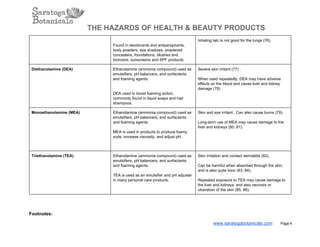
Found in deodorants and antiperspirants,
body powders, eye shadows, powdered
concealers, foundations, blushes and
bronzers, sunscreens and SPF products.
Inhaling talc is not good for the lungs (76).
Diethanolamine (DEA) Ethanolamine (ammonia compound) used as
emulsifiers, pH balancers, and surfactants
and foaming agents.
DEA used to boost foaming action,
commonly found in liquid soaps and hair
shampoos.
Severe skin irritant (77) .
When used repeatedly, DEA may have adverse
effects on the blood and cause liver and kidney
damage (78)
Monoethanolamine (MEA) Ethanolamine (ammonia compound) used as
emulsifiers, pH balancers, and surfactants
and foaming agents.
MEA is used in products to produce foamy
suds, increase viscosity, and adjust pH.
Skin and eye irritant.  Can also cause burns (79).
Long­term use of MEA may cause damage to the
liver and kidneys (80, 81).
Triethanolamine (TEA) Ethanolamine (ammonia compound) used as
emulsifiers, pH balancers, and surfactants
and foaming agents.
TEA is used as an emulsifier and pH adjuster
in many personal care products.
Skin irritation and contact dermatitis (82).
Can be harmful when absorbed through the skin,
and is also quite toxic (83, 84).
Repeated exposure to TEA may cause damage to
the liver and kidneys, and also necrosis or
ulceration of the skin (85, 86).
Footnotes:
www.saratogabotanicals.com        Page 4
THE HAZARDS OF HEALTH & BEAUTY PRODUCTS
1 Ford, R.A., Hawkins, D.R., Mayo, B.C., Api, A.M. “The in vivo dermal absorption and metabolism of [4­14C]coumarin by rats and
human volunteers under simulated conditions of use in fragrances.” Food and Chemical Toxicology 2001;39)2):153­162.
http://sciencedirect.com/science?ob=ArticleURL&_udi=B6T6P­42MICN5­8&_user=10&_rdoc­1&fmt_=&orig=search&_sort=d&view=
c&_acct=COOOO5O221&_version=1&_urlversion=0&userid=10&md5=327ffb3f820160bd0a68aeof5a8ed3d4.
2 Borough, R.L., Collier, S.W., Macpherson, S.E., Kraeling, M.E.K. “Influence of Metabolism in Skin on Dosimetry after Topical
Exposure.” Environmental Health Perspectives 1994;102(Suppl 11):71­74.
http://www.ehponline.org/members/1994/Suppl­11/bronaugh­full.html.
3 Kao, J., Hall, J. “Skin absorption and cutaneous first pass matabolism of topical steroids: In vitro studies with mouse skin in organ
culture.” Journal of Pharmacology and Experimental Therapeutics 1987;241(2):482­487.
http://jpet.aspetjournals.org/cgi/content/abstract/241/2/482.
4 National Toxicology Program. “Butylparaben: Final Review of Toxicological Literature.” CAS No. 94­26­8.
http://ntp.niehs.nih.gov/fiels/Butylparaben.pdf.
5 Ibid.
6 Oishi, S. “Effects of butyl paraben on the male reproductive system in mice.” Archives of Toxicology 2002: 76(7): 423­429.
http://www.ncbi.nlm.nih.gov/entrez/query.fegi?db=PubMed&cmd=Retrieve&list_uids=12111007.
7 National Toxicology Program. “Butylparaben: Final Review of Toxicological Literature.” CAS No. 94­26­8.
http://ntp.niehs.nih.gov/fiels/Butylparaben.pdf.
8 Ibid.
9 Ibid.
10 Darbre, P.D., Aljarrah, A., Miller, W.R., Coldham, N.G., Sauer, M.J., Pope, G.S.”Concentrations of Parabens in Human Breast
Tumors.” Journal of Applied Toxicology 2004; 24:5­13.
11 Harvey, P., Everett, D. “Significance of the detection of esters of p­hydroxybenzoic acid (parabens) in human breast tumors”
Journal of Applied Toxicology 2004;24:I­4.
12 Fisher, J.S., Turner, K.J., Brown, D., Sharpe, R.M. “Effects of neonatal exposure to estrogenic compounds on development of the
excurrent ducts of the rat testis through puberty to adulthood.” Environmental Health Perspectives 1999:107:397­405.
13 Routledge, E.J., Parker, J., Odum, J., Ashby, J., Sumpter, J.P. “Some alkyl hydroxy benzoate preservatives (parabens) are
estrogenic.” Toxicology and Applied Pharmacology 1998; 153(I): 12­19.
14 Elder, R. “Final report on the safety assessment of methylparaben, ethylparaben, propylparaben and butylparaben.” Journal of the
American College of Toxicology 1984;3:147­209.
15 Nagel, J.E., Fuscaldo, J.T., Fireman, P. “Paraben Allergy.” Journal of the American Medical Association 1977;237(15):1594­1595.
www.saratogabotanicals.com        Page 5
THE HAZARDS OF HEALTH & BEAUTY PRODUCTS
http://jama.ama­assn.org/cgi/content/abstract/237/15/1594.
16 Harvell, J., Bason, M., Maibach, H. “Contact Urticaria and Its Mechanisms.” Food and Chemical Toxicology 1994;32(2):103­112.
17 Darbre, P.D., Aljarrah, A., Miller, W.R., Coldham, N.G., Sauer, M.J., Pope, G.S.”Concentrations of Parabens in Human Breast
Tumors.” Journal of Applied Toxicology 2004; 24:5­13.
18 Harvey, P., Everett, D. “Significance of the detection of esters of p­hydroxybenzoic acid (parabens) in human breast tumors”
Journal of Applied Toxicology 2004;24:I­4.
19 Routledge, E.J., Parker, J., Odum, J., Ashby, J., Sumpter, J.P. “Some alkyl hydroxy benzoate preservatives (parabens) are
estrogenic.” Toxicology and Applied Pharmacology 1998; 153(I): 12­19.
20 Elder, R. “Final report on the safety assessment of methylparaben, ethylparaben, propylparaben and butylparaben.” Journal of the
American College of Toxicology 1984;3:147­209.
21 Ibid.
22 Nagel, J.E., Fuscaldo, J.T., Fireman, P. “Paraben Allergy.” Journal of the American Medical Association 1977;237(15):1594­1595.
http://jama.ama­assn.org/cgi/content/abstract/237/15/1594.
23 Oishi, S. “Effects of propyl paraben on the male reproductive system.” Food and Chemical Toxicology 2002;40(12):1807­1813.
24 Routledge, E.J., Parker, J., Odum, J., Ashby, J., Sumpter, J.P. “Some alkyl hydroxy benzoate preservatives (parabens) are
estrogenic.” Toxicology and Applied Pharmacology 1998; 153(I): 12­19.
25 Elder, R. “Final report on the safety assessment of methylparaben, ethylparaben, propylparaben and butylparaben.” Journal of the
American College of Toxicology 1984;3:147­209.
26 Ibid.
27 Houlihan, J., Brody, C., Schwan, B. “Not Too Pretty: Phthalates, Beauty Products and the FDA.” 2002.
http://www.safecosmetics.org/docUploads/NotTooPretty_r51.pdf.
28 DiGangi, J., Schettler, T., Cobbing, M., Rossi, M. “Aggregate Exposures to Phthalates in Humans.” Health Care Without Harm,
2002. http://www.noharm.org/library/docs/Phthalate_Report_Europe.pdf.
29 Ibid.
30 Shea, K., and Committee on Environmental Health. “Pediatric Exposure and Potential Toxicity of Phthalate Plasticizers.” Pediatrics
2003;111(6):1467­1474. http://pediatrics.aappublications.org/cgi/content/full/111/6/1467
31 Kleinsasser, N.H., Wallner, B.C., Kastenbauer, E.R., Weissacher, H., Harreus, U.A. “Genotoxicity of di­butyl­phthalate and di­iso
butyl­phthalate in human lymphocytes and mucosal cells.” Teratogenesis, Carcinogenesis, and Mutagenesis
2001;21(3):189­196.http://www3.interscience.wiley.com/cgi­bin/abstract/78505490/ABSTRACT.
32 Shea, K., and Committee on Environmental Health. “Pediatric Exposure and Potential Toxicity of Phthalate Plasticizers.” Pediatrics
www.saratogabotanicals.com        Page 6
THE HAZARDS OF HEALTH & BEAUTY PRODUCTS
2003;111(6):1467­1474. http://pediatrics.aappublications.org/cgi/content/full/111/6/1467
33 Graham, S., “Ubiquitous Chemical Associated with Abnormal Human Reproductive Development.” Scientific American May 27,
2005.
34 Foster, P. “Effects of Di(n­butyl) phthalate on Reproductive Development.” 2006.
http://www.americanchemistry.com/s_acc/docs/LRIAbstract_43.pdf
35 National Institute of Environmental Health Sciences. “Endocrine Disruptors.” 2007.
http://www.niehs.nih.gov/health/topics/agents/endorcrine.
36 Center for the Evaluation of Risks to Human Reproduction, National Toxicology Program. “NPT Brief on the Potential Human
Reproductive and Developmental Effects of Di(2­ethylhexyl) Phthalate (DEHP).” May 2006.
http://cerhr.niehs.nih.gov/chemicals/dehp/DEHP%20Brief%20DraftI.pdf.
37 Grandjean, P., Landrigan, P.J. “Developmental neurotoxicity of industrial chemicals.” Lancet 2006;368(9553)L2167­2178.
http://www.kevinleitch.co.uk/wp/wp­content/uploads/2006/11/chemicallist.pdf.
38 National Toxicology Program. “Chemical Information Profile for Diethyl Phthalate.” CAS No. 84­66­2. 2006.
http://ntp.niehs.nih.gov/ntp/htdocs/Chem_Background/exSumPdf/Diethyl_phthalate.pdf.
39 DiGangi, J., Schettler, T., Cobbing, M., Rossi, M. “Aggregate Exposures to Phthalates in Humans.” Health Care Without Harm,
2002. http://www.noharm.org/library/docs/Phthalate_Report_Europe.pdf.
40 Tickner, J.A., Schettler, T., Guidotti, T., McCally, M., Rossi, M. “Health risks posed by use of di­2­ethylhexyl phthalate (DEHP) in
PVC medical devices: A critical review.” American Journal of Industrial Medicine 2001:39(I)L100­111.
41 Lampen, A., Zimnik, S., Nau, H. “Teratogenic phthalate esters and metabolites activate the nuclear receptors PPARs and induce
differentiation of F9 cells.” Toxicology and Applied Pharmacology 2003;188(I)L14­23.
42 Hu, X., Wen, B., Shan, X. “Survey of phthalate pollution in arable soils in China.” Journal of Environmental Monitoring
2003;5:649­653. http://www.rsc.org/publishing/journals/EM/article.asp?doi=b304669a.
43 Centers for Disease Control and Prevention. “National Report on HUman Exposure to Environmental Chemicals.” 2001.
44 National Industrial Chemicals Notification and Assessment Scheme, Department of Health and Ageing, Australia. “Sodium Lauryl
Sulfate: CAS No: 151­21­3.” 2007
http://nicnas.gov.au/Publications/Information_Sheets/Existing_Chemical_Information_Sheets/ecis_SLS_PDF.pdf.
45 Huang, C.M., Wang, C.C., Kawai, M., Barnes, S., Elmets, C.A. “Surfactant Sodium Lauryl Sulfate enhances Skin Vaccination:
Molecular Characterization via a Novel Technique Using Ultrafiltration Capillaries and Mass Spectrometric Proteomics.” Molecular and
Cellular Proteomics 2006;5:523­532. http://www.mcponline.org/cgi/content/abstract/5/3/523.
46 Ibid.
www.saratogabotanicals.com        Page 7
THE HAZARDS OF HEALTH & BEAUTY PRODUCTS
47 Ibid.
48 Ibid.
49 Black, R.E., Hurley, F. J., Harvey, D.C. “Occurence of 1.4­Dioxane in Cosmetic Raw Materials and Finished Cosmetic Products.”
Journal of AOAC International 2001;84(3):666­670. http://www.atypon­link.com/AOAC/doi/abs/10.5555/jaoi.2001.84.3.666.
50 Ibid.
51 Ibid.
52 Ibid.
53 Kimura, M., Kawada, A. “Contact dermatitis due to trisodium ethylenediaminetetra­acetic acid (EDTA) in a cosmetic lotion.”
Contact Dermatitis 1999;41(6):341.
54 Ibid.
55 Material Safety Data Sheet. “Ethylenediamine Tetraacetic Acid.” CAS No. 60­00­4.
https://fscimage.fishersci.com/msds/09570.htm.
56 Ibid.
57 International Agency for Research on Cancer. “IARC Classifies Formaldehyde as Carcinogenic to Humans.” Press Release no.
153. June 15, 2004.  http://www.iarc.fr/ENG/Press_Releases/archives/pr153a.html. [press release]
58 Epstein, S.S. “losing the Cancer War.” The Stop Cancer Before It Starts Campaign: How to Win the Losing War Against Cancer.
Chicago: Cancer Prevention Coalition. 2003. http://www.preventcancer.com/losing/nci/experimental.htm.
59 Ibid.
60 Humane Society of the United States. “Protocols for Embalming Donated Animals.” Tufts University. 2001.
http://www.educationalmemorial.org/resource_embalming.html.
61 Agency for Toxic Substances and Disease Registry. “ToxFAQs for Ethylene Glycol.” CAS No. 107­21­1. 2007.
http://www.atsdr.cdc.gv/tfacts96.html.
62 Ibid.
63 Material Safety Data Sheet. “Propylene Glycol MSDS.” CAS No. 57­55­6. 2005.
http://www.sciencelab.com/xMSDS­Proplyene_glycol­9927239.
64 Material Safety Data Sheet. “Propylene Glycol.” CAS No. 57­55­6. MSDS No. P6928  2005.
http://environmentalchemistry.com/yogi/periodic/Al.html.
65 Gonzalo, M.A., de Argila, D., Garcia, J.M., Alvarado, M.I. “Allergic Contact Dermatitis to Propylene Glycol.” Allergy 1999;54(I):82­83.
66 Agency for Toxic Substances and Disease Registry. “Toxicological Profile for Ethylene Glycol.” CAS No. 107­21­I. 2007.
http://www.atsdr.cdc.gov/toxprofiles/tp96.html.
www.saratogabotanicals.com        Page 8
THE HAZARDS OF HEALTH & BEAUTY PRODUCTS
67 Morshed, K.M., Jain, S.K., McMartin, K.E. “Propylene Glycol­Mediated Cell Injury in a Primary Culture of HUman Proximal Tubule
Cells.” Toxicological Sciences 1998;46:410­417. http://toxsci.oxfordjournals.org/cgi/reprint/46/2/410.pdf.
68 Agency for Toxic Substances and Disease Registry. “Toxicological Profile for Toluene.” CAS No. 108­88­3. September 2000.
http://www.stsdr.cdc.gov/toxprofiles/tp56/html.
69 Ibid.
70 Ibid.
71 Ibid.
72 Ibid.
73 Agency for Toxic Substances and Disease Registry. “Asbestos Toxicity: How Are People Exposed to Asbestos?”
http://www.atsdr.cdc.gov/HEC/CSEM/asbestos/exposure_pathways/html.
74 Agency for Toxic Substances and Disease Registry. “Asbestos Toxicity: What Respiratory Conditions Are Associated with
Asbestos?” http://www.atsdr.cdc.gov/HEC/CSEM/asbestos/physiologic_effects.html#other.
75 Material Safety Data Sheet. “Talc.” CAS No. 014807­96­6. MSDS No. T0026. 2005.
76 Ibid.
77 Material Safety Data Sheet. “Diethanolamine.” Account No. 00532, Case No. 111­42­2.
78 Ibid.
79 Dow Chemical. “Product Safety Assessment: Monoethanolamine.” CAS No. 141­43­5.
http://www.dow.com/productsafety/finder/mea/htm.
80 Ibid.
81 Ibid.
82 Material Safety Data Sheet. “Triethanolamine.” CAS No. 102­71­6, EC No. 203­049­8.
http://ptcl.chem.ox.ac.uk/MSDS/TR/triethanolamine.html.
83 Ibid.
84 Dow Chemical. “Product Safety Assessment: Triethanolamine.” CAS No. 102­71­6.
http://www.dow.com/productsafety/finder/tea/htm.
85 Material Safety Data Sheet. “Triethanolamine” CAS No. 102­71­6, EC No. 203­049­8.
http://ptcl.chem.ox.ac.uk/MSDS/TR/triethanolamine.html.
86 Material Safety Data Sheet. “Triethanolamine” Account No. 01071. Case No. 102­71­6.
www.saratogabotanicals.com        Page 9

The Hazards of Health & Beauty Products